EP1312689A1 - Acier destiné à des pièces structurelles de machines - Google Patents
Acier destiné à des pièces structurelles de machines Download PDFInfo
- Publication number
- EP1312689A1 EP1312689A1 EP02292842A EP02292842A EP1312689A1 EP 1312689 A1 EP1312689 A1 EP 1312689A1 EP 02292842 A EP02292842 A EP 02292842A EP 02292842 A EP02292842 A EP 02292842A EP 1312689 A1 EP1312689 A1 EP 1312689A1
- Authority
- EP
- European Patent Office
- Prior art keywords
- less
- steel
- inclusions
- content
- steels
- Prior art date
- Legal status (The legal status is an assumption and is not a legal conclusion. Google has not performed a legal analysis and makes no representation as to the accuracy of the status listed.)
- Granted
Links
Images


Classifications
-
- C—CHEMISTRY; METALLURGY
- C22—METALLURGY; FERROUS OR NON-FERROUS ALLOYS; TREATMENT OF ALLOYS OR NON-FERROUS METALS
- C22C—ALLOYS
- C22C38/00—Ferrous alloys, e.g. steel alloys
- C22C38/02—Ferrous alloys, e.g. steel alloys containing silicon
-
- C—CHEMISTRY; METALLURGY
- C21—METALLURGY OF IRON
- C21C—PROCESSING OF PIG-IRON, e.g. REFINING, MANUFACTURE OF WROUGHT-IRON OR STEEL; TREATMENT IN MOLTEN STATE OF FERROUS ALLOYS
- C21C7/00—Treating molten ferrous alloys, e.g. steel, not covered by groups C21C1/00 - C21C5/00
- C21C7/04—Removing impurities by adding a treating agent
- C21C7/06—Deoxidising, e.g. killing
-
- C—CHEMISTRY; METALLURGY
- C22—METALLURGY; FERROUS OR NON-FERROUS ALLOYS; TREATMENT OF ALLOYS OR NON-FERROUS METALS
- C22C—ALLOYS
- C22C38/00—Ferrous alloys, e.g. steel alloys
- C22C38/002—Ferrous alloys, e.g. steel alloys containing In, Mg, or other elements not provided for in one single group C22C38/001 - C22C38/60
-
- C—CHEMISTRY; METALLURGY
- C22—METALLURGY; FERROUS OR NON-FERROUS ALLOYS; TREATMENT OF ALLOYS OR NON-FERROUS METALS
- C22C—ALLOYS
- C22C38/00—Ferrous alloys, e.g. steel alloys
- C22C38/04—Ferrous alloys, e.g. steel alloys containing manganese
-
- C—CHEMISTRY; METALLURGY
- C22—METALLURGY; FERROUS OR NON-FERROUS ALLOYS; TREATMENT OF ALLOYS OR NON-FERROUS METALS
- C22C—ALLOYS
- C22C38/00—Ferrous alloys, e.g. steel alloys
- C22C38/60—Ferrous alloys, e.g. steel alloys containing lead, selenium, tellurium, or antimony, or more than 0.04% by weight of sulfur
Definitions
- This invention relates to a steel for machine structural use, which are to be subjected to machining for use as industrial machinery or automotive parts, among others. More particularly, the invention relates to a steel for machine structural use excellent in chip disposability and effective in prolonging the cutting tool life (hereinafter referred to as "tool life improvement").
- steels for machine structural use which are used as industrial machinery or automotive parts, among others, there are steels for machine structural use as defined in the Japanese Industrial Standard JIS G 4051, and such alloy steels as nickel-chromium steels according to JIS G 4102, nickel-chromium-molybdenum steels according to JIS G 4103, chromium steels according to JIS G 4104 and manganese and manganese-chromium steels for machine structural use according to JIS G 4106. Also in use are steels improved in hardenability by more or less modifying the amount of addition of the specified components of these steels or by adding B (boron) or the like and/or improved in metallurgical structure by addition of Ti, Nb, V and/or the like.
- B boron
- these steels are subjected, after rolling or after further forging or other working, to machining to desired forms or shapes, followed by heat treatment according to the required characteristics, to give final products.
- machinability means that the period between exchanges of tools for use in machining due to wear is long, namely the tool life is long, that chips generated during machining can be finely torn and separated, that the cutting force is not so great, and that good machined or ground surfaces can be obtained.
- chip disposability With the advancement in automation of machining, not only the tool life but also the separability of chips, namely "chip disposability", becomes very important. Since the tool life is influenced by the characteristics of the material steel as well as the performance characteristics of the tool, tool selection is also important. On the contrary, good chip disposability means that chips generated during machining are finely torn or divided and separated but will not entwine to the tool. The chip disposability greatly depends on the characteristics of the material steel. For improving the machinability of steel, it is very important to improve this chip disposability.
- the machinability of steel can be improved by addition of Pb.
- addition of Pb not only increases the cost of steel but also may lead to environmental contamination. Therefore, investigations have been carried out in search of technologies of improving the machinability of steel without adding Pb.
- a typical one is the technology of improving the machinability by utilizing MnS inclusions. This technology has been studied in various aspects and already put to practical use.
- the steel disclosed in Japanese Patent Publication (JP Kokoku) H05-15777 contains Mn-Ca-S type inclusions with a Ca content of 3-55% as uniformly dispersed therein.
- the major axis L is not longer than 20 ⁇ m and the ratio thereof to the minor axis W (L/W) is not more than 3.
- L/W minor axis W
- individual sulfide inclusions become coarse, hence the number of sulfide inclusions at the same S concentration decreases. Therefore, the improvement in chip disposability is not entirely satisfactory.
- the steel is Al-killed steel.
- the oxide inclusions are of the CaO-Al 2 O 3 type, hence the improving effects on the machinability such as tool life are not very satisfactory.
- addition of a large amount of Ca is required, and this disadvantageously causes an increase in cost.
- Laid-open Japanese Patent Application (JP Kokai) 2001-131684 discloses steels for machine structural use, in which manganese sulfide-based inclusions have an average oxygen content of not more than 10%.
- the steels have the following principal composition, in % by mass: C: 0.05-0.7%, Si: not more than 2.5%, Mn: 0.1-3.0%, Al: not more than 0.1%, S: 0.003-0.2%, N: 0.002-0.025%, and O (oxygen): not more than 0.003%, with the balance being Fe.
- the steels may contain not more than 0.01%, in total, of one or more elements selected from the group consisting of rare earth elements, Ca and Mg.
- the steels according to the invention disclosed in JP Kokai 2001-131684, as described in the example section thereof, contain not less than 0.018% of Al used as a deoxidizer element so that the average oxygen concentration in sulfides may be reduced to 10% or less for obtaining such a sulfide form as effective in improving the chip disposability.
- the oxides in steel are mainly hard Al 2 O 3 type oxides, and the tool life is improved only to an unsatisfactory extent.
- the invention disclosed in the above-cited publication is not an invention made in an attempt to improve the chip disposability and, at the same time, improve the tool life.
- JP Kokai 2000-34538 there is disclosed a steel for machine structural use which contains C, Si, Mn, P, S, Al, Ca and N each in a specified amount and is excellent in machinability in turning.
- This steel has the following characteristic features. Namely, the following two relations are satisfied: A/(A+B+C) ⁇ 0.3 and B/(A+B+C) ⁇ 0.1 wherein A is the area percentage of sulfide grains having a Ca content exceeding 40% relative to the total area of an investigation field of view, B is the area percentage of sulfide grains having a Ca content of 0.3-40% relative to the total area of the investigation field of view, and C is the area percentage of sulfide grains having a Ca content of less than 0.3% relative to the total area of the investigation field of view.
- the steel of JP Kokai 2000-34538 is characterized by increasing sulfide containing 0.3-40%of Ca. However, increase of such sulfide of high Ca content makes the sul
- JP Kokai 2000-282169 discloses a steel, which contains C, Si, Mn, P and S and further contains one or more elements selected from among Zr, Te, Ca and Mg and satisfies the conditions: Al ⁇ 0.01%, total O ⁇ 0.2% and total N ⁇ 0.02%.
- This steel is excellent in forgeability owing to spheroidizing of sulfide inclusions and has good machinability.
- Ca is added, it is intended that Ca solutes in MnS and lowers the deforming ability of Mns for spheroidizing the same in this steel. In this case, however, individual sulfide inclusions become coarse, whereby that sulfide morphology suited for providing good chip disposability cannot be obtained, hence the improvement in chip disposability is not yet satisfactory.
- the machinability of steel is greatly influenced by the state of sulfide and/or oxide inclusions in the steel.
- the present inventors made close investigations concerning the relationship between the form and distribution of inclusions in the steels and the machinability thereof, and studied the investigation results.
- the inventors paid attention to the effects of Ca and Ti, in particular, and investigated the steelmaking conditions as well. In the process of these investigations and studies, the inventors could reveal the following interesting facts.
- Ca strongly binds to S and alters the form of sulfides, mainly MnS, and shows a large bonding strength with oxygen, leading to stable oxide formation.
- CaS or Ca-based oxides formed in the molten steel serve as nuclei for the formation of MnS grains and the number of sulfide having a Ca content of not less than 1% increases. It was found, however, that when, in adding Ca, the steelmaking conditions, such as the level of addition thereof, the dissolved oxygen level and the timing of addition of Ca, are appropriately selected, sulfide inclusions mainly composed of MnS not containing Ca are formed in large amounts. Further, it was revealed that the chip disposability of steel becomes improved only in such case.
- inclusions There are two type inclusions, i.e., sulfide type one and oxide type one. Since minute inclusions such as precipitates are not effective in machinability improvement, it was decided that the size of inclusion should be evaluated in terms of the diameter of a circle equivalent in area to the inclusion in the observation field of view, and investigations were made regarding inclusions greater in such diameter than a certain level.
- steels When compared at the same S content level, steels, in which a large number of small sulfides are present, are superior in chip disposability to steels in which a small number of coarse sulfide grains are present.
- an increased amount of sulfides containing Ca as solid solution is present in the molten steel or at the initial stage of solidification, they serve as nuclei for crystallization of MnS, giving coarse sulfide grains. Therefore, at the same S concentration, the number of dispersed sulfides decreases and fine sulfides are hardly formed.
- the amount of sulfides containing Ca as solid solution is small, the sulfides mostly form a large number of fine sulfides.
- a chip generated during machining is torn or separated when stress is concentrated on inclusions in the deformed steel chip, resulting in crack formation and propagation.
- Ca-free MnS type inclusions tend to be deformed in the direction of working, for example rolling, and many of them have an elongated form.
- the anisotropy in mechanical properties of a steel material increases and, in addition, the number of inclusions to serve as points for stress concentration and starting points of chipping decreases, hence no good chip disposability can be obtained.
- the number of crack starting points in chips subjected to deformation during machining increases and, further, stress is concentrated on the inclusions and crack propagation becomes readily promotable thereby. This is presumably the cause of improvement in chip disposability.
- the tool life is greatly influenced by the composition of oxides contained in the steel.
- Ca is added to convert oxides to low-melting oxides, the tool life is markedly prolonged. Therefore, treatment with Ca is essential.
- the steelmaking conditions before and after Ca treatment were further examined in detail. As a result, the following facts were revealed.
- oxide inclusions so that they may be composed of CaO-Al 2 O 3 -SiO 2 -TiO 2 as main constituents even within the same composition range, by restricting the contents of those components showing a high level of interaction with oxygen in steel, such as C, Si and Mn, causing S to be contained at a specific level, reducing Al as far as possible, adding Ti and Ca each at an appropriate addition level and at an appropriate time and adjusting the level of dissolved oxygen.
- These oxide inclusions are low in melting point and soft and are presumably effective not only in tool life improvement owing to Ca and Ti contained therein but also in producing starting points for cracking in chips and promoting crack propagation.
- the present inventors further established the limits to the chemical composition and to the states or forms of inclusions and, as a result, have completed the present invention.
- the gist of the invention is as follows.
- Second group Se: 0.0005-0.01%, Te: 0.0005-0.01%, Bi: 0.05-0.3% and rare earth elements: 0.0001-0.0020%.
- the ratio n 0 /S (%) is desirably not less than 3500. So long as the relation (1) is satisfied, n 0 may be large. However, when n 0 is excessively large, it becomes difficult to obtain such mechanical properties as tensile strength and fatigue strength as required of steels for machine structural use. Therefore, it is preferred that n 0 be not more than 2000, more preferably not more than 1000.
- n 1 When the number of those sulfide inclusions containing not less than 1.0% by mass of Ca, among the sulfide inclusions, per mm 2 is expressed as n 1 , the following relation should be satisfied: n 1 /n 0 ⁇ 0.1 This is because when the ratio of the number of sulfide, containing not less than 1.0 mass % Ca, to the total number of sulfide exceeds 0.1, there is a tendency toward individual inclusions becoming coarser, leading to lowered chip disposability. Within the range specified by the above formula, it is possible to make the size of sulfides in steel small. This leads to an increase in the number of sulfide inclusions containing less than 1.0 mass % Ca, whereby good chip disposability can be obtained. For further stably obtaining good chip disposability, n 1 /n 0 is desirably not more than 0.08. The n 1 is preferably as small as possible and may be equal to 0 (zero).
- the number of the oxide inclusions defined above should be not less than 10 because when it is less than 10, hard oxides having a composition of high melting point, such as Al 2 O 3 , are formed in addition to oxides having a composition of low melting point, which are formed by addition of Ca and Ti, and accordingly, no tool life prolonging effect can be obtained.
- the oxides in the inclusions are respectively restricted.
- these oxides become soft with the increasing temperature during cutting and, therefore, the oxides will not promote the wear of the tool but contribute to the prolongation of the tool life.
- the melting points of the oxides rise and the hardness thereof increases, and the oxides thus promote the wear of the tool, hence the tool life is shortened.
- the content of C should be 0.1-0.6%.
- C is an important element governing the properties relating to the strength of steels, and the content thereof is generally selected taking the mechanical properties into consideration.
- the C content is below 0.1%, the mechanical properties required of crankshafts and other automotive mechanical parts cannot be obtained.
- it exceeds 0.6% the tool life is markedly shortened and the desired machinability can hardly be obtained.
- the C content be 0.30-0.55%.
- the content of Si should be 0.01-2.0%.
- Si is an element essential for attaining the oxide composition according to the invention, and it is contained also for the purpose of deoxidizing molten steel. At a content below 0.01%, the desired oxide composition cannot be obtained. At levels exceeding 2.0%, its effects each reaches a point of saturation and, furthermore, a decrease in toughness of steel is caused. Therefore, the Si content should be 0.01-2.0%.
- Mn The content of Mn should be 0.2-2.0%.
- Mn is an important element for forming sulfide inclusions greatly effective in improving the machinability. It has a molten steel deoxidizing effect as well.
- Mn when S is caused to be contained for improving the machinability, Mn is effective in preventing hot workability of steel materials from deteriorating and, for producing this effect, a content thereof not less than 0.2% is essential. At levels exceeding 2.0%, however, resistance to cutting increases. Thus, the Mn content should be 0.2-2.0%.
- Mn is an element greatly contributing to the hardenability, and the content for that purpose is appropriately selected within the above range. On that occasion, a more preferred Mn content range is 0.4-1.70%.
- the content of S should be 0.005-0.2%.
- S is necessary for improving the machinability. It binds with Mn etc. and forms sulfide inclusions.
- the sulfide inclusion, MnS readily changes its shape in the process of steel solidification due to the addition of Ca and Ti and, therefore, the shape of the MnS type sulfides is specified simultaneously according to the present invention.
- MnS sulfide inclusion
- its content should be within the range of 0.005-0.2%. Within this range, good machinability and mechanical properties can be obtained.
- the S content is desirably 0.03-0.12%.
- the content of Al should be not more than 0.009%.
- Al has a great deoxidizing effects of molten steel and is added for adjusting the level of deoxidation.
- Al 2 O 3 which is formed as a result of deoxidation, is hard and shortens the tool life and, therefore, the upper limit for Al is set at 0.009% for avoiding an increase of Al 2 O 3 content.
- the frequency of formation of Al 2 O 3 itself and oxides whose main component is Al 2 O 3 can be reduced.
- a small amount of Al as a deoxidizer, which is used for rapid reduction in oxygen content at the initial stage of steelmaking, or Al inevitably coming from raw material such as ferro alloy will not cause any problem since such Al is mostly used for the formation of CaO-Al 2 O 3 -SiO 2 -TiO 2 oxides. Therefore, the Al content should be not more than 0.009%, without necessity for setting any particular lower limit. For more stable formation of the above mentioned oxide, the Al content is desirably not more than 0.005%.
- the content of Ti should be not less than 0.001% but less than 0.04%.
- Ti is effective in stably forming oxides comprising CaO-Al 2 O 3 -SiO 2 -TiO 2 and making them finer and, therefore, is an element essential in the steel of the invention. While those low-melting point oxides favorably influencing the machinability can also be formed in CaO-Al 2 O 3 -SiO 2 system without Ti, the effects are enhanced when TiO 2 is contained in the oxide. When the Ti content is below 0.001%, those effects will not be produced. At levels of 0.04% or more, not only the effects reach a point of saturation but also the precipitation of hard TiN increases, reducing the tool life. A more preferred Ti content for stably forming oxides favorable for the machinability is within the range of 0.005-0.025%.
- the Ca content should be 0.0001-0.01%.
- Ca is effective in improving the tool life and is necessary for the formation of oxides comprising CaO-Al 2 O 3 -SiO 2 -TiO 2 , which are effective in improving the machinability. Below 0.0001%, such effects are not produced to a satisfactory extent. On the other hand, at levels exceeding 0.01%, the above-mentioned oxide can no more be formed and, in addition, the cost of production increases since the efficiency of addition of Ca is low. In addition, the amount of MnS containing Ca as solid solution increases and MnS becomes coarse. Thus, the number of MnS inclusions decreases and the desired chip disposability improving and other effects cannot be obtained.
- a more preferred Ca content for more stably attaining the condition of inclusions as defined in accordance with the invention is within the range of 0.0005-0.005%.
- the steelmaking conditions before and after addition of Ca should be taken into consideration.
- the content of ⁇ (oxygen) should be 0.001-0.01%.
- Oxygen is an important element for the formation of CaO-Al 2 O 3 -SiO 2 -TiO 2 oxides favorable for machinability improvement and for attaining the form and number of sulfide inclusions, which are favorable for machinability improvement. At a level below 0.001%, such effects are not sufficient but it becomes rather difficult to obtain oxide inclusions in those forms favorable for machinability improvement.
- content levels exceeding 0.01% sulfide inclusions, including MnS and so forth, become coarse and, in addition, the amount of oxide inclusions increases, leading to deterioration of not only machinability but also steel material characteristics, such as a decrease in toughness.
- the oxygen content is desirably not more than 0.005%.
- the forms of sulfide inclusions and the composition of oxide inclusions which serve to improve the chip disposability and prolong the tool life, are controlled in the process of steelmaking, so that it is important to control of the steelmaking process.
- molten steel containing a small amount of carbon is subjected, in a state of a low Al content, to vacuum treatment, for instance, for adjusting the excess oxygen content. Then, the contents of the main elements C, Si, Mn and S and other elements are adjusted to the respective intended levels and then the dissolved oxygen content is preliminarily adjusted. On that occasion, Al may be added for adjusting the dissolved oxygen content, if necessary.
- the Al content resulting from this addition should be not more than 0.009%, preferably not more than 0.005%, as mentioned hereinabove.
- Ti is added and the molten steel is finally treated with Ca, followed by casting to give ingots or blooms.
- the oxides formed by deoxidation by Mn and Si added on the occasion of adjusting the contents of the main components become the oxides not containing excess Al 2 O 3 as compared with the case where Al is added.
- composition adjustment it is necessary to make adjustments so that the amount of dissolved oxygen may not become too low due to deoxidizing reactions of C, Mn and Si.
- the purpose of the dissolved oxygen level adjustment is to cause Ca added before casting to form the oxide to thereby prevent the formation of Ca-based sulfides capable of causing the formation of MnS containing Ca as a solute.
- Al is added for adjusting the dissolved oxygen content, if necessary.
- the formed oxide of Ti combines with already existing oxides to give thermodynamically more stable forms, which are effective in preventing the formation of large inclusions and uniformly dispersing inclusions about 1 to 10 ⁇ m in size.
- the subsequent treatment with Ca is made by adding calcium-silicon or ferro alloy. Ca is hardly soluble in molten steel and reacts with oxygen in the molten steel and with oxides dispersed therein, whereby CaO-Al 2 O 3 -SiO 2 -TiO 2 oxides are formed.
- the steel for machine structural use comprises the above-mentioned components, with the balance being Fe and impurities.
- the following upper limits are set to the contents of P and N among the impurities.
- P is an element appearing in steel as an impurity. It has a solid solution strengthening effect and a hardenability improving effect. However, it deteriorates the toughness of steel, so that the range of not more than 0.1% is selected as a range in which the adverse effect is not so significant. Its content is desirably not more than 0.05%, and the less, the better.
- N when it coexists with Al, forms fine nitride, effectively making steel crystal finer.
- the Al content in steel is restricted to a low level, hence such effects cannot be expected. Rather, N binds to the above-mentioned Ti to form TiN, which may possibly deteriorate the tool life. Therefore, it is desirable that its content be as low as possible.
- the allowable upper limit is set at 0.02%. A more preferred range is not more than 0.015%.
- the steel for machine structural use comprises, in addition to the components mentioned above, one or more components selected from the first group and/or the second group given below.
- Second group Se: 0.0005-0.01%, Te: 0.0005-0.01%, Bi: 0.05-0.3% and rare earth elements: 0.0001-0.0020%.
- the components belong to the above first group all contribute to improvements in strength of steels.
- the components belonging to the second group contribute to improvements in machinability of steels.
- the contents of these elements are restricted for the following reasons.
- Cr is effective in improving the hardenability of steels and is preferably added in alloy steels for machine structural use.
- a content of not less than 0.02% is preferred for the purpose of improving the hardenability but, at levels exceeding 2.5%, the hardenability becomes excessively high, lowering the endurance ratio and yield ratio and further deteriorating the machinability. Therefore, the Cr content should be 0.02-2.5%.
- Mo is effective in making the ferrite-pearlite structure finer and, when heat refining is carried out, it is effective in improving the hardenability and toughness.
- its content is desirably not less than 0.05%. However, at levels exceeding 1.0%, the effects reach a point of saturation and the fatigue strength may rather be reduced. Further, the cost increases. Therefore, the Mo content should be 0.05-1.0%.
- Ni is effective in improving the strength of steels through solid solution strengthening and also in improving the hardenability and/or toughness.
- an appropriate content of Ni is 0.05-2.0%.
- Cu is effective in improving the hardenability of steels. When such effect is desired, it is recommended that Cu be contained at a level of not less than 0.02%. Furthermore, it is effective in improving the strength of steels through precipitation strengthening and, for producing this effect, its content of not less than 0.1% is desirable. However, at a content level exceeding 1.0%, deterioration in hot workability may be induced or the Cu-containing precipitates become coarse, whereby the above effects are lost. Therefore, the Cu content should be 0.02-1.0%.
- V 0.05-0.5%
- Nb 0.005-0.1%
- V and Nb precipitate as fine nitrides or carbonitrides and thus improve the strength of steels.
- the V content be not less than 0.05% and the Nb content not less than 0.005%.
- the V content should be 0.05-0.5% and the Nb content 0.005-0.1%.
- Se and Te react with Mn to form MnSe and MnTe, respectively, and improve the machinability of steels.
- the contents of Se and Te are each desirably not less than 0.0005%.
- an appropriate Se content and an appropriate Te content are 0.0005-0.01% respectively.
- Bi improves the machinability of steels. This is presumably due to its formation of low-melting point inclusions and its lubricating effect in the step of machining, like Pb. For securing that effect, its content is recommendably not less than 0.05%. However, when it exceeds 0.3%, not only the effect reaches a point of saturation but also the hot workability is worsened. Therefore, an appropriate content of Bi is within the range of 0.05-0.3%.
- rare earth elements When rare earth elements are contained in steels, they form inclusions including sulfides and increase the number of sulfide inclusions, so that an machinability improving effect is obtained.
- the rare earth elements such as La, Ce and Nd, and others are called "REM". Mischmetal may also be used for adding rare earth elements.
- one or more of rare earth elements is added at a level of not less than 0.0001%, the above effect is produced.
- they are desirably added at a level of not less than 0.0005%.
- an appropriate content of rare earth elements is within the range of 0.0001-0.0020%.
- the steels shown in Table 1 are steels falling within the composition range defined in accordance with the present invention.
- the steels shown in Table 2 are steels failing to fall within that composition range.
- those steels differing in the form of inclusions from the steels of the invention were melted in the following manner, even when they were within the same composition range.
- the vacuum treatment in a state containing a small amount of carbon was omitted or iron oxide was added in excess for adjusting the dissolved oxygen content in the intermediate stage.
- Al was added at the stage of adjusting the main components.
- Al was added for deoxidation immediately before the addition of Ca, which was performed in the conventional manner, according to the chemical analysis and the like.
- the dissolved oxygen level adjustment by addition of iron oxide or the like was not carried out after the deoxidation with C, Si and Mn, but Ti and Ca were added immediately before casting.
- the excess Ca which does not contribute to the deoxidation reaction, forms CaS in the molten steel stage because of its high affinity for S and the CaS serves as nuclei for the formation of MnS which crystallizes out subsequently.
- the excess Ca whish does not contribute to the deoxidation reaction, is contained in a state after sufficient deoxidation, it forms CaS in the molten steel and MnS crystallizes out utilizing the CaS as nuclei for the formation of MnS. Therefore, the number (n 1 ) of MnS inclusions containing not less than 1% of Ca as a solute increases and the left term "n 1 /n 0 "of the formula (2) exceeds 0.1.
- Each steel ingot was heated at 1250°C and then hot-forged at temperatures up to 1000°C to give a round bar with a diameter of 70 mm and, after forging, the bar was air-cooled to room temperature.
- Test specimens were taken from the thus-obtained round bar at a site of 17.5 mm deep from the bar surface, namely at a site half the radius of the round bar, the cross section of each specimen parallel to the direction of working was mirror-polished and observed at a magnification of 400 using an EPMA in not less than 20 fields of view per specimen, and those sulfide and oxide inclusions not less than 1 ⁇ m in circle equivalent diameter (diameter of a circle equal in area to the grain) were counted. Then, not less than ten sulfide and oxide inclusions randomly selected for each field of view were quantitatively analyzed and the compositions thereof were determined.
- the number (n 2 ) of those oxide inclusions in which the sum of the constituents CaO, Al 2 O 3 , SiO 2 and TiO 2 accounted for not less than 80% by mass, with CaO: 5-60%, Al 2 O 3 : 5-60%, SiO 2 : 10-80% and TiO 2 : 0.1-40% when the sum of CaO, Al 2 O 3 , SiO 2 and TiO 2 was taken as 100% by mass was determined.
- the results of these examinations as to inclusions are summarized in Table 3 and Table 4. Mark "*" in Table 4 indicates values not satisfying the conditions of this invention or not reaching aimed properties.
- the machinability evaluation was carried out in the following manner. Cylindrical test specimens with a length of 60 mm were taken from the round bar with a diameter of 70 mm as prepared in the manner mentioned above, and the cross section of each specimen was subjected to a drilling test in the perpendicular direction. As for the drilling conditions, a straight shank drill made of a high-speed steel and having a diameter of 6 mm was used, together with a water-soluble cutting fluid (emulsion type), and the feed rate was 0.15 mm/rev, the number of revolutions was 980 rpm, and the hole depth was 50 mm.
- a water-soluble cutting fluid emulsion type
- the tool life was evaluated in terms of the number of drillings after which drilling was no more possible due to the wear of the tip.
- the chip disposability was evaluated in terms of the chip disposability index (f) as calculated by dividing the number of chips cut out per unit mass as counted in the above test by the S content (% by mass) of the relevant steel. It is known that the number of chips per unit mass increases as the S content in steel increases. When the S content is the same, the chip disposability is better when the number of chips per unit mass is greater.
- the results of these machinability evaluations are also shown in Table 3 and Table 4.
- Fig. 1 is a graphic representation of the relationship between chip disposability index and S content as drawn based on the data shown in Table 3 and Table 4. The data for those steels No. 63 to No. 73, which were particularly poor in tool life, have been omitted. From this figure it is evident that the steels of the invention are superior in chip disposability when the S content is at the same level.
- Fig. 2 is a graphic representation of the relationship between chip disposability index and "n 1 /n 0 " as drawn based on the data shown in Table 3 and Table 4. The data for those steels Nos. 63-73, which were particularly poor in tool life, have been omitted. From this figure, it is seen that the steels of the invention which satisfy the condition "n 1 /n 0 ⁇ 0.1" are superior in chip disposability.
- Fig. 3 is a graphic representation of the relationship between chip disposability index and "n 0 /S (%)" as drawn based on the data shown in Table 3 and Table 4. The data for those steels Nos. 63-73, which were particularly poor in tool life, have been omitted. From Fig. 3, it is seen that the steels of the invention which satisfy the condition "n 0 /S (%) ⁇ 2500" are superior in chip disposability.
- Fig. 4 is a graphic representation of the relationship between tool life and S content as drawn based on the data shown in Table 3 and Table 4. The data for those steels Nos. 41-62, which were particularly poor in chip disposability, have been omitted. From this figure, it is seen that the steels of the invention are superior in tool life when comparison is made on the same S content level.
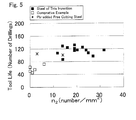
- Fig. 5 is a graphic representation of the relationship between tool life and n 2 as drawn based on the data shown in Table 3 and Table 4.
- the data of the steels of the invention (steels Nos. 8-11, 17-18, 21, 23, 27-28, 31-32 and 39) having an S content within the range of 0.074-0.119%, and the date of the comparative steels Nos. 67 and 69-73 have been added for comparison at the same S content level. From Fig. 5, it is evident that the steels of the invention satisfying "n 2 ⁇ 10" are superior in tool life when comparison is made on the same S content level.
- the steel for machine structural use according to the invention is excellent in machinability, in particular chip disposability, and in tool life prolonging effect as well, in spite of containing no Pb.
- this steel is used as a parts material requiring machining, the production cost of the parts can be markedly reduced.
Landscapes
- Chemical & Material Sciences (AREA)
- Engineering & Computer Science (AREA)
- Materials Engineering (AREA)
- Metallurgy (AREA)
- Organic Chemistry (AREA)
- Mechanical Engineering (AREA)
- Treatment Of Steel In Its Molten State (AREA)
- Heat Treatment Of Steel (AREA)
Applications Claiming Priority (2)
| Application Number | Priority Date | Filing Date | Title |
|---|---|---|---|
| JP2001350470 | 2001-11-15 | ||
| JP2001350470 | 2001-11-15 |
Publications (2)
| Publication Number | Publication Date |
|---|---|
| EP1312689A1 true EP1312689A1 (fr) | 2003-05-21 |
| EP1312689B1 EP1312689B1 (fr) | 2007-11-28 |
Family
ID=19162966
Family Applications (1)
| Application Number | Title | Priority Date | Filing Date |
|---|---|---|---|
| EP02292842A Expired - Lifetime EP1312689B1 (fr) | 2001-11-15 | 2002-11-14 | Acier destiné à des pièces structurelles de machines |
Country Status (3)
| Country | Link |
|---|---|
| US (1) | US6797231B2 (fr) |
| EP (1) | EP1312689B1 (fr) |
| CN (1) | CN1169992C (fr) |
Cited By (10)
| Publication number | Priority date | Publication date | Assignee | Title |
|---|---|---|---|---|
| EP1507016A1 (fr) * | 2003-08-01 | 2005-02-16 | Sumitomo Metal Industries, Ltd. | Acier de décolletage faible teneur en carbonne. |
| EP1529610A1 (fr) * | 2003-11-06 | 2005-05-11 | SSC Prototypen-Anlagenbau GmbH | Procédé et dispositif de production d'un bord tridimensionel sur un pièce |
| EP1553201A4 (fr) * | 2002-08-09 | 2005-10-05 | Honda Motor Co Ltd | Acier pour structure de machine avec tres bonne friabilite des ebarbures |
| WO2006021123A3 (fr) * | 2004-08-26 | 2006-04-20 | Moos Stahl Ag | Acier de cementation et son procede de production |
| EP1666621A4 (fr) * | 2003-08-27 | 2006-11-15 | Sumitomo Metal Ind | Acier sans traitement thermique forge a chaud pour trempe par induction |
| EP2666880A4 (fr) * | 2011-01-18 | 2015-02-25 | Kobe Steel Ltd | Matériau d'acier à ténacité supérieure de zone soudée, touchée par la chaleur, et son procédé de fabrication |
| KR20150131392A (ko) * | 2013-04-24 | 2015-11-24 | 신닛테츠스미킨 카부시키카이샤 | 저산소 청정 강 및 저산소 청정 강 제품 |
| US10260123B2 (en) | 2014-07-03 | 2019-04-16 | Nippon Steel & Sumitomo Metal Corporation | Rolled steel bar for machine structural use and method of producing the same |
| US10266908B2 (en) | 2014-07-03 | 2019-04-23 | Nippon Steel & Sumitomo Metal Corporation | Rolled steel bar for machine structural use and method of producing the same |
| EP3647453A4 (fr) * | 2017-06-29 | 2021-03-03 | Baoshan Iron & Steel Co., Ltd. | Acier de décolletage, non trempé et revenu et procédé d'usinage correspondant |
Families Citing this family (19)
| Publication number | Priority date | Publication date | Assignee | Title |
|---|---|---|---|---|
| JP2004332078A (ja) * | 2003-05-09 | 2004-11-25 | Sanyo Special Steel Co Ltd | 切屑処理性に優れた機械構造用快削鋼 |
| US8156042B2 (en) * | 2003-08-29 | 2012-04-10 | Starbucks Corporation | Method and apparatus for automatically reloading a stored value card |
| WO2005048145A1 (fr) * | 2003-10-13 | 2005-05-26 | Starbucks Corporation D/B/A Starbucks Coffee Company | Carte double |
| US20050080672A1 (en) * | 2003-10-13 | 2005-04-14 | Starbucks Corporation | Creating customer loyalty |
| JP2005264270A (ja) * | 2004-03-19 | 2005-09-29 | Honda Motor Co Ltd | クランクシャフト |
| JP4868916B2 (ja) * | 2006-04-04 | 2012-02-01 | 株式会社神戸製鋼所 | 耐食性に優れた船舶用鋼材 |
| JP2009174033A (ja) * | 2008-01-28 | 2009-08-06 | Kobe Steel Ltd | 被削性に優れた機械構造用鋼 |
| JP5392207B2 (ja) * | 2010-08-31 | 2014-01-22 | 新日鐵住金株式会社 | 高周波焼入れ用鋼及びそれを用いて製造されるクランクシャフト |
| CN103469116B (zh) * | 2013-08-07 | 2016-03-02 | 安徽蓝博旺机械集团合诚机械有限公司 | 一种叉车转向节用铸钢材料 |
| CA2940981C (fr) | 2014-03-07 | 2022-05-03 | Jeffrey Brian Newcombe | Carte a double fonction avec fonctionnalite de carte cle et fonctionnalite de carte a valeur stockee |
| CN104762558A (zh) * | 2015-03-20 | 2015-07-08 | 苏州科胜仓储物流设备有限公司 | 一种高强度抗冲击型货架梁用钢及其焊接工艺 |
| CN105568144A (zh) * | 2015-12-19 | 2016-05-11 | 丹阳市宸兴环保设备有限公司 | 一种货车车体用结构钢 |
| US11274354B2 (en) * | 2016-04-05 | 2022-03-15 | Daido Steel Co., Ltd. | Steel material, crankshaft, and automobile component |
| JP6760379B2 (ja) * | 2016-07-27 | 2020-09-23 | 日本製鉄株式会社 | 機械構造用鋼 |
| CN108611562B (zh) * | 2018-03-20 | 2020-10-30 | 马鞍山钢铁股份有限公司 | 一种含硫铝镇静非调质钢及其硫化物形貌控制方法 |
| CN109355573B (zh) * | 2018-12-03 | 2020-08-14 | 东北大学 | 一种基于碳分配技术的一钢多级热轧钢板及其制造方法 |
| CN111187996B (zh) * | 2020-01-21 | 2021-07-20 | 鞍钢股份有限公司 | 一种中碳含硫硒的易切削钢用盘条及其制造方法 |
| CN113549830B (zh) * | 2021-07-16 | 2022-05-20 | 鞍钢股份有限公司 | 高表面硬度折弯性能优异的中碳球化索氏体工具钢及其生产方法 |
| CN114990452B (zh) * | 2022-08-08 | 2022-11-01 | 中特泰来模具技术有限公司 | 一种易切削模架钢及其制备方法 |
Citations (5)
| Publication number | Priority date | Publication date | Assignee | Title |
|---|---|---|---|---|
| JPS5719357A (en) * | 1980-07-09 | 1982-02-01 | Kobe Steel Ltd | Machine structural steel with superior cold upsettability and machinability |
| JPS57140854A (en) * | 1981-02-23 | 1982-08-31 | Nippon Steel Corp | Machine structural steel with superior machinability |
| US4431445A (en) * | 1980-07-09 | 1984-02-14 | Kabushiki Kaisha Kobe Seiko Sho | Steel for machine construction having excellent cold forgeability and machinability |
| US4719079A (en) * | 1985-07-24 | 1988-01-12 | Nippon Steel Corporation | Continuous-cast low-carbon resulfurized free-cutting steel |
| JP2000282169A (ja) * | 1999-04-02 | 2000-10-10 | Nippon Steel Corp | 鍛造性と被削性に優れる鋼 |
Family Cites Families (16)
| Publication number | Priority date | Publication date | Assignee | Title |
|---|---|---|---|---|
| US3861906A (en) * | 1972-12-29 | 1975-01-21 | Republic Steel Corp | Calcium deoxidized, fine grain steels |
| JPS62103340A (ja) | 1985-10-29 | 1987-05-13 | Kobe Steel Ltd | 機械構造用Ca快削鋼 |
| JPS62170460A (ja) * | 1986-01-21 | 1987-07-27 | Honda Motor Co Ltd | 高強度弁ばね用鋼及びその製造方法 |
| JPH0892687A (ja) | 1994-09-22 | 1996-04-09 | Kobe Steel Ltd | 熱間鍛造用高強度高靭性非調質鋼とその製造方法 |
| FR2765593B1 (fr) * | 1997-07-04 | 1999-08-20 | Ascometal Sa | Acier au carbone ou faiblement allie a usinabilite amelioree et procede d'elaboration de cet acier |
| US5961747A (en) * | 1997-11-17 | 1999-10-05 | University Of Pittsburgh | Tin-bearing free-machining steel |
| JP3437079B2 (ja) | 1998-02-05 | 2003-08-18 | 株式会社神戸製鋼所 | 切りくず処理性に優れた機械構造用鋼 |
| JP3587348B2 (ja) | 1998-07-14 | 2004-11-10 | 大同特殊鋼株式会社 | 旋削加工性に優れた機械構造用鋼 |
| JP2000219936A (ja) | 1999-02-01 | 2000-08-08 | Daido Steel Co Ltd | 快削鋼 |
| JP2000282171A (ja) | 1999-03-31 | 2000-10-10 | Kobe Steel Ltd | 切り屑分断性および機械的特性に優れた機械構造用鋼 |
| JP2001131684A (ja) | 1999-11-04 | 2001-05-15 | Kobe Steel Ltd | 切り屑処理性に優れた機械構造用鋼 |
| JP3442705B2 (ja) | 1999-11-26 | 2003-09-02 | 株式会社神戸製鋼所 | 快削鋼 |
| JP4049969B2 (ja) | 2000-05-24 | 2008-02-20 | 山陽特殊製鋼株式会社 | 機械構造用快削鋼 |
| JP4148311B2 (ja) | 2000-12-12 | 2008-09-10 | トヨタ自動車株式会社 | 被削性に優れ、強度異方性の小さい鉛無添加の機械構造用鋼 |
| JP2002180194A (ja) | 2000-12-12 | 2002-06-26 | Sanyo Special Steel Co Ltd | 衝撃特性の異方性に優れる非調質鋼 |
| JP4556334B2 (ja) | 2001-02-01 | 2010-10-06 | 大同特殊鋼株式会社 | 軟窒化用非調質鋼熱間鍛造部品 |
-
2002
- 2002-11-12 CN CNB021505128A patent/CN1169992C/zh not_active Expired - Fee Related
- 2002-11-14 EP EP02292842A patent/EP1312689B1/fr not_active Expired - Lifetime
- 2002-11-15 US US10/295,032 patent/US6797231B2/en not_active Expired - Lifetime
Patent Citations (5)
| Publication number | Priority date | Publication date | Assignee | Title |
|---|---|---|---|---|
| JPS5719357A (en) * | 1980-07-09 | 1982-02-01 | Kobe Steel Ltd | Machine structural steel with superior cold upsettability and machinability |
| US4431445A (en) * | 1980-07-09 | 1984-02-14 | Kabushiki Kaisha Kobe Seiko Sho | Steel for machine construction having excellent cold forgeability and machinability |
| JPS57140854A (en) * | 1981-02-23 | 1982-08-31 | Nippon Steel Corp | Machine structural steel with superior machinability |
| US4719079A (en) * | 1985-07-24 | 1988-01-12 | Nippon Steel Corporation | Continuous-cast low-carbon resulfurized free-cutting steel |
| JP2000282169A (ja) * | 1999-04-02 | 2000-10-10 | Nippon Steel Corp | 鍛造性と被削性に優れる鋼 |
Non-Patent Citations (3)
| Title |
|---|
| PATENT ABSTRACTS OF JAPAN vol. 006, no. 090 (C - 104) 27 May 1982 (1982-05-27) * |
| PATENT ABSTRACTS OF JAPAN vol. 006, no. 239 (C - 137) 26 November 1982 (1982-11-26) * |
| PATENT ABSTRACTS OF JAPAN vol. 2000, no. 13 5 February 2001 (2001-02-05) * |
Cited By (14)
| Publication number | Priority date | Publication date | Assignee | Title |
|---|---|---|---|---|
| EP1553201A4 (fr) * | 2002-08-09 | 2005-10-05 | Honda Motor Co Ltd | Acier pour structure de machine avec tres bonne friabilite des ebarbures |
| EP1507016A1 (fr) * | 2003-08-01 | 2005-02-16 | Sumitomo Metal Industries, Ltd. | Acier de décolletage faible teneur en carbonne. |
| EP1666621A4 (fr) * | 2003-08-27 | 2006-11-15 | Sumitomo Metal Ind | Acier sans traitement thermique forge a chaud pour trempe par induction |
| US7387691B2 (en) | 2003-08-27 | 2008-06-17 | Sumitomo Metal Industries, Ltd. | Hot forged non-heat treated steel for induction hardening |
| EP1529610A1 (fr) * | 2003-11-06 | 2005-05-11 | SSC Prototypen-Anlagenbau GmbH | Procédé et dispositif de production d'un bord tridimensionel sur un pièce |
| WO2006021123A3 (fr) * | 2004-08-26 | 2006-04-20 | Moos Stahl Ag | Acier de cementation et son procede de production |
| EP2666880A4 (fr) * | 2011-01-18 | 2015-02-25 | Kobe Steel Ltd | Matériau d'acier à ténacité supérieure de zone soudée, touchée par la chaleur, et son procédé de fabrication |
| KR20150131392A (ko) * | 2013-04-24 | 2015-11-24 | 신닛테츠스미킨 카부시키카이샤 | 저산소 청정 강 및 저산소 청정 강 제품 |
| EP2990497A4 (fr) * | 2013-04-24 | 2016-11-30 | Nippon Steel & Sumitomo Metal Corp | Acier purifié à faible teneur en oxygène et produit en acier purifié à faible teneur en oxygène |
| US10526686B2 (en) | 2013-04-24 | 2020-01-07 | Nippon Steel Corporation | Low-oxygen clean steel and low-oxygen clean steel product |
| US10260123B2 (en) | 2014-07-03 | 2019-04-16 | Nippon Steel & Sumitomo Metal Corporation | Rolled steel bar for machine structural use and method of producing the same |
| US10266908B2 (en) | 2014-07-03 | 2019-04-23 | Nippon Steel & Sumitomo Metal Corporation | Rolled steel bar for machine structural use and method of producing the same |
| EP3647453A4 (fr) * | 2017-06-29 | 2021-03-03 | Baoshan Iron & Steel Co., Ltd. | Acier de décolletage, non trempé et revenu et procédé d'usinage correspondant |
| US11396682B2 (en) | 2017-06-29 | 2022-07-26 | Baoshan Iron & Steel Co., Ltd. | Free machining and non-quenched and tempered steel and manufacturing method therefor |
Also Published As
| Publication number | Publication date |
|---|---|
| US6797231B2 (en) | 2004-09-28 |
| CN1169992C (zh) | 2004-10-06 |
| EP1312689B1 (fr) | 2007-11-28 |
| US20030138343A1 (en) | 2003-07-24 |
| CN1420197A (zh) | 2003-05-28 |
Similar Documents
| Publication | Publication Date | Title |
|---|---|---|
| EP1312689B1 (fr) | Acier destiné à des pièces structurelles de machines | |
| JP3468239B2 (ja) | 機械構造用鋼及びその製造方法 | |
| AU2005264481B2 (en) | Steel for steel pipe | |
| EP1507016A1 (fr) | Acier de décolletage faible teneur en carbonne. | |
| EP1184477B1 (fr) | Acier de décolletage pour une structure de machine avec des caractéristiques mécaniques excellentes | |
| EP1270757A1 (fr) | Acier structural sans plomb pour construction mecanique presentant une excellente usinabilite et une anisotropie de resistance reduite | |
| JP2001131684A (ja) | 切り屑処理性に優れた機械構造用鋼 | |
| EP1188846B1 (fr) | Acier destiné a des piéces structurelles de machines présentant une abilité ameliorée d'évacuation des copeaux d'acier et de propriétés mécaniques supérieures | |
| JP2000219936A (ja) | 快削鋼 | |
| JP2000034538A (ja) | 旋削加工性に優れた機械構造用鋼 | |
| JP4041413B2 (ja) | 切り屑処理性に優れた機械構造用鋼、およびその製造方法 | |
| EP0452526A1 (fr) | Matériau de soutien pour lames de scies, à haute résistance à la fatigue | |
| JP3460721B2 (ja) | 機械構造用鋼 | |
| JP4023196B2 (ja) | 被削性にすぐれた機械構造用鋼 | |
| JP2006299296A (ja) | 疲労特性と耐結晶粒粗大化特性に優れた肌焼用圧延棒鋼およびその製法 | |
| JP4348163B2 (ja) | 被削性に優れる鋼及びその製造方法 | |
| JP3270035B2 (ja) | 被削性に優れ,強度異方性の小さい鉛無添加の機械構造用鋼 | |
| EP1553201A1 (fr) | Acier pour structure de machine avec tres bonne friabilite des ebarbures | |
| US20250382687A1 (en) | Steel material | |
| JP3442706B2 (ja) | 快削鋼 | |
| EP1471159A1 (fr) | Acier non raffine de type bainite pour nitruration, procede de production correspondant et produit nitrure | |
| JP7469612B2 (ja) | 機械構造用棒鋼及びその切削方法 | |
| JP2004292929A (ja) | 機械構造用鋼 | |
| JP2001234279A (ja) | 切屑処理性に優れた冷間鍛造用鋼 | |
| JP2001152279A (ja) | 快削鋼 |
Legal Events
| Date | Code | Title | Description |
|---|---|---|---|
| PUAI | Public reference made under article 153(3) epc to a published international application that has entered the european phase |
Free format text: ORIGINAL CODE: 0009012 |
|
| AK | Designated contracting states |
Designated state(s): AT BE BG CH CY CZ DE DK EE ES FI FR GB GR IE IT LI LU MC NL PT SE SK TR |
|
| AX | Request for extension of the european patent |
Extension state: AL LT LV MK RO SI |
|
| 17P | Request for examination filed |
Effective date: 20030616 |
|
| AKX | Designation fees paid |
Designated state(s): FR |
|
| REG | Reference to a national code |
Ref country code: DE Ref legal event code: 8566 |
|
| GRAP | Despatch of communication of intention to grant a patent |
Free format text: ORIGINAL CODE: EPIDOSNIGR1 |
|
| GRAS | Grant fee paid |
Free format text: ORIGINAL CODE: EPIDOSNIGR3 |
|
| RIN1 | Information on inventor provided before grant (corrected) |
Inventor name: NISHI, TAKAYUKI,C/O SUMITOMO METAL IND., LTD. Inventor name: TAHIRA, HIROAKI,C/O SUMITOMO METAL IND., LTD. Inventor name: KATO, TORU,C/O SUMITOMO METAL INDUSTRIES, LTD. Inventor name: MATSUMOTO, HITOSHI,SUMITOMO METALS (KOKURA), LTD. Inventor name: WATARI, KOJI,C/O SUMITOMO METAL INDUSTRIES, LTD. Inventor name: MATSUI, NAOKI,C/O SUMITOMO METAL INDUSTRIES, LTD. |
|
| GRAA | (expected) grant |
Free format text: ORIGINAL CODE: 0009210 |
|
| AK | Designated contracting states |
Kind code of ref document: B1 Designated state(s): FR |
|
| ET | Fr: translation filed | ||
| PLBE | No opposition filed within time limit |
Free format text: ORIGINAL CODE: 0009261 |
|
| STAA | Information on the status of an ep patent application or granted ep patent |
Free format text: STATUS: NO OPPOSITION FILED WITHIN TIME LIMIT |
|
| 26N | No opposition filed |
Effective date: 20080829 |
|
| REG | Reference to a national code |
Ref country code: FR Ref legal event code: TP Owner name: NIPPON STEEL & SUMITOMO METAL CORPORATION, JP Effective date: 20131108 |
|
| REG | Reference to a national code |
Ref country code: FR Ref legal event code: PLFP Year of fee payment: 14 |
|
| REG | Reference to a national code |
Ref country code: FR Ref legal event code: PLFP Year of fee payment: 15 |
|
| REG | Reference to a national code |
Ref country code: FR Ref legal event code: PLFP Year of fee payment: 16 |
|
| REG | Reference to a national code |
Ref country code: FR Ref legal event code: PLFP Year of fee payment: 17 |
|
| PGFP | Annual fee paid to national office [announced via postgrant information from national office to epo] |
Ref country code: FR Payment date: 20191015 Year of fee payment: 18 |
|
| PG25 | Lapsed in a contracting state [announced via postgrant information from national office to epo] |
Ref country code: FR Free format text: LAPSE BECAUSE OF NON-PAYMENT OF DUE FEES Effective date: 20201130 |