EP1314748A2 - Compositions de résine durcissable - Google Patents
Compositions de résine durcissable Download PDFInfo
- Publication number
- EP1314748A2 EP1314748A2 EP03001380A EP03001380A EP1314748A2 EP 1314748 A2 EP1314748 A2 EP 1314748A2 EP 03001380 A EP03001380 A EP 03001380A EP 03001380 A EP03001380 A EP 03001380A EP 1314748 A2 EP1314748 A2 EP 1314748A2
- Authority
- EP
- European Patent Office
- Prior art keywords
- slump
- epoxy resin
- hardener
- composition
- polyethyleneimine
- Prior art date
- Legal status (The legal status is an assumption and is not a legal conclusion. Google has not performed a legal analysis and makes no representation as to the accuracy of the status listed.)
- Withdrawn
Links
Images
Classifications
-
- C—CHEMISTRY; METALLURGY
- C08—ORGANIC MACROMOLECULAR COMPOUNDS; THEIR PREPARATION OR CHEMICAL WORKING-UP; COMPOSITIONS BASED THEREON
- C08L—COMPOSITIONS OF MACROMOLECULAR COMPOUNDS
- C08L63/00—Compositions of epoxy resins; Compositions of derivatives of epoxy resins
-
- C—CHEMISTRY; METALLURGY
- C08—ORGANIC MACROMOLECULAR COMPOUNDS; THEIR PREPARATION OR CHEMICAL WORKING-UP; COMPOSITIONS BASED THEREON
- C08G—MACROMOLECULAR COMPOUNDS OBTAINED OTHERWISE THAN BY REACTIONS ONLY INVOLVING UNSATURATED CARBON-TO-CARBON BONDS
- C08G59/00—Polycondensates containing more than one epoxy group per molecule; Macromolecules obtained by polymerising compounds containing more than one epoxy group per molecule using curing agents or catalysts which react with the epoxy groups
- C08G59/18—Macromolecules obtained by polymerising compounds containing more than one epoxy group per molecule using curing agents or catalysts which react with the epoxy groups ; e.g. general methods of curing
- C08G59/40—Macromolecules obtained by polymerising compounds containing more than one epoxy group per molecule using curing agents or catalysts which react with the epoxy groups ; e.g. general methods of curing characterised by the curing agents used
- C08G59/50—Amines
Definitions
- This invention relates to curable epoxy resin compositions.
- an epoxy resin composition which develops an almost instant increase in texture even up to the point of being totally non-slump on mixing of the resin and hardener components.
- Such applications are widespread and include adhesives, sealants, mastics, stopping compounds, caulking materials, encapsulants and surface coatings amongst many others.
- Dispensing of such epoxy resin components may be from bottles, cans, tubes, sachets and drums for instance and sometimes may be mixed with the hardener components via static or dynamic mixer heads.
- epoxy/hardener compositions are required to exhibit no slump when mixed and laid horizontally oriented on a vertical surface in thickness up to 40mm and greater.
- epoxy resin compositions can be very viscous, thixotropic or even of low viscosity, but are still required to develop non-slump properties quickly on mixing of their components.
- the degree of non-slumping required can even be that of retaining almost exactly the shape and dimensions achieved by extruding the compositions through a shaped orifice.
- this discharged mixture (of resin and hardener) be applied (extruded onto) a suitable surface in a particular shape or pattern.
- the discharged mixture maintains this particular shape or pattern until gelled or processed further.
- the resin and hardeners can be exposed to a high shear stress regime. It is well known, however, that such stresses can result in a lowering of viscosity which can, in turn, lead to distortion of the shape or pattern. Such distortion is known as sag or slump. Where retention of extruded shape properties is required, such prior shearing during the discharging process could have detrimental effects on the shape retention properties of the extruded mixture.
- epoxy resin compositions having excellent non-slump properties; improved slump resistance on subjection to mechanical stress; good slump resistance after prolonged post-mixing time; improved non-slump and sag resistance on first mixing and on ageing when combined with hydrophilic silica, can be produced by using as the hardener component a mixture of a polyethyleneimine together with another amine hardener having at least 2 amino hydrogen atoms.
- the present invention provides, in one aspect, a curable epoxy resin composition
- a curable epoxy resin composition comprising (A) an epoxy resin, (B) a thixotropic agent in an amount sufficient to induce thixotropic properties, and a hardener comprising (C) at least one polyethyleneimine and (D) at least one other amine having at least 2 amino hydrogen atoms, the combined amounts of (C) and (D) being sufficient to effect cure of the epoxy resin.
- the epoxy resin (A) may consist of one or more epoxy resins which are themselves liquid or may be a liquid mixture of one or more solid epoxy resins with one or more liquid epoxy resins or may be one or more solid epoxy resins dissolved in a diluent such as a diluent conventionally used in epoxy resin compositions.
- the epoxy resin may be a polyglycidyl ether of a polyhydric alcohol such as 1,4-butanediol or 1,3-propanediol or, preferably, a polyglycidyl ether of a polyhydric phenol, for example a bisphenol such as bis(4-hydroxyphenyl)methane (bisphenol F) or 2,2-bis-(4-hydroxyphenyl)propane (bisphenol A) or a novolak formed from formaldehyde and a phenol such as phenol itself or a cresol, or a mixture of two or more such polyglycidyl ethers.
- bisphenol such as bis(4-hydroxyphenyl)methane (bisphenol F) or 2,2-bis-(4-hydroxyphenyl)propane (bisphenol A)
- bisphenol bis(4-hydroxyphenyl)methane
- bisphenol A 2,2-bis-(4-hydroxyphenyl)propane
- the epoxy resin particularly where it comprises a solid epoxy resin, may contain one or more epoxy-functional diluents, usually monoepoxides, or non-epoxide diluents, such as the monoepoxide and non-epoxide diluents conventionally used in curable epoxy resin compositions.
- epoxy-functional diluents usually monoepoxides, or non-epoxide diluents, such as the monoepoxide and non-epoxide diluents conventionally used in curable epoxy resin compositions.
- the thixotropic agent (B) is preferably a thixotropic agent which, it is believed, relies largely on interparticle hydrogen bonding to achieve its thixotropic effect, especially a hydrophilic fumed silica.
- the amount of thixotropic agent required to induce thixotropic properties may depend on the nature of the specific epoxy resin and specific thixotropic agent used. This amount is generally from 1 to 20%, preferably from 3 to 15%, by weight based on the weight of the epoxy resin (A).
- the polyethyleneimine (C) may have a molecular weight (Mw) from 700 to 1,000,000 or more, preferably from 5000 to 750,000, especially from 25,000 to 750,000, particularly about 750,000.
- Mw molecular weight
- Such polyethyleneimines are commercially available or may be prepared from ethyleneimine by known procedures.
- the amount of polyethyleneimine is generally chosen so that the epoxy resin composition of the invention does not flow during a desired time after the formation of the composition.
- the amount of polyethyleneimine is such that the epoxy resin composition does not flow for at least 60 minutes after formation thereof.
- the amount of polyethyleneimine is such that the epoxy resin composition does not flow prior to gelation thereof, which in some instances requires several hours.
- the amount of polyethyleneimine needed to impart non-flow properties for a given time can be readily determined by simple experiment. For compositions of the invention containing the especially preferred components (A), (B) and (D) described herein, an amount of polyethyleneimine from 0.2 to 2 parts by weight per 100 parts by weight of the epoxy resin is preferred.
- amines suitable for use as the amine hardener (D) there may be mentioned those aliphatic, cycloaliphatic, aromatic, araliphatic and heterocyclic amines known as hardeners for epoxy resins, including: alkylenediamines such as ethylenediamine or butane-1,4-diamine; polyalkylenepolyamines such as diethylenetriamine, triethylenetetramine, tetraethylenepentamine, dipropylenetriamine or tripropylenetetramine; N-hydroxyalkyl derivatives of polyalkylene polyamines such as N-(hydroxyethyl) diethylenetriamine or mono-N-2-hydroxypropyl derivative of triethylenetetramine; polyoxyalkylenepolyamines such as polyoxyethylene - and polyoxypropylene - diamines and triamines; N,N-dialkylalkylenediamines such as N,N-dimethylpropane-1,3-diamine or N,N-
- Aliphatic and cycloaliphatic amine hardeners are usually preferred for use as component (D) of the composition, including N-hydroxyalkyl derivatives of polyalkylene polyamines, particularly a mono-N-2-hydroxypropyl derivative of triethylenetetramine, and mixtures thereof with polyaminoamide reaction products of polyalkylenepolyamines and polymerised vegetable oil adds and the amine functional reaction products of amines and epoxy group containing compounds.
- the amount of (D) is preferably such that (C) and (D) together provide from about 0.75 to 1.25 amino hydrogen equivalents per 1,2-epoxide equivalent of the epoxy resin (A).
- the epoxy resin resin composition of the invention may also contain minor amounts of accelerators and additives conventionally used in curable epoxy resin compositions, such as diluents, fillers, fibres, pigments, dyes, fire retardants, antifoaming agents, wetting agents and polymeric toughening agents.
- accelerators and additives conventionally used in curable epoxy resin compositions, such as diluents, fillers, fibres, pigments, dyes, fire retardants, antifoaming agents, wetting agents and polymeric toughening agents.
- the epoxy resin composition may be formed conveniently by stirring a preformed mixture of (A) and (B) together with a preformed mixture of (C) and (D).
- the composition may conveniently be supplied in the form of a two-part pack.
- the present invention also provides a two-part pack comprising a first part containing (A) a liquid epoxy resin as hereinbefore described and (B) a thixotropic agent as hereinbefore described and a second part containing (C) a polyethyleneimine as hereinbefore described and (D) at least one other amine having at least 2 amino hydrogen atoms as hereinbefore described.
- the second part may also contain a thixotropic agent (B).
- the optional components such as diluents may be in either the first or second part, or in both.
- Cure of the epoxy resin composition of the invention can be effected in accordance with conventional practice in the particular application.
- the composition can be allowed to gel (set) at ambient temperature or heated moderately in accordance with conventional practice to accelerate setting. Subsequently, completion of cure may be effected at ambient temperature, moderately elevated temperature or higher temperature as required.
- the epoxy resin composition of the invention can be used in any of the abovementioned applications. It may be used in applications where it is desired to produce a randomly shaped composition which is to be shaped to a particular form before or after gelation or cure. It is particularly useful as an adhesive, especially where the adhesive has to be applied to a surface, such as that of a decorative building panel, which has to be held in an upright, e.g. vertical, position. Accordingly, the present invention also provides a method of bonding two surfaces together using an adhesive, characterised in that the adhesive is an epoxy resin composition of the invention as hereinbefore described.
- a liquid polyglycidyl ether of bisphenol A having an epoxide content of 5.3 mol/kg (100 parts) was mixed with a hydrophilic fumed silica available from Degussa as A380 (8 parts) in a planetary mixer for 10 minutes.
- the resulting composition was divided into portions which were tested for slump (after applied mechanical stress) at various time intervals.
- the composition according to Example 1 was prepared using a polyethyleneimine having a molecular weight (Mw) of 750,000 available from BASF as Lupasol P (RTM). The resulting composition was divided into portions which were tested for slump (after applied mechanical stress) at various time intervals. As a control, the experiment was repeated using a composition which was identical, with the exception that, it contains 20 parts of hydroxypropylated triethylenetetraime hardener rather than the polyethyleneimine.
- the slump resistance results obtained were as follows: X (parts) Time after initial mixing Result 0 (control) 30 minutes slump and flow 0.2 60 minutes no slump 0.65 75 minutes no slump 1.1 75 minutes no slump 2.0 75 minutes no slump
- a mastic composition (Composition 3A) was prepared by mixing together a liquid polyglycidyl ether of bisphenol A having an epoxide content of 5.3 mol/kg (100 parts), hydrophilic fumed silica A380 (9.2 parts), fly ash filler (85.0 parts), a mono N-2-hydroxypropyl derivative of triethylenetetramine (12.3 parts), a polyaminoamide reaction product of a polyalkylenepolyamine and polymerised vegetable oil acid available as Versamid 140 (RTM) (16.4 parts), Lupasol WF (RTM) polyethyleneimine (1.5 parts), hydrocarbon diluent (14.0 parts), benzyl alcohol (6.0 parts) and glycerol (0.4 parts).
- the mastic composition was loaded into cartridges and extruded, after various time intervals, as beads 1cm high onto horizontal panels. The panels were then placed in a vertical position and the beads examined for slump behaviour.
- Composition 3B a mastic composition which was the same as Composition 3A, with the exception that, it contained 13.8 parts of hydroxypropylated triethylenetetramine as hardener rather than polyethyleneimine.
- the slump resistance results obtained were as follows: Result Time after initial mixing Composition 3A Composition 3B 30 minutes no slump no slump 45 minutes no slump slump (0.5cm) 60 minutes no slump severe flow (7.5cm) 75 minutes no slump severe flow (8.0cm) 90 minutes no slump slump (4.0cm) 105 minutes no slump slump (2.0cm) 120 minutes no slump slump (1.5cm) 210 minutes no slump slump (0.5cm)
- composition 3B (without the polyethyleneimine hardener) exhibited slump behaviour. It is believed that this slump may result from the reaction between the hydroxypropylated triethylenetetramine hardener with the resin.
- the composition accordingly to the present invention Composition 3A does not exhibit slump, even after 210 minutes from initial mxing (and discharge and extrusion).
- This example illustrates the effect of storage and preshearing on the performance of resin compositions with and without the polyethyleneimine hardeners according to the present invention.
- composition 4A A resin composition (composition 4A) was prepared by mixing together a liquid polyglycidyl ether of bisphenol A having an epoxide content of 5.3 mol/kg (100 parts), hydrophilic fumed silica A 380 (8.0 parts) and benzyl alcohol (6.0 parts). The blend was a pourable viscous liquid. Resin Composition 4A was split into batches and stored under the following storage regimes: 4A(i) 7 days at 23°C - i.e. fresh 4A(ii) 300 days at 23°C - medium age 4A(iii) 7 days at 100°C - accelerated ageing believed to be the equivalent of at least two years at 23°C
- compositions 4B, 4C and 4D were prepared. These hardeners were: Composition 4B - a mono N-2-hydroxypropyl derivative of triethylene tetramine Composition 4C - Composition 4B (10.0 parts) mixed with a 50% solution of polyethyleneimine in benzyl alcohol (0.8 parts) 28,000 m.wt. Composition 4D - Composition 4B (10.0 parts) mixed with a 50% solution of polyethyleneimine 750,000 m.wt. in benzyl alcohol
- Test compositions were prepared by mixing a portion of each of the test resins 4A(i), 4A(ii) and 4A(iii) with each of the test hardener compositions 4B, 4C and 4D.
- the hardener compositions (4B, 4C and 4D) were mixed in their 'fresh' condition, which was after 7 days storage at 23°C.
- each mixture was tested on a TA instruments CSL 2 500 Carri-Med Rheometer using a 2cm diameter, 2 degree angle cone using the flow procedure with a stepped ramp, with and without a marker at 100 sec -1 , for one minute.
- the yield point for each (expressed as Yield Stress, Y, and measured in pascals, in Pa) of these mixtures was then determined from a plot of viscosity against shear stress.
- Such yield point (Y) measurements indicate the individual cohesive strengths of each of the mixed compositions and the relative likelihood of each mixed composition to exhibit non-sag/non slump and shape retention properties, both when first discharged onto a surface and over time.
- compositions according to the present invention Compositions 4C/4A(i); 4C/4A (ii); 4C/4A (iii) and 4D/4A (i); 4D/4A(ii); 4D(iii) display improved yield stress properties over the nil polyethyleneimine systems.
- Table I illustrate the improved yield strengths obtained with the hardener containing polyethyleneimine of 750,000 mol. wt. (compositions with 4D) under all the conditions of storage and shearing versus both the systems containing polyethyleneimine hardener having a 25,000 mol wt and the non-polyethyleneimine hardener systems.
- This example further illustrates the effectiveness of the higher molecular weight polyethyleneimine in giving texture, flow and sag resistance to epoxy hydrophilic silica blends.
- the two test polyethyleneimines were utilised alone, that is without a cohardener.
- a standard hardener was also utilised at the same addition levels.
- a resin composition 5A was prepared by mixing together a liquid polyglycidyl ether of bisphenol A having an epoxide content of 5.3 mol/kg (100 parts), hydrophilic fumed silica, A380 (4.0 parts) and benzyl alcohol (8.0 parts). The blend was a free flowing liquid.
- Composition 5A 100 gram positions of Composition 5A were stored at 23°C in open topped cylinder containers. Into those were added: Composition 5B - a mono N-2-hydroxyl derivative of triethylene tetramine having molecular weights of about 750,000 are likely to deliver the most satisfactory performance 0.18 grams Composition 5C - a polyethyleneimine of 25,000 molecular weight -0.18 grams Composition 5D - a 50% solution of polyethyleneimine 750,000 in benzyl alcohol - 0.36 grams
- This example illustrates the differences in slump and/or flow properties of various resin/hardener mixtures both on the point of first mixing, and when under a regime where the mixture is mixed, then allowed to stand for a fixed period of time (15 minutes), then mixed again. This standing, mixing, assessing process was repeated for three mixtures of resin and hardener.
- the resin (mixture A) was split into batches which were stored in dosed containers at 100°C and 23°C for periods of up to 2, 4, 8 and 16 days. For the avoidance of doubt 1 day herein equals to about 24 hours.
- HARDENERS Parts by weight 1) monohydroxy propylated triethylene tetramine 22.0 2) monohydroxy propylated triethylene tetramine 20.4 polyethylene imine 25,000 mol. wt. 1.6 3) monohydroxy propylated triethylene tetramine 20.4 polyethylene imine 750,000 mol. wt. 1.6 benzyl alcohol 1.6
- test resin/hardener mixtures of Example 6 were subjected to mechanical disturbance by the mechanical compression (by hand) of a spatula onto the premoulded resin/hardener mixture of shape (X) to create a spatula shaped imprint (or stamp).
- This imprinted (mechanically disturbed) resin/hardener mixture was then re-moulded to shape X, provided it had not already slumped or flowed. This process was repeated up to 4 times and subsequent visual assessments of slump or flow on these stamped and remoulded mixtures were then made after every 15 minutes (from first mixing) up to 1 hour (60 minutes).
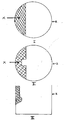
- Drawings I, II and III of this application illustrate: moulded mixture of shape X in container Z; a section of an imprinted moulded resin/hardener mixture in container Z and a plan of the imprinted moulded resin in container Z.
- Table III illustrates that inclusion of a polyethyleneimine hardner having a molecular weight of about 25,000 (Hardner 2) provides excellent non-slump performance under normal storage conditions (23°C) and improved slump resistance over about 1 or 2 days under elevated storage temperature conditions (100°C) versus polyethylenepolyamine type epoxy hardners.
- Table IV illustrates that the inclusion of a polyethyleneimine hardner having a molecular weignt of about 750,000 (Hardner 3) provides excellent non-slump performance advantages versus polyethylenepolyamine type epoxy and the 25,000 molecular weight polyethyleneimine hardners across conditions of temperature and storage.
Landscapes
- Chemical & Material Sciences (AREA)
- Health & Medical Sciences (AREA)
- Chemical Kinetics & Catalysis (AREA)
- Medicinal Chemistry (AREA)
- Polymers & Plastics (AREA)
- Organic Chemistry (AREA)
- Epoxy Resins (AREA)
- Compositions Of Macromolecular Compounds (AREA)
- Adhesives Or Adhesive Processes (AREA)
- Macromonomer-Based Addition Polymer (AREA)
- Laminated Bodies (AREA)
- Paper (AREA)
Applications Claiming Priority (3)
| Application Number | Priority Date | Filing Date | Title |
|---|---|---|---|
| GBGB9621196.6A GB9621196D0 (en) | 1996-10-11 | 1996-10-11 | Curable resin compositions |
| GB9621196 | 1996-10-11 | ||
| EP97810763A EP0835910B1 (fr) | 1996-10-11 | 1997-10-10 | Compositions de résines durcissables |
Related Parent Applications (1)
| Application Number | Title | Priority Date | Filing Date |
|---|---|---|---|
| EP97810763A Division EP0835910B1 (fr) | 1996-10-11 | 1997-10-10 | Compositions de résines durcissables |
Publications (2)
| Publication Number | Publication Date |
|---|---|
| EP1314748A2 true EP1314748A2 (fr) | 2003-05-28 |
| EP1314748A3 EP1314748A3 (fr) | 2009-07-29 |
Family
ID=10801246
Family Applications (2)
| Application Number | Title | Priority Date | Filing Date |
|---|---|---|---|
| EP97810763A Expired - Lifetime EP0835910B1 (fr) | 1996-10-11 | 1997-10-10 | Compositions de résines durcissables |
| EP03001380A Withdrawn EP1314748A3 (fr) | 1996-10-11 | 1997-10-10 | Compositions de résine durcissable |
Family Applications Before (1)
| Application Number | Title | Priority Date | Filing Date |
|---|---|---|---|
| EP97810763A Expired - Lifetime EP0835910B1 (fr) | 1996-10-11 | 1997-10-10 | Compositions de résines durcissables |
Country Status (15)
| Country | Link |
|---|---|
| US (1) | US6077886A (fr) |
| EP (2) | EP0835910B1 (fr) |
| JP (1) | JP3826334B2 (fr) |
| AT (1) | ATE243727T1 (fr) |
| AU (1) | AU732525B2 (fr) |
| BR (1) | BR9705016A (fr) |
| CA (1) | CA2217834C (fr) |
| DE (1) | DE69723020T2 (fr) |
| ES (1) | ES2202567T3 (fr) |
| GB (1) | GB9621196D0 (fr) |
| ID (1) | ID18836A (fr) |
| IN (1) | IN213824B (fr) |
| MY (1) | MY130974A (fr) |
| TW (1) | TW347398B (fr) |
| ZA (1) | ZA979097B (fr) |
Cited By (3)
| Publication number | Priority date | Publication date | Assignee | Title |
|---|---|---|---|---|
| RU2462488C1 (ru) * | 2011-03-30 | 2012-09-27 | Государственное образовательное учреждение высшего профессионального образования "Мордовский государственный университет им. Н.П. Огарева" | Полимерная композиция |
| US8278398B2 (en) * | 2007-08-17 | 2012-10-02 | Dow Global Technologies Llc | Two part crash durable epoxy adhesives |
| EP2592100A1 (fr) * | 2011-11-10 | 2013-05-15 | Sika Technology AG | Durcisseur pour revêtements de résines époxydes |
Families Citing this family (33)
| Publication number | Priority date | Publication date | Assignee | Title |
|---|---|---|---|---|
| US20040101643A1 (en) * | 1996-11-26 | 2004-05-27 | National Starch And Chemical Limited | Adhesives containing FDA approved materials |
| EP1332045B1 (fr) * | 2000-09-11 | 2004-10-20 | Huntsman Advanced Materials (Switzerland) GmbH | Modele continu et procede de fabrication d'un modele continu |
| US6650044B1 (en) * | 2000-10-13 | 2003-11-18 | Lumileds Lighting U.S., Llc | Stenciling phosphor layers on light emitting diodes |
| GB2383009A (en) * | 2001-12-14 | 2003-06-18 | Vantico Ag | Method of making models |
| CN1875056B (zh) * | 2003-11-04 | 2013-10-16 | 亨斯迈先进材料(瑞士)有限公司 | 双组分可固化组合物 |
| EP1616924A1 (fr) * | 2004-07-13 | 2006-01-18 | Huntsman Advanced Materials (Switzerland) GmbH | Composition ignifuge |
| US7708858B2 (en) * | 2004-11-17 | 2010-05-04 | Huntsman Advanced Materials Americas Inc. | Method of making high temperature resistant models or tools |
| JP4718220B2 (ja) * | 2005-03-30 | 2011-07-06 | 三洋化成工業株式会社 | コンクリート素地調整材 |
| JP2006312747A (ja) * | 2006-06-12 | 2006-11-16 | Sumitomo Osaka Cement Co Ltd | 成形用材料 |
| US9133306B2 (en) | 2007-04-26 | 2015-09-15 | Air Products And Chemicals, Inc. | Amine composition |
| JP2010202686A (ja) * | 2009-02-27 | 2010-09-16 | Sumitomo Bakelite Co Ltd | 液状封止樹脂組成物および半導体パッケージ |
| WO2010121853A1 (fr) * | 2009-04-24 | 2010-10-28 | Huntsman Advanced Materials (Switzerland) Gmbh | Procédé de fabrication de moules et outils chimiquement résistants |
| BR112012008587A2 (pt) * | 2009-10-14 | 2016-04-05 | Henkel Ag & Co Kgaa | processo de distribuição homogênea para uma composição epóxi com teor de carga elevado |
| JP5746939B2 (ja) * | 2011-09-15 | 2015-07-08 | 株式会社ブリヂストン | 有機繊維コード用接着剤組成物及びそれを用いた接着方法、並びにゴム補強材及びタイヤ |
| KR20150003373A (ko) * | 2012-04-26 | 2015-01-08 | 다우 글로벌 테크놀로지스 엘엘씨 | 에폭시 접착제 조성물 |
| US20140127499A1 (en) * | 2012-11-02 | 2014-05-08 | Ashland Licensing And Intellectual Property Llc | Two Part Primer Composition |
| KR102135392B1 (ko) | 2013-03-11 | 2020-07-17 | 비와이케이-케미 게엠베하 | 요변성-증진 첨가제 및 상기 첨가제를 함유하는 조성물 |
| DE102014103920A1 (de) * | 2013-04-05 | 2014-10-09 | Fischerwerke Gmbh & Co. Kg | Biogene flüssige nichtreaktive Verdünner in Kunstharz-Verklebungs mitteln |
| CN103320071B (zh) * | 2013-06-28 | 2015-08-12 | 上海悍马建筑科技有限公司 | 改性环氧透明裂缝封口胶 |
| EP3161036B1 (fr) | 2014-06-24 | 2018-01-24 | BYK-Chemie GmbH | Systèmes résine d'époxy époxy durcisseur avec tendance différé épaississant |
| JP6423459B2 (ja) | 2014-06-24 | 2018-11-14 | ベーイプシロンカー ヘミー ゲゼルシャフト ミット ベシュレンクター ハフトゥング | 潜在的増粘傾向を有する不飽和ポリエステル樹脂系 |
| JP2017525795A (ja) * | 2014-06-24 | 2017-09-07 | ベーイプシロンカー ヘミー ゲゼルシャフト ミット ベシュレンクター ハフトゥング | 潜在的増粘傾向を有するポリウレタン二成分又は多成分系 |
| EP3161058B1 (fr) | 2014-06-24 | 2017-11-22 | BYK-Chemie GmbH | Système à base d'acrylate avec tendance latente à l'épaississement |
| US10392494B2 (en) | 2014-06-24 | 2019-08-27 | Byk-Chemie Gmbh | Latent thickeners, rheology control kit and multi-component systems |
| US9522981B1 (en) | 2016-06-22 | 2016-12-20 | Byk-Chemie Gmbh | Process of manufacturing thickeners and use of thus produced thickeners in high-viscosity non aqueous formulations |
| US9670339B1 (en) | 2016-06-22 | 2017-06-06 | Byk Usa Inc. | Process of manufacturing thickeners and the use of thus produced thickeners in high-viscosity epoxy resin formulations |
| US9637614B1 (en) | 2016-06-22 | 2017-05-02 | Byk Usa Inc. | Process of manufacturing thickeners and the use of thus produced thickeners in high-viscosity unsaturated polyester containing formulations |
| US9546252B1 (en) | 2016-06-22 | 2017-01-17 | Byk-Chemie Gmbh | Process of manufacturing thickeners and use of thus produced thickeners in high-viscosity unsaturated polyester containing formulations |
| EP3381961B1 (fr) | 2017-04-01 | 2020-11-11 | CliQ SwissTech (Netherlands) B.V. | Composition de résine de coulée |
| WO2019222402A1 (fr) * | 2018-05-15 | 2019-11-21 | Nd Industries, Inc. | Revêtements multifonctionnels et compositions adhésives pour éléments de fixation |
| CA3156245A1 (fr) * | 2019-11-14 | 2021-05-20 | Desiree Nicole Snyder | Compositions adhesives pour dispositifs de fixation d'ancrage |
| JP6736118B1 (ja) * | 2020-03-10 | 2020-08-05 | イイダ産業株式会社 | マスチック接着剤 |
| EP4121478B1 (fr) * | 2020-03-17 | 2024-08-07 | BYK-Chemie GmbH | Agent de contrôle de rhéologie |
Family Cites Families (6)
| Publication number | Priority date | Publication date | Assignee | Title |
|---|---|---|---|---|
| US3939020A (en) * | 1969-09-18 | 1976-02-17 | John A. Caramanian | Method of balancing a rotor |
| US4238387A (en) * | 1978-11-20 | 1980-12-09 | E. I. Du Pont De Nemours And Company | Rheology control additive for paints |
| JPS605052A (ja) * | 1983-06-22 | 1985-01-11 | 花王株式会社 | セメント分散剤 |
| JPS60104173A (ja) * | 1983-11-11 | 1985-06-08 | Konishi Kk | 2成分系エポキシ樹脂接着用並びに充填用組成物 |
| JP2681442B2 (ja) * | 1993-06-03 | 1997-11-26 | 四国化成工業株式会社 | エポキシ樹脂組成物 |
| JP2678557B2 (ja) * | 1993-06-03 | 1997-11-17 | 四国化成工業株式会社 | エポキシ樹脂系塗材及びその調製方法 |
-
1996
- 1996-10-11 GB GBGB9621196.6A patent/GB9621196D0/en active Pending
-
1997
- 1997-10-09 TW TW86114825A patent/TW347398B/zh not_active IP Right Cessation
- 1997-10-09 MY MYPI97004739A patent/MY130974A/en unknown
- 1997-10-09 US US08/947,997 patent/US6077886A/en not_active Expired - Lifetime
- 1997-10-09 CA CA002217834A patent/CA2217834C/fr not_active Expired - Fee Related
- 1997-10-09 IN IN2900DE1997 patent/IN213824B/en unknown
- 1997-10-10 EP EP97810763A patent/EP0835910B1/fr not_active Expired - Lifetime
- 1997-10-10 AT AT97810763T patent/ATE243727T1/de not_active IP Right Cessation
- 1997-10-10 ZA ZA9709097A patent/ZA979097B/xx unknown
- 1997-10-10 BR BR9705016A patent/BR9705016A/pt not_active Application Discontinuation
- 1997-10-10 AU AU40955/97A patent/AU732525B2/en not_active Ceased
- 1997-10-10 ES ES97810763T patent/ES2202567T3/es not_active Expired - Lifetime
- 1997-10-10 ID IDP973411A patent/ID18836A/id unknown
- 1997-10-10 EP EP03001380A patent/EP1314748A3/fr not_active Withdrawn
- 1997-10-10 DE DE69723020T patent/DE69723020T2/de not_active Expired - Lifetime
- 1997-10-13 JP JP29483197A patent/JP3826334B2/ja not_active Expired - Fee Related
Cited By (5)
| Publication number | Priority date | Publication date | Assignee | Title |
|---|---|---|---|---|
| US8278398B2 (en) * | 2007-08-17 | 2012-10-02 | Dow Global Technologies Llc | Two part crash durable epoxy adhesives |
| RU2462488C1 (ru) * | 2011-03-30 | 2012-09-27 | Государственное образовательное учреждение высшего профессионального образования "Мордовский государственный университет им. Н.П. Огарева" | Полимерная композиция |
| EP2592100A1 (fr) * | 2011-11-10 | 2013-05-15 | Sika Technology AG | Durcisseur pour revêtements de résines époxydes |
| WO2013068501A1 (fr) * | 2011-11-10 | 2013-05-16 | Sika Technology Ag | Durcisseurs pour revêtements à base de résines époxy |
| US9340701B2 (en) | 2011-11-10 | 2016-05-17 | Sika Technology Ag | Curing agent for epoxy resin coatings |
Also Published As
| Publication number | Publication date |
|---|---|
| JPH10130463A (ja) | 1998-05-19 |
| IN213824B (fr) | 2008-01-25 |
| ATE243727T1 (de) | 2003-07-15 |
| DE69723020D1 (de) | 2003-07-31 |
| EP0835910A1 (fr) | 1998-04-15 |
| ZA979097B (en) | 1998-05-11 |
| ES2202567T3 (es) | 2004-04-01 |
| TW347398B (en) | 1998-12-11 |
| CA2217834A1 (fr) | 1998-04-11 |
| EP0835910B1 (fr) | 2003-06-25 |
| ID18836A (id) | 1998-05-14 |
| DE69723020T2 (de) | 2004-04-01 |
| AU732525B2 (en) | 2001-04-26 |
| EP1314748A3 (fr) | 2009-07-29 |
| JP3826334B2 (ja) | 2006-09-27 |
| US6077886A (en) | 2000-06-20 |
| BR9705016A (pt) | 1998-12-29 |
| GB9621196D0 (en) | 1996-11-27 |
| IN1997DE02900A (fr) | 2007-02-23 |
| MY130974A (en) | 2007-07-31 |
| CA2217834C (fr) | 2009-07-14 |
| AU4095597A (en) | 1998-04-23 |
Similar Documents
| Publication | Publication Date | Title |
|---|---|---|
| US6077886A (en) | Curable resin compositions | |
| US4921912A (en) | Epoxy resin composition containing acrylic oligomer, amine and amine-terminated nitrile rubber | |
| US4578424A (en) | High performance two-component epoxy structural adhesives with chemical thixotropy | |
| US4728384A (en) | Two component epoxy structural adhesives with improved flexibility | |
| JPH0632877A (ja) | 硬化しうる樹脂組成物及びその製造方法 | |
| US4661539A (en) | Sag resistant two-component epoxy structural adhesive | |
| US5766768A (en) | Ionic emulsion polymers and their preparation | |
| KR20050062456A (ko) | 수계 에폭시 경화제의 제조 방법 | |
| US6489405B1 (en) | Epoxy resin formulation containing epoxy group-terminated polyesters | |
| US4143009A (en) | Polyurethane-epoxy casting resin | |
| CN110582525A (zh) | 环氧固化剂、组合物及其用途 | |
| US4652492A (en) | Use of a polyamide to thicken an amine | |
| JPH05271389A (ja) | 一液系可撓性エポキシ樹脂組成物並びにそれからなるシーリング材または接着剤 | |
| JP7076720B2 (ja) | エポキシ注型樹脂配合物 | |
| JP2022526956A (ja) | ピッカリング乳化剤を有するエポキシドマイクロカプセル | |
| CN102191000B (zh) | 粘合剂组合物 | |
| US4728737A (en) | High performance two-component epoxy structural adhesive with chemical thixotropy | |
| US5098505A (en) | Epoxy resin, thermoplastic polymer and hardener adhesive | |
| US5424371A (en) | Adhesive of amine-terminated, piperazine-containing polyamide and epoxy resin | |
| US2955951A (en) | Non-tacky acid salts of polyamide resins | |
| CN1585808A (zh) | 低通读的环氧树脂粘合的smc | |
| US6001902A (en) | Wollastonite-containing curable epoxy resin mixture | |
| JP7738558B2 (ja) | 2剤型硬化性接着剤 | |
| SU1151557A1 (ru) | Полиуретанэпоксидна композици | |
| JP2974382B2 (ja) | 軟質エポキシ樹脂組成物 |
Legal Events
| Date | Code | Title | Description |
|---|---|---|---|
| PUAI | Public reference made under article 153(3) epc to a published international application that has entered the european phase |
Free format text: ORIGINAL CODE: 0009012 |
|
| 17P | Request for examination filed |
Effective date: 20030226 |
|
| AC | Divisional application: reference to earlier application |
Ref document number: 0835910 Country of ref document: EP Kind code of ref document: P |
|
| AK | Designated contracting states |
Designated state(s): AT CH DE ES FR GB IT LI NL SE |
|
| RAP1 | Party data changed (applicant data changed or rights of an application transferred) |
Owner name: HUNTSMAN ADVANCED MATERIALS (SWITZERLAND) GMBH |
|
| PUAL | Search report despatched |
Free format text: ORIGINAL CODE: 0009013 |
|
| AK | Designated contracting states |
Kind code of ref document: A3 Designated state(s): AT CH DE ES FR GB IT LI NL SE |
|
| RIC1 | Information provided on ipc code assigned before grant |
Ipc: C08L 63/00 20060101AFI20090625BHEP Ipc: C08G 59/50 20060101ALI20090625BHEP |
|
| AKX | Designation fees paid |
Designated state(s): AT CH DE ES FR GB IT LI NL SE |
|
| 17Q | First examination report despatched |
Effective date: 20130313 |
|
| STAA | Information on the status of an ep patent application or granted ep patent |
Free format text: STATUS: THE APPLICATION IS DEEMED TO BE WITHDRAWN |
|
| 18D | Application deemed to be withdrawn |
Effective date: 20130724 |