EP1316355A2 - Matériaux modifiés à membranes de fibres creuses et procédé pour leur modification - Google Patents
Matériaux modifiés à membranes de fibres creuses et procédé pour leur modification Download PDFInfo
- Publication number
- EP1316355A2 EP1316355A2 EP02026168A EP02026168A EP1316355A2 EP 1316355 A2 EP1316355 A2 EP 1316355A2 EP 02026168 A EP02026168 A EP 02026168A EP 02026168 A EP02026168 A EP 02026168A EP 1316355 A2 EP1316355 A2 EP 1316355A2
- Authority
- EP
- European Patent Office
- Prior art keywords
- hollow fiber
- groups
- fiber membrane
- vinyl
- membrane materials
- Prior art date
- Legal status (The legal status is an assumption and is not a legal conclusion. Google has not performed a legal analysis and makes no representation as to the accuracy of the status listed.)
- Withdrawn
Links
Images
Classifications
-
- B—PERFORMING OPERATIONS; TRANSPORTING
- B01—PHYSICAL OR CHEMICAL PROCESSES OR APPARATUS IN GENERAL
- B01D—SEPARATION
- B01D67/00—Processes specially adapted for manufacturing semi-permeable membranes for separation processes or apparatus
- B01D67/0081—After-treatment of organic or inorganic membranes
- B01D67/0088—Physical treatment with compounds, e.g. swelling, coating or impregnation
-
- B—PERFORMING OPERATIONS; TRANSPORTING
- B01—PHYSICAL OR CHEMICAL PROCESSES OR APPARATUS IN GENERAL
- B01D—SEPARATION
- B01D67/00—Processes specially adapted for manufacturing semi-permeable membranes for separation processes or apparatus
- B01D67/0081—After-treatment of organic or inorganic membranes
- B01D67/0093—Chemical modification
- B01D67/00933—Chemical modification by addition of a layer chemically bonded to the membrane
-
- B—PERFORMING OPERATIONS; TRANSPORTING
- B01—PHYSICAL OR CHEMICAL PROCESSES OR APPARATUS IN GENERAL
- B01D—SEPARATION
- B01D69/00—Semi-permeable membranes for separation processes or apparatus characterised by their form, structure or properties; Manufacturing processes specially adapted therefor
- B01D69/02—Semi-permeable membranes for separation processes or apparatus characterised by their form, structure or properties; Manufacturing processes specially adapted therefor characterised by their properties
-
- B—PERFORMING OPERATIONS; TRANSPORTING
- B01—PHYSICAL OR CHEMICAL PROCESSES OR APPARATUS IN GENERAL
- B01D—SEPARATION
- B01D69/00—Semi-permeable membranes for separation processes or apparatus characterised by their form, structure or properties; Manufacturing processes specially adapted therefor
- B01D69/08—Hollow fibre membranes
-
- B—PERFORMING OPERATIONS; TRANSPORTING
- B01—PHYSICAL OR CHEMICAL PROCESSES OR APPARATUS IN GENERAL
- B01D—SEPARATION
- B01D2323/00—Details relating to membrane preparation
- B01D2323/38—Graft polymerization
- B01D2323/385—Graft polymerization involving radiation
Definitions
- the invention relates to the fields of chemistry and processing technology and relates to modified hollow fiber membrane materials, for example for Refurbishing aqueous systems such.
- Membrane fouling represents a problem that has not yet been solved satisfactorily.
- Membrane fouling summarizes all phenomena that lead to a decrease in performance, in general the permeate flow, with increasing operating time.
- Membrane fouling is usually caused by undesired deposition of feed components on the membrane, which in the case of organic materials is supported in particular by hydrophobic interactions (van der Waals) between the membrane material and the feed components.
- the object of the present invention is to modify Specify hollow fiber membrane materials and a modification process with which with at least the same reduction in membrane fouling, the permate flow in one is reduced to a much smaller extent than in comparison to the previous ones described methods and the chemical structure of the membrane material is not is damaged.
- the modified hollow fiber membrane materials consist of porous or dense membrane materials, in which the modification is designed as a graft-polymerized layer on at least the surface of a hollow fiber membrane facing the feed solution and the thickness of the layer is uneven along the length of the hollow fiber.
- the modification can advantageously also comprise the inner surface of the hollow fiber membrane, the surface of the pore walls being defined as the inner surface.
- the thickness of the layer advantageously has a gradient along the length of the hollow fiber. Also advantageously, the thickness of the layer along the hollow fiber length to the hollow fiber longitudinal center is made too thin than at the open ends of the hollow fiber. It is also advantageous if the thickness of the layer is adapted to the permeate flow profile.
- the hollow fiber membrane material according to the invention consists of a porous or dense hollow fiber membrane, the surface of which faces the feed solution, using a pre-adsorbed macroinitiator with at least one, preferably hydrophilic, monomer which has at least one olefinic double bond, was modified by graft polymerization, the degree of grafting not linearly along the fiber length and advantageously adapted to the permeate flow profile.
- the inner surface can also be modified.
- the area of the pore walls is defined as the inner surface.
- the hollow fiber can be present as a single fiber or as a fiber bundle or in a prefabricated module. The degree of grafting is advantageously highest at the open ends of the membrane and lowest in the middle.
- the respective optimal graft profile can be determined by calculating the permeate flow profile over the fiber length.
- the hollow fibers can be made of polymers such as polyolefins such. B. polypropylene, polyethylene, per- or partially fluorinated polyolefins, such as PTFE or PVDF, polyacrylonitrile, polysulfones, polyether sulfones, polycarbonates, polyethers, polyether ketones, polyether ether ketones, polyimides, polyesters (e.g. PET), polyamides, polyether amides, polyester amides, polyurethanes, Cellulose or cellulose derivatives or ceramic materials or metal oxides or silicates (zeolites) or silicate-polymer composite materials have been produced.
- polymers such as polyolefins such.
- macroinitiators preferably copolymers of maleic anhydride with ⁇ -olefins are used which contain radical-forming and / or effective as photoinitiator groups, which by reacting the copolymers with e.g. B. alkyl hydroperoxides such. B. tert-butyl hydroperoxide, aromatic ketones z. B. 4-aminobenzophenone or hydroxybenzophenone or azo compounds such as 4 - ((1,1-dicyanoethyl) azo) benzyl alcohol can be obtained.
- the groups of the macroinitiators which form free radicals and / or act as photoinitiators are advantageously arranged in the side chains.
- the macroinitiator For the advantageous pretreatment (priming) of the hollow fiber membranes with the macroinitiator, this is dissolved in an organic solvent or solvent mixture and applied in the dipping, spraying, rinsing or filtration process at least to the surface of the hollow fiber membrane facing the feed solution.
- the surface of the pore walls is defined as the inner surface.
- the macroinitiator can advantageously also be applied to the inner surface.
- An inexpensive solvent or solvent mixture which can be easily determined by means of orientation tests, should have the highest possible vapor pressure in order to ensure that the substrates dry quickly and which advantageously swell but do not permanently change the membrane material (e.g. destruction of the pore structure) ,
- the macroinitiator is preferably applied from 1-10% by weight solutions.
- Suitable solvents are, for example, alcohols (e.g. methanol, ethanol, propanol, 2-propanol), ethers (e.g. diethyl ether, tetrahydrofuran, dioxane), esters (e.g. ethyl acetate, butyl acetate), ketones (e.g. B. acetone, methyl ethyl ketone), hydrocarbons (e.g. pentane, hexane, heptane, cyclohexane, toluene, xylene), halogenated hydrocarbons (e.g.
- alcohols e.g. methanol, ethanol, propanol, 2-propanol
- ethers e.g. diethyl ether, tetrahydrofuran, dioxane
- esters e.g. ethyl acetate, butyl acetate
- ketones e
- Monomers used for the modification contain at least one olefinic double bond capable of polymerization and preferably at least one hydrophilic group in the molecule.
- the polymerizable olefinic double bond can be present, for example, as a vinyl or allyl radical or in radicals derived from unsaturated carboxylic acids and their derivatives, such as acrylic acid, methacrylic acid or maleic acid.
- Hydrophilic groups are, for example: hydroxyl groups, alkyl ether groups, acyloxy groups, carboxyl groups and their salts, carboxamide groups, sulfate, sulfonic acid, sulfinic acid, phosphate, phosphonic acid and phosphinic acid groups and their salts, primary, secondary and tertiary amino groups and their salts, phosphonium groups , Polyethylene oxide or polypropylene oxide groups, with or without a terminal hydroxyl group.
- Acrylic acid and its derivatives such as acrylamide, N, N-dimethylacrylamide, 2-hydroxyethyl acrylate, polyethylene glycol monomethyl ether monoacrylate, methacrylic acid and its derivatives such as 2-hydroxyethyl methacrylate, N, N-dimethyl-2-aminoethyl methacrylate, vinyl ether (e.g.
- the concentration of these monomers is in the range of 0.1-2% by mass, preferably in the range of 0.5-1.5% by mass, based on the weight of monomer.
- Suitable crosslinking monomers are, for example, diacrylamide, polyethylene glycol diacrylate, polyethylene dimethacrylate.
- the modification according to the invention is carried out as follows.
- at least one monomer with at least one free-radically polymerizable double bond in the molecule with the aid of a pre-adsorbed macroinitiator, which has radical-forming and / or photoinitiator groups, advantageously in the side chains of the polymer structure, which are capable of one initiate thermal and / or radiation-induced graft polymerization, applied to a hollow fiber membrane material and then a thermal and / or radiation-induced graft polymerization is carried out, the degree of grafting and the layer thickness being controlled along the length of the hollow fibers via the monomer concentration and the reaction time.
- the hollow fiber materials, monomers, hydrophilic which can advantageously be used Groups and macro initiators have already been mentioned above.
- the membranes are modified by thermal and / or radiation-initiated graft polymerization using the monomers according to the invention.
- the hollow fiber membrane is first coated with a macroinitiator which has radical-forming groups and / or groups which act as a photoinitiator, advantageously in the side chains of the polymer structure.
- the graft polymerization is then initiated thermally and / or radiation-initiated and continued in accordance with the respective permeate flow profile and the monomer concentration used until the desired layer thickness in the desired profile is achieved along the fiber length.
- a graft-polymerized layer to reduce the membrane fouling the surface facing the feed and advantageously also the inner surface Surface of the hollow fiber membrane materials applied without the underlying hollow fiber membrane material by irradiation or Long-term damage to plasma treatment.
- Another advantage is that the Graft profile the permeate flow along the longitudinal axis of the fiber and thus the Fouling profile is adjusted. It is with an optimal reduction in fouling the greatest possible permeate flow and thus the greatest possible performance of the membrane achieved.
- Poly (trimethyl-2-pentene-old-maleic anhydride) was used as the macroinitiator. Some of the anhydride groups are esterified with tert-butyl hydroperoxide. The perester content is approx. 10 mol%.
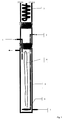
- the macroinitiator is coated by immersing the membranes in a 3% solution of the macroinitiator in acetone for 30 seconds. It is known from previous work that the monomer concentration and the reaction time have a decisive influence on the yield of the thermally initiated graft polymerization. For this reason, the apparatus shown schematically in FIG. 1 was used, which makes it possible to control the grafting yield simultaneously via the monomer concentration and the reaction time. The total volume of the reaction vessel is approximately 200 ml.
- the reaction vessel is filled with 40 ml of an aqueous acrylic acid solution (12% by mass) so that the first approx. 2 cm of the hollow fiber is immersed in this solution.
- the monomer solution is flushed with inert gas (nitrogen, argon) for about 30 minutes in order to displace the dissolved oxygen, which acts as an inhibitor.
- the heating jacket of the reaction vessel is then connected to a circulating thermostat with which the heating medium, usually water, has already been preheated to 90 ° C.
- the heating medium circulates through the heating jacket of the reaction vessel during the entire reaction time. After a reaction time of 15 minutes, oxygen-free water preheated to 90 ° C.
- the degree of grafting along the fiber axis was determined by means of ATR / FTIR spectroscopy. A quantitative comparison with IR spectra of homogeneously grafted membranes confirms the non-linear grafting.
- the grafting yields are between 7% by mass at the open ends of the membrane and 2.5% by mass in the middle of the fibers.
Landscapes
- Chemical & Material Sciences (AREA)
- Chemical Kinetics & Catalysis (AREA)
- Inorganic Chemistry (AREA)
- Engineering & Computer Science (AREA)
- Manufacturing & Machinery (AREA)
- Separation Using Semi-Permeable Membranes (AREA)
- Treatments Of Macromolecular Shaped Articles (AREA)
Applications Claiming Priority (2)
| Application Number | Priority Date | Filing Date | Title |
|---|---|---|---|
| DE10159191 | 2001-11-29 | ||
| DE10159191A DE10159191B4 (de) | 2001-11-29 | 2001-11-29 | Modifizierte Hohlfasermembranmaterialien und Verfahren zu ihrer Modifizierung |
Publications (2)
| Publication Number | Publication Date |
|---|---|
| EP1316355A2 true EP1316355A2 (fr) | 2003-06-04 |
| EP1316355A3 EP1316355A3 (fr) | 2004-12-22 |
Family
ID=7707794
Family Applications (1)
| Application Number | Title | Priority Date | Filing Date |
|---|---|---|---|
| EP02026168A Withdrawn EP1316355A3 (fr) | 2001-11-29 | 2002-11-25 | Matériaux modifiés à membranes de fibres creuses et procédé pour leur modification |
Country Status (2)
| Country | Link |
|---|---|
| EP (1) | EP1316355A3 (fr) |
| DE (1) | DE10159191B4 (fr) |
Cited By (11)
| Publication number | Priority date | Publication date | Assignee | Title |
|---|---|---|---|---|
| EP1602387A1 (fr) * | 2004-06-03 | 2005-12-07 | B. Braun Medizintechnologie GmbH | Dispositif d'elimination des lipopolysaccharides et/ou de l'acide lipoteichoique des liquides contenant des proteines ainsi que son utlilisation pour le traitement des sepsies |
| US7608189B2 (en) | 2002-12-17 | 2009-10-27 | B. Braun Medizintechnologie Gmbh | Device for removing bacterial lipopolysaccharides and/or lipoteichoic acids from protein-containing fluids and its use for the treatment of sepsis |
| CN101351337B (zh) * | 2005-12-30 | 2011-07-27 | 3M创新有限公司 | 功能性基底 |
| CN104801210A (zh) * | 2015-04-03 | 2015-07-29 | 燕山大学 | 一种乙二胺四亚甲基膦酸改性聚偏氟乙烯分离膜的制备方法 |
| CN106890577A (zh) * | 2017-03-14 | 2017-06-27 | 天津工业大学 | 一种抗污染抗凝血pvdf膜的制备方法 |
| CN111249930A (zh) * | 2018-11-30 | 2020-06-09 | 恩特格里斯公司 | 具有侧链亲水基的亲水滤膜与其制备及使用方法 |
| CN113600032A (zh) * | 2021-08-13 | 2021-11-05 | 中国科学院宁波材料技术与工程研究所 | 聚烯烃复合膜及其制备方法和应用 |
| CN113640431A (zh) * | 2021-09-23 | 2021-11-12 | 江西大自然制药有限公司 | 一种强力枇杷露的检测方法 |
| CN114713039A (zh) * | 2022-04-06 | 2022-07-08 | 华南理工大学 | 一种梯度疏水复合膜及其制备方法与应用 |
| CN115003406A (zh) * | 2019-08-09 | 2022-09-02 | 海德奥克赛斯控股有限公司 | 水可湿性滤膜及其制备 |
| CN115254051A (zh) * | 2022-07-12 | 2022-11-01 | 核工业北京化工冶金研究院 | 改性聚丙烯中空纤维膜及其制备方法和用途 |
Families Citing this family (1)
| Publication number | Priority date | Publication date | Assignee | Title |
|---|---|---|---|---|
| CN107824054A (zh) * | 2017-11-22 | 2018-03-23 | 广东桑海环保有限公司 | 一种反渗透膜清洗剂及其制备方法 |
Family Cites Families (7)
| Publication number | Priority date | Publication date | Assignee | Title |
|---|---|---|---|---|
| US4329434A (en) * | 1979-05-31 | 1982-05-11 | Asahi Kasei Kogyo Kabushiki Kaisha | Novel fluorinated cation exchange membrane and process for producing the same |
| JPS63229108A (ja) * | 1987-03-18 | 1988-09-26 | Mitsubishi Rayon Co Ltd | 中空糸膜の親水化処理方法 |
| US5468390A (en) * | 1992-11-23 | 1995-11-21 | Rensselaer Polytechnic Institute | Low fouling ultrafiltration and microfiltration aryl polysulfone |
| TW353086B (en) * | 1994-12-30 | 1999-02-21 | Novartis Ag | Method for multistep coating of a surface |
| DE19727554A1 (de) * | 1997-06-28 | 1999-01-07 | Huels Chemische Werke Ag | Verfahren zur Hydrophilierung der Oberfläche polymerer Substrate mit einem Makroinitiator als Primer |
| DE19809042A1 (de) * | 1997-06-28 | 1999-01-07 | Huels Chemische Werke Ag | Bioaktive Beschichtung von Oberflächen unter Verwendung von Makroinitiatoren |
| FR2797198B1 (fr) * | 1999-08-04 | 2002-05-03 | Tami Ind | Membrane pour filtration tangentielle et son procede de fabrication |
-
2001
- 2001-11-29 DE DE10159191A patent/DE10159191B4/de not_active Expired - Fee Related
-
2002
- 2002-11-25 EP EP02026168A patent/EP1316355A3/fr not_active Withdrawn
Cited By (16)
| Publication number | Priority date | Publication date | Assignee | Title |
|---|---|---|---|---|
| US7608189B2 (en) | 2002-12-17 | 2009-10-27 | B. Braun Medizintechnologie Gmbh | Device for removing bacterial lipopolysaccharides and/or lipoteichoic acids from protein-containing fluids and its use for the treatment of sepsis |
| EP1602387A1 (fr) * | 2004-06-03 | 2005-12-07 | B. Braun Medizintechnologie GmbH | Dispositif d'elimination des lipopolysaccharides et/ou de l'acide lipoteichoique des liquides contenant des proteines ainsi que son utlilisation pour le traitement des sepsies |
| CN101351337B (zh) * | 2005-12-30 | 2011-07-27 | 3M创新有限公司 | 功能性基底 |
| CN104801210A (zh) * | 2015-04-03 | 2015-07-29 | 燕山大学 | 一种乙二胺四亚甲基膦酸改性聚偏氟乙烯分离膜的制备方法 |
| CN104801210B (zh) * | 2015-04-03 | 2017-01-25 | 燕山大学 | 一种乙二胺四亚甲基膦酸改性聚偏氟乙烯分离膜的制备方法 |
| CN106890577A (zh) * | 2017-03-14 | 2017-06-27 | 天津工业大学 | 一种抗污染抗凝血pvdf膜的制备方法 |
| CN106890577B (zh) * | 2017-03-14 | 2019-09-20 | 天津工业大学 | 一种抗污染抗凝血pvdf膜的制备方法 |
| CN111249930A (zh) * | 2018-11-30 | 2020-06-09 | 恩特格里斯公司 | 具有侧链亲水基的亲水滤膜与其制备及使用方法 |
| CN111249930B (zh) * | 2018-11-30 | 2024-04-05 | 恩特格里斯公司 | 具有侧链亲水基的亲水滤膜与其制备及使用方法 |
| CN115003406A (zh) * | 2019-08-09 | 2022-09-02 | 海德奥克赛斯控股有限公司 | 水可湿性滤膜及其制备 |
| CN113600032A (zh) * | 2021-08-13 | 2021-11-05 | 中国科学院宁波材料技术与工程研究所 | 聚烯烃复合膜及其制备方法和应用 |
| CN113600032B (zh) * | 2021-08-13 | 2024-04-09 | 中国科学院宁波材料技术与工程研究所 | 聚烯烃复合膜及其制备方法和应用 |
| CN113640431A (zh) * | 2021-09-23 | 2021-11-12 | 江西大自然制药有限公司 | 一种强力枇杷露的检测方法 |
| CN114713039A (zh) * | 2022-04-06 | 2022-07-08 | 华南理工大学 | 一种梯度疏水复合膜及其制备方法与应用 |
| CN114713039B (zh) * | 2022-04-06 | 2024-01-05 | 华南理工大学 | 一种梯度疏水复合膜及其制备方法与应用 |
| CN115254051A (zh) * | 2022-07-12 | 2022-11-01 | 核工业北京化工冶金研究院 | 改性聚丙烯中空纤维膜及其制备方法和用途 |
Also Published As
| Publication number | Publication date |
|---|---|
| DE10159191A1 (de) | 2003-06-12 |
| EP1316355A3 (fr) | 2004-12-22 |
| DE10159191B4 (de) | 2006-05-11 |
Similar Documents
| Publication | Publication Date | Title |
|---|---|---|
| DE69719632T2 (de) | Membranen aus Polysulfon-Copolymer und Verfahren | |
| DE69207020T2 (de) | Poröse Hohlfasermembran aus Polypropylen und ihrere Herstellung | |
| DE60125560T2 (de) | Uv-unterstützes aufpfropfen von pes-membranen | |
| EP0186758B2 (fr) | Membrane poreuse avec surface hydrophile et procédé de sa fabrication | |
| EP0527992B1 (fr) | Procede de modification de la surface des membranes microporeuses, objets moules ainsi obtenus et leur utilisation pour la separation de substances par adsorption | |
| DE69117175T2 (de) | Poröse hohlfasermembran aus polyethylen und ihre herstellung | |
| EP0772488B1 (fr) | Membrane composite poreuse et son procede de fabrication | |
| DE69012912T2 (de) | Membran mit einer hydrophilen Oberfläche. | |
| DE69010766T2 (de) | Hydrophobe Membranen. | |
| DE3784410T2 (de) | Permeable, poroese polymermembran mit hydrophilen eigenschaften, verfahren zu ihrer herstellung und ihre anwendung. | |
| DE10159191B4 (de) | Modifizierte Hohlfasermembranmaterialien und Verfahren zu ihrer Modifizierung | |
| EP0887369B1 (fr) | Procédé pour hydrophiliser les surfaces de substrats polymères en utilisant un macroinitiateur primaire | |
| DE60106777T2 (de) | Modifiziertes polymer mit verbesserten eigenschaften und verfahren zu seiner herstellung | |
| EP0814116A1 (fr) | Revêtement hydrophilique de surfaces de substrats polymères | |
| DE69023650T2 (de) | Verfahren zur behandlung eines porösen substrats zwecks erhaltung von verbesserten wasser- und ölabweisenden eigenschaften. | |
| US4717479A (en) | Hydrophilized porous polyolefin membrane and production process thereof | |
| DE2236663A1 (de) | Vernetzte interpolymermembran mit fixierter ladung und verfahren zu deren herstellung | |
| DE2638065A1 (de) | Verfahren zur herstellung von semipermeablen membranen | |
| US5814372A (en) | Process for forming porous composite membrane | |
| JP7292742B2 (ja) | 非対称複合膜およびその調製に使用される修飾された基質 | |
| EP1390126B1 (fr) | Procede de reduction de la propension a l'adsorption de molecules ou de cellules biologiques sur une surface de materiau | |
| DE69204991T2 (de) | Hitzebeständige poröse Membran, hydrophilisierte hitzebeständige poröse Membran und Verfahren zu ihrer Herstellung. | |
| DE19700079A1 (de) | Verfahren zur Herstellung hydrophilen Beschichtungen auf polymeren Substraten | |
| DE10053555A1 (de) | Verfahren zur Erhöhung der Heißdampfstabilität polymerer Substrate und damit erhaltene Werkstücke | |
| JPS63229108A (ja) | 中空糸膜の親水化処理方法 |
Legal Events
| Date | Code | Title | Description |
|---|---|---|---|
| PUAI | Public reference made under article 153(3) epc to a published international application that has entered the european phase |
Free format text: ORIGINAL CODE: 0009012 |
|
| AK | Designated contracting states |
Designated state(s): AT BE BG CH CY CZ DE DK EE ES FI FR GB GR IE IT LI LU MC NL PT SE SK TR |
|
| AX | Request for extension of the european patent |
Extension state: AL LT LV MK RO SI |
|
| PUAL | Search report despatched |
Free format text: ORIGINAL CODE: 0009013 |
|
| AK | Designated contracting states |
Kind code of ref document: A3 Designated state(s): AT BE BG CH CY CZ DE DK EE ES FI FR GB GR IE IT LI LU MC NL PT SE SK TR |
|
| AX | Request for extension of the european patent |
Extension state: AL LT LV MK RO SI |
|
| RAP1 | Party data changed (applicant data changed or rights of an application transferred) |
Owner name: LEIBNIZ-INSTITUT FUER POLYMERFORSCHUNG DRESDEN E.V |
|
| 17P | Request for examination filed |
Effective date: 20050525 |
|
| AKX | Designation fees paid |
Designated state(s): AT BE BG CH CY CZ DE DK EE ES FI FR GB GR IE IT LI LU MC NL PT SE SK TR |
|
| GRAP | Despatch of communication of intention to grant a patent |
Free format text: ORIGINAL CODE: EPIDOSNIGR1 |
|
| STAA | Information on the status of an ep patent application or granted ep patent |
Free format text: STATUS: THE APPLICATION IS DEEMED TO BE WITHDRAWN |
|
| 18D | Application deemed to be withdrawn |
Effective date: 20080401 |