EP1324741B1 - Verfahren zum färben von keratinhaltigen fasern - Google Patents
Verfahren zum färben von keratinhaltigen fasern Download PDFInfo
- Publication number
- EP1324741B1 EP1324741B1 EP01983540A EP01983540A EP1324741B1 EP 1324741 B1 EP1324741 B1 EP 1324741B1 EP 01983540 A EP01983540 A EP 01983540A EP 01983540 A EP01983540 A EP 01983540A EP 1324741 B1 EP1324741 B1 EP 1324741B1
- Authority
- EP
- European Patent Office
- Prior art keywords
- sub
- alkyl
- phenyl
- substituted
- hydrogen
- Prior art date
- Legal status (The legal status is an assumption and is not a legal conclusion. Google has not performed a legal analysis and makes no representation as to the accuracy of the status listed.)
- Expired - Lifetime
Links
Classifications
-
- A—HUMAN NECESSITIES
- A61—MEDICAL OR VETERINARY SCIENCE; HYGIENE
- A61K—PREPARATIONS FOR MEDICAL, DENTAL OR TOILETRY PURPOSES
- A61K8/00—Cosmetics or similar toiletry preparations
- A61K8/18—Cosmetics or similar toiletry preparations characterised by the composition
- A61K8/30—Cosmetics or similar toiletry preparations characterised by the composition containing organic compounds
- A61K8/49—Cosmetics or similar toiletry preparations characterised by the composition containing organic compounds containing heterocyclic compounds
-
- A—HUMAN NECESSITIES
- A61—MEDICAL OR VETERINARY SCIENCE; HYGIENE
- A61Q—SPECIFIC USE OF COSMETICS OR SIMILAR TOILETRY PREPARATIONS
- A61Q5/00—Preparations for care of the hair
- A61Q5/06—Preparations for styling the hair, e.g. by temporary shaping or colouring
- A61Q5/065—Preparations for temporary colouring the hair, e.g. direct dyes
-
- A—HUMAN NECESSITIES
- A61—MEDICAL OR VETERINARY SCIENCE; HYGIENE
- A61K—PREPARATIONS FOR MEDICAL, DENTAL OR TOILETRY PURPOSES
- A61K8/00—Cosmetics or similar toiletry preparations
- A61K8/18—Cosmetics or similar toiletry preparations characterised by the composition
- A61K8/30—Cosmetics or similar toiletry preparations characterised by the composition containing organic compounds
- A61K8/49—Cosmetics or similar toiletry preparations characterised by the composition containing organic compounds containing heterocyclic compounds
- A61K8/494—Cosmetics or similar toiletry preparations characterised by the composition containing organic compounds containing heterocyclic compounds with more than one nitrogen as the only hetero atom
- A61K8/4946—Imidazoles or their condensed derivatives, e.g. benzimidazoles
-
- A—HUMAN NECESSITIES
- A61—MEDICAL OR VETERINARY SCIENCE; HYGIENE
- A61Q—SPECIFIC USE OF COSMETICS OR SIMILAR TOILETRY PREPARATIONS
- A61Q5/00—Preparations for care of the hair
- A61Q5/10—Preparations for permanently dyeing the hair
-
- C—CHEMISTRY; METALLURGY
- C09—DYES; PAINTS; POLISHES; NATURAL RESINS; ADHESIVES; COMPOSITIONS NOT OTHERWISE PROVIDED FOR; APPLICATIONS OF MATERIALS NOT OTHERWISE PROVIDED FOR
- C09B—ORGANIC DYES OR CLOSELY-RELATED COMPOUNDS FOR PRODUCING DYES, e.g. PIGMENTS; MORDANTS; LAKES
- C09B44/00—Azo dyes containing onium groups
- C09B44/10—Azo dyes containing onium groups containing cyclammonium groups attached to an azo group by a carbon atom of the ring system
- C09B44/16—1,3-Diazoles or hydrogenated 1,3-diazoles ; (Benz)imidazolium
Definitions
- the present invention relates to a method of dyeing keratin-containing fibres, especially human hair, using cationic imidazole azo dyes.
- Cationic imidazole azo dyes and the use thereof for dyeing hair are already known, for example, from WO 95/01772 and EP-A-714 954.
- Such dyes are especially suitable for dyeing undamaged hair, since they are capable of penetrating into the hair shaft relatively easily on account of their low molecular weight. They also exhibit good fastness to washing on undamaged hair, but are washed out of severely damaged (bleached) hair relatively easily.
- C.A. 86 , 1977 no. 191316 discloses azo and cationic azo dyes with 2-amino-4,5-dicyanoimidazole wich are useful for acetate fibers and acrylic fibers.
- the dyes of formula (1) hereinbelow are especially suitable for dyeing hair and that the dyeings obtained are distinguished especially by good fastness to washing properties.
- the present invention accordingly relates to a method of dyeing keratin-containing fibres, which comprises using a dye of formula wherein
- alkyl radicals are to be understood generally as straight-chain or branched alkyl radicals, for example methyl, ethyl, n- and iso-propyl and n-, sec-and tert-butyl.
- alkyl radicals and also the cycloalkyl groups may be mono- or poly-substituted, for example by hydroxy, carboxy, halogen, cyano or C 1 -C 4 alkoxy.
- the alkoxy radicals may contain from 1 to 12 carbon atoms, preferably from 1 to 4 carbon atoms. They are, for example, methoxy, ethoxy, propoxy, isopropoxy, n-butoxy, isobutoxy, tert-butoxy, n-pentyloxy or n-hexyloxy.
- the alkoxy groups may be substituted, for example by the radicals mentioned as possible substituents for the alkyl groups, especially by hydroxy or C 1 -C 4 alkoxy.
- Suitable anions X - include both inorganic and organic anions, for example halide, such as chloride, bromide or iodide, sulfate, hydrogen sulfate, methyl sulfate, boron tetrafluoride, aminosulfonate, perchlorate, carbonate, bicarbonate, phosphate, nitrate, benzenesulfonate, formate, acetate, propionate, lactate, and complex anions, such as the anion of a zinc chloride double salt.
- halide such as chloride, bromide or iodide
- sulfate hydrogen sulfate, methyl sulfate, boron tetrafluoride
- aminosulfonate perchlorate
- carbonate bicarbonate
- phosphate, nitrate benzenesulfonate
- formate formate
- acetate propionate
- lactate lactate
- the anion is generally predetermined by the preparation process.
- chlorides, hydrogen sulfates, sulfates, methosulfates, phosphates, formates, lactates or acetates are present.
- Halogen is to be understood as fluorine, bromine or iodine or, especially, chlorine.
- Each of R 1 and R 2 is preferably methyl and especially hydrogen.
- R 3 and R 4 is preferably ethyl, hydroxyethyl or especially methyl.
- Each of X 1 and X 2 is preferably methoxy, methyl, chlorine or especially hydrogen.
- R 5 is preferably hydrogen, methyl or ethyl, especially hydrogen or methyl.
- R 5 is hydrogen.
- C 5 -C 12 Alkyl radicals R 6 are preferably corresponding unsubstituted alkyl radicals, especially C 5 -C 8 alkyl radicals and preferably C 6 -C 8 alkyl radicals.
- Cycloalkyl radicals R 6 are preferably corresponding unsubstituted cycloalkyl radicals, especially cyclohexyl radicals.
- R 6 is preferably phenyl-substituted or cyclohexyl-substituted C 1 -C 4 alkyl, especially phenyl-substituted C 1 -C 4 alkyl.
- piperazine rings formed by R 5 and R 6 together with the nitrogen atom linking them preference is given to those which are substituted, at the nitrogen atom that is not bonded to the phenyl group, by C 1 -C 8 alkyl, especially C 1 -C 4 alkyl, or by phenyl.
- R 6 is especially preferably C 5 -C 8 alkyl; or cyclohexyl; or phenyl-substituted C 1 -C 4 alkyl, like benzyl; or R 5 and R 6 together with the nitrogen atom linking them form a piperazine ring which is substituted, at the nitrogen atom that is not bonded to the phenyl group, by C 1 -C 4 alkyl or phenyl.
- Especially preferred dyes used according to the invention are those of formula wherein
- R 6 ' is especially preferably C 5 -C 8 alkyl, phenyl-substituted C 1 -C 8 alkyl or C 5 -C 8 cycloalkyl.
- the invention relates also to the compounds of formula (3).
- the dyes of formula (1) can be prepared according to methods known per se (see e.g. EP-A-714 954).
- the dyes of formula (1) can be obtained, for example, by reacting a compound of formula with an amine of formula HN(R 5 )R 6 (5), wherein the substituents have the definitions and preferred meanings indicated above.
- compounds of formula (4) those compounds which, instead of the methoxy group indicated, contain halogen, e.g. chlorine, or C 2 -C 4 alkoxy.
- the compounds of formulae (4) and (5) are known or can be prepared in a manner known per se.
- the compounds of formula (4) can be obtained by diazotising 4-alkoxyanilines, coupling the product with an imidazole and then carrying out alkylation and quaternisation.
- the reaction of a compound of formula (4) with an amine of formula (5) can be carried out, for example, at a temperature of about from 40 to 100°C, preferably from 40 to 70°C, optionally under pressure and/or in an inert gas atmosphere, and in an Inert solvent, e.g. in water or especially aliphatic alcohols, e.g. C 1 -C 8 alcohols, such as methanol, ethanol or especially isopropanol. It is also possible to carry out the reaction in aprotic polar solvents, such as dimethylformamide or dimethyl sulfoxide. In the case of amines that are liquid under the reaction conditions, it is possible, if desired, to dispense with a solvent.
- the compounds of formula (1) are present in the compositions according to the invention preferably in an amount of from 0.001 % to 5 %, especially from 0,01 % to 1 %, based on the total dyeing composition.
- the diversity of shades and the colour fastness of the dyes of formula (1) used in accordance with the invention can be increased by combination with other dyes used in the field of hair-dyeing compositions. They can be combined very readily both with oxidation dyes and with direct dyes, it being possible for the latter to be of cationic nature or also uncharged. Only in the case of anionic direct dyes is a certain degree of caution required, since precipitation may possibly occur in the formulation.
- the dyes of formula (1) according to the invention produce colour shades in the range from yellowish-red to bluish-red, and the fastness properties are excellent. Attention is drawn to the property thereof that enables hair that has already been dyed a dark colour still to be distinctly altered in shade.
- the dyes are distinguished by a good storage stability also at alkaline pH values, e.g. pH 9.5.
- dyes of formula (1) in admixture with one or more further cationic dyes, for example in mixtures comprising a dye of formula (1) and at least one of the dyes described in WO 95/01772.
- one, two, three or even more dyes from WO 95/01772 may be used.
- dyes there may be mentioned as examples of such dyes the yellow dye according to Example 1, the red dye according to Example 4 and the orange dye according to Example 46 of WO 95/01772.
- dye mixtures comprising a dye of formula (1) and the yellow dye according to Example 1 and/or the red dye according to Example 4 and/or the orange dye according to Example 46 of WO 95/01772.
- the dyeing compositions according to the invention comprise, in addition to the dyes of formula (1) according to the invention, customary direct dyes, for example from the group of the nitroanilines, nitrophenylenediamines, nitroaminophenols, anthraquinones, indophenols, phenazines, phenothiazines, methines or the compounds known as Arianors, such as, for example, the compounds known by the international names or trade names HC Yellow 2, HC Yellow 4, HC Yellow 6, Basic Yellow 57, Basic Yellow 9, Disperse Orange 3, HC Red 3, HC Red BN, Basic Red 76, Basic Red 2, Basic Violet 14, Basic Blue 3, Basic Blue 6, Basic Blue 7, Basic Blue 9, Basic Blue 12, Basic Blue 26, HC Blue 2, HC Blue 7, HC Blue 12, Disperse Blue 3, Basic Blue 99, HC Violet 1, Disperse Violet 1, Disperse Violet 4, Disperse Black 9, Basic Brown 16 und Basic Brown 17, and also picramic acid, 2-amino-6
- cationised nitroaniline and anthraquinone dyes for example those described in the following patent specifications: US-5 298 029, especially in column 2, line 33 to column 5, line 38; US-5 360 930, especially in column 2, line 38 to column 5, line 49; US-5 169 403, especially in column 2, line 30 to column 5, line 38; US-5 256 823, especially in column 4, line 23 to column 5, line 15; US-5 135 543, especially in column 4, line 24 to column 5, line 16; EP-A-818 193, especially on page 2, line 40 to page 3, line 26; US-5 486 629, especially in column 2, line 34 to column 5, line 29; and EP-A-758 547, especially on page 7, line 48 to page 8, line 19.
- cationic azo dyes e.g. according to GB-A-2 319 776, as well as the oxazine dyes described in DE-A-299 12 327 and mixtures thereof with the other direct dyes mentioned therein, are likewise very suitable for combination.
- compositions of the invention according to this embodiment contain the dyes preferably in an amount of from 0.01 to 5 % by weight, based on the total dyeing composition.
- the dyeing compositions according to the invention may also comprise naturally occurring dyes, such as, for example, henna red, henna neutral, henna black, camomile blossom, sandalwood, black tea, Rhamnus frangula bark, sage, campeche wood, madder root, catechu, sedre and alkanet root.
- Naturally occurring dyes such as, for example, henna red, henna neutral, henna black, camomile blossom, sandalwood, black tea, Rhamnus frangula bark, sage, campeche wood, madder root, catechu, sedre and alkanet root.
- oxidation dye precursors where present, or for the dyes each to be single compounds, but rather there may in addition be present in the dyeing compositions according to the invention, in lesser amounts, further components predetermined by the preparation processes for the individual dyes, provided such components do not have an adverse effect on the dyeing result or do not need to be excluded for other reasons, for example on toxicological grounds.
- the dyes of formula (1) according to the invention may also readily be used in combination with other dyes and/or adjuvants used in the colouring of hair, for example with
- the dyeing compositions according to the invention produce intense dyeings even at physiologically tolerable temperatures of less than 45°C. They are accordingly suitable especially for dyeing human hair.
- the dyeing compositions can usually be incorporated into an aqueous cosmetic carrier.
- Suitable aqueous cosmetic carriers include, for example, creams, emulsions, gels and also surfactant-containing foaming solutions, e.g. shampoos or other preparations, that are suitable for use on keratin-containing fibres. Such forms of use are described in detail in Research Disclosure 42448 (August 1999).
- the dyeing compositions according to the invention are also excellently suitable for the dyeing method described in DE-A-3 829 870 using a dyeing comb or a dyeing brush.
- the dyeing compositions according to the invention may furthermore comprise any active ingredient, additive or adjuvant known for such preparations.
- the dyeing compositions in many cases comprise at least one surfactant, there being suitable in principle anionic and also zwitterionic, ampholytic, non-ionic and cationic surfactants. In many cases, however, it has proved advantageous to select the surfactants from anionic, zwitterionic and non-ionic surfactants.
- Anionic surfactants suitable for use in the preparations according to the invention include any anionic surface-active substance that is suitable for use on the human body. Such a substance is characterised by an anionic group that imparts water solubility, for example a carboxylate, sulfate, sulfonate or phosphate group, and a lipophilic alkyl group having approximately from 10 to 22 carbon atoms.
- an anionic group that imparts water solubility for example a carboxylate, sulfate, sulfonate or phosphate group, and a lipophilic alkyl group having approximately from 10 to 22 carbon atoms.
- glycol or polyglycol ether groups, ester, ether and amide groups and also hydroxy groups may be present in the molecule.
- suitable anionic surfactants each in the form of sodium, potassium or ammonium salts or mono-, di- or tri-alkanolammonium salts having 2 or 3 carbon atoms in the alkanol group:
- Preferred anionic surfactants are alkyl sulfates, alkyl polyglycol ether sulfates and ether carboxylic acids having from 10 to 18 carbon atoms in the alkyl group and up to 12 glycol ether groups in the molecule, and also especially salts of saturated and especially unsaturated C 8 -C 22 carboxylic acids, such as oleic acid, stearic acid, isostearic acid and palmitic acid.
- zwitterionic surfactants denotes surface-active compounds that carry at least one quaternary ammonium group and at least one -COO (-) or -SO 3 (-) group in the molecule.
- Zwitterionic surfactants that are especially suitable are the so-called betaines, such as the N-alkyl-N,N-dimethylammonium glycinates, for example cocoalkyldimethylammonium glycinate, N-acylaminopropyl-N,N-dimethylammonium glycinates, for example cocoacylaminopropyldimethylammonium glycinate, and 2-alkyl-3-carboxymethyl-3-hydroxyethylimidazolines having from 8 to 18 carbon atoms in the alkyl or acyl group and also cocoacylaminoethylhydroxyethylcarboxymethyl glycinate.
- a preferred zwitterionic surfactant is the fatty acid amide derivative known
- Ampholytic surfactants are to be understood as meaning surface-active compounds that, in addition to a C 8 -C 18 -alkyl or -acyl group, contain at least one free amino group and at least one -COOH or -SO 3 H group in the molecule and are capable of forming internal salts.
- ampholytic surfactants include N-alkylglycines, N-alkylpropionic acids, N-alkylaminobutyric acids, N-alkyliminodipropionic acids, N-hydroxyethyl-N-alkylamidopropylglycines, N-alkyltaurines, N-alkylsarcosines, 2-alkylaminopropionic acids and alkylaminoacetic acids, each having approximately from 8 to 18 carbon atoms in the alkyl group.
- Ampholytic surfactants to which special preference is given are N-cocoalkylaminopropionate, cocoacylaminoethylaminopropionate and C 12 -C 18 acylsarcosine.
- Non-ionic surfactants contain as the hydrophilic group, for example, a polyol group, a polyalkylene glycol ether group or a combination of polyol and polyglycol ether groups.
- Such compounds are, for example:
- ammonium halides such as alkyltrimethylammonium chlorides, dialkyldimethylammonium chlorides and trialkylmethylammonium chlorides, for example cetyltrimethylammonium chloride, stearyltrimethylammonium chloride, distearyldimethylammonium chloride, lauryldimethylammonium chloride, lauryldimethylbenzylammonium chloride and tricetylmethylammonium chloride.
- Further cationic surfactants that can be used in accordance with the invention are quaternised protein hydrolysates.
- cationic silicone oils such as, for example, the commercially available products Q2-7224 (manufacturer: Dow Corning; a stabilised trimethylsilylamodimethicone), Dow Corning 929 emulsion (comprising a hydroxylamino-modified silicone, which is also referred to as amodimethicone), SM-2059 (manufacturer: General Electric), SLM-55067 (manufacturer: Wacker) and also Abil® -Quat 3270 and 3272 (manufacturer: Th. Goldschmidt; diquaternary polydimethylsiloxanes, quaternium-80).
- Alkylamidoamines especially fatty acid amidoamines, such as the stearylamidopropyldimethylamine obtainable under the name Tego Amid® 18, are distinguished not only by a good conditioning action but also especially by their good biodegradability.
- estersquats such as the methyl hydroxyalkyldialkoyloxyalkylammonium methosulfates marketed under the trade mark Stepantex® , are also very readily biodegradable.
- quaternary sugar derivative that can be used as cationic surfactant is the commercial product Glucquat® 100, according to CTFA nomenclature a "lauryl methyl gluceth-10 hydroxypropyl dimonium chloride".
- the alkyl-group-containing compounds used as surfactants may be single substances, but the use as starting materials of natural raw materials of vegetable or animal origin is generally preferred in the preparation of such substances, with the result that the substance mixtures obtained have different alkyl chain lengths according to the particular starting material used.
- the surfactants that are addition products of ethylene oxide and/or propylene oxide with fatty alcohols or derivatives of such addition products may either be products having a "normal” homologue distribution or products having a restricted homologue distribution.
- "Normal” homologue distribution is to be understood as meaning mixtures of homologues obtained in the reaction of fatty alcohol and alkylene oxide using alkali metals, alkali metal hydroxides or alkali metal alcoholates as catalysts.
- Restricted homologue distributions are obtained when, for example, hydrotalcites, alkali metal salts of ether carboxylic acids, alkali metal oxides, hydroxides or alcoholates are used as catalysts.
- the use of products having restricted homologue distribution may be preferred.
- constituents of the aqueous carrier are used in the preparation of the dyeing compositions according to the invention in the amounts customary for that purpose; for example emulsifiers are used in concentrations of from 0.5 to 30 % by weight and thickeners in concentrations of from 0.1 to 25 % by weight of the total dyeing composition.
- the pH value of the ready-to-use dyeing preparations is usually from 2 to 11, preferably from 5 to 10.
- the dyeing compositions are usually applied to the hair in an amount of from 50 to 100 g in the form of a mixture with the aqueous cosmetic carrier, left on the hair for approximately 30 minutes and then rinsed off or washed off with a commercially available hair shampoo.
- the compounds used according to the invention and, where used, the oxidation dye precursors may be applied to the keratin-containing fibres either simultaneously or in succession, the order in which they are applied being unimportant.
- the compounds used according to the invention and, where used, the oxidation dye precursors of the compositions according to the invention may be stored separately or together, either in a liquid to paste-like preparation (aqueous or non-aqueous) or in the form of a dry powder.
- a liquid preparation aqueous or non-aqueous
- the preparation should be substantially anhydrous in order to reduce reaction of the components.
- the reactive components are intimately mixed with one another only immediately before use. In the case of dry storage, before use a defined amount of hot (from 50 to 80°C) water is usually added and a homogeneous mixture prepared.
- a strongly alkaline 10 % solution of a non-ionic surfactant (Plantaren 2000, Henkel) is adjusted to pH 9.5 using citric acid.
- 0.1 % of the dye of formula is dissolved therein and a strand of human hair, bleached white, is treated with the dye solution at room temperature. After only a short period of time, the strand has been dyed a red shade, which is still very intense even after shampooing ten times.
- the dye also has a strong affinity for undamaged hair. In that case, too, the fastness to washing is very good.
- a 0.1 % solution of the dye according to the invention of formula in a surfactant base consisting of 10 % cocoamphoglycinate and 90 % water is applied for 20 minutes to a strand each of bleached and unbleached white human hair ("Italian white virgin" IMHAIR Ltd.), rinsed and shampooed once. Very intense, vibrant scarlet dyeings of identical shade are obtained on both qualities of hair. Surprisingly, both the colour strength and fastness to washing are excellent and very similar for both qualities of hair, which speaks for the good levelling ability of this product.
- Example 4 illustrates a method for "lightening" dyeings, as described also in WO 97/20545.
- the following dye solution is prepared:
- a dye formulation is prepared from
- 60,6 g of the educt of formula (101) is slurried in 43 g 2-propanol at room temperature. The temperature is then raised to 45-50 °C and 30,3 g of benzyl amine is added. The mixture is stirred for 20 hours for the completion of reaction. Then the reaction mass is diluted in 0.5 hours with 140 g of methyl-ethyl-ketone, cooled during 3 hours to room temperature, when crystallization occurs. The crystal suspension is separated by filtration, washed twice with 20 g methyl-ethyl-ketone, then with 20 g 2-propanol and dried under vacuum to get 53 g of a dark powder.
- 60 g of the educt of formula (101) is slurried in 45 g 2-propanol at room temperature. The temperature is then raised to 45-50 °C and 20 g of n-hexylamine is added. The mixture is stirred for 17 hours. Then the reaction mass is diluted with 140 g of methyl-ethylketone, cooled during 3 hours to room temperature, when crystallization occurs. The crystal suspension is separated by filtration, washed twice with 20 g methyl-ethylketone and dried at vacuum to get ca. 50 g of a dark powder.
Landscapes
- Life Sciences & Earth Sciences (AREA)
- Health & Medical Sciences (AREA)
- Animal Behavior & Ethology (AREA)
- General Health & Medical Sciences (AREA)
- Public Health (AREA)
- Veterinary Medicine (AREA)
- Birds (AREA)
- Epidemiology (AREA)
- Chemical & Material Sciences (AREA)
- Organic Chemistry (AREA)
- Cosmetics (AREA)
- Coloring (AREA)
- Paper (AREA)
- Pyridine Compounds (AREA)
- Polymerization Catalysts (AREA)
- Silicon Polymers (AREA)
- Plural Heterocyclic Compounds (AREA)
- Hydrogenated Pyridines (AREA)
Claims (9)
- Verfahren zum Färben von keratinhaltigen Fasern, dadurch gekennzeichnet, dass man einen Farbstoff der Formel
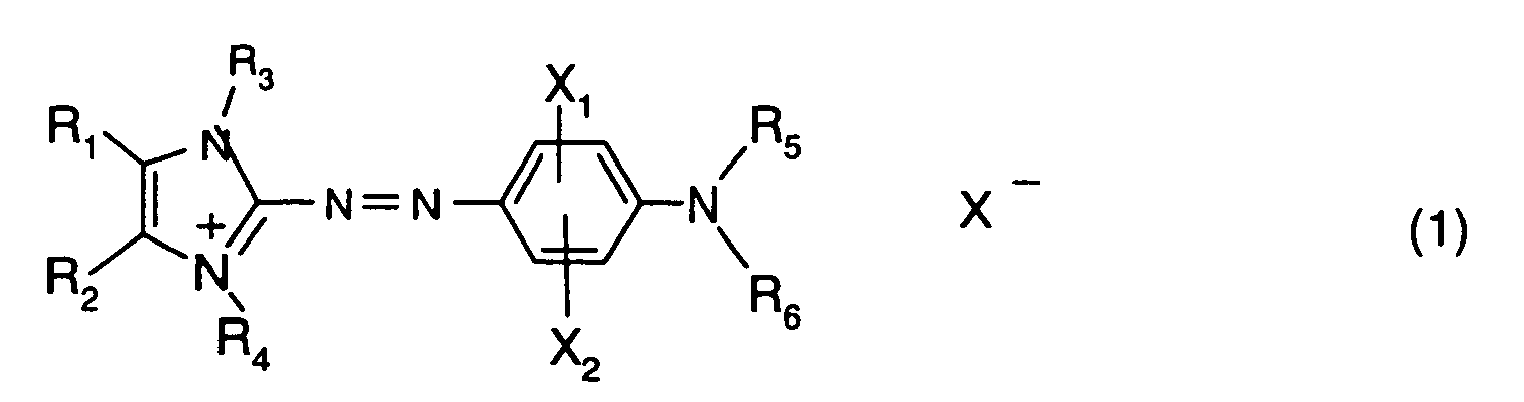 R1 und R2 unabhängig voneinander je Wasserstoff, C1-C4-Alkyl, Halogen oder Nitro,R3 und R4 unabhängig voneinander je unsubstituiertes oder durch OH, C1-C4-Alkoxy, Halogen, CN oder Phenyl substituiertes C1-C4-Alkyl,X1 und X2 unabhängig voneinander je Wasserstoff, C1-C4-Alkyl, C1-C4-Alkoxy oder Halogen, R5 Wasserstoff oder C1-C4-Alkyl,R6 unsubstituiertes oder durch OH, C1-C4-Alkoxy, Halogen, CN, oder Phenyl, substituiertes C5-C12 -Alkyl oder C5-C8-Cycloalkyl, oder durch Phenyl oder C5-C8-Cycloalkyl substituiertes C1-C4-Alkyl, bedeutet,oder worin R5 und R6 zusammen mit dem sie verbindenden N-Atom einen Piperazinring bilden, der am N-Atom, das nicht mit der Phenylgruppe verbunden ist, durch C1-C8-Alkyl oder Phenyl substituiert ist, oder der an diesem N-Atom durch 2 solcher Gruppen quaternisiert ist, wobei die als Substituenten des N-Atoms des Piperazinrings genannten C1-C8-Alkylreste unsubstituiert oder durch OH, C1-C4-Alkoxy, Halogen, CN, oder, Phenyl, substituiert sind,und worin X- ein Anion bedeutet.
 - Verfahren gemäss Anspruch 1, dadurch gekennzeichnet, dass man einen Farbstoff der Formel (1) verwendet, worin R1 und R2 je Methyl und insbesondere je Wasserstoff bedeuten.
- Verfahren gemäss einem der Ansprüche 1 und 2, dadurch gekennzeichnet, dass man einen Farbstoff der Formel (1) verwendet, worin R3 und R4 je Ethyl, Hydroxyethyl oder Methyl bedeuten.
- Verfahren gemäss einem der Ansprüche 1 bis 3, dadurch gekennzeichnet, dass man einen Farbstoff der Formel (1) verwendet, worin X1 und X2 je Methoxy, Methyl, Wasserstoff oder Chlor bedeuten.
- Verfahren gemäss Anspruch 1, dadurch gekennzeichnet, dass man einen Farbstoff der Formel
 X1 und X2 unabhängig voneinander je Wasserstoff, Methyl oder Methoxy,R5 Wasserstoff,R6 Benzyl, C6-C8-Alkyl oder Cyclohexyl ist,oder worin R5 und R6 zusammen mit dem sie verbindenden N-Atom einen Piperazinring bilden, der am nicht mit dem Phenylring verbundenen N-Atom substituiert ist durch C1-C4-Alkyl oder Phenyl, undX- ein Anion bedeutet.
 - Verfahren gemäss Anspruch 5, dadurch gekennzeichnet, dass R6 Benzyl, C6-C8-Alkyl oder Cyclohexyl, ist.
- Verfahren gemäss Anspruch 6, dadurch gekennzeichnet, dass
R6 Benzyl
bedeutet. - Verfahren gemäss Anspruch 6, dadurch gekennzeichnet, dass
R6 C6-C8-Alkyl
bedeutet. - Verfahren gemäss Anspruch 6, dadurch gekennzeichnet, dass
R6 Cyclohexyl
bedeutet.
Applications Claiming Priority (3)
| Application Number | Priority Date | Filing Date | Title |
|---|---|---|---|
| CH200600 | 2000-10-12 | ||
| CH20062000 | 2000-10-12 | ||
| PCT/EP2001/011706 WO2002030374A1 (en) | 2000-10-12 | 2001-10-10 | Method of dyeing keratin-containing fibres |
Publications (2)
| Publication Number | Publication Date |
|---|---|
| EP1324741A1 EP1324741A1 (de) | 2003-07-09 |
| EP1324741B1 true EP1324741B1 (de) | 2006-08-23 |
Family
ID=4567095
Family Applications (2)
| Application Number | Title | Priority Date | Filing Date |
|---|---|---|---|
| EP01986706A Withdrawn EP1325085A1 (de) | 2000-10-12 | 2001-10-10 | Kataionische imidazolazofarbstoffe |
| EP01983540A Expired - Lifetime EP1324741B1 (de) | 2000-10-12 | 2001-10-10 | Verfahren zum färben von keratinhaltigen fasern |
Family Applications Before (1)
| Application Number | Title | Priority Date | Filing Date |
|---|---|---|---|
| EP01986706A Withdrawn EP1325085A1 (de) | 2000-10-12 | 2001-10-10 | Kataionische imidazolazofarbstoffe |
Country Status (12)
| Country | Link |
|---|---|
| US (3) | US20030177591A1 (de) |
| EP (2) | EP1325085A1 (de) |
| JP (2) | JP2004510799A (de) |
| KR (2) | KR100843113B1 (de) |
| AT (1) | ATE337049T1 (de) |
| AU (2) | AU2002215016A1 (de) |
| BR (2) | BR0114586A (de) |
| DE (1) | DE60122545T2 (de) |
| ES (1) | ES2269481T3 (de) |
| MX (2) | MXPA03002559A (de) |
| TW (1) | TWI280147B (de) |
| WO (2) | WO2002030374A1 (de) |
Families Citing this family (46)
| Publication number | Priority date | Publication date | Assignee | Title |
|---|---|---|---|---|
| AU2002215016A1 (en) * | 2000-10-12 | 2002-04-22 | Ciba Specialty Chemicals Holding Inc. | Method of dyeing keratin-containing fibres |
| FR2825625B1 (fr) * | 2001-06-12 | 2005-06-17 | Oreal | Utilisation de composes dicationiques en teinture des fibres keratiniques humaines et compositions les contenant |
| FR2825624B1 (fr) | 2001-06-12 | 2005-06-03 | Oreal | Composition de teinture des fibres keratiniques humaines avec des colorants directs et des composes dicationiques |
| WO2003006554A1 (en) * | 2001-07-11 | 2003-01-23 | Ciba Specialty Chemicals Holding Inc. | A method of coloring hair using cationic dyes |
| KR100894973B1 (ko) * | 2001-09-24 | 2009-04-24 | 시바 홀딩 인크 | 양이온성 반응성 염료 |
| WO2003032937A1 (en) * | 2001-10-10 | 2003-04-24 | Ciba Specialty Chemicals Holding Inc. | Method of dyeing keratin-containing fibres |
| US7192453B2 (en) * | 2001-10-15 | 2007-03-20 | Ciba Specialty Chemicals Corporation | Method of coloring keratin-containing fibres using diazonium salts |
| AU2003208882A1 (en) * | 2002-02-28 | 2003-09-09 | Ciba Specialty Chemicals Holding Inc. | Process for the preparation of cationic azo compounds |
| BRPI0407817B1 (pt) * | 2003-02-25 | 2014-07-01 | Ciba Sc Holding Ag | Corante catiônico, composição compreendendo o referido corante catiônico e método de tingimento de material orgânico |
| EP1622686B1 (de) * | 2003-03-18 | 2010-01-13 | Basf Se | Kationische dimere farbstoffe |
| AU2004247892B2 (en) * | 2003-06-11 | 2009-09-17 | Basf Se | Storage-stable fluorescent whitener formulations |
| US7201779B2 (en) | 2003-06-16 | 2007-04-10 | L'oreal S.A. | Dye composition comprising at least one direct dye containing mixed chromophores |
| US7172633B2 (en) | 2003-06-16 | 2007-02-06 | L'ORéAL S.A. | Lightening dye composition comprising at least one cationic direct dye containing mixed chromophores |
| FR2855967B1 (fr) * | 2003-06-16 | 2005-09-02 | Oreal | Composition tinctoriale eclaircissante comprenant au moins un colorant direct cationique a chromophores mixtes |
| US20050125913A1 (en) | 2003-12-11 | 2005-06-16 | Saroja Narasimhan | Method and compositions for coloring hair |
| MXPA06006855A (es) * | 2003-12-19 | 2006-08-23 | Ciba Sc Holding Ag | Metodo de coloracion con compuesto diazotizado coronado y componente de acoplamiento. |
| WO2005095522A2 (en) * | 2004-04-02 | 2005-10-13 | Ciba Specialty Chemicals Holding Inc. | Cationic imidazolazo dyes containing a 2, 5-diaminophenyl moiety |
| US7326259B2 (en) * | 2004-06-23 | 2008-02-05 | L'oreal S.A. | Use of polycationic compounds in the dyeing of keratinous fibres |
| FR2872035B1 (fr) * | 2004-06-23 | 2007-11-23 | Oreal | Utilisation de composes polycationiques en teinture des fibres keratiniques |
| FR2879196B1 (fr) | 2004-12-15 | 2007-03-02 | Oreal | Composes diaz0iques symetriques a groupements 2-imidazolium et bras de liaison non cationique, compositions les comprenant, procede de coloration et dispositif |
| US7438728B2 (en) | 2004-12-15 | 2008-10-21 | L'oreal S.A. | Dissymmetrical diazo compounds comprising 2-pyridinium group and a cationic or non-cationic linker, compositions comprising them, method for coloring, and device |
| US7247713B2 (en) | 2004-12-15 | 2007-07-24 | L'oreal, S.A. | Symmetrical diazo compounds containing 2-pyridinium groups and cationic or non-cationic linker, compositions comprising them, method of coloring, and device |
| US7396368B2 (en) | 2004-12-15 | 2008-07-08 | L'oreal S.A. | Symmetrical diazo compounds comprising 4-pyridinium groups and a cationic or non-cationic linker, compositions comprising them, method for coloring, and device |
| US7288639B2 (en) | 2004-12-15 | 2007-10-30 | L'oreal S.A. | Dyssymmetrical diazo compounds having at least one 4-pyridinium unit and a cationic or non-cationic linker, compositions comprising them, method of coloring, and device |
| FR2889954B1 (fr) | 2005-08-26 | 2007-10-19 | Oreal | Colorants mixtes cationiques comprenant un chromophore anthraquinone et leur utilisation en colorant capillaire |
| US7771490B2 (en) | 2005-08-30 | 2010-08-10 | Ciba Corporation | Dyes containing a thiol group |
| JP5204766B2 (ja) | 2006-06-13 | 2013-06-05 | チバ ホールディング インコーポレーテッド | トリカチオン性染料 |
| WO2008009579A1 (en) * | 2006-07-18 | 2008-01-24 | Ciba Holding Inc. | Polymeric hair dyes |
| KR100851614B1 (ko) * | 2007-02-28 | 2008-08-12 | 로레알 | 줄롤리딘 유닛을 가지는 양이온성 아조 염료, 그를포함하는 염색용 조성물, 및 염색 방법 |
| CN101918498B (zh) * | 2008-01-17 | 2014-05-28 | 巴斯夫欧洲公司 | 聚合毛发染料 |
| PL2352482T3 (pl) * | 2008-12-05 | 2017-07-31 | Unilever N.V. | Farbowanie włókien keratynowych ze wstępnym traktowaniem obejmującym stosowanie soli żelaza i wywoływacza koloru zawierającego ulegającą hydrolizie taninę |
| BR112012000793B1 (pt) | 2009-07-15 | 2021-06-22 | Basf Se | Corante polimérico, composição, e, método de tingimento de material orgânico |
| US8641783B2 (en) | 2010-08-17 | 2014-02-04 | Basf Se | Disulfide or thiol polymeric hair dyes |
| GB201201536D0 (en) * | 2012-01-30 | 2012-03-14 | Sheedy Paul D | Method and apparatus for communicating messages to individuals |
| RU2680068C2 (ru) | 2013-09-02 | 2019-02-14 | Л'Ореаль | Способ окрашивания кератиновых волокон с применением катионных стириловых дисульфидных красителей и композиция, содержащая указанные красители |
| WO2016149493A2 (en) | 2015-03-19 | 2016-09-22 | The Procter & Gamble Company | Method for improving fastness properties of fluorescent compounds on hair |
| WO2016149491A1 (en) | 2015-03-19 | 2016-09-22 | The Procter & Gamble Company | Fluorescent compounds for treating hair |
| CN107635538A (zh) | 2015-03-19 | 2018-01-26 | 诺赛尔股份有限公司 | 使用直接染料化合物染色毛发的方法 |
| EP3270874A1 (de) * | 2015-03-19 | 2018-01-24 | Noxell Corporation | Zusammensetzungen zum färben von haar mit kationischen direktfarbstoffen |
| EP3271027A1 (de) | 2015-03-19 | 2018-01-24 | Noxell Corporation | Zusammensetzungen zum färben von haar mit kationischen direktfarbstoffen |
| US9943472B2 (en) | 2015-03-19 | 2018-04-17 | Noxell Corporation | Acid perspiration resistant fluorescent compounds for treating hair |
| US9849072B2 (en) | 2015-03-19 | 2017-12-26 | Noxell Corporation | Method of coloring hair with direct dye compounds |
| US9913791B2 (en) | 2015-03-19 | 2018-03-13 | Noxell Corporation | Method for improving acid perspiration resistance of fluorescent compounds on hair |
| US9982138B2 (en) | 2016-09-13 | 2018-05-29 | Noxell Corporation | Hair color compositions comprising stable violet-blue to blue imidazolium dyes |
| US10034823B2 (en) | 2016-09-16 | 2018-07-31 | Noxell Corporation | Method of coloring hair with washfast blue imidazolium direct dye compounds |
| US9918919B1 (en) | 2016-09-16 | 2018-03-20 | Noxell Corporation | Method of coloring hair with washfast yellow imidazolium direct dye compounds |
Family Cites Families (15)
| Publication number | Priority date | Publication date | Assignee | Title |
|---|---|---|---|---|
| CA861977A (en) * | 1971-01-26 | Miyoshi Akira | Electrical insulating means and method for making the same | |
| FR1238315A (fr) * | 1958-06-25 | 1960-08-12 | Basf Ag | Nouveaux colorants azoïques basiques cationiques et procédé pour leur production |
| US3102879A (en) * | 1958-09-30 | 1963-09-03 | Basf Ag | Production of cationic dyestuffs |
| US3173907A (en) * | 1959-11-27 | 1965-03-16 | American Cyanamid Co | Quaternized n-alkylated arylazoimidazoles |
| FR79556E (fr) * | 1960-10-28 | 1962-12-21 | Basf Ag | Nouveaux colorants azoïques basiques cationiques et procédés pour leur reproduction |
| US3649162A (en) | 1970-07-27 | 1972-03-14 | Du Pont | Biscationic monoazo dyes for acid-modified nylon |
| DE2819197A1 (de) * | 1977-05-17 | 1978-11-30 | Sandoz Ag | Organische verbindungen, deren herstellung und verwendung |
| JPS5678842A (en) * | 1979-12-03 | 1981-06-29 | Fuji Photo Film Co Ltd | Spectral sensitizer for photoconductive material and photoconductive composition |
| TW311089B (de) * | 1993-07-05 | 1997-07-21 | Ciba Sc Holding Ag | |
| DE59510884D1 (de) * | 1994-11-03 | 2004-04-29 | Ciba Sc Holding Ag | Kationische Imidazolazofarbstoffe |
| AUPN858596A0 (en) * | 1996-03-08 | 1996-04-04 | Csl Limited | Filtration of plasma precipitates using cellulose filter aid |
| FR2757387B1 (fr) * | 1996-12-23 | 1999-01-29 | Oreal | Composition de teinture d'oxydation des fibres keratiniques et procede de teinture mettant en oeuvre cette composition |
| WO1999040895A1 (en) * | 1998-02-10 | 1999-08-19 | Yamahatsu Sangyo Kaisha, Ltd. | A permanent wave agent composition having dyeing effect and method for dyeing hair using the same |
| FR2779055B1 (fr) * | 1998-05-28 | 2001-05-04 | Oreal | Composition de teinture directe pour fibres keratiniques avec un colorant direct cationique et un polyol et/ou un ether de polyol |
| AU2002215016A1 (en) * | 2000-10-12 | 2002-04-22 | Ciba Specialty Chemicals Holding Inc. | Method of dyeing keratin-containing fibres |
-
2001
- 2001-10-10 AU AU2002215016A patent/AU2002215016A1/en not_active Abandoned
- 2001-10-10 EP EP01986706A patent/EP1325085A1/de not_active Withdrawn
- 2001-10-10 DE DE60122545T patent/DE60122545T2/de not_active Expired - Lifetime
- 2001-10-10 AT AT01983540T patent/ATE337049T1/de not_active IP Right Cessation
- 2001-10-10 AU AU2002215936A patent/AU2002215936A1/en not_active Abandoned
- 2001-10-10 WO PCT/EP2001/011706 patent/WO2002030374A1/en not_active Ceased
- 2001-10-10 US US10/398,825 patent/US20030177591A1/en not_active Abandoned
- 2001-10-10 EP EP01983540A patent/EP1324741B1/de not_active Expired - Lifetime
- 2001-10-10 KR KR1020037005161A patent/KR100843113B1/ko not_active Expired - Fee Related
- 2001-10-10 BR BR0114586-0A patent/BR0114586A/pt not_active Application Discontinuation
- 2001-10-10 MX MXPA03002559A patent/MXPA03002559A/es active IP Right Grant
- 2001-10-10 WO PCT/EP2001/011708 patent/WO2002031056A1/en not_active Ceased
- 2001-10-10 MX MXPA03003042 patent/MX239064B/es active IP Right Grant
- 2001-10-10 JP JP2002533819A patent/JP2004510799A/ja active Pending
- 2001-10-10 KR KR1020037005067A patent/KR100832255B1/ko not_active Expired - Fee Related
- 2001-10-10 ES ES01983540T patent/ES2269481T3/es not_active Expired - Lifetime
- 2001-10-10 US US10/398,823 patent/US6762287B2/en not_active Expired - Fee Related
- 2001-10-10 BR BR0114585-1A patent/BR0114585A/pt not_active Application Discontinuation
- 2001-10-10 JP JP2002534430A patent/JP2004511609A/ja active Pending
- 2001-10-11 TW TW090125069A patent/TWI280147B/zh not_active IP Right Cessation
-
2005
- 2005-09-27 US US11/235,912 patent/US7189268B2/en not_active Expired - Fee Related
Non-Patent Citations (1)
| Title |
|---|
| CHEMICAL ABSTRACTS, vol. 86, 1977, Columbus, Ohio, US; abstract no. 191316 * |
Also Published As
| Publication number | Publication date |
|---|---|
| EP1324741A1 (de) | 2003-07-09 |
| US6762287B2 (en) | 2004-07-13 |
| KR100843113B1 (ko) | 2008-07-02 |
| TWI280147B (en) | 2007-05-01 |
| KR100832255B1 (ko) | 2008-05-28 |
| ATE337049T1 (de) | 2006-09-15 |
| AU2002215016A1 (en) | 2002-04-22 |
| ES2269481T3 (es) | 2007-04-01 |
| KR20030041163A (ko) | 2003-05-23 |
| JP2004510799A (ja) | 2004-04-08 |
| DE60122545T2 (de) | 2007-10-04 |
| DE60122545D1 (de) | 2006-10-05 |
| KR20030036914A (ko) | 2003-05-09 |
| MXPA03003042A (es) | 2003-07-14 |
| US7189268B2 (en) | 2007-03-13 |
| BR0114586A (pt) | 2003-08-26 |
| EP1325085A1 (de) | 2003-07-09 |
| MX239064B (es) | 2006-07-31 |
| US20060026776A1 (en) | 2006-02-09 |
| BR0114585A (pt) | 2003-08-26 |
| AU2002215936A1 (en) | 2002-04-22 |
| US20030177591A1 (en) | 2003-09-25 |
| MXPA03002559A (es) | 2003-06-30 |
| JP2004511609A (ja) | 2004-04-15 |
| US20040049020A1 (en) | 2004-03-11 |
| WO2002030374A1 (en) | 2002-04-18 |
| WO2002031056A1 (en) | 2002-04-18 |
Similar Documents
| Publication | Publication Date | Title |
|---|---|---|
| EP1324741B1 (de) | Verfahren zum färben von keratinhaltigen fasern | |
| EP1261666B1 (de) | Verfahren zur färbung von haaren unter verwendung von kationischen farbstoffen | |
| US20040244127A1 (en) | Cationic reactive dyes | |
| EP1622686B1 (de) | Kationische dimere farbstoffe | |
| EP1448156B1 (de) | Verfahren zur färbung von keratinhaltigen fasern | |
| EP1478696B1 (de) | Verfahren zur herstellung von kationischen azoverbindungen | |
| MXPA05009050A (es) | Colorantes cationicos, su produccion y uso. | |
| US20040083560A1 (en) | Method of clouring porous material | |
| US20040143913A1 (en) | Method of coloring hair using cationic dyes | |
| AU2002253086A1 (en) | Method of colouring porous material | |
| EP1635778A2 (de) | Haarfärbemethode, beinhaltend die reaktion einer geschützten diazoverbindung mit dem haar, sowie entsprechende zusammensetzungen und verbindungen |
Legal Events
| Date | Code | Title | Description |
|---|---|---|---|
| PUAI | Public reference made under article 153(3) epc to a published international application that has entered the european phase |
Free format text: ORIGINAL CODE: 0009012 |
|
| 17P | Request for examination filed |
Effective date: 20030317 |
|
| AK | Designated contracting states |
Designated state(s): AT BE CH CY DE DK ES FI FR GB GR IE IT LI LU MC NL PT SE TR |
|
| AX | Request for extension of the european patent |
Extension state: AL LT LV MK RO SI |
|
| 17Q | First examination report despatched |
Effective date: 20050318 |
|
| GRAP | Despatch of communication of intention to grant a patent |
Free format text: ORIGINAL CODE: EPIDOSNIGR1 |
|
| RIC1 | Information provided on ipc code assigned before grant |
Ipc: A61Q 5/10 20060101ALI20060301BHEP Ipc: A61Q 5/06 20060101AFI20060301BHEP Ipc: A61K 8/49 20060101ALI20060301BHEP |
|
| GRAS | Grant fee paid |
Free format text: ORIGINAL CODE: EPIDOSNIGR3 |
|
| GRAA | (expected) grant |
Free format text: ORIGINAL CODE: 0009210 |
|
| AK | Designated contracting states |
Kind code of ref document: B1 Designated state(s): AT BE CH CY DE DK ES FI FR GB GR IE IT LI LU MC NL PT SE TR |
|
| PG25 | Lapsed in a contracting state [announced via postgrant information from national office to epo] |
Ref country code: IT Free format text: LAPSE BECAUSE OF FAILURE TO SUBMIT A TRANSLATION OF THE DESCRIPTION OR TO PAY THE FEE WITHIN THE PRESCRIBED TIME-LIMIT;WARNING: LAPSES OF ITALIAN PATENTS WITH EFFECTIVE DATE BEFORE 2007 MAY HAVE OCCURRED AT ANY TIME BEFORE 2007. THE CORRECT EFFECTIVE DATE MAY BE DIFFERENT FROM THE ONE RECORDED. Effective date: 20060823 Ref country code: FI Free format text: LAPSE BECAUSE OF FAILURE TO SUBMIT A TRANSLATION OF THE DESCRIPTION OR TO PAY THE FEE WITHIN THE PRESCRIBED TIME-LIMIT Effective date: 20060823 Ref country code: BE Free format text: LAPSE BECAUSE OF FAILURE TO SUBMIT A TRANSLATION OF THE DESCRIPTION OR TO PAY THE FEE WITHIN THE PRESCRIBED TIME-LIMIT Effective date: 20060823 Ref country code: AT Free format text: LAPSE BECAUSE OF FAILURE TO SUBMIT A TRANSLATION OF THE DESCRIPTION OR TO PAY THE FEE WITHIN THE PRESCRIBED TIME-LIMIT Effective date: 20060823 Ref country code: NL Free format text: LAPSE BECAUSE OF FAILURE TO SUBMIT A TRANSLATION OF THE DESCRIPTION OR TO PAY THE FEE WITHIN THE PRESCRIBED TIME-LIMIT Effective date: 20060823 |
|
| REG | Reference to a national code |
Ref country code: GB Ref legal event code: FG4D |
|
| PGFP | Annual fee paid to national office [announced via postgrant information from national office to epo] |
Ref country code: CH Payment date: 20060828 Year of fee payment: 6 |
|
| REG | Reference to a national code |
Ref country code: CH Ref legal event code: EP |
|
| REG | Reference to a national code |
Ref country code: IE Ref legal event code: FG4D |
|
| REF | Corresponds to: |
Ref document number: 60122545 Country of ref document: DE Date of ref document: 20061005 Kind code of ref document: P |
|
| PG25 | Lapsed in a contracting state [announced via postgrant information from national office to epo] |
Ref country code: IE Free format text: LAPSE BECAUSE OF NON-PAYMENT OF DUE FEES Effective date: 20061010 |
|
| PG25 | Lapsed in a contracting state [announced via postgrant information from national office to epo] |
Ref country code: MC Free format text: LAPSE BECAUSE OF NON-PAYMENT OF DUE FEES Effective date: 20061031 |
|
| PG25 | Lapsed in a contracting state [announced via postgrant information from national office to epo] |
Ref country code: DK Free format text: LAPSE BECAUSE OF FAILURE TO SUBMIT A TRANSLATION OF THE DESCRIPTION OR TO PAY THE FEE WITHIN THE PRESCRIBED TIME-LIMIT Effective date: 20061123 Ref country code: SE Free format text: LAPSE BECAUSE OF FAILURE TO SUBMIT A TRANSLATION OF THE DESCRIPTION OR TO PAY THE FEE WITHIN THE PRESCRIBED TIME-LIMIT Effective date: 20061123 |
|
| PG25 | Lapsed in a contracting state [announced via postgrant information from national office to epo] |
Ref country code: PT Free format text: LAPSE BECAUSE OF FAILURE TO SUBMIT A TRANSLATION OF THE DESCRIPTION OR TO PAY THE FEE WITHIN THE PRESCRIBED TIME-LIMIT Effective date: 20070124 |
|
| NLV1 | Nl: lapsed or annulled due to failure to fulfill the requirements of art. 29p and 29m of the patents act | ||
| ET | Fr: translation filed | ||
| REG | Reference to a national code |
Ref country code: ES Ref legal event code: FG2A Ref document number: 2269481 Country of ref document: ES Kind code of ref document: T3 |
|
| PLBE | No opposition filed within time limit |
Free format text: ORIGINAL CODE: 0009261 |
|
| STAA | Information on the status of an ep patent application or granted ep patent |
Free format text: STATUS: NO OPPOSITION FILED WITHIN TIME LIMIT |
|
| 26N | No opposition filed |
Effective date: 20070524 |
|
| PG25 | Lapsed in a contracting state [announced via postgrant information from national office to epo] |
Ref country code: GR Free format text: LAPSE BECAUSE OF FAILURE TO SUBMIT A TRANSLATION OF THE DESCRIPTION OR TO PAY THE FEE WITHIN THE PRESCRIBED TIME-LIMIT Effective date: 20061124 |
|
| REG | Reference to a national code |
Ref country code: CH Ref legal event code: PL |
|
| PG25 | Lapsed in a contracting state [announced via postgrant information from national office to epo] |
Ref country code: CH Free format text: LAPSE BECAUSE OF NON-PAYMENT OF DUE FEES Effective date: 20071031 Ref country code: LI Free format text: LAPSE BECAUSE OF NON-PAYMENT OF DUE FEES Effective date: 20071031 Ref country code: TR Free format text: LAPSE BECAUSE OF FAILURE TO SUBMIT A TRANSLATION OF THE DESCRIPTION OR TO PAY THE FEE WITHIN THE PRESCRIBED TIME-LIMIT Effective date: 20060823 Ref country code: LU Free format text: LAPSE BECAUSE OF NON-PAYMENT OF DUE FEES Effective date: 20061010 |
|
| PG25 | Lapsed in a contracting state [announced via postgrant information from national office to epo] |
Ref country code: CY Free format text: LAPSE BECAUSE OF FAILURE TO SUBMIT A TRANSLATION OF THE DESCRIPTION OR TO PAY THE FEE WITHIN THE PRESCRIBED TIME-LIMIT Effective date: 20060823 |
|
| PGFP | Annual fee paid to national office [announced via postgrant information from national office to epo] |
Ref country code: GB Payment date: 20090914 Year of fee payment: 9 |
|
| PGFP | Annual fee paid to national office [announced via postgrant information from national office to epo] |
Ref country code: DE Payment date: 20091026 Year of fee payment: 9 Ref country code: ES Payment date: 20091028 Year of fee payment: 9 |
|
| PGFP | Annual fee paid to national office [announced via postgrant information from national office to epo] |
Ref country code: FR Payment date: 20091110 Year of fee payment: 9 Ref country code: IT Payment date: 20091013 Year of fee payment: 9 |
|
| GBPC | Gb: european patent ceased through non-payment of renewal fee |
Effective date: 20101010 |
|
| PG25 | Lapsed in a contracting state [announced via postgrant information from national office to epo] |
Ref country code: FR Free format text: LAPSE BECAUSE OF NON-PAYMENT OF DUE FEES Effective date: 20101102 |
|
| REG | Reference to a national code |
Ref country code: FR Ref legal event code: ST Effective date: 20110630 |
|
| PG25 | Lapsed in a contracting state [announced via postgrant information from national office to epo] |
Ref country code: GB Free format text: LAPSE BECAUSE OF NON-PAYMENT OF DUE FEES Effective date: 20101010 |
|
| REG | Reference to a national code |
Ref country code: DE Ref legal event code: R119 Ref document number: 60122545 Country of ref document: DE Effective date: 20110502 |
|
| REG | Reference to a national code |
Ref country code: ES Ref legal event code: FD2A Effective date: 20111118 |
|
| PG25 | Lapsed in a contracting state [announced via postgrant information from national office to epo] |
Ref country code: IT Free format text: LAPSE BECAUSE OF NON-PAYMENT OF DUE FEES Effective date: 20101010 |
|
| PG25 | Lapsed in a contracting state [announced via postgrant information from national office to epo] |
Ref country code: ES Free format text: LAPSE BECAUSE OF NON-PAYMENT OF DUE FEES Effective date: 20101011 |
|
| PG25 | Lapsed in a contracting state [announced via postgrant information from national office to epo] |
Ref country code: DE Free format text: LAPSE BECAUSE OF NON-PAYMENT OF DUE FEES Effective date: 20110502 |