EP1331237A1 - Verfahren zur Herstellung von Polyasparaginsäurederivaten - Google Patents
Verfahren zur Herstellung von Polyasparaginsäurederivaten Download PDFInfo
- Publication number
- EP1331237A1 EP1331237A1 EP03000351A EP03000351A EP1331237A1 EP 1331237 A1 EP1331237 A1 EP 1331237A1 EP 03000351 A EP03000351 A EP 03000351A EP 03000351 A EP03000351 A EP 03000351A EP 1331237 A1 EP1331237 A1 EP 1331237A1
- Authority
- EP
- European Patent Office
- Prior art keywords
- preparation
- polyaspartic acid
- range
- linear
- acid derivatives
- Prior art date
- Legal status (The legal status is an assumption and is not a legal conclusion. Google has not performed a legal analysis and makes no representation as to the accuracy of the status listed.)
- Granted
Links
Classifications
-
- C—CHEMISTRY; METALLURGY
- C08—ORGANIC MACROMOLECULAR COMPOUNDS; THEIR PREPARATION OR CHEMICAL WORKING-UP; COMPOSITIONS BASED THEREON
- C08G—MACROMOLECULAR COMPOUNDS OBTAINED OTHERWISE THAN BY REACTIONS ONLY INVOLVING UNSATURATED CARBON-TO-CARBON BONDS
- C08G73/00—Macromolecular compounds obtained by reactions forming a linkage containing nitrogen with or without oxygen or carbon in the main chain of the macromolecule, not provided for in groups C08G12/00 - C08G71/00
- C08G73/06—Polycondensates having nitrogen-containing heterocyclic rings in the main chain of the macromolecule
- C08G73/10—Polyimides; Polyester-imides; Polyamide-imides; Polyamide acids or similar polyimide precursors
- C08G73/1092—Polysuccinimides
Definitions
- the invention relates to a process for the preparation of polyaspartic acid derivatives, especially polyaspartic acid polyether amides.
- Polyamino acid derivatives especially polyaspartic acid, have recently due to their properties, in particular special attention to their biodegradability and closeness to nature found.
- Applications as biological degradable complexing agents, softeners and detergent builders proposed.
- Thermal polymerization is used for technical applications of aspartic acid with the help of catalysts (phosphoric acid) or preferred of maleic anhydride with ammonia.
- catalysts phosphoric acid
- maleic anhydride with ammonia you always get polysuccinimide as the first step Reaction product with lyes, preferably sodium hydroxide, too Poylaspartic acid sodium salt is opened.
- lyes preferably sodium hydroxide
- lyes preferably sodium hydroxide
- Poylaspartic acid sodium salt is opened.
- DE-A-42 44 031 the reaction of maleic anhydride described with ammonia. You get polysuccinimide first, which hydrolyzed to solution of sodium polyaspartic acid becomes. In a subsequent spray drying, solid polyaspartic acid sodium salt be preserved.
- a standard method is to convert polysuccinimide into organic solvents with amines to polyaspartic acid amides.
- US-A-5,929,198 and DE-A-198 43 455 polysuccinimides from various production routes dissolved in dimethylformamide and with different Compounds that contain amine functions Amides implemented.
- Refurbishment is economically complex because the products in usually have to be precipitated from the reaction solutions and other cleaning steps like dialysis and freeze drying connect. Furthermore, the related solvents for applications in the field of pharmacy or cosmetics from toxicological Visible, because they never separate completely to let.
- PSI polyaspartic acid imide
- DE-A-196 31 380 shows a method in which Polysuccinimide in stages with various amines differ in particular in the length of the hydrocarbon residues, is implemented in water.
- An object of the present invention was therefore a method to find which for the production of polyaspartic acid derivatives such as polyaspartic acid esters and in particular Polyaspartic acid amides and / or polyaspartic acid ester amides also the use of polyaspartic acid sodium salt as a starting product and performing the process in aqueous Solution, i.e. without the use of organic solvents.
- polyaspartic acid derivatives such as polyaspartic acid esters and in particular Polyaspartic acid amides and / or polyaspartic acid ester amides also the use of polyaspartic acid sodium salt as a starting product and performing the process in aqueous Solution, i.e. without the use of organic solvents.
- the parameters h and j denote a ⁇ -link, the parameters i and k a ⁇ -link.
- the Backbone may have a 100% ⁇ or ⁇ link, preferred both types are in any relation to each other in the polymer, the ratio is particularly preferably ⁇ to ⁇ linkage in a range from 1 to 10 to 10 to 1.
- R, R ' can stand for hydrophobic or hydrophilic monomers, oligomeric or polymeric side chains, especially for linear, branched, saturated and / or unsaturated hydrocarbons such as alkyl, alkenyl, aryl substituents and derivatives thereof, preferably linear alkyl groups, particularly preferably in the range from one to twenty carbon atoms and for functionalized ones Alkyl groups, such as carboxyalkyl, sulfoalkyl, thioalkyl, Hydroxyalkyl or aminoalkyl, preferably hydroxyalkyl and aminoalkyl.
- Typical examples are methylamine, dimethylamine, Ethylamine, diethylamine, n-propylamine, di-n-propylamine, i-propylamine, di-i-propylamine, n-butylamine, di-n-butylamine, tert-butylamine, di-tert-butylamine, hexylamine, dihexylamine, as well as octyl, decyl, dodecyl, tetradecyl, hexadecyl, and Octadecylamine and the dialkylamines thereof, furthermore benzylamines, Phenylamines and derivatives thereof, saturated cyclic hydrocarbon amines such as cyclohexylamine and derivatives of these compounds, also ethanolamine, diethanolamine, aminoethoxyethanol and other linear, branched, saturated and / or unsaturated Hydroxyalkylamines in the range from 2 to 20 carbon
- the adjustment of the pH of the reaction mixture of the first Stage becomes more organic, for example, by adding concentrated organic or inorganic acids.
- the time of Acid addition is not critical and can be freely varied. Preferably it is added directly to the aqueous PSI / amine mixture. It is also possible from the basic solution of the polyaspartimide To remove water so far that a stirrable Mixture remains with the other reactants can be moved.
- voluminous Amines such as the polyether-modified amines
- these in Reaction vessel submitted and only then with the other starting materials to be reacted.
- polyaspartimide in substance with polyether modified Bring amines to reaction or only add as much water that a stirrable reaction mixture is formed.
- Polyetheramine at 100 to 120 ° C. in a reaction flask is preferred submitted with stirring and with polysuccinimide added and at temperatures between 140 and 170 ° C for the reaction brought. No solvent or eluent is added.
- the reaction be carried out in conventional reactors. In the sense of this invention are conventional reactors with known reaction vessels Stirring tools such as anchor stirrers, Dissovler discs, Mig / Intermig and the corresponding stirring motors.
- a high-viscosity reactor preferably from List, solid polyaspartimide (Polysuccinimide, PSI) submitted and with Amines reacted.
- PSI is usually used at temperatures between 80 and 100 ° C entered in the reactor and then gradually mixed with the amine component so that the Viscosity of the resulting paste does not exceed the load limit of the high viscosity reactor.
- the real reaction is carried out at 120 to 180 ° C.
- the approx. 40% aqueous solution of a polyaspartic acid sodium salt (520 g, 1.5 mol) is placed in a three-necked round bottom flask Stir to pH with concentrated sulfuric acid set from about 2.
- the solution is mixed with the methoxypolyoxyalkylene amine Jeffamine M-1000® from Huntsman (470 g, 0.5 mol), checks and sets the pH (total consumption Sulfuric acid: approx. 110 g) to 2. It is stirring on Heated 140 ° C and already distilled off water. you increases the reaction temperature to 170 ° C and sets the distillation in a vacuum. Overall, over a period of time distilled from five hours. You get a dark brown Paste.
- 1,600 g of polysuccinimide are in a high viscosity reactor List presented and with grinding and heating to 130 ° C. 400 g of ethanolamine were added within 60 minutes. there about 75 ml of cyclohexanone are added to reduce the viscosity. The reaction temperature is raised for a further 4 hours 150 ° C and distilled the last 60 min. under vacuum. It becomes a highly viscous brown paste discharged, which solidifies at room temperature.
- the approx. 40% aqueous solution of a polyaspartic acid sodium salt (422 g, 1.28 mol) is placed in a three-necked round bottom flask Stir to pH with concentrated sulfuric acid set from about 2.
- the solution is mixed with the methoxypolyoxyalkylene amine Jeffamine M-1000® from Huntsman (257 g, 0.26 mol) and then with ethanolamine (47 g; 0.77 mol) and sets the pH (total consumption of sulfuric acid: approx. 98 g) to 2. It is heated to 140 ° C while stirring Distilled water.
- the reaction temperature is raised 170 ° C and continues distillation in vacuo. All in all is distilled over a period of 14 hours. You get a dark brown paste.
Landscapes
- Chemical & Material Sciences (AREA)
- Health & Medical Sciences (AREA)
- Chemical Kinetics & Catalysis (AREA)
- Medicinal Chemistry (AREA)
- Polymers & Plastics (AREA)
- Organic Chemistry (AREA)
- Macromolecular Compounds Obtained By Forming Nitrogen-Containing Linkages In General (AREA)
- Polyamides (AREA)
Abstract
Description
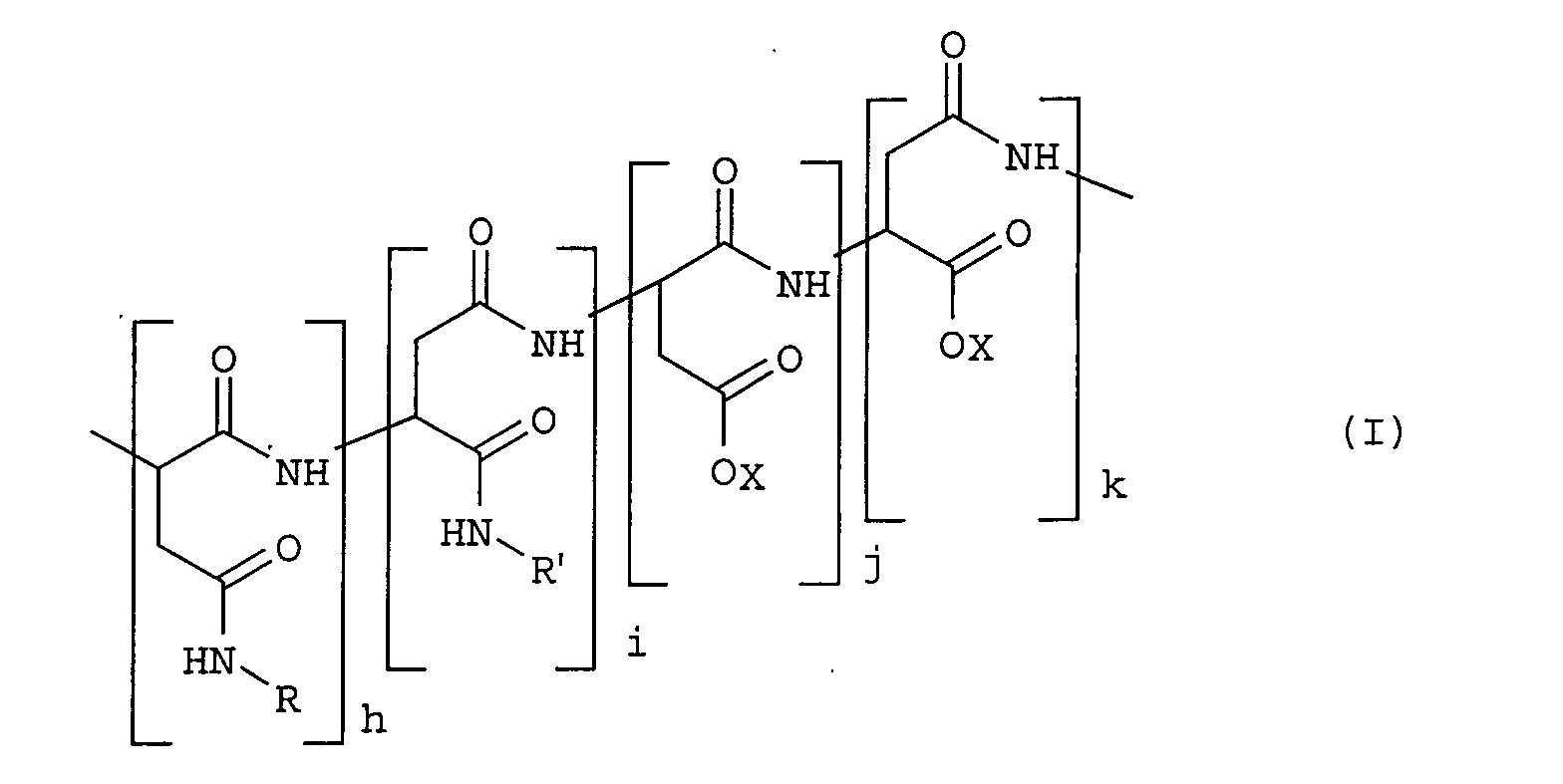
- h, i, j, k
- den molaren Anteil einer jeden Wiederholeinheit repräsentieren und Dezimalzahlen zwischen ≥ 0 und < 1 annehmen, wobei die Summe dieser Zahlen 1 ist und mindestens eine der Variablen h, i Zahlenwerte > 0 annimmt,
- X
- unabhängig voneinander H, Alkali- oder Erdalkalimetallkationen oder andere Metallkationen, positiv geladene Derivate des Stickstoffs wie Ammoniumsalze, Salze der Amine, Hydroxyalkylamine oder Poyletheralkyl(en)amine und deren Salze bedeutet,
- R, R'
- unabhängig voneinander gegebenenfalls verzweigte, gegebenenfalls Doppelbindungen enthaltende, gegebenenfalls Heteroatome und/oder funktionelle Gruppen enthaltende aliphatische, cycloaliphatische und/oder aromatische Kohlenwasserstoffreste sein können,
in erster Stufe eine wässrige Mischung bestehend aus den basischen Hydrolyseprodukten des Polyasparaginsäureimids und Aminverbindungen auf pH-Werte von ≤ 3 eingestellt und
in zweiter Stufe die Aminolyse bei Temperaturen zwischen 140 und 200 °C, vorzugsweise bei 150 bis 180 °C durchgeführt wird.
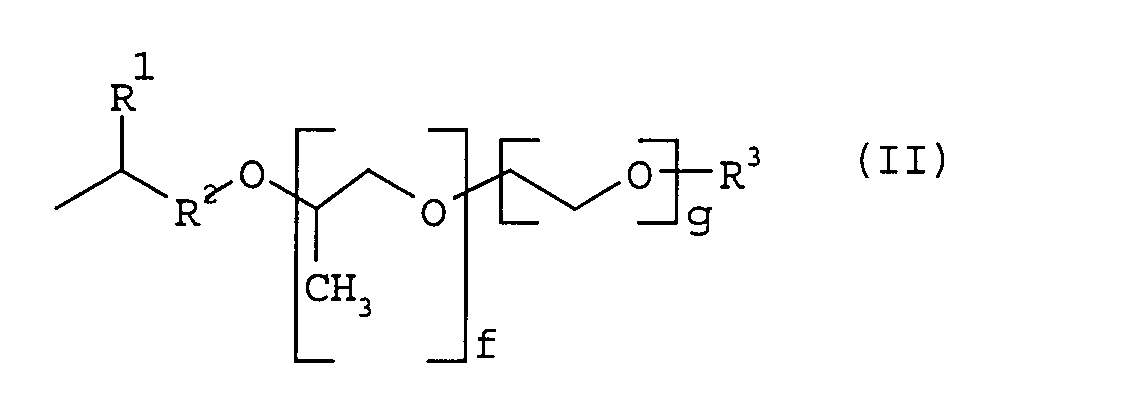
- R1
- für Wasserstoff, einen Kohlenwasserstoffrest, vorzugsweise einen linearen oder verzweigten Alkylrest mit 1 bis 20, bevorzugt 1 bis 4 C-Atomen wie Methyl-, Ethyl-, Propyl-, Butyl- oder Arylrest und dessen substituierte Derivate steht,
- R2
- für einen Kohlenwasserstoffrest, vorzugsweise einen linearen oder verzweigten Alkylrest mit 1 bis 10, bevorzugt 1 bis 4 C-Atomen oder für Phenylengruppen und deren substituierte Derivate steht,
- R3
- für Wasserstoff, einen linearen oder verzweigten Kohlenwasserstoffrest wie Alkyl oder Aryl, bevorzugt Alkyl im Bereich C1 bis C20, besonders bevorzugt im Bereich C1 bis C4 steht,
- f
- 0 bis 300, bevorzugt 1 bis 100, besonders bevorzugt im Bereich 2 bis 10 und
- g
- 0 bis 300, bevorzugt 0 bis 100, besonders bevorzugt 10 bis 20, ist
das Verhältnis von f zu g = 0 zu 100 bis etwa 60 zu 40 beträgt und worin die Propylenoxideinheiten und Ethylenoxydeinheiten statistisch oder blockweise verteilt sein können.
Claims (6)
- Verfahren zur Herstellung von Polyasparaginsäurederivaten der allgemeinen Formel (I)worin

- h, i, j, k
- den molaren Anteil einer jeden Wiederholeinheit repräsentieren und Dezimalzahlen zwischen ≥ 0 und < 1 annehmen, wobei die Summe dieser Zahlen 1 ist und mindestens eine der Variablen h, i Zahlenwerte > 0 annimmt,
- X
- unabhängig voneinander H, Alkali- oder Erdalkalimetallkationen oder andere Metallkationen, positiv geladene Derivate des Stickstoffs wie Ammoniumsalze, Salze der Amine, Hydroxyalkylamine oder Polyetheralkyl(en)amine und deren Salze bedeutet,
- R, R'
- unabhängig voneinander gegebenenfalls verzweigte, gegebenenfalls Doppelbindungen enthaltende, gegebenenfalls Heteroatome und/oder funktionelle Gruppen enthaltende aliphatische, cycloaliphatische und/oder aromatische Kohlenwasserstoffreste sein können,
in erster Stufe eine wässrige Mischung bestehend aus den basischen Hydrolyseprodukten des Polyasparaginsäureimids und Aminverbindungen auf pH-Werte von ≤ 3 eingestellt und
in zweiter Stufe die Aminolyse bei Temperaturen zwischen 140 und 200 °C, vorzugsweise bei 150 bis 180 °C durchgeführt wird. - Verfahren zur Herstellung von Polyasparaginsäurederivaten gemäß Anspruch 1, worin R, R' unabhängig voneinander für lineare Alkylgruppen im Bereich von 1 bis 20 Kohlenstoffatomen steht.
- Verfahren zur Herstellung von Polyasparaginsäurederivaten gemäß Anspruch 1, worin R, R' unabhängig voneinander für Reste der allgemeinen Formel (II)stehen, worin

- R1
- für Wasserstoff, einen Kohlenwasserstoffrest, vorzugsweise einen linearen oder verzweigten Alkylrest mit 1 bis 20, bevorzugt 1 bis 4 C-Atomen wie Methyl-, Ethyl-, Propyl-, Butyl- oder Arylrest und dessen substituierte Derivate steht,
- R2
- für einen Kohlenwasserstoffrest, vorzugsweise einen linearen oder verzweigten Alkylrest mit 1 bis 10, bevorzugt 1 bis 4 C-Atomen oder für Phenylengruppen und deren substituierte Derivate steht,
- R3
- für Wasserstoff, einen linearen oder verzweigten Kohlenwasserstoffrest wie Alkyl oder Aryl, bevorzugt Alkyl im Bereich C1 bis C20, besonders bevorzugt im Bereich C1 bis C4 steht,
- f
- 0 bis 300, bevorzugt 1 bis 100, besonders bevorzugt im Bereich 2 bis 10,
- g
- 0 bis 300, bevorzugt 0 bis 100, besonders bevorzugt 10 bis 20 beträgt und
das Verhältnis von f zu g = 0 zu 100 bis etwa 60 zu 40 beträgt und worin die Propylenoxideinheiten und Ethylenoxydeinheiten statistisch oder blockweise verteilt sein können. - Verfahren zur Herstellung von Polyasparaginsäurederivaten gemäß Anspruch 1, in dem alkalisch wässrige Lösungen von Asparaginsäure, die ein Verhältnis von α- zu β-Verknüpfung in einem Bereich von 1 zu 10 bis 10 zu 1 aufweisen, verwendet werden.
- Verfahren zur Herstellung von Polyasparaginsäurederivaten gemäß Anspruch 3, worin R1 für einen linearen oder verzweigten Alkylrest im Bereich C1 bis C4 steht.
- Verfahren zur Herstellung von Polyasparaginsäurederivaten gemäß Anspruch 3, worin R2 für einen linearen oder verzweigten Alkylrest im Bereich C1 bis C4 oder Phenylengruppen und R3 für einen linearen oder verzweigten Kohlenwasserstoffrest im Bereich C1 bis C4 steht.
Applications Claiming Priority (2)
| Application Number | Priority Date | Filing Date | Title |
|---|---|---|---|
| DE10202316 | 2002-01-23 | ||
| DE10202316A DE10202316B4 (de) | 2002-01-23 | 2002-01-23 | Verfahren zur Herstellung von Polyasparaginsäurederivaten |
Publications (2)
| Publication Number | Publication Date |
|---|---|
| EP1331237A1 true EP1331237A1 (de) | 2003-07-30 |
| EP1331237B1 EP1331237B1 (de) | 2006-09-13 |
Family
ID=7712765
Family Applications (1)
| Application Number | Title | Priority Date | Filing Date |
|---|---|---|---|
| EP03000351A Expired - Lifetime EP1331237B1 (de) | 2002-01-23 | 2003-01-10 | Verfahren zur Herstellung von Polyasparaginsäurederivaten |
Country Status (3)
| Country | Link |
|---|---|
| US (1) | US20030144464A1 (de) |
| EP (1) | EP1331237B1 (de) |
| DE (2) | DE10202316B4 (de) |
Families Citing this family (2)
| Publication number | Priority date | Publication date | Assignee | Title |
|---|---|---|---|---|
| JP2017039920A (ja) * | 2015-08-17 | 2017-02-23 | 三洋化成工業株式会社 | ポリアスパラギン酸誘導体及びそれを含有する洗浄剤組成物 |
| CN116284751B (zh) * | 2022-09-09 | 2024-05-31 | 长江大学 | 聚天冬氨酸衍生物及其制备方法与作为润滑剂的应用、水基钻井液及其应用 |
Citations (2)
| Publication number | Priority date | Publication date | Assignee | Title |
|---|---|---|---|---|
| EP0832851A1 (de) * | 1996-09-30 | 1998-04-01 | Nalco Chemical Company | Bio-abbaubare Polyaminosäure, Aminosäurepolymere-Derivate und deren Verfahren zur Herstellung |
| EP0884344A2 (de) * | 1997-06-11 | 1998-12-16 | Th. Goldschmidt AG | Milde tensidhaltige Zubereitungen mit copolymeren Polyasparaginsäurederivaten für kosmetische oder Reinigungszwecke |
Family Cites Families (4)
| Publication number | Priority date | Publication date | Assignee | Title |
|---|---|---|---|---|
| US5776875A (en) * | 1996-07-16 | 1998-07-07 | Nalco Chemical Company | Use of biodegradable polymers in preventing scale build-up |
| US5750070A (en) * | 1996-07-19 | 1998-05-12 | Nalco Chemical Company | Use of biodegradable polymers in preventing corrosion and scale build-up |
| DE19631380A1 (de) * | 1996-08-02 | 1998-02-05 | Basf Ag | Wasserlösliche oder wasserdispergierbare Polyasparaginsäure-Derivate, ihre Herstellung und ihre Verwendung |
| DE19631379A1 (de) * | 1996-08-02 | 1998-02-05 | Basf Ag | Wasserlösliche oder wasserdispergierbare Polyasparaginsäure-Derivate, ihre Herstellung und ihre Verwendung |
-
2002
- 2002-01-23 DE DE10202316A patent/DE10202316B4/de not_active Expired - Fee Related
-
2003
- 2003-01-10 DE DE50304994T patent/DE50304994D1/de not_active Expired - Fee Related
- 2003-01-10 EP EP03000351A patent/EP1331237B1/de not_active Expired - Lifetime
- 2003-01-23 US US10/349,980 patent/US20030144464A1/en not_active Abandoned
Patent Citations (2)
| Publication number | Priority date | Publication date | Assignee | Title |
|---|---|---|---|---|
| EP0832851A1 (de) * | 1996-09-30 | 1998-04-01 | Nalco Chemical Company | Bio-abbaubare Polyaminosäure, Aminosäurepolymere-Derivate und deren Verfahren zur Herstellung |
| EP0884344A2 (de) * | 1997-06-11 | 1998-12-16 | Th. Goldschmidt AG | Milde tensidhaltige Zubereitungen mit copolymeren Polyasparaginsäurederivaten für kosmetische oder Reinigungszwecke |
Also Published As
| Publication number | Publication date |
|---|---|
| DE10202316B4 (de) | 2007-07-19 |
| EP1331237B1 (de) | 2006-09-13 |
| DE50304994D1 (de) | 2006-10-26 |
| DE10202316A1 (de) | 2003-08-07 |
| US20030144464A1 (en) | 2003-07-31 |
Similar Documents
| Publication | Publication Date | Title |
|---|---|---|
| EP0604813B1 (de) | Verfahren zur Herstellung von Polysuccinimid, Polyasparaginsäure und ihrer Salze | |
| EP0623587B1 (de) | Verfahren zur Herstellung von amphoteren Tensiden | |
| DE69124628T2 (de) | Verfahren zur herstellung von polyamino-säuren | |
| EP0959091A1 (de) | Copolymere hydrophob modifizierte Polyasparaginsäureesteramide und ihre Verwendung | |
| CH660487A5 (de) | In wasser dispergierbares, modifiziertes polyurethan. | |
| DE69518519T2 (de) | Lösliche, vernetzte polyaspartate | |
| EP0885185A1 (de) | Betain-geminitenside auf der basis von aminen | |
| EP0612784A1 (de) | Verfahren zur Herstellung von Polysuccinimid und Polyasparaginsäure | |
| EP0563013B1 (de) | N-Substituierte Chitosanderivate, ein Verfahren zu deren Herstellung und deren Verwendung | |
| DE69408717T2 (de) | Verfahren zur Herstellung von Polypeptiden | |
| WO2007087988A1 (de) | Verfahren zur herstellung von lithium-molybdat nanopartikeln | |
| EP0918809B1 (de) | Verfahren zur herstellung von biuretgruppen enthaltenden polyisocyanaten aus (cyclo)aliphatischen diisocyanaten | |
| DE4310503A1 (de) | Verfahren zur Herstellung von Polyasparaginsäure und ihre Salze | |
| EP0959090A1 (de) | Copolymere, hydrophob modifizierte Polyasparaginsäureester mit erhöhter Molekularmasse und deren Verwendung | |
| EP1331237B1 (de) | Verfahren zur Herstellung von Polyasparaginsäurederivaten | |
| DE19933024A1 (de) | Kationische Blockcopolymere | |
| EP0884344A2 (de) | Milde tensidhaltige Zubereitungen mit copolymeren Polyasparaginsäurederivaten für kosmetische oder Reinigungszwecke | |
| EP0730572B1 (de) | Niedrigviskose wässrige konzentrate von betaintensiden | |
| WO1996004332A1 (de) | Verfahren zur herstellung von polymeren, die in der seitenkette hydroxamsäure-, hydroxamsäureether- und/oder hydrazidgruppen enthalten und ihre verwendung | |
| DE69815318T2 (de) | Vernetzte polyaspartatsalze und verfahren zu ihrer herstellung | |
| DE19603053A1 (de) | Verfahren zur Herstellung von Polymeren mit wiederkehrenden Succinyl-Einheiten | |
| DE60006571T2 (de) | Assoziative polyesterverdickungsmittel | |
| EP0006204A1 (de) | Wässrige Dispersionen von oligomeren oder polymeren Kunststoffen, ein Verfahren zu ihrer Herstellung sowie ihre Verwendung | |
| DE19822604A1 (de) | Kondensationsprodukte enthaltend polyethermodifizierte Monoester und/oder -amide alpha, beta-ungesättigter Dicarbonsäuren, ihre Herstellung und Verwendung | |
| DE19603052A1 (de) | Verfahren zur Herstellung von Polymeren mit wiederkehrenden Succinyl-Einheiten |
Legal Events
| Date | Code | Title | Description |
|---|---|---|---|
| PUAI | Public reference made under article 153(3) epc to a published international application that has entered the european phase |
Free format text: ORIGINAL CODE: 0009012 |
|
| 17P | Request for examination filed |
Effective date: 20030117 |
|
| AK | Designated contracting states |
Designated state(s): AT BE BG CH CY CZ DE DK EE ES FI FR GB GR HU IE IT LI LU MC NL PT SE SI SK TR |
|
| AX | Request for extension of the european patent |
Extension state: AL LT LV MK RO |
|
| AKX | Designation fees paid |
Designated state(s): DE FR GB |
|
| RAP1 | Party data changed (applicant data changed or rights of an application transferred) |
Owner name: GOLDSCHMIDT GMBH |
|
| GRAP | Despatch of communication of intention to grant a patent |
Free format text: ORIGINAL CODE: EPIDOSNIGR1 |
|
| GRAS | Grant fee paid |
Free format text: ORIGINAL CODE: EPIDOSNIGR3 |
|
| GRAA | (expected) grant |
Free format text: ORIGINAL CODE: 0009210 |
|
| AK | Designated contracting states |
Kind code of ref document: B1 Designated state(s): DE FR GB |
|
| REG | Reference to a national code |
Ref country code: GB Ref legal event code: FG4D Free format text: NOT ENGLISH |
|
| REF | Corresponds to: |
Ref document number: 50304994 Country of ref document: DE Date of ref document: 20061026 Kind code of ref document: P |
|
| GBT | Gb: translation of ep patent filed (gb section 77(6)(a)/1977) |
Effective date: 20061220 |
|
| ET | Fr: translation filed | ||
| PLBE | No opposition filed within time limit |
Free format text: ORIGINAL CODE: 0009261 |
|
| STAA | Information on the status of an ep patent application or granted ep patent |
Free format text: STATUS: NO OPPOSITION FILED WITHIN TIME LIMIT |
|
| 26N | No opposition filed |
Effective date: 20070614 |
|
| PGFP | Annual fee paid to national office [announced via postgrant information from national office to epo] |
Ref country code: DE Payment date: 20080122 Year of fee payment: 6 Ref country code: GB Payment date: 20080124 Year of fee payment: 6 |
|
| GBPC | Gb: european patent ceased through non-payment of renewal fee |
Effective date: 20090110 |
|
| PG25 | Lapsed in a contracting state [announced via postgrant information from national office to epo] |
Ref country code: DE Free format text: LAPSE BECAUSE OF NON-PAYMENT OF DUE FEES Effective date: 20090801 |
|
| PGFP | Annual fee paid to national office [announced via postgrant information from national office to epo] |
Ref country code: FR Payment date: 20090115 Year of fee payment: 7 |
|
| PG25 | Lapsed in a contracting state [announced via postgrant information from national office to epo] |
Ref country code: GB Free format text: LAPSE BECAUSE OF NON-PAYMENT OF DUE FEES Effective date: 20090110 |
|
| REG | Reference to a national code |
Ref country code: FR Ref legal event code: CD |
|
| REG | Reference to a national code |
Ref country code: FR Ref legal event code: ST Effective date: 20100930 |
|
| PG25 | Lapsed in a contracting state [announced via postgrant information from national office to epo] |
Ref country code: FR Free format text: LAPSE BECAUSE OF NON-PAYMENT OF DUE FEES Effective date: 20100201 |