EP1331782A2 - Récepteur et procédé de réception d'un signal OFDM avec diversité utilisant une pluralité d'égaliseurs - Google Patents
Récepteur et procédé de réception d'un signal OFDM avec diversité utilisant une pluralité d'égaliseurs Download PDFInfo
- Publication number
- EP1331782A2 EP1331782A2 EP03002030A EP03002030A EP1331782A2 EP 1331782 A2 EP1331782 A2 EP 1331782A2 EP 03002030 A EP03002030 A EP 03002030A EP 03002030 A EP03002030 A EP 03002030A EP 1331782 A2 EP1331782 A2 EP 1331782A2
- Authority
- EP
- European Patent Office
- Prior art keywords
- ofdm
- signals
- antennas
- state information
- channel state
- Prior art date
- Legal status (The legal status is an assumption and is not a legal conclusion. Google has not performed a legal analysis and makes no representation as to the accuracy of the status listed.)
- Withdrawn
Links
Images



Classifications
-
- H—ELECTRICITY
- H04—ELECTRIC COMMUNICATION TECHNIQUE
- H04N—PICTORIAL COMMUNICATION, e.g. TELEVISION
- H04N7/00—Television systems
- H04N7/015—High-definition television systems
-
- H—ELECTRICITY
- H04—ELECTRIC COMMUNICATION TECHNIQUE
- H04L—TRANSMISSION OF DIGITAL INFORMATION, e.g. TELEGRAPHIC COMMUNICATION
- H04L1/00—Arrangements for detecting or preventing errors in the information received
- H04L1/02—Arrangements for detecting or preventing errors in the information received by diversity reception
- H04L1/06—Arrangements for detecting or preventing errors in the information received by diversity reception using space diversity
-
- H—ELECTRICITY
- H04—ELECTRIC COMMUNICATION TECHNIQUE
- H04B—TRANSMISSION
- H04B7/00—Radio transmission systems, i.e. using radiation field
- H04B7/02—Diversity systems; Multi-antenna system, i.e. transmission or reception using multiple antennas
- H04B7/04—Diversity systems; Multi-antenna system, i.e. transmission or reception using multiple antennas using two or more spaced independent antennas
- H04B7/08—Diversity systems; Multi-antenna system, i.e. transmission or reception using multiple antennas using two or more spaced independent antennas at the receiving station
- H04B7/0837—Diversity systems; Multi-antenna system, i.e. transmission or reception using multiple antennas using two or more spaced independent antennas at the receiving station using pre-detection combining
- H04B7/0842—Weighted combining
- H04B7/0845—Weighted combining per branch equalization, e.g. by an FIR-filter or RAKE receiver per antenna branch
-
- H—ELECTRICITY
- H04—ELECTRIC COMMUNICATION TECHNIQUE
- H04L—TRANSMISSION OF DIGITAL INFORMATION, e.g. TELEGRAPHIC COMMUNICATION
- H04L25/00—Baseband systems
- H04L25/02—Details ; arrangements for supplying electrical power along data transmission lines
- H04L25/03—Shaping networks in transmitter or receiver, e.g. adaptive shaping networks
- H04L25/03006—Arrangements for removing intersymbol interference
- H04L2025/0335—Arrangements for removing intersymbol interference characterised by the type of transmission
- H04L2025/03375—Passband transmission
- H04L2025/03414—Multicarrier
-
- H—ELECTRICITY
- H04—ELECTRIC COMMUNICATION TECHNIQUE
- H04L—TRANSMISSION OF DIGITAL INFORMATION, e.g. TELEGRAPHIC COMMUNICATION
- H04L25/00—Baseband systems
- H04L25/02—Details ; arrangements for supplying electrical power along data transmission lines
- H04L25/0202—Channel estimation
- H04L25/0204—Channel estimation of multiple channels
-
- H—ELECTRICITY
- H04—ELECTRIC COMMUNICATION TECHNIQUE
- H04W—WIRELESS COMMUNICATION NETWORKS
- H04W52/00—Power management, e.g. Transmission Power Control [TPC] or power classes
- H04W52/04—Transmission power control [TPC]
- H04W52/38—TPC being performed in particular situations
- H04W52/42—TPC being performed in particular situations in systems with time, space, frequency or polarisation diversity
Definitions
- the present invention relates to an OFDM(Orthogonal Frequency Division Multiplexing) diversity receiver system, in particular to an OFDM diversity receiver for accomplishing optimal signal receiving performance to prevent the transmission quality from being degraded by fading when OFDM signals are transmitted in multi-carrier transmission scheme.
- a broadcasting system for HDTV(High Definition Television) can be largely divided into an image coding portion and a modulation portion.
- the image coding portion compresses about 1Gbyte data obtained from a high definition image source into 15 ⁇ 18 Mbyte data.
- the modulation portion transmits tens of Mbyte digital data to a receiver through a 6 ⁇ 8 MHz band-limited channel.
- a digital HDTV broadcasting scheme adopts a ground simultaneous broadcasting scheme using channels of VHF(Very High Frequency)/UHF(Ultra High Frequency) band allocated to the conventional TV broadcasting scheme. Therefore, under the circumstance of the ground simultaneous broadcasting, a modulation method for the HDTV broadcasting system should satisfy the following conditions: First, the modulation method for the HDTV should have high spectrum efficiency to transmit tens of Mbyte digital data to a receiver through the 6 ⁇ 8 MHz band-limited channel. Second, the modulation method for the HDTV should be robust to the fading where the fading can be caused by multi-paths which are formed by surrounding buildings and structures, etc. in the HDTV broadcasting. Third, the modulation method for the HDTV should be robust to same channel interference caused surely by the conventional analog TV signal. In addition, digital modulation signals of the HDTV should be capable of minimizing interference with the conventional analog TV receiver.
- the OFDM scheme is to convert a sequence of symbols input in series into a predetermined-sized block of parallel data and to multiplex the parallel data into each different sub-carrier frequency.
- This OFDM scheme uses multi-carriers and differs deeply from the conventional scheme using a single carrier.
- the multi-carriers have orthogonality each other. Orthogonality means that multiplication of any two carriers results in "0". This feature becomes a necessary condition for using multi-carriers.
- OFDM can be implemented by FFT(Fast Fourier Transform) and IFFT(Inverse Fast Fourier Transform). This implementation comes from the definition of the FFT and orthogonality between the carriers.
- the OFDM scheme has advantages as described below.
- the ground transmission scheme of TV has channel characteristics that transmission quality depends on reflective waves generated in signal transmission, same channel interference and contiguous channel interference, etc. Subsequently, the design condition of the transmission system becomes very difficult.
- the OFDM scheme is robust to the multi-paths. Namely, the OFDM scheme can use the multi-carriers to increase symbol transmission time. This makes degradation of performance smaller to the long time echo signals, since the OFDM scheme becomes relatively insensitive to the multipath interference signals.
- the OFDM scheme is also robust to the existed signals and then is less effective on the same channel interference. Owing to these characteristics, SFN(Single Frequency Network) can be constructed.
- SFN means that a single broadcasting covers a whole nation in a single frequency. In this case, the same channel interference is getting worse and then the OFDM scheme can be adopted due to its robustness to this case.
- OFDM signals include multi-carriers and each carrier has very narrow bandwidth. Accordingly, frequency efficiency becomes relatively better since overall spectrum shape appears almost rectangular.
- Another advantage of the OFDM scheme is that since the waveform of the OFDM signals is similar to the one of white Gaussian noise, the OFDM scheme has less interference than the other scheme including PAL(Phase Alteration by Line) or SECAM(Sequential Couleur a Memoire) scheme. Subsequently, different modulation methods can be applied to each carrier in the OFDM scheme for hierarchical transmission.
- an OFDM receiver uses a diversity technique to face with fading phenomena due to the multi-paths.
- the multi-paths mean that an antenna receives several transmitted signals via various paths in the air. There occur different amplitude attenuation and phase changes if the several signals are received via the various paths.
- the fading phenomena explain that when the signals suffered from the different amplitude attenuation and phase changes are received and combined, the powers of the signals become differed from the ones of the transmitted signals as time passes by.
- the diversity technique means that several signals suffered from each different fading are received and then combined properly to overcome the fading phenomena.
- the microscopic diversity is divided in detail into space, polarization, angle, frequency and time diversity.
- the combining method of the received signals is divided into selective combining, maximal ratio combining, equal gain combining and feedback combining, etc.
- Fig. 1 is a block diagram exemplifying the conventional OFDM diversity receiver.
- the OFDM diversity receiver shown in Fig. 1 comprises two antennas 12, 22 for diversity, which receive OFDM signals transmitted via multi-paths respectively.
- the OFDM diversity receiver comprises a first and second antennas 12, 22, a first and second demodulating unit 14, 24, a first and second equalizer 16, 26, a combiner 32 and FEC(Forward Error Corrector) 34.
- the first and second antennas 12, 22 receive OFDM signals transmitted via each transmission path at preset receiving strength.
- the first and second demodulation ffs 14, 24 demodulate the received OFDM signals into original signals respectively.
- the first and second demodulating units 14, 24 demodulate the received signals into the original signals by converting them into digital signals and Fast Fourier Transforming the digital signals.
- the first and second equalizers 16, 26 compensate distortions occurred in the Fast Fourier Transformed OFDM signals during transmission.
- the combiner 32 combines each OFDM signal whose distortions are compensated in the first and second equalizers 16, 26.
- FEC 34 detects errors using an error detection scheme preset in the data of OFDM signals and corrects the errors.
- the conventional OFDM diversity receiver receives the OFDM signals at fixed receiving strength and direction of the antennas 12, 22. Subsequently, the conventional OFDM receiver is not capable of accomplishing the optimal receiving performance. In addition, since the conventional OFDM diversity receiver receives the OFDM signals at a fixed receiving strength and direction of the antennas 12, 22 without regarding environmental changes of transmission paths, it is not stable to receive the OFDM signals. In case of receiving the OFDM signals in the above-described scheme, it is difficult to recover the original signals because a ratio of the distortions included in the received OFDM signals grows and then SNR(signal-to-noise ratio) becomes smaller.
- an OFDM diversity receiver comprising a plurality of antennas through which receive OFDM signals transmitted via multi-paths, a plurality of demodulating units which demodulate the OFDM signals received at the antennas into original signals, a plurality of equalizers which estimate a plurality of channel state information from the OFDM signals demodulated by the demodulating units and compensate distortions occurred on OFDM signal channel according to the plurality of channel state information, and an antenna adjusting unit which generates control signals in order to adjust the antennas according to the plurality of channel state information estimated by the equalizers.
- the antenna adjusting unit comprises a null detecting unit which detect nulls from the plurality of channel state information estimated by the equalizers when a channel state information is considered as a null if the channel state information is smaller than a predetermined threshold, a null counting unit which count the number of the nulls detected at the same position among the nulls detected in the null detecting unit, and a controller which generates the control signals in order to adjust the antennas so that the number of nulls counted in the null counting unit can be minimized.
- the OFDM diversity receiver further comprises a combiner with which combines the OFDM signals whose distortions occurred on the channel are compensated in the equalizers and an error correcting unit which detects errors in an error detecting scheme preset on the data of the OFDM signals and corrects the errors.
- an OFDM diversity receiver comprising a plurality of antennas through which receive OFDM signals transmitted via multi-paths, a plurality of power detecting units which detect maximum power of the OFDM signals received at the antennas and generate control signals in order to adjust the antennas in response to the maximum power, a plurality of demodulating units which demodulate the OFDM signals received at the antennas into original signals, and a plurality of equalizers which estimate a plurality of channel state information from the OFDM signals demodulated by the demodulating units and compensate distortions occurred on OFDM signal channel according to the plurality of channel state information.
- the OFDM diversity receiver further comprises a combiner with which combines the OFDM signals whose distortions occurred on the channel are compensated in the equalizers and an error correcting unit which detects errors in an error detecting scheme preset on the data of the OFDM signals and corrects the errors.
- a method for receiving an OFDM signal comprising the steps of receiving OFDM signals transmitted via multi-paths through a plurality of antennas, converting the OFDM signals into digital signals and demodulating the digital signals into original signals by Fast Fourier Transforming, estimating a plurality of channel state information on channel which the OFDM signals transmitted through and compensating distortions occurred on the channel and generating control signals according to the plurality of channel state information in order to adjust the antennas.
- the generating step comprises the steps of detecting position of nulls from the plurality of channel state information where a channel state information is considered as a null if the channel state information is smaller than a predetermined threshold; counting the number of the nulls detected at the same position among the detected nulls and generating the control signals in order to adjust the antennas so that the number of the nulls at the same position can be minimized.
- the method for receiving an OFDM signal of the present invention further comprises the steps of combining the OFDM signals whose distortions occurred on the channel are compensated, detecting errors in an error detecting scheme preset on the data of the OFDM signals and correcting the errors.
- a method for receiving an OFDM signal comprising the steps of receiving OFDM signals transmitted via multi-paths through a plurality of antennas, detecting maximum power of the OFDM signals and generating control signals in response to the maximum power in order to adjust the antennas, converting the OFDM signals into digital signals and demodulating the digital signals into original signals by Fast Fourier Transforming and estimating a plurality of channel state information on channel which the OFDM signals transmitted through and compensating distortions occurred on the channel.
- the method for receiving an OFDM signal of the present invention further comprises the steps of combining the OFDM signals whose distortions occurred on the channel are compensated, detecting errors in an error detecting scheme preset on the data of the OFDM signals and correcting the errors.
- the SNR of each sub-carrier of the OFDM signals combined in the combiner can be maintained high by controlling the operations of a first and second motors in order to minimize the number of nulls generated in a same position, when the nulls are detected from CSI(Channel State Information) of the OFDM signals received at the first and second antennas respectively. Also, as the powers of the received OFDM signals become larger with the receiving strength of the first and second antennas raised, the recovery of the original signals from the received OFDM signals may become easier.
- Fig. 2 is a block diagram showing a first preferred embodiment of the OFDM diversity receiver according to the present invention.
- the OFDM diversity receiver according to the first preferred embodiment comprises two antennas 120, 220 for use in diversity.
- the OFDM diversity receiver comprises a first and second antenna 120, 220, a first and second motors 130, 230, a first and second demodulating units 140, 240, a first and second equalizers 150, 250, a combiner 420 and FEC 440.
- the first and second antennas 120, 220 receive the OFDM signals transmitted via multi-paths respectively.
- the first and second motors 130, 230 adjust the receiving strength of the first and second antennas 120, 220 according to control signals.
- the amplitudes and periodicities of the received OFDM signals appear differently according to the adjustment of the receiving strength of the first and second motors 130, 230.
- the first and second demodulating units 140, 240 demodulate each OFDM signal received at the first and second antennas 120, 220 with the adjusted receiving strength by the first and second motors 130, 230 into original signals.
- the first and second demodulating units 140, 240 convert each OFDM signal into digital signals respectively and then Fast Fourier Transform the digital signals.
- the first and second equalizers 150, 250 compensate distortions occurred during transmission in each OFDM signal Fast Fourier Transformed in the first and second demodulating units 140, 240.
- the first and second equalizers 150, 250 detect from each OFDM signal the CSI C1, C2 on the channel through which each OFDM signal is transmitted and compensate distortions occurred in the OFDM signals during transmission using each detected CSI C1, C2.
- the combiner 420 combines each OFDM signal whose distortions occurred during transmission are compensated by the first and second equalizer 150, 250.
- the combiner 420 compensates distortions due to nulls of the OFDM signals by compensating nulls generated in one OFDM signal received at any one of the first and second antennas 120, 220 with the other OFDM signal received at the other one of the first and second antennas 120, 220.
- FEC 440 detects errors in an error detection scheme preset to the data of OFDM signals and then corrects the errors.
- the OFDM diversity receiver further comprises a first and second null detecting units 160, 260.
- the first and second null detecting units 160, 260 compare the CSI C1, C2 detected in the first and second equalizer 150, 250 with a predetermined threshold to determine each one as null in case that the CSI C1, C2 are smaller than the threshold respectively.
- the first and second null detecting units 160, 260 detect positions of nulls from the CSI C1, C2 compared with the threshold respectively and provide information on the detected positions of nulls to null counting unit 320.
- the null counting unit 320 compares the position information N1, N2 provided by the first and second null detecting units 160, 260, and counts the number of nulls generated at the same position and provides null matching counting information M containing the number of nulls generated at the same position to the controller 340.
- the controller 340 controls the first and second motors 130, 230 in order to adjust the receiving strength of the first and second antennas 120, 230 to make the number of nulls generated at the same position minimized with the null matching counting information M provided by the null counting unit 320.
- the SNR of each sub-carrier of OFDM signals combined by the combiner 420 can be maintained high by detecting nulls with the CSI of each OFDM signal received at the first and the second antennas 120, 220 and controlling the operations of the first and second motors 130, 230 in order to make the number of nulls generated at the same position minimized.
- Fig. 3 is a block diagram showing a second preferred embodiment of the OFDM diversity receiver according to the present invention.
- the descriptions of the same reference numbers of the Fig. 3 as those ones of the Fig. 2 are abbreviated.
- the OFDM diversity receiver of the present embodiment comprises a first and second antennas 120, 220, a first and second motors 130, 230, a first and second power detecting units 520, 540, a first and second demodulating units 140, 240, a first and second equalizers 150, 250, a combiner 420 and FEC 440.
- the first and second antennas 120, 220 receive the OFDM signals transmitted via the multi-paths respectively.
- the first and second motors 130, 230 adjust the receiving strength of the first and second antennas 120, 220 according to control signals.
- the first and second power detecting units 520, 540 detect powers with amplitudes of the OFDM signals received at the first and second antennas 120, 220.
- the first and second power detecting units 520, 540 detect the maximum power among detected powers and control the operations of the first and second motors 130, 230 so that the receiving strength of the first and second antennas 120, 220 can maintain the detected power as maximum.
- the power of the OFDM signals received at the first and second antennas 120, 220 whose receiving strength is maintained as maximum becomes larger.
- the first and second demodulating units 140, 240 convert each OFDM signal received at the first and second antennas 120, 220 having maximum power into digital signals and Fast Fourier Transform the digital signals.
- the first and second equalizers 150, 250 detect the CSI from the Fast Fourier Transformed OFDM signals and compensate distortions occurred in the transmitted OFDM signals (during transmission) according to the CSI.
- the combiner 420 combines each OFDM signal whose distortions occurred on the transmission channel are compensated by the first and second equalizers 150, 250.
- FEC 440 detects errors in the data of OFDM signals combined in the combiner 420 and corrects the errors.
- the recovery of the original signals from the received OFDM signals may become easier.
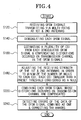
- Fig. 4 is a flow chart showing a first preferred embodiment of an OFDM signal receiving method using the OFDM diversity receiver according to the present invention.
- the OFDM receiver receives OFDM signals transmitted via multi-paths respectively (step S120).
- the first and second demodulating units 140, 240 convert each OFDM signal received at the first and second antennas 120, 220 into digital signals, Fast Fourier Transform the digital signals and then recover original signals.
- the first and second equalizers 150, 250 estimate the CSI C1, C2 from each demodulated OFDM signal (step S160).
- the first and second equalizers 150, 250 also compensate distortions occurred in each transmitted OFDM signal (during transmission) based on the estimated CSI C1, C2 (step S160).
- the OFDM diversity receiver of the present embodiment controls the receiving strength of the first and second antennas 120, 220 in order to minimize the number of nulls generated at the same position, when each CSI C1, C2 is considered as null in case that the CSI C1, C2 estimated by the first and second equalizers 150, 250 are smaller than a preset threshold (step S180).
- the combiner 420 combines each OFDM signal whose distortions occurred on the transmission channel are compensated by the first and second equalizers 150, 250 (step S220).
- FEC 440 detects errors from the data of OFDM signals combined in the combiner 420 and corrects the errors (step S240).
- the SNR of each OFDM signal combined by the combiner 420 can be raised by adjusting the receiving strength of the first and second antennas 120, 220 in order to detect the null positions from each CSI and make the number of nulls generated at the same position minimized.
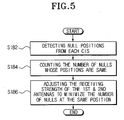
- Fig. 5 is a flow chart showing the step of S180 of Fig. 4 in detail.
- the first and second null detecting units 160, 260 detect null positions where each CSI C1, C2 estimated by the first and second equalizer 150, 250 is smaller than the preset threshold (step S182).
- the first and second null detecting units 160, 260 provide the null position information N1, N2 to a null counting unit 320.
- the null counting unit 320 counts the number of nulls generated at the same position using the null position information N1, N2 provided by the first and second null detecting units 160, 260 (step S184).
- the null counting unit 320 provides the counted number of null information M to the controller 340.
- the controller 340 adjusts the receiving strength of the first and second antennas 120, 220 in order to make the number of nulls at the same position minimized based on the number of null information M provided by the null counting unit 320 (step S186).
- Fig. 6 is a flow chart showing a second preferred embodiment of an OFDM signal receiving method using the OFDM diversity receiver according to the present invention.
- the OFDM receiver receives the OFDM signals transmitted via multi-paths respectively (step S320).
- the first and second power detecting units 520, 540 detect powers of the OFDM signals received at the first and second antennas 120, 220.
- the first and second power detecting units 520, 540 detect the maximum power among detected powers.
- the first and second power detecting units 520, 540 control the operations of the first and second motors 130, 230 in order to adjust the receiving strength of the first and second antennas 120, 220 in response to the maximum power.
- the first and second demodulating units 140, 240 convert each OFDM signal received at the first and second antennas 120, 220 into digital signals, Fast Fourier Transform the digital signals and then recover the original signals (step S360).
- the first and second equalizers 150, 250 estimate CSI C1, C2 from each demodulated OFDM signals and also compensate distortions occurred in each transmitted OFDM signals (during transmission) based on the CSI C1, C2 (step S380).
- the combiner 420 combines each OFDM signal whose distortions occurred on the transmission channel are compensated by the first and second equalizers 150, 250 (step S420).
- FEC 440 detects errors from the data of OFDM signals combined as a single signal in the combiner 420 and corrects the errors (step S440).
- the recovery of the original signals from the received OFDM signals may become easier.
- the SNR of each sub-carrier of the OFDM signals combined in the combiner can be maintained high by controlling the operations of the first and second motors in order to minimize the number of nulls generated in the same position, when nulls are detected with the CSI of the OFDM signals received at the first and the second antennas respectively.
- the recovery of the original signals from the received OFDM signals may become easier.
Landscapes
- Engineering & Computer Science (AREA)
- Signal Processing (AREA)
- Computer Networks & Wireless Communication (AREA)
- Multimedia (AREA)
- Radio Transmission System (AREA)
Applications Claiming Priority (2)
| Application Number | Priority Date | Filing Date | Title |
|---|---|---|---|
| KR10-2002-0005232A KR100406935B1 (ko) | 2002-01-29 | 2002-01-29 | 오에프디엠 다이버시티 수신기 및 방법 |
| KR2002005232 | 2002-01-29 |
Publications (2)
| Publication Number | Publication Date |
|---|---|
| EP1331782A2 true EP1331782A2 (fr) | 2003-07-30 |
| EP1331782A3 EP1331782A3 (fr) | 2006-01-11 |
Family
ID=19718968
Family Applications (1)
| Application Number | Title | Priority Date | Filing Date |
|---|---|---|---|
| EP03002030A Withdrawn EP1331782A3 (fr) | 2002-01-29 | 2003-01-28 | Récepteur et procédé de réception d'un signal OFDM avec diversité utilisant une pluralité d'égaliseurs |
Country Status (3)
| Country | Link |
|---|---|
| EP (1) | EP1331782A3 (fr) |
| KR (1) | KR100406935B1 (fr) |
| CN (1) | CN1310450C (fr) |
Cited By (8)
| Publication number | Priority date | Publication date | Assignee | Title |
|---|---|---|---|---|
| WO2007066904A1 (fr) * | 2005-12-09 | 2007-06-14 | Electronics And Telecommunications Research Institute | Appareil et procede de selection d'un signal optimal par egalisation auxiliaire dans un dispositif de reception en diversite |
| KR100765990B1 (ko) | 2006-11-07 | 2007-10-12 | 삼성전자주식회사 | 멀티-밴드 ofdm 스킴에서 적응적 ola를 수행하는수신기 및 방법 |
| WO2008078972A1 (fr) * | 2006-12-27 | 2008-07-03 | Sk Telecom Co., Ltd. | Appareil à puce d'égalisation |
| US7436914B2 (en) | 2005-07-11 | 2008-10-14 | Mediatek Incorporation | Methods and apparatus for providing television signals |
| CN100477752C (zh) * | 2006-01-13 | 2009-04-08 | 联发科技股份有限公司 | 应用弹性化接收器架构的数字电视接收器及其相关方法 |
| US8180005B2 (en) | 2005-12-09 | 2012-05-15 | Electronics And Telecommunications Research Institute | Apparatus and method for selecting optimal signal using auxiliary equalization in diversity receiver |
| CN103039029A (zh) * | 2010-07-28 | 2013-04-10 | 高通股份有限公司 | 用于信道状态信息反馈的协议 |
| TWI393398B (zh) * | 2008-06-23 | 2013-04-11 | Mediatek Inc | 正交分頻多工接收機與正交分頻多工接收方法 |
Families Citing this family (11)
| Publication number | Priority date | Publication date | Assignee | Title |
|---|---|---|---|---|
| KR101042807B1 (ko) * | 2003-12-18 | 2011-06-20 | 삼성전자주식회사 | 주파수 직접변환 방식 수신기의 부정합 보상 장치 및 방법 |
| JP2005236638A (ja) * | 2004-02-19 | 2005-09-02 | Alps Electric Co Ltd | Ofdmダイバーシティ受信装置 |
| US7502411B2 (en) * | 2004-03-05 | 2009-03-10 | Silicon Image, Inc. | Method and circuit for adaptive equalization of multiple signals in response to a control signal generated from one of the equalized signals |
| CN1973492B (zh) * | 2004-06-24 | 2010-12-08 | 皇家飞利浦电子股份有限公司 | 用于发送mc网络中子载波状态的方法和用于自适应分配mc网络中子载波的方法 |
| JP4641233B2 (ja) * | 2005-09-14 | 2011-03-02 | ルネサスエレクトロニクス株式会社 | 復調装置及び復調方法 |
| WO2009079849A1 (fr) * | 2007-12-21 | 2009-07-02 | Utstarcom Telecom Co., Ltd. | Procédé et dispositif de combinaison de diversité de réception dans un système ofdm |
| JP5318091B2 (ja) * | 2008-04-18 | 2013-10-16 | シャープ株式会社 | 受信装置および通信システム |
| CN101277278B (zh) * | 2008-05-21 | 2010-12-15 | 清华大学 | 一种针对有轨交通的无线信道预测方法 |
| KR101511782B1 (ko) * | 2008-09-03 | 2015-04-14 | 엘지전자 주식회사 | 다중중계국기반 협력 무선통신시스템에서의 적응적 다이버시티 기법 및 이를 지원하는 장치 |
| CN103117789A (zh) * | 2011-11-16 | 2013-05-22 | 中兴通讯股份有限公司 | 宏分集接收方法及装置 |
| KR102182390B1 (ko) * | 2020-07-03 | 2020-11-24 | (주)아이스톰 | 다중 경로 페이딩 환경에 적합한 sc-fde 웨이브폼이 적용된 vdes 장치 |
Citations (1)
| Publication number | Priority date | Publication date | Assignee | Title |
|---|---|---|---|---|
| US5680142A (en) | 1995-11-07 | 1997-10-21 | Smith; David Anthony | Communication system and method utilizing an antenna having adaptive characteristics |
Family Cites Families (1)
| Publication number | Priority date | Publication date | Assignee | Title |
|---|---|---|---|---|
| JP2000115123A (ja) * | 1998-08-07 | 2000-04-21 | Nippon Telegr & Teleph Corp <Ntt> | Ofdm用歪補償回路 |
-
2002
- 2002-01-29 KR KR10-2002-0005232A patent/KR100406935B1/ko not_active Expired - Fee Related
-
2003
- 2003-01-06 CN CNB031014275A patent/CN1310450C/zh not_active Expired - Fee Related
- 2003-01-28 EP EP03002030A patent/EP1331782A3/fr not_active Withdrawn
Patent Citations (1)
| Publication number | Priority date | Publication date | Assignee | Title |
|---|---|---|---|---|
| US5680142A (en) | 1995-11-07 | 1997-10-21 | Smith; David Anthony | Communication system and method utilizing an antenna having adaptive characteristics |
Non-Patent Citations (1)
| Title |
|---|
| DAMMANN A ET AL.: "Standard conformable antenna diversity techniques for OFDM and its application to the DVB-T system", GLOBECOM'01. IEEE GLOBAL TELECOMMUNICATIONS CONFERENCE, vol. 5-6, 25 November 2001 (2001-11-25), pages 3100 - 3105, XP010747380, DOI: doi:10.1109/GLOCOM.2001.965997 |
Cited By (13)
| Publication number | Priority date | Publication date | Assignee | Title |
|---|---|---|---|---|
| US7436914B2 (en) | 2005-07-11 | 2008-10-14 | Mediatek Incorporation | Methods and apparatus for providing television signals |
| WO2007066904A1 (fr) * | 2005-12-09 | 2007-06-14 | Electronics And Telecommunications Research Institute | Appareil et procede de selection d'un signal optimal par egalisation auxiliaire dans un dispositif de reception en diversite |
| US8180005B2 (en) | 2005-12-09 | 2012-05-15 | Electronics And Telecommunications Research Institute | Apparatus and method for selecting optimal signal using auxiliary equalization in diversity receiver |
| CN100477752C (zh) * | 2006-01-13 | 2009-04-08 | 联发科技股份有限公司 | 应用弹性化接收器架构的数字电视接收器及其相关方法 |
| US7792221B2 (en) | 2006-01-13 | 2010-09-07 | Mediatek Inc. | Flexible diversity combine receiver architecture for digital television |
| KR100765990B1 (ko) | 2006-11-07 | 2007-10-12 | 삼성전자주식회사 | 멀티-밴드 ofdm 스킴에서 적응적 ola를 수행하는수신기 및 방법 |
| CN101627631B (zh) * | 2006-12-27 | 2011-05-18 | Sk电信有限公司 | 码片均衡装置及其方法 |
| WO2008078972A1 (fr) * | 2006-12-27 | 2008-07-03 | Sk Telecom Co., Ltd. | Appareil à puce d'égalisation |
| US8442102B2 (en) | 2006-12-27 | 2013-05-14 | Sk Telecom Co., Ltd. | Chip equalization apparatus and method thereof |
| TWI393398B (zh) * | 2008-06-23 | 2013-04-11 | Mediatek Inc | 正交分頻多工接收機與正交分頻多工接收方法 |
| CN103039029A (zh) * | 2010-07-28 | 2013-04-10 | 高通股份有限公司 | 用于信道状态信息反馈的协议 |
| US9337954B2 (en) | 2010-07-28 | 2016-05-10 | Qualcomm Incorporated | Protocol for channel state information feedback |
| CN103039029B (zh) * | 2010-07-28 | 2016-11-09 | 高通股份有限公司 | 用于信道状态信息反馈的协议 |
Also Published As
| Publication number | Publication date |
|---|---|
| CN1310450C (zh) | 2007-04-11 |
| CN1435958A (zh) | 2003-08-13 |
| KR20030065080A (ko) | 2003-08-06 |
| KR100406935B1 (ko) | 2003-11-21 |
| EP1331782A3 (fr) | 2006-01-11 |
Similar Documents
| Publication | Publication Date | Title |
|---|---|---|
| EP1331782A2 (fr) | Récepteur et procédé de réception d'un signal OFDM avec diversité utilisant une pluralité d'égaliseurs | |
| JP3776716B2 (ja) | 直交周波数分割多重伝送信号受信装置 | |
| JP3782330B2 (ja) | Ofdm受信方法及びofdm受信装置 | |
| US8005165B2 (en) | MIMO-OFDM transmission device, MIMO-OFDM transmission method, reception apparatus and reception method | |
| EP1829312B1 (fr) | Appareil pour transmettre et recevoir des donnees pour offrir une communication de donnees haut debit et procede de celui-ci | |
| JP4057603B2 (ja) | 送信方法、受信方法、送信装置、受信装置 | |
| KR100985395B1 (ko) | 직교주파수 분할다중화 통신시스템에서 전송 장치 및 방법 | |
| US7233625B2 (en) | Preamble design for multiple input—multiple output (MIMO), orthogonal frequency division multiplexing (OFDM) system | |
| US10693681B2 (en) | OFDM transmission/reception device for transmitting and receiving OFDM symbols having a variable data transmission rate and method thereof | |
| JP4409743B2 (ja) | 無線通信装置及び無線通信方式 | |
| EP2477369B1 (fr) | Système de transmission de fréquence radio OFDM - MIMO | |
| WO2002001749A2 (fr) | Dispositif de reception en diversite | |
| US20130034192A1 (en) | Receiving method and apparatus, and communication system using the same | |
| KR20080031345A (ko) | 무선 통신 장치 및 무선 통신 방법 | |
| JP3554465B2 (ja) | 直交周波数分割多重方式の復調器 | |
| US8139544B1 (en) | Pilot tone processing systems and methods | |
| KR101430609B1 (ko) | 무선통신시스템에서 채널 추정 장치 및 방법 | |
| JP4255908B2 (ja) | マルチキャリア信号復調回路およびマルチキャリア信号復調方法 | |
| JP4260722B2 (ja) | マルチキャリア信号復調回路およびマルチキャリア信号復調方法 | |
| JP4583254B2 (ja) | 送信方法および装置 | |
| JP4583330B2 (ja) | 送信方法および装置 |
Legal Events
| Date | Code | Title | Description |
|---|---|---|---|
| PUAI | Public reference made under article 153(3) epc to a published international application that has entered the european phase |
Free format text: ORIGINAL CODE: 0009012 |
|
| 17P | Request for examination filed |
Effective date: 20030128 |
|
| AK | Designated contracting states |
Designated state(s): AT BE BG CH CY CZ DE DK EE ES FI FR GB GR HU IE IT LI LU MC NL PT SE SI SK TR |
|
| AX | Request for extension of the european patent |
Extension state: AL LT LV MK RO |
|
| PUAL | Search report despatched |
Free format text: ORIGINAL CODE: 0009013 |
|
| AK | Designated contracting states |
Kind code of ref document: A3 Designated state(s): AT BE BG CH CY CZ DE DK EE ES FI FR GB GR HU IE IT LI LU MC NL PT SE SI SK TR |
|
| AX | Request for extension of the european patent |
Extension state: AL LT LV MK RO |
|
| RIC1 | Information provided on ipc code assigned before grant |
Ipc: H04L 1/06 20060101ALI20051121BHEP Ipc: H04B 7/08 20060101ALI20051121BHEP Ipc: H04L 27/26 20060101AFI20030508BHEP |
|
| AKX | Designation fees paid |
Designated state(s): DE FR GB NL |
|
| 17Q | First examination report despatched |
Effective date: 20090126 |
|
| RAP1 | Party data changed (applicant data changed or rights of an application transferred) |
Owner name: SAMSUNG ELECTRONICS CO., LTD. |
|
| STAA | Information on the status of an ep patent application or granted ep patent |
Free format text: STATUS: THE APPLICATION IS DEEMED TO BE WITHDRAWN |
|
| 18D | Application deemed to be withdrawn |
Effective date: 20170801 |
|
| RIC1 | Information provided on ipc code assigned before grant |
Ipc: H04B 7/08 20060101ALI20051121BHEP Ipc: H04L 1/06 20060101ALI20051121BHEP Ipc: H04L 27/26 20060101AFI20030508BHEP |