EP1333032A1 - Procede de purification d'un anticorps - Google Patents
Procede de purification d'un anticorps Download PDFInfo
- Publication number
- EP1333032A1 EP1333032A1 EP01974669A EP01974669A EP1333032A1 EP 1333032 A1 EP1333032 A1 EP 1333032A1 EP 01974669 A EP01974669 A EP 01974669A EP 01974669 A EP01974669 A EP 01974669A EP 1333032 A1 EP1333032 A1 EP 1333032A1
- Authority
- EP
- European Patent Office
- Prior art keywords
- antibody
- carbohydrate
- lectin
- hil
- cdr
- Prior art date
- Legal status (The legal status is an assumption and is not a legal conclusion. Google has not performed a legal analysis and makes no representation as to the accuracy of the status listed.)
- Withdrawn
Links
Images





Classifications
-
- C—CHEMISTRY; METALLURGY
- C07—ORGANIC CHEMISTRY
- C07K—PEPTIDES
- C07K16/00—Immunoglobulins [IG], e.g. monoclonal or polyclonal antibodies
- C07K16/18—Immunoglobulins [IG], e.g. monoclonal or polyclonal antibodies against material from animals or humans
- C07K16/28—Immunoglobulins [IG], e.g. monoclonal or polyclonal antibodies against material from animals or humans against receptors, cell surface antigens or cell surface determinants
- C07K16/2866—Immunoglobulins [IG], e.g. monoclonal or polyclonal antibodies against material from animals or humans against receptors, cell surface antigens or cell surface determinants against receptors for cytokines, lymphokines, interferons
-
- A—HUMAN NECESSITIES
- A61—MEDICAL OR VETERINARY SCIENCE; HYGIENE
- A61P—SPECIFIC THERAPEUTIC ACTIVITY OF CHEMICAL COMPOUNDS OR MEDICINAL PREPARATIONS
- A61P31/00—Antiinfectives, i.e. antibiotics, antiseptics, chemotherapeutics
- A61P31/12—Antivirals
-
- A—HUMAN NECESSITIES
- A61—MEDICAL OR VETERINARY SCIENCE; HYGIENE
- A61P—SPECIFIC THERAPEUTIC ACTIVITY OF CHEMICAL COMPOUNDS OR MEDICINAL PREPARATIONS
- A61P35/00—Antineoplastic agents
-
- A—HUMAN NECESSITIES
- A61—MEDICAL OR VETERINARY SCIENCE; HYGIENE
- A61P—SPECIFIC THERAPEUTIC ACTIVITY OF CHEMICAL COMPOUNDS OR MEDICINAL PREPARATIONS
- A61P37/00—Drugs for immunological or allergic disorders
- A61P37/08—Antiallergic agents
-
- A—HUMAN NECESSITIES
- A61—MEDICAL OR VETERINARY SCIENCE; HYGIENE
- A61P—SPECIFIC THERAPEUTIC ACTIVITY OF CHEMICAL COMPOUNDS OR MEDICINAL PREPARATIONS
- A61P9/00—Drugs for disorders of the cardiovascular system
-
- C—CHEMISTRY; METALLURGY
- C07—ORGANIC CHEMISTRY
- C07K—PEPTIDES
- C07K16/00—Immunoglobulins [IG], e.g. monoclonal or polyclonal antibodies
- C07K16/06—Immunoglobulins [IG], e.g. monoclonal or polyclonal antibodies from serum
- C07K16/065—Purification, fragmentation
-
- A—HUMAN NECESSITIES
- A61—MEDICAL OR VETERINARY SCIENCE; HYGIENE
- A61K—PREPARATIONS FOR MEDICAL, DENTAL OR TOILETRY PURPOSES
- A61K39/00—Medicinal preparations containing antigens or antibodies
- A61K2039/505—Medicinal preparations containing antigens or antibodies comprising antibodies
-
- C—CHEMISTRY; METALLURGY
- C07—ORGANIC CHEMISTRY
- C07K—PEPTIDES
- C07K2317/00—Immunoglobulins specific features
- C07K2317/20—Immunoglobulins specific features characterized by taxonomic origin
- C07K2317/24—Immunoglobulins specific features characterized by taxonomic origin containing regions, domains or residues from different species, e.g. chimeric, humanized or veneered
-
- C—CHEMISTRY; METALLURGY
- C07—ORGANIC CHEMISTRY
- C07K—PEPTIDES
- C07K2317/00—Immunoglobulins specific features
- C07K2317/70—Immunoglobulins specific features characterized by effect upon binding to a cell or to an antigen
- C07K2317/73—Inducing cell death, e.g. apoptosis, necrosis or inhibition of cell proliferation
- C07K2317/732—Antibody-dependent cellular cytotoxicity [ADCC]
Definitions
- the present invention relates to a process for purifying an antibody having a desired property. Moreover, it relates to a medicament comprising the antibody obtained by the purifying method of the present invention as an active ingredient, and a method for treating various diseases using the antibody obtained by a substance having an affinity to the carbohydrate binding to the antibody.
- glycopeptides the glycopeptides whose carbohydrate structures coordinate toward surface of the proteins can be purified by means of a column to which a lectin binding to a carbohydrate is immobilized.
- a lectin has a property of specifically binding to a specific carbohydrate structure. Examples of the lectin include a wheat germ lectin, a lentil lectin and the like.
- a wheat germ lectin is suggested to have a high binding activity to a hybrid type carbohydrate or a carbohydrate or glycopeptide having sialic acid ( Biochemistry , 16 , 4426 (1977); The Journal of Biological Chemistry, 254 , 4000 (1979)).
- a wheat germ lectin is suggested to have stronger binding activity to glycopeptides having a carbohydrate structure having bisecting N -acetylglucosamine ( Biochemistry , 20 , 5894 (1981)).
- a lentil lectin (hereinafter also referred to as "LCA") is known to recognize monosaccharides, ⁇ -D-mannose and ⁇ -D-glucose ( The Journal of Biological Chemistry , 268 , 7668 (1993)). It is also known that LCA exhibits a strong binding activity to glycopeptides having a carbohydrate structure wherein L-fucose binds to an N -acetylglucosamine residue which is closest bound to the asparagine residue of N -glycan through ⁇ 1,6-bond ( Carbohydrate Research , 40 , 111 (1975); Carbohydrate Research , 110 , 283(1982)).
- An antibody has a carbohydrate structure which binds to its Fc region (a region after the hinge region of the heavy chain of an antibody), and the carbohydrate structure is present in a form of being buried in the Fc region, i.e., in a form that the carbohydrate structure is structurally directed to inside of the antibody (Nature, 264 , 415-420 (1976)).
- Nose et al . have employed a column wherein LCA is immobilized to sepharose carriers, but failed to separate mouse IgG2a. As a result, they considered that it is because the carbohydrate of usual mouse IgG2a produced by a hybridoma cell (12-6 cell) is buried in the Fc region. Also, they have cultured the hybridoma 12-6 cell after the addition of swainesonine which is an agent for inhibiting maturation of an N -glycan to produce IgG2a-class monoclonal antibody and passed the culture product through an LCA-immobilized sepharose column, thereby the binding of the monoclonal antibody to the column being achieved.
- swainesonine which is an agent for inhibiting maturation of an N -glycan to produce IgG2a-class monoclonal antibody
- ADCC activity antibody-dependent cell-mediated cytotoxic activity
- CDC activity complement-dependent cytotoxic activity
- An object of the present invention is to obtain an antibody having a desired property in a high purity by purifying the antibody depending on the difference of the carbohydrate structure which binds to the Fc region. Moreover, it is expected to employ an antibody in a living body purified by said process for diagnosing various diseases. Furthermore, an antibody having a desired property can be purified from an antibody produced in an animal cell or the like. Especially, the antibody having a high ADCC activity which is purified by the process of the present invention is expected to be capable of activating immune system in a living body and thus is expected to have usefulness for treating various human diseases including an antitumor effect.
- the present invention relates to the following (1) to (21).
- a high complement-dependent cytotoxic activity or antibody-dependent cell-mediated cytotoxic activity of an antibody means that the antibody after purification has a higher CDC activity or ADCC activity than the antibody or antibody composition before passing through a column.
- An antibody is a glycopeptide produced in vivo by immunoreaction as a result of stimulation with an extraneous antigen, and has an activity of specifically binding to the antigen.
- the antibody purified in the present invention may be any antibody including an antiserum obtained immunizing an animal with an antigen, a monoclonal antibody secreted by a hybridoma cell prepared from a spleen cell of an animal immunized with an antigen, an antibody which is genetically produced, i.e., an antibody obtained by inserting an antibody gene into an antibody expression vector and introducing the vector into a host cell.
- the antibody of the present invention includes a fused protein with which Fc region of an antibody is fused and the like.
- Examples include a mouse antibody obtained from a spleen cell after immunization of mouse, a human chimeric antibody and a human complementarity determining region (hereinafter referred to as "CDR")-grafted antibody ( Nature , 321 , 522 (1986)) produced by using a host cell into which genes of a mouse antibody and a human antibody are optionally incorporated ( Proc. Natl. Acad. Sci., U.S.A ., 81 , 6851 (1984)), and the like.
- CDR complementarity determining region
- human IgG immunoglobulin
- human IgG belonging to a subclass of IgG1 is more preferable.
- the Fc region of an antibody has a region to which N -glycan is bound at one position per each heavy chain, and therefore, two carbohydrates are bound to one molecule of the antibody. Since the N -glycan which is bound to an antibody includes any carbohydrate represented by Compound (I), there exist a number of combinations of carbohydrates as the two N -glycans. Therefore, the antibody is the same as the known purified antibody from a viewpoint of the amino acid sequence, but is regarded as an antibody composition because various carbohydrates exist in the carbohydrate structure bound to the Fc region of the purified antibody.
- Any carbohydrate may be used, so long as it is a linear or branched oligosaccharide or polysaccharide.
- the carbohydrate is roughly classified into N -glycans which are bound to asparagine and O -glycans which are bound to serine, threonine or the like.
- the N -glycans include a high-mannose-type, a complex-type and a hybrid-type.
- An oligosaccharide is a compound obtained by dehydratively binding 2 to 10 monosaccharides or substituted derivatives of monosaccharides.
- a saccharide formed by binding a larger number of monosaccharides is called a polysaccharide.
- Different kinds of polysaccharides exist depending on the constituting saccharides.
- a saccharide containing a large amount of uronic acid or ester-sulfuric acid is called an acidic polysaccharide, and a polysaccharide containing only neutral saccharides is called a neutral polysaccharide.
- a group of polysaccharides called mucopolysaccharides are mostly bound to a protein, and are called proteoglycan.
- a monosaccharide is a constituting unit of a carbohydrate, and is an elemental substance which will not be hydrolyzed to a molecule simpler than itself.
- a monosaccharide is roughly classified into three kinds: an acidic sugar having an acidic side chain such as a carboxyl group or the like; an aminosugar in which a hydroxyl group is substituted with an amino group; and a neutral sugar other than the above two groups.
- the acidic sugar includes sialic acid such as N -acetylneuraminic acid and N -glycolylneuraminic acid (hereinafter referred to as "Neu5Gc”), etc., uronic acid and the like;
- the aminosugar includes N -acetylglucosamine (hereinafter referred to as "GlcNAc”), N -acetylgalactosamine and the like;
- the neutral sugar includes glucose, mannose, galactose, fucose and the like.
- the carbohydrate which is bound to an antibody includes the three types of N -glycans.
- the N -glycan has an elemental common core structure as shown below.
- the terminal to be bound to asparagine is referred to as reducing terminal and the opposite side is referred to as non-reducing terminal.
- any substance having a property of binding to a carbohydrate can be used.
- examples includes a protein, an antibody, a low molecular weight compound and the like.
- the protein having an affinity to a carbohydrate includes a sugar-binding protein such as a mannose-binding protein, a fibroblast growth factor, an epidermal growth factor, etc., a lectin, a lectin-like substance and the like.
- a sugar-binding protein such as a mannose-binding protein, a fibroblast growth factor, an epidermal growth factor, etc., a lectin, a lectin-like substance and the like.
- a lectin is a generic term of proteins having an affinity to a saccharide present in all living organisms such as animals, plants, microorganisms and the like.
- the lectin is defined by the following (1) to (3).
- a glycoconjugate is a generic term of biomolecules including saccharides and includes glycopeptide, proteoglycan and glycolipid.
- Examples of the lectin include concanavarin A (hereinafter referred to as "ConA”) derived from sword beans (English name: Jack bean; botanical name: Conavalia ensiformis ), a wheat germ lectin (hereinafter referred to as "WGA”) derived from wheat germ (botanical name: Triticum vulgaris ), a LCA derived from lentil (botanical name: Lens culinaris ), a Phaseolus vulgaris lectin E 4 (hereinafter referred to as "PHA-E 4 ”) derived from snap beans (botanical name: Phaseolus vulgaris ), a Ricinus communis lectin (hereinafter referred to as "RCA”) derived from caster beans (botanical name: Ricinus communis ) and the like.
- ConA concanavarin A
- WGA wheat germ lectin
- WGA wheat germ lectin
- LCA derived from lentil
- PHA-E 4 Phaseolus vulgaris lectin E
- ConA recognizes ⁇ -D-mannose and ⁇ -D-glucose. Since ConA strongly binds to an N -glycan, it is a lectin most widely used.
- WGA has a high binding ability to a hybrid-type carbohydrate and a glycopeptide having sialic acid, and its binding is strengthened when bisecting GlcNAc is present.
- GlcNAc which is bound to a mannose residue via a ⁇ 1,4-bond in the above formula (I).
- LCA recognizes ⁇ -D-mannose and ⁇ -D-glucose. It shows a strong binding ability to a structure in which L-fucose binds to a GlcNAc residue which is closest bound to asparagine of an N -glycan via an ⁇ 1,6-bond.
- PHA-E 4 binds to a double-stranded or triple-stranded asparagine-bound carbohydrate, and its binding is strengthened when bisecting GlcNAc is present.
- RCA recognizes ⁇ -D-galactose and binds to an O -glycan and/or an N -glycan having ⁇ -galactose at a non-reducing end. Especially, it has a strong affinity to a complex-type carbohydrate having a galactose ⁇ 1-4GlcNAc structure.
- the antibody having an affinity to a carbohydrate includes a monoclonal antibody against a carbohydrate secreted by a hybridoma cell prepared from a spleen cell of an animal immunized with a carbohydrate, a recombinant antibody having an affinity to a carbohydrate obtained by isolating an antibody gene from the monoclonal antibody, inserting the antibody gene into an antibody-expressing vector and introducing the vector into a host cell to produce the antibody in the host cell.
- the antibody examples include a mouse antibody obtained from a spleen cell of an immunized mouse; a human chimeric antibody or a human CDR-grafted antibody produced by using a host cell into which genes of a mouse antibody and a human antibody are optionally incorporated; the antibody fragments thereof such as Fab, Fab', F(ab) 2 , a single stranded antibody ( Science, 242 , 423 (1988)), a dimerized variable region fragment ( Nature Biotechnol ., 15 , 629 (1997)), a disulfide antibody fragment (disulfide stabilized variable region fragment) ( Molecular Immunol ., 32 , 249 (1995)), a peptide comprising CDR ( J. Biol. Chem ., 271 , 2966 (1996)), etc.; and the like.
- the antibody fragments thereof such as Fab, Fab', F(ab) 2 , a single stranded antibody ( Science, 242 , 423 (1988
- a peptide and a protein having an affinity to a carbohydrate obtained by phage display or the like are also included.
- the low molecular weight compound having an affinity to a carbohydrate include serotonin, phenyl borate and the like. Furthermore, it also includes a carrier to which a functional group having an affinity to a carbohydrate is bound. Serotonin is a low molecular weight compound having an affinity to sialic acid.
- the functional group having an affinity to a carbohydrate includes a hydrophobic functional group such as a phenyl group, a butyl group, an octyl group and the like.
- An antibody having a desired property can be purified by conducting chromatography or the like using an apparatus wherein a substance having an affinity to a carbohydrate is bound directly or indirectly to a carrier such as a resin, a film or the like.
- the carrier includes a synthetic resin polymer, and is preferably an acrylic synthetic resin polymer or a vinyl synthetic resin polymer, and more preferably a polyacrylate ester.
- the desired property in the present invention includes an effector activity such as CDC activity, ADCC activity, etc., in vivo stability and the like.
- CDC activity is an activity of making a hole in a membrane of a microorganism or working so as to be eaten by macrophage or neutrophil through binding of a complement to an antibody which is bound to an antigen to form a membrane-impaired protein complex.
- ADCC activity is an activity wherein an antibody which is bound to a tumor cell or the like activates an effector cell such as a killer cell, a natural killer cell, an activated macrophage or the like via binding of the Fc region of the antibody to an Fc receptor present on the surface of the effector cell to thereby impair the tumor cell or the like.
- the desired properties include homogeneity of the carbohydrate structure of an antibody.
- the desired properties described above are derived from the carbohydrate structure of an antibody.
- the carbohydrate structure which is bound to the Fc region of an antibody has higher ratios of a carbohydrate structure having no fucose bound to GlcNAc at reducing end via an ⁇ 1,6-bond and a carbohydrate structure having bisecting GlcANc, the antibody shows higher ADCC activity.
- the carbohydrate structure bound to the Fc region of an antibody has a higher ratio of a carbohydrate structure having galactose
- the antibody shows higher CDC and ADCC activities.
- the higher the ratio of an carbohydrate structure having an increased content of sialic acid is, the more stable in vivo the antibody is.
- the higher the ratio of a carbohydrate structure having no Neu5Gc among sialic acid is, the lower the immnogenicity of the antibody is.
- an antibody having a desired property can be purified by carrying out purification using a substance which specifically recognizes these carbohydrate structures.
- an antibody having a desired property can be further purified by combining the purification process of the present invention.
- an antibody can be purified from body fluid such as serum, etc., culture medium in which antibody-producing cells have been cultured, and the like.
- the culture medium is preferably a solution obtained by removing cells beforehand, and more preferably a solution in which no glycopeptide is present. Examples include a solution roughly purified by a known process for purifying an antibody such as purification with protein A, etc., and the like.
- the culture medium in which antibody-producing cells have been cultured is preferably a culture medium in which they have been cultured in a serum-free or protein-free medium.
- Lectin chromatography is affinity chromatography using the character that lectin specifically binds to a carbohydrate.
- the kind of the lectin used for purifying an antibody having a desired property can be selected depending on the carbohydrate structure of the antibody.
- a lectin having an affinity to galactose can be used.
- the lectin having an affinity to galactose includes RCA, and is preferably RCA120.
- a lectin having an affinity to fucose or bisecting GlcNAc can be used.
- the lectin having an affinity to fucose includes LCA, and is preferably LA-LCA4 (manufactured by Honen Corporation).
- the lectin having an affinity to bisecting GlcNAc includes WGA, PHA-E 4 and the like, and is preferably LA-WGA4 and LA-PHA-E 4 (both manufactured by Honen Corporation).
- a lectin is selected with reference to the above specificity of lectins.
- a lectin having a binding ability can be selected by carrying out a dot blot method ( Analytical Biochemistry, 204 (1), 198 (1992)) or the Western blotting (Practice and Study of Legal Medicine, 37 , 155 (1994)) using a lectin labeled with biotin, fluorescein isothiocyanate, horseradish peroxidase or the like.
- the glycopeptide may be difficult to elute due to its stronger binding to a lectin.
- the glycopeptide may be easily eluted by increasing the sugar concentration of the eluent, but it is more preferable to select other lectin which weakly binds to the glycopeptide.
- Examples of a column for the lectin chromatography includes HiTrap ConA, HiTrap Lentil Lectin (LCA), HiTrap Wheat Germ Lectin (WGA) (all manufactured by Pharmacia) and the like.
- a column which immobilized a carrier to which a lectin isolated from a biological sample such as a microorganism, a plant, an animal or the like may be used.
- the carrier includes agarose, a polymer of an acrylic synthetic resin and the like, and a polymer of acrylate ester is preferable.
- HPLC high-performance liquid chromatography
- any commercially available HPLC system can be used. Examples include LC-6A (manufactured by Shimadzu Corporation) and the like.
- eluent 10 to 100 mmol/l tris-sulfate buffer, 10 to 100 mol/l acetic acid-sodium acetate buffer or the like is used.
- the pH is preferably from about 7 to 8.
- a column is sufficiently equilibrated with an initial eluent such as 10 to 100 mmol/l tris-sulfate buffer, 10 to 100 mol/l acetic acid-sodium acetate buffer or the like.
- a sample is passed through the column in an HPLC system and eluted using 10 to 100 mmol/l tris-sulfate buffer, 10 to 100 mol/l acetic acid-sodium acetate buffer containing an eluting sugar.
- the eluting sugar varies depending on a lectin. For example, in the case of ConA column, 0.02 to 0.5 mol/l methyl ⁇ -D-glucoside or 0.02 to 0.5 mol/l methyl ⁇ -D-mannoside is used as the eluting sugar. Elution is carried out by a stepwise method or a gradient method. Proteins can be detected by a method such as ultraviolet absorption, electrophoresis or the like.
- Hydrophobic chromatography is a technique of separating proteins based on a difference in hydrophobicity of proteins.
- the chromatography is used for separating a target protein utilizing a difference in hydrophobicity between the target protein and contaminated proteins.
- a difference in carbohydrate structure or dimer content of the protein may be detected based on a difference in elution time. This is because the difference in hydrophobicity occurs with a change of the stereochemical structure of the protein.
- a column for the hydrophobic chromatography may be any commercially available column for hydrophobic chromatography. Examples include HiTrap 16/10 Phenyl (manufactured by Pharmacia), TSK-gel Phenyl-5PW (manufactured by Tosoh corporation) and the like.
- any commercially available HPLC system can be used. Examples include LC-6A (manufactured by Shimadzu Corporation) and the like.
- an HPLC system As an eluent, 10 to 100 mmol/l citric acid-glycine buffer, 10 to 100 mol/l sodium sulfate buffer or the like is used. The pH is preferably from about 5 to 8, preferably about 7.
- a column is sufficiently equilibrated with an initial eluent such as 10 to 100 mmol/l citric acid-glycine buffer, 10 to 100 mol/l sodium sulfate buffer or the like containing 0.5 to 1 mol/l ammonium sulfate.
- a sample is passed through the column in an HPLC system and eluted using an eluent such as 10 to 100 mmol/l citric acid-glycine buffer, 10 to 100 mol/l sodium sulfate buffer or the like. Elution is carried out by a stepwise method or a gradient method. Proteins can be detected by a method such as ultraviolet absorption, electrophoresis or the like.
- the following methods can be used for measuring activities of the antibody obtained by the above method 1 and analyzing the carbohydrate which is bound to the antibody.
- the binding activity of the antibody purified in the above 1 to an antigen and the binding activity to an antigen-positive culture cell line can be measured by ELISA, a fluorescent antibody method ( Cancer Immunol. Immunother., 36 , 373 (1993)) or the like.
- the cytotoxic activity against an antigen-positive culture cell line can be evaluated by measuring CDC activity, ADCC activity or the like ( Cancer Immunol. Immunother ., 36 , 373 (1993)).
- safety and therapeutic effects on human can be evaluated using an appropriate model of animal species relatively near to human, such as Macaca fascicularis or the like.
- Examples of an analytical method of the carbohydrate structure of an antibody include a two-dimensional carbohydrate map method ( Anal. Biochem., 171 , 73 (1988); Experimental Method in Biochemistry , 23 , "Glycoprotein Carbohydrate Studying Method” (Japan Scientific Societies Press), edited by Reiko Takahashi (1989)).
- the two-dimensional carbohydrate map method is a method in which the retention time or elution position of the carbohydrate on a reverse-phase chromatography and the retention time or elution position of the carbohydrate on a normal-phase chromatography are plotted at X-axis and Y-axis, respectively, and the plots are compared with the results of known carbohydrates to thereby presume a carbohydrate structure.
- carbohydrates are freed from an antibody by hydrazinolysis and are subjected to fluorescent labeling with 2-aminopyridine (hereinafter referred to as "PA") ( J. of Biochem ., 95 , 197 (1984)). Thereafter, the carbohydrates are separated from an excess PA-labeling reagent or the like by gel filtration and subjected to reverse-phase chromatography. Furthermore, normal-phase chromatography is carried out on each peak of separated carbohydrates. Based on these results, a carbohydrate structure can be estimated by plotting the data on a two-dimensional carbohydrate map (Anal. Biochem ., 171 , 73 (1988)).
- PA 2-aminopyridine
- carbohydrate structure estimated by two-dimensional carbohydrate map method can be confirmed by measuring mass spectrometry such as MALDI-TOF-MS or the like of each carbohydrate.
- Medicament comprising as an active ingredient antibody obtained by the purification process of the present invention
- the characteristics of the antibody purified by the above method 1 are confirmed by the evaluation method of the above 2.
- LCA has an affinity to the structure in which L-fucose is bound to a GlcNAc residue via an ⁇ 1,6-bond.
- an antibody which has or does not have fucose bound to GlcNAc at a reducing end side via an ⁇ 1,6-bond in the carbohydrate structure bound to the Fc region of the antibody can be separated and purified by purification with LCA.
- WGA and PHA-E 4 have an affinity to bisecting GlcNAc.
- an antibody which has or does not have bisecting GlcNAc at a non-reducing end side in the carbohydrate structure bound to the Fc region of the antibody can be separated and purified by purification with WGA or PHA-E 4 .
- An antibody having a carbohydrate structure in which fucose is not bound to GlcNAc at a reducing terminal side obtained by purification with LCA and an antibody having a carbohydrate structure having bisecting GlcNAc at a non-reducing terminal side obtained by purification with WGA or PHA-E 4 have high ADCC activity.
- the antibody having such a characteristic is useful for prevention and treatment of various diseases such as cancer, allergy, circulatory diseases, viral or bacterial infections and the like.
- the general anticancer agents have a characteristic of inhibiting growth of cancer cells.
- the agent having high ADCC activity can treat cancers by impairing cancer cells, and therefore is more useful than the general anticancer agents.
- allergic reaction is caused by the release of a mediator molecule from immunocytes, the allergic reaction can be suppressed by removing immunocytes using an antibody having high ADCC activity.
- circulatory diseases examples include arteriosclerosis and the like.
- Balloon catheter is known as a method for treating arteriosclerosis.
- arterial cells may grow to cause restenosis.
- Circulatory diseases can be prevented or treated by inhibiting the growth of arterial cells using an antibody having high ADCC activity.
- various diseases including viral or bacterial infections can be prevented and treated by inhibiting the growth of the cells infected with virus or bacteria using an antibody having high ADCC activity.
- the antibody having a carbohydrate structure having fucose bound to GlcNAc at a reducing end via an ⁇ 1,6-bond has ADCC activity lower than the above-described antibody.
- the antibody having decreased ADCC activity is useful for prevention and treatment of autoimmune diseases from the viewpoint of suppressing increased immunoreaction in autoimmune diseases.
- the antibody having a large number of carbohydrate structures having galactose has high CDC and ADCC activities. Therefore, the antibody having such a property is useful for prevention and treatment of various diseases such as cancer, allergy, circulatory diseases, viral or bacterial infections and the like.
- the antibody comprising a small number of carbohydrate structures having galactose has CDC and ADCC activities lower than those of the antibody before the purification.
- the antibody having decreased CDC and ADCC activities is useful for prevention and treatment of autoimmune diseases from the viewpoint of suppressing increased immunoreaction in autoimmune diseases.
- the carbohydrate structures and the properties resulted from the carbohydrate structures may be combined.
- the process for purifying such antibody includes a process using a combination of columns to which a substance having an affinity to a carbohydrate is immobilized and a process using a column prepared by mixing substances having different binding specificity to carbohydrates within the same column.
- the above purified antibody can be administrated alone but in general, is preferably provided as a pharmaceutical formulation produced by any method well known in the technical field of manufacturing pharmacy through mixing with one or more pharmaceutically acceptable carriers.
- a route of administration which is most effective in carrying out a treatment.
- examples include oral administration and parenteral administration such as buccal, airway, rectal, subcutaneous, intramuscular, intravenous administration and the like. Intravenous administration is preferable.
- Examples of a dosage form include a spray, a capsule, a tablet, a granule, a syrup, an emulsion, a suppository, an injection, an ointment, a tape and the like.
- Examples of a formulation suitable for oral administration include an emulsion, a syrup, a capsule, a tablet, a powder, a granule and the like.
- a liquid preparation such as an emulsion and a syrup can be produced by using, as additives, water; saccharides such as sucrose, sorbitol, fructose, etc .; glycols such as polyethylene glycol, propylene glycol, etc.; oils such as sesame oil, olive oil, soybean oil, etc.; antiseptics such as p-hydroxybenzoic acid esters, etc.; flavors such as strawberry flavor, peppermint, etc.; and the like.
- a capsule, a tablet, a powder, a granule and the like can be produced by using, as additives, a filler such as lactose, glucose, sucrose, mannitol, etc.; a disintegrating agent such as starch, sodium alginate, etc.; a lubricant such as magnesium stearate, talc, etc.; a binder such as polyvinyl alcohol, hydroxypropylcellulose, gelatin etc.; a surfactant such as fatty acid ester, etc.; a plasticizer such as glycerol, etc.; and the like.
- a filler such as lactose, glucose, sucrose, mannitol, etc.
- a disintegrating agent such as starch, sodium alginate, etc.
- a lubricant such as magnesium stearate, talc, etc.
- a binder such as polyvinyl alcohol, hydroxypropylcellulose, gelatin etc.
- a surfactant such as
- Examples of a pharmaceutical preparation suitable for parenteral administration include an injection, a suppository, a spray and the like.
- An injection is prepared using a carrier such as a salt solution, a glucose solution, a mixture of both of them or the like.
- a suppository is prepared using a carrier such as cacao butter, hydrogenated fat, carboxylic acid or the like.
- a spray is prepared using the antibody of the present invention as such or using a carrier which does not stimulate the buccal or airway mucous membrane of a patient and can facilitate absorption of the antibody or the antibody fragment by dispersing it as fine particles.
- the carrier examples include lactose, glycerine and the like.
- a pharmaceutical preparation such as aerosol, dry powder or the like.
- the components exemplified as additives for the oral preparation can also be added to the parenteral preparation.
- the dose and the frequency of the administration vary depending on the objective therapeutic effect, administration method, therapeutic term, age, body weight and the like, it is administered to an adult at a dose of 0.01 to 20 mg/kg per day.
- Diagnosis of various diseases can be effected by extracting a biological sample from a human body and detecting or determining quantitatively an antibody in the biological sample using a substance having an affinity to a carbohydrate. Moreover, by detecting or determining quantitatively an antibody in a human body, change of human biological functions, progress of diseases, and the like can be diagnosed.
- the method comprises packing a column with a carrier to which a substance having an affinity to a carbohydrate binding to an antibody in the present invention is immobilized.
- a biological sample collected from a human body is passed through the column and the ratio of various carbohydrate structures binding to an antibody is detected or determined quantitatively.
- an antibody having a desired property can be purified according to the present invention.
- the medicament comprising an antibody obtained by the purifying method of the present invention as an active ingredient is useful for diagnosis of human various diseases owing to its desired property.
- various diseases can be diagnosed by using a process similar to the process for purifying an antibody from a biological sample.
- An anti-hIL-5R ⁇ CDR-grafted antibody was purified using a lectin binding to a carbohydrate having fucose.
- an expression vector for anti-hIL-5R ⁇ CDR-grafted antibody which is produced according to the method described in WO97/10354 was introduced into a rat myeloma YB2/0 cell to obtain a cell which produces the anti-hIL-5R ⁇ CDR-grafted antibody.
- the cell was cultured in a culture medium and then the anti-hIL-5R ⁇ CDR-grafted antibody was purified from the medium according to the method described in WO97/10354.
- a solution comprising the anti-hIL-5R ⁇ CDR-grafted antibody purified in the above was passed through a lectin column (LA-LCA, 4.6 ⁇ 150 mm, manufactured by Honen Corporation).
- LA-LCA lectin column
- LC-6A manufactured by Shimadzu Corporation as an HPLC system
- the solution was passed through the column at a flow rate of 0.5 ml/minute and at a room temperature as the column temperature.
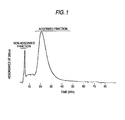
- the column was equilibrated with 50 mM tris-sulfate buffer (pH 7.3), and the purified anti-hIL-5R ⁇ CDR-grafted antibody was injected and then eluted by a linear gradient (60 minutes) of 0 M to 0.2 M of ⁇ -methylmannoside (manufactured by Nacalai Tesque) in 50 mM tris-sulfate buffer (pH 7.3).
- the anti-hIL-5R ⁇ CDR-grafted antibody was fractionated into a non-adsorbed fraction and an absorbed fraction (Fig. 1).
- the non-adsorbed fraction and a part of the adsorbed fraction shown in Fig. 1 were collected, and the binding activity to hIL-5R ⁇ was measured by ELISA.
- Each 50 ⁇ l of a solution of anti-hIL-5R ⁇ mouse antibody KM1257 described in WO97/10354 diluted to a concentration of 10 ⁇ g/ml with PBS was dispensed into each well of a 96-well plate for ELISA (manufactured by Greiner), followed by reaction at 4°C for 20 hours. After the reaction, 1% BSA-PBS was added in an amount of 100 ⁇ l/well, followed by reaction at room temperature for 1 hour to block remaining active groups.
- the 1% BSA-PBS was discarded and a solution of soluble hIL-5R ⁇ described in WO97/10354 diluted to 0.5 ⁇ g/ml with 1% BSA-PBS was added in an amount of 50 ⁇ l/well, followed by reaction at 4°C for 20 hours. After the reaction, each well was washed with Tween-PBS and then a variously diluted solution of the culture supernatant of the transformant or the purified humanized CDR-grafted antibody was added in an amount of 50 ⁇ l/well, followed by reaction at room temperature for 2 hours.
- each well was washed with Tween-PBS and then a solution of a peroxidase-labeled goat anti-human IgG (H&L) antibody (manufactured by American Qualex) diluted by 3000 times with 1% BSA-PBS was added as the second antibody solution in an amount of 50 ⁇ l/well, followed by reaction at room temperature for 1 hour.
- H&L peroxidase-labeled goat anti-human IgG
- ABTS substrate solution a solution obtained by dissolving 0.55 g of ammonium 2,2'-azino-bis(3-ethylbenzothiazoline-6-sulfonate) in 1 L of 0.1 M citric acid buffer (pH 4.2) and, immediately before use, adding hydrogen peroxide in an amount of 1 ⁇ l/ml) was added in an amount of 50 ⁇ l/well to develop color. Then, absorbance at 415 nm (OD415) was measured.
- the non-adsorbed fraction and the part of the adsorbed fraction showed a binding activity similar to that of the anti-hIL-5R ⁇ CDR-grafted antibody before the separation (Fig. 2).
- ADCC activity In vivo cytotoxic activity
- ADCC activities of the non-adsorbed fraction and the part of the adsorbed fraction were measured, respectively.
- a target cell solution was prepared.
- a mouse T cell line CTLL-2(h5R) expressing hIL-5R ⁇ -chain and ⁇ -chain described in WO97/10354 was cultured in RPMI1640-FBS(10) medium to prepare the culture to give a concentration of 1 ⁇ 10 6 cells/0.5 ml, and 3.7 MBq equivalents of a radioactive substance Na 2 51 CrO 4 was added thereto, followed by reaction at 37°C for 1.5 hours to thereby radio-label the cell.
- the cell was washed three times by suspending into RPMI1640-FBS(10) medium and centrifuging, and then re-suspended into the medium and incubated at 4°C for 30 minutes in ice to dissociate the radioactive substance spontaneously. After centrifugation, a target cell solution was obtained by incorporating with 5 ml of RPMI1640-FBS(10) medium to prepare a solution of 2 ⁇ 10 5 cells/ml.
- an effector cell solution was prepared. Healthy human venous blood was collected in an amount of 50 ml and, after the addition of 0.5 ml of heparin sodium (manufactured by Takeda Chemical Industries, Ltd.), the mixture was gently stirred. The mixture was centrifuged using Polymorphprep (manufactured by Nycomed Pharma AS) according to the manufacture's instructions to separate a mononuclear cell layer. The layer was washed by centrifuging three times in RPMI1640-FBS(10) medium and then re-suspended into the medium at a concentration of 9 ⁇ 10 6 cells/well to prepare an effector cell solution.
- Polymorphprep manufactured by Nycomed Pharma AS
- a spontaneously dissociated amount of 51 Cr was determined by measuring the amount of 51 Cr in the supernatant obtained by conducting a similar operation to the above using the medium alone instead of the effector cell solution and antibody solution.
- the total dissociated amount of 51 Cr was determined by measuring the amount of 51 Cr in the supernatant obtained by conducting a similar operation to the above using the medium alone instead of the antibody solution and 1 N hydrochloric acid instead of the effector cell solution.
- the results are shown in Fig. 3.
- the non-adsorbed fraction had ADCC activity higher than the anti-hIL-5R ⁇ CDR-grafted antibody before separation, and the part of the adsorbed fraction showed ADCC activity lower than the anti-hIL-5R ⁇ CDR-grafted antibody before separation.
- the non-adsorbed fraction and the part of the adsorbed fraction were subjected to hydrazinolysis to cleave the carbohydrates from the proteins ( Method in Enzymology , 83 , 263 (1982)).
- N -acetylation was conducted by adding an aqueous ammonium acetate solution and acetic anhydride.
- fluorescent labeling was conducted with PA ( J. of Biochem ., 95 , 197 (1984)).
- the fluorescence-labeled carbohydrates (PA-labeled carbohydrates) were separated from excess reagents by Surperdex peptide HR 10/30 column (manufactured by Pharmacia).
- the carbohydrate fraction was exsiccated in a centrifugal concentrating apparatus to prepare purified PA-labeled carbohydrates.
- the purified PA-labeled carbohydrates were subjected to reverse-phase HPLC analysis using CLC-ODS column (manufactured by Shimadzu Corporation) (Fig. 4).
- the PA-labeled carbohydrates were eluted in the range of 39 minutes to 75 minutes. Based on the calculation from the peak areas, the carbohydrate having no fucose was 100% in the non-adsorbed fraction, while the carbohydrate having no fucose was 18% in the part of the adsorbed fraction.
- the carbohydrate having no fucose was 37% in the anti-hIL-5R ⁇ CDR-grafted antibody before separation.
- an antibody comprising a larger amount of carbohydrate having no fucose and an antibody comprising a smaller amount of carbohydrate having no fucose than that contained in the anti-hIL-5R ⁇ CDR-grafted antibody before separation can be separated each other and purified using a lectin column binding to a carbohydrate having fucose.
- An anti-hIL-5R ⁇ CDR-grafted antibody was purified using a lectin binding to a carbohydrate having bisecting GlcNAc.
- an expression vector for anti-hIL-5R ⁇ CDR-grafted antibody produced according to the method described in WO97/10354 was introduced into a rat myeloma YB2/0 cell to obtain a cell which produces the anti-hIL-5R ⁇ CDR-grafted antibody.
- the cell was cultured in a culture medium and then the anti-hIL-5R ⁇ CDR-grafted antibody was purified from the medium according to the method described in WO97/10354.
- a solution containing the anti-hIL-5R ⁇ CDR-grafted antibody purified in the above was passed through a lectin column (LA-WGA, 4.6 ⁇ 150 mm, manufactured by Honen Corporation).
- LA-WGA lectin column
- LC-6A manufactured by Shimadzu Corporation as an HPLC system
- the solution was passed through the column at a flow rate of 0.5 ml/minute and at room temperature as the column temperature.
- the column was equilibrated with 50 mM tris-sulfate buffer (pH 7.3), and the purified anti-hIL-5R ⁇ CDR-grafted antibody was injected and then eluted by a linear gradient (60 minutes) of 0 M to 0.2 M of GlcNAc (manufactured by Junsei Chemical Co., Ltd.) in 50 mM tris-sulfate buffer (pH 7.3).
- the anti-hIL-5R ⁇ CDR-grafted antibody was separated into a fraction eluted between 2 to 5 minutes and a fraction eluted between 8 to 12 minutes.
- Carbohydrates in the earlier eluted fraction and the later eluted fraction were analyzed by the method described in Example 1(4).
- the PA-labeled carbohydrate group was eluted in the range of 20 minutes to 50 minutes.
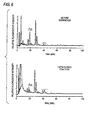
- the anti-hIL-5R ⁇ CDR-grafted antibody of the later eluted fraction had a content of a carbohydrate having bisecting GlcNAc, increased from 6% to 12%, as compared with the anti-hIL-5R ⁇ CDR-grafted antibody before purification and separation (Fig. 5).
- the antibody composition containing a large amount of a bisecting GlcNAc-bound carbohydrate obtained in Example 2 was separated into a non-adsorbed fraction and a part of an adsorbed fraction in a similar manner to the method described in Example 1(1).
- Carbohydrates in the non-adsorbed fraction and the part of the adsorbed fraction were analyzed by the method described in Example 1(4).
- the PA-labeled carbohydrates were eluted in the range of 18 minutes to 45 minutes.
- the part of the adsorbed fraction had a content of a carbohydrate having no fucose, decreased from 29% to 15%, and a content of a bisecting GlcNAc-bound carbohydrate, increased from 5% to 18%, as compared with the anti-hIL-5R ⁇ CDR-grafted antibody before separation (Fig. 6).
- An anti-hIL-5R ⁇ CDR-grafted antibody was purified using hydrophobic chromatography.
- an expression vector for anti-hIL-5R ⁇ CDR-grafted antibody produced according to the method described in WO97/10354 was introduced into a rat myeloma YB2/0 cell to obtain a cell which produces the anti-hIL-5R ⁇ CDR-grafted antibody.
- the cell was cultured in a culture medium and then the anti-hIL-5R ⁇ CDR-grafted antibody was purified from the medium according to the method described in WO97/10354.
- a solution comprising the anti-hIL-5R ⁇ CDR-grafted antibody purified in the above was passed through hydrophobic column Phenyl-5PW (manufactured by Tosoh Corporation).
- LC-6A manufactured by Shimadzu Corporation as an HPLC system
- the solution was passed through the column at a flow rate of 1 ml/minute and at room temperature as the column temperature.
- the column was equilibrated with 20 mM sodium phosphate buffer (pH 6.0) containing 1 M ammonium sulfate, and the purified anti-hIL-5R ⁇ CDR-grafted antibody was injected and then eluted by a linear gradient (60 minutes) to 20 mM sodium phosphate buffer (pH 6.0).
- the anti-hIL-5R ⁇ CDR-grafted antibody was separated into an earlier eluted fraction (between 4 to 6 minutes) and a later eluted fraction (between 20 to 25 minutes).
- Carbohydrates in the earlier eluted fraction and the later eluted fraction were analyzed by the method described in Example 1(4).
- the PA-labeled carbohydrate group was eluted in the range of 33 minutes to 70 minutes.
- a galactose-bound carbohydrate was 53% in the earlier eluted fraction, and a galactose-bound carbohydrate was 44% in the later eluted fraction (Fig. 7).
- An anti-hIL-5R ⁇ CDR-grafted antibody was purified using a lectin binding to a carbohydrate having fucose.
- an expression vector for anti-hIL-5R ⁇ CDR-grafted antibody prepared according to the method described in WO97/10354 was introduced into a mouse myeloma NS0 cell to obtain a cell which produces the anti-hIL-5R ⁇ CDR-grafted antibody.
- the cell was cultured in a culture medium and then the anti-hIL-5R ⁇ CDR-grafted antibody was purified from the medium according to the method described in WO97/10354.
- the anti-hIL-5R ⁇ CDR-grafted antibody was fractionated into a non-adsorbed fraction and an absorbed fraction by treating the purified solution containing the anti-hIL-5R ⁇ CDR-grafted antibody in a similar manner to the method described in Example 1(1).
- the non-adsorbed fraction and the part of the adsorbed fraction were collected, and the binding activity to hIL-5R ⁇ was measured by a method similar to the method described in Example 1(2).
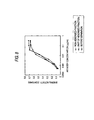
- the non-adsorbed fraction and the part of the adsorbed fraction showed a binding activity similar to the anti-hIL-5R ⁇ CDR-grafted antibody before separation (Fig. 8).
- ADCC activity In vivo cytotoxic activity
- ADCC activities of the non-adsorbed fraction and the part of the adsorbed fraction were measured by a method similar to the method described in Example 1(3).
- the non-adsorbed fraction had ADCC Activity higher than the anti-hIL-5R ⁇ CDR-grafted antibody before separation, and the part of the adsorbed fraction showed ADCC activity lower than the anti-hIL-5R ⁇ CDR-grafted antibody before separation (Fig. 9).
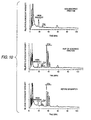
- Carbohydrates of the non-adsorbed fraction and the part of the adsorbed fraction were analyzed by the method described in Example 1(4) (Fig. 10).
- the PA-labeled carbohydrate group was eluted in the range of 15 minutes to 55 minutes. Based on the calculation from the peak areas, a high mannose-type carbohydrate and a complex-type carbohydrate having no fucose were 84% and 16%, respectively, in the non-adsorbed fraction.
- a high mannose-type carbohydrate and a complex-type carbohydrate having no fucose were 5% and 7%, respectively, in the part of the adsorbed fraction.
- a high mannose-type carbohydrate and a complex-type carbohydrate having no fucose were 7% and 8%, respectively, in the anti-hIL-5R ⁇ CDR-grafted antibody before separation.
- an antibody containing a larger amount of carbohydrates having no fucose and an antibody containing a smaller amount of carbohydrates having no fucose than that contained in the anti-hIL-5R ⁇ CDR-grafted antibody before separation can be separated each other and purified using a lectin column binding to a carbohydrate having fucose, regardless of a high mannose-type or complex-type carbohydrate.
- An anti-hIL-5R ⁇ CDR-grafted antibody was purified using a lectin binding to a carbohydrate having bisecting GlcNAc.
- an expression vector for anti-hIL-5R ⁇ CDR-grafted antibody produced according to the method described in WO97/10354 was introduced into a mouse myeloma NS0 cell to obtain a cell which produces the anti-hIL-5R ⁇ CDR-grafted antibody.
- the cell was cultured in a culture medium and then the anti-hIL-5R ⁇ CDR-grafted antibody was purified from the medium according to the method described in WO97/10354.
- a solution comprising the anti-hIL-5R ⁇ CDR-grafted antibody purified in the above was passed through a lectin column (LA-PHA-E 4 , 4.6 ⁇ 150 mm, manufactured by Honen Corporation).
- a lectin column LA-PHA-E 4 , 4.6 ⁇ 150 mm, manufactured by Honen Corporation.
- LC-6A manufactured by Shimadzu Corporation as an HPLC system, the solution was passed through the column at a flow rate of 0.5 ml/minute and at room temperature as the column temperature.
- the column was equilibrated with 50 mM tris-sulfate buffer (pH 8.0), and the purified anti-hIL-5R ⁇ CDR-grafted antibody was injected and then eluted by a linear gradient (60 minutes) of 0 M to 0.2 M of K 2 B 4 O 7 (manufactured by Nacalai Tesque) in 50 mM tris-sulfate buffer (pH 8.0).
- the anti-hIL-5R ⁇ CDR-grafted antibody was separated into an earlier eluted fraction (between 5 to 8 minutes) and a later eluted fraction (between 18 to 30 minutes).
- Carbohydrates in the later eluted fraction and the antibody before separation were analyzed by the method described in Example 1(4).
- the PA-labeled carbohydrate group was eluted in the range of 26 minutes to 55 minutes.
- the anti-hIL-5R ⁇ CDR-grafted antibody of the later eluted fraction had a content of a carbohydrate having bisecting GlcNAc, increased from 4% to 21%, as compared with the anti-hTL-5R ⁇ CDR-grafted antibody before purification and separation (Fig. 11).
- the antibody composition comprising a large amount of a bisecting GlcNAc-bound carbohydrate obtained in Example 6(1) was separated into a non-adsorbed fraction and a part of an adsorbed fraction in a similar manner to the method described in Example 1(1).
- Carbohydrates in the non-adsorbed fraction and the adsorbed fraction were analyzed by the method described in Example 1(4).
- the PA-labeled carbohydrates were eluted in the range of 25 minutes to 55 minutes.
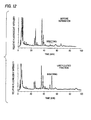
- the part of the adsorbed fraction had a content of a carbohydrate having no fucose, decreased from 27% to 10%, and a content of a bisecting GlcNAc-bound carbohydrate, increased from 4% to 31%, as compared with the anti-hIL-5R ⁇ CDR-grafted antibody before separation (Fig. 12).
Landscapes
- Health & Medical Sciences (AREA)
- Chemical & Material Sciences (AREA)
- Organic Chemistry (AREA)
- Life Sciences & Earth Sciences (AREA)
- Medicinal Chemistry (AREA)
- General Health & Medical Sciences (AREA)
- Public Health (AREA)
- Veterinary Medicine (AREA)
- Chemical Kinetics & Catalysis (AREA)
- Nuclear Medicine, Radiotherapy & Molecular Imaging (AREA)
- General Chemical & Material Sciences (AREA)
- Pharmacology & Pharmacy (AREA)
- Animal Behavior & Ethology (AREA)
- Immunology (AREA)
- Biochemistry (AREA)
- Proteomics, Peptides & Aminoacids (AREA)
- Bioinformatics & Cheminformatics (AREA)
- Engineering & Computer Science (AREA)
- Biophysics (AREA)
- Genetics & Genomics (AREA)
- Molecular Biology (AREA)
- Virology (AREA)
- Oncology (AREA)
- Communicable Diseases (AREA)
- Cardiology (AREA)
- Heart & Thoracic Surgery (AREA)
- Pulmonology (AREA)
- Peptides Or Proteins (AREA)
- Medicines Containing Antibodies Or Antigens For Use As Internal Diagnostic Agents (AREA)
Applications Claiming Priority (3)
| Application Number | Priority Date | Filing Date | Title |
|---|---|---|---|
| JP2000308254 | 2000-10-06 | ||
| JP2000308254 | 2000-10-06 | ||
| PCT/JP2001/008715 WO2002030954A1 (fr) | 2000-10-06 | 2001-10-03 | Procede de purification d'un anticorps |
Publications (2)
| Publication Number | Publication Date |
|---|---|
| EP1333032A1 true EP1333032A1 (fr) | 2003-08-06 |
| EP1333032A4 EP1333032A4 (fr) | 2005-03-16 |
Family
ID=18788598
Family Applications (1)
| Application Number | Title | Priority Date | Filing Date |
|---|---|---|---|
| EP01974669A Withdrawn EP1333032A4 (fr) | 2000-10-06 | 2001-10-03 | Procede de purification d'un anticorps |
Country Status (5)
| Country | Link |
|---|---|
| EP (1) | EP1333032A4 (fr) |
| JP (1) | JPWO2002030954A1 (fr) |
| AU (1) | AU2001294175A1 (fr) |
| CA (1) | CA2424977C (fr) |
| WO (1) | WO2002030954A1 (fr) |
Cited By (4)
| Publication number | Priority date | Publication date | Assignee | Title |
|---|---|---|---|---|
| EP1860184A4 (fr) * | 2005-03-01 | 2009-01-21 | Nat University Of Corp Hiroshi | Nouveau polypeptide, polynucléotide codant pour le polypeptide et utilisation du polypeptide et du polynucléotide |
| WO2013013193A1 (fr) | 2011-07-20 | 2013-01-24 | Zepteon, Incorporated | Procédés de séparation de polypeptide |
| US11021728B2 (en) | 2009-10-26 | 2021-06-01 | Hoffmann-La Roche Inc. | Method for the production of a glycosylated immunoglobulin |
| US11872289B2 (en) | 2018-05-18 | 2024-01-16 | Daiichi Sankyo Co., Ltd. | Anti-MUC1 antibody-drug conjugate |
Families Citing this family (205)
| Publication number | Priority date | Publication date | Assignee | Title |
|---|---|---|---|---|
| FR2807767B1 (fr) | 2000-04-12 | 2005-01-14 | Lab Francais Du Fractionnement | Anticorps monoclonaux anti-d |
| US7317091B2 (en) | 2002-03-01 | 2008-01-08 | Xencor, Inc. | Optimized Fc variants |
| US7662925B2 (en) | 2002-03-01 | 2010-02-16 | Xencor, Inc. | Optimized Fc variants and methods for their generation |
| US8188231B2 (en) | 2002-09-27 | 2012-05-29 | Xencor, Inc. | Optimized FC variants |
| US20040132101A1 (en) | 2002-09-27 | 2004-07-08 | Xencor | Optimized Fc variants and methods for their generation |
| EP1553975B8 (fr) | 2002-09-27 | 2023-04-12 | Xencor, Inc. | Variants fc optimises et methodes destinees a leur generation |
| US20090010920A1 (en) | 2003-03-03 | 2009-01-08 | Xencor, Inc. | Fc Variants Having Decreased Affinity for FcyRIIb |
| US8084582B2 (en) | 2003-03-03 | 2011-12-27 | Xencor, Inc. | Optimized anti-CD20 monoclonal antibodies having Fc variants |
| US8388955B2 (en) | 2003-03-03 | 2013-03-05 | Xencor, Inc. | Fc variants |
| US9051373B2 (en) | 2003-05-02 | 2015-06-09 | Xencor, Inc. | Optimized Fc variants |
| US9714282B2 (en) | 2003-09-26 | 2017-07-25 | Xencor, Inc. | Optimized Fc variants and methods for their generation |
| US8883147B2 (en) | 2004-10-21 | 2014-11-11 | Xencor, Inc. | Immunoglobulins insertions, deletions, and substitutions |
| US8399618B2 (en) | 2004-10-21 | 2013-03-19 | Xencor, Inc. | Immunoglobulin insertions, deletions, and substitutions |
| AU2004297616B2 (en) | 2003-12-04 | 2008-12-18 | Xencor, Inc. | Methods of generating variant proteins with increased host string content and compositions thereof |
| EP1737890A2 (fr) | 2004-03-24 | 2007-01-03 | Xencor, Inc. | Variantes d'immunoglobuline a l'exterieur de la region fc |
| EP2471813B1 (fr) | 2004-07-15 | 2014-12-31 | Xencor, Inc. | Variantes optimisées de Fc |
| US20150010550A1 (en) | 2004-07-15 | 2015-01-08 | Xencor, Inc. | OPTIMIZED Fc VARIANTS |
| US8367805B2 (en) | 2004-11-12 | 2013-02-05 | Xencor, Inc. | Fc variants with altered binding to FcRn |
| US8546543B2 (en) | 2004-11-12 | 2013-10-01 | Xencor, Inc. | Fc variants that extend antibody half-life |
| AU2005304624B2 (en) | 2004-11-12 | 2010-10-07 | Xencor, Inc. | Fc variants with altered binding to FcRn |
| US8802820B2 (en) | 2004-11-12 | 2014-08-12 | Xencor, Inc. | Fc variants with altered binding to FcRn |
| HUE025945T2 (en) | 2005-02-15 | 2016-07-28 | Univ Duke | Anti-CD19 antibodies and their applications in oncology |
| ES2971647T3 (es) | 2005-04-15 | 2024-06-06 | Macrogenics Inc | Diacuerpos covalentes y usos de los mismos |
| EP1885755A4 (fr) | 2005-05-05 | 2009-07-29 | Univ Duke | Traitements des maladies auto-immunes par anticorps anti-cd19 |
| WO2007008943A2 (fr) | 2005-07-08 | 2007-01-18 | Xencor, Inc. | Proteines optimisees qui ciblent la molecule ep-cam |
| PL2573114T3 (pl) | 2005-08-10 | 2016-10-31 | Identyfikacja i inżynieria przeciwciał z wariantami regionów FC oraz sposoby ich stosowania | |
| WO2007041635A2 (fr) | 2005-10-03 | 2007-04-12 | Xencor, Inc. | Variants de fc dotés de propriétés de liaison aux récepteurs fc optimisées |
| WO2007044616A2 (fr) | 2005-10-06 | 2007-04-19 | Xencor, Inc. | Anticorps anti-cd30 optimises |
| WO2007044607A2 (fr) * | 2005-10-06 | 2007-04-19 | Emthrax, Llc | Méthodes et compositions en rapport avec l’utilisation de glycoprotéines de spores de b. anthracis comme vaccins |
| US8470318B2 (en) | 2005-11-07 | 2013-06-25 | The Rockefeller University | Polypeptides with enhanced anti-inflammatory and decreased cytotoxic properties and relating methods |
| EP1999148B8 (fr) | 2006-03-06 | 2014-03-05 | Medlmmune, LLC | Anticorps humanisés dirigés contre l'antigène cd22 et leur utilisation à des fins thérapeutiques en oncologie, ainsi que dans le cadre de transplantations et de maladies auto-immunes |
| CA2647524C (fr) * | 2006-04-05 | 2019-11-26 | The Rockefeller University | Polypeptides presentant des proprietes anti-inflammatoires accrues et des proprietes cytotoxiques reduites, et procedes coorespondants |
| PL2383297T3 (pl) | 2006-08-14 | 2013-06-28 | Xencor Inc | Zoptymalizowane przeciwciała ukierunkowane na CD19 |
| EP3539981A1 (fr) | 2006-09-10 | 2019-09-18 | Glycotope GmbH | Utilisation de cellules humaines d'origine leucémique myéloïde pour l'expression d'anticorps |
| WO2008036688A2 (fr) | 2006-09-18 | 2008-03-27 | Xencor, Inc. | Anticorps optimisés ciblant l'antigène hm1.24 |
| JP2010512306A (ja) * | 2006-10-27 | 2010-04-22 | ザ ロックフェラー ユニバーシティー | 抗炎症特性が増強され、細胞毒性特性が減少したポリペプチドおよび関連する方法 |
| PL3199180T3 (pl) | 2007-03-08 | 2022-08-08 | Humanigen, Inc. | Przeciwciała przeciwko epha3 do leczenia guzów litych |
| AU2008247382B2 (en) | 2007-05-07 | 2014-06-05 | Medimmune, Llc | Anti-ICOS antibodies and their use in treatment of oncology, transplantation and autoimmune disease |
| MX376656B (es) | 2007-05-14 | 2025-03-07 | Kyowa Kirin Co Ltd | Metodos para reducir niveles de basófilos. |
| EP2176298B1 (fr) | 2007-05-30 | 2017-11-15 | Xencor, Inc. | Procédés et compositions permettant l'inhibition de cellules d'expression du cd32b |
| EP2158221B1 (fr) | 2007-06-21 | 2018-08-29 | MacroGenics, Inc. | Di-anticorps covalents et leurs utilisations |
| KR20100058509A (ko) | 2007-07-31 | 2010-06-03 | 메디뮨 엘엘씨 | 다중특이적 에피토프 결합 단백질 및 이의 용도 |
| US8092804B2 (en) | 2007-12-21 | 2012-01-10 | Medimmune Limited | Binding members for interleukin-4 receptor alpha (IL-4Rα)-173 |
| KR101759457B1 (ko) | 2007-12-21 | 2017-07-31 | 메디뮨 리미티드 | 인터루킨-4 수용체 알파(IL-4Rα)에 대한 결합 구성원-173 |
| HRP20150279T1 (hr) | 2007-12-26 | 2015-05-08 | Xencor, Inc. | Fc inaäśice s promijenjenim vezanjem na fcrn |
| BRPI0907046A2 (pt) | 2008-01-18 | 2015-07-28 | Medimmune Llc | Anticorpo de cisteína engenheirada, ácido nucleico isolado, vetor, célula hospedeira, conjugado de anticorpo, composição farmacêutica, métodos de detecção de câncer, doenças ou distúrbios autoimunes, inflamatórios ou infecciosos em um indivíduo e de inibição de proliferação de uma célula alvo |
| KR20160070165A (ko) | 2008-02-08 | 2016-06-17 | 메디뮨 엘엘씨 | Fc 리간드 친화성이 감소된 항-IFNAR1 항체 |
| US12492253B1 (en) | 2008-02-25 | 2025-12-09 | Xencor, Inc. | Anti-human C5 antibodies |
| WO2009123894A2 (fr) | 2008-04-02 | 2009-10-08 | Macrogenics, Inc. | Anticorps spécifiques de her2/neu et procédés d’utilisation de ceux-ci |
| ES2589912T3 (es) | 2008-04-02 | 2016-11-17 | Macrogenics, Inc. | Anticuerpos específicos para el complejo BCR y procedimientos de uso de los mismos |
| US20110081347A1 (en) | 2008-06-04 | 2011-04-07 | Macrogenics, Inc. | Antibodies with Altered Binding to FcRn and Methods of Using Same |
| EP2305704B1 (fr) | 2008-07-22 | 2016-10-19 | J-Oil Mills, Inc. | Lectine spécifique du fucose 1 6 |
| BRPI0918670B8 (pt) | 2008-09-17 | 2021-05-25 | Xencor Inc | anticorpo |
| AU2009294415B2 (en) | 2008-09-19 | 2015-09-24 | Medimmune Llc | Antibodies directed to DLL4 and uses thereof |
| JP5933975B2 (ja) | 2008-11-12 | 2016-06-15 | メディミューン,エルエルシー | 抗体製剤 |
| DK2786762T3 (da) | 2008-12-19 | 2019-05-06 | Macrogenics Inc | Kovalente diabodies og anvendelser deraf |
| AU2010221159B2 (en) | 2009-03-06 | 2015-11-26 | Humanigen, Inc. | Treatment of leukemias and chronic myeloproliferative diseases with antibodies to EphA3 |
| EP2233500A1 (fr) | 2009-03-20 | 2010-09-29 | LFB Biotechnologies | Variantes Fc optimisées |
| EP2711018A1 (fr) | 2009-06-22 | 2014-03-26 | MedImmune, LLC | Régions Fc modifiées pour conjugaison spécifique d'un site |
| WO2011028952A1 (fr) | 2009-09-02 | 2011-03-10 | Xencor, Inc. | Compositions et procédés pour une co-liaison bivalente et monovalente simultanée d'antigènes |
| JP5898082B2 (ja) | 2009-10-07 | 2016-04-06 | マクロジェニクス,インコーポレーテッド | フコシル化程度の変更により改良されたエフェクター機能を示すFc領域含有ポリペプチドおよびその使用法 |
| PL2504364T3 (pl) | 2009-11-24 | 2017-12-29 | Medimmune Limited | Ukierunkowane środki wiążące przeciwko B7-H1 |
| WO2011091078A2 (fr) | 2010-01-19 | 2011-07-28 | Xencor, Inc. | Variants d'anticorps possédant une activité complémentaire accrue |
| WO2011097527A2 (fr) | 2010-02-04 | 2011-08-11 | Xencor, Inc. | Immunoprotection de fractions thérapeutiques avec des régions fc améliorées |
| KR20130009760A (ko) | 2010-02-10 | 2013-01-23 | 이뮤노젠 아이엔씨 | Cd20 항체 및 이의 용도 |
| EP2542256B1 (fr) | 2010-03-04 | 2019-05-22 | MacroGenics, Inc. | Anticorps réagissant avec b7-h3, fragments immunologiquement actifs associés et utilisations associées |
| JP2013528357A (ja) | 2010-03-29 | 2013-07-11 | ザイムワークス,インコーポレイテッド | 強化又は抑制されたエフェクター機能を有する抗体 |
| EP2576622A4 (fr) | 2010-06-01 | 2013-11-27 | Univ Monash | Anticorps dirigés contre le récepteur tyrosine kinase c-met |
| EP3323830B1 (fr) | 2010-06-19 | 2023-08-23 | Memorial Sloan-Kettering Cancer Center | Anticorps anti-gd2 |
| AU2011283694B2 (en) | 2010-07-29 | 2017-04-13 | Xencor, Inc. | Antibodies with modified isoelectric points |
| AU2011286024B2 (en) | 2010-08-02 | 2014-08-07 | Macrogenics, Inc. | Covalent diabodies and uses thereof |
| WO2012019061A2 (fr) | 2010-08-05 | 2012-02-09 | Stem Centrx, Inc. | Nouveaux effecteurs et leurs procédés d'utilisation |
| SG10201506782XA (en) | 2010-08-27 | 2015-10-29 | Stem Centrx Inc | Notum protein modulators and methods of use |
| AU2011295715B9 (en) | 2010-09-03 | 2017-02-23 | Abbvie Stemcentrx Llc | Novel modulators and methods of use |
| EP3828205A1 (fr) | 2010-10-01 | 2021-06-02 | Oxford BioTherapeutics Ltd | Anticorps anti-ror1 |
| ES2758994T3 (es) | 2010-11-05 | 2020-05-07 | Zymeworks Inc | Diseño anticuerpo heterodimérico estable con mutaciones en el dominio Fc |
| NZ611428A (en) | 2010-12-08 | 2015-07-31 | Stemcentrx Inc | Novel modulators and methods of use |
| JOP20210044A1 (ar) | 2010-12-30 | 2017-06-16 | Takeda Pharmaceuticals Co | الأجسام المضادة لـ cd38 |
| SA112330278B1 (ar) | 2011-02-18 | 2015-10-09 | ستيم سينتركس، انك. | مواد ضابطة جديدة وطرق للاستخدام |
| US8476409B2 (en) | 2011-04-19 | 2013-07-02 | Merrimack Pharmaceuticals, Inc. | Bispecific anti-IGF-1R and anti-ErbB3 antibodies |
| BR112013029892A2 (pt) | 2011-05-21 | 2016-12-20 | Macrogenics Inc | polipeptídeo, molécula de ligação a antígeno, diacorpo e uso de uma porção polipeptídica de uma proteína de ligação a soro desimunizada |
| UA117901C2 (uk) | 2011-07-06 | 2018-10-25 | Ґенмаб Б.В. | Спосіб посилення ефекторної функції вихідного поліпептиду, його варіанти та їх застосування |
| CN103717729B (zh) | 2011-07-08 | 2017-11-21 | 动量制药公司 | 细胞培养方法 |
| WO2013022855A1 (fr) | 2011-08-05 | 2013-02-14 | Xencor, Inc. | Anticorps avec points isoélectriques modifiés et immunofiltration |
| CN104168913A (zh) * | 2011-08-10 | 2014-11-26 | 法国化学与生物科技实验室 | 高半乳糖基化抗体 |
| CA2843158A1 (fr) | 2011-08-26 | 2013-03-07 | Merrimack Pharmaceuticals, Inc. | Anticorps bispecifiques a fc en tandem |
| US12466897B2 (en) | 2011-10-10 | 2025-11-11 | Xencor, Inc. | Heterodimeric human IgG1 polypeptides with isoelectric point modifications |
| AU2012323287B2 (en) | 2011-10-10 | 2018-02-01 | Xencor, Inc. | A method for purifying antibodies |
| US10851178B2 (en) | 2011-10-10 | 2020-12-01 | Xencor, Inc. | Heterodimeric human IgG1 polypeptides with isoelectric point modifications |
| BR112014010580B1 (pt) | 2011-11-04 | 2021-01-12 | Zymeworks, Inc. | constructo de fc heteromultimérico isolado, composição, uso de um constructo de fc heteromultimérico isolado, composição de ácido nucléico e método para expressar o constructo de fc heteromultimérico isolado |
| WO2013087789A1 (fr) | 2011-12-13 | 2013-06-20 | Glykos Finland Ltd. | Réseaux d'isoformes d'anticorps et procédés associés |
| JP2015502397A (ja) | 2011-12-23 | 2015-01-22 | ファイザー・インク | 部位特異的コンジュゲーションのための操作された抗体定常領域、ならびにそのための方法および使用 |
| CA2867444C (fr) | 2012-03-16 | 2021-04-13 | University Health Network | Procedes et compositions pour moduler l'activite toso |
| WO2013155346A1 (fr) | 2012-04-11 | 2013-10-17 | The Regents Of The University Of California | Outils diagnostiques pour la réponse au traitement par 6-thiopurines |
| US9663581B2 (en) | 2012-04-25 | 2017-05-30 | Momenta Pharmaceuticals, Inc. | Modified glycoproteins |
| AU2013258834B2 (en) | 2012-05-10 | 2017-09-07 | Zymeworks Bc Inc. | Heteromultimer constructs of immunoglobulin heavy chains with mutations in the Fc domain |
| KR101566539B1 (ko) | 2012-06-08 | 2015-11-05 | 국립암센터 | 신규한 Th2 세포 전환용 에피토프 및 이의 용도 |
| WO2014004549A2 (fr) | 2012-06-27 | 2014-01-03 | Amgen Inc. | Protéines de liaison anti-mésothéline |
| NZ630363A (en) | 2012-07-25 | 2018-09-28 | Celldex Therapeutics Inc | Anti-kit antibodies and uses thereof |
| EP2877589B1 (fr) | 2012-07-26 | 2024-03-06 | Momenta Pharmaceuticals, Inc. | Glycoprotéines ayant des propriétés anti-inflammatoires |
| KR20200024345A (ko) | 2013-01-10 | 2020-03-06 | 젠맵 비. 브이 | 인간 IgG1 Fc 영역 변이체 및 그의 용도 |
| US9605084B2 (en) | 2013-03-15 | 2017-03-28 | Xencor, Inc. | Heterodimeric proteins |
| US10487155B2 (en) | 2013-01-14 | 2019-11-26 | Xencor, Inc. | Heterodimeric proteins |
| US9701759B2 (en) | 2013-01-14 | 2017-07-11 | Xencor, Inc. | Heterodimeric proteins |
| US10968276B2 (en) | 2013-03-12 | 2021-04-06 | Xencor, Inc. | Optimized anti-CD3 variable regions |
| KR102211837B1 (ko) | 2013-01-14 | 2021-02-03 | 젠코어 인코포레이티드 | 신규한 이형이량체 단백질 |
| US11053316B2 (en) | 2013-01-14 | 2021-07-06 | Xencor, Inc. | Optimized antibody variable regions |
| US10131710B2 (en) | 2013-01-14 | 2018-11-20 | Xencor, Inc. | Optimized antibody variable regions |
| WO2014113510A1 (fr) | 2013-01-15 | 2014-07-24 | Xencor, Inc. | Elimination rapide de complexes antigéniques à l'aide de nouveaux anticorps |
| WO2014122143A1 (fr) | 2013-02-05 | 2014-08-14 | Engmab Ag | Procédé de sélection d'anticorps anti-bcma |
| EP2762496A1 (fr) | 2013-02-05 | 2014-08-06 | EngMab AG | Procédé pour la sélection d'anticorps contre BCMA |
| EP3594230A1 (fr) | 2013-02-13 | 2020-01-15 | Laboratoire Français du Fractionnement et des Biotechnologies | Anticorps anti-tnf alpha hautement galactosylés et leurs utilisations |
| US10034921B2 (en) | 2013-02-13 | 2018-07-31 | Laboratoire Français Du Fractionnement Et Des Biotechnologies | Proteins with modified glycosylation and methods of production thereof |
| HK1220465A1 (zh) | 2013-03-06 | 2017-05-05 | Merrimack Pharmaceuticals, Inc. | 抗c-met串联fc双特异性抗体 |
| US8956830B2 (en) | 2013-03-14 | 2015-02-17 | Momenta Pharmaceuticals, Inc. | Methods of cell culture |
| US9217168B2 (en) | 2013-03-14 | 2015-12-22 | Momenta Pharmaceuticals, Inc. | Methods of cell culture |
| US10858417B2 (en) | 2013-03-15 | 2020-12-08 | Xencor, Inc. | Heterodimeric proteins |
| RU2680267C2 (ru) | 2013-03-15 | 2019-02-19 | Мемориал Слоан Кеттеринг Кэнсер Сентер | Высокоаффинные антитела к gd2 |
| US10106624B2 (en) | 2013-03-15 | 2018-10-23 | Xencor, Inc. | Heterodimeric proteins |
| US9260527B2 (en) | 2013-03-15 | 2016-02-16 | Sdix, Llc | Anti-human CXCR4 antibodies and methods of making same |
| US10519242B2 (en) | 2013-03-15 | 2019-12-31 | Xencor, Inc. | Targeting regulatory T cells with heterodimeric proteins |
| EP2970486B1 (fr) | 2013-03-15 | 2018-05-16 | Xencor, Inc. | Modulation de cellules t avec des anticorps bispecifiques et des fusions fc |
| JP6594855B2 (ja) | 2013-03-15 | 2019-10-23 | ゼンコア インコーポレイテッド | ヘテロ二量体タンパク質 |
| ES2802274T3 (es) | 2013-05-02 | 2021-01-18 | Momenta Pharmaceuticals Inc | Glicoproteínas sialiladas |
| WO2014186310A1 (fr) | 2013-05-13 | 2014-11-20 | Momenta Pharmaceuticals, Inc. | Méthodes de traitement de la neurodégénérescence |
| EP3016729B1 (fr) | 2013-07-05 | 2020-03-25 | Laboratoire Francais du Fractionnement et des Biotechnologies Societe Anonyme | Matrice de chromatographie d'affinité |
| CN105745224B (zh) | 2013-10-11 | 2019-11-05 | 牛津生物疗法有限公司 | 用于治疗癌症的针对ly75的偶联抗体 |
| WO2015057622A1 (fr) | 2013-10-16 | 2015-04-23 | Momenta Pharmaceuticals, Inc. | Glycoprotéines sialylées |
| US8986691B1 (en) | 2014-07-15 | 2015-03-24 | Kymab Limited | Method of treating atopic dermatitis or asthma using antibody to IL4RA |
| US8980273B1 (en) | 2014-07-15 | 2015-03-17 | Kymab Limited | Method of treating atopic dermatitis or asthma using antibody to IL4RA |
| AU2015225867B2 (en) | 2014-03-07 | 2020-02-06 | University Health Network | Methods and compositions for modifying the immune response |
| EP3699195A3 (fr) | 2014-03-28 | 2020-11-04 | Xencor, Inc. | Anticorps bispécifiques se liant à cd38 et cd3 |
| EP3194449A1 (fr) | 2014-07-24 | 2017-07-26 | Xencor, Inc. | Élimination rapide de complexes antigéniques à l'aide de nouveaux anticorps |
| PE20171324A1 (es) | 2014-11-26 | 2017-09-11 | Xencor Inc | Anticuerpos heterodimericos que se unen a cd3 y a antigenos tumorales |
| EP3223907A2 (fr) | 2014-11-26 | 2017-10-04 | Xencor, Inc. | Anticorps hétérodimériques se liant aux antigènes cd3 et cd38 |
| US10259887B2 (en) | 2014-11-26 | 2019-04-16 | Xencor, Inc. | Heterodimeric antibodies that bind CD3 and tumor antigens |
| WO2016105450A2 (fr) | 2014-12-22 | 2016-06-30 | Xencor, Inc. | Anticorps trispécifiques |
| CN107847584B (zh) | 2015-02-09 | 2022-01-25 | 纪念斯隆凯特琳癌症中心 | 具有人a33抗原和dota金属复合物亲和力的多特异性抗体及其用途 |
| US10227411B2 (en) | 2015-03-05 | 2019-03-12 | Xencor, Inc. | Modulation of T cells with bispecific antibodies and FC fusions |
| US20160280767A1 (en) | 2015-03-23 | 2016-09-29 | Lonza Ltd. | Methods for controlling protein glycosylation |
| SG11201708804WA (en) | 2015-05-07 | 2017-11-29 | Agenus Inc | Anti-ox40 antibodies and methods of use thereof |
| AU2016274767B2 (en) | 2015-06-09 | 2022-05-19 | Eureka Therapeutics, Inc. | T cell receptor-like antibody agents specific for EBV latent membrane protein 2A peptide presented by human HLA |
| FR3038517B1 (fr) | 2015-07-06 | 2020-02-28 | Laboratoire Francais Du Fractionnement Et Des Biotechnologies | Utilisation de fragments fc modifies en immunotherapie |
| SI3331910T1 (sl) | 2015-08-03 | 2020-07-31 | Engmab Sarl | Monoklonska protitelesa proti humani antigen dozorevanja limfocitov B (BCMA) |
| CA3007030A1 (fr) | 2015-12-07 | 2017-06-15 | Xencor, Inc. | Anticorps heterodimees se liant a cd3 et psma |
| EP3397282A4 (fr) | 2015-12-30 | 2019-08-07 | Momenta Pharmaceuticals, Inc. | Méthodes associées à des produits biologiques |
| WO2017198731A1 (fr) | 2016-05-18 | 2017-11-23 | Genmab B.V. | Anticorps et leurs procédés d'utilisation dans le traitement de maladies infectieuses |
| WO2017214452A1 (fr) | 2016-06-08 | 2017-12-14 | Xencor, Inc. | Traitement des maladies associées aux igg4 par des anticorps anti-cd19 se réticulant à cd32b |
| JP7010854B2 (ja) | 2016-06-14 | 2022-01-26 | ゼンコア インコーポレイテッド | 二重特異性チェックポイント阻害剤抗体 |
| CN109715663B (zh) | 2016-06-28 | 2022-11-25 | Xencor股份有限公司 | 结合生长抑素受体2的异源二聚抗体 |
| MA45674A (fr) | 2016-07-15 | 2019-05-22 | Takeda Pharmaceuticals Co | Méthodes et matériaux permettant d'évaluer une réponse à des traitements de déplétion de plasmoblastes et de plasmocytes |
| US10793632B2 (en) | 2016-08-30 | 2020-10-06 | Xencor, Inc. | Bispecific immunomodulatory antibodies that bind costimulatory and checkpoint receptors |
| US20190270821A1 (en) | 2016-09-13 | 2019-09-05 | Humanigen, Inc. | Epha3 antibodies for the treatment of pulmonary fibrosis |
| MY203000A (en) | 2016-10-14 | 2024-06-01 | Xencor Inc | Il15/il15r� heterodimeric fc-fusion proteins |
| US20190276549A1 (en) | 2016-11-01 | 2019-09-12 | Genmab B.V. | Polypeptide variants and uses thereof |
| JP7267914B2 (ja) | 2016-11-02 | 2023-05-02 | エンクマフ エスアーエールエル | Bcma及びcd3に対する二重特異性抗体、及び多発性骨髄腫を治療するために併用して使用される免疫療法薬 |
| CN110300599B (zh) | 2016-12-07 | 2024-07-02 | 艾吉纳斯公司 | 抗体和其使用方法 |
| US20180230218A1 (en) | 2017-01-04 | 2018-08-16 | Immunogen, Inc. | Met antibodies and immunoconjugates and uses thereof |
| CN112210010B (zh) | 2017-01-06 | 2023-12-05 | 优特力克斯有限公司 | 抗-人4-1bb抗体及其应用 |
| EP3580233A1 (fr) | 2017-02-10 | 2019-12-18 | Genmab B.V. | Variants polypeptidiques et ses utilisations |
| EP3882271A3 (fr) | 2017-02-10 | 2022-01-05 | Eutilex Co., Ltd. | Anticorps anticancéreux convertible en cellules t régulatrices inductibles par ifn-gamma (irtca) et ses utilisations |
| WO2019006472A1 (fr) | 2017-06-30 | 2019-01-03 | Xencor, Inc. | Protéines de fusion fc hétérodimères ciblées contenant il-15/il-15ra et domaines de liaison à l'antigène |
| US11306144B2 (en) | 2017-08-25 | 2022-04-19 | Five Prime Therapeutics, Inc. | B7-H4 antibodies and methods of use thereof |
| EP4512469A3 (fr) | 2017-09-11 | 2025-05-21 | Monash University | Proteines de liaison au recepteur de la thrombine humaine, par4 |
| US10981992B2 (en) | 2017-11-08 | 2021-04-20 | Xencor, Inc. | Bispecific immunomodulatory antibodies that bind costimulatory and checkpoint receptors |
| JP2021502100A (ja) | 2017-11-08 | 2021-01-28 | ゼンコア インコーポレイテッド | 新規抗pd−1配列を用いた二重特異性および単一特異性抗体 |
| IL275426B2 (en) | 2017-12-19 | 2025-03-01 | Xencor Inc | Engineered il-2 fc fusion proteins |
| CA3091161A1 (fr) | 2018-02-21 | 2019-08-29 | Five Prime Therapeutics, Inc. | Schemas posologiques d'anticorps b7-h4 |
| BR112020016986A2 (pt) | 2018-02-21 | 2021-03-02 | Five Prime Therapeutics, Inc. | formulações de anticorpo contra b7-h4 |
| KR20200144094A (ko) | 2018-03-02 | 2020-12-28 | 파이브 프라임 테라퓨틱스, 인크. | B7-h4 항체 및 이의 사용 방법 |
| CN119930831A (zh) | 2018-03-14 | 2025-05-06 | 纪念斯隆凯特琳癌症中心 | 抗聚唾液酸抗体及其用途 |
| CA3096052A1 (fr) | 2018-04-04 | 2019-10-10 | Xencor, Inc. | Anticorps heterodimeres qui se lient a la proteine d'activation des fibroblastes |
| EP3781598A1 (fr) | 2018-04-18 | 2021-02-24 | Xencor, Inc. | Protéines de fusion hétérodimères ciblant tim-3 contenant des protéines de fusion fc d'il-15/il-15ra et domaines de liaison à l'antigène de tim-3 |
| SG11202010163QA (en) | 2018-04-18 | 2020-11-27 | Xencor Inc | Pd-1 targeted heterodimeric fusion proteins containing il-15/il-15ra fc-fusion proteins and pd-1 antigen binding domains and uses thereof |
| MX2020011552A (es) | 2018-05-03 | 2020-11-24 | Genmab Bv | Combinaciones de variantes de anticuerpos y usos de las mismas. |
| TW202519260A (zh) | 2018-07-02 | 2025-05-16 | 美商安進公司 | 抗steap1抗原結合蛋白 |
| WO2020014306A1 (fr) | 2018-07-10 | 2020-01-16 | Immunogen, Inc. | Anticorps anti-met, immunoconjugués et utilisations de ceux-ci |
| US20200017600A1 (en) | 2018-07-13 | 2020-01-16 | Genmab A/S | Variants of cd38 antibody and uses thereof |
| US20240254252A1 (en) | 2018-07-13 | 2024-08-01 | Genmab A/S | Trogocytosis-mediated therapy using cd38 antibodies |
| US12595454B2 (en) | 2018-09-06 | 2026-04-07 | Momenta Pharmaceuticals, Inc. | Methods of continuous cell culture |
| AU2019355971B2 (en) | 2018-10-03 | 2025-05-08 | Xencor, Inc. | IL-12 heterodimeric Fc-fusion proteins |
| KR20210076025A (ko) | 2018-10-15 | 2021-06-23 | 파이브 프라임 테라퓨틱스, 인크. | 암 병용 요법 |
| WO2020089437A1 (fr) | 2018-10-31 | 2020-05-07 | Engmab Sàrl | Polythérapie |
| IL284374B2 (en) | 2018-12-31 | 2025-10-01 | Momenta Pharmaceuticals Inc | Methods for producing ozatekinumab |
| CA3132185A1 (fr) | 2019-03-01 | 2020-09-10 | Xencor, Inc. | Anticorps heterodimeres qui se lient a enpp3 et cd3 |
| EP3938400B1 (fr) | 2019-03-11 | 2025-07-30 | Memorial Sloan Kettering Cancer Center | Anticorps cd22 et leurs procédés d'utilisation |
| US20220169706A1 (en) | 2019-03-28 | 2022-06-02 | Danisco Us Inc | Engineered antibodies |
| US20230272105A1 (en) | 2020-01-16 | 2023-08-31 | Genmab A/S | Formulations of cd38 antibodies and uses thereof |
| HRP20240182T1 (hr) | 2020-03-26 | 2024-04-26 | Vanderbilt University | Ljudska monoklonska protutijela za teški akutni respiratorni sindrom koronavirusa 2 (sars-cov-2) |
| WO2021231976A1 (fr) | 2020-05-14 | 2021-11-18 | Xencor, Inc. | Anticorps hétérodimères qui se lient à l'antigène membranaire spécifique de la prostate (psma) et cd3 |
| TW202208423A (zh) | 2020-05-17 | 2022-03-01 | 英商阿斯特捷利康英國股份有限公司 | Sars-cov-2抗體及其選擇和使用方法 |
| CN116670285A (zh) | 2020-06-23 | 2023-08-29 | 江苏康缘药业股份有限公司 | 抗cd38抗体及其用途 |
| US20220041694A1 (en) | 2020-08-10 | 2022-02-10 | Astrazeneca Uk Limited | Sars-cov-2 antibodies for treatment and prevention of covid-19 |
| CA3192204A1 (fr) | 2020-08-19 | 2022-02-24 | Xencor, Inc. | Anticorps anti-cd28 et/ou compositions anti-b7h3 |
| MX2023008285A (es) | 2021-01-13 | 2023-09-12 | Memorial Sloan Kettering Cancer Center | Conjugado de anticuerpo anti-dll3-farmaco. |
| CA3204628A1 (fr) | 2021-01-13 | 2022-07-21 | John T. POIRIER | Conjugue anticorps-derive de pyrrolobenzodiazepine |
| US11739144B2 (en) | 2021-03-09 | 2023-08-29 | Xencor, Inc. | Heterodimeric antibodies that bind CD3 and CLDN6 |
| EP4305065A1 (fr) | 2021-03-10 | 2024-01-17 | Xencor, Inc. | Anticorps hétérodimères qui se lient au cd3 et au gpc3 |
| IL311141A (en) | 2021-09-06 | 2024-04-01 | Genmab As | Antibodies capable of binding to CD27, their variants and uses thereof |
| TW202342095A (zh) | 2021-11-05 | 2023-11-01 | 英商阿斯特捷利康英國股份有限公司 | 用於治療和預防covid—19之組成物 |
| US20250101089A1 (en) | 2022-01-24 | 2025-03-27 | Cambridge Enterprise Limited | Tau therapy |
| TW202342510A (zh) | 2022-02-18 | 2023-11-01 | 英商Rq生物科技有限公司 | 抗體 |
| US20250289871A1 (en) | 2022-04-29 | 2025-09-18 | Astrazeneca Uk Limited | Sars-cov-2 antibodies and methods of using the same |
| TW202509071A (zh) | 2023-05-12 | 2025-03-01 | 丹麥商珍美寶股份有限公司 | 能夠與ox40結合之抗體、其變異體及其用途 |
| US20250109187A1 (en) | 2023-09-28 | 2025-04-03 | Novavax, Inc. | ANTI-SARS-CoV-2 SPIKE (S) ANTIBODIES AND THEIR USE IN TREATING COVID-19 |
Family Cites Families (6)
| Publication number | Priority date | Publication date | Assignee | Title |
|---|---|---|---|---|
| US5641870A (en) * | 1995-04-20 | 1997-06-24 | Genentech, Inc. | Low pH hydrophobic interaction chromatography for antibody purification |
| US5695760A (en) * | 1995-04-24 | 1997-12-09 | Boehringer Inglehiem Pharmaceuticals, Inc. | Modified anti-ICAM-1 antibodies and their use in the treatment of inflammation |
| ES2233974T3 (es) * | 1995-09-11 | 2005-06-16 | Kyowa Hakko Kogyo Co., Ltd. | Anticuerpo contra la cadena alfa del receptor de la interleucina 5 humana. |
| ES2244066T3 (es) * | 1997-06-24 | 2005-12-01 | Genentech, Inc. | Procedimiento y composiciones de glicoproteinas galactosiladas. |
| US6342220B1 (en) * | 1997-08-25 | 2002-01-29 | Genentech, Inc. | Agonist antibodies |
| DK1071700T3 (da) * | 1998-04-20 | 2010-06-07 | Glycart Biotechnology Ag | Glykosylerings-modifikation af antistoffer til forbedring af antistofafhængig cellulær cytotoksicitet |
-
2001
- 2001-10-03 CA CA002424977A patent/CA2424977C/fr not_active Expired - Lifetime
- 2001-10-03 EP EP01974669A patent/EP1333032A4/fr not_active Withdrawn
- 2001-10-03 WO PCT/JP2001/008715 patent/WO2002030954A1/fr not_active Ceased
- 2001-10-03 JP JP2002534339A patent/JPWO2002030954A1/ja active Pending
- 2001-10-03 AU AU2001294175A patent/AU2001294175A1/en not_active Abandoned
Cited By (15)
| Publication number | Priority date | Publication date | Assignee | Title |
|---|---|---|---|---|
| EP1860184A4 (fr) * | 2005-03-01 | 2009-01-21 | Nat University Of Corp Hiroshi | Nouveau polypeptide, polynucléotide codant pour le polypeptide et utilisation du polypeptide et du polynucléotide |
| KR100939073B1 (ko) | 2005-03-01 | 2010-01-28 | 고쿠리츠다이가쿠호진 히로시마다이가쿠 | 신규 폴리펩티드 및 그 폴리펩티드를 코드하는폴리뉴클레오티드 및 이들의 이용 |
| US7867732B2 (en) | 2005-03-01 | 2011-01-11 | National University Of Corporation Hiroshima University | Isolated polypeptide binding to a sugar chain, polynucleotide encoding the polypeptide and use of the polypeptide and polynucleotide |
| JP4876258B2 (ja) * | 2005-03-01 | 2012-02-15 | 国立大学法人広島大学 | 新規ポリペプチドおよびそのポリペプチドをコードするポリヌクレオチド、並びにそれらの利用 |
| US11377678B2 (en) | 2009-10-26 | 2022-07-05 | Hoffman-La Roche Inc. | Method for the production of a glycosylated immunoglobulin |
| US11021728B2 (en) | 2009-10-26 | 2021-06-01 | Hoffmann-La Roche Inc. | Method for the production of a glycosylated immunoglobulin |
| US11136610B2 (en) | 2009-10-26 | 2021-10-05 | Hoffmann-La Roche Inc. | Method for the production of a glycosylated immunoglobulin |
| US10221210B2 (en) | 2011-07-20 | 2019-03-05 | Zepteon, Incorporated | Polypeptide separation methods |
| AU2012283858C1 (en) * | 2011-07-20 | 2020-01-23 | Zepteon, Incorporated | Polypeptide separation methods |
| WO2013013193A1 (fr) | 2011-07-20 | 2013-01-24 | Zepteon, Incorporated | Procédés de séparation de polypeptide |
| EP2734537B1 (fr) * | 2011-07-20 | 2022-12-21 | Zepteon, Incorporated | Procédés de séparation de polypeptide |
| US11872289B2 (en) | 2018-05-18 | 2024-01-16 | Daiichi Sankyo Co., Ltd. | Anti-MUC1 antibody-drug conjugate |
| US12291577B2 (en) | 2018-05-18 | 2025-05-06 | Daiichi Sankyo Co., Ltd. | Anti-MUC1 antibody-drug conjugate |
| US12297289B2 (en) | 2018-05-18 | 2025-05-13 | Glycotope Gmbh | Anti-MUC1 antibody |
| US12479926B2 (en) | 2018-05-18 | 2025-11-25 | Daiichi Sankyo Co., Ltd. | Anti-MUC1 antibody-drug conjugate |
Also Published As
| Publication number | Publication date |
|---|---|
| EP1333032A4 (fr) | 2005-03-16 |
| JPWO2002030954A1 (ja) | 2004-02-19 |
| CA2424977C (fr) | 2008-03-18 |
| WO2002030954A1 (fr) | 2002-04-18 |
| CA2424977A1 (fr) | 2003-04-04 |
| AU2001294175A1 (en) | 2002-04-22 |
Similar Documents
| Publication | Publication Date | Title |
|---|---|---|
| US7064191B2 (en) | Process for purifying antibody | |
| CA2424977C (fr) | Procede de purification d'un anticorps | |
| ES2568898T3 (es) | Procedimiento para controlar la actividad de una molécula inmunofuncional | |
| Listinsky et al. | α-L-fucose: a potentially critical molecule in pathologic processes including neoplasia | |
| Leibiger et al. | Variable domain-linked oligosaccharides of a human monoclonal IgG: structure and influence on antigen binding | |
| JP6008740B2 (ja) | 変更されたFabシアル酸付加を有する抗体組成物 | |
| US5240833A (en) | Method for the production of monoclonal antibodies directed to tumor-associated gangliosides and fucogangliosides | |
| Fukushi et al. | A novel disialoganglioside (IV3NeuAcIII6NeuAcLc4) of human adenocarcinoma and the monoclonal antibody (FH9) defining this disialosyl structure | |
| EP4063392B1 (fr) | Nanocorps d'antigène anti-tumoral et séquence de codage d'acide nucléique associé, et utilisations du même | |
| EP0381310A1 (fr) | Anticorps monoclonaux dirigés contre des gangliosides et fucogangliosides associés aux tumeurs et méthode pour leur production | |
| Ito et al. | Carbohydrates as antigenic determinants of tumor‐associated antigens recognized by monoclonal anti‐tumor antibodies produced in a syngeneic system | |
| Thorn et al. | Structural characterization of x2 glycosphingolipid, its extended form, and its sialosyl derivatives: accumulation associated with the rare blood group p phenotype | |
| US20150210777A1 (en) | Glycoprotein | |
| Leibiger et al. | Glycosylation analysis of a polyreactive human monoclonal IgG antibody derived from a human-mouse heterohybridoma | |
| CN105229498A (zh) | 使用离子交换色谱来控制高甘露糖糖型的水平的方法 | |
| KR20150090107A (ko) | 중피종의 치료 방법 | |
| Kniep et al. | Monoclonal antibodies against the human lymphocyte differentiation antigen CD 76 bind to gangliosides | |
| Hanisch et al. | Primary structure of a major sialyl-saccharide alditol from human amniotic mucins expressing the tumor-associated sialyl-X antigenic determinant | |
| JP3795588B2 (ja) | 動的流動系においてe−セレクチンに依存する細胞回転および付着を惹起する新規な炭水化物リガンド類(ミエロローリン) | |
| Kong et al. | Fucosylated glycosphingolipids of human myeloid cells | |
| EP4295863A1 (fr) | Préparation d'immunoglobuline anti-inflammatoire non fucosylée et son procédé de production | |
| HK40103158A (en) | Anti-inflammatory, non-fucosylated immunoglobulin preparation and production method therefor | |
| Okada et al. | Human hepatocellular carcinoma-associated changes of glycosphingolipids detected by two monoclonal antibodies FH2 and IB9 | |
| Takimoto et al. | Recognition by a natural cytotoxic antibody of lactoneotetraglycosyl ceramide as an antigenic molecule in a syngeneic rat fibrosarcoma | |
| JP2013527850A (ja) | セイヨウニワトコアフィニティーカラム上の血漿免疫グロブリンアフィニティークロマトグラフィーの分画により得られた抗体組成物 |
Legal Events
| Date | Code | Title | Description |
|---|---|---|---|
| PUAI | Public reference made under article 153(3) epc to a published international application that has entered the european phase |
Free format text: ORIGINAL CODE: 0009012 |
|
| 17P | Request for examination filed |
Effective date: 20030506 |
|
| AK | Designated contracting states |
Designated state(s): AT BE CH CY DE DK ES FI FR GB GR IE IT LI LU MC NL PT SE TR |
|
| AX | Request for extension of the european patent |
Extension state: AL LT LV MK RO SI |
|
| A4 | Supplementary search report drawn up and despatched |
Effective date: 20050127 |
|
| 17Q | First examination report despatched |
Effective date: 20050525 |
|
| STAA | Information on the status of an ep patent application or granted ep patent |
Free format text: STATUS: THE APPLICATION IS DEEMED TO BE WITHDRAWN |
|
| 18D | Application deemed to be withdrawn |
Effective date: 20081031 |