EP1333431B1 - Optische platte - Google Patents
Optische platte Download PDFInfo
- Publication number
- EP1333431B1 EP1333431B1 EP01972700.7A EP01972700A EP1333431B1 EP 1333431 B1 EP1333431 B1 EP 1333431B1 EP 01972700 A EP01972700 A EP 01972700A EP 1333431 B1 EP1333431 B1 EP 1333431B1
- Authority
- EP
- European Patent Office
- Prior art keywords
- data
- optical disk
- code
- disk
- recording
- Prior art date
- Legal status (The legal status is an assumption and is not a legal conclusion. Google has not performed a legal analysis and makes no representation as to the accuracy of the status listed.)
- Expired - Lifetime
Links
- 230000003287 optical effect Effects 0.000 title claims description 99
- 238000003860 storage Methods 0.000 claims description 12
- 239000012782 phase change material Substances 0.000 claims description 2
- 239000011295 pitch Substances 0.000 description 30
- 238000000034 method Methods 0.000 description 26
- 238000012937 correction Methods 0.000 description 19
- 238000006073 displacement reaction Methods 0.000 description 9
- 239000000463 material Substances 0.000 description 9
- 238000012545 processing Methods 0.000 description 9
- 230000004075 alteration Effects 0.000 description 5
- 238000012546 transfer Methods 0.000 description 5
- 239000000428 dust Substances 0.000 description 4
- 206010073261 Ovarian theca cell tumour Diseases 0.000 description 3
- 230000008859 change Effects 0.000 description 3
- 238000006243 chemical reaction Methods 0.000 description 3
- 230000007423 decrease Effects 0.000 description 3
- 238000013461 design Methods 0.000 description 3
- 238000009792 diffusion process Methods 0.000 description 3
- 239000004065 semiconductor Substances 0.000 description 3
- 208000001644 thecoma Diseases 0.000 description 3
- 206010010071 Coma Diseases 0.000 description 2
- 229910000618 GeSbTe Inorganic materials 0.000 description 2
- 235000005811 Viola adunca Nutrition 0.000 description 2
- 240000009038 Viola odorata Species 0.000 description 2
- 235000013487 Viola odorata Nutrition 0.000 description 2
- 235000002254 Viola papilionacea Nutrition 0.000 description 2
- 235000019504 cigarettes Nutrition 0.000 description 2
- 230000003247 decreasing effect Effects 0.000 description 2
- 230000001419 dependent effect Effects 0.000 description 2
- 239000002245 particle Substances 0.000 description 2
- 230000004044 response Effects 0.000 description 2
- 239000000779 smoke Substances 0.000 description 2
- 239000000758 substrate Substances 0.000 description 2
- 238000007476 Maximum Likelihood Methods 0.000 description 1
- 230000002238 attenuated effect Effects 0.000 description 1
- 230000008901 benefit Effects 0.000 description 1
- 238000005520 cutting process Methods 0.000 description 1
- 238000013500 data storage Methods 0.000 description 1
- 238000001514 detection method Methods 0.000 description 1
- 230000002542 deteriorative effect Effects 0.000 description 1
- 238000010586 diagram Methods 0.000 description 1
- 230000000694 effects Effects 0.000 description 1
- 238000001914 filtration Methods 0.000 description 1
- 239000010419 fine particle Substances 0.000 description 1
- 238000001746 injection moulding Methods 0.000 description 1
- 230000001678 irradiating effect Effects 0.000 description 1
- 238000004519 manufacturing process Methods 0.000 description 1
- 238000011160 research Methods 0.000 description 1
- 230000001629 suppression Effects 0.000 description 1
- 238000002834 transmittance Methods 0.000 description 1
Images




Classifications
-
- G—PHYSICS
- G11—INFORMATION STORAGE
- G11B—INFORMATION STORAGE BASED ON RELATIVE MOVEMENT BETWEEN RECORD CARRIER AND TRANSDUCER
- G11B7/00—Recording or reproducing by optical means, e.g. recording using a thermal beam of optical radiation by modifying optical properties or the physical structure, reproducing using an optical beam at lower power by sensing optical properties; Record carriers therefor
- G11B7/007—Arrangement of the information on the record carrier, e.g. form of tracks, actual track shape, e.g. wobbled, or cross-section, e.g. v-shaped; Sequential information structures, e.g. sectoring or header formats within a track
- G11B7/0079—Zoned data area, e.g. having different data structures or formats for the user data within data layer, Zone Constant Linear Velocity [ZCLV], Zone Constant Angular Velocity [ZCAV], carriers with RAM and ROM areas
-
- G—PHYSICS
- G11—INFORMATION STORAGE
- G11B—INFORMATION STORAGE BASED ON RELATIVE MOVEMENT BETWEEN RECORD CARRIER AND TRANSDUCER
- G11B7/00—Recording or reproducing by optical means, e.g. recording using a thermal beam of optical radiation by modifying optical properties or the physical structure, reproducing using an optical beam at lower power by sensing optical properties; Record carriers therefor
- G11B7/007—Arrangement of the information on the record carrier, e.g. form of tracks, actual track shape, e.g. wobbled, or cross-section, e.g. v-shaped; Sequential information structures, e.g. sectoring or header formats within a track
-
- G—PHYSICS
- G11—INFORMATION STORAGE
- G11B—INFORMATION STORAGE BASED ON RELATIVE MOVEMENT BETWEEN RECORD CARRIER AND TRANSDUCER
- G11B7/00—Recording or reproducing by optical means, e.g. recording using a thermal beam of optical radiation by modifying optical properties or the physical structure, reproducing using an optical beam at lower power by sensing optical properties; Record carriers therefor
- G11B7/007—Arrangement of the information on the record carrier, e.g. form of tracks, actual track shape, e.g. wobbled, or cross-section, e.g. v-shaped; Sequential information structures, e.g. sectoring or header formats within a track
- G11B7/00718—Groove and land recording, i.e. user data recorded both in the grooves and on the lands
-
- G—PHYSICS
- G11—INFORMATION STORAGE
- G11B—INFORMATION STORAGE BASED ON RELATIVE MOVEMENT BETWEEN RECORD CARRIER AND TRANSDUCER
- G11B7/00—Recording or reproducing by optical means, e.g. recording using a thermal beam of optical radiation by modifying optical properties or the physical structure, reproducing using an optical beam at lower power by sensing optical properties; Record carriers therefor
- G11B7/24—Record carriers characterised by shape, structure or physical properties, or by the selection of the material
- G11B7/2407—Tracks or pits; Shape, structure or physical properties thereof
- G11B7/24073—Tracks
- G11B7/24079—Width or depth
-
- G—PHYSICS
- G11—INFORMATION STORAGE
- G11B—INFORMATION STORAGE BASED ON RELATIVE MOVEMENT BETWEEN RECORD CARRIER AND TRANSDUCER
- G11B7/00—Recording or reproducing by optical means, e.g. recording using a thermal beam of optical radiation by modifying optical properties or the physical structure, reproducing using an optical beam at lower power by sensing optical properties; Record carriers therefor
- G11B7/24—Record carriers characterised by shape, structure or physical properties, or by the selection of the material
- G11B7/2407—Tracks or pits; Shape, structure or physical properties thereof
- G11B7/24085—Pits
-
- G—PHYSICS
- G11—INFORMATION STORAGE
- G11B—INFORMATION STORAGE BASED ON RELATIVE MOVEMENT BETWEEN RECORD CARRIER AND TRANSDUCER
- G11B7/00—Recording or reproducing by optical means, e.g. recording using a thermal beam of optical radiation by modifying optical properties or the physical structure, reproducing using an optical beam at lower power by sensing optical properties; Record carriers therefor
- G11B7/24—Record carriers characterised by shape, structure or physical properties, or by the selection of the material
-
- G—PHYSICS
- G11—INFORMATION STORAGE
- G11B—INFORMATION STORAGE BASED ON RELATIVE MOVEMENT BETWEEN RECORD CARRIER AND TRANSDUCER
- G11B7/00—Recording or reproducing by optical means, e.g. recording using a thermal beam of optical radiation by modifying optical properties or the physical structure, reproducing using an optical beam at lower power by sensing optical properties; Record carriers therefor
- G11B7/24—Record carriers characterised by shape, structure or physical properties, or by the selection of the material
- G11B7/2407—Tracks or pits; Shape, structure or physical properties thereof
- G11B7/24073—Tracks
- G11B7/24082—Meandering
Definitions
- the present invention relates to a disk storage medium on which data is recorded by light (which will be referred to as an "optical disk”).
- optical disks such as DVD-RAM and DVD-RW have been used as storage media for recording digital information thereon at a high density.
- Each of these optical disks used commonly today is designed in such a manner as to record data of 4.7 GB per side by being irradiated with a laser beam having a wavelength of 650 nm through an optical system (e.g., objective lens) having a numerical aperture of 0.6.
- an optical system e.g., objective lens
- the maximum recordable length of approximately one hour is not long enough to cope with most of actual applications. Accordingly, to make those optical disks as handy as home video tape recorders, those optical disks should acquire an even greater storage capacity. Also, to perform editing and other types of operations by making full use of the random-access capability, which is one of advantageous features of the optical disks, video signal needs to be recorded for about five hours or more. In that case, the data storage capacity of the optical disks should be at least 23 GB and preferably more.
- ISAO ISHIMURA ET AL "Optical Disc recording using a GaN Blue-Violet Laser Diode", JAPANESE JOURNAL OF APPLIED PHYSICS, JAPAN SOCIETY OF APPLIED PHYSICS, TOKYO, JP, vol. 39, no. 2b, February 2000 (2000-02), pages 937-942, XP002427189, ISSN: 0021-4922 describes the combination of a CaN laser diode and a 0.85 numerical aperture objective has achieved an optical storage capacity of over 22GB. Owing to sufficient modulation ability and low-noise characteristics, GaN semiconductor lasers possess adequate quality to be light sources in optical recording systems.
- a new small electromagnetic actuator with a lightweight ⁇ 3 mm two-element lens has extended its servo-bandwidth up to 8 kHz and enabled precise focusing control at the data transfer rate of 35 Mbps.
- US 6 097 695 A specifies an optical disc has a track pitch of up to 0.64 ⁇ m and a light transmitting layer thickness of up to 177 ⁇ m.
- An optical disc apparatus for reliably detecting an address recorded on the optical disc utilizes the information recording surface with high density recording on the disc.
- the address data such as position information is recorded to the optical disc using a groove formed as the laser beam guiding groove.
- the groove is formed by modulating a signal formed by bi-phase modulating the address data.
- the present invention overcomes the problems described above, and a primary object thereof is to provide an optical disk that achieves a high recording density and a huge storage capacity.
- An optical disk according to the present invention is defined in claim 1, A preferred embodiment is defined in the dependent claim.
- FIGS. 1(a) and 1(b) are respectively a perspective view and a partial view of an optical disk 1 according to a first example.
- spiral grooves 2 have been formed on the optical disk 1 .
- This optical disk 1 has a diameter of 120 mm and has been formed to have a total thickness of 1.2 mm.
- the optical disk 1 is made by forming an information recording layer 4 of a phase change material such as a GeSbTe film, for example, on a disk substrate 3 .
- a light transmitting layer 5 which transmits a laser beam and guides it onto the information recording layer 4 , is further formed on this information recording layer 4 so as to have a thickness of about 0.1 mm.
- a zone between two grooves 2 is called a land 6. In this optical disk 1 , data is recorded on both the grooves 2 and the lands 6.
- the grooves 2 are wobbled. It should be noted that the optical depth of the grooves 2 is set approximately equal to ⁇ /6, where ⁇ is the laser wavelength. This is done to reduce the crosstalk occurring between the land 6 and the grooves 2 .
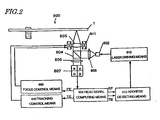
- optical disk drive 800 that can write or read information on/from this optical disk 1 will be described with reference to FIG. 2 .
- the optical disk drive 800 includes a semiconductor laser diode 802 for emitting a laser beam.
- the laser beam emitted from the semiconductor laser diode 802 , passes through a collimator lens 803 and a beam splitter 804 and then is focused by an objective lens 805 onto the information recording layer of the optical disk 1 .
- the optical disk drive 800 In performing a write operation, the optical disk drive 800 changes the intensity of the light beam, thereby writing information on the recording layer of the optical disk.
- the optical disk drive 800 receives the light, which has been reflected and diffracted by the optical disk 1, at a photodetector 807 by way of the objective lens 805 , beam splitter 804 and condenser lens 806 , thereby generating read signals based on the light received.
- the photodetector 807 includes a plurality of light-receiving elements A , B , C and D , for example. In accordance with the quantities of light that have been detected by these light-receiving elements A , B , C and D , a read signal computing means 808 generates the read signals.
- the read signal computing means 808 sends out a focus error (FE) signal and a tracking error (TE) signal to a focus control means 809 and a tracking control means 810 , respectively.
- These control means 809 and 810 appropriately drive an actuator 811 for moving the objective lens 805 in response to the FE and TE signals, thereby irradiating a desired track location with a light spot of the focused light.
- this optical disk drive 800 reads out the information stored on the optical disk 1 by using the light spot that has been subjected to the focus and tracking controls.
- an address detecting means 812 detects the address.
- Table 1 shows various design parameters of the optical disk 1 of this example, the wavelength of the laser beam for use to record information on this optical disk, and the numerical aperture of the objective lens for use to focus the laser beam onto the optical disk:
- Table 1 Laser wavelength 405 nm Numerical aperture of objective lens 0.85 Thickness of light transmitting layer 0.1 mm Diameter of disk 120 mm Data recording area 24-58 mm in radius Data efficiency 83.7% Recording method Land/groove recording Track pitch 0.294 ⁇ m Data bit length 0.1213 ⁇ m Channel bit length (T) 0.0606 ⁇ m Shortest mark length 3T (0.1819 ⁇ m) Error correction code RS (208, 192, 17) ⁇ RS (182, 172, 11)
- the optical disk 1 of this example is designed in such a manner that information is recorded by an optical disk drive that uses a laser beam with a relatively short wavelength of 405 nm and an objective lens with a relatively large numerical aperture of 0.85.
- the thickness of the disk base material to be the light transmitting layer is set equal to 0.1 mm.
- this optical disk drive uses a laser beam with a wavelength of 405 nm and an objective lens with as high a numerical aperture as 0.85.
- the numerical aperture of the objective lens is increased, then the resultant coma aberration also increases with respect to the tilt of the disk.
- the coma aberration is proportional to the third power of the numerical aperture of the objective lens. Accordingly, compared to a situation where a conventional objective lens with a numerical aperture of 0.6 is used, the coma aberration is about 2.8 times greater.
- the phenomenon that the coma aberration is proportional to the thickness of the base material may be utilized.
- the base material thickness is 0.6 mm. Accordingly, it can be seen that a base material with a thickness of 0.2 mm or less may be used. In this example, a base material with a thickness of 0.1 mm is used. As a result, a greater tilt is allowed for the disk than the conventional DVD.
- the diameter of the disk is set equal to 120 mm because the following advantage should be brought about. Specifically, since the CD and the DVD currently available both have a size of 120 mm, the user, who should be used to the handiness or the ease of use of the CD and the DVD, would accept a disk of the same size without feeling any inconvenience.
- the data recording area is defined so as to extend from a radius of 24 mm to a radius of 58 mm.
- the inner boundary of the data recording area is defined by the inner radius of 24 mm. This is done to make the drive (i.e., the optical disk drive) designable easily by adopting the same design parameter as the conventional DVD.
- the light transmitting layer is formed by an injection molding process, for example, then the birefringence increases steeply around the disk outer periphery. When the birefringence is so much great, the amplitude of the read signal decreases and the data cannot be read accurately. For that reason, the outer boundary of the data recording area is defined by 58 mm, inside which the birefringence is relatively stabilized.
- the land/groove recording technique is a method of recording a signal not only on groove tracks but also on land tracks between the groove tracks.
- a disk having a very narrow groove pitch should be made.
- the groove pitch may be greater. Accordingly, there is no need to form grooves having a very narrow width and the disk can be easily manufactured advantageously.
- the track pitch (i.e., the distance between the center of a groove and that of an adjacent land) is set equal to 0.294 ⁇ m.
- this optical disk drive uses a laser beam with a wavelength of about 405 nm and an objective lens with a numerical aperture of about 0.85.
- a write operation is carried out under the conditions including a laser wavelength of 660 nm and a numerical aperture of 0.6.
- a track pitch of 0.615 ⁇ m was realized.
- the optical disk 1 of this example can have a track pitch of 0.266 ⁇ m.
- the track pitch required is 0.276 ⁇ m. Accordingly, by setting the track pitch equal to 0.28 ⁇ m or more, the resultant performance will be comparable to that of the conventional DVD-RAM even in view of possible variations of the optical system. It should be noted, however, that if the track pitch is greater than 0.32 ⁇ m, the desired storage capacity cannot be obtained unless the data bit length is defined to be very short. Nevertheless, such a short data bit length is inappropriate because the read signal should increase its jitter in that case.
- the track pitch is preferably 0.28 ⁇ m or more but 0.32 ⁇ m or less. For these reasons, the optical disk of this example has a track pitch of 0.294 ⁇ m.
- the "data efficiency” (also called “format efficiency”) is a ratio of the user data capacity (i.e., the data capacity that can be used by the user) to the total data capacity.
- a data efficiency of as high as 80% or more is realized by adopting an appropriate data recording format.
- the data efficiency can be increased to about 84%.
- the ECC data is calculated for every 16 user data sets (i.e., 2048 ⁇ 16). Accordingly, if the address data and synchronization data are provided for every 16 sets, these two groups of data can be well matched with each other.
- the pre-pits representing the address data may have mutually different lengths.
- Such a technique is described in Japanese Patent Application No. 2001-034914 , which was filed by the applicant of the present application and which is hereby incorporated by reference.
- the data efficiency can be increased to 80% or more relatively easily.
- a greater mark can be recorded.
- the read signal can have its amplitude increased and its quality improved.
- the data bit length is determined with the track pitch, data efficiency, data recording area and required user data capacity taken into account.
- a user data capacity of 25 GB is achievable by setting the data bit length equal to 0.1213 ⁇ m.
- a modulation code of a 3T system i.e., a modulation code in which the shortest mark length is three times as long as the channel bit length T
- Two types of modulation codes having shortest mark lengths of 2T and 3T, respectively, are known as being normally used for an optical disk or a magnetic disk.
- Examples of the former type that are used most frequently include a (1, 7, 2, 3) code (i.e., a so-called (1, 7) code).
- examples of the latter type include a (2, 10, 8, 16) code (i.e., a so-called "8-16 code") for a DVD, for example.
- Each of these two types of modulation codes has its own merits and demerits.
- the (1, 7) code has a short channel byte length of 12 bits and ensures good conversion efficiency, but the shortest mark length thereof is as short as 2T.
- the 8-16 code has a shortest mark length of 3T, which is longer than that of the (1, 7) code, but the channel byte length thereof is 16 bits, thus resulting in bad conversion efficiency.
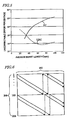
- FIG. 3 shows relationships between the recording density (i.e., disk capacity) and the jitter of the read signal.
- the (1, 7) code (of the 2T system) results in the smaller jitter. This is believed to be because this code ensures high conversion efficiency (i.e., one channel window width thereof is broader than that of the 8-16 code).
- the relationship between these two codes turns over. That is to say, the jitter caused by the (1, 7) code worsens significantly.
- the reason is believed to be as follows. Since the shortest mark of the (1, 7) code is as short as 2T, the SNR of the mark declines extremely, thus affecting the signal jitter considerably. Accordingly, to reduce the jitter of the read signal, the 8-16 code of the 3T system is the more advantageous at capacities of 25 GB or more.
- FIG. 4 shows relationships between the recording density (i.e., disk capacity) and the bit error rate.
- the present inventors discovered that the relationship between the two types of codes turns over at around 22 GB and that the bit error rate of the 8-16 code is smaller than that of the (1, 7) code by more than one order of magnitude at densities of 25 GB or more.
- the present inventors discovered that to realize a recording density of 25 GB or more, the modulation code of the 3T system is the more advantageous in terms of jitter and bit error rate.
- An 8-15 modulation code ensuring higher efficiency by increasing the channel bit length to 15 bits, is a typical non-8-16 modulation code of the 3T system.
- PC product code
- ECC error correction code
- Examples of error correction codes suitably applicable to an optical disk or a magnetic disk include not only the product code but also a long distance code (LDC) represented as (304) ⁇ RS (248, 216, 33).
- LDC long distance code
- the present inventors carried out a similar research to determine which of these two error correction codes is more qualified to write data of 25 GB. However, it is not an effective measure to take to rate the qualities of these error correction codes by the data capacity (recording density).
- the abscissa represents the average burst error length. At any average burst error length, the total symbol error rate is supposed to be 2 ⁇ 10 -2 .
- the ordinate represents the percentage of uncorrectable errors, which is the percentage of errors remaining even after the error correction processing has been carried out.
- the relationship between the two types of error correction codes turns over at an average burst length of about 30-40 bytes. That is to say, if the burst length is longer than that value, the LDC results in the lower uncorrectable error percentage and realizes more appropriate correction. However, if the burst errors are short, then the PC shows higher correcting ability (i.e., lower uncorrectable error percentage) than the LDC. It should be noted that to obtain the results shown in FIG. 5 through computation, the PC is subjected in advance to a diagonal interleaving processing such as that shown in FIG. 6 .
- the “diagonal interleaving processing” herein refers to the following type of processing. First, two PCs stored on a memory are subjected to interleaving processing, thereby forming two PC groups. Next, each of these PC groups formed is read diagonally, e.g., a symbol at the 2 nd row, 2 nd column is read after a symbol at the 1 st row, 1 st column has been read. Thereafter, those symbols of the PCs are recorded on the disk in the order in which those symbols have been read. Then, the PC can exhibit correcting ability that has been strengthened against burst errors. It should be noted that such diagonal interleaving processing is described in Japanese Patent Application No. 2000-317452 , for example, which was filed by the applicant of the present application and which is hereby incorporated by reference.
- the question is exactly how big the dirt actually attached to an optical disk is.
- an optical disk packaged in a cartridge it is expected that only dust or dirt that is small enough to pass through the gap of the cartridge can be attached to the disk.
- the smoke particles of a cigarette have a diameter of at most about 10 ⁇ m.
- supposing one data bit length is equal to about 0.12 ⁇ m
- one data byte length is eight time longer, i.e., about 1 ⁇ m.
- the cigarette smoke particle size of 10 ⁇ m may be regarded as corresponding to about 10 bytes.
- the product code should exhibit the higher correcting ability.
- the optical disk according to the first example has a track pitch of 0.294 ⁇ m and a data bit length of 0.1213 ⁇ m, thus realizing a track density that is allowed a sufficient margin against the cross-erase phenomenon even in view of possible variations of the optical system.
- a modulation code having the shortest mark length of 3T e.g., 8-16 modulation code
- the jitter can be kept smaller than a code of the 2T system (e.g., (1, 7) code) at recording densities of 24 GB or more.
- optical disk including spiral grooves thereon
- the optical disk may include concentric grooves and lands thereon.
- FIGS. 7(a) and 7(b) are respectively a perspective view and a partial view of an optical disk 11 according to a second example of the present invention.
- spiral grooves 12 have been formed on the optical disk 11 .
- This optical disk 11 has a diameter of 120 mm and has been formed to have a total thickness of 1.2 mm.
- the optical disk 11 is made by forming an information recording layer 14 of a GeSbTe film, for example, on a disk substrate 13 .
- a light transmitting layer 15 which transmits a laser beam and guides it onto the information recording layer 14 , is further formed on this 26 information recording layer 14 so as to have a thickness of about 0.1 mm.
- a zone between two grooves 12 is also called a land 16 . In the optical disk 11 of this example, however, data is recorded either on the grooves 12 or on the lands 16 .
- the grooves are wobbled.
- the optical depth of the grooves is set approximately equal to ⁇ /12, where ⁇ is the laser wavelength. This is done to increase the amplitude of a signal and to obtain practical push-pull signal amplitude.
- the groove width is set greater than the land width.
- the land width is set greater than the groove width. In that case, the signal amplitude can be increased and the signal quality can be improved.
- Table 2 shows various parameters of the optical disk 11 of this example, the wavelength of the laser beam for use to record information on this optical disk, and the numerical aperture of the objective lens for use to focus the laser beam onto the optical disk:
- Table 2 Laser wavelength 405 nm Numerical aperture Of objective lens 0.85 Thickness of light transmitting layer 0.1 mm Diameter of disk 120 mm Data recording area 24-58 mm in radius Data efficiency 84.6% Recording method
- Groove recording (or land recording) Track pitch 0.32 ⁇ m Data bit length 0.1155 ⁇ m Channel bit length (T) 0.0578 ⁇ m Shortest mark length 3T (0.1733 ⁇ m) Error correction code RS (208, 192, 17) ⁇ RS (182, 172, 11)
- a base material with a thickness of 0.1 mm is used as the light transmitting layer because of the same reason as that described for the first example.
- the disk diameter is set equal to 120 mm and the data recording area is defined to extend from a radius of 24 mm to a radius of 58 mm for the same reasons as those already described for the first example.
- the groove recording technique is adopted.
- the groove recording technique is applied to an optical disk, which uses a phase change type material so that an amorphous portion is formed as a recording mark and from which a difference in reflectance between the crystalline and amorphous portions is read as a signal
- the film thereof may be designed in such a manner as to create a phase difference between the amorphous and crystalline portions and thereby obtain great amplitude.
- the difference in depth between the lands and the grooves i.e., the phase difference between them, is used to reduce the crosstalk.
- the track pitch is set equal to 0.320 ⁇ m.
- a laser beam with a wavelength of about 405 nm and an objective lens with a numerical aperture of about 0.85 are also used in this embodiment to write data of about 23 GB. Accordingly, as already described for the first example, the track pitch can be set equal to 0.266 ⁇ m for a write operation.
- the track pitch i.e., the distance between the center of a groove and that of an adjacent groove
- the amplitude of a push-pull signal is small. Accordingly, a non-negligible variation should occur in the amplitude of the push-pull signal if the track pitch is not constant. As a result, it becomes difficult to perform the tracking servo control.
- FIG. 8 shows the results obtained by simulating the relationship between the track pitch and the variation in amplitude of a push-pull signal due to inconstant track pitches.
- the variation in track pitch was supposed to be ⁇ 15 nm, which is an adequate value that is actually realizable in a manufacturing process in view of the feeding precision of a cutting machine, for example.
- the amplitude variation is preferably 2 dB or less.
- the track pitch is preferably 0.32 ⁇ m or more.
- the conventional DVD-RAM has a format in which 370 bytes of ECC data and 279 bytes of address data, synchronization data and other types of data are added to every 2048 bytes of user data. Thus, the data efficiency thereof was 75.9%. If this data efficiency can be increased, then a greater mark can be recorded and the read signal can have its amplitude increased and its quality improved.
- the data efficiency can be increased to about 84%.
- the ECC data is calculated for every 16 user data sets (i.e., 2048 ⁇ 16). Accordingly, if the address data and synchronization data are provided for every 16 sets, these two groups of data can be well matched with each other. In this manner, the data efficiency can be increased to 80% or more relatively easily.
- the ECC data is calculated for every 16 user data sets (i.e., 2048 ⁇ 16). Accordingly, if the block marks and so on are provided for the double thereof, i.e., every 32 sets, these two groups of data can be well matched with each other.
- address data is represented in this example by changing the wobble patterns of the grooves.
- areas for address data can be eliminated.
- the areas that were allocated to the address data can also be used as user data areas.
- the data efficiency can be increased.
- the planar shape of the track grooves does not consist of just a sine waveform but at least part of it has a shape different from the sine waveform.
- a basic configuration for such a groove is disclosed in the descriptions of Japanese Patent Applications Nos. 2000-6593 , 2000-187259 and 2000-319009 , which were filed by the applicant of the present application.
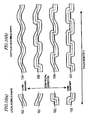
- FIG. 10(a) illustrates the four types of basic elements that make up a wobble pattern of the track grooves 2 .
- smooth sine waveform portions 100 and 101 a portion 102 with a steep disk-outer-periphery-oriented displacement and a portion 103 with a steep disk-inner-periphery-oriented displacement are illustrated.
- the four types of wobble patterns 104 through 107 shown in FIG. 10(b) are formed.
- the wobble pattern 104 is a sine wave with no steeply displaced portions. This pattern will be herein referred to as a "fundamental waveform”. It should also be noted that the "sine wave” is not herein limited to a perfect sine curve, but may broadly refer to any smooth wobble.
- the wobble pattern 105 includes portions that are displaced toward the disk outer periphery more steeply than the sine waveform displacement. Such portions will be herein referred to as "outer-periphery-oriented displaced rectangular portions”.
- an edge actually formed is not perfectly rectangular.
- an edge of a rectangular portion may be displaced relatively steeply compared to a sine waveform portion and does not have to be perfectly rectangular.
- a displacement from the innermost periphery toward the outermost periphery is completed in a half wobble period.
- a similar displacement may be finished in a quarter or less of one wobble period, for example. Then, the difference between these shapes is sufficiently detectible.
- the wobble pattern 106 is characterized by inner-periphery-oriented displaced rectangles while the wobble pattern 107 is characterized by both "inner-periphery-oriented displaced rectangles" and "outer-periphery-oriented displaced rectangles”.
- the wobble pattern 104 consists of the fundamental waveform alone. Accordingly, the frequency components thereof are defined by a "fundamental frequency (or wobble frequency)" that is proportional to the inverse number of the wobble period T.
- the frequency components of the other wobble patterns 105 through 107 include not only the fundamental frequency components but also high-frequency components. Those high-frequency components are generated by the steep displacements at the rectangular portions of the wobble patterns.
- the multiple types of wobble patterns are combined with each other, thereby recording various types of information, including the address information, on the track grooves. More specifically, by allocating one of the four types of wobble patterns 104 through 107 to each predetermined section of the track grooves, four types of codes (e.g., "B", “S”, “0” and “1", where “B” denotes block information, "S” denotes synchronization information and a combination of zeros and ones represents address data, for example) may be recorded.
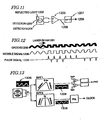
- FIG. 11 illustrates a main portion of a reproducing apparatus.
- the track groove 1200 schematically illustrated in FIG. 12 is scanned by a read laser beam 1201 so that the spot thereof moves in the direction indicated by the arrow.
- the laser beam 1201 is reflected from the optical disk to form reflected light 1202 , which is received by detectors 1203 and 1204 of the reproducing apparatus shown in FIG. 11 .
- the detectors 1203 and 1204 are spaced apart from each other in a direction corresponding to the disk radial direction and each output a voltage corresponding to the intensity of the light received.
- the position at which the detectors 1203 and 1204 are irradiated with the reflected light 1202 shifts toward one of the detectors 1203 and 1204 with respect to the centerline that separates the detectors 1203 and 1204 from each other, then a difference is created between the outputs of the detectors 1203 and 1204 (which is "differential push-pull detection").
- the outputs of the detectors 1203 and 1204 are input to a differential circuit 1205 , where a subtraction is carried out on them.
- a signal representing the wobble shape of the groove 1200 i.e., a wobble signal 1206
- the wobble signal 1206 is input to, and differentiated by, a high-pass filter (HPF) 1207 . Consequently, the smooth fundamental components that have been included in the wobble signal 1206 are attenuated and instead a pulse signal 1208 , including pulse components corresponding to rectangular portions with steeps gradients, is obtained. As can be seen from FIG. 12 , the polarity of each pulse in the pulse signal 1208 depends on the direction of its associated steep displacement of the groove 1200 . Accordingly, the wobble pattern of the groove 1200 is identifiable by the pulse signal 1208 .
- FIG. 13 illustrated is an exemplary circuit configuration for generating the pulse signal 1208 and a clock signal 1209 from the wobble signal 1206 shown in FIG. 12 .
- the wobble signal 1206 is input to first and second band-pass filters BPF1 and BPF2, which generate the pulse and clock signals 1208 and 1209, respectively.
- the first band-pass filter BPF1 may be a filter having such a characteristic that the gain (i.e., transmittance) thereof reaches its peak at a frequency of 4 fw to 6 fw (e.g., 5 fw).
- the gain thereof preferably increases at a rate of 20 dB/dec, for example, in a range from low frequencies to the peak frequency, and then preferably decreases steeply (e.g., at a rate of 60 dB/dec) in a frequency band exceeding the peak frequency.
- the first band-pass filter BPF1 can appropriately generate the pulse signal 1208, representing the rectangularly changing portions of the track wobble, from the wobble signal 1206 .
- the second band-pass filter BPF2 has such a filtering characteristic that the gain thereof is high in a predetermined frequency band (e.g., in a band ranging from 0.5 fw to 1.5 fw and including the wobble frequency fw at the center) but is small at the other frequencies.
- the second band-pass filter BPF2 like this can generate a sine wave signal, having a frequency corresponding to the wobble frequency of the track, as the clock signal 209.
- the data bit length is determined with the track pitch, data efficiency, data recording area and required user data capacity taken into account.
- a user data capacity of 25 GB is achievable by setting the data bit length equal to 0.1155 ⁇ m.
- the disk drive according to the second example adopts a track pitch of 0.32 ⁇ m and a data bit length of 0.1155 ⁇ m, thereby achieving the maximum track density within a range in which the tracking error signal is detectible.
- a modulation code having the shortest mark length of 3T e.g., 8-16 code
- the jitter can be kept smaller than a code of the 2T system (e.g., (1, 7) code) at recording densities of 24 GB or more.
- an error correction code represented as RS (208, 192, 17) ⁇ RS (182, 172, 11) the short burst errors, caused by the dust that has been attached to the disk surface, can be corrected effectively. As a result, an optical disk having a practical capacity of 25 GB can be provided.
- optical disk including spiral grooves thereon
- the optical disk may include concentric grooves and lands thereon.
- This optical disk has the same configuration as the optical disk of the first example shown in FIG. 1 .
- modulation is carried out by using a modulation code of the 2T system.
- Table 3 shows various parameters of the optical disk of this example, the wavelength of the laser beam for use to record information on this optical disk, and the numerical aperture of the objective lens for use to focus the laser beam on the optical disk:
- Table 3 Laser wavelength 405 nm Numerical aperture of objective lens 0.85 Thickness of light transmitting layer 0.1 mm Diameter of disk 120 mm Data recording area 24-58 mm in radius Data efficiency 83.7% Recording method Land/groove recording Track pitch 0.294 ⁇ m Data bit length 0.1213 ⁇ m Channel bit length (T) 0.0809 ⁇ m Shortest mark length 2T (0.1617 ⁇ m) Error correction code RS (208, 192, 17) ⁇ RS (182, 172, 11)
- a base material with a thickness of 0.1 mm is used as the light transmitting layer because of the same reason as that described for the first example.
- the disk diameter is set equal to 120 mm
- the data recording area is defined to extend from a radius of 24 mm to a radius of 58 mm and the land/groove recording technique is adopted for the same reasons as those already described for the first example.
- the 2T system In using a modulation code of the 2T system, if the data bit length is the same, the channel bit length increases compared to the 3T system. Accordingly, the 2T system needs a lower channel clock frequency to achieve the same data transfer rate. Thus, when the transfer rate is high, it is more preferable to use a modulation code of the 2T system.
- supposing the data transfer rate is T (megabits per second) in the example shown in Table 3, the 2T system (e.g., (1, 7) modulation) needs a channel clock frequency of 1.5 T (MHz) while the 3T system (e.g., (8-16) modulation) needs a channel clock frequency of 2.0 T (MHz)
- the shortest mark length is shorter than that of the 3T system, and a 2T mark has small signal amplitude, thus possibly deteriorating the jitter disadvantageously. In that case, a 2T mark is easily detected as a 1T mark erroneously. As a result, errors may occur.
- FIGS. 9(a) and 9(b) show how the jitter and the bit error rate of a read signal change with the tilt angle in the PRML reading method when the shortest mark length is 0.138 ⁇ m.
- the abscissas represent a tilt angle in the tangential direction (i.e., a tangential tilt) and a tilt angle in the radial direction (i.e., a radial tilt), respectively.
- the jitter is as high as 15%.
- the bit error rate after the mark has been decoded by the PRML reading method is 10 ⁇ e -4 , which is good enough.
- a track pitch realizing a capacity of 25 GB may be increased to at least 0.344 ⁇ m.
- This optical disk has the same configuration as the optical disk 11 of the second example shown in FIG. 7 .
- a modulation code of the 2T system is used.
- Table 4 shows various parameters of the optical disk of this embodiment, the wavelength of the laser beam for use to record information on this optical disk, and the numerical aperture of the objective lens for use to focus the laser beam on the optical disk:
- Table 4 Laser wavelength 405 nm Numerical aperture of objective lens 0.85 Thickness of light transmitting layer 0.1 mm Diameter of disk 120 mm Data recording area 24-58 mm in radius Data efficiency 84.6% Recording method
- Groove recording Track pitch 0.32 ⁇ m Data bit length 0.1155 ⁇ m Channel bit length (T) 0.077 ⁇ m Shortest mark length 2T (0.154 ⁇ m) Error correction code RS (208, 192, 17) ⁇ RS (182, 172, 11)
- a base material with a thickness of 0.1 mm is used as the light transmitting layer because of the same reason as that described for the second example.
- the disk diameter is set equal to 120 mm
- the data recording area is defined to extend from a radius of 24 mm to a radius of 58 mm and the groove recording technique is adopted for the same reasons as those already described for the second example.
- a modulation code of the 2T system is used. Even so, by combining the 2T modulation code with the PRML reading method as described for the third embodiment, the error rate can be reduced. Also, since the channel clock frequency becomes relatively low, this modulation effectively contributes to achieving a high transfer rate.
- the present invention provides an optical disk having high storage capacity by increasing the recording density greatly.
- an optical disk having a diameter of 120 mm and a storage capacity of 23 GB or more, for example, is realized by the present invention.
Landscapes
- Engineering & Computer Science (AREA)
- Software Systems (AREA)
- Theoretical Computer Science (AREA)
- Optical Recording Or Reproduction (AREA)
- Optical Record Carriers And Manufacture Thereof (AREA)
- Signal Processing For Digital Recording And Reproducing (AREA)
Claims (2)
- Optische Platte (11), die eine Rille (12) und eine Erhebung (16) umfasst und auf der Daten nur auf einem von der Erhebung (16) und der Rille (12) aufgezeichnet werden,
wobei die Rille (12) eine Mehrzahl von Wobble-Mustern (100 bis 107) aufweist, die Adressinformation darstellen,
wobei die optische Platte des Weiteren eine lichtdurchlassende Schicht (15) an der Oberfläche der Platte (11) umfasst, an der die Rille (12) und die Erhebung (16) ausgebildet worden sind, wobei die lichtdurchlassende Schicht (15) eine Dicke von 0,2 mm oder weniger aufweist,
wobei die Datenbitlänge gleich 0,1155 µm ist,
wobei die Kanalbitlänge T gleich 0,077µm mit einem Modulationscode des 2T-Systems ist und
wobei die optische Platte (11) eine minimale Speicherkapazität von 23 GB aufweist. - Optische Platte nach Anspruch 1, wobei die optische Platte (11) des Weiteren eine Aufzeichnungsschicht (14) eines Phasenänderungsmaterials umfasst und die Daten wiederbeschreibbar bzw. neuschreibbar sind.
Applications Claiming Priority (3)
| Application Number | Priority Date | Filing Date | Title |
|---|---|---|---|
| JP2000308755 | 2000-10-10 | ||
| JP2000308755 | 2000-10-10 | ||
| PCT/JP2001/008775 WO2002031821A1 (en) | 2000-10-10 | 2001-10-04 | Optical disc |
Publications (3)
| Publication Number | Publication Date |
|---|---|
| EP1333431A1 EP1333431A1 (de) | 2003-08-06 |
| EP1333431A4 EP1333431A4 (de) | 2008-03-05 |
| EP1333431B1 true EP1333431B1 (de) | 2013-07-03 |
Family
ID=18789012
Family Applications (1)
| Application Number | Title | Priority Date | Filing Date |
|---|---|---|---|
| EP01972700.7A Expired - Lifetime EP1333431B1 (de) | 2000-10-10 | 2001-10-04 | Optische platte |
Country Status (9)
| Country | Link |
|---|---|
| US (3) | US6804190B2 (de) |
| EP (1) | EP1333431B1 (de) |
| JP (2) | JPWO2002031821A1 (de) |
| KR (1) | KR100809188B1 (de) |
| CN (2) | CN101430889A (de) |
| AU (1) | AU2001292360A1 (de) |
| CA (1) | CA2420971C (de) |
| SK (1) | SK5522003A3 (de) |
| WO (1) | WO2002031821A1 (de) |
Families Citing this family (16)
| Publication number | Priority date | Publication date | Assignee | Title |
|---|---|---|---|---|
| HK1054814B (zh) * | 2000-11-20 | 2005-12-30 | Sony Corporation | 光记录介质和光盘装置 |
| JP2002208186A (ja) * | 2001-01-09 | 2002-07-26 | Sony Corp | 光学記録媒体 |
| JP2003022580A (ja) | 2001-05-02 | 2003-01-24 | Victor Co Of Japan Ltd | 情報記録担体、情報記録担体の製造方法、情報記録担体再生装置及び情報記録担体記録装置 |
| KR20030030506A (ko) * | 2001-10-11 | 2003-04-18 | 삼성전자주식회사 | 고밀도 광디스크 |
| KR100788650B1 (ko) * | 2001-10-13 | 2007-12-26 | 삼성전자주식회사 | 고밀도 디스크 |
| KR100896681B1 (ko) * | 2001-12-18 | 2009-05-14 | 삼성전자주식회사 | 컴팩트 디스크에 데이터를 기록하는 방법 및 그 장치 |
| CN101685641B (zh) * | 2002-04-03 | 2011-09-28 | 松下电器产业株式会社 | 光盘驱动器、光学存储介质 |
| EP1586087B1 (de) | 2003-01-23 | 2013-08-21 | LG Electronics, Inc. | Aufzeichnungsmedium mit optionaler information, verfahren zur bildung des aufzeichnungsmediums, und vorrichtung und verfahren zur wiedergabe des aufzeichnungsmediums |
| TWI304973B (en) | 2003-01-23 | 2009-01-01 | Lg Electronics Inc | Recording medium with copy protection information formed in intermittent or alternate wobbled pits and apparatus and methods for forming, recording, and reproducing the recording medium |
| KR100952949B1 (ko) | 2003-01-24 | 2010-04-15 | 엘지전자 주식회사 | 고밀도 광디스크의 복사 방지 정보 관리방법 |
| JP2004327013A (ja) | 2003-04-11 | 2004-11-18 | Nec Corp | 光ディスク媒体および光ディスク装置 |
| TWI356404B (en) * | 2004-03-08 | 2012-01-11 | Panasonic Corp | Optical recording medium, method for manufacturing |
| US20080192610A1 (en) * | 2005-06-06 | 2008-08-14 | Koninklijke Philips Electronics, N.V. | Optical System with 3 Spot Radial Tracking |
| CN105474110A (zh) * | 2013-08-16 | 2016-04-06 | 胡斯华纳有限公司 | 智能地面管理系统 |
| TWI606565B (zh) * | 2016-08-31 | 2017-11-21 | 金寶電子工業股份有限公司 | 封裝結構及其製作方法 |
| WO2018187395A1 (en) * | 2017-04-07 | 2018-10-11 | The Willamette Valley Company Llc | Polymeric plugging composition |
Family Cites Families (29)
| Publication number | Priority date | Publication date | Assignee | Title |
|---|---|---|---|---|
| JP2735230B2 (ja) * | 1988-08-05 | 1998-04-02 | 株式会社東芝 | 書き換え形光ディスク装置 |
| JP2801495B2 (ja) * | 1993-04-07 | 1998-09-21 | シャープ株式会社 | 光記録再生装置 |
| EP0631277A3 (de) * | 1993-06-22 | 1995-02-22 | Quantum Corp | Datensektorformat ohne Identitätskode und Daten-Steuereinheit für Plattenantrieb. |
| US5751512A (en) * | 1994-01-28 | 1998-05-12 | Seagate Technology, Inc. | Data storage format for data storage devices having a radial offset between read and write elements |
| US5477527A (en) * | 1994-02-02 | 1995-12-19 | Sanyo Electric Co., Ltd. | High density optical disc and optical disc player |
| US5838657A (en) * | 1994-02-02 | 1998-11-17 | Sanyo Electric Co., Ltd. | High density optical disc and optical disc player |
| JP3063598B2 (ja) * | 1995-12-01 | 2000-07-12 | 三菱電機株式会社 | 光ディスクおよび光ディスク装置 |
| JPH1069646A (ja) * | 1996-08-29 | 1998-03-10 | Ricoh Co Ltd | 光ディスク媒体、光ディスク装置 |
| TW357346B (en) * | 1996-10-22 | 1999-05-01 | Hitachi Ltd | Data recording medium and data recording reproduction device by means of oscillation of tracks for showing data |
| CN1136554C (zh) * | 1996-10-25 | 2004-01-28 | 松下电器产业株式会社 | 具有摆动凸区和凹槽的光盘 |
| JPH10154378A (ja) * | 1996-11-22 | 1998-06-09 | Sony Corp | ディスク状記録媒体 |
| US6385257B1 (en) * | 1997-01-21 | 2002-05-07 | Sony Corporation | Frequency demodulating circuit, optical disk apparatus thereof and preformating device |
| EP0911820A4 (de) * | 1997-04-24 | 2002-01-16 | Matsushita Electric Industrial Co Ltd | Optisches aufzeichnungsmedium und substrat dafür |
| JPH10302321A (ja) * | 1997-04-30 | 1998-11-13 | Sony Corp | 光ディスクおよび光ディスク製造方法 |
| JP4099549B2 (ja) | 1997-05-16 | 2008-06-11 | ソニー株式会社 | 光記録媒体及び光学ディスク装置 |
| US6564009B2 (en) * | 1997-05-19 | 2003-05-13 | Sony Corporation | Apparatus for recording and/or reproducing data onto and/or from an optical disk and method thereof |
| JP4232056B2 (ja) * | 1997-05-19 | 2009-03-04 | ソニー株式会社 | 光ディスクの製造方法及び光ディスク |
| JPH11149644A (ja) | 1997-11-18 | 1999-06-02 | Sony Corp | 光ディスク、光ディスク記録装置及び方法並びに光ディスク記録再生装置及び方法 |
| JPH11259868A (ja) | 1997-12-26 | 1999-09-24 | Toshiba Corp | 光ディスクおよび光ディスク装置 |
| DE69834708T2 (de) * | 1997-12-26 | 2007-04-26 | Kabushiki Kaisha Toshiba, Kawasaki | Optische Platte und optisches Plattengerät |
| KR100278786B1 (ko) * | 1998-06-18 | 2001-01-15 | 구자홍 | 광기록매체와 광 기록/재생 방법 및 장치 |
| JP2000123416A (ja) * | 1998-10-14 | 2000-04-28 | Sony Corp | 光記録媒体と光記録再生装置 |
| US6511788B1 (en) * | 1999-02-12 | 2003-01-28 | Sony Corporation | Multi-layered optical disc |
| JP2001034914A (ja) | 1999-07-15 | 2001-02-09 | Victor Co Of Japan Ltd | 磁気抵抗効果型薄膜ヘッド及びその製造方法 |
| US6449241B1 (en) * | 1999-11-03 | 2002-09-10 | Samsung Electronics Co., Ltd. | Optical disk |
| US6738342B2 (en) | 2000-01-14 | 2004-05-18 | Matsushita Electric Industrial Co., Ltd. | Optical disc and optical disc address reading apparatus and method |
| US6996053B2 (en) | 2000-01-24 | 2006-02-07 | Matsushita Electric Industrial Co., Ltd. | Optical recording medium, optical reproduction apparatus, and optical reproduction method |
| JPWO2002033699A1 (ja) | 2000-10-19 | 2004-02-26 | 松下電器産業株式会社 | 光ディスク媒体および信号再生方法 |
| KR20030030506A (ko) * | 2001-10-11 | 2003-04-18 | 삼성전자주식회사 | 고밀도 광디스크 |
-
2001
- 2001-10-04 CA CA2420971A patent/CA2420971C/en not_active Expired - Fee Related
- 2001-10-04 WO PCT/JP2001/008775 patent/WO2002031821A1/ja not_active Ceased
- 2001-10-04 JP JP2002535120A patent/JPWO2002031821A1/ja active Pending
- 2001-10-04 AU AU2001292360A patent/AU2001292360A1/en not_active Abandoned
- 2001-10-04 US US10/169,336 patent/US6804190B2/en not_active Expired - Lifetime
- 2001-10-04 CN CNA2008101859479A patent/CN101430889A/zh active Pending
- 2001-10-04 SK SK552-2003A patent/SK5522003A3/sk not_active Application Discontinuation
- 2001-10-04 KR KR1020037004981A patent/KR100809188B1/ko not_active Expired - Fee Related
- 2001-10-04 EP EP01972700.7A patent/EP1333431B1/de not_active Expired - Lifetime
- 2001-10-04 CN CNB018171370A patent/CN100454396C/zh not_active Expired - Lifetime
-
2004
- 2004-07-16 US US10/892,658 patent/US7697406B2/en not_active Expired - Fee Related
-
2005
- 2005-06-28 JP JP2005188332A patent/JP2005327465A/ja active Pending
-
2007
- 2007-09-28 US US11/864,226 patent/US7782743B2/en not_active Expired - Fee Related
Also Published As
| Publication number | Publication date |
|---|---|
| JPWO2002031821A1 (ja) | 2004-02-19 |
| US20050002321A1 (en) | 2005-01-06 |
| AU2001292360A1 (en) | 2002-04-22 |
| CA2420971C (en) | 2014-03-18 |
| WO2002031821A1 (en) | 2002-04-18 |
| CN101430889A (zh) | 2009-05-13 |
| KR100809188B1 (ko) | 2008-02-29 |
| JP2005327465A (ja) | 2005-11-24 |
| US7782743B2 (en) | 2010-08-24 |
| SK5522003A3 (en) | 2003-11-04 |
| EP1333431A1 (de) | 2003-08-06 |
| US20080025194A1 (en) | 2008-01-31 |
| US7697406B2 (en) | 2010-04-13 |
| KR20030048429A (ko) | 2003-06-19 |
| CA2420971A1 (en) | 2003-02-27 |
| CN1468429A (zh) | 2004-01-14 |
| US6804190B2 (en) | 2004-10-12 |
| US20030016617A1 (en) | 2003-01-23 |
| EP1333431A4 (de) | 2008-03-05 |
| CN100454396C (zh) | 2009-01-21 |
Similar Documents
| Publication | Publication Date | Title |
|---|---|---|
| US7782743B2 (en) | High density phase-change type optical disk having a data efficiency of more than 80 percent | |
| US6850469B2 (en) | Information recording medium with index header | |
| TWI289840B (en) | Optical disk, optical disk apparatus, optical disk recording and reproduction method, and apparatus and method for recording BCA code | |
| KR20010030905A (ko) | 광 디스크 및 이 광 디스크를 주사하는 장치 | |
| CN101461001A (zh) | 优化聚焦串扰消除 | |
| EA005639B1 (ru) | Носитель записи и устройство для сканирования носителя записи | |
| EP1333430B1 (de) | Mehrschichtige optische platte und verfahren zur herstellung der mehrschichtigen optischen platte | |
| KR20010030904A (ko) | 광 디스크 및 이 광 디스크를 주사하는 장치 | |
| KR20010112268A (ko) | 광 기록매체와 주사장치 | |
| EP1202255A2 (de) | Mehrschichtiges Informationsaufzeichnungsmedium und Aufzeichnungsgerät dafür | |
| US6262950B1 (en) | Optical disc recording method and access method, optical disc, optical disc recording apparatus, and optical disc apparatus | |
| JP2003346348A (ja) | 光ディスクおよびその記録再生方法 | |
| JP2007508645A (ja) | 焦点オフセット領域を有する光ディスク | |
| JP4249663B2 (ja) | 情報記録媒体、並びに情報記録装置及び方法 | |
| JP2008516367A (ja) | 光記録担体 | |
| JP4543084B2 (ja) | 情報記録媒体、情報再生装置及び方法、並びに、情報記録媒体の製造装置及び方法 | |
| JP2010518537A (ja) | 焦点オフセット記録システム及び焦点オフセット記録方法 | |
| KR100554904B1 (ko) | 정보 기록 매체, 정보 기록 재생 방법 및 정보 기록 재생장치 | |
| JP3637347B1 (ja) | 光記録媒体 | |
| JP2006521653A (ja) | 焦点オフセット領域を有する光ディスク | |
| JPH0430327A (ja) | 光情報記録媒体 | |
| JP2004259401A (ja) | 光ディスク媒体、その原盤作成方法、及び、光記録媒体の記録・再生装置 | |
| JPH07296396A (ja) | 光記録再生方法及び光ディスク |
Legal Events
| Date | Code | Title | Description |
|---|---|---|---|
| PUAI | Public reference made under article 153(3) epc to a published international application that has entered the european phase |
Free format text: ORIGINAL CODE: 0009012 |
|
| 17P | Request for examination filed |
Effective date: 20030423 |
|
| AK | Designated contracting states |
Designated state(s): AT BE CH CY DE DK ES FI FR GB GR IE IT LI LU MC NL PT SE TR |
|
| AX | Request for extension of the european patent |
Extension state: AL LT LV MK RO SI |
|
| RIN1 | Information on inventor provided before grant (corrected) |
Inventor name: FURUMIYA, SHIGERU Inventor name: ISHIDA, TAKASHI Inventor name: NAKAMURA, ATSUSHI Inventor name: ISHIBASHI, HIROMICHI Inventor name: SHOJI, MAMORU Inventor name: MINAMINO, JUNICHI |
|
| RBV | Designated contracting states (corrected) |
Designated state(s): AT BE CH CY DE FR GB IT LI NL |
|
| A4 | Supplementary search report drawn up and despatched |
Effective date: 20080204 |
|
| RAP1 | Party data changed (applicant data changed or rights of an application transferred) |
Owner name: PANASONIC CORPORATION |
|
| 17Q | First examination report despatched |
Effective date: 20101004 |
|
| GRAP | Despatch of communication of intention to grant a patent |
Free format text: ORIGINAL CODE: EPIDOSNIGR1 |
|
| RBV | Designated contracting states (corrected) |
Designated state(s): DE FR GB IT NL |
|
| GRAS | Grant fee paid |
Free format text: ORIGINAL CODE: EPIDOSNIGR3 |
|
| GRAA | (expected) grant |
Free format text: ORIGINAL CODE: 0009210 |
|
| AK | Designated contracting states |
Kind code of ref document: B1 Designated state(s): DE FR GB IT NL |
|
| REG | Reference to a national code |
Ref country code: GB Ref legal event code: FG4D |
|
| REG | Reference to a national code |
Ref country code: DE Ref legal event code: R096 Ref document number: 60148128 Country of ref document: DE Effective date: 20130829 |
|
| REG | Reference to a national code |
Ref country code: NL Ref legal event code: T3 |
|
| PLBE | No opposition filed within time limit |
Free format text: ORIGINAL CODE: 0009261 |
|
| STAA | Information on the status of an ep patent application or granted ep patent |
Free format text: STATUS: NO OPPOSITION FILED WITHIN TIME LIMIT |
|
| 26N | No opposition filed |
Effective date: 20140404 |
|
| REG | Reference to a national code |
Ref country code: DE Ref legal event code: R097 Ref document number: 60148128 Country of ref document: DE Effective date: 20140404 |
|
| REG | Reference to a national code |
Ref country code: FR Ref legal event code: PLFP Year of fee payment: 15 |
|
| REG | Reference to a national code |
Ref country code: FR Ref legal event code: PLFP Year of fee payment: 16 |
|
| REG | Reference to a national code |
Ref country code: FR Ref legal event code: PLFP Year of fee payment: 17 |
|
| REG | Reference to a national code |
Ref country code: FR Ref legal event code: PLFP Year of fee payment: 18 |
|
| PGFP | Annual fee paid to national office [announced via postgrant information from national office to epo] |
Ref country code: NL Payment date: 20181019 Year of fee payment: 18 |
|
| PGFP | Annual fee paid to national office [announced via postgrant information from national office to epo] |
Ref country code: DE Payment date: 20181019 Year of fee payment: 18 |
|
| PGFP | Annual fee paid to national office [announced via postgrant information from national office to epo] |
Ref country code: FR Payment date: 20181022 Year of fee payment: 18 Ref country code: GB Payment date: 20181019 Year of fee payment: 18 Ref country code: IT Payment date: 20181024 Year of fee payment: 18 |
|
| REG | Reference to a national code |
Ref country code: DE Ref legal event code: R119 Ref document number: 60148128 Country of ref document: DE |
|
| REG | Reference to a national code |
Ref country code: NL Ref legal event code: MM Effective date: 20191101 |
|
| PG25 | Lapsed in a contracting state [announced via postgrant information from national office to epo] |
Ref country code: DE Free format text: LAPSE BECAUSE OF NON-PAYMENT OF DUE FEES Effective date: 20200501 |
|
| PG25 | Lapsed in a contracting state [announced via postgrant information from national office to epo] |
Ref country code: NL Free format text: LAPSE BECAUSE OF NON-PAYMENT OF DUE FEES Effective date: 20191101 |
|
| GBPC | Gb: european patent ceased through non-payment of renewal fee |
Effective date: 20191004 |
|
| PG25 | Lapsed in a contracting state [announced via postgrant information from national office to epo] |
Ref country code: IT Free format text: LAPSE BECAUSE OF NON-PAYMENT OF DUE FEES Effective date: 20191004 Ref country code: FR Free format text: LAPSE BECAUSE OF NON-PAYMENT OF DUE FEES Effective date: 20191031 Ref country code: GB Free format text: LAPSE BECAUSE OF NON-PAYMENT OF DUE FEES Effective date: 20191004 |