EP1333443A1 - Système de mémoire - Google Patents
Système de mémoire Download PDFInfo
- Publication number
- EP1333443A1 EP1333443A1 EP02002377A EP02002377A EP1333443A1 EP 1333443 A1 EP1333443 A1 EP 1333443A1 EP 02002377 A EP02002377 A EP 02002377A EP 02002377 A EP02002377 A EP 02002377A EP 1333443 A1 EP1333443 A1 EP 1333443A1
- Authority
- EP
- European Patent Office
- Prior art keywords
- memory
- memory module
- board
- mother board
- chips
- Prior art date
- Legal status (The legal status is an assumption and is not a legal conclusion. Google has not performed a legal analysis and makes no representation as to the accuracy of the status listed.)
- Withdrawn
Links
- 239000000969 carrier Substances 0.000 description 8
- 238000001816 cooling Methods 0.000 description 7
- 238000010276 construction Methods 0.000 description 6
- 230000009977 dual effect Effects 0.000 description 1
- 238000003780 insertion Methods 0.000 description 1
- 230000037431 insertion Effects 0.000 description 1
Images


Classifications
-
- H—ELECTRICITY
- H05—ELECTRIC TECHNIQUES NOT OTHERWISE PROVIDED FOR
- H05K—PRINTED CIRCUITS; CASINGS OR CONSTRUCTIONAL DETAILS OF ELECTRIC APPARATUS; MANUFACTURE OF ASSEMBLAGES OF ELECTRICAL COMPONENTS
- H05K1/00—Printed circuits
- H05K1/02—Details
- H05K1/14—Structural association of two or more printed circuits
- H05K1/144—Stacked arrangements of planar printed circuit boards
-
- G—PHYSICS
- G11—INFORMATION STORAGE
- G11C—STATIC STORES
- G11C5/00—Details of stores covered by group G11C11/00
- G11C5/02—Disposition of storage elements, e.g. in the form of a matrix array
- G11C5/04—Supports for storage elements, e.g. memory modules; Mounting or fixing of storage elements on such supports
Definitions
- the present application relates to a memory system in which at least one memory module is arranged on a mother board and, in particular, a memory system for use as a computer memory subsystem.
- FIG. 4A A prior art computer memory subsystem is explained hereinafter, wherein a schematical top view thereof is shown in Fig. 4A and a schematical cross-sectional view thereof along line A-A of Fig. 4A is shown in Fig. 4B.
- the existing computer memory subsystem comprises a memory controller 10 connected to a central processing unit (CPU) 12 of the computer via a connecting bus 14.
- the memory controller 10, the CPU 12 and the connecting bus 14 are arranged on a mother board 16 (Fig. 4B) of the computer.
- Each memory module comprises a memory module board 20.
- the connectors 18 may be commonly used slot connectors having associated therewith a plurality of terminals connected to respective terminals on the memory module boards 20.
- the memory chips 22 comprise commonly used BGA cases including a plurality of terminals 24.
- the respective memory chip terminals 24 are connected to associated contact areas on the memory module boards 20, and the contact areas are connected to the terminals of the memory module boards which are connected to respective terminals of the connectors 18.
- the terminals of the connectors 18 are electrically connected to respective terminals 26 of the memory controller 10.Thus, the memory chips 22 are properly electrically connected to the memory controller 10.
- the necessary connection lines are shown schematically in Fig. 4A and 4B as traces 28a, 28b, 28c, 28d and 28e.
- the conductive traces include vertical portions 30 essentially arranged on the memory module boards 20.
- the conductive traces 28A to 28E and 30 are intended to represent both data lines and command-address lines (C/A lines).
- a distance X indicated in Fig. 4A is about 7.6 cm (3 inches).
- DIMM dual in-line memory module
- a data rate is limited due to the large distance from the memory controller to the memory chips 22 located toward the outer margins of the memory module board 20.
- excessive trace matching is necessary with respect to those memory chips located more centrally on the memory module boards 20 as can be seen by viewing the meander shaped traces 28b, 28c and 28d in Fig. 4A.
- Such structures matching the trace lengths of the "inner” memory chips to the trace lengths of the "outer” memory chips take a lot of area on the mother board.
- the above considerations apply to both, data lines and command/address lines, i.e. data buses and command/address buses connecting the memory chips to the memory controller.
- the vertical position of the memory module boards 20 relative to the mother board 16 is an obstacle to an air flow which can be utilized for cooling the modules and the memory controller.
- air flow is indicated in Fig. 4B by arrows 32.
- the present invention provides a memory system comprising:
- two rows of memory chips are arranged on both principle surfaces of the memory board.
- the mother board and the memory module board are arranged such that a principle plane of the mother board and a principle plane of the memory module board are oriented in an angle of less than 45° with respect to each other. More preferably, the principle plane of the mother board and the principle plane of the memory module board are substantially parallel to each other.
- the present invention is firstly based on the finding that the main reason for the increased line lengths of traditional memory architectures is the difference of the dimensions of the memory controller and the memory modules.
- the lateral dimensions of conventional controllers are about 3.8 cm, whereas the lateral dimension of conventional memory module boards (DIMMs) is about 12.7 cm.
- DIMMs conventional memory module boards
- the necessary trace length from the memory controller to the first slot is about 7.6 cm resulting in an associated delay time.
- a module length of 12.7 cm also brings about post-register nets in buffered modules of minimum lengths of about 6.35 cm.
- the present invention is based on the recognition that a reduced length topology for memory subsystems can be achieved by arranging memory components on the memory module of the boards in two rows, rather than in one row as in prior art topologies.
- the length of the module i.e. the memory module board and the length of all buses can be reduced by about 30 to 50 percent. This gives the possibility to increase working frequencies and data flow.
- a proposed topology is to arrange the memory modules, i.e. the memory module boards, relative to the mother board such that a principle plane of the modules is substantially parallel to the principle plane of the mother board.
- This advantage is the parallel arrangement is the existence of a direct way for an air flow through the memory subsystem for cooling of the memory modules and the memory controller making use of one air fan only.
- This air fan can, for example, be the CPU air fan.
- the proposed new architecture of memory subsystems allows to increase data rate close to point to point organisation due to reduced trace lengths.
- a better cooling efficiency can be achieved due to the possibility of a better air circulation.
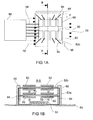
- the memory subsystem comprises a memory controller 50, a first memory module and a second memory module.
- the memory controller 50 is arranged on a mother board 54.
- the mother board 54 is a computers mother board having arranged thereon a central processing unit (CPU) 56. Respective terminals of the CPU 56 are connected to respective terminals of the memory controller 51 via a connection bus 58.
- CPU central processing unit
- the first memory module comprises a first memory module board 52a and a plurality of memory chips 60, 62 arranged thereon.
- the second memory module comprises a second memory module board 52b and plurality of memory chips 60, 62 arranged thereon.
- BGA Ball Grid Array
- the memory modules 60 and 62 are arranged on the principle surfaces of the respective memory module board in two rows, wherein the respective modules 60 form a first row and the respective modules 62 form a second row.
- the memory module boards 52a and 52b are supported by two carriers 66 and 68.
- the carriers 66 and 68 provide for a mechanical support for the memory module boards 52a and 52b, on the one hand, and for an electrical connection of the memory chips 60 and 62 to the memory controller 50, on the other hand.
- data outputs and command-address outputs of the memory controller 50 are connected to data inputs and command-address inputs, respectively, of memory chips 60, 62 located on the memory module boards 52a and 52b.
- the corresponding connections are indicated schematically by electrical connections 64.
- the carriers 66 and 68 may include slot connectors (not shown), into which the memory module boards 52a and 52b are inserted so that contact areas on the memory module boards are electrically connected to terminals of the slot connectors.
- the carriers 66 and 68 comprise means for providing electrical connection between the slot connectors and contact areas on the motherboard.
- the carriers 66 and 68 support the memory module boards at two opposite edges thereof to provide mechanical stability, on the one hand, and reduced trace lengths of the electrical connections, on the other hand.
- the memory chips 60 and 62 are arranged on the memory module boards 52a and 52b in two rows.
- the memory chips 60 form respective first rows and are electrically connected via the left edge of the memory module boards.
- the memory chip 62 form respective second rows and are electrically connected via the right edge of the memory module boards.
- two rows of memory chips 60 and 62 are arranged on both principle surfaces of the memory module boards 52a and 52b.
- Fig. 1A the memory controller 50 and the portions of the connection lines 64 located on the mother board 54 are shown in Fig. 1A by solid lines for the purpose of illustration, although they actually are hidden below the memory module boards.
- the distance Y indicated in Fig. 1A may be about 3.8 cm assuming the dimensions of memory controllers and memory chips as usually used in DIMM topologies.
- trace lengths can be twice shorter than in conventional memory topologies. Due to the reduced length of traces reduced access times to the memory chips can be obtained.
- a further remarkable advantage of the substantially parallel arrangement of the mother board 54 and the memory module boards 52a and 52b is the fact that good cooling conditions for the memory modules and the memory controller are provided.
- a single fan can be used to produce an air flow, which is shown by arrows 70, for cooling both the memory modules (i.e. the memory module boards and the memory chips arranged thereon) and the memory controller 50.
- the inventive memory subsystem on the mother board 54 such that the air flow from the fan (not shown) associated with and normally arranged on the CPU 56 can be used for cooling the memory controller 50 and the memory modules.
- an improved cooling efficiency is obtained due to the better air circulation enabled by the inventive memory subsystem topology.
- Fig. 2 and 3 show two possible implementations of the inventive memory subsystem in greater detail.
- each carrier is comprised of four carrier modules 72.
- the carrier modules 72 have an identical construction and comprise features which permit stacking of a plurality of memory module boards substantially in parallel to the mother board 54 on top of each other.
- the carrier module 72 comprise features permitting the required electrical connections.
- Such features can comprise contact structures 74 which preferably provide for a springy contact between the respective carrier modules 72.
- the contact structures 74 include further features permitting an electrical connection to respective bus connection structures 76 on the memory module boards 52a to 52c.
- the lowermost carrier module provides for electrical connections to contact areas of connection bus structures 78 on the mother board 54. It is preferable that the contact structures on the mother board 54 have an adapted construction (via connector or the like) such that the carrier modules 72 providing a connection to the contact areas on the mother board and the carrier modules 72 providing a connection to another carrier module may have the same construction.
- FIG. 3 Another implementation of an inventive memory subsystem topology is shown in Fig. 3.
- springy contacts 80 are provided on the inner surfaces of the carriers 66 and 68.
- the springy contacts 80 are configured to permit insertion of soldered clips 82 provided on the memory module boards 52a and 52b.
- mechanical support for the memory module boards 52a and 52b is obtained.
- an electrical connection is achieved via the springy contacts 80 and the soldered clips 82.
- connection lines 64 are schematically indicated in Fig. 3.
- braces 84 can be provided to improve the mechanical stability of the carrier 66 and 68.
- each memory module board may have a roof-like structure, wherein one row of memory chips being arranged on one side of the ridge of the roof-like structure and the other row being arranged on the other side thereof.
- the memory module boards are arranged slightly oblique when compared with the mother board.
- the definition that the principle plane of the mother board and the principle plane of the memory module board are oriented in an angle of less than 45° with respect to each other is intended to encompass such cases.
- more than two rows of memory chips might be placed on one or both principle surfaces of the memory module boards.
Landscapes
- Engineering & Computer Science (AREA)
- Microelectronics & Electronic Packaging (AREA)
- Combinations Of Printed Boards (AREA)
Priority Applications (1)
| Application Number | Priority Date | Filing Date | Title |
|---|---|---|---|
| EP02002377A EP1333443A1 (fr) | 2002-01-31 | 2002-01-31 | Système de mémoire |
Applications Claiming Priority (1)
| Application Number | Priority Date | Filing Date | Title |
|---|---|---|---|
| EP02002377A EP1333443A1 (fr) | 2002-01-31 | 2002-01-31 | Système de mémoire |
Publications (1)
| Publication Number | Publication Date |
|---|---|
| EP1333443A1 true EP1333443A1 (fr) | 2003-08-06 |
Family
ID=8185402
Family Applications (1)
| Application Number | Title | Priority Date | Filing Date |
|---|---|---|---|
| EP02002377A Withdrawn EP1333443A1 (fr) | 2002-01-31 | 2002-01-31 | Système de mémoire |
Country Status (1)
| Country | Link |
|---|---|
| EP (1) | EP1333443A1 (fr) |
Citations (3)
| Publication number | Priority date | Publication date | Assignee | Title |
|---|---|---|---|---|
| GB2130025A (en) * | 1982-11-08 | 1984-05-23 | Control Data Corp | Memory board stacking module |
| GB2237691A (en) * | 1989-10-30 | 1991-05-08 | Mitsubishi Electric Corp | Semiconductor device and wiring board module |
| EP0924764A2 (fr) * | 1997-12-17 | 1999-06-23 | Hitachi, Ltd. | Carte de circuit imprimé avec une pluralité de dispositifs sémiconducteurs |
-
2002
- 2002-01-31 EP EP02002377A patent/EP1333443A1/fr not_active Withdrawn
Patent Citations (3)
| Publication number | Priority date | Publication date | Assignee | Title |
|---|---|---|---|---|
| GB2130025A (en) * | 1982-11-08 | 1984-05-23 | Control Data Corp | Memory board stacking module |
| GB2237691A (en) * | 1989-10-30 | 1991-05-08 | Mitsubishi Electric Corp | Semiconductor device and wiring board module |
| EP0924764A2 (fr) * | 1997-12-17 | 1999-06-23 | Hitachi, Ltd. | Carte de circuit imprimé avec une pluralité de dispositifs sémiconducteurs |
Similar Documents
| Publication | Publication Date | Title |
|---|---|---|
| US6202110B1 (en) | Memory cards with symmetrical pinout for back-to-back mounting in computer system | |
| CN102396030B (zh) | 用于降低大的存储器覆盖区背景下的迹线长度和电容的方法和系统 | |
| US5949657A (en) | Bottom or top jumpered foldable electronic assembly | |
| EP0554077B1 (fr) | Dispositif de montage | |
| US7072201B2 (en) | Memory module | |
| US7103753B2 (en) | Backplane system having high-density electrical connectors | |
| US10749817B2 (en) | High-density, fail-in-place switches for computer and data networks | |
| JPH0513661A (ja) | 三次元回路モジユールとその構造 | |
| US7298625B1 (en) | Expansion structure of memory module slot | |
| US6976848B2 (en) | Sockets for module extension and memory system using same | |
| US5317477A (en) | High density interconnection assembly | |
| JP2007018516A (ja) | メモリモジュール、記憶容量拡張メモリモジュール、メモリモジュールシステム、および、メモリモジュールの製造方法 | |
| US6381140B1 (en) | Memory module | |
| US7309911B2 (en) | Method and stacked memory structure for implementing enhanced cooling of memory devices | |
| US20120282803A1 (en) | Double Stack Compact Flash Card Connector | |
| CN1133912C (zh) | 电脑的主机板 | |
| CN109216975B (zh) | 用于启用低高度平台的阶梯式槽连接器 | |
| US7606040B2 (en) | Memory module system and method | |
| JP2008205402A (ja) | 電子モジュール | |
| EP3493208B1 (fr) | Serveur | |
| US20070158827A1 (en) | Electronic device comprising at least one printed circuit board and comprising a plurality of semiconductor components of identical type, and method | |
| JP2007129185A (ja) | 半導体メモリモジュール | |
| WO2016192136A1 (fr) | Carte fille à mémoire, carte mère et châssis | |
| US20060202328A1 (en) | Memory module and memory configuration with stub-free signal lines and distributed capacitive loads | |
| US7435097B2 (en) | Radial circuit board, system, and methods |
Legal Events
| Date | Code | Title | Description |
|---|---|---|---|
| PUAI | Public reference made under article 153(3) epc to a published international application that has entered the european phase |
Free format text: ORIGINAL CODE: 0009012 |
|
| AK | Designated contracting states |
Designated state(s): AT BE CH CY DE DK ES FI FR GB GR IE IT LI LU MC NL PT SE TR |
|
| AX | Request for extension of the european patent |
Extension state: AL LT LV MK RO SI |
|
| AKX | Designation fees paid | ||
| REG | Reference to a national code |
Ref country code: DE Ref legal event code: 8566 |
|
| STAA | Information on the status of an ep patent application or granted ep patent |
Free format text: STATUS: THE APPLICATION IS DEEMED TO BE WITHDRAWN |
|
| 18D | Application deemed to be withdrawn |
Effective date: 20040207 |