EP1335568A2 - Anrufbetriebsverfahren für ein Kommunikationsgerät - Google Patents
Anrufbetriebsverfahren für ein Kommunikationsgerät Download PDFInfo
- Publication number
- EP1335568A2 EP1335568A2 EP03250439A EP03250439A EP1335568A2 EP 1335568 A2 EP1335568 A2 EP 1335568A2 EP 03250439 A EP03250439 A EP 03250439A EP 03250439 A EP03250439 A EP 03250439A EP 1335568 A2 EP1335568 A2 EP 1335568A2
- Authority
- EP
- European Patent Office
- Prior art keywords
- call
- user
- interface
- connection state
- communication device
- Prior art date
- Legal status (The legal status is an assumption and is not a legal conclusion. Google has not performed a legal analysis and makes no representation as to the accuracy of the status listed.)
- Withdrawn
Links
Images



Classifications
-
- H—ELECTRICITY
- H04—ELECTRIC COMMUNICATION TECHNIQUE
- H04B—TRANSMISSION
- H04B1/00—Details of transmission systems, not covered by a single one of groups H04B3/00 - H04B13/00; Details of transmission systems not characterised by the medium used for transmission
- H04B1/38—Transceivers, i.e. devices in which transmitter and receiver form a structural unit and in which at least one part is used for functions of transmitting and receiving
- H04B1/40—Circuits
-
- H—ELECTRICITY
- H04—ELECTRIC COMMUNICATION TECHNIQUE
- H04M—TELEPHONIC COMMUNICATION
- H04M1/00—Substation equipment, e.g. for use by subscribers
- H04M1/60—Substation equipment, e.g. for use by subscribers including speech amplifiers
- H04M1/6033—Substation equipment, e.g. for use by subscribers including speech amplifiers for providing handsfree use or a loudspeaker mode in telephone sets
- H04M1/6041—Portable telephones adapted for handsfree use
- H04M1/6058—Portable telephones adapted for handsfree use involving the use of a headset accessory device connected to the portable telephone
- H04M1/6066—Portable telephones adapted for handsfree use involving the use of a headset accessory device connected to the portable telephone including a wireless connection
-
- H—ELECTRICITY
- H04—ELECTRIC COMMUNICATION TECHNIQUE
- H04M—TELEPHONIC COMMUNICATION
- H04M1/00—Substation equipment, e.g. for use by subscribers
- H04M1/02—Constructional features of telephone sets
- H04M1/04—Supports for telephone transmitters or receivers
- H04M1/05—Supports for telephone transmitters or receivers specially adapted for use on head, throat or breast
-
- H—ELECTRICITY
- H04—ELECTRIC COMMUNICATION TECHNIQUE
- H04M—TELEPHONIC COMMUNICATION
- H04M1/00—Substation equipment, e.g. for use by subscribers
- H04M1/60—Substation equipment, e.g. for use by subscribers including speech amplifiers
- H04M1/6033—Substation equipment, e.g. for use by subscribers including speech amplifiers for providing handsfree use or a loudspeaker mode in telephone sets
- H04M1/6041—Portable telephones adapted for handsfree use
- H04M1/6058—Portable telephones adapted for handsfree use involving the use of a headset accessory device connected to the portable telephone
Definitions
- the present invention relates to communication devices and, more particularly, to a call operation method for a wireless voice communication device that utilizes a selectively connectable voice interface, such as a removable headset.
- Headsets add convenience and utility to wireless communication devices, such as cellular telephones, cordless phones, and cellular modem cards for portable computers and personal digital assistants (PDAs).
- wireless communication devices such as cellular telephones, cordless phones, and cellular modem cards for portable computers and personal digital assistants (PDAs).
- PDAs personal digital assistants
- a headset provides a voice interface that permits "hands free” voice input to and output by the wireless device allowing the user to engage in a manual task while engaged in voice communication. For example, with a headset a service technician can troubleshoot or repair a machine while receiving technical support over the telephone.
- Hands free operation may also be required for cellular phones used in motor vehicles as a result of proposed legislation prompted by an apparent concurrence of traffic accidents and cellular phone use.
- the user must rely entirely on a headset for voice communication because a built-in speaker or microphone is not included in the wireless communication device.
- Both wired and wireless headsets are available for wireless communication devices.
- Wireless headsets are relatively expensive and require their own powered radio transceiver making a wire a common interface between the headset and the communication device.
- wired headset is not easily stored and can become tangled or interfere with the portability of the communication device. Therefore, wired headsets are typically disconnected from the communication device when not in use. This is particularly so with devices such as modem cards for portable computers and PDAs where voice communication characteristically constitutes only a minor part of the usage of the computer or PDA.
- the user When a telephone call is received, the user typically must locate the headset, connect it to the communication device, and respond to the incoming call at a user interface. These actions must be completed in a short period of time or the caller may hang up resulting in a missed call.
- an answering system may intervene, requiring the user to contact the answering system to identify the caller and place a return call.
- the time required to prepare the communication device to receive a call is particularly critical when the communication device does not include a built-in speaker or microphone. If the user cannot perform the tasks necessary to prepare the communication device to receive or initiate calls in a timely fashion, user frustration with the communication device is the likely result.
- a wireless communication device can take many forms including, by way of examples, a cellular telephone, a wireless telephone, and a voice capable, wireless modem for a portable computer or a personal digital assistant (hereinafter, will be referred to as PDA) 20.
- PDA personal digital assistant
- Wireless communication is commonly facilitated by a short range radio interface to a telephone system but may utilize other systems such as longer range radio transmission.
- the radio or communication hardware may be built into the PDA 20 or provided as a removable accessory.
- Many wireless communication systems provide for both voice communication and data communication, enabling portable web surfing, text messaging, and e-mail as well as telephony.
- the voice interface is commonly provided by a selectively connectable headset 22 that includes an earphone 26 for audible output and a microphone 24 for audible input to the PDA 20.
- the PDA 20 may also be equipped with a built-in microphone or speaker, but often the removable headset 22 is the sole voice interface provided with the device.
- the headset 22 may be a wireless device, but for cost and other reasons is typically connected to the PDA 20 with a wire 28 which terminates in a mating half of a selectively engagable headset jack 30.
- FIG. 2 is a block diagram of a controller 50 for the PDA 20.
- the PDA 20 is typically controlled by a microprocessor-based, central processing unit (CPU) 58 that fetches data and instructions from a plurality of sources, processes the data according to the instructions, and either stores the results or transmits the results to a peripheral device for display to the user or further transmission.
- CPU central processing unit
- the basic operating instructions used by the CPU 58 are stored in nonvolatile storage, such as ROM 64.
- Data and application programs, including a call operation program used in communication, are typically stored in a nonvolatile memory device 76, such as a disk storage unit or a flash memory card.
- the application programs includes a call operation program for communications.
- the program instructions and data are generally transferred from the nonvolatile storage 76 to random access memory (RAM) 66 and then transferred from RAM 66 to the CPU 58 over an internal bus 60.
- RAM random access memory
- the CPU 58 is typically connected to one or more input devices 68 and output devices.
- Input devices 68 may include a contact-sensitive display 33, a CALL button 34, and a phone book icon 36 illustrated in FIG. 1.
- the input devices 68 may include a keyboard, a keypad, and a pointing device such as a mouse, track ball, touch pad, or joy stick, for moving a cursor displayed on a display 32.
- the input devices 68 are generally connected to the internal bus 60 by an interface adapter 72.
- Output devices typically include a display 32 which is connected to the internal bus by a display adapter 74.
- the PDA 20 may include one or more peripheral devices, such as a wireless communication unit 78, a modem 54, and a nonvolatile memory device 76 such as a hard disk.
- the wireless communication unit 78 commonly provides both data and voice communication services and typically comprises a short range radio or infrared transceiver to facilitate a communication channel and signal processing hardware and firmware to convert voice and data signals to signals appropriate for the communication channel.
- An external data interface 56 and an input-output (I/O) adapter 62 typically provide the interface between the peripheral devices such as the wireless communication unit 78 and the internal bus 60.
- a user interface generally comprises an input device 68 to accept user input often in connection with a display 32 to indicate the effect of the user input.
- a portable computer may utilize a keyboard, a pointing device, and a graphical user interface (GUI) as a user interface.
- GUI graphical user interface
- the user interface of a cellular telephone typically relies substantially on switches located on a keypad for user input because of the small size of the phone and its display.
- the PDA 20 as a wireless communication device typically relies heavily on a graphical user interface (GUI) and a contact-sensitive display 33 for user input because the small 1 size and portability of the device rules out a keyboard and a pointing device.
- GUI graphical user interface
- the user when an incoming call is detected by the PDA 20, the user must respond to the "ringing" phone by locating and connecting a removable headset 22 to the device and by undertaking a responsive action at the user interface, such as touching the CALL button 34 on the display 32 of the PDA 20.
- the time required to perform this combination of actions is often sufficient to either cause the caller to hang up or an answering machine to intervene.
- the answering machine may be included in the PDA 20, or may be an answering service provided by a telephone office.
- the present inventor concluded that user frustration with wireless communication devices could be substantially reduced if the actions necessary to answer or initiate a call could be streamlined and made more convenient.
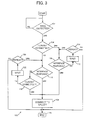
- a call operation method regarding a communication device of the present invention incorporates the call answering routine 100 which is provided in the PDA 20 as the communication device.
- the receiver portion of the wireless unit 78 is monitored by the controller 50 to detect a "ring" (Step 102; hereinafter, “Step” will be referred to as "S").
- the controller 50 When a ring is detected, the controller 50 loads a call answering routine 100 of a call operation program stored in the PDA 20. In response to instructions in the call answering routine 100, the controller 50 tests to determine a connection state of the selectively connectable voice interface, the headset 22 (S104).
- connection state of the headset 22 is determined by measuring an impedance between conductors in the headset jack 30.
- the headset jack 30 may be constructed so that physical engagement of the mating halves is detected providing a signal indicating headset connection.
- a switch may be arranged so that it is actuated when the connector halves of the headset jack 30 are engaged.
- connection state of the headset 22 is "connected" (S104)
- the controller 50 checks for a response to the ringing at the user interface of the PDA 20 (S106).
- the response at the user interface (S106) may comprise, for examples, depressing a switch or selecting an icon, such as the CALL button 34, displayed on a GUI on the device's display.
- the controller 50 connects the PDA 20 to the calling device (S108) and the call answering routine is completed (S110).
- the controller 50 waits for a period of time (S112) and then, if the caller has not terminated the call or an answering service has not intervened, checks the user interface again for a user response (S114). If the user response is detected (S114), the controller 50 answers the call by connecting the PDA 20 to the calling communication device (S108) and the call answering routine is completed (S110). If the user response is not detected (S114), the controller 50 completes the call answering routine without responding to the call (S110).
- the controller 50 detects that the connection state of the headset 22 is "disconnected" (S104) when the ring of an incoming call is detected (S102) the controller 50 will also check the device's user interface for a user response to the ring (S116). If a response at the interface is detected (S116), the controller 50 answers the call by connecting the PDA 20 to the calling communication device (S108) and the call answering routine is completed (S110).
- the controller 50 will again check to determine if the headset 22 is connected (S118). If the headset 22 is now connected, the controller 50 will connect the calling communication device to the PDA 20 (S108) so as to answer the call.
- the controller 50 detects that the headset 22 has not been connected (S118) and if the ringing is still being detected after a delay (S122), the user interface will again be checked for a user response (S120).
- the headset connection state will be checked again (S118). If the caller has hung up or an answering system has intervened (S114 and S120), the call answering routine will end (S110).
- the call operation method of the present invention is arranged in such a manner that, when the headset 22 has already been connected on the occasion of a call, an interaction with the user interface is determined as the user's will to respond to the call, and when the headset 22 has not been connected on the occasion of a call, an interaction with the user interface or the connection of the headset 22 is determined as the user's will to respond to the call.
- a call initiation routine 130 of the call operation method regarding the communication device of the present invention can also be used to facilitate initiating outgoing calls from the PDA 20.
- a call is typically initiated by interaction of the user with a dialer displayed on the user interface.
- the dialer includes a virtual keypad on the display 32 and a phone book stored in memory and accessed by touching a phone book icon 36.
- a call can be originated by the user by touching the appropriate numbers rendered as part of the graphical user interface (GUI) on the display 32 or by selecting a phone number stored in the phone book.
- GUI graphical user interface
- the user opens the dialer by selecting an appropriate icon on the top level display of the user interface.
- the controller 50 determines the connection state of the voice interface, for example the headset 22 (S132). If the controller 50 determines that the headset 22 has been connected, the controller 50 pops up the dialer without further intervention by the user (S134). If the headset 22 is not connected, the user may open the dialer by selecting an icon on the GUI (S136).
- the dialer When the dialer is displayed (S134), the user may originate a call by selecting displayed virtual buttons or by selecting a number from the phone book and then touching the CALL button 34 (S138). In response, the controller 50 generates a call origination request (S140) which causes the controller to check the connection state of the headset 22 (S142).
- S140 call origination request
- a headset alert signal is returned indicating that the PDA 20 is not properly configured for voice communication (S144).
- the controller 50 In response to the headset alert (S144), the controller 50 will display a user prompt on the display (S146) or produce an audible signal. The controller 50 will then wait for a period of time (S148) before rechecking the connection state of the headset (S142). Once the headset 22 is connected the call will be initiated (S150) and the call initiation routine is concluded (S152).
- a call received by the PDA 20 can be answered either by action taken at the user interface or by connecting the headset 22 to the PDA 20 eliminating duplicate actions, reducing the time necessary to respond to the call, and reducing the frustration of missed calls.
- the call operation also makes sure that the headset 22 is connected and the PDA 20 is ready for voice communication before an outgoing call is initiated, and hence it is possible to carry out the outgoing call operation with certainty.
Landscapes
- Engineering & Computer Science (AREA)
- Signal Processing (AREA)
- Computer Networks & Wireless Communication (AREA)
- Health & Medical Sciences (AREA)
- Otolaryngology (AREA)
- Mobile Radio Communication Systems (AREA)
- Telephone Function (AREA)
Applications Claiming Priority (2)
| Application Number | Priority Date | Filing Date | Title |
|---|---|---|---|
| US10/074,480 US7027841B2 (en) | 2002-02-11 | 2002-02-11 | Call operation method for a communication device |
| US74480 | 2002-02-11 |
Publications (2)
| Publication Number | Publication Date |
|---|---|
| EP1335568A2 true EP1335568A2 (de) | 2003-08-13 |
| EP1335568A3 EP1335568A3 (de) | 2004-03-10 |
Family
ID=27610578
Family Applications (1)
| Application Number | Title | Priority Date | Filing Date |
|---|---|---|---|
| EP03250439A Withdrawn EP1335568A3 (de) | 2002-02-11 | 2003-01-24 | Anrufbetriebsverfahren für ein Kommunikationsgerät |
Country Status (5)
| Country | Link |
|---|---|
| US (1) | US7027841B2 (de) |
| EP (1) | EP1335568A3 (de) |
| JP (1) | JP2003234804A (de) |
| KR (1) | KR20030068050A (de) |
| CN (1) | CN1196306C (de) |
Cited By (1)
| Publication number | Priority date | Publication date | Assignee | Title |
|---|---|---|---|---|
| CN103152463A (zh) * | 2013-03-06 | 2013-06-12 | 苏州佳世达电通有限公司 | 通讯装置及用于通讯装置的自动提醒和呼叫方法 |
Families Citing this family (20)
| Publication number | Priority date | Publication date | Assignee | Title |
|---|---|---|---|---|
| JP4125036B2 (ja) * | 2002-04-24 | 2008-07-23 | 松下電器産業株式会社 | 携帯端末装置 |
| US7330695B2 (en) * | 2003-12-12 | 2008-02-12 | Rosemount, Inc. | Bus powered wireless transmitter |
| US7603148B2 (en) * | 2003-12-16 | 2009-10-13 | Sony Ericsson Mobile Communications Ab | Integrated wireless headset |
| JP3912395B2 (ja) * | 2004-07-12 | 2007-05-09 | セイコーエプソン株式会社 | 半導体集積回路、検査装置および半導体集積回路の検査方法 |
| US7243851B2 (en) * | 2004-08-31 | 2007-07-17 | Research In Motion Limited | Mobile wireless communications device with reduced interfering energy from the keyboard |
| US7398072B2 (en) * | 2004-08-31 | 2008-07-08 | Research In Motion Limited | Mobile wireless communications device with reduced microphone noise from radio frequency communications circuitry |
| US7363063B2 (en) * | 2004-08-31 | 2008-04-22 | Research In Motion Limited | Mobile wireless communications device with reduced interference from the keyboard into the radio receiver |
| US7444174B2 (en) | 2004-08-31 | 2008-10-28 | Research In Motion Limited | Mobile wireless communications device with reduced interfering energy into audio circuit and related methods |
| US7328047B2 (en) | 2004-08-31 | 2008-02-05 | Research In Motion Limited | Mobile wireless communications device with reduced interfering energy from the display and related methods |
| US7353041B2 (en) | 2005-04-04 | 2008-04-01 | Reseach In Motion Limited | Mobile wireless communications device having improved RF immunity of audio transducers to electromagnetic interference (EMI) |
| KR100677463B1 (ko) * | 2005-06-24 | 2007-02-02 | 엘지전자 주식회사 | 이동 통신 단말기에서의 화면 구성 방법 |
| US7643856B2 (en) * | 2005-12-09 | 2010-01-05 | Motorola, Inc. | Method for reducing apparent latency in linking a call received at a mobile communication device to a remote audio processor |
| JP5211053B2 (ja) * | 2007-07-31 | 2013-06-12 | パナソニック株式会社 | 電子回路、電子機器及びゲイン制御方法 |
| US8099064B2 (en) * | 2008-05-08 | 2012-01-17 | Research In Motion Limited | Mobile wireless communications device with reduced harmonics resulting from metal shield coupling |
| CN101610307A (zh) * | 2008-06-17 | 2009-12-23 | 深圳富泰宏精密工业有限公司 | 手机接听模式切换系统及方法 |
| EP2282258B1 (de) * | 2009-07-24 | 2019-09-18 | Lg Electronics Inc. | Verfahren zur Ausführung eines Menüs in einem mobilen Endgerät und mobiles Endgerät damit |
| US9055421B2 (en) * | 2012-08-10 | 2015-06-09 | Facebook, Inc. | Messaging interface based on caller of an incoming call |
| KR102017845B1 (ko) | 2012-09-20 | 2019-09-03 | 삼성전자주식회사 | 휴대단말기에서 부재중 통화를 표시하는 방법 및 장치 |
| US10003563B2 (en) | 2015-05-26 | 2018-06-19 | Facebook, Inc. | Integrated telephone applications on online social networks |
| US10013864B1 (en) * | 2017-06-19 | 2018-07-03 | Qualcomm Incorporated | Alerts and reminders in a personal area network |
Family Cites Families (14)
| Publication number | Priority date | Publication date | Assignee | Title |
|---|---|---|---|---|
| US4975949A (en) * | 1989-06-15 | 1990-12-04 | Plantronics, Inc. | Electronic headset telephone |
| US5191602A (en) * | 1991-01-09 | 1993-03-02 | Plantronics, Inc. | Cellular telephone headset |
| SG45350A1 (en) * | 1992-06-29 | 1998-01-16 | At & T Corp | Cordless headset telephone for use with a business telephone |
| US5557653A (en) * | 1993-07-27 | 1996-09-17 | Spectralink Corporation | Headset for hands-free wireless telephone |
| US5608794A (en) * | 1995-08-04 | 1997-03-04 | Larson; Dana | Telephone headset in-use indicator |
| EP0782306A3 (de) * | 1995-12-27 | 2002-05-29 | Siemens Information and Communication Networks, Inc. | Schnittstelle zur Anrufsteuerung für einen in einen Kopfhörer eingebauten Telefonapparat |
| KR100226222B1 (ko) * | 1996-12-28 | 1999-10-15 | 유기범 | 이어-마이크 접속 감지를 통한 자동 착신전환기능을 갖춘 무선전화기 |
| JP2933575B2 (ja) * | 1997-09-30 | 1999-08-16 | 静岡日本電気株式会社 | 無線電話機能付き携帯情報端末 |
| US6078825A (en) * | 1998-02-20 | 2000-06-20 | Advanced Mobile Solutions, Inc. | Modular wireless headset system for hands free talking |
| KR100617851B1 (ko) * | 2000-01-25 | 2006-08-28 | 삼성전자주식회사 | 무선 단말기에서 이어마이크에 의한 발신 방법 |
| KR20010095446A (ko) * | 2000-03-30 | 2001-11-07 | 윤종용 | 휴대폰의 착신음 인지용 이어 마이크 |
| EP1154621B1 (de) | 2000-05-11 | 2008-01-23 | Lucent Technologies Inc. | Mobilstation für Telekommunikationssystem |
| JP2002084361A (ja) * | 2000-06-22 | 2002-03-22 | Iwao Kashiwamura | ワイヤレス型送受話器セット |
| KR20010025174A (ko) * | 2000-07-29 | 2001-04-06 | 양현민 | 핸즈프리장치의 자동 착신방법 및 착신회로 |
-
2002
- 2002-02-11 US US10/074,480 patent/US7027841B2/en not_active Expired - Lifetime
- 2002-11-25 JP JP2002341557A patent/JP2003234804A/ja active Pending
-
2003
- 2003-01-24 EP EP03250439A patent/EP1335568A3/de not_active Withdrawn
- 2003-02-10 KR KR10-2003-0008137A patent/KR20030068050A/ko not_active Ceased
- 2003-02-11 CN CNB031044050A patent/CN1196306C/zh not_active Expired - Fee Related
Cited By (1)
| Publication number | Priority date | Publication date | Assignee | Title |
|---|---|---|---|---|
| CN103152463A (zh) * | 2013-03-06 | 2013-06-12 | 苏州佳世达电通有限公司 | 通讯装置及用于通讯装置的自动提醒和呼叫方法 |
Also Published As
| Publication number | Publication date |
|---|---|
| CN1438795A (zh) | 2003-08-27 |
| JP2003234804A (ja) | 2003-08-22 |
| CN1196306C (zh) | 2005-04-06 |
| US20030166409A1 (en) | 2003-09-04 |
| KR20030068050A (ko) | 2003-08-19 |
| US7027841B2 (en) | 2006-04-11 |
| EP1335568A3 (de) | 2004-03-10 |
Similar Documents
| Publication | Publication Date | Title |
|---|---|---|
| US7027841B2 (en) | Call operation method for a communication device | |
| US8311589B2 (en) | Handsfree device | |
| US20080080703A1 (en) | Telephone station incorporating wirless handset and cradle feature | |
| US20060252465A1 (en) | Method and system for single-step enablement of telephony functionality for a portable computer system | |
| WO2017197650A1 (zh) | 通话中的交互方法和设备 | |
| EP1401179A3 (de) | Mobiltelefon, dazugehöriges lokales drahtloses Kommunikationsverfahren und Programme dafür | |
| CN108632453B (zh) | 一种通话方法及移动终端 | |
| EP2119203B1 (de) | Batteriesparende selektive bildschirmsteuerung | |
| JP2009518919A (ja) | 発呼中のキーロックを有する電子装置、及びそのプログラム | |
| US20140179232A1 (en) | Communication system for establishing a wireless connection between two devices based on the permission status | |
| CN104935361A (zh) | 用于蓝牙耳机与移动终端通信的方法以及装置 | |
| EP2849417B1 (de) | Kommunikationsverarbeitungsverfahren und -vorrichtung | |
| WO2020015534A1 (zh) | 移动终端和实现与固定终端即时通讯的方法、装置 | |
| WO2015101016A1 (zh) | 一种便携终端及接听来电的方法 | |
| US20100183137A1 (en) | Phone With Child Mode | |
| US6055309A (en) | Circuit and method for automatically cutting off a speech path and converting to a standby state upon completion of speakerphone speech in a cordless telephone | |
| JP2007166073A (ja) | 車載ハンズフリー装置及び車載ハンズフリーシステム | |
| KR20030022556A (ko) | 휴대용 개인 정보 단말기에서 터치 스크린 자동 잠금 방법 | |
| WO2015070643A1 (zh) | 耳机接口适配设备的连接切换方法及终端 | |
| JPH11252283A (ja) | 携帯情報端末、携帯情報端末の制御方法および記憶媒体 | |
| CN111163209A (zh) | 移动终端、智能终端及通话方法、存储介质 | |
| KR100711715B1 (ko) | 핸즈프리기능이 구비된 이동통신단말기 및 그 제어방법 | |
| KR100594176B1 (ko) | 사용자 접촉감지를 통한 제어기능을 갖는 이동통신단말기및 그 제어방법 | |
| JP4702144B2 (ja) | 電話制御装置およびプログラム | |
| KR101032645B1 (ko) | 복합무선단말기에서 전화 수신 장치 및 방법 |
Legal Events
| Date | Code | Title | Description |
|---|---|---|---|
| PUAI | Public reference made under article 153(3) epc to a published international application that has entered the european phase |
Free format text: ORIGINAL CODE: 0009012 |
|
| AK | Designated contracting states |
Designated state(s): AT BE BG CH CY CZ DE DK EE ES FI FR GB GR HU IE IT LI LU MC NL PT SE SI SK TR |
|
| AX | Request for extension of the european patent |
Extension state: AL LT LV MK RO |
|
| PUAL | Search report despatched |
Free format text: ORIGINAL CODE: 0009013 |
|
| AK | Designated contracting states |
Kind code of ref document: A3 Designated state(s): AT BE BG CH CY CZ DE DK EE ES FI FR GB GR HU IE IT LI LU MC NL PT SE SI SK TR |
|
| AX | Request for extension of the european patent |
Extension state: AL LT LV MK RO |
|
| RIC1 | Information provided on ipc code assigned before grant |
Ipc: 7H 04M 1/725 B Ipc: 7H 04M 1/247 B Ipc: 7H 04M 1/60 A |
|
| 17P | Request for examination filed |
Effective date: 20040609 |
|
| AKX | Designation fees paid |
Designated state(s): DE FR GB |
|
| 17Q | First examination report despatched |
Effective date: 20070531 |
|
| GRAP | Despatch of communication of intention to grant a patent |
Free format text: ORIGINAL CODE: EPIDOSNIGR1 |
|
| STAA | Information on the status of an ep patent application or granted ep patent |
Free format text: STATUS: THE APPLICATION IS DEEMED TO BE WITHDRAWN |
|
| 18D | Application deemed to be withdrawn |
Effective date: 20130801 |