EP1338330A2 - Dispositif de mélange et d'homogénéisation destiné à la production d'émulsions - Google Patents
Dispositif de mélange et d'homogénéisation destiné à la production d'émulsions Download PDFInfo
- Publication number
- EP1338330A2 EP1338330A2 EP03290291A EP03290291A EP1338330A2 EP 1338330 A2 EP1338330 A2 EP 1338330A2 EP 03290291 A EP03290291 A EP 03290291A EP 03290291 A EP03290291 A EP 03290291A EP 1338330 A2 EP1338330 A2 EP 1338330A2
- Authority
- EP
- European Patent Office
- Prior art keywords
- mixer
- rotor
- stage
- mixture
- stator
- Prior art date
- Legal status (The legal status is an assumption and is not a legal conclusion. Google has not performed a legal analysis and makes no representation as to the accuracy of the status listed.)
- Withdrawn
Links
Images


Classifications
-
- C—CHEMISTRY; METALLURGY
- C10—PETROLEUM, GAS OR COKE INDUSTRIES; TECHNICAL GASES CONTAINING CARBON MONOXIDE; FUELS; LUBRICANTS; PEAT
- C10L—FUELS NOT OTHERWISE PROVIDED FOR; NATURAL GAS; SYNTHETIC NATURAL GAS OBTAINED BY PROCESSES NOT COVERED BY SUBCLASSES C10G OR C10K; LIQUIFIED PETROLEUM GAS; USE OF ADDITIVES TO FUELS OR FIRES; FIRE-LIGHTERS
- C10L1/00—Liquid carbonaceous fuels
- C10L1/32—Liquid carbonaceous fuels consisting of coal-oil suspensions or aqueous emulsions or oil emulsions
- C10L1/328—Oil emulsions containing water or any other hydrophilic phase
-
- B—PERFORMING OPERATIONS; TRANSPORTING
- B01—PHYSICAL OR CHEMICAL PROCESSES OR APPARATUS IN GENERAL
- B01F—MIXING, e.g. DISSOLVING, EMULSIFYING OR DISPERSING
- B01F23/00—Mixing according to the phases to be mixed, e.g. dispersing or emulsifying
- B01F23/40—Mixing liquids with liquids; Emulsifying
- B01F23/41—Emulsifying
-
- B—PERFORMING OPERATIONS; TRANSPORTING
- B01—PHYSICAL OR CHEMICAL PROCESSES OR APPARATUS IN GENERAL
- B01F—MIXING, e.g. DISSOLVING, EMULSIFYING OR DISPERSING
- B01F27/00—Mixers with rotary stirring devices in fixed receptacles; Kneaders
- B01F27/27—Mixers with stator-rotor systems, e.g. with intermeshing teeth or cylinders or having orifices
- B01F27/271—Mixers with stator-rotor systems, e.g. with intermeshing teeth or cylinders or having orifices with means for moving the materials to be mixed radially between the surfaces of the rotor and the stator
-
- B—PERFORMING OPERATIONS; TRANSPORTING
- B01—PHYSICAL OR CHEMICAL PROCESSES OR APPARATUS IN GENERAL
- B01F—MIXING, e.g. DISSOLVING, EMULSIFYING OR DISPERSING
- B01F27/00—Mixers with rotary stirring devices in fixed receptacles; Kneaders
- B01F27/05—Stirrers
- B01F27/11—Stirrers characterised by the configuration of the stirrers
- B01F27/19—Stirrers with two or more mixing elements mounted in sequence on the same axis
- B01F27/191—Stirrers with two or more mixing elements mounted in sequence on the same axis with similar elements
Definitions
- the invention relates to a mixing and homogenization device intended for the production of high-speed emulsions, a process using this device, and a installation comprising such a device.
- Such a device is intended for the production of a mixture or an emulsion with from at least two fluids which are difficult to mix, the emulsion having a sufficient fineness and stability for certain industrial applications.
- the fuels concerned are typically liquid hydrocarbons such only petroleum derivatives (petrol, diesel, kerosene, fuel oils), derivatives of coal or gas, hydrocarbons of vegetable origin.
- petroleum derivatives such as petroleum derivatives (petrol, diesel, kerosene, fuel oils), derivatives of coal or gas, hydrocarbons of vegetable origin.
- emulsions which are extremely fine, typically below or close to one micron.
- Such a system includes a tank comprising the mixture, a mixer outside this tank, and pipes between the mixing tank and the mixer.
- the fluid is extracted from the mixing tank, transferred to the mixer, to be homogenized. After mixing, the fluid leaving the mixer is transferred to the tank.
- the invention aims to overcome the drawbacks of the prior art by proposing a device for the continuous production of a fine emulsion, which can be to do on a large scale, for operating costs and power used lower compared to conventional processes, in particular of the batch type.
- the invention also relates to the production of ultrafine emulsions whose diameter droplets is of the order of a micron, or even less, of the order of 200 nm.
- the invention also aims to better control the composition of the mixture and a greatly reduced deterioration of fragile components of the mixture.
- the invention further relates to a wide variety of industrial applications, in in the fields of chemistry, fuels, food.
- the stator typically comprises a fixing crown connecting the crown annular and the wall of the floor.
- the rotor is a paddle wheel comprising a transverse plate and a cylindrical bore receiving the shaft supporting the at least four blades on at least one side.
- the rotor is a four-blade turbine having a cylindrical bore receiving the shaft, mounted transversely on a circular plate, the cross section of the blades increasing in moving away from the axis substantially up to half the blades, then constant over the other half.
- the rotor is a four-blade turbine substantially trapezoidal, connected by a cylindrical bore, the cross-section transverse of the blades being increasing by moving away radially from the shaft.
- the dimension of the stator slots in the axial direction is typically two to ten times the size of the slits transversely to this axial direction.
- the space between the annular crown of the stator and the internal face of the wall of the stage is between 0.2 and once the dimension of the slots according to the axial direction.
- the segments extend parallel to the direction axial of the mixer, the end of the segments being free on the side opposite the fixing crown.
- the segments and the slots are inclined relative to to the axial direction by an angle of the order of 5 to 30 °.
- Each stage includes a zone of strong turbulence under the action of rotor / stator and a homogenization zone without particle coalescence between the zone of strong turbulence and the partition with the floor next, before transfer to the next floor.
- Each stage optimizes the quality (rate) of homogenization of the mixed.
- the particular choice of mixing mobiles at the rotor / stator level allows to multiply the number of passages of particles in the area of shear (stator slots and rotor blades) inside each bedroom.
- the mixer comprises deflocculation means in at least one mixing chamber intended to re-homogenize the flow and provide additional shear in the homogenization zone.
- the mixer comprises means of injection by introduction orifices of mixing components in the mixing stages.
- the mixer comprises external reinforcing collars to the periphery of the wall of the main body.
- the mixer includes means for controlling and regulating the speed of rotation of each rotor during mixing, the structure of each stator rotor being defined as a function of the desired shear stresses.
- the invention relates to a mixing installation comprising at least one mixer as described above.
- a zone of strong turbulence is created under the action of the rotor / stator and a homogenization zone without particle coalescence between the zone of strong turbulence and the partition with the floor next, before transfer to the next floor.
- the mixture of a stage is transferred, under the effect of the flow in this stage and the drive by the rotor of the following stage, towards the following stage.
- the components of the mixture are incorporated all at once in the first mixer stage or multi-stage mixer, the constituents more fragile being incorporated in the last stage (s) of the mixer.
- the emulsified mixture has a viscosity of the order of 1 mPa.s to 10Pa.s.
- the invention relates to the application of the method to the online production of detergent, resin, cosmetic emulsions, glues, oils, food derivatives.
- the invention relates to the application of the method to the online production of water emulsions in at least one chosen hydrocarbon in the group comprising fuel oil, diesel, fuel oil, petrol, kerosene, the water percentage of the mixture being from 1 to 15%.
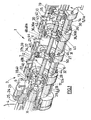
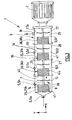
- Mixer 1 is a multi-stage in-line homogenizer mixer.
- the mixer 1 comprises motorization means 2, a main body tubular 3 for mixing, a chassis 4, means 5 for inlet of fluids, means 6 for evacuating fluids.
- At least two fluids intended to be mixed in the mixer 3 are routed by the arrival means 5, pass through the main body 3 and are discharged from the mixer 1 by the discharge means 6.
- the mixer 1 is typically in a horizontal position.
- the mixer 1 comprises a mixing shaft 7 movable in rotation extending along the longitudinal X axis of the main body 3.
- the main body 3 has a circular section and comprises several 8 aligned compartments which form the stages 9 of the mixer. Each compartment or stage has a mixing chamber.
- the mixer 1 comprises in this embodiment four chambers 10, 11, 12, 13.
- the continuous phase of the mixture enters the chamber 10, the mixture in the form of an emulsion leaves the mixer 1 through the chamber 13.
- the main body 3 comprises a cylindrical wall 17 delimiting the chambers 10, 11, 12, 13.
- the inlet means 5 comprise on the one hand a flared supply 5a of the continuous phase, in the axial direction X.
- the means of arrival 5 on the other hand have side inlets 5b, 5c, 5d of fluids intended for be incorporated into the mixture, respectively introduced into the chambers 10, 11, 12, 13.
- each stage 9 also called dispersed phase
- the fluids introduced into each stage 9, also called dispersed phase are incorporated by incorporation orifices 14, 15, 16 respectively for the rooms 10, 11, 12.
- Stage 13 is the emulsion outlet stage obtained after mixing with a evacuation orifice 18 of the evacuation means 6.
- the mixer 1 also comprises reinforcing collars 19, 20, 21, 22, 23 fixed.
- the collar 19 forms the end wall of the chamber 10 at the entrance to the mixer 1.
- the reinforcing collar 23 is located at the extreme part of the chamber 13 from the mixer outlet 1.
- the collar 23 is mounted on a ring 24 of the mixer 1 using connecting bolts 25.
- the collars 20, 21 and 22 are located in the separation zone between the chambers, respectively 10 and 11 for the collar 20, 11 and 12 for the collar 21, 12 and 13 for the collar 22.
- the collars 20, 21, 22 are embedded in the cylindrical wall 17 which is thus divided into cylindrical sections, respectively the section 26 for the chamber 10, the section 27 for the chamber 11, the section 28 for the chamber 12, the section 29 for room 13.
- the mixer further comprises support rods 30, 31, 32, 33 connecting two by two respectively the collars 19, 20, 21, 22, 23.
- Each stage 9 comprises a device 34 of rotor / stator type.
- the four-stage mixer 1 thus comprises four rotor / stator devices, respectively 35 for room 10, 36 for room 11, 37 for the room 12, 38 for room 13.
- Each rotor / stator device 35, 36, 37, 38 comprises a rotor respectively 35a, 36a, 37a, 38a, and a stator respectively 35b, 36b, 37b, 38b.
- Each chamber 10, 11, 12, 13 thus comprises a first zone of turbulence comprising the rotor / stator device 34, and a second zone homogenization between the rotor / stator device 34 of this chamber, and the rotor / stator device 34 of the adjacent downstream chamber.
- the stator 36b is in one piece, and includes an annular crown 39 and a fixing crown 40.
- the annular crown 39 is in the form segments 41 spaced at regular circumferential intervals.
- the fixing ring 40 forms a ring anchored by a fixing portion 42 in the cylindrical wall 17, more precisely the section 27 of the chamber 11.
- the fixing portion 42 is thus contiguous with the fixing portion 43 of the collar support 20 located between the section 27 and the section 26 of the chamber 10.
- the annular ring 39 has slots 44 between the segments 41 extending axially, comprising one end 45 on the side of the crown attachment 40 and one end 46 on the side opposite to the attachment ring 40.
- the fixing ring 40 of the rotor 36b forms a partition wall between the rooms 10 and 11.
- proximal and distal For each room, we designate by the qualifiers "proximal” and “Distal”, the areas respectively close to a fixing ring 40 and moving away from this fixing ring 40.
- the end 45 of a segment 41 For example for the bedroom 11, the end 45 of a segment 41 is located in the proximal position while its end 46 is in a distal position.
- the rotor 36a is intended to be rotated by the mixing shaft 7.
- the rotor 36a is a wheel with blade which includes a transverse plate 48 supporting on each face 48a, 48b, blades 49, eight blades 49 on the variant shown.
- the plaque transverse 48 has an axial cylindrical bore 50 intended to receive the shaft 7, and integral with the shaft 7 during its rotation.
- the blades 49 are spaced from the axial tubular part 50, and each comprise a song 51a inclined with respect to the axial direction X by an angle of the order of 10 degrees, an edge 51b in the radial direction Y, and an axial edge 51c.
- the diameter of the annular crown 19 is slightly greater than the diameter of the plate 48, for example 125 mm, so as to allow the rotation of the rotor 36a.
- the edge 51c is perpendicular and tangent to the plate 48 to improve shearing through the slots 44 of the stator 36b.
- the stator 36b surrounds the rotor 36a.
- the annular crown 39 is spaced from a space 47, sufficiently small to the desired shear stresses of the cylindrical wall 17.
- the diameter of the chamber 11 is for example in this embodiment 180 mm. In certain embodiments the diameter of the mixer can vary from 80 to 400 mm.
- transverse plate 48 is spaced along the direction X of the face of the fixing ring 40 opposite, a distance d sufficient for allow the mixture to pass from the previous upstream chamber, the occurrence of chamber 10 for device 36, towards chamber 11.
- This distance d is in this example 20 mm, substantially equal to the distance axial edge 51c.
- the mixture flows while being stirred under the action of the rotation of the rotor 36a towards the downstream part of the chamber 11.
- the blades 49 located on the side of the face 48b of the plate 48 also project the mixture through the slots 44.
- the structure of the devices 35, 36, 37, 38 is identical.
- the circulation of the fluids in the mixer 1 is done in the manner next, choosing fuel oil as an example of a continuous phase.
- the continuous phase (or first fluid) enters the mixer 1 through the means 5 of arrival in room 10.
- a second fluid, water, intended to be mixed with the continuous phase is introduced into the chamber 10 through the orifice 14.
- the two fluids are mixed by the rotor 35a causing a shear of this mixture in the axial direction and in the radial direction.
- the blades 49 of the rotor 35a project the fluids stirred in the radial direction through the slots 44 of the annular crown 39 of the stator 35b, towards the space 47.
- the rotor / stator device 35 allows the fluids to be mixed in the chamber 10, with a direction of flow of the mixture towards the next chamber 11.
- a deflocculating turbine 65 is placed in the chamber 10 after the device rotor / stator, so as to continue mixing the mixture in the area of the room 10.
- the mixture thus obtained of the first fluid and the second fluid is intended to pass into the next chamber 11, opening at the level of the device of the rotor / stator 36 of this chamber 11.
- the rotor 36a of chamber 11 stirs the mixture and directs it radially through the slots 44 of the crown ring 39 of stator 36b. Then the mixture goes according to the direction flow to the next room 12.
- a third fluid intended to be incorporated into the mixture of the first two fluids, can be introduced into compartment 11 through port 15. According to a variant this third fluid is the same as the second fluid.
- the mixture of the first, second and third fluids is then transferred to chamber 12, stirred by the rotor / stator device 37 in a similar manner, with possible incorporation of a fourth fluid which may be different or identical to the second and third fluids of chambers 10 and 11.
- the mixture then passes through the fourth and last chamber 13 of the mixer. It is stirred by the rotor / stator 38, a last fluid which can be introduced through an orifice 17 to be incorporated into the mixture. This latter fluid is typically more fragile than the previous fluid (s).
- the mixture is then evacuated via the evacuation conduit 18 of the means evacuation 6.
- the embodiment described is typically used for mixtures of the type water / oil.
- Such a mixer is also suitable for a water / milk powder mixture.
- the particle size of the emulsion obtained is of the order of ⁇ m.
- the rotor stator devices 35,36,37,38 are as in the first mode of identical realization between them. We therefore describe, for example, the stator rotor 36.
- the rotor 36a comprises a plate bottom 48 'supporting four blades 51 which are interconnected by a bore cylindrical hollow 50 'able to receive the axis 7.
- the cylindrical bore 50' comprises orifices 52 for means for fixing the bore 50 'to the shaft 7.
- Each blade 51 includes a bulged end portion 53 close to the cylindrical bore 50 'and a substantially flat end portion 54.
- each blade 51 is straight.
- the free radial edge 56 has a section 57 parallel to the plate bottom 48 and a section 58 inclined with respect to the section 57 by an angle of the order 30 degrees.
- the tangent free edges 55 of the blades 51 are spaced apart by a angle of around 90 degrees.
- the free edge 56 of the blades 51 when the rotor is mounted on the shaft, is in proximal position, on the side of the fixing ring 48, the base plate 48 being in the distal position, on the stator rotor side according to 37. In the position of mounting, the free edge 55 is opposite and parallel to the segments 41.
- the length of the free edge 56 in the direction X is substantially equal to the length of the segments 41.
- the circumference of the base plate 48 'and the ends 46 of segments 41 are substantially in the same plane.
- the structure of the stator 36 is different from that of the embodiment described above.
- the one-piece stator 36b ( Figures 5a, 5b) always includes a crown annular 39 and a fixing ring 40. However, instead of segments 41 spaced and straight, the annular ring 39 comprises segments spaced 59 connected together at their distal extreme part by a distal ring 60.
- the circumferentially spaced segments 59 are parallel to each other and inclined with respect to the axial direction by an angle of the order of 30 degrees.
- the annular crown 39 comprises for example 16 or 24 segments.
- the rotor 36a comprises four blades 61 connected around a cylindrical portion 62 receiving the shaft 7, the section of blades being increasing from the cylindrical portion 62 towards the free edge 63 of the blades 61.
- the rotor 36a does not include a bottom plate.
- the song 63a inclined by about 10 ° to the east radial direction, in the position of mounting on the shaft located in the proximal position, i.e. on the side of the fixing crown 40 of stator 36b.
- the structure of the devices rotor / stator 34 varies between chambers 10, 11, 12, 13.
- inlet chamber 10 and outlet chamber 13 may include a downstream pumping turbine.
- the residence time in the mixing zone is extremely short, which allows fine emulsions to be produced on large scales at a cost lower operating procedures compared to conventional methods.
- the power required by the mixer typically from 0.03 to 0.08 kW / kg of product, is less than that of a batch system.
- rotor / stator can be used, ranging from laboratory with a capacity of a few liters, foam concentrates for tanks of 1000 liters.
- the viscosity range accepted by the mixer is quite wide, ranging from 1 mPa.s to 10Pa.s.
- the different products to be mixed may have different physical properties as well as a high viscosity ratio, around 1000.
- the distribution of the product is optimized and the dosage is easier since each stage of the mixer has a valve introduction.
- the incorporation of the products is then done directly in the mixing zone, which allows optimal work of the different tools.
- this modularity of the exchanger makes it possible to limit the shearing of sensitive products by incorporating them on the top floor.
- the dosage of the components of the mixture makes it possible to obtain online stable emulsions without the need for recycling, and the mixer allows obtain a very good distribution of the product under the best conditions taking into account the physical characteristics of the product while reducing energy consumption compared to conventional methods of manufacturing, so as to obtain a wide field of application.
Landscapes
- Chemical & Material Sciences (AREA)
- Chemical Kinetics & Catalysis (AREA)
- Oil, Petroleum & Natural Gas (AREA)
- Engineering & Computer Science (AREA)
- General Chemical & Material Sciences (AREA)
- Organic Chemistry (AREA)
- Mixers Of The Rotary Stirring Type (AREA)
Abstract
- un rotor (35a, 36a, 37a, 38a) monté sur un axe support (7) et comportant des pales (49, 51) de mélange exerçant des forces de cisaillement sur le mélange dans la direction axiale et dans la direction radiale ;
- un stator (35b, 36b, 37b, 38b) comportant une couronne annulaire (39) entourant le rotor, située à une faible distance (47) de la face interne (17a) de la paroi (17) de l'étage, présentant des segments (41) espacés circonférentiellement par des fentes (44).
Description
- une puissance nécessitée par le mélangeur élevée, pour mélanger à chaque passe le fluide de manière à obtenir une émulsion ;
- des phénomènes de coalescence dans la cuve de fluides ;
- l'encombrement d'une telle installation ;
- une altération des composants fragiles du mélange.
- un rotor monté sur un axe support et comportant des pales de mélange exerçant des forces de cisaillement sur le mélange dans la direction axiale et dans la direction radiale ;
- un stator comportant une couronne annulaire entourant le rotor, située à une faible distance de la face interne de la paroi de l'étage, présentant des segments espacés circonférentiellement par des fentes de manière à définir des ouvertures, parallèles entre elles, et telles que le mélange projeté par le rotor selon la direction radiale à travers les ouvertures subit un cisaillement selon cette direction radiale.
- un corps principal de mélange tubulaire comportant la paroi externe du mélangeur, le mélangeur comprenant au moins un étage de mélange, les étages étant alignés en série selon la direction d'écoulement et séparés entre eux par une cloison de séparation ménageant au moins une zone de passage du mélange ;
- des moyens de motorisation et de commande de la rotation de l'axe support des outils de mélange ;
- des moyens d'arrivée au mélangeur des constituants du mélange et des moyens d'évacuation du mélange du mélangeur ;
- a) introduction des fluides par lesdits moyens d'entrée dans un étage d'entrée du mélangeur ;
- b) mélange des matières premières dans le premier étage à l'aide du dispositif rotor/stator, de manière à exercer des forces de cisaillement dans la direction axiale et la direction radiale du mélangeur ;
- c) transfert du mélange selon l'axe du mélangeur jusque dans l'étage suivant ;
- d) répétition des étapes b) et c) pour chaque étage du mélangeur, le mélange transféré subissant au moins un cycle de mélange à chaque étage avant le transfert à l'étage suivant ;
- e) évacuation du mélange homogénéisé, de manière à obtenir des émulsions ultrafines stables, et dont le diamètre des particules est contrôlé, de l'ordre de 100 nanomètres à plusieurs microns.
- 1 à 15% d'eau ;
- 0 à 10% d'un système émulsifiant ;
- le complément à 100% d'hydrocarbures choisis dans le groupe comprenant le fioul, le gazole, le mazout, l'essence, le kérosène ; la taille des particules du mélange obtenu étant de l'ordre de 200 nm à quelques micromètres, et le mélange étant stable de manière à éviter une coalescence perturbant son utilisation.
- la figure 1 est une vue écorchée du mélangeur à plusieurs étages selon l'invention ;
- la figure 2 est une vue en agrandissement de la figure 1 au niveau des chambres de mélange 10 à 12 ;
- la figure 3 est une vue générale schématique en coupe longitudinale d'un mélangeur selon l'invention ;
- les figures 4a, 4b sont des vues ,respectivement du stator et du rotor d'un étage, selon un deuxième mode de réalisation ;
- les figures 5a, 5b et 5c représentent des variantes de réalisation du rotor/stator d'un étage du mélangeur selon un troisième mode de réalisation de l'invention.
Le mélangeur comprend en outre des tiges de soutien 30, 31, 32, 33 reliant deux à deux respectivement les colliers 19, 20, 21, 22, 23.
Claims (23)
- Dispositif de rotor stator (34) d'un mélangeur destiné à la production en continu d'émulsions fines, à partir d'au moins deux fluides difficiles à mélanger, le mélangeur comprenant au moins un étage (10, 11, 12, 13) de mélange, les étages étant séparés par des moyens formant cloison (40) ménageant au moins une zone de passage du mélange, caractérisé en ce qu'il comprend pour chaque étage :un rotor (35a, 36a, 37a, 38a) monté sur un axe support (7) et comportant des pales (49, 51) de mélange exerçant des forces de cisaillement sur le mélange dans la direction axiale et dans la direction radiale ;un stator (35b, 36b, 37b, 38b) comportant une couronne annulaire (39) entourant le rotor, située à une faible distance (47) de la face interne (17a) de la paroi (17) de l'étage, présentant des segments (41) espacés circonférentiellement par des fentes (44) de manière à définir des ouvertures, parallèles entre elles, et telles que le mélange projeté par le rotor (35a, 36a, 37a, 38a) selon la direction radiale à travers les ouvertures subit un cisaillement selon cette direction radiale.
- Dispositif rotor stator selon la revendication 1, caractérisé en ce que le stator (35b, 36b, 37b, 38b) comprend une couronne de fixation (40) reliant la couronne annulaire (39) et la paroi (17) de l'étage.
- Dispositif selon la revendication 1 ou 2 caractérisé en ce que le rotor est une roue à aube comprenant une plaque transversale (48) et un alésage cylindrique (50) recevant l'arbre (7) supportant au moins quatre pales (49) sur au moins une face (48a, 48b).
- Dispositif rotor stator selon la revendication 1 ou 2, caractérisé en ce que le rotor est une turbine à quatre pales (51) reliées par un alésage cylindrique (50) recevant l'arbre (7) montées transversalement sur une plaque transversale (48), la section transversale des pales (51) étant croissante en s'éloignant radicalement de l'axe sensiblement jusqu'à la moitié des pales, puis constante sur l'autre moitié.
- Dispositif rotor stator selon la revendication 1 ou 2, caractérisé en ce que le rotor est une turbine à quatre pales (61) sensiblement trapézoïdales, reliées par une portion cylindrique circulaire (62) recevant l'arbre (7), la section transversale des pales (61) étant croissante en s'éloignant radialement de l'axe du mélangeur (7).
- Dispositif rotor stator selon l'une quelconque des revendications 1 à 5, caractérisé en ce que les segments (41) s'étendent parallèlement à la direction axiale du mélangeur,
- Dispositif rotor stator selon l'une quelconque des revendications 1 à 5, caractérisé en ce que les segments (41) et les fentes (44) sont inclinés par rapport à la direction axiale d'un angle de l'ordre de 5 à 30°.
- Dispositif rotor stator selon l'une quelconque des revendications 1 à 7, caractérisé en ce que la dimension des fentes (44) selon la direction axiale est deux à dix fois supérieure à la dimension des fentes transversalement à cette direction axiale.
- Dispositif rotor stator selon l'une quelconque des revendications 1 à 8, caractérisé en ce que l'espace entre la couronne annulaire du stator et la face interne de la paroi de l'étage est compris entre 0.2 et une fois la dimension des fentes selon la direction axiale.
- Mélangeur (1) comprenant :caractérisé en ce que le dispositif rotor stator (34) d'au moins un des étages de mélange est conforme à l'une quelconque des revendications 1 à 9, les rotors (35) étant entraínés en rotation par un arbre traversant les chambres de mélange ; de manière à obtenir des émulsions ultrafines et stables dont le diamètre des particules est contrôlé, de l'ordre de 100 nanomètres à plusieurs microns.un corps principal (3) de mélange tubulaire comportant la paroi externe (17) du mélangeur, le mélangeur comprenant au moins un étage (94) de mélange, les étages étant alignés en série selon la direction d'écoulement et séparées par une cloison de séparation (40) présentant au moins une zone de passage du mélange et chaque étage comprenant un dispositif rotor stator ;des moyens de motorisation (2) et de commande de la rotation de l'axe (7) support des outils de mélange ;des moyens d'arrivée (5) au mélangeur des constituants du mélange et des moyens d'évacuation (6) du mélange du mélangeur ;
- Mélangeur selon la revendication 10, caractérisé en ce que chaque étage (9) comprend une zone de forte turbulence sous l'action du rotor/stator (34) et une zone d'homogénéisation sans coalescence des particules entre la zone de forte turbulence et la cloison de séparation avec l'étage suivant, avant le transfert à l'étage suivant.
- Mélangeur selon la revendication 10 ou 11, caractérisé en ce qu'il comprend des moyens de défloculation dans au moins une chambre de mélange destinés à réhomogénéiser le flux et apporter un cisaillement supplémentaire dans la zone d'homogénéisation.
- Mélangeur selon l'une quelconque des revendications 10 à 12, caractérisé en ce qu'il comprend des moyens d'injection et des orifices d'introductions (14, 15, 16) de composants du mélange dans les étages de mélange.
- Mélangeur selon l'une quelconque des revendications 10 à 13, caractérisé en ce qu'il comprend des colliers externes de renfort (19, 20, 21, 22, 23) à la périphérie de la paroi (17) du corps principal.
- Mélangeur selon l'une quelconque des revendications 10 à 14, caractérisé en ce qu'il comprend des moyens de contrôle et de régulation de la vitesse de rotation de chaque rotor lors du mélange, la structure de chaque rotor stator étant définie en fonction des contraintes de cisaillement souhaitées.
- Installation de mélange caractérisée en ce qu'elle comprend au moins un mélangeur selon l'une quelconque des revendications 10 à 15.
- Procédé d'homogénéisation en continu destiné à la production à débit élevé d'émulsions fines mettant en oeuvre le mélangeur selon l'une quelconque des revendications 10 à 15 caractérisé en ce qu'il comprend les étapes suivantes :a) introduction des fluides par lesdits moyens d'entrée (5a,5b) dans un étage d'entrée (10) du mélangeur (1) ;b) mélange des matières premières dans le premier étage (10) à l'aide du dispositif rotor/stator (35), de manière à exercer des forces de cisaillement dans la direction axiale et la direction radiale du mélangeur ;c) transfert du mélange selon l'axe du mélangeur jusque dans l'étage suivant ;d) répétition des étapes b) et c) pour chaque étage (10,11,12,13) du mélangeur, le mélange transféré subissant au moins un cycle de mélange à chaque étage avant le transfert à l'étage suivant ;e) évacuation du mélange homogénéisé, de manière à obtenir des émulsions ultrafines stables, et dont le diamètre des particules est contrôlé, de l'ordre de 100 nanomètres à plusieurs microns.
- Procédé selon la revendication 17, caractérisé en ce que le mélange d'un étage est transféré, sous l'effet de l'écoulement dans cet étage et de l'entraínement par le rotor de l'étage suivant, vers l'étage suivant.
- Procédé selon l'une quelconque des revendications 17 à 18, caractérisé en ce que les composants du mélange sont incorporés en une seule fois dans le premier étage du mélangeur ou à plusieurs étages du mélangeur, les constituants les plus fragiles étant incorporés dans le ou les derniers étages du mélangeur.
- Procédé selon l'une quelconque des revendications 17 à 19, caractérisé en ce que le mélange émulsionné a une viscosité de l'ordre de 1 mPa.s à 10Pa.s.
- Application du procédé selon l'une quelconque des revendications 17 à 20, à la production en ligne d'émulsions de type détergents, résines, cosmétiques, colles, huiles, dérivés alimentaires.
- Application du procédé selon l'une quelconque des revendications 17 à 20 à la production en ligne d'émulsions d'eau dans au moins un hydrocarbure choisi dans le groupe comprenant le fioul, le gazole, le mazout, l'essence, le kérosène, le pourcentage en eau du mélange étant de 1 à 15%.
- Produit obtenu par la mise en oeuvre du procédé selon l'une quelconque des revendications 17 à 19, caractérisé en ce qu'il comprend :la taille des particules du mélange obtenu étant de l'ordre de 200 nm à quelques micromètres, et le mélange étant stable de manière à éviter une coalescence perturbant son utilisation.1 à 15% d'eau ;0 à 10% d'un système émulsifiant ;le complément à 100% d'hydrocarbures choisis dans le groupe comprenant le fioul, le gazole, le mazout, l'essence, le kérosène ;
Applications Claiming Priority (2)
| Application Number | Priority Date | Filing Date | Title |
|---|---|---|---|
| FR0201575 | 2002-02-08 | ||
| FR0201575A FR2835762B1 (fr) | 2002-02-08 | 2002-02-08 | Dispositif de melange et d'homogeneisation destine a la production d'emulsions |
Publications (2)
| Publication Number | Publication Date |
|---|---|
| EP1338330A2 true EP1338330A2 (fr) | 2003-08-27 |
| EP1338330A3 EP1338330A3 (fr) | 2003-10-29 |
Family
ID=27620032
Family Applications (1)
| Application Number | Title | Priority Date | Filing Date |
|---|---|---|---|
| EP03290291A Withdrawn EP1338330A3 (fr) | 2002-02-08 | 2003-02-05 | Dispositif de mélange et d'homogénéisation destiné à la production d'émulsions |
Country Status (2)
| Country | Link |
|---|---|
| EP (1) | EP1338330A3 (fr) |
| FR (1) | FR2835762B1 (fr) |
Cited By (12)
| Publication number | Priority date | Publication date | Assignee | Title |
|---|---|---|---|---|
| RU2284852C1 (ru) * | 2005-03-28 | 2006-10-10 | Общество с ограниченной ответственностью "Брянскпромобеспечение" | Устройство для приготовления экологического водомазутного топлива |
| RU2304162C1 (ru) * | 2005-12-29 | 2007-08-10 | Борис Георгиевич Куликов | Устройство для получения горючей смеси |
| CN100462627C (zh) * | 2006-09-30 | 2009-02-18 | 宋凤杰 | 燃油微化机 |
| FR2929133A1 (fr) * | 2008-03-31 | 2009-10-02 | Vmi Sa | Dispositif de melange comprenant un conduit d'amenee de particules debouchant dans la zone de turbulences |
| US8408299B2 (en) | 2008-03-20 | 2013-04-02 | Exxonmobil Upstream Research Company | Viscous oil recovery using emulsions |
| US8592351B2 (en) | 2008-03-20 | 2013-11-26 | Exxonmobil Upstream Research Company | Enhancing emulsion stability |
| CN103933884A (zh) * | 2014-05-07 | 2014-07-23 | 冀中能源邯郸矿业集团有限公司 | 一种有动力三向入料液固介质混合装置 |
| CN104289136A (zh) * | 2014-09-19 | 2015-01-21 | 江西中船航海仪器有限公司 | 一种磁力传动式均质机 |
| CN104329193A (zh) * | 2014-11-15 | 2015-02-04 | 安庆泰邦机械科技有限责任公司 | 具有磁性联轴器的燃油均质机 |
| WO2017046017A1 (fr) * | 2015-09-14 | 2017-03-23 | Wacker Chemie Ag | Procédé de préparation en continu d'émulsions de silicone stables |
| CN107998913A (zh) * | 2017-12-28 | 2018-05-08 | 山东豪迈化工技术有限公司 | 剪切混合器及剪切混合反应装置 |
| CN115105985A (zh) * | 2022-06-28 | 2022-09-27 | 广东永芳日用化工有限公司 | 乳化均质锅 |
Families Citing this family (2)
| Publication number | Priority date | Publication date | Assignee | Title |
|---|---|---|---|---|
| US8269057B2 (en) * | 2007-06-27 | 2012-09-18 | H R D Corporation | System and process for alkylation |
| FR2970879B1 (fr) * | 2011-01-31 | 2013-02-15 | Vmi | Dispositif de melange |
Family Cites Families (6)
| Publication number | Priority date | Publication date | Assignee | Title |
|---|---|---|---|---|
| US3194540A (en) * | 1961-07-28 | 1965-07-13 | Liberty Nat Bank And Trust Com | Homogenizing apparatus |
| JPS5850771B2 (ja) * | 1980-03-31 | 1983-11-12 | 株式会社 関口 | 管路内連続乳化機 |
| DE3220092A1 (de) * | 1982-05-28 | 1983-12-01 | Janke & Kunkel GmbH & Co KG Ika - Werk, 7813 Staufen | Dispergiervorrichtung |
| JPS596928A (ja) * | 1982-07-05 | 1984-01-14 | Toshio Araki | エマルジヨン流体の製造装置 |
| EP1108463A1 (fr) * | 1998-01-13 | 2001-06-20 | Advanced Molecular Technologies, L.L.C. | Procede d'emulsification et dispositif de mise en oeuvre de ce procede |
| US6368366B1 (en) * | 1999-07-07 | 2002-04-09 | The Lubrizol Corporation | Process and apparatus for making aqueous hydrocarbon fuel compositions, and aqueous hydrocarbon fuel composition |
-
2002
- 2002-02-08 FR FR0201575A patent/FR2835762B1/fr not_active Expired - Fee Related
-
2003
- 2003-02-05 EP EP03290291A patent/EP1338330A3/fr not_active Withdrawn
Cited By (17)
| Publication number | Priority date | Publication date | Assignee | Title |
|---|---|---|---|---|
| RU2284852C1 (ru) * | 2005-03-28 | 2006-10-10 | Общество с ограниченной ответственностью "Брянскпромобеспечение" | Устройство для приготовления экологического водомазутного топлива |
| RU2304162C1 (ru) * | 2005-12-29 | 2007-08-10 | Борис Георгиевич Куликов | Устройство для получения горючей смеси |
| CN100462627C (zh) * | 2006-09-30 | 2009-02-18 | 宋凤杰 | 燃油微化机 |
| US8408299B2 (en) | 2008-03-20 | 2013-04-02 | Exxonmobil Upstream Research Company | Viscous oil recovery using emulsions |
| US8592351B2 (en) | 2008-03-20 | 2013-11-26 | Exxonmobil Upstream Research Company | Enhancing emulsion stability |
| US8960993B2 (en) | 2008-03-31 | 2015-02-24 | Vmi | Blender assembly for producing a vacuum inside a vat and method for dispensing particles therein |
| FR2929133A1 (fr) * | 2008-03-31 | 2009-10-02 | Vmi Sa | Dispositif de melange comprenant un conduit d'amenee de particules debouchant dans la zone de turbulences |
| WO2009122021A1 (fr) * | 2008-03-31 | 2009-10-08 | Vmi | Ensemble de melange, et procede de fabrication d'une reparation utilisant ledit ensemble |
| CN103933884A (zh) * | 2014-05-07 | 2014-07-23 | 冀中能源邯郸矿业集团有限公司 | 一种有动力三向入料液固介质混合装置 |
| CN103933884B (zh) * | 2014-05-07 | 2016-03-09 | 冀中能源邯郸矿业集团有限公司 | 一种有动力三向入料液固介质混合装置 |
| CN104289136A (zh) * | 2014-09-19 | 2015-01-21 | 江西中船航海仪器有限公司 | 一种磁力传动式均质机 |
| CN104329193A (zh) * | 2014-11-15 | 2015-02-04 | 安庆泰邦机械科技有限责任公司 | 具有磁性联轴器的燃油均质机 |
| WO2017046017A1 (fr) * | 2015-09-14 | 2017-03-23 | Wacker Chemie Ag | Procédé de préparation en continu d'émulsions de silicone stables |
| US10561995B2 (en) | 2015-09-14 | 2020-02-18 | Wacker Chemie Ag | Process for continuous production of stable silicone emulsions |
| CN107998913A (zh) * | 2017-12-28 | 2018-05-08 | 山东豪迈化工技术有限公司 | 剪切混合器及剪切混合反应装置 |
| CN115105985A (zh) * | 2022-06-28 | 2022-09-27 | 广东永芳日用化工有限公司 | 乳化均质锅 |
| CN115105985B (zh) * | 2022-06-28 | 2024-03-12 | 广东永芳日用化工有限公司 | 乳化均质锅 |
Also Published As
| Publication number | Publication date |
|---|---|
| EP1338330A3 (fr) | 2003-10-29 |
| FR2835762B1 (fr) | 2005-02-18 |
| FR2835762A1 (fr) | 2003-08-15 |
Similar Documents
| Publication | Publication Date | Title |
|---|---|---|
| FR2835762A1 (fr) | Dispositif de melange et d'homogeneisation destine a la production d'emulsions | |
| EP0596764B1 (fr) | Dispositif et procédé pour effectuer la séparation de phases par filtration et centrifugation | |
| US4175873A (en) | Process and apparatus for mechanically mixing two immiscible liquids and one or more other substances | |
| US7645067B2 (en) | Homogenizer | |
| CA2320342C (fr) | Procede de preparation d'un combustible emulsionne et son dispositif de mise en oeuvre | |
| EP0781929B1 (fr) | Dispositif de pompage ou de compression d'un fluide polyphasique à aubage en tandem | |
| WO2014155436A1 (fr) | Dispositif d'agitation continue à grande vitesse de type vertical | |
| US20110038901A1 (en) | Method for Gentle Mechanical Generation of Finely Dispersed Micro-/Nano-Emulsions with Narrow Particle Size Distribution and Device for Carrying Out Said Method | |
| CA2489088A1 (fr) | Procede pour melanger en continu dynamiquement au moins deux fluides et micromelangeur | |
| US20090176638A1 (en) | Gas sealed apparatus for separating solids, liquids and gases having different specific gravities | |
| JP7342134B2 (ja) | 密度がより低い流体を密度がより高い流体から分離するための方法およびデバイス | |
| WO2008107404A1 (fr) | Dispositif et procede d'injection de fluide dans un lit fluidite rotatif | |
| AU2008240757B2 (en) | Process and device for the separation of oil/water mixtures | |
| EP3231786B1 (fr) | Mélangeur statique avec un dispositif de cisaillement et procédé de production d'explosif | |
| EP1467810A1 (fr) | DISPOSITIF ET PROCEDE D AGITATION EN PARTICULIER POUR u /u LA DISPERSION OU L EMULSIFICATION DE DEUX LIQUIDES NON MISC IBLES | |
| GB1578785A (en) | Process and apparatus for mixing immiscible liquids and one or more other substances | |
| EP1108463A1 (fr) | Procede d'emulsification et dispositif de mise en oeuvre de ce procede | |
| EP1967261A1 (fr) | Dispositif et procédé d'injection de fluide dans un lit fluidifié rotatif. | |
| EP3113867B1 (fr) | Procédé et dispositif de dispersion de gaz dans un liquide | |
| RU2613957C1 (ru) | Устройство для приготовления топочной жидкости | |
| EP2188215B1 (fr) | Procede de separation solide/liquide d'effluent et separateur pour sa mise en oeuvre | |
| EP1865781B1 (fr) | Dispositif de melange en continu d une pâte alimentaire comprenant deux types d outils de melange superposes et une evacuation laterale, procédé de fabrication et installation | |
| BE499081A (fr) | ||
| BE1032651B1 (fr) | Procédé de fabrication d'une composition biocide et/ou fertilisante sous forme d'une émulsion | |
| CA2636415A1 (fr) | Installation domestique de purification d'effluents |
Legal Events
| Date | Code | Title | Description |
|---|---|---|---|
| PUAI | Public reference made under article 153(3) epc to a published international application that has entered the european phase |
Free format text: ORIGINAL CODE: 0009012 |
|
| AK | Designated contracting states |
Designated state(s): AT BE BG CH CY CZ DE DK EE ES FI FR GB GR HU IE IT LI LU MC NL PT SE SI SK TR |
|
| AX | Request for extension of the european patent |
Extension state: AL LT LV MK RO |
|
| PUAL | Search report despatched |
Free format text: ORIGINAL CODE: 0009013 |
|
| AK | Designated contracting states |
Kind code of ref document: A3 Designated state(s): AT BE BG CH CY CZ DE DK EE ES FI FR GB GR HU IE IT LI LU MC NL PT SE SI SK TR |
|
| AX | Request for extension of the european patent |
Extension state: AL LT LV MK RO |
|
| RIC1 | Information provided on ipc code assigned before grant |
Ipc: 7B 01F 3/08 B Ipc: 7C 10L 1/32 B Ipc: 7B 01F 7/00 A |
|
| 17P | Request for examination filed |
Effective date: 20040127 |
|
| 17Q | First examination report despatched |
Effective date: 20040330 |
|
| AKX | Designation fees paid |
Designated state(s): BE DE FR GB IT |
|
| STAA | Information on the status of an ep patent application or granted ep patent |
Free format text: STATUS: THE APPLICATION IS DEEMED TO BE WITHDRAWN |
|
| 18D | Application deemed to be withdrawn |
Effective date: 20041012 |