EP1339231A2 - System und Verfahren zur FM Demodulation des zweiten Tonträgers - Google Patents
System und Verfahren zur FM Demodulation des zweiten Tonträgers Download PDFInfo
- Publication number
- EP1339231A2 EP1339231A2 EP03004147A EP03004147A EP1339231A2 EP 1339231 A2 EP1339231 A2 EP 1339231A2 EP 03004147 A EP03004147 A EP 03004147A EP 03004147 A EP03004147 A EP 03004147A EP 1339231 A2 EP1339231 A2 EP 1339231A2
- Authority
- EP
- European Patent Office
- Prior art keywords
- signal
- copy
- information
- secondary audio
- audio program
- Prior art date
- Legal status (The legal status is an assumption and is not a legal conclusion. Google has not performed a legal analysis and makes no representation as to the accuracy of the status listed.)
- Withdrawn
Links
Images


Classifications
-
- H—ELECTRICITY
- H04—ELECTRIC COMMUNICATION TECHNIQUE
- H04N—PICTORIAL COMMUNICATION, e.g. TELEVISION
- H04N5/00—Details of television systems
- H04N5/44—Receiver circuitry for the reception of television signals according to analogue transmission standards
- H04N5/60—Receiver circuitry for the reception of television signals according to analogue transmission standards for the sound signals
- H04N5/602—Receiver circuitry for the reception of television signals according to analogue transmission standards for the sound signals for digital sound signals
-
- H—ELECTRICITY
- H04—ELECTRIC COMMUNICATION TECHNIQUE
- H04N—PICTORIAL COMMUNICATION, e.g. TELEVISION
- H04N21/00—Selective content distribution, e.g. interactive television or video on demand [VOD]
- H04N21/40—Client devices specifically adapted for the reception of or interaction with content, e.g. set-top-box [STB]; Operations thereof
- H04N21/43—Processing of content or additional data, e.g. demultiplexing additional data from a digital video stream; Elementary client operations, e.g. monitoring of home network or synchronising decoder's clock; Client middleware
- H04N21/439—Processing of audio elementary streams
- H04N21/4398—Processing of audio elementary streams involving reformatting operations of audio signals
-
- H—ELECTRICITY
- H04—ELECTRIC COMMUNICATION TECHNIQUE
- H04N—PICTORIAL COMMUNICATION, e.g. TELEVISION
- H04N21/00—Selective content distribution, e.g. interactive television or video on demand [VOD]
- H04N21/80—Generation or processing of content or additional data by content creator independently of the distribution process; Content per se
- H04N21/81—Monomedia components thereof
- H04N21/8106—Monomedia components thereof involving special audio data, e.g. different tracks for different languages
-
- H—ELECTRICITY
- H04—ELECTRIC COMMUNICATION TECHNIQUE
- H04N—PICTORIAL COMMUNICATION, e.g. TELEVISION
- H04N5/00—Details of television systems
- H04N5/44—Receiver circuitry for the reception of television signals according to analogue transmission standards
- H04N5/60—Receiver circuitry for the reception of television signals according to analogue transmission standards for the sound signals
- H04N5/607—Receiver circuitry for the reception of television signals according to analogue transmission standards for the sound signals for more than one sound signal, e.g. stereo, multilanguages
-
- H—ELECTRICITY
- H04—ELECTRIC COMMUNICATION TECHNIQUE
- H04H—BROADCAST COMMUNICATION
- H04H20/00—Arrangements for broadcast or for distribution combined with broadcast
- H04H20/44—Arrangements characterised by circuits or components specially adapted for broadcast
- H04H20/46—Arrangements characterised by circuits or components specially adapted for broadcast specially adapted for broadcast systems covered by groups H04H20/53-H04H20/95
- H04H20/47—Arrangements characterised by circuits or components specially adapted for broadcast specially adapted for broadcast systems covered by groups H04H20/53-H04H20/95 specially adapted for stereophonic broadcast systems
- H04H20/48—Arrangements characterised by circuits or components specially adapted for broadcast specially adapted for broadcast systems covered by groups H04H20/53-H04H20/95 specially adapted for stereophonic broadcast systems for FM stereophonic broadcast systems
Definitions
- Certain embodiments of the present invention generally relate to a second audio program (SAP) channel, and in particular, relate to demodulation of a frequency modulation (FM) SAP channel.
- SAP second audio program
- FM frequency modulation
- information may be provided to supplement an audio or audiovisual program.
- advertisements or promotions related to a television program may be attractive to viewers.
- customers may enjoy listening to local radio stations through their television sets or may enjoy receiving current weather or traffic reports along with regular television programming.
- SAP channels may be used in audio communications, such as television or radio, for example, to provide a separate audio source in addition to left and right stereo signals or a monoaural audio signal.
- An SAP channel may be used to duplicate audio content contained on other audio channels or may carry additional information, such as audio content in a second language, descriptive information regarding the audio content, advertising material, local radio stations, weather or traffic reports, frequency-shift keying information, or other additional material unrelated to the main audio content.
- the Federal Communications Commission adopted the format established by the Broadcast Television Standards Committee (BTSC) as a standard for multichannel television sound (MTS).
- BTSC Broadcast Television Standards Committee
- MTS multichannel television sound
- the BTSC format is used with a composite TV signal that includes a video signal, as well as the BTSC format for sound reproduction.
- the BTSC format is similar to FM stereo, but has the ability to carry two additional audio channels.
- Left plus right channel mono information is transmitted in a way similar to stereo FM in order to ensure compatibility with monaural television receivers.
- a 15.734 kHz pilot signal is used, instead of the FM stereo 19 kHz pilot signal, which allows the pilot signal to be phase-locked to the horizontal line frequency.
- a double sideband-suppressed carrier at twice the frequency of the pilot transmits the left minus right stereo information.
- the stereo information may be DBX encoded to aid in noise reduction.
- An SAP channel is located at 5 times the pilot frequency.
- the SAP channel may be used for second language or independent source program material.
- a professional audio channel may be added at 6.5 times the plot frequency in order to accommodate additional voice or data.
- Stereo tuners and demodulator units capable of decoding the BTSC format have been on the market for some time.
- the front end of the units typically includes analog components or integrated circuit chips that cause variation in the amplitude of the composite signal, including the BTSC portion of the signal. This variation in amplitude reduces stereo separation of the right and left channel information carried in the composite signal.
- current stereo tuners and demodulator units attempt to separate an SAP channel using an unnecessarily complicated process with significant hardware cost.
- Certain embodiments of the present invention provides a system and method for SAP FM demodulation. Certain embodiments of the present invention provide a digital FM demodulator that uses a simplified approximation of a digital FM demodulation equation using non-unity delay for simplified demodulation of frequency modulated signals.
- the system includes a bandpass filter for isolating the SAP signal, a Hilbert filter to produce a copy of the SAP signal phase shifted by 90 degrees, an FM demodulator for demodulating the SAP signal using the phase shifted SAP signal and a delayed SAP signal, and a lowpass filter to eliminate noise from the FM demodulated SAP signal.
- the system may also include an automatic gain control for normalizing amplitude of FM demodulator input signals.
- the FM demodulator uses a simplified approximation for easy demodulation of SAP signals.
- a simplified equation that may be used is I(n)*Q(n-d)-Q(n)*I(n-d), wherein I(n) represents the delayed copy of the SAP information, Q(n) represents the copy of the SAP information with a phase shift, d represents a delay greater than one, and n represents a discrete time index.
- the method includes isolating desired signal information from an audio signal. Then, the method includes phase shifting a copy of the desired signal information from an audio signal and delaying a copy of the desired signal information. The method further includes FM demodulating the desired signal information using the phase shifted copy of the desired signal information and the delayed copy of the desired signal information to produce an FM demodulated signal.
- Certain embodiments also provide a method for simplification of secondary audio program signal demodulation.
- the method includes using a bandpass filter with a minimal number of coefficients to isolate the secondary audio program signal in a composite audio signal, using a Hilbert filter with a minimal number of coefficients to produce a signal in quadrature phase, and using a simple approximation for FM demodulation of the secondary audio program signal and the signal in quadrature phase.
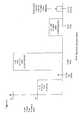
- FIG. 1 illustrates a SAP demodulation system 100, formed in accordance with an embodiment of the present invention.
- the SAP demodulation system 100 includes a BTSC composite audio signal 110, a bandpass filter (BPF) 120, a delay module 130, a Hilbert filter 140, an FM demodulator 150, and a low pass filter (LPF) 160.
- the output is an FM demodulated signal 170.
- the system 100 may be used to demodulate digital FM signals, but, for the purposes of illustration, the system 100 will be described in relation to SAP signal demodulation.
- the BTSC composite audio signal 110 feeds into the BPF 120. After passing through the BPF 120, a filtered signal representing the SAP channel travels to both the delay module 130 and the Hilbert filter 140.
- the delay module 130 produces a signal Xi that is sent to the FM demodulator 150.
- the Hilbert filter 140 produces a signal Xq that is sent to the FM demodulator 150.
- a signal from the FM demodulator 150 enters the LPF 160.
- the FM demodulated signal 170 is generated from the LPF 160.
- the BTSC composite audio signal 110 is similar to FM stereo but has the ability to carry two additional audio channels.
- Left plus right (L+R) channel mono information may be transmitted in a way similar to stereo FM in order to ensure compatibility with monaural television receivers.
- a 15.734 kHz pilot signal may be used, instead of the FM stereo 19 kHz pilot signal, which allows the pilot signal to be phase-locked to the horizontal line frequency.
- the stereo information may be DBX encoded to aid in noise reduction.
- An SAP channel may be located at 5 times the pilot frequency.
- the SAP channel may be used for second language, advertising, supplement information, or independent source program material, for example.
- a professional audio channel may be added at 6.5 times the pilot frequency in order to accommodate additional voice or data.
- Figure 2 illustrates a BTSC baseband frequency in accordance with an embodiment of the present invention.
- the BPF 120 passes a range of frequencies between low and high cut-off frequencies.
- the BPF 120 may be used to remove stereo and professional audio channels.
- the BPF 120 may be a finite impulse response (FIR) filter.
- FIR filter generates a response based on an input impulse. The impulse is finite because it does not produce feedback in the filter.
- the FIR filter receives an input signal and produces a set of coefficients. The input signal and the coefficients form the output signal. Delay may be introduced as the input signal moves past the coefficients.
- a "tap" of a FIR filter is a coefficient/delay pair. The number of FIR filter taps may relate to the amount of memory in the filter, the scope of the filtering, and the number of calculations involved in the filtering.
- the BPF 120 uses a minimal number of taps to isolate the SAP signal.
- the BPF 120 is 32-tap FIR bandpass filter.
- the 32-tap FIR filter reduces the number of calculations involved in filtering the SAP channel from the composite audio signal 110.
- the 32-tap FIR filter also reduces the hardware and memory used in filtering the audio signal 110 to obtain the SAP channel.
- the Hilbert filter 140 is a filter used to derive a signal in phase quadrature. Signals in phase quadrature have a 90 degree phase difference.
- the Hilbert filter 140 receives an input signal and produces output with the same frequency response as the input but with a 90 degree phase difference.
- the Hilbert filter 140 may be a FIR filter or an infinite impulse response (IIR) filter, for example. An IIR filter uses feedback, while an FIR filter does not use feedback.
- the Hilbert filter 140 is an 11-tap frequency-domain Remez-designed Hilbert filter.
- the delay module 130 delays the SAP channel signal as a copy of the SAP channel is filtered by the Hilbert filter 140.
- the delayed signal is used with the phase quadrature signal from the Hilbert filter 140 in the FM demodulator 150.
- the delay introduced by the delay module 130 may be a delay d, preferably greater than 1 (non-unity delay).
- the FM demodulator 150 combines the delayed SAP signal from the delay module 130 and the signal in phase quadrature from the Hilbert filter 140 to produce an FM demodulated signal.
- the FM demodulator 150 uses a four times (4x) sampling rate.
- the FM demodulator 150 uses a simplified demodulation equation m(n) ⁇ I(n)*Q(n-d)-Q(n)*I(n-d) as an approximation to demodulate the signal, where d is a delay greater than 1.
- the delay d is 2, yielding the equation m(n) ⁇ I(n)*Q(n-2)-Q(n)*I(n-2).
- the simplified demodulation equation may also be used for FM demodulation of other digital signals, such as Bluetooth TM digital communication signals and other digital audio signals, for example.
- the LPF 160 passes only low frequencies up to a set cut-off frequency.
- the LPF 160 is used to remove noise that is out of the desired frequency band from the demodulated signal.
- the LPF 160 is a 4 th order elliptical LPF.
- the composite signal 110 is transmitted to the BPF 120.
- the SAP signal is centered at five times the pilot signal 25 at a frequency of 78.67 kHz.
- the BPF 120 is applied to the signal 110 to remove the L+R and L-R stereo channels, as well as the professional channel if the professional channel is present in the composite signal 110.
- the bandpass filtered signal is fed into a Hilbert filter 140 to generate a signal in phase quadrature and is also fed into the delay module 130 to delay the bandpass filtered signal.
- the delayed signal and signal in phase quadrature are then transmitted to the FM demodulator 150.
- the FM demodulator 150 applies a simplified demodulation equation to generate a demodulated SAP signal.
- the demodulated SAP signal is transferred to the LPF 160 to clean up the signal and remove noise outside the desired SAP band.
- the LPF 160 produces the FM demodulated signal 170.
- the FM carrier amplitude at the FM demodulator 150 is not a known constant.
- the FM carrier amplitude is adjusted with an automatic gain control (AGC) module (not pictured).
- the AGC module includes a comparator and a scaling factor generator. The FM carrier amplitude is normalized and compared with a programmable reference value. Then, the controlling scaling factor either increments or decrements the FM carrier signal from the normalized value based on the comparator results which are either larger than or less than the reference value.
- Figure 3 illustrates a flow diagram for a method of FM demodulating an SAP signal in accordance with an embodiment of the present invention.
- a BTSC composite signal 110 is transmitted to the BPF 120.
- the bandpass filter removes the stereo components, such as L+R, L-R, L, R, or professional channel, for example, to isolate the secondary audio program signal.
- the SAP signal is sent to both the delay module 130 and the Hilbert filter 140.
- the Hilbert filter is applied to the SAP signal to produce a phase quadrature signal, with a 90 degree difference in phase from the input signal.
- the SAP signal is delayed by the delay module 130.
- Xq and Xi are separated by 90 degrees.
- the delayed and phase quadrature signals are transmitted to the FM demodulator 150. If the FM carrier amplitude is not a constant, the FM carrier amplitude may be adjusted using automatic gain correction to normalize the amplitude and adjusted based on a comparison with a reference value. Then, at step 370, the SAP signal is demodulated using the delayed signal Xi and the quadrature signal Xq.
- the FM demodulator 150 uses the simplified demodulation equation: (3) m(n) ⁇ I(n)*Q(n-d) - Q(n)*I(n-d), wherein I(n) represents the delayed signal Xi, Q(n) represents the quadrature phase signal Xq, d represents the non-unity delay, and n represents a discrete time index.
- the simplified demodulation equation is obtained from the more detailed demodulation equation based on Xq and Xi.
- the demodulated SAP signal is transmitted to the LPF 160.
- the LPF 160 filters the demodulated signal to remove noise outside the range of the SAP signal.
- the resulting signal is the FM demodulated signal 180.
- the FM demodulated signal 180 is in digital form and may be used in televisions, radios, or other such devices.
- a general delay d greater than one, may allow simplified FM demodulation of a variety of digital signals, such as SAP signals, Bluetooth TM communication signals, and other digital audio signals.
- the following equations illustrate the use of a general delay d.
- m(n) represents an original message sequence, such as speech, music, program material, or data, for example.
- M(n) represents the original message sequence integrated modulo 2*pi.
- (n) represents a scaled approximate message signal received using an approximate and efficient digital demodulation equation.
- I(n) and Q(n) are the in-phase and quadrature parts of the received FM modulated signal.
- d is a delay used in the approximate demodulation equation (a non-negative integer)
- n is a discrete time index
- f c is a carrier frequency
- F s is a sampling frequency
- f dev is a frequency deviation of the FM modulation.
- certain embodiments of the present invention use minimal hardware and minimal equations to isolated and demodulate secondary audio program data included in a BTSC composite audio signal.
- the use of a simplified equation reduces the complexity of the process and also reduces the amount of hardware and memory involved in demodulation.
- Using a minimal number of filter taps also may reduce hardware complexity.
- Certain embodiments may improve the speed of the demodulation, as well as reduce the size, complexity, and cost of hardware.
- certain embodiments of the present invention afford an approach to achieve efficient, low cost, low power, digital audio signal decoding of frequency modulated information, such as SAP information, from digital signals, such as BTSC audio signals, in the digital domain.
Landscapes
- Engineering & Computer Science (AREA)
- Multimedia (AREA)
- Signal Processing (AREA)
- Stereo-Broadcasting Methods (AREA)
- Transmission Systems Not Characterized By The Medium Used For Transmission (AREA)
- Circuits Of Receivers In General (AREA)
- Television Receiver Circuits (AREA)
- Analogue/Digital Conversion (AREA)
Applications Claiming Priority (10)
| Application Number | Priority Date | Filing Date | Title |
|---|---|---|---|
| US82950 | 2002-02-26 | ||
| US83201 | 2002-02-26 | ||
| US10/083,076 US7006806B2 (en) | 2002-02-26 | 2002-02-26 | System and method for SAP FM demodulation |
| US10/083,201 US6832078B2 (en) | 2002-02-26 | 2002-02-26 | Scaling adjustment using pilot signal |
| US83052 | 2002-02-26 | ||
| US10/083,052 US7079657B2 (en) | 2002-02-26 | 2002-02-26 | System and method of performing digital multi-channel audio signal decoding |
| US10/083,203 US6859238B2 (en) | 2002-02-26 | 2002-02-26 | Scaling adjustment to enhance stereo separation |
| US10/082,950 US7253753B2 (en) | 2002-02-26 | 2002-02-26 | Method and apparatus of performing sample rate conversion of a multi-channel audio signal |
| US83203 | 2002-02-26 | ||
| US83076 | 2002-02-26 |
Publications (2)
| Publication Number | Publication Date |
|---|---|
| EP1339231A2 true EP1339231A2 (de) | 2003-08-27 |
| EP1339231A3 EP1339231A3 (de) | 2004-11-24 |
Family
ID=27671201
Family Applications (4)
| Application Number | Title | Priority Date | Filing Date |
|---|---|---|---|
| EP03004146A Withdrawn EP1341379A3 (de) | 2002-02-26 | 2003-02-26 | Skalierungsreglung zur Verbesserung der Stereotrennung |
| EP20030004148 Expired - Lifetime EP1349386B1 (de) | 2002-02-26 | 2003-02-26 | Verfahren und Vorrichtung zur Wandlung der Abtastraten eines Mehrkanaltonsignals |
| EP03004145A Withdrawn EP1339230A3 (de) | 2002-02-26 | 2003-02-26 | Audiosignalskalierungeinstellung mit Hilfe eines Pilotsignales |
| EP03004147A Withdrawn EP1339231A3 (de) | 2002-02-26 | 2003-02-26 | System und Verfahren zur FM Demodulation des zweiten Tonträgers |
Family Applications Before (3)
| Application Number | Title | Priority Date | Filing Date |
|---|---|---|---|
| EP03004146A Withdrawn EP1341379A3 (de) | 2002-02-26 | 2003-02-26 | Skalierungsreglung zur Verbesserung der Stereotrennung |
| EP20030004148 Expired - Lifetime EP1349386B1 (de) | 2002-02-26 | 2003-02-26 | Verfahren und Vorrichtung zur Wandlung der Abtastraten eines Mehrkanaltonsignals |
| EP03004145A Withdrawn EP1339230A3 (de) | 2002-02-26 | 2003-02-26 | Audiosignalskalierungeinstellung mit Hilfe eines Pilotsignales |
Country Status (1)
| Country | Link |
|---|---|
| EP (4) | EP1341379A3 (de) |
Families Citing this family (2)
| Publication number | Priority date | Publication date | Assignee | Title |
|---|---|---|---|---|
| ATE390683T1 (de) | 2004-03-01 | 2008-04-15 | Dolby Lab Licensing Corp | Mehrkanalige audiocodierung |
| DE602006010246D1 (de) | 2006-01-26 | 2009-12-17 | Infra Com Ltd | Jitterarme taktrückgewinnung aus einem über ein drahtloses medium übertragenen digitalen basisband-datensignal |
Family Cites Families (12)
| Publication number | Priority date | Publication date | Assignee | Title |
|---|---|---|---|---|
| US4716589A (en) * | 1984-11-26 | 1987-12-29 | Nec Corporation | Multivoice signal switching circuit |
| GB2176356A (en) * | 1985-06-12 | 1986-12-17 | Philips Electronic Associated | Method of, and demodulator for, digitally demodulating an ssb signal |
| US4727333A (en) * | 1986-06-30 | 1988-02-23 | Rca Corporation | Circuitry for multiplying a PCM signal by a sinusoid |
| US5151926A (en) * | 1991-05-21 | 1992-09-29 | General Electric Company | Sample timing and carrier frequency estimation circuit for sine-cosine detectors |
| JPH0787430B2 (ja) * | 1993-05-20 | 1995-09-20 | 日本電気株式会社 | デジタルfm変調器 |
| JP3301891B2 (ja) * | 1995-07-25 | 2002-07-15 | 三洋電機株式会社 | ステレオ復調回路及びその分離度調整方法 |
| JPH09130148A (ja) * | 1995-10-27 | 1997-05-16 | Icom Inc | ディジタル復調器 |
| JPH10242925A (ja) * | 1997-02-25 | 1998-09-11 | Sanyo Electric Co Ltd | ステレオ分離度の調整方法 |
| JP4169393B2 (ja) * | 1998-06-16 | 2008-10-22 | アイコム株式会社 | 角度復調器 |
| KR100712746B1 (ko) * | 1999-04-22 | 2007-05-02 | 코닌클리즈케 필립스 일렉트로닉스 엔.브이. | 적응성 샘플링 레이트 컨버터 |
| JP2001197398A (ja) * | 2000-01-07 | 2001-07-19 | Sony Corp | 音声多重復調装置および方法 |
| WO2001099277A1 (en) * | 2000-06-23 | 2001-12-27 | Stmicroelectronics Asia Pacific Pte Ltd | Universal sampling rate converter for digital audio frequencies |
-
2003
- 2003-02-26 EP EP03004146A patent/EP1341379A3/de not_active Withdrawn
- 2003-02-26 EP EP20030004148 patent/EP1349386B1/de not_active Expired - Lifetime
- 2003-02-26 EP EP03004145A patent/EP1339230A3/de not_active Withdrawn
- 2003-02-26 EP EP03004147A patent/EP1339231A3/de not_active Withdrawn
Also Published As
| Publication number | Publication date |
|---|---|
| EP1339230A3 (de) | 2004-11-24 |
| EP1349386B1 (de) | 2012-10-24 |
| EP1349386A3 (de) | 2004-11-24 |
| EP1349386A2 (de) | 2003-10-01 |
| EP1341379A3 (de) | 2004-11-24 |
| EP1339231A3 (de) | 2004-11-24 |
| EP1341379A2 (de) | 2003-09-03 |
| EP1339230A2 (de) | 2003-08-27 |
Similar Documents
| Publication | Publication Date | Title |
|---|---|---|
| US5946048A (en) | Network device for handling digital data over a TV channel | |
| EP2051523B1 (de) | Empfänger mit Mitteln zum Umschalten ohne Discontinuität zwischen den Audio-Video Signalen aus zwei Transportströmen. | |
| US5946047A (en) | Network system for handling digital data over a TV channel | |
| US7343143B2 (en) | Radio receiver with operation state setting unit | |
| US5357284A (en) | Compatible digital audio for NTSC television | |
| EP1370016A1 (de) | Verfahren und Vorrichtung zum Empfang eines gleichzeitig in analoger und digitaler Modulation übertragenen Audiosignales, mit allmählicher Umblendung von digitalem auf Analogen bei Empfang schlechter kanalgüte, um den Tausch weniger wahrnehmbar zu machen | |
| US20110211658A1 (en) | System and method of performing digital multi-channel audio signal decoding | |
| US7650125B2 (en) | System and method for SAP FM demodulation | |
| CN101277399A (zh) | 处理异常调制信号的方法及接收机 | |
| US4761814A (en) | Variable bandwidth multivoice demodulating circuit | |
| EP1339231A2 (de) | System und Verfahren zur FM Demodulation des zweiten Tonträgers | |
| EP1507348A2 (de) | Mechanismus und Verfahren zur Einstellung der spektralen und breitband Verstärkung in den Rückkopplungsschleifen eines BTSC Kodierer | |
| CN101383928B (zh) | 丽音控制方法和应用该方法的电视机 | |
| RU2163420C2 (ru) | Способ формирования и передачи двухканальных, в том числе стереофонических, сигналов звукового сопровождения, радиовещания, данных и команд управления в сетях эфирного и кабельного вещания (варианты), система передачи сигналов многоканального звукового сопровождения, радиовещания, данных и команд управления в сетях эфирного и кабельного вещания | |
| US20050036627A1 (en) | Mechanism for using the allpass decomposition architecture for the cauer low pass filter used in a BTSC | |
| US7705921B2 (en) | Digital BTSC multi-channel TV sound decoder circuit, and decoder comprising same | |
| RU9561U1 (ru) | Цифровая система звукового сопровождения для эфирного и кабельного вещания | |
| JP2847973B2 (ja) | 音声pcm放送受信機 | |
| WO1997015128A1 (fr) | Systeme de diffusion de donnees en f.m. et procede pour traiter ses signaux | |
| KR20020026949A (ko) | 소스 코드내의 오디오 데이터 준비 방법과, 이를 위한송신기 및 수신기 | |
| JP3119518B2 (ja) | テレビジョン信号変換装置 | |
| CN1066163A (zh) | 具有nicam或dab解码器的无线电接收机 | |
| JPS6281139A (ja) | 音声多重復調器 | |
| Rumsey | Hearing both sides-stereo sound for TV in the UK | |
| JP2003188748A (ja) | Rdsデコーダ |
Legal Events
| Date | Code | Title | Description |
|---|---|---|---|
| PUAI | Public reference made under article 153(3) epc to a published international application that has entered the european phase |
Free format text: ORIGINAL CODE: 0009012 |
|
| AK | Designated contracting states |
Designated state(s): AT BE BG CH CY CZ DE DK EE ES FI FR GB GR HU IE IT LI LU MC NL PT SE SI SK TR |
|
| AX | Request for extension of the european patent |
Extension state: AL LT LV MK RO |
|
| PUAL | Search report despatched |
Free format text: ORIGINAL CODE: 0009013 |
|
| AK | Designated contracting states |
Kind code of ref document: A3 Designated state(s): AT BE BG CH CY CZ DE DK EE ES FI FR GB GR HU IE IT LI LU MC NL PT SE SI SK TR |
|
| AX | Request for extension of the european patent |
Extension state: AL LT LV MK RO |
|
| 17P | Request for examination filed |
Effective date: 20050524 |
|
| AKX | Designation fees paid |
Designated state(s): DE FR GB |
|
| RAP1 | Party data changed (applicant data changed or rights of an application transferred) |
Owner name: BROADCOM CORPORATION |
|
| 17Q | First examination report despatched |
Effective date: 20100706 |
|
| STAA | Information on the status of an ep patent application or granted ep patent |
Free format text: STATUS: THE APPLICATION IS DEEMED TO BE WITHDRAWN |
|
| 18D | Application deemed to be withdrawn |
Effective date: 20120901 |