EP1344752A1 - Silikatglas mit hoher Beständigkeit, Verfahren zu dessen Herstellung, dieses enthaltendes Element, und damit versehende Vorrichtung - Google Patents
Silikatglas mit hoher Beständigkeit, Verfahren zu dessen Herstellung, dieses enthaltendes Element, und damit versehende Vorrichtung Download PDFInfo
- Publication number
- EP1344752A1 EP1344752A1 EP03004983A EP03004983A EP1344752A1 EP 1344752 A1 EP1344752 A1 EP 1344752A1 EP 03004983 A EP03004983 A EP 03004983A EP 03004983 A EP03004983 A EP 03004983A EP 1344752 A1 EP1344752 A1 EP 1344752A1
- Authority
- EP
- European Patent Office
- Prior art keywords
- silica glass
- highly durable
- aluminum
- group
- elements
- Prior art date
- Legal status (The legal status is an assumption and is not a legal conclusion. Google has not performed a legal analysis and makes no representation as to the accuracy of the status listed.)
- Granted
Links
Images


Classifications
-
- C—CHEMISTRY; METALLURGY
- C03—GLASS; MINERAL OR SLAG WOOL
- C03C—CHEMICAL COMPOSITION OF GLASSES, GLAZES OR VITREOUS ENAMELS; SURFACE TREATMENT OF GLASS; SURFACE TREATMENT OF FIBRES OR FILAMENTS MADE FROM GLASS, MINERALS OR SLAGS; JOINING GLASS TO GLASS OR OTHER MATERIALS
- C03C3/00—Glass compositions
- C03C3/04—Glass compositions containing silica
- C03C3/06—Glass compositions containing silica with more than 90% silica by weight, e.g. quartz
-
- C—CHEMISTRY; METALLURGY
- C03—GLASS; MINERAL OR SLAG WOOL
- C03C—CHEMICAL COMPOSITION OF GLASSES, GLAZES OR VITREOUS ENAMELS; SURFACE TREATMENT OF GLASS; SURFACE TREATMENT OF FIBRES OR FILAMENTS MADE FROM GLASS, MINERALS OR SLAGS; JOINING GLASS TO GLASS OR OTHER MATERIALS
- C03C3/00—Glass compositions
- C03C3/04—Glass compositions containing silica
- C03C3/076—Glass compositions containing silica with 40% to 90% silica, by weight
- C03C3/083—Glass compositions containing silica with 40% to 90% silica, by weight containing aluminium oxide or an iron compound
- C03C3/085—Glass compositions containing silica with 40% to 90% silica, by weight containing aluminium oxide or an iron compound containing an oxide of a divalent metal
-
- C—CHEMISTRY; METALLURGY
- C03—GLASS; MINERAL OR SLAG WOOL
- C03C—CHEMICAL COMPOSITION OF GLASSES, GLAZES OR VITREOUS ENAMELS; SURFACE TREATMENT OF GLASS; SURFACE TREATMENT OF FIBRES OR FILAMENTS MADE FROM GLASS, MINERALS OR SLAGS; JOINING GLASS TO GLASS OR OTHER MATERIALS
- C03C3/00—Glass compositions
- C03C3/04—Glass compositions containing silica
- C03C3/076—Glass compositions containing silica with 40% to 90% silica, by weight
- C03C3/095—Glass compositions containing silica with 40% to 90% silica, by weight containing rare earths
Definitions
- This invention relates to highly durable silica glass, a process for producing the silica glass, a member comprised of the silica glass, and an apparatus provided with the member.
- the silica glass of the present invention has enhanced durability, and good prooessability and machinability, and therefore, a member comprised of the silica glass is suitable for apparatuses using a plasma, such as a semiconductor-producing apparatus and a liquid crystal-producing display apparatus.
- a dry-etching step using a plasma bears importance.
- a halogenated gas such as fluorine-containing gas or chlorine-containing gas is used.
- the halogenated gas and its plasma have a high reactivity and thus are utilized in various steps, for example, as an etching gas in an etching step or cleaning gas in heat CVD step.
- the halogenated gas used includes, for example, fluorine-containing gases such as F 2 , HF, CF 4 , C 2 F 6 , C 3 F 6 , C 4 F 8 , CHF 3 , SF 6 and NF 3 ; chlorine-containing gases such as Cl 2 , HCl, BCl 3 and CCl 4 ; and bromine-containing gases such as Br 2 and HBr.
- silica glass member Inside the semiconductor production apparatus and liquid crystal display production apparatus, a silica glass member is provided. This is because silica glass has a high-frequency transmittance which is important for plasma generation, and silica glass can be shaped into a member of a complicated shape with high purity at a low production cost.
- the reason for which silica glass member of a complicated shape can be produced at a low cost, is that a rock crystal powder of a high purity used as a raw material for silica glass is inexpensive, and further that it has good prooessability and machinability, i.e., machining can be easily carried out and oxyhydrogen flame-welding can be conducted.
- Silica glass has good characteritics, as mentioned above, but has problems. That is, a surface of a silica glass member is gradually etched and eroded by a halogenated gas or its plasma at the exposed location. This undesirable etching reduces the durability of the silica glass member and sometimes causes abnormal discharge.
- the members to be exposed to a plasma are composed of a sintered body exhibiting enhanced resistance to etching.
- a sintered body includes, for example, a sintered alumina body exhibiting a lower etching rate when exposed to a plasma, than that of silica glass, was proposed (Japanese Unexamined Patent Publication [hereinafter abbreviated to "JP-A”] H5-217946), a sintered body comprising yttrium-aluminum-garnet (JP-A H10-236871), and a sintered aluminum nitride body (JP-A H10-275524).
- these sintered bodies have problems such that a raw material with a high purity is difficult to prepare, and, they have a grain boundary and therefore, when the sintered body is etched, the particles are liable to be separated from the sintered body with the result of reduction in yield of semiconductors or liquid crystal displays. Further, they have poor processability and machinability, and the produced members are costly.
- An attempt of adding a corrosion resistant element in silica glass is made to reduce the undesirable etching caused by a plasma while the good properties inherently possessed by silica glass, such as high purity, low cost, good processability and low dusting property are kept. More specifically, an attempt is made of adding an element in silica'glass, a halide of which has a sublimation temperature or a boiling point higher than that of a halide of silica contained in the silica glass, whereby a silica glass composition exhibiting a reduced etching rate is provided.
- metal element selected from Sm, Eu, Yb, Pm, Nd, Ce, Tb, Gd, Ba, Mg, Y, Tm, Dy, Ho, Er, Cd, Co, Cr, Cs, Zr, Al, In, Cu, Fe
- the inventors have found that the addition of the above-mentioned anticorrosive elements exerts a function of lowering the etching rate, but tends to destroy the structure of silica glass which offsets the durability enhancement function performed by the addition of corrosive elements.
- the reason for which the structure of silica glass tends to be destroyed is believed that the SiO 2 network constituting silica glass is broken by the incorporation of secondary elements, and consequently, non-orosslinking oxygen having a weak bonding force is introduced. This undesirable phenomenon occurs remarkably under etching conditions in which incidence of ion with high energy occurs markedly.
- the etching rate of silica glass is rather increased and the durability is reduced.
- a glass composition composed of SiO 2 -Al 2 O 3 -CaO, SiO 2 -Al 2 O 3 -MgO, SiO 2 -BaO-CaO or SiO 2 -ZrO 2 -CaO or SiO 2 -TiO 2 -BaO was proposed (for example, JP-A 2002-121047).
- These proposed glass compositions are not advantageous because these contain repellent elements for the semiconductor production such as Mg and Ca or toxic elements such as Ba.
- a silica glass composition comprising 0.1 to 20% by weight of a combination of a first metal element selected from Group 3B elements of the Periodic Table with a second element selected from Zr, Y, and lanthanoid and actinoid elements (for example, JP-A 2002-220257).
- This glass composition has a problem such that, when a large amount of elements are added, cracks, bubbles and turbidity tend to occur, although glass state (i.e., amorphous structure) can be kept.
- An object of the present invention is to provide silica glass with high purity exhibiting enhanced durability while good processability and machinability, and reduced dusting property are kept, and suitable for members of a semiconductor production apparatus or liquid crystal display production apparatus using a halogenated gas and/or a plasma thereof.
- Another object of the present invention is to provide highly durable silica glass having substantially no bubbles inside the glass and cracks, and exhibiting enhanced resistance to a halogenated gas and/or a plasma thereof.
- Still another object of the present invention is to provide highly durable silica glass which is substantially transparent to visible light.
- a further object of the present invention is to provide a member composed of the above-mentioned highly durable silica glass and suitable for a semiconductor production apparatus or a liquid crystal display production apparatus.
- a further object of the present invention is to provide a semiconductor production apparatus or a liquid crystal display production apparatus, which is provided with a member composed of the above-mentioned highly durable silica glass.
- highly durable silica glass comprising silica, aluminum and at least one element (M) selected from the group consisting of group 2A elements, group 3A elements and group 4A elements of the periodic table, which element (M) is hereinafter referred to as merely “element (M)" when appropriate.
- the sum of aluminum and element (M) is at least 30 atomic % based on the amount of total metal elements in the silica glass, and the atomic ratio of aluminum to element (M) is in the range of 0.05 to 20.
- the highly durable silica glass of the present invention comprises silica, aluminum and at least one element (M) selected from group 2A elements, group 3A elements and group 4A elements of the periodic table.
- Aluminum and element (M) exhibit a synergistic action of reducing the amounts of non-crosslinking oxygen and aluminum atoms not having a function of constituting a network in silica glass, and enhancing the resistance to a halogenated gas and/or its plasma.
- halides of aluminum and halides of element (M) have a boiling point and sublimation temperature, which are higher than a boiling point and sublimation temperature of compound SiX 4 (X is a halogen atom). Therefore, the rate of etching caused by a halogenated gas and/or its plasma is far smaller than the rate of etching in silica glass not having aluminum and element (M) incorporated therein. Consequently, oxides and/or halides of aluminum and element (M) are condensed on the surface of silica glass. The condensed oxides and halides exert a protective action and thus enhance the resistance to a halogenated gas and/or its plasma.
- Another part of Al atoms is believed to form a non-crosslinking oxygen as also observed when an element of group 4A of the periodic table is added.
- the inventors showed that the formation of non-crosslinking oxygen can be suppressed by an electric charge compensation method, i.e., by compensating a positive electric charge occurring due to the addition of element (M) with a negative electric charge occurring due to aluminum having substituted Si forming the SiO 2 network. That is, it was demonstrated that, when element (M) is added in combination with aluminum, the SiO 2 network is repaired or stabilized by the synergistic effect of the two ingredients, and consequently, the resistance to a plasma can be drastically enhanced as compared with the case when one of the two ingredients is added.
- an electric charge compensation method i.e., by compensating a positive electric charge occurring due to the addition of element (M) with a negative electric charge occurring due to aluminum having substituted Si forming the SiO 2 network. That is, it was demonstrated that, when element (M) is added in combination with aluminum, the SiO 2 network is repaired or stabilized by the synergistic effect of the two ingredients, and consequently, the resistance to a plasma can be drastically enhanced as
- the solubility of these ingredients in silica glass increases to a great extent.
- the addition of the two ingredients according to the present invention is beneficial in view of an increase in concentration of these ingredients in glass leading to enhancement of the resistance to a plasma.
- element (M) is at least one element selected from group 3A elements of the periodic table
- the highly durable silica glass of the present invention is substantially free from bubbles for a desired transparency, and more specifically, it has an optical transmittance of at least 80% as measured by irradiating a specimen having a thickness of 10 mm with light having a wavelength of 400 to 700 nm.
- the resulting glass is usually white and turbid, and opaque. It is presumed that, by the addition of element (M), fine bubbles are formed within the glass and a phase separation occurs, and thus, incident light irregularly reflects. The presence of fine bubbles and the phase separation undesirably cause nonuniform etching and generation of particles.
- element (M) is added in combination with aluminum, transparent glass can be obtained with a broad range of glass compositions.
- the transparent silica glass is suitable for, for example, a viewing window of semiconductor production apparatus or other apparatus.
- Element (M) used in the present invention is not particularly limited provided that it is selected from group 2A elements, group 3A elements and group 4A elements of the periodic table. Element (M) may be used either alone or as a combination of at least two thereof.
- group 2A elements group 3A elements and group 4A elements
- fluorides of the group 4A elements have a boiling point higher and stability poorer than those of fluorides of the group 2A elements and group 3A elements, and thus, their erosion resistance-enhancing effect is relatively low.
- Group 2A elements give a chemical compound in Al-(2A)-Si-O system and thus are capable of being crystallized at a high temperature. Therefore, group 3A elements are preferable among the elements of the three groups.
- group 2A elements there can be mentioned Be, Mg, Ca, Sr, Ba and Ra. Of these, Mg, Ca, Sr and Ba are preferable. Sr is especially preferable because it has a relatively large ion radius and a small mobility, and therefore does not exert a bad influence on a semiconductor element, and it has no toxicity.
- group 3A elements there can be mentioned Sc, Y, La, Ce, Pr, Nd, Pm, Sm, Eu, Gd, Tb, Dy, Ho, Er, Tm, Yb and Lu.
- Y, La and Ce are preferable in view of low cost. La and Ce are especially preferable. La is most preferable because of no absorption in the visible wavelength range.
- the sum (Al + La) of the amount of aluminum and the amount of La is in the range of 45 to 65 atomic % based on the amount of total metal elements, and the atomic ratio (Al/La) of aluminum to La is in the range of 1.5 to 3.
- group 4A elements there can be mentioned Ti, Zr and Hf. Of these, Ti and Zr are preferable in view of low cost.
- the melt occurrence temperature of a three-oxides composition SiO 2 -Al 2 O 3 -element (M) greatly varies depending upon the particular composition. Especially the minimum melt occurrence temperature varies depending upon the kind of element (M), and, as the composition becomes apart from the composition at the minimum melt occurrence temperature, the temperature at which the composition is completely molten becomes high and vitrification becomes difficult.
- element (M) is at least element selected from group 2A elements of the periodic table
- vitrification can be achieved easily when the atomic ratio of Al to element (M) is in the range of 0.1 to 5.
- vitrification can be achieved easily when the atomic ratio of Al to element (M) is in the range of 0.5 to 10, preferably 1 to 6.
- vitrification can be achieved even with silica glass composition other than the above-mentioned composition, provided that a sufficiently high temperature and a cooling rate necessary for vitrification are adopted.
- the highly durable silica glass of the present invention is preferably substantially free from metal impurities which are other than Si, O, Al and element (M). More specifically the content of each metal selected from Na, Fe and Cu is preferably not larger than 1 ppm. Therefore, a raw material powder used for the production of the highly durable silica glass of the present invention is preferably of high purity.
- the raw materials used are compounds each containing aluminum, element (M) or Si, and are usually powdery.
- the raw materials there can be mentioned oxide and nitrate salt for an aluminum raw material; oxide, carbonate salt and nitrate salt for element (M) raw material; and quartz powder for Si raw material.
- a compound containing both of aluminum and element (M) can be used. This compound is preferable because it exhibits prominently a synergistic effect achieved by the two ingredients.
- the method of vitrification includes, for example, an electrical melting method, a plasma melting method and an oxyhydrogen flame melting method.
- an electrical melting method is preferable because this method can be adopted for a broad range of compositions including the silica glass composition exhibiting a high viscosity at a high temperature and the production apparatus used therefor is advantageous.
- the highly durable silica glass is produced as follows.
- powdery oxide or powdery carbonate salt of element (M) and oxide of aluminum are placed together with powdery quartz in a vessel and thoroughly stirred to be thereby uniformly mixed together.
- the mixture is then melted by an electrical melting method or an oxyhydrogen flame melting method.
- an electrical melting method is adopted.
- oxide or carbonate salt of element (M), oxide of aluminum, and powdery quartz are placed in a vessel together with a solvent such as ethanol, and then the solvent is evaporated while the mixture is thoroughly stirred.
- oxide or carbonate salt of element (M) and oxide of aluminum are deposited on particles of quartz. Thereafter the quartz is melted by an electrical melting method or an oxyhydrogen flame melting method, preferably by an electrical melting method.
- nitrate salt of element (M) and nitrate salt of aluminum are dissolved in a solvent such as water, powdery quartz is added into the thus-obtained solution. and then, the solvent is evaporated while the solution is thoroughly stirred whereby the nitrate salts of added elements are deposited on particles of quartz. Thereafter the quartz is melted by an electrical melting method or an oxyhydrogen flame melting method, preferably by an electrical melting method.
- the thus-prepared silica glass is preferably substantially vitreous, but crystallite may be present.
- the silica glass is preferably dense and does not have grain boundary nor contain bubbles. Undesirable erosion by a halogenated gas and/or its plasma is liable to occur prominently at grain boundaries and sites at which bubbles are present. Further, the presence of grain boundaries and bubbles leads deterioration of mechanical strengths of the silica glass.
- the highly durable silica glass may have incorporated therein minor amounts of auxiliary elements other than aluminum and element (M), such as a compatibility enhancing agent for improving compatibility between the added elements and silica glass, and a binder used for press-molding.
- auxiliary elements other than aluminum and element (M) such as a compatibility enhancing agent for improving compatibility between the added elements and silica glass
- the binder for press-molding may be an organic resin such as acrylic resin.
- the highly durable silica glass member of the present invention is comprised of the above-mentioned silica glass comprising silica, aluminum and element (M).
- This silica glass member exhibits an enhanced durability and is suitable as an inner member provided within an apparatus using a halogenated gas and/or its plasma, such as a semiconductor production apparatus or a liquid crystal display production apparatus.
- a halogenated gas and/or its plasma such as a semiconductor production apparatus or a liquid crystal display production apparatus.
- inner member used herein we mean a member which is contacted with a halogenated gas and/or its plasma within the apparatus.
- the silica glass member of the present invention is advantageously used in an apparatus having a reaction vessel provided therein, such as a semiconductor production apparatus or a liquid crystal display production apparatus, into which a halogenated gas is introduced and in which a plasma is generated by applying a high frequency or a microwave.
- a reaction vessel provided therein, such as a semiconductor production apparatus or a liquid crystal display production apparatus, into which a halogenated gas is introduced and in which a plasma is generated by applying a high frequency or a microwave.
- the silica glass member is especially suitably used in a dry etching apparatus wherein a conventional silica glass member is usually eroded to a great extent.
- the silica glass member exhibits a corrosion rate of not larger than 0.5, more preferably not larger than 0.1, as measured in a halogenated gas and/or its plasma and as expressed as the corrosion rate of silica glass having not incorporated therein aluminum and element (M) being 1.
- halogenated gas there can be mentioned fluorine-containing gases such as F 2 . HF, CF 4 , C 4 F 8 . CHF 3 , NF 3 and SF 6 ; chlorine-containing gases such as Cl 2 , HCl, BCl 3 and CCl 4 ; and bromine-containing gases such as Br 2 and HBr.
- fluorine-containing gases such as F 2 . HF, CF 4 , C 4 F 8 . CHF 3 , NF 3 and SF 6
- chlorine-containing gases such as Cl 2 , HCl, BCl 3 and CCl 4
- bromine-containing gases such as Br 2 and HBr.
- the silica glass member of the present invention is eroded by these halogenated gasses and/or their plasma only to a reduced extent and exhibits an enhanced durability. This is due to the synergistic effect achieved by the addition of aluminum and element (M).
- Halides of alumina or halides of element (M) have a boiling point or a sublimation temperature which are higher than those of SiX 4 (X is a halogen element). This means that the etching rate of aluminum and element (M) as observed when they are exposed to a halogenated gas and/or its plasma is smaller than that of silica glass not having aluminum and element (M).
- an oxide or a halide of the added alumina and element (M) is concentrated on the surface of silica glass and the concentrated product functions as a protective film and enhances the resistance of the silica glass to the halogenated gas and/or its plasma.
- the synergistic effect by the addition of the two ingredients contributes the repair and/or stabilization of the SiO 2 network which also leads to enhancement of the resistance to a plasma.
- the surface configuration of the silica glass member of the present invention provided in a semiconductor production apparatus and/or a liquid crystal production apparatus is not particularly limited. However, if the surface thereof is rough, the silica glass member tends to be subject to erosion. Therefore, at least parts of the member which are subject to erosion are preferably abraded or polished, for example, by fire polishing to reduce the surface roughness.
- Particles with a particle diameter of not larger than 5 ⁇ m of an oxide or carbonate salt of elements added, and a quartz powder with a particle diameter of 100 ⁇ m were well mixed together. The mixture was melted in an electrical melting furnace to obtain silica glass.
- the characteristics of the silica glass were evaluated by the following methods.
- the concentration of added elements in the silica glass was measured by a fluorescent X-ray spectrometric method.
- concentration of the added elements were expressed by atomic % based on the amount of total metal elements.
- the silica glass was pulverized and X-ray diffraction analysis (XRD) was conducted.
- the silica glass was cut and both surfaces of the cut glass were abraded to prepare a specimen having a thickness of 10 mm.
- Optical transmittance was measured by spectrophotometric analysis upon irradiation of the specimen with light having a wavelength of 400-700 nm.
- the optical trnsmittance was expressed by the minimum transmittance value.
- A Transparent, and substantially free from bubbles having a diameter of at least 0.5 mm and cracks inside the silica glass.
- a slide glass sample was cut from the silica glass, and it was mirror-polished.
- the polished surface was partially masked, and the polished specimen was placed on an electrode of a parallel flat sheet etching apparatus (DEM-451 available from Anelva Co.).
- Plasma etching was carried out by using a mixed gas of CF 4 /O 2 /Ar at 300W for 4 hours.
- a mask was removed from the specimen, and the rate of etching of the specimen was determined by measuring the height difference between the masked region (i.e., non-etched region) and the etched region by a surface roughness meter.
- the etching rate was expressed as a relative value as the rate of etching of silica glass having no element added being 1. Note, the rate of etching of sample No. 1 (silica glass having no element added) was 6.09 ⁇ m/hr.
- the evaluation results are shown in Tables 1-1, 1-2, 1-3, 1-4, 2-1, 2-2, 2-3, 2-4, 3-1 and 3-2.
- Silica glass samples having added elements (M) selected from group 2A elements of the periodic table are shown in Tables 1-1, 1-2, 1-3 and 1-4.
- Silica glass samples having added elements (M) selected from group 3A elements of the periodic table are shown in Tables 2-1, 2-2, 2-3 and 2-4.
- Silica glass samples having added elements (M) selected from group 4A elements of the periodic table are shown in Tables 3-1 and 3-2.
- compositions As seen from Tables 1-1, 1-2, 1-3 and 1-4, some compositions (sample No. 19-31 and 33) exhibited a plasma resistance which was higher than that of ⁇ -alumina ceramic (sintered body, sample No. 35) which is known as having very high resistance to fluorine plasma and other plasmas.
- the samples assigned with rating C are not preferable in view of the fact that they have a poor dusting property.
- crystalline particles contained in these samples are very minute and thus the problem of dusting is very minor, as compared with the problem of grain boundary as observed in plasma-resistant ceramic members.
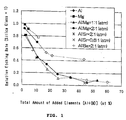
- Fig. 1 is a graph showing a relationship between the total amount of aluminum and element (M) [Al + (M)] (atomic %; ordinate) and a relative etching rate (abscissa) of added element-containing silica glass as expressed as the etching rate of silica glass is 1.
- relative etching rate of silica glass decreases with an increase of the total amount of added elements.
- the extent to which the relative etching rate decreases as in the case of the addition of Al plus Mg was larger than that as in the case of the addition of Al or Mg alone.
- Al or Mg was added alone, a large amount of the added elements could not be added while the amorphous state was maintained, whereas, Al and Mg were added in combination, even when the total amount of addition exceeded 16 atomic %, the amorphous state could be maintained.
- the highly durable silica glass of the invention is characterized as having amorphous state (i.e., minor amount of particles) and reduced rate of etching (i.e., high resistance to plasma) in contrast to the conventional ceramics and silica glass having a single element added therein.
- the beneficial effects could be obtained similarly when each of Mg, Sr and Ba was added in combination with Al. Similar results can be obtained by the addition of Al with any element selected from group 2A elements of the periodic table.
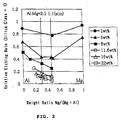
- Fig. 2 is a graph showing a relationship of the atomic ratio of Mg to Al [Mg/(Al+Mg)] (abscissa) provided that the total amount of added elements (Al+Mg) is constant and the ratio of Al to Mg is varied, with a relative etching rate (ordinate) of added element-containing silica glass as expressed as the etching rate of silica glass (sample No. 1) is 1.
- the resistance to plasma is enhanced by the addition of Al combined with Mg, as compared with the case when Al or Mg is added alone.
- compositions As seen from Tables 2-1, 2-2, 2-3 and 2-4, some compositions (sample No. 41, 42, 50-57 and 63) exhibited a plasma resistance which was higher than that of ⁇ -alumina ceramic (sintered body, sample No. 35) which is known as having very high resistance to fluorine-containing plasma and other plasmas.
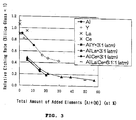
- Fig. 3 is a graph showing a relationship between the total amount of aluminum and element (M) [Al + (M)] (atomic %; ordinate) and a relative etching rate (abscissa) of added element-containing silica glass as expressed as the etching rate of silica glass is 1.
- relative etching rate of silica glass decreases with an increase of the total amount of added elements.
- the extent to which the relative etching rate decreases as in the case of the addition of Al plus Y, La or Ce was larger than that as in the case of the addition of Al or Y or La or Ce alone.
- the plasma-resistant effect was obtained to a similar extent when each of Y, La and Ce was added in combination with Al. Similar results can be obtained by the addition of Al with any element selected from group 3A elements of the periodic table.
- Fig. 4 is a graph showing a relationship of the atomic ratio of Al to La [Al/(Al+La)] (abscissa) provided that the total amount of added elements (Al + La) is constant (6 atomic %) and the ratio of Al to La is varied, with a relative etching rate (ordinate) of added element-containing silica glass as expressed as the etching rate of silica glass (sample No. 1) is 1.
- Fig. 5 is a graph showing a relationship between the total amount of aluminum and element (M) [Al + (M)] (atomic %; ordinate) and a relative etching rate (abscissa) of added element-containing silica glass as expressed as the etching rate of, silica glass is 1.
- the resistance to plasma is enhanced by the addition of Al combined with Ti while an amorphous state is maintained, as compared with the case when Al or Ti is added alone.
- Fig. 6 is a graph showing chemical shifts ( ⁇ 2 ⁇ ) (ordinate) at peaks of Al-K ⁇ ray emitted from various Al-containing oxides, provided that peak of Al-K ⁇ ray emitted from Al metal is zero [deg.]. Rh was used as the X-ray source. Each segment of a line in the ordinate direction means a standard deviation of the measured value (number of measurement: 3).
- CaAl 2 O 4 ( ⁇ -tridymite type structure) and synthetic zeolite (A-4 type) are known as typical oxides having aluminum with coordination number of 4, and ⁇ -Al 2 O 3 is known as a typical oxide having aluminum with coordination number of 6.
- the magnitude of shifts ( ⁇ 2 ⁇ ) of Al-K ⁇ ray was usually in the range of 0.04 to 0.06 [deg.] at an Al coordination number of 4, although measurement inaccuracy was found to a minor extent.
- the magnitude of shifts ( ⁇ 2 ⁇ ) of Al-K a ray was usually in the range of 0.08 to 0.10 [deg.] at an Al coordination number of 6.
- the magnitude of shift ( ⁇ 2 ⁇ ) of Al-K ⁇ ray in Al-added silica glass was about 0.07 [deg.]. This means that an Al atom with coordination number of 6 not constituting the SiO 2 network is present in addition to an Al atom with coordination number of 4 constituting the SiO 2 network.
- the magnitude of shift ( ⁇ 2 ⁇ ) of Al-K ⁇ ray in Al-Mg added silica glass was in the range of about 0.04 to about 0.06 [deg.]. This means that almost all Al atoms present have a coordination number of 4.
- the silica glass was dissolved in an acid and the contents of impurities contained in trace amounts were measured by an ICP-Mass analysis method. Analysis of the content of each metal of Na, Fe, Cu, Ni, Cr and other metals in the Al-La added silica glass revealed that each metal content was below 1 ppm.
- a shadow ring was prepared from the Al-La added silica glass.
- the Al-La-added silica glass was suitable for use in a semiconductor production apparatus.
- Al-La-added silica glass was prepared by the same procedures as mentioned above, wherein No. 8 silica sand was used as SiO 2 raw material with all other conditions remaining the same.
- a shadow ring was prepared from the Al-La-added silica glass.
- the Al-La-added silica glass was not suitable for use in a semiconductor production apparatus.
- the highly durable silica glass of the plus invention which comprises silica, aluminum and at least one element (M) selected from group 2A elements, group 3A elements and group 4A elements of the periodic table, has a high purity and exhibits enhanced durability while good processability and machinability and low dusting property inherently possessed by silica glass are maintained.
- this highly durable silica glass is suitable for use as a member provided in a semiconductor production apparatus and liquid crystal display production apparatus using a halogenated gas and/or its plasma.
Landscapes
- Chemical & Material Sciences (AREA)
- Life Sciences & Earth Sciences (AREA)
- Engineering & Computer Science (AREA)
- Chemical Kinetics & Catalysis (AREA)
- General Chemical & Material Sciences (AREA)
- Geochemistry & Mineralogy (AREA)
- Materials Engineering (AREA)
- Organic Chemistry (AREA)
- Glass Compositions (AREA)
Applications Claiming Priority (6)
| Application Number | Priority Date | Filing Date | Title |
|---|---|---|---|
| JP2002065314 | 2002-03-11 | ||
| JP2002065314 | 2002-03-11 | ||
| JP2002065316 | 2002-03-11 | ||
| JP2002065316 | 2002-03-11 | ||
| JP2002065315 | 2002-03-11 | ||
| JP2002065315 | 2002-03-11 |
Publications (3)
| Publication Number | Publication Date |
|---|---|
| EP1344752A1 true EP1344752A1 (de) | 2003-09-17 |
| EP1344752B1 EP1344752B1 (de) | 2018-11-14 |
| EP1344752B8 EP1344752B8 (de) | 2018-12-26 |
Family
ID=27767768
Family Applications (1)
| Application Number | Title | Priority Date | Filing Date |
|---|---|---|---|
| EP03004983.7A Expired - Lifetime EP1344752B8 (de) | 2002-03-11 | 2003-03-11 | Silikatglas mit hoher Beständigkeit, Verfahren zu dessen Herstellung, dieses enthaltendes Element, und damit versehende Vorrichtung |
Country Status (5)
| Country | Link |
|---|---|
| US (1) | US7084084B2 (de) |
| EP (1) | EP1344752B8 (de) |
| KR (1) | KR100927815B1 (de) |
| CN (1) | CN100408497C (de) |
| TW (1) | TWI318198B (de) |
Cited By (2)
| Publication number | Priority date | Publication date | Assignee | Title |
|---|---|---|---|---|
| EP1894896A1 (de) * | 2006-08-31 | 2008-03-05 | Heraeus Quarzglas GmbH & Co. KG | Gemischtes Pulver und Verfahren zur Herstellung von Quarzglas unter Einsatz des Pulvers |
| US20160362782A1 (en) * | 2015-06-15 | 2016-12-15 | Taiwan Semiconductor Manufacturing Co., Ltd. | Gas dispenser and deposition apparatus using the same |
Families Citing this family (17)
| Publication number | Priority date | Publication date | Assignee | Title |
|---|---|---|---|---|
| JP4614403B2 (ja) * | 2000-10-13 | 2011-01-19 | 信越石英株式会社 | プラズマ耐食性ガラス部材 |
| JP2009013048A (ja) * | 2007-06-06 | 2009-01-22 | Shin Etsu Chem Co Ltd | ナノインプリントモールド用チタニアドープ石英ガラス |
| EP2194030B1 (de) * | 2007-08-02 | 2017-12-27 | Shin-Etsu Quartz Products Co.,Ltd. | Verwendung eines quarzglaselements für das plasmaätzen |
| US20100139320A1 (en) * | 2008-12-04 | 2010-06-10 | Savannah River Nulcear Solutions, Llc | Hollow porous-wall glass microspheres and composition and process for controlling pore size and pore volume |
| KR20110063172A (ko) * | 2009-12-04 | 2011-06-10 | 현대자동차주식회사 | 스포츠 변속 모드 연동 스티어링 시스템 및 그 제어방법 |
| GB201011582D0 (en) | 2010-07-09 | 2010-08-25 | Heraeus Quartz Uk Ltd | High purity synthetic silica and items such as semiconductor jigs manufactured therefrom |
| JP2013159531A (ja) * | 2012-02-07 | 2013-08-19 | Panasonic Liquid Crystal Display Co Ltd | 液晶表示素子の製造方法 |
| EP3224213B1 (de) * | 2014-11-26 | 2022-03-23 | Corning Incorporated | Glas aus dotiertem kieselsäure-titandioxid mit geringer ausdehnung und verfahren zur herstellung davon |
| CN105301896B (zh) * | 2015-11-25 | 2020-01-10 | 华中科技大学 | 一种基于金属玻璃薄膜相变材料的光刻方法 |
| SG11202109473SA (en) * | 2019-03-01 | 2021-09-29 | Jfe Galvanizing & Coating Co Ltd | HOT-DIP Al-Zn-Mg-Si-Sr COATED STEEL SHEET AND METHOD OF PRODUCING SAME |
| KR20230079076A (ko) * | 2020-10-07 | 2023-06-05 | 토소 에스지엠 가부시키가이샤 | 흑색 석영 유리 및 그 제조 방법 |
| JP2022165905A (ja) * | 2021-04-20 | 2022-11-01 | 東ソー株式会社 | ガラス及びその製造方法、これを用いた部材並びに装置 |
| KR20220164859A (ko) * | 2021-06-04 | 2022-12-14 | 아이원스 주식회사 | 내플라즈마 유리, 반도체 제조 공정을 위한 챔버 내부용 부품 및 그들의 제조 방법 |
| CN117940385A (zh) * | 2021-09-14 | 2024-04-26 | Agc株式会社 | 玻璃块及其制造方法和半导体制造装置用部件 |
| DE102022133501A1 (de) | 2022-12-15 | 2024-06-20 | Qsil Gmbh Quarzschmelze Ilmenau | Verfahren zur Herstellung eines MAS-Glases mit hoher Ätzhomogenität |
| DE102023127314A1 (de) | 2023-10-06 | 2025-04-10 | Qsil Gmbh Quarzschmelze Ilmenau | Verfahren zur Herstellung eines MAS-Glaskörpers, Pulvermischung, MAS-Glaskörper und Verwendung eines MAS-Glaskörpers |
| DE102023127315A1 (de) | 2023-10-06 | 2025-04-10 | Qsil Gmbh Quarzschmelze Ilmenau | Verfahren zur Herstellung eines MAS-Glaskörpers, Pulvermischung, MAS-Glaskörper und Verwendung eines MAS-Glaskörpers |
Citations (12)
| Publication number | Priority date | Publication date | Assignee | Title |
|---|---|---|---|---|
| US4180618A (en) * | 1977-07-27 | 1979-12-25 | Corning Glass Works | Thin silicon film electronic device |
| EP0220818A2 (de) * | 1985-10-23 | 1987-05-06 | Corning Glass Works | Strontium-Aluminosilikat-Glassubstrate für flache Plattenanzeigeeinrichtungen |
| JPH05217946A (ja) | 1992-01-31 | 1993-08-27 | Toshiba Ceramics Co Ltd | アルミナ質ベルジヤ− |
| JPH06171974A (ja) * | 1992-11-30 | 1994-06-21 | Olympus Optical Co Ltd | 屈折率分布を有したガラス体 |
| US5326730A (en) * | 1993-01-22 | 1994-07-05 | Corning Incorporated | Barium aluminosilicate glasses |
| JPH06238342A (ja) * | 1993-02-23 | 1994-08-30 | Matsushita Electric Works Ltd | 曲げ加工方法及び曲げ加工装置 |
| EP0672629A2 (de) * | 1994-03-14 | 1995-09-20 | Corning Incorporated | Aluminosilicatglas für einen flachen Bildschirm |
| JPH10236871A (ja) | 1997-02-26 | 1998-09-08 | Kyocera Corp | 耐プラズマ部材 |
| JPH10275524A (ja) | 1997-03-31 | 1998-10-13 | Kyocera Corp | 耐プラズマ部材 |
| WO2002030840A2 (en) * | 2000-10-13 | 2002-04-18 | Heraeus Quarzglas Gmbh & Co. Kg | Glass member resistant to plasma corrosion |
| JP2002137927A (ja) | 2000-08-23 | 2002-05-14 | Shinetsu Quartz Prod Co Ltd | プラズマ耐食性に優れた石英ガラス及び石英ガラス治具並びにそれらの製造方法 |
| JP2002193634A (ja) | 2000-12-26 | 2002-07-10 | Shinetsu Quartz Prod Co Ltd | プラズマ耐食性に優れた石英ガラス及び石英ガラス治具 |
Family Cites Families (11)
| Publication number | Priority date | Publication date | Assignee | Title |
|---|---|---|---|---|
| US3978362A (en) * | 1975-08-07 | 1976-08-31 | Corning Glass Works | Glass envelope for tungsten-bromine lamp |
| NL183092C (nl) * | 1976-08-05 | 1988-07-18 | Philips Nv | Gasontladingslamp. |
| US4746578A (en) * | 1984-01-09 | 1988-05-24 | Ngk Spark Plug Co., Ltd. | Glaze compositions for ceramic substrates |
| US4940678A (en) * | 1989-07-27 | 1990-07-10 | Corning Incorporated | Rare earth oxynitride glasses |
| US6136736A (en) * | 1993-06-01 | 2000-10-24 | General Electric Company | Doped silica glass |
| JPH07330370A (ja) * | 1994-06-08 | 1995-12-19 | Olympus Optical Co Ltd | 組成に分布を有したガラス体 |
| JP3261044B2 (ja) * | 1996-07-31 | 2002-02-25 | 京セラ株式会社 | プラズマプロセス装置用部材 |
| US6447937B1 (en) * | 1997-02-26 | 2002-09-10 | Kyocera Corporation | Ceramic materials resistant to halogen plasma and components using the same |
| JP2000169181A (ja) * | 1998-09-30 | 2000-06-20 | Kobe Steel Ltd | 記録媒体用高比剛性ガラス及び該ガラスを用いたハ―ドディスク基板 |
| US6645585B2 (en) * | 2000-05-30 | 2003-11-11 | Kyocera Corporation | Container for treating with corrosive-gas and plasma and method for manufacturing the same |
| JP2002087896A (ja) * | 2000-09-12 | 2002-03-27 | Mitsubishi Heavy Ind Ltd | 自己修復性高耐熱耐酸化性皮膜及び積層体 |
-
2003
- 2003-03-10 US US10/383,682 patent/US7084084B2/en not_active Expired - Lifetime
- 2003-03-10 TW TW092105100A patent/TWI318198B/zh not_active IP Right Cessation
- 2003-03-11 CN CNB031454607A patent/CN100408497C/zh not_active Expired - Lifetime
- 2003-03-11 EP EP03004983.7A patent/EP1344752B8/de not_active Expired - Lifetime
- 2003-03-11 KR KR1020030015167A patent/KR100927815B1/ko not_active Expired - Fee Related
Patent Citations (13)
| Publication number | Priority date | Publication date | Assignee | Title |
|---|---|---|---|---|
| US4180618A (en) * | 1977-07-27 | 1979-12-25 | Corning Glass Works | Thin silicon film electronic device |
| EP0220818A2 (de) * | 1985-10-23 | 1987-05-06 | Corning Glass Works | Strontium-Aluminosilikat-Glassubstrate für flache Plattenanzeigeeinrichtungen |
| JPH05217946A (ja) | 1992-01-31 | 1993-08-27 | Toshiba Ceramics Co Ltd | アルミナ質ベルジヤ− |
| JPH06171974A (ja) * | 1992-11-30 | 1994-06-21 | Olympus Optical Co Ltd | 屈折率分布を有したガラス体 |
| US5326730A (en) * | 1993-01-22 | 1994-07-05 | Corning Incorporated | Barium aluminosilicate glasses |
| JPH06238342A (ja) * | 1993-02-23 | 1994-08-30 | Matsushita Electric Works Ltd | 曲げ加工方法及び曲げ加工装置 |
| EP0672629A2 (de) * | 1994-03-14 | 1995-09-20 | Corning Incorporated | Aluminosilicatglas für einen flachen Bildschirm |
| JPH10236871A (ja) | 1997-02-26 | 1998-09-08 | Kyocera Corp | 耐プラズマ部材 |
| JPH10275524A (ja) | 1997-03-31 | 1998-10-13 | Kyocera Corp | 耐プラズマ部材 |
| JP2002137927A (ja) | 2000-08-23 | 2002-05-14 | Shinetsu Quartz Prod Co Ltd | プラズマ耐食性に優れた石英ガラス及び石英ガラス治具並びにそれらの製造方法 |
| WO2002030840A2 (en) * | 2000-10-13 | 2002-04-18 | Heraeus Quarzglas Gmbh & Co. Kg | Glass member resistant to plasma corrosion |
| JP2002121047A (ja) | 2000-10-13 | 2002-04-23 | Shinetsu Quartz Prod Co Ltd | プラズマ耐食性ガラス部材 |
| JP2002193634A (ja) | 2000-12-26 | 2002-07-10 | Shinetsu Quartz Prod Co Ltd | プラズマ耐食性に優れた石英ガラス及び石英ガラス治具 |
Non-Patent Citations (5)
| Title |
|---|
| CLAYDEN N J ET AL: "Solid state Al NMR and FTIR study of lanthanum aluminosilicate glasses", JOURNAL OF NON-CRYSTALLINE SOLIDS, NORTH-HOLLAND PHYSICS PUBLISHING. AMSTERDAM, NL, vol. 258, no. 1-3, November 1999 (1999-11-01), pages 11 - 19, XP004364333, ISSN: 0022-3093 * |
| PATENT ABSTRACTS OF JAPAN vol. 018, no. 506 (C - 1252) 22 September 1994 (1994-09-22) * |
| PATENT ABSTRACTS OF JAPAN vol. 018, no. 613 (M - 1709) 22 November 1994 (1994-11-22) * |
| SHELBY J E ET AL: "FORMATION AND PROPERTIES OF YTTRIUM ALUMINOSILICATE GLASSES", PHYSICS AND CHEMISTRY OF GLASSES, SOCIETY OF GLASS TECHNOLOGY. SHEFFIELD, GB, vol. 33, no. 3, 1 June 1992 (1992-06-01), pages 93 - 98, XP000275459, ISSN: 0031-9090 * |
| SIN-LUNG LIN ET AL: "PROPERTIES OF CEO2-AL2O3 GLASSES PREPARED IN AN ATMOSPHERE OF NITROGEN", JOURNAL OF THE CERAMIC SOCIETY OF JAPAN, INTERNATIONAL EDITION., vol. 103, no. 12, 1 December 1995 (1995-12-01), FUJI TECHNOLOGY PRESS, TOKYO., JP, pages 1196 - 1200, XP000625996, ISSN: 0912-9200 * |
Cited By (3)
| Publication number | Priority date | Publication date | Assignee | Title |
|---|---|---|---|---|
| EP1894896A1 (de) * | 2006-08-31 | 2008-03-05 | Heraeus Quarzglas GmbH & Co. KG | Gemischtes Pulver und Verfahren zur Herstellung von Quarzglas unter Einsatz des Pulvers |
| US20160362782A1 (en) * | 2015-06-15 | 2016-12-15 | Taiwan Semiconductor Manufacturing Co., Ltd. | Gas dispenser and deposition apparatus using the same |
| US12281385B2 (en) * | 2015-06-15 | 2025-04-22 | Taiwan Semiconductor Manufacturing Co., Ltd. | Gas dispenser and deposition apparatus using the same |
Also Published As
| Publication number | Publication date |
|---|---|
| TWI318198B (en) | 2009-12-11 |
| US20030176269A1 (en) | 2003-09-18 |
| KR20030074368A (ko) | 2003-09-19 |
| EP1344752B1 (de) | 2018-11-14 |
| CN100408497C (zh) | 2008-08-06 |
| TW200304436A (en) | 2003-10-01 |
| EP1344752B8 (de) | 2018-12-26 |
| KR100927815B1 (ko) | 2009-11-23 |
| CN1461740A (zh) | 2003-12-17 |
| US7084084B2 (en) | 2006-08-01 |
Similar Documents
| Publication | Publication Date | Title |
|---|---|---|
| US7084084B2 (en) | Highly durable silica glass, process for producing same, member comprised thereof, and apparatus provided therewith | |
| EP3677559A1 (de) | Optisches glas, vorformmaterial und optisches element | |
| JP5349721B2 (ja) | 光照射による屈折率変化の小さい光学ガラス | |
| JP2009096662A (ja) | ガラス組成物 | |
| JP2008088019A (ja) | ガラス組成物 | |
| EP1332117B1 (de) | Verwendung eines glassmaterials zur herstellung eines glassteiles mit widerstand gegen plasmakorrosion | |
| JP4439192B2 (ja) | 高耐久性石英ガラス、製造方法、これを用いた部材及び装置 | |
| US6887576B2 (en) | Quartz glass body having improved resistance against plasma corrosion, and method for production thereof | |
| WO2023042717A1 (ja) | ガラスブロックおよびその製造方法ならびに半導体製造装置用部材 | |
| JP2002198504A (ja) | 半導体パッケージ用窓材ガラス及びその製造方法 | |
| KR101842597B1 (ko) | 내플라즈마 코팅을 위한 에어로졸 증착용 비정질 코팅소재 및 그의 제조방법 | |
| JP4677710B2 (ja) | 紫外線遮蔽ガラス、その製造方法、これを用いた紫外線遮蔽ガラス部材及び装置 | |
| JP2002193634A (ja) | プラズマ耐食性に優れた石英ガラス及び石英ガラス治具 | |
| KR100458414B1 (ko) | 석영유리와 석영유리 치구 및 그들의 제조방법 | |
| JP2011251903A (ja) | 光照射による屈折率変化の小さい光学ガラス | |
| JP2000086281A (ja) | 半導体パッケ―ジ用窓材ガラス及びその製造方法 | |
| JPWO2007077681A1 (ja) | ガラス組成物 | |
| JP2008088021A (ja) | ガラス組成物 | |
| JPH1036134A (ja) | アルミナ封着用紫外線透過ガラス | |
| JP2004026510A (ja) | 多層膜フィルター用基板ガラス及び多層膜フィルター | |
| WO2007077680A1 (ja) | ガラス組成物 | |
| WO2023189779A1 (ja) | ガラスブロックおよびその製造方法ならびに耐プラズマ性部材 | |
| JP2007292558A (ja) | ガラス組成物 | |
| WO2024219405A1 (ja) | ガラス部材およびその製造方法 | |
| JPH1081543A (ja) | アルミナ封着用紫外線透過ガラス及びその製造方法 |
Legal Events
| Date | Code | Title | Description |
|---|---|---|---|
| PUAI | Public reference made under article 153(3) epc to a published international application that has entered the european phase |
Free format text: ORIGINAL CODE: 0009012 |
|
| AK | Designated contracting states |
Kind code of ref document: A1 Designated state(s): AT BE BG CH CY CZ DE DK EE ES FI FR GB GR HU IE IT LI LU MC NL PT RO SE SI SK TR |
|
| AX | Request for extension of the european patent |
Extension state: AL LT LV MK |
|
| 17P | Request for examination filed |
Effective date: 20040223 |
|
| AKX | Designation fees paid |
Designated state(s): DE GB IT NL |
|
| 17Q | First examination report despatched |
Effective date: 20071012 |
|
| STAA | Information on the status of an ep patent application or granted ep patent |
Free format text: STATUS: EXAMINATION IS IN PROGRESS |
|
| GRAP | Despatch of communication of intention to grant a patent |
Free format text: ORIGINAL CODE: EPIDOSNIGR1 |
|
| STAA | Information on the status of an ep patent application or granted ep patent |
Free format text: STATUS: GRANT OF PATENT IS INTENDED |
|
| INTG | Intention to grant announced |
Effective date: 20180530 |
|
| GRAS | Grant fee paid |
Free format text: ORIGINAL CODE: EPIDOSNIGR3 |
|
| GRAA | (expected) grant |
Free format text: ORIGINAL CODE: 0009210 |
|
| STAA | Information on the status of an ep patent application or granted ep patent |
Free format text: STATUS: THE PATENT HAS BEEN GRANTED |
|
| RAP1 | Party data changed (applicant data changed or rights of an application transferred) |
Owner name: TOSOH CORPORATION Owner name: TOSOH SGM CORPORATION Owner name: TOSOH QUARTZ CORPORATION |
|
| AK | Designated contracting states |
Kind code of ref document: B1 Designated state(s): DE GB IT NL |
|
| REG | Reference to a national code |
Ref country code: GB Ref legal event code: FG4D |
|
| REG | Reference to a national code |
Ref country code: DE Ref legal event code: R096 Ref document number: 60351618 Country of ref document: DE |
|
| REG | Reference to a national code |
Ref country code: NL Ref legal event code: FP |
|
| REG | Reference to a national code |
Ref country code: DE Ref legal event code: R097 Ref document number: 60351618 Country of ref document: DE |
|
| PLBE | No opposition filed within time limit |
Free format text: ORIGINAL CODE: 0009261 |
|
| STAA | Information on the status of an ep patent application or granted ep patent |
Free format text: STATUS: NO OPPOSITION FILED WITHIN TIME LIMIT |
|
| 26N | No opposition filed |
Effective date: 20190815 |
|
| PGFP | Annual fee paid to national office [announced via postgrant information from national office to epo] |
Ref country code: GB Payment date: 20220127 Year of fee payment: 20 Ref country code: DE Payment date: 20220203 Year of fee payment: 20 |
|
| PGFP | Annual fee paid to national office [announced via postgrant information from national office to epo] |
Ref country code: NL Payment date: 20220215 Year of fee payment: 20 Ref country code: IT Payment date: 20220210 Year of fee payment: 20 |
|
| REG | Reference to a national code |
Ref country code: DE Ref legal event code: R071 Ref document number: 60351618 Country of ref document: DE |
|
| REG | Reference to a national code |
Ref country code: NL Ref legal event code: MK Effective date: 20230310 |
|
| REG | Reference to a national code |
Ref country code: GB Ref legal event code: PE20 Expiry date: 20230310 |
|
| PG25 | Lapsed in a contracting state [announced via postgrant information from national office to epo] |
Ref country code: GB Free format text: LAPSE BECAUSE OF EXPIRATION OF PROTECTION Effective date: 20230310 |
|
| P01 | Opt-out of the competence of the unified patent court (upc) registered |
Effective date: 20230523 |