EP1345109A2 - Unité de traitement de données - Google Patents
Unité de traitement de données Download PDFInfo
- Publication number
- EP1345109A2 EP1345109A2 EP03003694A EP03003694A EP1345109A2 EP 1345109 A2 EP1345109 A2 EP 1345109A2 EP 03003694 A EP03003694 A EP 03003694A EP 03003694 A EP03003694 A EP 03003694A EP 1345109 A2 EP1345109 A2 EP 1345109A2
- Authority
- EP
- European Patent Office
- Prior art keywords
- clock
- bus
- control circuit
- processing unit
- information processing
- Prior art date
- Legal status (The legal status is an assumption and is not a legal conclusion. Google has not performed a legal analysis and makes no representation as to the accuracy of the status listed.)
- Withdrawn
Links
Images


Classifications
-
- G—PHYSICS
- G06—COMPUTING OR CALCULATING; COUNTING
- G06F—ELECTRIC DIGITAL DATA PROCESSING
- G06F1/00—Details not covered by groups G06F3/00 - G06F13/00 and G06F21/00
- G06F1/04—Generating or distributing clock signals or signals derived directly therefrom
- G06F1/08—Clock generators with changeable or programmable clock frequency
-
- G—PHYSICS
- G06—COMPUTING OR CALCULATING; COUNTING
- G06F—ELECTRIC DIGITAL DATA PROCESSING
- G06F13/00—Interconnection of, or transfer of information or other signals between, memories, input/output devices or central processing units
- G06F13/14—Handling requests for interconnection or transfer
- G06F13/36—Handling requests for interconnection or transfer for access to common bus or bus system
- G06F13/362—Handling requests for interconnection or transfer for access to common bus or bus system with centralised access control
Definitions
- the present invention relates to an information processing unit.
- it relates to an information processing unit, which performs clock switching dynamically.
- a system typically includes a power management unit.
- This power management unit performs detection or prediction of an inactive circuit section, and issues an instruction to halt the clock signal related to that inactive circuit section in accordance with that detection or prediction. It is also necessary to issue an instruction to switch to low speed the clock that drives a circuit section that is in operation mode and where processing time is unimportant.
- DMA direct memory access
- FIG. 2 illustrates a configuration of an information processing unit according to this Japanese Patent Application Laid-open No. Hei 7-152499.
- Japanese Patent Application Laid-open No. Hei 7-152499 as shown in FIG. 2, presence of a bus request signal from a master 1 (10) and master 2 (11), which are peripheral processors, is conveyed to a power management unit 4 as a clock request.
- the power management unit 4 then applies control so as to halt or de-accelerate the clock in order to achieve power- saving when there is no bus request signal.
- a clock switch cannot be performed when a bus request signal is consecutively asserted by a plurality of master devices. Accordingly, the clock cannot be switched to low speed and it must continue to operate with a high-speed clock and consume excess power. In the opposite case, when high-speed operation is requested while operating with a low-speed clock, the clock naturally cannot be switched to a high-speed clock if the bus request signal is being consecutively asserted.
- An information processing unit has a system bus that connects devices configuring the information processing unit; an arbiter that performs arbitration relating to use of this system bus; and a clock control circuit that controls the clock to be supplied to the devices, wherein the clock control circuit has a means for performing a bus request signal to the arbiter; and a means for performing a clock switch or clock halt after being granted use of a bus by the arbiter.
- FIG. 1 illustrates a configuration of an information processing unit according to the first embodiment of the present invention.
- the information processing unit includes a CPU 1, arbiter 2, clock control circuit 3, power management unit 4, frequency divider circuit 5, clock multiplying phase locked loop (PLL) circuit 6; oscillator 7, memory controller 8, random access memory (RAM) 9, peripheral processor 1 (10), peripheral processor 2 (11), and system bus 12.
- the CPU 1, arbiter 2, clock control circuit 3, memory controller 8, peripheral processor 1 (10), and peripheral processor 2 (11) are interconnected via the system bus 12. More specifically, in addition to having the CPU 1 connected to a local bus, and the peripheral processor 1 (10) and peripheral processor 2 (11) connected to a peripheral bus, the information processing unit has a bus interface that adjusts data/ address signal transfer between the local bus and peripheral bus.
- the CPU 1 is a data processing unit that implements a predefined instruction set.
- the arbiter 2 selects the device that has the highest priority and issues a grant signal in response to a bus request signal from a peripheral processor or the like.
- the clock control circuit 3 is a circuit that controls clock switches and clock halts. In particular, in this example the clock control circuit 3 has a trigger register to perform the clock switch or clock halt. In the case where data is written into this trigger register, clock switch or clock halt processing is performed.
- the power management unit 4 performs power management by outputting a request for a clock switch or clock halt to the clock control circuit 3.
- the oscillator 7 outputs a predetermined clock signal.
- the clock multiplying PLL circuit 6 multiplies the clock signal output from the oscillator 7.
- the frequency divider circuit 5 is a circuit which either frequency divides the clock output from the clock multiplying PLL circuit 6 and converts it into a clock signal having a predetermined number of clock cycles or outputs it without changing it, and then supplies either the original clock or the resultant clock signal to the CPU 1 or peripheral processor 10 or 11.
- the frequency division ratio for the frequency divider circuit 5 is controlled by the clock control circuit 3.
- the memory controller 8 controls access between the CPU 1 and peripheral processors 10 and 11, and RAM 9.
- the peripheral processors 10 and 11 have an internal DMA control circuit, and make high-speed DMA requests to the power management unit 4 when it is required that high-speed DMA be performed by the peripheral processors 10 and 11 themselves.
- the power management unit 4 issues to the clock control circuit 3 an instruction for switching the clock to low speed in order to reduce power consumption if there is no high-speed DMA request from the peripheral processor 10 or 11.
- Point-to-point connection is made between the CPU 1 and arbiter 2, and between the arbiter 2 and peripheral processors 10 and 11.
- processing in the case where the CPU 1 or peripheral processor 10 or 11 uses the system bus 12 is described.
- processing is implemented by exchanging a bus request signal (BUSREQ) and a bus grant signal (GRANT) between the CPU 1 and arbiter 2, or between the arbiter 2 and peripheral processors 10 and 11.
- BUSREQ bus request signal
- GRANT bus grant signal
- the CPU 1 or peripheral processor 10 or 11 to which the bus grant signal has been asserted becomes the bus master and initiates a bus transaction.
- a point-to-point connection is made between the clock control circuit 3 and arbiter 2.
- Exchange of the bus request signal (BUSREQ) and bus grant signal (GRANT) is performed between the clock control circuit 3 and arbiter 2.
- the clock control circuit 3 is also able to become a bus master as well as the CPU 1 and peripheral processors 10 and 11.
- the arbitration priority ranking of the clock control circuit 3 is higher than that of the CPU 1 or peripheral processor 10 or 11, that is, the highest priority is assigned to the clock control circuit 3 in the arbiter 2.
- FIG. 3 is a timing chart of the information processing unit according to this first embodiment.
- FIG. 4 is a flowchart illustrating the operation of a clock control circuit during a clock switch in the information processing unit according to the first embodiment.
- the power management unit 4 performs a clock switch to a low-speed clock if there is no high-speed DMA request in order to save power.
- the power management unit 4 is making the request for a switch to a low-speed clock to the clock control circuit 3 by asserting the clock switch request signal at time point t1.
- the clock control circuit 3 asserts a bus request signal (BUSREQ0) in order to obtain bus ownership after receiving the request for a switch to a low-speed clock.
- BUSREQ0 bus request signal
- a bus ownership request is made to the arbiter 2 at time point t2 through this bus request signal (BUSREQ0).
- a bus request signal (BUSREQ1) from the peripheral processor 1 (10) to the arbiter 2 is asserted at time point t1.
- the arbiter 2 asserts a bus grant signal (GRANT1) at time point t2 in response to this bus request signal (BUSREQ1). Since the arbiter 2 has asserted the bus grant signal (GRANT1) to the peripheral processor 1 (10) when the arbiter 2 recognizes the assertion of the bus request signal from the clock control circuit 3 at time point t2, the clock control circuit 3 is not granted use of the system bus 12 immediately. Accordingly, data transfer, which is a type of bus transaction, is performed in the meantime on the system bus 12 by the peripheral processor 1 (10) between time points t3 and t7.
- the peripheral processor 1 (10) is still continuing to assert the bus request signal (BUSREQ1). Nevertheless, the arbiter 2 de-asserts the bus grant signal (GRANT1) to the peripheral processor 1 (10) and asserts a bus grant signal (GRANT0) to the clock control circuit 3 at time point t7 since the highest priority in the arbitration priority ranking is assigned to the clock control circuit 3.
- BUSREQ1 bus request signal
- the arbiter 2 de-asserts the bus grant signal (GRANT1) to the peripheral processor 1 (10) and asserts a bus grant signal (GRANT0) to the clock control circuit 3 at time point t7 since the highest priority in the arbitration priority ranking is assigned to the clock control circuit 3.
- the clock control circuit 3 becomes the bus master after the bus grant signal (GRANT0) is asserted.
- the address phase the address of the clock switch trigger register in the clock control circuit 3 is output to the system bus 12 as a transfer destination address.
- the clock control circuit 3 outputs dummy data.
- the clock control circuit 3 de-asserts the bus request signal (BUSREQ0) at time point t12 after this data phase ends in order to release ownership of the system bus 12.
- the clock control circuit 3 switches the clock by changing the frequency divider ratio for the frequency divider circuit when the clock switch trigger register in the clock control circuit 3 is written into through this bus transaction.
- the clock is switched to low speed at time point t12.
- the arbiter 2 Upon completion of the clock switch, or following time point t12, the arbiter 2 asserts the bus grant signal (GRANT1) in response to the bus request signal (BUSREQ1) being asserted by the peripheral processor 1 (10).
- the peripheral processor 1 (10) to which the bus grant signal (GRANT1) is asserted performs the bus transaction with a low-speed clock.
- the clock control circuit 3 makes a request for bus ownership to the arbiter 2 in response to the clock switch request (S102). After obtaining bus ownership, the clock control circuit 3 performs dummy data transfer by specifying an internal register of the clock control circuit 3 as the transfer destination address (S103). If its own register specified as the transfer destination is written, the clock control circuit 3 makes this the trigger signal and switches the clock frequency division ratio (S104).
- a second embodiment of the present invention relates to an information processing unit in the case of halting a clock.
- the fundamental configuration of this information processing unit is same as that of the first embodiment of the present invention. Even in the case where the information processing unit according to the second embodiment of the present invention halts the clock, since data transfer may fail if the clock is halted when data transfer is performed on the system bus, it is necessary for the information processing unit to become the bus master when halting the clock.
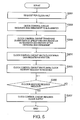
- FIG. 5 illustrates a flowchart in the case of halting the clock in the information processing unit according to the second embodiment of the present invention.
- the clock control circuit 3 Upon receiving the clock halt request, the clock control circuit 3 asserts a bus request signal (BUSREQ0) in order to obtain bus ownership (S202). A request for bus ownership is made to the arbiter 2 through this bus request signal (BUSREQ0). The arbiter 2 asserts a bus grant signal (GRANT0) to the clock control circuit 3 since the highest priority in the arbitration priority ranking is assigned to the clock control circuit 3.
- BUSREQ0 bus request signal
- GRANT0 bus grant signal
- the clock control circuit 3 becomes the bus master after the bus grant signal (GRANT0) is asserted.
- the address phase the address of the clock halt trigger register in the clock control circuit 3 is output to the system bus 12 as the transfer destination address.
- the clock control circuit 3 outputs dummy data (S203).
- the clock control circuit 3 halts the clock when the clock halt trigger register in the clock control circuit 3 is written into through this bus transaction (S204).
- the clock control circuit 3 stays in the wait state until an instruction to return to normal operation, or a clock restore request is received (S205). If there is an instruction to return to normal operation following the clock halt (S206), the clock control circuit 3 resumes clock supply (S207). It should be noted that because there is no suspended data transfer when the clock is halted since the clock control circuit 3 becomes the bus master and halts the clock, it is not necessary for it to become the bus master when resuming clock supply.
- a third embodiment of the present invention relates to an information processing unit that has an oscillator clock supplied to the system bus and peripheral processors that merely passes through the PLL during the PLL lock-up period.
- the fundamental configuration of this information processing unit is same as that of the first embodiment of the present invention.
- a clock generated by multiplying the clock of the oscillator 7 with the clock multiplying PLL 6 is supplied to the CPU 1 and peripheral processors 10 and 11.
- the clock multiplying PLL 6 is turned off (OFF) in order to reduce the clock multiplying PLL 6 power consumption.
- the clock of the oscillator 7 is supplied to the system bus 12 and peripheral processors 10 and 11 merely passes through the PLL.
- the clock multiplied by the clock multiplying PLL 6 is switched to be clock output to the CPU 1 and peripheral processors 10 and 11.
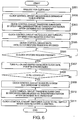
- FIG. 6 is a flowchart illustrating the processing operation of an information processing unit according to a third embodiment of the invention.
- the clock control circuit 3 Upon receiving the clock halt request, the clock control circuit 3 asserts a bus request signal (BUSREQ0) in order to obtain bus ownership (S302). Bus ownership is requested to the arbiter 2 by this bus request signal (BUSREQ0).
- the arbiter 2 asserts a bus grant signal (GRANT0) to the clock control circuit 3 since the highest priority in the arbitration priority ranking is assigned to the clock control circuit 3.
- the clock control circuit 3 becomes the bus master after the bus grant signal (GRANT0) is asserted.
- the address phase the address of the clock halt trigger register in the clock control circuit 3 is output to the system bus 12 as a transfer destination address.
- the clock control circuit 3 outputs dummy data (S303).
- the clock control circuit 3 stays in the wait state until an instruction to return to normal operation, or a clock restore request is received (S305). If there is an instruction to return to normal operation after halting the clock (S306), the clock control circuit 3 turns the clock multiplying PLL 6 on, and until the PLL enters locked state or the phase is synchronized, the clock from the oscillator 7 merely passes through the PLL and is supplied to the CPU 1 and peripheral processors 10 and 11 (S307).
- the clock control circuit 3 makes a request for bus ownership of the system bus 12 to the arbiter 2 (S309). Namely, the clock control circuit 3 asserts the bus request signal (BUSREQ0) to the arbiter 2.
- BUSREQ0 bus request signal
- the arbiter 2 asserts the bus grant signal (GRANT0) to the clock control circuit 3.
- the clock control circuit 3 becomes the bus master after the bus grant signal (GRANT0) is asserted.
- the address phase the address of the clock halt trigger register in the clock control circuit 3 is output to the system bus 12 as the transfer destination address.
- the clock control circuit 3 outputs dummy data (S310).
- the clock control circuit 3 switches from a clock supplied to the CPU 1 and peripheral processors 10 and 11 from the direct output of the clock of the oscillator 7, to the clock output that has been multiplied by the clock multiplying PLL 6 when the clock halt trigger register in the clock control circuit 3 is written through this bus transaction (S311).
- a fourth embodiment of the present invention relates to an information processing unit that performs writing in the clock switch or clock halt trigger register from a device other than the clock control circuit, such as the CPU or peripheral processor.
- the fundamental configuration of this information processing unit is same as that of the first embodiment of the present invention.
- the clock control circuit in the case where the clock control circuit receives a request for a clock switch or clock halt, it was the clock control circuit itself that was performing the dummy data transfer to write into the clock switch trigger register. Nevertheless, when writing into the clock switch trigger register, the contents of the dummy data output to the system bus have no meaning. Since there is no problem if this data is lost due to a clock switch, it is not necessary to limit the bus master that writes into the clock switch trigger register to only the clock control circuit.
- the CPU or peripheral processor itself may become the bus master to directly write into the clock switch trigger register in the clock control circuit without generating a clock switch request signal.
- the clock control circuit switches the clock timed with when the trigger register is written. Since it may be determined that no data transfer is being performed on the system bus when the clock switch trigger register is written, it is possible to switch the clock at a time where data transfer is not performed on the system bus.
- the peripheral processor when the arbitration priority of the peripheral processor is low, the peripheral processor is kept waiting until it becomes the bus master. Accordingly, by assigning an arbitration priority ranking to the peripheral processor having the trigger register writing function that is higher than that of the peripheral processor that has no need for writing into the trigger register, the former becomes the bus master immediately and can switch the clock by writing into the clock switch trigger register.
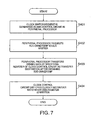
- FIG. 7 is a flowchart illustrating the processing operation of an information processing unit according to a fourth embodiment of the present invention.
- the peripheral processor 10 asserts a bus request signal (BUSREQ0) in order to obtain bus ownership.
- a request for bus ownership is made to the arbiter 2 by this bus request signal (BUSREQ0) (S402).
- the arbiter 2 asserts a bus grant signal (GRANT0) to the peripheral processor 10.
- the peripheral processor 10 becomes the bus master after the bus grant signal (GRANT0) is asserted.
- the peripheral processor 10 outputs the address of the clock switch trigger register in the clock control circuit 3 to the system bus 12 as the transfer destination address.
- the peripheral processor 10 outputs dummy data (S403).
- the clock control circuit 3 switches the clock frequency division ratio when the clock switch trigger register in the clock control circuit 3 is written through this bus transaction (S404). In this manner, it is possible to perform a clock switch.
Landscapes
- Engineering & Computer Science (AREA)
- Theoretical Computer Science (AREA)
- Physics & Mathematics (AREA)
- General Engineering & Computer Science (AREA)
- General Physics & Mathematics (AREA)
- Bus Control (AREA)
- Power Sources (AREA)
- Information Transfer Systems (AREA)
Applications Claiming Priority (2)
| Application Number | Priority Date | Filing Date | Title |
|---|---|---|---|
| JP2002040869A JP3665030B2 (ja) | 2002-02-19 | 2002-02-19 | バス制御方法及び情報処理装置 |
| JP2002040869 | 2002-02-19 |
Publications (2)
| Publication Number | Publication Date |
|---|---|
| EP1345109A2 true EP1345109A2 (fr) | 2003-09-17 |
| EP1345109A3 EP1345109A3 (fr) | 2006-02-22 |
Family
ID=27678325
Family Applications (1)
| Application Number | Title | Priority Date | Filing Date |
|---|---|---|---|
| EP03003694A Withdrawn EP1345109A3 (fr) | 2002-02-19 | 2003-02-18 | Unité de traitement de données |
Country Status (4)
| Country | Link |
|---|---|
| US (1) | US7155631B2 (fr) |
| EP (1) | EP1345109A3 (fr) |
| JP (1) | JP3665030B2 (fr) |
| KR (1) | KR100573942B1 (fr) |
Families Citing this family (15)
| Publication number | Priority date | Publication date | Assignee | Title |
|---|---|---|---|---|
| US7302508B2 (en) * | 2003-06-10 | 2007-11-27 | Via Technologies, Inc. | Apparatus and method for high speed data transfer |
| JP4860104B2 (ja) * | 2003-10-09 | 2012-01-25 | 日本電気株式会社 | 情報処理装置 |
| US7321979B2 (en) | 2004-01-22 | 2008-01-22 | International Business Machines Corporation | Method and apparatus to change the operating frequency of system core logic to maximize system memory bandwidth |
| FI20040418A7 (fi) * | 2004-03-18 | 2005-09-19 | Nokia Corp | Digitaalijärjestelmän kellokontrolli |
| JP4792766B2 (ja) * | 2005-02-25 | 2011-10-12 | カシオ計算機株式会社 | データ転送装置及び撮像装置 |
| JP4716167B2 (ja) * | 2005-03-28 | 2011-07-06 | 富士ゼロックス株式会社 | データ処理方法およびデータ処理装置並びに画像形成装置 |
| EP1894114B1 (fr) * | 2005-06-10 | 2014-08-13 | Freescale Semiconductor, Inc. | Dispositif et procede de controle d'acces au support |
| EP1894116A1 (fr) * | 2005-06-10 | 2008-03-05 | Freescale Semiconductor, Inc. | Procede et dispositif pour la synchronisation de trames |
| US7725759B2 (en) * | 2005-06-29 | 2010-05-25 | Sigmatel, Inc. | System and method of managing clock speed in an electronic device |
| US7467245B2 (en) * | 2005-07-22 | 2008-12-16 | Cisco Technology, Inc. | PCI arbiter |
| US7809973B2 (en) * | 2005-11-16 | 2010-10-05 | Cypress Semiconductor Corporation | Spread spectrum clock for USB |
| JP4846486B2 (ja) * | 2006-08-18 | 2011-12-28 | 富士通株式会社 | 情報処理装置およびその制御方法 |
| JP2008059047A (ja) * | 2006-08-29 | 2008-03-13 | Oki Electric Ind Co Ltd | 情報処理システム及びこの制御方法 |
| JP5561374B2 (ja) | 2010-11-15 | 2014-07-30 | 富士通株式会社 | 情報処理システム |
| US9841804B2 (en) * | 2012-02-22 | 2017-12-12 | Silicon Laboratories Inc. | Clocking a processor |
Family Cites Families (12)
| Publication number | Priority date | Publication date | Assignee | Title |
|---|---|---|---|---|
| US5914953A (en) * | 1992-12-17 | 1999-06-22 | Tandem Computers, Inc. | Network message routing using routing table information and supplemental enable information for deadlock prevention |
| US5600839A (en) * | 1993-10-01 | 1997-02-04 | Advanced Micro Devices, Inc. | System and method for controlling assertion of a peripheral bus clock signal through a slave device |
| US6163848A (en) * | 1993-09-22 | 2000-12-19 | Advanced Micro Devices, Inc. | System and method for re-starting a peripheral bus clock signal and requesting mastership of a peripheral bus |
| EP0644475B1 (fr) | 1993-09-22 | 2004-07-21 | Advanced Micro Devices, Inc. | Appareil et méthode pour commander un signal d'horloge de bus périphérique |
| DE19706496A1 (de) * | 1997-02-19 | 1998-08-27 | Siemens Ag | Taktversorgungssystem für ein Microcomputersystem |
| JP2000020462A (ja) | 1998-06-30 | 2000-01-21 | Toshiba Corp | コンピュータシステムに適用するバスシステム |
| US6279058B1 (en) * | 1998-07-02 | 2001-08-21 | Advanced Micro Devices, Inc. | Master isochronous clock structure having a clock controller coupling to a CPU and two data buses |
| JP2000276436A (ja) | 1999-03-29 | 2000-10-06 | Minolta Co Ltd | Dma制御装置 |
| JP2001051747A (ja) | 1999-08-12 | 2001-02-23 | Fujitsu Ltd | クロック制御回路 |
| US6496938B1 (en) * | 2000-02-11 | 2002-12-17 | Compaq Information Technologies Group Lp | Enhanced PCI clock control architecture |
| JP2002007316A (ja) | 2000-06-19 | 2002-01-11 | Niigata Fuji Xerox Manufacturing Co Ltd | 低消費電力コンピュータシステム |
| JP3906015B2 (ja) * | 2000-07-12 | 2007-04-18 | 株式会社東芝 | クロック周波数切り替え機能を有するlsi、計算機システム及びクロック周波数切り替え方法 |
-
2002
- 2002-02-19 JP JP2002040869A patent/JP3665030B2/ja not_active Expired - Fee Related
-
2003
- 2003-02-18 EP EP03003694A patent/EP1345109A3/fr not_active Withdrawn
- 2003-02-19 KR KR1020030010433A patent/KR100573942B1/ko not_active Expired - Fee Related
- 2003-02-19 US US10/367,758 patent/US7155631B2/en not_active Expired - Fee Related
Also Published As
| Publication number | Publication date |
|---|---|
| KR20030069851A (ko) | 2003-08-27 |
| US7155631B2 (en) | 2006-12-26 |
| US20030159080A1 (en) | 2003-08-21 |
| KR100573942B1 (ko) | 2006-04-26 |
| EP1345109A3 (fr) | 2006-02-22 |
| JP2003242104A (ja) | 2003-08-29 |
| JP3665030B2 (ja) | 2005-06-29 |
Similar Documents
| Publication | Publication Date | Title |
|---|---|---|
| KR100329344B1 (ko) | 전원관리장치및방법 | |
| JP3526920B2 (ja) | コンピュータシステム、ならびに周辺バスクロック信号を制御するためのシステムおよび方法 | |
| US7155631B2 (en) | Information processing unit with a clock control circuit having access to the system bus during system clock changes | |
| US7752373B2 (en) | System and method for controlling memory operations | |
| US5625807A (en) | System and method for enabling and disabling a clock run function to control a peripheral bus clock signal | |
| EP0679982B1 (fr) | Système pour commander un signal d'horloge de bus périphérique | |
| US10055369B1 (en) | Systems and methods for coalescing interrupts | |
| KR20040091705A (ko) | 데이터 처리 시스템을 위한 저 전력 시스템 및 방법 | |
| US6948017B2 (en) | Method and apparatus having dynamically scalable clock domains for selectively interconnecting subsystems on a synchronous bus | |
| JP3552213B2 (ja) | Sdメモリカードホストコントローラ及びクロック制御方法 | |
| CN113093899B (zh) | 一种跨电源域数据传输方法 | |
| KR100591524B1 (ko) | 버스 구조하에서 다이나믹 클록 게이팅이 가능한 슬레이브장치 및 그 동작방법 | |
| US7277976B2 (en) | Multilayer system and clock control method | |
| TWI291624B (en) | Method and device for transferring data and data transfer bridge | |
| US20150177816A1 (en) | Semiconductor integrated circuit apparatus | |
| JP2006040276A (ja) | 選択的なクロック制御に基づいて消費電力を節減させるバス仲裁システム及びその方法 | |
| EP2109029B1 (fr) | Appareil et procédé pour commander l'alimentation d'un bus d'adresse | |
| EP0644475A2 (fr) | Appareil et méthode pour commander un signal d'horloge de bus périphérique | |
| US8645602B2 (en) | Microcomputer | |
| JP4124579B2 (ja) | バス制御システム | |
| JP3914404B2 (ja) | 省電力インターフェース装置及び省電力方法 | |
| JPH10133766A (ja) | 適応型パワーダウン・クロック制御 | |
| US20060206644A1 (en) | Method of hot switching data transfer rate on bus | |
| JP4649926B2 (ja) | データ処理装置 | |
| EP1712979A1 (fr) | Architecture modulaire de circuit intégré |
Legal Events
| Date | Code | Title | Description |
|---|---|---|---|
| PUAI | Public reference made under article 153(3) epc to a published international application that has entered the european phase |
Free format text: ORIGINAL CODE: 0009012 |
|
| AK | Designated contracting states |
Kind code of ref document: A2 Designated state(s): AT BE BG CH CY CZ DE DK EE ES FI FR GB GR HU IE IT LI LU MC NL PT SE SI SK TR |
|
| AX | Request for extension of the european patent |
Extension state: AL LT LV MK RO |
|
| PUAL | Search report despatched |
Free format text: ORIGINAL CODE: 0009013 |
|
| AK | Designated contracting states |
Kind code of ref document: A3 Designated state(s): AT BE BG CH CY CZ DE DK EE ES FI FR GB GR HU IE IT LI LU MC NL PT SE SI SK TR |
|
| AX | Request for extension of the european patent |
Extension state: AL LT LV MK RO |
|
| 17P | Request for examination filed |
Effective date: 20060330 |
|
| AKX | Designation fees paid |
Designated state(s): DE FR GB |
|
| STAA | Information on the status of an ep patent application or granted ep patent |
Free format text: STATUS: THE APPLICATION IS DEEMED TO BE WITHDRAWN |
|
| 18D | Application deemed to be withdrawn |
Effective date: 20061003 |