EP1347011A1 - Gaine de câble comprenant une composition intumescente non-halogénée - Google Patents
Gaine de câble comprenant une composition intumescente non-halogénée Download PDFInfo
- Publication number
- EP1347011A1 EP1347011A1 EP03290719A EP03290719A EP1347011A1 EP 1347011 A1 EP1347011 A1 EP 1347011A1 EP 03290719 A EP03290719 A EP 03290719A EP 03290719 A EP03290719 A EP 03290719A EP 1347011 A1 EP1347011 A1 EP 1347011A1
- Authority
- EP
- European Patent Office
- Prior art keywords
- sheath
- composition
- copolymer
- ethylene
- compound
- Prior art date
- Legal status (The legal status is an assumption and is not a legal conclusion. Google has not performed a legal analysis and makes no representation as to the accuracy of the status listed.)
- Withdrawn
Links
- 239000000203 mixture Substances 0.000 title claims abstract description 112
- RNFJDJUURJAICM-UHFFFAOYSA-N 2,2,4,4,6,6-hexaphenoxy-1,3,5-triaza-2$l^{5},4$l^{5},6$l^{5}-triphosphacyclohexa-1,3,5-triene Chemical class N=1P(OC=2C=CC=CC=2)(OC=2C=CC=CC=2)=NP(OC=2C=CC=CC=2)(OC=2C=CC=CC=2)=NP=1(OC=1C=CC=CC=1)OC1=CC=CC=C1 RNFJDJUURJAICM-UHFFFAOYSA-N 0.000 title claims abstract description 20
- 229920000642 polymer Polymers 0.000 claims abstract description 26
- 239000011159 matrix material Substances 0.000 claims abstract description 21
- 239000003063 flame retardant Substances 0.000 claims abstract description 19
- 150000001875 compounds Chemical class 0.000 claims abstract description 18
- 239000000654 additive Substances 0.000 claims abstract description 16
- 150000002484 inorganic compounds Chemical class 0.000 claims abstract description 16
- 229910010272 inorganic material Inorganic materials 0.000 claims abstract description 16
- VGGSQFUCUMXWEO-UHFFFAOYSA-N Ethene Chemical compound C=C VGGSQFUCUMXWEO-UHFFFAOYSA-N 0.000 claims abstract description 14
- 239000005977 Ethylene Substances 0.000 claims abstract description 14
- 229920001577 copolymer Polymers 0.000 claims abstract description 14
- -1 polyethylene Polymers 0.000 claims abstract description 13
- 239000004952 Polyamide Substances 0.000 claims abstract description 10
- 230000000996 additive effect Effects 0.000 claims abstract description 10
- 229920002647 polyamide Polymers 0.000 claims abstract description 10
- 229920001296 polysiloxane Polymers 0.000 claims abstract description 10
- 239000004698 Polyethylene Substances 0.000 claims abstract description 9
- 239000013078 crystal Substances 0.000 claims abstract description 9
- 230000000694 effects Effects 0.000 claims abstract description 9
- 229920000573 polyethylene Polymers 0.000 claims abstract description 9
- 239000004743 Polypropylene Substances 0.000 claims abstract description 7
- 229920001155 polypropylene Polymers 0.000 claims abstract description 7
- 229920005606 polypropylene copolymer Polymers 0.000 claims abstract description 4
- 238000000926 separation method Methods 0.000 claims abstract description 4
- OKTJSMMVPCPJKN-UHFFFAOYSA-N Carbon Chemical compound [C] OKTJSMMVPCPJKN-UHFFFAOYSA-N 0.000 claims description 39
- 239000010439 graphite Substances 0.000 claims description 32
- 229910002804 graphite Inorganic materials 0.000 claims description 32
- XTXRWKRVRITETP-UHFFFAOYSA-N Vinyl acetate Chemical compound CC(=O)OC=C XTXRWKRVRITETP-UHFFFAOYSA-N 0.000 claims description 10
- 239000000945 filler Substances 0.000 claims description 9
- 239000004114 Ammonium polyphosphate Substances 0.000 claims description 8
- 235000019826 ammonium polyphosphate Nutrition 0.000 claims description 8
- 229920001276 ammonium polyphosphate Polymers 0.000 claims description 8
- 229910052799 carbon Inorganic materials 0.000 claims description 7
- 229920001038 ethylene copolymer Polymers 0.000 claims description 7
- 239000003963 antioxidant agent Substances 0.000 claims description 6
- 230000003078 antioxidant effect Effects 0.000 claims description 6
- 229910052500 inorganic mineral Inorganic materials 0.000 claims description 6
- 239000011707 mineral Substances 0.000 claims description 6
- QAOWNCQODCNURD-UHFFFAOYSA-N Sulfuric acid Chemical compound OS(O)(=O)=O QAOWNCQODCNURD-UHFFFAOYSA-N 0.000 claims description 4
- 239000004927 clay Substances 0.000 claims description 4
- 239000000835 fiber Substances 0.000 claims description 4
- 239000010445 mica Substances 0.000 claims description 4
- 229910052618 mica group Inorganic materials 0.000 claims description 4
- 238000004519 manufacturing process Methods 0.000 claims description 3
- QQONPFPTGQHPMA-UHFFFAOYSA-N propylene Natural products CC=C QQONPFPTGQHPMA-UHFFFAOYSA-N 0.000 claims description 3
- SMZOUWXMTYCWNB-UHFFFAOYSA-N 2-(2-methoxy-5-methylphenyl)ethanamine Chemical compound COC1=CC=C(C)C=C1CCN SMZOUWXMTYCWNB-UHFFFAOYSA-N 0.000 claims description 2
- NIXOWILDQLNWCW-UHFFFAOYSA-N 2-Propenoic acid Natural products OC(=O)C=C NIXOWILDQLNWCW-UHFFFAOYSA-N 0.000 claims description 2
- 125000005250 alkyl acrylate group Chemical group 0.000 claims description 2
- 239000004020 conductor Substances 0.000 claims description 2
- 125000000524 functional group Chemical group 0.000 claims description 2
- 150000007522 mineralic acids Chemical class 0.000 claims description 2
- 230000003287 optical effect Effects 0.000 claims description 2
- 229910052615 phyllosilicate Inorganic materials 0.000 claims description 2
- 229920001200 poly(ethylene-vinyl acetate) Polymers 0.000 claims description 2
- 125000004805 propylene group Chemical group [H]C([H])([H])C([H])([*:1])C([H])([H])[*:2] 0.000 claims description 2
- 229920001897 terpolymer Polymers 0.000 claims description 2
- 239000003610 charcoal Substances 0.000 claims 1
- 238000012360 testing method Methods 0.000 description 17
- 239000000463 material Substances 0.000 description 13
- NLYAJNPCOHFWQQ-UHFFFAOYSA-N kaolin Chemical compound O.O.O=[Al]O[Si](=O)O[Si](=O)O[Al]=O NLYAJNPCOHFWQQ-UHFFFAOYSA-N 0.000 description 9
- 239000005995 Aluminium silicate Substances 0.000 description 8
- 235000012211 aluminium silicate Nutrition 0.000 description 8
- 239000003245 coal Substances 0.000 description 8
- 239000011248 coating agent Substances 0.000 description 7
- 238000000576 coating method Methods 0.000 description 7
- 239000013307 optical fiber Substances 0.000 description 7
- HXIQYSLFEXIOAV-UHFFFAOYSA-N 2-tert-butyl-4-(5-tert-butyl-4-hydroxy-2-methylphenyl)sulfanyl-5-methylphenol Chemical compound CC1=CC(O)=C(C(C)(C)C)C=C1SC1=CC(C(C)(C)C)=C(O)C=C1C HXIQYSLFEXIOAV-UHFFFAOYSA-N 0.000 description 6
- CPLXHLVBOLITMK-UHFFFAOYSA-N Magnesium oxide Chemical compound [Mg]=O CPLXHLVBOLITMK-UHFFFAOYSA-N 0.000 description 6
- 229920002292 Nylon 6 Polymers 0.000 description 5
- 239000011777 magnesium Substances 0.000 description 5
- VTYYLEPIZMXCLO-UHFFFAOYSA-L Calcium carbonate Chemical compound [Ca+2].[O-]C([O-])=O VTYYLEPIZMXCLO-UHFFFAOYSA-L 0.000 description 4
- 238000002485 combustion reaction Methods 0.000 description 4
- 238000001125 extrusion Methods 0.000 description 4
- 239000007789 gas Substances 0.000 description 4
- HQKMJHAJHXVSDF-UHFFFAOYSA-L magnesium stearate Chemical compound [Mg+2].CCCCCCCCCCCCCCCCCC([O-])=O.CCCCCCCCCCCCCCCCCC([O-])=O HQKMJHAJHXVSDF-UHFFFAOYSA-L 0.000 description 4
- 239000000047 product Substances 0.000 description 4
- 229920003345 Elvax® Polymers 0.000 description 3
- QVGXLLKOCUKJST-UHFFFAOYSA-N atomic oxygen Chemical compound [O] QVGXLLKOCUKJST-UHFFFAOYSA-N 0.000 description 3
- 230000004888 barrier function Effects 0.000 description 3
- 230000015556 catabolic process Effects 0.000 description 3
- 238000005253 cladding Methods 0.000 description 3
- 239000003431 cross linking reagent Substances 0.000 description 3
- 238000006731 degradation reaction Methods 0.000 description 3
- 230000004907 flux Effects 0.000 description 3
- 229910052736 halogen Inorganic materials 0.000 description 3
- 150000002367 halogens Chemical class 0.000 description 3
- 238000003780 insertion Methods 0.000 description 3
- 230000037431 insertion Effects 0.000 description 3
- 239000000395 magnesium oxide Substances 0.000 description 3
- 229910052760 oxygen Inorganic materials 0.000 description 3
- 239000001301 oxygen Substances 0.000 description 3
- 239000000454 talc Substances 0.000 description 3
- 229910052623 talc Inorganic materials 0.000 description 3
- RYGMFSIKBFXOCR-UHFFFAOYSA-N Copper Chemical compound [Cu] RYGMFSIKBFXOCR-UHFFFAOYSA-N 0.000 description 2
- VYPSYNLAJGMNEJ-UHFFFAOYSA-N Silicium dioxide Chemical compound O=[Si]=O VYPSYNLAJGMNEJ-UHFFFAOYSA-N 0.000 description 2
- 239000002253 acid Substances 0.000 description 2
- 230000008901 benefit Effects 0.000 description 2
- 229910000019 calcium carbonate Inorganic materials 0.000 description 2
- 229910052802 copper Inorganic materials 0.000 description 2
- 239000010949 copper Substances 0.000 description 2
- 238000004132 cross linking Methods 0.000 description 2
- 239000004205 dimethyl polysiloxane Substances 0.000 description 2
- 235000013870 dimethyl polysiloxane Nutrition 0.000 description 2
- 238000009413 insulation Methods 0.000 description 2
- 235000019359 magnesium stearate Nutrition 0.000 description 2
- 238000000034 method Methods 0.000 description 2
- GUSFEBGYPWJUSS-UHFFFAOYSA-N pentaazanium;[oxido(phosphonatooxy)phosphoryl] phosphate Chemical compound [NH4+].[NH4+].[NH4+].[NH4+].[NH4+].[O-]P([O-])(=O)OP([O-])(=O)OP([O-])([O-])=O GUSFEBGYPWJUSS-UHFFFAOYSA-N 0.000 description 2
- 150000002978 peroxides Chemical class 0.000 description 2
- 229920000435 poly(dimethylsiloxane) Polymers 0.000 description 2
- 239000011253 protective coating Substances 0.000 description 2
- 229920001169 thermoplastic Polymers 0.000 description 2
- KGRVJHAUYBGFFP-UHFFFAOYSA-N 2,2'-Methylenebis(4-methyl-6-tert-butylphenol) Chemical group CC(C)(C)C1=CC(C)=CC(CC=2C(=C(C=C(C)C=2)C(C)(C)C)O)=C1O KGRVJHAUYBGFFP-UHFFFAOYSA-N 0.000 description 1
- OYPRJOBELJOOCE-UHFFFAOYSA-N Calcium Chemical compound [Ca] OYPRJOBELJOOCE-UHFFFAOYSA-N 0.000 description 1
- XFXPMWWXUTWYJX-UHFFFAOYSA-N Cyanide Chemical compound N#[C-] XFXPMWWXUTWYJX-UHFFFAOYSA-N 0.000 description 1
- 229920002943 EPDM rubber Polymers 0.000 description 1
- 229920000219 Ethylene vinyl alcohol Polymers 0.000 description 1
- 235000002918 Fraxinus excelsior Nutrition 0.000 description 1
- 206010061218 Inflammation Diseases 0.000 description 1
- 229920000877 Melamine resin Polymers 0.000 description 1
- BPQQTUXANYXVAA-UHFFFAOYSA-N Orthosilicate Chemical compound [O-][Si]([O-])([O-])[O-] BPQQTUXANYXVAA-UHFFFAOYSA-N 0.000 description 1
- 239000004113 Sepiolite Substances 0.000 description 1
- BLRPTPMANUNPDV-UHFFFAOYSA-N Silane Chemical compound [SiH4] BLRPTPMANUNPDV-UHFFFAOYSA-N 0.000 description 1
- 239000004708 Very-low-density polyethylene Substances 0.000 description 1
- 229910021536 Zeolite Inorganic materials 0.000 description 1
- 230000009471 action Effects 0.000 description 1
- 239000002956 ash Substances 0.000 description 1
- 125000004429 atom Chemical group 0.000 description 1
- 239000000440 bentonite Substances 0.000 description 1
- 229910000278 bentonite Inorganic materials 0.000 description 1
- SVPXDRXYRYOSEX-UHFFFAOYSA-N bentoquatam Chemical compound O.O=[Si]=O.O=[Al]O[Al]=O SVPXDRXYRYOSEX-UHFFFAOYSA-N 0.000 description 1
- 230000015572 biosynthetic process Effects 0.000 description 1
- 229910052791 calcium Inorganic materials 0.000 description 1
- 239000011575 calcium Substances 0.000 description 1
- 239000000378 calcium silicate Substances 0.000 description 1
- 229910052918 calcium silicate Inorganic materials 0.000 description 1
- VNSBYDPZHCQWNB-UHFFFAOYSA-N calcium;aluminum;dioxido(oxo)silane;sodium;hydrate Chemical compound O.[Na].[Al].[Ca+2].[O-][Si]([O-])=O VNSBYDPZHCQWNB-UHFFFAOYSA-N 0.000 description 1
- OYACROKNLOSFPA-UHFFFAOYSA-N calcium;dioxido(oxo)silane Chemical compound [Ca+2].[O-][Si]([O-])=O OYACROKNLOSFPA-UHFFFAOYSA-N 0.000 description 1
- 125000004432 carbon atom Chemical group C* 0.000 description 1
- 238000010000 carbonizing Methods 0.000 description 1
- 239000003054 catalyst Substances 0.000 description 1
- 230000008859 change Effects 0.000 description 1
- 238000012512 characterization method Methods 0.000 description 1
- 239000003795 chemical substances by application Substances 0.000 description 1
- 230000000052 comparative effect Effects 0.000 description 1
- 238000001816 cooling Methods 0.000 description 1
- 239000007857 degradation product Substances 0.000 description 1
- GUJOJGAPFQRJSV-UHFFFAOYSA-N dialuminum;dioxosilane;oxygen(2-);hydrate Chemical compound O.[O-2].[O-2].[O-2].[Al+3].[Al+3].O=[Si]=O.O=[Si]=O.O=[Si]=O.O=[Si]=O GUJOJGAPFQRJSV-UHFFFAOYSA-N 0.000 description 1
- HNPSIPDUKPIQMN-UHFFFAOYSA-N dioxosilane;oxo(oxoalumanyloxy)alumane Chemical compound O=[Si]=O.O=[Al]O[Al]=O HNPSIPDUKPIQMN-UHFFFAOYSA-N 0.000 description 1
- 229920001971 elastomer Polymers 0.000 description 1
- 239000000806 elastomer Substances 0.000 description 1
- 125000003700 epoxy group Chemical group 0.000 description 1
- 239000004715 ethylene vinyl alcohol Substances 0.000 description 1
- 238000011156 evaluation Methods 0.000 description 1
- 230000009970 fire resistant effect Effects 0.000 description 1
- 239000006260 foam Substances 0.000 description 1
- 239000003517 fume Substances 0.000 description 1
- 238000007496 glass forming Methods 0.000 description 1
- 230000036541 health Effects 0.000 description 1
- 229910000271 hectorite Inorganic materials 0.000 description 1
- KWLMIXQRALPRBC-UHFFFAOYSA-L hectorite Chemical compound [Li+].[OH-].[OH-].[Na+].[Mg+2].O1[Si]2([O-])O[Si]1([O-])O[Si]([O-])(O1)O[Si]1([O-])O2 KWLMIXQRALPRBC-UHFFFAOYSA-L 0.000 description 1
- RZXDTJIXPSCHCI-UHFFFAOYSA-N hexa-1,5-diene-2,5-diol Chemical compound OC(=C)CCC(O)=C RZXDTJIXPSCHCI-UHFFFAOYSA-N 0.000 description 1
- 238000000265 homogenisation Methods 0.000 description 1
- 239000012943 hotmelt Substances 0.000 description 1
- XLYOFNOQVPJJNP-UHFFFAOYSA-M hydroxide Chemical compound [OH-] XLYOFNOQVPJJNP-UHFFFAOYSA-M 0.000 description 1
- 230000004054 inflammatory process Effects 0.000 description 1
- 239000004615 ingredient Substances 0.000 description 1
- 239000012212 insulator Substances 0.000 description 1
- 230000010354 integration Effects 0.000 description 1
- 229910052622 kaolinite Inorganic materials 0.000 description 1
- 238000005259 measurement Methods 0.000 description 1
- JDSHMPZPIAZGSV-UHFFFAOYSA-N melamine Chemical compound NC1=NC(N)=NC(N)=N1 JDSHMPZPIAZGSV-UHFFFAOYSA-N 0.000 description 1
- 238000002844 melting Methods 0.000 description 1
- 230000008018 melting Effects 0.000 description 1
- 229910052751 metal Inorganic materials 0.000 description 1
- 239000002184 metal Substances 0.000 description 1
- 239000012764 mineral filler Substances 0.000 description 1
- 239000002808 molecular sieve Substances 0.000 description 1
- 229910052901 montmorillonite Inorganic materials 0.000 description 1
- 229920003052 natural elastomer Polymers 0.000 description 1
- 229920001194 natural rubber Polymers 0.000 description 1
- 229910000273 nontronite Inorganic materials 0.000 description 1
- 231100000926 not very toxic Toxicity 0.000 description 1
- QIQXTHQIDYTFRH-UHFFFAOYSA-N octadecanoic acid Chemical compound CCCCCCCCCCCCCCCCCC(O)=O QIQXTHQIDYTFRH-UHFFFAOYSA-N 0.000 description 1
- CXQXSVUQTKDNFP-UHFFFAOYSA-N octamethyltrisiloxane Chemical compound C[Si](C)(C)O[Si](C)(C)O[Si](C)(C)C CXQXSVUQTKDNFP-UHFFFAOYSA-N 0.000 description 1
- 239000003921 oil Substances 0.000 description 1
- 150000002894 organic compounds Chemical class 0.000 description 1
- 229910052592 oxide mineral Inorganic materials 0.000 description 1
- 239000003973 paint Substances 0.000 description 1
- 235000014594 pastries Nutrition 0.000 description 1
- WXZMFSXDPGVJKK-UHFFFAOYSA-N pentaerythritol Chemical compound OCC(CO)(CO)CO WXZMFSXDPGVJKK-UHFFFAOYSA-N 0.000 description 1
- 238000004987 plasma desorption mass spectroscopy Methods 0.000 description 1
- 229920000137 polyphosphoric acid Polymers 0.000 description 1
- 230000008569 process Effects 0.000 description 1
- 230000001681 protective effect Effects 0.000 description 1
- 239000005871 repellent Substances 0.000 description 1
- 230000002940 repellent Effects 0.000 description 1
- 229910000275 saponite Inorganic materials 0.000 description 1
- 229910052624 sepiolite Inorganic materials 0.000 description 1
- 235000019355 sepiolite Nutrition 0.000 description 1
- 238000007493 shaping process Methods 0.000 description 1
- 229910000077 silane Inorganic materials 0.000 description 1
- 150000004756 silanes Chemical class 0.000 description 1
- 229910052604 silicate mineral Inorganic materials 0.000 description 1
- 239000000377 silicon dioxide Substances 0.000 description 1
- 229920002545 silicone oil Polymers 0.000 description 1
- 229910021647 smectite Inorganic materials 0.000 description 1
- 229910000269 smectite group Inorganic materials 0.000 description 1
- 239000000779 smoke Substances 0.000 description 1
- URGAHOPLAPQHLN-UHFFFAOYSA-N sodium aluminosilicate Chemical compound [Na+].[Al+3].[O-][Si]([O-])=O.[O-][Si]([O-])=O URGAHOPLAPQHLN-UHFFFAOYSA-N 0.000 description 1
- 230000003068 static effect Effects 0.000 description 1
- 230000008961 swelling Effects 0.000 description 1
- 229920003051 synthetic elastomer Polymers 0.000 description 1
- 229920002725 thermoplastic elastomer Polymers 0.000 description 1
- 231100000331 toxic Toxicity 0.000 description 1
- 230000002588 toxic effect Effects 0.000 description 1
- 231100000419 toxicity Toxicity 0.000 description 1
- 230000001988 toxicity Effects 0.000 description 1
- 239000002966 varnish Substances 0.000 description 1
- 239000010455 vermiculite Substances 0.000 description 1
- 229910052902 vermiculite Inorganic materials 0.000 description 1
- 235000019354 vermiculite Nutrition 0.000 description 1
- 229920001866 very low density polyethylene Polymers 0.000 description 1
- 229920002554 vinyl polymer Polymers 0.000 description 1
- XLYOFNOQVPJJNP-UHFFFAOYSA-N water Substances O XLYOFNOQVPJJNP-UHFFFAOYSA-N 0.000 description 1
- 239000010457 zeolite Substances 0.000 description 1
Images


Classifications
-
- C—CHEMISTRY; METALLURGY
- C08—ORGANIC MACROMOLECULAR COMPOUNDS; THEIR PREPARATION OR CHEMICAL WORKING-UP; COMPOSITIONS BASED THEREON
- C08K—Use of inorganic or non-macromolecular organic substances as compounding ingredients
- C08K9/00—Use of pretreated ingredients
- C08K9/02—Ingredients treated with inorganic substances
Definitions
- the present invention relates to a cable sheath comprising a intumescent composition not containing halogen, in particular a sheath flame retardant for cables, especially for telecommunications cables.
- the invention also relates to a cable whose properties, in particular flame retardant, are significantly improved compared to currently known cables.
- Cables especially those used for telecommunications, have one or more cores surrounded by a protective coating comprising one or more layers.
- the soul can be a metallic soul or a optical fiber.
- the coating surrounding the core is composed of layers having various properties, for example insulating or water repellent. In case the cable includes several coated souls, these are gathered in bundle. This the beam is also surrounded by a sheath comprising at least one layer, usually the outer layer, which is made from a composition that imparting flame retardant properties.
- sheathing materials must satisfy a number of requirements. They must be neither polluting nor toxic. They must resist fire well and delay ignition. Their combustion must not cause strong smoke emissions. It is also desirable that these fumes are of low opacity, not very toxic and not very corrosive.
- sheathing materials must have good mechanical resistance to deformation when exposed to heat. Especially when the materials melt under the effect of heat, the drops formed during melting create the risk of burns and can also lead to spread of fire by generating new homes.
- compositions based on polymers containing flame retardant additives We are currently looking to replace the polymeric compositions containing halogenated additives which were widely used so far for cable sheathing and insulation. Indeed, standards tend to prohibit the use of such additives not only because of the toxicity and corrosiveness of the products released during their combustion, but also due to possible health risks during their manufacture and incineration. Furthermore, there is a tendency today to favor the implementation of easily degradable or even recyclable products. These halogen-free materials delaying the spread of flame and fire are often also referred to by HFFR, English acronym for "halogen free fire retardant".
- a known solution for making polymer cable sheaths more fire resistant consists in adding a filler consisting of a metallic hydroxide such as Al (OH) 3 or Mg (OH) 2 to them .
- a filler consisting of a metallic hydroxide such as Al (OH) 3 or Mg (OH) 2
- a filler consisting of a metallic hydroxide such as Al (OH) 3 or Mg (OH) 2
- these compositions have a high viscosity; they are therefore difficult to implement, in particular by extrusion.
- compositions containing the association of an oil silicone, calcium carbonate and magnesium stearate can be further improved.
- a cable sheath made of halogen-free material composed of a polymer, a component causing the intumescence of the material and a flux forming a foam non-flammable inorganic This crosslinkable composition further comprises as a crosslinking agent for silanes or peroxides. Static crosslinking extruded sheaths is carried out in a separate step, after the extrusion of the cable. By this process, a complete crosslinking and a material are obtained. difficult to recycle.
- the object of the present invention is to provide a cable sheath comprising a non-halogenated intumescent composition having simultaneously good mechanical and flame retardant properties.
- the invention provides a cable sheath which does not have the disadvantages of the prior art.
- the composition contains a mixture of a polymer matrix and at least one flame retardant additive.
- the matrix is chosen from a polyethylene, a polypropylene, an ethylene copolymer, a copolymer of propylene, a silicone, a polyamide and a mixture thereof.
- the additive consists of a first inorganic compound with a crystal structure puff pastry and a second inorganic compound inserted between the sheets of the first compound, the second compound being capable of causing the separation of the sheets under the effect of heat.
- the first compound can be chosen from graphite and silicate with puff structure called phyllosilicate, like a mica or clay.
- phyllosilicate like a mica or clay.
- From clays we can use a talc, a vermiculite, a kaolinite, a smectite or any mixture of several of these clays.
- smectite group we can choose in particular montmorillonite, bentonite, beidellite, nontronite, saponite, hectorite or a mixture of the above.
- the first compound is a graphite.
- Graphite has a crystal structure composed of atoms of carbon forming planes stacked in parallel. Molecules of another inorganic compound can be inserted between these planes. The insertion of these molecules between the planes of graphite makes it possible to obtain a flame retardant additive according to the present invention which is a graphite called "expandable".
- Expandable a graphite expandable
- Expanded graphite has a low density, it is not combustible and it is a good thermal insulator because it reflects up to 50% of the radiant heat.
- Expandable graphite is a commercially available product.
- the table below gives examples of commercial expandable graphite usable in the present invention.
- Provider Product reference Glitter size Expansion start temperature Expansion volume at 1000 ° C Nissho Iwai SS-100 100 to 200 ⁇ m > 200 ° C SSFF 300 to 500 ⁇ m > 200 ° C Timcal KH80 NGS naturgraphit EX 100 SC ⁇ 300 ⁇ m 250 ° C 350cm 3 / g EX CX325 HMY ⁇ 45 ⁇ m 250 ° C 20cm 3 / g EX EF95 HMY ⁇ 150 ⁇ m 250 ° C 100-110cm 3 / g EX 8580 170 HMY 150 to 300 ⁇ m 230 ° C 170cm 3 / g Carbone Lorraine Graphex CK 23 480 ⁇ m > 200 ° C 290cm 3 / g
- an expandable graphite will be chosen whose size glitter is at least equal to 45 ⁇ m, preferably at least equal to 100 ⁇ m and more preferably at least equal to 300 ⁇ m.
- the second inorganic compound has the function of causing, under the effect of heat, the separation of the sheets between which it is inserted. This spacing is obtained by the pressure of the molecules of the second compound which is exerted on the sheets. This pressure may be due to an increase in volume or a change in physical state caused by the rise in temperature. According to a particular embodiment, the second inorganic compound has the property of decomposing by giving off gas under the effect of heat.
- a strong acid such as sulfuric acid H 2 SO 4 will preferably be chosen.
- the matrix is a polymer or a mixture of polymers which are usually used for cable coating.
- the matrix is preferably a polymer or a mixture of polymers chosen from a thermoplastic polymer and an elastomer, preferably a thermoplastic elastomer.
- the matrix is preference chosen from polyethylene (PE), polypropylene (PP) and their copolymers, a silicone, a polyamide (PA), and a mixture thereof.
- ethylene copolymers From ethylene copolymers, one can choose a copolymer of ethylene and acetate vinyl (EVA), a copolymer of ethylene and propylene (EPR, EPM or EPDM), a copolymer of ethylene and alkyl acrylate (EBA, EEA or EMA), a copolymer ethylene and acrylic acid, a terpolymer of ethylene, these same polymers carrying specific groups such as acid or epoxy groups, and the mixtures of these.
- EVA ethylene and acetate vinyl
- EPR ethylene and propylene
- EBA ethylene and alkyl acrylate
- EMA ethylene and acrylic acid
- terpolymer of ethylene these same polymers carrying specific groups such as acid or epoxy groups
- the polymer is a thermoplastic polymer, in particular an ethylene copolymer, in particular an ethylene copolymer and vinyl acetate (EVA).
- an EVA containing up to 80% is used by weight of vinyl acetate, and more preferably from 10 to 70% by weight vinyl acetate.
- the polymer matrix preferably represents from 25 to 85 parts by weight of the composition, preferably 30 to 85 parts by weight.
- the composition contains an antioxidant.
- an antioxidant We use by example 4,4'-thiobis (6-tert-butyl-m-cresol) which is an antioxidant in particular used for natural or synthetic elastomers, in particular the compound referenced "SANTONOX TBMC supplied by the company FLEXSYS.
- the quantity antioxidant in the composition is preferably between 0.05 and 2 parts, and in particular from 0.1 to 1 part by weight.
- the composition contains a compound called "coal source” which has the role of providing a significant volume of coal to slow combustion.
- a source of coal can be used organic compounds rich in carbon that contain functional groups forming a carbon when exposed to heat. They can be used alone or in the presence of a “coal promoter” who amplifies their effect. So we can use polymers such as ethylene vinyl alcohol, and preferably a polyamide such as polyamide 6 (PA 6).
- the composition contains a promoter of charring.
- the coal promoter is generally chosen from among the compounds releasing an inorganic acid at elevated temperature.
- APP ammonium polyphosphate
- carbon promoter which forms polyphosphoric acid.
- the composition also contains a filler which is most often an inorganic compound.
- This charge is chosen in particular among a mica, a clay such as a kaolin or a talc, an oxide mineral such as magnesia, graphite and mixtures thereof.
- a mineral filler with a particular structure such as a filler with a laminated structure (graphite, mica, kaolin, talc, ...) or comprising pseudo-sheets (fibrous clay, sepiolite, ...) or a large specific surface (molecular sieve, zeolite, ...), further strengthens the holding properties the fire of the composition.
- the charge represents at most 40 parts by weight of the composition, and preferably at most 20 parts by weight.
- composition may also contain other additives commonly used in cladding as a catalyst or flux (Glass-forming).
- the present invention has the advantage of improving the fire resistance of polymer-based cable sheaths.
- the sheaths according to the present invention have a high oxygen limit index (IOL) and has the properties required for meet the tests defined in the IEC 332 standard, in particular the IEC 332-1 tests and IEC 332-2 relating to the resistance of sheathed copper wires.
- IOL oxygen limit index
- the composition according to the invention contains a low charge rate. Now we found that a high charge rate leads to degradation of mechanical characteristics of the material.
- the composition it is not necessary to crosslink the composition. It therefore does not contain a crosslinking agent, such as than a peroxide or a silane.
- the invention also relates to a cable comprising at least one core and at least one sheath comprising at least in part the intumescent composition non-halogenated described previously.
- the core is an optical fiber.
- Optical fiber is surrounded by a protective coating and a sheath, the sheath and / or the coating comprising at least in part the composition according to the invention.
- the core is a metallic conductor.
- Blade metal is surrounded by a sheath according to the invention comprising at least in part of the composition described above.
- the invention also relates to a method for manufacturing such a cable.
- a non-halogenated intumescent composition containing a mixture of a polymer matrix chosen from a polyethylene, a polypropylene, a copolymer of ethylene, a copolymer of propylene, a silicone, a polyamide and a mixture thereof, and at least one additive flame retardant consisting of a first inorganic compound with a crystal structure laminated and a second inorganic compound inserted between the sheets of said first compound around said core to form a sheath.
- the invention also relates to the use of the cable sheath described previously, as a flame retardant in the cables of telecommunication.
- FIG. 1 represents a cable 1 composed of several cores 2 which are here optical fibers.
- the optical fibers 2 are composed of a core (core) surrounded by an optical cladding based on silica (cladding). They are covered with a coating 3 (coating) possibly colored to allow them to be distinguished from one another.
- the optical fibers 2 are joined together in bundles 4 and held by a common protective skin 5 intended to ensure the cohesion of the bundle 4 .
- the cable 1 according to the invention comprises several bundles 4 grouped, arranged around a rigid element 6 and surrounded by a sheath 7 (sheath) made of flexible material which is extruded directly on the bundles 4 .
- the sheath 7 according to the invention comprises at least one internal layer 8 and one external layer 9 .
- the outer layer 9 consists at least in part of a non-halogenated flame retardant composition as described above.
- the optical fiber cable 1 according to the invention can in particular be used for telecommunications.
- FIG. 2 shows the crystal structure of a graphite, usable in the present invention, composed of crystal planes 20 , made up of carbon atoms 21 , between which a molecule 22 can be interposed.
- Figure 3a is an electron microscope view of an expandable graphite in its initial state, when incorporated into the matrix to obtain the composition of the invention. It shows the plans bunk 30 crystalline graphite.
- Figure 3b shows the same graphite in an expanded state. It is observed that the planes 31 have moved apart under the effect of heat. Under the action of a heat flux, the expandable graphite contained in the composition expands and thus creates a fire barrier which protects from flame the polymers constituting the cable sheath.
- composition A according to the invention has been prepared which comprises: polymer matrix 100 parts by weight antioxidant 1 part coal source 7 parts coal promoter 50 parts flame retardant additive 5 parts
- the polymer matrix is an EVA ELVAX 260 supplied by DUPONT DE NEMOURS containing 28% weight of vinyl acetate and having a hot melt index of 6.
- the antioxidant here bears the reference SANTONOX TBMC supplied by the company FLEXSYS.
- a carbon source which is a polyamide PA 6, and a promoter coal which is ammonium polyphosphate (APP) from reference EXOLITE AP 422.
- the flame retardant additive is an expandable graphite of reference EX 100Sc having a glitter size greater than 300 ⁇ m supplied by the company NGS NATURGRAPHIT GmbH.
- Composition A does not contain halogen, nor crosslinking agent.
- the compositions according to the invention are not crosslinked.
- the EVA polymer matrix is kneaded in a mixer with the polyamide 6 and the antioxidant at a temperature of 230 ° C. After homogenization of the mixture and cooling to a temperature of 180 ° C., the expandable graphite then the filler, and finally the ammonium polyphosphate APP.
- the mixture thus obtained is shaped into a plate for determining the fire resistance and mechanical properties of each composition.
- composition B according to the invention which has been prepared is analogous to the composition A except that it also contains 10 parts of a charge mineral which is a kaolin.
- composition C according to the invention has been prepared which is analogous to the composition A except that it also contains 20 parts of a charge mineral which is a kaolin.
- composition D according to the invention has been prepared which is analogous to the composition A except that it also contains 40 parts of a charge mineral which is a kaolin.
- composition E according to the invention has been prepared which is analogous to the composition D except that the flame retardant additive is an expandable graphite EX CX 325 HMY with a flake size of at most 45 ⁇ m supplied by NGS NATURGRAPHIT GmbH.
- compositions A to E according to the invention. The quantities are indicated in number of parts by weight relative to the polymer matrix which represents 100 parts.
- Composition reference AT B VS D E "ELVAX 260" EVA 100 100 100 100 100 "SANTONOX TBMC” 1 1 1 1 1 1 PA 6 7 7 7 7 APP "EXOLITE AP 422" 50 50 50 50 Kaolin 0 10 20 40 40 Expandable graphite: EX 100Sc 5 5 5 5 EX CX 325 HMY 5
- composition X containing "ELVAX 260" EVA 100 parts by weight SANTONOX TBMC 1 part PA 6 7 parts magnesia Mg (OH) 2 50 parts
- composition X the charge is magnesia Mg (OH) 2 .
- composition Y was also tested, analogous to the composition X, but containing 100 parts of charge.
- composition Z was also tested containing Polyethylene (PE and VLDPE) 100 parts by weight "SANTONOX TBMC" 1 part CaO 3 charge 60 parts Silicone 8 slices Magnesium stearate 6 parts
- composition Z Silicone represents a mixture equiponderal of two silicone oils with PDMS references respectively (polydimethyl siloxane) (4 parts) and NG 200 (4 parts).
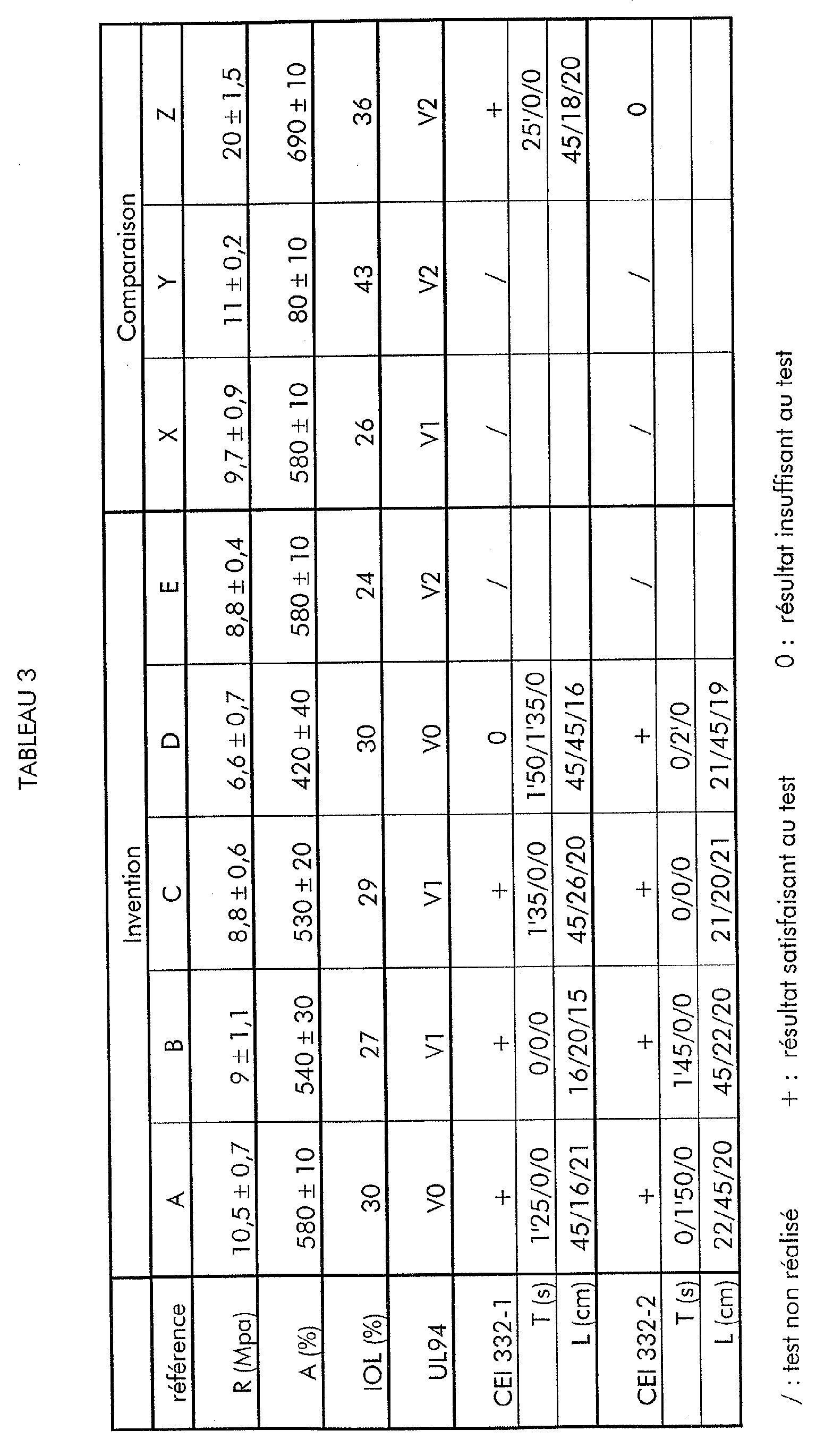
- compositions A to E according to the present invention were mechanical properties of the compositions A to E according to the present invention and compositions comparative X, Y and Z in terms of their tensile strength R and their elongation A under tension according to standard ASTM D638.
- compositions previously prepared are firstly shaped in press to obtain plates of desired thickness: a thickness 1 mm for determining mechanical characteristics and thickness 3mm for characterization according to UL94 test.
- part of the composition is extruded onto an already insulated wire with a non-flame retardant mixture (insulation thickness: 0.5mm and sheath thickness: 0.5mm) and the cable thus obtained is tested according to standard IEC 332.
- compositions A to D When the quantity of kaolin filler is increased, a degradation of the mechanical properties of compositions A to D is observed. The same evolution is observed for the charge of Mg (OH) 2 between compositions X and Y.
- the limit oxygen index IOL provides information on the flammability of a material in contact with a flame at ordinary temperature. All tested compositions have high IOL values, greater than 24.
- the results given in the Table 3 represents the average of several measures. By way of illustration, the values of 24 corresponding to the sample referenced E and of 26 corresponding to the sample referenced X can be considered to be of the same order taking into account the measurement uncertainties.
- compositions according to the invention were subjected to the UL94 test.
- a test bar is fixed horizontally or vertically, held by one of its ends. The free end is exposed to a gas flame under conditions prescribed.
- the notation V0 means that the composition withstands the test well, i.e. that the composition does not burn and does not drip when exposed to test conditions.
- the notation V1 represents an intermediate behavior, it is to say that the composition does not burn, it creeps and can drip.
- the V2 notation is the sign of a lower resistance of the material, ie it burns and flows.
- composition A containing no filler has a behavior as good as composition D which has the rate of charge in kaolin the highest (40 parts).
- Compositions B and C with higher charge rates weak (10 and 20 parts) give slightly lower results.
- the fire resistance is estimated by the CEI 332-1 and CEI 332-2 tests, the IEC 332-2 test being considered more demanding than the IEC 332-1 test.
- the principle consists in measuring the length L of the sheath burn after exposure to a flame and the corresponding combustion time T. The test is declared satisfactory (+) when two out of three attempts are successful; it is declared insufficient (0) otherwise.
- the compositions according to the invention obtain satisfactory results overall. Composition Z of the prior art achieves an acceptable result for the IEC 332-1 test, but does not pass the IEC 332-2 test.
- composition A according to the invention containing no filler and compositions B and C having a low charge rate. These performances are overall higher than those presented by the compositions of the prior art.
- the integration of the composition according to the invention in layer 9 of sheathing material allows a significant increase in mechanical characteristics, resistance and fire spread.
- composition of the polymer matrix in particular, without departing from the scope of the invention, the composition of the polymer matrix.
- the different incoming secondary ingredients in the realization of the matrix, as well as their relative proportions, could be changed.
- Additives, in particular with a view to facilitating the shaping of the coating for example by extrusion, may be incorporated therein into minor proportions.
Landscapes
- Chemical & Material Sciences (AREA)
- Health & Medical Sciences (AREA)
- Chemical Kinetics & Catalysis (AREA)
- Medicinal Chemistry (AREA)
- Polymers & Plastics (AREA)
- Organic Chemistry (AREA)
- Compositions Of Macromolecular Compounds (AREA)
- Insulated Conductors (AREA)
- Organic Insulating Materials (AREA)
Abstract
Description
| Fournisseur | Référence du produit | Taille des paillettes | Température de début d'expansion | Volume d'expansion à 1000°C |
| Nissho Iwaï | SS-100 | 100 à 200µm | > 200°C | |
| SSFF | 300 à 500µm | > 200°C | ||
| Timcal | KH80 | |||
| NGS naturgraphit | EX 100 SC | ≥ 300µm | 250°C | 350cm3/g |
| EX CX325 HMY | ≤ 45µm | 250°C | 20cm3/g | |
| EX EF95 HMY | ≤ 150µm | 250°C | 100-110cm3/g | |
| EX 8580 170 HMY | 150 à 300µm | 230°C | 170cm3/g | |
| Carbone Lorraine | Graphex CK 23 | 480µm | > 200°C | 290cm3/g |
- la figure 1 est une vue en coupe d'un câble à fibre optique comprenant l'invention,
- la figure 2 représente schématiquement la structure cristalline du graphite et indique comment s'effectue l'insertion d'un composé inorganique entre les feuillets,
- les figures 3a et 3b montrent l'aspect d'un graphite respectivement avant et après expansion,
| matrice polymère | 100 parts en poids |
| antioxydant | 1 part |
| source de charbonnement | 7 parts |
| promoteur de charbonnement | 50 parts |
| additif ignifuge | 5 parts |
| Référence de la composition | A | B | C | D | E |
| EVA "ELVAX 260" | 100 | 100 | 100 | 100 | 100 |
| "SANTONOX TBMC" | 1 | 1 | 1 | 1 | 1 |
| PA 6 | 7 | 7 | 7 | 7 | 7 |
| APP "EXOLITE AP 422" | 50 | 50 | 50 | 50 | 50 |
| Kaolin | 0 | 10 | 20 | 40 | 40 |
| Graphite expansible : EX 100Sc | 5 | 5 | 5 | 5 | |
| EX CX 325 HMY | 5 |
| EVA "ELVAX 260" | 100 parts en poids |
| SANTONOX TBMC | 1 part |
| PA 6 | 7 parts |
| magnésie Mg(OH)2 | 50 parts |
| Polyéthylène (PE et VLDPE) | 100 parts en poids |
| "SANTONOX TBMC" | 1 part |
| charge CaO3 | 60 parts |
| Silicone | 8 parts |
| Stéarate de magnésium | 6 parts |
Claims (29)
- Gaine (7) de câble (1) comprenant au moins en partie une composition intumescente non-halogénée, caractérisée en ce que ladite composition contient un mélange deune matrice polymère choisie parmi un polyéthylène, un polypropylène, un copolymère de l'éthylène, un copolymère du propylène, un silicone, un polyamide et un mélange de ceux-ci, etau moins un additif ignifugeant constitué d'un premier composé inorganique à structure cristalline feuilletée et d'un second composé inorganique inséré entre les feuillets dudit premier composé, ledit second composé étant capable de provoquer l'écartement desdits feuillets sous l'effet de la chaleur.
- Gaine selon la revendication 1, dans laquelle ledit premier composé est choisi parmi un graphite et un phyllosilicate.
- Gaine selon la revendication 2, dans laquelle ledit premier composé est un graphite.
- Gaine selon la revendication 3, dans laquelle ledit graphite a une taille de paillettes au moins égale à 45µm.
- Gaine selon la revendication 4, dans laquelle ledit graphite a une taille de paillettes au moins égale à 100µm.
- Gaine selon la revendication 5, dans laquelle ledit graphite a une taille de paillettes au moins égale à 300µm.
- Gaine selon l'une des revendications précédentes, dans laquelle ledit second composé inorganique est l'acide sulfurique.
- Gaine selon la revendication 7, dans laquelle ladite matrice est choisie parmi un copolymère d'éthylène et d'acétate de vinyle, un copolymère d'éthylène et de propylène, un copolymère d'éthylène et d'acrylate d'alkyl, un copolymère d'éthylène et d'acide acrylique, un terpolymère d'éthylène et les mélanges de ceux-ci.
- Gaine selon la revendication 8, dans laquelle ladite matrice est un copolymère d'éthylène et d'acétate de vinyle.
- Gaine selon la revendication 9, dans laquelle ledit copolymère d'éthylène et d'acétate de vinyle renferme jusqu'à 80% en poids d'acétate de vinyle.
- Gaine selon la revendication 10, dans laquelle ledit copolymère d'éthylène et d'acétate de vinyle renferme de 10 à 70% en poids d'acétate de vinyle.
- Gaine selon l'une des revendications précédentes, dans laquelle ladite matrice polymère représente de 25 à 85 parts en poids de ladite composition.
- Gaine selon la revendication 12, dans laquelle ladite matrice polymère représente 30 à 85 parts en poids de ladite composition.
- Gaine selon l'une des revendications précédentes, dans laquelle ladite composition contient en outre un antioxydant.
- Gaine selon l'une des revendications précédentes, dans laquelle ladite composition contient en outre une source de charbonnement qui est un composé organique riche en carbone contenant des groupes fonctionnels formant un charbon lorsqu'ils sont exposés à la chaleur.
- Gaine selon la revendication 15, dans laquelle ladite source est un polyamide.
- Gaine selon l'une des revendications précédentes, dans laquelle ladite composition contient en outre un promoteur de charbonnement choisi parmi les composés libérant un acide inorganique à température élevée.
- Gaine selon la revendication 17, dans laquelle ledit promoteur est un polyphosphate d'ammonium.
- Gaine selon l'une des revendications précédentes, dans laquelle ladite composition contient en outre une charge.
- Gaine selon la revendication 19, dans laquelle ladite charge est choisie parmi un mica, une argile, un oxyde minéral, un graphite et les mélanges de ceux-ci.
- Gaine selon la revendication 20, dans laquelle ladite charge représente au plus 40 parts de ladite composition.
- Gaine selon la revendication 21, dans laquelle ladite charge représente au plus 20 parts de ladite composition.
- Gaine selon l'une des revendications précédentes, dans laquelle ladite composition est non réticulée.
- Câble (1) comportant au moins une âme (2) et au moins une gaine (7) selon l'une des revendications 1 à 23.
- Câble selon la revendication 24, dans lequel ladite âme est une fibre optique (2).
- Câble selon la revendication 24, dans lequel ladite âme est un conducteur métallique.
- Câble selon la revendication 24, dans lequel ladite composition est non réticulée.
- Procédé de fabrication d'un câble selon l'une des revendications 24 à 27, comprenant une étape d'extrusion d'une composition intumescente non-halogénée contenant un mélange d'une matrice polymère choisie parmi un polyéthylène, un polypropylène, un copolymère de l'éthylène, un copolymère du propylène, un silicone, un polyamide et un mélange de ceux-ci, et au moins un additif ignifugeant constitué d'un premier composé inorganique à structure cristalline feuilletée et d'un second composé inorganique inséré entre les feuillets dudit premier composé autour de ladite âme pour former une gaine.
- Utilisation d'une gaine de câble selon l'une des revendications précédentes, comme retardateur de flamme dans les câbles de télécommunication.
Applications Claiming Priority (2)
| Application Number | Priority Date | Filing Date | Title |
|---|---|---|---|
| FR0203551 | 2002-03-21 | ||
| FR0203551A FR2837494B1 (fr) | 2002-03-21 | 2002-03-21 | Composition intumescente non-hallogenee pour gaine de cable de telecommunication |
Publications (1)
| Publication Number | Publication Date |
|---|---|
| EP1347011A1 true EP1347011A1 (fr) | 2003-09-24 |
Family
ID=27772264
Family Applications (1)
| Application Number | Title | Priority Date | Filing Date |
|---|---|---|---|
| EP03290719A Withdrawn EP1347011A1 (fr) | 2002-03-21 | 2003-03-21 | Gaine de câble comprenant une composition intumescente non-halogénée |
Country Status (4)
| Country | Link |
|---|---|
| US (1) | US6998536B2 (fr) |
| EP (1) | EP1347011A1 (fr) |
| CN (1) | CN1282974C (fr) |
| FR (1) | FR2837494B1 (fr) |
Cited By (2)
| Publication number | Priority date | Publication date | Assignee | Title |
|---|---|---|---|---|
| EP1534784B1 (fr) * | 2002-08-19 | 2014-01-22 | LANXESS Deutschland GmbH | Polyamides modifies par des elastomeres, destines a ameliorer la resistance au flambage de films et de corps creux |
| CN105765431A (zh) * | 2013-11-12 | 2016-07-13 | 康宁光电通信有限责任公司 | 耐火光学通信电缆 |
Families Citing this family (31)
| Publication number | Priority date | Publication date | Assignee | Title |
|---|---|---|---|---|
| JP2006506486A (ja) * | 2002-11-13 | 2006-02-23 | ジェイジェイアイ エルエルシー | 膨張性専門化学物質を含有する、熱可塑性又は熱硬化性耐火組成物 |
| US20050045368A1 (en) * | 2003-09-02 | 2005-03-03 | Keogh Michael John | Dual layer wire and cable |
| FR2870543B1 (fr) * | 2004-05-21 | 2006-07-21 | Nexans Sa | Cable resistant au feu |
| BRPI0622193A2 (pt) * | 2006-12-15 | 2012-01-03 | Prysmian Spa | cabo de transmissço de energia |
| US7939764B2 (en) * | 2007-09-25 | 2011-05-10 | Samuel Gottfried | Fire, heat and high voltage cable protection wrap |
| CA2639886A1 (fr) * | 2007-10-03 | 2009-04-03 | Jji Technologies, Llc | Pieces d'electricite et de construction ignifuges |
| US8375572B2 (en) * | 2008-05-12 | 2013-02-19 | Howard Lind | Method for creating a silicone encased flexible cable |
| US8595922B2 (en) * | 2008-05-12 | 2013-12-03 | Howard Lind | Flexible silicone cable system integrated with snap washer |
| WO2010015876A1 (fr) * | 2008-08-05 | 2010-02-11 | Prysmian S.P.A. | Câble électrique ignifugé |
| US8658576B1 (en) | 2009-10-21 | 2014-02-25 | Encore Wire Corporation | System, composition and method of application of same for reducing the coefficient of friction and required pulling force during installation of wire or cable |
| US8871843B2 (en) * | 2009-12-15 | 2014-10-28 | Apple Inc. | Halogen-free flame retardant material |
| ES2819026T3 (es) * | 2010-09-10 | 2021-04-14 | Prysmian Spa | Cable óptico resistente al fuego |
| JP2013122911A (ja) * | 2011-11-10 | 2013-06-20 | Kanzacc Co Ltd | 高周波電流供給電線 |
| US9543060B2 (en) | 2011-11-30 | 2017-01-10 | Rockbestos Suprenant Cable Corp. | High-temperature cable having inorganic material |
| ES2415557B1 (es) * | 2011-12-23 | 2014-03-31 | Grupo General Cable Sistemas, S.A. | "composición ceramificable para cables de energía y/o telecomunicaciones" |
| US9352371B1 (en) | 2012-02-13 | 2016-05-31 | Encore Wire Corporation | Method of manufacture of electrical wire and cable having a reduced coefficient of friction and required pulling force |
| EP2820462B1 (fr) * | 2012-03-02 | 2019-11-13 | Ofs Fitel Llc | Câbles aériens à fibres optiques |
| US11328843B1 (en) | 2012-09-10 | 2022-05-10 | Encore Wire Corporation | Method of manufacture of electrical wire and cable having a reduced coefficient of friction and required pulling force |
| US10056742B1 (en) | 2013-03-15 | 2018-08-21 | Encore Wire Corporation | System, method and apparatus for spray-on application of a wire pulling lubricant |
| EP2933313A1 (fr) * | 2014-04-16 | 2015-10-21 | HILTI Aktiengesellschaft | Composition ignifuge et son utilisation |
| US9557503B2 (en) * | 2014-08-08 | 2017-01-31 | Corning Optical Communications LLC | Optical fiber cable |
| US9517369B2 (en) * | 2014-08-12 | 2016-12-13 | Stephen Samouhos | Fire stop conduit |
| CN104217797B (zh) * | 2014-09-03 | 2017-01-25 | 江苏兴华胶带股份有限公司 | 膨胀型无卤阻燃pp/eva复合电线电缆及其制备方法 |
| EP3088929B1 (fr) * | 2015-04-27 | 2020-05-06 | Corning Optical Communications LLC | Câble à fibre optique |
| US10373738B2 (en) | 2015-05-08 | 2019-08-06 | Radix Wire & Cable, Llc | Insulated wire construction with liner |
| EP3368809B1 (fr) * | 2015-10-29 | 2021-05-19 | Favuseal AS | Protection contre l'incendie pour des tubes |
| WO2018185180A1 (fr) * | 2017-04-07 | 2018-10-11 | Imerys Talc Europe | Composition de polymère ignifuge |
| CN111566161A (zh) * | 2017-11-16 | 2020-08-21 | 缅因大学系统董事会 | 用于3d打印的改进的长丝 |
| CN209045218U (zh) * | 2018-11-09 | 2019-06-28 | 江苏亨通电力电缆有限公司 | 智能预警通讯用防火低压电缆 |
| FR3108913B1 (fr) * | 2020-04-06 | 2022-07-29 | Nexans | Cable comportant une composition résistante et/ou retardante au feu |
| IT202000032015A1 (it) | 2020-12-23 | 2022-06-23 | Prysmian Spa | Cavo elettrico di media tensione con miglior comportamento al fuoco |
Citations (2)
| Publication number | Priority date | Publication date | Assignee | Title |
|---|---|---|---|---|
| EP0081004A1 (fr) * | 1981-11-20 | 1983-06-15 | Intercal Company | Matières composites organiques renforcées par graphite intercalaire |
| JPH04342764A (ja) * | 1991-05-21 | 1992-11-30 | Lignyte Co Ltd | 発泡性耐火材料 |
Family Cites Families (20)
| Publication number | Priority date | Publication date | Assignee | Title |
|---|---|---|---|---|
| US4018962A (en) * | 1975-04-09 | 1977-04-19 | Pedlow J Watson | Arc and fireproofing tape |
| US4514466A (en) * | 1982-06-04 | 1985-04-30 | General Electric Company | Fire-resistant plenum cable and method for making same |
| US4513173A (en) * | 1983-06-07 | 1985-04-23 | Minnesota Mining And Manufacturing Company | Intumescent fire protective sheaths |
| GB2174095A (en) * | 1985-03-20 | 1986-10-29 | Dainichi Nippon Cables Ltd | Flame-retardant resin compositions |
| US4722959A (en) * | 1985-06-25 | 1988-02-02 | Nippon Petrochemicals Co., Ltd. | Flame-retardant olefin polymer composition |
| US4881794A (en) * | 1986-04-02 | 1989-11-21 | Pennwalt Corporation | Low smoke and reduced flame fluorinated polymer compositions and cable constructions |
| DE3917518A1 (de) * | 1989-05-30 | 1990-12-06 | Bayer Ag | Brandschutzelemente |
| US5256718A (en) * | 1990-02-14 | 1993-10-26 | Mitsui Petrochemical Industries, Ltd. | Flame retardant polyamide thermoplastic resin composition |
| US5418272A (en) * | 1991-12-10 | 1995-05-23 | Nippon Petrochemicals Company, Limited | Abrasion-resistant flame-retardant composition |
| US5294655A (en) * | 1992-05-15 | 1994-03-15 | General Electric Company | Polyphenylene ether electrical insulation compositions |
| US5744757A (en) * | 1995-03-28 | 1998-04-28 | Belden Wire & Cable Company | Plenum cable |
| US5397822A (en) * | 1993-08-18 | 1995-03-14 | General Electric Company | Thermoplastic compositions containing polyphenylene ether resin and characterized by improved elongation and flexibility employing a blend of multiblock copolymers |
| US5475041A (en) * | 1993-10-12 | 1995-12-12 | Polytechnic University | Flame retardant polyolefin wire and cable insulation |
| US5770820A (en) * | 1995-03-15 | 1998-06-23 | Belden Wire & Cable Co | Plenum cable |
| DE19516970A1 (de) * | 1995-05-09 | 1996-11-14 | Siemens Ag | Kabel mit einer Füllmasse und Verfahren zu deren Herstellung |
| WO2000023513A1 (fr) * | 1998-10-22 | 2000-04-27 | Parker-Hannifin Corporation | Composition auto-adhesive retardatrice de flammes et intumescente pour applications de blindage electromagnetique |
| AT409045B (de) * | 1999-02-03 | 2002-05-27 | Dsm Fine Chem Austria Gmbh | Halogenfreie intumeszierende ummantelung von drähten und lichtkabeln |
| US6492453B1 (en) * | 1999-09-24 | 2002-12-10 | Alphagary Corporation | Low smoke emission, low corrosivity, low toxicity, low heat release, flame retardant, zero halogen polymeric compositions |
| FR2809737B1 (fr) * | 2000-05-31 | 2002-07-19 | Cit Alcatel | Nanocomposite a base d'argile pontee et pontee organo et cable comprenant un tel nanocomposite |
| US6740396B2 (en) * | 2001-02-26 | 2004-05-25 | Pirelli Cavi E Sistemi S.P.A. | Cable with coating of a composite material |
-
2002
- 2002-03-21 FR FR0203551A patent/FR2837494B1/fr not_active Expired - Fee Related
-
2003
- 2003-03-20 CN CN03107416.2A patent/CN1282974C/zh not_active Expired - Fee Related
- 2003-03-20 US US10/391,595 patent/US6998536B2/en not_active Expired - Fee Related
- 2003-03-21 EP EP03290719A patent/EP1347011A1/fr not_active Withdrawn
Patent Citations (2)
| Publication number | Priority date | Publication date | Assignee | Title |
|---|---|---|---|---|
| EP0081004A1 (fr) * | 1981-11-20 | 1983-06-15 | Intercal Company | Matières composites organiques renforcées par graphite intercalaire |
| JPH04342764A (ja) * | 1991-05-21 | 1992-11-30 | Lignyte Co Ltd | 発泡性耐火材料 |
Non-Patent Citations (1)
| Title |
|---|
| DATABASE WPI Section Ch Week 199302, Derwent World Patents Index; Class A60, AN 1993-014155, XP002219445 * |
Cited By (3)
| Publication number | Priority date | Publication date | Assignee | Title |
|---|---|---|---|---|
| EP1534784B1 (fr) * | 2002-08-19 | 2014-01-22 | LANXESS Deutschland GmbH | Polyamides modifies par des elastomeres, destines a ameliorer la resistance au flambage de films et de corps creux |
| CN105765431A (zh) * | 2013-11-12 | 2016-07-13 | 康宁光电通信有限责任公司 | 耐火光学通信电缆 |
| CN105765431B (zh) * | 2013-11-12 | 2019-08-02 | 康宁光电通信有限责任公司 | 耐火光学通信电缆 |
Also Published As
| Publication number | Publication date |
|---|---|
| CN1447347A (zh) | 2003-10-08 |
| FR2837494B1 (fr) | 2006-06-23 |
| US20030178220A1 (en) | 2003-09-25 |
| US6998536B2 (en) | 2006-02-14 |
| FR2837494A1 (fr) | 2003-09-26 |
| CN1282974C (zh) | 2006-11-01 |
Similar Documents
| Publication | Publication Date | Title |
|---|---|---|
| EP1347011A1 (fr) | Gaine de câble comprenant une composition intumescente non-halogénée | |
| CA2296361C (fr) | Cable a fibres optiques presentant une resistance elevee a la degradation | |
| EP2804906B1 (fr) | Compositions thermoplastiques ignifugees a haute tenue mecanique, en particulier pour les cables electriques | |
| FR2870543A1 (fr) | Cable resistant au feu | |
| EP2346931B1 (fr) | Cable electrique resistant au feu | |
| EP3615608B1 (fr) | Composition de mélange de polyéthylène | |
| FR2525615A1 (fr) | Matiere isolante de polyolefine reticulee a combustion retardee et conducteur electrique revetu de cette matiere | |
| FR3019368A1 (fr) | Dispositif electrique a moyenne ou haute tension | |
| FR3021451A1 (fr) | Cable electrique comprenant une couche reticulee | |
| EP2319053B1 (fr) | Composition ceramisable pour cable d'energie et/ou de telecommunication | |
| CN112466536B (zh) | 海上石油平台用耐喷射火焰和碳氢火焰中压电缆及其制造方法 | |
| WO2007012703A1 (fr) | Cable de securite resistant au feu, sensiblement plat | |
| EP0774488A1 (fr) | Composition à haute résistance à la propagation du feu | |
| EP1238014B1 (fr) | Compositions polyorganosiloxanes vulcanisables a chaud utilisables notamment pour la fabrication de fils ou cables electriques | |
| CN119192716A (zh) | 一种零滴落阻燃软电缆及其制备方法 | |
| FR3067160B1 (fr) | Cable resistant au feu | |
| FR2972559A1 (fr) | Cable electrique a moyenne ou haute tension | |
| EP1156066A1 (fr) | Composition à propriétés thermomécaniques améliorées et procédé pour sa réticulation | |
| FR2822836A1 (fr) | Procede de preparation de composition intumescente | |
| WO2023047029A1 (fr) | Câble électrique comprenant une couche semi- conductrice présentantune surface lisse | |
| IT202100032810A1 (it) | Cavo ritardante di fiamma con strato autoestinguente | |
| FR2459266A1 (fr) | Caoutchouc ethylene-propylene resistant a la chaleur offrant une resistance a la traction amelioree, et conducteur electrique isole a l'aide de ce caoutchouc | |
| EP4115431A1 (fr) | Câble comprenant une couche semi-conductrice présentant une surface lisse | |
| EP2148335B1 (fr) | Couche tubante electriquement isolante pour cable electrique | |
| FR2489832A1 (fr) | Compositions polymeres retardatrices de combustion, capables de reussir l'essai au vernis csa, et conducteurs electriques revetus d'une telle composition |
Legal Events
| Date | Code | Title | Description |
|---|---|---|---|
| PUAI | Public reference made under article 153(3) epc to a published international application that has entered the european phase |
Free format text: ORIGINAL CODE: 0009012 |
|
| AK | Designated contracting states |
Kind code of ref document: A1 Designated state(s): AT BE BG CH CY CZ DE DK EE ES FI FR GB GR HU IE IT LI LU MC NL PT RO SE SI SK TR |
|
| AX | Request for extension of the european patent |
Extension state: AL LT LV MK |
|
| 17P | Request for examination filed |
Effective date: 20040324 |
|
| AKX | Designation fees paid |
Designated state(s): AT BE BG CH CY CZ DE DK EE ES FI FR GB GR HU IE IT LI LU MC NL PT RO SE SI SK TR |
|
| RAP1 | Party data changed (applicant data changed or rights of an application transferred) |
Owner name: DRAKA COMTEQ B.V. |
|
| RAP1 | Party data changed (applicant data changed or rights of an application transferred) |
Owner name: DRAKA COMTEQ B.V. |
|
| RAP1 | Party data changed (applicant data changed or rights of an application transferred) |
Owner name: DRAKA COMTEQ B.V. |
|
| STAA | Information on the status of an ep patent application or granted ep patent |
Free format text: STATUS: THE APPLICATION HAS BEEN WITHDRAWN |
|
| 18W | Application withdrawn |
Effective date: 20090206 |