EP1349178A1 - Polymere mit Kationenleitfähigkeit, deren Monomere und deren Verwendung in Lithiumbatterien - Google Patents
Polymere mit Kationenleitfähigkeit, deren Monomere und deren Verwendung in Lithiumbatterien Download PDFInfo
- Publication number
- EP1349178A1 EP1349178A1 EP03006827A EP03006827A EP1349178A1 EP 1349178 A1 EP1349178 A1 EP 1349178A1 EP 03006827 A EP03006827 A EP 03006827A EP 03006827 A EP03006827 A EP 03006827A EP 1349178 A1 EP1349178 A1 EP 1349178A1
- Authority
- EP
- European Patent Office
- Prior art keywords
- group
- polymer
- solution
- polymers
- polymers according
- Prior art date
- Legal status (The legal status is an assumption and is not a legal conclusion. Google has not performed a legal analysis and makes no representation as to the accuracy of the status listed.)
- Granted
Links
- OJXWKGJMLDLDHL-UHFFFAOYSA-N C=Cc(cc1)ccc1C(Nc(c(O)ccc1)c1O)=O Chemical compound C=Cc(cc1)ccc1C(Nc(c(O)ccc1)c1O)=O OJXWKGJMLDLDHL-UHFFFAOYSA-N 0.000 description 1
- WQSFODYSHBUOSP-UHFFFAOYSA-N C=Cc(cc1)ccc1NC(c1ccccc1O)=O Chemical compound C=Cc(cc1)ccc1NC(c1ccccc1O)=O WQSFODYSHBUOSP-UHFFFAOYSA-N 0.000 description 1
Images
Classifications
-
- C—CHEMISTRY; METALLURGY
- C08—ORGANIC MACROMOLECULAR COMPOUNDS; THEIR PREPARATION OR CHEMICAL WORKING-UP; COMPOSITIONS BASED THEREON
- C08F—MACROMOLECULAR COMPOUNDS OBTAINED BY REACTIONS ONLY INVOLVING CARBON-TO-CARBON UNSATURATED BONDS
- C08F2/00—Processes of polymerisation
- C08F2/44—Polymerisation in the presence of compounding ingredients, e.g. plasticisers, dyestuffs, fillers
-
- H—ELECTRICITY
- H01—ELECTRIC ELEMENTS
- H01B—CABLES; CONDUCTORS; INSULATORS; SELECTION OF MATERIALS FOR THEIR CONDUCTIVE, INSULATING OR DIELECTRIC PROPERTIES
- H01B1/00—Conductors or conductive bodies characterised by the conductive materials; Selection of materials as conductors
- H01B1/06—Conductors or conductive bodies characterised by the conductive materials; Selection of materials as conductors mainly consisting of other non-metallic substances
- H01B1/12—Conductors or conductive bodies characterised by the conductive materials; Selection of materials as conductors mainly consisting of other non-metallic substances organic substances
- H01B1/122—Ionic conductors
-
- Y—GENERAL TAGGING OF NEW TECHNOLOGICAL DEVELOPMENTS; GENERAL TAGGING OF CROSS-SECTIONAL TECHNOLOGIES SPANNING OVER SEVERAL SECTIONS OF THE IPC; TECHNICAL SUBJECTS COVERED BY FORMER USPC CROSS-REFERENCE ART COLLECTIONS [XRACs] AND DIGESTS
- Y02—TECHNOLOGIES OR APPLICATIONS FOR MITIGATION OR ADAPTATION AGAINST CLIMATE CHANGE
- Y02E—REDUCTION OF GREENHOUSE GAS [GHG] EMISSIONS, RELATED TO ENERGY GENERATION, TRANSMISSION OR DISTRIBUTION
- Y02E60/00—Enabling technologies; Technologies with a potential or indirect contribution to GHG emissions mitigation
- Y02E60/10—Energy storage using batteries
Definitions
- the present invention relates to ionic conductive organic electrolytes and polymer electrolytes, intermediates thereof, methods for their preparation and their use as solid electrolytes and separators in batteries, particularly lithium batteries.
- lithium batteries lithium ion secondary batteries with an organic electrolyte solution (hereinafter referred to as lithium batteries) that have remarkably increased energy density have been developed and used widely.
- lithium batteries use as positive active material a lithium metal complex oxide such as lithium cobalt composite oxide, for example, and as a negative active material a carbon material that is capable of inserting lithium ions into intercalations of the carbon material (i.e. formation of lithium intercalation compounds) and of releasing lithium ions from the intercalation structure.
- a lithium metal complex oxide such as lithium cobalt composite oxide
- a carbon material that is capable of inserting lithium ions into intercalations of the carbon material (i.e. formation of lithium intercalation compounds) and of releasing lithium ions from the intercalation structure.
- lithium batteries use as an electrolyte an inflammable organic electrolyte
- lithium batteries have been developed, that have lithium ion conductive solid polymers instead of the inflammable organic electrolyte solution.
- polyethylene oxide is a typical one.
- the suitability of polyethylene oxide as a lithium ionic conductive solid electrolyte is pointed out by Almand et al. in "First Ion Transport in Solids", pp. 131, Elsevier, New York, 1979.
- an ionic conductive polymer that exhibits the highest ionic conductivity is a branched copolymer of ethylene oxide and propylene oxide as disclosed in Japanese Patent Laid-open 2000-123632.
- the ionic conductivity is about 10 -4 Scm -1 .
- ion conductivity takes place jointly with molecular motion of the polymer. That is, functional groups having coordinating capability present in the polymer chain make coordination to lithium ions, whereby lithium ions can move to other coordination groups by transition along with the motion of molecular chains. Therefore, the ionic conductivity depends on the mobility of the molecular chains, and also depends on the motion necessary for conformation change of a main chain such as dihedral angle motion that needs large activation energy. When the temperature is so low that the molecular motion is suppressed, ionic conductivity is decreased at the same time.
- the inventors have devised to employ as a mechanism for transferring ions the rotation of a single bond in a molecular chain that has a small activation energy and that does not depend on the motion of a molecular chain.
- functional groups that can become coordination groups or ligands to lithium ions are bonded to other organic groups, whereby the single bond can rotate freely over a wide range of temperature.
- the exchange of lithium ions between adjoining similar or analogous functional groups takes place by the action of the rotation. This phenomenon brings about ionic conductivity.
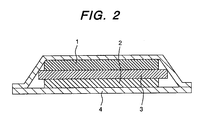
- the lithium-ion conductive polymer electrolyte of the present invention shown in Fig. 2 comprises polymer and lithium salt.
- the polymer electrolyte can be prepared by polymerizing monomer in the presence of the lithium salt both of them being dissolved in an organic solvent, followed by removing the solvent.
- the polymer electrolyte can be prepared by adding the lithium salt to the polymer solution dissolved in an organic solvent, followed by removing the solvent.
- the form of the polymer electrolyte is a sheet form when it is used as an electrolyte of a lithium battery.
- the sheet also works as a separator between the anode and cathode electrodes.
- the sheet polymer electrolyte is prepared by casting a solution of a monomer and a lithium salt on a polytetrafluoroethylene (PTFE) sheet. Then, the monomer is polymerized by heating addition polymerization, polyaddition polymerization, polycondensation polymerization, etc., followed by removing the solvent.
- PTFE polytetrafluoroethylene
- the sheet polymer electrolyte can also be prepared by casting a solution comprising a polymer and a lithium salt on the PTFE sheet, followed by removing the solvent.
- Organic solvents for dissolving the polymers and lithium salts are NMP, dimethylformamide, toluene, etc. which can solve the lithium salts and do not react with the polymer.
- the battery shown in Fig. 2 is assembled in such a manner that the polymer electrolyte sheet is sandwiched between an anode made of active material and a cathode made of active material.
- an anode and cathode that comprise the polymer electrolyte are preferable.
- a monomer containing lithium salt dissolved in an organic solvent is polymerized by heating on the anode and/or the cathode.
- a solution in which the polymer and lithium salt are dissolved in an organic solvent is cast on the anode and/or cathode, followed by removing the solvent.
- the polymer according to the present invention is represented by the general formula 1 wherein R p is a residue of a polymer of a compound having a polymerizable unsaturated bond, Q is an organic residue of a valence of n+1 and connected directly or through another group to R p by means of a single bond, M k+ is a cation of valence k, Z is an organic function group capable of forming an ionic bond with the cation M k+ or an organic function group having a coordination capability with M k+ , and m, n and k are integers of 1 or more.
- the intermediate of the polymer defined above is represented by the general formula wherein R is a residue of a compound having a polymerizable unsaturated bond, and Q, Z, M k+ , m, n and k are the same as defined above.
- the above formula represents a salt, wherein R is an organic group of a valence m, Q is an organic group of a valence of n+1, Z is an anionic residue of valence 1, M k+ is a cation of valence 1 (M + ), and n and m are integers of 1 or more.
- the group Q connected to the anionic residue Z is bonded to the group R by a single bond. The single bond can freely rotate in the molecule so that the salt exhibits cationic conductivity by the action of exchanging each other cations M k+ coordinated on the anionic residue Z.
- the group R may have functional groups that can be polymerizable. Further, the polymerizable functional groups are unsaturated bonds that are addition-polymerizable.
- the group R may be a polymer of an organic group having addition-polymerizable unsaturated bonds.
- the group Q in the above formula may be an aryl group. Further, in that formula, the group Q is an aryl group, Z-may be a hydroxyl residue, and M + may be a lithium ion.
- the formula 1 encompasses the compounds (2) and (3) shown below: wherein R p is an organic group of a valence m which is an integer of 1 or 2, X is an organic group and m is an integer of 1 or more, and wherein R p is an organic group of a valence m which is an integer of 1 or 2, and m is an integer of 1 or more.
- the valence k of the metal cation M k+ in the polymers of formulae (2), (3) and (4) is preferably equal to 1.
- the organic group R and R p is not limited in the present invention; examples therefore are groups of saturated hydrocarbons, unsaturated hydrocarbons, aromatic hydrocarbons, etc.
- the group may contain not only pure hydrocarbon groups or may be not only a pure hydrocarbon group, but may also comprise or consist of groups of hydrocarbons substituted with nitrogen, sulfur, oxygen atom, halogen atoms.
- the molecular weight of the groups is not limited; they may be low molecular weight compounds to high molecular weight compounds.
- the high molecular weight compounds may be polymers of low or high molecular weight monomers.
- the number of substitutes of the organic group Q is not limited; a number of one or more per one molecule is sufficient.
- the group R is a polymer, the number may be that corresponding to the degree of polymerization.
- several kinds of polymerizable monomers may be used to substitute the group Z.
- the methods of polymerization are not limited; for example, addition polymerization, addition polyaddition, polycondensation, etc. may be employed.
- the group Z is a group having a function capable of coordinating cations thereon; when the group Z is oxygen (O), the group Q may be a phenolate anion such as a hydroxyphenyl group, a dihydroxyphenyl group, etc.
- the functional group Z is a methoxy group (-OCH 3 )
- there may be alkoxyphenyl groups such as methoxyphenyl, dimethoxyphenyl, etc.
- the functional groups should be methoxy groups and ethoxy groups as alkoxy groups. If the number of carbon atoms is too large, they may interfere with the rotation of the single bond or may have an adverse affect on the solubility of the cationic conductor and impair the workability of the material.
- R 6 to R 9 are all alkyl groups.
- the functional groups must be bonded by a single bond to the group R/R p .
- the most preferable compounds are compounds wherein the group R/R p is bonded to the group Q through an amide bond.
- Cations used in the present invention include ions of alkali metals such as lithium, sodium, potassium and ions of alkaline earth metals such as magnesium, etc. Among the above ions lithium ions are most preferable.
- the lithium ion conductive polymer of the present invention can be used as a separator, as well as an electrolyte.
- the polymer functions as electrolyte and separator.
- the polymer is formed as a sheet of a thickness of several micrometers.
- the polymer can also be used as an anode to which positive active materials are added for lithium ion batteries.
- Negative active materials are graphite or carbon in which lithium ions are intercalated in the lamellar structure, lithium metal, lithium-lead alloy, etc.
- the reaction solution was condensed to extract an ethyl acetate phase from ethyl acetate and 2 n hydrochloric acid.
- the extract was rinsed with hydrochloric acid and saturated sodium chloride solution and dried with sodium sulfate, followed by condensation and purification to obtain a white powdery solid.
- the cast film was sandwiched between electrodes made of stainless steel (SUS 304) each having a diameter of 15 mm to obtain a cell for evaluation.
- SUS 304 stainless steel
- An a.c. current of an amplitude voltage of 10 mV was applied to the cell at room temperature to measure the a.c. impedance.
- the frequency range was from 1 Hz to 1 MHz.
- the ionic conductivity was derived from the reciprocal value of the bulk ohmic resistance that was obtained from the measurement of the a.c. impedance.
- the ionic conductivity was 5 ⁇ 10 -4 Scm -1 , which was larger than that of the solid electrolyte made of polyethylene oxide.
- the reaction solution was condensed to extract an ethyl acetate phase from ethyl acetate and 2 n hydrochloric acid.
- the extract was rinsed with hydrochloric acid and saturated sodium chloride solution and dried with sodium sulfate, followed by condensation and purification to obtain a white powdery solid.
- the cast film was sandwiched between electrodes made of stainless steel (SUS 304) each having a diameter of 15 mm to obtain a cell for evaluation.
- SUS 304 stainless steel
- An a.c. current of an amplitude voltage of 10 mV was applied to the cell at room temperature to measure the a.c. impedance.
- the frequency range was from 1 Hz to 1 MHz.
- the ionic conductivity was derived from the reciprocal value of the bulk ohmic resistance that was obtained from the measurement of the a.c. impedance.
- the ionic conductivity was 4 ⁇ 10 -4 Scm -1 , which was larger than that of the solid electrolyte made of polyethylene oxide.
- the cast film was sandwiched between a pair of stainless steel electrodes (SUS 304) of 15 mm in diameter to prepare a cell for evaluation.
- An a.c. current of an amplitude of 10 mV was applied to the cell at room temperature of measure the a.c. impedance.
- the frequency range was from 1 Hz to 1 MHz.
- the ionic conductivity was determined from the reciprocal value of the bulk resistance obtained from the a.c. impedance.
- the ionic conductivity was 1.4 ⁇ 10 -4 Scm -1 , which was almost the same as that of the solid electrolyte made of polyethylene oxide.
- Fig. 2 there is shown a sectional view of a lithium battery that uses the polymer electrolyte 3 obtained in the above procedure sandwiched between two electrodes 1, 2 in a housing 4.
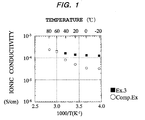
- the graph of Fig. 1 shows the relationship between the ionic conductivity of the polymer electrolyte and the temperature.
- the electrolyte obtained in this example exhibits a very small temperature coefficient, as compared to one obtained in the Comparative Example. That is, the coefficient of the electrolyte of Example 3 at -20 °C is almost the same as that at room temperature.
- the electrolyte obtained in Comparative Example 2 shows a temperature coefficient change resulting in that the ionic conductivity decreases with increasing temperature. Therefore, the electrolyte of the present invention exhibits a much better ionic conductivity than the comparative polymer electrolyte.
- the cast film was sandwiched between a pair of stainless steel electrodes (SUS304) of a diameter of 15 mm to prepare a cell for evaluation.
- An a.c. current of an amplitude of 10 mV was applied to the cell at room temperature to measure the a.c. impedance.
- the frequency range was from 1 Hz to 1 MHz.
- the ionic conductivity was determined from the reciprocal value of the bulk resistance obtained from the measurement of the a.c. impedance.
- the ionic conductivity was almost the same as that of the solid electrolyte made of polyethylene oxide.
- the solution was added to 434 g of tris(2-aminoethyl)-amine that was dissolved in 500 ml of N-methylpyrrolidone, while cooling the solution.
- the solution was stirred at room temperature for two days.
- the reaction solution was dropped in 10 l of an aqueous 2 % solution of sodium hydrogencarbonate, and the solution was stirred.
- the precipitate was extracted with ethylacetate/n-hexane to obtain a solid.
- the solution was cast on a polytetrafluoroethylene sheet, and the cast film was dried under vacuum at 60 °C to obtain a cast film of a thickness of 100 ⁇ m.
- the cast film was sandwiched between a pair of stainless steel electrodes (SUS304) of a diameter of 15 mm to prepare a cell for evaluation.
- An a.c. current of an amplitude of 10 mV was applied to the cell at room temperature to measure the a.c. impedance.
- the frequency range was from 1 Hz to 1 MHz.
- the ionic conductivity was determined from the reciprocal value of the bulk resistance obtained from the measurement of the a.c. impedance.
- the ionic conductivity was almost the same as that of the solid electrolyte made of polyethylene oxide.
- the extract was rinsed with hydrochloric acid and saturated sodium chloride solution, and then was dried with sodium sulfate.
- the product was condensed and purified to produce a white solid.
- An a.c. current of an amplitude of 10 mV was applied to the cell at room temperature to measure the a.c. impedance.
- the frequency range was from 1 Hz to 1 MHz.
- the ionic conductivity was determined from the reciprocal value of the bulk resistance obtained from the measurement of the a.c. impedance.
- the ionic conductivity was 1.6 ⁇ 10 -5 Scm -1 , which was almost the same as that of the solid electrolyte made of polyethylene oxide.
- the cast film was sandwiched between electrodes made of stainless steel (SUS304) each having a diameter of 15 mm to prepare a cell for evaluation.
- An a.c. current of an amplitude voltage of 10 mV was applied to the cell at room temperature to measure the a.c. impedance.
- the frequency range was from 1 Hz to 1 MHz.
- the ionic conductivity was derived from the reciprocal value of the bulk ohmic resistance that was obtained from the measurement of the a.c. impedance.
- the ionic conductivity was 5 ⁇ 10 -5 Scm -1 .
- the solid electrolyte according to the present invention that exhibits an ionic conductivity mechanism based on single bond rotation showed higher ionic conductivity than the conventional solid electrolyte whose conductivity is based on segmental motion of molecular chains.
- the polymer of the present invention can be used as an electronic conductive material for connecting unit cells of a fuel cell system, capacitors, etc..
Landscapes
- Chemical & Material Sciences (AREA)
- Physics & Mathematics (AREA)
- Spectroscopy & Molecular Physics (AREA)
- Health & Medical Sciences (AREA)
- Chemical Kinetics & Catalysis (AREA)
- Medicinal Chemistry (AREA)
- Polymers & Plastics (AREA)
- Organic Chemistry (AREA)
- Conductive Materials (AREA)
- Secondary Cells (AREA)
Applications Claiming Priority (2)
| Application Number | Priority Date | Filing Date | Title |
|---|---|---|---|
| JP2002087355 | 2002-03-27 | ||
| JP2002087355 | 2002-03-27 |
Publications (2)
| Publication Number | Publication Date |
|---|---|
| EP1349178A1 true EP1349178A1 (de) | 2003-10-01 |
| EP1349178B1 EP1349178B1 (de) | 2006-02-01 |
Family
ID=27800459
Family Applications (1)
| Application Number | Title | Priority Date | Filing Date |
|---|---|---|---|
| EP03006827A Expired - Lifetime EP1349178B1 (de) | 2002-03-27 | 2003-03-27 | Polymere mit Ionenleitfähigkeit, ihre Monomere sowie ihre Verwendung in Lithiumbatterien |
Country Status (3)
| Country | Link |
|---|---|
| US (2) | US7300991B2 (de) |
| EP (1) | EP1349178B1 (de) |
| DE (1) | DE60303403T2 (de) |
Families Citing this family (14)
| Publication number | Priority date | Publication date | Assignee | Title |
|---|---|---|---|---|
| US7858679B2 (en) * | 2001-07-20 | 2010-12-28 | Northwestern University | Polymeric compositions and related methods of use |
| US8815793B2 (en) * | 2001-07-20 | 2014-08-26 | Northwestern University | Polymeric compositions and related methods of use |
| US7618937B2 (en) * | 2001-07-20 | 2009-11-17 | Northwestern University | Peptidomimetic polymers for antifouling surfaces |
| US20080171012A1 (en) * | 2007-01-11 | 2008-07-17 | Phillip Messersmith | Fouling Resistant Coatings and Methods of Making Same |
| US8911831B2 (en) | 2002-07-19 | 2014-12-16 | Northwestern University | Surface independent, surface-modifying, multifunctional coatings and applications thereof |
| JP4337654B2 (ja) * | 2004-06-28 | 2009-09-30 | 株式会社日立製作所 | カチオン伝導体 |
| US7732539B2 (en) * | 2006-02-16 | 2010-06-08 | National Science Foundation | Modified acrylic block copolymers for hydrogels and pressure sensitive wet adhesives |
| US7622533B2 (en) * | 2006-08-04 | 2009-11-24 | Nerites Corporation | Biomimetic compounds and synthetic methods therefor |
| US8563117B2 (en) | 2006-08-04 | 2013-10-22 | Phillip B. Messersmith | Biomimetic modular adhesive complex: materials, methods and applications therefore |
| US8673286B2 (en) * | 2007-04-09 | 2014-03-18 | Northwestern University | DOPA-functionalized, branched, poly(aklylene oxide) adhesives |
| US8383092B2 (en) | 2007-02-16 | 2013-02-26 | Knc Ner Acquisition Sub, Inc. | Bioadhesive constructs |
| WO2012064821A2 (en) | 2010-11-09 | 2012-05-18 | Knc Ner Acquisition Sub, Inc. | Adhesive compounds and methods use for hernia repair |
| WO2012133881A1 (en) | 2011-03-30 | 2012-10-04 | Canon Kabushiki Kaisha | Polymerizable monomer, polymeric compound, charge control agent containing the polymeric compound, and developer bearing member and toner which contain the charge control agent |
| KR101513387B1 (ko) | 2011-03-30 | 2015-04-17 | 캐논 가부시끼가이샤 | 중합성 단량체, 고분자 화합물, 고분자 화합물을 함유하는 하전 제어제, 하전 제어제를 함유하는 현상제 담지체 및 토너 |
Citations (3)
| Publication number | Priority date | Publication date | Assignee | Title |
|---|---|---|---|---|
| GB2119162A (en) * | 1982-04-16 | 1983-11-09 | Atomic Energy Authority Uk | Solid state electrochemical cell |
| US4898915A (en) * | 1983-08-24 | 1990-02-06 | University Of Akron | Alternating copolymerization of donor monomers having protected amine groups with acceptor monomers |
| EP1098382A2 (de) * | 1999-11-05 | 2001-05-09 | Ilion Technology Corporation | Polyelektrolytgel |
Family Cites Families (6)
| Publication number | Priority date | Publication date | Assignee | Title |
|---|---|---|---|---|
| JPH01309213A (ja) | 1987-12-10 | 1989-12-13 | Matsushita Electric Works Ltd | イオン導伝膜の製法 |
| FR2687400A1 (fr) * | 1992-02-17 | 1993-08-20 | Atochem Elf Sa | Nouveaux composes (meth)acryliques, leur procede de preparation et leur application a la synthese de nouveaux polymeres. |
| US5665490A (en) * | 1993-06-03 | 1997-09-09 | Showa Denko K.K. | Solid polymer electrolyte, battery and solid-state electric double layer capacitor using the same as well as processes for the manufacture thereof |
| JP3491539B2 (ja) | 1998-10-13 | 2004-01-26 | ダイソー株式会社 | 高分子固体電解質及びその用途 |
| EP1337563B1 (de) * | 2000-10-06 | 2006-12-20 | Carnegie-Mellon University | Polymerisationsverfahren für ionische monomere |
| JP2002317058A (ja) | 2001-04-23 | 2002-10-31 | Daikin Ind Ltd | 膜 体 |
-
2003
- 2003-03-21 US US10/392,921 patent/US7300991B2/en not_active Expired - Fee Related
- 2003-03-27 DE DE60303403T patent/DE60303403T2/de not_active Expired - Lifetime
- 2003-03-27 EP EP03006827A patent/EP1349178B1/de not_active Expired - Lifetime
-
2007
- 2007-11-01 US US11/933,507 patent/US7704642B2/en not_active Expired - Fee Related
Patent Citations (3)
| Publication number | Priority date | Publication date | Assignee | Title |
|---|---|---|---|---|
| GB2119162A (en) * | 1982-04-16 | 1983-11-09 | Atomic Energy Authority Uk | Solid state electrochemical cell |
| US4898915A (en) * | 1983-08-24 | 1990-02-06 | University Of Akron | Alternating copolymerization of donor monomers having protected amine groups with acceptor monomers |
| EP1098382A2 (de) * | 1999-11-05 | 2001-05-09 | Ilion Technology Corporation | Polyelektrolytgel |
Non-Patent Citations (2)
| Title |
|---|
| "Ionic Conductivity of a Novel Solid Polymer Electrolyte", JOURNAL OF APPLIED POLYMER SCIENCE, vol. 80, 2001, pages 2176 - 2184, XP002246383 * |
| MEYER: "Polymer Electrolytes for Lithium-Ion Batteries", ADVANCED MATERIALS, vol. 10, no. 6, 1998, pages 439 - 448, XP002246382 * |
Also Published As
| Publication number | Publication date |
|---|---|
| US20080187839A1 (en) | 2008-08-07 |
| US7300991B2 (en) | 2007-11-27 |
| US7704642B2 (en) | 2010-04-27 |
| EP1349178B1 (de) | 2006-02-01 |
| US20030194610A1 (en) | 2003-10-16 |
| DE60303403D1 (de) | 2006-04-13 |
| DE60303403T2 (de) | 2006-09-07 |
Similar Documents
| Publication | Publication Date | Title |
|---|---|---|
| US7704642B2 (en) | Cationic conductor, its intermediate, and lithium secondary battery using the conductor | |
| US11050083B2 (en) | Lithium metal polymer battery having a high energy density | |
| EP3295502B1 (de) | Copolymere von peo und fluorierten polymeren als elektrolyten für lithiumbatterien | |
| Sato et al. | High rate performance of a lithium polymer battery using a novel ionic liquid polymer composite | |
| KR100532180B1 (ko) | 혼합된 플루오로카본/탄화수소 이미드 및 메티드 염을함유하는 전해질 | |
| US20210119213A1 (en) | Battery electrode with solid polymer electrolyte and aqueous soluble binder | |
| US20180175372A1 (en) | Battery having aluminum anode and solid polymer electrolyte | |
| US20050255385A1 (en) | Safe battery solvents | |
| JP2011523765A (ja) | イオン液体電解質を含む電気化学セル | |
| Dong et al. | Stepwise optimization of single-ion conducting polymer electrolytes for high-performance lithium-metal batteries | |
| JP2002329495A (ja) | リチウム二次電池とその製造方法 | |
| US11876176B2 (en) | Copolymer having functional group as substituent at chain-end, method for preparing electrolyte membrane for secondary battery including the same, and electrolyte membrane for secondary battery including the same | |
| KR102188558B1 (ko) | PEALiFSI 고분자 화합물, 이의 제조방법 및 이의 고체 전해질 용도 | |
| KR20210101850A (ko) | 단일 이온 전도성 고분자 전해질을 포함하는 전고체상 신재생 리튬-유기 전지 | |
| US11453772B2 (en) | Polymer compositions based on PXE | |
| JP2014201599A (ja) | 重合体および二次電池 | |
| JP3685571B2 (ja) | 機能性高分子、それを用いた高分子固体電解質及び電池 | |
| JP2004006273A (ja) | 単結合回転型カチオン伝導体 | |
| US7273677B2 (en) | Cationic conductor | |
| US20250087747A1 (en) | Solid polymer electrolytes comprising ionic compounds and uses thereof | |
| US20070015059A1 (en) | Ionic conductive side-chain-type polymer electrolyte, precursor thereof, and lithium secondary battery | |
| US20240088437A1 (en) | Linear superionic polymer electrolyte | |
| JP5053891B2 (ja) | カチオン伝導体、中間体、高分子電解質膜および電池 | |
| EP3748709A1 (de) | Kathodenmaterial für festkörperbatterien |
Legal Events
| Date | Code | Title | Description |
|---|---|---|---|
| PUAI | Public reference made under article 153(3) epc to a published international application that has entered the european phase |
Free format text: ORIGINAL CODE: 0009012 |
|
| AK | Designated contracting states |
Kind code of ref document: A1 Designated state(s): AT BE BG CH CY CZ DE DK EE ES FI FR GB GR HU IE IT LI LU MC NL PT RO SE SI SK TR |
|
| AX | Request for extension of the european patent |
Extension state: AL LT LV MK |
|
| 17P | Request for examination filed |
Effective date: 20040123 |
|
| 17Q | First examination report despatched |
Effective date: 20040312 |
|
| AKX | Designation fees paid |
Designated state(s): DE FR |
|
| GRAP | Despatch of communication of intention to grant a patent |
Free format text: ORIGINAL CODE: EPIDOSNIGR1 |
|
| RTI1 | Title (correction) |
Free format text: IONIC POLYMERIC CONDUCTORS, THEIR MONOMERS AND USE IN LITHIUM SECONDARY BATTERIES |
|
| GRAS | Grant fee paid |
Free format text: ORIGINAL CODE: EPIDOSNIGR3 |
|
| GRAA | (expected) grant |
Free format text: ORIGINAL CODE: 0009210 |
|
| RIN1 | Information on inventor provided before grant (corrected) |
Inventor name: OKUMURA, TAKEFUMI,HITACHI, LTD.,INTELL.PROP.GRP. Inventor name: YAMAMOTO, HITOSHIHITACHI, LTD.,INTELL.PROP.GRP. Inventor name: NISHIMURA, SHIN,HITACHI, LTD.,INTELL.PROP.GRP. Inventor name: UEYAMA, NORIKAZUHITACHI, LTD.,INTELL.PROP.GRP. Inventor name: MORISHIMA, MAKOTO,HITACHI, LTD.,INTELL.PROP.GRP. Inventor name: SATOU, AKIRA,HITACHI, LTD.,INTELL.PROP.GRP. |
|
| RAP1 | Party data changed (applicant data changed or rights of an application transferred) |
Owner name: HITACHI, LTD. |
|
| RIN1 | Information on inventor provided before grant (corrected) |
Inventor name: YAMAMOTO, HITOSHI Inventor name: MORISHIMA, MAKOTO, HITACHI, LTD., INTELL.PROP.GRP. Inventor name: OKUMURA, TAKEFUMI, HITACHI, LTD., INTELL.PROP.GRP. Inventor name: UEYAMA, NORIKAZU Inventor name: NISHIMURA, SHIN, HITACHI, LTD., INTELL.PROP.GRP. Inventor name: SATOU, AKIRA, HITACHI, LTD., INTELL.PROP.GRP. |
|
| AK | Designated contracting states |
Kind code of ref document: B1 Designated state(s): DE FR |
|
| REF | Corresponds to: |
Ref document number: 60303403 Country of ref document: DE Date of ref document: 20060413 Kind code of ref document: P |
|
| ET | Fr: translation filed | ||
| PLBE | No opposition filed within time limit |
Free format text: ORIGINAL CODE: 0009261 |
|
| STAA | Information on the status of an ep patent application or granted ep patent |
Free format text: STATUS: NO OPPOSITION FILED WITHIN TIME LIMIT |
|
| 26N | No opposition filed |
Effective date: 20061103 |
|
| PGFP | Annual fee paid to national office [announced via postgrant information from national office to epo] |
Ref country code: FR Payment date: 20130325 Year of fee payment: 11 Ref country code: DE Payment date: 20130320 Year of fee payment: 11 |
|
| REG | Reference to a national code |
Ref country code: DE Ref legal event code: R119 Ref document number: 60303403 Country of ref document: DE |
|
| REG | Reference to a national code |
Ref country code: FR Ref legal event code: ST Effective date: 20141128 |
|
| REG | Reference to a national code |
Ref country code: DE Ref legal event code: R119 Ref document number: 60303403 Country of ref document: DE Effective date: 20141001 |
|
| PG25 | Lapsed in a contracting state [announced via postgrant information from national office to epo] |
Ref country code: DE Free format text: LAPSE BECAUSE OF NON-PAYMENT OF DUE FEES Effective date: 20141001 Ref country code: FR Free format text: LAPSE BECAUSE OF NON-PAYMENT OF DUE FEES Effective date: 20140331 |