EP1351165A2 - Echantillonnage stratifié de données dans un système de base de données - Google Patents
Echantillonnage stratifié de données dans un système de base de données Download PDFInfo
- Publication number
- EP1351165A2 EP1351165A2 EP03251558A EP03251558A EP1351165A2 EP 1351165 A2 EP1351165 A2 EP 1351165A2 EP 03251558 A EP03251558 A EP 03251558A EP 03251558 A EP03251558 A EP 03251558A EP 1351165 A2 EP1351165 A2 EP 1351165A2
- Authority
- EP
- European Patent Office
- Prior art keywords
- plural
- database system
- sampling
- data
- query
- Prior art date
- Legal status (The legal status is an assumption and is not a legal conclusion. Google has not performed a legal analysis and makes no representation as to the accuracy of the status listed.)
- Withdrawn
Links
Images

Classifications
-
- G—PHYSICS
- G06—COMPUTING OR CALCULATING; COUNTING
- G06F—ELECTRIC DIGITAL DATA PROCESSING
- G06F16/00—Information retrieval; Database structures therefor; File system structures therefor
- G06F16/20—Information retrieval; Database structures therefor; File system structures therefor of structured data, e.g. relational data
- G06F16/24—Querying
- G06F16/245—Query processing
- G06F16/2458—Special types of queries, e.g. statistical queries, fuzzy queries or distributed queries
- G06F16/2462—Approximate or statistical queries
-
- Y—GENERAL TAGGING OF NEW TECHNOLOGICAL DEVELOPMENTS; GENERAL TAGGING OF CROSS-SECTIONAL TECHNOLOGIES SPANNING OVER SEVERAL SECTIONS OF THE IPC; TECHNICAL SUBJECTS COVERED BY FORMER USPC CROSS-REFERENCE ART COLLECTIONS [XRACs] AND DIGESTS
- Y10—TECHNICAL SUBJECTS COVERED BY FORMER USPC
- Y10S—TECHNICAL SUBJECTS COVERED BY FORMER USPC CROSS-REFERENCE ART COLLECTIONS [XRACs] AND DIGESTS
- Y10S707/00—Data processing: database and file management or data structures
- Y10S707/99931—Database or file accessing
- Y10S707/99932—Access augmentation or optimizing
-
- Y—GENERAL TAGGING OF NEW TECHNOLOGICAL DEVELOPMENTS; GENERAL TAGGING OF CROSS-SECTIONAL TECHNOLOGIES SPANNING OVER SEVERAL SECTIONS OF THE IPC; TECHNICAL SUBJECTS COVERED BY FORMER USPC CROSS-REFERENCE ART COLLECTIONS [XRACs] AND DIGESTS
- Y10—TECHNICAL SUBJECTS COVERED BY FORMER USPC
- Y10S—TECHNICAL SUBJECTS COVERED BY FORMER USPC CROSS-REFERENCE ART COLLECTIONS [XRACs] AND DIGESTS
- Y10S707/00—Data processing: database and file management or data structures
- Y10S707/99931—Database or file accessing
- Y10S707/99933—Query processing, i.e. searching
-
- Y—GENERAL TAGGING OF NEW TECHNOLOGICAL DEVELOPMENTS; GENERAL TAGGING OF CROSS-SECTIONAL TECHNOLOGIES SPANNING OVER SEVERAL SECTIONS OF THE IPC; TECHNICAL SUBJECTS COVERED BY FORMER USPC CROSS-REFERENCE ART COLLECTIONS [XRACs] AND DIGESTS
- Y10—TECHNICAL SUBJECTS COVERED BY FORMER USPC
- Y10S—TECHNICAL SUBJECTS COVERED BY FORMER USPC CROSS-REFERENCE ART COLLECTIONS [XRACs] AND DIGESTS
- Y10S707/00—Data processing: database and file management or data structures
- Y10S707/99931—Database or file accessing
- Y10S707/99933—Query processing, i.e. searching
- Y10S707/99934—Query formulation, input preparation, or translation
-
- Y—GENERAL TAGGING OF NEW TECHNOLOGICAL DEVELOPMENTS; GENERAL TAGGING OF CROSS-SECTIONAL TECHNOLOGIES SPANNING OVER SEVERAL SECTIONS OF THE IPC; TECHNICAL SUBJECTS COVERED BY FORMER USPC CROSS-REFERENCE ART COLLECTIONS [XRACs] AND DIGESTS
- Y10—TECHNICAL SUBJECTS COVERED BY FORMER USPC
- Y10S—TECHNICAL SUBJECTS COVERED BY FORMER USPC CROSS-REFERENCE ART COLLECTIONS [XRACs] AND DIGESTS
- Y10S707/00—Data processing: database and file management or data structures
- Y10S707/99941—Database schema or data structure
- Y10S707/99942—Manipulating data structure, e.g. compression, compaction, compilation
-
- Y—GENERAL TAGGING OF NEW TECHNOLOGICAL DEVELOPMENTS; GENERAL TAGGING OF CROSS-SECTIONAL TECHNOLOGIES SPANNING OVER SEVERAL SECTIONS OF THE IPC; TECHNICAL SUBJECTS COVERED BY FORMER USPC CROSS-REFERENCE ART COLLECTIONS [XRACs] AND DIGESTS
- Y10—TECHNICAL SUBJECTS COVERED BY FORMER USPC
- Y10S—TECHNICAL SUBJECTS COVERED BY FORMER USPC CROSS-REFERENCE ART COLLECTIONS [XRACs] AND DIGESTS
- Y10S707/00—Data processing: database and file management or data structures
- Y10S707/99941—Database schema or data structure
- Y10S707/99944—Object-oriented database structure
-
- Y—GENERAL TAGGING OF NEW TECHNOLOGICAL DEVELOPMENTS; GENERAL TAGGING OF CROSS-SECTIONAL TECHNOLOGIES SPANNING OVER SEVERAL SECTIONS OF THE IPC; TECHNICAL SUBJECTS COVERED BY FORMER USPC CROSS-REFERENCE ART COLLECTIONS [XRACs] AND DIGESTS
- Y10—TECHNICAL SUBJECTS COVERED BY FORMER USPC
- Y10S—TECHNICAL SUBJECTS COVERED BY FORMER USPC CROSS-REFERENCE ART COLLECTIONS [XRACs] AND DIGESTS
- Y10S707/00—Data processing: database and file management or data structures
- Y10S707/99941—Database schema or data structure
- Y10S707/99944—Object-oriented database structure
- Y10S707/99945—Object-oriented database structure processing
Definitions
- a database is a collection of stored data that is logically related and that is accessible by one or more users.
- a popular type of database is the relational database management system (RDBMS), which includes relational tables made up of rows and columns (also referred to as tuples and attributes). Each row represents an occurrence of an entity defined by a table, with an entity being a person, place, thing, or other object about which the table contains information.
- RDBMS relational database management system
- SQL Structured Query Language
- Examples of SQL statements include INSERT, SELECT, UPDATE, and DELETE.
- a common approach to data analysis on a large database is to work with samples of the data.
- a sample is a subset of the data chosen randomly so as to be representative of the entire data set.
- the processing time and system resource usage is made much more efficient.
- the entire population of data contained in a data set may not be homogenous. For example, in maintaining records of shoppers at a retail outlet, it may be determined that 80% of the shoppers are male while 20% of the shoppers are female. If this is the case, it is sometimes desirable to obtain stratified random samples, as compared to simple random samples. Stratified random sampling involves dividing a given population into homogenous subgroups and then taking a simple random sample in each subgroup. Thus, in the above example, the population is divided into two subgroups, one female and one male.
- a method of performing stratified sampling in a database system includes receiving a query containing a clause indicating stratified sampling of a source table is to be performed.
- the clause contains plural stratification conditions.
- the method further includes generating one or more commands to send to a processing module, with the one or more commands containing instructions to evaluate the stratification conditions and to perform sampling of data from the source table.
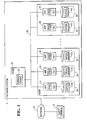
- a database system 14 is coupled over a data network 12 to one or more client terminals 10.
- the data network 12 include a local area network (LAN), a wide area network (WAN), the Internet, and so forth.
- the client terminal 10 is capable of issuing queries according to a standard database query language (such as Structured Query Language or SQL), as provided by the American National Standards Institute (ANSI).
- SQL Structured Query Language
- ANSI American National Standards Institute
- One version of SQL is the SQL-92 Standard, while another version is the SQL-99 Standard.
- other versions of SQL or other standard database query languages can be used.
- the database system 14 includes several nodes 18, with each node 18 including database management components.
- One node 18 includes a parsing engine (PE) 20.
- the parsing engine 20 checks the request for proper syntax, semantically evaluates the request, and develops an execution plan for the request.
- the parsing engine also includes a scheduler to schedule the sequence in which steps corresponding to the query are to be executed.
- a "step" is a command or other form of instruction to indicate performance of an action.
- the steps are communicated over an interconnect layer 28 to access modules (or data server modules) 24 to manage access or manipulation of data stored in respective storage modules 26.
- the access modules 24 are based on access module processors (AMPs) used in TERADATA® database systems from NCR Corporation.
- AMPs access module processors
- the term "access module” is used to refer to any module (whether implemented in software or hardware) that manages the access and manipulation of data stored in a storage system or module of a database system.
- Each AMP is responsible for locking databases, tables, or portions of tables; creating, modifying, or deleting definitions of tables; inserting, deleting, or modifying rows within tables; and retrieving information from definitions and tables.
- the AMPs after executing an action specified by the parsing engine 20, return responses to the parsing engine over the interconnect layer 28.
- the arrangement of the database system 14 shown in Fig. 1 is an example of a parallel database arrangement, in which the multiple AMPs 24 are capable of concurrently accessing and manipulating data in respective storage modules 26.
- Each relational table stored in the database system is partitioned across the multiple AMPs and respective storage modules. In other words, a given table is divided into multiple partitions and stored in respective storage modules.
- a single-node or uni-processor database system can be used instead of a parallel database system.
- stratified random sampling a data set containing a given population of data is divided into multiple subgroups (or strata). Within each subgroup (or stratum), random sampling is performed. Thus, for example, a population may be divided into male and female subgroups. Stratification can also be performed on the basis of age, professions, or other criteria.
- an SQL query (or a query according to another standard database query language) is extended to add a predefined clause (referred to as the SAMPLE STRATIFIED clause in one example embodiment) to indicate stratified sampling is to be performed.
- a predefined clause referred to as the SAMPLE STRATIFIED clause in one example embodiment
- the predefined clause to indicate performance of stratified sampling can have other names.
- the SAMPLE STRATIFIED clause contains two elements: (1) a stratification/sub-grouping condition, and (2) the contribution from the subgroup. Note that multiple stratification/sub-grouping conditions and associated contributions are specified in the SAMPLE STRATIFIED clause. Each stratification or sub-grouping condition specifies the characteristic of members of the subgroup or stratum. The contribution can be expressed in one of two forms: a number of sample records requested for the subgroup or a fraction or percentage of the total records requested. The sum of the contributions of all subgroups is the size of the resulting sample.
- the example query above is in the form of an SQL SELECT statement.
- the select list contains a list of all attributes from the one or more tables specified in the FROM clause that are to be produced as the output.
- a WHERE clause is an optional clause that specifies a search condition that table rows are to match to be produced at the output.
- each WHEN clause contains the stratification condition
- the corresponding THEN clause contains the sample size to indicate the relative size of the sample for the corresponding subgroup.
- the result of the query in the example above includes a sample of 60 rows in the first subgroup (specified by the first stratification condition), a sample of 30 rows in the second subgroup (specified by the second stratification condition), and a sample of 10 rows in the third subgroup (specified by the third stratification condition).
- the total number of samples requested is 100 (60 + 30 + 10).
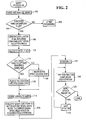
- Fig. 2 illustrates a process according to one embodiment of the invention for performing stratified random sampling.
- the parsing engine 20 parses and analyzes the query (at 102).
- the parsing engine 20 looks for the SAMPLE STRATIFIED clause to determine (at 104) if the query is a stratified random sampling query. If not, then other processing is performed (at 106), However, if the query is a stratified random sampling query, then the parsing engine 20 generates (at 108) an evaluation plan that includes the creation of input spool files 150 (Fig. 1) for stratified sampling.
- the parsing engine 20 allocates (at 112) the input spool files to store random samples, with one spool file allocated per stratum. Thus, if the query specifies 3 strata, then 3 corresponding spool files are created.
- the parsing engine 20 checks (at 114) for a condition to determine if the requested stratified sampling can be optimized. Basically, the parsing engine 20 determines if the stratification actions specified by the stratified sampling query can be pushed into a preceding step to enhance processing efficiency.
- the query containing the SAMPLE STRATIFIED clause can be classified as either a simple query or a complex query.
- a "complex" query is one that contains one of the following: join, aggregate, or online analytical processing (OLAP).
- OLAP online analytical processing
- a simple query is one that does not contain any one of the above functions. If the query is a simple query, then the stratification actions can be pushed (at 116) into a preceding step (instead of generating an extra stratification step).
- the "preceding" step is the step that is generated by the parsing engine 20 to process the query (e.g., to identify qualifying rows that match the search condition of a WHERE clause in the query).
- Pushing (at 116) the stratification actions into the preceding step refers to adding indications into the preceding step to determine whether the stratification conditions are satisfied and to write rows satisfying the stratification conditions into corresponding input spool files. This enhanced preceding step is referred to as an "enhanced step”.
- the enhanced step is generated to perform the following: (1) process the query, such as to identify qualifying rows that match the search condition of the WHERE clause; (2) determine which stratum each of the qualifying rows is associated with based on the stratification conditions; and (3) write the qualifying row to the appropriate one of the input spool files based on determining which stratum the row belongs to.
- the stratification actions cannot be pushed into a preceding step if the stratified sampling query is a complex query that performs one of a join, an aggregate, or OLAP function. If this is true, then a separate stratification step is generated (at 118) to perform the stratification actions. Next, the enhanced step (if the condition at 114 is satisfied) or the query step and separate stratification step (if the condition at 114 is not satisfied) are submitted (at 119) by the parsing engine 20 to each AMP.
- a WHERE clause of a simple SQL query involves a selection criterion that involves columns from one table only.
- the example query SELECT Name FROM EMPLOYEE SAMPLE STRATIFIED ⁇ conditions> WHERE Age > 20
- the query is a complex query.
- An example of a complex query with an aggregate function is as follows: SELECT E.deptid, SUM (E.salary) FROM E SAMPLE STRATIFIED ⁇ conditions> GROUPBY E.deptid;
- SUM is an example of an aggregate function that computes the sum of attribute values in a table.
- Other types of aggregate functions include AVG, MIN, MAX, and so forth.
- OLAP functions include RANKING, MOVING AVERAGE, MOVING SUM, and so forth.
- One example complex stratified sampling query with an OLAP function is as follows: SELECT E.name, E.deptid, RANK (E.salary) FROM E SAMPLE STRATIFIED ⁇ conditions>;
- each AMP evaluates (at 120) the query condition to obtain qualifying records. Based on the stratification conditions (contained either in an enhanced step or a separate stratification step), the AMP writes qualifying records to corresponding spool files.
- each AMP performs the random sampling of records of each input spool file (at 126). The random sampling according to one embodiment is described in connection with Figs. 3 and 4 below.
- Each AMP determines (at 128) if there are more strata left. If so, the next stratum is processed (at 130). This is repeated until all strata have been processed and the random samples have been collected in each stratum.
- the query with the SAMPLE STRATIFIED clause is executed by pushing the stratification actions into the step that identifies qualifying rows. Syntactically, the parsing engine accomplishes this by moving elements of the SAMPLE STRATIFIED clause to the select list of the SELECT clause as "virtual columns" embedded inside a CASE statement.
- the AMP uses the returned stratum number to append qualifying records to the correct spool file.
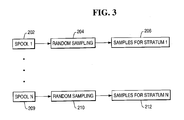
- a general process of obtaining random samples in plural strata is illustrated.
- the AMP receives N input spool files 202, 208 that correspond to plural strata. Random sampling is then performed (at 204, 210) of records in each spool file.
- Each AMP uses a pseudo-random number generator 152 (Fig. 1) to perform the random sampling.
- the sampling algorithm employed is random so that any sample data in a table is equally likely to be selected.
- the rows obtained as a result of the random sampling of each spool file are outputted as sample rows in a corresponding output file 206, 212.
- the random sampling for each stratum is relatively straightforward, as the spool file for the stratum is non-partitioned.
- the random sampling is performed according to a process in Fig. 4 in one embodiment.
- the number of sample rows to be obtained at each AMP are first pre-allocated.
- the parallel random sampling algorithm preserves most of the randomness properties as the pre-allocation does not examine the data itself.
- the input to the parallel random sampling process is the input spool file, which is partitioned across the multiple AMPs of the database system 14.
- Fig. 4 shows a parallel random sampling process performed in accordance with one embodiment. The process is described with respect to one input spool file associated with one stratum. The same process is repeated for other input spool files associated with other strata.
- Each AMP determines the number of rows in the input spool file partition stored by the AMP by scanning (at 300) an index or the partition to obtain a count of rows stored on the corresponding storage module that is managed by the AMP.
- each partition of an input spool file is stored as a B+ Tree indexed file (or some other type of index) on a respective storage module 26.
- the index contains information of how many rows are in each of the partitions.
- the index is scanned to collect row counts for the partition. In other embodiments where no such index is available or where no such information is available in the index, each partition is scanned to obtain the row count. This row count is used in producing random samples of the input spool files generated by stratification.
- Each AMP then sends (at 302) the row count to a designated AMP (referred to as the "control AMP").
- the control AMP then computes (at 303) the total row count of partitions of the input spool file across all AMPs in the database system 14. This is a simple sum of the row counts received from the AMPs.
- the control AMP then computes how many sample rows are to be obtained from each AMP and generates (at 304) a sample request accordingly for each AMP.
- the control AMP allocates the number of sample rows requested from each of the AMPs in proportion to how many rows are stored on their associated storage modules.
- Proportional_Allocation Fraction * total_row_count, where "Fraction” is the fraction of the total rows that make up the sample request, and "total_row_count” is the total number of rows stored on the storage module associated with that AMP.
- the control AMP then performs adjustments (at 306) for purposes of rounding. If more rows than needed are allocated, then the Proportional_Allocation parameter for the last AMP is reduced.
- the Proportional_Allocation parameter for that AMP is reduced. If less rows than needed are allocated, then the control AMP allocates zero or more additional rows to the Proportional_Allocation parameters for each AMP until the total rows have been allocated. The control AMP considers the AMPs of the database system 14 in a random order to determine each of their allocation.
- control AMP If the control AMP is unable to completely satisfy the sample request, then the control AMP issues warnings (at 308). Assuming the control AMP is able to satisfy the request, the control AMP sends (at 310) the sample requests, including the Proportional_Allocation parameter, to the AMPs for processing.
- each AMP When each AMP receives its proportional allocation (in a sample request) from the control AMP, the receiving AMP executes the steps necessary to fulfill the sampling request. If the AMP determines (at 312) that the request has not been completed, the AMP finds the next "accepted" row, that is, a row that belongs to the requested sample. This is performed by computing (at 314) the current probabilities of the next row belonging to any of the samples. The probability is the number of rows remaining in the sample request divided by the total number of rows remaining.
- the AMP then performs a random "toss" (at 316) to determine if the next row belongs to a sample (it is accepted or rejected). For example, assume that there are N rows stored in an AMP, and that it is desired to select n rows at random from the set of N rows, where 0 ⁇ n ⁇ N. Initially, variables t and m are set to zero (t 0, m 0), with m representing the number of rows selected (accepted) so far, and t representing the total number of input rows the AMP has processed. Then, a random number U is generated that is uniformly distributed between 0 and 1.
- the AMP accepts or rejects (at 318) the next row based on the following comparison: (N -t) * U n-m. If the comparison is true, the next row is skipped (that is, the row is rejected), and the variable t is incremented. However, if (N - t) * U n - m is not true, then the next row is selected (that is, accepted) for the sample and the variables m and t are each incremented by 1.
- the AMP When an accepted row is found (at 320), the AMP reads the accepted row, assigns a sample identifier to the accepted row, and writes the accepted row to the output (at 322). In the case where multiple samples are requested but no identification is requested, the output will contain the requested sample rows, but there will be no identification information for the row.
- segmentation includes subdividing a population according to known discriminators for marketing analysis. By using the stratified sampling technique discussed here, segmentation efficiency is enhanced.
- online analytical processing (OLAP) tools summarize data from relational transactional systems and build multi-dimensional cubes that enable adhoc analysis.
- these tools are extremely sensitive to data sparsity and need help in figuring out what dimensions and attributes to consider.
- Stratified sampling can be used to analyze how data is distributed prior to cube design.
- Stratified sampling can be used to materialize temporary tables or views against which queries desiring approximate answers can be executed.
- control units include microprocessors, microcontrollers, processor cards (including one or more microprocessors or microcontrollers), or other control or computing devices.
- a “controller” or “processing module” refers to hardware, software, or a combination thereof.
- a “controller” or “processing module” can refer to a single component or to plural components (whether software or hardware).
- the storage devices referred to in this discussion include one or more machine-readable storage media for storing data and instructions.
- the storage media include different forms of memory including semiconductor memory devices such as dynamic or static random access memories (DRAMs or SRAMs), erasable and programmable read-only memories (EPROMs), electrically erasable and programmable read-only memories (EEPROMs) and flash memories; magnetic disks such as fixed, floppy and removable disks; other magnetic media including tape; and optical media such as compact disks (CDs) or digital video disks (DVDs).
- DRAMs or SRAMs dynamic or static random access memories
- EPROMs erasable and programmable read-only memories
- EEPROMs electrically erasable and programmable read-only memories
- flash memories such as fixed, floppy and removable disks
- optical media such as compact disks (CDs) or digital video disks (DVDs).
- Instructions that make up the various software routines or modules in the system are stored in respective storage devices. The
- the instructions of the software routines or modules are loaded or transported to the system in one of many different ways. For example, code segments including instructions stored on floppy disks, CD or DVD media, a hard disk, or transported through a network interface card, modem, or other interface device are loaded into the system and executed as corresponding software routines or modules.
- data signals that are embodied in carrier waves (transmitted over telephone lines, network lines, wireless links, cables, and the like) may communicate the code segments, including instructions, to the system.
- carrier waves may be in the form of electrical, optical, acoustical, electromagnetic, or other types of signals.
Landscapes
- Engineering & Computer Science (AREA)
- Physics & Mathematics (AREA)
- Probability & Statistics with Applications (AREA)
- Theoretical Computer Science (AREA)
- Computational Linguistics (AREA)
- Software Systems (AREA)
- Mathematical Physics (AREA)
- Data Mining & Analysis (AREA)
- Databases & Information Systems (AREA)
- General Engineering & Computer Science (AREA)
- General Physics & Mathematics (AREA)
- Fuzzy Systems (AREA)
- Information Retrieval, Db Structures And Fs Structures Therefor (AREA)
Applications Claiming Priority (2)
| Application Number | Priority Date | Filing Date | Title |
|---|---|---|---|
| US113497 | 2002-04-01 | ||
| US10/113,497 US7069264B2 (en) | 1999-12-08 | 2002-04-01 | Stratified sampling of data in a database system |
Publications (2)
| Publication Number | Publication Date |
|---|---|
| EP1351165A2 true EP1351165A2 (fr) | 2003-10-08 |
| EP1351165A3 EP1351165A3 (fr) | 2006-04-26 |
Family
ID=28041031
Family Applications (1)
| Application Number | Title | Priority Date | Filing Date |
|---|---|---|---|
| EP03251558A Withdrawn EP1351165A3 (fr) | 2002-04-01 | 2003-03-14 | Echantillonnage stratifié de données dans un système de base de données |
Country Status (2)
| Country | Link |
|---|---|
| US (1) | US7069264B2 (fr) |
| EP (1) | EP1351165A3 (fr) |
Families Citing this family (30)
| Publication number | Priority date | Publication date | Assignee | Title |
|---|---|---|---|---|
| US20030005087A1 (en) * | 2001-05-24 | 2003-01-02 | Microsoft Corporation | Server side sampling of databases |
| US6889221B1 (en) * | 2001-08-23 | 2005-05-03 | Ncr Corporation | Parallel random sampling |
| AU2002951784A0 (en) * | 2002-09-26 | 2002-10-17 | Callidan Instruments Pty Ltd | Moisture analyser |
| US6993516B2 (en) * | 2002-12-26 | 2006-01-31 | International Business Machines Corporation | Efficient sampling of a relational database |
| US7693847B1 (en) * | 2004-07-13 | 2010-04-06 | Teradata Us, Inc. | Administering workload groups |
| US8306986B2 (en) | 2005-09-30 | 2012-11-06 | American Express Travel Related Services Company, Inc. | Method, system, and computer program product for linking customer information |
| US20070156724A1 (en) * | 2005-12-19 | 2007-07-05 | Pekka Kostamaa | Database system |
| US7590652B2 (en) * | 2006-08-18 | 2009-09-15 | Isilon Systems, Inc. | Systems and methods of reverse lookup |
| US7543006B2 (en) * | 2006-08-31 | 2009-06-02 | International Business Machines Corporation | Flexible, efficient and scalable sampling |
| US8533216B2 (en) * | 2006-10-30 | 2013-09-10 | Teradata Us, Inc. | Database system workload management method and system |
| US20080208735A1 (en) * | 2007-02-22 | 2008-08-28 | American Expresstravel Related Services Company, Inc., A New York Corporation | Method, System, and Computer Program Product for Managing Business Customer Contacts |
| US20080301016A1 (en) * | 2007-05-30 | 2008-12-04 | American Express Travel Related Services Company, Inc. General Counsel's Office | Method, System, and Computer Program Product for Customer Linking and Identification Capability for Institutions |
| US8170998B2 (en) * | 2007-09-12 | 2012-05-01 | American Express Travel Related Services Company, Inc. | Methods, systems, and computer program products for estimating accuracy of linking of customer relationships |
| US8060502B2 (en) | 2007-10-04 | 2011-11-15 | American Express Travel Related Services Company, Inc. | Methods, systems, and computer program products for generating data quality indicators for relationships in a database |
| US8392461B2 (en) * | 2007-11-19 | 2013-03-05 | Teradota Us, Inc. | Virtual data maintenance |
| US9183255B1 (en) * | 2009-12-30 | 2015-11-10 | Teradata Us, Inc. | Spool management and checkpointing in a multi-database system |
| US8639692B2 (en) | 2010-06-28 | 2014-01-28 | Alcatel Lucent | High-dimensional stratified sampling |
| US8868546B2 (en) * | 2011-09-15 | 2014-10-21 | Oracle International Corporation | Query explain plan in a distributed data management system |
| US8392434B1 (en) * | 2011-09-16 | 2013-03-05 | International Business Machines Corporation | Random sampling from distributed streams |
| AU2013200887B2 (en) | 2012-02-18 | 2015-09-17 | Tata Consultancy Services Limited | Multi-entity test case execution workflow |
| US20140012637A1 (en) * | 2012-07-06 | 2014-01-09 | Xerox Corporation | Traffic delay detection by mining ticket validation transactions |
| US9135300B1 (en) * | 2012-12-20 | 2015-09-15 | Emc Corporation | Efficient sampling with replacement |
| US9564918B2 (en) | 2013-01-10 | 2017-02-07 | International Business Machines Corporation | Real-time reduction of CPU overhead for data compression |
| US9792350B2 (en) * | 2013-01-10 | 2017-10-17 | International Business Machines Corporation | Real-time classification of data into data compression domains |
| US9053121B2 (en) * | 2013-01-10 | 2015-06-09 | International Business Machines Corporation | Real-time identification of data candidates for classification based compression |
| US20150106301A1 (en) * | 2013-10-10 | 2015-04-16 | Mastercard International Incorporated | Predictive modeling in in-memory modeling environment method and apparatus |
| WO2017017748A1 (fr) * | 2015-07-27 | 2017-02-02 | 株式会社日立製作所 | Système informatique et procédé d'échantillonnage |
| US20200349652A1 (en) * | 2019-05-03 | 2020-11-05 | Koninklijke Philips N.V. | System to simulate outcomes of a new contract with a financier of care |
| GB2585890B (en) * | 2019-07-19 | 2022-02-16 | Centrica Plc | System for distributed data processing using clustering |
| US20220019918A1 (en) * | 2020-07-17 | 2022-01-20 | Servicenow, Inc. | Machine learning feature recommendation |
Family Cites Families (14)
| Publication number | Priority date | Publication date | Assignee | Title |
|---|---|---|---|---|
| US5742806A (en) * | 1994-01-31 | 1998-04-21 | Sun Microsystems, Inc. | Apparatus and method for decomposing database queries for database management system including multiprocessor digital data processing system |
| US5878426A (en) * | 1996-12-23 | 1999-03-02 | Unisys Corporation | Statistical database query using random sampling of records |
| US6226629B1 (en) * | 1997-02-28 | 2001-05-01 | Compaq Computer Corporation | Method and apparatus determining and using hash functions and hash values |
| US6003036A (en) * | 1998-02-12 | 1999-12-14 | Martin; Michael W. | Interval-partitioning method for multidimensional data |
| US6278989B1 (en) * | 1998-08-25 | 2001-08-21 | Microsoft Corporation | Histogram construction using adaptive random sampling with cross-validation for database systems |
| US6223171B1 (en) * | 1998-08-25 | 2001-04-24 | Microsoft Corporation | What-if index analysis utility for database systems |
| US6282570B1 (en) * | 1998-12-07 | 2001-08-28 | International Business Machines Corporation | Monitoring a large parallel database through dynamic grouping and sequential sampling |
| US6532458B1 (en) * | 1999-03-15 | 2003-03-11 | Microsoft Corporation | Sampling for database systems |
| US6205441B1 (en) * | 1999-03-31 | 2001-03-20 | Compaq Computer Corporation | System and method for reducing compile time in a top down rule based system using rule heuristics based upon the predicted resulting data flow |
| US6564221B1 (en) * | 1999-12-08 | 2003-05-13 | Ncr Corporation | Random sampling of rows in a parallel processing database system |
| US6691120B1 (en) * | 2000-06-30 | 2004-02-10 | Ncr Corporation | System, method and computer program product for data mining in a normalized relational database |
| US6519604B1 (en) * | 2000-07-19 | 2003-02-11 | Lucent Technologies Inc. | Approximate querying method for databases with multiple grouping attributes |
| US6778977B1 (en) * | 2001-04-19 | 2004-08-17 | Microsoft Corporation | Method and system for creating a database table index using multiple processors |
| US6732085B1 (en) * | 2001-05-31 | 2004-05-04 | Oracle International Corporation | Method and system for sample size determination for database optimizers |
-
2002
- 2002-04-01 US US10/113,497 patent/US7069264B2/en not_active Expired - Lifetime
-
2003
- 2003-03-14 EP EP03251558A patent/EP1351165A3/fr not_active Withdrawn
Also Published As
| Publication number | Publication date |
|---|---|
| US7069264B2 (en) | 2006-06-27 |
| US20020198863A1 (en) | 2002-12-26 |
| EP1351165A3 (fr) | 2006-04-26 |
Similar Documents
| Publication | Publication Date | Title |
|---|---|---|
| US7069264B2 (en) | Stratified sampling of data in a database system | |
| US11971890B2 (en) | Database management system for optimizing queries via multiple optimizers | |
| US6801903B2 (en) | Collecting statistics in a database system | |
| US8037059B2 (en) | Implementing aggregation combination using aggregate depth lists and cube aggregation conversion to rollup aggregation for optimizing query processing | |
| Kim et al. | Parallel top-k similarity join algorithms using MapReduce | |
| US6212526B1 (en) | Method for apparatus for efficient mining of classification models from databases | |
| EP3014488B1 (fr) | Maintenance incrémentielle de statistiques séparées par plage pour optimisation de requête | |
| US8140568B2 (en) | Estimation and use of access plan statistics | |
| Mamoulis et al. | Slot index spatial join | |
| EP3913494B1 (fr) | Techniques de compression des données | |
| US9110949B2 (en) | Generating estimates for query optimization | |
| US12026162B2 (en) | Data query method and apparatus, computing device, and storage medium | |
| Yu et al. | ClusterTree: Integration of cluster representation and nearest-neighbor search for large data sets with high dimensions | |
| US20090171921A1 (en) | Accelerating Queries Based on Exact Knowledge of Specific Rows Satisfying Local Conditions | |
| US20050102271A1 (en) | Indexes with embedded data | |
| US7321898B1 (en) | Locking mechanism for materialized views in a database system | |
| US9378229B1 (en) | Index selection based on a compressed workload | |
| CN110321388B (zh) | 一种基于Greenplum的快速排序查询方法及系统 | |
| US6694324B1 (en) | Determination of records with a specified number of largest or smallest values in a parallel database system | |
| Zhu et al. | Developing a dynamic materialized view index for efficiently discovering usable views for progressive queries | |
| Papadias et al. | Hierarchical Constraint Satisfaction in Spatial Databases. | |
| US7933867B1 (en) | Maintaining views of cube-based operations in a database system | |
| Zhu et al. | DMVI: a dynamic materialized view index for efficiently discovering usable views for progressive queries | |
| Soares et al. | cx-sim: A metric access method for similarity queries with additional conditions | |
| CN119783791A (zh) | 数据存储方法、电子设备及计算机可读存储介质 |
Legal Events
| Date | Code | Title | Description |
|---|---|---|---|
| PUAI | Public reference made under article 153(3) epc to a published international application that has entered the european phase |
Free format text: ORIGINAL CODE: 0009012 |
|
| AK | Designated contracting states |
Kind code of ref document: A2 Designated state(s): AT BE BG CH CY CZ DE DK EE ES FI FR GB GR HU IE IT LI LU MC NL PT RO SE SI SK TR |
|
| AX | Request for extension of the european patent |
Extension state: AL LT LV MK |
|
| PUAL | Search report despatched |
Free format text: ORIGINAL CODE: 0009013 |
|
| AK | Designated contracting states |
Kind code of ref document: A3 Designated state(s): AT BE BG CH CY CZ DE DK EE ES FI FR GB GR HU IE IT LI LU MC NL PT RO SE SI SK TR |
|
| AX | Request for extension of the european patent |
Extension state: AL LT LV MK |
|
| 17P | Request for examination filed |
Effective date: 20061026 |
|
| AKX | Designation fees paid |
Designated state(s): DE FR GB |
|
| RAP1 | Party data changed (applicant data changed or rights of an application transferred) |
Owner name: TERADATA US, INC. |
|
| 17Q | First examination report despatched |
Effective date: 20090724 |
|
| R17C | First examination report despatched (corrected) |
Effective date: 20090806 |
|
| STAA | Information on the status of an ep patent application or granted ep patent |
Free format text: STATUS: THE APPLICATION IS DEEMED TO BE WITHDRAWN |
|
| 18D | Application deemed to be withdrawn |
Effective date: 20161001 |