EP1352368B1 - Prevention du vol par determination de position - Google Patents
Prevention du vol par determination de position Download PDFInfo
- Publication number
- EP1352368B1 EP1352368B1 EP02732205A EP02732205A EP1352368B1 EP 1352368 B1 EP1352368 B1 EP 1352368B1 EP 02732205 A EP02732205 A EP 02732205A EP 02732205 A EP02732205 A EP 02732205A EP 1352368 B1 EP1352368 B1 EP 1352368B1
- Authority
- EP
- European Patent Office
- Prior art keywords
- location
- local policy
- appliance
- user
- central agency
- Prior art date
- Legal status (The legal status is an assumption and is not a legal conclusion. Google has not performed a legal analysis and makes no representation as to the accuracy of the status listed.)
- Expired - Lifetime
Links
Images


Classifications
-
- G—PHYSICS
- G08—SIGNALLING
- G08B—SIGNALLING SYSTEMS, e.g. PERSONAL CALLING SYSTEMS; ORDER TELEGRAPHS; ALARM SYSTEMS
- G08B13/00—Burglar, theft or intruder alarms
- G08B13/02—Mechanical actuation
- G08B13/14—Mechanical actuation by lifting or attempted removal of hand-portable articles
- G08B13/1409—Mechanical actuation by lifting or attempted removal of hand-portable articles for removal detection of electrical appliances by detecting their physical disconnection from an electrical system, e.g. using a switch incorporated in the plug connector
- G08B13/1418—Removal detected by failure in electrical connection between the appliance and a control centre, home control panel or a power supply
Definitions
- the present invention relates generally to preventing theft of devices.
- Location determination and motion detection devices are known, including such mechanisms as mercury switches, accelerometers, and global positioning system (GPS) devices. It is known to utilize such devices in a passive, queried mode to provide theft deterrence. For example, automobiles equipped with the OnStar System can be remotely disabled after the theft has been detected. However, this requires that the owner or other person notice that the automobile has been stolen. Furthermore, if the thief disables the OnStar System before the owner phones in a report of the theft, the OnStar personnel will be unable to disable the vehicle remotely.
- GPS global positioning system
- US-A-5 532 690 discloses an apparatus for monitoring the path of a ground vehicle.
- the apparatus comprises a GPS receiver for receiving radio signals from a Global Positioning System.
- the signals are indicative of the current ground position of the GPS and of the vehicle's current ground position, respectively.
- the position of the vehicle is compared with data stored in a data base representing a bounded area by computer means. If the position of the vehicle is outside this bounded area, kill switch means will disable the vehicle. Additionally a transmitter may transmit the current ground position of the vehicle to a ground vehicle monitoring area.
- US-A-5 760 681 discloses a burglar alarm activated by the movement of an article to be secured.
- the alarm comprises a movement-detecting transducer and electronic circuit for processing a signal received from the transducer.
- the electronic circuit provides elements for analyzing the form of movement of the alarm (and therefore for the article to which the alarm is connected). The alarm is activated, if the detected form of movement satisfies predetermined criteria.
- EP-A-0 924 123 discloses an apparatus for controlling a vehicle using fingerprint matching.
- an apparatus comprising: a functional unit, a location determination device, a local policy enforcement device coupled to the location determination device and to the functional unit for enabling the functional unit if a local policy is met, and a communication interface coupled to the local policy enforcement device to transmit to a central agency information related to a failure to meet a local policy and to receive from the central agency an enablement signal if the information complies with a remote policy.
- a method of operating an apparatus comprising the steps of: determining a location of the apparatus, determining if the location complies with a local policy and enabling a functional unit of the apparatus if the local policy is complied with, if the location fails to comply with a local policy, transmitting information related to failure to comply with the local policy to a central agency, receiving enabling information from the central agency if the location complies with a remote policy, and receiving disabling information from the central agency if the location fails to comply with the remote policy.
- FIG. 1 illustrates one embodiment of a system which utilizes the principles of this invention, including an exemplary appliance device to be protected against theft.
- FIG. 2 illustrates one embodiment of a method of operating the device to be protected against theft.
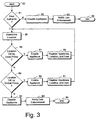
- FIG. 3 illustrates another embodiment of a method of operating the device to be protected.
- FIG. 1 illustrates a system 10 according to this invention, including an exemplary device 12 to be protected against theft.
- the device 12 will be referred to as an appliance, but the reader will understand that it may be any type of device whatsoever, such as an automobile, a home appliance such as a refrigerator, a computer, or a television.
- the appliance is coupled over a communication link to a central agency 16 service or device which may, in turn, be coupled over a notification link 18 to a law enforcement agency device 20 such as a central dispatch computer, radio, or the like.
- a central agency 16 service or device which may, in turn, be coupled over a notification link 18 to a law enforcement agency device 20 such as a central dispatch computer, radio, or the like.
- a law enforcement agency device 20 such as a central dispatch computer, radio, or the like.
- the communication link and the notification link may utilize a telephone network, computer network, the internet, wireless, cellular, satellite, laser, audio, or any other suitable mechanism.
- the appliance includes a local policy enforcer 30, a location determiner 32 which may be a location determination device or a motion detection device, a user authenticator 34, an appliance disabler/enabler, a functional unit 38, and a communication interface 39.
- the local policy enforcer may constitute a software-programmed microprocessor, hard-wired logic, or other suitable means of performing the functionality of the local policy enforcer, which will be described below.
- the location determiner may be as simplistic as a mercury switch, which detects only motion but not relative position much less absolute position; or it may be a more complex device such as a GPS receiver, which detects absolute position as well as motion; or it may be something in between such as an accelerometer, which detects motion and relative position but not absolute position.
- the user authenticator may be as simple as a key device which may readily be possessed by any user; or it may be as complex as a biometric identity analyzer which is specific to a single individual user; or it may be something in between such as a password system. It may include simply a data gathering mechanism, but it may also include means for applying policies or comparing the data against, for example, a locally-stored copy of known-valid data, such as from a previously sampled user input.
- the enabler/disabler is adapted for enabling and/or disabling the functional unit.
- the functional unit may be in a default state of disablement until the enabler/disabler enables it. In other embodiments, me functional unit may be enabled unless the enabler/disabler disables it.
- the functional unit provides the functionality of the appliance and would typically be found in an appliance which lacks the features of this invention; for example, in the case of a television, the functional unit might be the tuner or the display or the on/off switch.
- the appliance's communication interface is suitably adapted for communicating over the chosen communication link.
- the location determiner and user authenticator may be coupled to the local policy enforcer, and the local policy enforcer may be coupled to the communication interface.
- Other configurations will, of course, be apparent given the teachings of this patent.
- the central agency service or device 16 includes a communication interface 44 which is suitably adapted for communicating with the appliance over the communication link. It further includes a remote policy enforcer 40, an appliance registry 42, an optional user authenticator 43, and an optional notification interface 46.
- the remote policy enforcer may constitute a software-programmed microprocessor, hard-wired logic, or other suitable means of performing the functionality of the remote policy enforcer, which will be described below.
- the appliance registry may include a database or other suitable data storage and retrieval system, and a storage device for housing the database, such as a hard disk, a tape drive, a DVD-R drive, semiconductor memory, or other suitable storage means.
- the user authenticator 43 will not typically include a user data input gathering device, such as the biometric apparatus or password input means of the user authenticator 34 of the appliance.
- the central agency's user authenticator 43 may gather data through such user data input gathering device, and apply locally-held knowledge or policies, such as by comparing the user's biometric information against a stored database (not shown).
- the notification interface is suitably adapted for communicating over the chosen notification link.
- FIG. 2 shows a flowchart which illustrates one exemplary embodiment of a method of operating the appliance of FIG. 1, to which the reader is also referred.
- FIG. 2 should also be understood to represent on or more information storage devices having stored thereon instructions, operations, routines, control codes, or the like, which, when loaded into or executed upon a programmed computer device, a programmable logic-device, or the like, will cause such device to execute the exemplary method.
- the method begins (59) with the appliance being disabled (60).
- the appliance determines (61), via its location determiner, where the appliance is presently located. In the simplistic case of e.g. a mercury switch, what is determined is simply that the appliance has moved, rather than an absolute or relative position.
- a variety of local policies may be utilized in practicing this invention. Examples, given by way of illustration and not exhaustive enumeration, include:
- the local policy enforcer enables (63) the appliance. In various embodiments, this may constitute providing power to the functional unit. In other embodiments, it may constitute unlocking the functional unit.
- a suitable dis/enablement mechanism may readily be chosen for a given appliance, given the teachings of this patent. The reader will also appreciate that various mechanisms may be adapted to disable the appliance, to enable the appliance, or to do both; thus the term "dis/enablement”.
- the method may end (64) until a next time that, for example, it is powered on, or a next time that it is moved.
- the appliance will communicate information over the communication interface and communication link to the central agency.
- the information sent to the central agency may be, for example, the location of the appliance, the fact that the appliance has moved, an indication of in what manner the local policy was failed, a unique identification of the appliance, an identification of the owner of the appliance, a most recent location which did not fail the local policy, or any combination of such information or other suitable information.
- the central agency's remote policy enforcer will make a determination (65) of whether the new location (or other submitted data) meets a remote policy.
- a variety of remote policies may be utilized in practicing this invention, such as, for example:
- the central agency remotely enables (66) the appliance. This may be done by sending an enablement signal or value back over the communication link, or by other suitable mechanism. In some instances, it may be desirable to have the appliance be self-enabling unless the central agency disables the appliance.
- the local policy enforcer Upon receipt at the communication interface of the dis/enablement signal, the local policy enforcer triggers the dis/enabler to enable or disable the functional unit.
- the method may be desirable to update (67) the appliance registry with the new location or other information provided by the appliance or derived from such information. Once the appliance is enabled and the new information is registered, the method may end (68) until a next time it is utilized.
- the appliance may simply be disabled (not shown). In other embodiments, it may be more desirable to provide for a mechanism to allow the appliance to be used even though its movement has failed both the local and remote policies.
- One suitable choice is by authenticating (69) the user. This may involve the user inserting a key into the user authenticator, or the user entering a password into the user authenticator, or the user authenticator gathering biometric data about the user, such as via a thumbprint pad or an iris scan.
- the appliance notifies (70) the central agency, which in turn may notify (71) law enforcement.
- the authentication may be checked at the central agency rather than at the appliance; in this case, the appliance will not need to notify (70) the central agency.
- the central agency may provide to law enforcement any of the data which the central agency has about the user, the location and identity of the appliance, and so forth.
- the user authenticator on the appliance may be simply a data input device (whether it be a key, a password, or a biometric input device), and the logic to determine whether the user is authentic may reside at the central agency. This would help prevent a thief from altering the output of the user authenticator, or sending back simplistic "he is authentic" types of messages.
- the notification (70) to the central agency will be data to be used in a determination, rather than an outcome of a determination.
- the method may end (72) with the appliance being left in a disabled state, or in some embodiments, in an enabled state.
- the functionality of the device (such as a defibrillator) is important enough that it is better to leave the device functioning in the hands of a possible thief.
- the law enforcement notification may be done directly by the appliance, rather than, or in addition to, by the central agency.
- the appliance is enabled (73), the register is updated (74), and the method ends (75).
- the local policy and/or remote policy may have dynamically adjustable guidelines.
- the policies may require a user authentication. Then, as long as the golf cart does not leave the general vicinity (meaning that it is likely to still be at the same golf course), no authentication may be required. Then, when the cart suddenly moves to a different course, authentication may again be required. But then, on a second or third trip to different courses, within the same city, authentication may not be required; the policies may learn that the legitimate user has recently changed his playing habits.
- FIG. 3 illustrates another embodiment of a method for practicing the invention.
- the method begins (80) and the appliance attempts to authenticate (81) the user. If the user is not authenticated, the appliance is disabled (82), law enforcement is notified (83), and the method ends (84). If the user is authenticated, the location of the appliance is determined (84) If the location meets the local policy (86), the appliance is enabled (87) and the new location and so forth may optionally be registered (88), then the method returns to re-checking the location, providing continuous location policy checking. If the location fails the local guidelines, then it is checked against the global guidelines (89).
- the appliance is enabled (90) and the new location and so forth may optionally be registered (91), and the method returns to re-checking the location continuously. If the remote policy is also failed, the appliance is disabled (92), law enforcement is notified (93), and the method ends (94). Alternatively, the method could disable the appliance at the start, so it would be disabled until one of the policies enables it.
- signals or values transmitted over the communication link and notification link may advantageously be protected by suitable means, such as by data encryption.
- suitable means such as by data encryption.
- Use of a public key system over the communication link may be used to prevent a thief from stealing the appliance and leaving a dummy device behind in place of the appliance; the public key system will enable the central agency to authenticate that the appliance is what it claims to be.
- the various elements of the appliance and/or central agency may be constructed in hardware, software, or a combination thereof.
- the phrase "device” is not necessarily limited to hardware devices, nor to discrete, stand-alone mechanisms.
Landscapes
- Physics & Mathematics (AREA)
- General Physics & Mathematics (AREA)
- Burglar Alarm Systems (AREA)
- Mobile Radio Communication Systems (AREA)
- Lock And Its Accessories (AREA)
- Fittings On The Vehicle Exterior For Carrying Loads, And Devices For Holding Or Mounting Articles (AREA)
- Soil Working Implements (AREA)
- Spinning Or Twisting Of Yarns (AREA)
Claims (29)
- Appareil comprenant:une unité fonctionnelle (38);un dispositif de détermination (32) d'emplacement;un dispositif de mise en vigueur (30) d'une règle locale couplé au dispositif de détermination (32) d'emplacement et à l'unité fonctionnelle (38) pour activer l'unité fonctionnelle (38) si une règle locale est remplie ; etune interface (39) de communication couplée au dispositif de mise en vigueur (30) de règle locale pour transmettre une information d'agence centrale liée à une défaillance pour remplir une règle locale, et pour recevoir de l'agence centrale un signal d'activation si l'information est conforme à une règle distante.
- Appareil selon la revendication 1 dans lequel le dispositif de détermination (32) d'emplacement comprend un dispositif de détection de position.
- Appareil selon la revendication 2 dans lequel le dispositif de détermination d'emplacement comprend un récepteur de système de positionnement global, ou récepteur GPS, initiales de Global Positioning System.
- Appareil selon la revendication 2 dans lequel le dispositif de détermination d'emplacement comprend un accéléromètre.
- Appareil selon la revendication 1 dans lequel le dispositif de détection (32) d'emplacement comprend un dispositif de détection de mouvement.
- Appareil selon la revendication 1 comprenant en outre:un authentifiant (34) d'utilisateur couplé au dispositif de mise en vigueur (30) de règle locale.
- Appareil selon la revendication 6 dans lequel l'authentifiant (34) d'utilisateur comprend un dispositif à mot de passe.
- Appareil selon la revendication 6 dans lequel l'authentifiant (34) d'utilisateur comprend un dispositif d'entrée biométrique.
- Appareil selon la revendication 6 dans lequel le dispositif de détermination d'emplacement (32) comprend un récepteur de système de positionnement global.
- Appareil selon la revendication 6 dans lequel le dispositif de détermination d'emplacement (32) comprend un accéléromètre.
- Appareil selon la revendication 1 dans lequel le dispositif de mise en vigueur (30) de règle locale comprend un moyen permettant de déterminer si l'appareil est à l'intérieur d'un périmètre défini par une distance d'un certain emplacement.
- Appareil selon la revendication 11 dans lequel la distance est une distance prédéterminée.
- Appareil selon la revendication 11 dans lequel l'emplacement est un emplacement prédéterminé.
- Appareil selon la revendication 11 dans lequel l'emplacement est un emplacement précédemment déterminé de l'appareil.
- Appareil selon la revendication 14 dans lequel la distance est une distance prédéterminée.
- Appareil selon la revendication 1 dans lequel le dispositif de mise en vigueur (30) de règle locale comprend un moyen d'adaptation dynamique d'une règle locale en réponse à des déterminations précédentes d'emplacements et à des applications précédentes de la règle locale.
- Appareil selon la revendication 1 dans lequel le dispositif de mise en vigueur (30) de règle locale comprend un moyen permettant de déterminer, en réponse à une détermination effectuée par le dispositif de détermination (32) d'emplacement précisant que l'appareil a été déplacé à un nouvel emplacement, si le nouvel emplacement est conforme à une règle locale.
- Appareil selon la revendication 17 dans lequel la règle locale consiste à préciser si le nouvel emplacement est un emplacement précédemment approuvé.
- Appareil selon la revendication 17 dans lequel la règle locale consiste à préciser si le nouvel emplacement est à l'intérieur d'un périmètre défini par une distance déterminée à partir d'un emplacement précédent de l'appareil.
- Appareil selon la revendication 19 dans lequel la distance est une distance prédéterminée.
- Procédé de mise en oeuvre d'un appareil, le procédé comprenant les étapes consistant à:déterminer un emplacement (61) de l'appareil;déterminer si l'emplacement est conforme à une règle locale (62) et activer une unité fonctionnelle (38) de l'appareil en cas de conformité avec la règle locale;si l'emplacement n'est pas conforme à la règle locale, transmettre à l'agence centrale une information liée à la défaillance de conformité à la règle locale;recevoir de l'agence centrale une information d'activation si l'emplacement est conforme à une règle distante; etrecevoir de l'agence centrale une information de désactivation si l'emplacement n'est pas conforme à la règle distante.
- Procédé selon la revendication 21, dans lequel l'information comprend l'emplacement de l'appareil.
- Procédé selon la revendication 21, dans lequel l'information comprend l'emplacement le plus récent de l'appareil qui a été conforme à la règle locale.
- Procédé selon la revendication 21, comprenant en outre l'étape consistant à:désactiver l'appareil en réponse à la réception d'une information de désactivation provenant de l'agence centrale.
- Procédé selon la revendication 21, comprenant en outre l'étape consistant à:activer l'appareil en réponse à la réception d'une information de désactivation provenant de l'agence centrale, à condition qu'un utilisateur soit authentifié.
- Procédé selon la revendication 25, dans lequel l'utilisateur est authentifié par un mot de passe.
- Procédé selon la revendication 25, dans lequel l'utilisateur est authentifié par des données biométriques.
- Procédé selon la revendication 25, dans lequel l'utilisateur est authentifié par une clé.
- Procédé selon la revendication 21, comprenant en outre l'étape consistant à:ajuster dynamiquement la règle locale.
Applications Claiming Priority (3)
| Application Number | Priority Date | Filing Date | Title |
|---|---|---|---|
| US765823 | 2001-01-19 | ||
| US09/765,823 US20020099503A1 (en) | 2001-01-19 | 2001-01-19 | Theft prevention using location determination |
| PCT/US2002/000849 WO2002058022A2 (fr) | 2001-01-19 | 2002-01-11 | Prevention du vol par determination de position |
Publications (2)
| Publication Number | Publication Date |
|---|---|
| EP1352368A2 EP1352368A2 (fr) | 2003-10-15 |
| EP1352368B1 true EP1352368B1 (fr) | 2006-03-15 |
Family
ID=25074588
Family Applications (1)
| Application Number | Title | Priority Date | Filing Date |
|---|---|---|---|
| EP02732205A Expired - Lifetime EP1352368B1 (fr) | 2001-01-19 | 2002-01-11 | Prevention du vol par determination de position |
Country Status (7)
| Country | Link |
|---|---|
| US (1) | US20020099503A1 (fr) |
| EP (1) | EP1352368B1 (fr) |
| AT (1) | ATE320639T1 (fr) |
| AU (1) | AU2002330291A1 (fr) |
| DE (2) | DE60209896D1 (fr) |
| GB (1) | GB2390719B (fr) |
| WO (1) | WO2002058022A2 (fr) |
Families Citing this family (14)
| Publication number | Priority date | Publication date | Assignee | Title |
|---|---|---|---|---|
| US6957067B1 (en) * | 2002-09-24 | 2005-10-18 | Aruba Networks | System and method for monitoring and enforcing policy within a wireless network |
| US9137670B2 (en) * | 2003-02-18 | 2015-09-15 | Hewlett-Packard Development Company, L.P. | Method for detecting rogue devices operating in wireless and wired computer network environments |
| US7295524B1 (en) | 2003-02-18 | 2007-11-13 | Airwave Wireless, Inc | Methods, apparatuses and systems facilitating management of airspace in wireless computer network environments |
| PL1594098T3 (pl) * | 2004-05-06 | 2008-07-31 | Arboprofit | Sprawdzające lokalizację urządzenie zabezpieczające przed kradzieżą |
| US7904940B1 (en) * | 2004-11-12 | 2011-03-08 | Symantec Corporation | Automated environmental policy awareness |
| US20060220809A1 (en) * | 2005-03-21 | 2006-10-05 | Rf Monolithics, Inc. | System and method for monitoring use of vehicles such as golf carts |
| US8817813B2 (en) * | 2006-10-02 | 2014-08-26 | Aruba Networks, Inc. | System and method for adaptive channel scanning within a wireless network |
| US9047494B1 (en) * | 2008-09-08 | 2015-06-02 | United Services Automobile Association | System and method for disabling and/or enabling a device |
| US20100138080A1 (en) * | 2008-12-02 | 2010-06-03 | Gm Global Technology Operations, Inc. | Remote management of vehicle modules based on geographic location |
| GB2468349A (en) * | 2009-03-06 | 2010-09-08 | Timothy John Bell | Securing devices against unauthorized use |
| GB201009419D0 (en) * | 2010-06-07 | 2010-07-21 | Wyn Davies Alan | Disabling electrical devices |
| DE102013007064A1 (de) * | 2013-04-18 | 2014-10-23 | ISS-AVIATION GmbH | Vorwärmgerät |
| US10024971B2 (en) | 2013-07-16 | 2018-07-17 | Walter Fields | Apparatus, system and method for locating a lost instrument or object |
| US12595609B2 (en) * | 2023-01-24 | 2026-04-07 | Haier Us Appliance Solutions, Inc. | Domestic appliances and methods of automatic calibration |
Family Cites Families (12)
| Publication number | Priority date | Publication date | Assignee | Title |
|---|---|---|---|---|
| CH662995A5 (de) | 1984-03-30 | 1987-11-13 | Sig Schweiz Industrieges | Einrichtung zum dosieren von schuettgut. |
| DE59100325D1 (de) | 1990-09-14 | 1993-09-30 | K Tron Tech Inc | Schneckenförderer. |
| FI100004B (fi) * | 1994-03-21 | 1997-07-31 | Alektro Safeguard Ltd Oy | Suojeltavan kohteen liikuttamisesta aktivoituva varashälytin |
| US5868234A (en) | 1995-01-26 | 1999-02-09 | Takeda Chemical Industries, Ltd. | Transfer device for transferring solid articles |
| DE19508370C2 (de) * | 1995-03-10 | 1998-10-22 | Daimler Benz Ag | Verfahren zur Sicherung von Fahrzeugen, insbesondere Leasing- oder Mietfahrzeugen, vor unbefugter Nutzung |
| DE19512074A1 (de) * | 1995-04-03 | 1996-10-10 | Ruediger Klaschka | Diebstahlsicherung für ein Fahrzeug |
| US5532690A (en) * | 1995-04-04 | 1996-07-02 | Itt Corporation | Apparatus and method for monitoring and bounding the path of a ground vehicle |
| JPH09193901A (ja) | 1996-01-12 | 1997-07-29 | Awaji:Kk | 脱気型粉体充填機及粉粒体充填機 |
| US6100811A (en) * | 1997-12-22 | 2000-08-08 | Trw Inc. | Fingerprint actuation of customized vehicle features |
| US6225890B1 (en) * | 1998-03-20 | 2001-05-01 | Trimble Navigation Limited | Vehicle use control |
| DE19844458C2 (de) * | 1998-09-28 | 2003-12-11 | Siemens Ag | Diebstahlsicherungsverfahren für ein bewegliches Objekt, insbesondere Kraftfahrzeug |
| JP2001048355A (ja) | 1999-08-17 | 2001-02-20 | Shibuya Kogyo Co Ltd | 粉粒体供給装置 |
-
2001
- 2001-01-19 US US09/765,823 patent/US20020099503A1/en not_active Abandoned
-
2002
- 2002-01-11 DE DE60209896T patent/DE60209896D1/de not_active Expired - Lifetime
- 2002-01-11 AU AU2002330291A patent/AU2002330291A1/en not_active Abandoned
- 2002-01-11 DE DE10295702T patent/DE10295702B4/de not_active Expired - Fee Related
- 2002-01-11 WO PCT/US2002/000849 patent/WO2002058022A2/fr not_active Ceased
- 2002-01-11 AT AT02732205T patent/ATE320639T1/de not_active IP Right Cessation
- 2002-01-11 GB GB0316078A patent/GB2390719B/en not_active Revoked
- 2002-01-11 EP EP02732205A patent/EP1352368B1/fr not_active Expired - Lifetime
Also Published As
| Publication number | Publication date |
|---|---|
| GB2390719B (en) | 2004-12-29 |
| WO2002058022A3 (fr) | 2002-11-07 |
| WO2002058022A2 (fr) | 2002-07-25 |
| EP1352368A2 (fr) | 2003-10-15 |
| GB0316078D0 (en) | 2003-08-13 |
| DE10295702T5 (de) | 2004-04-15 |
| HK1058719A1 (en) | 2004-05-28 |
| US20020099503A1 (en) | 2002-07-25 |
| DE10295702B4 (de) | 2011-02-17 |
| GB2390719A (en) | 2004-01-14 |
| AU2002330291A1 (en) | 2002-07-30 |
| ATE320639T1 (de) | 2006-04-15 |
| DE60209896D1 (de) | 2006-05-11 |
Similar Documents
| Publication | Publication Date | Title |
|---|---|---|
| EP1352368B1 (fr) | Prevention du vol par determination de position | |
| US5966081A (en) | Paging activated electronic security system | |
| JP4078087B2 (ja) | 電子キーシステム | |
| EP1564690B1 (fr) | Système de contrôle de sécurité pour gérer l'enregistrement de codes d'identification d'appareils portables | |
| US6587040B2 (en) | Emergency call system provided with theftproof function | |
| US7512795B2 (en) | Method and apparatus for authenticating components | |
| US8006101B2 (en) | Radio transceiver or other encryption device having secure tamper-detection module | |
| CN103370717B (zh) | 始终可用的嵌入式盗窃反应子系统 | |
| US20040006655A1 (en) | Method for protecting nomad devices against theft, corresponding device and installation | |
| EP1901577B1 (fr) | Appareil et procédé pour le contrôle Bluetooth d'un terminal portable | |
| JP2019070276A (ja) | カーシェアリングシステム | |
| CN1981312B (zh) | 防盗归属位置检查装置 | |
| EP0740037A1 (fr) | Dispositif de sécurité | |
| JP2004502061A (ja) | 車両用の駐車スペースの遮断装置を制御するための方法及び装置 | |
| US7215237B1 (en) | Security device for the global protection with objects with electronic components | |
| WO2002035880A2 (fr) | Procede et appareil pour proteger un dispositif electronique mobile, dont le fonctionnement est base sur l"emplacement de ce dispositif | |
| US7510580B2 (en) | Method and apparatus to eliminate theft of electronic equipment using existing telephone jack | |
| JP2005029990A (ja) | 携帯端末及び遠隔制御装置 | |
| CN110800325B (zh) | 用于运行机动车的发射装置的方法 | |
| RU2225302C1 (ru) | Информационно-охранный комплекс для мониторинга и защиты транспортных средств и объектов недвижимости от несанкционированного использования | |
| KR100387708B1 (ko) | 무선 이동 단말기를 이용한 보안 및 방범장치 제어 시스템 | |
| JP4748048B2 (ja) | 認証システム | |
| KR20050093050A (ko) | 차량 도난 자동호출시스템 | |
| KR20180052941A (ko) | 스마트 잠금 장치 및 이의 제어방법 | |
| EP1634258A1 (fr) | Methode de protection pour dispositifs electroniques |
Legal Events
| Date | Code | Title | Description |
|---|---|---|---|
| PUAI | Public reference made under article 153(3) epc to a published international application that has entered the european phase |
Free format text: ORIGINAL CODE: 0009012 |
|
| 17P | Request for examination filed |
Effective date: 20030717 |
|
| AK | Designated contracting states |
Kind code of ref document: A2 Designated state(s): AT BE CH CY DE DK ES FI FR GB GR IE IT LI LU MC NL PT SE TR |
|
| AX | Request for extension of the european patent |
Extension state: AL LT LV MK RO SI |
|
| 17Q | First examination report despatched |
Effective date: 20041116 |
|
| GRAP | Despatch of communication of intention to grant a patent |
Free format text: ORIGINAL CODE: EPIDOSNIGR1 |
|
| GRAS | Grant fee paid |
Free format text: ORIGINAL CODE: EPIDOSNIGR3 |
|
| GRAA | (expected) grant |
Free format text: ORIGINAL CODE: 0009210 |
|
| AK | Designated contracting states |
Kind code of ref document: B1 Designated state(s): AT BE CH CY DE DK ES FI FR GB GR IE IT LI LU MC NL PT SE TR |
|
| PG25 | Lapsed in a contracting state [announced via postgrant information from national office to epo] |
Ref country code: LI Free format text: LAPSE BECAUSE OF FAILURE TO SUBMIT A TRANSLATION OF THE DESCRIPTION OR TO PAY THE FEE WITHIN THE PRESCRIBED TIME-LIMIT Effective date: 20060315 Ref country code: IT Free format text: LAPSE BECAUSE OF FAILURE TO SUBMIT A TRANSLATION OF THE DESCRIPTION OR TO PAY THE FEE WITHIN THE PRESCRIBED TIME-LIMIT;WARNING: LAPSES OF ITALIAN PATENTS WITH EFFECTIVE DATE BEFORE 2007 MAY HAVE OCCURRED AT ANY TIME BEFORE 2007. THE CORRECT EFFECTIVE DATE MAY BE DIFFERENT FROM THE ONE RECORDED. Effective date: 20060315 Ref country code: BE Free format text: LAPSE BECAUSE OF FAILURE TO SUBMIT A TRANSLATION OF THE DESCRIPTION OR TO PAY THE FEE WITHIN THE PRESCRIBED TIME-LIMIT Effective date: 20060315 Ref country code: FI Free format text: LAPSE BECAUSE OF FAILURE TO SUBMIT A TRANSLATION OF THE DESCRIPTION OR TO PAY THE FEE WITHIN THE PRESCRIBED TIME-LIMIT Effective date: 20060315 Ref country code: AT Free format text: LAPSE BECAUSE OF FAILURE TO SUBMIT A TRANSLATION OF THE DESCRIPTION OR TO PAY THE FEE WITHIN THE PRESCRIBED TIME-LIMIT Effective date: 20060315 Ref country code: CH Free format text: LAPSE BECAUSE OF FAILURE TO SUBMIT A TRANSLATION OF THE DESCRIPTION OR TO PAY THE FEE WITHIN THE PRESCRIBED TIME-LIMIT Effective date: 20060315 |
|
| REG | Reference to a national code |
Ref country code: GB Ref legal event code: FG4D Ref country code: CH Ref legal event code: EP |
|
| REG | Reference to a national code |
Ref country code: IE Ref legal event code: FG4D |
|
| REF | Corresponds to: |
Ref document number: 60209896 Country of ref document: DE Date of ref document: 20060511 Kind code of ref document: P |
|
| PG25 | Lapsed in a contracting state [announced via postgrant information from national office to epo] |
Ref country code: DK Free format text: LAPSE BECAUSE OF FAILURE TO SUBMIT A TRANSLATION OF THE DESCRIPTION OR TO PAY THE FEE WITHIN THE PRESCRIBED TIME-LIMIT Effective date: 20060615 Ref country code: SE Free format text: LAPSE BECAUSE OF FAILURE TO SUBMIT A TRANSLATION OF THE DESCRIPTION OR TO PAY THE FEE WITHIN THE PRESCRIBED TIME-LIMIT Effective date: 20060615 |
|
| PG25 | Lapsed in a contracting state [announced via postgrant information from national office to epo] |
Ref country code: DE Free format text: LAPSE BECAUSE OF FAILURE TO SUBMIT A TRANSLATION OF THE DESCRIPTION OR TO PAY THE FEE WITHIN THE PRESCRIBED TIME-LIMIT Effective date: 20060617 |
|
| PG25 | Lapsed in a contracting state [announced via postgrant information from national office to epo] |
Ref country code: ES Free format text: LAPSE BECAUSE OF FAILURE TO SUBMIT A TRANSLATION OF THE DESCRIPTION OR TO PAY THE FEE WITHIN THE PRESCRIBED TIME-LIMIT Effective date: 20060626 |
|
| PG25 | Lapsed in a contracting state [announced via postgrant information from national office to epo] |
Ref country code: PT Free format text: LAPSE BECAUSE OF FAILURE TO SUBMIT A TRANSLATION OF THE DESCRIPTION OR TO PAY THE FEE WITHIN THE PRESCRIBED TIME-LIMIT Effective date: 20060816 |
|
| REG | Reference to a national code |
Ref country code: CH Ref legal event code: PL |
|
| PG25 | Lapsed in a contracting state [announced via postgrant information from national office to epo] |
Ref country code: IE Free format text: LAPSE BECAUSE OF NON-PAYMENT OF DUE FEES Effective date: 20070111 |
|
| PG25 | Lapsed in a contracting state [announced via postgrant information from national office to epo] |
Ref country code: MC Free format text: LAPSE BECAUSE OF NON-PAYMENT OF DUE FEES Effective date: 20070131 |
|
| PLBE | No opposition filed within time limit |
Free format text: ORIGINAL CODE: 0009261 |
|
| STAA | Information on the status of an ep patent application or granted ep patent |
Free format text: STATUS: NO OPPOSITION FILED WITHIN TIME LIMIT |
|
| 26N | No opposition filed |
Effective date: 20061218 |
|
| EN | Fr: translation not filed | ||
| PG25 | Lapsed in a contracting state [announced via postgrant information from national office to epo] |
Ref country code: GR Free format text: LAPSE BECAUSE OF FAILURE TO SUBMIT A TRANSLATION OF THE DESCRIPTION OR TO PAY THE FEE WITHIN THE PRESCRIBED TIME-LIMIT Effective date: 20060616 Ref country code: FR Free format text: LAPSE BECAUSE OF FAILURE TO SUBMIT A TRANSLATION OF THE DESCRIPTION OR TO PAY THE FEE WITHIN THE PRESCRIBED TIME-LIMIT Effective date: 20070309 |
|
| PG25 | Lapsed in a contracting state [announced via postgrant information from national office to epo] |
Ref country code: FR Free format text: LAPSE BECAUSE OF FAILURE TO SUBMIT A TRANSLATION OF THE DESCRIPTION OR TO PAY THE FEE WITHIN THE PRESCRIBED TIME-LIMIT Effective date: 20060315 |
|
| PG25 | Lapsed in a contracting state [announced via postgrant information from national office to epo] |
Ref country code: CY Free format text: LAPSE BECAUSE OF FAILURE TO SUBMIT A TRANSLATION OF THE DESCRIPTION OR TO PAY THE FEE WITHIN THE PRESCRIBED TIME-LIMIT Effective date: 20060315 Ref country code: LU Free format text: LAPSE BECAUSE OF NON-PAYMENT OF DUE FEES Effective date: 20070111 |
|
| PG25 | Lapsed in a contracting state [announced via postgrant information from national office to epo] |
Ref country code: TR Free format text: LAPSE BECAUSE OF FAILURE TO SUBMIT A TRANSLATION OF THE DESCRIPTION OR TO PAY THE FEE WITHIN THE PRESCRIBED TIME-LIMIT Effective date: 20060315 |
|
| PGFP | Annual fee paid to national office [announced via postgrant information from national office to epo] |
Ref country code: NL Payment date: 20120118 Year of fee payment: 11 |
|
| REG | Reference to a national code |
Ref country code: NL Ref legal event code: V1 Effective date: 20130801 |
|
| PG25 | Lapsed in a contracting state [announced via postgrant information from national office to epo] |
Ref country code: NL Free format text: LAPSE BECAUSE OF NON-PAYMENT OF DUE FEES Effective date: 20130801 |
|
| PGFP | Annual fee paid to national office [announced via postgrant information from national office to epo] |
Ref country code: GB Payment date: 20170111 Year of fee payment: 16 |
|
| GBPC | Gb: european patent ceased through non-payment of renewal fee |
Effective date: 20180111 |
|
| PG25 | Lapsed in a contracting state [announced via postgrant information from national office to epo] |
Ref country code: GB Free format text: LAPSE BECAUSE OF NON-PAYMENT OF DUE FEES Effective date: 20180111 |