EP1353258A1 - Komponentendienstnetzsystem - Google Patents
Komponentendienstnetzsystem Download PDFInfo
- Publication number
- EP1353258A1 EP1353258A1 EP01967788A EP01967788A EP1353258A1 EP 1353258 A1 EP1353258 A1 EP 1353258A1 EP 01967788 A EP01967788 A EP 01967788A EP 01967788 A EP01967788 A EP 01967788A EP 1353258 A1 EP1353258 A1 EP 1353258A1
- Authority
- EP
- European Patent Office
- Prior art keywords
- cpackage
- asp
- application
- mode
- development
- Prior art date
- Legal status (The legal status is an assumption and is not a legal conclusion. Google has not performed a legal analysis and makes no representation as to the accuracy of the status listed.)
- Withdrawn
Links
Images




Classifications
-
- G—PHYSICS
- G06—COMPUTING OR CALCULATING; COUNTING
- G06F—ELECTRIC DIGITAL DATA PROCESSING
- G06F17/00—Digital computing or data processing equipment or methods, specially adapted for specific functions
-
- G—PHYSICS
- G06—COMPUTING OR CALCULATING; COUNTING
- G06F—ELECTRIC DIGITAL DATA PROCESSING
- G06F9/00—Arrangements for program control, e.g. control units
- G06F9/06—Arrangements for program control, e.g. control units using stored programs, i.e. using an internal store of processing equipment to receive or retain programs
- G06F9/46—Multiprogramming arrangements
- G06F9/54—Interprogram communication
-
- G—PHYSICS
- G06—COMPUTING OR CALCULATING; COUNTING
- G06F—ELECTRIC DIGITAL DATA PROCESSING
- G06F15/00—Digital computers in general; Data processing equipment in general
-
- G—PHYSICS
- G06—COMPUTING OR CALCULATING; COUNTING
- G06F—ELECTRIC DIGITAL DATA PROCESSING
- G06F21/00—Security arrangements for protecting computers, components thereof, programs or data against unauthorised activity
- G06F21/10—Protecting distributed programs or content, e.g. vending or licensing of copyrighted material ; Digital rights management [DRM]
-
- G—PHYSICS
- G06—COMPUTING OR CALCULATING; COUNTING
- G06F—ELECTRIC DIGITAL DATA PROCESSING
- G06F8/00—Arrangements for software engineering
- G06F8/30—Creation or generation of source code
- G06F8/36—Software reuse
Definitions
- the present invention relates to component service network systems wherein software is divided into components and stored on a network, thereby enabling a third party's reuse.
- the applicant has directly addressed this issue during his engagement in the system integration business.
- the applicant has developed a knowledge management system using a mechanism wherein software is divided into components and stored on a network to enable a third party's reuse, thus introducing and using the mechanism himself and thereby improving productivity in the system integration business.
- a license business in which components are licensed off-line or downloaded using a network, and an ASP ("Application Service Provider") business in which components are used on a network and a fee for their use is charged based on the amount used, are contemplated in the use of the cBankTM.
- a simple expansion of the ASP business cannot sufficiently respond to the demands of an ASP business in which a cBankTM service provider provides components to a cBankTM user's ("cBank's user” here includes an application developer) end user through the cBank's user's function of developing an application for its end user and the demand of an ASP business conducted by a cBankTM user (including the cases where a server with components is provided for the business and where the business is outsourced to a cBankTM service provider). Accordingly, there has yet to be a business in which such components are provided as a part of an ASP business.
- the present invention is characterized in that a business entity that collectively manages base components, which are comprised of modularized and reusable software, or a cPackage that is constructed by further combining the base components, can transmit via a network the base components or the cPackage to a user that develops an application using the base component or the cPackage, and the business entity can charge a fee based on the amount used by an end user, who is a final user of an application developed by the user using the base components and the cPackage.
- the present invention is characterized in that the user is a development entity of application software developed using the base components or the cPackage.
- the present invention is characterized in that a license for a user is issued by the development entity, upon delivery of application software to the user, simultaneously informing the business entity of such delivery.
- the execution mode of the base component or the cPackage can be initially set and also be reset.
- FIGs. 1 and 2 an example of the images showing the relationship between a business entity and a user is shown in Figs. 1 and 2, in which a service business that provides a board application development environment and an ASP business that grants the use of a function of a base component, e.g., for a web site.
- Delivery of contents to a consumer or a company, who is a user, can also be conducted by a web service provider selecting a service provided by a business entity.
- a manager of the business entity can set an execution mode (ASP mode and local mode) for each of the base components having a minimum unit of a function.
- a base component or a cPackage set in a local mode is compiled in an application at the time of development of such application and executed in the application at the time of execution.
- a base component set in an ASP mode is not incorporated into an application, and, instead, a booting component to read this base component (the booting component itself is set in a local mode) or a proxy is added into such application.
- a reading component automatically connects the application to the business entity to read a base component and executes it in the business entity and only a processing result is sent back to the application.
- the business entity can grant a development entity a right to reset an execution mode for each base component.
- the business entity distributes a dedicated development tool to an application developer (development entity), such as an Sl company, and grants them the use of a base component and a cPackage.
- development entity such as an Sl company
- the development entity can greatly improve the productivity of its Sl services by using such base component or cPackage.
- the development entity can use the same upon making an prior arrangement with the business entity with regard to the conditions, such as a fee for using such component, and can reset, for example, a base component in a local mode to an ASP mode at the time of development,
- a development entity having its own ASP function can conduct ASP business by resetting at the time of development the mode of a base component to an ASP mode +, by which the development entity could be an ASP (i.e. resetting an ASP mode to an ASP + mode) (A detailed explanation is given in Fig. 1 below).
- a combination of base components can obtain a composite function close to that of an application level, and thus the above mechanism of an execution mode setting/resetting can be constructed in multiple phases.
- a group of combined base components is referred to as a "cPackage" and an execution mode can be set/reset for each cPackage.
- a cBankTM holds a third party's component and grants a right to reset the same to a development entity.
- the cBankTM conducts ASP business representing such third party.
- a cBankTM's role as an ASP business provider varies depending on whether such third party has an ASP function.
- a reference numeral 10 is a cBankTM (business entity), 12 is a development entity, 14 is a user, 14A is a user in a local mode, 148 is a user in an ASP mode, 16 is a network and 18 is a management system (within the cBank).
- cBankTM business entity
- 12 is a development entity
- 14 is a user
- 14A is a user in a local mode
- 148 is a user in an ASP mode
- 16 is a network
- 18 is a management system (within the cBank).
- Fig. 4 is a diagram showing a basic concept of a component service network system of an aspect of the present invention.
- This system comprises a cBank 10 as a business entity, a development entity 12 as a user that develops an application using a base component and a cPackage stored in the cBank 10, and a user 14 that executes an application developed by the development entity 12.
- the cBank 10 principally engages in the management of base components and cPackages, and the management of the settings of execution modes, etc.
- the development entity 12 principally engages in the development of an application based on a base component and a cPackage introduced from the cBank 10 and the setting/resetting of modes when the application is executed. Further, the business entity 12 can also be served by the user 14 described below.
- the user 14 executes an application developed by the development entity 12. In this case, however, there are cases where a base component or a cPackage is in a local mode (user 14A) and where a base component or a cPackage is in an ASP mode (user 148).
- the cBank 10 is connected to these users 14A and 14B (through the Internet) when the application is executed, and charges based on the number of processing times, etc. (see an arrow A in Fig. 4).
- a local mode (compile mode) adopted for the user 14A is a mode in which a base component or a cPackage (component package) is compiled in a program at the time of development by the development entity 12 and executed within the application at the time of execution of the application in order to perform its function.
- a base component or a cPackage component package
- an ASP mode adopted for the user 14B is a mode in which a base component or a cPackage is not compiled in a program but only reserved for use, at the time of development of an application, and the user 14B accesses the application through the cBank 10 and the network each time he executes the application, and only receives a processing result using the base component or the cPackage.
- the above execution mode can be initially set by the business entity in the cBank 10 to either a local mode or an ASP mode for each base component or cPackage, and the setting can also be entrusted to the development entity 12 (permission for resetting).
- the development entity 12 By enabling the development entity 12 to reset (set) an execution mode, the development entity 12 itself can be a business entity for the execution of the base component or the cPackage (see Table 1).
- the appropriateness of or conditions for the setting/resetting of an execution mode by the business entity 12 may be determined through a prior arrangement with the cBank 10 or upon consultation with the cBank 10 in each case.
- Setting by cBankTM Resetting by the business entity Service entity using base components or cPackages ASP Not permitted cBankTM Unchanged Development entity (Development entity is represented by a cBankTM .)
- ASP+ Development entity itself provides an ASP service. service.
- Local Development entity (Development entity is represented by a cBankTM.) Local+ Development entity (Development entity grants a license.) Local Not permitted cBankTM Unchanged Development entity (Development entity is represented by a cBankTM.) Local+ Development entity ASP Development entity (Development entity is represented by a cBankTM.) ASP+ Development entity itself provides an ASP service.
- the development entity 12 searches for a base component or cPackage having a necessary function from the cBankTM repository via a network, using a development tool specially prepared by the cBank 10, and then develops the application using such base component or cPackage.
- the base component or cPackage having a necessary function may be provided collectively from the business entity to the development entity off-line.
- the development entity 12 may reset an execution mode of each base component or cPackage when such resetting is permitted.
- Figs. 5 and 7 the outline of the system flow is shown. Further, Fig. 5 shows a configuration comprising only the base components, and Fig. 7 shows a configuration comprising a base component and cPackage.
- a development tool which is distributed from the cBank 10, is activated by an lD provided specifically to each development tool, thereby securing a connection to the cBank 10.
- the development entity 12 which develops applications, delivers an application developed using the cBank 10 to the user 14A or 148, and informs the cBank 10 of such delivery. Using this information, the cBank 10 confirms the identity of the user 14A or 14B, makes an agreement with them and confirms their payment, etc., and then issues an execution key to the user 14A or 14B.
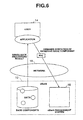
- Fig. 6 indicates an ASP mode including base components (see Fig. 5), that is, a system flow for the user 14B.
- a booting component is started in the phase of executing such base component or cPackage, and is automatically connected to a management system 18 of the cBank 10 via a network 16.
- a management system 18 After user authentication by the management system 18 (confirmation of the execution key), such base component or cPackage is read from a repository of the cBank 10 and executed in the cBank 10, and then only a processing result is delivered to the application
- the management system 18 processes operations such as the confirmation of the user 14, the execution and monitoring of, and charging for, etc., a reserved base component or a reserved cPackage.
- a method for processing such operations can be set in advance in a form corresponding to the number of times, the length of time, the form, etc. of the use of such base component or cPackage.
- the cBank 10 charges a fee either directly to the user 14B or through the development entity 12. This is preferably applied in the case where a fee is charged per transaction.
- the development entity 12 sets (resets) a base component or cPackage in an ASP mode
- the development entity 12 charges a fee to the user 14B.
- the cBank 10, representing the development entity 12 can charge the fee.
- a base component or cPackage is executed within an application without connecting to the cBank 10.
- an agent program attached to the base component or cPackage to inform an execution monitoring system in the management system 18 of the cBank 10 of such execution.
- a charging system for a base component set in a local mode can be applied to a fee system for e.g. a lump sum license fee, a monthly license fee.
- an execution mode of a base component or a cPackage can be set separately; therefore, both an ASP mode and a local mode could be included in an application.
- a user becomes both the user 14A and the user 14B.
- the management system 18 of the cBank 10 has, for example, an execution mode setting table as a method to manage an execution mode setting for each development entity 12 (AA in Table 2).
- the user 14 (A and B in Table 2), applications (Applications 1 through 3 in Table 2), base components and cPackages (Components 1, 3, 4, 5, 6, 7and 9), and charges thereon, can be managed in accordance with the table.
- Fig. 8 is a diagram of a charging system in an execution mode (fixed local mode, variable compile mode, variable ASP mode and fixed ASP mode) set by the cBank 10, which is a business entity.
- the development entity 12 has a base component or cPackage in a variable mode, that is, in a state in which the execution mode can be varied, and, as a result, the development entity 12 are provided with three charging systems in local modes (C1 through C3) and four in ASP modes (ASP1 through ASP4).
- the development entity sets the fee structures and charges the end users.
- cBank and the development entity make an arrangement regarding the charging system, the fee structure and the division of areas between them.
- cBank is provided with an online payment function for every charge generated; therefore, this function can be used as necessary.
- a flow for using the base component or cPackage of the present system is described below for each execution mode in reference to Fig. 9.
- Fig. 9 (A) in the case of a base component or cPackage in a local mode only, when the user 14 executes an application provided by the development entity 12, which has been prepared using a base component or cPackage stored in the cBank 10, it is unnecessary for the user 14 to access the cBank 10 and the development entity 12 upon execution of the application as the base component or cPackage is included in the application.
- a booting component or proxy is incorporated in the application instead.
- the booting component is started and accesses the base component or cPackage stored in the cBank 10, and processing is performed in the cBank 10, and only a processing result is sent back.
- Fig. 9 (C) when an execution mode is reset by the development entity 12 from a local mode to an ASP mode and the cBank conducts the ASP business representing the development entity 12, a base component or cPackage in a local mode is copied onto an ASP mode and then used in an application prepared by the development entity 12. Except for this point, the processes are the same as those in Fig. 9 (B).
- Fig. 9 (D) when an execution mode is reset by the development entity 12 from an ASP mode to a local mode, a base component or cPackage in an ASP mode is copied by the cBank 10 onto a local mode and then incorporated into an application prepared by the development entity 12. Except for this point, the processes are the same as those in Fig. 9 (A).
- a component or cPackage in a local mode is copied by the cBank 10 onto an ASP mode and then transferred to the development entity 12 (in accordance with a prescribed license agreement), and a booting component is incorporated in an application to be delivered to a user.
- the user 14 uses the base component or cPackage in an ASP mode, by accessing the development entity 12, the base component or cPackage in an ASP mode, which has been transferred to the development entity 12, performs processing, and only a processing result is sent back to the user 14.
- Methods for switching the execution modes include a method in which a local or ASP function is provided in advance to each component and is automatically switched upon the receipt of a direction at the time of setting/resetting, and a method in which two components (ASP mode component and local mode component) are prepared and either can be selected in accordance with a setting/resetting.
- an application is developed by the development entity 12 in an execution mode that is either an ASP mode conforming to a conventional ASP business or a local mode in which a base component or cPackage is incorporated in the application, by centering the cBank 10, which is a business entity that manages base components or a cPackage hierarchically constructed from based components.
- an appropriate charging system is set up according to the execution mode. Therefore, a network of ASP business can be built, thereby contributing to the expansion of stand-alone ASP business.
- ASP business using a base component or a cPackage can be entrusted to the business entity 12 as necessary, rather than having the cBank 10 collectively manage the same all the time, and a base component or a cPackage, which belongs to a new business entity 12, can also be written in the cBank 10.
- a home server as described below is a common example of use of the components in an ASP mode.
- a home has a home server and that all electric appliances in the home are connected via a network (wired or wireless).
- the ASP booting component in the ASP server is started and checks the names of the part and its maker in the information provided on the malfunction and searches for a substitute part from a maker that is compatible with the maker of the part, and then reports the name of the part, maker, price, delivery date and provides an order button, to the home server.
- a settlement booting component in the application When a person in the home pushes an order button corresponding to the most favorable maker's part, a settlement booting component in the application is started, and accesses a server of a credit company, etc., that provides payment services, and a settlement component confirms the person's bank account and performs the payment processing.
- the present invention has advantages of further developing the conventional ASP business by collectively managing application software, which incorporates a plurality of components, on the basis of the components, and of reducing the burden on users by responding to their needs.
Landscapes
- Engineering & Computer Science (AREA)
- Theoretical Computer Science (AREA)
- Software Systems (AREA)
- General Engineering & Computer Science (AREA)
- Physics & Mathematics (AREA)
- General Physics & Mathematics (AREA)
- Computer Hardware Design (AREA)
- Computer Security & Cryptography (AREA)
- Multimedia (AREA)
- Technology Law (AREA)
- Mathematical Physics (AREA)
- Databases & Information Systems (AREA)
- Data Mining & Analysis (AREA)
- Stored Programmes (AREA)
- Management, Administration, Business Operations System, And Electronic Commerce (AREA)
- Data Exchanges In Wide-Area Networks (AREA)
- Information Transfer Between Computers (AREA)
Applications Claiming Priority (3)
| Application Number | Priority Date | Filing Date | Title |
|---|---|---|---|
| JP2000287473A JP2002099340A (ja) | 2000-09-21 | 2000-09-21 | コンポーネント・サービス・ネットワークシステム |
| JP2000287473 | 2000-09-21 | ||
| PCT/JP2001/008250 WO2002025412A1 (en) | 2000-09-21 | 2001-09-21 | Component service network system |
Publications (2)
| Publication Number | Publication Date |
|---|---|
| EP1353258A1 true EP1353258A1 (de) | 2003-10-15 |
| EP1353258A4 EP1353258A4 (de) | 2005-08-17 |
Family
ID=18771211
Family Applications (1)
| Application Number | Title | Priority Date | Filing Date |
|---|---|---|---|
| EP01967788A Withdrawn EP1353258A4 (de) | 2000-09-21 | 2001-09-21 | Komponentendienstnetzsystem |
Country Status (7)
| Country | Link |
|---|---|
| US (1) | US20050177813A1 (de) |
| EP (1) | EP1353258A4 (de) |
| JP (1) | JP2002099340A (de) |
| KR (1) | KR20030060896A (de) |
| CN (1) | CN1232895C (de) |
| AU (1) | AU2001288097A1 (de) |
| WO (1) | WO2002025412A1 (de) |
Cited By (1)
| Publication number | Priority date | Publication date | Assignee | Title |
|---|---|---|---|---|
| WO2006117721A2 (en) | 2005-05-02 | 2006-11-09 | Nxp B.V. | Receiver with adaptive strobe offset adjustment |
Families Citing this family (2)
| Publication number | Priority date | Publication date | Assignee | Title |
|---|---|---|---|---|
| CN100456247C (zh) * | 2002-12-26 | 2009-01-28 | 捷讯研究有限公司 | 用于建立无线组件应用的方法、移动通信装置和服务器 |
| US7930363B2 (en) | 2005-10-12 | 2011-04-19 | Powerreviews, Inc. | Application service provider delivery system |
Family Cites Families (8)
| Publication number | Priority date | Publication date | Assignee | Title |
|---|---|---|---|---|
| JPH086660A (ja) * | 1994-06-23 | 1996-01-12 | Hitachi Ltd | 課金処理方式 |
| US5850518A (en) * | 1994-12-12 | 1998-12-15 | Northrup; Charles J. | Access-method-independent exchange |
| EP0809221A3 (de) * | 1996-05-23 | 1999-06-30 | Sun Microsystems, Inc. | Virtuelles Verkaufsystem und Verfahren zum Verwalten der Verteilung, der Lizenzierung und der Vermietung von elektronischen Daten |
| JPH1020956A (ja) * | 1996-06-28 | 1998-01-23 | Nippon Telegr & Teleph Corp <Ntt> | ソフトウェア課金方法及びシステム |
| US6021492A (en) * | 1996-10-09 | 2000-02-01 | Hewlett-Packard Company | Software metering management of remote computing devices |
| US6056786A (en) * | 1997-07-11 | 2000-05-02 | International Business Machines Corp. | Technique for monitoring for license compliance for client-server software |
| US6188995B1 (en) * | 1997-07-28 | 2001-02-13 | Apple Computer, Inc. | Method and apparatus for enforcing software licenses |
| US20020022971A1 (en) * | 2000-08-21 | 2002-02-21 | Masanori Tanaka | Software rental system, software rental method, and computer program for being executed on the software rental system |
-
2000
- 2000-09-21 JP JP2000287473A patent/JP2002099340A/ja active Pending
-
2001
- 2001-09-21 AU AU2001288097A patent/AU2001288097A1/en not_active Abandoned
- 2001-09-21 WO PCT/JP2001/008250 patent/WO2002025412A1/ja not_active Ceased
- 2001-09-21 KR KR10-2003-7004135A patent/KR20030060896A/ko not_active Ceased
- 2001-09-21 EP EP01967788A patent/EP1353258A4/de not_active Withdrawn
- 2001-09-21 CN CNB018161391A patent/CN1232895C/zh not_active Expired - Fee Related
- 2001-09-21 US US10/381,151 patent/US20050177813A1/en not_active Abandoned
Cited By (1)
| Publication number | Priority date | Publication date | Assignee | Title |
|---|---|---|---|---|
| WO2006117721A2 (en) | 2005-05-02 | 2006-11-09 | Nxp B.V. | Receiver with adaptive strobe offset adjustment |
Also Published As
| Publication number | Publication date |
|---|---|
| KR20030060896A (ko) | 2003-07-16 |
| WO2002025412A1 (en) | 2002-03-28 |
| CN1232895C (zh) | 2005-12-21 |
| EP1353258A4 (de) | 2005-08-17 |
| JP2002099340A (ja) | 2002-04-05 |
| CN1462381A (zh) | 2003-12-17 |
| US20050177813A1 (en) | 2005-08-11 |
| AU2001288097A1 (en) | 2002-04-02 |
Similar Documents
| Publication | Publication Date | Title |
|---|---|---|
| US6023766A (en) | Software license control system and software license control equipment | |
| US5438508A (en) | License document interchange format for license management system | |
| US5204897A (en) | Management interface for license management system | |
| US5260999A (en) | Filters in license management system | |
| EP0538453B1 (de) | Verwaltungssschnittstelle und format für lizenzverwaltungssystem | |
| JP2001236232A (ja) | Icカードシステム、icカード、icカード処理方法及び記録媒体 | |
| JPH06500878A (ja) | ライセンス管理システム | |
| JP2003256062A (ja) | アプリケーション等利用期限管理システム | |
| EP1523151A2 (de) | Verfahren, Anwendungsserver, Programm für Datenverarbeitungsanlagen, sowie zugehöriges Produkt zur automatischen Erzeugung und Konfiguration von Lizenzmodellen und -richtlinien | |
| JP2002163555A5 (de) | ||
| EP1353258A1 (de) | Komponentendienstnetzsystem | |
| CN113850577A (zh) | 资源账户处理方法及装置 | |
| CA2496672A1 (en) | Secured method to exchange data between a browser and a web site | |
| JP2003256670A (ja) | ソフトウェアの分散管理型ネット販売方法及びプロテクトプログラム | |
| EP4538881A1 (de) | Verfahren zur zuweisung virtueller ressourcen und zugehörige vorrichtung | |
| JP2003044602A (ja) | アプリケーション提供装置及びアプリケーション提供方法 | |
| JP3886715B2 (ja) | コンポーネント・サービス・ネットワークシステム | |
| CN110598884A (zh) | 家用电器的预约控制方法、预约控制装置及存储介质 | |
| JPH09319575A (ja) | 有償プログラムのオンラインによる使用権承認方式 | |
| JP7678507B2 (ja) | 貸出管理システム、貸出管理方法、および貸出管理プログラム | |
| CN102739789A (zh) | 服务处理方法及装置、服务提供方法及装置、服务系统 | |
| CN116805947B (zh) | 区块链数据处理方法、装置、设备及计算机可读存储介质 | |
| JP2024158908A (ja) | 利用契約システム、利用契約方法、および利用契約プログラム | |
| WO2003036530A1 (en) | A method and a system for licensing digital resources and services | |
| Wesner et al. | Application Service Provision |
Legal Events
| Date | Code | Title | Description |
|---|---|---|---|
| PUAI | Public reference made under article 153(3) epc to a published international application that has entered the european phase |
Free format text: ORIGINAL CODE: 0009012 |
|
| 17P | Request for examination filed |
Effective date: 20030418 |
|
| AK | Designated contracting states |
Kind code of ref document: A1 Designated state(s): AT BE CH CY DE DK ES FI FR GB GR IE IT LI LU MC NL PT SE TR |
|
| AX | Request for extension of the european patent |
Extension state: AL LT LV MK RO SI |
|
| A4 | Supplementary search report drawn up and despatched |
Effective date: 20050704 |
|
| STAA | Information on the status of an ep patent application or granted ep patent |
Free format text: STATUS: THE APPLICATION IS DEEMED TO BE WITHDRAWN |
|
| 18D | Application deemed to be withdrawn |
Effective date: 20061128 |