EP1353383A2 - Bildsensorsvorrichtung mit einer Vielzahl von Ausgangskanälen - Google Patents
Bildsensorsvorrichtung mit einer Vielzahl von Ausgangskanälen Download PDFInfo
- Publication number
- EP1353383A2 EP1353383A2 EP03252142A EP03252142A EP1353383A2 EP 1353383 A2 EP1353383 A2 EP 1353383A2 EP 03252142 A EP03252142 A EP 03252142A EP 03252142 A EP03252142 A EP 03252142A EP 1353383 A2 EP1353383 A2 EP 1353383A2
- Authority
- EP
- European Patent Office
- Prior art keywords
- electric charge
- image
- area
- ccd
- sensing device
- Prior art date
- Legal status (The legal status is an assumption and is not a legal conclusion. Google has not performed a legal analysis and makes no representation as to the accuracy of the status listed.)
- Withdrawn
Links
- 238000001444 catalytic combustion detection Methods 0.000 claims description 99
- 230000003287 optical effect Effects 0.000 claims description 22
- 238000003384 imaging method Methods 0.000 description 7
- 239000007787 solid Substances 0.000 description 5
- 238000001514 detection method Methods 0.000 description 3
- 230000006866 deterioration Effects 0.000 description 2
- 238000010586 diagram Methods 0.000 description 2
- 238000010276 construction Methods 0.000 description 1
Images


Classifications
-
- H—ELECTRICITY
- H04—ELECTRIC COMMUNICATION TECHNIQUE
- H04N—PICTORIAL COMMUNICATION, e.g. TELEVISION
- H04N25/00—Circuitry of solid-state image sensors [SSIS]; Control thereof
- H04N25/40—Extracting pixel data from image sensors by controlling scanning circuits, e.g. by modifying the number of pixels sampled or to be sampled
- H04N25/41—Extracting pixel data from a plurality of image sensors simultaneously picking up an image, e.g. for increasing the field of view by combining the outputs of a plurality of sensors
-
- H—ELECTRICITY
- H04—ELECTRIC COMMUNICATION TECHNIQUE
- H04N—PICTORIAL COMMUNICATION, e.g. TELEVISION
- H04N25/00—Circuitry of solid-state image sensors [SSIS]; Control thereof
- H04N25/60—Noise processing, e.g. detecting, correcting, reducing or removing noise
- H04N25/62—Detection or reduction of noise due to excess charges produced by the exposure, e.g. smear, blooming, ghost image, crosstalk or leakage between pixels
- H04N25/625—Detection or reduction of noise due to excess charges produced by the exposure, e.g. smear, blooming, ghost image, crosstalk or leakage between pixels for the control of smear
-
- H—ELECTRICITY
- H04—ELECTRIC COMMUNICATION TECHNIQUE
- H04N—PICTORIAL COMMUNICATION, e.g. TELEVISION
- H04N25/00—Circuitry of solid-state image sensors [SSIS]; Control thereof
- H04N25/60—Noise processing, e.g. detecting, correcting, reducing or removing noise
- H04N25/63—Noise processing, e.g. detecting, correcting, reducing or removing noise applied to dark current
- H04N25/633—Noise processing, e.g. detecting, correcting, reducing or removing noise applied to dark current by using optical black pixels
-
- H—ELECTRICITY
- H04—ELECTRIC COMMUNICATION TECHNIQUE
- H04N—PICTORIAL COMMUNICATION, e.g. TELEVISION
- H04N25/00—Circuitry of solid-state image sensors [SSIS]; Control thereof
- H04N25/60—Noise processing, e.g. detecting, correcting, reducing or removing noise
- H04N25/67—Noise processing, e.g. detecting, correcting, reducing or removing noise applied to fixed-pattern noise, e.g. non-uniformity of response
- H04N25/671—Noise processing, e.g. detecting, correcting, reducing or removing noise applied to fixed-pattern noise, e.g. non-uniformity of response for non-uniformity detection or correction
- H04N25/672—Noise processing, e.g. detecting, correcting, reducing or removing noise applied to fixed-pattern noise, e.g. non-uniformity of response for non-uniformity detection or correction between adjacent sensors or output registers for reading a single image
-
- H—ELECTRICITY
- H04—ELECTRIC COMMUNICATION TECHNIQUE
- H04N—PICTORIAL COMMUNICATION, e.g. TELEVISION
- H04N25/00—Circuitry of solid-state image sensors [SSIS]; Control thereof
- H04N25/70—SSIS architectures; Circuits associated therewith
- H04N25/71—Charge-coupled device [CCD] sensors; Charge-transfer registers specially adapted for CCD sensors
-
- H—ELECTRICITY
- H04—ELECTRIC COMMUNICATION TECHNIQUE
- H04N—PICTORIAL COMMUNICATION, e.g. TELEVISION
- H04N25/00—Circuitry of solid-state image sensors [SSIS]; Control thereof
- H04N25/70—SSIS architectures; Circuits associated therewith
- H04N25/71—Charge-coupled device [CCD] sensors; Charge-transfer registers specially adapted for CCD sensors
- H04N25/713—Transfer or readout registers; Split readout registers or multiple readout registers
-
- H—ELECTRICITY
- H10—SEMICONDUCTOR DEVICES; ELECTRIC SOLID-STATE DEVICES NOT OTHERWISE PROVIDED FOR
- H10D—INORGANIC ELECTRIC SEMICONDUCTOR DEVICES
- H10D44/00—Charge transfer devices
- H10D44/40—Charge-coupled devices [CCD]
- H10D44/45—Charge-coupled devices [CCD] having field effect produced by insulated gate electrodes
- H10D44/454—Output structures
-
- H—ELECTRICITY
- H10—SEMICONDUCTOR DEVICES; ELECTRIC SOLID-STATE DEVICES NOT OTHERWISE PROVIDED FOR
- H10F—INORGANIC SEMICONDUCTOR DEVICES SENSITIVE TO INFRARED RADIATION, LIGHT, ELECTROMAGNETIC RADIATION OF SHORTER WAVELENGTH OR CORPUSCULAR RADIATION
- H10F39/00—Integrated devices, or assemblies of multiple devices, comprising at least one element covered by group H10F30/00, e.g. radiation detectors comprising photodiode arrays
- H10F39/10—Integrated devices
- H10F39/12—Image sensors
- H10F39/15—Charge-coupled device [CCD] image sensors
- H10F39/153—Two-dimensional or three-dimensional array CCD image sensors
Definitions
- the present invention relates to an image-sensing device having a plurality of output channels for use in a video camera which can obtain a moving picture image and a still picture image.
- a solid state image-sensing device converts optical image into an electric signal, and is used for video camera or digital still camera.
- resolution of a picture depends on a number of pixels in the image-sensing device. Increasing a number of pixels can capture higher resolution images.
- a digital still camera uses an image-sensing device having more pixels than a conventional video camera to obtain higher resolution still picture images.
- a video camera also adopts the function of digital still camera that obtains a still picture image in addition to a moving picture image. Accordingly, the image-sensing device for such a video camera requires more pixels than an image-sensing device for used in a conventional video camera which does not have the function of digital still camera. In addition, a number of pixels in an image-sensing device is increasing every year to obtain higher resolution pictures.
- Fig. 1 is a partial enlarged view of a conventional solid state image-sensing device.
- an image-sensing device is composed of a plurality of photoelectric converters 31 which convert optical image into an electric signal, a plurality of vertical transferring CCDs (hereinafter referred to as VCCD) 32 which transfer an electric charge from the photoelectric converter 31 towards the vertical direction, a horizontal transferring CCD (hereinafter referred to as HCCD) 33 which shifts the electric charge from the VCCD 32 towards the horizontal direction, and an amplifier 34 to amplify the electric charge to be outputted from the HCCD 33.
- VCCD vertical transferring CCDs
- HCCD horizontal transferring CCD
- a timing generator not shown provides a driving pulse signal in every one field period of television signal to the image-sensing device.
- the electric charge in the photoelectric converter 31 is transferred to every adjacent VCCD 32 by the timing of this driving pulse.
- the VCCD 32 shifts the electric charge towards the HCCD 33 one by one stage of the VCCD 32, and the HCCD 33 outputs the electric charge through the amplifier 34 when the VCCD 32 transfers one stage of the electric charge to the HCCD 33. Accordingly, a shift velocity of electric charge in the HCCD 33 is set to a velocity which outputs all the electric charges through the amplifier 34 every time the electric charge is transferred from the VCCD 32.
- the clock frequency for transferring electric charge should also be increased and set faster as a number of pixels increases.
- Fig. 2 is a plan view of an image-sensing device in accordance with the related art.
- the image-sensing device is composed of a pixel area 41 including a photoelectric converter and a VCCD, two HCCDs 42 and 43 for shifting an electric charge transferred from a VCCD in the pixel area 41, two adders 44 and 45 to add a reference signal on the electric charge to be outputted, and two amplifiers 46 and 47 to amplify the reference signal and the electric charge for predetermined level.
- the electric charge transferred from the VCCD in the pixel area 41 is supplied to the HCCD 42 and the HCCD 43 respectively and then shifted towards the horizontal direction. Accordingly, the clock frequency necessary for shifting an electric charge in the HCCDs 42 and 43 can be set to half a frequency of using only one HCCD.
- a pixel size of an image-sensing device becomes smaller as a number of pixels becomes bigger.
- the smaller pixel size deteriorates the transferring efficiency of an electric charge from VCCD to the HCCD 43 and resulted in affecting the quality of the picture.
- the size of camera itself is miniaturized including an optical mechanism that the size of the image-sensing device also becomes very small (such as 1/3 inch size or 1/4 inch size, etc.).
- the size of the image-sensing device may deteriorate the transferring efficiency of an electric charge which affects the picture quality.
- the present invention provides an image-sensing device having over one million pixel which obtains good quality of pictures in full screen with suppressing the transferring clock frequency.
- an image-sensing device having a plurality of output channels including a pixel area having a plurality of first photoelectric converters (21a, 21b) to convert an optical image into an electric charge and a plurality of first vertical CCDs (22a, 22b) to transfer the electric charge vertically, an optical black area (15a, 15b, and 16) having a plurality of second photoelectric converters to produce an electric charge in optical black level and a plurality of second vertical CCDs to vertically transfer the electric charge disposed on both sides of the pixel area, a horizontal shift area (13a, 13b) having first and second horizontal CCDs to horizontally shift the electric charge transferred from the plurality of first and second vertical CCDs, an adder (17) for adding a reference signal to the plurality of first and second vertical CCDs, and an adjusting portion (4) for adjusting a level of electric charge outputted from the first and second horizontal CCDs, wherein the pixel area and the optical black area are divided into
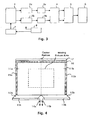
- Fig. 3 is a block diagram of an imaging apparatus using an image-sensing device in accordance with the present invention.
- an imaging apparatus is composed of a solid state image-sensing device 1 to output an electric signal converted from an optical image, CDS/AG circuits 2a and 2b which clamp the signal outputted from each channel of the image-sensing device 1 and eliminate a noise element from the output signal and control the signal level thereof, A/D converters 3a and 3b which convert the output signal into a CCD signal in digital signal form, and an adjusting circuit 4 which adjusts the CCD signal level of each channel, a line converter 5 which converts a screen direction of the CCD signal, a Y/C processor 6 which carries out signal processing such as gamma correction and aperture control for the CCD signal, a timing generator 7 which provides a driving pulse for the image-sensing device 1, and a control circuit 8 which controls each element of the imaging apparatus.
- CDS/AG circuits 2a and 2b which clamp the signal output
- Fig. 4 is a plan view of the image-sensing device in accordance with the present invention.
- the image-sensing device 1 is composed of pixel areas 11a and 11b, slide shift areas 12a and 12b, HCCDs 13a and 13b, amplifiers 14a and 14b, horizontal optical black (OB) areas 15a and 15b, vertical optical black (OB) area 16, and vertical adder 17.
- OB optical black
- OB vertical optical black
- the pixel areas 11a and 11b have a plurality of photoelectric converters in horizontal and vertical array therein to convert an optical image into an electric charge, and have VCCDs to shift the electric charge towards the vertical direction and transfer the electric charge to the slide shift areas 12a and 12b.
- the slide shift areas 12a and 12b have a plurality of CCDs which shift the electric charge towards oblique direction.
- the HCCDs 13a and 13b shift the electric charge from the slide shift areas 12a and 12b towards the horizontal direction respectively.
- the amplifiers 14a and 14b amplify the electric charge outputted from the HCCDs 13a and 13b respectively.
- the horizontal OB areas 15a and 15b output electric charge signals for the reference of optical black level to the vertical OB area 16.
- the vertical adder 17 adds an electric charge of predetermined level (also referred to as vertical reference signal) to the vertical OB area 16.
- Fig. 5 is a plan view of an output stage of HCCD in the image-sensing device according to the present invention.
- an output stage of the image-sensing device is composed of a plurality of photoelectric converters 21a in the pixel area 11a shown in Fig. 4 which outputs the electric charge converted from the optical image, a plurality of VCCDs 22a which transfers the electric charge from the photoelectric converter 21a towards the vertical direction, a plurality of slide shift CCDs 23a which shifts the electric charge transferred from the VCCD 22a towards the oblique direction to the HCCD 13a, a plurality of photoelectric converters 21b in the pixel area 11b shown in Fig.
- the photoelectric converter 21a and the VCCD 22a are included in the pixel areas 11a, and the slide shift CCD 23a is included in the slide shift area 12a shown in Fig. 4.
- the pixel area 11b shown in Fig. 4 has the plurality of photoelectric converters 21b, the plurality of VCCDs 22b, the plurality of slide shift CCDs 23b, which also obtain the electric charge and transfer the electric charge to the HCCD 13b.
- the horizontal OB area 15a and 15b shown in Fig. 4 also include the photoelectric converters 21a and 21b and the VCCDs 22a and 22b respectively.
- the photoelectric converters 21a and 21b and the VCCDs 22a and 22b in the horizontal OB areas 15a and 15b are covered by mask shield.
- the OB areas 15a and 15b are covered by mask shield to block the light from reaching the photoelectric converter 21 formed in the OB areas 15a and 15b.
- the vertical adder 17 outputs an electric charge to be added to a first electric charge shifted from the VCCD in the vertical optical black area 16.
- the imaging apparatus obtains a still picture image in still picture image mode and a moving picture image in moving picture image mode, respectively.
- the still picture image mode all CCDs in the pixel areas 11a and 11b of the image-sensing device, shown in Fig. 4, is utilized to output CCD signal.
- the moving picture image mode a limited pixel area surrounded by the dotted line in Fig. 4 is utilized to output a CCD signal.
- the horizontal and vertical OB information, and the vertical reference signal are outputted irrespective of the operation mode of either still picture image mode or moving picture image mode.
- the CCD signal is outputted from all CCDs in the pixel areas 11a and 11b for one time.
- the CCD signal is outputted from the CCD in the pixel area surrounded by the dotted line shown in Fig. 4 for once in every predetermined period.
- the CCD signal outputted from the image-sensing device 1 is adjusted by the horizontal and vertical reference signals, and further by the horizontal and vertical OB information, irrespective of the still or moving picture image mode.
- the control circuit 8 controls the timing generator 7 to provide the driving pulse to the image-sensing device 1.
- the driving pulse includes a read-out pulse of the photoelectric converters 21a and 21b, a vertical driving pulse for the VCCDs 22a and 22b, a driving pulse for the slide shift CCDs 23a and 23b, and a horizontal driving pulse for the HCCDs 13a and 13b.
- the timing generator 7 provides a read-out pulse to the image-sensing device 1
- the electric charge accumulated in the photoelectric converters 21a and 21b in the area including the horizontal OB area 15a and 15b and the vertical OB area 16 are all transferred to adjacent VCCDs 22a and 22b at the same time.
- the electric charge is shifted to the HCCDs 13a and 13b by the timing of the vertical driving pulse from the timing generator 7, and subsequently, the electric charge transferred from the vertical adder 17 to the VCCDs 22a and 22b are also shifted to the HCCDs 13a and 13b.
- the driving pulse for the HCCDs 21a and 21b is also provided to the slide shift CCDs 23a and 23b that the electric charge is shifted to the oblique direction by the timing of the driving pulse.
- the electric charge shifted in the slide shift area 12a is transferred to the HCCD 13a and the electric charge shifted in the slide shift area 12b is transferred to the HCCD 13b, respectively.
- the electric charge from the photoelectric converter 21a in the pixel area 11a and in the horizontal OB area 15a are transferred to the HCCD 13a through the VCCD 22a and the slide shift CCD 23a.
- the electric charges from the photoelectric converter 21b in the pixel area 11b and in the horizontal OB area 15b are transferred to the HCCD 13b through the VCCD 22b and the slide shift CCD 23b.
- the electric charge from the photoelectric converter in the vertical OB area 16 and the electric charge from the vertical adder 17 are shifted to the slide shift CCDs 23a and 23b through the VCCDs 22a and 22b one by one stage.
- the electric charge in the center portion is transferred through the pixel areas 11a and 11b to the slide shift CCDs 23a and 23b.
- the electric charge in each side of the pixel areas 11a and 11b is transferred through the horizontal OB areas 15a and 15b to the slide shift CCDs 23a and 23b.
- the electric charge is then transferred to the HCCD 13a and the HCCD 13b, and is shifted to the horizontal direction.
- the HCCDs 13a and 13b are provided with the horizontal driving pulse respectively.
- the two driving pulses have different phase that the electric charges in the HCCD 13a and the HCCD 13b are shifted towards opposite direction from each other.
- Fig. 6 (a) shows a waveform of CCD signal outputted from the amplifier 14a for one scan line.
- Fig. 6 (b) shows a waveform of CCD signal outputted from the amplifier 14b for one scan line.
- the electric charge in the pixel area 11a is outputted from the pixels in right to left side
- the electric charge in the pixel area 11b is outputted from the pixels in left to right side.
- Each electric charge in the pixel areas 11a and 11b is transferred to the different direction respectively.
- the electric charge in the divided two pixel areas 11a and 11b are outputted from divided border which is the center of the whole pixel area. In this sense, a number of transferring stages for shifting electric charge towards the horizontal direction in the pixel areas 11a and 11b becomes the same.
- the photoelectric converters in the pixel areas 11a and 11b are in a line symmetric position with respect to the divided border that the number of transferring stages becomes the same in each pixel area. This prevents the difference of picture level in the pixel areas 11a and 11b which affects the quality of the picture.
- Fig. 6 (c) shows one scan line of a vertical reference signal outputted from the vertical adder 17 and transferred through the vertical OB area 16, the pixel area 11a, the slide shift area 12a, and the HCCD 13a.
- Fig. 6 (d) shows one scan line of a vertical reference signal outputted from the vertical adder 17 and transferred through the vertical OB area 16, the pixel area 11b, the slide shift area 12b, and the HCCD 13b.
- the electric charge in the pixel areas 11a and 11b, and the horizontal OB areas 15a and 15b shown in Fig. 4 are outputted from the bottom line through the top line of the pixel area that one screen of the picture information [for one screen] is outputted.
- this signal processing is conducted for every predetermined period in the moving picture image mode.
- the image-sensing device 1 obtains two channels of CCD signals from the HCCDs 13a and 13b respectively. These two channel signals may include an error as explained below.
- the error is caused by the difference of transferring efficiency of the electric charge in the center of the pixel area and in each side of the pixel areas.
- the image-sensing device which can be used in the still picture image mode and the moving picture image mode, there is a large number of photoelectric converters and transferring CCDs in the pixel area that the transferring efficiency of the electric charge becomes different between the center portion and each side portion of the pixel area. This may cause the difference of the driving condition of the VCCD in the center portion and in both side portions of the pixel area.
- the error between two channels of CCD signals may also be caused by a connecting angle of the VCCDs 22a and 22b and the HCCDs 13a and 13b. Further more, the transferring efficiency of the slide shift CCDs 23a and 23b are inferior to the VCCDs 22a and 22b in principle. This may also cause the error in the two channels of CCD signals.
- the imaging apparatus in accordance with the present invention takes care of the error that it adjusts a CCD signal of each channel. For this reason, each channel of the CCD signal outputted from the image-sensing device 1 is provided to the CDS/AG circuits 2a and 2b respectively, and subsequently to the A/D converters 3a and 3b, and then to the adjusting circuit 4.
- the CDS/AGC circuits 2a and 2b clamp the CCD signal to eliminate a noise element and adjust the signal level thereof.
- the A/D converters 3a and 3b convert the CCD signal from the CDS/AGC circuits 2a and 2b into a digital signal form, and the adjusting circuit 4 adjusts the level of each channel of CCD signals.
- the adjusting circuit 4 detects a smear element in the CCD signal outputted from the A/D converters 3a and 3b based on the vertical OB information.
- the vertical OB information in the CCD signal is compared with a predetermined threshold level to detect the smear in the CCD signal.
- the detection of the smear in CCD signal can be conducted accurately by utilizing plural OB information in the plural lines.
- the level of the vertical reference signal may have been affected by the occurrence of the smear that the neighbor of the vertical reference signal can not be utilized as is.
- the vertical reference signal level of the CCD signal outputted from the pixel area 11a becomes bigger than that of the CCD signal outputted from the pixel area 11b.
- the vertical reference signal in the horizontal OB areas 15a and 15b is utilized for level adjustment because it has little influence of the smear.
- the vertical reference signal from both sides of the pixel area is used for adjustment of the level of vertical reference signal outputted from the HCCDs 13a and 13b. This can absorb the variation of transferring efficiency of the slide shift CCDs 23a and 23b, and the HCCDs 13a and 13b.
- the vertical reference signal outputted from the center portion of the vertical adder 17 is utilized for making the same reference signal level as the CCD signal in each channel. This is because the transferring efficiency of the electric charge in the center portion of the pixel area visibly affects the picture image. Accordingly, the adjustment of the reference signal in the center portion of the vertical adder 17 absorbs the variation of the transferring efficiency in the VCCDs 22a and 22b, and the slide shift CCDs 23a and 23b contiguous to the center of the pixel area.
- the adjustment can be conducted more accurately by the clamp processing of the CDS/AGC circuits 2a and 2b utilizing the vertical OB information outputted from the same horizontal position of the vertical reference signal in each channel.
- the vertical OB information through the horizontal OB areas 15a and 15b is utilized for the clamp processing of the CDS/AGC circuits 2a and 2b when the smear is detected, and the vertical OB information through the center of the pixel area, i.e. the border of the pixel area 11a and 11b is utilized for the clamp processing of CDS/AGC circuit 2a and 2b when the smear is not detected.
- the vertical reference signal from the center of the pixel area and from the horizontal OB areas 15a and 15b can be used for channel level adjustment.
- the vertical reference signal not only from the border of the pixel areas 15a and 15b but also from both sides of the pixel area, can be used for level adjustment.
- "shading" which is caused by deterioration of electric charge level upon shifting through plural stages can also be adjusted.
- all vertical reference signals can be utilized for level adjustment. Practically all reference signals can be used for the adjustment by calculating the average of all the reference signals, and adjusts the signal level of both channels of the CCD signal.
- the CCD signal is provided to the line converter 5. Then the CCD signal obtained from the pixel area 11a is reversed in the line direction.
- Fig. 6 (e) shows an example of CCD signal to be provided to the line converter 5.
- Each channel of the CCD signal is combined to form one CCD signal and is supplied to the Y/C processor 6.
- the Y/C processor conducts signal processing such as gamma correction and aperture control.
- the embodiment of the present invention describes that the level adjustment of each channel of the CCD signal is conducted by utilizing the vertical reference signal provided by the vertical adder 17.
- the vertical adder 17 for supplying horizontal electric charge to the top of line information can be provided between the HCCD 13a and the amplifier 14a and between the HCCD 13b and the amplifier 14b to adjust the level of each channel of the CCD signal.
- the reference signal is provided to the first and second vertical CCDs, so that the signal level of each channel of the CCD signal can be adjusted suitably.
- the imaging apparatus can also adjust such variation by the vertical reference signal to be added to each channel of the CCD signal.
- the CCD signal level of each channel is adjusted by the reference signal obtained from the border of the pixel area, so that the level of the CCD signal can be adjusted more accurately.
- the reference signal in such a CCD signal is not utilized for level adjustment and the other channel of the CCD signal is used, so that the CCD signal can be adjusted more accurately irrespective of the detection of the smear.
Landscapes
- Engineering & Computer Science (AREA)
- Multimedia (AREA)
- Signal Processing (AREA)
- Transforming Light Signals Into Electric Signals (AREA)
- Solid State Image Pick-Up Elements (AREA)
Applications Claiming Priority (2)
| Application Number | Priority Date | Filing Date | Title |
|---|---|---|---|
| JP2002107569 | 2002-04-10 | ||
| JP2002107569A JP3879987B2 (ja) | 2002-04-10 | 2002-04-10 | 撮像装置 |
Publications (2)
| Publication Number | Publication Date |
|---|---|
| EP1353383A2 true EP1353383A2 (de) | 2003-10-15 |
| EP1353383A3 EP1353383A3 (de) | 2007-06-20 |
Family
ID=28449939
Family Applications (1)
| Application Number | Title | Priority Date | Filing Date |
|---|---|---|---|
| EP03252142A Withdrawn EP1353383A3 (de) | 2002-04-10 | 2003-04-04 | Bildsensorsvorrichtung mit einer Vielzahl von Ausgangskanälen |
Country Status (3)
| Country | Link |
|---|---|
| US (1) | US7277128B2 (de) |
| EP (1) | EP1353383A3 (de) |
| JP (1) | JP3879987B2 (de) |
Cited By (2)
| Publication number | Priority date | Publication date | Assignee | Title |
|---|---|---|---|---|
| WO2014057148A3 (es) * | 2012-10-10 | 2014-06-12 | Universidad De Sevilla | Procedimiento de vitrificación de material biológico mediante microcapilares de polímeros termoplásticos cerrados introducidos en fluidos criogénicos |
| CN105376507A (zh) * | 2015-10-09 | 2016-03-02 | 中国电子科技集团公司第四十四研究所 | Ccd多路输出结构 |
Families Citing this family (15)
| Publication number | Priority date | Publication date | Assignee | Title |
|---|---|---|---|---|
| JP4497872B2 (ja) * | 2003-09-10 | 2010-07-07 | キヤノン株式会社 | 撮像装置 |
| US7522205B2 (en) * | 2004-09-10 | 2009-04-21 | Eastman Kodak Company | Image sensor with charge multiplication |
| JP4625685B2 (ja) * | 2004-11-26 | 2011-02-02 | 株式会社東芝 | 固体撮像装置 |
| JP4636895B2 (ja) * | 2005-02-07 | 2011-02-23 | 三洋電機株式会社 | 電子カメラ |
| JP4612848B2 (ja) * | 2005-02-16 | 2011-01-12 | キヤノン株式会社 | 撮像装置及びその制御方法 |
| KR100660862B1 (ko) * | 2005-02-23 | 2006-12-26 | 삼성전자주식회사 | 동일 색상의 화소 데이터를 가산하여 출력하는 컬러 촬상장치 및 그 화소 데이터 독출 방법 |
| JP4731278B2 (ja) * | 2005-10-25 | 2011-07-20 | パナソニック株式会社 | 固体撮像素子の駆動法方法 |
| JP2007259135A (ja) * | 2006-03-23 | 2007-10-04 | Fujifilm Corp | 撮像装置およびその駆動方法 |
| JP4434250B2 (ja) * | 2007-09-21 | 2010-03-17 | ソニー株式会社 | 画像信号処理回路、撮像装置、および画像信号処理方法、並びにコンピュータ・プログラム |
| JP5254830B2 (ja) * | 2009-02-03 | 2013-08-07 | キヤノン株式会社 | 撮像装置及びその制御方法及びプログラム |
| US8053716B1 (en) * | 2009-05-12 | 2011-11-08 | Lockheed Martin Corporation | Method and apparatus for determining the time and location of light flashes |
| US8878256B2 (en) * | 2013-01-07 | 2014-11-04 | Semiconductor Components Industries, Llc | Image sensors with multiple output structures |
| US8878255B2 (en) * | 2013-01-07 | 2014-11-04 | Semiconductor Components Industries, Llc | Image sensors with multiple output structures |
| JP2015091005A (ja) * | 2013-11-05 | 2015-05-11 | オリンパス株式会社 | 撮像装置 |
| CN108305576B (zh) | 2017-01-13 | 2021-11-30 | 元太科技工业股份有限公司 | 显示装置 |
Citations (2)
| Publication number | Priority date | Publication date | Assignee | Title |
|---|---|---|---|---|
| US5467128A (en) * | 1994-01-19 | 1995-11-14 | The Regents Of The University Of California, Office Of Technology Transfer | High speed imager test station |
| JP2000138869A (ja) * | 1998-10-30 | 2000-05-16 | Victor Co Of Japan Ltd | 撮像装置 |
Family Cites Families (12)
| Publication number | Priority date | Publication date | Assignee | Title |
|---|---|---|---|---|
| JPS5911674A (ja) | 1982-07-12 | 1984-01-21 | Nec Corp | 固体撮像装置 |
| US4523326A (en) * | 1983-01-17 | 1985-06-11 | Hughes Aircraft Company | Low noise charge coupled imager circuit |
| US4541068A (en) * | 1983-05-23 | 1985-09-10 | Rca Corporation | Reducing noise in introducing bias charge into charge transfer devices |
| JPS6028265A (ja) * | 1983-07-27 | 1985-02-13 | Canon Inc | 電荷転送デバイス |
| US4647977A (en) * | 1985-01-15 | 1987-03-03 | Rca Corporation | Charge-coupled-device parallel-to-serial converter |
| JP2702982B2 (ja) * | 1988-09-14 | 1998-01-26 | 株式会社日立製作所 | 撮像装置 |
| JP2663889B2 (ja) * | 1994-12-21 | 1997-10-15 | 日本電気株式会社 | 二重チャネルの信号処理回路 |
| KR970705894A (ko) | 1995-06-23 | 1997-10-09 | 요트.게.아.롤페즈 | CCD 이미저를 동작시키는 방법과 이러한 방법을 수행시키기에 적합한 CCD 이미저(Method Of operating a CCD imager, and CCD imager suitable for the imple-mentation of such a method) |
| EP0866502A3 (de) * | 1997-03-21 | 1999-01-13 | Dalsa Inc. | Architektur für eine CCD-Bildaufnahmevorrichtung mit mehreren Ausleseregistern |
| JP3574563B2 (ja) | 1997-04-04 | 2004-10-06 | ペンタックス株式会社 | 画素信号処理装置 |
| JP3031358B1 (ja) | 1998-09-28 | 2000-04-10 | 日本電気株式会社 | 固体撮像装置 |
| JP3619077B2 (ja) | 1999-09-20 | 2005-02-09 | キヤノン株式会社 | 撮像装置、撮像装置の制御方法及び記憶媒体 |
-
2002
- 2002-04-10 JP JP2002107569A patent/JP3879987B2/ja not_active Expired - Fee Related
-
2003
- 2003-04-04 EP EP03252142A patent/EP1353383A3/de not_active Withdrawn
- 2003-04-08 US US10/408,245 patent/US7277128B2/en not_active Expired - Lifetime
Patent Citations (2)
| Publication number | Priority date | Publication date | Assignee | Title |
|---|---|---|---|---|
| US5467128A (en) * | 1994-01-19 | 1995-11-14 | The Regents Of The University Of California, Office Of Technology Transfer | High speed imager test station |
| JP2000138869A (ja) * | 1998-10-30 | 2000-05-16 | Victor Co Of Japan Ltd | 撮像装置 |
Cited By (2)
| Publication number | Priority date | Publication date | Assignee | Title |
|---|---|---|---|---|
| WO2014057148A3 (es) * | 2012-10-10 | 2014-06-12 | Universidad De Sevilla | Procedimiento de vitrificación de material biológico mediante microcapilares de polímeros termoplásticos cerrados introducidos en fluidos criogénicos |
| CN105376507A (zh) * | 2015-10-09 | 2016-03-02 | 中国电子科技集团公司第四十四研究所 | Ccd多路输出结构 |
Also Published As
| Publication number | Publication date |
|---|---|
| US20030193591A1 (en) | 2003-10-16 |
| JP2003304452A (ja) | 2003-10-24 |
| JP3879987B2 (ja) | 2007-02-14 |
| US7277128B2 (en) | 2007-10-02 |
| EP1353383A3 (de) | 2007-06-20 |
Similar Documents
| Publication | Publication Date | Title |
|---|---|---|
| US7466003B2 (en) | Solid state image pickup device, camera, and driving method of solid state image pickup device | |
| CN100438582C (zh) | 固体摄像装置和相机 | |
| US8405750B2 (en) | Image sensors and image reconstruction methods for capturing high dynamic range images | |
| US7277128B2 (en) | Image-sensing device having a plurality of output channels | |
| US7855742B2 (en) | Solid state imaging device with horizontal transfer paths and a driving method therefor | |
| JP4475665B2 (ja) | 固体撮像装置 | |
| US7880789B2 (en) | Solid-state image pick-up apparatus capable of remarkably reducing dark current and a drive method therefor | |
| US20080218598A1 (en) | Imaging method, imaging apparatus, and driving device | |
| US7907193B2 (en) | Image capturing apparatus | |
| JP2868915B2 (ja) | 固体撮像装置 | |
| JP2004282552A (ja) | 固体撮像素子および固体撮像装置 | |
| US20040239790A1 (en) | Image capturing apparatus | |
| US6778215B1 (en) | Driving method of solid-state image pickup device and image pickup system | |
| JPH08251491A (ja) | 固体撮像装置 | |
| JP2005175930A (ja) | 撮像装置及びその信号処理方法と撮像システム | |
| JP2005109994A (ja) | 撮像装置 | |
| JP2000106678A (ja) | 撮像装置 | |
| JP2007135200A (ja) | 撮像方法および撮像装置並びに駆動装置 | |
| JP3985275B2 (ja) | 撮像装置および撮像方法 | |
| JP4758160B2 (ja) | 固体撮像素子およびその駆動方法 | |
| JP4774348B2 (ja) | デジタルカメラ及び固体撮像素子 | |
| JP4759444B2 (ja) | Ccd型固体撮像素子の駆動方法、固体撮像装置 | |
| JP2001145025A (ja) | 固体撮像装置およびその駆動方法 | |
| JP3849230B2 (ja) | 信号処理装置 | |
| JPH10210370A (ja) | 固体撮像装置 |
Legal Events
| Date | Code | Title | Description |
|---|---|---|---|
| PUAI | Public reference made under article 153(3) epc to a published international application that has entered the european phase |
Free format text: ORIGINAL CODE: 0009012 |
|
| AK | Designated contracting states |
Kind code of ref document: A2 Designated state(s): AT BE BG CH CY CZ DE DK EE ES FI FR GB GR HU IE IT LI LU MC NL PT RO SE SI SK TR |
|
| AX | Request for extension of the european patent |
Extension state: AL LT LV MK |
|
| PUAL | Search report despatched |
Free format text: ORIGINAL CODE: 0009013 |
|
| AK | Designated contracting states |
Kind code of ref document: A3 Designated state(s): AT BE BG CH CY CZ DE DK EE ES FI FR GB GR HU IE IT LI LU MC NL PT RO SE SI SK TR |
|
| AX | Request for extension of the european patent |
Extension state: AL LT LV MK |
|
| 17P | Request for examination filed |
Effective date: 20070618 |
|
| AKX | Designation fees paid |
Designated state(s): DE FR GB |
|
| 17Q | First examination report despatched |
Effective date: 20100707 |
|
| RAP1 | Party data changed (applicant data changed or rights of an application transferred) |
Owner name: JVC KENWOOD CORPORATION |
|
| GRAP | Despatch of communication of intention to grant a patent |
Free format text: ORIGINAL CODE: EPIDOSNIGR1 |
|
| RIC1 | Information provided on ipc code assigned before grant |
Ipc: H04N 5/372 20110101ALI20130821BHEP Ipc: H04N 5/359 20110101ALI20130821BHEP Ipc: H04N 5/365 20110101AFI20130821BHEP |
|
| INTG | Intention to grant announced |
Effective date: 20130916 |
|
| STAA | Information on the status of an ep patent application or granted ep patent |
Free format text: STATUS: THE APPLICATION IS DEEMED TO BE WITHDRAWN |
|
| 18D | Application deemed to be withdrawn |
Effective date: 20140128 |