EP1353473B1 - Trap SNMP et mécanisme de mise en forme de notification - Google Patents
Trap SNMP et mécanisme de mise en forme de notification Download PDFInfo
- Publication number
- EP1353473B1 EP1353473B1 EP03007232A EP03007232A EP1353473B1 EP 1353473 B1 EP1353473 B1 EP 1353473B1 EP 03007232 A EP03007232 A EP 03007232A EP 03007232 A EP03007232 A EP 03007232A EP 1353473 B1 EP1353473 B1 EP 1353473B1
- Authority
- EP
- European Patent Office
- Prior art keywords
- notification
- router
- queue
- notifications
- operably connected
- Prior art date
- Legal status (The legal status is an assumption and is not a legal conclusion. Google has not performed a legal analysis and makes no representation as to the accuracy of the status listed.)
- Expired - Lifetime
Links
Images




Classifications
-
- H—ELECTRICITY
- H04—ELECTRIC COMMUNICATION TECHNIQUE
- H04L—TRANSMISSION OF DIGITAL INFORMATION, e.g. TELEGRAPHIC COMMUNICATION
- H04L41/00—Arrangements for maintenance, administration or management of data switching networks, e.g. of packet switching networks
- H04L41/02—Standardisation; Integration
- H04L41/0213—Standardised network management protocols, e.g. simple network management protocol [SNMP]
-
- H—ELECTRICITY
- H04—ELECTRIC COMMUNICATION TECHNIQUE
- H04L—TRANSMISSION OF DIGITAL INFORMATION, e.g. TELEGRAPHIC COMMUNICATION
- H04L41/00—Arrangements for maintenance, administration or management of data switching networks, e.g. of packet switching networks
- H04L41/04—Network management architectures or arrangements
- H04L41/044—Network management architectures or arrangements comprising hierarchical management structures
-
- H—ELECTRICITY
- H04—ELECTRIC COMMUNICATION TECHNIQUE
- H04L—TRANSMISSION OF DIGITAL INFORMATION, e.g. TELEGRAPHIC COMMUNICATION
- H04L43/00—Arrangements for monitoring or testing data switching networks
- H04L43/08—Monitoring or testing based on specific metrics, e.g. QoS, energy consumption or environmental parameters
- H04L43/0805—Monitoring or testing based on specific metrics, e.g. QoS, energy consumption or environmental parameters by checking availability
- H04L43/0811—Monitoring or testing based on specific metrics, e.g. QoS, energy consumption or environmental parameters by checking availability by checking connectivity
-
- H—ELECTRICITY
- H04—ELECTRIC COMMUNICATION TECHNIQUE
- H04L—TRANSMISSION OF DIGITAL INFORMATION, e.g. TELEGRAPHIC COMMUNICATION
- H04L41/00—Arrangements for maintenance, administration or management of data switching networks, e.g. of packet switching networks
- H04L41/06—Management of faults, events, alarms or notifications
Definitions
- the invention is related to the management of traffic flow in a router. More particularly, this invention relates to managing the output notification queue.
- SNMP defines a protocol used to define management information. Managers and agents exchange messages. SNMP determines the format and meaning of the messages. It also determines the representation of names and values within those messages.
- WO 02/15442 discloses a system, device and method for managing communication services in an optical communication system utilizing an optical service agent operating within a domain of a network user.
- EP 1158720 describes a node management method and system that supports multiple SNMP agents in a single platform with capability to include the AgentX standard.
- Agents may be equipped with SNMP so that a manager can manage them. The agent responds to requests from the manager. Such requests include requests for information and requests to perform certain actions. In addition, an agent may asynchronously provide unsolicited information to the management server.
- SNMP defines a get-request, a get-next-request, a get-response and a set-response command to provide fetch and store operations between the agent and the manager.
- the invention comprises a router comprising a rack, at least one line card operably connected to the rack, at least one switching fabric card operably connected to the line card, a management server comprising management software stored in a first memory, a database operably connected to the management server, a route server comprising routing software stored in a second memory operably connected to the line card and a database operably connected to the management server.
- the management server comprises a master agent-subagent architecture which comprises a manager and a master agent-subagent operably connected to the manager.
- the master agent-subagent comprises a queue notification generator, a notification queue operably connected to the queue notification generator, a timer operably connected to the notification queue and a retransmission queue operably connected to the timer.
- the invention further comprises a method of controlling the flow of notifications, comprising the steps of putting an entry on a notification queue, expiring a timer and responding to an inform.
- the step of putting an entry on a notification queue further comprises acknowledging the entry if it is an inform, transmitting the notification if a transmission rate is below a threshold, discarding the notification if the transmission rate is above the threshold and the notification queue is full, and adding the notification to the notification queue if the transmission rate is above the threshold and the notification queue is not full.
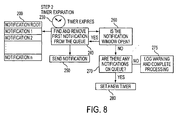
- the step of expiring a timer further comprises finding a first notification pointed to by a notification root, removing and sending the first notification, checking if a notification window is open, removing and sending another notification if the notification window is open, checking if there are any of the notifications on the queue if the notification window is not open, logging a warning if the notification window is not open and there are none of the notifications on the queue, and setting another timer if the notification window is not open and there are notifications on the queue.
- the step of responding to an inform further comprises receiving the inform, and locating and destroying any queued retransmissions.
- notifications are sent in a steady flow, and not in bursts.
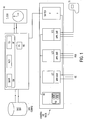
- Figure 1 shows a chassis or a rack in a physical network server, the 7770 RCP Router, containing a number of boards. Connection to the physical network is through the line cards (LC1, LC2, LC3). These cards can be either Ethernet cards or SONET cards. In a preferred embodiment, they are gigabit Ethernet (GE) cards or packet over sonet (POS) cards, each comprising an applique.
- GE gigabit Ethernet
- POS packet over sonet
- the management server is a separate board that holds the management software (SW) stored in memory (M1).
- Management software (SW) (or the manager) can request operational data or receive event notifications from an agent by using a management protocol.
- Three different management protocols are used by the software: 1) Simple Network Browser Protocol (SNMP), 2) Web browser interface (WEB), or 3) Command Line Interface (CLI). They can also be referred to as 3 different management interfaces.
- Figure 2 illustrates three external management interfaces. Users of the three management interfaces ( figure 3 ) are as follows.
- OS and external 3 rd party managers use SNMP. Therefore, third party applications use the SNMP interface. Fault management and network monitoring also use the SNMP interface.
- Web applications such as HTML pages and Java applets use the Web interface.
- configuration management and diagnostic applications use the Web interface.
- the system configuration is stored in a database (dB1) See Figure 1 .
- the configuration information stored in the database (dB1) is used to load all the line cards (LC1, LC2, LC3).
- the management server (MS) comprises an operator interface (I/F).
- the management server or station comprises a processor P1.
- Connected to the management server (MS) is a terminal T1.
- the terminal T1 comprises an interface (I/F) through which the user can interact with the manager software (SNMP, WEB, or CLI) running on the processor (P1).
- Processor P1 is operably connected to memory M1.
- the management software (SW) is downloaded to memory located on processor P1 when in use.
- memory M1 can be located on processor P1 in the form of firmware.
- switching fabric (switch) cards There are also switching fabric (switch) cards (X). These switching fabric cards (X) allow ports on the line cards to speak with each other. This enables packets input through one line card (LC1,LC2,LC3) to be switched through the network and out another card (LC1,LC2,LC3).
- the route server (RS) is a separate board that holds routing software (RSW). Routing software (RSW) comprise protocols that hold IP addresses and create routing tables (RTB) containing routes to each of these IP addresses.
- the routing tables are stored in memory (M2).
- the memory (M2) can be RAM, ROM, compact disc or any other type of media storage.
- the routing server (RS) can share these routing tables (RTB) with line cards and distribute the tables (RTB) to the line cards.
- the route server (RS) uses these routing tables (RTB) to send and receive network protocol data units called data packets.
- the route server (RS) will relay packets from one peripheral or device or to another device in the network.
- a router is also referred to as a Gateway in the TCP/IP protocol.
- the normal method of managing a system is for an operator to log into the network through a terminal (T1)
- the terminal (T1) can be a personal computer (PC) connected to the network.
- the PC sends a packet to the system through a line card (LC1, LC2, LC3).
- the line card (LC1, LC2, LC3) is routed or switched to the management server (MS). See Figure 1 .
- the operator enters all commands using the SNMP interface, even if the operator desires to use the WEB or the CLI protocol. Commands are mapped from the SNMP protocol to the WEB or CLI protocol. This avoids having to implement everything three times. Therefore, to the internal architectures it appears as if all commands came from an SNMP user.
- the internal mapping is done using a translation facility called MibWay, purchased from the RapidLogic division of WindRiver Inc.
- An agent monitors and accumulates operational data and detects exceptional events for each network element.
- the master agent (MA) communicates with the subagent (SA) through a protocol called AgentX.
- AgentX a protocol called AgentX.
- the present invention comprises an extension to the AgentX protocol and the SNMP master agent processing for a multi-interface management architecture that is modeled using SNMP internally.
- the extension allows information to be reported back to CLI and WEB operators.
- this extension is used in a model 7770 RCP router (7770 RCP).
- the code used by the SNMP Master Agent is to map messages between protocols operates as a filter.
- the 7770 RCP router (R1) uses an SNMP Master Agent-Subagent architecture internally for processing management operations.
- the Master Agent (MA) receives SNMP messages from external SNMP managers, and distributes them internally as AgentX messages to multiple subagents (SA) within the router (R1).
- the subagents (SA) route the messages to corresponding applications.
- the subagents (SA) return responses from the applications to the master agent (MA).
- Each management subagent (SA) may service multiple applications.
- a subagent (SA) services one type of application (e.g., IP forwarding) on all boards.
- the subagent (SA) can service up to 30 TLKs, although the present inventions can apply to systems where each subagent (SA) can service even greater numbers.
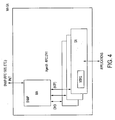
- FIG. 4 discloses a SNMP Master Agent-Subagent architecture (MA-SA).
- configuration commands CMD
- NTF error notifications
- SA subagents
- MA master agent
- PTT SNMP response packets
- the 7770 RCP Master Agent-Subagent architecture also includes a link to a Web Interface (WEB) and a Command Line Interface (CLI).
- WEB Web Interface
- CLI Command Line Interface
- the Web commands and the CLI commands are translated into AgentX messages. They share the same internal processing as the equivalent SNMP commands.
- SNMP In addition to the fetch and store commands discussed above, SNMP also defines a trap command.
- the master agent (MA) uses the trap command to asynchronously send information to a manager (SW) triggered by an event. For example, the master agent (MA) informs the SNMP manager (SW) of any unusual events in the network.
- One such unusual event consists of a line which is down. The agent or router will send a notification when a line goes down. The notification can be a trap or an inform. (Traps require acknowledgement, while informs do not).
- One example of a trap for a downed line can consist of a screen at the SNMP manager (SW) flashing red.
- Another example of a trap can consist of a page sent to an operator.
- Other examples of unusual events include the failure of a link or an overload condition which occurs because a packet load crossed a threshold.
- an agent uses a trap to notify the manager (SW) of significant events. For example, when a router (R1) initially boots up, all the peripherals such as the boards and the cards come online.
- a master agent (MA) uses traps to inform the SNMP manager (SW) which peripherals are online.
- the notifications (NTF) are sent through an upstream router (UR) which is generally very busy (see figure 5 ). Consequently, the notifications (NTF) will be dropped into a notification queue (Q1). If the notification queue (Q1) is full, then the notification (NTF) will be discarded.
- a first in, first out (FIFO) protocol is used to process notifications (NTF) in the queue (Q1). The system does not directly respond to a notification or query (NTF). In the present invention, the notification (NTF) will first be stored in the queue (Q1).
- a traffic management problem occurs when the system is rebooted when a large number of messages are stored in the queue (Q1) ready to be processed. A large number of messages are sent to the SNMP manager (SW) in a very short time frame.
- SW SNMP manager
- notifications are transmitted in a steady flow and not in bursts.
- the notification shaping method of the present invention uses a timer (TR) to process the notifications stored in the notification queue (Q1). See Figure 5 .
- the timer can be a processor, a microprocessor, a central processing unit or any of a number of processing means including analog processing means.
- the transmission rate for sending the notification messages is set at a maximum of n messages in m seconds.
- the notification rate has a range of 1 to 255 notifications per second with a default of 10. If the notification rate is set to zero, notification shaping is disabled.
- the timer (TR) controls the notification transmission rate.
- NDF notification
- the notification (NTF) is forwarded. If not, the notification (NTF) remains in the queue until it is time for it to be forwarded using the FIFO protocol. As a result, notifications (NTF) will be transmitted in a steady flow and not in bursts.
- the core routers (CR) and the edge routers (ER1, ER2, ER3) will begin to exchange routing information that is required for the network to become operational.
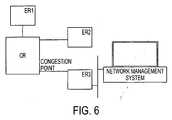
- the core router (CR) starts to send notifications (NTF), the reporting system, card and interface status information to the Network Management System (see Figure 6 which shows the Network Topology).
- the notification shaping method of the present invention can be used to prevent the core router (CR) from flooding the edge routers (ER1, ER2, ER3) with notifications (NTF) while the edge routers (ER1, ER2, ER3) are trying to process routing updates. Thereby, congestion is reduced.
- FIGs 7 , 8 and 9 illustrate the three basic steps involved in the notification shaping method of the present invention. These steps can be stored in software (NSW) stored in memory (M3) on the Master Agent (MA).
- NSW software
- M3 memory
- MA Master Agent
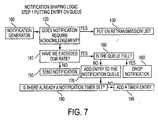
- Figure 7 is a flowchart which illustrates step 1, putting an entry on the notification queue (Q1).
- Step 100 comprises a queue notification generator or notification generator (NTFG) generating an entry. It is operably connected to the notification queue (Q1). AgentX sub-agents (SA) typically initiate notifications (NTF). The master agent (MA) will then determine if they are to be sent to the SNMP manager (SW) as traps which do not require acknowledgement (ACK) or as informs (IN) which do require a response.
- NTFG queue notification generator or notification generator
- NTF notification
- ACK acknowledgement
- Step 120 Does notification (NTF) require acknowledgement (ACK) (Step 120)? As stated above if a notification (NTF) is an inform (IN) it will require an acknowledgement (ACK). If that acknowledgement (ACK) is not received within a pre-defined period of time, then the inform (IN) will be re-transmitted. This re-transmission can occur a pre-defined number of times before the inform (IN) is considered "dead”.
- a retransmission list is a list of all informs (IN) that is kept so that they can be re-transmitted if no response is sent. In a preferred embodiment, it is stored in memory located in the master agent (MA).
- Step 140 Has the notification transmission rate been exceeded (Step 140)? This is determined by counting the number of notifications (NTF) that was sent in the last second.
- step 150 If the answer to step 140 is no, then send the notification (NTF) (Step 150). At this point no additional shaping or queuing is needed. The notification (NTF) is sent to its destination.
- step 160 If the answer to step 140 is yes, then is the queue (Q1) full (Step 160)? The queue depth will be checked at this point. (The notification queue depth has a range of 0 to 255 with a default of 10. If this feature is set to 0, it is turned off.) If it is equal or greater than the defined maximum depth, then the notification will be discarded. Note that if there is an entry on the re-transmission list (RLST), it will be left on the list since after the timeout, the queue (Q1) may no longer be full and the inform can be sent or queued for sending.
- RLST re-transmission list
- the notification queue (Q1) is a linked list of data structures. When an entry is added it will be added to the end of the list. At this point the queue depth is re-calculated.
- step 170 If step 170 is performed (the queue (Q1) is not full and the entry was added to the notification queue) then ask the question is there already a timer (TR) set (Step 190)? Setting the timer (TR) enables the system to come back and check the queue (Q1) and send its window of. notifications (NTF). The timer is operably connected to the notification queue (Q1).
- step 190 If the answer to step 190 is no (a timer (TR) is not set), then add the timer entry (Step 195): This will check to see if there is a timer (TR) set and if there is not it will create and set one.
- FIG 8 illustrates step 2, Timer Expiration.
- the notification root is a structure that points to the oldest entry in the notification queue (Q1).
- the notification queue (Q1) is a linked list of data structures.
- Step 200 consists of pointing to the first notification (NTF1, NTF2, NTF3) in the notification queue (Q1).
- Step 230 occurs when the timer (TR) expires.
- the notification window (W1) is checked to see if it is open "is the notification window (W1) open?"(Step 260). If the notification window (W1) is open, then remove the next notification from the queue (Q1) and send the notification (Step 250).
- next query is "are there any notifications (NTF) on queue (Q1) (270)?" If there are no notifications on the queue (Q1), then a warning is logged and processing is complete (275).
- step 280 is to set a new timer (TR).
- TR another timer
- Figure 9 illustrates step 3, response to an inform.
- the notification root is a structure that points to the oldest entry in the notification queue (Q1).
- the notification queue (Q1) is a linked list of data structures.
- the retransmit root (RPTR) is a structure which points to entries that indicate that an inform is being processed and that no response has yet been received for.
- step 300 the inform response is received.
- a notification is an inform it will require an acknowledgement (ACK). If that acknowledgement (ACK) is not received within a pre-defined period of time then the inform will be re-transmitted.
- a response to an inform is a get response message.
- step 310 involves locating and destroying any queued retransmissions. This process steps though the retransmission queue or retransmission list (Q2) and removes the entry that has been responded to. Since a timeout may have occurred that would cause a retransmission to be placed on the notification queue (Q1), that queue (Q1) will also be scanned to see if there is an entry for that notification (NTF) on the notification queue (Q1). If one is found it is removed.
- NTF entry for that notification
Landscapes
- Engineering & Computer Science (AREA)
- Computer Networks & Wireless Communication (AREA)
- Signal Processing (AREA)
- Environmental & Geological Engineering (AREA)
- Data Exchanges In Wide-Area Networks (AREA)
Claims (14)
- Routeur (R1), comprenant : un bâti ; au moins une carte de ligne (LC1, LC2, LC3) connectée de manière fonctionnelle audit bâti ; au moins une carte de matrice de commutation (X) connectée de manière fonctionnelle à ladite au moins une carte de ligne (LC1, LC2, LC3) ; un serveur de gestion (MS) comprenant un logiciel de gestion (SW) stocké dans une première mémoire (M1) connectée de manière fonctionnelle à ladite au moins une carte de matrice de commutation (X) ; un serveur de routage (RS) comprenant un logiciel de routage (RSW) stocké dans une deuxième mémoire (M2) connectée de manière fonctionnelle auxdites cartes de ligne (LC1, LC2, LC3) ; et une base de données (DB1) connectée de manière fonctionnelle audit serveur de gestion (MS), dans lequel ledit serveur de gestion comprend une architecture agent maître-sous-agent (MA-SA), caractérisé en ce que ladite architecture agent maître-sous-agent (MA-SA) comprend un agent maître (MA) et une pluralité de sous-agents (SA) connectés de manière fonctionnelle audit logiciel de gestion (SW), dans lequel un sous-agent comprend un générateur de notifications (NTFG) pour générer des notifications (NTF), et dans lequel ledit agent maître (MA) comprend une file d'attente de notifications (Q1) connectée de manière fonctionnelle audit générateur de notifications (NTFG), ladite file d'attente de notifications (Q1) configurée pour stocker lesdites notifications (NTF), un temporisateur (TR) connecté de manière fonctionnelle à ladite file d'attente de notifications (Q1) et configuré pour commander un débit de transmission de notifications (NTF), et une file d'attente de retransmission (Q2) connectée de manière fonctionnelle audit temporisateur (TR).
- Routeur selon la revendication 1, comprenant en outre une racine de notification connectée de manière fonctionnelle à ladite file d'attente de notifications (Q1), au moyen duquel des notifications stockées dans ladite file d'attente de notifications (Q1) sont indiquées.
- Routeur (R1) selon la revendication 1, comprenant en outre une racine de retransmission connectée de manière fonctionnelle à ladite file d'attente de retransmission (Q2), au moyen duquel des notifications stockées dans ladite file d'attente de retransmission sont indiquées.
- Routeur (R1) selon la revendication 1, dans lequel ledit logiciel de routage (RSW) comprend des protocoles qui contiennent des adresses IP et créent des tables de routage contenant des routes vers chacune desdites adresses IP.
- Routeur (R1) selon la revendication 1, dans lequel lesdites cartes de ligne sont des cartes SONET.
- Routeur (R1) selon la revendication 1, dans lequel lesdites cartes de ligne sont des cartes Ethernet.
- Routeur (R1) selon la revendication 1, dans lequel une configuration de système est stockée dans ladite base de données (DB1).
- Routeur (R1) selon la revendication 1, dans lequel ledit logiciel de gestion (SW) comprend un protocole de gestion.
- Routeur (R1) selon la revendication 1, dans lequel ledit logiciel de gestion (SW) est un gestionnaire de protocole de gestion de réseau simple (SNMP).
- Routeur (R1) selon la revendication 8, dans lequel ledit protocole de gestion est un protocole de gestion de réseau simple (SNMP).
- Routeur (R1) selon la revendication 1, dans lequel ledit agent maître (MA) est configuré pour recevoir une notification (NTF) au niveau de ladite file d'attente de notifications (Q1), et, si un débit de transmission de notifications est inférieur à un débit de transmission maximum prédéterminé, pour transférer ladite notification (NTF) reçue.
- Routeur (R1) selon la revendication 11, dans lequel ledit agent maître (MA) est configuré pour conserver ladite notification (NTF) reçue dans la file d'attente de notifications (Q1) jusqu'au moment de la transférer comme cela est déterminé par ledit temporisateur (TR).
- Routeur (R1) selon l'une des revendications 1, 11, 12, dans lequel ledit agent maître (MA) est configuré pour transmettre des notifications (NTF) reçues dans un flux constant comme cela est déterminé par ledit temporisateur (TR).
- Routeur (R1) selon l'une des revendications 1, 11, 12, 13, dans lequel ledit agent maître (MA) est configuré pour transmettre des notifications (NTF) reçues selon un débit de notification allant de 1 notification par seconde à 255 notifications par seconde.
Applications Claiming Priority (2)
| Application Number | Priority Date | Filing Date | Title |
|---|---|---|---|
| US10/118,894 US20030195922A1 (en) | 2002-04-10 | 2002-04-10 | SNMP trap and inform shaping mechanism |
| US118894 | 2005-04-28 |
Publications (3)
| Publication Number | Publication Date |
|---|---|
| EP1353473A2 EP1353473A2 (fr) | 2003-10-15 |
| EP1353473A3 EP1353473A3 (fr) | 2004-06-16 |
| EP1353473B1 true EP1353473B1 (fr) | 2012-01-18 |
Family
ID=28453975
Family Applications (1)
| Application Number | Title | Priority Date | Filing Date |
|---|---|---|---|
| EP03007232A Expired - Lifetime EP1353473B1 (fr) | 2002-04-10 | 2003-04-01 | Trap SNMP et mécanisme de mise en forme de notification |
Country Status (3)
| Country | Link |
|---|---|
| US (1) | US20030195922A1 (fr) |
| EP (1) | EP1353473B1 (fr) |
| AT (1) | ATE542328T1 (fr) |
Families Citing this family (14)
| Publication number | Priority date | Publication date | Assignee | Title |
|---|---|---|---|---|
| US7120833B2 (en) * | 2002-04-26 | 2006-10-10 | Alcatel | Error codes in Agent X |
| US7236459B1 (en) * | 2002-05-06 | 2007-06-26 | Packeteer, Inc. | Method and apparatus for controlling data transmission volume using explicit rate control and queuing without data rate supervision |
| US7330440B1 (en) * | 2003-05-20 | 2008-02-12 | Cisco Technology, Inc. | Method and apparatus for constructing a transition route in a data communications network |
| US20060047806A1 (en) * | 2004-08-24 | 2006-03-02 | Matthias Bannach | Mediation-based methods and devices for updating operations support systems |
| US7849199B2 (en) | 2005-07-14 | 2010-12-07 | Yahoo ! Inc. | Content router |
| US7631045B2 (en) | 2005-07-14 | 2009-12-08 | Yahoo! Inc. | Content router asynchronous exchange |
| US7623515B2 (en) | 2005-07-14 | 2009-11-24 | Yahoo! Inc. | Content router notification |
| US20070100856A1 (en) * | 2005-10-21 | 2007-05-03 | Yahoo! Inc. | Account consolidation |
| US8024290B2 (en) | 2005-11-14 | 2011-09-20 | Yahoo! Inc. | Data synchronization and device handling |
| US8065680B2 (en) | 2005-11-15 | 2011-11-22 | Yahoo! Inc. | Data gateway for jobs management based on a persistent job table and a server table |
| US9367832B2 (en) | 2006-01-04 | 2016-06-14 | Yahoo! Inc. | Synchronizing image data among applications and devices |
| US7653741B2 (en) * | 2007-02-27 | 2010-01-26 | Red Hat, Inc. | Method and apparatus for processing system management messages |
| US9350639B2 (en) * | 2007-09-06 | 2016-05-24 | Cisco Technology, Inc. | Forwarding data in a data communications network |
| US9203638B2 (en) * | 2008-11-11 | 2015-12-01 | Arris Enterprises, Inc. | CMTS plant topology fault management |
Family Cites Families (33)
| Publication number | Priority date | Publication date | Assignee | Title |
|---|---|---|---|---|
| US6115393A (en) * | 1991-04-12 | 2000-09-05 | Concord Communications, Inc. | Network monitoring |
| US5740368A (en) * | 1995-06-30 | 1998-04-14 | Canon Kabushiki Kaisha | Method and apparatus for providing information on a managed peripheral device to plural agents |
| SE506431C2 (sv) * | 1995-12-08 | 1997-12-15 | Ericsson Telefon Ab L M | Agent, system och förfarande vid övervakning av objekt |
| FR2750517B1 (fr) * | 1996-06-27 | 1998-08-14 | Bull Sa | Procede de surveillance d'une pluralite de types d'objets d'une pluralite de noeuds a partir d'un noeud d'administration dans un systeme informatique |
| US6298386B1 (en) * | 1996-08-14 | 2001-10-02 | Emc Corporation | Network file server having a message collector queue for connection and connectionless oriented protocols |
| US5901147A (en) * | 1996-08-30 | 1999-05-04 | Mmc Networks, Inc. | Apparatus and methods to change thresholds to control congestion in ATM switches |
| US6182157B1 (en) * | 1996-09-19 | 2001-01-30 | Compaq Computer Corporation | Flexible SNMP trap mechanism |
| US6263366B1 (en) * | 1996-12-31 | 2001-07-17 | Mci Communications Corporation | System and method therefor of translating a message having a given format for usage in an operations system |
| US6000046A (en) * | 1997-01-09 | 1999-12-07 | Hewlett-Packard Company | Common error handling system |
| US6490251B2 (en) * | 1997-04-14 | 2002-12-03 | Nortel Networks Limited | Method and apparatus for communicating congestion information among different protocol layers between networks |
| JP2959539B2 (ja) * | 1997-10-01 | 1999-10-06 | 日本電気株式会社 | バッファ制御方法および装置 |
| GB2330430B (en) * | 1997-10-16 | 2002-07-17 | Ibm | Error handler for a proxy server computer system |
| GB9725855D0 (en) * | 1997-12-04 | 1998-02-04 | 3Com Ireland | Network management communication |
| JP3707233B2 (ja) * | 1998-02-26 | 2005-10-19 | ブラザー工業株式会社 | ネットワークアダプタ及びこれを備えた端末システム |
| US6085237A (en) * | 1998-05-01 | 2000-07-04 | Cisco Technology, Inc. | User-friendly interface for setting expressions on an SNMP agent |
| US6539422B1 (en) * | 1998-05-04 | 2003-03-25 | Intermec Ip Corp. | Automatic data collection device having a network communications capability |
| US6272131B1 (en) * | 1998-06-11 | 2001-08-07 | Synchrodyne Networks, Inc. | Integrated data packet network using a common time reference |
| US6292829B1 (en) * | 1998-07-15 | 2001-09-18 | Nortel Networks Limited | Method and device for network management |
| US6304552B1 (en) * | 1998-09-11 | 2001-10-16 | Nortel Networks Limited | Memory and apparatus for input based control of discards in a lossy packet network |
| US6253243B1 (en) * | 1998-12-04 | 2001-06-26 | Sun Microsystems, Inc. | Automated trap control for a distributed network management system |
| US6597689B1 (en) * | 1998-12-30 | 2003-07-22 | Nortel Networks Limited | SVC signaling system and method |
| US6812157B1 (en) * | 1999-06-24 | 2004-11-02 | Prasad Narhar Gadgil | Apparatus for atomic layer chemical vapor deposition |
| US6771652B1 (en) * | 1999-11-23 | 2004-08-03 | International Business Machines Corporation | Method and system for controlling transmission of packets in computer networks |
| US20020087649A1 (en) * | 2000-03-16 | 2002-07-04 | Horvitz Eric J. | Bounded-deferral policies for reducing the disruptiveness of notifications |
| US6697845B1 (en) * | 2000-05-25 | 2004-02-24 | Alcatel | Network node management system and method using proxy by extensible agents |
| US7028025B2 (en) * | 2000-05-26 | 2006-04-11 | Citrix Sytems, Inc. | Method and system for efficiently reducing graphical display data for transmission over a low bandwidth transport protocol mechanism |
| AU2001268674B2 (en) * | 2000-06-22 | 2007-04-26 | Microsoft Technology Licensing, Llc | Distributed computing services platform |
| DE60121350T2 (de) * | 2000-08-15 | 2006-11-16 | Nortel Networks Ltd., St. Laurent | System, einrichtung und verfahren zur verwaltung von kommunikationsdiensten in einem optischen kommunikationssystem |
| US6895586B1 (en) * | 2000-08-30 | 2005-05-17 | Bmc Software | Enterprise management system and method which includes a common enterprise-wide namespace and prototype-based hierarchical inheritance |
| US6757901B1 (en) * | 2000-12-21 | 2004-06-29 | Cisco Technology, Inc. | Method and system for setting expressions in network management notifications at an agent |
| US20030009543A1 (en) * | 2001-04-30 | 2003-01-09 | Ankur Gupta | Network management system and computer-based methods for network management |
| US7047303B2 (en) * | 2001-07-26 | 2006-05-16 | International Business Machines Corporation | Apparatus and method for using a network processor to guard against a “denial-of-service” attack on a server or server cluster |
| US7464409B2 (en) * | 2003-06-27 | 2008-12-09 | University Of Florida Research Foundation, Inc. | Perimeter-based defense against data flooding in a data communication network |
-
2002
- 2002-04-10 US US10/118,894 patent/US20030195922A1/en not_active Abandoned
-
2003
- 2003-04-01 EP EP03007232A patent/EP1353473B1/fr not_active Expired - Lifetime
- 2003-04-01 AT AT03007232T patent/ATE542328T1/de active
Also Published As
| Publication number | Publication date |
|---|---|
| EP1353473A2 (fr) | 2003-10-15 |
| EP1353473A3 (fr) | 2004-06-16 |
| US20030195922A1 (en) | 2003-10-16 |
| ATE542328T1 (de) | 2012-02-15 |
Similar Documents
| Publication | Publication Date | Title |
|---|---|---|
| EP1353473A2 (fr) | Trap SNMP et mécanisme de mise en forme de notification | |
| US7484222B1 (en) | Method and system for setting expressions in network management notifications | |
| EP0786179B1 (fr) | Systeme de gestion de communication a distance a filtrage intelligent | |
| US5710885A (en) | Network management system with improved node discovery and monitoring | |
| US7017082B1 (en) | Method and system for a process manager | |
| US6292472B1 (en) | Reduced polling in an SNMPv1-managed network | |
| JP4707288B2 (ja) | ネットワーク監視装置およびネットワーク監視方法 | |
| US8477779B1 (en) | Method and system for reliable multicast | |
| US20050141499A1 (en) | Method and system for high reliability cluster management | |
| JP2006501717A (ja) | 電気通信ネットワーク・エレメントの監視 | |
| CN101710862B (zh) | 一种网管操作错误信息的处理方法及装置 | |
| US7275094B1 (en) | System and method for configuring contents of network management notifications | |
| US9246746B2 (en) | Reliable systems and methods for network notifications | |
| JP5304200B2 (ja) | ネットワーク管理システム、ネットワーク管理方法、マネージャおよびエージェント | |
| US20030126193A1 (en) | Method and system for providing synchronization | |
| JPH09282252A (ja) | ネットワーク管理方式 | |
| JP3080936B2 (ja) | ネットワーク管理システム | |
| JP3152183B2 (ja) | 通信ネットワーク運用情報収集設定制御システム | |
| US20050180441A1 (en) | Soft permanent virtual circuit (PVC) network management | |
| JP2003244142A (ja) | Ipネットワークにおけるトラップ抜け検出方式及び検出方法 | |
| JP2001333072A (ja) | Snmpネットワーク管理システム及び方法 | |
| EP1826945A1 (fr) | Rétablissement de traps dans un système SNMP/UDP de gestion de réseau | |
| KR100798995B1 (ko) | Snmp기반의 tcp방식을 이용한 트랩 메시지 전송방법 | |
| KR20030026743A (ko) | 정적 테이블 객체의 검색방법 | |
| JP2024124144A (ja) | パケット転送装置及びプログラム |
Legal Events
| Date | Code | Title | Description |
|---|---|---|---|
| PUAI | Public reference made under article 153(3) epc to a published international application that has entered the european phase |
Free format text: ORIGINAL CODE: 0009012 |
|
| AK | Designated contracting states |
Kind code of ref document: A2 Designated state(s): AT BE BG CH CY CZ DE DK EE ES FI FR GB GR HU IE IT LI LU MC NL PT RO SE SI SK TR |
|
| AX | Request for extension of the european patent |
Extension state: AL LT LV MK |
|
| PUAL | Search report despatched |
Free format text: ORIGINAL CODE: 0009013 |
|
| AK | Designated contracting states |
Kind code of ref document: A3 Designated state(s): AT BE BG CH CY CZ DE DK EE ES FI FR GB GR HU IE IT LI LU MC NL PT RO SE SI SK TR |
|
| AX | Request for extension of the european patent |
Extension state: AL LT LV MK |
|
| 17P | Request for examination filed |
Effective date: 20040803 |
|
| 17Q | First examination report despatched |
Effective date: 20040830 |
|
| AKX | Designation fees paid |
Designated state(s): AT BE BG CH CY CZ DE DK EE ES FI FR GB GR HU IE IT LI LU MC NL PT RO SE SI SK TR |
|
| RAP1 | Party data changed (applicant data changed or rights of an application transferred) |
Owner name: ALCATEL LUCENT |
|
| GRAP | Despatch of communication of intention to grant a patent |
Free format text: ORIGINAL CODE: EPIDOSNIGR1 |
|
| GRAS | Grant fee paid |
Free format text: ORIGINAL CODE: EPIDOSNIGR3 |
|
| GRAA | (expected) grant |
Free format text: ORIGINAL CODE: 0009210 |
|
| AK | Designated contracting states |
Kind code of ref document: B1 Designated state(s): AT BE BG CH CY CZ DE DK EE ES FI FR GB GR HU IE IT LI LU MC NL PT RO SE SI SK TR |
|
| REG | Reference to a national code |
Ref country code: GB Ref legal event code: FG4D |
|
| REG | Reference to a national code |
Ref country code: CH Ref legal event code: EP |
|
| REG | Reference to a national code |
Ref country code: IE Ref legal event code: FG4D Ref country code: AT Ref legal event code: REF Ref document number: 542328 Country of ref document: AT Kind code of ref document: T Effective date: 20120215 |
|
| RAP2 | Party data changed (patent owner data changed or rights of a patent transferred) |
Owner name: ALCATEL LUCENT |
|
| REG | Reference to a national code |
Ref country code: CH Ref legal event code: PCOW Free format text: ALCATEL LUCENT;3, AVENUE OCTAVE GREARD;75007 PARIS (FR) |
|
| REG | Reference to a national code |
Ref country code: DE Ref legal event code: R096 Ref document number: 60339727 Country of ref document: DE Effective date: 20120315 |
|
| REG | Reference to a national code |
Ref country code: NL Ref legal event code: VDEP Effective date: 20120118 |
|
| PG25 | Lapsed in a contracting state [announced via postgrant information from national office to epo] |
Ref country code: BG Free format text: LAPSE BECAUSE OF FAILURE TO SUBMIT A TRANSLATION OF THE DESCRIPTION OR TO PAY THE FEE WITHIN THE PRESCRIBED TIME-LIMIT Effective date: 20120418 Ref country code: BE Free format text: LAPSE BECAUSE OF FAILURE TO SUBMIT A TRANSLATION OF THE DESCRIPTION OR TO PAY THE FEE WITHIN THE PRESCRIBED TIME-LIMIT Effective date: 20120118 Ref country code: NL Free format text: LAPSE BECAUSE OF FAILURE TO SUBMIT A TRANSLATION OF THE DESCRIPTION OR TO PAY THE FEE WITHIN THE PRESCRIBED TIME-LIMIT Effective date: 20120118 |
|
| PG25 | Lapsed in a contracting state [announced via postgrant information from national office to epo] |
Ref country code: FI Free format text: LAPSE BECAUSE OF FAILURE TO SUBMIT A TRANSLATION OF THE DESCRIPTION OR TO PAY THE FEE WITHIN THE PRESCRIBED TIME-LIMIT Effective date: 20120118 Ref country code: PT Free format text: LAPSE BECAUSE OF FAILURE TO SUBMIT A TRANSLATION OF THE DESCRIPTION OR TO PAY THE FEE WITHIN THE PRESCRIBED TIME-LIMIT Effective date: 20120518 Ref country code: GR Free format text: LAPSE BECAUSE OF FAILURE TO SUBMIT A TRANSLATION OF THE DESCRIPTION OR TO PAY THE FEE WITHIN THE PRESCRIBED TIME-LIMIT Effective date: 20120419 |
|
| REG | Reference to a national code |
Ref country code: AT Ref legal event code: MK05 Ref document number: 542328 Country of ref document: AT Kind code of ref document: T Effective date: 20120118 |
|
| PG25 | Lapsed in a contracting state [announced via postgrant information from national office to epo] |
Ref country code: CY Free format text: LAPSE BECAUSE OF FAILURE TO SUBMIT A TRANSLATION OF THE DESCRIPTION OR TO PAY THE FEE WITHIN THE PRESCRIBED TIME-LIMIT Effective date: 20120118 |
|
| PG25 | Lapsed in a contracting state [announced via postgrant information from national office to epo] |
Ref country code: SE Free format text: LAPSE BECAUSE OF FAILURE TO SUBMIT A TRANSLATION OF THE DESCRIPTION OR TO PAY THE FEE WITHIN THE PRESCRIBED TIME-LIMIT Effective date: 20120118 Ref country code: SI Free format text: LAPSE BECAUSE OF FAILURE TO SUBMIT A TRANSLATION OF THE DESCRIPTION OR TO PAY THE FEE WITHIN THE PRESCRIBED TIME-LIMIT Effective date: 20120118 Ref country code: CZ Free format text: LAPSE BECAUSE OF FAILURE TO SUBMIT A TRANSLATION OF THE DESCRIPTION OR TO PAY THE FEE WITHIN THE PRESCRIBED TIME-LIMIT Effective date: 20120118 Ref country code: DK Free format text: LAPSE BECAUSE OF FAILURE TO SUBMIT A TRANSLATION OF THE DESCRIPTION OR TO PAY THE FEE WITHIN THE PRESCRIBED TIME-LIMIT Effective date: 20120118 Ref country code: RO Free format text: LAPSE BECAUSE OF FAILURE TO SUBMIT A TRANSLATION OF THE DESCRIPTION OR TO PAY THE FEE WITHIN THE PRESCRIBED TIME-LIMIT Effective date: 20120118 Ref country code: EE Free format text: LAPSE BECAUSE OF FAILURE TO SUBMIT A TRANSLATION OF THE DESCRIPTION OR TO PAY THE FEE WITHIN THE PRESCRIBED TIME-LIMIT Effective date: 20120118 |
|
| PLBE | No opposition filed within time limit |
Free format text: ORIGINAL CODE: 0009261 |
|
| STAA | Information on the status of an ep patent application or granted ep patent |
Free format text: STATUS: NO OPPOSITION FILED WITHIN TIME LIMIT |
|
| PG25 | Lapsed in a contracting state [announced via postgrant information from national office to epo] |
Ref country code: IT Free format text: LAPSE BECAUSE OF FAILURE TO SUBMIT A TRANSLATION OF THE DESCRIPTION OR TO PAY THE FEE WITHIN THE PRESCRIBED TIME-LIMIT Effective date: 20120118 Ref country code: MC Free format text: LAPSE BECAUSE OF NON-PAYMENT OF DUE FEES Effective date: 20120430 Ref country code: SK Free format text: LAPSE BECAUSE OF FAILURE TO SUBMIT A TRANSLATION OF THE DESCRIPTION OR TO PAY THE FEE WITHIN THE PRESCRIBED TIME-LIMIT Effective date: 20120118 |
|
| REG | Reference to a national code |
Ref country code: CH Ref legal event code: PL |
|
| 26N | No opposition filed |
Effective date: 20121019 |
|
| REG | Reference to a national code |
Ref country code: IE Ref legal event code: MM4A |
|
| PG25 | Lapsed in a contracting state [announced via postgrant information from national office to epo] |
Ref country code: CH Free format text: LAPSE BECAUSE OF NON-PAYMENT OF DUE FEES Effective date: 20120430 Ref country code: IE Free format text: LAPSE BECAUSE OF NON-PAYMENT OF DUE FEES Effective date: 20120401 Ref country code: LI Free format text: LAPSE BECAUSE OF NON-PAYMENT OF DUE FEES Effective date: 20120430 Ref country code: AT Free format text: LAPSE BECAUSE OF FAILURE TO SUBMIT A TRANSLATION OF THE DESCRIPTION OR TO PAY THE FEE WITHIN THE PRESCRIBED TIME-LIMIT Effective date: 20120118 |
|
| REG | Reference to a national code |
Ref country code: DE Ref legal event code: R097 Ref document number: 60339727 Country of ref document: DE Effective date: 20121019 |
|
| PG25 | Lapsed in a contracting state [announced via postgrant information from national office to epo] |
Ref country code: ES Free format text: LAPSE BECAUSE OF FAILURE TO SUBMIT A TRANSLATION OF THE DESCRIPTION OR TO PAY THE FEE WITHIN THE PRESCRIBED TIME-LIMIT Effective date: 20120429 |
|
| REG | Reference to a national code |
Ref country code: GB Ref legal event code: 732E Free format text: REGISTERED BETWEEN 20130926 AND 20131002 |
|
| REG | Reference to a national code |
Ref country code: FR Ref legal event code: GC Effective date: 20131018 |
|
| PG25 | Lapsed in a contracting state [announced via postgrant information from national office to epo] |
Ref country code: TR Free format text: LAPSE BECAUSE OF FAILURE TO SUBMIT A TRANSLATION OF THE DESCRIPTION OR TO PAY THE FEE WITHIN THE PRESCRIBED TIME-LIMIT Effective date: 20120118 |
|
| PG25 | Lapsed in a contracting state [announced via postgrant information from national office to epo] |
Ref country code: LU Free format text: LAPSE BECAUSE OF NON-PAYMENT OF DUE FEES Effective date: 20120401 |
|
| PG25 | Lapsed in a contracting state [announced via postgrant information from national office to epo] |
Ref country code: HU Free format text: LAPSE BECAUSE OF FAILURE TO SUBMIT A TRANSLATION OF THE DESCRIPTION OR TO PAY THE FEE WITHIN THE PRESCRIBED TIME-LIMIT Effective date: 20030401 |
|
| REG | Reference to a national code |
Ref country code: FR Ref legal event code: RG Effective date: 20141016 |
|
| REG | Reference to a national code |
Ref country code: FR Ref legal event code: PLFP Year of fee payment: 13 |
|
| REG | Reference to a national code |
Ref country code: FR Ref legal event code: PLFP Year of fee payment: 14 |
|
| REG | Reference to a national code |
Ref country code: FR Ref legal event code: PLFP Year of fee payment: 15 |
|
| PGFP | Annual fee paid to national office [announced via postgrant information from national office to epo] |
Ref country code: SK Payment date: 20170904 Year of fee payment: 11 |
|
| PG25 | Lapsed in a contracting state [announced via postgrant information from national office to epo] |
Ref country code: FR Free format text: LAPSE BECAUSE OF NON-PAYMENT OF DUE FEES Effective date: 20180430 |
|
| REG | Reference to a national code |
Ref country code: GB Ref legal event code: 732E Free format text: REGISTERED BETWEEN 20190429 AND 20190502 |
|
| REG | Reference to a national code |
Ref country code: DE Ref legal event code: R082 Ref document number: 60339727 Country of ref document: DE Representative=s name: MENZIETTI WETZEL, DE Ref country code: DE Ref legal event code: R081 Ref document number: 60339727 Country of ref document: DE Owner name: PROVENANCE ASSET GROUP LLC, PITTSFORD, US Free format text: FORMER OWNER: ALCATEL LUCENT, PARIS, FR |
|
| PGFP | Annual fee paid to national office [announced via postgrant information from national office to epo] |
Ref country code: DE Payment date: 20210528 Year of fee payment: 19 |
|
| PGFP | Annual fee paid to national office [announced via postgrant information from national office to epo] |
Ref country code: GB Payment date: 20210601 Year of fee payment: 19 |
|
| REG | Reference to a national code |
Ref country code: DE Ref legal event code: R079 Ref document number: 60339727 Country of ref document: DE Free format text: PREVIOUS MAIN CLASS: H04L0012240000 Ipc: H04L0041000000 |
|
| REG | Reference to a national code |
Ref country code: DE Ref legal event code: R119 Ref document number: 60339727 Country of ref document: DE |
|
| GBPC | Gb: european patent ceased through non-payment of renewal fee |
Effective date: 20220401 |
|
| PG25 | Lapsed in a contracting state [announced via postgrant information from national office to epo] |
Ref country code: GB Free format text: LAPSE BECAUSE OF NON-PAYMENT OF DUE FEES Effective date: 20220401 Ref country code: DE Free format text: LAPSE BECAUSE OF NON-PAYMENT OF DUE FEES Effective date: 20221103 |