EP1359619A2 - Dissipateur de chaleur pour la technique de montage en surface - Google Patents
Dissipateur de chaleur pour la technique de montage en surface Download PDFInfo
- Publication number
- EP1359619A2 EP1359619A2 EP03008576A EP03008576A EP1359619A2 EP 1359619 A2 EP1359619 A2 EP 1359619A2 EP 03008576 A EP03008576 A EP 03008576A EP 03008576 A EP03008576 A EP 03008576A EP 1359619 A2 EP1359619 A2 EP 1359619A2
- Authority
- EP
- European Patent Office
- Prior art keywords
- heat sink
- contact surface
- heatsink
- smt
- forming
- Prior art date
- Legal status (The legal status is an assumption and is not a legal conclusion. Google has not performed a legal analysis and makes no representation as to the accuracy of the status listed.)
- Withdrawn
Links
Images




Classifications
-
- H—ELECTRICITY
- H10—SEMICONDUCTOR DEVICES; ELECTRIC SOLID-STATE DEVICES NOT OTHERWISE PROVIDED FOR
- H10W—GENERIC PACKAGES, INTERCONNECTIONS, CONNECTORS OR OTHER CONSTRUCTIONAL DETAILS OF DEVICES COVERED BY CLASS H10
- H10W40/00—Arrangements for thermal protection or thermal control
- H10W40/10—Arrangements for heating
-
- H—ELECTRICITY
- H10—SEMICONDUCTOR DEVICES; ELECTRIC SOLID-STATE DEVICES NOT OTHERWISE PROVIDED FOR
- H10W—GENERIC PACKAGES, INTERCONNECTIONS, CONNECTORS OR OTHER CONSTRUCTIONAL DETAILS OF DEVICES COVERED BY CLASS H10
- H10W40/00—Arrangements for thermal protection or thermal control
- H10W40/60—Securing means for detachable heating or cooling arrangements, e.g. clamps
- H10W40/641—Snap-on arrangements, e.g. clips
Definitions
- the invention relates to a heat sink for electronic Components with a heat sink contact surface for contacting the Heatsink with a component to be cooled.
- This heat sink is with the lower edges of its T-bars, which form the "bridge pillars" on the corresponding ones Contact pads attached to the circuit board, which is Component between the T-webs and the between the Surface located on T-bars contacts the component.
- This The dimensions of the heat sink must match exactly Dimension of the component to be cooled may be adapted. moreover is the use of these heat sinks only for cooling SMD components (Surface Mounted Device) possible, the accordingly with an SMT process lying on the PCB are mounted.
- SMD components Surface Mounted Device
- THT process Thinough Hole Technology
- the Heatsink at least one substantially perpendicular to the Heat sink contact surface on an underside of the heat sink arranged SMT mounting surface.
- Attachment pin can be the heat sink on a corresponding contact pad arranged on the circuit board with usual SMT processes such as automated or pressure gluing processes or can be attached within a reflow soldering process.
- the heat sink essentially has one perpendicular to the heat sink contact surface above the SMT mounting surface suction surface arranged on the heat sink for an SMT pipette so that the heat sink, for example using a conventional pick-and-place placement machine can be equipped.
- the heat sink is also can be fitted horizontally because the back of the Heatsink contact area is also very good to grasp the heat sink using an SMT pipette and the Heatsink also z. B. on an SMD power semiconductor can be put on.
- the heat sink is consequently for Cooling a variety of different types of Power components, which in different ways the circuit board can be mounted, suitable.
- the Heatsink at least one from a top of the Heat sink from into a heat sink contact surface Wall extending into the receiving slot to the Inclusion of a clamp element for clamping the relevant component against the heat sink contact surface serves.
- the heat sink is particularly preferably designed such that he both the features of the first variant of the invention as well as the features of the second variant according to the invention having. Such a heat sink is particularly universal operational.
- the SMT mounting surface is via an element that hinders heat conduction connected to the heat sink.
- a "heat trap” provides to ensure that if the heat sink is heated excessively a high temperature of the component to be cooled, the SMT mounting surfaces stay relatively cold themselves and therefore the Solder connection between the SMT mounting surfaces and the PCB is not softened. Thus, even with higher ones Temperatures of the heat sink a firm connection between the heat sink and the circuit board.
- a The heat trap fulfills another function when the SMT heat sink only with a small mounting pad on the PCB is soldered. Then for reflow soldering the heat requirement is reduced and the SMT heat sink is safe attached.
- Such an element that impedes heat conduction can be realized relatively easily by using the SMT mounting surface only over a thin bridge with the Heatsink is connected.
- preferred shape has the heat sink in a parallel to the SMT mounting surface lying plane has a substantially U-shaped profile on.
- An outside of the wall forming the U base of the U-profile forms the heat sink contact surface
- the two side walls of the U-profile forming the U-legs form the outside of the heat sink laterally delimiting side surfaces.
- the two side faces stand thereby essentially perpendicular to the Heat sink contact surface.
- one SMT mounting surface at each end arranged, with particular preference the SMT mounting surfaces from the lower ends of the two Side walls made into one defined by the U-profile Protrude base, d. H. not laterally over the Protrude side faces.
- the heat sink is preferably designed such that a lower edge of the wall forming the U base surface as a second heat sink contact surface flush with the bottom SMT mounting surfaces 12 completes.
- This about the First mentioned first, large heat sink contact area existing relatively small, second Heatsink contact surface can be used if the Heatsinks are used to cool an SMD component that is cooled via the contact pad of the SMD component is because this second heat sink contact surface then directly on the contact pad of the relevant component can be placed can.
- Such a heat sink is therefore not only for Cooling of standing THT components and for lying installation on SMD components can be used be cooled on the top, but also for such SMD components, which cooled down over the contact pad become.
- the suction surface of the heat sink can be on a any position above, d. H. also laterally above of the SMT mounting surfaces.
- the suction surface can differ from the upper end of the concerned Sidewall out towards the top of the extend to the other side wall, so that the suction surface also defined in the U-profile Cross-sectional area - behind which the heat sink contact area forming wall - extends.
- the suction surface is directly above the center of gravity of the Heatsink or over the through the SMT mounting surfaces defined footprint. The heat sink is therefore from To place placement machines relatively uncomplicated, without the risk of tipping over.
- the suction surface particularly preferably extends in a distance from the wall forming the U base.
- the receiving slots preferably run parallel to one to the heat sink contact surface adjacent side surface of the Heatsink. It is particularly preferred for one Heatsink with essentially perpendicular to the Side surfaces arranged in heat sink contact each in a receiving slot a short distance from the side surfaces in the wall forming the heat sink contact surface arranged. I.e. the heat sink then points to both the right one as well as on the left edge in its heat sink contact area a slot running parallel to the side surface, so that either a bracket element in the right or in the left slot can be inserted.
- the heat sink as modules for cooling a wider component can be placed side by side, because so for example one essentially over two Component extending heat sink widths on one Heat sink from the right and on the other heat sink from the left can be bracketed to make firm contact with the To manufacture heat sinks.
- the wall forming the heat sink contact surface in a partial area, preferably exactly in the partial area between the two slots, over the suction surface or the upper ends of the side walls of the heat sink outwards and forms one Heat sink extension tongue.
- Heatsink expansion tab can then add additional heat sinks be attached to expand the cooling capacity.
- Heat sink in a corresponding grid dimension on one Assemble circuit board and a common total heat sink with a variety of cooling fins.
- the Expansion heatsink via usual spring contacts that inserted between the ribs of the expansion heat sink and the heatsink extension tabs against a rib press, attached to the heat sink according to the invention become.
- the heat sink preferably consists of Brass or bronze.
- the heat sink is made in one piece from an exemplary embodiment Sheet metal blank bent, d. H. it is not a screw connection or soldering individual heat sink parts to form the Heatsink necessary. This is a very inexpensive one Manufacturing possible.
- a particularly simple and inexpensive to manufacture Clamp element for insertion into a slot in one of the heat sink according to the invention for clamping a Component has a plug-in web, which with respect its thickness to the width of the receiving slot of the Heatsink and its length to the thickness of the Heat sink contact surface forming wall and the thickness of the clamped component is adjusted.
- the insert is a resilient pressure element arranged, which in the assembled state against the Component presses.
- a replacement element is arranged, which in assembled Condition on the wall forming the heat sink contact surface of the heat sink.
- Such a clamp element is also relatively simple in part by bending from one Sheet cut can be produced.
- the bracket element is preferably made of bronze or another resilient material such as B. spring steel.
- the two replacement elements preferably extend in each case at right angles from the insertion web and at right angles to an insertion direction in opposite directions Directions.
- the restitution elements extend particularly preferred in parallel planes in one such a distance from each other, the thickness the wall of the heat sink contact surface Heatsink is adjusted. I.e. one of the two Replacement elements are in the inserted state the outside of the wall in question and one on the Inside, so that a particularly secure hold of the Clamping element in the receiving slot of the heat sink given is.
- the heat sink 1 has, as in particular FIGS. 1 and 3 clearly show an essentially viewed from above U-shaped cross-sectional profile.
- the outside of the wall 4 forming the U base U-profile is the actual heat sink contact area 7.
- the side walls forming the U-legs of the U-profile 5, 6 form two perpendicular to the outside Heatsink contact surface 7 standing side surfaces 8, 9, the limit the heat sink 1 laterally.
- a thin web 13 which serves as a heat trap, a SMT mounting surface 12 arranged, the webs 13 themselves each inside, d. H. towards the through the U profile defined base area, so that the SMT mounting surfaces 12 are located within this area.
- the heat sink 1 is attached to these SMT fastening surfaces 12 with an upright assembly, as shown in FIGS. 1, 3 and 4 to 10 is shown, on contact pads 26 with a Printed circuit board 24 connected.
- the heat trap ensures that If the heat sink 1 heats up strongly, the SMT mounting surfaces 12 do not heat to the same extent and the connection between the SMT mounting surfaces 12 and can release the contact pads 26 of the circuit board 24. she also ensures reliable soldering in the reflow soldering system, thus not so high heat demand for the Preheating the heat sink is necessary.
- This wall 4 projects upwards to form a Heat sink extension tongue 11 in a central area over the side wall 5, 6 out.
- Right and left of this upwardly extending region 11 are two parallel at a short distance from each other Side surfaces 8, 9 receiving slots 14.
- These Receiving slots 14 serve to receive a clamp element 2 according to Figure 2, which - as shown in Figure 3 - from above is inserted.
- This Suction area 10 is the pick-and-place pick-up area for the Suction pipette of an SMT placement machine with which the Heat sink in the in Figures 1, 3 and 4 to 10th shown assembly mounted on the circuit board 24 can be.
- the distance a between the suction surface 10 and the wall 4, which forms the heat sink contact surface 7 is so wide chosen that the clamp element 2 as shown in Figure 2, freely from above in both the right and in the left receiving slot 14 can be inserted.
- the entire heat sink 1 is made of a single bronze or Brass sheet cutout bent by first the two Side walls 6 U-shaped from the U-base wall 4 forming heat sink contact surface 7 be bent away at a right angle and then the two SMT mounting surfaces 12 on their webs 13 and the tab forming the suction surface 10 from the side walls 5, 6 can be bent inwards into the U-profile. Then the entire heat sink is tinned.
- the clip element according to FIG. 2 is made in one piece from one Bronze sheet metal cutout curved.
- the pressure tongue 17 is made up of two sections 18, 19 constructed, the first, on the insertion web 16 arranged section 19 in this way from the insertion web 16 is bent away from the outside in the assembled state obliquely in the direction of the assembled component 3a (see FIG. 3) has.
- the second outer section 18 is again in at a slight angle from the first section 19 bent away so that it is parallel to the surface of the Cooling component 3a runs and flat to the surface of the relevant component 3a presses.
- the insertion web is used to form the replacement elements 21 from its rear end parallel in the direction of extension of the insert 16 slotted twice.
- One between the Slotted middle part is then to the outside bent at right angles to the insertion web 16, in one Direction opposite to the direction of extension of the Pressure tongue 17.
- Are parallel to it in an offset plane the two outer end parts of the insertion web 16 each in the opposite direction, d. H. parallel in Direction of extension of the pressure tongue 17, at right angles bent.
- the heat sink shown in the figures is universal for Various SMT and THT power components can be used. Using SMT assembly technology, it can be used in any Direction are set automatically. It is possible the heat sink 1 magazine or assembled in rods to feed the pick and place machine.
- this is Weight of the heat sink not more than 13 g, and the height of the entire heat sink is not more than 20 mm, so that the usual placement machine requirements are met and consequently no special placement machines are used Need to become.
- the heat sink 1 is good all round solderable, d. H. the heat sinks 1 can also cover the entire surface the component to be cooled are soldered, which is particularly important in HF applications important is. Due to the compact, accurate from the outside right-angled design, the heat sink 1 are arbitrary can be strung together as modules. Due to the full area The heat sinks are tinned in a row State in a reflow oven automatically so interconnected that a stable structure of a Heat sink row is generated without this Additional effort in the process chain would be required, such as for example screwing or clipping the individual heatsink modules against each other.
- the heat sink contact surface 7 be equipped with a heat-conducting tape, which is electrical is insulating.
- the heat sink contact surface be equipped with an electrically conductive heat-conducting tape.
- the heat sink contact area also be easily soldered to the component accordingly.
- FIGS 4 to 8 each show different Mounting variants for cooling typical THT power semiconductors 3a, 3b, which are perpendicular to a Board 24 are mounted.
- the figures show a lot clearly the possibility of the heat sink 1 modular use and, for example, as shown here, with a heat sink 1 a relatively narrow Power semiconductor 3a or with two heat sinks 1 one to cool wide power semiconductors 3b.
- a heat sink 1 a relatively narrow Power semiconductor 3a or with two heat sinks 1 one to cool wide power semiconductors 3b.
- the heat sink 1 should do this from its Width and the distance between the receiving slots to the usual grid width dimension of the usual Power semiconductors can be adapted.
- Figure 5 shows the same embodiment again of considered behind. In this embodiment, how this can be seen in Figure 5, a second embodiment a bracket element 2 used.
- the essential There is a difference to the exemplary embodiment according to FIG. 2 here in that the replacement elements 22, 23 are in one Level and only from behind against the Heat sink contact surface 7 forming wall 4 of the heat sink Press 1.
- the variant according to FIG. 2 is somewhat more stable because these clamp elements 2 even without pressure on the resilient pressure element 17 firmly in position be held within the receiving slot 14.
- FIG 5 is also shown by an arrow as the heat sink 1 according to the invention in principle within a bundle guide a pick and place machine can be supplied so that the SMT pipette of the Pick and place the heat sinks 1 on their SMT suction surfaces 10 can hold and on a circuit board 24th can touch down.
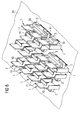
- FIGS 6 to 8 show different groupings of possible juxtaposition and juxtaposition of the Heat sink according to the invention 1.
- the arrangement of the heat sink 1 takes place here preferably in a standardized grid dimension, so that, as shown in Figures 7 and 8, to the Heat sink extension tongues 11 of the heat sink 1 simple Sum heat sink 28 can be placed.
- Figure 7 shows a sum heat sink 28, which only has ribs 30 on the underside, so that the upper surface as Mounting surface can serve for a system assembly.
- Figure 8 shows the grouping with a total heat sink 28, which has cooling fins 30 on the underside and on the top, whereby an even larger cooling capacity is available.
- On firm contact of the heat sink 1 according to the invention with the Expansion sum heat sinks 28 can be done by insertable spring contacts 29 are used, the Heat sink extension tongues 11 of the concerned heat sink 1 according to the invention against an adjacent rib 30 of the total heat sink 28.
- the spring contacts 29 biased with an aid his.
- a total heat sink 28 can also be used with ribs 30 on both sides on the outside Extension tabs 31 for connection to others Have sum heat sink.
- Connecting tabs 31 a plurality of total heat sinks 28 be connected to each other.
- With a corresponding Number of heat sinks according to the invention arranged upright 1 can also handle a large area of individual Sum heat sinks 28 are formed, which are in a kind Parquet are laid together and together in the matching grid dimension below heat sink 1 with cool the power components 31, 3b arranged thereon.
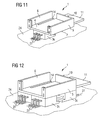
- FIGS 9 to 12 show different Embodiments as with the invention Heatsink 1 typical SMD power components 3c are cooled can.
- Such an SMD component 3c is, as in the figures shown, usually via contact pads 25, 27 with the Circuit electrically connected and is simultaneously through the soldering to these contact pads 25, 27 firmly with the Printed circuit board 24 connected.
- SMD components 3c there are usually two different ones Variants.
- One variant consists in that the component 3c from below, d. H. is cooled indirectly via the contact pad 25.
- the component 3c gives the heat via the contact pad 24 from under the component 3c.
- the heat sink 1 take the Heat via the pad heat connection 25, 26 - if possible via the wall 4 - forming the heat sink contact surface 7 and dissipate the heat.
- FIG 9 shows a first embodiment of this first Variant.
- the heat sink 1 according to the invention is upright standing on contact pads 26 on the printed circuit board 24 attached that at the same time the lower edge 15 of the (Main) heat sink contact-forming wall 4 on the Contact pad 25 of the component 3c rests and thus as Heatsink contact surface is used for this purpose.
- cooling is carried out by two Heatsink 1, with their contact pads 26 and as far as possible with the walls 4 forming the heat sink contact surfaces 7 absorb and dissipate the heat.
- the heat sink 1 in a lying shape with its Heatsink contact surface 7 from above on what is to be cooled Component 3c placed.
- the heat sink 1 for example with thermal adhesive on the item to be cooled Component 3c are glued on.
- the exemplary embodiments show the particularly large one Variability of the heat sink according to the invention in terms of Application range.
- the possibility of Using heatsinks on a modular basis is almost a given unlimited ways to cool the heat sink use a wide variety of components, with almost an automatic assembly is possible for each variant.
- Due to the possibility of bracketing the effort is Ensuring good contact of the heat sink 1 to the component 3a, 3b to be cooled is extraordinarily small. moreover can both the heat sink 1 itself and that Clamp element 2 is particularly inexpensive from simple Metal sheet blanks are bent.
Landscapes
- Cooling Or The Like Of Electrical Apparatus (AREA)
- Cooling Or The Like Of Semiconductors Or Solid State Devices (AREA)
Applications Claiming Priority (4)
| Application Number | Priority Date | Filing Date | Title |
|---|---|---|---|
| DE10218625 | 2002-04-25 | ||
| DE10218625 | 2002-04-25 | ||
| DE10227047 | 2002-06-17 | ||
| DE10227047A DE10227047A1 (de) | 2002-04-25 | 2002-06-17 | Kühlkörper |
Publications (1)
| Publication Number | Publication Date |
|---|---|
| EP1359619A2 true EP1359619A2 (fr) | 2003-11-05 |
Family
ID=26011121
Family Applications (1)
| Application Number | Title | Priority Date | Filing Date |
|---|---|---|---|
| EP03008576A Withdrawn EP1359619A2 (fr) | 2002-04-25 | 2003-04-14 | Dissipateur de chaleur pour la technique de montage en surface |
Country Status (4)
| Country | Link |
|---|---|
| US (1) | US20030201093A1 (fr) |
| EP (1) | EP1359619A2 (fr) |
| JP (1) | JP2003318340A (fr) |
| DE (1) | DE20210149U1 (fr) |
Families Citing this family (4)
| Publication number | Priority date | Publication date | Assignee | Title |
|---|---|---|---|---|
| JP2006339170A (ja) * | 2003-06-26 | 2006-12-14 | Toshiba Kyaria Kk | インバータ装置及びその製造方法 |
| US20050254207A1 (en) * | 2004-05-17 | 2005-11-17 | Lien Cheng Electronic | Cooling means for a driver semiconductor |
| US20090091892A1 (en) * | 2007-09-26 | 2009-04-09 | Rohm Co., Ltd. | Semiconductor Device |
| WO2019137806A1 (fr) * | 2018-01-12 | 2019-07-18 | Fachhochschule Kiel | Unité de fixation pour relier entre eux des composants soumis à des contraintes thermiques |
-
2002
- 2002-07-01 DE DE20210149U patent/DE20210149U1/de not_active Expired - Lifetime
-
2003
- 2003-04-14 EP EP03008576A patent/EP1359619A2/fr not_active Withdrawn
- 2003-04-22 US US10/420,183 patent/US20030201093A1/en not_active Abandoned
- 2003-04-24 JP JP2003120199A patent/JP2003318340A/ja not_active Withdrawn
Also Published As
| Publication number | Publication date |
|---|---|
| JP2003318340A (ja) | 2003-11-07 |
| DE20210149U1 (de) | 2002-10-31 |
| US20030201093A1 (en) | 2003-10-30 |
Similar Documents
| Publication | Publication Date | Title |
|---|---|---|
| DE69632865T2 (de) | Transistor-lötclip und kühlkörper | |
| DE69131712T2 (de) | Lottragender anschlussdraht | |
| DE4427854C2 (de) | Kühlvorrichtung und Montageverfahren dafür | |
| EP1858079A2 (fr) | Agencement destiné au refroidissement de composants de puissance SMD sur une plaquette | |
| DE69106615T2 (de) | Lageweise zusammengebaute Steckbuchsenleiste mit integraler Erdabschirmung. | |
| DE3612862A1 (de) | Kuehlkoerperbefestigungsanordnung fuer einen halbleiter | |
| EP2010500A1 (fr) | Dispositif de contact de semi-conducteurs de puissance sur une surface réfrigérante | |
| DE102013100701B4 (de) | Halbleitermodulanordnung und verfahren zur herstellung einer halbleitermodulanordnung | |
| WO1994029901A1 (fr) | Dispositif de fixation pour elements semi-conducteurs de circuit | |
| DE3886471T2 (de) | Vorrichtung einer leitenden Verbindung. | |
| WO2001073844A1 (fr) | Module d'eclairage | |
| DE10207778B4 (de) | Lottragende Kontakte und Herstellungsverfahren dafür sowie Verwendung in einem Lotkugelgittermatrix-Verbinder | |
| EP3477781A1 (fr) | Douille enfichable pour cartes de circuits imprimés | |
| DE10057460C1 (de) | Halteelement mit einer Halteklammer, Anordnung mit einer Trägerplatte und einem Halteelement und Anordnung mit Halteelement und Trägerstreifen | |
| DE3627372C2 (fr) | ||
| DE112012004381B4 (de) | Halbleiterbauelement und Halbleiterbauelementherstellungsverfahren | |
| DE3148018C1 (de) | Verbindungselement fuer Chiptraeger | |
| EP0674828A1 (fr) | Dispositif a support plastique permettant de loger et de maintenir un module electronique. | |
| DE3444844A1 (de) | Ic-sockel | |
| DE60315469T2 (de) | Wärmeableiteinsatz, Schaltung mit einem solchen Einsatz und Verfahren zur Herstellung | |
| WO2013135791A1 (fr) | Procédé, dispositif et système pour une commutation de puissance | |
| EP0116162B1 (fr) | Dispositif pour le montage enfichable d'un porteur de circuit électrique sur un appareil électrique ou similaire et procédé pour le fabriquer | |
| DE20210149U1 (de) | Kühlkörper | |
| DE10103950C1 (de) | Rastverbindung | |
| DE10227047A1 (de) | Kühlkörper |
Legal Events
| Date | Code | Title | Description |
|---|---|---|---|
| PUAI | Public reference made under article 153(3) epc to a published international application that has entered the european phase |
Free format text: ORIGINAL CODE: 0009012 |
|
| AK | Designated contracting states |
Kind code of ref document: A2 Designated state(s): AT BE BG CH CY CZ DE DK EE ES FI FR GB GR HU IE IT LI LU MC NL PT SE SI SK TR |
|
| AX | Request for extension of the european patent |
Extension state: AL LT LV MK RO |
|
| STAA | Information on the status of an ep patent application or granted ep patent |
Free format text: STATUS: THE APPLICATION IS DEEMED TO BE WITHDRAWN |
|
| 18D | Application deemed to be withdrawn |
Effective date: 20051102 |