EP1362880A2 - Wachstuch und lampenruss - Google Patents
Wachstuch und lampenruss Download PDFInfo
- Publication number
- EP1362880A2 EP1362880A2 EP01999473A EP01999473A EP1362880A2 EP 1362880 A2 EP1362880 A2 EP 1362880A2 EP 01999473 A EP01999473 A EP 01999473A EP 01999473 A EP01999473 A EP 01999473A EP 1362880 A2 EP1362880 A2 EP 1362880A2
- Authority
- EP
- European Patent Office
- Prior art keywords
- carbon black
- rubber
- fluffy
- fluffy carbon
- black
- Prior art date
- Legal status (The legal status is an assumption and is not a legal conclusion. Google has not performed a legal analysis and makes no representation as to the accuracy of the status listed.)
- Withdrawn
Links
Images




Classifications
-
- C—CHEMISTRY; METALLURGY
- C08—ORGANIC MACROMOLECULAR COMPOUNDS; THEIR PREPARATION OR CHEMICAL WORKING-UP; COMPOSITIONS BASED THEREON
- C08K—Use of inorganic or non-macromolecular organic substances as compounding ingredients
- C08K3/00—Use of inorganic substances as compounding ingredients
- C08K3/02—Elements
- C08K3/04—Carbon
-
- B—PERFORMING OPERATIONS; TRANSPORTING
- B29—WORKING OF PLASTICS; WORKING OF SUBSTANCES IN A PLASTIC STATE IN GENERAL
- B29B—PREPARATION OR PRETREATMENT OF THE MATERIAL TO BE SHAPED; MAKING GRANULES OR PREFORMS; RECOVERY OF PLASTICS OR OTHER CONSTITUENTS OF WASTE MATERIAL CONTAINING PLASTICS
- B29B7/00—Mixing; Kneading
- B29B7/74—Mixing; Kneading using other mixers or combinations of mixers, e.g. of dissimilar mixers ; Plant
- B29B7/7476—Systems, i.e. flow charts or diagrams; Plants
- B29B7/748—Plants
-
- B—PERFORMING OPERATIONS; TRANSPORTING
- B29—WORKING OF PLASTICS; WORKING OF SUBSTANCES IN A PLASTIC STATE IN GENERAL
- B29B—PREPARATION OR PRETREATMENT OF THE MATERIAL TO BE SHAPED; MAKING GRANULES OR PREFORMS; RECOVERY OF PLASTICS OR OTHER CONSTITUENTS OF WASTE MATERIAL CONTAINING PLASTICS
- B29B7/00—Mixing; Kneading
- B29B7/74—Mixing; Kneading using other mixers or combinations of mixers, e.g. of dissimilar mixers ; Plant
- B29B7/7476—Systems, i.e. flow charts or diagrams; Plants
- B29B7/7485—Systems, i.e. flow charts or diagrams; Plants with consecutive mixers, e.g. with premixing some of the components
-
- B—PERFORMING OPERATIONS; TRANSPORTING
- B29—WORKING OF PLASTICS; WORKING OF SUBSTANCES IN A PLASTIC STATE IN GENERAL
- B29B—PREPARATION OR PRETREATMENT OF THE MATERIAL TO BE SHAPED; MAKING GRANULES OR PREFORMS; RECOVERY OF PLASTICS OR OTHER CONSTITUENTS OF WASTE MATERIAL CONTAINING PLASTICS
- B29B7/00—Mixing; Kneading
- B29B7/74—Mixing; Kneading using other mixers or combinations of mixers, e.g. of dissimilar mixers ; Plant
- B29B7/7476—Systems, i.e. flow charts or diagrams; Plants
- B29B7/7495—Systems, i.e. flow charts or diagrams; Plants for mixing rubber
Definitions
- the present invention pertains to the homogenous incorporation of fillers into rubber, and more particularly to a process for the preparation of rubber containing carbon black of a very small and uniform particle size that is highly and uniformly dispersed.
- Rubber products such as vehicle tires and seals are made typically by compounding or mixing fillers, such as carbon black or silica, into rubber, which is then vulcanized.
- fillers such as carbon black or silica
- a manufacturer such as a tire manufacturer, typically receives its raw material from different sources. Rubber is received as bales or possibly as a crumb or as a powder. A rubber manufacturer is located typically geographically separated by a considerable distance from its customer, the tire or rubber product manufacturer. The rubber is transported over considerable distances typically by rail or truck.
- a carbon black manufacturer is typically located geographically distant from both the tire or rubber product manufacturer and the rubber manufacturer.
- Several processes are available for making carbon black, including a thermal black process, an acetylene black process, a lampblack process, an impingement or channel process, and an oil-furnace process.
- the oil-furnace process is used typically for making carbon black, and in any of these processes, an intermediate is made called fluffy carbon black.
- Fluffy carbon black is very difficult to handle. It comprises particles so fine that the particles are measured in nanometers (nm), and it has a very low bulk density. Fluffy carbon black is typically pelletized with the addition of water and an agglomerating agent to yield a pelletized product that can be handled. Other types of agglomerates such as granules, powder and beads can be used. The wet pellets are dried, typically in rotary drums, and dry pellets are transported by truck or rail in bags or the like to the tire or rubber product manufacturer.
- the tire or rubber product manufacturer receives the dry pellets and grinds the pellets by mechanical means to essentially as small a particle size as can be practically achieved.
- the ground carbon black typically has a particle size ranging between about 0.5 microns and about 45 microns.
- the ground carbon black is mixed with the rubber in a process called dry compounding. Mechanical mixing is used in the dry compounding process to intimately mix the carbon black with the rubber.
- the dry pellets of carbon black are transported to a rubber manufacturing plant, which is typically geographically separated from the carbon black plant by a considerable distance.
- the dry pellets of carbon black are ground into as small a particle size as is practical using essentially the same grinding process as would otherwise have been used at the tire or rubber product manufacturer.
- the ground carbon black has a particle size distribution ranging between about 0.1 microns and about 7 microns.
- the dry ground carbon black is mixed with water to form a slurry that is added to an intermediate step in the process for making the rubber, typically in a coagulation step.
- the carbon black is mixed with the rubber as the rubber is made, resulting in a product called black masterbatch.
- Black masterbatch is thus a rubber product that already has carbon black dispersed through it.
- the black masterbatch can be handled and transported to the tire or rubber product manufacturer in bales or as crumb or dry powder in the same manner as rubber without carbon black can be handled and transported.
- a rubber manufacturing plant that makes black masterbatch typically uses styrene and butadiene as raw materials although other types of rubber can be used, such as acrylonitrile and butadiene.
- One of two processes is typically used for making rubber from styrene and butadiene.
- One process is called emulsion styrene-butadiene rubber (ESBR), and the other process uses organolithium compounds in an ionic polymerization for making what is called solution styrene-butadiene rubber (SSBR).
- Fillers are typically added to rubber, and the most common filler is carbon black since it is a reinforcement agent as well as a filler.
- a process for making a carbon-filled rubber that includes the steps of forming a rubber intermediate; adding a fluffy carbon black stream to the rubber intermediate; incorporating fluffy carbon black to form a rubber having carbon black dispersed therethrough; and processing the mixture of carbon black and rubber to form a carbon-filled rubber.
- the rubber intermediate is a latex in an emulsion styrene-butadiene plant
- the fluffy carbon black stream is preferably received as a slurry of fluffy carbon black in water; and optionally, a dispersant can be added to aid in dispersing the fluffy carbon black in the water to form the fluffy carbon black slurry.
- the dispersant is preferably a naphthalenesulfonate composition although other dispersants can be used.
- the average particle size of the fluffy carbon black intermediate is less than about 1000 nm when dispersed in water, and/or about 95% of the carbon black particles may be less than 2000 nm.
- the present invention includes an integrated plant for making black masterbatch rubber, which is a rubber material containing carbon black having a very small particle size wherein the carbon black is distributed uniformly through the rubber.
- black masterbatch rubber which is a rubber material containing carbon black having a very small particle size wherein the carbon black is distributed uniformly through the rubber.
- the present invention can be better understood in light of the prior art in which a rubber plant, a carbon black plant and a tire or rubber product manufacturer were geographically dispersed.
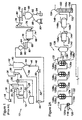
- a fuel 12 such as natural gas
- a blower 16 draws in ambient air and conveys it through a line 18 to an air preheater 20.
- Air preheater 20 is a heat exchanger that transfers heat from the reaction products from reactor 14 to the process air, which is fed through line 22 to reactor 14.
- a liquid, oil-based feedstock is stored in a storage tank 24 and is preheated in a heat exchanger 26 by reaction products from reactor 14 after the reactor products pass through air preheater 20.
- the liquid feedstock flows through line 28 from oil preheater 26 to reactor 14.
- Fuel 12 mixes with the preheated air in line 22 and burns in reactor 14 to create a high-temperature environment.
- Feedstock flowing through line 28 is atomized and injected into a combustion zone of reactor 14, where the feedstock vaporizes essentially instantly and decomposes to primarily carbon black and hydrogen. A portion of the feedstock also reacts with excess oxygen in the process air to maintain a proper reaction temperature for the formation of carbon black.
- Quench water is introduced to reactor 14 through line 30 to quickly quench the reaction products flowing out of the combustion zone of reactor 14.
- the quenched reaction product which is a heavy carbon black smoke, flows through line 32 to air preheater 20.
- the hot carbon black smoke is cooled as it passes through air preheater 20 and then through oil preheater 26.
- the carbon black smoke flows from oil preheater 26 into a quench tower 34.
- Quench water is fed to quench tower 34 through line 36, and the carbon black smoke is further cooled as it flows through quench tower 34.
- the carbon black smoke is then fed through line 38 to a bag filter unit 40.
- Bag filter unit 40 separates the carbon black smoke into an intermediate called fluffy carbon black and a tail gas stream.
- the tail gas stream or off-gas is vented from bag filter unit 40 through line 42, which can be fed as a supplement to fuel 12.
- the fluffy carbon black flows through line 44 into a micro-pulverizer 46, which agitates and agglomerates the fluffy carbon black to increase its bulk density.
- the fluffy carbon black then flows through line 48 into a blower 50, which conveys the fluffy carbon black through a line 52 to a cyclone 54.
- Cyclone 54 which may be a set and/or series of cyclones, separates the fluffy carbon black from the air used to convey the fluffy carbon black through line 52. Air and any fluffy carbon black that escapes through cyclone 54 is returned to bag filter unit 40 through line 56.
- Fluffy carbon black product flows into a surge tank 58 for short-term storage to compensate for an unequal flow rate into and out of storage tank 58.
- the fluffy carbon black product flows out of a hopper in the bottom of surge tank 58 through a line 60 into a pelletizer 62. Water is added through a line 64 to pelletizer 62 to aid in agglomerating the fluffy carbon black intermediate into wet pellets.
- the wet pellets from pelletizer 62 flow through a line 66 into a rotary dryer 68.
- Rotary dryer 68 is heated, such as by combustion of natural gas, and the wet pellets of carbon black are dried as the pellets flow through the rotary dryer.
- Water vapor and gases are exhausted from rotary dryer 68 through a line 70 to a purge gas filter (not shown).
- Dry pellets exit rotary dryer 68 through a line 74 into an elevator 76.
- the dry carbon black pellets are dropped onto a rotating drum magnet 78 that separates any pellets containing metal from the dry carbon black pellet.
- the dry pellets are dropped onto a screen 80, which has a screen of a desired mesh size, and dry pellets having the proper size pass through the screen onto screw conveyors 82.
- Screw conveyors 82 transport the dried and pelletized carbon black through a line 84 into storage tanks 86.
- Final product dry carbon black pellets can be conveyed through line 88 to a rail car or tank truck 90 for bulk loading.
- dry carbon black pellets can be conveyed through line 92 to a packaging unit 94, where the dry pellets are typically bagged. The bulk or bagged dry carbon black pellets can then be transported to a tire or rubber product manufacturer, according to this prior art process.
- FIG. 2A and 2B a process 100 for making rubber and incorporating carbon black, according to the present invention, is shown schematically.
- This embodiment of the present invention is illustrated for a styrene butadiene rubber (SBR) plant, in particular an emulsion SBR plant, but the present invention includes any process for making a rubbery material having a uniform dispersion of carbon black, including solution SBR, acrylonitrile butadiene rubber, high styrene rubber, and natural rubber, with or without additional co-monomer to provide functional group such as carboxylic acid or acrylic monomer.
- SBR styrene butadiene rubber
- carboxylated styrene butadiene rubber and carboxylated nitrile butadiene rubber are included, and the carboxylate used for making carboxylated styrene butadiene rubber or carboxylated nitrile butadiene rubber can be selected from the group consisting of carboxylic, maleates, acrylic, alcohol, amine and epoxy monomers.
- Emulsion SBR (ESBR) polymerization is based on free radicals that attack unsaturated monomers of styrene and butadiene, which causes the monomer units to bond together at the end of, and extending, the polymer chain.
- Solution SBR (SSBR) polymerization is based on an ionic mechanism.
- the rubber product from an ESBR plant is somewhat different as compared to the rubber product from an SSBR plant, but the process is and products are more similar than they are different
- the present invention has applicability for both of these types of rubber plants as well as to other processes for making somewhat different rubber products.
- the processes can be batch, semi-batch or continuous as well as cold or hot.
- styrene and butadiene monomers are mixed together in water, which is the solvent in the ESBR process, and additives including a modifier, an emulsifier and an activator are added to the solution to form a feed stream 116.
- Feed stream 116 is fed to a heat exchanger 118 that removes heat from the feed stream.
- a coolant supply 120 flows into heat exchanger 118, and a coolant return 120a flows out of heat exchanger 118, where coolant return 120a is at a higher temperature than coolant supply 120.
- Feed stream 116 flows through line 116a, and an initiator is added to feed stream 116 via line 122.
- Feed stream 116 with the initiator flows through line 124 into a series of reactors 126a, 126b, 126c and 126d, which may be referred to as reactors 126 for simplicity.
- Reactors 126a, 126b, 126c and 126d have agitators 128a, 128b, 128c and 128d, respectively, which may be referred to as agitators 128.
- agitator 128d has paddles 128d' and 128d".
- Each of reactors 126 is configured in a similar manner.
- Reactors 126 are arranged in series. Feed stream 116 flows into reactor 126a through line 124 and out through line 130a into reactor 126b out through line 130b into reactor 126c out through line 130c into reactor 128d.
- Polymerization occurs as the material flows through reactors 126, the styrene and the butadiene monomer units adding to the end of polymer chains and increasing the polymer chain length. Polymerization continues as long as styrene and butadiene monomer units are available in the solution.
- a chemical called a short-stopping agent is added either to one of the reactors 126 or to the reactor product stream.
- the short-stopping agent is a reducing agent that combines with a growing species to destroy the source of free radicals, which stops the addition of monomer units to the polymer chains.
- a low concentration of hydroquinone is an effective short-stopping agent, although other reducing agents can be used.
- the short-stopping agent is added to the reactor product stream through a line 132 making a short-stopped latex that flows through line 134 into a blowdown tank 136.
- Steam is added through a line 138 to blowdown tank 136, which heats the latex and strips out styrene and butadiene monomer from the aqueous latex stream.
- a gas stream containing styrene, butadiene and water vapor, as well as any other volatile material, is removed through a line (not shown) from the overhead of blowdown tank 136 and sent to a recovery unit (not shown) for recovery of styrene and butadiene monomer.
- the latex stream flows from blowdown tank 136 through a line 140 into a first flash tank 142a through a line 144 into a second flash tank 142b.
- Butadiene monomer flashes off from the latex stream in flash tanks 142a and 142b and is sent to the recovery unit through lines 146a and 146b, respectively, for recovering and recycling the butadiene monomer.
- the latex stream flows through line 148 into a stripping column 150.
- Stripping column 150 has a series of plates 150a, which may be perforated plates, bubble cap distillation trays, or any other technology suitable for stripping styrene and any remaining butadiene from the latex stream.
- Steam is added to stripping column 150 through line 152, and styrene is recovered overhead and transferred via a line 154 to the recovery unit to recover and recycle the styrene monomer.
- a stripped latex stream flows from the bottom of stripping column 150 through a line 156 to a plurality of latex storage tanks, of which one is shown as tank 158 in Figure 2B.
- fluffy carbon black intermediate is separated from an air stream in a cyclone 54a and passed through a valve 54b into a surge tank 58a.
- the numbers with suffixes used for the cyclone and surge tank indicate that these can be cyclone 54 and surge tank 58 shown in Figure 1.
- fluffy carbon black can be withdrawn from a carbon black plant at other locations, including before or after a filter unit, such as bag filter unit 40 shown in Figure 1.
- the rubber and carbon black plant of the present invention can differ in other ways from carbon black plant 10 shown in Figure 1.
- quench tower 34 can be replaced with a venturi cooler where water is injected into hot carbon black smoke as it flows through a throat in the venturi cooler.
- fluffy carbon black intermediate is withdrawn from a carbon black plant at a point in the carbon black manufacturing process before the pelletizer, such as before pelletizer 62 shown in Figure 1.
- the carbon black intermediate used in a process according to the present invention has not been pelletized or otherwise agglomerated so that the smallest, finest particles of carbon black in a carbon black plant are used in the present invention.
- the fluffy carbon black intermediate used in the present invention is referred to as fluffy carbon black as distinguished from pelletized or agglomerated carbon black.
- surge tank 58a is shown as having an agitator 58b for keeping the fluffy carbon black in a fluidized state. (It may be found desirable to avoid agitation of dry fluffy carbon black to prevent agglomeration of particles. It may be preferable to form a slurry using the venturi cooler.) Dry fluffy carbon black flows from surge tank 58a through line 58c into a mixer 162, and water is also added through a line 160 to mixer 162.
- surge tank 58a for dry carbon black may not be necessary as a slurry of fluffy carbon black and water can be produced and stored, which may minimize the formation of agglomerates of fluffy carbon black particles.
- One goal of the present invention is to use the ultra fine particle size of fluffy carbon black as opposed to agglomerated or ground carbon black.
- the characteristics of the tire or rubber product formed using the rubber and carbon black product of the present invention have been found highly desirable as compared to similar tires and rubber products made using carbon black that is agglomerated or mechanically ground.
- fluffy carbon black is added to the latex before a coagulation step, which is described below, and the use of fluffy carbon black, which has never been pelletized, yields a rubber product having very desirable characteristics as will be explained further below.
- water is added through line 160 to mixer 162 at a rate to yield a slurry of fluffy carbon black and water having a concentration of carbon black in the slurry that ranges between about 0.5 weight percent and about 50 weight percent, preferably ranging between about 1 weight percent and about 20 weight percent, and more preferably ranging between about 3 weight percent and about 12 weight percent, and most preferably ranging between about 5 weight percent and about 8 weight percent.
- about 7 weight percent of carbon black in the fluffy carbon black slurry is used. .
- a dispersing agent may be added through line 164 to mixer 162 for aiding in the mixing of the dry fluffy carbon black with the water.
- a dispersing agent sodium naphthalenesulfonate polymer with formaldehyde, which is sold under U.S. Registered Trademarks of Criosotan and Daxad, may be used, preferably at a concentration of less than about twenty parts of dispersing agent per hundred parts carbon black; preferably at a concentration of less than about eight parts per hundred parts carbon black and more preferably at about one part dispersing agent per hundred parts of carbon black.
- Daxad dispersing agent may be obtained from Hampshire Chemical Corporation, a subsidiary of Dow Chemical Company.
- Other dispersing agents that may possibly be used include alkylene oxide block co-polymer sold under the U.S. Trademark Registration Hydropalat 1080, sulfosuccinamate such as octadecyl sulfosuccinamate, tretrasodium sulfosuccinamate tricarboxilate, sodium dioctyl sulfosuccinamate, tretrasodium N-(1,2-dicarboxyethyl)-N-octadecyl sulfosuccinamate, sodium bis(tridecyl) sulfosuccinamate, phosphate chemicals including monoester phosphate and diesther phosphate.
- Mixer 162 can be of any design suitable for intimately mixing dry carbon black with water.
- Mixer 162 is shown in this embodiment as a horizontal mixer having a motor 162a that rotates a drive shaft 162b to which is connected a series of blades 162c.
- High pressure steam is added through a line 166 for heating the slurry and promoting further agitation for mixing the dry fluffy carbon black with the water.
- the solution of fluffy carbon black, water and dispersing agent flows through mixer 162, and a fluffy carbon black slurry exits mixer 162 through a line 168. Any volatile material, gases and dust from the fluffy carbon black are vented through a line 170 to either an appropriate recovery unit or to an appropriate environmental control unit.
- the fluffy carbon black slurry flows through line 168 into a settling tank 172, where grit and/or inorganic salts or the like settle out for removal and discard through a line 172a.
- Settling tank 172 may be referred to as a de-gritting unit or as a de-gritter.
- the separation of this solid material that settles out when fluffy carbon black is mixed with water is an unexpected result discovered in this process, which leads to additional desirable characteristics in the product of this process.
- the solid material withdrawn through line 172a from settling tank 172 would otherwise become ash or a hard spot in a tire or other rubber product. Such ash would be a defect in a tire or rubber product composition, and such a defect is essentially eliminated in the process of the present invention.
- the source of the solids removed from the fluffy carbon black slurry through line 172a from settling tank 172 may be the oil used as a feedstock to the carbon black reactor. If the oil feedstock to the carbon black reactor has a low enough concentration of ash to meet one's desired specifications in the product from a process according to the present invention, then it may not be necessary to include settling tank 172, but it is believed desirable to include settling tank 172 in this process.
- the product from this process is generally considered better if settling tank 172 is included, but on the other hand, the characteristics of the product are acceptable without settling tank 172 in many if not most applications.
- a de-ashed fluffy carbon black slurry flows through a line 174 into a storage tank 176 and is withdrawn from storage tank 176 at a desired rate through a line 178 to a process tank 180.
- tank 180 As shown with respect to tank 180, but applicable for any storage for fluffy carbon black slurry, it may be desirable to include a disperser 182 for maintaining the fluffy carbon black in solution so that the fluffy carbon black does not settle out of solution into the bottom of a tank.
- Fluffy carbon black solution is withdrawn from tank 180 through a line 180a into mechanical disperser 182 and returned through a line 182a to tank 180.
- a low concentration of fluffy carbon black in water, fluffy carbon black slurry flows through line 184 into a mechanical disperser 186, and latex rubber solution from tank 158 flows through a line 158a into mechanical disperser 186, which mixes the fluffy carbon black slurry with the latex rubber solution.
- Additives, such as oil, are added through line 188, and an antioxidant is added through a line 188a.
- a static mixer may be satisfactory for mechanical mixer 186, high shear rotors are preferred, but possibly a tank and agitator can be used as well. For example, a cream tank with an agitator may provide satisfactory results.
- the dispersion of carbon black in the final rubber-carbon black product may depend on how well the fluffy carbon black slurry is mixed with the latex rubber solution in this step.
- the mixture of latex and fluffy carbon black slurry is fed to a coagulation tank 190 through a line 186a.
- Sulfuric acid is added through a line 192 to coagulation tank 190, and serum is added through a line 194.
- a coagulation aid is typically added, possibly through line 194 or through line 188.
- a polyamide, such as sold under the registered U.S. trademark Perchem, can be used as the coagulation aid.
- the concentration of coagulant aid in the serum in tank 190 is maintained at a desired concentration, typically at less than about 200 or so parts per million (ppm), preferably between about 50 ppm and about 150 ppm, and more preferably at about 100 ppm.
- Agitation is one of many variables that can be manipulated to yield a desired rubber product from the coagulation tank.
- a rubber product is formed according to the present invention in coagulation tank 190 as the latex coagulates to form rubber and incorporates the fluffy carbon black in its matrix during rubber formation.
- the coagulation tank is preferably operated at a slightly lower pH and at a slightly higher temperature. While a prior art coagulation tank may have been operated at a pH between about 4 and about 6, coagulation tank 190 may be operated according to the present invention at a pH ranging preferably between about 3 and about 5, although it is possible to achieve satisfactory results within a different pH range, possibly including a pH higher than 7, but more likely in the range of about 2 or 2.5 to about 7.
- Sulfuric acid is typically added for coagulation of soap in the latex solution to form rubber, but other acids can be used, possibly including hydrochloric acid for example.
- sodium chloride and/or aluminum sulfate may be used.
- Solution SBR, acrylonitrile butadiene rubber and high styrene rubber may each have different requirements.
- the flow rate of sulfuric acid is manipulated to control pH at a desired level.
- a prior art coagulation tank may have operated between about 55°C and about 65°C, particularly at about 60°C.
- Coagulation tank 190 is preferably operated at a slightly higher temperature, possibly from about 2°C to about 15°C or about 2°C to about 10°C higher, but preferably about 5°C higher than a prior art coagulation tank may have operated.
- coagulation tank 190 preferably operates at a temperature between about 57°C and about 80°C, preferably in a range between about 57°C and about 75°C and more preferably in a range between about 65°C and about 75°C.
- Coagulation tank 190 can operate at about 70°C.
- the concentration of antioxidant in coagulation tank 190 is about the same in the process according to the present invention as in a prior art process that does not add fluffy carbon black to coagulation tank 190, which is about 0.015 weight percent antioxidant in the serum in coagulation tank 190.
- the reaction products from coagulation tank 190 flow through a line 196 into a conversion tank 198, where the conversion to a rubber product according to the present invention is completed.
- the rubber product contains a highly dispersed matrix of extremely small particles of carbon black, where the size of the carbon black is believed to be the size of the fluffy carbon black particles as produced in the carbon black plant since pelletizing (agglomeration) has been avoided.
- the particle size of the carbon black in the rubber product in conversion tank 198 is believed to have an average particle size of less than 1,000 nm, possibly between about 400 to 800 nanometers, and the particle size distribution of carbon black in the rubber product is believed to range between about 100 nm and about 2,000 nm.
- the size of particles in rubber made by incorporating fluffy carbon black into the latex is believed to be smaller than the size of carbon black particles incorporated into rubber through prior art methods.
- the smaller size of the carbon black particles in the rubber of the present invention and the uniformity of the dispersion of the carbon black in the rubber yields a rubber-carbon black product with superior performance characteristics as will be explained further below.
- Conversion tank 198 has an agitator 198a with paddles 198b for keeping the solution well mixed, and the reaction product stream flows through a line 200 to a first screen 202.
- Liquid flows through a screen in first screen 202 into a tank 204 through a line 202a.
- Rubber flows from first screen 202 through a line 206 into a slurry tank 208, where the rubber is washed and then flows through a line 210 to a second screen 212.
- Serum flows through a screen into a tank 214 through a line 212a, and the serum is recycled through a line 214a.
- Rubber product flows through a line 216 into an extruder 218 for extrusion and agglomeration.
- Rubber product flows through a line 220 to a conveyor 222 and into a hammer mill 224.
- the rubber product is then dried in a dryer 226 and conveyed with a conveyor 228 to a baler 230.
- Bales of rubber typically weighing about 80 lbs but of any desirable weight, is weighed on a scale 232 and wrapped in a film by a film wrapper 234. Bales of rubber roll along a roller conveyor 236 and are boxed or crated in a box or crate 238.
- This rubber is a product according to the present invention as made by a process according to the present invention.
- This product which may be referred to as black masterbatch with nanometric-sized fluffy carbon black particles, has desirable and superior characteristics that are described below and by example.
- a carbon black plant and a rubber plant are located adjacent to one another and operate as an integrated carbon black-rubber plant.
- a carbon black plant can be located from about one to hundreds of miles away from each other.
- a fluffy carbon black slurry can be formed according to the present invention and transported to a synthetic rubber plant. Fluffy carbon black slurry is very difficult to handle. Varying with its concentration, it is very viscous and abrasive. Before agitation, it is very viscous, but upon agitation, it is subject to shear thinning so viscosity decreases as flow rate increases.
- gaseous fluidized carbon black could be mixed together directly in a mixer of a suitable design with latex before the coagulation step.
- fluffy carbon black could be transported to a rubber processing plant through a pneumatic conveyor line like line 52 in Figure 1.
- An existing carbon black plant can be modified or retrofitted to produce a fluffy carbon black slurry according to the present invention.
- the fluffy carbon black slurry can be transported by pipe, pipeline, tank truck or rail car to a synthetic rubber plant, and a black masterbatch can be made according to the present invention.
- the steps of pelletizing or agglomerating the carbon black, drying it, storing the pellets, packaging or bulk loading the pellets, transporting the pellets in bags or bulk, and receiving and handling the bagged or bulk pellets are all eliminated in the present invention. If the pellets were received by a tire or rubber product manufacturer, the pellets would have to be ground and compounded into rubber from a rubber plant, and these steps are eliminated in the present invention.
- the fluffy carbon black slurry is delivered and mixed directly into the rubber as it is made to yield a black masterbatch that can be shipped to the tire or rubber product manufacturer ready to use.
- the tire or rubber product manufacturer receives the black masterbatch using the same facilities as used for receiving bales of rubber without carbon black.
- a tire or rubber product can be made with properties that are superior to those in a tire or rubber product made using carbon black that was first pelletized and then ground into small particles, presumably because the fluffy carbon black intermediate is used directly (in a slurry) without ever having been agglomerated or pelletized, which yields a significantly smaller carbon black particle in the final product and in which the carbon black is more uniformly dispersed than in the prior art.
- the dispersion can be done at ambient or at room temperature or between about 20 and about 80°C. Testing for optimization can be carried out by adding under stirring a dispersing agent derived from naphthalenesulfonic acid in a basic aqueous solution, preferably with a pH between 8 and 11. In one test, deionized water is used and pH is adjusted by means of an hydroxide of an alkaline-metal selected from potassium and sodium, preferably sodium hydroxide.
- the dispersing agent can be a metal-salt of polymerized naphthalenesulfonic acids, preferably using copolymers of sodium-formaldehyde naphthalenesulfonates. Preparation of a dispersing mixture can be carried out by heating to temperature within the range between 20 to 80°C in order to obtain a fast and suitable dissolution.
- the dispersion may contain between 1 and 30% by weight of carbon black, to which the dispersing agent solution is added in such an amount that a dispersing agent/carbon black ratio of 1:50 to 1:200 by weight is reached, preferably about 1:100.
- any mixing equipment to perform the fluffy carbon black dispersion stage, as long as foaming during mixing is avoided.
- Such equipment may be selected from stirring tanks, homogenization equipment, and equipment for the elaboration of carbon black agglomerates, such as binders. Avoiding making foam while stirring in a mixing equipment, mixing should continue long enough for the mixture obtained not to contain apparent crumbs when a sample is magnified up to 100 times.
- the carbon black for the dispersion can be selected from any of several furnace types; and any of the carbon black known as 110, 220, 234, 299, 326, 330, 339, 347, 375, 530, 550, 583, 660, 680, 726, 770 and 774 can be used.
- Carbon blacks can also be selected from those known as Super Abrasion Furnace Carbon Black (SAF); Intermediate Super Abrasion Furnace Carbon Black (ISAF); Intermediate Super Abrasion Furnace Carbon Black of High Structure (ISAF-HS); High Abrasion Furnace Carbon Black (HAF); High Abrasion Furnace Carbon Black of High Structure (HAF-HS); Fast Extrusion Furnace Carbon Black (FEF); and Semi-reinforcement Furnace Carbon Black (SRF).
- SAF Super Abrasion Furnace Carbon Black
- ISAF Intermediate Super Abrasion Furnace Carbon Black
- ISAF-HS Intermediate Super Abrasion Furnace Carbon Black of High Structure
- HAF High Abrasion Furnace Carbon Black
- HAF-HS High Abrasion Furnace Carbon Black of High Structure
- FEF Fast Extrusion Furnace Carbon Black
- SRF Semi-reinforcement Furnace Carbon Black
- a crumb-free carbon black dispersion is obtained with a viscosity from 100 to 1000 cp having from 1 to 25% of suspended solids.
- the dispersion can allow rubber to be obtained that has improved mechanical properties when mixed with rubber emulsions before the recovery thereof since it practically eliminates crumbs formation.
- the dispersion degree of carbon black in rubber that can be obtained from the dispersion of carbon black of the present invention is higher than that obtained in prior art mixtures trough conventional equipment since in the case of the present invention, dispersion of particles is practically made individually, which consequently results in the disappearance of micro-voids that can cause poor performance in the materials.
- a sufficient amount of solution to obtain a carbon black and rubber nano-dispersed material with 10 to 100 parts per hundred of rubber (phr) of carbon black is added.
- an extender oil it is selected from highly aromatic type oils and naphthenic-type oils, and it is added in amounts enough to reach up to 100 phr.
- antioxidants the antioxidants are added in amounts varying from 0.2 to 0.4 weight percent.
- the rubber recovery process can be carried out from the mixture of carbon black with rubber emulsion through any method known therefor. As described above, recovery can be made through a coagulation process.
- Coagulation processes include, as unit operations, a rubber coagulates formation stage; a washing stage where coagulation agents residues are eliminated; a squeezing stage, and, a drying stage.
- Equipment is also available that groups some or all of the operations, and therefore the present invention can also be made through any method selected from a Coagulation-Washing-Drying (CWD) system in a single piece of equipment; in a welding (continuous coagulation-extrusion) system, using mechanical coagulation; and using static coagulation.
- CWD Coagulation-Washing-Drying
- the rubber recovery process can be a rubber coagulation process wherein the step of crumbs formation is carried out at a temperature within the range from 50 to 100°C, preferably 80°C, in a coagulation tank using coagulating agents selected from metal salts and highly cationic polymers or copolymers in the presence of an acid medium.
- the salts can be selected from sodium chloride, calcium sulfate and aluminum sulfate.
- the polymers/copolymers include low molecular weight polyamines and/or polymers or copolymers derived from acrylic acid, in a sulfuric acid solution.
- the washing stage is made by contacting water with the obtained crumbs, where water is eliminated practically free of carbon black.
- the washing stage is performed wherein coagulating agent residues are practically eliminated, which is followed by a squeezing stage with a kneader-type equipment and a drying stage of rubber squeezed through heating.
- the drying stage is carried out by heating to temperatures up to 60°C and 180°C, preferably by using a furnace, until reaching a humidity content below 1%.
- compositions with a high carbon black content can be obtained, a good distribution of the same in rubber and with large amounts of extender oil, which allows reducing costs of final products without affecting rheological and mechanical properties thereof.
- Such compositions, for the purposes of the present invention are considered carbon black and rubber nano-dispersed materials.
- An amount of carbon black dispersion can be added to the rubber emulsion that allows obtaining from 10 to 100 phr of carbon black in the final composition, and an extender oil amount that allows obtaining from 10 to 100 phr in the final composition.
- Carbon black and rubber nano-dispersed materials in the form of master batches of vulcanized rubber with up to 100 phr of carbon black and with up to 100 phr of extender oil can be obtained without the material losing its rheological and mechanical properties, having a dispersion ASTM D2663-89 "A" ("Carbon Black Dispersion in Rubber", 1989) of at least 99%.
- dispersions of at least 99% are obtained, which is highly significant, irrespective of the amount of carbon black incorporated into rubber.
- the present invention can be used for different kinds of carbon black, as well as different kinds of rubber, which affects the magnitudes of the rheometric and mechanical properties for descriptive purposes.
- Rubbers obtained through the present invention when parameters are identical, compared to a rubber with the same characteristics, where the only difference is whether the dispersion used is of a carbon black agglomerated form or a fluffy carbon black, show an increase in the Mooney viscosity of between about 2 and about 10%.
- Carbon black and rubber nano-dispersed materials such as vulcanized rubber compositions, show in turn between about 12 and about 40% increase in the maximum torque, and an increase between 15 and 80% in the modulus, depending on the kind of rubber and carbon black used, preserving the behavior known of the same properties when the type of rubber and the type of carbon black changes. This indicates that it is a material which has carbon black nanometrically dispersed, since harder materials could be obtained. This characteristic allows the incorporation of greater amounts of extender oil, through which mechanical properties can be adjusted according to the specific formulations needs.
- the difference between the tan ⁇ value at 0°C and tan ⁇ value at 60°C is found to be between about 0.03 and about 0.09, while with those materials obtained through the present invention, differences from about 0.06 up to about 0.2 can be obtained which means that a material will have a better performance at high and low temperatures for tire applications.
- the increase in tan ⁇ at 0°C of materials of the present invention compared to those of the prior art could be up to approximately 35%, while the reduction of tan ⁇ at 60°C could be up to about 50%.
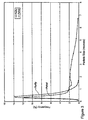
- a laser light scattering instrument was used, which is available from Horiba Ltd. of Kyoto, Japan.
- the Horiba Model LA-910 was used with a helium-neon laser detector model GLT2331 at a wave length of 632.8 nm.
- a sample of each of the carbon blacks, ground pellet and fluffy carbon black, were dispersed in 150 ml of water, until reaching a concentration proportional to 80% transmittance, as measured in the Horiba Model LA-910.
- Ultrasonic mixing and recirculation was applied constantly during the run for dispersing the carbon black in the water. A refraction index of 1.88 was maintained with respect to water, the determination was taken over three minutes at room temperature.
- Analyzing Figure 3 it can be seen that the particle size distribution obtained when pellets are ground overlaps the particle size distribution of fluffy carbon black, but the ground pellets have a substantial portion of its particles that are larger than the largest particles in the fluffy carbon black.
- the particle size distribution of the fluffy carbon black dispersed in water ranges from about 100 to about 1700 nanometers with only about 1.63% of the particles having a size greater than 1.005 microns (or micrometers), which is about 1000 nanometers (nm). All of the fluffy carbon black particles dispersed in water are less than two microns in size, with the largest size measurement being 1729 nanometers (about 1.7 microns). About 95% of the fluffy particles have a size less than about 900 nm. It is believed that generally about 99% of the carbon black particles in rubber made according to the present invention will be less than about 2 microns, and about 95% will be less than about 1 micron.
- the ground pellet on the other hand has a size distribution ranging from about 100 to about 6700 nanometers.
- About 18.36% of the ground pellet carbon black particles have a size greater than about 1.005 microns, which is about 1000 nanometers.
- about 11.35% of the ground pellet carbon black particles are larger than the largest fluffy carbon black particle dispersed in water in this experiment, and about 9.5% of the particles from the ground pellets have a size greater than about 2000 nm.
- About 95% of the ground particles have a size less than about 3500 nm.
- About 90.5% of the ground particles have a size less than about 2 microns, and about 79.5% of the ground particles have a size less than about 1 micron.
- the weighted average particle size of fluffy carbon black dispersed in water is about 0.44 microns, while the weighted average particle size of ground pellet carbon black is about 0.78 microns.
- the particle size distribution of fluffy carbon black is nearly a normal bell-shaped curve while the particle size distribution of ground pellets of carbon black is positively skewed. It is believed that this particle size distribution is representative of the distribution in carbon-filled rubber.
- the particle size distribution of carbon black in carbon-filled rubber made according to the present invention is not skewed significantly and has a weighted average particle size of less than about 700 nm, preferably less than about 600 nm and more preferably less than about 500 nm.
- the fluffy carbon black according to the present invention has an average particle size ranging between about 400 nm and about 800 nm, typically an average size between about 500 and about 700 nm, and the fluffy particle size ranges in its distribution from about 100 nm to about 2000 nm or at least about 95% of the particles are less than about 2000 nm when measured as dispersed in water.
- pelletized or agglomerated carbon black that has been subsequently ground by mechanical means to obtain as small a particle size as possible, where the particle size of such ground carbon black has an average particle size between about 1000 nm and about 3000 nm, typically an average size of about 2000 nm or about 2 microns and a range in particle size between about 0.1 microns (100 nm) and about 7 microns (7000 nm).
- the weighted average particle size of the fluffy carbon black intermediate of the present invention is roughly half (about 50 to about 70%) that of ground carbon black obtained by pulverizing carbon black pellets.
- the distribution of particle sizes obtained from pulverizing carbon black pellets may overlap the distribution of particle sizes of fluffy carbon black intermediate, but it is believed that the generally smaller particle size of the fluffy carbon black intermediate contributes to improvements in properties obtained in rubber-carbon black products made according to the present invention. It is believed that the carbon black particles from ground pellets that are larger than the largest particles in fluffy carbon black have a detrimental effect on rubber properties as compared to rubber made according to the present invention.
- the particle size of carbon black may not provide a full explanation of the improvements obtained in the properties of carbon-filled rubber made by incorporating fluffy carbon into rubber latex before or during the coagulation step.
- Fluffy carbon black tends to agglomerate naturally, particularly in water, so the particle size measured in the experiment above may not be fully indicative of the particle size distribution obtained when fluffy carbon black is incorporated into rubber according to the present invention.
- Photographs of carbon-filled rubber product taken using transmission electron microscopy (TEM), which are discussed below, may provide a better indication of the results that can be achieved with the present invention.
- TEM transmission electron microscopy
- Rubber and polymeric materials made with nanometric-sized carbon filler have improved rheological and mechanical properties as compared to rubber and polymeric materials made with micron-sized carbon filler.
- the process for the preparation of carbon black and rubber nano-dispersed materials of the present invention, as well as advantages rendered to products obtained therefrom, will be more clearly illustrated by the following examples, which are presented for illustrative purposes only and therefore are not intended to limit the scope of this invention.
- Dispersions with 40 g of water and 10 g of fluffy carbon black N-234 type manufactured by Cabot Corporation were carried out.
- the fluffy carbon black was first placed in water, and a solution of a dispersing agent with a basic aqueous solution of 16% sodium hydroxide with a pH of 10 was added.
- Dispersions were carried out with several dispersing agents and the amount required to disperse 10 g of carbon black above mentioned, was scored.
- the following dispersing agents were tested: hydrophilic block copolymer, which is available under the U.S. trademark Hydropalat ® 3275, for example 1 (E1); alkylene oxide block copolymer, which is available under the U.S. trademark Hydropalat ® 1080 for example 2 (E2); octadecyl sulfosuccinamate available, which is available under the U.S. trademark Meximul® 991 for example 3 (E3); tetrasodium sulfosuccinamate tricarboxilate, which is available under the U.S.
- Meximul® 346 for example 4 (E4); sulfated alkyl-aryl ether, which is available under the U.S. trademark Meximul® P-607 for example 5 (E5); sodium dioctyl sulfosuccinamate, which is available under the U.S. trademark Meximul® 712 for example 6 (E6); polyacrylic acid, which is available under the U.S. trademark Diper® 1227 for example 7 (E7); tetrasodium N-(1,2-dicarboxyethyl)-N-octadecyl sulfosuccinamate, which is available under the U.S.
- Aerosol® 22 for example 8 (E8); sodium bis(tridecyl) sulfosuccinate, which is available under the U.S. trademark Aerosol® TR-70 for example 9 (E9); a mixture of sodium bis(tridecyl) sulfosuccinate with ethyl hexanol, which is available under the U.S. trademark Aerosol® OT-NV for example 10 (E10); an etoxilated octadecylamine-octadecylguanidine complex, which is available under the U.S. trademark Aerosol® C-61 for example 11 (E11); monoester phosphate, which is available under the U.S.
- an indication of grit sediments or phase separation will indicate a low efficiency dispersion process, and this will be noted by a grumous (or lumpy) appearance.
- the fluffy carbon black slurry should be mixed intimately with the latex emulsion. A good dispersion of the fluffy carbon black in the slurry will increase the contact between the rubber and the fluffy particles, increasing the possible interactions among them. The dispersion should be maintained during the coagulation stage.
- HLB Hydrophilic Lypophilic Balance
- coagulation process it is desired to use the least amount of coagulants (brine and acid) for cost and disposal reasons. Also, a totally clear serum should be obtained to avoid environmental and further recovery problems while increasing the yield of the process at the same time.
- coagulants brine and acid
- a totally clear serum should be obtained to avoid environmental and further recovery problems while increasing the yield of the process at the same time.
- parameters including: a) size of the agglomerate; b) ease of squeezing; and c) clear water.
- the size of the agglomerate is important because if a very fine size is obtained there will be problems recovering the material, and a big lump should to be avoided because it can be trapped along the process and plug the system.
- the agglomerate should not trap water because problems will arise during the squeezing and drying processes if this occurs.
- clear water after coagulation, the remaining water or serum should be totally clear (not turbid), indicating a good coagulation process. All of these parameters were evaluated in order to qualify an experiment with a good grade.
- Dispersions obtained from examples 1 to 14 were subjected to a coagulation process at room temperature, followed by the addition of a brine solution [6% by weight of NaCI] and a 1.0 N sulfiuic acid solution.
- the amount of brine was three (3) times relative to the dispersion to coagulate and a 10% by weight of the acid solution.
- the dispersion to coagulate is composed of: water, latex particles and fluffy carbon black. If the coagulate is one part (take 100 gr as a basis) then the brine solution are added to coagulate is three parts (300 gr).
- the required amount of sulfuric acid (1 N) is 10% of the dispersion to be coagulated (i.e., 10 gr).
- Table 3 The results obtained are shown in Table 3.
- ASTM 2226-82 extender oil as defined in "Description for Petroleum Ex
- a rubber coagulation process was performed wherein 1500 ml of fluffy carbon black dispersion from example 14 was added under stirring to 1085 g of a rubber emulsion with 20% of suspended solids, along with the high aromatic extender oil and butyl hydroxy toluene (BHT) as antioxidant. Afterwards, the mixture was coagulated using 3 liters of a sodium chloride solution with 1.037 g/cc density and 20 ml of 0.1 N sulfuric acid solution. When the coagulation ended, the coagulate was washed, squeezed, and dried out at 50°C for 24 hours.
- BHT butyl hydroxy toluene
- Figure 4 shows a microphotograph of the inventive material at 8,000 times amplification.
- the microphotograph was obtained using transmission electron microscopy.
- a highly homogeneous dispersion is desired, which is indicated by a gray tone.
- a less homogeneous dispersion is indicated by discrete black and white spots, such as observed in Figure 5.
- a black spot is carbon black, and a white spot is rubber without carbon black filler.
- a gray homogeneous tone indicates a highly homogeneous dispersion, which indicates better mechanical properties than where there are larger discrete particles of carbon black.
- the distance between the tips of the arrows shown in Figure 4 represents 1.51 microns or micrometers ( ⁇ m) in the carbon-filled rubber sample of Example 29.
- none of the carbon black particles in the inventive material have a diameter larger than 1.5 microns, and only seven (7) defined or discrete particles of carbon black (the black spots) can be readily observed, which were not dispersed, and which represent together less than 1% of the 100 squared micron area in the microphotograph..
- ASTM D2663A A standard method provided by the American Society of Testing and Materials (ASTM) known as method ASTM D2663A is used to study the degree of dispersion of carbon black in rubber using an optical surface analysis.
- the surface of a carbon black compound can be viewed with a microscope or video system, and the roughness of the surface ranked on a scale of 1 to 5 (ASTM D2663, Method A) or some other scale.
- ASTM D2663, Method A A standard method provided by the American Society of Testing and Materials (ASTM) known as method ASTM D2663A is used to study the degree of dispersion of carbon black in rubber using an optical surface analysis.
- the surface of a carbon black compound can be viewed with a microscope or video system, and the roughness of the surface ranked on a scale of 1 to 5 (ASTM D2663, Method A) or some other scale.
- ASTM D2663, Method A a more absolute measurement as opposed to a relative measurement
- standards can be prepared and quantified by a more absolute method,
- a specimen In order to get a representative surface to view, a specimen should be cut (or fractured) with a very sharp blade.
- a fresh razor blade works well for samples of rubber, and the blade should be used only once. The blade will not cut the carbon black particles, but rather will pull them out of the matrix. Thus the surface is covered with hills and valleys the size of the particles.
- An instrument called a Dispersegrader provides measurements according to Method A of ASTM D2663. In this method the surface is imaged with a video camera and compared side by side to standards stored in memory. The material obtained in example 29 showed a 99% ASTM D2663A dispersion as measured with the Dispersegrader.
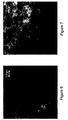
- FIG. 5 shows a photograph of the obtained material with a 8,000 times amplification
- Figure 6 shows an 10,000 times amplification, both obtained by transmission electron microscopy.
- the distance between the tips of the arrows in Figure 5 represents 1.5 microns in the carbon-filled rubber sample while in Figure 6 it is 1.21 microns.
- ASTM D2663 "A" dispersion was 96% for this carbon black obtained by grinding carbon black pellets as compared to a 99% dispersion obtained using fluffy carbon black in Example 29.
- Figure 7 shows a photograph of the obtained material with a 10,000 times amplification obtained through transmission electron microscopy, which has an ASTM D2663 "A" dispersion of 96%.
- the distance between the tips of the arrows represents 1.21 microns in the actual sample.
- the rubber obtained has the same ASTM dispersion as that of example 16, it is evident that microphotographs show a greater amount of crumbs when compared to Figure 6.
- example 29 was performed by using: 30 phr, 50 phr and 70 phr of fluffy carbon black, respectively, for examples 32 to 34; while for the examples 35 to 37, 30 phr, 50 phr and 70 phr of agglomerated carbon black in the form of pellets were used. Referring to extender oil, 13 phr were used.
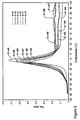
- the Mooney viscosity (M 100) in Table 6 shows higher values for the samples containing fluffy. It is well known when preparing rubber compounds that when the reinforcer (in this case the fluffy) is acting (Zhu, A. and S. Sternstein, "Filled and Nanocomposite Polymer Materials", Mater. Res. Soc. Proc. 2001), there is a good interaction between the rubber and the carbon black, therefore a higher Mooney viscosity is obtained. The same is observed in storage modulus which can be raised by increasing the amount of an interacting filler or by adding a more interacting filler. This last feature is achieved in the examples where fluffy is used instead of ground pellets of carbon black.
- tan ⁇ value which relates the elastic and viscous modulus of materials. At low temperatures, this parameter is desired to be larger, and at high temperatures, the same is desired to be as small as possible.
- tan delta values taken at different temperatures can be correlated with the tire performance. For instance a high value of tan delta at around-30°C is correlated with better ice traction properties, meaning a good grip at very low temperatures, and a high value of tan delta at about 0°C is correlated with better wet traction properties (not sliding during rainy conditions). A low value of tan delta at about 60°C is correlated with good rolling resistance, which increases the life of a tire and reduces fuel consumption. All of these tire performance requirements are achieved with a product made according to the present invention.
- examples 44 to 49 were carried out wherein SBR 1502 rubber was used for examples 44, 45, 47 and 48, and SBR 1712 rubber for examples 46 and 49.
- Fifty (50) phr carbon black was used for examples 44, 46, 47, 49, and examples 45 and 48 used thirty (30) phr of carbon black. The remaining components were in the amounts used for example 15. It is important to furkher mention that examples 44 to 46 were carried out through the process of the present invention, i.e., using fluffy carbon black, while examples 47 to 49 were performed by using agglomerated carbon black in pellet form and mechanically dry mixed after rubber recovery.
- a ratio has been calculated and presented in Table 7, which is the ratio of tan ⁇ at 0°C to tan ⁇ at 80°C. Since it is desirable to have a high tan ⁇ at low temperatures and a low tan ⁇ at high temperatures and since it is desirable to have both a high tan ⁇ at low temperatures and a low tan ⁇ at high temperatures, a ratio of tan ⁇ at 0°C to tan ⁇ at 80°C is indicative of the performance of a carbon-filled rubber in a tire.
- a tire made from rubber having a high value of the ratio of tan ⁇ at 0°C to tan ⁇ at 80°C may perform better than a tire made from rubber having a low ratio of tan ⁇ at 0°C to tan ⁇ at 80°C.
- the tire may perform better in that it may have better traction in wet or icy conditions and/or lower rolling resistance for longer tire life and lower fuel consumption.
- the ratio of tan ⁇ at 0°C to tan ⁇ at 80°C is 4.02, 2.19 and 2.25, respectively, which is considerably higher than the values 1.33, 1.19 and 1.32 for the ratios in examples 47, 48 and 49, respectively, in Table 7, which use ground pellets.
- the present invention includes a carbon-filled rubber having a ratio of tan ⁇ at 0°C to tan ⁇ at 80°C that exceeds about 1.5, preferably exceeding about 2.0 and more preferably exceeding about 3.0.
- example 44 which is a fluffy carbon black sample, is particularly dramatic with the highest tan ⁇ value (0.626) of all of the examples 44-49 at about -10°C (-9.4°C) as compared to the pellet carbon black sample of example 49, which is the lowest tan ⁇ value (0.299) of all of the examples 44-49 at about -10°C (-9.5°C).
- the fluffy samples in examples 44-46 have an average tan ⁇ value of 0.538 while the pellet samples in examples 47-49 have an average tan ⁇ value of 0.374.
- the higher value of tan ⁇ for the fluffy samples at the low temperature of about -10°C indicates that tires made according to the present invention will have better traction in rainy and icy conditions.
- the fluffy sample in example 44 again provides the best results with the lowest value of tan ⁇ , 0.076, as compared to pellet example 48, which has the highest value of tan ⁇ at 0.1783.
- the fluffy samples in examples 44-46 have an average tan ⁇ value of 0.973 while the pellet samples in examples 47-49 have an average tan ⁇ value of 0.165, when measured at about 80°C.
- maximum torque or MH indicates the amount of energy required for a Banbury mixer. Mixing energy is a function of torque times the rpm of the mixer. Lower values for maximum torque indicate that less energy is required as compared to higher values. Since the present inventive carbon-filled rubber has a value of 7.77 lb-in as compared to the prior art mechanically mixed carbon-filled rubber, which has a value of 8.59 lb-in, less energy would be required to mix the inventive carbon-filled rubber as compared to the prior art mechanically mixed carbon-filled rubber. This is important because both rubber materials would need to be mixed with or compounded with sulfur, as well as possibly other additives, before vulcanization. This mixing energy is an expense incurred by tire and other rubber product manufacturers, which expense can be lowered by using the carbon-filled rubber of the present invention.
- the scorch time, TS+1 and TS+2 which is the number of minutes required to rise 1 unit above the minimum torque or ML, provides an indication of cure time, where lower values indicate a shorter cure time, shorter mixing time and higher productivity as compared to higher values.
- the inventive carbon-filled rubber has a TS+1 and TS+2 scorch time of 3.1 and 3.58 minutes as compared to 4.45 and 5.24 minutes, respectively, which indicates that carbon-filled rubber made according to the present invention will cure quicker than prior art carbon-filled rubber.
- a shorter cure time would increase the productivity of a tire and other rubber product manufacturer, allowing more tires or rubber products to be made in a given period of time.
- the cure time measurements of Tc50% and Tc90% also indicate how much time is required to cure rubber, and low values mean shorter, and thus better, cure times.
- the measurement of Tc50% is the number of minutes required to achieve 50% of the maximum torque value
- the measurement of Tc90% is the number of minutes required to achieve 90% of the maximum torque value.
- Carbon-filled rubber made according to the present invention has values of 4.27 and 7.28 minutes for Tc50% and Tc90%, respectively, as compared to 6.68 and 11.7 minutes for Tc50% and Tc90% for the prior art carbon-filled rubber.
- the carbon-filled rubber made according to the present invention will thus have a shorter cure time than the prior art carbon-filled rubber and thus higher productivity can be achieved by tire and other rubber product manufacturers when using the present inventive carbon-filled rubber.
- the carbon-filled rubber made according to the present invention has a hardness of 63 as measured using the hardness Shore A Method identified as DIN 53505 while the prior art rubber made with ground carbon black pellets has a lower hardness value of 59. Since a hardness of 63 is greater than a hardness of 59, the inventive rubber is better for tire tread applications than prior art carbon-filled rubber.
- Abrasion test ASTM D3186 measures the amount (volume in mm 3 ) of rubber removed by abrading a sample of rubber, where the less rubber removed indicates better performance.
- the inventive rubber yielded 105 mm 3 of rubber removed while the prior art rubber allowed 124 mm 3 of rubber to be removed.
- a tire tread made using the inventive rubber would not wear off of a tire as quickly as a tire tread made using prior art rubber.
- carbon-filled rubber made according to the present invention has better performance parameters than carbon-filled rubber made by mechanically mixing ground carbon black pellets into rubber. While the minimum torque and Mooney viscosity values are about the same between the inventive rubber and the prior art rubber, all of the other parameters shown in Table 9 indicate that the inventive rubber will perform better than the prior art rubber. The inventive rubber provides better parameters in the end product, allows lower manufacturing costs, and increases manufacturing productivity.
- a tire or rubber products manufacturer can produce a product with superior performance to prior art products with presumably about the same raw material cost for the rubber and carbon black as required for the prior art products.
- the cohesive forces between the rubber and carbon black particles are apparently greater in the inventive carbon-filled rubber, one can use less carbon black than in the prior art material to achieve performance properties comparable to the performance of prior art tires and rubber products.
- a tire or rubber product manufacturer has the option to lower its cost for the carbon black raw material, since less carbon black is required, while achieving performance equivalent to that provided by prior art tires and rubber products.
- Figures 9 - 12 about 1.0 milligram of carbon black has been dispersed in about 1.0 liter of water
- Figures 9 and 11 are TEM photomicrographs of N-234 fluffy carbon black dispersed in water without a dispersant.
- Figures 10 and 12 are N-234 carbon black ground from pellets that has been dispersed in water in the same concentration and also without a dispersant.
- Figures 9 and 10 are TEM photomicrographs at a magnification of 20000 times the original size (20000 X), while figures 11 and 12 are TEM photomicrographs at a magnification of 31500 times the original size (31500 X).
- Figures 9 and 10 are TEM photomicrographs at a magnification of 20000 times the original size (20000 X)
- figures 11 and 12 are TEM photomicrographs at a magnification of 31500 times the original size (31500 X).
- Carbon black has a natural tendency to agglomerate when dispersed in water.
- the darker-tone areas are clumps of carbon black that have naturally agglomerated.
- the lighter-tone areas show individual particles of carbon black dispersed in water, and a darker color in a lighter-tone area indicates that larger particles are present than the particles in a lighter color in a lighter-tone area.
- the fractal structure agglomerate density is thus higher for the ground pellets in Figures 10 and 12 than for the fluffy carbon black samples in Figures 9 and 11.
- These microphotographs in this TEM study tend to confirm the results of measuring particle size distribution using the Horiba Model LA-910, which was discussed above with reference to Table 1 and Figure 3.
- the particle size distribution as measured using the Horiba Model LA-910 showed that the largest fluffy carbon black particles tended to be less than about 2.0 microns, while the largest particle size of the ground carbon black approached 7.0 microns with over 10% of the particles in ground carbon black being larger than the largest particle of fluffy carbon black.
- TEM microphotographs are provided to compare a commercial sample of a prior art carbon-filled rubber (in Figures 14 and 16) to the present inventive carbon-filled rubber (in Figures 13 and 15), where the prior art rubber was presumably made by first grinding carbon black pellets and then compounding the ground carbon black by dry mixing it with rubber.
- the present inventive carbon-filled rubber a fluffy carbon slurry was added to latex before coagulation occurred and was mixed with the latex before and during the coagulation step.
- the present inventive carbon-filled rubber was then recovered as described above with reference to Figures 2A and 2B.
- a more homogeneous dispersion is achieved when less contrast is observed in the microphotographs (i.e.; not very black and not very white).
- a completely black area means no dispersion of carbon black.
- a gray homogeneous tone is preferred to a mixture of discrete black and white areas.
- a dark area means no dispersion of carbon black, and this is bad from the mechanical properties point of view due to the fact that this area is a very weak point where rupture can occur.
- Figures 15 and 16 which are like Figures 13 and 14, respectively, but at 31500 X rather than 20000 X, further confirm the observations made with respect to Figures 13 and 14.
- the inventive rubber in Figure 15 has a homogeneous or uniform appearance, which is good
- the prior art black masterbatch in Figure 16 has a very light region, which indicates a lack of carbon black, and a very dark region, which indicates a high density of carbon black. While prior art black masterbatch has generally performed well in its end uses, the uniformity seen in Figure 15 indicates that superior performance can be obtained in end products that incorporate rubber or polymer made according to the present invention.
- the TEM photomicrographs shown in the figures can be analyzed using digital image analysis based on gray scale level.
- the highly homogeneous dispersion in the inventive carbon-filled rubber indicated by the gray tone can be quantitatively analyzed and compared to the less homogeneous TEM photomicrographs of the prior art material. This is done by analyzing the color itself - black, white and the many shades of gray in between.
- the inventive material can be defined by the results obtained from digital image analysis.
- particle sizes, and thus particle size distribution can be determined using digital image analysis on these TEM photomicrographs, which can further define the inventive carbon-filled rubber.
- a process for making a carbon-filled rubber that includes the steps of forming a rubber intermediate; adding a fluffy carbon black stream to the rubber intermediate; incorporating fluffy carbon black to form a rubber having carbon black dispersed therethrough; and processing the mixture of carbon black and rubber to form a carbon-filled rubber.
- the rubber intermediate is a latex in an emulsion styrene-butadiene plant.
- the fluffy carbon black is preferably received as a slurry of fluffy carbon black in water; and optionally, a dispersant can be added to aid in dispersing the fluffy carbon black in the water to form the fluffy carbon black slurry.
- the dispersant is preferably a naphthalenesulfonate composition although other dispersants can be used.
- the process further includes operating a carbon black plant to form a fluffy carbon black intermediate that can be used as the source of fluffy carbon black stream.
- the fluffy carbon black intermediate is withdrawn upstream of agglomeration or pelletizing equipment, or the carbon black plant does not have agglomeration or pelletizing equipment so that in either case the fluffy carbon black intermediate has not been agglomerated or pelletized.
- the average particle size of the fluffy carbon black intermediate is less than about 1000 nm when dispersed in water, and/or about 95% of the carbon black particles may be less than 2000 nm.
- a process for making rubber containing carbon black that includes the steps of feeding a fuel to a reactor for maintaining the reactor at an elevated temperature; feeding a hydrocarbon-based feedstock to the reactor; feeding air to the reactor; reacting the air with the hydrocarbon-based feedstock to form a carbon black smoke; quenching the reaction; recovering a fluffy carbon black intermediate from the carbon black smoke; adding water to the fluffy carbon black intermediate to form a fluffy carbon black solution; removing grit from the fluffy carbon black solution to form a fluffy carbon black slurry; operating a rubber manufacturing plant capable of making rubber; receiving the fluffy carbon black slurry; adding the fluffy carbon black slurry to an intermediate step in the process for making rubber; incorporating the fluffy carbon black into rubber to make rubber containing carbon black; and processing the rubber containing carbon black to make black masterbatch rubber.
- Another embodiment of the invention includes an integrated plant for making black masterbatch rubber that includes a carbon black plant capable of making a fluffy carbon black intermediate; means for making a fluffy carbon black stream; a rubber manufacturing plant adjacent to the carbon black plant; means for conveying the fluffy carbon black stream to the rubber manufacturing plant; means for incorporating fluffy carbon black into rubber; and means for making a black masterbatch rubber that contains fluffy carbon black.
- a process for making a fluffy carbon black slurry comprises feeding a fuel to a reactor for maintaining the reactor at an elevated temperature; feeding a hydrocarbon-based feedstock to the reactor; feeding air to the reactor; reacting the air with the hydrocarbon-based feedstock to form a carbon black smoke; quenching the reaction; recovering a fluffy carbon black intermediate from the carbon black smoke; adding water to the fluffy carbon black intermediate to form a fluffy carbon black solution; and removing grit from the fluffy carbon black solution to form a fluffy carbon black slurry.
- the concentration of carbon black in the fluffy carbon black slurry is less than about 15 weight percent and, more preferably, less than about 11 weight percent.
- a process for making black masterbatch rubber comprises feeding a fuel to a reactor for maintaining the reactor at an elevated temperature; feeding a hydrocarbon-based feedstock to the reactor; feeding air to the reactor; reacting the air with the hydrocarbon-based feedstock to form a carbon black smoke; quenching the reaction; recovering a fluffy carbon black intermediate from the carbon black smoke; adding water to the fluffy carbon black intermediate to form a fluffy carbon black solution; removing grit from the fluffy carbon black solution to form a fluffy carbon black slurry; operating a rubber manufacturing plant capable of making rubber; receiving the fluffy carbon black slurry; adding the fluffy carbon black slurry to an intermediate step in the process for making rubber; incorporating the fluffy carbon black into rubber to make rubber containing carbon black; and processing the rubber containing carbon black to make black masterbatch rubber.
- An integrated plant for making black masterbatch rubber comprises a carbon black plant capable of making a fluffy carbon black intermediate; means for making a fluffy carbon black stream; a rubber manufacturing plant adjacent to the carbon black plant; means for conveying the fluffy carbon black stream to the rubber manufacturing plant; means for incorporating the fluffy carbon black stream into rubber; and means for making a black masterbatch rubber that contains fluffy carbon black.
- a tire or rubber manufacturing plant is further integrated with and adjacent to the integrated plant for making black masterbatch rubber.
- a method for improving the efficiency of making vehicle tires or rubber products includes idling equipment and facilities at a tire or rubber product manufacturing facility used for receiving, handling and grinding agglomerated or pelletized carbon black; idling equipment at a carbon black plant used for agglomerating or pelletizing a fluffy carbon black intermediate; idling equipment at a carbon black plant used for storing and handling agglomerated or pelletized carbon black; forming a fluffy carbon black stream with the fluffy carbon black intermediate; conveying the fluffy carbon black stream to a manufacturing plant used for making rubber; adding the fluffy carbon black stream to an intermediate stage in making rubber at the rubber manufacturing plant; incorporating fluffy carbon black in rubber produced at the rubber manufacturing plant to make a black masterbatch product; shipping the black masterbatch product to the tire or rubber product manufacturing facility; and using the black masterbatch product to make a tire or a rubber product
- the black masterbatch product preferably has a ratio of tan ⁇ at 0°C to tan ⁇ at 80°C that exceeds about 1.5
- a carbon-filled rubber is provided, which is made in a process that incorporates a step of adding fluffy carbon black during the process of making rubber.
- the carbon-filled rubber has a distribution of carbon particle sizes where about 99% of the particles are less than about 2 microns in diameter, and the particle size distribution is not significantly skewed, but rather is a nearly normal, bell-shaped curve.
- the carbon-filled rubber is defined or identified by a digital image analysis, based on gray scale level, of Figures 4, 13 and/or 15 as compared to Figures 5, 14 and/or 16, respectively.
Landscapes
- Engineering & Computer Science (AREA)
- Mechanical Engineering (AREA)
- Chemical & Material Sciences (AREA)
- Health & Medical Sciences (AREA)
- Chemical Kinetics & Catalysis (AREA)
- Medicinal Chemistry (AREA)
- Polymers & Plastics (AREA)
- Organic Chemistry (AREA)
- Compositions Of Macromolecular Compounds (AREA)
- Processes Of Treating Macromolecular Substances (AREA)
- Colloid Chemistry (AREA)
Applications Claiming Priority (7)
| Application Number | Priority Date | Filing Date | Title |
|---|---|---|---|
| MX0012172 | 2000-12-07 | ||
| MXPA00012172A MXPA00012172A (es) | 2000-12-07 | 2000-12-07 | Procedimiento para la preparacion de materiales nano-dispersos de negro de humo y hule. |
| US28577001P | 2001-04-23 | 2001-04-23 | |
| US285770P | 2001-04-23 | ||
| US4950 | 2001-12-05 | ||
| US10/004,950 US6646028B2 (en) | 2000-12-07 | 2001-12-05 | Rubber and carbon black |
| PCT/MX2001/000088 WO2002045945A2 (es) | 2000-12-07 | 2001-12-06 | Hule y negro de humo |
Publications (2)
| Publication Number | Publication Date |
|---|---|
| EP1362880A2 true EP1362880A2 (de) | 2003-11-19 |
| EP1362880A4 EP1362880A4 (de) | 2005-01-05 |
Family
ID=32600751
Family Applications (1)
| Application Number | Title | Priority Date | Filing Date |
|---|---|---|---|
| EP01999473A Withdrawn EP1362880A4 (de) | 2000-12-07 | 2001-12-06 | Wachstuch und lampenruss |
Country Status (5)
| Country | Link |
|---|---|
| US (1) | US6646028B2 (de) |
| EP (1) | EP1362880A4 (de) |
| AU (1) | AU2002222774A1 (de) |
| CA (1) | CA2431275A1 (de) |
| WO (1) | WO2002045945A2 (de) |
Cited By (2)
| Publication number | Priority date | Publication date | Assignee | Title |
|---|---|---|---|---|
| EP1632522A1 (de) * | 2004-09-02 | 2006-03-08 | The Goodyear Tire & Rubber Company | Pelletförmiger Kompositwerkstoff aus Pulverruss, Herstellung von einer Kautschukzusammensetzung daraus und hergestellter Artikel |
| WO2010107032A1 (ja) | 2009-03-16 | 2010-09-23 | 株式会社ブリヂストン | ゴムウェットマスターバッチの製造方法、ゴム組成物及びタイヤ |
Families Citing this family (30)
| Publication number | Priority date | Publication date | Assignee | Title |
|---|---|---|---|---|
| US7341142B2 (en) * | 2001-11-09 | 2008-03-11 | Cabot Corporation | Elastomer composite materials in low density forms and methods |
| JP3969329B2 (ja) * | 2002-04-26 | 2007-09-05 | 豊田合成株式会社 | ゴム製品の成形方法 |
| JP4533317B2 (ja) * | 2003-08-05 | 2010-09-01 | 株式会社ブリヂストン | ゴムマスターバッチの製造方法 |
| US20060086253A1 (en) * | 2004-10-27 | 2006-04-27 | Siddhartha Gaur | Cyclone separator cooler |
| KR100635605B1 (ko) | 2005-06-22 | 2006-10-18 | 금호타이어 주식회사 | 외관 특성이 향상된 타이어 트레드 고무조성물 |
| KR100728382B1 (ko) * | 2005-07-15 | 2007-06-13 | 엘지전자 주식회사 | 냉장고용 도어가스켓 |
| US8034316B2 (en) * | 2006-11-07 | 2011-10-11 | Cabot Corporation | Carbon blacks having low PAH amounts and methods of making same |
| WO2009032178A1 (en) | 2007-08-30 | 2009-03-12 | Cabot Corporation | An elastomer composite and method for producing it |
| EP2218749B1 (de) * | 2007-12-03 | 2013-11-20 | Bridgestone Corporation | Verfahren zur herstellung eines naturkautschuk-masterbatches, naturkautschuk-masterbatch, kautschukzusammensetzung und reifen |
| AU2009210723B2 (en) * | 2008-02-08 | 2012-08-16 | Cabot Corporation | An elastomer composite and method for producing it |
| EP2303951B1 (de) | 2008-07-24 | 2018-03-07 | Industrias Negromex, S.a. De C.v. | Verfahren zur herstellung von silan, hydrophobierter kieselsäure, eines kieselsäure-masterbatches und von kautschukprodukten |
| US20110166265A1 (en) * | 2010-01-07 | 2011-07-07 | Lion Copolymer, Llc | High structure carbon black in elastomeric polymers and method for making |
| GB2496362B (en) | 2010-09-15 | 2018-05-02 | Cabot Corp | Elastomer composite with silica-containing filler and methods to produce same |
| RU2495889C2 (ru) * | 2011-12-28 | 2013-10-20 | Федеральное государственное бюджетное образовательное учреждение высшего профессионального образования "Чувашский государственный университет имени И.Н. Ульянова" | Термостойкая резиновая смесь |
| US9175150B2 (en) | 2012-03-02 | 2015-11-03 | Cabot Corporation | Modified carbon blacks having low PAH amounts and elastomers containing the same |
| WO2013191764A1 (en) * | 2012-06-21 | 2013-12-27 | Sid Richardson Carbon, Ltd. | Polysulfide treatment of carbon black filler and elastomeric compositions with polysulfide treated carbon black |
| US11421097B2 (en) | 2012-12-20 | 2022-08-23 | Henkel Ag & Co. Kgaa | Container sealant composition |
| US9475057B2 (en) | 2013-01-24 | 2016-10-25 | Cabot Corporation | Liner elements with improved wear-life for grinding operations |
| MY192040A (en) | 2013-05-20 | 2022-07-24 | Cabot Corp | Elastomer composites, blends and methods for preparing same |
| KR101847806B1 (ko) | 2014-03-07 | 2018-04-12 | 인두스트리아스네그로멕스에스에이데세베 | 에멀젼 고무와 용액 고무로 제조된 실리카 마스터배치 |
| US9815962B2 (en) * | 2014-08-26 | 2017-11-14 | The Goodyear Tire & Rubber Company | Tire with carbon black reinforced polyurethane |
| EP3197947A4 (de) * | 2014-09-23 | 2018-05-09 | Bridgestone Bandag, LLC | Durch styrolbutadien-latexpolymer gebundene russpellets |
| EP3197957A4 (de) | 2014-09-23 | 2018-03-07 | Bridgestone Bandag, LLC | Durch funktionelle polymere gebundene russpellets |
| US20180371181A1 (en) * | 2015-12-03 | 2018-12-27 | Ski Carbon Black (India) Pvt Ltd | Carbon black latex masterbatch composition |
| WO2018091955A2 (en) | 2016-08-31 | 2018-05-24 | Dynasol Elastomeros, S.A. De C.V. | Processes for making masterbatches of rubber and silica |
| JP6989702B2 (ja) | 2017-11-10 | 2022-01-05 | キャボット コーポレイションCabot Corporation | 1又は複数のエラストマー化合物を生成する方法 |
| SK932021A3 (sk) | 2019-06-05 | 2022-04-27 | BEYOND LOTUS LLC c/o Corporation Service Company | pôsob prípravy kompozitu obsahujúceho elastomér a plnivo |
| WO2021247153A2 (en) | 2020-04-20 | 2021-12-09 | Beyond Lotus Llc | Elastomer compositions with carbon nanostructure filler |
| CN115709618A (zh) * | 2022-11-23 | 2023-02-24 | 广饶吉星轮胎有限公司 | 一种轮胎及轮胎制造方法 |
| WO2026075938A1 (en) | 2024-10-03 | 2026-04-09 | Cabot Corporation | Elastomer composites with polysaccharide filler |
Family Cites Families (49)
| Publication number | Priority date | Publication date | Assignee | Title |
|---|---|---|---|---|
| US2538809A (en) * | 1946-06-26 | 1951-01-23 | Gen Tire & Rubber Co | Process of compounding rubbery polymers |
| US2786879A (en) | 1953-01-12 | 1957-03-26 | Phillips Petroleum Co | Method for coagulating rubber black masterbatch |
| US3021226A (en) | 1958-06-02 | 1962-02-13 | Phillips Petroleum Co | Carbon black slurries and latex-carbon black masterbatches |
| NL290390A (de) | 1962-03-29 | |||
| GB1125801A (en) * | 1965-02-05 | 1968-09-05 | Rubber Res Inst Of Malaya Boar | Improvements in or relating to the production of rubber compositions |
| US3767605A (en) | 1969-08-13 | 1973-10-23 | Copolymer Rubber & Chem Corp | Method for preparation of rubber crumb |
| US4111867A (en) * | 1976-04-05 | 1978-09-05 | Nippon Zeon Co., Ltd. | Rubber composition for tire treads |
| US4029633A (en) | 1976-04-14 | 1977-06-14 | Cabot Corporation | Carbon black-rubber masterbatch production |
| US4246251A (en) | 1979-04-23 | 1981-01-20 | Sid Richardson Carbon & Gasoline Company | Method of producing carbon black |
| US4374941A (en) | 1981-08-27 | 1983-02-22 | The Goodyear Tire & Rubber Company | Particle size control of SBR/carbon black powder |
| US4375497A (en) | 1981-08-27 | 1983-03-01 | The Goodyear Tire & Rubber Company | Free flowing SBR black masterbatch powder |
| US4481329A (en) | 1983-10-21 | 1984-11-06 | The Goodyear Tire & Rubber Company | Method of dispersing reinforcing pigments in a latex |
| JPH02115279A (ja) | 1988-10-25 | 1990-04-27 | Mitsubishi Kasei Corp | 分散性の改良されたカーボンブラック水分散液の製造法 |
| JP2674602B2 (ja) | 1988-11-25 | 1997-11-12 | 三菱化学株式会社 | 易分散性カーボンブラック |
| DE4023537A1 (de) | 1990-07-25 | 1992-01-30 | Degussa | Mit organosiliciumverbindungen chemisch modifizierte russe, verfahren zu deren herstellung und deren verwendung |
| US5352289A (en) | 1992-12-18 | 1994-10-04 | Cabot Corporation | Low ash carbon blacks |
| JP2701138B2 (ja) * | 1995-03-13 | 1998-01-21 | ニチアス株式会社 | 加硫ゴム組成物 |
| US5725650A (en) | 1995-03-20 | 1998-03-10 | Cabot Corporation | Polyethylene glycol treated carbon black and compounds thereof |
| JPH08269361A (ja) | 1995-03-31 | 1996-10-15 | Nippon Zeon Co Ltd | カーボンブラック用水系分散剤 |
| US5739198A (en) | 1996-03-18 | 1998-04-14 | The Goodyear Tire & Rubber Company | Rubber composition and tire with tread thereof |
| US5807918A (en) * | 1996-03-26 | 1998-09-15 | Patch Rubber Company | Color changeable aqueous adhesive systems |
| BR9708412A (pt) | 1996-04-01 | 2000-10-24 | Cabot Corp | Aparelho, método e compostos de elastÈmero novos |
| TW360585B (en) | 1996-04-01 | 1999-06-11 | Cabot Corp | Elastomeric compositions and methods and apparatus for producing same |
| US6019829A (en) | 1996-10-31 | 2000-02-01 | Mitsubishi Chemical Corporation | Carbon black aggregate |
| US5763388A (en) | 1996-12-18 | 1998-06-09 | Dsm Copolymer, Inc. | Process for producing improved silica-reinforced masterbatch of polymers prepared in latex form |
| KR100536796B1 (ko) | 1996-12-26 | 2005-12-14 | 미쓰비시 가가꾸 가부시키가이샤 | 카본블랙, 그 제조방법 및 이를 함유하는 수성분산액 및수성잉크 |
| US6218465B1 (en) * | 1997-03-05 | 2001-04-17 | Nippon Shokubai Co., Ltd. | Crosslinked elastomer and producing process thereof |
| JPH11131004A (ja) | 1997-10-28 | 1999-05-18 | Citizen Watch Co Ltd | 水性顔料系記録液の製造方法 |
| JPH11131001A (ja) | 1997-10-30 | 1999-05-18 | Fujitsu Ltd | 水系分散記録液、これを使用したインクカートリッジおよび記録装置 |
| JP3122402B2 (ja) | 1997-11-05 | 2001-01-09 | 冨士色素株式会社 | 白板用水性黒色顔料インク |
| JP3691947B2 (ja) | 1997-11-17 | 2005-09-07 | 東海カーボン株式会社 | 易水分散性カーボンブラック及びその製造方法 |
| JPH11152424A (ja) | 1997-11-25 | 1999-06-08 | Dainippon Ink & Chem Inc | 水性顔料分散体の製造方法及び水性着色液 |
| JP3803762B2 (ja) | 1997-12-05 | 2006-08-02 | 大日本インキ化学工業株式会社 | インクジェットプリンター用水性記録液の製造方法 |
| JPH11199807A (ja) | 1998-01-09 | 1999-07-27 | Kao Corp | インクジェット記録用インク |
| JPH11228891A (ja) | 1998-02-18 | 1999-08-24 | Fuji Xerox Co Ltd | インクジェット記録用インク |
| JPH11246806A (ja) | 1998-03-02 | 1999-09-14 | Toyo Ink Mfg Co Ltd | 水性顔料分散体およびインクジェット用記録液 |
| JPH11279770A (ja) | 1998-03-30 | 1999-10-12 | Kobe Steel Ltd | 耐水性と耐糸さび性に優れた輸送機用Al合金材 |
| JPH11286644A (ja) | 1998-04-03 | 1999-10-19 | Minolta Co Ltd | 水系顔料分散体 |
| JPH11335601A (ja) | 1998-05-22 | 1999-12-07 | Minolta Co Ltd | 記録用インク |
| JPH11335586A (ja) | 1998-05-22 | 1999-12-07 | Minolta Co Ltd | カーボンブラック及び記録用インク |
| JPH11335587A (ja) | 1998-05-22 | 1999-12-07 | Minolta Co Ltd | カーボンブラック及び記録用インク |
| JPH11335605A (ja) | 1998-05-25 | 1999-12-07 | Hitachi Maxell Ltd | 水系分散インクおよびその製造方法 |
| JPH11335603A (ja) | 1998-05-26 | 1999-12-07 | Minolta Co Ltd | 記録用インク |
| JPH11335602A (ja) | 1998-05-26 | 1999-12-07 | Minolta Co Ltd | 記録用インク |
| EP1047739B1 (de) | 1998-05-28 | 2009-11-04 | Sun Chemical Corporation | Wässrige pigmentdispersion auf farbstoffbasis |
| JP4277326B2 (ja) | 1998-06-03 | 2009-06-10 | Dic株式会社 | 水性インク組成物 |
| JP3933303B2 (ja) | 1998-06-04 | 2007-06-20 | 三菱化学株式会社 | カーボンブラック及びその製造方法並びにカーボンブラック水性分散液及びこれを用いた水性インキ |
| JP4099263B2 (ja) | 1998-06-09 | 2008-06-11 | 東海カーボン株式会社 | 易水分散性カーボンブラックの製造方法 |
| US6087416A (en) | 1998-07-22 | 2000-07-11 | E.I. Du Pont De Nemours And Company | Aqueous pigmented ink jet inks for printing on vinyls |
-
2001
- 2001-12-05 US US10/004,950 patent/US6646028B2/en not_active Expired - Fee Related
- 2001-12-06 CA CA002431275A patent/CA2431275A1/en not_active Abandoned
- 2001-12-06 WO PCT/MX2001/000088 patent/WO2002045945A2/es not_active Ceased
- 2001-12-06 AU AU2002222774A patent/AU2002222774A1/en not_active Abandoned
- 2001-12-06 EP EP01999473A patent/EP1362880A4/de not_active Withdrawn
Cited By (2)
| Publication number | Priority date | Publication date | Assignee | Title |
|---|---|---|---|---|
| EP1632522A1 (de) * | 2004-09-02 | 2006-03-08 | The Goodyear Tire & Rubber Company | Pelletförmiger Kompositwerkstoff aus Pulverruss, Herstellung von einer Kautschukzusammensetzung daraus und hergestellter Artikel |
| WO2010107032A1 (ja) | 2009-03-16 | 2010-09-23 | 株式会社ブリヂストン | ゴムウェットマスターバッチの製造方法、ゴム組成物及びタイヤ |
Also Published As
| Publication number | Publication date |
|---|---|
| US20020111413A1 (en) | 2002-08-15 |
| US6646028B2 (en) | 2003-11-11 |
| WO2002045945A2 (es) | 2002-06-13 |
| CA2431275A1 (en) | 2002-06-13 |
| AU2002222774A1 (en) | 2002-06-18 |
| WO2002045945A3 (es) | 2002-11-28 |
| EP1362880A4 (de) | 2005-01-05 |
Similar Documents
| Publication | Publication Date | Title |
|---|---|---|
| US6646028B2 (en) | Rubber and carbon black | |
| KR102791600B1 (ko) | 엘라스토머 및 충전제를 갖는 복합재를 제조하는 방법 | |
| EP2410003B1 (de) | Verfahren zur herstellung eines kautschukbenetzten masterbatchs, kautschukzusammensetzung und reifen daraus | |
| US11781020B2 (en) | Silica-graphenic carbon composite particles and elastomeric materials including such particles | |
| US6762236B2 (en) | Carbon black, process for its production and its use | |
| GB2530526A (en) | Styrene-butadiene rubber (SBR)-CNT filled masterbatch | |
| Karabork et al. | Influence of pyrolytic carbon black and pyrolytic oil made from used tires on the curing and (dynamic) mechanical properties of natural rubber (NR)/styrene-butadiene rubber (SBR) blends. | |
| KR101105213B1 (ko) | 실리카 충전 고무 과립체 및 그 제조방법 | |
| KR101426104B1 (ko) | 가황 활성 성분 처리 탄산칼슘 | |
| US6548584B1 (en) | Pulverulent rubber powder containing filler, process of the production thereof and use thereof | |
| EP3835263A1 (de) | Nasse kieselsäure für kautschuk-verstärkende füllstoffe | |
| CA2338107C (en) | Process for preparing carbon-black-filled rubber powders based on aqueous polymer-latex emulsions | |
| JPWO2006025423A1 (ja) | 白色粉末状加硫活性成分組成物及びゴム組成物 | |
| US4158682A (en) | Control of carbon black densification | |
| US4158690A (en) | Control of carbon black densification | |
| Worlee et al. | Influence of filler network on thermo-chemical de-vulcanization efficiency of carbon black filled natural rubber | |
| WO2024160370A1 (en) | Dry-granulation of particulate carbon material and agglomerates produced thereby | |
| Wahab et al. | of Polybutadiene Rubber with Nanoclay | |
| Yang et al. | The structure, properties and application of NR/BR/OMMT nanocomposites |
Legal Events
| Date | Code | Title | Description |
|---|---|---|---|
| PUAI | Public reference made under article 153(3) epc to a published international application that has entered the european phase |
Free format text: ORIGINAL CODE: 0009012 |
|
| 17P | Request for examination filed |
Effective date: 20030611 |
|
| AK | Designated contracting states |
Kind code of ref document: A2 Designated state(s): AT BE CH CY DE DK ES FI FR GB GR IE IT LI LU MC NL PT SE TR |
|
| AX | Request for extension of the european patent |
Extension state: AL LT LV MK RO SI |
|
| A4 | Supplementary search report drawn up and despatched |
Effective date: 20041123 |
|
| STAA | Information on the status of an ep patent application or granted ep patent |
Free format text: STATUS: THE APPLICATION HAS BEEN WITHDRAWN |
|
| 18W | Application withdrawn |
Effective date: 20050223 |