EP1367829A2 - Appareil de reproduction audio et méthode pour le contrôle - Google Patents
Appareil de reproduction audio et méthode pour le contrôle Download PDFInfo
- Publication number
- EP1367829A2 EP1367829A2 EP03008128A EP03008128A EP1367829A2 EP 1367829 A2 EP1367829 A2 EP 1367829A2 EP 03008128 A EP03008128 A EP 03008128A EP 03008128 A EP03008128 A EP 03008128A EP 1367829 A2 EP1367829 A2 EP 1367829A2
- Authority
- EP
- European Patent Office
- Prior art keywords
- audio data
- audio
- reproduction
- reproducing apparatus
- time period
- Prior art date
- Legal status (The legal status is an assumption and is not a legal conclusion. Google has not performed a legal analysis and makes no representation as to the accuracy of the status listed.)
- Withdrawn
Links
- 238000000034 method Methods 0.000 title claims description 48
- 238000004891 communication Methods 0.000 claims abstract description 45
- 230000004075 alteration Effects 0.000 claims description 28
- 230000008569 process Effects 0.000 description 24
- 238000001514 detection method Methods 0.000 description 21
- 238000003780 insertion Methods 0.000 description 7
- 230000037431 insertion Effects 0.000 description 7
- 238000005070 sampling Methods 0.000 description 6
- 230000007423 decrease Effects 0.000 description 5
- 230000003247 decreasing effect Effects 0.000 description 5
- 238000012217 deletion Methods 0.000 description 4
- 230000037430 deletion Effects 0.000 description 4
- 238000010586 diagram Methods 0.000 description 4
- 238000000926 separation method Methods 0.000 description 4
- 238000004590 computer program Methods 0.000 description 2
- 230000005236 sound signal Effects 0.000 description 2
- 230000001360 synchronised effect Effects 0.000 description 2
- 230000005540 biological transmission Effects 0.000 description 1
- 230000008859 change Effects 0.000 description 1
- 238000012937 correction Methods 0.000 description 1
- 230000006870 function Effects 0.000 description 1
Images


Classifications
-
- H—ELECTRICITY
- H04—ELECTRIC COMMUNICATION TECHNIQUE
- H04N—PICTORIAL COMMUNICATION, e.g. TELEVISION
- H04N21/00—Selective content distribution, e.g. interactive television or video on demand [VOD]
- H04N21/40—Client devices specifically adapted for the reception of or interaction with content, e.g. set-top-box [STB]; Operations thereof
- H04N21/43—Processing of content or additional data, e.g. demultiplexing additional data from a digital video stream; Elementary client operations, e.g. monitoring of home network or synchronising decoder's clock; Client middleware
- H04N21/4302—Content synchronisation processes, e.g. decoder synchronisation
- H04N21/4305—Synchronising client clock from received content stream, e.g. locking decoder clock with encoder clock, extraction of the PCR packets
-
- H—ELECTRICITY
- H04—ELECTRIC COMMUNICATION TECHNIQUE
- H04N—PICTORIAL COMMUNICATION, e.g. TELEVISION
- H04N21/00—Selective content distribution, e.g. interactive television or video on demand [VOD]
- H04N21/40—Client devices specifically adapted for the reception of or interaction with content, e.g. set-top-box [STB]; Operations thereof
- H04N21/41—Structure of client; Structure of client peripherals
- H04N21/4104—Peripherals receiving signals from specially adapted client devices
- H04N21/4112—Peripherals receiving signals from specially adapted client devices having fewer capabilities than the client, e.g. thin client having less processing power or no tuning capabilities
-
- H—ELECTRICITY
- H04—ELECTRIC COMMUNICATION TECHNIQUE
- H04N—PICTORIAL COMMUNICATION, e.g. TELEVISION
- H04N21/00—Selective content distribution, e.g. interactive television or video on demand [VOD]
- H04N21/40—Client devices specifically adapted for the reception of or interaction with content, e.g. set-top-box [STB]; Operations thereof
- H04N21/43—Processing of content or additional data, e.g. demultiplexing additional data from a digital video stream; Elementary client operations, e.g. monitoring of home network or synchronising decoder's clock; Client middleware
- H04N21/439—Processing of audio elementary streams
- H04N21/4392—Processing of audio elementary streams involving audio buffer management
-
- H—ELECTRICITY
- H04—ELECTRIC COMMUNICATION TECHNIQUE
- H04N—PICTORIAL COMMUNICATION, e.g. TELEVISION
- H04N21/00—Selective content distribution, e.g. interactive television or video on demand [VOD]
- H04N21/40—Client devices specifically adapted for the reception of or interaction with content, e.g. set-top-box [STB]; Operations thereof
- H04N21/43—Processing of content or additional data, e.g. demultiplexing additional data from a digital video stream; Elementary client operations, e.g. monitoring of home network or synchronising decoder's clock; Client middleware
- H04N21/439—Processing of audio elementary streams
- H04N21/4394—Processing of audio elementary streams involving operations for analysing the audio stream, e.g. detecting features or characteristics in audio streams
Definitions
- the present invention relates to an audio reproducing apparatus for reproducing audio data that is to be reproduced in synchronism with video data, and to an audio reproduction control method for use in this apparatus.
- Jpn.Pat. Appln. KOKAI Publication No. 9-261613 discloses a reproducing method that can alter a reproduction speed in an apparatus that receives and reproduces multimedia data.
- the reproduction speed is altered in accordance with the amount of residual data in a receiving buffer. Specifically, in this method, when the amount of residual data in the receiving buffer is large, the reproduction speed is increased. When the amount of residual data in the receiving buffer is small, the reproduction speed is decreased. Thereby, overflow or underflow of the receiving buffer is prevented.
- Jpn. Pat. Appln. KOKAI Publication No. 5-135228 discloses a technique that realizes decelerated reproduction or accelerated reproduction of voice signals while maintaining high-quality reproduction, by increasing or decreasing voiceless time periods in the voice signals.
- the reproduction timing of the video data is controlled according to the time indicated by the clock provided in the apparatus for reproducing the video data.
- the reproduction timing of the audio data is controlled according to the time indicated by the clock provided in another apparatus for reproducing the audio data.
- the difference between the clock referred to for the video data reproduction timing and the clock referred to for the audio data reproduction timing causes asynchronism between reproduced video and audio. If the reproduction speed of video data or audio data is altered in order to eliminate the asynchronism, an unnatural impression may be given to the viewer/listener.
- Embodiments of the present invention provide an audio reproducing apparatus and an audio reproduction control method capable of altering an audio data reproduction speed in accordance with a degree of asynchronism between the audio data and video data that is reproduced by another apparatus, without giving an unnatural impression to the viewer/listener.
- an audio reproducing apparatus that reproduces audio data to be reproduced in sync with video data, comprising: a communication device configured to execute communication with another apparatus that reproduces the video data; a unit configured to detect an'amount of a error between a reproduction point of the video data in the another apparatus and a reproduction point of the audio data in the audio reproducing apparatus by making use of the communication executed by the communication device with the another apparatus; a unit configured to detect, from a stream of the audio data, an audio data time period of audio data with a sound volume level lower than a specified value; and a unit configured to alter a reproduction speed of the audio data belonging to the detected audio data time period, on the basis of the detected amount of the error in reproduction point.
- FIG. 1 shows an audio reproducing apparatus 20 according to an embodiment of the invention.
- the audio reproducing apparatus 20 is configured to reproduce audio data in synchronism with the reproduction of video data, such as moving picture, by a video reproducing apparatus 10.
- video data such as moving picture
- the video reproducing apparatus 10 performs video data reproduction while the audio reproducing apparatus 20 performs audio data reproduction.
- the audio reproducing apparatus 20 while receiving to-be-reproduced audio data from an external apparatus over a communication path by wire or by radio, reproduces the received audio data.
- Audio data is sent to the audio reproducing apparatus 20 by one of the following methods: (1) to send audio data from the video reproducing apparatus 10 to the audio reproducing apparatus 20, or (2) to send video data and audio data simultaneously from an external content server to the video reproducing apparatus 10 and audio reproducing apparatus 20, respectively.
- method (1) is adopted.
- the video reproducing apparatus 10 When audio-video content is to be reproduced, the video reproducing apparatus 10 separates the audio-video content into video data and audio data. The video reproducing apparatus 10 reproduces the video data while transmitting the audio data to the audio reproducing apparatus 20.
- a short-distance wireless communication protocol represented by BluetoothTM is used for audio data transmission from the video reproducing apparatus 10 to the audio reproducing apparatus 20.
- the video reproducing apparatus 10 transmits the audio data wirelessly from an antenna 101 to the audio reproducing apparatus 20, and the audio reproducing apparatus 20 receives the audio data via an antenna 201 from the video reproducing apparatus 10.
- the audio reproducing apparatus 20 is realized as a wireless headphone, as shown in FIG. 2.
- the audio reproducing apparatus 20 while receiving the audio data from the video reproducing apparatus 10, reproduces the received audio data. During a time period in which the audio data is being reproduced, the audio reproducing apparatus 20 periodically communicates with the video reproducing apparatus 10 and detects an amount of an error between a reproduction point of video data in the video reproducing apparatus 10 and a reproduction point of audio data in the audio reproducing apparatus 20 (i.e. an amount of asynchronism between video and audio). In order to realize synchronous reproduction of video and audio, the audio reproducing apparatus 20 alters the reproduction speed of audio data in accordance with the detected amount of asynchronism. The alteration of reproduction speed of audio data is effected in a time period of an audio data component in which a sound volume level of audio is lower than a predetermined value.
- FIGS. 3 and 4 the structures of the video reproducing apparatus 10 and audio reproducing apparatus 20 will now be described.
- FIG. 3 shows a system configuration of the video reproducing apparatus 10.
- the video reproducing apparatus 10 is realized, for example, as a portable electronic apparatus such as a PDA (Personal Digital Assistant), a portable personal computer or a mobile phone.
- PDA Personal Digital Assistant
- the video reproducing apparatus 10 comprises a CPU 11, a time management unit 12, a memory device 13, a wireless communication device 14, a video/audio separation unit 15, a decoding unit 16, a video reproducing unit 17, and a display 18.
- the CPU 11 is a processor that is provided to control operations of the video reproducing apparatus 10.
- the CPU 11 is connected to other components of the video reproducing apparatus 10 over a bus 100.
- the CPU 11 cooperates with these components.
- the time management unit 12 comprises a clock device that measures time.
- the time management unit 12 provides time information which serves as a reference time for the video data reproducing operation.
- the memory device 13 comprises, for instance, a non-volatile memory device, and stores audio-video content to be reproduced.
- the audio-video content is composed of a stream of encoded video data and a stream of encoded audio data to be reproduced in sync with the video data stream.
- the video data stream and audio data stream are multiplexed.
- AVI Audio Video Interleave Format
- AVI format content data sampling rates are recorded for associated video and audio media, respectively.
- the video/audio separation unit 15 separates the to-be-reproduced content data into video data and audio data.
- the video data separated from the content data by the video/audio separation unit 15 is sent to the decoding unit 16, while the audio data separated from the content data by the video/audio separation unit 15 is sent to the wireless communication device 14.
- the wireless communication device 14 establishes wireless connection with the audio reproducing apparatus 20 and performs wireless communication with the audio reproducing apparatus 20.
- the wireless communication is executed according to procedures based on, for instance, BluetoothTM protocol.
- the decoding unit 16 decodes the encoded video data and decompresses the compressed video data into a displayable format.
- the video reproducing unit 17 controls the display 18 and executes a reproducing operation for enabling the display 18 to display the video data decoded by the decoding unit 16. In this case, the reproduction speed of video data is controlled by the time information managed by the time management unit 12 and the sampling rate of the video data.
- the reproduction of the video data by the video reproducing unit 17 begins after a predetermined time period has passed since the start of a process for sending the audio data to the audio reproducing apparatus 20 by radio signals.
- This predetermined time period is set in advance on the basis of the time needed until the audio reproducing apparatus 20 is made ready to reproduce the audio data. It is thus possible to simultaneously start the reproduction of audio data by the audio reproducing apparatus 20 and the reproduction of video data by the video reproducing unit 17.
- FIG. 4 shows a system configuration of the audio reproducing apparatus 20.
- the audio reproducing apparatus 20 is realized as a wireless headphone, as shown in FIG. 2.
- the audio reproducing apparatus 20, as shown in FIG. 4, comprises a CPU 21, a time management unit 22, a wireless communication device 23, a decoding unit 24, a buffer memory 25, an audio reproducing unit 26, an audio output unit 27, a video reproduction point acquiring unit 28, an asynchronism amount detection unit 29, a sound output level detection unit 30, and an audio reproduction speed control unit 31.
- the CPU 21 is a processor that is provided to control operations of the audio reproducing apparatus 20.
- the CPU 21 is connected to other components of the audio reproducing apparatus 20 over a bus 200.
- the CPU 21 cooperates with these components.
- the time management unit 22 comprises a clock device that measures time.
- the time management unit 22 provides time information which serves as a reference time for the audio data reproducing operation.
- the wireless communication device 23 establishes wireless connection with the video reproducing apparatus 10 and performs wireless communication with the video reproducing apparatus 10.
- the wireless communication is executed according to procedures based on, for instance, BluetoothTM protocol.
- the wireless communication device 23, under control of CPU 21, receives the encoded audio data from the video reproducing apparatus 10.
- the decoding unit 24 decodes the encoded audio data received by the wireless communication device 23 and decompresses the compressed audio data into a reproducible format.
- the decoded audio data is stored in the buffer memory 25.
- the buffer memory 25 is a memory device for temporarily storing audio data to be reproduced.
- the buffer memory 25 stores audio data having a length corresponding to a reproduction time of, e.g. about 50 msec to 600 msec.
- the audio reproducing unit 26 reproduces the audio data stored in the buffer memory 25 and outputs it as sound via the audio output unit 27 comprising a loudspeaker or a headphone.
- the audio reproducing operation involves, for example, a process for converting the audio data stored in the buffer memory 25 from a digital signal to an analog signal.
- the reproduction speed of audio data is basically controlled by the time information managed by the time management unit 22 and the sampling rate of the audio data, but it can be altered by the control under the audio reproduction speed control unit 31.
- the clock (time information) referred to in the control of the audio reproduction timing in the audio reproduction apparatus 20 differs from the clock (time information) referred to in the control of the video reproduction timing in the video reproducing apparatus 10.
- asynchronism may occur between audio reproduced by the audio reproducing apparatus 20 and video reproduced by the video reproducing apparatus 10. If the same clock can be referred to in the video reproduction timing control and the audio reproduction timing control, it is easy to realize synchronous reproduction of audio and video.
- the apparatus for reproducing video and the apparatus for reproducing audio are physically different, it is practically difficult for one apparatus to frequently refer to the clock in the other apparatus.
- the audio reproduction timing control is executed referring to a clock (time information of time management unit 22) different from the clock for the video reproduction timing control.
- the audio reproducing apparatus 20 While the audio is being reproduced, the audio reproducing apparatus 20 periodically acquires a current video reproduction point from the video reproducing apparatus 10 making use of radio communication with the video reproducing-apparatus 10. Based on the acquired video reproduction point, the audio reproducing apparatus 20 corrects the audio reproduction point and thus eliminates asynchronism.
- the correction process for the audio reproduction point is executed by the video reproduction point acquiring unit 28, asynchronism amount detection unit 29, sound output level detection unit 30, and audio reproduction-speed control unit 31.
- the video reproduction point acquiring unit 28 and asynchronism amount detection unit 29 detect the amount of an error between the reproduction point in video data in the video reproducing apparatus 10 and the reproduction point in audio data in the audio reproducing apparatus 20.
- the video reproduction point acquiring unit 28 sends a request for acquiring a video reproduction point to the video reproducing apparatus 10 and acquires the current reproduction point in the video data from the video reproducing apparatus 10.
- the request for acquiring the video reproduction point is periodically sent to the video reproducing apparatus 10 while the audio data is being reproduced.
- the asynchronism amount detection unit 29 detects the amount of an error of a relative position of audio data to video data (i.e. the amount of asynchronism) on the basis of the current reproduction point in the audio data reproduced by the audio reproducing unit 26 and the current reproduction point in the video data acquired by the video reproduction point acquiring unit 28.
- the current reproduction point in audio data is given by an elapsed time from the start of reproduction of audio data up to now.
- the current reproduction point in video data is given by an elapsed time from the start of reproduction of video data up to now.
- the asynchronism amount detection process by the video reproduction point acquiring unit 28 and asynchronism amount detection unit 29 can be executed by utilizing clock synchronization according to, e.g. NTP (Network Time Protocol).
- NTP Network Time Protocol
- the NTP is a protocol for making systems, which are connected via networks, have the same time.
- the video reproducing apparatus 10 and audio reproducing apparatus 20 control the video and audio reproduction timings, referring to their own time management units 12 and 22.
- the difference between the time indicated by the time management unit 22 of audio reproducing apparatus 20 and the time indicated by the time management unit 12 of video reproducing apparatus 10 is checked using the NTP. Thereby, the amount of error between the current reproduction point of video data and the current reproduction point of audio data can be detected.
- the sound output level detection unit 30 analyzes the audio data stream stored in the buffer memory 25, thereby detecting the sound volume level (also referred to as "sound output level") of the audio data stream that is about to be reproduced. This sound volume level detection process detects, from the audio data stream to be reproduced, a time period of an audio data component with a sound volume level lower than a predetermined value.
- the audio reproduction speed control unit 31 is configured to execute a control to alter the audio data reproduction speed of the audio reproducing unit 26 in order to eliminate asynchronism.
- the alteration of audio reproduction speed is effected for the audio data component of the to-be-reproduced audio data, which belongs to the detected time period in which the sound volume level is low. The reason is that if a major alteration of the audio reproduction speed is effected in the time period of an audio data component with a high sound volume level, an unnatural impression may possibly given to the viewer/listener. In the time period of an audio data component with a low sound volume level, alteration of the audio reproduction speed may less possibly cause an unnatural impression to the user.
- the audio reproduction speed control unit 31 comprises an audio reproduction speed determination unit 311 and an audio reproduction speed alteration unit 312.
- the audio reproduction speed determination unit 311 determines the amount of alteration of the audio reproduction speed on the basis of the amount of asynchronism detected by the asynchronism amount detection unit 29 and the detected result of the sound volume level by the sound output level detection unit 30.
- the amount of alteration of the audio reproduction speed is determined according to preset rules so that the audio reproduction speed may be altered in the time period in which the sound volume level is relatively low. These rules specify a maximum tolerable alteration amount of the audio reproduction speed for each of sound volume levels.
- the audio reproduction speed alteration unit 312 alters the audio data reproduction speed in the audio reproducing unit 26 in accordance with the alteration amount of audio reproduction speed determined by the audio reproduction speed determination unit 311.
- the alteration of the audio reproduction speed is effected in three processes: (1) to increase/decrease the amount of audio data to be reproduced per unit time, (2) to decimate (or delete) audio data, and (3) to insert specific audio data (silent data).
- Process (1) is a process of increasing or decreasing the audio data reproduction speed, without decimating or inserting data.
- the audio reproduction speed alteration unit 312 includes a speed adjustment unit 313, a data decimation unit 314 and a silent data insertion unit 315.
- the speed adjustment unit 313 performs a process of increasing or decreasing the amount of audio data to be reproduced per unit time relative to a reference amount, thereby altering the audio data reproduction speed without decimating or inserting data.
- the reference amount is determined based on the sampling rate of audio data and the clock output from the time management unit 22.
- the data decimation unit 314 and silent data insertion unit 315 perform processes of decimating the audio data and inserting silent data in the audio data, respectively.
- the audio reproduction speed control unit 31 increases the amount of audio data to be reproduced per unit time or decimates (e.g. deletes) audio data, thereby eliminating the asynchronism.
- the audio reproduction speed control unit 31 decreases the amount of audio data to be reproduced per unit time or inserts specific data (e.g. silent data), thereby eliminating the asynchronism.
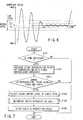
- FIG. 6 schematically shows audio data stored in the buffer memory 25.
- the sound volume level of audio data is given by a magnitude of waveform of a digital audio signal, which is represented by a line connecting time-sequential sample data elements (indicated by black dots in FIG. 6).
- Each sample data element is obtained by sampling the analog audio signal at a sampling rate of, e.g. 44.1 KHz.
- a time period of audio data, whose amplitude, i.e. sound volume level, is between the first and second thresholds, is detected as the time period with "volume level middle.”
- the first and second thresholds are predetermined fixed values.
- a flow chart of FIG. 7 illustrates procedures by which the audio reproducing apparatus 20 detects asynchronism between video and audio and alters the audio reproduction speed on the basis of the detection result.
- the audio reproducing apparatus 20 while receiving audio data from the video reproducing apparatus 10, reproduces the audio data. During the audio data reproduction time period, the audio reproducing apparatus 20 executes a synchronization process at predetermined time intervals, thereby to reproduce the audio in sync with the video reproduction in the video reproducing apparatus 10.
- the audio reproducing apparatus 20 determines whether synchronism needs to be established, on the basis of an elapsed time from the last synchronization process (step S101). If the elapsed time from the last synchronization process is a predetermined time or more (YES in step S101), the audio reproducing apparatus 20 performs the following synchronization process.
- the video reproduction point acquiring unit 28 of audio reproducing apparatus 20 acquires the reproduction point of video currently reproduced by the video reproducing apparatus 10 (step S102). Then, the asynchronism amount detection unit- 29 compares the video reproduction point in the video reproducing apparatus 10 acquired in step S102 and the audio reproduction point in the audio reproducing apparatus 20, and determines whether there is an error between the reproduction point of video and reproduction point of audio (step S103).
- the sound output level detection unit 30 of audio reproducing apparatus 20 performs, sound volume level detection for the audio data stream stored in the buffer 25, which follows the reproduction point of audio that is currently reproduced (step S104). Subsequently, the audio reproduction speed determination unit 311 of audio reproduction speed control unit 31 determines the time period of audio data, whose reproduction speed is to be altered, and the amount of alteration in reproduction speed in this time period, according to preset rules, on the basis of the error in reproduction point between video and audio, which has been detected in step S103, and the sound volume level of audio data detected in step S104 (step S105).
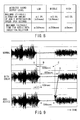
- FIG. 8 shows an example of the rules used in determining the amount of alteration in audio reproduction speed.
- the first row shows the sound volume levels of audio data detected in step S104.
- the second row indicates maximum tolerable alteration amounts of audio reproduction speed, which are associated with the sound volume levels in the first row, that is, maximum tolerable increase/decrease ranges of the data amount of audio to be reproduced per unit time.
- the third row indicates maximum tolerable times for audio data insertion or decimation (deletion), which are associated with the sound volume levels in the first row, that is, time periods corresponding to maximum tolerable data lengths of audio data which can be inserted or deleted per unit time.
- the maximum tolerable alteration amount of audio reproduction speed and the maximum tolerable time for audio data insertion/deletion take higher values as the sound volume level becomes lower, and take lower values as it becomes higher.
- the alteration of audio reproduction speed or the insertion/deletion of audio data is repeated more than once until the asynchronism between video and audio is eliminated. If the asynchronism is not eliminated within a predetermined time period from the start of the audio reproduction speed alteration, the audio data is immediately deleted or inserted by the amount corresponding to the time necessary for eliminating the asynchronism, irrespective of the sound volume level of audio data to be reproduced.
- the audio reproduction point is corrected with reference to the video reproduction point. If the reproduction point of video data precedes the reproduction point of audio data, the amount of audio data to be reproduced per unit time is increased or the audio data is deleted, thereby eliminating the asynchronism. On the other hand, if the reproduction point of video data is behind the reproduction point of audio data, the amount of audio data to be reproduced per unit time is decreased or audio data (silent data) is inserted, thereby eliminating the asynchronism.
- step S105 in this manner, the amount of increase/decrease of audio data to be reproduced per unit time, or the time for audio data insertion/deletion, is determined.
- the audio reproduction speed alteration unit 312 of audio reproduction speed control unit 31 controls the audio reproducing unit 26, and alters the audio reproduction speed of audio reproducing unit 26 (step S106).
- FIG. 9 shows a state in which the audio data reproduction speed is altered.
- FIG. 9 shows three audio data waveforms.
- the upper audio data waveform indicates a normal state with no asynchronism.
- the middle audio data waveform indicates a state in which asynchronism has occurred and the audio data reproduction is behind the video data reproduction.
- the lower audio data waveform indicates a state in which asynchronism has been eliminated by the process of altering the audio reproduction speed.
- step S104 the sound volume level of audio data in the buffer memory 25, which follows the time instant A, is detected (step S104). Based on the detected sound volume level, the amount of alteration of the audio reproduction speed is determined according to the rules shown in FIG. 8 (step S105).
- the sound volume level of the audio data belonging to a time period (100 msec) between time instant A and time instant B is "high".
- the amount of alteration of the audio reproduction speed in the time period between time instant A and time instant B is 0 msec.
- the sound volume level of the audio data belonging to a time period (600 msec) between time instant B and time instant D is "low”.
- insertion or decimation of audio data in a range of ⁇ 500 msec per second is permitted.
- the detected delay is 100 msec. This delay can be eliminated by deleting audio data corresponding to 100 msec from the audio data belonging to the time period (600 msec) between time instant B and time instant D.
- the audio data in the time period (600 msec) between time instant B and time instant D is reduced to 500 msec.
- the reproduction point of audio data is made to coincide with the reproduction point of video data at time instant C.
- the amount of asynchronism can be suppressed within a predetermined range by the audio reproduction speed alteration process, even without strictly making the clock in the video reproducing apparatus 10 coincide with the clock in the audio reproducing apparatus 20. Therefore, even in a system wherein video and audio are reproduced by different apparatuses, a so-called lip-sync can easily be achieved.
- the audio reproduction speed is altered in the time period in which the sound volume level of audio data is low, lip-sync can be realized without giving unnatural impression to the viewer/listener.
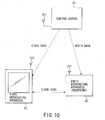
- the video reproducing apparatus 10 sends audio data to the audio reproducing apparatus 20.
- a content server 40 may send video data and audio data to the video reproducing apparatus 10 and audio reproducing apparatus 20 by radio signals via an antenna 301.
- the audio reproducing apparatus 20 may periodically acquire a video reproduction point from the video reproducing apparatus 10, thereby detecting asynchronism between video and audio.
- the audio reproduction control process in the audio reproducing apparatus 20 may be realized by computer-executable programs.
- a computer-readable storage medium storing computer programs including procedures of the above-described audio reproduction control process is prepared.
- the computer programs are installed in an ordinary computer with a communication function and executed, and thereby the same advantages as with the present embodiment can easily be obtained.
Landscapes
- Engineering & Computer Science (AREA)
- Multimedia (AREA)
- Signal Processing (AREA)
- Signal Processing For Digital Recording And Reproducing (AREA)
- Television Signal Processing For Recording (AREA)
- Two-Way Televisions, Distribution Of Moving Picture Or The Like (AREA)
Applications Claiming Priority (2)
| Application Number | Priority Date | Filing Date | Title |
|---|---|---|---|
| JP2002158898A JP3629253B2 (ja) | 2002-05-31 | 2002-05-31 | 音声再生装置および同装置で用いられる音声再生制御方法 |
| JP2002158898 | 2002-05-31 |
Publications (2)
| Publication Number | Publication Date |
|---|---|
| EP1367829A2 true EP1367829A2 (fr) | 2003-12-03 |
| EP1367829A3 EP1367829A3 (fr) | 2009-07-01 |
Family
ID=29417246
Family Applications (1)
| Application Number | Title | Priority Date | Filing Date |
|---|---|---|---|
| EP03008128A Withdrawn EP1367829A3 (fr) | 2002-05-31 | 2003-04-07 | Appareil de reproduction audio et méthode pour le contrôle |
Country Status (3)
| Country | Link |
|---|---|
| US (1) | US7228059B2 (fr) |
| EP (1) | EP1367829A3 (fr) |
| JP (1) | JP3629253B2 (fr) |
Cited By (5)
| Publication number | Priority date | Publication date | Assignee | Title |
|---|---|---|---|---|
| WO2006036207A1 (fr) * | 2004-09-28 | 2006-04-06 | Sony Ericsson Mobile Communications Ab | Systeme et procede de diffusion audio en flux a partir d'un dispositif video courant |
| EP1860866A1 (fr) * | 2006-05-26 | 2007-11-28 | British Telecommunications Public Limited Company | Récéption audiovisuelle |
| WO2009027128A1 (fr) * | 2007-08-31 | 2009-03-05 | International Business Machines Corporation | Procédé de synchronisation de flux de données |
| CN107046664A (zh) * | 2016-02-08 | 2017-08-15 | 索尼公司 | 可自动配置的扬声器系统 |
| US11528389B2 (en) * | 2014-12-18 | 2022-12-13 | Directv, Llc | Method and system for synchronizing playback of independent audio and video streams through a network |
Families Citing this family (78)
| Publication number | Priority date | Publication date | Assignee | Title |
|---|---|---|---|---|
| JP4401063B2 (ja) * | 2002-09-11 | 2010-01-20 | シャープ株式会社 | 映像音声伝送送信装置及びそれを備えた映像音声伝送システム |
| US11106424B2 (en) | 2003-07-28 | 2021-08-31 | Sonos, Inc. | Synchronizing operations among a plurality of independently clocked digital data processing devices |
| US8290603B1 (en) | 2004-06-05 | 2012-10-16 | Sonos, Inc. | User interfaces for controlling and manipulating groupings in a multi-zone media system |
| US8020023B2 (en) | 2003-07-28 | 2011-09-13 | Sonos, Inc. | Systems and methods for synchronizing operations among a plurality of independently clocked digital data processing devices without a voltage controlled crystal oscillator |
| US11650784B2 (en) | 2003-07-28 | 2023-05-16 | Sonos, Inc. | Adjusting volume levels |
| US11294618B2 (en) | 2003-07-28 | 2022-04-05 | Sonos, Inc. | Media player system |
| US11106425B2 (en) | 2003-07-28 | 2021-08-31 | Sonos, Inc. | Synchronizing operations among a plurality of independently clocked digital data processing devices |
| US8234395B2 (en) * | 2003-07-28 | 2012-07-31 | Sonos, Inc. | System and method for synchronizing operations among a plurality of independently clocked digital data processing devices |
| US10613817B2 (en) | 2003-07-28 | 2020-04-07 | Sonos, Inc. | Method and apparatus for displaying a list of tracks scheduled for playback by a synchrony group |
| US8086752B2 (en) | 2006-11-22 | 2011-12-27 | Sonos, Inc. | Systems and methods for synchronizing operations among a plurality of independently clocked digital data processing devices that independently source digital data |
| US9977561B2 (en) | 2004-04-01 | 2018-05-22 | Sonos, Inc. | Systems, methods, apparatus, and articles of manufacture to provide guest access |
| US9374607B2 (en) | 2012-06-26 | 2016-06-21 | Sonos, Inc. | Media playback system with guest access |
| DE102004017215A1 (de) * | 2004-04-05 | 2005-10-20 | Sennheiser Electronic | Audiovisuelles System |
| FI116439B (fi) * | 2004-06-04 | 2005-11-15 | Nokia Corp | Videon ja audion synkronointi |
| US8868698B2 (en) | 2004-06-05 | 2014-10-21 | Sonos, Inc. | Establishing a secure wireless network with minimum human intervention |
| US8326951B1 (en) | 2004-06-05 | 2012-12-04 | Sonos, Inc. | Establishing a secure wireless network with minimum human intervention |
| KR100875592B1 (ko) * | 2005-03-18 | 2008-12-23 | 후지쯔 가부시끼가이샤 | 영상 장치에서의 영상 신호와 음성 신호와의 동기 제어방법 및 장치 |
| JP2007101772A (ja) * | 2005-10-03 | 2007-04-19 | D & M Holdings Inc | 再生装置及び再生方法 |
| JP4978984B2 (ja) * | 2006-03-27 | 2012-07-18 | サミー株式会社 | 再生装置 |
| US8483853B1 (en) | 2006-09-12 | 2013-07-09 | Sonos, Inc. | Controlling and manipulating groupings in a multi-zone media system |
| US9202509B2 (en) | 2006-09-12 | 2015-12-01 | Sonos, Inc. | Controlling and grouping in a multi-zone media system |
| US12167216B2 (en) | 2006-09-12 | 2024-12-10 | Sonos, Inc. | Playback device pairing |
| US8788080B1 (en) | 2006-09-12 | 2014-07-22 | Sonos, Inc. | Multi-channel pairing in a media system |
| JP2008107381A (ja) * | 2006-10-23 | 2008-05-08 | Mitsubishi Electric Corp | 話速変換装置及び話速変換制御方法 |
| JP2009005910A (ja) * | 2007-06-28 | 2009-01-15 | Namco Bandai Games Inc | プログラム、情報記憶媒体、ゲーム装置 |
| JP5464870B2 (ja) * | 2009-03-05 | 2014-04-09 | キヤノン株式会社 | 再生装置、その制御方法及びプログラム |
| JP5001318B2 (ja) * | 2009-03-18 | 2012-08-15 | 富士通テレコムネットワークス株式会社 | ディジタル音声信号伝送装置及びディジタル音声信号伝送方法 |
| WO2010122626A1 (fr) * | 2009-04-20 | 2010-10-28 | パイオニア株式会社 | Dispositif de réception |
| JP5643821B2 (ja) * | 2010-06-18 | 2014-12-17 | パナソニック インテレクチュアル プロパティ コーポレーション オブアメリカPanasonic Intellectual Property Corporation of America | 音声制御装置及び音声制御方法 |
| US11429343B2 (en) | 2011-01-25 | 2022-08-30 | Sonos, Inc. | Stereo playback configuration and control |
| US11265652B2 (en) | 2011-01-25 | 2022-03-01 | Sonos, Inc. | Playback device pairing |
| JP5696552B2 (ja) * | 2011-03-23 | 2015-04-08 | 富士通株式会社 | 再生装置、再生方法およびプログラム |
| US9924282B2 (en) * | 2011-12-30 | 2018-03-20 | Gn Resound A/S | System, hearing aid, and method for improving synchronization of an acoustic signal to a video display |
| US9344292B2 (en) | 2011-12-30 | 2016-05-17 | Sonos, Inc. | Systems and methods for player setup room names |
| US9729115B2 (en) | 2012-04-27 | 2017-08-08 | Sonos, Inc. | Intelligently increasing the sound level of player |
| US9008330B2 (en) | 2012-09-28 | 2015-04-14 | Sonos, Inc. | Crossover frequency adjustments for audio speakers |
| US9510055B2 (en) | 2013-01-23 | 2016-11-29 | Sonos, Inc. | System and method for a media experience social interface |
| US9307508B2 (en) | 2013-04-29 | 2016-04-05 | Google Technology Holdings LLC | Systems and methods for syncronizing multiple electronic devices |
| US20150037008A1 (en) * | 2013-08-05 | 2015-02-05 | Yamaha Corporation | Video synchronization based on audio |
| US9288596B2 (en) | 2013-09-30 | 2016-03-15 | Sonos, Inc. | Coordinator device for paired or consolidated players |
| US9654545B2 (en) | 2013-09-30 | 2017-05-16 | Sonos, Inc. | Group coordinator device selection |
| US9720576B2 (en) | 2013-09-30 | 2017-08-01 | Sonos, Inc. | Controlling and displaying zones in a multi-zone system |
| US20150095679A1 (en) | 2013-09-30 | 2015-04-02 | Sonos, Inc. | Transitioning A Networked Playback Device Between Operating Modes |
| US9300647B2 (en) | 2014-01-15 | 2016-03-29 | Sonos, Inc. | Software application and zones |
| US9313591B2 (en) | 2014-01-27 | 2016-04-12 | Sonos, Inc. | Audio synchronization among playback devices using offset information |
| US20150220498A1 (en) | 2014-02-05 | 2015-08-06 | Sonos, Inc. | Remote Creation of a Playback Queue for a Future Event |
| US9226073B2 (en) | 2014-02-06 | 2015-12-29 | Sonos, Inc. | Audio output balancing during synchronized playback |
| US9226087B2 (en) | 2014-02-06 | 2015-12-29 | Sonos, Inc. | Audio output balancing during synchronized playback |
| US9679054B2 (en) | 2014-03-05 | 2017-06-13 | Sonos, Inc. | Webpage media playback |
| US10587693B2 (en) | 2014-04-01 | 2020-03-10 | Sonos, Inc. | Mirrored queues |
| US20150324552A1 (en) | 2014-05-12 | 2015-11-12 | Sonos, Inc. | Share Restriction for Media Items |
| US20150356084A1 (en) | 2014-06-05 | 2015-12-10 | Sonos, Inc. | Social Queue |
| US9874997B2 (en) | 2014-08-08 | 2018-01-23 | Sonos, Inc. | Social playback queues |
| US9860286B2 (en) | 2014-09-24 | 2018-01-02 | Sonos, Inc. | Associating a captured image with a media item |
| US10645130B2 (en) | 2014-09-24 | 2020-05-05 | Sonos, Inc. | Playback updates |
| US9723038B2 (en) | 2014-09-24 | 2017-08-01 | Sonos, Inc. | Social media connection recommendations based on playback information |
| US9959087B2 (en) | 2014-09-24 | 2018-05-01 | Sonos, Inc. | Media item context from social media |
| WO2016049329A1 (fr) | 2014-09-24 | 2016-03-31 | Sonos, Inc. | File d'attente de médias sociaux |
| US9667679B2 (en) | 2014-09-24 | 2017-05-30 | Sonos, Inc. | Indicating an association between a social-media account and a media playback system |
| US9690540B2 (en) | 2014-09-24 | 2017-06-27 | Sonos, Inc. | Social media queue |
| WO2016049342A1 (fr) | 2014-09-24 | 2016-03-31 | Sonos, Inc. | Recommandations de connexions de média sociaux sur la base d'informations de lecture |
| US10248376B2 (en) | 2015-06-11 | 2019-04-02 | Sonos, Inc. | Multiple groupings in a playback system |
| DE102015212218A1 (de) * | 2015-06-30 | 2017-01-05 | Robert Bosch Gmbh | Dezentral synchronisiertes Multisensorsystem |
| US10303422B1 (en) | 2016-01-05 | 2019-05-28 | Sonos, Inc. | Multiple-device setup |
| US9886234B2 (en) | 2016-01-28 | 2018-02-06 | Sonos, Inc. | Systems and methods of distributing audio to one or more playback devices |
| US10712997B2 (en) | 2016-10-17 | 2020-07-14 | Sonos, Inc. | Room association based on name |
| KR102725853B1 (ko) * | 2016-12-13 | 2024-11-05 | 삼성전자주식회사 | 전자 장치 및 이의 제어 방법 |
| JP6786173B2 (ja) * | 2017-04-24 | 2020-11-18 | 株式会社ユニバーサルエンターテインメント | 遊技機 |
| JP6786172B2 (ja) * | 2017-04-24 | 2020-11-18 | 株式会社ユニバーサルエンターテインメント | 遊技機 |
| JP6786171B2 (ja) * | 2017-04-24 | 2020-11-18 | 株式会社ユニバーサルエンターテインメント | 遊技機 |
| JP7229696B2 (ja) * | 2018-08-02 | 2023-02-28 | キヤノン株式会社 | 情報処理装置、情報処理方法、及びプログラム |
| US11102523B2 (en) | 2019-03-19 | 2021-08-24 | Rovi Guides, Inc. | Systems and methods for selective audio segment compression for accelerated playback of media assets by service providers |
| US11039177B2 (en) | 2019-03-19 | 2021-06-15 | Rovi Guides, Inc. | Systems and methods for varied audio segment compression for accelerated playback of media assets |
| US10708633B1 (en) | 2019-03-19 | 2020-07-07 | Rovi Guides, Inc. | Systems and methods for selective audio segment compression for accelerated playback of media assets |
| KR102220216B1 (ko) * | 2019-04-10 | 2021-02-25 | (주)뮤직몹 | 데이터 그룹재생 장치 및 그 시스템과 방법 |
| US12549945B2 (en) | 2020-09-25 | 2026-02-10 | Sonos, Inc. | Intelligent setup for playback devices |
| CN118053447A (zh) * | 2022-11-15 | 2024-05-17 | 北京字跳网络技术有限公司 | 一种声音信号处理方法、装置、电子设备及存储介质 |
| JP2024132049A (ja) * | 2023-03-17 | 2024-09-30 | 株式会社カプコン | プログラム、およびゲーム装置 |
Family Cites Families (10)
| Publication number | Priority date | Publication date | Assignee | Title |
|---|---|---|---|---|
| US4951155A (en) * | 1987-11-23 | 1990-08-21 | Stokes Imaging Services | Apparatus and method for synchronizing videodisc images with audio signals |
| JPH05135228A (ja) | 1991-11-11 | 1993-06-01 | Hitachi Ltd | デイジタル信号受け渡しシステムとデイジタル音声信号処理回路及び信号変換回路 |
| US5467139A (en) * | 1993-09-30 | 1995-11-14 | Thomson Consumer Electronics, Inc. | Muting apparatus for a compressed audio/video signal receiver |
| JPH0965303A (ja) | 1995-08-28 | 1997-03-07 | Canon Inc | 映像音声同期方法及び装置 |
| JPH09261613A (ja) | 1996-03-26 | 1997-10-03 | Mitsubishi Electric Corp | データ受信再生装置 |
| JP3698376B2 (ja) * | 1996-08-19 | 2005-09-21 | 松下電器産業株式会社 | 同期再生装置 |
| GB9804071D0 (en) * | 1998-02-27 | 1998-04-22 | Ridgeway Systems And Software | Audio-video telephony |
| US6583821B1 (en) * | 1999-07-16 | 2003-06-24 | Thomson Licensing S.A. | Synchronizing apparatus for a compressed audio/video signal receiver |
| GB0000873D0 (en) * | 2000-01-14 | 2000-03-08 | Koninkl Philips Electronics Nv | Interconnection of audio/video devices |
| AU2003217488A1 (en) * | 2002-04-19 | 2003-11-03 | Matsushita Electric Industrial Co., Ltd. | Reproduction speed conversion apparatus |
-
2002
- 2002-05-31 JP JP2002158898A patent/JP3629253B2/ja not_active Expired - Fee Related
-
2003
- 2003-04-07 EP EP03008128A patent/EP1367829A3/fr not_active Withdrawn
- 2003-04-25 US US10/422,835 patent/US7228059B2/en not_active Expired - Fee Related
Cited By (7)
| Publication number | Priority date | Publication date | Assignee | Title |
|---|---|---|---|---|
| WO2006036207A1 (fr) * | 2004-09-28 | 2006-04-06 | Sony Ericsson Mobile Communications Ab | Systeme et procede de diffusion audio en flux a partir d'un dispositif video courant |
| US8719874B2 (en) | 2004-09-28 | 2014-05-06 | Sony Corporation | System and method of streaming audio from a common video device |
| EP1860866A1 (fr) * | 2006-05-26 | 2007-11-28 | British Telecommunications Public Limited Company | Récéption audiovisuelle |
| WO2009027128A1 (fr) * | 2007-08-31 | 2009-03-05 | International Business Machines Corporation | Procédé de synchronisation de flux de données |
| US11528389B2 (en) * | 2014-12-18 | 2022-12-13 | Directv, Llc | Method and system for synchronizing playback of independent audio and video streams through a network |
| CN107046664A (zh) * | 2016-02-08 | 2017-08-15 | 索尼公司 | 可自动配置的扬声器系统 |
| CN107046664B (zh) * | 2016-02-08 | 2020-02-14 | 索尼公司 | 可自动配置的扬声器系统 |
Also Published As
| Publication number | Publication date |
|---|---|
| US20030231871A1 (en) | 2003-12-18 |
| JP2004007140A (ja) | 2004-01-08 |
| JP3629253B2 (ja) | 2005-03-16 |
| US7228059B2 (en) | 2007-06-05 |
| EP1367829A3 (fr) | 2009-07-01 |
Similar Documents
| Publication | Publication Date | Title |
|---|---|---|
| US7228059B2 (en) | Audio reproducing apparatus and audio reproduction control method for use in the same | |
| KR101535827B1 (ko) | 무선 통신 네트워크에서 오디오 및 비디오 동기화 장치 및 방법 | |
| JPH07303240A (ja) | デジタル記録音声及びビデオの同期式可変速度再生 | |
| JP2007501428A (ja) | バッファ管理システム、ディジタルオーディオ受信機、ヘッドホン、スピーカ、バッファ管理方法 | |
| EP1014370A2 (fr) | Méthode, support d'enregistrement, et appareil d'enregistrement, de montage, d'enregistrement et de reproduction permettant la lecture continue | |
| US7240013B2 (en) | Method and apparatus for controlling buffering of audio stream | |
| JPH09191296A (ja) | ディジタル復号化器と符号化器のクロックの同期方法及び装置 | |
| US7092411B2 (en) | Transport stream multiplexing method, transport stream multiplexing apparatus, and storage and reproduction system | |
| KR101600891B1 (ko) | 복수의 단말기에 출력되는 비디오 및 오디오를 동기화시키는 동기화시스템 및 방법 | |
| JP2005101766A (ja) | 電子装置及びその制御方法 | |
| JP4376165B2 (ja) | 受信装置,クロック調整方法および放送システム | |
| JP2001078185A (ja) | 信号処理装置 | |
| KR102422794B1 (ko) | 재생지연 조절 방법 및 장치와 시간축 변형방법 및 장치 | |
| KR20070008069A (ko) | 음성/영상신호의 동기화 장치 및 방법 | |
| US20070248170A1 (en) | Transmitting Apparatus, Receiving Apparatus, and Reproducing Apparatus | |
| JP2005184383A (ja) | リアルタイムデータ通信システム、リアルタイムデータ通信装置及びリアルタイムデータ通信方法 | |
| JP2023179125A (ja) | デジタル音声信号同期装置及びプログラム | |
| JP4570483B2 (ja) | デジタル放送受信装置 | |
| JP2002290910A (ja) | マルチメディア情報記録再生装置 | |
| JP2006330541A (ja) | 音声受信再生装置 | |
| JP2003258784A (ja) | デジタル放送受信再生機能付き通信端末 | |
| JPH1075413A (ja) | データ伝送システム | |
| JPH09205625A (ja) | 映像音声多重化伝送装置の同期方法 | |
| KR100808169B1 (ko) | 미디어 재생 제어 방법과 그를 위한 단말기 | |
| JP3430613B2 (ja) | 情報信号再生方法及び装置 |
Legal Events
| Date | Code | Title | Description |
|---|---|---|---|
| PUAI | Public reference made under article 153(3) epc to a published international application that has entered the european phase |
Free format text: ORIGINAL CODE: 0009012 |
|
| 17P | Request for examination filed |
Effective date: 20030407 |
|
| AK | Designated contracting states |
Kind code of ref document: A2 Designated state(s): AT BE BG CH CY CZ DE DK EE ES FI FR GB GR HU IE IT LI LU MC NL PT SE SI SK TR |
|
| AX | Request for extension of the european patent |
Extension state: AL LT LV MK RO |
|
| PUAL | Search report despatched |
Free format text: ORIGINAL CODE: 0009013 |
|
| STAA | Information on the status of an ep patent application or granted ep patent |
Free format text: STATUS: THE APPLICATION HAS BEEN WITHDRAWN |
|
| AK | Designated contracting states |
Kind code of ref document: A3 Designated state(s): AT BE BG CH CY CZ DE DK EE ES FI FR GB GR HU IE IT LI LU MC NL PT SE SI SK TR |
|
| AX | Request for extension of the european patent |
Extension state: AL LT LV MK RO |
|
| 18W | Application withdrawn |
Effective date: 20090603 |