EP1376469A2 - Methode und System zur Erzeugung eines Weichzeichnereffekts in einem digitalen oder digitalisierten Bild - Google Patents
Methode und System zur Erzeugung eines Weichzeichnereffekts in einem digitalen oder digitalisierten Bild Download PDFInfo
- Publication number
- EP1376469A2 EP1376469A2 EP03013206A EP03013206A EP1376469A2 EP 1376469 A2 EP1376469 A2 EP 1376469A2 EP 03013206 A EP03013206 A EP 03013206A EP 03013206 A EP03013206 A EP 03013206A EP 1376469 A2 EP1376469 A2 EP 1376469A2
- Authority
- EP
- European Patent Office
- Prior art keywords
- image
- diffused
- pixel value
- pixel
- synthesizing
- Prior art date
- Legal status (The legal status is an assumption and is not a legal conclusion. Google has not performed a legal analysis and makes no representation as to the accuracy of the status listed.)
- Withdrawn
Links
Images


Classifications
-
- G—PHYSICS
- G06—COMPUTING OR CALCULATING; COUNTING
- G06T—IMAGE DATA PROCESSING OR GENERATION, IN GENERAL
- G06T5/00—Image enhancement or restoration
- G06T5/20—Image enhancement or restoration using local operators
-
- G—PHYSICS
- G06—COMPUTING OR CALCULATING; COUNTING
- G06T—IMAGE DATA PROCESSING OR GENERATION, IN GENERAL
- G06T5/00—Image enhancement or restoration
- G06T5/50—Image enhancement or restoration using two or more images, e.g. averaging or subtraction
-
- G—PHYSICS
- G06—COMPUTING OR CALCULATING; COUNTING
- G06T—IMAGE DATA PROCESSING OR GENERATION, IN GENERAL
- G06T5/00—Image enhancement or restoration
- G06T5/70—Denoising; Smoothing
-
- G—PHYSICS
- G06—COMPUTING OR CALCULATING; COUNTING
- G06T—IMAGE DATA PROCESSING OR GENERATION, IN GENERAL
- G06T2207/00—Indexing scheme for image analysis or image enhancement
- G06T2207/20—Special algorithmic details
- G06T2207/20212—Image combination
- G06T2207/20221—Image fusion; Image merging
Definitions
- the present invention relates to an image processing method and system for correcting digital image data read from a photographic medium such as a photographic film or a semiconductor memory by effecting a filtering process on the data, thereby to obtain corrected digital image data of superior photographic image quality.
- the photographic operation is effected with attaching a soft tone effect filter to the lens of a camera or by using a camera attached with a soft focus lens.
- the soft tone effect filter is a physical component to be attached to the front of the lens system of the camera for shielding light beam of a particular wavelength, the filter being distinct from a filtering process effected in a digital image processing.
- the soft tone effect filter is characterized in that the it provides subtle optical blurring effect to the image and it has a center of focus in the soft-focused image expression.
- a variety of such soft tone special effect filters are commercially available under the trade names of e.g. "DUTO” "SOFTON”, “FOGGY”, “SOFT CROSS”, etc.
- a dodging mask is generated from an original image and this dodging mask is subjected to a diffusing process. Thereafter, as the original image is synthesized with or added to this dodging mask, there is obtained an image with a desired soft tone (diffusion) effect.
- This technique requires a complicated series of procedure to make the dodging mask. Therefore, in order to achieve high-speed operation, it is proposed that the dodging mask be first reduced (“thinned out") and the diffusing process be effected on this reduced image (thinned-out image), then, the resultant reduced image be enlarged again to be added eventually to the original image.
- a primary object of the invention is to provide a novel image processing technique which makes it possible to obtain a soft tone image of as high as or even higher image quality through the digital image processing without using a soft tone effect filter or soft focus lens in the camera, as compared with a case using such filter or lens.
- an image processing method for correcting digital image data read from a photographic medium such as a photographic film (conventional camera) or a semiconductor memory (digital camera), the method comprising the computer-implemented steps of:
- digital image data are read from a photographic medium storing photographic image and a diffusing process is effected on an original image composed from the read digital image data to generate a diffused image.
- a diffusing process is effected on an original image composed from the read digital image data to generate a diffused image.
- a pixel value of the original image and a pixel value of the diffused image are calculated, based on a synthesizing coefficient provided for each pixel, whereby a corrected image is generated.
- the synthesizing coefficient determines a ratio of the pixel value of the diffused image relative to the pixel value of the corrected image.
- each pixel thereof is provided with a different diffusion effect, that is, a different soft tone effect.
- a different soft tone effect for each distinct luminance range of the pixel. Consequently, even if a soft tone effect filter or a soft focus lens is not used with the camera, it is possible to obtain a soft tone image equivalent to one obtained by using such filter or lens.
- a “positive correlation” means such a correlation that for a function: f(X), if X1 ⁇ X2, the correlation f(X1) ⁇ f(X2) is derived.
- a rate of change (slope) of the synthesizing coefficient: Op [i, j ⁇ can be adjusted relative to a possible value of the diffused image. That is, for each luminance range, the operator can freely set a different soft tone effect.
- an image value range of the diffused image is divided into at least two sub-ranges and the synthesizing coefficient: Op ⁇ i, j ⁇ for a pixel having a pixel value included in the lowest sub-range is set to 0%. That is, in the corrected image, the ratio of the pixel value of the pixel affecting the pixels of a low luminance area (dark area) can be set to 0%. With this, in the low luminance area, the pixel value of the original image alone can be reproduced in the corrected image. This method is effective for providing enhanced clearness in a dark area in the corrected image (e.g. hair of a woman) when the diffused image has strong whitish blurring.
- the image processing method of the present invention is applicable also to a case where the digital image data comprise color image data consisting of respective primary color components.
- the synthesizing coefficient: Op ⁇ i, j] to be assigned to each pixel will be different for each color component, it is possible to provide a different soft tone effect to each color component of the image.
- an image processing system for correcting digital image data read from a photographic medium such as a photographic film (conventional camera) or a semiconductor memory (digital camera), the system comprising:
- the present invention is directed also to an image processing program which is used as a principal component in realizing the above-described method or system as well as to a medium storing this image processing program.
- an image processing is effected on original digital image data ("image data" hereinafter) read from e.g. a photographic film, thereby to provide the image with soft tone effect (soft focus effect), which would be obtained when a soft tone effect filter or a soft focus lens were employed with the camera.
- image data original digital image data
- soft tone effect soft focus effect
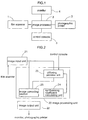
- Fig. 1 is a block diagram showing a schematic construction of a photographic printing system embodying the present invention.
- This system includes a film scanner 1, an image processor 2, a photographic printer 3, a monitor 4 and a control console 5.
- the film scanner 1 for instance, irradiates a light from a light source on to a photographic film and then receives its transmission light by means of e.g. a CCD, thereby to read images recorded in respective frames of the photographic film.
- This film scanner 1 outputs the read image data for each component of red component, green component and blue component to the image processor 2.
- the image processor 2 comprises e.g. a PC (personal computer).
- the processor 2 effects various image processing on the image data received from the film scanner 1 and then feeds the processed high-quality image data to the photographic printer 3.
- the control console 5 can be a keyboard, a mouse, etc.
- the photographic printer 3 as a printer for outputting photographic prints, exposes a print paper as a photosensitive material according to the processed image data received from the image processor 2, thereby to print images on the print paper.
- an optical modulator which can be a PLZT exposing head, DMD (digital micro-mirror device), LCD (liquid crystal display), LED (light emitting diode) panel, laser, FOCRT (fiber optic cathode ray tube), CRT (cathode ray tube), etc.
- the film scanner 1, the image processor 2 and the photographic printer 3 can be provided as discrete units, or one or more of them may be integrated with the others or the other.
- the monitor 4 is used for displaying to an operator an image read by the film scanner 1, image being under image processing, image after the image processing, an operational condition of the system, etc.
- Fig. 2 is a functional block diagram schematically illustrating principal functions of the image processor 2.
- the image processor 2 includes an image input unit 21 for receiving digital image data of a photographic image from the film scanner 1 or a media reader, an image output unit 22 for outputting final image data after the image processing to the monitor 5 and/or the photographic printer 3, and an image processing unit 20 for effecting the image processing.
- the image processing unit 20 includes, as its principal functional blocks pertinent to the present invention, a diffusing process section 23 for effecting a diffusing process on the original image received as the digital image data thereby to generate a diffused image, a synthesizing coefficient calculating section 24 for obtaining a synthesizing coefficient for each pixel of the diffused image with using a pixel value of the diffused image as a parameter, and an image correcting section 25 for effecting synthesis of the original image and the diffused image according to the synthesizing coefficient, thereby to generate a corrected image.
- a diffusing process section 23 for effecting a diffusing process on the original image received as the digital image data thereby to generate a diffused image
- a synthesizing coefficient calculating section 24 for obtaining a synthesizing coefficient for each pixel of the diffused image with using a pixel value of the diffused image as a parameter
- an image correcting section 25 for effecting synthesis of the original image and the diffused image according to the synthesizing coefficient,
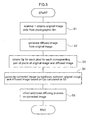
- the film scanner 1 reads and obtains original image data from an image of each frame recorded in the photographic film and transmits this original image data to the image processor 2 (S1).
- the read original image data has a number of pixels of about 1024 x 1534 for each of R, G and B component.
- the invention is not limited to this particular construction.
- the image processing unit 20 stores this received original image data within an unillustrated memory thereof. And at its diffusing process section 23, the processing unit 20 then effects a diffusing process on an original image generated at the diffusing process section 23 from the original image data, thereby to obtain a diffused image (S2).
- This synthesizing coefficient is obtained for each pixel and represents a ratio of the pixel value of the diffused image relative to or contained within an image value of each pixel of the corrected image to be generated at step S4 (synthesis of the original image and the diffused image).
- This coefficient can be referred to also as an "opaqueness" or "fusion" coefficient.
- the image processor 2 effects, at is image correcting section 25, the synthesis between the original image and the diffused image, thereby to generate the corrected image (S4). Further, the image processor 2 effects an additional diffusing process on any portion present in the corrected image where sharpness still remains (S5). With this, the process is completed.
- the image processing operation relating to the present embodiment is carried out in the manner described above. In this operation, the steps S2 through S5 are the characterizing portions of the embodiment. Therefore, these steps will be described in greater details next.
- the diffused image is obtained here by effecting a diffusing process by using a filter on all of the pixels constituting the original image data.
- the filter employed here is a moving average filter which is one type of spatial filter having n-dimension square matrix.
- the diffusing process refers to a process wherein for an area referenced by the spatial filter, an average of pixel values of pixels surrounding a "focal" (center) pixel of interest is obtained as the pixel value of this focal pixel.
- the pixel value of the focal pixel can be obtained with providing a "weight" relative to the focal pixel to each of its surrounding pixels.
- Fig. 4 shows an area referenced by the spatial filter of the original image generated from the original image data.
- the filter comprises a moving average filter having dimensions: (2R + 1) ⁇ (2R + 1). And, the center of this filter area is provided as the focal pixel shown as [i j].
- the focal pixel [i, j]
- the pixel value for each focal pixel after the diffusing process can be obtained from the following expression: where, bdat [i, j]: pixel value of each pixel after the diffusing process (pixel value of diffused image) sdat [m, n]: pixel value of referenced pixel prior to the diffusing process, W [m, n]: weight for each pixel.
- Marks: m, n denote respective coordinate values of [m, n] of each referenced pixel prior to the diffusing process.
- the weight: Wmn for each pixel is determined by the type of the spatial filter employed, such as a moving average filter, Gaussian distribution weighted average filter, power weighted average filter, etc.
- a mark: r denotes a distance between each pixel and the focal pixel.
- the focal pixel comprises the center of the referenced area. The invention, however, is not limited to this particular construction.
- the values of Wmn are all 1, so that the weights for the respective pixels are constant.
- the power weighted average filter for adjacent pixels present in the diffused image, it is possible to vary the strength of the soft tone effect to be provided thereto. Consequently, it is possible to avoid such inconvenience as blurring or fuzzing out of image of a small subject in the photography due to the diffusing process.
- the process for generating the corrected image by adding the diffused image obtained at S2 to the original image (“synthesizing process" hereinafter) will be described.
- the original image data is retrieved from the unillustrated memory.
- a pixel value is calculated (corrected) by average color mixing technique from the pixel value of the original image (image data) and the pixel value of the diffused image and this calculated pixel value is set as the pixel value of the corresponding pixel.
- Op [ij] is the synthesizing coefficient assigned to each pixel for use in the synthesizing process. And this coefficient represents a ratio (in percentage) of the pixel value of the diffused image (image data) to be contained within or relative to the pixel value (image data) of each pixel constituting the corrected image.
- This each synthesizing coefficient: Op is calculated in advance prior to the synthesis effected at the synthesizing coefficient calculating section 24 by means of the power function described below.
- the synthesizing coefficient: Op is calculated according to the pixel value (luminance level) of the diffused image.
- the above calculation expression represents a case of the maximum gradation of the image data being 255
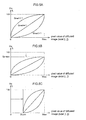
- the denominator of the above fractional expression will be: "65535 to the Grad-th power (65535 Grad )". That is, when Op [i, j] is calculated by the above-described function, if bdat [i, j] is 0, Op [i, j] is set to 0%, whereas, if bdat [i, j] is the maximum pixel value (maximum gradation), Op [i, j] is set to 100%. Further, by adjusting the value of Grad, the rate of change in Op [i, j] can be adjusted relative to change in bdat [i, j].
- the relationship between bdat [i, j] and Op [i, j] can be represented by the graph shown in Fig. 5A.
- Op [i, j] assigned to a pixel having a maximum value of bdat [i, j], Op [i, j] (“Op-max" hereinafter) is 100%, meaning that the pixel value of the original image is not to be contained in the pixel after the synthesis. Therefore, in order to allow the pixel values of the original image to be reflected in all the pixels constituting the image after the synthesis, it is necessary to set Op-max less than 100%.
- a function can be obtained by multiplying this F(bdat[i, j]) by Op-max/100 as an operational expression for obtaining Op[i, j] and the resultant function can be provided in the form of a table.
- Fig. 5B shows a graph of the function thus obtained.
- the operator sets a desired limit pixel value: DLim for bdat [i, j], and also the area (coordinate space) defined by bdat [i, j] is divided into a sub-area which satisfies: bdat [i, j] ⁇ DLim and a further sub-area which satisfies: bdat [i, j] ⁇ DLim.
- the original image data can be reflected with high fidelity. So that, even when the whitish blur is strong, the image of the photographic subject constituting the dark portion can be reproduced with greater clarity.
- the area defined by: bdat [i, j] is divided into the sub-area: bdat [i, j] ⁇ Dlim and the further sub-area: bdat [i, j] ⁇ DLim.
- the image processor 2 effects a additional diffusing process only on the specified area with the spatial filter (S4).
- spatial filter for example, as shown in Fig. 7, there is employed a filter for obtaining pixel values of the respective pixels by the following calculation.
- the image processor 2 gives a pixel value which differs depending the distance from that pixel to the focal pixel and these pixel values are progressively decreased with increase in the distance from each pixel from the focal pixel.
- the image processor 2 can eliminate sharpness, i. e., can diffuse the contour of the subject image only in the area in the synthesized image specified by the operator.
- the image obtained by executing the process of S1 through S4 has a high soft tone effect. Namely, by effecting the process of the steps S1 through S4 on a digital image read from a photographic film, it is possible to obtain a soft tone image equivalent to one conventionally obtainable when a photographic operation is carried out with attaching a soft tone effect filter to the lens of the camera or using a soft focus lens in the camera.
- the pixel value is calculated by the average color mixing method.
- the pixel value can be calculated by the additive color mixing method.
- the pixel value will be calculated by the following operation expression.
- the synthesizing coefficient: Op [i, j] to be set for each pixel can have a different value for each color component for a same pixel.
- the above-described specific procedure employed for executing the diffusing process of S2 and S4 is a non-limiting example of the invention.
- the invention may employ any other process as long as such other process too can enhance the soft tone effect of the image.
- the image processing technique of this embodiment can be applied to both a color image and a monoclonal image.
- the synthesizing coefficient is calculated from the pixel value of the diffused image by using the power function.
- the invention is not limited thereto. Any other function can be used instead as long as a correlation is established between the synthesizing coefficient and the pixel value of the diffused image.
- the moving average filter is employed so as to restrict the amount of calculation required for the diffusing process.
- this procedure described in the foregoing embodiment can be realized in the form of a computer program.
- this computer program will be stored in a computer-readable storage medium.
- this storage medium can be the unillustrated memory (e.g. ROM per se) required for the process executed at the image processor 2.
- this storage medium can be a program recording medium to be inserted into a program reader device as an external storage unit so that its program may be loaded into the device upon the insertion.
- the program medium described above refers to a recording medium detachable to a main device body and this medium can fixedly storing the program therein, such as the tape type media as a magnetic tape or cassette tape, a disc type media such as magnetic discs including a floppy (registered trademark) disc, a hard disc, etc, as well as optical discs including CD-ROM, MO, MD, DVD, etc, the card type media such as IC card (including a memory card) or an optical card, or the semiconductor memory devices including a mask ROM, EPROM, EEPROM, flash ROM, etc.
- the tape type media as a magnetic tape or cassette tape
- a disc type media such as magnetic discs including a floppy (registered trademark) disc, a hard disc, etc, as well as optical discs including CD-ROM, MO, MD, DVD, etc
- the card type media such as IC card (including a memory card) or an optical card
- semiconductor memory devices including a mask ROM, EPROM, EEPROM, flash
- the medium can also be a medium capable of "flexibly" storing the program such as a medium to which the program can be downloaded via the communication network.
- a program needed for such download operation may be stored in advance in the main device body or can be installed to the device from another recording medium.
Landscapes
- Physics & Mathematics (AREA)
- General Physics & Mathematics (AREA)
- Engineering & Computer Science (AREA)
- Theoretical Computer Science (AREA)
- Image Processing (AREA)
Applications Claiming Priority (2)
| Application Number | Priority Date | Filing Date | Title |
|---|---|---|---|
| JP2002187334A JP2004030370A (ja) | 2002-06-27 | 2002-06-27 | 画像処理方法、画像処理プログラム、および画像処理プログラムを記録した記録媒体 |
| JP2002187334 | 2002-06-27 |
Publications (2)
| Publication Number | Publication Date |
|---|---|
| EP1376469A2 true EP1376469A2 (de) | 2004-01-02 |
| EP1376469A3 EP1376469A3 (de) | 2005-01-26 |
Family
ID=29717639
Family Applications (1)
| Application Number | Title | Priority Date | Filing Date |
|---|---|---|---|
| EP03013206A Withdrawn EP1376469A3 (de) | 2002-06-27 | 2003-06-12 | Methode und System zur Erzeugung eines Weichzeichnereffekts in einem digitalen oder digitalisierten Bild |
Country Status (4)
| Country | Link |
|---|---|
| US (1) | US20040001644A1 (de) |
| EP (1) | EP1376469A3 (de) |
| JP (1) | JP2004030370A (de) |
| CN (1) | CN1467987A (de) |
Cited By (1)
| Publication number | Priority date | Publication date | Assignee | Title |
|---|---|---|---|---|
| EP2061227A4 (de) * | 2006-09-08 | 2012-08-01 | Sony Corp | Bildverarbeitungseinrichtung, bildverarbeitungsverfahren und programm |
Families Citing this family (13)
| Publication number | Priority date | Publication date | Assignee | Title |
|---|---|---|---|---|
| JP2006301921A (ja) * | 2005-04-20 | 2006-11-02 | Noritsu Koki Co Ltd | 軟調効果フィルタ、軟調効果フィルタ処理プログラム、及び、写真画像処理装置 |
| US7621285B2 (en) * | 2005-09-15 | 2009-11-24 | Steris Inc. | Tunnel washer system with improved cleaning efficiency |
| KR100843087B1 (ko) | 2006-09-06 | 2008-07-02 | 삼성전자주식회사 | 영상 생성 장치 및 방법 |
| US20100098399A1 (en) * | 2008-10-17 | 2010-04-22 | Kurt Breish | High intensity, strobed led micro-strip for microfilm imaging system and methods |
| CN103673872A (zh) * | 2012-09-10 | 2014-03-26 | 中国科学院空间科学与应用研究中心 | 液滴体积的测量方法和测量系统 |
| CN103455969B (zh) | 2013-08-28 | 2019-06-04 | 腾讯科技(成都)有限公司 | 图像处理的方法及装置 |
| CN103593834B (zh) * | 2013-12-03 | 2017-06-13 | 厦门美图网科技有限公司 | 一种智能添加景深的图像增强方法 |
| US10409031B2 (en) * | 2015-11-18 | 2019-09-10 | Maxell, Ltd. | Image projection apparatus |
| KR101751039B1 (ko) | 2016-02-17 | 2017-06-26 | 네이버 주식회사 | 영상 표시 장치, 방법, 및 컴퓨터 프로그램 |
| CN107578393B (zh) * | 2017-09-26 | 2021-12-10 | 成都国翼电子技术有限公司 | 一种基于人工交互的航拍图像亮度调节方法 |
| CN108874482B (zh) * | 2018-05-30 | 2021-06-15 | 北京小米移动软件有限公司 | 图像处理方法及装置 |
| CN109558008B (zh) * | 2018-11-30 | 2020-10-27 | 腾讯科技(深圳)有限公司 | 控制方法、装置、计算机设备和存储介质 |
| CN109598689A (zh) * | 2018-12-17 | 2019-04-09 | 网易(杭州)网络有限公司 | 实时图像处理方法及装置、电子设备、存储介质 |
Family Cites Families (5)
| Publication number | Priority date | Publication date | Assignee | Title |
|---|---|---|---|---|
| GB2311432B (en) * | 1996-03-20 | 2000-05-03 | Sony Uk Ltd | Method and apparatus for processing an input image |
| EP0933924B1 (de) * | 1998-01-28 | 2004-03-24 | Konica Corporation | Bildverarbeitungsvorrichtung |
| JP2001346044A (ja) * | 2000-06-01 | 2001-12-14 | Fuji Photo Film Co Ltd | 画像処理方法 |
| JP3529759B2 (ja) * | 2001-01-26 | 2004-05-24 | 株式会社ソニー・コンピュータエンタテインメント | 画像処理プログラム、画像処理プログラムを記録したコンピュータ読み取り可能な記録媒体、プログラム実行装置、画像処理装置、及び画像処理方法 |
| US7082211B2 (en) * | 2002-05-31 | 2006-07-25 | Eastman Kodak Company | Method and system for enhancing portrait images |
-
2002
- 2002-06-27 JP JP2002187334A patent/JP2004030370A/ja active Pending
-
2003
- 2003-06-09 US US10/457,259 patent/US20040001644A1/en not_active Abandoned
- 2003-06-12 EP EP03013206A patent/EP1376469A3/de not_active Withdrawn
- 2003-06-16 CN CNA031427332A patent/CN1467987A/zh active Pending
Cited By (1)
| Publication number | Priority date | Publication date | Assignee | Title |
|---|---|---|---|---|
| EP2061227A4 (de) * | 2006-09-08 | 2012-08-01 | Sony Corp | Bildverarbeitungseinrichtung, bildverarbeitungsverfahren und programm |
Also Published As
| Publication number | Publication date |
|---|---|
| EP1376469A3 (de) | 2005-01-26 |
| US20040001644A1 (en) | 2004-01-01 |
| JP2004030370A (ja) | 2004-01-29 |
| CN1467987A (zh) | 2004-01-14 |
Similar Documents
| Publication | Publication Date | Title |
|---|---|---|
| US7426298B2 (en) | Image processing method, image processing device, image processing program, and recording medium for recording image processing program | |
| JP3766308B2 (ja) | カメラおよび画像形成システム | |
| JP3706185B2 (ja) | 画像再生方法および装置 | |
| JP3726223B2 (ja) | 画像処理装置 | |
| EP1376469A2 (de) | Methode und System zur Erzeugung eines Weichzeichnereffekts in einem digitalen oder digitalisierten Bild | |
| JPH09130609A (ja) | 画像再生方法および装置 | |
| JP2001298619A (ja) | 画像処理方法及び画像処理装置 | |
| JP3696345B2 (ja) | 画像処理方法及び装置 | |
| EP0961486A2 (de) | Digitales Fotobehandlungssystem mit digitaler Bildverarbeitung | |
| US7013052B1 (en) | Image processing apparatus | |
| US6584287B2 (en) | Camera and image forming system using the camera | |
| JP4123900B2 (ja) | 画像処理方法、画像処理装置、画像処理プログラム、および画像処理プログラムを記録した記録媒体 | |
| US6560374B1 (en) | Image processing apparatus | |
| JP3823865B2 (ja) | 画像処理方法、画像処理プログラムおよび画像処理プログラムを記録した記録媒体 | |
| JP2004133551A (ja) | 画像処理方法、画像処理装置、画像処理プログラム、および画像処理プログラムを記録した記録媒体 | |
| JP2005216043A (ja) | 軟調効果フィルタ及びその処理プログラム | |
| JP2001086332A (ja) | 画像処理装置 | |
| JP3797442B2 (ja) | 画像再生方法および装置 | |
| JP4091220B2 (ja) | 画像処理方法および装置並びに記録媒体 | |
| US7312892B2 (en) | Image processing apparatus, method, and program performing chromatic and achromatic data conversion for a preferred whiteness in an image output | |
| JP4011072B2 (ja) | 画像処理装置 | |
| JPH1013679A (ja) | 画像再生方法および装置 | |
| JP3970261B2 (ja) | 画像処理装置及び画像処理方法 | |
| JP3819194B2 (ja) | 画像処理装置 | |
| JP3791420B2 (ja) | 画像処理方法、画像処理プログラム、および該プログラムを記録したコンピュータ読み取り可能な記録媒体 |
Legal Events
| Date | Code | Title | Description |
|---|---|---|---|
| PUAI | Public reference made under article 153(3) epc to a published international application that has entered the european phase |
Free format text: ORIGINAL CODE: 0009012 |
|
| AK | Designated contracting states |
Kind code of ref document: A2 Designated state(s): AT BE BG CH CY CZ DE DK EE ES FI FR GB GR HU IE IT LI LU MC NL PT RO SE SI SK TR |
|
| AX | Request for extension of the european patent |
Extension state: AL LT LV MK |
|
| PUAL | Search report despatched |
Free format text: ORIGINAL CODE: 0009013 |
|
| AK | Designated contracting states |
Kind code of ref document: A3 Designated state(s): AT BE BG CH CY CZ DE DK EE ES FI FR GB GR HU IE IT LI LU MC NL PT RO SE SI SK TR |
|
| AX | Request for extension of the european patent |
Extension state: AL LT LV MK |
|
| 17P | Request for examination filed |
Effective date: 20050223 |
|
| 17Q | First examination report despatched |
Effective date: 20050411 |
|
| AKX | Designation fees paid |
Designated state(s): DE FR GB |
|
| GRAP | Despatch of communication of intention to grant a patent |
Free format text: ORIGINAL CODE: EPIDOSNIGR1 |
|
| STAA | Information on the status of an ep patent application or granted ep patent |
Free format text: STATUS: THE APPLICATION IS DEEMED TO BE WITHDRAWN |
|
| 18D | Application deemed to be withdrawn |
Effective date: 20061207 |