EP1376992A2 - Dispositif et procédé pour contrôler un appareil d'information mobile dépendant d'un opération d'un utilisateur et d'un état détecté - Google Patents
Dispositif et procédé pour contrôler un appareil d'information mobile dépendant d'un opération d'un utilisateur et d'un état détecté Download PDFInfo
- Publication number
- EP1376992A2 EP1376992A2 EP03003776A EP03003776A EP1376992A2 EP 1376992 A2 EP1376992 A2 EP 1376992A2 EP 03003776 A EP03003776 A EP 03003776A EP 03003776 A EP03003776 A EP 03003776A EP 1376992 A2 EP1376992 A2 EP 1376992A2
- Authority
- EP
- European Patent Office
- Prior art keywords
- user
- predetermined state
- mobile information
- information device
- unit
- Prior art date
- Legal status (The legal status is an assumption and is not a legal conclusion. Google has not performed a legal analysis and makes no representation as to the accuracy of the status listed.)
- Withdrawn
Links
Images




Classifications
-
- H—ELECTRICITY
- H04—ELECTRIC COMMUNICATION TECHNIQUE
- H04W—WIRELESS COMMUNICATION NETWORKS
- H04W52/00—Power management, e.g. Transmission Power Control [TPC] or power classes
- H04W52/02—Power saving arrangements
- H04W52/0209—Power saving arrangements in terminal devices
- H04W52/0251—Power saving arrangements in terminal devices using monitoring of local events, e.g. events related to user activity
- H04W52/0254—Power saving arrangements in terminal devices using monitoring of local events, e.g. events related to user activity detecting a user operation or a tactile contact or a motion of the device
-
- H—ELECTRICITY
- H04—ELECTRIC COMMUNICATION TECHNIQUE
- H04M—TELEPHONIC COMMUNICATION
- H04M1/00—Substation equipment, e.g. for use by subscribers
- H04M1/02—Constructional features of telephone sets
- H04M1/22—Illumination; Arrangements for improving the visibility of characters on dials
-
- H—ELECTRICITY
- H04—ELECTRIC COMMUNICATION TECHNIQUE
- H04M—TELEPHONIC COMMUNICATION
- H04M2250/00—Details of telephonic subscriber devices
- H04M2250/12—Details of telephonic subscriber devices including a sensor for measuring a physical value, e.g. temperature or motion
-
- Y—GENERAL TAGGING OF NEW TECHNOLOGICAL DEVELOPMENTS; GENERAL TAGGING OF CROSS-SECTIONAL TECHNOLOGIES SPANNING OVER SEVERAL SECTIONS OF THE IPC; TECHNICAL SUBJECTS COVERED BY FORMER USPC CROSS-REFERENCE ART COLLECTIONS [XRACs] AND DIGESTS
- Y02—TECHNOLOGIES OR APPLICATIONS FOR MITIGATION OR ADAPTATION AGAINST CLIMATE CHANGE
- Y02D—CLIMATE CHANGE MITIGATION TECHNOLOGIES IN INFORMATION AND COMMUNICATION TECHNOLOGIES [ICT], I.E. INFORMATION AND COMMUNICATION TECHNOLOGIES AIMING AT THE REDUCTION OF THEIR OWN ENERGY USE
- Y02D30/00—Reducing energy consumption in communication networks
- Y02D30/70—Reducing energy consumption in communication networks in wireless communication networks
Definitions
- the present invention relates to a mobile information device.
- a multiplicity of small-sized mobile information devices such as a mobile phone, an electronic note, a PDA (Personal Digital Assistant) or s small-sized personal computer etc, have been developed, sold and utilized.
- This type of mobile information device is operated by a built-in battery and can be utilized in places unable or difficult to ensure a power source on a commercial basis in conditions such as walking, the outdoors, a destination of excursion and so on.
- An external configuration of such a mobile information device has dimensions that are as small as being insertable into a pocket of clothing, and a battery capacity thereof is limited. What is therefore demanded is a reduction in electricity consumption of the device for a long period of operation.
- a device started up by pressing an operation button other than a power switch in order to enhance user-friendliness.
- a mobile phone disclosed in Japanese Patent Application Laying-Open Publication No.8-341946 is structured such that a handholding state of a device carrier (user) and a touched state of a user's own ear with the receiver are detected, and a supply of electricity from a battery to an LCD is stopped in such a state. In the state where the ear touches the receiver, the user does not see the LCD, and therefore this is because the electricity is saved.
- a technology of a wireless mouse disclosed in Japanese Patent Application Laying-Open Publication No.10-124250 is that the power source is switched ON upon touching a sensor provided on an upper portion of the mouse with a hand and switched OFF when the hand separates therefrom.
- a mobile information device has an operation unit which detects an operation by a user, a detection unit which detects a predetermined state when operated by the user, and a control unit which validates or invalidates the operation of the operation unit, depending on whether the predetermined state is detected or not.
- the predetermined state connotes herein, for instance, a state where the mobile information device can be actually utilized by the user, i.e., a state where the mobile information device is handheld by the user, and so on.
- the present mobile information device validates or invalidates the operation on the operation unit in accordance with whether the device is in such a predetermined state or not.
- the present mobile information device even if the operation unit detects the user's operation when not actually in a usable state, invalidates the operation. This scheme restrains an unnecessary action on the mobile information . device when not in the predetermined state.
- a mobile information device has a power source, a detection unit which detects a predetermined state when operated by a user, and a control unit which controls such a transition point as to transit from a first state to a second state in accordance with whether the predetermined state is detected or not.
- the present mobile information device controls the transition point, e.g., the power cut-off point, depending on whether in the predetermined state or not. For example, if the user does not operate the operation unit of the mobile information device for a predetermined period of time, the power source may be automatically cut off. Further, when the mobile information device is in the predetermined state, e.g., in the handholding state, the above predetermined time may be set longer than not in the predetermined state.
- the mobile information device may further have an operation unit which detects the operation by the user, and the control unit may cut off the power source when the operation unit does not detect the operation by the user for duration of a first period in the predetermined state, and may also cut off the power source when the operation unit does not detect the operation by the user for duration of a second period if not in the predetermined state.
- the control unit may cut off the power source when the operation unit does not detect the operation by the user for duration of a first period in the predetermined state, and may also cut off the power source when the operation unit does not detect the operation by the user for duration of a second period if not in the predetermined state.
- a mobile information device has a display unit capable of controlling brightness of a display, a detection unit which detects a predetermined state when operated by a user, and a control unit which controls the brightness of the display in accordance with whether the predetermined state is detected or not.
- the present mobile information device controls the brightness of the display in accordance with whether in the predetermined state or not. For example, if the user does not operate the operation unit of the mobile information device for the predetermined time, the display may be darkened. Further, the above predetermined time may be set longer when the mobile information is in the handholding state than not in the handholding state.
- the brightness of the display is herein, for instance, a luminosity on a liquid crystal display, brightness of an electroluminescence panel, a luminosity of a CRT and so on.
- control unit may control a period for keeping the brightness of the display in accordance with whether the predetermined state is detected or not.
- the mobile information device may further have an operation unit which detects an operation by a user, and the control unit may decrease the brightness of the display when the operation unit does not detect the operation by the user for duration of a first period in the predetermined state, and may also decrease the brightness of the display when the operation unit does not detect the operation by the user for duration of a second period if not in the predetermined state.
- the control unit may decrease the brightness of the display when the operation unit does not detect the operation by the user for duration of a first period in the predetermined state, and may also decrease the brightness of the display when the operation unit does not detect the operation by the user for duration of a second period if not in the predetermined state.
- the mobile information device may further have a display unit supplied with electricity from the power source, and the transition point may be a point of cutting off the power source to stop the electric supply to the display unit.
- the mobile information device may further have an operation unit which detects an operation by a user, and the control unit may stop the electric supply to the display unit when the operation unit does not detect the operation by the user for duration of a first period in the predetermined state, and may stop the electric supply to the display unit when the operation unit does not detect the operation by the user for duration of a second period if not in the predetermined state.
- the control unit may stop the electric supply to the display unit when the operation unit does not detect the operation by the user for duration of a first period in the predetermined state, and may stop the electric supply to the display unit when the operation unit does not detect the operation by the user for duration of a second period if not in the predetermined state.
- a mobile information device has a performance unit capable of controlling a performance speed, a detection unit which detects a predetermined state when operated by a user, and a control unit which controls the performance speed in accordance with whether the predetermined state is detected or not.
- the present mobile information device controls the performance speed of the performance unit in accordance with whether in the predetermined state or not. For instance, if the user does not operate the operation unit of the mobile information device for the predetermined time, the performance speed may be decreased. Further, when the mobile information device is in the predetermined state, e.g., in the handholding state, the predetermined period of time may be set longer than not in the predetermined state.
- the performance speed is herein a clock cycle of a CPU or bus, an interval of executing a predetermined program, an interval of executing a predetermined process and so forth.
- control unit may control a period of keeping the performance speed in accordance with whether the predetermined state is detected or not.
- the mobile information device may further have an operation unit which detects an operation by a user, and the control unit may decrease the performance speed when the operation unit does not detect the operation by the user for duration of a first period in the predetermined state, and may decrease the performance speed when the operation unit does not detect the operation by the user for duration of a second period if not in the predetermined state.
- a mobile information device has a processing unit which executes one or more processing programs, a detection unit which detects a predetermined state when operated by a user, and a control unit which starts or terminates a specified processing program in the processing unit in accordance with whether the predetermined state is detected or not.
- control unit may control such a keeping period as to keep an executed state or a stopped state of the processing program in accordance with whether the predetermined state is detected or not.
- the mobile information device may further have an operation unit which detects an operation by a user, and the control unit may start or terminate the processing process when the operation unit does not detect the operation by the user for duration of a first period in the predetermined state, and may start or terminate the processing program when the operation unit does not detect the operation by the user for duration of a second period if not in the predetermined state.
- the control unit may start or terminate the processing process when the operation unit does not detect the operation by the user for duration of a first period in the predetermined state, and may start or terminate the processing program when the operation unit does not detect the operation by the user for duration of a second period if not in the predetermined state.
- a storage medium readable by a computer etc and recorded with a program for making one of the computer and other devices or machines actualize any one of the functions described above.
- the mobile information device is capable of restraining the unnecessary action under the condition the user does not intend to operate. Further, according to the present invention, the unnecessary action of the mobile information device can be restrained, and besides the user friendliness can be ensured.
- FIGS. 1 through 6 A mobile information device in a first embodiment of the present invention will hereinafter be discussed referring to FIGS. 1 through 6.
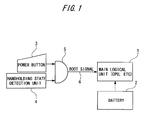
- FIG. 1 is a block diagram showing a logical operation when starting up the mobile information device in the first embodiment.
- FIG. 2 is a block diagram showing a logical operation after the mobile information device has been started up.
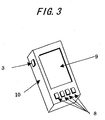
- FIG. 3 is a view showing an external configuration of this mobile information device.
- FIG. 4 is a view showing an example of a layout of electrodes installed for detecting a handholding state of this mobile information device.
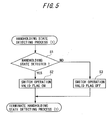
- FIG. 5 is a flowchart showing a handholding state detecting process (1) executed by a main logical unit 1.
- FIG. 6 is a flowchart showing an operation detecting process of detecting an operation of the user.
- FIG. 1 shows the logical operation when starting up this mobile information device.
- the mobile information device includes, logically, the main logical unit 1 for controlling the device, a battery 2 for supplying electric power to this mobile information device, a power button 3 for inputting electric power to the mobile information device, a handholding state detection unit 4 for detecting a handholding state when the user holds the mobile information device in hand, and an AND circuit 5 that generates a logical product (AND) of an input signal transmitted from the power button 3 and an input signal from the handholding state detection unit 4.
- the main logical unit 1 for controlling the device
- a battery 2 for supplying electric power to this mobile information device
- a power button 3 for inputting electric power to the mobile information device
- a handholding state detection unit 4 for detecting a handholding state when the user holds the mobile information device in hand
- an AND circuit 5 that generates a logical product (AND) of an input signal transmitted from the power button 3 and an input signal from the handholding state detection unit 4.
- the main logical unit 1 is defined as a main control unit including a CPU, a memory etc, and operates with the battery 2 serving as the power source. This main logical unit 1 is started up when a boot signal 6 is inputted from the AND circuit 5.
- the handholding state detection unit 4 detects whether the user handholds the device. A detected state is inputted to the AND circuit 5.
- the boot signal 6 is generated based on a press on the power button 3 and on an AND of the information indicating whether the handholding state detection unit 4 shows a handholding state, thereby starting up the main logical unit 1. Namely, the boot signal 6 is not generated from only one of the detection of the handholding state detection unit 4 and the press on the power button 3, with the result that the mobile information device is not started up.
- the handholding state detection unit 4 and the AND circuit 5 may be, though not illustrated in FIG. 1, supplied with the electricity through the power button 3. Based on such an architecture, upon switching ON the power button 3, to begin with, the handholding state detection unit 4 and the AND circuit 5 are supplied with the electricity, and, when the handholding state is detected in this state, it follows that the boot signal 6 is inputted to the main logical unit 1.
- FIG. 2 is the block diagram showing the logical operation after the present mobile information device has been start up.
- the mobile information device provides, after being started up, the user with functions through the components (the main logical unit 1 for controlling the device, the battery 2 for supplying the electric power to the mobile information device, the power button 3 for inputting the electric power to mobile information device, the handholding state detection unit 4 for detecting the handholding state when the user holds the mobile information device in hand)illustrated in FIG. 1 and further, in addition, an operation button 8 and a display unit 9.
- the main logical unit 1 includes the logical circuits such as the CPU, the memory etc, and the functions of the present mobile information device are actualized by hardware or software.
- the operation button 8 is constructed of a plurality of button elements (which will hereinafter be generically referred to as the operation button 8) each pushed for starting a specified application program. Further, the power source of the mobile information device is, when in an OFF-state, switched ON upon pressing the operation button 8.
- the display unit 9 which is, e.g., a liquid crystal display, an electroluminescence panel etc, displays the information outputted from the main logical unit 1 or the information of an input trough the operation button 8.
- the main logical unit 1 When the handholding state detection unit 4 indicates the handholding state, the main logical unit 1, upon detecting a press on the button element of the operation button 8, executes the application program corresponding to this pressed button element of the operation button 8. While on the other hand, when the handholding state detection unit 4 does not indicate the handholding state, the main logical unit 1, even when detecting the press on the power button 3 or on the operation button 8, ignores the detection thereof.
- FIG. 3 is the view showing the external configuration of the mobile information device.
- a PDA may be exemplified as this type of mobile information device.
- the mobile information device in this embodiment is not, however, limited to the PDA. Namely, the present invention can be applied to, e.g., the mobile phone, PHS (Personal Handyphone System) etc.
- PHS Personal Handyphone System
- the present mobile information device includes the display unit 9 provided on an upper surface of a main body 10, the operation button 8 provided downwardly of the display unit 9, and the power button 3 provided on a left side surface, as viewed from the sheet surface, of the main body 10.
- the power source is switched ON, thereby starting up the system. Further, when the user presses the operation button 8 in a state where the system has been started up, a specified application program is started.
- the power button 3 and the operation button 8 are provided on the surface of the main body 10, and hence there is a case where the system of the mobile information device might be started up by an external pressure for the duration of the user's carrying the mobile information device put into a bag or a pocket.
- the present mobile information device 1 incorporates a protection function for relieving such an unexpected operation.
- FIG. 4 is the explanatory view showing an example of a handholding state detection function defined as a characteristic of the present mobile information device.
- FIG. 4 illustrates the mobile information device 1 including electrodes 4a, 4b attached to the two side surfaces thereof.
- the thumb touches the electrode 4a, and at least one of the index finger, the middle finger , the third finger and the little finger touches the electrode 4b (the palm proximal to these fingers touches the electrodes depending on how the device is handheld).
- a voltage is applied across between the electrodes 4a and 4b to flow a feeble current through a human body (fingers), and a circuit measures a value of electric resistance between the electrodes, thereby detecting whether the device is handheld or not.
- FIG. 5 is the flowchart showing the handholding state detecting process (1) executed by the main logical unit 1 shown in FIG. 2.
- the main logical unit 1 has the CPU, the memory etc, and the process in FIG. 5 is actualized as a program executed by the CPU. Further, this program is developed on the memory and repeatedly executed at a predetermined interval by the main logical unit 1.
- the main logical unit 1 judges whether the handholding state can be detected or not (S1). If the handholding state can be detected, the main logical unit 1 sets ON an operation valid flag (S2). This switch operation valid flag is ensured in, e.g., the memory within the main logical unit 1.
- the main logical unit 1 sets OFF the operation valid flag (S3). Thereafter, the main logical unit 1 terminates the process.
- the main logical unit 1 periodically executes the process described above and thus monitors the handholding state of the mobile information device.
- FIG. 6 is the flowchart showing the operation detecting process in which the main logical unit 1 detects the user's operation. This process is also actualized as a program executed by the CPU, and this program is developed on the memory.
- the main logical unit 1 monitors whether the operation button 8 is pressed or not (S11). Then, if the operation button 8 is pressed, the main logical unit 1 judges whether the witch operation valid flag is set ON (S12).
- the main logical unit 1 executes a process corresponding to an operation (which is called a switch operation) onto the operation button 8 (S13). For example, the application program corresponding to the button element of the operation button 8 is thereby started.
- the main logical unit 1 ignores the operation onto the operation button 8 (S14). Thereafter, the main logical unit 1 returns the control to S11 and monitors the operation onto the operation button 8.
- the present mobile information device is structured such that when the power button 3 is pressed in the state where the handholding detection unit 4 detects the handholding state, the system is started up but is not started up even by pressing the power button 3 in the state where the handholding detection unit 4 does not detect the handholding state.
- this mobile information device is also structures such that when the operation button 8 is pressed in the state where the handholding detection unit 4 detects the handholding state after starting up the system, a function corresponding to the pressed operation button 8 is provided (e.g., an application program is started) but is not provided even pressing the operation button 8 in the state where the handholding state detection unit 4 does not detect the handholding state.
- a function corresponding to the pressed operation button 8 is provided (e.g., an application program is started) but is not provided even pressing the operation button 8 in the state where the handholding state detection unit 4 does not detect the handholding state.
- the handholding state is detected from the electric resistance between the electrodes 4a and 4b.
- the embodiment of the present invention is not limited to this construction.
- the handholding state may also be detected by a tilt sensor for detecting a tilt of the mobile information device by use of, for example, a distortion gauge or by a tilt sensor using a mercury switch. Further, the handholding state may be detected by detecting a temperature of a human finger. Moreover, the handholding state may be detected by a pressure sensor for detecting a pressure on the main body 10 when handheld.
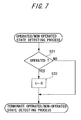
- FIG. 7 is a flowchart showing an operated/non-operated state detecting process for detecting whether a user's operation is made or not.
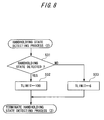
- FIG. 8 is a flowchart showing a handholding state detecting process (2).
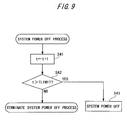
- FIG. 9 is a flowchart showing a system power OFF process.
- the operation of the power button 3 or the operation button 8 is validated.
- What will be discussed in the second embodiment is a function of automatically stopping the system if the operation of the operation button 8 is not detected for a predetermined period of time, and a function of adjusting a period till the system is automatically stopped by detecting whether the mobile information device is handheld or not.
- FIG. 7 is a flowchart showing the operated/non-operated state detecting process for detecting whether the user's operation is made or not. This process is triggered (started) at an interval of a predetermined time, thereby monitoring the user's operation of the operation button 8 etc.
- the main logical unit 1 judges whether the user manipulates the operation button 8 etc (S21). Then, if the user's operation is detected, a time parameter t is cleared to 0 (S22). Note that the time parameter t is a parameter for counting a time till the system is automatically stopped and is set to 0 in an initial state. Accordingly, when the user's operation is detected, the time parameter is reset to the initial state.
- FIG. 8 is the flowchart showing the handholding state detecting process (2). This process is triggered likewise at an interval of a predetermined time, thereby monitoring whether the user handholds the present mobile information device.
- the main logical unit 1 at first judges whether the handholding state detection unit 4 detects the handholding state (S31). Then, when the handholding state detection unit 4 detects the user's handholding state, the main logical unit 1 sets a parameter TLIMIT to 100 (S32).
- the main logical unit 1 sets the parameter TLIMIT to 6 (S33). Thereafter, the main logical unit 1 terminates the handholding state detecting process (2).
- FIG. 9 is the flowchart showing the system power OFF process. This process is triggered likewise at an interval of a predetermined time, and it is judged whether or not the power source of the present mobile information device is switched OFF. In this process, the main logical unit 1, to begin with, increments the time parameter t (S41).
- the main logical unit 1 judges whether or not a value of the time parameter t exceeds a value of the parameter TLIMIT (S42). Then, when the value of the time parameter t exceeds the value of the parameter TLIMIT, the main logical unit 1 switches OFF the power source of the system (S43) (a supply of the electric power from the battery 2 shown in FIG. 2 is stopped). Whereas if the value of the time parameter t does not exceed the value of the parameter TLIMIT, the main logical unit 1 directly terminates the process.
- the predetermined time till the power source is automatically stopped is set based on judging whether the device is handheld or not. Further, if unable to detect the user's operation during the predetermined time (which will hereinafter be referred to as an idle time), the power source of the mobile information device is automatically stopped. For instance, if not in the handholding state, the mobile information device is automatically stopped within a comparatively short period of idle time. Whereas if in the handholding state, the mobile information device is not automatically stopped unless a longer period of idle time than not in the handholding state is detected. It is therefore possible to finely control the automatic stop of the mobile information device, corresponding to how the user utilizes the device.
- the system of the mobile information device does not automatically stop for a comparatively long period of time even when the user does not manipulate.
- the system does not frequently stop in the handholding state, and the user has a less annoyance in operation of starting up the system.
- the system automatically stops within a comparatively short period of time, whereby the power can be saved.
- the value of the parameter TLIMIT is set to 100 or 6 depending on whether the mobile information device is handheld or not.
- the embodiment of the present invention is not limited to these values themselves as the values of the parameter TLIMT. Namely, the value of TLIMIT may be determined within a range proper to the user. In this case, it is desirable that the value of TLIMIT be set to a value larger in the handholding state than not in the handholding state.
- the second embodiment has exemplified the case where the predetermined time up to the automatic stop of the power source is set depending on whether the mobile information device is handheld or not.
- the embodiment of the present invention is not, however, restricted to this processing example.
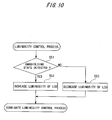
- FIG. 10 is a flowchart showing a luminosity control process of controlling a luminosity of the display unit 9 (an LCD is herein assumed), depending on whether the mobile information device is handheld or not. This process can be actualized by a program executed at an interval of a predetermined time by the CPU of the main logical unit 1.
- the main logical unit 1 at first judges whether the device is handheld or not (S51). Then, when the mobile information device is in the handholding state, the main logical unit 1 increases a luminosity of the LCD (the LCD is brightened) (S52). While on the other hand, when the mobile information device is not in the handholding state, the main logical unit 1 decreases the luminosity of the LCD (the LCD is darkened) (S53). Thereafter, the main logical unit 1 terminates the luminosity control process.
- the present mobile information device is capable of controlling the luminosity of the LCD based on whether the device is handheld or not. Further, in this case, as in the second embodiment, the predetermined time for keeping the luminosity high is set based on whether the device is handheld or not, and, if the user does not manipulate for this predetermined time, the luminosity is decreased, whereby a more flexible adjustment can be made. For instance, in the handholding state, the predetermined time for keeping the luminosity high may be set longer.
- the luminosity of the LCD is adjusted depending on when the mobile information device is handheld or not.
- a power source for the luminosity of the LCD may be switched OFF when not in the handholding state.
- the predetermined time for keeping the luminosity is set based on whether the device is handheld or not, and, if the user does not manipulate for this predetermined time, the luminosity power source may be switched OFF.
- the embodiment of the present invention is not limited to the LCD described above. Namely, the present invention can be applied to a general category of display devices capable of controlling brightness of the display or the luminosity of the device, such as an electroluminescence panel, a CRT and so forth as substitutes for the LCD.
- a general category of display devices capable of controlling brightness of the display or the luminosity of the device, such as an electroluminescence panel, a CRT and so forth as substitutes for the LCD.
- FIG. 11 is a flowchart showing a clock control process of controlling a clock cycle of the main logical unit 1 in accordance with whether the mobile information device is handheld or not. This process can be actualized by a program executed at a interval of a predetermined time by a CPU of the main logical unit 1 or by a control device cooperating with such a CPU.
- the main control unit 1 to start with, judges whether the device is handheld or not (S61). Then, when the mobile information device is in the handholding state, the main control unit 1 sets the clock in a high-speed mode, e.g., 1 GHz (S62). Whereas if not handheld, the main control unit 1 sets the clock in a low-speed mode, e.g., 250 MHz (S63). Thereafter, the main logical unit 1 terminates the clock control process.
- a high-speed mode e.g., 1 GHz
- S63 250 MHz
- the present mobile information device is capable of controlling the clock cycle of the main logical unit 1 based on whether the device is handheld or not. Further, in this case, as in the second embodiment, the predetermined time for keeping the high-speed mode is set based on whether in the handholding state or not, and, if there is no occurrence of the user's operation during this predetermined time, a more flexible adjustment can be made by shifting to the low-speed mode. For instance, the predetermined time for keeping the high-speed mode may be set long in the handholding state.
- the high-speed mode may involve using a normal clock cycle of the CPU, while the low-speed mode may involve using a clock extended to a 4-fold cycle through a frequency dividing circuit such as a predetermined multiple counter, e.g., a quaternary counter in the case of this embodiments
- a frequency dividing circuit such as a predetermined multiple counter, e.g., a quaternary counter in the case of this embodiments
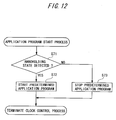
- FIG. 12 is a flowchart showing an application program start process of starting or stopping the application program in the main logical unit 1, depending on whether the mobile information device is in the handholding state or not. This process can be actualized by a program executed at an interval of a predetermined time by the CPU of the main logical unit 1.
- the main logical unit 1 at first judges whether the device is handheld (S71). @Then, if the mobile information device is handheld, the main logical unit 1 starts a predetermined application program (S72). Whereas if not handheld, the main logical unit 1 stops the predetermined application program (S73). Thereafter, the main logical unit 1 terminates the application program start process.
- the present mobile information device is capable of starting or stopping the specified application program based on whether the device is handheld or not. Further, in this case, as in the second embodiment, the predetermined time up to the start of the specified application program or the predetermined time up to the stop thereof may be set depending on whether the device is handheld or not. Then, if there is no occurrence of the user's operation for this predetermined time, a mode flexible adjustment can be performed by starting or stopping the application program.
- a program for making a computers actualize any one of the functions described above may be recorded on a readable-by-computer storage medium. Then, the computer reads and executes the program on this storage medium, whereby the function thereof can be provided.
- the readable-by-computer storage medium includes storage mediums capable of storing information such as data, programs, etc. electrically, magnetically, optically and mechanically or by chemical action, which can be all read by the computer. What is demountable out of the computer among those storage mediums may be, e.g., a flexible disk, a magneto-optic disk, a CD-ROM, a CD-R/W, a DVD, a DAT, an 8mm tape, a memory card, etc.
- a hard disk a ROM (Read Only Memory) and so on are classified as fixed type storage mediums within the computer.
- the above program may be stored in the hard disk and the memory of the computer, and downloaded to other computers via communication media.
- the program is transmitted as data communication signals embodied in carrier waves via the communication media.
- the computer downloaded with this program can be made to provide the function described above.
- the communication media may be any one of cable communication mediums such as metallic cables including a coaxial cable and a twisted pair cable, optical communication . cables, or wireless communication media such as satellite communications, ground wave wireless communications, etc.
- the carrier waves are electromagnetic waves for modulating the data communication signals, or the light.
- the carrier waves may, however, be DC signals.
- the data communication signal takes a base band waveform with no carrier wave.
- the data communication signal embodied in the carrier wave may be any one of a modulated broadband signal and an unmodulated base band signal (corresponding to a case of setting a DC signal having a voltage of 0 as a carrier wave).
Landscapes
- Engineering & Computer Science (AREA)
- Computer Networks & Wireless Communication (AREA)
- Signal Processing (AREA)
- Telephone Function (AREA)
- Power Sources (AREA)
- Mobile Radio Communication Systems (AREA)
- Calculators And Similar Devices (AREA)
Applications Claiming Priority (2)
| Application Number | Priority Date | Filing Date | Title |
|---|---|---|---|
| JP2002181871A JP2004029960A (ja) | 2002-06-21 | 2002-06-21 | 携帯情報機器、携帯情報機器の制御方法、およびプログラム |
| JP2002181871 | 2002-06-21 |
Publications (2)
| Publication Number | Publication Date |
|---|---|
| EP1376992A2 true EP1376992A2 (fr) | 2004-01-02 |
| EP1376992A3 EP1376992A3 (fr) | 2005-03-23 |
Family
ID=29717544
Family Applications (1)
| Application Number | Title | Priority Date | Filing Date |
|---|---|---|---|
| EP03003776A Withdrawn EP1376992A3 (fr) | 2002-06-21 | 2003-02-19 | Dispositif et procédé pour contrôler un appareil d'information mobile dépendant d'un opération d'un utilisateur et d'un état détecté |
Country Status (4)
| Country | Link |
|---|---|
| US (1) | US7224996B2 (fr) |
| EP (1) | EP1376992A3 (fr) |
| JP (1) | JP2004029960A (fr) |
| CN (1) | CN100458754C (fr) |
Cited By (7)
| Publication number | Priority date | Publication date | Assignee | Title |
|---|---|---|---|---|
| WO2005099105A1 (fr) * | 2004-04-05 | 2005-10-20 | Sony Ericsson Mobile Communications Ab | Economiseur d'ecran a capteur |
| WO2005093552A3 (fr) * | 2004-03-22 | 2006-03-02 | Koninkl Philips Electronics Nv | Procede et appareil destines a la gestion d'alimentation dans des terminaux mobiles |
| EP1686776A1 (fr) * | 2005-01-31 | 2006-08-02 | Research In Motion Limited | Détection d'une main d'utilisateur pour dispositif sans fils |
| EP1589403A3 (fr) * | 2004-04-21 | 2006-11-02 | Symbol Technologies, Inc. | Sytèmes et procédés pour gérer la consommation de machines à états |
| US7430439B2 (en) | 2005-01-31 | 2008-09-30 | Research In Motion Limited | User hand detection for wireless devices |
| EP2120174A3 (fr) * | 2008-05-09 | 2010-06-09 | Ricoh Company, Ltd. | Dispositif d'affichage d'images et procédé de commande correspondant |
| WO2012054005A1 (fr) * | 2010-10-20 | 2012-04-26 | Yota Devices Ipr Ltd | Dispositif mobile comprenant un système d'entrée |
Families Citing this family (28)
| Publication number | Priority date | Publication date | Assignee | Title |
|---|---|---|---|---|
| US7017059B2 (en) * | 2003-12-12 | 2006-03-21 | Cray Canada Inc. | Methods and apparatus for replacing cooling systems in operating computers |
| US7221964B2 (en) * | 2004-02-27 | 2007-05-22 | Research In Motion Limited | LCD backlight duration proportional to amount of information on the LCD display screen |
| CN100444668C (zh) * | 2005-01-13 | 2008-12-17 | 乐金电子(中国)研究开发中心有限公司 | 一种控制手机功耗的方法及其手机 |
| US20060223593A1 (en) * | 2005-04-01 | 2006-10-05 | Ixi Mobile (R&D) Ltd. | Content delivery system and method for a mobile communication device |
| KR100668341B1 (ko) * | 2005-06-29 | 2007-01-12 | 삼성전자주식회사 | 사용자의 파지 형태를 이용한 휴대용 단말기의 기능 입력방법 및 장치. |
| US20070042816A1 (en) * | 2005-08-15 | 2007-02-22 | Idt Communication Technology Limited | Handheld communication device with key-lock |
| WO2008149658A1 (fr) * | 2007-05-30 | 2008-12-11 | Kyocera Corporation | Terminal portable, appareil portable et procédé de commande d'alimentation électrique |
| JP2009152705A (ja) * | 2007-12-19 | 2009-07-09 | Toshiba Corp | 電子計算機および切替回路 |
| US8368658B2 (en) | 2008-12-02 | 2013-02-05 | At&T Mobility Ii Llc | Automatic soft key adaptation with left-right hand edge sensing |
| US20100138680A1 (en) * | 2008-12-02 | 2010-06-03 | At&T Mobility Ii Llc | Automatic display and voice command activation with hand edge sensing |
| US20100134424A1 (en) * | 2008-12-02 | 2010-06-03 | At&T Mobility Ii Llc | Edge hand and finger presence and motion sensor |
| US20110087963A1 (en) * | 2009-10-09 | 2011-04-14 | At&T Mobility Ii Llc | User Interface Control with Edge Finger and Motion Sensing |
| CN102111490A (zh) * | 2009-12-23 | 2011-06-29 | 索尼爱立信移动通讯有限公司 | 移动终端的键盘自动解锁方法及装置 |
| USD654038S1 (en) * | 2010-02-05 | 2012-02-14 | Samsung Electronics Co., Ltd. | Mobile phone |
| USD635541S1 (en) * | 2010-05-14 | 2011-04-05 | Samsung Electronics Co., Ltd. | Mobile phone |
| USD635113S1 (en) * | 2010-05-14 | 2011-03-29 | Samsung Electronics Co., Ltd. | Mobile phone |
| USD633467S1 (en) * | 2010-05-14 | 2011-03-01 | Samsung Electronics Co., Ltd. | Mobile phone |
| JP5703763B2 (ja) * | 2011-01-13 | 2015-04-22 | カシオ計算機株式会社 | 携帯型電子機器、及びプログラム |
| USD650766S1 (en) * | 2011-06-16 | 2011-12-20 | Samsung Electronics Co., Ltd. | Mobile phone |
| US8473975B1 (en) | 2012-04-16 | 2013-06-25 | The Nielsen Company (Us), Llc | Methods and apparatus to detect user attentiveness to handheld computing devices |
| JP5915424B2 (ja) * | 2012-07-09 | 2016-05-11 | 日本電気株式会社 | 情報処理端末 |
| JP5904055B2 (ja) * | 2012-08-17 | 2016-04-13 | コニカミノルタ株式会社 | 携帯型の情報機器およびコンピュータープログラム |
| CN103019124B (zh) * | 2012-12-27 | 2017-04-05 | 中兴通讯股份有限公司 | 一种防止开关误触发的方法及装置 |
| JP6079799B2 (ja) * | 2015-02-24 | 2017-02-15 | カシオ計算機株式会社 | 携帯機器及びプログラム |
| JP2017076208A (ja) * | 2015-10-14 | 2017-04-20 | オムロンオートモーティブエレクトロニクス株式会社 | 携帯型電子機器 |
| KR102529686B1 (ko) * | 2016-09-01 | 2023-05-08 | 삼성전자 주식회사 | 전자 장치 및 이를 이용한 그립 상태를 인식하는 방법 |
| JP6269778B2 (ja) * | 2016-10-26 | 2018-01-31 | カシオ計算機株式会社 | 携帯機器及びプログラム |
| CN112912802B (zh) * | 2018-12-29 | 2023-11-03 | 深圳迈瑞生物医疗电子股份有限公司 | 一种开关机控制方法和除颤仪 |
Family Cites Families (33)
| Publication number | Priority date | Publication date | Assignee | Title |
|---|---|---|---|---|
| JPH031075A (ja) | 1989-05-29 | 1991-01-07 | Sharp Corp | 液体窒素供給システムの結露防止構造 |
| JP2710699B2 (ja) * | 1991-02-06 | 1998-02-10 | 三菱電機株式会社 | デュアルモード自動車電話端末装置 |
| JPH05143551A (ja) | 1991-11-19 | 1993-06-11 | Canon Inc | 携帯型電子機器 |
| JPH064183A (ja) | 1992-06-22 | 1994-01-14 | Sharp Corp | 情報機器の電源制御装置 |
| CN1043930C (zh) * | 1993-03-20 | 1999-06-30 | 宏碁电脑股份有限公司 | 具有控制电源供至外围设备的省电电脑系统 |
| JP3001075B2 (ja) | 1993-05-31 | 2000-01-17 | 日本開閉器工業株式会社 | 端末入力装置 |
| US6035191A (en) * | 1994-11-30 | 2000-03-07 | Motorola, Inc. | Standby operation in a wireless communication device |
| JPH08272495A (ja) * | 1995-03-31 | 1996-10-18 | Mitsubishi Electric Corp | 電力制御装置及び電力制御方法 |
| JPH09212462A (ja) | 1996-02-02 | 1997-08-15 | Nec Corp | 携帯型電子装置 |
| US5884156A (en) * | 1996-02-20 | 1999-03-16 | Geotek Communications Inc. | Portable communication device |
| KR0168805B1 (ko) * | 1996-03-06 | 1999-02-01 | 김광호 | 셀룰라 기지국에서 유지보수를 위한 송수신기 절체장치 및 방법 |
| JP2877081B2 (ja) * | 1996-06-26 | 1999-03-31 | 日本電気株式会社 | 移動体通信装置 |
| KR100193829B1 (ko) | 1996-06-26 | 1999-06-15 | 윤종용 | 이동무선전화기의 키잠금 제어장치 및 방법 |
| JP3581218B2 (ja) * | 1996-07-03 | 2004-10-27 | 株式会社東芝 | 移動通信端末装置とその携帯電話機並びにデータ端末装置 |
| JP2830914B2 (ja) * | 1996-08-27 | 1998-12-02 | 日本電気株式会社 | 無線パケットデータ通信のチャネル獲得方式 |
| US5881377A (en) * | 1996-08-29 | 1999-03-09 | Motorola, Inc. | Communication device and display blanking control method therefor |
| JP3111909B2 (ja) * | 1996-09-27 | 2000-11-27 | 松下電器産業株式会社 | 移動電話機 |
| JPH10124250A (ja) | 1996-10-24 | 1998-05-15 | Nec Home Electron Ltd | ワイヤレスマウス |
| JP3037170B2 (ja) | 1996-12-20 | 2000-04-24 | 日本電気移動通信株式会社 | 携帯電話機 |
| US6029061A (en) | 1997-03-11 | 2000-02-22 | Lucent Technologies Inc. | Power saving scheme for a digital wireless communications terminal |
| JP4243344B2 (ja) * | 1997-05-23 | 2009-03-25 | 株式会社Access | 移動通信機器 |
| US6002763A (en) * | 1998-02-02 | 1999-12-14 | Siemens Information And Communication Networks, Inc. | Telephone with a mute ringer function having an automatic ringer reactivation capability |
| US6154525A (en) * | 1998-05-11 | 2000-11-28 | Detection Systems, Inc. | Security system with call forwarding activation |
| KR20000010415A (ko) * | 1998-07-31 | 2000-02-15 | 서평원 | 휴대전화기의휴대감지에따른통화서비스제공방법 |
| US6292674B1 (en) | 1998-08-05 | 2001-09-18 | Ericsson, Inc. | One-handed control for wireless telephone |
| US6246862B1 (en) * | 1999-02-03 | 2001-06-12 | Motorola, Inc. | Sensor controlled user interface for portable communication device |
| AU767415B2 (en) * | 1999-05-06 | 2003-11-06 | Qualcomm Incorporated | Detection of flip closure state of a flip phone |
| CN1124729C (zh) * | 1999-08-19 | 2003-10-15 | 北京首信股份有限公司 | 移动电话机的显示屏照明及键盘照明的省电装置使用方法 |
| JP2001086215A (ja) | 1999-09-14 | 2001-03-30 | Pioneer Electronic Corp | 電話機 |
| JP2001094653A (ja) * | 1999-09-21 | 2001-04-06 | Sanyo Electric Co Ltd | 携帯端末装置 |
| FR2815501B1 (fr) * | 2000-10-13 | 2004-07-02 | Sagem | Perfectionnements aux terminaux mobiles de telecommunication |
| JP2002171314A (ja) | 2000-11-29 | 2002-06-14 | Casio Comput Co Ltd | 音声入力機能付き情報機器 |
| US6813344B1 (en) * | 2001-08-29 | 2004-11-02 | Palm Source, Inc. | Method and system for providing information for identifying callers based on a partial number |
-
2002
- 2002-06-21 JP JP2002181871A patent/JP2004029960A/ja active Pending
-
2003
- 2003-02-13 US US10/365,393 patent/US7224996B2/en not_active Expired - Fee Related
- 2003-02-19 EP EP03003776A patent/EP1376992A3/fr not_active Withdrawn
- 2003-03-12 CN CNB031194540A patent/CN100458754C/zh not_active Expired - Fee Related
Cited By (13)
| Publication number | Priority date | Publication date | Assignee | Title |
|---|---|---|---|---|
| WO2005093552A3 (fr) * | 2004-03-22 | 2006-03-02 | Koninkl Philips Electronics Nv | Procede et appareil destines a la gestion d'alimentation dans des terminaux mobiles |
| WO2005099105A1 (fr) * | 2004-04-05 | 2005-10-20 | Sony Ericsson Mobile Communications Ab | Economiseur d'ecran a capteur |
| RU2390931C2 (ru) * | 2004-04-05 | 2010-05-27 | Сони Эрикссон Мобайл Коммьюникейшнз Аб | Датчик экранной заставки |
| CN100583658C (zh) * | 2004-04-05 | 2010-01-20 | 索尼爱立信移动通讯股份有限公司 | 传感器屏幕节电器 |
| JP2007532069A (ja) * | 2004-04-05 | 2007-11-08 | ソニー エリクソン モバイル コミュニケーションズ, エービー | センサスクリーンセーバー |
| EP1589403A3 (fr) * | 2004-04-21 | 2006-11-02 | Symbol Technologies, Inc. | Sytèmes et procédés pour gérer la consommation de machines à états |
| US7430439B2 (en) | 2005-01-31 | 2008-09-30 | Research In Motion Limited | User hand detection for wireless devices |
| EP1783993A1 (fr) * | 2005-01-31 | 2007-05-09 | Research In Motion Limited | Détection du main d'utilisateur et adaption d'illumination d'écran pour dispositif sans fils |
| EP1686776A1 (fr) * | 2005-01-31 | 2006-08-02 | Research In Motion Limited | Détection d'une main d'utilisateur pour dispositif sans fils |
| US8165627B2 (en) | 2005-01-31 | 2012-04-24 | Research In Motion Limited | User hand detection for wireless devices |
| EP2120174A3 (fr) * | 2008-05-09 | 2010-06-09 | Ricoh Company, Ltd. | Dispositif d'affichage d'images et procédé de commande correspondant |
| US8378785B2 (en) | 2008-05-09 | 2013-02-19 | Ricoh Company, Ltd. | Image display device and method for controlling the same |
| WO2012054005A1 (fr) * | 2010-10-20 | 2012-04-26 | Yota Devices Ipr Ltd | Dispositif mobile comprenant un système d'entrée |
Also Published As
| Publication number | Publication date |
|---|---|
| US20040204016A1 (en) | 2004-10-14 |
| US7224996B2 (en) | 2007-05-29 |
| CN100458754C (zh) | 2009-02-04 |
| CN1467649A (zh) | 2004-01-14 |
| JP2004029960A (ja) | 2004-01-29 |
| EP1376992A3 (fr) | 2005-03-23 |
Similar Documents
| Publication | Publication Date | Title |
|---|---|---|
| US7224996B2 (en) | Mobile information device, method of controlling mobile information device, and program | |
| JP5407731B2 (ja) | 電子機器、および、プログラム | |
| US11112851B2 (en) | Apparatus for driving a touch pad and a portable terminal having the same | |
| US9696891B2 (en) | Mobile terminal device, screen control method, and non-transitory computer readable storage medium | |
| US8199006B2 (en) | Computing device that detects hand presence in order to automate the transition of states | |
| KR100472429B1 (ko) | 휴대용 무선단말기의 키패드 어셈블리 및 그 제어방법 | |
| EP1131694B1 (fr) | Telephone portatif et procede de mise sous tension | |
| CN109543574B (zh) | 指纹采集方法及相关设备 | |
| US7420541B2 (en) | Wireless mouse | |
| JPH0965436A (ja) | 携帯端末 | |
| KR101646779B1 (ko) | 터치 스크린을 구비한 휴대 단말기의 글자 크기 설정 방법 및 장치 | |
| CN111290794A (zh) | 一种屏幕唤醒方法、装置、存储介质及移动终端 | |
| US20160170553A1 (en) | Information processing apparatus and control method for information processing apparatus | |
| WO2001089180A1 (fr) | Telephone portable a ecran tactile | |
| EP2075994A1 (fr) | Appareil électronique portable à commutation automatique entre deux modes d'opération | |
| JP5239386B2 (ja) | 携帯端末装置、その制御方法及びプログラム | |
| US20040166904A1 (en) | Power saving method and mechanism for wireless input device | |
| KR101578932B1 (ko) | 특정 패턴의 터치 입력에 따라 터치 모드의 전환이 가능한 단말기 및 그 제어방법 | |
| CN111158449A (zh) | 终端设备及其控制系统、控制方法 | |
| US20080100144A1 (en) | Automatic Power-Off Method for an Electronic Device | |
| JP3688317B2 (ja) | 携帯形無線装置 | |
| US20020063692A1 (en) | Keyboard device capable of being used as external keyboard device for portable terminal | |
| CN111309178A (zh) | 移动终端和用于控制移动终端的方法 | |
| CN111083288A (zh) | 屏幕控制方法、装置、终端设备和存储介质 | |
| KR100424470B1 (ko) | 특정 기능키를 구비한 디지털 휴대용 단말기 및 그 구현방법 |
Legal Events
| Date | Code | Title | Description |
|---|---|---|---|
| PUAI | Public reference made under article 153(3) epc to a published international application that has entered the european phase |
Free format text: ORIGINAL CODE: 0009012 |
|
| AK | Designated contracting states |
Kind code of ref document: A2 Designated state(s): AT BE BG CH CY CZ DE DK EE ES FI FR GB GR HU IE IT LI LU MC NL PT SE SI SK TR |
|
| AX | Request for extension of the european patent |
Extension state: AL LT LV MK RO |
|
| PUAL | Search report despatched |
Free format text: ORIGINAL CODE: 0009013 |
|
| AK | Designated contracting states |
Kind code of ref document: A3 Designated state(s): AT BE BG CH CY CZ DE DK EE ES FI FR GB GR HU IE IT LI LU MC NL PT SE SI SK TR |
|
| AX | Request for extension of the european patent |
Extension state: AL LT LV MK RO |
|
| RIC1 | Information provided on ipc code assigned before grant |
Ipc: 7H 04M 1/02 B Ipc: 7H 04M 1/73 A |
|
| 17P | Request for examination filed |
Effective date: 20050905 |
|
| AKX | Designation fees paid |
Designated state(s): DE FR GB |
|
| STAA | Information on the status of an ep patent application or granted ep patent |
Free format text: STATUS: THE APPLICATION IS DEEMED TO BE WITHDRAWN |
|
| 18D | Application deemed to be withdrawn |
Effective date: 20110729 |