EP1380278A1 - Preparation d'emulsion cosmetique et agent pour usage externe - Google Patents
Preparation d'emulsion cosmetique et agent pour usage externe Download PDFInfo
- Publication number
- EP1380278A1 EP1380278A1 EP02713266A EP02713266A EP1380278A1 EP 1380278 A1 EP1380278 A1 EP 1380278A1 EP 02713266 A EP02713266 A EP 02713266A EP 02713266 A EP02713266 A EP 02713266A EP 1380278 A1 EP1380278 A1 EP 1380278A1
- Authority
- EP
- European Patent Office
- Prior art keywords
- polyglycerol
- fatty acid
- weight
- agent
- external use
- Prior art date
- Legal status (The legal status is an assumption and is not a legal conclusion. Google has not performed a legal analysis and makes no representation as to the accuracy of the status listed.)
- Withdrawn
Links
Images
Classifications
-
- B—PERFORMING OPERATIONS; TRANSPORTING
- B82—NANOTECHNOLOGY
- B82Y—SPECIFIC USES OR APPLICATIONS OF NANOSTRUCTURES; MEASUREMENT OR ANALYSIS OF NANOSTRUCTURES; MANUFACTURE OR TREATMENT OF NANOSTRUCTURES
- B82Y5/00—Nanobiotechnology or nanomedicine, e.g. protein engineering or drug delivery
-
- A—HUMAN NECESSITIES
- A61—MEDICAL OR VETERINARY SCIENCE; HYGIENE
- A61K—PREPARATIONS FOR MEDICAL, DENTAL OR TOILETRY PURPOSES
- A61K8/00—Cosmetics or similar toiletry preparations
- A61K8/02—Cosmetics or similar toiletry preparations characterised by special physical form
- A61K8/04—Dispersions; Emulsions
- A61K8/06—Emulsions
-
- A—HUMAN NECESSITIES
- A61—MEDICAL OR VETERINARY SCIENCE; HYGIENE
- A61K—PREPARATIONS FOR MEDICAL, DENTAL OR TOILETRY PURPOSES
- A61K8/00—Cosmetics or similar toiletry preparations
- A61K8/18—Cosmetics or similar toiletry preparations characterised by the composition
- A61K8/30—Cosmetics or similar toiletry preparations characterised by the composition containing organic compounds
- A61K8/33—Cosmetics or similar toiletry preparations characterised by the composition containing organic compounds containing oxygen
- A61K8/39—Derivatives containing from 2 to 10 oxyalkylene groups
-
- A—HUMAN NECESSITIES
- A61—MEDICAL OR VETERINARY SCIENCE; HYGIENE
- A61P—SPECIFIC THERAPEUTIC ACTIVITY OF CHEMICAL COMPOUNDS OR MEDICINAL PREPARATIONS
- A61P17/00—Drugs for dermatological disorders
-
- A—HUMAN NECESSITIES
- A61—MEDICAL OR VETERINARY SCIENCE; HYGIENE
- A61P—SPECIFIC THERAPEUTIC ACTIVITY OF CHEMICAL COMPOUNDS OR MEDICINAL PREPARATIONS
- A61P17/00—Drugs for dermatological disorders
- A61P17/16—Emollients or protectives, e.g. against radiation
-
- A—HUMAN NECESSITIES
- A61—MEDICAL OR VETERINARY SCIENCE; HYGIENE
- A61Q—SPECIFIC USE OF COSMETICS OR SIMILAR TOILETRY PREPARATIONS
- A61Q19/00—Preparations for care of the skin
-
- C—CHEMISTRY; METALLURGY
- C09—DYES; PAINTS; POLISHES; NATURAL RESINS; ADHESIVES; COMPOSITIONS NOT OTHERWISE PROVIDED FOR; APPLICATIONS OF MATERIALS NOT OTHERWISE PROVIDED FOR
- C09K—MATERIALS FOR MISCELLANEOUS APPLICATIONS, NOT PROVIDED FOR ELSEWHERE
- C09K23/00—Use of substances as emulsifying, wetting, dispersing, or foam-producing agents
- C09K23/017—Mixtures of compounds
-
- C—CHEMISTRY; METALLURGY
- C09—DYES; PAINTS; POLISHES; NATURAL RESINS; ADHESIVES; COMPOSITIONS NOT OTHERWISE PROVIDED FOR; APPLICATIONS OF MATERIALS NOT OTHERWISE PROVIDED FOR
- C09K—MATERIALS FOR MISCELLANEOUS APPLICATIONS, NOT PROVIDED FOR ELSEWHERE
- C09K23/00—Use of substances as emulsifying, wetting, dispersing, or foam-producing agents
- C09K23/017—Mixtures of compounds
- C09K23/018—Mixtures of two or more different organic oxygen-containing compounds
-
- C—CHEMISTRY; METALLURGY
- C09—DYES; PAINTS; POLISHES; NATURAL RESINS; ADHESIVES; COMPOSITIONS NOT OTHERWISE PROVIDED FOR; APPLICATIONS OF MATERIALS NOT OTHERWISE PROVIDED FOR
- C09K—MATERIALS FOR MISCELLANEOUS APPLICATIONS, NOT PROVIDED FOR ELSEWHERE
- C09K23/00—Use of substances as emulsifying, wetting, dispersing, or foam-producing agents
- C09K23/34—Higher-molecular-weight carboxylic acid esters
-
- A—HUMAN NECESSITIES
- A61—MEDICAL OR VETERINARY SCIENCE; HYGIENE
- A61K—PREPARATIONS FOR MEDICAL, DENTAL OR TOILETRY PURPOSES
- A61K2800/00—Properties of cosmetic compositions or active ingredients thereof or formulation aids used therein and process related aspects
- A61K2800/20—Chemical, physico-chemical or functional or structural properties of the composition as a whole
- A61K2800/21—Emulsions characterized by droplet sizes below 1 micron
-
- A—HUMAN NECESSITIES
- A61—MEDICAL OR VETERINARY SCIENCE; HYGIENE
- A61K—PREPARATIONS FOR MEDICAL, DENTAL OR TOILETRY PURPOSES
- A61K2800/00—Properties of cosmetic compositions or active ingredients thereof or formulation aids used therein and process related aspects
- A61K2800/40—Chemical, physico-chemical or functional or structural properties of particular ingredients
- A61K2800/41—Particular ingredients further characterized by their size
- A61K2800/413—Nanosized, i.e. having sizes below 100 nm
Definitions
- the present invention relates to a cosmetic emulsion preparation and agent for external use, having for its emulsification base a polyglycerol fatty acid ester, which is used in the fields of cosmetics; quasi-drugs, drugs, household articles, and so forth, and more particularly, relates to a cosmetic emulsion preparation and agent for external use having a stable emulsification over a wide temperature range, no large decrease in hardness at high temperatures above 40°C, no increase in hardness with the passage of time even at 0°C, a fine texture in appearance, and smoothly vanishing without leaving behind any white residue on the skin when applied.
- the present invention relates to a transparent cosmetic emulsion preparation and agent for external use, having lecithin in addition to a polyglycerol fatty acid ester for its emulsification base, and more particularly, relates to a transparent cosmetic emulsion preparation and agent for external use having an average particle diameter of 100 nm or less, a clear appearance; being stable without the occurrence of decreased transparency, clouding, or ingredient separation with the passage of time; and exhibiting hardly any lowering of pH as is frequently observed in aqueous compositions combining the use of polyglycerol fatty acid ester and lecithin.
- Polyoxyethylene-based surfactants are typically used as emulsifiers or solubilizers in cosmetic emulsion preparations and solubilized cosmetic preparations in which oily ingredients are finely dispersed, examples of which include cosmetics and agents for external use such as ointments, creams, moisturizer, toner, essence, lotions, and eau de cologne.
- Reasons for the wide use of polyoxyethylene-based surfactants include their ease of use as emulsifiers or solubilizers, and their structural characteristic of allowing chain length of hydrophilic groups in molecules to be controlled as desired, thereby resulting in products being available on the market having various HLB values.
- an emulsion is usually formed by dissolving or dispersing surfactant in an oily phase followed by the addition of aqueous phase to invert the emulsion from a W/O emulsion to an O/W emulsion.
- aqueous phase is added to an oily phase
- this method is commonly used for production of cosmetics and agents for external use in particular.
- the balance between hydrophilic properties and lipophilic properties has been reported to involve lamellar liquid crystal formed during phase inversion ("Journal of Oleo Science", Vol. 30, No. 1,1981).
- a cosmetic or agent for external use if only a very small amount of oily ingredient is contained in a cosmetic or agent for external use, it can be solubilized by dissolved into micelles using a surfactant having a high HLB value.
- the advantages of such cosmetic products and agents for external use include the imparting of a refreshing feeling that is not oily even though they contain an oily ingredient, stable blending of the oily ingredient without having to increase the viscosity of the system and resulting in an attractive appearance. These advantages result in high product value.
- Polyglycerol fatty acid esters are used as alternative surfactants due to their high level of safety.
- Polyglycerol which is a constituent component of many of the polyglycerol fatty acid esters typically on the market, has an average degree of polymerization as determined from the hydroxyl value of 2-10, and HLB can be adjusted to a certain degree by the composition and amounts of esterified fatty acids.
- This polyglycerol is typically obtained by a dehydration condensation reaction, is inexpensive and is commonly used in food applications.
- polyglycerol fatty acid ester has limitations when considering its use as a hydrophilic surfactant for cosmetic applications.
- the average degree of polymerization of polyglycerol obtained by the aforementioned dehydration condensation reaction is 2-10
- the reason for the absence of products on the market having a higher average degree of polymerization is that an insoluble rubber-like substance forms during the reaction when the degree of polymerization becomes high, thereby resulting in a loss of the inherent hydrophilic properties of polyglycerol. This is due to an increase in cyclic and steric bonding when the degree of polymerization increases beyond a certain level.
- One characteristic of polyglycerol obtained by a dehydration condensation reaction is the wide distribution of the degree of polymerization of the components.
- a large number of components having a low degree of polymerization can be determined to be present when looking at the distribution of polymerization by gas chromatography or liquid chromatography.
- Fatty acid esters of polyglycerol have hydrophilic properties that are less hydrophilic than that which would be expected from the average degree of polymerization of polyglycerol.
- the HLB value as determined by an emulsification experiment is not that high at about 11-12.
- the HLB value naturally becomes higher as the chain length of the fatty acid becomes shorter (for example, an HLB value of about 15 in the case of lauric acid)
- the emulsification capacity of a surfactant is generally known to be higher for higher fatty acids than medium fatty acids, these are not suitable for use as emulsifiers.
- emulsified oil having various polarities and molecular weights are present, and in the case of hydrocarbon oils and ester oils, the polarities and molecular weights of the oily agents are not uniform.
- HLB values determined in oily agents having high polarity, such as ester oils and alcohols are not uniform.
- fatty acid esters of polyglycerol conventionally available on the market, which are obtained from a dehydration condensation reaction and have a wide distribution of average degree of polymerization and a high average degree of polymerization, do not have very high HLB values, they are not emulsifiers suitable for ensuring a balance between hydrophilic properties and lipophilic properties, thereby making it difficult to obtain a satisfactory emulsion in the case of using such esters.
- linear, saturated higher alcohols and alkyl glyceryl ethers are commonly used when adjusting the hardness of cosmetic emulsion preparations and agents for external use.
- Inversion emulsification is effective for adjusting hardness, and liquid crystal is formed at an oil-water interface by using a higher alcohol or other emulsification assistant with a surfactant. This method is preferable for generating the characteristic hardness of creams, moisturizer, and so forth.
- Emulsification methods such as D-phase emulsification and liquid crystal emulsification have been developed as easy methods for producing emulsions.
- polyglycerol fatty acid esters obtained by a ring-opening polymerization reaction or nucleophilic substitution reaction using glycidol, epichlorohydrin, monochlorohydrin, dichlorohydrin, or so forth as a starting substance have relatively highly hydrophilic as compared with polyglycerol fatty acid esters having an equal average degree of polymerization obtained by a dehydration condensation reaction.
- the difficulty in cyclization due to the reaction characteristics is a factor behind the high degree of hydrophilic properties of the former.
- Polyglycerol having few lowly polymerized components and a narrow distribution of the degree of polymerization are obtained by a synthesis method in which the reaction process is controlled (Japanese Unexamined Patent Application, First Publication No. 7-100355).
- examples of highly pure fatty acid esters of polyglycerol are disclosed in Japanese Unexamined Patent Application, First Publication No. 62-266135.
- a technique for removing components having a low degree of polymerization from polyglycerol by column fractionation has already been developed and industrialized, and such fatty acid esters have been developed (Japanese Unexamined Patent Application, First Publication No. 8-143513).
- lecithin As a natural surfactant having a high degree of safety. Lecithin not only acts as a surfactant, but is also useful as an ingredient of cosmetics for moisturizing which easily retain moisture due to the formation of lamellar liquid crystal by interacting with water.
- polyglycerol fatty acid ester and lecithin are used in combination in a cosmetic product or agent for external use, the emulsifying capacity is increased more than in the case of using each alone.
- polyglycerol fatty acid ester is also used as a dispersant for dispersing lecithin in water.
- the blended amount of emulsifier When the blended amount of emulsifier is increased to avoid this problem, hardness decreases or the presence of the emulsifier can be felt strongly, thereby making this undesirable.
- the polyglycerol ester of a branched fatty acid disclosed in Japanese Unexamined Patent Application, First Publication No. 58-185537 has a lower melting point than polyglycerol fatty acid ester of a saturated, linear higher fatty acid, and exhibits smaller changes in viscosity caused by changes in temperature, the resulting product is soft. If the blended amount of higher alcohol is then increased to enhance hardness, the problem previously described ends up occurring.
- the temperature stability of cosmetics and agents for external use is such that it has become necessary to achieve hardness stability and storage stability at temperatures higher than 40°C.
- This problem cannot be resolved with conventional polyoxyethylene-based surfactants or technologies like those disclosed in Japanese Unexamined Patent Application, First Publication No. 58-185537, and the only alternative is to accommodate the problem by increasing the amounts of higher alcohol and wax ingredients or increasing the amount of thickener.
- such cosmetics and agents for external use having an extremely poor texture and appearance.
- hardness stability at low temperatures may become poor with the passage of time and the higher alcohol and wax ingredients easily aggregate with the passage of time, resulting in a significant increase in hardness that may ultimately result in elimination of water. This tendency is particularly conspicuous when the ambient temperature of the cosmetic agent or agent for external use falls to 0°C.
- a first object of the present invention is to provide a cosmetic emulsion preparation and agent for external use comprising an emulsified composition having polyglycerol fatty acid ester as its emulsification base, wherein even in the case of using a polyglycerol fatty acid ester having a high HLB value so as to facilitate use in phase inversion emulsification, there is no remarkable decrease in hardness at temperatures higher than 40°C, it remains stable with the passage of time when stored, it is stable with the passage of time and there is no elimination of water even at temperatures of 0°C without increasing in hardness, and it has a satisfactorily fine texture in appearance and vanishes smoothly without leaving any white residue on the skin.
- a second object of the present invention is to provide a transparent cosmetic emulsion preparation and agent for external use comprising a transparent and fine cosmetic emulsion preparation having polyglycerol fatty acid ester and lecithin as its emulsification base, which has satisfactory emulsification stability for which there is no decrease in transparency or separation with the passage of time, and has particularly satisfactory pH stability.
- the transparent cosmetic referred to here indicates that having transmittance of 50% T or more, and preferably 70% T or more, using purified water as a control and measuring with a spectrophotometer when the measurement wavelength is 750 nm and the measurement light path is 10 mm.
- the inventors of the present invention found that the above problems can be solved with a cosmetic emulsion preparation and agent for external use containing as essential ingredients hydrophilic and lipophilic polyglycerol fatty acid ester, for which HLB, the content of a specific degree of polymerization, fatty acid residues and so forth are specified, and a specific emulsification assistant, thereby leading to completion of the present invention.
- a cosmetic emulsion preparation and agent for external use comprising as essential ingredients: (A) polyglycerol fatty acid ester as hydrophilic surfactant in which the HLB value is 13 or more, the average degree of polymerization of the polyglycerol is 8 to 12, the total content of pentamer and hexamer is 50 % by weight or more, the total content of tetramer and lower polymers is less than 20 % by weight, and the fatty acid residue is a linear alkyl group having 14 to 22 carbon atoms; (B) polyglycerol fatty acid ester as lipophilic surfactant in which the HLB value is 5 to 11, the average degree of polymerization of the polyglycerol is 2 to 12, the total content of tetramer or lower polymer is 20 % by weight or more, each of (2/3)n components being contained in an amount of at least 5% by weight or more, where n (n is 2 or more) is taken
- a transparent cosmetic emulsion preparation and agent for external use in which the average particle diameter of the emulsion is 100 nm or less, are provided comprising as essential ingredients: (D) polyglycerol fatty acid ester as hydrophilic surfactant in which the HLB value is 13 or more, the average degree of polymerization of the polyglycerol is 8 to 12, the total content of pentamer and hexamer is 50 % by weight or more, the total content of tetramer and lower polymers is less than 20 % by weight, and the fatty acid residue is a linear alkyl group having 14 to 22 carbon atoms; (E) polyglycerol fatty acid ester as lipophilic surfactant in which the HLB value is 5 to 11, the average degree of polymerization of the polyglycerol is 2 to 12, the total content of tetramer or lower polymer is 20 % by weight or more, each of (2/3)n components being contained in an amount
- the average degree of polymerization referred to here indicates the average degree of polymerization as determined from the hydroxyl value that is commonly used for polyglycerol available on the market.
- the constituent components of the polyglycerol indicate those that were analyzed by analytical methods such as gas chromatography and liquid chromatography.
- the polyglycerol referred to here indicates that which includes mixtures of glycerol polymers having different degrees of polymerization and cases in which unreacted free glycerol remains.
- the average degree of polymerization of the polyglycerol in the present invention was determined from the hydroxyl value as defined in Standard Methods for the Analysis of Fats, Oils and Related Materials (edited by Japan Oil Chemists' Society).
- GC gas chromatography
- Analysis by GC can be easily carried out by, for example, analyzing while raising the temperature from 100°C to 250°C at the rate of 10°C/minute using a fused silica capillary tube chemically bonded with a low polarity liquid phase such as methyl silicon.
- identification of the degree of polymerization of the peaks on the chromatograms can be easily carried out by, for example, connecting the gas chromatograph to a double-focusing mass spectrograph and measuring by ionizing by chemical ionization or other method, followed by determining the molecular weights of the peaks on the chromatogram from the molecular weight of the parent ion, and finally determining the degree of polymerization of glycerol according to the chemical formula.
- identification is not limited to this method.
- calculations are made on the hypothesis that polyglycerol having an average degree of polymerization n has (n+2) hydroxyl groups. Since the presence of cyclical polyglycerol and the presence of hydroxyl groups that have difficulty in reaction during analysis are not taken into consideration, the average degree of polymerization is frequently higher than the results of component analysis by gas chromatography or liquid chromatography.
- Measurement of the HLB value of polyglycerol fatty acid ester should use a method in which the HLB value is actually measured by performing an emulsification experiment. Namely, an emulsion of liquid paraffin is produced by combining hydrophilic and lipophilic surfactants for which the HLB values are known, followed by calculating the required HLB of the liquid paraffin according to the combination that produces the most favorable oil-in-water emulsion.
- the HLB value of polyglycerol fatty acid ester is determined from the ratio at which the most favorable oil-in-water emulsion is produced by emulsifying liquid paraffin with an unknown polyglycerol fatty acid ester and known surfactant, and the aforementioned required HLB.
- HLB value of polyglycerol fatty acid ester of the present invention can also be determined directly from the empirical formula of Griffin, a discrepancy occurs as compared with methods for determining HLB values by emulsification experiments (refer to "Polyglycerol Esters", p. 107, edited by Sakamoto Yakuhin Kogyo Co., Ltd., ).
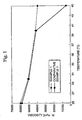
- Fig. 1 is a graph showing the viscosity of a cream versus temperature.
- the emulsifier of the present invention requires a combination of polyglycerol fatty acid ester having an HLB value of 13 or more, and polyglycerol fatty acid ester having an HLB value of 5 to 11, and is used after adjusting the HLB to match the emulsified oil.
- an emulsion is produced if the overall HLB of the system is within the specified range.
- an emulsion having favorable emulsification stability or hardness stability over a wide range of temperatures cannot be obtained.
- an emulsion can also not be obtained that has favorable particle diameter and transparency, and emulsification stability with the passage of timewith the passage of time.
- the highly hydrophilic polyglycerol fatty acid ester used in the present invention is required to have an HLB value of 13 or more, and preferably within the range of 13 to 17. If the HLB value is lower than 13, it becomes difficult to adjust the HLB value due to difficulty in phase inversion emulsification, thereby making it difficult to produce a satisfactory emulsion, In addition, a fine emulsion can also not be produced, and emulsification stability and hardness stability at temperatures higher than 40°C are unable to be obtained.
- the composite polyglycerol is required to have an average degree of polymerization of 8 to 12, and preferably 10 to 12.
- the average degree of polymerization is lower than 8, it becomes difficult to adjust the HLB value due to the low level of hydrophilic properties.
- Polyglycerol having an HLB value larger than 12 are unable to produce a satisfactory emulsion, and since various problems occur such as poor fineness, difficulty in generating hardness, large average particle diameter and poor high-temperature stability, such a polyglycerol is not suitable for the present invention.
- the total content of pentamer and hexamer be 50% by weight or more, and preferably 70% by weight or more. If the total content is less than 50% by weight, emulsification stability and maintenance of hardness at high temperatures become poor, pH decreases and other problems occur.
- the content of tetramer and lower polymers is required to be less than 20% by weight, and preferably 10% by weight or less.
- a satisfactory emulsion can be produced having emulsification stability and hardness stability over a wide temperature range.
- the polyglycerol when obtaining polyglycerol having for its main component pentamer and hexamer glycerol compounds, the polyglycerol typically contains 0% to 30% by weight of heptamer and higher polymers as auxiliary components, and there presence to a certain extent does not present a problem in the present invention as well.
- glycerol compounds in the form of heptamers or larger polymers are contained as the main component, a satisfactory emulsion is not produced, satisfactory fineness, hardness, high-temperature stability and emulsification stability are not obtained, the pH decreases and other problems occur, thereby making such glycerol compounds unsuitable for the present invention.
- the fatty acid residue that composes the polyglycerol fatty acid ester is required to be a linear alkyl group having 14 to 22 carbon atoms, and is preferably a linear alkyl group having 16 to 18 carbon atoms.
- a satisfactory emulsion can be produced that has emulsification stability and hardness stability over a wide temperature range.
- Typical examples of such alkyl groups include myristic acid, palmitic acid, stearic acid and behenic acid.
- alkyl groups having less than 14 carbon atoms such as lauric acid and capric acid do not have emulsification stability at temperatures higher than 40°C and exhibit decreases in hardness, they do not comply with the object of the present invention.
- unsaturated fatty acids and branched fatty acids such as oleic acid and isostearic acid inhibit the hardness of the composition and do not have stability at temperatures higher than 40°C, they also do not comply with the object of the present invention.
- the containing of small amounts of other fatty acids for the purpose of finely adjusting functionality does not present a problem provided they do not affect the first object of the present invention.
- esterification since the polyglycerol is obtained by ordinary methods and the HLB value required in the first aspect of the present invention is 13 or more, about 8% to 15% by weight of the hydroxyl groups of the polyglycerol should be esterified.
- the lipophilic polyglycerol fatty acid ester used in the first aspect of the present invention is required to have an HLB value of 5 to 11, and preferably 8 to 11. If the HLB value is outside this range, phase inversion emulsification becomes difficult, and it becomes difficult to form a satisfactory emulsion. In addition, a fine emulsion is not formed, and emulsification stability and hardness stability are unable to be obtained at high temperatures above 40°C.
- the average degree of polymerization of the polyglycerol that composes the polyglycerol fatty acid ester is 2 to 12, preferably 4 to 12, and more preferably 6 to 12.
- the total content of tetramer and lower polymers is 20% by weight or more.
- each of (2/3)n components being contained in an amount of at least 5% by weight or more, (when (2/3)n is not a natural number, (2/3)n is considered to be a lowest natural number greater than (2/3)n), each of at least (1/3)n components being contained preferably in an amount of at least 10% by weight or more, (when (1/3)n is not a natural number, (1/3)n is considered to be a lowest natural number greater than (1/3)n), each of at least (1/2)n components being contained in an amount of at least 8% by weight or more, (when (1/2)n is not a natural number, (1/2)n is considered to be a lowest natural number greater than (1/2)n), and each of (n-1) components being contained in an amount of at least 3% by weight or more.
- each of the largest degree of polymerization components being contained in an amount of 50% by weight or less, and preferably 30% by weight or less.
- a method in which the product is obtained by a dehydration condensation reaction or a method that uses glycidol, epichlorohydrin, monochlorohydrin, dichlorohydrin, or so forth as a starting material is suitable, but the reaction method is not limited to this.
- products having a low degree of polymerization are intentionally reduced according to the reaction conditions and the use of a multistage reaction in the case of these reaction methods, thereby resulting in the production of polyglycerol having a narrow distribution of the degree of polymerization, such polyglycerol is not suitable.
- the fatty acid residue that composes the polyglycerol fatty acid ester is required to be a linear alkyl group having 14 to 22 carbon atoms, and preferably a linear alkyl group having 16 to 18 carbon atoms.
- Typical examples of such alkyl groups include myristic acid, palmitic acid, stearic acid, arachidic acid, and behenic acid.
- Alkyl groups having less than 14 carbon atoms such as lauric acid and capric acid do not comply with the first object of the present invention since they do not have emulsification stability at high temperatures above 40°C and exhibit decreases in hardness.
- unsaturated fatty acids and branched fatty acids such as oleic acid and isostearic acid do not generate hardness and do not have stability at temperatures higher than 40°C, thereby preventing them from comply with the first object of the present invention.
- These fatty acids may be contained in small amounts provided they do not have an effect on the first object of the present invention.
- the polyglycerol is obtained by ordinary methods and the HLB value required in the first aspect of the present invention is 5 to 11, it is appropriate that about 15% to 70% by weight of the hydroxyl groups of the polyglycerol be esterified.
- the ratio between polyglycerol fatty acid ester having an HLB value of 13 or more and polyglycerol fatty acid ester having an HLB value of 5 to 11 is preferably 20:1 to 1:4, and particularly preferably 10:1 to 1:2.
- the total blended amount polyglycerol fatty acid ester in the form of hydrophilic surfactant (A) in the cosmetic emulsion preparation and agent for external use of the first aspect of the present invention having an HLB value of 13 or more, an average degree of polymerization of the polyglycerol of 8 to 12, a total content of pentamer and hexamer of 50% by weight or more, a total content of tetramer and lower polymers of less than 20% by weight, and a fatty acid residue in the form of a linear alkyl group having 14 to 22 carbon atoms, and polyglycerol fatty acid ester in the form of lipophilic surfactant (B), having an HLB value of 5 to 11, an average degree of polymerization of the polyg
- saturated linear alcohols having 16 to 22 carbon atoms used in the first aspect of the present invention include cetanol, stearyl alcohol, cetostearyl alcohol, and behenyl alcohol.
- linear monoalkyl glyceryl ethers include monocetyl glyceryl ether (chimyl alcohol), monostearyl glyceryl ether (batyl alcohol), and monobehenyl glyceryl ether, and these may either be used alone or as a mixture. If the number of carbon atoms is less than 16, the effect of generating hardness diminishes and hardness also decreases due to the absence of emulsification stability at high. temperatures above 40°C.
- the blended amount of (C) saturated linear alcohol having 16 to 22 carbon atoms and/or linear monoalkyl glyceryl ether having 16 to 22 carbon atoms in the cosmetic emulsion preparation and agent for external use of the first aspect of the present invention is preferably 0.1% to 5% by weight, and particularly preferably 0.2% to 4% by weight.
- the cosmetic emulsion preparation and agent for external use of the first aspect of the present invention may be blended with an oily ingredient, and any oily ingredient may be used provided it is ordinarily used in a cosmetic emulsion preparation and agent for external use.
- oily agents include naturally-occurring animal and plant oils, semi-synthetic oil, hydrocarbon oils, higher fatty acids, ester oils, silicone oils, plant, animal or synthetic purified oil components, and oil-soluble vitamins.
- Naturally-occurring animal and plant oils as well as semi-synthetic oils include avocado oil, linseed oil, almond oil, olive oil, carnauba wax, candelilla wax, beef tallow, beef leg tallow, beef bone tallow, hardened beef tallow, wheat germ oil, sesame oil, rice germ oil, rice bran oil, safflower oil, soybean oil, camellia oil, evening primrose oil, corn oil, rapeseed oil, horse tallow, palm oil, palm kernel oil, castor oil, hardened castor oil, sunflower oil, jojoba oil, macadamia nut oil, beeswax, mink oil, cottonseed oil, coconut oil, hardened coconut oil, peanut oil, lanolin, liquid lanolin, reduced lanolin, and lanolin isopropyl fatty acid.
- hydrocarbons examples include squalane, squalene, ceresin, paraffin, paraffin wax, liquid paraffin, microcrystalline wax, and Vaseline.
- higher fatty acids examples include lauric acid, myristic acid, palmitic acid, stearic acid, behenic acid, undecylenic acid, oleic acid, linoleic acid, linolenic acid, isostearic acid, and 12-hydroxystearic acid.
- ester oils include diisobutyl adipate, 2-hexyldecyl adipate, di-2-heptylundecyl adipate, isostearyl isostearate, trimethylolpropane triisostearate, cetyl 2-ethylhexanoate, neopentyl glycol di-2-ethylhexanoate, trimethylol propane tri-2-ethylhexanoate, pentaerythritol tetra-2-ethylhexanoate, cetyl octanoate, oleyl oleate, octyldodecyl oleate, decyl oleate, neopentyl glycol dicaprate, 2-ethylhexyl succinate, isocetyl stearate, butyl stearate, diisopropyl sebacate, cetyl lactate,
- glyceride oils include glyceryl triisostearate, glyceryl triisopalmitate, glyceryl tri-2-ethylhexanoate, glyceryl trimyristate, and glyceryl diparamethoxycinnamate monoisooctylate.
- silicone oils examples include dimethylpolysiloxane, methylphenylpolysiloxane, methylhydrogenpolysiloxane, octamethylcyclopentasiloxane, dodecamethylcyclohexasiloxane, higher alkoxy-modified silicones such as stearoxysilicone, alkyl-modified silicones, and higher fatty acid ester-modified silicones.
- fat-soluble vitamins examples include tocopherol and its derivatives, and retinal and its derivatives.
- oily ingredients used in the first aspect of the present invention are not limited to these examples.
- the use of an oily ingredient having for its main component (containing 50% by weight or more) a hydrocarbon oil is particularly preferable.
- an oily component is not essential, it is normally used at 100 times or less the total amount of polyglycerol fatty acid ester.
- emulsification stability and hardness stability at high temperatures above 40°C that is an object of the present invention
- stability is set particularly in the vicinity of 45°C, and emulsification stability and hardness stability at even higher temperatures can be achieved by blending saturated lecithin.
- lecithin saturated lecithin
- the amount of lecithin is not specified to be this blended amount.
- saturated lecithin examples include soybean lecithin and egg yolk lecithin that can normally be obtained in the form of commercially available products and reagents, as well as purified lecithin and fractionated lecithin obtained by the solvent separation, extraction, fractionation, or so forth.
- lecithin having an enhanced degree of saturation as a result of hydrogenation are particularly preferable. They are primarily composed of saturated, linear dialkyloyl phosphatidyl choline having 12 to 22 carbon atoms, dialkyloyl phosphatidyl ethanol amine and dialkyloyl phosphatidyl inositol.
- lyzolecithin can also be used since it exhibits similar effects.
- examples of other substances that exhibit similar effects to lecithin are sterol esters.
- the constituent components of sterol esters are divided into sterols and fatty acid.
- examples of sterols include cholesterol and phytosterol, while examples of esters include esters of oleic acid, palmitoleic acid, ricinolic acid, stearic acid, palmitic acid, myristic acid, lauric acid, and 12-hydroxystearic acid, and there are no restrictions on their sources.
- the cosmetic emulsion preparation and agent for external use of the first aspect of the present invention can be blended with known ingredients used in those fields within a range that does not impair the characteristics of the present invention.
- substances that can be blended include aqueous ingredients such as disodium edetate; powdered ingredients such as talc, silica, kaolin, and magnesium oxide; moisturizing ingredients such as sorbitol, propylene glycol, lactic acid, and polyethylene glycol: thickeners such as carboxyvinyl polymer, carboxymethyl cellulose, polyvinyl alcohol, and carageenan; pH adjusters such as lactic acid-sodium lactate, and citric acid-sodium citrate; antioxidants such as butylhydroxytoluene and sodium hydrogen sulfite; antiseptics such as methylparaben and sodium benzoate; and ultraviolet protectants such as paraaminobenzoic acid and octylcinnamate.
- aqueous ingredients such as disodium
- the cosmetic emulsion preparation and agent for external use of the first aspect of the present invention can be produced by, for example, mixing, stirring, and dissolving the aforementioned components (A), (B), and (C), and an oily ingredient as necessary, followed by mixing therein water or other ingredients as necessary to carry out phase inversion emulsification.
- the temperature during phase inversion emulsification is preferably 40 to 90°C, and particularly preferably 50 to 80°C.
- the fatty acid residue that composes the polyglycerol fatty acid ester in the second aspect of the present invention is a hydrocarbon group having 14 to 22 carbon atoms, and examples of this hydrocarbon group include a linear alkyl group, branched alkyl group and alkenyl group. Typical examples of these hydrocarbon groups include myristic acid, palmitic acid, stearic acid, behenic acid, palmitoleic acid, oleic acid, isopalmitic acid, and isostearic acid. Since hydrocarbon groups having less than 14 carbon atoms such as lauric acid and capric acid have poor emulsification stability and end up clouding with the passage of time, they do not comply with the second object of the present invention. The containing of other fatty acids for the purpose of finely adjusting functionality does not present a problem provided they do not affect the second object of the present invention.
- the lipophilic polyglycerol fatty acid ester used in the present invention is required to have an HLB value of 5 to 11, and preferably 8 to 11. If the HLB value is outside this range, emulsification stability becomes poor and it ends up clouding with the passage of time.
- the fatty acid residue that composes the polyglycerol fatty acid ester is a hydrocarbon group having 14 to 22 carbon atoms, and preferable examples of such hydrocarbon groups include linear alkyl groups, branched alkyl groups and alkenyl groups. Specific examples of such hydrocarbon groups include myristic acid, palmitic acid, stearic acid, behenic acid, palmitoleic acid, oleic acid, isopalmitic acid, and isostearic acid.
- hydrocarbon groups having less than 14 carbon atoms such as capric acid and lauric acid exhibit decreases in permeability with the passage of time or have poor emulsification stability due to the particle diameter of the emulsion being unable to be made small, they do not comply with the second object of the present invention.
- Other fatty acids may be contained provided they do not affect the second object of the present invention.
- the weight ratio of polyglycerol fatty acid ester having an HLB value of 13 or more and polyglycerol fatty acid ester having an HLB value of 5 to 10 is preferably 20:1 to 1:4, and particularly preferably 10:1 to 1:2.
- the total blended amount polyglycerol fatty acid ester in the form of hydrophilic surfactant (D) in the cosmetic emulsion preparation and agent for external use of the second aspect of the present invention having an HLB value of 13 or more, an average degree of polymerization of the polyglycerol of 8 to 12, a total content of pentamer and hexamer of 50% by weight or more, a total content of tetramer and lower polymers of less than 20% by weight, and a fatty acid residue in the form of a hydrocarbon group having 14 to 22 carbon atoms, and polyglycerol fatty acid ester in the form of lipophilic surfactant (E), having an HLB value of 5-11, an average degree of polymerization of the polyglycerol of 2 to 12, a total content of tetramer and lower polymers of 20% by weight or more, each of (2/3)n components being contained in an amount of at least 5% by weight or more, where n (n is 2 or more) is taken to be an average
- soybean lecithin and egg yolk lecithin that can normally be obtained in the form of commercially available products and reagents, as well as purified lecithin and fractionated lecithin obtained by the solvent separation, extraction, fractionation, or so forth, are used for the lecithin (component (F)).
- lecithin having an enhanced degree of saturation as a result of hydrogenation is suitable.
- Lecithin is particularly preferable in which the phosphatidyl choline concentration in the phospholipid component is 50% by weight or more, and particularly that in which the alkyloyl phosphatidyl choline concentration is 50% by weight or more, and the phosphatidyl inositol concentration is 3% or less, and particularly that in which the alkyloyl phosphatidyl inositol concentration is below the detection limit, on the basis of the phosphorous content as determined by thin layer chromatography (TLC).
- TLC thin layer chromatography
- these can generally be obtained by treatment consisting of alcohol extraction and column fractionation, they may be obtained by other methods as well.
- those obtained by chemical synthesis can also be used, when considering in terms of cost, those extracted from natural substances are suitable.
- lyzolecithin obtained by enzyme conversion and chemical synthesis is also within this range.
- the ratio of lecithin and polyglycerol fatty acid ester is preferably 1:20 to 4:1, and particularly preferably 1:15 to 3:1.
- the content of lecithin in the transparent cosmetic emulsion preparation and agent for external use of the second aspect of the present invention is preferably 0.1% to 10% by weight, and particularly preferably 0.2% to 8% by weight.
- An oily ingredient (G) is used in the transparent cosmetic emulsion preparation and agent for external use of the second aspect of the present invention.
- any oily ingredient may be used provided it is typically used in cosmetics and agents for external use, an oily ingredient that is a liquid or paste at normal temperatures is particularly suitable.
- the oily ingredient of the second aspect of the present invention is that which is obtained by removing the naturally-occurring animal or plant oils and semi-synthetic oils such as carnauba wax, candelilla wax, beef leg tallow, beef bone tallow, hardened beef tallow, hardened castor oil, beeswax, or hardened coconut oil; hydrocarbon oils such as ceresin, paraffin, paraffin wax, microcrystalline wax, and long-chained fatty acid esters from the oily ingredient of the first aspect of the present invention followed by the addition of hydrocarbon oil in the form of olefin oligomer.
- oils and semi-synthetic oils such as carnauba wax, candelilla wax, beef leg tallow, beef bone tallow, hardened beef tallow, hardened castor oil, beeswax, or hardened coconut oil
- hydrocarbon oils such as ceresin, paraffin, paraffin wax, microcrystalline wax, and long-chained fatty acid esters from the oil
- the weight ratio of the total amount of polyglycerol fatty acid ester and lecithin to the amount of oily component is preferably 100:1 to 1:2, and in the absence of the oily component, emulsification stability and pH stability are impaired.
- the blended amount of oily ingredient is preferably 0.01% to 10% by weight.
- Oily ingredients that are particularly effective in stabilizing emulsification are those in which the fatty acid residue is a sterol ester having 14 to 22 carbon atoms, and is preferably contained in the oily ingredient.
- the constituent components of sterol esters are as indicated in the first aspect of the present invention.
- pH stability with the passage of time is correlated with emulsification stability, and in cases in which emulsification stability is satisfactory, pH is resistant to decreases, while in the case of poor emulsification stability, pH tends to decrease.
- substrate of a hydrolysis reaction is presumed to become increasing resistant to attack at an ester site for reasons such as an increase in interface density or the interface becoming rigid.
- the transparent cosmetic emulsion preparation and agent for external use of the second aspect of the present invention is required to have an average particle diameter of the emulsion of 100 nm or less, and preferably 80 nm or less. If the average particle diameter is 100 nm or less, a transparent cosmetic emulsion preparation and agent for external use are obtained having superior emulsification stability and pH stability without a decrease in transparency or separation with the passage of time.
- An emulsion having such an average particle diameter can be obtained by adjusting the ratio of hydrophilic polyglycerol fatty acid ester, lipophilic polyglycerol fatty acid ester, and lecithin according to the vicinity of the required HLB of the oily ingredient.
- the transparent cosmetic referred to here indicates that having transmittance of 50% T or more, and preferably 70% T or more, using purified water as a control and measuring with a spectrophotometer when the measurement wavelength is 750 nm and the measurement light path is 10 mm.
- the transparent cosmetic emulsion preparation and agent for external use of the second aspect of the present invention can be produced by, for example, mixing, stirring and emulsifying the aforementioned components (D), (E), (F), and (G), followed by mixing, stirring and emulsifying therein water or other ingredients as necessary.
- the temperature at this time is preferably 40 to 90°C, and particularly preferably 50 to 80°C.
- the average particle diameter can be made to be 100 nm or less by suitably selecting the stirring conditions and so forth at this time, or suitably adjusting the HLB values of both polyglycerol fatty acid esters.
- the transparent cosmetic emulsion preparation and agent for external use of the second aspect of the present invention can also be applied to products not containing an antiseptic as an added ingredient from the perspective of safety.
- the transparent cosmetic emulsion preparation and agent for external use of the second aspect of the present invention can also be applied to products not containing an antiseptic as an added ingredient from the perspective of safety.
- the transparent cosmetic emulsion preparation and agent for external use of the second aspect of the present invention can also be applied to products not containing an antiseptic as an added ingredient from the perspective of safety.
- containing one or a combination of two or more of either of 1,3-butylene glycol, 3-methyl-1,3-butylene glycol, 1,2-pentanediol, propylene glycol, or 1,2-hexanediol or in the case of preparing with an ethylene oxide-based surfactant, even if a transparent composition is obtained by a fine emulsion, when they are blended at a high concentration of, for example, 15% to 25%
- the form of the cosmetic emulsion preparation and agent for external use of the present invention may be in any arbitrary form such as a cream, moisturizer, essence, ointment, gel, lotion, or pack.
- the cosmetic emulsion preparation and agent for external use of the present invention can be used according to the ordinary methods of use of each form.
- the cosmetic emulsion preparation and agent for external use of the present invention may be blended with known ingredients ordinarily used in those fields provided they are within a range that does not impair the characteristics of the present invention.
- the weight percentages were found to be 0% for free glycerol, 2% for the dimer component, 3% for the trimer component, 5% for the tetramer component, 60% for the pentamer component, 15% for the hexamer component, 5% for the heptamer component, 4% for the octamer component, 3% for the nonamer component, 1% for the decamer component, and 2% for the undecamer and higher polymer component.
- the resulting polyglycerol had an average degree of polymerization of 11, and its composition consisted of 1% free glycerol, 1% dimer component, 2% trimer component, 6% tetramer component, 58% pentamer component, 18% hexamer component, 4% octamer component, 2% nonamer component, 2% decamer component and 3% undecamer and higher polymer component.
- Polyglycerol stearate was obtained by the same process as Synthesis Example 1 with the exception of using the polyglycerol obtained in Production Example 2 instead of the polyglycerol obtained in Production Example 1.
- the acid value of this ester was 1.0.
- the HLB value of the polyglycerol stearate was 13.9.
- Polyglycerol myristate was obtained by the same process as Synthesis Example 1 from 269.5 g of the polyglycerol obtained in Production Example 1 and 80.5 g of myristic acid. The acid value of this ester was 1.0. The HLB value of this polyglycerol myristate was 15.0.
- Polyglycerol oleate was obtained by the same process as Synthesis Example 1 from 261.6 g of the polyglycerol obtained in Production Example 1 and 85.6 g of oleic acid. The acid value of this ester was 1.0. The HLB value of the polyglycerol oleate was 13.0.
- Polyglycerol isostearate was obtained by the same process as Synthesis Example 1 from 210 g of the polyglycerol obtained in Production Example 1 and 90 g of isostearic acid. The acid value of this ester was 1.2. The HLB value of the polyglycerol isostearate was 13.0.
- Polyglycerol laureate was obtained by the same process as Synthesis Example 1 from 210 g of the polyglycerol obtained in Production Example 2 and 52.5 g of lauric acid. The acid value of this ester was 1.0. The HLB value of the polyglycerol laureate was 15.6.
- Polyglycerol stearate was obtained by the same process as Synthesis Example 1 with the exception of using Grade Oil #1000 (Taiyo Kagaku Co., Ltd.) (average degree of polymerization: 10, free glycerin: 8%, dimer component: 20%, trimer component: 20%, tetramer component: 13%, pentamer component: 10%, hexamer component: 7%, heptamer component: 8%, octamer component: 6%, nonamer component: 4%, decamer component: 1%, undecamer and higher polymer component: 3%) instead of the polyglycerol obtained in Production Example 1.
- the HLB value was 12.0.
- Polyglycerol myristate was obtained by the same process as Synthesis Example 3 with the exception of using Grade Oil #1000 (Taiyo Kagaku Co., Ltd.) instead of the polyglycerol obtained in Production Example 1.
- the acid value of this ester was 1.0.
- the HLB value was 14.0.
- Polyglycerol laureate was obtained by the same process as Synthesis Example 1 from 210 g of the polyglycerol obtained in Production Example 2 and 52.5 g of lauric acid. The acid value of this ester was 1.0. The HLB value of thepolyglycerol laureate was 15.6.
- Polyglycerol palmitate was obtained by the same process as Synthesis Example 5 from 175.0 g of Grade Oil #1000 (Taiyo Kagaku, Co., Ltd.) and 175.0 g of palmitic acid. The acid value of this ester was 1.5. The HLB value of the polyglycerol palmitate was 9.5.
- Polyglycerol stearate was obtained by the same process as Synthesis Example 5 from 115.5 g of Grade Oil #600 (Taiyo Kagaku., Co., Ltd.) (average degree of polymerization: 6, free glycerin: 0%, dimer component: 6%, trimer component: 24%, tetramer component: 22%, pentamer component: 15%, hexamer component: 10%, heptamer component: 10%, octamer component: 8%, nonamer component: 5%, decamer component: 0%, undecamer and higher polymer component: 0%) and 234.5 g of stearic acid. The acid value of this ester was 0.5.
- the HLB value of the polyglycerol stearate was 6.0.
- Polyglycerol oleate was obtained by the same process as Synthesis Example 5 from 168.0 g of Grade Oil #1000 (Taiyo Kagaku, Co., Ltd.) and 182.0 g of oleic acid. The acid value of this ester was 1.0. The HLB value of the polyglycerol oleate was 9.2.
- Polyglycerol stearate was obtained by the same process as Synthesis Example 5 with the exception of using the polyglycerol of Production Example 1 instead of Grade Oil #1000 (Taiyo Kagaku, Co., Ltd.).
- the HLB value was 9.5.
- Polyglycerol oleate was obtained by the same process as Synthesis Example 5 from 168.0 g of Grade Oil #1000 (Taiyo Kagaku, Co., Ltd.) and 182.0 g of oleic acid. The acid value of this ester was 1.0. The HLB value of the polyglycerol oleate was 9.2.
- Polyglycerol stearate was obtained by the same process as Synthesis Example 5 from 199.5 g of Grade Oil #1000 (Taiyo Kagaku, Co., Ltd.) and 150.5 g of stearic acid. The acid value of this ester was 1.0. The HLB value of the polyglycerol stearate was 11.6.
- Polyglycerol stearate was obtained by the same process as Synthesis Example 5 from 87.5 g of Grade Oil #1000 (Taiyo Kagaku, Co., Ltd.) and 262.5 g of stearic acid. The acid value of this ester was 1.5. The HLB value of the polyglycerol stearate was 4.0.
- Polyglycerol laureate was obtained by the same process as Synthesis Example 5 from 170.0 g of Grade Oil #1000 (Taiyo Kagaku, Co., Ltd.) and 80.0 g of lauric acid. The acid value of this ester was 1.5. The HLB value of the polyglycerol laureate was 9.5.
- Cosmetic emulsion preparations were prepared according to the blends indicated in Tables 1 and 2. Namely, polyglycerol fatty acid ester, higher alcohol and an oily ingredient were mixed and dissolved while stirring with a homomixer (3000 rpm) at 70°C followed by pouring 70°C water or a mixed solution of water and 1,3-butylene glycol, and other ingredients to carry out phase inversion emulsification. Subsequently, aqueous sodium hydroxide solution was added followed by the addition of "CARBOPOL®” aqueous solution. The emulsion was cooled to 30°C, removed and then allowed to stand undisturbed for 24 hours at 25°C to obtain a cream.
- the blending ratio of hydrophilic polyglycerol fatty acid ester and lipophilic polyglycerol fatty acid ester was selected that resulted in the minimum average particle diameter so as to match the HLB (excluding Comparative Example 7 in which only a hydrophilic polyglycerol fatty acid ester was used, and Comparative Example 11 due to the low HLB value of the hydrophilic polyglycerol fatty acid ester).
- the average particle diameter was measured using the LA-500 Laser Refraction Particle Size Distribution Measuring System (manufactured by Horiba Ltd.).
- Fig. 1 shows a comparison of viscosity at each temperature between the cream of Example 1 and the cream of Comparative Example 1. It can be understood from Fig. 1 that the change in viscosity with respect to temperature of the product of the present invention is low.
- An emollient cream was prepared according to the blend indicated below. Namely, ingredients (1) through (11) were mixed and dissolved while stirring with a homomixer (5000 rpm) at 75°C followed by pouring in a mixed solution of ingredients (12) through (14) at 75°C to carry out phase inversion emulsification. Subsequently, ingredient (15) was added followed by the addition of ingredient (16). The emulsion was then cooled to 30°C, removed and allowed to stand undisturbed for 24 hours at 25°C to obtain a cream.
- the cream was evaluated in compliance with Examples 1 through 8, and the average particle diameter was 0.56 ⁇ m, emulsification stability was ⁇ , change in hardness was ⁇ (viscosity: 70200 mPa ⁇ s at 25°C, 43600 mPa ⁇ s at 45°C), low-temperature stability was o ⁇ (viscosity: 71000 mPa ⁇ s), texture in appearance was o ⁇ , and vanishing during use was o ⁇ .
- An emollient cream was obtained in the same manner as the blend of Example 9 with the exception of replacing ingredient (4) with soybean hydrogenated phospholipid (PC concentration: 60 wt%).
- the cream was evaluated in compliance with Examples 1 through 8, and the average particle diameter was 0.50 ⁇ m, emulsification stability was ⁇ , change in hardness was o ⁇ (viscosity: 74000 mPa ⁇ s at 25°C, 49600 mPa ⁇ s at 50°C), low-temperature stability was o ⁇ (viscosity: 75500 mPa ⁇ s), texture in appearance was o ⁇ , and vanishing during use was o ⁇ .
- a moisturizer was prepared according to the blend shown below. Namely, ingredients (1) through (11) were mixed and dissolved while stirring with a stirrer at 65°C followed by pouring in a mixed solution of ingredients (12) through (14) at 75°C to carry out phase inversion emulsification. Subsequently, ingredient (15) was added followed by the addition of ingredient (16). The emulsion was then cooled to 30°C, removed and allowed to stand undisturbed for 24 hours at 25°C to obtain a moisturizer.
- the moisturizer was evaluated in the same manner, the average particle diameter was 0.68 ⁇ m, emulsification stability was ⁇ , change in hardness was ⁇ (viscosity: 8620 mPa ⁇ s at 25°C, 5400 mPa ⁇ s at 45°C), low-temperature stability was o ⁇ (viscosity: 8880 mPa ⁇ s at 25°C), texture in appearance was o ⁇ , and vanishing during use was o ⁇ .
- a moisturizer was obtained in the same manner as the blend of Example 11 with the exception of replacing ingredient (6) with phytosteryl oleate.
- the moisturizer was evaluated in compliance with Examples 1 through 8, and the average particle diameter was 0.58 ⁇ m, emulsification stability was ⁇ , change in hardness was o ⁇ (viscosity: 9020 mPa ⁇ s at 25°C, 6360 mPa ⁇ s at 45°C), low-temperature stability was o ⁇ (viscosity: 8960 mPa ⁇ s at 25°C), texture in appearance was o ⁇ , and vanishing during use was o ⁇ .
- a UV cream was prepared according to the blend indicated below. Namely, ingredients (1) through (11) were mixed and dissolved while stirring with a homomixer (5000 rpm) at 75°C followed by pouring in a mixed solution of ingredients (12) through (14) at 75°C to carry out phase inversion emulsification. Subsequently, ingredient (15) was added. The emulsion was then cooled to 30°C, removed and allowed to stand undisturbed for 24 hours at 25°C to obtain a cream. Although the cream was evaluated in compliance with Examples 1 through 8, since the viscosity was 100000 mPa ⁇ s or more, a BH viscometer was used.
- the average particle diameter was 0.88 ⁇ m
- emulsification stability was ⁇
- change in hardness was ⁇
- low-temperature stability was o ⁇
- texture in appearance was o ⁇
- vanishing during use was o ⁇ .
- a moisturizer was obtained in the same manner as the blend of Example 11 with the exception of replacing ingredient (2) with Sunsoft Q-183Y (Taiyo Kagaku) (polyglycerol stearic ester, HLB value: 10.2; component polyglycerol has an average degree of polymerization of 10, and is composed of 3% free glycerin, 5% dimer component, 7% trimer component, 8% tetramer component, 9% pentamer component, 10% hexamer component, 12% heptamer component, 21% octamer component, 12% nonamer component, 8% decamer component, and 5% undecamer component).
- the average particle diameter was 0.50 ⁇ m
- emulsification stability was o ⁇
- change in hardness was o ⁇
- low-temperature stability was o ⁇
- texture in appearance was o ⁇
- vanishing during use was o ⁇ .
- Lotions were prepared according to the blends shown in Tables 3 and 4. Namely, polyglycerol fatty acid ester, lecithin and an oily ingredient were mixed and dissolved while stirring with a stirrer at 70°C followed by pouring in a mixed solution of water, 1,3-butylene glycol, and other ingredients at 70°C, and then cooling to 30°C and removing the emulsion to obtain a lotion.
- the blending ratio of hydrophilic polyglycerol fatty acid ester and lipophilic polyglycerol fatty acid ester was selected that resulted in the minimum average particle diameter so as to match the HLB (excluding Comparative Example 18 in which only a hydrophilic polyglycerol fatty acid ester was used, and Comparative Example 19 due to the low HLB value of the hydrophilic polyglycerol fatty acid ester).
- the average particle diameter was measured with the Coulter Counter N-4.
- transmittance was measured with the JASCOV-570 spectrophotometer (JASCO Corporation) using purified water as a control at a measurement wavelength of 750 nm and measurement light path of 10 mm.
- the pH was measured with the F-22 pH Meter (Horiba Ltd.).
- the lotions of Examples 9 through 18 exhibited superior emulsification stability, transmittance stability and pH stability.
- the lotions of Comparative Examples 13 through 25 were inferior to the lotions of Examples 9 through 18 for all parameters. As a result, the effect of the present invention was confirmed.
- An emollient lotion was prepared according to the blend indicated below. Namely, ingredients (1) through (6) were mixed and dissolved with a stirrer at 65°C followed by pouring in ingredients (7) through (9) at 65°C, and then cooling to 30°C and removing the emulsion to obtain a lotion.
- the lotion was evaluated in compliance with Examples 9 through 18, and the average particle diameter was 46.3 nm, the appearance was ⁇ , transmittance stability was o ⁇ (immediately after: 83.6%T, after 1 month: 83.2%T) and pH stability was o ⁇ (immediately after 6.34, after 1 month: 6.25).
- a lotion was obtained in the same manner as Example 11 with the exception of replacing ingredient (4) in the blend of Example 19 with 1,3-butylene glycol, and replacing ingredient (8) with 3-methyl-1,3-butylene glycol.
- the lotion was evaluated in compliance with Examples 9 through 18, and the average particle diameter was 48.3 nm, the appearance was ⁇ , transmittance stability was ⁇ (immediately after: 85.3%T, after 1 month: 83.4%T) and pH stability was o ⁇ (immediately after 6.23, after 1 month: 6.17).
- a lotion was obtained in the same manner as Example 19 with the exception of replacing ingredient (5) in the blend of Example 19 with phytosteryl oleate.
- the lotion was evaluated in compliance with Examples 9 through 18, and the average particle diameter was 40.3 nm, the appearance was ⁇ , transmittance stability was o ⁇ (immediately after: 91.3%T, after 1 month: 91.1 %T) and pH stability was o ⁇ (immediately after 6.26, after 1 month: 6.25).
- a medicinal beauty lotion was prepared according to the blend indicated below. Namely, ingredients (1) through (9) were mixed and dissolved with a stirrer at 65°C followed by pouring in ingredient (10) at 65°C, followed by adding ingredients (11) and (12), cooling to 30°C and removing the emulsion to obtain a beauty lotion.
- the beauty lotion was evaluated in compliance with Examples 9 through 18, and the average particle diameter was 74.3 nm, the appearance was ⁇ , transmittance stability was o ⁇ (immediately after: 81.5%T, after 1 month: 80.7%T) and pH stability was o ⁇ (immediately after 6.13, after 1 month: 6.00).
- a lotion was obtained in the same manner as Example 17 with the exception of using 1.8 g of component (1) in the blend of Example 17 and replacing component (2) in the blend of Example 17 with 0.6 g of Sunsoft Q-183Y (Taiyo Kagaku, Co., Ltd.) (polyglycerol stearic ester, HLB value: 10.2; component polyglycerol has an average degree of polymerization of 10, and is composed of 3% free glycerin, 5% dimer component, 7% trimer component, 8% tetramer component, 9% pentamer component, 10% hexamer component, 12% heptamer component, 21% octamer component, 12% nonamer component, 8% decamer component, and 5% undecamer and higher polymer component).
- the average particle diameter was 40.1 nm, the appearance was ⁇ , transmittance stability was o ⁇ (immediately after: 88.3%T, after 1 month: 88.1%T) and pH stability was o ⁇ (immediately after 6.23, after 1 month: 6.17).
- the present invention is a cosmetic emulsion preparation and agent for external use having for its emulsification base a polyglycerol fatty acid ester, and can be used in the fields of cosmetics, quasi-drugs, drugs, household articles, and so forth.
- the present invention provides a cosmetic emulsion preparation and agent for external use that remain stable even when stored with the passage of time without exhibiting a remarkable decrease in hardness at high temperatures of 40°C or higher, do not eliminate water and remain stable without increasing in hardness with the passage of time at 0°C, and have satisfactory texture in appearance while vanishing smoothly without leaving behind any white residue on the skin when used.
- an emulsified composition is obtained even with another emulsification method such as dispersion emulsification, D phase inversion emulsification or liquid crystal emulsification other than phase inversion emulsification. Since similar effects are obtained with these methods as well particularly in cases in which hardness is not required, the application range of the present invention can be said to be extremely broad.
- the present invention provides a transparent cosmetic emulsion preparation and agent for external use having for its emulsification base a polyglycerol fatty acid ester, and can be used in the fields of cosmetics, quasi-drugs, drugs, household articles, and so forth.
- This superior transparent cosmetic emulsion preparation and agent for external use exhibits emulsification stability in a transparent state without clouding or separation by oily ingredients, has pH stability without exhibiting any decreases in pH with the passage of time as is observed in aqueous compositions combining the use of polyglycerol fatty acid ester and lecithin, and is free of precipitation of fatty acid and precipitation of lecithin with the passage of time.
- the transparent cosmetic emulsion preparation and agent for external use of the present invention has an extremely high concentration for the blended amount of oily ingredients in comparison with an ethylene oxide-based fine emulsion, such as a concentration of 3% to 10% by weight within the composition, they remain transparent and stable, and can also be applied to a transparent cosmetic emulsion preparation and agent for external use having a high level of emollient effects similar to moisturizers and creams that cannot be obtained with conventional beauty washes and lotions.
- the present invention can also be applied to products not containing antiseptic as an additive.
- the present invention in the case of containing one or a combination of two or more substances such as 1,3-butylene glycol, 3-methyl-1,3-butylene glycol, 1,2-pentanediol, propylene glycol, or 1,2-hexanediol, or in the case of preparing with an ethylene oxide-based surfactant, even if a transparent composition is obtained by a fine emulsion, when these are blended at a high concentration of, for example, 15% to 25% by weight, there was the problem of clouding with the passage of time.
- a transparent cosmetic emulsion preparation and agent for external use having superior emulsification stability can be obtained even in the case of blending these substances.
Landscapes
- Health & Medical Sciences (AREA)
- Chemical & Material Sciences (AREA)
- Life Sciences & Earth Sciences (AREA)
- Engineering & Computer Science (AREA)
- General Health & Medical Sciences (AREA)
- Public Health (AREA)
- Veterinary Medicine (AREA)
- Animal Behavior & Ethology (AREA)
- Organic Chemistry (AREA)
- Materials Engineering (AREA)
- Bioinformatics & Cheminformatics (AREA)
- Dermatology (AREA)
- Epidemiology (AREA)
- Birds (AREA)
- Medicinal Chemistry (AREA)
- Nanotechnology (AREA)
- Pharmacology & Pharmacy (AREA)
- Molecular Biology (AREA)
- Biotechnology (AREA)
- General Engineering & Computer Science (AREA)
- Medical Informatics (AREA)
- Biophysics (AREA)
- Crystallography & Structural Chemistry (AREA)
- Nuclear Medicine, Radiotherapy & Molecular Imaging (AREA)
- Emergency Medicine (AREA)
- General Chemical & Material Sciences (AREA)
- Chemical Kinetics & Catalysis (AREA)
- Dispersion Chemistry (AREA)
- Toxicology (AREA)
- Cosmetics (AREA)
Applications Claiming Priority (5)
| Application Number | Priority Date | Filing Date | Title |
|---|---|---|---|
| JP2001097440 | 2001-03-29 | ||
| JP2001097441 | 2001-03-29 | ||
| JP2001097441 | 2001-03-29 | ||
| JP2001097440 | 2001-03-29 | ||
| PCT/JP2002/003203 WO2002078650A1 (fr) | 2001-03-29 | 2002-03-29 | Preparation d'emulsion cosmetique et agent pour usage externe |
Publications (2)
| Publication Number | Publication Date |
|---|---|
| EP1380278A1 true EP1380278A1 (fr) | 2004-01-14 |
| EP1380278A4 EP1380278A4 (fr) | 2004-12-15 |
Family
ID=26612634
Family Applications (1)
| Application Number | Title | Priority Date | Filing Date |
|---|---|---|---|
| EP02713266A Withdrawn EP1380278A4 (fr) | 2001-03-29 | 2002-03-29 | Preparation d'emulsion cosmetique et agent pour usage externe |
Country Status (4)
| Country | Link |
|---|---|
| US (1) | US20040115161A1 (fr) |
| EP (1) | EP1380278A4 (fr) |
| JP (1) | JP4350378B2 (fr) |
| WO (1) | WO2002078650A1 (fr) |
Cited By (3)
| Publication number | Priority date | Publication date | Assignee | Title |
|---|---|---|---|---|
| WO2006041011A1 (fr) | 2004-10-12 | 2006-04-20 | Taiyo Kagaku Co., Ltd. | Ester polyglycérique d'acide gras et préparation contenant ledit ester |
| WO2007102125A3 (fr) * | 2006-03-06 | 2008-01-03 | Procter & Gamble | Composition lipophile pour soins personnels |
| EP1702607A4 (fr) * | 2004-01-06 | 2012-07-04 | Shiseido Co Ltd | Composition de microemulsion monophase, formulation externe d'emulsion ultrafine huile dans l'eau et procede de production associe |
Families Citing this family (29)
| Publication number | Priority date | Publication date | Assignee | Title |
|---|---|---|---|---|
| JP4567945B2 (ja) * | 2003-01-17 | 2010-10-27 | 太陽化学株式会社 | ユビデカレノン製剤 |
| US7687066B2 (en) * | 2003-05-09 | 2010-03-30 | The Nisshin Oillio Group, Ltd. | Self emulsifying oily liquid cosmetic |
| JP5255749B2 (ja) * | 2003-09-05 | 2013-08-07 | 阪本薬品工業株式会社 | 化粧品用抱水性油性原料及び化粧品 |
| JP4284147B2 (ja) | 2003-10-10 | 2009-06-24 | 日清オイリオグループ株式会社 | 化粧料原料用紫外線防御製剤及び当該製剤を含有する化粧料の製造方法 |
| JP4397286B2 (ja) * | 2003-11-28 | 2010-01-13 | 日清オイリオグループ株式会社 | 水中油型乳化化粧料及びその製造方法 |
| CN100435773C (zh) * | 2003-11-28 | 2008-11-26 | 日清奥利友集团株式会社 | 水包油型乳化化妆材料及其制造方法 |
| JP4762495B2 (ja) * | 2004-01-06 | 2011-08-31 | 株式会社 資生堂 | O/w超微細エマルション外用剤の製造方法 |
| JP4969773B2 (ja) * | 2004-09-03 | 2012-07-04 | 太陽化学株式会社 | 化粧料用組成物及び化粧料 |
| JP5342102B2 (ja) | 2006-07-04 | 2013-11-13 | 昭和電工株式会社 | エマルション組成物 |
| JP4659810B2 (ja) * | 2007-10-26 | 2011-03-30 | 株式会社ファンケル | 乳化化粧料 |
| JP5475247B2 (ja) * | 2008-03-26 | 2014-04-16 | 株式会社コーセー | 乳化化粧料 |
| JP5642924B2 (ja) * | 2008-07-18 | 2014-12-17 | 御木本製薬株式会社 | 皮膚バリア機能回復促進用水中油型乳化組成物 |
| JP2010184908A (ja) * | 2009-02-13 | 2010-08-26 | Kose Corp | 乳化組成物およびそれを配合する化粧料、並びに皮膚外用剤 |
| JP2010280628A (ja) * | 2009-06-05 | 2010-12-16 | Ajinomoto Co Inc | 乳化製剤 |
| EP2359802B1 (fr) * | 2010-02-12 | 2014-06-18 | Evonik Degussa GmbH | Composition cosmétique contenant un ester partiel de polyglycérol |
| JP2012031125A (ja) * | 2010-08-03 | 2012-02-16 | Nikko Chemical Co Ltd | 紫外線吸収剤を含有する微細エマルション組成物並びに化粧料 |
| WO2012115053A1 (fr) * | 2011-02-21 | 2012-08-30 | 株式会社ナンバースリー | Composition pour les cheveux |
| JP6180817B2 (ja) * | 2013-06-24 | 2017-08-16 | ポーラ化成工業株式会社 | 皮膚外用剤 |
| JP6180816B2 (ja) * | 2013-06-24 | 2017-08-16 | ポーラ化成工業株式会社 | 皮膚外用剤 |
| JP6710019B2 (ja) * | 2014-04-01 | 2020-06-17 | 株式会社ポーラファルマ | 皮膚外用剤の使用性の評価法及び該評価法で使用性に優れると判別される皮膚外用剤 |
| JP6510177B2 (ja) | 2014-04-01 | 2019-05-08 | ロレアル | ナノ又はマイクロエマルションの形態の組成物 |
| JP6537788B2 (ja) * | 2014-06-25 | 2019-07-03 | ロレアル | ナノエマルション若しくはマイクロエマルションの形態の又はラメラ構造を有する組成物 |
| WO2018211847A1 (fr) * | 2017-05-18 | 2018-11-22 | キユーピー株式会社 | Composition auto-émulsifiante ainsi que procédé de fabrication de celle-ci, et nanoémulsion ainsi que procédé de fabrication de celle-ci |
| JP7233896B2 (ja) * | 2018-11-27 | 2023-03-07 | ロレアル | 2種のポリグリセリル脂肪酸エステルを含む組成物 |
| CN110638666B (zh) * | 2019-11-13 | 2022-06-24 | 瑞希(重庆)生物科技有限公司 | 一种w/o/w型多重乳液及其制备方法 |
| JP7181646B2 (ja) * | 2021-02-08 | 2022-12-01 | 株式会社アイテック | 液晶乳化物 |
| GB2625649B (en) * | 2021-07-12 | 2026-04-22 | Ocusoft Inc | Skin Moisturizing Compositions |
| JP7429316B1 (ja) * | 2022-10-28 | 2024-02-07 | 太陽化学株式会社 | ポリグリセリン脂肪酸エステル |
| CN119454482B (zh) * | 2024-11-29 | 2026-03-17 | 广东丸美生物技术股份有限公司 | 一种微囊及其制备方法、微囊化妆品 |
Family Cites Families (7)
| Publication number | Priority date | Publication date | Assignee | Title |
|---|---|---|---|---|
| JPH0816047B2 (ja) * | 1987-08-17 | 1996-02-21 | 株式会社資生堂 | 半透明液状化粧料 |
| JP3487881B2 (ja) * | 1993-09-30 | 2004-01-19 | 太陽化学株式会社 | 界面活性剤 |
| FR2710535B1 (fr) * | 1993-09-30 | 1995-11-24 | Gattefosse Ets Sa | Composition à usage pharmaceutique ou cosmétique apte à former une microémulsion. |
| JPH07132222A (ja) * | 1993-11-10 | 1995-05-23 | Lion Corp | 乳化型組成物 |
| JP2849339B2 (ja) * | 1994-11-02 | 1999-01-20 | ザ、プロクター、エンド、ギャンブル、カンパニー | 化粧料 |
| JP3549598B2 (ja) * | 1994-11-16 | 2004-08-04 | 太陽化学株式会社 | ポリグリセリン脂肪酸エステルの製造方法 |
| JP4048342B2 (ja) * | 1999-04-27 | 2008-02-20 | 三菱化学フーズ株式会社 | W/o型エマルジョン組成物およびその製造方法 |
-
2002
- 2002-03-29 JP JP2002576917A patent/JP4350378B2/ja not_active Expired - Fee Related
- 2002-03-29 US US10/473,309 patent/US20040115161A1/en not_active Abandoned
- 2002-03-29 WO PCT/JP2002/003203 patent/WO2002078650A1/fr not_active Ceased
- 2002-03-29 EP EP02713266A patent/EP1380278A4/fr not_active Withdrawn
Cited By (4)
| Publication number | Priority date | Publication date | Assignee | Title |
|---|---|---|---|---|
| EP1702607A4 (fr) * | 2004-01-06 | 2012-07-04 | Shiseido Co Ltd | Composition de microemulsion monophase, formulation externe d'emulsion ultrafine huile dans l'eau et procede de production associe |
| WO2006041011A1 (fr) | 2004-10-12 | 2006-04-20 | Taiyo Kagaku Co., Ltd. | Ester polyglycérique d'acide gras et préparation contenant ledit ester |
| EP1801096A4 (fr) * | 2004-10-12 | 2009-12-30 | Taiyo Kagaku Kk | Ester polyglycérique d'acide gras et préparation contenant ledit ester |
| WO2007102125A3 (fr) * | 2006-03-06 | 2008-01-03 | Procter & Gamble | Composition lipophile pour soins personnels |
Also Published As
| Publication number | Publication date |
|---|---|
| US20040115161A1 (en) | 2004-06-17 |
| WO2002078650A1 (fr) | 2002-10-10 |
| EP1380278A4 (fr) | 2004-12-15 |
| JP4350378B2 (ja) | 2009-10-21 |
| JPWO2002078650A1 (ja) | 2004-07-15 |
Similar Documents
| Publication | Publication Date | Title |
|---|---|---|
| US20040115161A1 (en) | Cosmetic emulsion preparation and agent for external use | |
| US8501823B2 (en) | Oil-in-water emulsion cosmetic composition and method for producing the same | |
| KR20120060833A (ko) | O/w 유화 조성물의 제조 방법 | |
| CN111568782B (zh) | 一种具有改善皮肤屏障的纳米乳液组合物及其应用 | |
| KR20110107335A (ko) | O/w 미세 에멀젼 외용제의 제조 방법 | |
| KR20150116655A (ko) | 난용성 기능성 성분을 안정화한 화장료 조성물 | |
| KR102080459B1 (ko) | 활성 성분 안정화 및 피부 흡수 촉진을 위한 다중 에멀젼 제형의 화장료 조성물 | |
| JP5614921B2 (ja) | 液晶ラメラ型化粧料用組成物及びそれを含有する化粧料 | |
| KR102381622B1 (ko) | 쌀겨왁스의 안정화 방법 및 고 함량의 쌀겨왁스를 안정화한 나노에멀젼을 함유하는 화장료 조성물 | |
| KR20170123612A (ko) | 나노에멀션 유화용 조성물, 양연속 마이크로에멀션, 화장료 및 그 제조방법 | |
| JP3667046B2 (ja) | 微細エマルション組成物 | |
| JP5833810B2 (ja) | 水中油型乳化化粧料 | |
| JP2009263346A (ja) | カイネチンを含有する乳化型化粧料 | |
| CN101060828B (zh) | 表面活性剂组合物 | |
| US7829106B2 (en) | Cosmetic composition and cosmetic | |
| JP2007254404A (ja) | 水中油型乳化白濁皮膚化粧料 | |
| JP2014162724A (ja) | 油中水型乳化組成物 | |
| JP5410650B2 (ja) | 化粧料用組成物及び化粧料 | |
| JP4817435B2 (ja) | 皮膚外用剤 | |
| KR20230150260A (ko) | 리포솜 조성물 | |
| JP5382974B2 (ja) | 化粧料用組成物及び化粧料 | |
| JP2007014866A (ja) | 水中油型微細乳化組成物の製造方法 | |
| JP2008195689A (ja) | 化粧料製剤及びそれを配合する化粧料 | |
| JPH09151112A (ja) | 微細エマルション組成物 | |
| JP2006045061A (ja) | セラミド類含有組成物、セラミド類含有水性製剤及びこれらを含有する飲食料、化粧料、皮膚外用剤 |
Legal Events
| Date | Code | Title | Description |
|---|---|---|---|
| PUAI | Public reference made under article 153(3) epc to a published international application that has entered the european phase |
Free format text: ORIGINAL CODE: 0009012 |
|
| 17P | Request for examination filed |
Effective date: 20031004 |
|
| AK | Designated contracting states |
Kind code of ref document: A1 Designated state(s): AT BE CH CY DE DK ES FI FR GB GR IE IT LI LU MC NL PT SE TR |
|
| AX | Request for extension of the european patent |
Extension state: AL LT LV MK RO SI |
|
| RAP1 | Party data changed (applicant data changed or rights of an application transferred) |
Owner name: THE NISSHIN OILLIO, LTD. |
|
| A4 | Supplementary search report drawn up and despatched |
Effective date: 20041102 |
|
| RIC1 | Information provided on ipc code assigned before grant |
Ipc: 7A 61K 7/48 B Ipc: 7A 61K 7/00 A |
|
| REG | Reference to a national code |
Ref country code: DE Ref legal event code: 8566 |
|
| RIN1 | Information on inventor provided before grant (corrected) |
Inventor name: UCHIDA, KAZUHITOC/O TAIYO KAGAKU CO., LTD. Inventor name: FUJINO, JINC/O THE NISSHIN OILLIO,LTD. Inventor name: OYAMA, KEIICHIC/O THE NISSHIN OILLIO,LTD. |
|
| RAP1 | Party data changed (applicant data changed or rights of an application transferred) |
Owner name: THE NISSHIN OILLIO GROUP, LTD. |
|
| STAA | Information on the status of an ep patent application or granted ep patent |
Free format text: STATUS: THE APPLICATION IS DEEMED TO BE WITHDRAWN |
|
| 18D | Application deemed to be withdrawn |
Effective date: 20060112 |