EP1380286A1 - Utilisation pour la teinture des fibres kératiniques humaines d'un chromoionophore et/ou un fluoroionophore, compositions et procédés de teinture - Google Patents
Utilisation pour la teinture des fibres kératiniques humaines d'un chromoionophore et/ou un fluoroionophore, compositions et procédés de teinture Download PDFInfo
- Publication number
- EP1380286A1 EP1380286A1 EP03291451A EP03291451A EP1380286A1 EP 1380286 A1 EP1380286 A1 EP 1380286A1 EP 03291451 A EP03291451 A EP 03291451A EP 03291451 A EP03291451 A EP 03291451A EP 1380286 A1 EP1380286 A1 EP 1380286A1
- Authority
- EP
- European Patent Office
- Prior art keywords
- chosen
- composition
- direct dyes
- composition according
- keratin fibers
- Prior art date
- Legal status (The legal status is an assumption and is not a legal conclusion. Google has not performed a legal analysis and makes no representation as to the accuracy of the status listed.)
- Granted
Links
- JKRDDELAKIZJRV-HKOYGPOVSA-N CN(C)c1ccc(/C=N/c(cc2)cc3c2OCCOCCOCCOCCO3)cc1 Chemical compound CN(C)c1ccc(/C=N/c(cc2)cc3c2OCCOCCOCCOCCO3)cc1 JKRDDELAKIZJRV-HKOYGPOVSA-N 0.000 description 1
Classifications
-
- A—HUMAN NECESSITIES
- A61—MEDICAL OR VETERINARY SCIENCE; HYGIENE
- A61K—PREPARATIONS FOR MEDICAL, DENTAL OR TOILETRY PURPOSES
- A61K8/00—Cosmetics or similar toiletry preparations
- A61K8/18—Cosmetics or similar toiletry preparations characterised by the composition
- A61K8/30—Cosmetics or similar toiletry preparations characterised by the composition containing organic compounds
- A61K8/49—Cosmetics or similar toiletry preparations characterised by the composition containing organic compounds containing heterocyclic compounds
- A61K8/4973—Cosmetics or similar toiletry preparations characterised by the composition containing organic compounds containing heterocyclic compounds with oxygen as the only hetero atom
-
- A—HUMAN NECESSITIES
- A61—MEDICAL OR VETERINARY SCIENCE; HYGIENE
- A61K—PREPARATIONS FOR MEDICAL, DENTAL OR TOILETRY PURPOSES
- A61K8/00—Cosmetics or similar toiletry preparations
- A61K8/18—Cosmetics or similar toiletry preparations characterised by the composition
- A61K8/30—Cosmetics or similar toiletry preparations characterised by the composition containing organic compounds
- A61K8/46—Cosmetics or similar toiletry preparations characterised by the composition containing organic compounds containing sulfur
- A61K8/463—Cosmetics or similar toiletry preparations characterised by the composition containing organic compounds containing sulfur containing sulfuric acid derivatives, e.g. sodium lauryl sulfate
-
- A—HUMAN NECESSITIES
- A61—MEDICAL OR VETERINARY SCIENCE; HYGIENE
- A61Q—SPECIFIC USE OF COSMETICS OR SIMILAR TOILETRY PREPARATIONS
- A61Q5/00—Preparations for care of the hair
- A61Q5/10—Preparations for permanently dyeing the hair
-
- A—HUMAN NECESSITIES
- A61—MEDICAL OR VETERINARY SCIENCE; HYGIENE
- A61K—PREPARATIONS FOR MEDICAL, DENTAL OR TOILETRY PURPOSES
- A61K2800/00—Properties of cosmetic compositions or active ingredients thereof or formulation aids used therein and process related aspects
- A61K2800/40—Chemical, physico-chemical or functional or structural properties of particular ingredients
- A61K2800/42—Colour properties
- A61K2800/43—Pigments; Dyes
- A61K2800/434—Luminescent, Fluorescent; Optical brighteners; Photosensitizers
-
- A—HUMAN NECESSITIES
- A61—MEDICAL OR VETERINARY SCIENCE; HYGIENE
- A61K—PREPARATIONS FOR MEDICAL, DENTAL OR TOILETRY PURPOSES
- A61K2800/00—Properties of cosmetic compositions or active ingredients thereof or formulation aids used therein and process related aspects
- A61K2800/40—Chemical, physico-chemical or functional or structural properties of particular ingredients
- A61K2800/57—Compounds covalently linked to a(n inert) carrier molecule, e.g. conjugates, pro-fragrances
Definitions
- the present invention relates to the field of dyeing human keratin fibers such as hair. It concerns more especially the use as a direct dye for dyeing of human keratin fibers of a compound chosen from chromoionophores and fluoroionophores, a composition dye for dyeing human keratin fibers comprising, in an appropriate medium, at least one such compound and at minus a cosmetic adjuvant, as well as dyeing processes said fibers and a multi-compartment device for the dyeing of said fibers.
- couplers or color modifiers the latter being chosen in particular among aromatic metadiamines, meta-aminophenols, metadiphenols and certain heterocyclic compounds such as indole compounds.
- This oxidation coloring process consists in applying to keratin fibers, oxidation bases or a mixture of bases of oxidation and of couplers with an oxidizing agent, for example of hydrogen peroxide, let it sit, then rinse the fibers.
- an oxidizing agent for example of hydrogen peroxide
- the problem posed at the origin of this request is to propose new dye compositions for dyeing human keratin fibers which make it possible to obtain colorings chromatic with homogeneous, tenacious and brilliant reflections, and of which the color can then be changed simply, without adding another dye.
- the plaintiff has discovered that it was possible to achieve this goal by using, in a medium suitable for dyeing human keratin fibers, minus one compound chosen from chromoionophores and fluoroionophores, as direct dye.
- the dye compositions according to the invention allow obtaining a color which can then be modified for a few hours, days, weeks or months.
- the user can therefore choose a color, change it to a second color then choose to return to its original color or keep the second color without these color changes do not cause a consequent alteration of the hair.
- compositions according to the invention make it possible to obtain particularly chromatic colors. They can be used to dye only a few strands or full hair.
- the dyes obtained using the compositions dyes according to the invention are resistant to bad weather, washes and perspiration.
- the chromoionophores and fluoroionophores are sufficiently stable in the presence of agents oxidants and reducers to also allow a lightening of the fiber either by using direct lightening compositions containing either by the use of coloring compositions of oxidation containing them.
- These chromoionophores and fluoroionophores allow to dye keratin fibers according to a very wide range wide of colors, in particular very chromatic, without forgetting the so-called "fundamental" shades like blacks and browns.
- Chromoionophores and fluoroionophores are compounds consist of one or more ionophoric molecules covalently linked to at least one molecule chosen from chromophores and fluorophores, said molecule chosen from chromophores and fluorophores preferably being a direct dye.
- a first object of the present application consists of use as a direct dye, in, or for the manufacture compositions for dyeing human keratin fibers, and in particular hair, of at least one compound chosen from chromoionophores and fluoroionophores, this compound being constituted at least one ionophore molecule covalently linked to at least one molecule chosen from chromophores and fluorophores.
- a second object of the present invention relates to a dye composition for dyeing keratin fibers human, and in particular hair, comprising, in a medium suitable for dyeing keratin fibers, at least one compound chosen from chromoionophores and fluoroionophores, and at least one cosmetic adjuvant other than water.
- adjuvant cosmetic can in particular be chosen from surfactants anionic, cationic, non-ionic, amphoteric or zwitterionic, or mixtures thereof, anionic, cationic polymers, not ionic, amphoteric or zwitterionic, or mixtures thereof, the agents mineral or organic thickeners, and in particular polymers anionic, cationic, nonionic and amphoteric associative, the antioxidants, penetration agents, sequestering agents, perfumes, dispersing agents, conditioning agents such as as for example volatile or non-volatile, modified or unmodified, fatty substances including ceramides and fatty alcohols, preservatives, clouding agents.
- conditioning agent within the meaning of this application means a compound capable of improving the properties keratin fiber cosmetics such as detangling, touching, smoothing, shine and volume.
- a chromophore is a compound that absorbs in the visible, compound is therefore colored.
- these are therefore those which have the property of being likely dyes dye human keratin fibers which are preferably used in the context of this application.
- a fluorophore is a compound which absorbs in the field of ultraviolet and in the visible, this compound is therefore colored.
- these are therefore those which have the property of being likely dyes dye human keratin fibers which are preferably used in the context of this application.
- the molecule chosen from chromophores and fluorophores is a direct dye comprising or not at least one cycloaliphatic, aromatic or heterocyclic cycle.
- the direct dye does not contain more than four cycles condensed.
- dyes direct classics are aromatic molecules or not aromatics chosen from the group formed by direct dyes neutral benzene nitrates, acidic or basic, direct dyes azo neutral, acidic or basic, quinone direct dyes and in particular neutral, acidic or basic anthraquinonics, azine direct dyes, methine direct dyes such as neutral and acidic or basic methines and azomethines, triarylmethane direct dyes, direct dyes indoamines, natural direct dyes such as carotenoids, terpenoids, flavonoids, porphyrins, fluorescein, rhodamine, coumarins.
- Ionophores are molecules capable of complexing ions.
- ionophores can be used to form the compound chosen from chromoionophores and fluoroionophores.
- the molecule (s) ionophores are conventionally chosen from molecules with a structure open such as chelators or podands, macrocycles called ether-crowns or coronands, and macrobicycles called cryptands.
- podands means open structure molecules capable of complexing ions in which the complexing part is a chain comprising heteroatoms. These molecules are for example oligoethers.
- coronand is understood to mean two-dimensional closed structure molecules capable of complexing ions. Generally these are hydrocarbon monocyclic molecules containing heteroatoms. These molecules are for example macrocyclic polyethers comprising the motif: - (CH 2 -CH 2 -Y) n - in which Y is a heteroatom chosen from O, S, N and P and n is an integer greater than 2 and preferably between 4 and 10.
- crown ethers such as 15-crown-5, 18-crown-6
- crown benzo ethers such as benzo-15-crown-5, benzo-18-crown-6, dibenzo-15-crown-5, dibenzo-18-crown-6
- crown monoaza-ethers or diaza-ethers crowns such as aza-15-crown-5, aza-18-crown-6, diaza-15-crown-5, diaza-18-crown-6.
- the crown ethers include the following motif: where n is an integer ranging from zero to 10.
- the monoaza- and diaza-ethers crowns include the following patterns: where n is an integer ranging from zero to 10.
- the term “cryptands” is understood to mean molecules with a three-dimensional closed structure (cages) capable of complexing ions. Generally these are bicyclic hydrocarbon molecules containing heteroatoms. These molecules are for example macrobicyclic polyethers comprising the motif: - (CH 2 -CH 2 -Y) n - in which Y is a heteroatom chosen from O, S, N and P and n is an integer greater than 2 and preferably between 2 and 10.
- Macrobicyclic polyethers have the following general structure:
- the attachment of the ionophoric molecule (s) to the one or more molecules chosen from chromophores and fluorophores is done preferably by one or more simple covalent bonds.
- this fixing can also be done by one or more divalent radicals such as alkylene radicals (for example methylene, ethylene, propylene, butylene) or divalent radicals aromatic or heterocyclic.
- the attachment can be made from one or more atoms of the ionophore molecule (carbon atoms or heteroatoms).
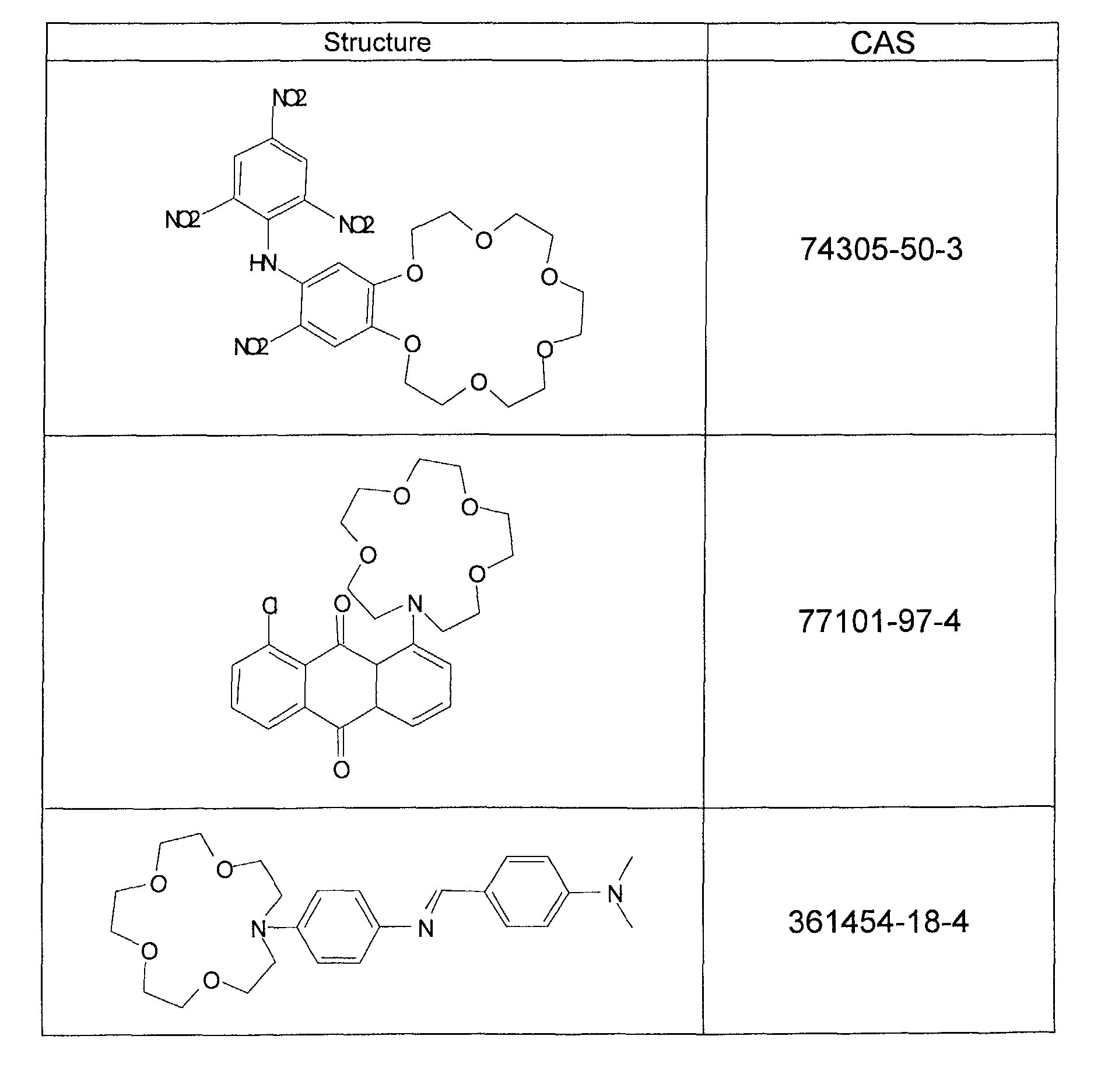
- chromoionophores or fluoroionophores are products known in themselves such as those, for example, listed in the following table:
- the compound or compounds chosen from chromoionophores and fluoroionophores are used in one concentration ranging from about 0.0001 to 20% by weight relative to the total weight of the composition, preferably from 0.0001 to 10% and more particularly from 0.0001 to 5%.
- the dye composition according to the present invention can be used to dye human keratin fibers, and in particular the hair, in a color of the user's choice, who can then be modified by simple addition of an ionic compound which may be in addition to a cosmetic adjuvant.
- ionic compounds can be present in the composition according to the invention or in another composition which is applied directly to the keratin fibers human.
- the ions which can be used according to the present invention can be cations or anions.
- cations are used in the form salts.
- the salts used are physiologically acceptable salts inorganic or organic in nature.
- the metal salts are preferred, even more preferably, these are the inorganic salts of alkali metals, alkaline earth metals, transition metals, of rare earth metals and their alloys.
- the alkali metals can be chosen from lithium (Li), sodium (Na), potassium (K) and cesium (Cs).
- the alkaline earth metals can be chosen from beryllium (Be), magnesium (Mg), calcium (Ca), strontium (Sr) and barium (Ba).
- the transition metals can be chosen from the series of elements ranging from scandium (Sc) to zinc (Zn) as presented in the periodic table of the elements that is to say among the elements following: Sc, Ti, V, Cr, Mn, Fe, Co, Ni, Cu, Zn; in the series going from Yttrium (Y) to cadmium (Cd), that is to say among the elements following: Y, Zr, Nb, Mo, Tc, Ru, Rh, Pd, Ag, Cd; or the series of lanthanum (La), that is to say among the following elements: La, Hf, Ta, W, Re, Os, Ir, Pt, Au.
- the preferred heavy metal salts are the salts physiologically acceptable zinc, lead, calcium, copper, manganese, iron, cobalt, nickel, tin, silver or magnesium, in the form of salts of chlorides, sulfates, nitrates or acetates.
- Rare earth metals can be chosen from the series elements of the lanthanide type, from cerium (Ce) to lutetium (Lu) that is to say among the following elements: Ce, Pr, Nd, Pm, Sm, Eu, Gd, Tb, Dy, Ho, Er, Tm, Yb, Lu.
- the salts nitrate, sulfate, carbonate, halide type correspondents, bromate, phosphate, sulfonate, acetate, chloride.
- ammonium salts such as that benzyltrimethylammonium, isobutylammonium, butyltrimethylammonium, decyltrimethylammonium, diethylammonium, dimethylammonium, dipropylammonium, dodecylammonium, dodecyltrimethylammonium, ethanolammonium, ethyl ammonium, ethyltrimethylammonium, diammonium salts.
- the ionic compound (s) are preferably present at a concentration by weight ranging from 0.001 to 25%, preferably from 0.01 to 10% and more particularly from 0.1 to 5% relative to the total weight of the composition.
- composition according to the present invention can also include at least one additional direct dye.
- This additional direct dye can be chosen from neutral, acid or cationic benzene nitrates direct dyes, neutral azo acid or cationic direct dyes, the dyes direct quinonics and in particular neutral, acidic anthraquinonics or cationic, azine direct dyes, direct dyes methinics, triarylmethane direct dyes, dyes direct indoamines and natural direct dyes.
- the additional direct dye (s) represent preferably from 0.001 to 20% by weight approximately of the total weight of the composition and even more preferably from 0.005 to 10% by weight about.
- the composition of the invention may further comprise a oxidizing agent.
- This oxidizing agent can be any agent oxidant conventionally used for bleaching fibers keratin.
- the oxidizing agent is preferably chosen from hydrogen peroxide, urea peroxide, metal bromates alkalies, persalts such as perborates and persulfates, peracids and the enzymes among which mention may be made of peroxidases, 2-electron oxy-reductases such as uricases and 4-electron oxygenases such as laccases.
- the use of hydrogen peroxide is particularly preferred.
- composition according to the invention may further comprise at minus an oxidation base.
- This oxidation base can be chosen among the oxidation bases conventionally used in dyeing oxidation, for example, para-phenylenediamines, bis-phenylalkylenediamines, para-aminophenols, orthoaminophenols and heterocyclic bases.
- the oxidation base (s) are present in an amount preferably ranging from 0.001 to 10% by weight approximately of the total weight of the dye composition, and more preferably from 0.005 to 6%.
- composition according to the invention can also contain one or more several couplers conventionally used for dyeing keratin fibers.
- couplers conventionally used for dyeing keratin fibers.
- couplers mention may in particular be made of: metaphenylenediamines, meta-aminophenols, metadiphenols, naphthalene couplers and heterocyclic couplers.
- the one or more couplers are generally present in an amount ranging from 0.001 to About 10% by weight of the total weight of the dye composition and more preferably from 0.005 to 6%.
- addition salts with an acid usable in the context of the dye compositions of the invention for the oxidation bases and the couplers are chosen in particular among hydrochlorides, hydrobromides, sulfates, citrates, succinates, tartrates, lactates, tosylates, benzene sulfonates, phosphates and acetates.
- the medium suitable for dyeing also called dye support, generally consists of water or of a mixture of water and at least one organic solvent. Mention may be made, as organic solvent, of lower C 1 -C 4 alcohols, such as ethanol and isopropanol; polyols and polyol ethers such as 2-butoxyethanol, propylene glycol, propylene glycol monoethyl ether, monoethyl ether and diethylene glycol monomethyl ether, as well as aromatic alcohols such as benzyl alcohol or phenoxyethanol, and mixtures thereof.
- organic solvent of lower C 1 -C 4 alcohols, such as ethanol and isopropanol; polyols and polyol ethers such as 2-butoxyethanol, propylene glycol, propylene glycol monoethyl ether, monoethyl ether and diethylene glycol monomethyl ether, as well as aromatic alcohols such as benzyl alcohol or phenoxyethanol, and mixtures thereof.
- Organic solvents can be present in proportions preferably between 1 and 40% by weight approximately relative to the total weight of the dye composition, and even more preferably between 5 and 30% by weight approximately.
- the adjuvants mentioned above are generally present in a quantity ranging for each of them from 0.01 to 20% by weight relative to the weight of composition.
- the pH of the dye composition according to the invention is generally between 3 and 12 approximately, and preferably between 5 and 11. It can be adjusted to the desired value using acidifying agents or basifying agents usually used in fiber dyeing keratinous or even using conventional buffer systems.
- the mineral or organic acids like hydrochloric acid, acid orthophosphoric, sulfuric acid, carboxylic acids like acetic acid, tartaric acid, citric acid, lactic acid, sulfonic acids.
- basifying agents there may be mentioned, by way of example, ammonia, alkali carbonates, alkanolamines such as mono-, di- and triethanolamines as well as their derivatives, sodium or potassium hydroxides and compounds of formula (III) below: in which W is a propylene residue optionally substituted by a hydroxyl group or a C 1 -C 4 alkyl radical, Ra, Rb, Rc and Rd, identical or different, represent a hydrogen atom, a C 1 alkyl radical - C 4 or C 1 -C 4 hydroxyalkyl.
- the dye composition may be in forms various, such as liquids, creams, gels, or any other suitable form for dyeing the fibers keratin, and in particular human hair.
- a third object of the present invention consists of a process for dyeing human keratin fibers, and in particular hair, which comprises applying a composition comprising at least one compound chosen from chromoionophores and fluoroionophores, on human keratin fibers during a sufficient time to develop the desired color. The fibers are then rinsed and dried.
- said composition can further comprise a cosmetic adjuvant different from water which can in particular be chosen from anionic, cationic, nonionic surfactants, amphoteric, zwitterionic or mixtures thereof, anionic, cationic, nonionic, amphoteric or zwitterionics or their mixtures, mineral thickeners or organic, and in particular anionic associative polymers, cationic, nonionic and amphoteric, antioxidants, penetrating agents, sequestering agents, perfumes, agents dispersants, conditioning agents such as for example modified or non-modified volatile or non-volatile silicones, the fatty substances including ceramides and fatty alcohols, agents preservatives, clouding agents.
- a cosmetic adjuvant different from water which can in particular be chosen from anionic, cationic, nonionic surfactants, amphoteric, zwitterionic or mixtures thereof, anionic, cationic, nonionic, amphoteric or zwitterionics or their mixtures, mineral thick
- a variant of the invention consists in including at least one ionic compound in the composition comprising the compound (s) chromoionophores or fluoroionophores.
- Said ionic compounds can then be present in a composition comprising the chromoionophores or fluoroionophores, and which is stored before use; they can also be present in a second composition that we add, when use with that comprising the chromoionophores or fluoroionophores.
- a fourth object of the present invention consists of a process for dyeing human keratin fibers, in several stages, one of these stages comprising the application of a composition comprising at least one chromoionophore or fluoroionophore compound as described above, said step being preceded or followed by the application of at least one composition comprising at least minus an ionic compound.
- the application of the two compositions can be separated by a intermediate rinse.
- the composition containing the compound (s) ionic will be added to human keratin fibers after the application of the compound chosen from chromoionophores and fluoroionophores on these fibers.
- the user can modulate its initial color more or less significantly by gradually adding ions.
- Each application lasts from 5 minutes to 1 hour, from preferably 10 to 30 minutes.
- the ionic compound (s) are present in the dye compositions of the invention in a concentration ranging from approximately 0.001 to 25% by weight and preferably from approximately 0.01 to 10%, and more preferably still from 0.1 to 5% relative to the weight total of the composition.
- composition according to the invention is generally applied to a temperature between room temperature and 80 ° C, preferably between 25 ° C and 55 ° C.
- the invention also relates to a direct dyeing process lightening which includes the application to the fibers of a composition containing a compound chosen from chromoionophores and fluoroionophores in the presence of an oxidizing agent, which causes discoloration of the fiber.
- This oxidizing agent can be added to the composition containing the compound chosen from chromoionophores and fluoroionophore at the time of use or directly on the keratin fiber.
- the invention also relates to a dyeing process oxidation which includes applying to the fibers a dye composition which comprises a compound chosen from chromoionophores and fluoroionophores, at least one base oxidation and optionally at least one coupler, in the presence of a oxidizing agent.
- a dye composition which comprises a compound chosen from chromoionophores and fluoroionophores, at least one base oxidation and optionally at least one coupler, in the presence of a oxidizing agent.
- the oxidation base, the coupler and the oxidizing agent are as defined above.
- the color can then be revealed at acidic, neutral or alkaline pH and the oxidizing agent can be added to the composition of the invention just at the time of use or it can be implemented from a oxidizing composition containing it, applied to the fibers simultaneously or sequentially to the dye composition.
- the dye composition is mixed, preferably at the time of use, to a composition containing, in a medium suitable for dyeing, at least one oxidizing agent, this oxidizing agent being present in an amount sufficient to develop a coloring.
- the mixture obtained is then applied to the fibers keratin. After a pause time of approximately 3 to 50 minutes, preferably 5 to 30 minutes approximately, the keratin fibers are rinsed, washed with shampoo, rinsed again and then dried.
- the oxidizing composition may also contain various adjuvants conventionally used in dye compositions hair oxidation.
- the pH of the oxidizing composition containing the oxidizing agent is such that after mixing with the dye composition, the pH of the resulting composition applied to keratin fibers varies from preferably between 3 and 12 approximately, and even more preferably between 5 and 11. It can be adjusted to the desired value using acidifying or basifying agents usually used in dyeing keratin fibers and as defined above.
- composition which is finally applied to the fibers keratin may be in various forms, such as form of liquids, creams, gels or any other suitable form for dyeing keratin fibers, and in particular human hair. It can also be conditioned under pressure in aerosol can in the presence of a propellant and form a foam.
- the application of the composition comprising at least minus one compound chosen from chromoionophores and fluoroionophores, can be preceded or followed by the application of a composition comprising at least one ionic compound.
- An additional object of the present invention is a multi-compartment device or "kit” for dyeing human keratin fibers, and more particularly of the hair.
- I1 includes at least two compartments, one of which contains a composition comprising, in a medium suitable for the dye, at least one compound chosen from chromoionophores and fluoroionophores, and another a composition comprising at least minus an ionic compound.
- the Applicant has produced the following composition in accordance with the invention: Iophore dye (*) at 10 -3 mol% 0.4 g Laureth ether sodium sulfate 0.1g Demineralized Water Qsp 100g
- the dye composition thus obtained is applied to strands of natural or permed gray hair containing 90% white and leave on for 30 minutes.
Landscapes
- Life Sciences & Earth Sciences (AREA)
- Health & Medical Sciences (AREA)
- Animal Behavior & Ethology (AREA)
- General Health & Medical Sciences (AREA)
- Public Health (AREA)
- Veterinary Medicine (AREA)
- Birds (AREA)
- Epidemiology (AREA)
- Cosmetics (AREA)
- Coloring (AREA)
Abstract
Description




| Colorant ionophore (*) à 10-3 mol% | 0,4g |
| Laureth ether sulfate de sodium | 0,1g |
| Eau déminéralisée | Qsp 100g |

Claims (31)
- Utilisation à titre de colorant direct, dans des, ou pour la fabrication de compositions pour la teinture des fibres kératiniques humaines, et en particulier des cheveux, d'au moins un composé choisi parmi les chromoionophores et les fluoroionophores, ce composé étant constitué d'au moins une molécule ionophore liée par covalence à au moins une molécule choisie parmi les chromophores et les fluorophores.
- Utilisation selon la revendication 1, caractérisée en ce que la molécule chromophore ou fluorophore est un colorant direct.
- Utilisation selon les revendications 1 ou 2, caractérisée en ce que la molécule choisie parmi les chromophores et les fluorophores est un colorant direct comprenant ou non au moins un cycle cycloaliphatique, aromatique ou hétérocyclique, et ne comprenant pas plus de quatre cycles condensés.
- Utilisation selon l'une quelconque des revendications 1 à 3, caractérisée en ce que le chromophore ou fluorophore est une molécule choisie dans le groupe formé par les colorants directs nitrés benzéniques neutres, acides ou basiques, les colorants directs azoïques neutres, acides ou basiques, les colorants directs quinoniques et en particulier anthraquinoniques neutres, acides ou basiques, les colorants directs aziniques, les colorants directs méthiniques tels que les méthines et les azométhines neutres, acides ou basiques, les colorants directs triarylméthaniques, les colorants directs indoaminiques, les colorants directs naturels tels que les caroténoïdes, les terpénoïdes, les flavonoïdes, les porphyrines, la fluoresceine, la rhodamine, les coumarines.
- Utilisation selon l'une quelconque des revendications précédentes, caractérisée en ce que la molécule ionophore est choisie parmi les chélatants, les podands, les coronands et les cryptands.
- Composition tinctoriale pour la teinture des fibres kératiniques humaines, et en particulier des cheveux comprenant, dans un milieu approprié pour la teinture des fibres kératiniques humaines, au moins un adjuvant cosmétique différent de l'eau et au moins un composé choisi parmi les chromoionophores et les fluoroionophores, ce composé étant constitué d'au moins une molécule ionophore liée par covalence à au moins une molécule choisie parmi les chromophores et les fluorophores.
- Composition selon la revendication 6, caractérisée en ce que la molécule chromophore ou fluorophore est un colorant direct.
- Composition selon la revendication 6 ou 7, caractérisée en ce que l'adjuvant cosmétique est choisi parmi les agents tensio-actifs anioniques, cationiques, non-ioniques, amphotères ou zwittérioniques, ou leurs mélanges, les polymères anioniques, cationiques, non ioniques, amphotères ou zwittérioniques, ou leurs mélanges, les agents épaississants minéraux ou organiques, et en particulier les polymères associatifs anioniques, cationiques, non ioniques et amphotères, les agents antioxydants, les agents de pénétration, les agents séquestrants, les parfums, les agents dispersants, les agents de conditionnement tels que par exemple les silicones volatiles ou non volatiles, modifiées ou non modifiées, les corps gras dont les céramides et les alcools gras, les agents conservateurs, les agents opacifiants.
- Composition selon l'une quelconque des revendications 6 à 8, caractérisée en ce que le chromophore ou fluorophore est une molécule choisie dans le groupe formé par les colorants directs nitrés benzéniques neutres, acides ou basiques, les colorants directs azoïques neutres, acides ou basiques, les colorants directs quinoniques et en particulier anthraquinoniques neutres, acides ou basiques, les colorants directs aziniques, les colorants directs méthiniques tels que les méthines et les azométhines neutres, acides ou basiques, les colorants directs triarylméthaniques, les colorants directs indoaminiques, les colorants directs naturels tels que les caroténoïdes, les terpénoïdes, les flavonoïdes, les porphyrines, la fluoresceine, la rhodamine, les coumarines.
- Composition selon l'une quelconque des revendications 6 à 9, caractérisée en ce que la molécule ionophore est choisie parmi les chélatants, les podands, les coronands et les cryptands.
- Composition selon l'une quelconque des revendications 6 à 10, caractérisée en ce que le composé choisi parmi les chromoionophores et les fluoroionophores est présent en une concentration allant de 0,0001 à 20%, de préférence de 0,001 à 10% et plus particulièrement de 0,001 à 5% en poids par rapport au poids total de la composition.
- Composition selon l'une quelconque des revendications 6 à 11, caractérisée en ce que le milieu approprié pour la teinture est constitué par de l'eau ou par un mélange d'eau et d'au moins un solvant organique.
- Composition selon la revendication 12, caractérisée en ce que le solvant organique est choisi parmi les alcools inférieurs en C1-C4, les polyols et éthers de polyols, et les alcools aromatiques, et leurs mélanges.
- Composition selon l'une quelconque des revendications 6 à 13, caractérisée en ce qu'elle comprend au moins un composé ionique.
- Composition selon la revendication 14, caractérisée en ce que le composé ionique comprend au moins un cation d'un sel choisi parmi les sels organiques ou inorganiques physiologiquement acceptables.
- Composition selon la revendication 15, caractérisée en ce que le composé ionique est un sel inorganique métallique choisi parmi ceux des métaux alcalins tels que Li, Na, K, Cs, des métaux alcalinoterreux tels que Be, Mg, Ca, Sr, Ba, des métaux de transition tels que Se, Ti, V, Cr, Mn, Fe, Co, Ni, Cu, Zn, Y, Zr, Nb, Mo, Tc, Ru, Rh, Pd, Ag, Cd, La, Hf, Ta, W, Re, Os, Ir, Pt, Au, des métaux de terres rares tels que, Ce, Pr, Nd, Pm, Sm, Eu, Gd, Tb, Dy, Ho, Er, Tm, Yb, Lu, et leurs alliages.
- Composition selon la revendication 15, caractérisée en ce que le composé ionique est un sel organique non-métallique choisi parmi les sels d'ammonium tels que le benzyltriméthylammonium, l'isobutylammonium, le butyltriméthylammonium, le décyltriméthylammonium, le diéthylammonium, le diméthylammonium, le dipropylammonium, le dodécylammonium, le dodécyltriméthylammonium, l'éthanolammonium, l'éthylammonium, l'éthyltriméthylammonium, les sels de diammonium.
- Composition selon l'une quelconque des revendications 14 à 17, caractérisée en ce que le composé ionique est présent à une concentration en poids allant de 0,001 à 25%, de préférence de 0,01 à 10% et plus particulièrement de 0,1 à 5% par rapport au poids total de la composition.
- Composition selon l'une quelconque des revendications 6 à 18, caractérisée en ce qu'elle comprend au moins un colorant direct choisi parmi les colorants directs nitrés benzéniques neutres, acides ou cationiques, les colorants directs azoïques neutres acides ou cationiques, les colorants directs quinoniques et en particulier anthraquinoniques neutres, acides ou cationiques, les colorants directs aziniques, les colorants directs méthiniques, les colorants directs triarylméthaniques, les colorants directs indoaminiques et les colorants directs naturels.
- Composition selon la revendication 19, caractérisée en ce que le ou les colorants directs sont présents dans une quantité allant de 0,001 % à 10% en poids par rapport au poids total de la composition.
- Composition selon l'une quelconque des revendications 6 à 20, caractérisée en ce qu'elle comprend au moins une base d'oxydation choisie dans le groupe formé par les para-phénylènediamines, les bis-phénylalkylènediamines, les paraaminophénols, les orthoaminophénols et les bases hétérocycliques.
- Composition selon la revendication 21, caractérisée en ce que la ou les bases d'oxydation sont présentes en une quantité allant de 0,001 à 10% en poids par rapport au poids total de la composition.
- Composition selon la revendication 21 ou 22, caractérisée en ce qu'elle comprend au moins un coupleur choisi dans le groupe formé par les métaphénylènediamines, les méta-aminophénols, les méta-diphénols, les coupleurs naphtaléniques et les coupleurs hétérocycliques.
- Composition selon la revendication 23, caractérisée en ce que le ou les coupleurs sont présents en une quantité allant de 0,001 à 10% en poids par rapport au poids total de la composition.
- Composition selon l'une des revendications 6 à 24, caractérisée en ce qu'elle comprend au moins un agent oxydant, de préférence choisi parmi le peroxyde d'hydrogène, le peroxyde d'urée, les bromates de métaux alcalins, les persels tels que les perborates et les persulfates, les peracides et les enzymes telles que les peroxydases, les oxydo-réductases à 2 électrons et les oxygénases à 4 électrons.
- Procédé de teinture des fibres kératiniques humaines et en particulier des cheveux, caractérisé en ce que l'on applique sur lesdites fibres kératiniques humaines une composition comprenant au moins un composé choisi parmi les chromoionophores et les fluoroionophores, pendant une durée suffisante pour développer la coloration désirée, ce composé étant constitué d'au moins une molécule ionophore liée par covalence à au moins une molécule choisie parmi les chromophores et les fluorophores.
- Procédé de teinture des fibres kératiniques humaines, et en particulier des cheveux, selon la revendication 26, caractérisé en ce que ladite composition comprend en outre un composé ionique.
- Procédé de teinture des fibres kératiniques humaines, et en particulier des cheveux, selon la revendication 26, caractérisé en ce que l'on applique ensuite sur lesdites fibres kératiniques humaines une composition comprenant au moins un composé ionique.
- Procédé de teinture des fibres kératiniques humaines, et en particulier des cheveux selon les revendications 26, caractérisé en ce que l'on applique au préalable sur lesdites fibres kératiniques humaines, une composition comprenant au moins un composé ionique.
- Procédé de teinture des fibres kératiniques humaines, et en particulier des cheveux, selon les revendications 27 à 29, caractérisé en ce que les composés ioniques sont choisis parmi les sels inorganiques métalliques de métaux alcalins tels que Li, Na, K, Cs, de métaux alcalinoterreux tels que Be, Mg, Ca, Sr, Ba, de métaux de transitions tels que Sc, Ti, V, Cr, Mn, Fe, Co, Ni, Cu, Zn, Y, Zr, Nb, Mo, Tc, Ru, Rh, Pd, Ag, La, Cd, Hf, Ta, W, Re, Os, Ir, Pt, Au, de métaux de terres rares tels que Ce, Pr, Nd, Pm, Sm, Eu, Gd, Tb, Dy, Ho, Er, Tm, Yb, Lu et leurs alliages, et les sels organiques non métalliques choisis parmi les sels d'ammonium tels que le benzyltriméthylammonium, l'isobutylammonium, le butyltriméthylammonium, le décyltriméthylammonium, le diéthylammonium, le diméthylammonium, le dipropylammonium, le dodécylammonium, le dodécyltriméthylammonium, l'éthanolammonium, l'éthylammonium, l'éthyltriméthylammonium, les sels de diammonium.
- Dispositif à plusieurs compartiments ou "kit" pour la teinture des fibres kératiniques humaines, et plus particulièrement des cheveux, caractérisé en ce qu'il comprend au moins deux compartiments, dont l'un d'entre eux renferme une composition comprenant, dans un milieu approprié pour la teinture, au moins un composé choisi parmi les chromoionophores et les fluoroionophores, et un autre une composition comprenant au moins un composé ionique.
Applications Claiming Priority (2)
| Application Number | Priority Date | Filing Date | Title |
|---|---|---|---|
| FR0208145A FR2841468B1 (fr) | 2002-06-28 | 2002-06-28 | Utilisation pour la teinture des fibres keratiniques humaines d'un chromoionophore et/ou un fluoroionophore, compositions et procedes de teinture |
| FR0208145 | 2002-06-28 |
Publications (2)
| Publication Number | Publication Date |
|---|---|
| EP1380286A1 true EP1380286A1 (fr) | 2004-01-14 |
| EP1380286B1 EP1380286B1 (fr) | 2007-08-01 |
Family
ID=29725007
Family Applications (1)
| Application Number | Title | Priority Date | Filing Date |
|---|---|---|---|
| EP03291451A Expired - Lifetime EP1380286B1 (fr) | 2002-06-28 | 2003-06-16 | Utilisation pour la teinture des fibres kératiniques humaines d'un chromoionophore et/ou un fluoroionophore, compositions et procédés de teinture |
Country Status (6)
| Country | Link |
|---|---|
| EP (1) | EP1380286B1 (fr) |
| JP (1) | JP4012487B2 (fr) |
| AT (1) | ATE368488T1 (fr) |
| DE (1) | DE60315226T2 (fr) |
| ES (1) | ES2290411T3 (fr) |
| FR (1) | FR2841468B1 (fr) |
Families Citing this family (1)
| Publication number | Priority date | Publication date | Assignee | Title |
|---|---|---|---|---|
| FR3090345B1 (fr) | 2018-12-21 | 2021-06-25 | Oreal | Procédé de coloration des matières kératiniques mettant en œuvre un colorant direct et un sel ammonium aliphatique et composition les comprenant |
Citations (3)
| Publication number | Priority date | Publication date | Assignee | Title |
|---|---|---|---|---|
| US4367072A (en) * | 1978-10-02 | 1983-01-04 | Boehringer Mannheim Gmbh | Ligands assayed by host molecules including cyclophanes, crown ethers, crypstands and podands |
| WO1994004539A1 (fr) * | 1992-08-13 | 1994-03-03 | The University Of Liverpool | Reactifs chromogenes |
| EP0826677A1 (fr) * | 1996-08-15 | 1998-03-04 | Johnson & Johnson Clinical Diagnostics, Inc. | Diaza-18-crown-6-éther-chromoionophores spécifiques du calcium |
Family Cites Families (1)
| Publication number | Priority date | Publication date | Assignee | Title |
|---|---|---|---|---|
| US5310888A (en) * | 1992-10-22 | 1994-05-10 | Miles Inc. | Arylazo chromoionophores |
-
2002
- 2002-06-28 FR FR0208145A patent/FR2841468B1/fr not_active Expired - Fee Related
-
2003
- 2003-06-16 EP EP03291451A patent/EP1380286B1/fr not_active Expired - Lifetime
- 2003-06-16 DE DE60315226T patent/DE60315226T2/de not_active Expired - Lifetime
- 2003-06-16 AT AT03291451T patent/ATE368488T1/de not_active IP Right Cessation
- 2003-06-16 ES ES03291451T patent/ES2290411T3/es not_active Expired - Lifetime
- 2003-06-30 JP JP2003187069A patent/JP4012487B2/ja not_active Expired - Fee Related
Patent Citations (3)
| Publication number | Priority date | Publication date | Assignee | Title |
|---|---|---|---|---|
| US4367072A (en) * | 1978-10-02 | 1983-01-04 | Boehringer Mannheim Gmbh | Ligands assayed by host molecules including cyclophanes, crown ethers, crypstands and podands |
| WO1994004539A1 (fr) * | 1992-08-13 | 1994-03-03 | The University Of Liverpool | Reactifs chromogenes |
| EP0826677A1 (fr) * | 1996-08-15 | 1998-03-04 | Johnson & Johnson Clinical Diagnostics, Inc. | Diaza-18-crown-6-éther-chromoionophores spécifiques du calcium |
Non-Patent Citations (1)
| Title |
|---|
| BUSCHMANN H.J., SCHOLLMEYER E.: "Ionenselektive Farbstoffe zum Färben von Polyamid", CHEMIEFASERN/TEXTILINDUSTRIE, vol. 40, no. 5, pages 449 - 452, XP009006903 * |
Also Published As
| Publication number | Publication date |
|---|---|
| EP1380286B1 (fr) | 2007-08-01 |
| FR2841468A1 (fr) | 2004-01-02 |
| FR2841468B1 (fr) | 2004-09-10 |
| DE60315226D1 (de) | 2007-09-13 |
| JP2004036072A (ja) | 2004-02-05 |
| DE60315226T2 (de) | 2008-04-17 |
| ATE368488T1 (de) | 2007-08-15 |
| ES2290411T3 (es) | 2008-02-16 |
| JP4012487B2 (ja) | 2007-11-21 |
Similar Documents
| Publication | Publication Date | Title |
|---|---|---|
| EP0810851B1 (fr) | Composition de teinture eclaircissante pour fibres keratiniques comprenant un colorant direct specifique | |
| EP0673641B1 (fr) | Composition de teinture d'oxydation des fibres kératiniques comprenant un dérivé de paraphénylènediamine et un polymère substantif cationique ou amphotère et utilisation | |
| EP2104486B2 (fr) | Utilisation de colorants naturels pour la coloration des cheveux humains | |
| EP0796850A1 (fr) | 4-5 Diiminopyrazolines, leur procédé de préparation et compositions de teinture les renfermant | |
| EP1432390A1 (fr) | Composition de teinture a effet eclaircissant pour fibres keratiniques humaines | |
| EP2196188A2 (fr) | Procédé de coloration capillaire mettant en oeuvre un dérivé de l'hématoxyline, de l'hématéine, de la braziline ou de la braziléine, un sel métallique, du péroxyde d'hydrogène et du (bi)carbonate | |
| WO2003028684A2 (fr) | Composition contenant un derive de pyrazine et utilisation pour la teinture directe ou d'oxydation et/ou l'eclaircissement optique des fibres keratiniques | |
| FR2626173A1 (fr) | Procede de teinture des fibres keratiniques et composition de teinture mettant en oeuvre un derive d'indole, un colorant quinonique et un systeme oxydant | |
| US6997963B2 (en) | Use of a chromoionophore and/or fluoroionophore for dyeing human keratin fibres, dyeing compositions and methods | |
| WO2011027076A2 (fr) | Procédé de coloration consistant à appliquer un sel métallique et une composition comprenant un colorant hydrophobe et un composé particulier | |
| EP1663400B1 (fr) | Composition tinctoriale comprenant au moins un colorant direct a chromophores mixtes | |
| WO2004112738A1 (fr) | Composition tinctoriale eclaircissante comprenant au moins un colorant direct cationique a chromophores mixtes | |
| FR2720633A1 (fr) | Composition de teinture d'oxydation des fibres kératiniques comprenant la 2-(BETHA-hydroxyéthyl) paraphénylènediamine, la 2-méthylrésorcine et le 3-aminophénol, et procédé de teinture utilisant une telle composition. | |
| EP0659400B1 (fr) | Procédé de décoloration des fibres kératiniques humaines à l'aide de vapeur d'eau | |
| EP1380286B1 (fr) | Utilisation pour la teinture des fibres kératiniques humaines d'un chromoionophore et/ou un fluoroionophore, compositions et procédés de teinture | |
| EP0728463B1 (fr) | Composition pour la teinture d'oxydation des fibres kératiniques comprenant au moins deux bases d'oxydation et un coupleur indolique et procédé de teinture | |
| FR2938434A1 (fr) | Composition comprenant des derives de phenoxazinones pour la coloration des cheveux | |
| EP0688558B1 (fr) | Composition de teinture d'oxydation des fibres kératiniques comprenant la 2-(bêta-hydroxyéthyl) paraphénylènediamine, la 2-méthylrésorcine et la résorcine et procédé de teinture mettant en oeuvre une telle composition | |
| FR2657781A1 (fr) | Procede d'eclaircissement ou d'effacement de la couleur de cheveux teints et compositions mises en óoeuvre. | |
| FR3000387A1 (fr) | Procede de coloration capillaire mettant en oeuvre un colorant chromenique ou chromanique et un alun | |
| FR3000386A1 (fr) | Procede de coloration capillaire mettant en oeuvre un colorant chromenique ou chromanique et un acide polyphenolique particulier | |
| FR3000385A1 (fr) | Procede de coloration capillaire mettant en oeuvre un colorant chromenique ou chromanique, un compose organique particulier, un agent oxydant, un agent alcalin et un sel metallique | |
| EP1574206A2 (fr) | Composition comprenant un colorant mixte à base d'au moins un chromophore de type nitre (hétéro)aromatique ou azine cyclique | |
| CA2289815A1 (fr) | Composition de teinture d'oxydation des fibres keratiniques et procede de teinture mettant en oeuvre cette composition | |
| CA2210328C (fr) | Composition de teinture eclaircissante pour fibres keratiniques comprenant un colorant direct specifique |
Legal Events
| Date | Code | Title | Description |
|---|---|---|---|
| PUAI | Public reference made under article 153(3) epc to a published international application that has entered the european phase |
Free format text: ORIGINAL CODE: 0009012 |
|
| 17P | Request for examination filed |
Effective date: 20030701 |
|
| AK | Designated contracting states |
Kind code of ref document: A1 Designated state(s): AT BE BG CH CY CZ DE DK EE ES FI FR GB GR HU IE IT LI LU MC NL PT RO SE SI SK TR |
|
| AX | Request for extension of the european patent |
Extension state: AL LT LV MK |
|
| AKX | Designation fees paid |
Designated state(s): AT BE BG CH CY CZ DE DK EE ES FI FR GB GR HU IE IT LI LU MC NL PT RO SE SI SK TR |
|
| 17Q | First examination report despatched |
Effective date: 20051124 |
|
| GRAP | Despatch of communication of intention to grant a patent |
Free format text: ORIGINAL CODE: EPIDOSNIGR1 |
|
| RIC1 | Information provided on ipc code assigned before grant |
Ipc: A61Q 5/06 20060101AFI20070130BHEP Ipc: A61K 8/49 20060101ALI20070130BHEP |
|
| RTI1 | Title (correction) |
Free format text: USE OF A CHROMOIONOPHORE AND/OR A FLUOROIONOPHORE FOR DYEING HUMAN KERATINIC FIBERS, COMPOSITIONS AND PROCESSES THEREOF |
|
| GRAS | Grant fee paid |
Free format text: ORIGINAL CODE: EPIDOSNIGR3 |
|
| GRAA | (expected) grant |
Free format text: ORIGINAL CODE: 0009210 |
|
| AK | Designated contracting states |
Kind code of ref document: B1 Designated state(s): AT BE BG CH CY CZ DE DK EE ES FI FR GB GR HU IE IT LI LU MC NL PT RO SE SI SK TR |
|
| REG | Reference to a national code |
Ref country code: GB Ref legal event code: FG4D Free format text: NOT ENGLISH |
|
| REG | Reference to a national code |
Ref country code: CH Ref legal event code: EP |
|
| REG | Reference to a national code |
Ref country code: IE Ref legal event code: FG4D Free format text: LANGUAGE OF EP DOCUMENT: FRENCH |
|
| REF | Corresponds to: |
Ref document number: 60315226 Country of ref document: DE Date of ref document: 20070913 Kind code of ref document: P |
|
| GBT | Gb: translation of ep patent filed (gb section 77(6)(a)/1977) |
Effective date: 20071011 |
|
| PG25 | Lapsed in a contracting state [announced via postgrant information from national office to epo] |
Ref country code: FI Free format text: LAPSE BECAUSE OF FAILURE TO SUBMIT A TRANSLATION OF THE DESCRIPTION OR TO PAY THE FEE WITHIN THE PRESCRIBED TIME-LIMIT Effective date: 20070801 Ref country code: BG Free format text: LAPSE BECAUSE OF FAILURE TO SUBMIT A TRANSLATION OF THE DESCRIPTION OR TO PAY THE FEE WITHIN THE PRESCRIBED TIME-LIMIT Effective date: 20071101 Ref country code: NL Free format text: LAPSE BECAUSE OF FAILURE TO SUBMIT A TRANSLATION OF THE DESCRIPTION OR TO PAY THE FEE WITHIN THE PRESCRIBED TIME-LIMIT Effective date: 20070801 |
|
| NLV1 | Nl: lapsed or annulled due to failure to fulfill the requirements of art. 29p and 29m of the patents act | ||
| REG | Reference to a national code |
Ref country code: ES Ref legal event code: FG2A Ref document number: 2290411 Country of ref document: ES Kind code of ref document: T3 |
|
| PG25 | Lapsed in a contracting state [announced via postgrant information from national office to epo] |
Ref country code: AT Free format text: LAPSE BECAUSE OF FAILURE TO SUBMIT A TRANSLATION OF THE DESCRIPTION OR TO PAY THE FEE WITHIN THE PRESCRIBED TIME-LIMIT Effective date: 20070801 |
|
| REG | Reference to a national code |
Ref country code: IE Ref legal event code: FD4D |
|
| PG25 | Lapsed in a contracting state [announced via postgrant information from national office to epo] |
Ref country code: GR Free format text: LAPSE BECAUSE OF FAILURE TO SUBMIT A TRANSLATION OF THE DESCRIPTION OR TO PAY THE FEE WITHIN THE PRESCRIBED TIME-LIMIT Effective date: 20071102 Ref country code: DK Free format text: LAPSE BECAUSE OF FAILURE TO SUBMIT A TRANSLATION OF THE DESCRIPTION OR TO PAY THE FEE WITHIN THE PRESCRIBED TIME-LIMIT Effective date: 20070801 |
|
| PG25 | Lapsed in a contracting state [announced via postgrant information from national office to epo] |
Ref country code: CZ Free format text: LAPSE BECAUSE OF FAILURE TO SUBMIT A TRANSLATION OF THE DESCRIPTION OR TO PAY THE FEE WITHIN THE PRESCRIBED TIME-LIMIT Effective date: 20070801 Ref country code: PT Free format text: LAPSE BECAUSE OF FAILURE TO SUBMIT A TRANSLATION OF THE DESCRIPTION OR TO PAY THE FEE WITHIN THE PRESCRIBED TIME-LIMIT Effective date: 20080102 Ref country code: IE Free format text: LAPSE BECAUSE OF FAILURE TO SUBMIT A TRANSLATION OF THE DESCRIPTION OR TO PAY THE FEE WITHIN THE PRESCRIBED TIME-LIMIT Effective date: 20070801 Ref country code: SK Free format text: LAPSE BECAUSE OF FAILURE TO SUBMIT A TRANSLATION OF THE DESCRIPTION OR TO PAY THE FEE WITHIN THE PRESCRIBED TIME-LIMIT Effective date: 20070801 |
|
| PLBE | No opposition filed within time limit |
Free format text: ORIGINAL CODE: 0009261 |
|
| STAA | Information on the status of an ep patent application or granted ep patent |
Free format text: STATUS: NO OPPOSITION FILED WITHIN TIME LIMIT |
|
| PG25 | Lapsed in a contracting state [announced via postgrant information from national office to epo] |
Ref country code: SE Free format text: LAPSE BECAUSE OF FAILURE TO SUBMIT A TRANSLATION OF THE DESCRIPTION OR TO PAY THE FEE WITHIN THE PRESCRIBED TIME-LIMIT Effective date: 20071101 Ref country code: RO Free format text: LAPSE BECAUSE OF FAILURE TO SUBMIT A TRANSLATION OF THE DESCRIPTION OR TO PAY THE FEE WITHIN THE PRESCRIBED TIME-LIMIT Effective date: 20070801 |
|
| 26N | No opposition filed |
Effective date: 20080506 |
|
| BERE | Be: lapsed |
Owner name: L'OREAL Effective date: 20080630 |
|
| PG25 | Lapsed in a contracting state [announced via postgrant information from national office to epo] |
Ref country code: MC Free format text: LAPSE BECAUSE OF NON-PAYMENT OF DUE FEES Effective date: 20080630 |
|
| REG | Reference to a national code |
Ref country code: CH Ref legal event code: PL |
|
| PG25 | Lapsed in a contracting state [announced via postgrant information from national office to epo] |
Ref country code: BE Free format text: LAPSE BECAUSE OF NON-PAYMENT OF DUE FEES Effective date: 20080630 |
|
| PG25 | Lapsed in a contracting state [announced via postgrant information from national office to epo] |
Ref country code: EE Free format text: LAPSE BECAUSE OF FAILURE TO SUBMIT A TRANSLATION OF THE DESCRIPTION OR TO PAY THE FEE WITHIN THE PRESCRIBED TIME-LIMIT Effective date: 20070801 |
|
| PG25 | Lapsed in a contracting state [announced via postgrant information from national office to epo] |
Ref country code: SI Free format text: LAPSE BECAUSE OF FAILURE TO SUBMIT A TRANSLATION OF THE DESCRIPTION OR TO PAY THE FEE WITHIN THE PRESCRIBED TIME-LIMIT Effective date: 20070801 Ref country code: LI Free format text: LAPSE BECAUSE OF NON-PAYMENT OF DUE FEES Effective date: 20080630 Ref country code: CH Free format text: LAPSE BECAUSE OF NON-PAYMENT OF DUE FEES Effective date: 20080630 |
|
| PG25 | Lapsed in a contracting state [announced via postgrant information from national office to epo] |
Ref country code: CY Free format text: LAPSE BECAUSE OF FAILURE TO SUBMIT A TRANSLATION OF THE DESCRIPTION OR TO PAY THE FEE WITHIN THE PRESCRIBED TIME-LIMIT Effective date: 20070801 |
|
| PG25 | Lapsed in a contracting state [announced via postgrant information from national office to epo] |
Ref country code: LU Free format text: LAPSE BECAUSE OF NON-PAYMENT OF DUE FEES Effective date: 20080616 Ref country code: HU Free format text: LAPSE BECAUSE OF FAILURE TO SUBMIT A TRANSLATION OF THE DESCRIPTION OR TO PAY THE FEE WITHIN THE PRESCRIBED TIME-LIMIT Effective date: 20080202 |
|
| PGFP | Annual fee paid to national office [announced via postgrant information from national office to epo] |
Ref country code: FR Payment date: 20100709 Year of fee payment: 8 |
|
| PG25 | Lapsed in a contracting state [announced via postgrant information from national office to epo] |
Ref country code: TR Free format text: LAPSE BECAUSE OF FAILURE TO SUBMIT A TRANSLATION OF THE DESCRIPTION OR TO PAY THE FEE WITHIN THE PRESCRIBED TIME-LIMIT Effective date: 20070801 |
|
| PGFP | Annual fee paid to national office [announced via postgrant information from national office to epo] |
Ref country code: IT Payment date: 20100616 Year of fee payment: 8 |
|
| PGFP | Annual fee paid to national office [announced via postgrant information from national office to epo] |
Ref country code: ES Payment date: 20100713 Year of fee payment: 8 |
|
| PGFP | Annual fee paid to national office [announced via postgrant information from national office to epo] |
Ref country code: DE Payment date: 20100610 Year of fee payment: 8 Ref country code: GB Payment date: 20100616 Year of fee payment: 8 |
|
| GBPC | Gb: european patent ceased through non-payment of renewal fee |
Effective date: 20110616 |
|
| PG25 | Lapsed in a contracting state [announced via postgrant information from national office to epo] |
Ref country code: IT Free format text: LAPSE BECAUSE OF NON-PAYMENT OF DUE FEES Effective date: 20110616 |
|
| REG | Reference to a national code |
Ref country code: FR Ref legal event code: ST Effective date: 20120229 |
|
| REG | Reference to a national code |
Ref country code: DE Ref legal event code: R119 Ref document number: 60315226 Country of ref document: DE Effective date: 20120103 |
|
| PG25 | Lapsed in a contracting state [announced via postgrant information from national office to epo] |
Ref country code: FR Free format text: LAPSE BECAUSE OF NON-PAYMENT OF DUE FEES Effective date: 20110630 Ref country code: DE Free format text: LAPSE BECAUSE OF NON-PAYMENT OF DUE FEES Effective date: 20120103 |
|
| PG25 | Lapsed in a contracting state [announced via postgrant information from national office to epo] |
Ref country code: GB Free format text: LAPSE BECAUSE OF NON-PAYMENT OF DUE FEES Effective date: 20110616 |
|
| REG | Reference to a national code |
Ref country code: ES Ref legal event code: FD2A Effective date: 20130531 |
|
| PG25 | Lapsed in a contracting state [announced via postgrant information from national office to epo] |
Ref country code: ES Free format text: LAPSE BECAUSE OF NON-PAYMENT OF DUE FEES Effective date: 20110617 |