EP1380832A2 - Verfahren zur Bestimmung der Hafteigenschaften von Materialien - Google Patents
Verfahren zur Bestimmung der Hafteigenschaften von Materialien Download PDFInfo
- Publication number
- EP1380832A2 EP1380832A2 EP03015263A EP03015263A EP1380832A2 EP 1380832 A2 EP1380832 A2 EP 1380832A2 EP 03015263 A EP03015263 A EP 03015263A EP 03015263 A EP03015263 A EP 03015263A EP 1380832 A2 EP1380832 A2 EP 1380832A2
- Authority
- EP
- European Patent Office
- Prior art keywords
- film
- coating
- absorbate
- substrate
- thickness
- Prior art date
- Legal status (The legal status is an assumption and is not a legal conclusion. Google has not performed a legal analysis and makes no representation as to the accuracy of the status listed.)
- Granted
Links
- 239000000463 material Substances 0.000 title claims abstract description 104
- 238000000034 method Methods 0.000 title claims abstract description 73
- 230000001070 adhesive effect Effects 0.000 title claims abstract description 24
- 230000008569 process Effects 0.000 title claims description 8
- 239000000758 substrate Substances 0.000 claims abstract description 45
- 238000000576 coating method Methods 0.000 claims abstract description 37
- 238000005259 measurement Methods 0.000 claims abstract description 3
- 239000011248 coating agent Substances 0.000 claims description 35
- 239000001257 hydrogen Substances 0.000 claims description 29
- 229910052739 hydrogen Inorganic materials 0.000 claims description 29
- UFHFLCQGNIYNRP-UHFFFAOYSA-N Hydrogen Chemical compound [H][H] UFHFLCQGNIYNRP-UHFFFAOYSA-N 0.000 claims description 24
- 229910052751 metal Inorganic materials 0.000 claims description 11
- 239000002184 metal Substances 0.000 claims description 11
- 238000010521 absorption reaction Methods 0.000 claims description 9
- 239000007789 gas Substances 0.000 claims description 9
- YMWUJEATGCHHMB-UHFFFAOYSA-N Dichloromethane Chemical compound ClCCl YMWUJEATGCHHMB-UHFFFAOYSA-N 0.000 claims description 6
- 239000002861 polymer material Substances 0.000 claims description 6
- 239000007788 liquid Substances 0.000 claims description 5
- CURLTUGMZLYLDI-UHFFFAOYSA-N Carbon dioxide Chemical group O=C=O CURLTUGMZLYLDI-UHFFFAOYSA-N 0.000 claims description 4
- 239000000126 substance Substances 0.000 claims description 4
- VZGDMQKNWNREIO-UHFFFAOYSA-N tetrachloromethane Chemical compound ClC(Cl)(Cl)Cl VZGDMQKNWNREIO-UHFFFAOYSA-N 0.000 claims description 4
- 230000003746 surface roughness Effects 0.000 claims description 3
- 239000001569 carbon dioxide Substances 0.000 claims description 2
- 229910002092 carbon dioxide Inorganic materials 0.000 claims description 2
- 239000004922 lacquer Substances 0.000 claims description 2
- 238000002310 reflectometry Methods 0.000 claims description 2
- XLYOFNOQVPJJNP-UHFFFAOYSA-N water Substances O XLYOFNOQVPJJNP-UHFFFAOYSA-N 0.000 claims description 2
- 229910000510 noble metal Inorganic materials 0.000 claims 1
- 239000003960 organic solvent Substances 0.000 claims 1
- 239000010955 niobium Substances 0.000 description 23
- KDLHZDBZIXYQEI-UHFFFAOYSA-N Palladium Chemical compound [Pd] KDLHZDBZIXYQEI-UHFFFAOYSA-N 0.000 description 20
- 229910052758 niobium Inorganic materials 0.000 description 20
- GUCVJGMIXFAOAE-UHFFFAOYSA-N niobium atom Chemical compound [Nb] GUCVJGMIXFAOAE-UHFFFAOYSA-N 0.000 description 20
- 229910052763 palladium Inorganic materials 0.000 description 10
- 230000003287 optical effect Effects 0.000 description 8
- 238000012360 testing method Methods 0.000 description 8
- 239000004417 polycarbonate Substances 0.000 description 7
- 229920000515 polycarbonate Polymers 0.000 description 7
- 239000002131 composite material Substances 0.000 description 6
- XKRFYHLGVUSROY-UHFFFAOYSA-N Argon Chemical compound [Ar] XKRFYHLGVUSROY-UHFFFAOYSA-N 0.000 description 4
- 238000011835 investigation Methods 0.000 description 4
- 239000002390 adhesive tape Substances 0.000 description 3
- 230000008859 change Effects 0.000 description 3
- 150000002431 hydrogen Chemical class 0.000 description 3
- PEDCQBHIVMGVHV-UHFFFAOYSA-N Glycerine Chemical compound OCC(O)CO PEDCQBHIVMGVHV-UHFFFAOYSA-N 0.000 description 2
- KFZMGEQAYNKOFK-UHFFFAOYSA-N Isopropanol Chemical compound CC(C)O KFZMGEQAYNKOFK-UHFFFAOYSA-N 0.000 description 2
- NBIIXXVUZAFLBC-UHFFFAOYSA-N Phosphoric acid Chemical compound OP(O)(O)=O NBIIXXVUZAFLBC-UHFFFAOYSA-N 0.000 description 2
- 230000002745 absorbent Effects 0.000 description 2
- 239000002250 absorbent Substances 0.000 description 2
- 229910052786 argon Inorganic materials 0.000 description 2
- 230000008901 benefit Effects 0.000 description 2
- 230000003647 oxidation Effects 0.000 description 2
- 238000007254 oxidation reaction Methods 0.000 description 2
- 239000003973 paint Substances 0.000 description 2
- 239000004033 plastic Substances 0.000 description 2
- 229920003023 plastic Polymers 0.000 description 2
- 239000000523 sample Substances 0.000 description 2
- 239000003929 acidic solution Substances 0.000 description 1
- 239000000853 adhesive Substances 0.000 description 1
- 229910045601 alloy Inorganic materials 0.000 description 1
- 239000000956 alloy Substances 0.000 description 1
- 229910000147 aluminium phosphate Inorganic materials 0.000 description 1
- 238000013459 approach Methods 0.000 description 1
- 230000015572 biosynthetic process Effects 0.000 description 1
- 150000001875 compounds Chemical class 0.000 description 1
- 230000032798 delamination Effects 0.000 description 1
- 230000001419 dependent effect Effects 0.000 description 1
- 238000000151 deposition Methods 0.000 description 1
- 230000008021 deposition Effects 0.000 description 1
- 230000001066 destructive effect Effects 0.000 description 1
- 238000001514 detection method Methods 0.000 description 1
- 238000011161 development Methods 0.000 description 1
- 230000000694 effects Effects 0.000 description 1
- 238000011156 evaluation Methods 0.000 description 1
- 238000002474 experimental method Methods 0.000 description 1
- 235000013305 food Nutrition 0.000 description 1
- 239000003292 glue Substances 0.000 description 1
- 235000011187 glycerol Nutrition 0.000 description 1
- 125000004435 hydrogen atom Chemical group [H]* 0.000 description 1
- -1 hydrogen ions Chemical class 0.000 description 1
- 238000011065 in-situ storage Methods 0.000 description 1
- 238000007373 indentation Methods 0.000 description 1
- 239000007791 liquid phase Substances 0.000 description 1
- 238000007620 mathematical function Methods 0.000 description 1
- 230000007246 mechanism Effects 0.000 description 1
- 150000002739 metals Chemical class 0.000 description 1
- 239000008267 milk Substances 0.000 description 1
- 210000004080 milk Anatomy 0.000 description 1
- 235000013336 milk Nutrition 0.000 description 1
- 238000012986 modification Methods 0.000 description 1
- 230000004048 modification Effects 0.000 description 1
- 239000012071 phase Substances 0.000 description 1
- 229920000642 polymer Polymers 0.000 description 1
- 229920006254 polymer film Polymers 0.000 description 1
- 239000010970 precious metal Substances 0.000 description 1
- 238000011002 quantification Methods 0.000 description 1
- 238000006748 scratching Methods 0.000 description 1
- 230000002393 scratching effect Effects 0.000 description 1
- 238000000926 separation method Methods 0.000 description 1
- 239000000243 solution Substances 0.000 description 1
- 239000002904 solvent Substances 0.000 description 1
- 238000004544 sputter deposition Methods 0.000 description 1
Images


Classifications
-
- G—PHYSICS
- G01—MEASURING; TESTING
- G01N—INVESTIGATING OR ANALYSING MATERIALS BY DETERMINING THEIR CHEMICAL OR PHYSICAL PROPERTIES
- G01N19/00—Investigating materials by mechanical methods
- G01N19/04—Measuring adhesive force between materials, e.g. of sealing tape, of coating
Definitions
- the invention relates to a method for determining the adhesive properties of at least two materials together, in particular for determination the adhesive properties of at least one coating or at least one film on a substrate.
- the invention has as its object the adhesive properties of at least two materials together reliably and reproducibly determine.
- the corresponding procedure is intended in particular for the determination of the adhesive properties of coatings or films be applicable on a substrate.
- the method should quantifiable results be accessible so that layer systems before their industrial application to the respective requirements the adhesive properties can be tested.
- the method mentioned at the outset is designed such that that at least one material, preferably the coating or the film is subjected to at least one absorbate. Then it will be determines at least one critical physical or chemical measurand, in which the two materials are at least partially, in particular essentially completely separate from each other.
- absorption of the absorbate is controlled one of the two materials swells or expands.
- the mechanical resulting from the adhesion to the other material Tensions lead to at least partial detachment of the materials from each other. In this way, a critical physical or Determine chemical measurand as a measure of the adhesive properties the two materials serve together.
- the critical quantity is the amount of absorbate, with one of the two materials, especially the coating or the film being acted upon. As explained later, such amounts of absorbate can often be determined in a simple manner.
- the critical measured variable is the Curvature of a material, preferably the substrate, resulting from the The absorption of this material results. Even those Curvatures can often be easily determined. This will be explained in more detail later in connection with the example.
- the invention is not critical to the above two Measured variables (amount of absorbent, substrate curvature) is limited. In principle, all measured variables can be selected, those with partial or complete detachment of the two materials from one another are determinable.
- the critical physical or chemical measured variable when performing the process steps once to determine. This is particularly the case if the initial stresses for a selected material combination are negligible. Then there is only one determination / measurement per material combination necessary to determine the adhesive properties. According to the invention however, it is preferred if the process steps at least be carried out twice, in particular several times. there then at least one material thickness, in particular the thickness of the Coating or film. The less often the procedural steps must be carried out, the faster the Determine the adhesive properties for a selected material combination. Accordingly, it is further preferred if the corresponding Process steps carried out only twice per material combination become.
- the critical ones obtained are used Measured variable preferably the so-called adhesion energy (calculated) determined.
- the corresponding mathematical Function depending on the materials used and the specific task be derived.
- the adhesion energy by determining the slope of an order of the critical measurand via a function, preferably the reciprocal root of the material thickness certainly.
- the material thickness is preferably the thickness of the coating or film.
- Adhesion energy obtained is the direct measure of the adhesiveness of the two materials to each other or to each other. The exact procedure for these preferred embodiments of the invention result from the further description and the figures.
- the advantages of the method according to the invention are particularly evident in material composite systems in which the thickness of the first material, in particular the coating or film, is small compared to the thickness of the second material, in particular the substrate. This corresponds exactly to the preferred applications in which the adhesive properties of at least two materials to one another or to one another are to be determined.
- material composite systems can be made with the method according to the invention examined with very different material thicknesses become.
- the material thicknesses i.e. H. the fat both the first material and the second material, in particular the coating / film or substrate, between 1 nm (Nanometers) and 5 mm (millimeters). Within these areas are values between 1 ⁇ m (micrometer) and 5 mm and values between the thickness of the coating or film To name 1 nm and 1 ⁇ m. These preferred values, too concern the preferred use cases for the determination of Adhesive properties.
- the absorbate with which at least one material is applied it is preferably at least one liquid.
- This Liquid is in a first group of more preferred embodiments Water.
- the liquid is an organic one Solvents, especially dichloromethane or carbon tetrachloride.
- the absorbate is at least one gas.
- gases carbon dioxide or gaseous elements, in particular Hydrogen. Hydrogen in particular can be easily and reproducible in certain quantities in materials.
- the absorption of a material with the absorbate done according to the invention in any manner. However, it is for one preferred if the absorption of the absorbate is direct the liquid phase or the gas phase.
- the first material is, in particular in the material of the coating or film, preferably by one Metal, especially a precious metal.
- the first material especially the material of the coating or the film to a polymer material, in particular a lacquer.
- the invention preferably a polymer material is used. Affect this way these embodiments in particular the material combination coating / film made of metal on substrate made of polymer material (plastic).
- a second material in particular as a substrate, preferably a Metal.
- These embodiments include the preferred ones Material combinations Coating / film made of polymer material (e.g. paint) on a metal substrate.
- the determination of the critical parameter in the partial, in particular essentially complete detachment of the two materials from each other can basically be done in any way.
- the stripping process of the two materials with the help of optical methods. In the simplest In this case, this can be done with the eye, especially with the help a light microscope or a corresponding other optical Setup (e.g. CCD camera).
- Another preferred approach involves determining the Surface roughness or its change during the peeling process. This surface roughness can also be determined in any way are used, the use of optical methods also being preferred here is. In particular, the surface reflectivity or the Surface scattering behavior or the change in these sizes determined become.
- the method according to the invention is also for combinations of materials applicable, where the two materials of the composite itself no or can absorb only a little absorbate. In these cases, at least a coating absorbing the absorbate or a corresponding one Film with no or only a low concentration of the absorbate receiving further coating / film adhered. Then by absorbing the absorbent Coating / film with the absorbate the adhesive properties of the absorbing the absorbate or only in a low concentration Coating / film determined on the substrate. This procedure will explained in more detail in connection with the figures.
- the invention is not based on the investigation is restricted by material combinations of two materials.
- a layer structure to determine the adhesive properties (including the substrate) from two to four, in particular two or three, layers preferred.
- the process according to the invention has the advantage that the controlled Applying a material in a layered structure the adhesive properties two materials together or simply on top of each other and can be determined reproducibly. Will the absorbate concentration targeted only until the materials are partially detached from one another increased, the determination of the adhesive properties takes place quasi destructively.
- Those obtained with the aid of the method according to the invention Statements make it possible to determine the adhesive properties of material systems to be specifically examined in advance. They are also quantitative Statements possible that a specific pre-selection of certain Allow material combinations.
- Thin palladium / niobium / palladium layers are deposited on polycarbonate substrates 250 ⁇ m thick by argon sputtering.
- the polycarbonate substrates are briefly cleaned with isopropanol.
- the metal films are produced at room temperature in an ultra high vacuum chamber (10 -10 mbar) at 10 -4 mbar argon gas pressure. This results in the layer structure shown in FIG. 2.
- the layer thicknesses are above and Palladium layers below the niobium layer each 10 nm.
- Absorbate hydrogen
- the internal tensions should be generated so that the Palladium layer of the polycarbonate substrate arranged below the niobium layer replaces. So the adhesive properties are examined the (lower) palladium layer on the polycarbonate substrate.
- niobium layers 10 nm, 30 nm, 100 nm and 200 nm thickness manufactured with low deposition rates of 1.6 nm / min.
- the layer structure through the (quasi as "window” serving) load the upper palladium layer with hydrogen electrochemically.
- a solution of glycerin and phosphoric acid (2: 1) used.
- This electrochemical loading represents a simple one Method because the hydrogen concentration taken up in the layer structure simply by measuring the electrical charge can be determined via Faraday's law (R. Kirchheim, Prog. Mat. Sci. 32: 261-325 (1988).
- a corresponding apparatus structure is also shown. To record of being able to trace the hydrogen became the corresponding one Sample built on the frame of an optical microscope. The change the surface structure during hydrogen loading was optically tracked in-situ with a CCD camera.
- the adhesion energy can be measured the substrate curvature using a suitable strain gauge be determined.
- the in the niobium layer during loading with Hydrogen stresses are caused by the curvature / deflection of the substrate determined, for example on a Page is firmly clamped in suitable equipment.
- the curvature can, for example, via a on the other side of the Metal element attached to the substrate with an inductively operating Strain gauge to be tracked.
- the surface of the layer structure when taking up the hydrogen and the resulting bulges and detachments are also carried out using an optical microscope and observed a CCD camera.
- the critical measure is in this case the substrate curvature, and from this the critical one can be calculated Tension in the niobium layer when the upper layers detach from the substrate.
- the critical tension can alternatively be considered as the Voltage value can be determined at which in an order the voltage about the hydrogen concentration in the niobium layer which actually measured voltage values significantly, for example by 10%, from the extrapolated linear course of these voltage / concentration curves deviate at low hydrogen concentrations.
Landscapes
- Immunology (AREA)
- Pathology (AREA)
- Life Sciences & Earth Sciences (AREA)
- Chemical & Material Sciences (AREA)
- Analytical Chemistry (AREA)
- Biochemistry (AREA)
- General Health & Medical Sciences (AREA)
- General Physics & Mathematics (AREA)
- Health & Medical Sciences (AREA)
- Physics & Mathematics (AREA)
- Application Of Or Painting With Fluid Materials (AREA)
- Laminated Bodies (AREA)
- Adhesives Or Adhesive Processes (AREA)
- Lining Or Joining Of Plastics Or The Like (AREA)
- Processing And Handling Of Plastics And Other Materials For Molding In General (AREA)
- Analysing Materials By The Use Of Radiation (AREA)
- Investigating Or Analyzing Non-Biological Materials By The Use Of Chemical Means (AREA)
Abstract
Description
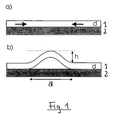
- Fig. 1
- die schematische Darstellung eines Verbundsystems aus zwei Materialien während der Aufnahme des Absorbats in das obere der beiden Materialien,
- Fig. 2
- den Schichtaufbau der im Beispiel erläuterten Ausführungsformen des erfindungsgemäßen Verfahrens,
- Fig. 3
- die Morphologieentwicklung der Oberfläche des Schichtaufbaus der im Beispiel erläuterten Ausführungsform des erfindungsgemäßen Verfahrens, und
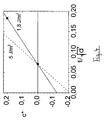
- Fig. 4
- die Bestimmung der Adhäsionsenergie bei der im Beispiel erläuterten Ausführungsform des erfindungsgemäßen Verfahrens.
Claims (26)
- Verfahren zur Bestimmung der Hafteigenschaften von mindestens zwei Materialien aneinander, insbesondere zur Bestimmung der Hafteigenschaften mindestens einer Beschichtung oder mindestens eines Films aus mindestens einem ersten Material auf einem Substrat aus einem zweiten Material, wobei mindestens ein Material, vorzugsweise mindestens eine Beschichtung oder mindestens ein Film mit mindestens einem Absorbat beaufschlagt wird und mindestens eine kritische physikalische oder chemische Meßgröße bestimmt wird, bei der sich die Materialien voneinander, vorzugsweise mindestens eine Beschichtung oder mindestens ein Film vom Substrat, mindestens teilweise, insbesondere im wesentlichen vollständig ablösen.
- Verfahren nach Anspruch 1, dadurch gekennzeichnet, daß es sich bei der kritischen Meßgröße um die beaufschlagte Absorbatmenge handelt.
- Verfahren nach Anspruch 1, dadurch gekennzeichnet, daß es sich bei der kritischen Meßgröße um die aus der Beaufschlagung mit dem Absorbat gegebenenfalls resultierende Substratkrümmung handelt.
- Verfahren nach einem der vorhergehenden Ansprüche, dadurch gekennzeichnet, daß die Verfahrensschritte mindestens zweimal, insbesondere mehrfach durchgeführt werden, wobei mindestens eine Materialstärke, insbesondere die Dicke der Beschichtung oder des Films, variiert wird.
- Verfahren nach einem der vorhergehenden Ansprüche, dadurch gekennzeichnet, daß mit Hilfe der kritischen Meßgröße die sogenannte Adhäsionsenergie bestimmt wird.
- Verfahren nach Anspruch 5, dadurch gekennzeichnet, daß die Adhäsionsenergie bestimmt wird durch Bestimmung der Steigung eines Auftrags der kritischen Meßgröße über eine Funktion, vorzugsweise die reziproke Wurzel, der Materialstärke, insbesondere Dicke der Beschichtung oder des Films.
- Verfahren nach einem der vorhergehenden Ansprüche, dadurch gekennzeichnet, daß die Dicke der Beschichtung oder des Films klein gegenüber der Dicke des Substrats ist.
- Verfahren nach einem der vorhergehenden Ansprüche, insbesondere nach Anspruch 7, dadurch gekennzeichnet, daß das Verhältnis Es2/d zwischen 108 Pa·m und 1014 Pa·m, vorzugsweise zwischen 1010 Pa·m und 1013 Pa·m, beträgt, mit E = Elastizitätsmodul des Substrats, s = Dicke des Substrats und d = Dicke der Beschichturig bzw. des Films.
- Verfahren nach einem der vorhergehenden Ansprüche, insbesondere nach Anspruch 7 oder Anspruch 8, dadurch gekennzeichnet, daß die Materialstärke, insbesondere die Dicke der Beschichtung oder des Films bzw. des Substrats zwischen 1 nm und 5 mm beträgt.
- Verfahren nach Anspruch 9, dadurch gekennzeichnet, daß die Dicke des Substrats zwischen 1 µm und 5 mm und die Dicke der Beschichtung oder des Films zwischen 1 nm und 1 µm beträgt.
- Verfahren nach einem der vorhergehenden Ansprüche, dadurch gekennzeichnet, daß es sich bei dem Absorbat um mindestens eine Flüssigkeit handelt.
- Verfahren nach Anspruch 11, dadurch gekennzeichnet, daß es sich bei dem Absorbat um Wasser handelt.
- Verfahren nach Anspruch 11, dadurch gekennzeichnet, daß es sich bei dem Absorbat um ein organisches Lösungsmittel, insbesondere um Dichlormethan oder Tetrachlormethan handelt.
- Verfahren nach einem der vorhergehenden Ansprüche, dadurch gekennzeichnet, daß es sich bei dem Absorbat um mindestens ein Gas handelt.
- Verfahren nach Anspruch 14, dadurch gekennzeichnet, daß es sich bei dem Absorbat um Kohlendioxid handelt.
- Verfahren nach Anspruch 14, dadurch gekennzeichnet, daß es sich bei dem Absorbat um ein gasförmiges Element, insbesondere um Wasserstoff, handelt.
- Verfahren nach einem der Ansprüche 11 bis 16, dadurch gekennzeichnet, daß die Beaufschlagung mit dem Absorbat direkt aus der Flüssigkeits- oder Gasphase erfolgt.
- Verfahren nach einem der Ansprüche 14 bis 16, dadurch gekennzeichnet, daß die Beaufschlagung mit dem Gas durch elektrochemische Beladung erfolgt.
- Verfahren nach einem der vorhergehenden Ansprüche, dadurch gekennzeichnet, daß es sich bei dem ersten Material, insbesondere bei dem Material der Beschichtung oder des Films um ein Metall, insbesondere ein Edelmetall, handelt.
- Verfahren nach einem der Ansprüche 1 bis 18, dadurch gekennzeichnet, daß es sich bei dem ersten Material, insbesondere bei dem Material der Beschichtung oder des Films um ein Polymermaterial, insbesondere einen Lack, handelt.
- Verfahren nach einem der vorhergehenden Ansprüche, insbesondere nach Anspruch 19, dadurch gekennzeichnet, daß es sich bei dem zweiten Material, insbesondere bei dem Substrat, um ein Polymermaterial handelt.
- Verfahren nach einem der Ansprüche 1 bis 20, insbesondere nach Anspruch 20, dadurch gekennzeichnet, daß es sich bei dem zweiten Material, vorzugsweise bei dem Substrat, um ein Metall handelt.
- Verfahren nach einem der vorhergehenden Ansprüche, dadurch gekennzeichnet, daß zur Bestimmung der kritischen Meßgröße der Ablösevorgang der beiden Materialien, insbesondere der Beschichtung oder des Films vom Substrat, optisch verfolgt wird, insbesondere mit Hilfe eines Lichtmikroskops.
- Verfahren nach einem der vorhergehenden Ansprüche, insbesondere nach Anspruch 23, dadurch gekennzeichnet, daß zur Bestimmung der kritischen Meßgröße beim Ablösevorgang der beiden Materialien, insbesondere der Beschichtung oder des Films vom Substrat, die Oberflächenrauhigkeit verfolgt wird, insbesondere durch Bestimmung der Oberflächenreflektivität und/oder des Oberflächenstreuverhaltens.
- Verfahren nach einem der vorhergehenden Ansprüche, dadurch gekennzeichnet, daß mindestens eine das Absorbat aufnehmende Beschichtung/Film mit mindestens einer das Absorbat nicht oder nur in geringer Konzentration aufnehmenden weiteren Beschichtung/Film festhaftend verbunden ist und durch Beaufschlagung der das Absorbat aufnehmenden Beschichtung/Film mit dem Absorbat die Hafteigenschaften der das Absorbat nicht oder nur in geringer Konzentration aufnehmenden Beschichtung/Film am Substrat bestimmt wird.
- Verfahren nach einem der vorhergehenden Ansprüche, insbesondere nach Anspruch 25, dadurch gekennzeichnet, daß zur Bestimmung der Hafteigenschaften einschließlich des Substrats ein Schichtaufbau aus zwei bis vier, vorzugsweise zwei oder drei, Schichten vorgesehen ist.
Applications Claiming Priority (2)
| Application Number | Priority Date | Filing Date | Title |
|---|---|---|---|
| DE10231383A DE10231383A1 (de) | 2002-07-09 | 2002-07-09 | Verfahren zur Bestimmung der Hafteigenschaften von Materialien |
| DE10231383 | 2002-07-09 |
Publications (3)
| Publication Number | Publication Date |
|---|---|
| EP1380832A2 true EP1380832A2 (de) | 2004-01-14 |
| EP1380832A3 EP1380832A3 (de) | 2004-11-03 |
| EP1380832B1 EP1380832B1 (de) | 2007-02-28 |
Family
ID=29723849
Family Applications (1)
| Application Number | Title | Priority Date | Filing Date |
|---|---|---|---|
| EP03015263A Expired - Lifetime EP1380832B1 (de) | 2002-07-09 | 2003-07-07 | Verfahren zur Bestimmung der Hafteigenschaften von Materialien |
Country Status (4)
| Country | Link |
|---|---|
| US (1) | US20040074293A1 (de) |
| EP (1) | EP1380832B1 (de) |
| AT (1) | ATE355514T1 (de) |
| DE (2) | DE10231383A1 (de) |
Cited By (2)
| Publication number | Priority date | Publication date | Assignee | Title |
|---|---|---|---|---|
| CN105890994A (zh) * | 2016-06-22 | 2016-08-24 | 重庆大学 | 一种层状金属复合材料界面结合强度评价方法 |
| CN111289570A (zh) * | 2020-03-30 | 2020-06-16 | 天津大学 | 一种构件涂层脱粘无损检测装置 |
Families Citing this family (3)
| Publication number | Priority date | Publication date | Assignee | Title |
|---|---|---|---|---|
| US7083327B1 (en) * | 1999-04-06 | 2006-08-01 | Thermal Wave Imaging, Inc. | Method and apparatus for detecting kissing unbond defects |
| FR2964193A1 (fr) * | 2010-08-24 | 2012-03-02 | Soitec Silicon On Insulator | Procede de mesure d'une energie d'adhesion, et substrats associes |
| DE102016222642A1 (de) * | 2016-11-17 | 2018-05-17 | Bayerische Motoren Werke Aktiengesellschaft | Prüfband |
Family Cites Families (8)
| Publication number | Priority date | Publication date | Assignee | Title |
|---|---|---|---|---|
| JPS5664644A (en) * | 1979-11-01 | 1981-06-01 | Mitsubishi Heavy Ind Ltd | Stripping test method of adhered coated layer |
| JPS5745431A (en) * | 1980-09-01 | 1982-03-15 | Fujitsu Ltd | Method for testing adhesiveness of plated product |
| US4952457A (en) * | 1988-12-05 | 1990-08-28 | Monsanto Company | Laminated safety glass and polymeric laminate for use therein |
| FR2644586B1 (fr) * | 1989-03-16 | 1991-07-05 | Ugine Aciers | Procede de determination de l'energie de pelage en t d'une tole sandwich |
| SU1592764A1 (ru) * | 1989-08-10 | 1990-09-15 | Viktor M Nagirnyj | Cпocoб oпpeдeлehия aдгeзиohhoй пpoчhoctи гaльbahичeckиx hиkeлebыx пokpыtий ha пoдлoжkax |
| JP2895361B2 (ja) * | 1993-09-09 | 1999-05-24 | 積水化成品工業株式会社 | 発泡樹脂成形品の粒子間融着度測定方法 |
| DE19617383A1 (de) * | 1996-04-30 | 1997-11-06 | Siemens Ag | Vorrichtung zum Prüfen oder Überwachen von Teilen oder Teile verbindenden Haftschichten und Verfahren zur Herstellung einer solchen Vorrichtung |
| DE69836259T2 (de) * | 1997-08-21 | 2007-06-06 | Toray Industries, Inc. | Verbundmaterial aus leichtmetall und mit kohlenstofffasern verstärktem kunststoff |
-
2002
- 2002-07-09 DE DE10231383A patent/DE10231383A1/de not_active Ceased
-
2003
- 2003-07-07 DE DE50306631T patent/DE50306631D1/de not_active Expired - Fee Related
- 2003-07-07 AT AT03015263T patent/ATE355514T1/de not_active IP Right Cessation
- 2003-07-07 EP EP03015263A patent/EP1380832B1/de not_active Expired - Lifetime
- 2003-07-09 US US10/615,453 patent/US20040074293A1/en not_active Abandoned
Non-Patent Citations (4)
| Title |
|---|
| DATABASE WPI Section Ch, Week 199132 Derwent Publications Ltd., London, GB; Class M11, AN 1991-236165 XP002293922 & SU 1 592 764 A (NAGIRNYI V M), 15. September 1990 (1990-09-15) * |
| J. MERTINS ET AL.: "Motivation und Entwicklung einer optischen Versuchungsanordnung zur 2-dimensionalen Messung lateraler mechanischer Spannungen un dünnen, haftenden Filmen" DEUTSCHE PHYSIKALISCHE GESELLSCHAFT: E-VERHANDLUNGEN 1999 - PROGRAMM UND ABSTRACTS DER SITZUNG M 21, [Online] 1999, XP002293921 Gefunden im Internet: <URL:http://dpg.rz.uni-ulm.de/archive/1999 /m_21.html> [gefunden am 2004-08-26] * |
| LAUDAHN U ET AL: "Determination of elastic constants in thin films using hydrogen loading" APPLIED PHYSICS LETTERS, AMERICAN INSTITUTE OF PHYSICS. NEW YORK, US, Bd. 74, Nr. 5, 1. Februar 1999 (1999-02-01), Seiten 647-649, XP012023147 ISSN: 0003-6951 * |
| LAUDAHN U ET AL: "Hydrogen-induced stress in Nb single layers" JOURNAL OF ALLOYS AND COMPOUNDS, ELSEVIER SEQUOIA, LAUSANNE, CH, Bd. 293-295, 20. Dezember 1999 (1999-12-20), Seiten 490-494, XP004364674 ISSN: 0925-8388 * |
Cited By (2)
| Publication number | Priority date | Publication date | Assignee | Title |
|---|---|---|---|---|
| CN105890994A (zh) * | 2016-06-22 | 2016-08-24 | 重庆大学 | 一种层状金属复合材料界面结合强度评价方法 |
| CN111289570A (zh) * | 2020-03-30 | 2020-06-16 | 天津大学 | 一种构件涂层脱粘无损检测装置 |
Also Published As
| Publication number | Publication date |
|---|---|
| ATE355514T1 (de) | 2006-03-15 |
| EP1380832A3 (de) | 2004-11-03 |
| US20040074293A1 (en) | 2004-04-22 |
| DE10231383A1 (de) | 2004-02-05 |
| EP1380832B1 (de) | 2007-02-28 |
| DE50306631D1 (de) | 2007-04-12 |
Similar Documents
| Publication | Publication Date | Title |
|---|---|---|
| EP2718094B1 (de) | Verfahren und vorrichtung zur ermittlung der druckverteilung zum bonden | |
| DE19703271A1 (de) | Materialprüfvorrichtung, Materialprüfgerät und Materialprüfverfahren | |
| WO2015090467A1 (de) | Verfahren und vorrichtung zur ermittlung der abriebeigenschaften von beschichteten flachprodukten mittels biegen | |
| EP1380832B1 (de) | Verfahren zur Bestimmung der Hafteigenschaften von Materialien | |
| EP2867649A1 (de) | Verfahren zur ermittlung der oberflächenspannung einer flüssigkeit | |
| WO2007101795A2 (de) | Verfahren und vorrichtung zur prüfung der qualität einer metallischen beschichtung | |
| DE102017220946A1 (de) | Graviervorrichtung und Verfahren zur Erzeugung und Messung von Spannungsrisskorrosion an einem flächigen beschichteten Prüfkörper | |
| WO2003036269A1 (de) | Verfahren und vorrichtung zur bestimmung der benetzbarkeit einer oberfläche sowie deren verwendung | |
| DE102018205529A1 (de) | Filtersubstrat zur Filterung und optischen Charakterisierung von Mikropartikeln, Verfahren zur Herstellung des Filtersubstrats und Verwendung des Filtersubstrats | |
| WO2020099071A1 (de) | VERFAHREN ZUM PRÜFEN DER HAFTEIGENSCHAFTEN EINER SCHICHT, INSBESONDERE EINER VERSCHLEIßSCHUTZSCHICHT | |
| EP3160737B1 (de) | Verfahren zur herstellung eines stanzbauteils | |
| DE102022114928A1 (de) | Verfahren zum Dressieren eines schmelztauchbeschichteten Stahlblechs und entsprechend dressiertes, schmelztauchbeschichtetes Stahlblech | |
| DE102022114930A1 (de) | Dressiertes, schmelztauchbeschichtetes Stahlblech | |
| DE102013014807B3 (de) | Anordnung und Verfahren zur synchronen Bestimmung des Schermoduls und der Poissonzahl an Proben aus elastisch isotropen und anisotropen Werkstoffen | |
| DE102011017466A1 (de) | Inline-Bestimmung von Oberflächeneigenschaften | |
| DE19802716C2 (de) | Verfahren zur Bestimmung mechanischer Eigenschaften dünner Schichten | |
| DE10143679C1 (de) | Verfahren zur Bestimmung mechanischer Eigenschaften dünner Schichten | |
| DE102008037063A1 (de) | Verfahren zum Prüfen einer Beschichtung, insbesondere eines Lackes | |
| DE102011119349A1 (de) | Verfahren zur Herstellung eines Dünnschichtsensorelements | |
| DE102018115071B4 (de) | Prüfverfahren für brünierte Bauteiloberflächen | |
| DD240603A1 (de) | Verfahren zur bestimmung der mechanischen eigenschaften von polymerschichten | |
| DE19807256C2 (de) | Verfahren zur Herstellung einer keramischen Rohfolie und Vorrichtung zur Bereitstellung einer keramischen Rohfolie | |
| DE102017123305A1 (de) | Probe für eine Analyse mittels eines Prüfverfahrens und Verfahren zu deren Herstellung | |
| WO2016074881A1 (de) | Verfahren zum bestimmen der haftfestigkeit von schichten auf substraten | |
| EP3124958B1 (de) | Verbundwerkstoff und verfahren zur detektion von kontaminationen auf einer oberfläche eines verbundwerkstoffs |
Legal Events
| Date | Code | Title | Description |
|---|---|---|---|
| PUAI | Public reference made under article 153(3) epc to a published international application that has entered the european phase |
Free format text: ORIGINAL CODE: 0009012 |
|
| AK | Designated contracting states |
Kind code of ref document: A2 Designated state(s): AT BE BG CH CY CZ DE DK EE ES FI FR GB GR HU IE IT LI LU MC NL PT RO SE SI SK TR |
|
| AX | Request for extension of the european patent |
Extension state: AL LT LV MK |
|
| PUAL | Search report despatched |
Free format text: ORIGINAL CODE: 0009013 |
|
| AK | Designated contracting states |
Kind code of ref document: A3 Designated state(s): AT BE BG CH CY CZ DE DK EE ES FI FR GB GR HU IE IT LI LU MC NL PT RO SE SI SK TR |
|
| AX | Request for extension of the european patent |
Extension state: AL LT LV MK |
|
| 17P | Request for examination filed |
Effective date: 20050427 |
|
| AKX | Designation fees paid |
Designated state(s): AT BE BG CH CY CZ DE DK EE ES FI FR GB GR HU IE IT LI LU MC NL PT RO SE SI SK TR |
|
| GRAP | Despatch of communication of intention to grant a patent |
Free format text: ORIGINAL CODE: EPIDOSNIGR1 |
|
| GRAS | Grant fee paid |
Free format text: ORIGINAL CODE: EPIDOSNIGR3 |
|
| GRAA | (expected) grant |
Free format text: ORIGINAL CODE: 0009210 |
|
| AK | Designated contracting states |
Kind code of ref document: B1 Designated state(s): AT BE BG CH CY CZ DE DK EE ES FI FR GB GR HU IE IT LI LU MC NL PT RO SE SI SK TR |
|
| PG25 | Lapsed in a contracting state [announced via postgrant information from national office to epo] |
Ref country code: IE Free format text: LAPSE BECAUSE OF FAILURE TO SUBMIT A TRANSLATION OF THE DESCRIPTION OR TO PAY THE FEE WITHIN THE PRESCRIBED TIME-LIMIT Effective date: 20070228 Ref country code: DK Free format text: LAPSE BECAUSE OF FAILURE TO SUBMIT A TRANSLATION OF THE DESCRIPTION OR TO PAY THE FEE WITHIN THE PRESCRIBED TIME-LIMIT Effective date: 20070228 Ref country code: SI Free format text: LAPSE BECAUSE OF FAILURE TO SUBMIT A TRANSLATION OF THE DESCRIPTION OR TO PAY THE FEE WITHIN THE PRESCRIBED TIME-LIMIT Effective date: 20070228 Ref country code: FI Free format text: LAPSE BECAUSE OF FAILURE TO SUBMIT A TRANSLATION OF THE DESCRIPTION OR TO PAY THE FEE WITHIN THE PRESCRIBED TIME-LIMIT Effective date: 20070228 Ref country code: NL Free format text: LAPSE BECAUSE OF FAILURE TO SUBMIT A TRANSLATION OF THE DESCRIPTION OR TO PAY THE FEE WITHIN THE PRESCRIBED TIME-LIMIT Effective date: 20070228 |
|
| REG | Reference to a national code |
Ref country code: GB Ref legal event code: FG4D Free format text: NOT ENGLISH |
|
| REG | Reference to a national code |
Ref country code: CH Ref legal event code: EP |
|
| REF | Corresponds to: |
Ref document number: 50306631 Country of ref document: DE Date of ref document: 20070412 Kind code of ref document: P |
|
| REG | Reference to a national code |
Ref country code: IE Ref legal event code: FG4D Free format text: LANGUAGE OF EP DOCUMENT: GERMAN |
|
| PG25 | Lapsed in a contracting state [announced via postgrant information from national office to epo] |
Ref country code: BG Free format text: LAPSE BECAUSE OF EXPIRATION OF PROTECTION Effective date: 20070529 |
|
| PG25 | Lapsed in a contracting state [announced via postgrant information from national office to epo] |
Ref country code: SE Free format text: LAPSE BECAUSE OF FAILURE TO SUBMIT A TRANSLATION OF THE DESCRIPTION OR TO PAY THE FEE WITHIN THE PRESCRIBED TIME-LIMIT Effective date: 20070531 |
|
| PG25 | Lapsed in a contracting state [announced via postgrant information from national office to epo] |
Ref country code: ES Free format text: LAPSE BECAUSE OF FAILURE TO SUBMIT A TRANSLATION OF THE DESCRIPTION OR TO PAY THE FEE WITHIN THE PRESCRIBED TIME-LIMIT Effective date: 20070608 |
|
| PG25 | Lapsed in a contracting state [announced via postgrant information from national office to epo] |
Ref country code: PT Free format text: LAPSE BECAUSE OF FAILURE TO SUBMIT A TRANSLATION OF THE DESCRIPTION OR TO PAY THE FEE WITHIN THE PRESCRIBED TIME-LIMIT Effective date: 20070730 |
|
| NLV1 | Nl: lapsed or annulled due to failure to fulfill the requirements of art. 29p and 29m of the patents act | ||
| GBV | Gb: ep patent (uk) treated as always having been void in accordance with gb section 77(7)/1977 [no translation filed] |
Effective date: 20070228 |
|
| REG | Reference to a national code |
Ref country code: IE Ref legal event code: FD4D |
|
| EN | Fr: translation not filed | ||
| PG25 | Lapsed in a contracting state [announced via postgrant information from national office to epo] |
Ref country code: GB Free format text: LAPSE BECAUSE OF FAILURE TO SUBMIT A TRANSLATION OF THE DESCRIPTION OR TO PAY THE FEE WITHIN THE PRESCRIBED TIME-LIMIT Effective date: 20070228 Ref country code: SK Free format text: LAPSE BECAUSE OF FAILURE TO SUBMIT A TRANSLATION OF THE DESCRIPTION OR TO PAY THE FEE WITHIN THE PRESCRIBED TIME-LIMIT Effective date: 20070228 |
|
| PG25 | Lapsed in a contracting state [announced via postgrant information from national office to epo] |
Ref country code: CZ Free format text: LAPSE BECAUSE OF FAILURE TO SUBMIT A TRANSLATION OF THE DESCRIPTION OR TO PAY THE FEE WITHIN THE PRESCRIBED TIME-LIMIT Effective date: 20070228 Ref country code: RO Free format text: LAPSE BECAUSE OF FAILURE TO SUBMIT A TRANSLATION OF THE DESCRIPTION OR TO PAY THE FEE WITHIN THE PRESCRIBED TIME-LIMIT Effective date: 20070228 |
|
| PLBE | No opposition filed within time limit |
Free format text: ORIGINAL CODE: 0009261 |
|
| STAA | Information on the status of an ep patent application or granted ep patent |
Free format text: STATUS: NO OPPOSITION FILED WITHIN TIME LIMIT |
|
| BERE | Be: lapsed |
Owner name: UNIVERSITAT GOTTINGEN Effective date: 20070731 |
|
| 26N | No opposition filed |
Effective date: 20071129 |
|
| REG | Reference to a national code |
Ref country code: CH Ref legal event code: PL |
|
| PG25 | Lapsed in a contracting state [announced via postgrant information from national office to epo] |
Ref country code: IT Free format text: LAPSE BECAUSE OF FAILURE TO SUBMIT A TRANSLATION OF THE DESCRIPTION OR TO PAY THE FEE WITHIN THE PRESCRIBED TIME-LIMIT Effective date: 20070228 Ref country code: MC Free format text: LAPSE BECAUSE OF NON-PAYMENT OF DUE FEES Effective date: 20070731 Ref country code: CH Free format text: LAPSE BECAUSE OF NON-PAYMENT OF DUE FEES Effective date: 20070731 Ref country code: FR Free format text: LAPSE BECAUSE OF FAILURE TO SUBMIT A TRANSLATION OF THE DESCRIPTION OR TO PAY THE FEE WITHIN THE PRESCRIBED TIME-LIMIT Effective date: 20071019 Ref country code: LI Free format text: LAPSE BECAUSE OF NON-PAYMENT OF DUE FEES Effective date: 20070731 Ref country code: GR Free format text: LAPSE BECAUSE OF FAILURE TO SUBMIT A TRANSLATION OF THE DESCRIPTION OR TO PAY THE FEE WITHIN THE PRESCRIBED TIME-LIMIT Effective date: 20070529 |
|
| PG25 | Lapsed in a contracting state [announced via postgrant information from national office to epo] |
Ref country code: BE Free format text: LAPSE BECAUSE OF NON-PAYMENT OF DUE FEES Effective date: 20070731 |
|
| PGFP | Annual fee paid to national office [announced via postgrant information from national office to epo] |
Ref country code: DE Payment date: 20080814 Year of fee payment: 6 |
|
| PG25 | Lapsed in a contracting state [announced via postgrant information from national office to epo] |
Ref country code: AT Free format text: LAPSE BECAUSE OF NON-PAYMENT OF DUE FEES Effective date: 20070707 Ref country code: FR Free format text: LAPSE BECAUSE OF FAILURE TO SUBMIT A TRANSLATION OF THE DESCRIPTION OR TO PAY THE FEE WITHIN THE PRESCRIBED TIME-LIMIT Effective date: 20070228 |
|
| PG25 | Lapsed in a contracting state [announced via postgrant information from national office to epo] |
Ref country code: EE Free format text: LAPSE BECAUSE OF FAILURE TO SUBMIT A TRANSLATION OF THE DESCRIPTION OR TO PAY THE FEE WITHIN THE PRESCRIBED TIME-LIMIT Effective date: 20070228 |
|
| PG25 | Lapsed in a contracting state [announced via postgrant information from national office to epo] |
Ref country code: CY Free format text: LAPSE BECAUSE OF FAILURE TO SUBMIT A TRANSLATION OF THE DESCRIPTION OR TO PAY THE FEE WITHIN THE PRESCRIBED TIME-LIMIT Effective date: 20070228 |
|
| PG25 | Lapsed in a contracting state [announced via postgrant information from national office to epo] |
Ref country code: LU Free format text: LAPSE BECAUSE OF NON-PAYMENT OF DUE FEES Effective date: 20070707 |
|
| PG25 | Lapsed in a contracting state [announced via postgrant information from national office to epo] |
Ref country code: HU Free format text: LAPSE BECAUSE OF FAILURE TO SUBMIT A TRANSLATION OF THE DESCRIPTION OR TO PAY THE FEE WITHIN THE PRESCRIBED TIME-LIMIT Effective date: 20070901 Ref country code: TR Free format text: LAPSE BECAUSE OF FAILURE TO SUBMIT A TRANSLATION OF THE DESCRIPTION OR TO PAY THE FEE WITHIN THE PRESCRIBED TIME-LIMIT Effective date: 20070228 |
|
| PG25 | Lapsed in a contracting state [announced via postgrant information from national office to epo] |
Ref country code: DE Free format text: LAPSE BECAUSE OF NON-PAYMENT OF DUE FEES Effective date: 20100202 |