EP1389009A2 - Informationsaufnahme- und -wiedergabegerät und Informationsaufnahme- und -wiedergabeverfahren - Google Patents
Informationsaufnahme- und -wiedergabegerät und Informationsaufnahme- und -wiedergabeverfahren Download PDFInfo
- Publication number
- EP1389009A2 EP1389009A2 EP03015472A EP03015472A EP1389009A2 EP 1389009 A2 EP1389009 A2 EP 1389009A2 EP 03015472 A EP03015472 A EP 03015472A EP 03015472 A EP03015472 A EP 03015472A EP 1389009 A2 EP1389009 A2 EP 1389009A2
- Authority
- EP
- European Patent Office
- Prior art keywords
- recording
- group
- recording medium
- information
- capacity
- Prior art date
- Legal status (The legal status is an assumption and is not a legal conclusion. Google has not performed a legal analysis and makes no representation as to the accuracy of the status listed.)
- Withdrawn
Links
Images





Classifications
-
- G—PHYSICS
- G11—INFORMATION STORAGE
- G11B—INFORMATION STORAGE BASED ON RELATIVE MOVEMENT BETWEEN RECORD CARRIER AND TRANSDUCER
- G11B27/00—Editing; Indexing; Addressing; Timing or synchronising; Monitoring; Measuring tape travel
- G11B27/36—Monitoring, i.e. supervising the progress of recording or reproducing
-
- G—PHYSICS
- G11—INFORMATION STORAGE
- G11B—INFORMATION STORAGE BASED ON RELATIVE MOVEMENT BETWEEN RECORD CARRIER AND TRANSDUCER
- G11B27/00—Editing; Indexing; Addressing; Timing or synchronising; Monitoring; Measuring tape travel
- G11B27/02—Editing, e.g. varying the order of information signals recorded on, or reproduced from, record carriers
- G11B27/031—Electronic editing of digitised analogue information signals, e.g. audio or video signals
- G11B27/034—Electronic editing of digitised analogue information signals, e.g. audio or video signals on discs
-
- G—PHYSICS
- G11—INFORMATION STORAGE
- G11B—INFORMATION STORAGE BASED ON RELATIVE MOVEMENT BETWEEN RECORD CARRIER AND TRANSDUCER
- G11B27/00—Editing; Indexing; Addressing; Timing or synchronising; Monitoring; Measuring tape travel
- G11B27/10—Indexing; Addressing; Timing or synchronising; Measuring tape travel
- G11B27/34—Indicating arrangements
-
- H—ELECTRICITY
- H04—ELECTRIC COMMUNICATION TECHNIQUE
- H04N—PICTORIAL COMMUNICATION, e.g. TELEVISION
- H04N5/00—Details of television systems
- H04N5/76—Television signal recording
-
- G—PHYSICS
- G11—INFORMATION STORAGE
- G11B—INFORMATION STORAGE BASED ON RELATIVE MOVEMENT BETWEEN RECORD CARRIER AND TRANSDUCER
- G11B2220/00—Record carriers by type
- G11B2220/20—Disc-shaped record carriers
- G11B2220/21—Disc-shaped record carriers characterised in that the disc is of read-only, rewritable, or recordable type
- G11B2220/215—Recordable discs
- G11B2220/216—Rewritable discs
-
- G—PHYSICS
- G11—INFORMATION STORAGE
- G11B—INFORMATION STORAGE BASED ON RELATIVE MOVEMENT BETWEEN RECORD CARRIER AND TRANSDUCER
- G11B2220/00—Record carriers by type
- G11B2220/20—Disc-shaped record carriers
- G11B2220/21—Disc-shaped record carriers characterised in that the disc is of read-only, rewritable, or recordable type
- G11B2220/215—Recordable discs
- G11B2220/218—Write-once discs
-
- G—PHYSICS
- G11—INFORMATION STORAGE
- G11B—INFORMATION STORAGE BASED ON RELATIVE MOVEMENT BETWEEN RECORD CARRIER AND TRANSDUCER
- G11B2220/00—Record carriers by type
- G11B2220/20—Disc-shaped record carriers
- G11B2220/25—Disc-shaped record carriers characterised in that the disc is based on a specific recording technology
- G11B2220/2508—Magnetic discs
- G11B2220/2516—Hard disks
-
- G—PHYSICS
- G11—INFORMATION STORAGE
- G11B—INFORMATION STORAGE BASED ON RELATIVE MOVEMENT BETWEEN RECORD CARRIER AND TRANSDUCER
- G11B2220/00—Record carriers by type
- G11B2220/20—Disc-shaped record carriers
- G11B2220/25—Disc-shaped record carriers characterised in that the disc is based on a specific recording technology
- G11B2220/2537—Optical discs
- G11B2220/2562—DVDs [digital versatile discs]; Digital video discs; MMCDs; HDCDs
-
- G—PHYSICS
- G11—INFORMATION STORAGE
- G11B—INFORMATION STORAGE BASED ON RELATIVE MOVEMENT BETWEEN RECORD CARRIER AND TRANSDUCER
- G11B2220/00—Record carriers by type
- G11B2220/20—Disc-shaped record carriers
- G11B2220/25—Disc-shaped record carriers characterised in that the disc is based on a specific recording technology
- G11B2220/2537—Optical discs
- G11B2220/2562—DVDs [digital versatile discs]; Digital video discs; MMCDs; HDCDs
- G11B2220/2575—DVD-RAMs
-
- G—PHYSICS
- G11—INFORMATION STORAGE
- G11B—INFORMATION STORAGE BASED ON RELATIVE MOVEMENT BETWEEN RECORD CARRIER AND TRANSDUCER
- G11B2220/00—Record carriers by type
- G11B2220/40—Combinations of multiple record carriers
- G11B2220/45—Hierarchical combination of record carriers, e.g. HDD for fast access, optical discs for long term storage or tapes for backup
- G11B2220/455—Hierarchical combination of record carriers, e.g. HDD for fast access, optical discs for long term storage or tapes for backup said record carriers being in one device and being used as primary and secondary/backup media, e.g. HDD-DVD combo device, or as source and target media, e.g. PC and portable player
-
- H—ELECTRICITY
- H04—ELECTRIC COMMUNICATION TECHNIQUE
- H04N—PICTORIAL COMMUNICATION, e.g. TELEVISION
- H04N5/00—Details of television systems
- H04N5/76—Television signal recording
- H04N5/765—Interface circuits between an apparatus for recording and another apparatus
-
- H—ELECTRICITY
- H04—ELECTRIC COMMUNICATION TECHNIQUE
- H04N—PICTORIAL COMMUNICATION, e.g. TELEVISION
- H04N5/00—Details of television systems
- H04N5/76—Television signal recording
- H04N5/765—Interface circuits between an apparatus for recording and another apparatus
- H04N5/77—Interface circuits between an apparatus for recording and another apparatus between a recording apparatus and a television camera
-
- H—ELECTRICITY
- H04—ELECTRIC COMMUNICATION TECHNIQUE
- H04N—PICTORIAL COMMUNICATION, e.g. TELEVISION
- H04N5/00—Details of television systems
- H04N5/76—Television signal recording
- H04N5/78—Television signal recording using magnetic recording
- H04N5/781—Television signal recording using magnetic recording on disks or drums
-
- H—ELECTRICITY
- H04—ELECTRIC COMMUNICATION TECHNIQUE
- H04N—PICTORIAL COMMUNICATION, e.g. TELEVISION
- H04N5/00—Details of television systems
- H04N5/76—Television signal recording
- H04N5/84—Television signal recording using optical recording
- H04N5/85—Television signal recording using optical recording on discs or drums
Definitions
- the present invention relates to an information recording and reproduction apparatus and an information recording and reproduction method, for selective recording/reproduction into/from a large-capacity stationary recording medium and a detachable/portable recording medium. Further, the invention relates to a broadcast-receiving apparatus, which selectively records and reproduces received information onto/from the above recording media.
- HDDs Hard Disk Drives
- DVD-RAM Digital Versatile Disk-Random Access Memory
- programs or other input information can be recorded/reproduced to/from either/both an HDD and DVD-RAM. Further, information in the HDD can also be transferred to DVD-RAM, and vice-versa.
- various problems arise, particularly when information is transferred from HDD to DVD-RAM. For example, the user might not know whether programs stored on the HDD have been copied onto DVD-RAM or not, or how many DVD-RAM disks are required for copying a certain program. When copying information to DVD-RAM, the user may have to use several disks, thus involving mounting them separately, which is troublesome.
- Jpn. Pat. Appln. KOKAI Publication Nos. 11-7705, 2000-175139, and 5-282793, and the like disclose examples of the known art regarding a technique which performs recording and reproduction between the two kinds of recording media.
- Jpn. Pat. Appln. KOKAI Publication No. 11-7705 relates to a technique in which data recorded in a video CD (Compact Disk) is copied to DVD-RAM having a different sector size from that of the video CD.
- a video CD Compact Disk
- Jpn. Pat. Appln. KOKAI Publication No. 2000-175139 relates to the technique in which part of a video data file recorded in the detachable optical disk is copied as the file to on HDD.
- Jpn. Pat. Appln. KOKAI Publication No. 5-282793 relates to the technique in which track and sector numbers of the large-capacity optical disk are transformed corresponding to the track and sector numbers of the small-capacity optical disk.
- an object of the invention is to provide an information recording and reproduction apparatus, and an information recording and reproduction method, in which information recorded in a medium of stationary type can be reliably transferred onto a medium of portable type, without the necessity of incorporating the medium of portable type, by providing a specific information-transfer environment for the medium of stationary type.
- an information recording and reproduction apparatus comprising:
- FIG. 1 shows a first embodiment of the invention, and schematically shows a television receiver.
- a reference numeral 11 is an antenna.
- a television broadcast signal received by the antenna 11 is supplied to a tuner portion 12, a video signal of a given channel is selected, and then the signal is supplied to a signal processing control portion 13.
- the signal processing control portion 13 includes a CPU 15 (Central Processing Unit) which receives operating information from an operating portion 14 to control the operation of the television receiver, an encoder portion 16 which performs encoding processing to the video signal, a decoder portion 17 which performs decoding processing of the video signal, a file management portion 18, and an edit processing portion 19.
- CPU 15 Central Processing Unit
- the video signal outputted from the tuner portion 12 is decoded with the decoder portion 17, converted into a format corresponding to an image display, and then supplied to a display portion 20 to be used for the image display.
- the signal processing control portion 13 is connected to an HDD 21 which records and reproduces information to a hard disk 21a and an optical disk drive portion 22 which records and reproduces information to an optical disk 22a such as DVD-RAM. Further, external devices such as an audio-visual recording and reproduction device 23 and a digital camera 24 may be connected to the signal processing control portion 13.
- the signal processing control portion 13 performs a predetermined encode processing to the video signal outputted from the tuner portion 12 by the encoder portion 16, and the video signal can be selectively recorded into the HDD 21, the optical disk drive portion 22, and the audio-visual recording and reproduction device 23.
- the signal processing control portion 13 can also cause the video signals outputted from the HDD 21, the optical disk drive portion 22, the audio-visual recording and reproduction device 23, and the digital camera 24 to be selectively displayed on the display portion 20.
- the signal processing control portion 13 can cause the video signal selectively outputted from the HDD 21, the optical disk drive portion 22, the audio-visual recording and reproduction device 23, and the digital camera 24 to be selectively recorded in the HDD 21, the optical disk drive portion 22, and the audio-visual recording and reproduction device 23.
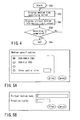
- a flow chart shown in FIG. 2 illustrates the operation informing a user how many optical disks 22a are required when the information recorded in the hard disk 21a is recorded into the optical disk 22a.
- the signal processing control portion 13 displays a title selecting screen, in which the user selects a title of information to be recorded in the optical disk 22a among the information recorded in the hard disk 21a, on the display portion 20 in step S2b.
- the titles of the information recorded in the hard disk 21a are listed in the title selecting screen.
- the selected title is separately displayed.
- step S2c the signal processing control portion 13 displays a medium specifying screen, in which the user selects the kind of optical disk 22a performing the recording, on the display portion 20.
- the medium specifying screen lists the kinds of optical disk 22a, such as DVD-RAM or DVD-R (Recordable). The user selects a desired kind among the listed kinds on the screen.
- FIG. 3B shows a state in which DVD-RAM is selected.
- the signal processing control portion 13 calculates the necessary number of optical disks 22a to display it on the display portion 20 (step S2d), and ends the processing (step S2e).
- the display screen of the necessary number of optical disks 22a displays the title selected in step S2b, the kind of optical disk 22a selected in step S2c, and the necessary number of optical disks 22a.
- the function informing the user of the necessary number of optical disks 22a is provided when the information recorded in the hard disk 21a is recorded in the optical disk 22a, so that handing can be convenient for the user.
- a flow chart shown in FIG. 4 illustrates the registering operation for reserving a recording region (virtual medium) corresponding to a recording capacity of the optical disk 22a (or the plurality of optical disks), in which the user specifies the kind, on the recording region of the hard disk 21a.
- the signal processing control portion 13 displays a medium specifying screen, in which the user selects the kind of optical disk 22a for which the recording region is reserved on the hard disk 21a, on the display portion 20 in step S4b.
- the type of optical disk 22a such as DVD-RAM or DVD-R, are listed in the medium specifying screen.
- the user selects the desired type from the list on the screen.
- FIG. 5A shows a state in which DVD-RAM is selected.
- step S4c the signal processing control portion 13 displays a screen, in which the user inputs virtual medium information indicating a name (virtual medium name) of the recording region reserved on the hard disk 21a, the number (creation number) of optical disks 22a, or the like, on the display portion 20.
- FIG. 5B shows an inputted state in which the virtual medium name is A and the number (creation number) of optical disks 22a constituting the virtual medium is two.
- the signal processing control portion 13 decides whether or not the registering operation is completed in step S4d. When it is decided that the registering operation is not completed (NO), the processing is returned to the step S4b. When it is decided that the registering operation is completed (YES), the signal processing control portion 13 ends the processing (step S4e).
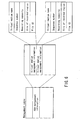
- the file management portion 18 includes a management table.
- the management table stores various kinds of management information for managing the HDD 21, the optical disk drive portion 22, the audio-visual recording and reproduction device 23, the digital camera 24, and the like.
- Each piece of virtual medium management information relates to one optical disk 22a, and is information such as a virtual medium name, a sequence number, the recording capacity, a size of the recorded region, and a file ID of the region which is allocated to the hard disk 21a.
- the file ID constitutes a file system indicating a location (leading address) and the size of the recording regions 1, 2, 3, ..., which are reserved on the hard disk 21a as shown in FIG. 7. Consequently, the recording region corresponding to one disk of the optical disk 22a can be reserved by combining plural empty regions on the hard disk 21a.
- a flow chart shown in FIG. 8 illustrates the operation of recording the information recorded in the hard disk 21a in the recording region reserved on the hard disk 21a, i.e., copying the information within the hard disk 21a.
- step S8a When the processing is started (step S8a) and the user specifies the virtual medium name in step S8b, the signal processing control portion 13 reproduces the information recorded in the hard disk 21a and records it in the recording region having the smallest sequence number among the recording regions on the hard disk 21a, for constituting the specified virtual medium, in step S8c.
- step S8d the signal processing control portion 13 decides whether or not the information to be recorded in the specified virtual medium still remains. When it is decided that the information does not remain (NO), the processing is ended (step S8h).
- step S8d When it is decided that the information remains in step S8d (YES), the signal processing control portion 13 decides whether or not the amount of information has exceeded the capacity of the recording region having the smallest sequence number in step S8e, and the processing is returned to the step S8c when the amount of information has not exceeded the capacity of the recording region (NO).
- the signal processing control portion 13 decides whether or not the recording region of the next sequence number exists on the hard disk 21a in step S8f, and the processing is ended (step S8h) when it is decided that the recording region of the next sequence number does not exist on the hard disk 21a (NO).
- the signal processing control portion 13 changes the recording region to the recording region of the next sequence number in step S8g, and the processing is returned to the step S8c.
- a flow chart shown in FIG. 9 illustrates the operation actually recording the information recorded in the virtual medium on the hard disk 21a in the optical disk 22a in the above-described way.
- step S9a When the processing is started (step S9a) and the optical disk 22a is mounted on the optical disk drive portion 22 in step S9b, the signal processing control portion 13 reproduces the information from the recording region having the initial sequence number on the hard disk 21a and records it in the optical disk 22a mounted on the optical disk drive portion 22 in step S9c.
- the signal processing control portion 13 decides whether or not the information is recorded in the recording region of the next sequence number in step S9d. When it is decided that the information is not recorded in the recording region of the next sequence number (NO), the processing is ended (S9e). When it is decided that the information is recorded in the recording region of the next sequence number (YES), the sequence number is changed to the next number to transfer the processing to the step S9b.
- the user reserves the recording region corresponding to the kind and the number of disks of the optical disk 22a as the virtual medium on the hard disk 21a, so that the processing, in which the information corresponds to the plural optical disks 22a and is divided on the hard disk 21a, can be performed without mounting the optical disk 22a on the optical disk drive portion 22.
- the information is recorded while the information is divided in every optical disk 22a on the hard disk 21a, when the information is actually recorded from the hard disk 21a to the optical disk 22a, the information of the recording region indicated by one sequence number of the hard disk 21a is only directly transferred to the optical disk 22a, and the task of recording the information by dividing it into the plural optical disks 22a can be largely simplified.
- FIG. 10 illustrates another example in which the information recorded in the hard disk 21a is copied in the recording region reserved on the hard disk 21a.
- steps S10a to S10h are the same as steps S8a to S8h shown in FIG. 8. That is, in the specified virtual media, the recording region having the smallest sequence number is filled on the hard disk 21a, the recording region is changed to the recording region having the next sequence number in step S10g. Thereafter, the signal processing control portion 13 subtracts the capacity c of a predetermined surplus from the capacity C of the recording region having the next sequence number in step S10i
- the recording of the information is performed for the capacity obtained by subtracting the capacity c of the surplus from the capacity C of the recording region.
- information is recorded while the capacity c of the surplus remains.
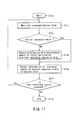
- a flow chart shown in FIG. 11 illustrates the operation of actually recording the information recorded in the virtual medium on the hard disk 21a in the optical disk 22a in the above-described way.
- step S11a When the processing is started (step S11a) and the optical disk 22a is mounted on the optical disk drive portion 22 in step S11b, the signal processing control portion 13 decides whether or not the recording region reading the information from the hard disk 21a is the recording region of the initial sequence number in step S11c.
- the signal processing control portion 13 When the signal processing control portion 13 decides that it is not the recording region of the initial sequence number (NO), the signal processing control portion 13 records the predetermined amount of latest portions (corresponding to the capacity c of the surplus) of the information, which is recorded in the recording region of the previous sequence number, in the optical disk 22a in step S11d
- step S11d when it is decided that it is the recording region of the initial sequence number (YES) in the above-described step S11c, the signal processing control portion 13 reproduces the information from the recording region having the current sequence number and records it in the optical disk 22a mounted on the optical disk drive portion 22 in step S11e
- the signal processing control portion 13 decides whether or not the information is recorded in the recording region of the next sequence number in step S11f When it is decided that the information is not recorded (NO), the processing is ended (step S11g). When it is decided that the information is recorded (YES), the sequence number is changed to the next value and the processing is returned to the step S11b
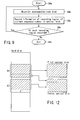
- FIG. 12 shows a sate in which the information including the above-described surplus is recorded in the hard disk 21a and a state in which the information is recorded from the hard disk 21a to the optical disk 22a.
- the information is recorded in the whole recording region A1 having the smallest sequence number, as shown by oblique lines. Further, the information is recorded in a recording region A2 having the sequence number larger than that of the recording region A1 so that the capacity c of the surplus portion is zero.
- the information of the recording region A1 is directly recorded in the first optical disk 22a.
- the information of the latest portion of the recording region A1 is recorded in an amount corresponding to only the capacity c of the surplus. Then, the information of the recording region A2 is directly recorded in the second optical disk 22a.
- the latest portion of the information recorded in the previous optical disk 22a is recorded in the second or later optical disks 22a. Therefore, when the optical disk 22a is changed in reproducing the optical disk 22a, the image of the latest portion of the previous optical disk 22a is reproduced, and then a new video image is displayed, so that it is convenient for the user.
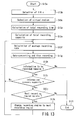
- a flow chart shown in FIG. 13 illustrates the operation of rate-converting the information recorded in the hard disk 21a and recording it in the recording region reserved on the hard disk 21a.
- step S13a When the processing is started (step S13a), the selection of the title is performed in step S13b, and the selection of the virtual medium is performed in step S13c, the signal processing control portion 13 determines total recording time of the information corresponding to the title in step S13d and determines total recording capacity of the virtual medium in step S13e.
- the signal processing control portion 13 calculates an average recording rate during the encoding from the previously determined total recording time and total recording capacity in step S13f.
- the signal processing control portion 13 reproduces the information recorded in the hard disk 21a, re-encodes the information so as to perform the rate-conversion, and records the information in the recording region having the smallest sequence number among the recording regions constituting the specified virtual medium on the hard disk 21a.
- the signal processing control portion 13 decides whether or not the information to be recorded in the specified virtual medium sill remains in step S13h. When it is decided that the information does not remain (NO), the processing is ended (step S131).
- step S13h the signal processing control portion 13 decides whether or not the amount of information exceeds the capacity of the recording region having the smallest sequence number in step S13i. When it is decided that the amount of information does not exceed the capacity of the recording region having the smallest sequence number (NO), the processing is returned to the step S13f.
- the signal processing control portion 13 decides whether or not the recording region of the next sequence number exists on the hard disk 21a in step S13j. When it is decided that the recording region of the next sequence number does not exist on the hard disk 21a (NO), the processing is ended (step S131).
- the signal processing control portion 13 changes the recording region of the information to the recording region of the next sequence number in step S13k, and the processing is returned to the step S13f.
- steps S13f and S13g considering how the rate changes during the encoding process by the video image, it is necessary to perform the control by periodically performing feedback to the encoding rate such that the information does not exceed the recording capacity of the virtual medium.
- the recording rate is automatically set on the basis on the total recording time of the information and the total recording capacity of the virtual medium, the handling is convenient for the user. Further by providing this function, the recording rate of the just recording can be calculated without actually mounting the optical disk 22a on the optical disk drive portion 22. The just recording can be performed on the virtual medium.
Landscapes
- Engineering & Computer Science (AREA)
- Multimedia (AREA)
- Signal Processing (AREA)
- Signal Processing For Digital Recording And Reproducing (AREA)
- Management Or Editing Of Information On Record Carriers (AREA)
- Television Signal Processing For Recording (AREA)
- Optical Recording Or Reproduction (AREA)
Applications Claiming Priority (2)
| Application Number | Priority Date | Filing Date | Title |
|---|---|---|---|
| JP2002209652A JP3607691B2 (ja) | 2002-07-18 | 2002-07-18 | 情報記録再生装置及び情報記録再生方法 |
| JP2002209652 | 2002-07-18 |
Publications (2)
| Publication Number | Publication Date |
|---|---|
| EP1389009A2 true EP1389009A2 (de) | 2004-02-11 |
| EP1389009A3 EP1389009A3 (de) | 2007-09-26 |
Family
ID=30437553
Family Applications (1)
| Application Number | Title | Priority Date | Filing Date |
|---|---|---|---|
| EP03015472A Withdrawn EP1389009A3 (de) | 2002-07-18 | 2003-07-09 | Informationsaufnahme- und -wiedergabegerät und Informationsaufnahme- und -wiedergabeverfahren |
Country Status (3)
| Country | Link |
|---|---|
| US (1) | US7224649B2 (de) |
| EP (1) | EP1389009A3 (de) |
| JP (1) | JP3607691B2 (de) |
Families Citing this family (14)
| Publication number | Priority date | Publication date | Assignee | Title |
|---|---|---|---|---|
| JP2006352180A (ja) * | 2003-07-11 | 2006-12-28 | Matsushita Electric Ind Co Ltd | 映像情報記録装置 |
| JP4414821B2 (ja) * | 2004-06-25 | 2010-02-10 | Dowaエレクトロニクス株式会社 | 蛍光体並びに光源およびled |
| JP2006309896A (ja) * | 2005-04-28 | 2006-11-09 | Toshiba Corp | 一回操作による複製・移動機能を有するカメラから画像データ群が転送可能な情報記録装置およびその情報記録装置による転送制御方法 |
| JP2008077695A (ja) * | 2006-09-19 | 2008-04-03 | Hitachi Ltd | 映像音声記録再生装置 |
| JP4750675B2 (ja) * | 2006-11-08 | 2011-08-17 | キヤノン株式会社 | 記録再生装置 |
| WO2008117349A1 (ja) * | 2007-03-22 | 2008-10-02 | Pioneer Corporation | 放送番組コンテンツ記録方法および装置、ならびにプログラム |
| JP2009004046A (ja) * | 2007-06-22 | 2009-01-08 | Canon Inc | 記録装置及び記録方法 |
| JP2011086340A (ja) * | 2009-10-15 | 2011-04-28 | Sony Corp | 記録装置、記録方法およびプログラム |
| JP2011129186A (ja) * | 2009-12-16 | 2011-06-30 | Hitachi Consumer Electronics Co Ltd | データ記憶装置 |
| JP5593744B2 (ja) * | 2010-03-10 | 2014-09-24 | 富士ゼロックス株式会社 | 情報記録装置及び情報記録プログラム |
| JP2011028837A (ja) * | 2010-09-17 | 2011-02-10 | Hitachi Ltd | 映像音声記録再生装置 |
| JP5755035B2 (ja) * | 2011-06-08 | 2015-07-29 | キヤノン株式会社 | 撮像装置及びその制御方法 |
| JP5052691B1 (ja) * | 2011-06-29 | 2012-10-17 | 株式会社ソニー・コンピュータエンタテインメント | 情報処理装置および情報処理方法 |
| JP2012059356A (ja) * | 2011-11-04 | 2012-03-22 | Hitachi Ltd | 撮像装置及び記録再生方法 |
Family Cites Families (11)
| Publication number | Priority date | Publication date | Assignee | Title |
|---|---|---|---|---|
| JPH05127956A (ja) * | 1991-10-31 | 1993-05-25 | Nec Corp | データ保存方法および装置 |
| JPH05282793A (ja) | 1992-03-31 | 1993-10-29 | Toshiba Corp | 光ディスク装置 |
| JP3166971B2 (ja) * | 1997-04-01 | 2001-05-14 | 日本ビクター株式会社 | ディジタルデータ記録再生装置及び再生装置 |
| JPH117705A (ja) | 1997-06-13 | 1999-01-12 | Victor Co Of Japan Ltd | 光ディスクの記録装置及び光ディスクデータ転記装置、光ディスクデータフォーマット装置並びに光ディスク再生装置 |
| JP3971487B2 (ja) | 1997-07-10 | 2007-09-05 | ソニー株式会社 | 記録装置および記録方法、並びに記録媒体 |
| KR100265113B1 (ko) | 1997-08-06 | 2000-09-01 | 윤종용 | 방송프로그램녹화방법 |
| JPH11232792A (ja) * | 1998-02-12 | 1999-08-27 | Nippon Columbia Co Ltd | 記録装置およびディスク記録方法 |
| JP2000175139A (ja) | 1998-12-04 | 2000-06-23 | Victor Co Of Japan Ltd | 映像編集装置 |
| JP2002093042A (ja) | 2000-09-12 | 2002-03-29 | Aiwa Co Ltd | 音声情報処理装置及び方法 |
| JP3593015B2 (ja) * | 2000-09-20 | 2004-11-24 | 株式会社東芝 | 異種規格情報混在記録管理システム |
| JP3762633B2 (ja) | 2000-11-01 | 2006-04-05 | 株式会社ケンウッド | 記録装置、及び、デジタルデータ記録方法 |
-
2002
- 2002-07-18 JP JP2002209652A patent/JP3607691B2/ja not_active Expired - Fee Related
-
2003
- 2003-07-09 EP EP03015472A patent/EP1389009A3/de not_active Withdrawn
- 2003-07-17 US US10/620,707 patent/US7224649B2/en not_active Expired - Fee Related
Also Published As
| Publication number | Publication date |
|---|---|
| JP3607691B2 (ja) | 2005-01-05 |
| US20040013060A1 (en) | 2004-01-22 |
| US7224649B2 (en) | 2007-05-29 |
| EP1389009A3 (de) | 2007-09-26 |
| JP2004055010A (ja) | 2004-02-19 |
Similar Documents
| Publication | Publication Date | Title |
|---|---|---|
| JP4051776B2 (ja) | 映像情報記録装置、及び映像情報再生装置 | |
| EP1389009A2 (de) | Informationsaufnahme- und -wiedergabegerät und Informationsaufnahme- und -wiedergabeverfahren | |
| US7882074B2 (en) | Video contents recording apparatus and method of managing data storage medium included therein | |
| US20030099460A1 (en) | Recording apparatus, recording program, and recording method | |
| US5812790A (en) | Variable encoding rate plan generation | |
| CN100463513C (zh) | 数据处理装置 | |
| US9407894B2 (en) | Information recording/play-backing apparatus | |
| CN1713709B (zh) | 信息处理器 | |
| EP1357747A2 (de) | Sich auf Prioritätsregeln beziehende Verwaltung von Inhalts-Aufnahme und -Speicherung | |
| CN1816875B (zh) | 信息处理设备和方法 | |
| JP2005276389A (ja) | 情報記録再生方法及び装置 | |
| EP1213927B1 (de) | Digitale Aufnahme- und Wiedergabevorrichtung mit eingebautem Speichermedium | |
| JP2000021136A (ja) | マルチメディア情報の記録再生装置及び同装置に適用する記録再生方法 | |
| Condit | Requirements for cardiac interchange media and the role of recordable CD | |
| JPH11353778A (ja) | 記録装置および記録方法 | |
| US7421192B2 (en) | Recording/reproducing apparatus, transmitting apparatus and transmitting method | |
| JP4798588B2 (ja) | 情報記録媒体、及び再生装置 | |
| EP1713072B1 (de) | Bildaufnahmeeinrichtung und verfahren zur aufnahme von video und standbildern auf ein optisches aufzeichnungsmedium | |
| US20080166104A1 (en) | Information recording and reproducing apparatus | |
| US20030156825A1 (en) | Method for managing play lists in an optical disk apparatus | |
| EP1073050B1 (de) | Verfahren zum Speichern von Daten auf einem Band über eine digitale Schnittstelle | |
| JP3097988U (ja) | 情報記録装置 | |
| JP2005109742A (ja) | コンテンツの記録装置、コンテンツの再生装置、コンテンツの記録再生装置及びコンテンツの削除管理方法。 | |
| JP2003189243A (ja) | 放送番組記録再生装置 | |
| US20070183752A1 (en) | Method and apparatus for generating continouous audio to a slideshow |
Legal Events
| Date | Code | Title | Description |
|---|---|---|---|
| PUAI | Public reference made under article 153(3) epc to a published international application that has entered the european phase |
Free format text: ORIGINAL CODE: 0009012 |
|
| 17P | Request for examination filed |
Effective date: 20030709 |
|
| AK | Designated contracting states |
Kind code of ref document: A2 Designated state(s): AT BE BG CH CY CZ DE DK EE ES FI FR GB GR HU IE IT LI LU MC NL PT RO SE SI SK TR |
|
| AX | Request for extension of the european patent |
Extension state: AL LT LV MK |
|
| PUAL | Search report despatched |
Free format text: ORIGINAL CODE: 0009013 |
|
| AK | Designated contracting states |
Kind code of ref document: A3 Designated state(s): AT BE BG CH CY CZ DE DK EE ES FI FR GB GR HU IE IT LI LU MC NL PT RO SE SI SK TR |
|
| AX | Request for extension of the european patent |
Extension state: AL LT LV MK |
|
| 17Q | First examination report despatched |
Effective date: 20080327 |
|
| AKX | Designation fees paid |
Designated state(s): DE FR GB |
|
| STAA | Information on the status of an ep patent application or granted ep patent |
Free format text: STATUS: THE APPLICATION IS DEEMED TO BE WITHDRAWN |
|
| 18D | Application deemed to be withdrawn |
Effective date: 20100202 |