EP1392913B1 - Verfahren und vorrichtung zur rückgewinnung von fasern und faserbasierenden feststoffen aus einem filtrat der mechanischen oder chemomechanischen holzstoffindustrie, welches filtrat sowohl feststoffe als auch lipophiles extraktmaterial enthält - Google Patents
Verfahren und vorrichtung zur rückgewinnung von fasern und faserbasierenden feststoffen aus einem filtrat der mechanischen oder chemomechanischen holzstoffindustrie, welches filtrat sowohl feststoffe als auch lipophiles extraktmaterial enthält Download PDFInfo
- Publication number
- EP1392913B1 EP1392913B1 EP02722318A EP02722318A EP1392913B1 EP 1392913 B1 EP1392913 B1 EP 1392913B1 EP 02722318 A EP02722318 A EP 02722318A EP 02722318 A EP02722318 A EP 02722318A EP 1392913 B1 EP1392913 B1 EP 1392913B1
- Authority
- EP
- European Patent Office
- Prior art keywords
- filtrate
- fibre
- centrifuge
- solids
- pulp
- Prior art date
- Legal status (The legal status is an assumption and is not a legal conclusion. Google has not performed a legal analysis and makes no representation as to the accuracy of the status listed.)
- Expired - Lifetime
Links
- 238000000034 method Methods 0.000 title claims abstract description 161
- 239000007787 solid Substances 0.000 title claims abstract description 131
- 239000000835 fiber Substances 0.000 title claims abstract description 90
- 239000000463 material Substances 0.000 title claims abstract description 33
- 229920001131 Pulp (paper) Polymers 0.000 title claims abstract description 18
- 239000000706 filtrate Substances 0.000 title claims description 153
- 238000000926 separation method Methods 0.000 claims abstract description 28
- 239000002023 wood Substances 0.000 claims abstract description 13
- 230000008569 process Effects 0.000 claims description 89
- 239000007788 liquid Substances 0.000 claims description 42
- 238000004061 bleaching Methods 0.000 claims description 19
- 239000002562 thickening agent Substances 0.000 claims description 17
- 238000005406 washing Methods 0.000 claims description 17
- 230000008719 thickening Effects 0.000 claims description 14
- 230000001133 acceleration Effects 0.000 claims description 9
- 238000012545 processing Methods 0.000 claims description 7
- 238000007670 refining Methods 0.000 claims description 5
- 238000007599 discharging Methods 0.000 claims description 4
- XLYOFNOQVPJJNP-UHFFFAOYSA-N water Substances O XLYOFNOQVPJJNP-UHFFFAOYSA-N 0.000 abstract description 54
- 238000004519 manufacturing process Methods 0.000 abstract description 17
- 230000009467 reduction Effects 0.000 abstract description 4
- 239000000084 colloidal system Substances 0.000 abstract description 3
- 238000011084 recovery Methods 0.000 description 51
- 239000000725 suspension Substances 0.000 description 30
- 238000004088 simulation Methods 0.000 description 23
- 230000004087 circulation Effects 0.000 description 20
- 230000014759 maintenance of location Effects 0.000 description 20
- 239000000123 paper Substances 0.000 description 19
- 238000001914 filtration Methods 0.000 description 17
- 238000012216 screening Methods 0.000 description 15
- 238000010790 dilution Methods 0.000 description 14
- 239000012895 dilution Substances 0.000 description 14
- 239000011343 solid material Substances 0.000 description 11
- 238000012360 testing method Methods 0.000 description 8
- 230000007423 decrease Effects 0.000 description 7
- 239000012071 phase Substances 0.000 description 7
- 230000002829 reductive effect Effects 0.000 description 6
- 238000004062 sedimentation Methods 0.000 description 6
- 239000007844 bleaching agent Substances 0.000 description 5
- 239000000356 contaminant Substances 0.000 description 5
- 239000002245 particle Substances 0.000 description 5
- 238000004537 pulping Methods 0.000 description 5
- 239000013505 freshwater Substances 0.000 description 4
- 238000000227 grinding Methods 0.000 description 4
- 239000000126 substance Substances 0.000 description 4
- 102100031260 Acyl-coenzyme A thioesterase THEM4 Human genes 0.000 description 3
- 101000638510 Homo sapiens Acyl-coenzyme A thioesterase THEM4 Proteins 0.000 description 3
- 239000012223 aqueous fraction Substances 0.000 description 3
- 238000005188 flotation Methods 0.000 description 3
- 238000003825 pressing Methods 0.000 description 3
- 238000004064 recycling Methods 0.000 description 3
- 241000894007 species Species 0.000 description 3
- 241000196324 Embryophyta Species 0.000 description 2
- 244000191761 Sida cordifolia Species 0.000 description 2
- 238000009825 accumulation Methods 0.000 description 2
- 238000005452 bending Methods 0.000 description 2
- 238000004140 cleaning Methods 0.000 description 2
- 239000012141 concentrate Substances 0.000 description 2
- 230000003247 decreasing effect Effects 0.000 description 2
- 230000001627 detrimental effect Effects 0.000 description 2
- 230000000694 effects Effects 0.000 description 2
- 238000001704 evaporation Methods 0.000 description 2
- 230000008020 evaporation Effects 0.000 description 2
- 239000012528 membrane Substances 0.000 description 2
- 150000002978 peroxides Chemical class 0.000 description 2
- 238000000746 purification Methods 0.000 description 2
- 239000002994 raw material Substances 0.000 description 2
- 230000001105 regulatory effect Effects 0.000 description 2
- 239000011347 resin Substances 0.000 description 2
- 229920005989 resin Polymers 0.000 description 2
- 239000011122 softwood Substances 0.000 description 2
- 239000000243 solution Substances 0.000 description 2
- 239000003643 water by type Substances 0.000 description 2
- 241000218657 Picea Species 0.000 description 1
- 235000008331 Pinus X rigitaeda Nutrition 0.000 description 1
- 235000011613 Pinus brutia Nutrition 0.000 description 1
- 241000018646 Pinus brutia Species 0.000 description 1
- 241000183024 Populus tremula Species 0.000 description 1
- 241000220317 Rosa Species 0.000 description 1
- 230000002411 adverse Effects 0.000 description 1
- 230000008901 benefit Effects 0.000 description 1
- 230000015572 biosynthetic process Effects 0.000 description 1
- 238000004364 calculation method Methods 0.000 description 1
- 239000000919 ceramic Substances 0.000 description 1
- 239000007795 chemical reaction product Substances 0.000 description 1
- 239000003795 chemical substances by application Substances 0.000 description 1
- 238000007796 conventional method Methods 0.000 description 1
- 230000001419 dependent effect Effects 0.000 description 1
- 238000011161 development Methods 0.000 description 1
- 238000007865 diluting Methods 0.000 description 1
- 239000006185 dispersion Substances 0.000 description 1
- 238000005516 engineering process Methods 0.000 description 1
- 238000002474 experimental method Methods 0.000 description 1
- 239000000945 filler Substances 0.000 description 1
- 230000002706 hydrostatic effect Effects 0.000 description 1
- 239000002655 kraft paper Substances 0.000 description 1
- 239000007791 liquid phase Substances 0.000 description 1
- 238000012067 mathematical method Methods 0.000 description 1
- 238000005259 measurement Methods 0.000 description 1
- 238000010297 mechanical methods and process Methods 0.000 description 1
- 230000036961 partial effect Effects 0.000 description 1
- 230000000717 retained effect Effects 0.000 description 1
- 239000010802 sludge Substances 0.000 description 1
- 239000007790 solid phase Substances 0.000 description 1
- 230000000930 thermomechanical effect Effects 0.000 description 1
- 238000011144 upstream manufacturing Methods 0.000 description 1
- 239000002351 wastewater Substances 0.000 description 1
- 238000004065 wastewater treatment Methods 0.000 description 1
Images






Classifications
-
- D—TEXTILES; PAPER
- D21—PAPER-MAKING; PRODUCTION OF CELLULOSE
- D21F—PAPER-MAKING MACHINES; METHODS OF PRODUCING PAPER THEREON
- D21F1/00—Wet end of machines for making continuous webs of paper
- D21F1/66—Pulp catching, de-watering, or recovering; Re-use of pulp-water
-
- D—TEXTILES; PAPER
- D21—PAPER-MAKING; PRODUCTION OF CELLULOSE
- D21C—PRODUCTION OF CELLULOSE BY REMOVING NON-CELLULOSE SUBSTANCES FROM CELLULOSE-CONTAINING MATERIALS; REGENERATION OF PULPING LIQUORS; APPARATUS THEREFOR
- D21C5/00—Other processes for obtaining cellulose, e.g. cooking cotton linters ; Processes characterised by the choice of cellulose-containing starting materials
Definitions
- the present invention relates to a method and apparatus for recovering fibre and fibre-based solids from filtrates containing both solids and lipophilic extractive agents, i.e. extractives of the mechanical or chemi-mechanical pulp industry.
- Lipophilic extractives i.e. mainly resin from wood, cause various problems particularly in the production of pulp and paper from mechanical or chemi-mechanical pulp. The most common problems are fouling of wires and showers, and deposits at the paper machine. Lipophilic extractives and their deposits also decrease the strength and brightness properties of the paper and cause holes in the paper.
- TMP ThermoMechanical Pulping
- CTMP ChemiThermoMechanical Pulping
- GW GroundWood
- PGW Pressure GroundWood
- APMP Alkaline Peroxide Mechanical Pulping
- CMP ChemiMechanical Pulping
- Modifying the water circulations and the use of more efficient washing equipment means in practice increasing the loss of solids multifold compared with the present situation. Modifying the water circulations alone would increase the solids loss to be even 4-5 fold compared with the present. More efficient presses in the wash of lipophilic extractives would increase the solids loss even from this up to 3-6 fold. Further, more efficient presses separate from the pulp to the water fine solids, which would have a clearly improving influence on the optic properties in the paper to be produced. Thus, if the filtrate from this press was removed from the process, the optic properties of the pulp would deteriorate. Changing the water circulations and employing more efficient presses presuppose development of more efficient fibre recovering equipment and introducing them into use.
- a PGW (Pressure Ground Wood) process Fig. 1
- the wood is introduced into the process as logs which are then ground at 2 at a high pressure to a fibre suspension.
- the thickening device 4 is called a hot loop thickener.
- the consistency of the fibre suspension is raised by removing from it filtrate, which is introduced into a hot water tank 6. Part of the filtrate in question is pumped from the hot water tank 6 to serve as shower water in refining while the rest flows into a channel 8 and further to the water cleaning system of the mill.
- the fibre suspension thickened in the hot loop thickener 4 is then introduced into sorting 10, however, before that the suspension is diluted, 12, with liquid obtained at least partly from the process itself.
- sorting 10 the fibre suspension continues to a disc filter 14, which again removes liquid/filtrate from the suspension.
- Filtrates of two types are obtained from the disc filter 14 by conventional methods, i. e. a clear filtrate and a cloudy filtrate, each into its own filtrate tank 16 and 18. Sometimes also a so-called super clear filtrate is separated which practically does not contain fines at all.
- the thickened fibre suspension flows to a bleach press 20 with which the consistency of the suspension is raised to the level required by the bleaching process. Filtrate from the bleach press 20 is collected to a bleach press filtrate tank 22 and from there in most cases all of it is used in the dilution 24 preceding the disc filter 14.
- the thickened fibre suspension from the bleach press 20 flows to a bleaching 26 (peroxide bleaching in the figure), which is followed by a washing press 28, which aims at removing reaction products of the bleaching from the fibre suspension. After the washing press 28 the suspension travels to the paper mill while the filtrate from the washing press 28 flows to a washing press filtrate tank 30.
- the filtrate collected there is used with filtrate from the bleach press 20 in the dilution 24 preceding the disc filter 14 and with fresh water in a dilution 32 preceding the washing press 28. It should be noted from the above description that the several dilution and the following pressing and thickening stages mentioned above mean in practice washing the fibre suspension whereby extractives or other substances detached from the fibres during the process and intended to be removed, are washed from the suspension.
- Table I presents extractive and solids contents of various filtrates in a prior art process ( Fig. 1 ) and Table II illustrates solids contents and extractives retentions of various filtrates from prior art presses Table I.
- fibre recovery is usually not employed, or if it is, the fibre recovery is based on screening and filtering methods or flotation. Problems with these methods are for example: the low consistency of the recovered solids, the retention of lipophilic extractives into the solids to be recovered and/or the poor solids recovery degree. The problems in the separation are mostly due to the high fines content in the filtrate, the size of the lipophilic extractives is approx. 0.1 - 2 ⁇ m and the size of the fibre material >5 ⁇ m which means that the filtering must employ a small hole size.
- the result achievable with the present fibre recovery methods is a compromise between the volume of the recovered fibres and the extractives load recycled to the process.
- Table III presents results obtained with various fibre recovery apparatus.
- Table III. Method Solids recovery degree % Extractives returned % Discharge consistency % Operation principle of separation method Disc thickener 90-95 20-50 10-20 filtering through pulp cake Flotation 85-98 30-55 1 - 15 20 - 80 ⁇ m air bubble Micro screen 30-60 10-15 ⁇ 1 screen plate with hole size 20-150 ⁇ m Certus microfilter ⁇ 100 93-99 * ceramic filter with hole size 1 ⁇ m Decanter centrifuge >85 ⁇ 0 25-30 settling based on centrifugal force *discharge consistency not given
- the most common fibre recovering apparatus are disc and drum thickeners in which the fibre and the fines are filtered through a solids cake as completely as possible. This method gives a fairly high solids recovery degree but at the same time the solids cake filters efficiently also colloidal substances off from the water. If the thickness of the solids cake is decreased the retention of colloids decreases but also the solids recovery efficiency decreases.
- the flotation method gives a high degree of solids recovery.
- air bubbles remove also colloidal material with the solids.
- a drawback of a flotator is the low consistency of the recovered material and the large share of the colloidal detrimental material returning to the process.
- US-A- 5,468,396 discusses the treating of the process liquids of pulp and paper industry by means of a conventional centrifuge to remove from the liquids contaminants less dense than water, like resins.
- the document teaches how the filtrates of kraft pulping, for instance, are divided into three fractions in an ordinary centrifuge, the fractions being the light contaminants, purified liquid, and heavier contaminants, like fibers and fines.
- the specification teaches further that it would be advantageous to reduce the amount of fibers and fines in the liquid entering the centrifuge by means of a filter upstream of the centrifuge.
- the specification teaches how the heavier contaminants are discharged from the apparatus intermittently via valves, which are opened for a short period.
- the apparatus of the US document is not purposed to continuous recovery of fibers from filtrates but rather to remove contaminants less dense than water from the, preferably, prefiltered filtrate.
- a method of continuously recovering both fibre and fibre-based solids from a filtrate, said filtrate of the mechanical or chemi-mechanical wood pulp processing industry containing both solids and colloidal lipophilic extractive material comprising the steps of a. transporting said filtrate to a centrifuge developing a strong central acceleration, said centrifuge being either a decanter centrifuge or a screen bowl centrifuge; b.
- said centrifuge separating the filtrate into two fractions, namely a liquid fraction containing the colloidal lipophilic extractives and a further fraction containing said fibre and fibre-based solids, the strong central acceleration generated in said centrifuge being such that, said further fraction containing said fibre and fibre-based solids settles onto an inner surface of said centrifuge; c. mechanically discharging said separated further fraction containing fibre and fibre-based solids from said centrifuge with the help of a screw conveyor arranged within said centrifuge; and d. removing the liquid fraction from said centrifuge as a separate flow.
- an apparatus for use in the mechanical and chemi-mechanical wood pulp processing industry comprising a device for separating a filtrate from mechanical or chemi-mechanical pulp, the filtrate containing both solids and colloidal lipophilic extractives, and a centrifuge for continuously recovering said fibre and fibre-based solids from the filtrate, wherein the centrifuge is either a decanter centrifuge or a screen bowl centrifuge, said centrifuge separating the filtrate into two fractions, namely a liquid fraction containing the colloidal lipophilic extractives and a further fraction containing said fibre and fibre-based solids, by generating a strong central acceleration in such a way that said further fraction containing said fibre and fibre-based solids settles onto an inner surface of said centrifuge, and wherein said further fraction containing said fibre and fibre-based solids is mechanically discharged from said centrifuge with the help of a screw conveyor arranged within said centrifuge and said liquid fraction is removed from said centr
- Centrifuging means a sorting or a separation process based on the centrifugal force.
- the centrifugal force created in the centrifuging has the same kind of an effect on material as the gravitational force in settling.
- the centrifugal force created in the centrifuging is hundreds or thousands of times stronger than the gravitational force; therefore centrifuging
- Fig. 2a is a schematic illustration of a centrifuge which is composed of a cylinder 40 to be rotated at a high speed and having a closed wall. The centrifugal force separates from the material supplied into the cylinder 40 the heavy fraction against the wall of the cylinder to a dense layer 42 while the liquid and the lighter material remain as layers 44 of their own on top of the solid material layer.
- Filtering centrifuges in turn are, in a way, combinations of filtering devices and centrifuges ( Fig. 2b ).
- filtering centrifuges the separation of particles itself takes place by filtering.
- the starting point of the filtering centrifuges as well is a rotating cylinder 50, but unlike a sedimentation centrifuge, it has a porous surface provided with holes, slots or other apertures suitable for the purpose.
- the driving force in the filtering is, however, the hydrostatic pressure created by the centrifugal force, which is why the methods are classified in separation methods based on centrifuging.
- the heavy material is accumulated onto the surface, in this case the perforated surface, of the cylinder and the lighter material closer to the axis of the cylinder.
- the liquid is removed via the apertures in the cylinder 50 and the extractives retain into the solid material layer.
- particles are separated by means of the centrifugal force as in the sedimentation centrifuging.
- the combination apparatus additionally comprise a washing/thickening zone which functions according to the same principle as a filtering centrifuge.
- the method must be continuous as the processes of the industry in this field are continuous and the liquid volumes to be treated are large. Batchtype operation is out of the question.
- the capacity must be high, at least ten litres per second.
- the method must be applicable in the treatment of sludges and suspensions. Also long-fibre suspensions are treated which further raises the requirements set on the apparatus.
- the fibre recovery degree must be high as the fibre is valuable paper manufacture raw material, which cannot be wasted.
- significant extractives retention is not acceptable, either, as expressly a solution is sought by means of which the problems caused by extractives could be avoided in the manufacture of both pulp and paper.
- the apparatus should be able to reach a high final consistency so as not to have to recycle the fibre returned from the apparatus for reuse back to the process via a thickener.
- the decanter centrifuge 60 illustrated in Fig. 3 and discussed for example in patent publication EP-A1-447742 comprises an outer casing 62, which surrounds the rotating parts of the device and comprises discharge outlets 64 and 66 for the thickened material and the filtrate.
- an outer casing 62 which surrounds the rotating parts of the device and comprises discharge outlets 64 and 66 for the thickened material and the filtrate.
- Inside the outer shell there is a rotating bowl 68, one end 70 of which is in this structure conical and the other end 72 cylindrical.
- Each end of the bowl has been provided with discharge openings 74 and 76. These are located at the end 72 of the bowl 68 having a larger diameter in the end plate 78 of the bowl 68, and at the narrower end 70 directly along the periphery of the casing of the bowl 68.
- the bowl 68 has been supported with bearings 80 at both the ends.
- a screw conveyor 82 has been placed inside the bowl 68, the screw thread of which extends close to the inner wall of the bowl 68.
- the screw conveyor 82 and the bowl 68 have been connected to each other via gears 86 so that a small difference is created between the rotation speed of the screw conveyor 82 and that of the bowl 68.
- the purpose of this difference is to force the screw conveyor 82 to feed the solids separated by the centrifugal force onto the inner surface of the bowl 68 towards the outlet 74 at the narrower end 70 of the bowl 68.
- the decanter centrifuge illustrated in the figure works so that the suspension to be treated is supplied via the pipe 88 to the screw conveyor 82, which rotates at a high speed. From there the liquid shoots out due to the centrifugal force created by the high rotational speed via holes 92 into the bowl 68 and there, further due to the centrifugal force, the heavy solids are separated from the liquid onto the surface of the bowl 68 while the liquid, being lighter, remains further inside.
- the screw conveyor 82 rotating inside the bowl 68 scrapes with it solid material from the surface of the bowl 68 towards the narrower end 70 of the bowl and from there towards the outlet 74 while the liquid flows to the opposite direction, in other words to a direction where the liquid gets further away from the center line of the rotating bowl 68.
- the thickness of the liquid layer in the bowl 68 is determined by the liquid outlets 76, or rather their distance from the inner surface of the bowl 68.
- the liquid is discharged from the bowl via the opposite end compared with the solids.
- other clearly lighter solid material such as in the case of the invention the extractive material particles, are removed with the liquid. In this way the separated fractions are discharged from the apparatus each via their own outlets 64 and 66.
- Decanter centrifuges have been disclosed also in Swedish patent publications 509400 and 501213 .
- the basic operation principles of the solutions disclosed in these are of course the same as that of the centrifuge illustrated in Fig. 3 . Only for example the feed point of the liquid to be treated may vary which results in a little different flow directions of the fractions in the apparatus.
- the screen bowl centrifuge illustrated in Fig. 4 and disclosed in US patent no. 5,321,898 works in principle in the same way. In other words the division of the liquid into fractions is performed with a uniform, non-perforated rotating surface. The only more significant difference is that in the separation portion 96, into which in practise flows only solids separated from the liquid, there is a screen surface 97 through which the finer fraction of the solids is removed from the apparatus to a discharge hopper 98. The coarser fraction of the solids is discharged via the end of the apparatus to a discharge chute 99. This portion may also be called a solids washing portion.
- the solving of the problems the invention addresses can be started with an apparatus, the characteristic features of which are both that the liquid is divided into fractions by a revolving unbroken surface, and that the revolving speed of the apparatus, more precisely that of the bowl or the cylinder of the apparatus, is high.
- the central acceleration the apparatus develops we have determined it in our experiments. Based on the tests we have performed, the central acceleration should be more than 200 * g, preferably more than 700 * g, most preferably more than 1000 * g.
- a test run was performed with a solids recovery method and a method for separating solids and extractives in a productions scale PGW pulp production plant in connection with a paper mill.
- the wood species were spruce and the filtrate was filtrate from a washing press.
- the bleaching process was ditionite bleaching and the pulp was brought to the washing press directly from a disc filter.
- a bleaching press was not in use.
- the solids recovery apparatus was a decanter centrifuge; the capacity of the decanter centrifuge was informed by the producer of the apparatus to be 20 m 3 /h.
- the length of the centrifuge was 3975 mm, the width 1140 mm and the height 1570 mm.
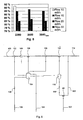
- Figure 5 illustrates the different degrees of solids recovery at different feed rates as a function of the rotating speed of the decanted cylinder.
- the test apparatus was adjusted to give as high a discharge consistency of the solids as possible. This kind of an adjustment is as such better suited in the concentration of the biological sludge of waste water treatment plants than in the treatment of pulp production waters. By optimising the apparatus the solids recovery degree and the capacity can be improved further.
- the reference number 100 refers to the wood material brought to the process, the material being diluted to a suitable consistency at 102.
- Filtrate from the circulation water tank 104 of the process is used in the dilution.
- the pulp obtained from the dilution is brought to screening 106 and the accepted fraction obtained from the screening is thickened for example with a disc filter 108.
- the purpose of the thickening is both, as is natural, to raise the consistency of the pulp and to remove extractives from the pulp.
- the thickened pulp is reintroduced to dilution 110 where the consistency is adjusted to be suitable for further processing.
- the pulp is brought to a washer 112, which is preferably a press, either a screw or a wire press. After the wash the pulp 114 is transported either directly to the paper mill or to bleaching.
- Figure 6 illustrates also, how the filtrate from the thickener 108, which in this example is disc filter, and the wash filtrate from the washer 112, however, via a filtrate tank 116 of its own, are brought to a circulation water tank 104, where filtrates from different sources are mixed with each other.
- a decanter centrifuge 60 has been connected to the process and filtrate obtained from the washer 112 is brought from the filtrate tank 116 to the decanter centrifuge via a valve 118.
- the task of the centrifuge 60 is to recover from the filtrate fibre material suitable for paper production, the material being guided in a flow 120 to pulp 114, which is forwarded to further processing, and to separate from the filtrate lipophilic extractives to a separate flow 122.
- Figure 6 further illustrates with the reference number 124 clean fresh water brought to the process to replace the water volume discharged from the process. Water is removed for example with the pulp 114 discharged from the process and both from the circulation water tank 104 in the flow 126 and from the filtrate tank 116 with the extractives in the flow 122.
- the flows and apparatus of the simulation model 100 Wood into the process.
- the solids flow is chosen to be 1 kg/s.
- the total volume of lipophilic extractives is known to be 8 mg/g and their share in the water phase is 60 %.
- the water flow is 0.992 kg/s.
- the consistency is 50 % and the total flow rate 2 kg/s.
- the dilution is performed with filtrate from the circulation water tank 7.
- the module used is CONSIS. 108 Thickening, the typical values of the disc filter are used in the simulation.
- this thickener which corresponds to a disc, produces only one filtrate.
- the solids content of the filtrate is 68.4 mg/l. 110 Dilution with the filtrate from the circulation water tank 44 to a consistency of 6 %.
- the module used CONSIS. 112 A press serving as a washer. In the simulation, typical readings of both a wire press and a screw press have been used for comparison. - the values of a wire press: final consistency 40 %, retention of lipophilic extractives 30 %, recovery degree of solids 99 %, the module used FLOTA2.
- the solids content of the filtrate of this press is 704,6 mg/l.
- Water is discharged for the process with the discharged pulp 114 and in the circulation water discharge 126 and filtrate discharged, 122, of the press 116 if they are used. This replacing fresh water is perfectly clean water.
- 122 Water fraction from the solids recovery, which is discharged from the process.
- 126 Water fraction from the circulation water tank 104, which is discharged from the process.
- 118 Valve for regulating the solilds flow to the solids recovery.
- the module used FSET. 128 Valve for regulating the water fraction 126 discharged from the process from the circulation water tank 104.
- Figure 7 illustrates the solids losses (%) of the process obtained from a simulation according to Figure 6 as a function of the filtrate volume flowing to the solids recovery(l/kg abs. dry matter) with different solids recovery methods.
- the recovery methods were a decanter centrifuge, a screening method and a disc filter. For comparison, also a case was taken up where solids were not recovered.
- the results indicate that the solids losses with a decanter centrifuge and a disc filter are essentially the same, i. e. less than 10 % compared with a situation where solids were not recovered.
- the solids losses were a little more than one third compared with the situation with no fibre recovery.
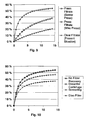
- Figure 8 illustrates solids losses (%) of the process obtained from a simulation according to Figure 6 as a function of the filtrate volume (l/kg abs. dry pulp) discharged from the process with different process filtrates.
- the process filtrates treated were filtrates from a screw press and a wire press and for comparison so-called clear filtrate of the present technology.
- the amount of solids removed with the filtrate from a screw press is about three times the amount removed by a wire press, and roughly expressed about twenty times the amount removed with a clear filtrate.
- Figure 9 illustrates separation efficiencies of lipophilic extractives (%) as a function of the filtrate volume discharged from the process (l/kg abs. dry pulp) obtained from a simulation according to Figure 6 with different process filtrates.
- a screw press reaches a level of its own. Its separation efficiency very quickly rises over thirty percent and ends up at over fifty percent. The separation efficiency of a wire press rises more slowly, however, reaching in the end a level of close to forty percent.
- Figure 10 illustrates separation efficiencies of lipophilic extractives (%) as a function of the filtrate volume flowing to the solids recovery (l/kg abs. dry pulp) obtained from a simulation according to Figure 6 with different solids recovery methods.
- the recovery methods were the same as in Figure 6 .
- the best separation efficiency was reached with a decanter centrifuge or, when solids were not recovered, the screening method was a little worse and the disc filter even a little worse than the screening method.
- Figure 11 illustrates consistencies (%) of the discharged pulp as a function of the filtrate volume flowing to the fibre recovery (l/kg abs. dry pulp) obtained from a simulation according to Figure 6 with different solids recovery methods.
- An interesting feature is that the consistency of the discharging pulp remains practically constant irrespective of the volume of filtrate with all other recovery methods except with the screening method with which the consistency decreased from forty percent to less than 25 percent.
- a process application according to a preferred embodiment of the invention is illustrated in Figure 12 .
- the application is a PGW plant (also GW and other processes based on grinding), into which the wood material 140 is brought in the form of logs, which are ground under high pressure.
- the fibre suspension produced as a result of the grinding 142 is transported to a so-called hot loop thickening 144 where filtrate is removed from the suspension.
- the suspension itself continues thickened to a sorting 146 and the filtrate to a hot water tank 148.
- a part of the liquid from the hot water tank 148 is returned to the grinding 142 and a part is taken to a decanter centrifuge 60 where the solids S are recovered from the liquid in the manner described above and can be recycled to the process.
- the extractives E remaining in the liquid phase are discharged from the process separate from the solids S.
- FIG 13 illustrates a process application according to another preferred embodiment of the invention. Also this application relates to a PGW plant (also GW and other processes based on grinding) and resembles closely the application in Figure 12 ; in the version of Figure 13 , only a press 150 has been added after the hot loop thickener 144.
- the filtrate from the press 150 is taken to a filtrate tank 152 from which at least a portion of the filtrate is further taken to decanter centrifuge 60 where the extractive material and the solids to be recovered and to be recycled to the process are separated to form separate flows.
- Figure 14 illustrates a process application according to a third preferred embodiment of the invention.
- This application relates to a pulp manufacturing process portion following a sorting 160. After the sorting 160 the pulp suspension is guided to a thickening 162 where the filtrate is separated and transported to a circulation water tank 164. A portion of the filtrate is returned to the pulp suspension prior to the sorting 160 to dilute the suspension and a portion is guided to the decanter centrifuge 60 where the usable solid material S is separated from the filtrate for recycling to the process, and the extractive material E for removal from the process.
- FIG. 15 illustrates a process application according to a fourth preferred embodiment of the invention.
- This application relates to a thickening and pressing process preceding the bleaching of mechanical or chemi-mechanical pulp.
- a thickening 170 in which filtrate is removed to a circulation water tank 172 in order to raise the consistency.
- the thickened fibre suspension is introduced further to a bleaching press 174, where filtrate is further removed from the suspension.
- the fibre suspension travels from the bleaching press 174 to bleaching 176 and the filtrate from the press 174 to a filtrate tank 178.
- a portion of the filtrate collected to the filtrate tank 178 is transported to dilute the pulp before the thickening 170 and a portion to the decanter centrifuge 60, where the filtrate is divided in the way described above into a fraction containing solids S to be recycled into the process, and into a fraction containing extractives E to be removed from the process.
- FIG 16 illustrates a process application according to a fifth preferred embodiment of the invention suitable for use in connection with any of the processes covered by this invention.
- the decanter centrifuge has been arranged to treat filtrate from a washing press 182 following a bleaching180.
- a portion of the filtrate of the washing press 182 is guided from the filtrate tank 184 back to the process to be used prior to the press 182 in the dilution of the fibre suspension while a portion flows to the decanter centrifuge 60.
- the solid material S is separated from the filtrate for recycling to the process and the extractives E for removal from the process.
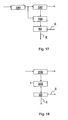
- FIG 17 illustrates a process application according to a sixth preferred embodiment of the invention. It describes a refining process (CTMP or APMP); the fibre suspension obtained after a refining phase 190 of the process is transported to a press 192 in which filtrate is pressed out from the suspension by a known method. The filtrate is guided to a filtrate tank 194 from which at least a portion of the filtrate is guided to a decanter centrifuge 60, which separates from the filtrate the recoverable solids S to a flow of its own to be returned to the process and the extractive material E to a flow to be discharged from the process.
- CTMP refining process
- APMP APMP
- FIG 18 illustrates a process application according to a seventh preferred embodiment of the invention. Also that describes for example a refining process (TMP, CTMP, CMP, APMP and other processes in which the wood raw material is chopped into chips prior to at least a partial mechanical defiberizing), in which a first press 200 is arranged to treat the chips. It has been found advantageous to recover already at this stage at least part of the filtrate via a filtrate tank 202 to the decanter centrifuge 60 in order to separate from each other the extractives E, and the solids S to be returned to the process.
- TMP refining process
- CTMP CMP
- APMP partial mechanical defiberizing
- Figure 19 illustrates a process application according to an eighth preferred embodiment of the invention, suitable for use in connection with any mechanical or chemi-mechanical process.
- the figure illustrates how an apparatus 212 has been disposed after a filtrate tank 210 and prior to a decanter centrifuge 60; the apparatus 212 can be for example a screen, a separator, a fractionator, a thickener or a corresponding device, which is intended to have an appropriate influence on the filtrate to be introduced into the decanter centrifuge 60.
- One possibility is for example a thickener with which water is separated from the filtrate flowing to the decanter centrifuge whereby the size of the centrifuge required can be reduced as the liquid flow to be treated decreases.
- the process described also creates a situation where, when the apparatus 212 is for example a disc filter (the consistency of the incoming pulp for example 0.3%) whereby the extractives readily remain in the suspension thickened by the disc filter, there are in the filtrate of the disc filter (consistency 0 %) relatively small amounts of extractives as they accumulate into the cake (consistency 0,6 %) of the disc filter which is transported further to the centrifuge. Then, although the centrifuge can be fairly small in size the liquid flow it treats contains remarkable amounts of extractives.
- Another alternative is an apparatus separating fibre fractions with which a portion of the fibre can be removed before the centrifuge.
- the processed described above can include also washers, which in this context are devices in which the consistency of the pulp fed into the device and that of the pulp discharged from the devices are essentially the same.
- the filtrate of the washer is analogous with the filtrate of a thickener or a press or a corresponding device, which removes liquid from the pulp, and thus it can be treated in a decanter centrifuge or a corresponding device for separating extractives from the usable solids.
- the decanter centrifuge or the corresponding device 60 is always preceded by a filtrate stank, in suitable conditions this can be omitted altogether, in which case there is a pipeline extending from a press or a corresponding device to the decanted centrifuge or a corresponding device.
- the filtrate tank can be replaced by two or even three filtrate tanks if the preceding liquid removing devices allows separating several types of filtrates (for example cloudy, clear, super clear).
- each portion of the above filtrates can be used in the way desired (for example as dilution liquid, as liquid to be treated in a decanter centrifuge, as waste water to be transferred to a channel, etc.)
Landscapes
- Paper (AREA)
- Extraction Or Liquid Replacement (AREA)
- Treatment Of Liquids With Adsorbents In General (AREA)
- Solid-Sorbent Or Filter-Aiding Compositions (AREA)
Claims (11)
- Verfahren zum kontinuierlichen Rückgewinnen von sowohl Faser-, als auch faserbasierten Feststoffen aus einem Filtrat einer mechanischen oder chemomechanischen Zellstoff verarbeitenden Industrie, wobei die Feststoffe sowohl festes, als auch kolloidales lipophiles extrahiertes Material enthalten, das Verfahren umfasst die Schrittea) Transportieren des Filtrats zu einer Zentrifuge (60), die eine starke Zentralbeschleunigung entwickelt, wobei die Zentrifuge (60) entweder eine Dekanterzentrifuge oder eine Filterkugelzentrifuge ist;b) wobei in der Zentrifuge (60) das Filtrat in zwei Anteile getrennt wird, nämlich in einen flüssigen Anteil (E), der das kolloidale, lipohile extrahierte Material enthält und einen weiteren Anteil (S), der die Faser- und faserbasierten Feststoffe enthält, wobei die starke Zentralbeschleunigung, die in der Zentrifuge (60) erzeugt wird, derart gestaltet ist, dass der weitere Anteil, der die Faser- und faserbasierten Feststoffe enthält, sich an einer inneren Oberfläche der Zentrifuge (60) absetzt;c) mechanisches Entladen des getrennten weiteren Anteils (S), der die Faser- und faserbasierten Feststoffe enthält, aus der Zentrifuge (60) mit der Hilfe eines Schraubenförderers (82), der innerhalb der Zentrifuge (60) angeordnet ist; undd) Entfernen des flüssigen Anteils (E) aus der Zentrifuge (60), als getrennten Fluss.
- Verfahren nach Anspruch 1, bei dem das Filtrat ein Filtrat eines Waschapparats (112), einer Presse oder eines Eindickers ist.
- Verfahren nach Anspruch 1, bei dem der weitere Anteil (S), der die Faser- und faserbasierten Feststoffe enthält, aus der Zentrifuge (60) in einer Stoffdichte von mehr als 20 Prozent abgeführt wird, so dass er direkt in dem Hauptfluss entweder einer Papierfabrik oder eines Bleichverfahrens wiederverwertet werden kann.
- Verfahren nach Anspruch 3, bei dem das Filtrat ist:- das Filtrat aus einem Heissschlaufeneindickungsschritt (144) einer feststofferzeugenden Anlage, oder- das Filtrat aus einer Presse, (150) die einem einem Heissschlaufeneindickungsschritt (144) einer feststofferzeugenden Anlage folgt, oder- das Filtrat aus einem Eindickungsschritt (162), der einem Sortierschritt (160) in einer feststofferzeugenden Anlage folgt, oder- das Filtrat aus einer Bleichpresse (174) die in einer feststofferzeugenden Anlage einen Bleichschritt (176)voranstellt, oder- das Filtrat aus einer Waschpresse (182) die einem Bleichschritt (180) in einer feststofferzeugenden Anlage folgt, oder- das Filtrat aus einer Presse (192), die einem Verfeinerungsschritt (190) in einer feststofferzeugenden Anlage folgt, oder- das Filtrat aus einer Chip-Presse in einer feststofferzeugenden Anlage.
- Verfahren nach Anspruch 1, bei dem vor Schritt a) das Filtrat zumindest in einem Zerkleinerer, einem Eindicker, einem Filter oder einem Trenner behandelt wird.
- Verfahren nach Anspruch 1, bei dem die Zentralbeschleunigung größer als 200g ist.
- Vorrichtung für die Verwendung in einer mechanischen und chemomechanischen Zellstoff verarbeitenden Industrie, wobei die Vorrichtung eine Einrichtung (112, 144, 150, 162, 174, 182, 192, 200) zum Trennen eines Filtrats von einem mechanischen oder chemomechanischen Stoff umfasst, wobei das Filtrat sowohl festes, als auch kolloidales lipophiles extrahiertes Material enthält, und eine Zentrifuge (60) zum kontinuierlichen Rückgewinnen der Faser-, als auch faserbasierten Feststoffe aus dem Filtrat umfasst, bei der die Zentrifuge (60) entweder eine Dekanterzentrifuge oder eine Filterkugelzentrifuge ist, wobei die Zentrifuge (60) das Filtrat in zwei Anteile trennt, nämlich einen flüssigen Anteil (E), der das kolloidale, lipohile extrahierte Material enthält und einen weiteren Anteil (S), der die Faser- und faserbasierten Feststoffe enthält, durch Erzeugen einer starken Zentralbeschleunigung in einer solchen Weise, dass der weitere Anteil, (S) der die Faser- und faserbasierten Feststoffe enthält, sich an einer inneren Oberfläche der Zentrifuge (60) absetzt, und bei der der weitere Anteil (S), der die Faser- und faserbasierten Feststoffe enthält, mechanisch von der Zentrifuge (60) abgeführt wird, mit Hilfe eines Schraubenförderers (82), der innerhalb der Zentrifuge (60) angeordnet ist, und der flüssige Anteil (E) von der Zentrifuge als getrennter Fluss entfernt wird.
- Vorrichtung nach Anspruch 7, bei der eine Einrichtung (212) für das Vorbehandeln des Filtrats zwischen der Filtrattrenneinrichtung und der Zentrifuge angeordnet ist.
- Vorrichtung nach Anspruch 8, bei der die vorbehandelnde Einrichtung (212) ein Filter, ein Eindicker, ein Zerkleinerer und/oder ein Trenner ist.
- Vorrichtung nach Anspruch 7, bei der die innere Oberfläche der Zentrifuge (60), auf der sich der weitere, die Faser- und faserbasierten Feststoffe enthaltende Anteil (S) während der Trennung absetzt, ungebrochen ist.
- Vorrichtung nach Anspruch 10, bei der die Filtrattrenneinrichtung (112, 144, 150, 162, 174, 182, 192, 200) ein Eindicker, eine Presse oder ein Waschapparat ist.
Applications Claiming Priority (3)
| Application Number | Priority Date | Filing Date | Title |
|---|---|---|---|
| FI20010967 | 2001-05-09 | ||
| FI20010967A FI110580B (fi) | 2001-05-09 | 2001-05-09 | Menetelmä kuidun sekä kuitupohjaisen kiintoaineen talteenottamiseksi sekä rasvaliukoisten uuteaineiden erottamiseksi |
| PCT/FI2002/000391 WO2002090647A1 (en) | 2001-05-09 | 2002-05-07 | Method and apparatus for recovering fibre and fibre-based solids from filtrates containing both solids and liposoluble extractive agents of mechanical or chemi-mechanical pulp industry |
Publications (2)
| Publication Number | Publication Date |
|---|---|
| EP1392913A1 EP1392913A1 (de) | 2004-03-03 |
| EP1392913B1 true EP1392913B1 (de) | 2009-07-01 |
Family
ID=8561155
Family Applications (1)
| Application Number | Title | Priority Date | Filing Date |
|---|---|---|---|
| EP02722318A Expired - Lifetime EP1392913B1 (de) | 2001-05-09 | 2002-05-07 | Verfahren und vorrichtung zur rückgewinnung von fasern und faserbasierenden feststoffen aus einem filtrat der mechanischen oder chemomechanischen holzstoffindustrie, welches filtrat sowohl feststoffe als auch lipophiles extraktmaterial enthält |
Country Status (6)
| Country | Link |
|---|---|
| EP (1) | EP1392913B1 (de) |
| AT (1) | ATE435328T1 (de) |
| CA (1) | CA2446407C (de) |
| DE (1) | DE60232791D1 (de) |
| FI (1) | FI110580B (de) |
| WO (1) | WO2002090647A1 (de) |
Cited By (2)
| Publication number | Priority date | Publication date | Assignee | Title |
|---|---|---|---|---|
| WO2021253107A1 (en) * | 2020-06-17 | 2021-12-23 | Suzano S.A. | Method to treat a condensate in a pulping process |
| RU2840052C1 (ru) * | 2020-06-17 | 2025-05-16 | Сусано С.А. | Способ обработки конденсата в процессе варки целлюлозы |
Families Citing this family (2)
| Publication number | Priority date | Publication date | Assignee | Title |
|---|---|---|---|---|
| CN102392381B (zh) * | 2011-08-02 | 2013-09-25 | 华南理工大学 | 一种化机浆废液碱回收预处理方法 |
| FI20215862A1 (en) * | 2021-08-17 | 2023-02-18 | Metsae Board Oyj | Process, uses thereof, pulp composition and system |
Family Cites Families (4)
| Publication number | Priority date | Publication date | Assignee | Title |
|---|---|---|---|---|
| DD223479A1 (de) * | 1984-04-12 | 1985-06-12 | Zellstoff U Papierfabrik Rosen | Verfahren zur mechanischen entharzung von sulfitzellstoff |
| FI81396C (fi) * | 1988-10-25 | 1990-10-10 | Enso Gutzeit Oy | Foerfarande foer behandling av avfallsvatten fraon traefoeraedlingsindustrins massaframstaellningsprocesser. |
| US5321898A (en) * | 1992-06-19 | 1994-06-21 | Decanter Machine, Inc. | Centrifugal screen bowl dryer |
| US5468396A (en) * | 1994-03-16 | 1995-11-21 | Pulp And Paper Research Institute Of Canada | Centrifugal cleaning of pulp and paper process liquids |
-
2001
- 2001-05-09 FI FI20010967A patent/FI110580B/fi not_active IP Right Cessation
-
2002
- 2002-05-07 EP EP02722318A patent/EP1392913B1/de not_active Expired - Lifetime
- 2002-05-07 CA CA002446407A patent/CA2446407C/en not_active Expired - Fee Related
- 2002-05-07 AT AT02722318T patent/ATE435328T1/de not_active IP Right Cessation
- 2002-05-07 DE DE60232791T patent/DE60232791D1/de not_active Expired - Lifetime
- 2002-05-07 WO PCT/FI2002/000391 patent/WO2002090647A1/en not_active Ceased
Cited By (3)
| Publication number | Priority date | Publication date | Assignee | Title |
|---|---|---|---|---|
| WO2021253107A1 (en) * | 2020-06-17 | 2021-12-23 | Suzano S.A. | Method to treat a condensate in a pulping process |
| RU2840052C1 (ru) * | 2020-06-17 | 2025-05-16 | Сусано С.А. | Способ обработки конденсата в процессе варки целлюлозы |
| US12522979B2 (en) | 2020-06-17 | 2026-01-13 | Suzano S.A. | Method to treat a condensate in a pulping process |
Also Published As
| Publication number | Publication date |
|---|---|
| ATE435328T1 (de) | 2009-07-15 |
| CA2446407A1 (en) | 2002-11-14 |
| FI20010967A0 (fi) | 2001-05-09 |
| WO2002090647A1 (en) | 2002-11-14 |
| DE60232791D1 (de) | 2009-08-13 |
| FI110580B (fi) | 2003-02-28 |
| CA2446407C (en) | 2010-01-12 |
| EP1392913A1 (de) | 2004-03-03 |
| FI20010967L (fi) | 2002-11-10 |
Similar Documents
| Publication | Publication Date | Title |
|---|---|---|
| CA2133630C (en) | Method and apparatus for screening waste paper pulp | |
| KR900004943B1 (ko) | 폐지처리용 선별 및 세척장치 | |
| DE68928632T2 (de) | Verfahren und Vorrichtung zum Behandeln von Faserbrei | |
| US20110061829A1 (en) | Method for degassing and supplying a fibrous suspension to a headbox or a filter device and degassing device | |
| FI82082B (fi) | Foerfarande och anordning foer behandling av massa. | |
| TW444077B (en) | Method and apparatus for screening waste paper pulp | |
| CN101027446A (zh) | 生产纤维素浆的方法和装置 | |
| US8262849B2 (en) | Apparatus and method for manufacturing fibre mass suspension | |
| US5468396A (en) | Centrifugal cleaning of pulp and paper process liquids | |
| EP1392913B1 (de) | Verfahren und vorrichtung zur rückgewinnung von fasern und faserbasierenden feststoffen aus einem filtrat der mechanischen oder chemomechanischen holzstoffindustrie, welches filtrat sowohl feststoffe als auch lipophiles extraktmaterial enthält | |
| CA2085306C (en) | Method and apparatus for treating white water | |
| SE527041C2 (sv) | Förfarande för selektivt avlägsnande av märgstråleceller ur cellulosamassa | |
| KR100495098B1 (ko) | 폐지로부터 펄프를 생산하는 장치 및 방법 | |
| JPS62199888A (ja) | 故紙から得られる繊維懸濁液からインク粒子を除去する方法と装置 | |
| US7163604B2 (en) | Production of fiber suspension from waste paper | |
| CN101072912B (zh) | 用离心净化器使回用纸脱墨的方法 | |
| JPS5934834B2 (ja) | 故紙を含む原料から紙繊維を回収する方法および装置 | |
| CA2634529C (en) | Method for preparing paper pulp from recycled paper containing contaminants | |
| EP0887458A1 (de) | Verfahren zum Suspendieren und Reinigen von störstoffhaltigen Papierrohstoffen | |
| WO2004067838A1 (en) | Method and device for handling filler-containing broke in a paper machine and a board machine | |
| AU750899B2 (en) | Screening of fibrous suspensions | |
| CN109983175B (zh) | 用于工艺水处理的设备 | |
| FI113948B (fi) | Menetelmä ja laitteisto nollaveden käsittelemiseksi | |
| WO1994025667A1 (en) | Apparatus and method for treating a pulp slurry of waste paper | |
| Holik et al. | Stock preparation |
Legal Events
| Date | Code | Title | Description |
|---|---|---|---|
| PUAI | Public reference made under article 153(3) epc to a published international application that has entered the european phase |
Free format text: ORIGINAL CODE: 0009012 |
|
| 17P | Request for examination filed |
Effective date: 20031205 |
|
| AK | Designated contracting states |
Kind code of ref document: A1 Designated state(s): AT BE CH CY DE DK ES FI FR GB GR IE IT LI LU MC NL PT SE TR |
|
| AX | Request for extension of the european patent |
Extension state: AL LT LV MK RO SI |
|
| RAP1 | Party data changed (applicant data changed or rights of an application transferred) |
Owner name: V & K CONSULTING OY |
|
| GRAP | Despatch of communication of intention to grant a patent |
Free format text: ORIGINAL CODE: EPIDOSNIGR1 |
|
| RTI1 | Title (correction) |
Free format text: METHOD AND APPARATUS FOR RECOVERING FIBRE AND FIBRE-BASED SOLIDS FROM A FILTRATE OF THE MECHANICAL OR CHEMI-MECHANICAL WOOD PULP INDUSTRY, SAID FILTRATE CONTAINING BOTH SOLIDS AN |
|
| RIC1 | Information provided on ipc code assigned before grant |
Ipc: D21F 1/66 20060101ALI20081204BHEP Ipc: D21C 5/00 20060101AFI20081204BHEP |
|
| GRAS | Grant fee paid |
Free format text: ORIGINAL CODE: EPIDOSNIGR3 |
|
| GRAA | (expected) grant |
Free format text: ORIGINAL CODE: 0009210 |
|
| RAP1 | Party data changed (applicant data changed or rights of an application transferred) |
Owner name: ANDRITZ AG |
|
| AK | Designated contracting states |
Kind code of ref document: B1 Designated state(s): AT BE CH CY DE DK ES FI FR GB GR IE IT LI LU MC NL PT SE TR |
|
| REG | Reference to a national code |
Ref country code: GB Ref legal event code: FG4D |
|
| REG | Reference to a national code |
Ref country code: CH Ref legal event code: EP |
|
| REG | Reference to a national code |
Ref country code: IE Ref legal event code: FG4D |
|
| REF | Corresponds to: |
Ref document number: 60232791 Country of ref document: DE Date of ref document: 20090813 Kind code of ref document: P |
|
| REG | Reference to a national code |
Ref country code: SE Ref legal event code: TRGR |
|
| NLV1 | Nl: lapsed or annulled due to failure to fulfill the requirements of art. 29p and 29m of the patents act | ||
| PG25 | Lapsed in a contracting state [announced via postgrant information from national office to epo] |
Ref country code: FI Free format text: LAPSE BECAUSE OF FAILURE TO SUBMIT A TRANSLATION OF THE DESCRIPTION OR TO PAY THE FEE WITHIN THE PRESCRIBED TIME-LIMIT Effective date: 20090701 Ref country code: ES Free format text: LAPSE BECAUSE OF FAILURE TO SUBMIT A TRANSLATION OF THE DESCRIPTION OR TO PAY THE FEE WITHIN THE PRESCRIBED TIME-LIMIT Effective date: 20091012 |
|
| PG25 | Lapsed in a contracting state [announced via postgrant information from national office to epo] |
Ref country code: NL Free format text: LAPSE BECAUSE OF FAILURE TO SUBMIT A TRANSLATION OF THE DESCRIPTION OR TO PAY THE FEE WITHIN THE PRESCRIBED TIME-LIMIT Effective date: 20090701 |
|
| PG25 | Lapsed in a contracting state [announced via postgrant information from national office to epo] |
Ref country code: PT Free format text: LAPSE BECAUSE OF FAILURE TO SUBMIT A TRANSLATION OF THE DESCRIPTION OR TO PAY THE FEE WITHIN THE PRESCRIBED TIME-LIMIT Effective date: 20091102 |
|
| PG25 | Lapsed in a contracting state [announced via postgrant information from national office to epo] |
Ref country code: DK Free format text: LAPSE BECAUSE OF FAILURE TO SUBMIT A TRANSLATION OF THE DESCRIPTION OR TO PAY THE FEE WITHIN THE PRESCRIBED TIME-LIMIT Effective date: 20090701 |
|
| PLBE | No opposition filed within time limit |
Free format text: ORIGINAL CODE: 0009261 |
|
| STAA | Information on the status of an ep patent application or granted ep patent |
Free format text: STATUS: NO OPPOSITION FILED WITHIN TIME LIMIT |
|
| PG25 | Lapsed in a contracting state [announced via postgrant information from national office to epo] |
Ref country code: BE Free format text: LAPSE BECAUSE OF FAILURE TO SUBMIT A TRANSLATION OF THE DESCRIPTION OR TO PAY THE FEE WITHIN THE PRESCRIBED TIME-LIMIT Effective date: 20090701 |
|
| 26N | No opposition filed |
Effective date: 20100406 |
|
| PGFP | Annual fee paid to national office [announced via postgrant information from national office to epo] |
Ref country code: FR Payment date: 20100611 Year of fee payment: 9 |
|
| PGFP | Annual fee paid to national office [announced via postgrant information from national office to epo] |
Ref country code: DE Payment date: 20100521 Year of fee payment: 9 Ref country code: AT Payment date: 20100513 Year of fee payment: 9 |
|
| PG25 | Lapsed in a contracting state [announced via postgrant information from national office to epo] |
Ref country code: GR Free format text: LAPSE BECAUSE OF FAILURE TO SUBMIT A TRANSLATION OF THE DESCRIPTION OR TO PAY THE FEE WITHIN THE PRESCRIBED TIME-LIMIT Effective date: 20091002 |
|
| PGFP | Annual fee paid to national office [announced via postgrant information from national office to epo] |
Ref country code: SE Payment date: 20100517 Year of fee payment: 9 |
|
| PG25 | Lapsed in a contracting state [announced via postgrant information from national office to epo] |
Ref country code: MC Free format text: LAPSE BECAUSE OF NON-PAYMENT OF DUE FEES Effective date: 20100531 |
|
| REG | Reference to a national code |
Ref country code: CH Ref legal event code: PL |
|
| GBPC | Gb: european patent ceased through non-payment of renewal fee |
Effective date: 20100507 |
|
| PG25 | Lapsed in a contracting state [announced via postgrant information from national office to epo] |
Ref country code: LI Free format text: LAPSE BECAUSE OF NON-PAYMENT OF DUE FEES Effective date: 20100531 Ref country code: CH Free format text: LAPSE BECAUSE OF NON-PAYMENT OF DUE FEES Effective date: 20100531 |
|
| PG25 | Lapsed in a contracting state [announced via postgrant information from national office to epo] |
Ref country code: IT Free format text: LAPSE BECAUSE OF FAILURE TO SUBMIT A TRANSLATION OF THE DESCRIPTION OR TO PAY THE FEE WITHIN THE PRESCRIBED TIME-LIMIT Effective date: 20090701 |
|
| PG25 | Lapsed in a contracting state [announced via postgrant information from national office to epo] |
Ref country code: IE Free format text: LAPSE BECAUSE OF NON-PAYMENT OF DUE FEES Effective date: 20100507 |
|
| PG25 | Lapsed in a contracting state [announced via postgrant information from national office to epo] |
Ref country code: GB Free format text: LAPSE BECAUSE OF NON-PAYMENT OF DUE FEES Effective date: 20100507 |
|
| REG | Reference to a national code |
Ref country code: SE Ref legal event code: EUG |
|
| REG | Reference to a national code |
Ref country code: AT Ref legal event code: MM01 Ref document number: 435328 Country of ref document: AT Kind code of ref document: T Effective date: 20110507 |
|
| REG | Reference to a national code |
Ref country code: FR Ref legal event code: ST Effective date: 20120131 |
|
| PG25 | Lapsed in a contracting state [announced via postgrant information from national office to epo] |
Ref country code: AT Free format text: LAPSE BECAUSE OF NON-PAYMENT OF DUE FEES Effective date: 20110507 |
|
| REG | Reference to a national code |
Ref country code: DE Ref legal event code: R119 Ref document number: 60232791 Country of ref document: DE Effective date: 20111201 |
|
| PG25 | Lapsed in a contracting state [announced via postgrant information from national office to epo] |
Ref country code: FR Free format text: LAPSE BECAUSE OF NON-PAYMENT OF DUE FEES Effective date: 20110531 |
|
| PG25 | Lapsed in a contracting state [announced via postgrant information from national office to epo] |
Ref country code: CY Free format text: LAPSE BECAUSE OF FAILURE TO SUBMIT A TRANSLATION OF THE DESCRIPTION OR TO PAY THE FEE WITHIN THE PRESCRIBED TIME-LIMIT Effective date: 20090701 |
|
| PG25 | Lapsed in a contracting state [announced via postgrant information from national office to epo] |
Ref country code: LU Free format text: LAPSE BECAUSE OF NON-PAYMENT OF DUE FEES Effective date: 20100507 |
|
| PG25 | Lapsed in a contracting state [announced via postgrant information from national office to epo] |
Ref country code: TR Free format text: LAPSE BECAUSE OF FAILURE TO SUBMIT A TRANSLATION OF THE DESCRIPTION OR TO PAY THE FEE WITHIN THE PRESCRIBED TIME-LIMIT Effective date: 20090701 |
|
| PG25 | Lapsed in a contracting state [announced via postgrant information from national office to epo] |
Ref country code: SE Free format text: LAPSE BECAUSE OF NON-PAYMENT OF DUE FEES Effective date: 20110508 |
|
| PG25 | Lapsed in a contracting state [announced via postgrant information from national office to epo] |
Ref country code: DE Free format text: LAPSE BECAUSE OF NON-PAYMENT OF DUE FEES Effective date: 20111201 |