EP1397352B1 - Procede d'isolation de bisaryltriazines monophenoliques - Google Patents
Procede d'isolation de bisaryltriazines monophenoliques Download PDFInfo
- Publication number
- EP1397352B1 EP1397352B1 EP02726905.9A EP02726905A EP1397352B1 EP 1397352 B1 EP1397352 B1 EP 1397352B1 EP 02726905 A EP02726905 A EP 02726905A EP 1397352 B1 EP1397352 B1 EP 1397352B1
- Authority
- EP
- European Patent Office
- Prior art keywords
- carbon atoms
- triazine
- solvent
- compound
- mixture
- Prior art date
- Legal status (The legal status is an assumption and is not a legal conclusion. Google has not performed a legal analysis and makes no representation as to the accuracy of the status listed.)
- Expired - Lifetime
Links
- 238000002955 isolation Methods 0.000 title claims description 59
- 238000000034 method Methods 0.000 title claims description 59
- 150000003918 triazines Chemical class 0.000 title description 12
- 239000000203 mixture Substances 0.000 claims description 126
- 125000004432 carbon atom Chemical group C* 0.000 claims description 101
- 239000002904 solvent Substances 0.000 claims description 52
- 238000010992 reflux Methods 0.000 claims description 49
- 239000000047 product Substances 0.000 claims description 45
- 150000001875 compounds Chemical class 0.000 claims description 41
- XLYOFNOQVPJJNP-UHFFFAOYSA-N water Substances O XLYOFNOQVPJJNP-UHFFFAOYSA-N 0.000 claims description 33
- 150000007529 inorganic bases Chemical class 0.000 claims description 25
- 229910052757 nitrogen Inorganic materials 0.000 claims description 23
- 229910052739 hydrogen Inorganic materials 0.000 claims description 17
- 239000001257 hydrogen Substances 0.000 claims description 17
- 125000004435 hydrogen atom Chemical group [H]* 0.000 claims description 17
- 125000003118 aryl group Chemical group 0.000 claims description 16
- 239000004215 Carbon black (E152) Substances 0.000 claims description 14
- 229930195733 hydrocarbon Natural products 0.000 claims description 14
- 150000002430 hydrocarbons Chemical class 0.000 claims description 14
- 239000007787 solid Substances 0.000 claims description 14
- 125000000217 alkyl group Chemical group 0.000 claims description 13
- 125000002252 acyl group Chemical group 0.000 claims description 12
- 125000003342 alkenyl group Chemical group 0.000 claims description 12
- 125000003710 aryl alkyl group Chemical group 0.000 claims description 12
- 125000004429 atom Chemical group 0.000 claims description 12
- 125000000753 cycloalkyl group Chemical group 0.000 claims description 12
- 125000001188 haloalkyl group Chemical group 0.000 claims description 12
- 239000000706 filtrate Substances 0.000 claims description 9
- 229920006395 saturated elastomer Polymers 0.000 claims description 9
- -1 triazine compound Chemical class 0.000 claims description 9
- 125000002529 biphenylenyl group Chemical group C1(=CC=CC=2C3=CC=CC=C3C12)* 0.000 claims description 8
- 125000002837 carbocyclic group Chemical group 0.000 claims description 8
- UFWIBTONFRDIAS-UHFFFAOYSA-N naphthalene-acid Natural products C1=CC=CC2=CC=CC=C21 UFWIBTONFRDIAS-UHFFFAOYSA-N 0.000 claims description 8
- 150000002790 naphthalenes Chemical class 0.000 claims description 8
- 125000003545 alkoxy group Chemical group 0.000 claims description 4
- 238000001914 filtration Methods 0.000 claims description 4
- 125000004433 nitrogen atom Chemical group N* 0.000 claims description 4
- 229910052760 oxygen Inorganic materials 0.000 claims description 4
- 125000004430 oxygen atom Chemical group O* 0.000 claims description 4
- 125000004434 sulfur atom Chemical group 0.000 claims description 4
- LFQSCWFLJHTTHZ-UHFFFAOYSA-N Ethanol Chemical compound CCO LFQSCWFLJHTTHZ-UHFFFAOYSA-N 0.000 claims description 3
- 239000002253 acid Substances 0.000 claims description 2
- CDBYLPFSWZWCQE-UHFFFAOYSA-L Sodium Carbonate Chemical compound [Na+].[Na+].[O-]C([O-])=O CDBYLPFSWZWCQE-UHFFFAOYSA-L 0.000 description 64
- 239000012535 impurity Substances 0.000 description 60
- FROCQMFXPIROOK-UHFFFAOYSA-N 4-[4,6-bis(2,4-dimethylphenyl)-1,3,5-triazin-2-yl]benzene-1,3-diol Chemical compound CC1=CC(C)=CC=C1C1=NC(C=2C(=CC(C)=CC=2)C)=NC(C=2C(=CC(O)=CC=2)O)=N1 FROCQMFXPIROOK-UHFFFAOYSA-N 0.000 description 45
- IJGRMHOSHXDMSA-UHFFFAOYSA-N Atomic nitrogen Chemical compound N#N IJGRMHOSHXDMSA-UHFFFAOYSA-N 0.000 description 38
- GHMLBKRAJCXXBS-UHFFFAOYSA-N resorcinol Chemical compound OC1=CC=CC(O)=C1 GHMLBKRAJCXXBS-UHFFFAOYSA-N 0.000 description 38
- 229910000029 sodium carbonate Inorganic materials 0.000 description 32
- 238000004128 high performance liquid chromatography Methods 0.000 description 28
- HEMHJVSKTPXQMS-UHFFFAOYSA-M Sodium hydroxide Chemical compound [OH-].[Na+] HEMHJVSKTPXQMS-UHFFFAOYSA-M 0.000 description 27
- YXFVVABEGXRONW-UHFFFAOYSA-N Toluene Chemical compound CC1=CC=CC=C1 YXFVVABEGXRONW-UHFFFAOYSA-N 0.000 description 27
- 239000012065 filter cake Substances 0.000 description 22
- MGNCLNQXLYJVJD-UHFFFAOYSA-N cyanuric chloride Chemical compound ClC1=NC(Cl)=NC(Cl)=N1 MGNCLNQXLYJVJD-UHFFFAOYSA-N 0.000 description 19
- RFFLAFLAYFXFSW-UHFFFAOYSA-N 1,2-dichlorobenzene Chemical compound ClC1=CC=CC=C1Cl RFFLAFLAYFXFSW-UHFFFAOYSA-N 0.000 description 18
- XEKOWRVHYACXOJ-UHFFFAOYSA-N Ethyl acetate Chemical compound CCOC(C)=O XEKOWRVHYACXOJ-UHFFFAOYSA-N 0.000 description 18
- 238000010438 heat treatment Methods 0.000 description 18
- IMNFDUFMRHMDMM-UHFFFAOYSA-N N-Heptane Chemical compound CCCCCCC IMNFDUFMRHMDMM-UHFFFAOYSA-N 0.000 description 16
- FGSWHTHOKBLYSA-UHFFFAOYSA-N 4-[4,6-bis(3,4-dimethylphenyl)-1,3,5-triazin-2-yl]benzene-1,3-diol Chemical compound C1=C(C)C(C)=CC=C1C1=NC(C=2C=C(C)C(C)=CC=2)=NC(C=2C(=CC(O)=CC=2)O)=N1 FGSWHTHOKBLYSA-UHFFFAOYSA-N 0.000 description 12
- 238000005727 Friedel-Crafts reaction Methods 0.000 description 12
- 239000002585 base Substances 0.000 description 11
- 230000015572 biosynthetic process Effects 0.000 description 11
- 239000010410 layer Substances 0.000 description 10
- JYEUMXHLPRZUAT-UHFFFAOYSA-N 1,2,3-triazine Chemical group C1=CN=NN=C1 JYEUMXHLPRZUAT-UHFFFAOYSA-N 0.000 description 9
- 238000006243 chemical reaction Methods 0.000 description 9
- 239000011541 reaction mixture Substances 0.000 description 9
- VSCWAEJMTAWNJL-UHFFFAOYSA-K aluminium trichloride Chemical compound Cl[Al](Cl)Cl VSCWAEJMTAWNJL-UHFFFAOYSA-K 0.000 description 8
- MVPPADPHJFYWMZ-UHFFFAOYSA-N chlorobenzene Chemical compound ClC1=CC=CC=C1 MVPPADPHJFYWMZ-UHFFFAOYSA-N 0.000 description 8
- 239000000463 material Substances 0.000 description 8
- YMWUJEATGCHHMB-UHFFFAOYSA-N Dichloromethane Chemical compound ClCCl YMWUJEATGCHHMB-UHFFFAOYSA-N 0.000 description 6
- VEXZGXHMUGYJMC-UHFFFAOYSA-N Hydrochloric acid Chemical compound Cl VEXZGXHMUGYJMC-UHFFFAOYSA-N 0.000 description 6
- 239000006096 absorbing agent Substances 0.000 description 6
- IVSZLXZYQVIEFR-UHFFFAOYSA-N m-xylene Chemical group CC1=CC=CC(C)=C1 IVSZLXZYQVIEFR-UHFFFAOYSA-N 0.000 description 6
- 239000012265 solid product Substances 0.000 description 6
- 238000003786 synthesis reaction Methods 0.000 description 6
- 229910052736 halogen Inorganic materials 0.000 description 5
- 150000002367 halogens Chemical class 0.000 description 5
- 239000012044 organic layer Substances 0.000 description 5
- 238000002360 preparation method Methods 0.000 description 5
- BWHMMNNQKKPAPP-UHFFFAOYSA-L potassium carbonate Chemical compound [K+].[K+].[O-]C([O-])=O BWHMMNNQKKPAPP-UHFFFAOYSA-L 0.000 description 4
- ZWEHNKRNPOVVGH-UHFFFAOYSA-N 2-Butanone Chemical compound CCC(C)=O ZWEHNKRNPOVVGH-UHFFFAOYSA-N 0.000 description 3
- YCNFNXPUWNPXMG-UHFFFAOYSA-N 4-(4,6-diphenyl-1,3,5-triazin-2-yl)benzene-1,3-diol Chemical compound OC1=CC(O)=CC=C1C1=NC(C=2C=CC=CC=2)=NC(C=2C=CC=CC=2)=N1 YCNFNXPUWNPXMG-UHFFFAOYSA-N 0.000 description 3
- JYICWKRJVMWPNM-UHFFFAOYSA-N 4-[4,6-bis(2-ethylphenyl)-1,3,5-triazin-2-yl]benzene-1,3-diol Chemical compound CCc1ccccc1-c1nc(nc(n1)-c1ccccc1CC)-c1ccc(O)cc1O JYICWKRJVMWPNM-UHFFFAOYSA-N 0.000 description 3
- MEVNDVKZECMSJI-UHFFFAOYSA-N 4-[4,6-bis(2-methylphenyl)-1,3,5-triazin-2-yl]benzene-1,3-diol Chemical compound Cc1ccccc1-c1nc(nc(n1)-c1ccc(O)cc1O)-c1ccccc1C MEVNDVKZECMSJI-UHFFFAOYSA-N 0.000 description 3
- WXNZTHHGJRFXKQ-UHFFFAOYSA-N 4-chlorophenol Chemical compound OC1=CC=C(Cl)C=C1 WXNZTHHGJRFXKQ-UHFFFAOYSA-N 0.000 description 3
- WEVYAHXRMPXWCK-UHFFFAOYSA-N Acetonitrile Chemical compound CC#N WEVYAHXRMPXWCK-UHFFFAOYSA-N 0.000 description 3
- UHOVQNZJYSORNB-UHFFFAOYSA-N Benzene Chemical compound C1=CC=CC=C1 UHOVQNZJYSORNB-UHFFFAOYSA-N 0.000 description 3
- CTQNGGLPUBDAKN-UHFFFAOYSA-N O-Xylene Chemical compound CC1=CC=CC=C1C CTQNGGLPUBDAKN-UHFFFAOYSA-N 0.000 description 3
- KWYUFKZDYYNOTN-UHFFFAOYSA-M Potassium hydroxide Chemical compound [OH-].[K+] KWYUFKZDYYNOTN-UHFFFAOYSA-M 0.000 description 3
- 238000013019 agitation Methods 0.000 description 3
- 238000013459 approach Methods 0.000 description 3
- VEFXTGTZJOWDOF-UHFFFAOYSA-N benzene;hydrate Chemical compound O.C1=CC=CC=C1 VEFXTGTZJOWDOF-UHFFFAOYSA-N 0.000 description 3
- 239000007789 gas Substances 0.000 description 3
- 150000007522 mineralic acids Chemical class 0.000 description 3
- VLKZOEOYAKHREP-UHFFFAOYSA-N n-Hexane Chemical compound CCCCCC VLKZOEOYAKHREP-UHFFFAOYSA-N 0.000 description 3
- 238000001953 recrystallisation Methods 0.000 description 3
- CXWXQJXEFPUFDZ-UHFFFAOYSA-N tetralin Chemical compound C1=CC=C2CCCCC2=C1 CXWXQJXEFPUFDZ-UHFFFAOYSA-N 0.000 description 3
- KVNYFPKFSJIPBJ-UHFFFAOYSA-N 1,2-diethylbenzene Chemical compound CCC1=CC=CC=C1CC KVNYFPKFSJIPBJ-UHFFFAOYSA-N 0.000 description 2
- 150000005207 1,3-dihydroxybenzenes Chemical class 0.000 description 2
- OCJBOOLMMGQPQU-UHFFFAOYSA-N 1,4-dichlorobenzene Chemical compound ClC1=CC=C(Cl)C=C1 OCJBOOLMMGQPQU-UHFFFAOYSA-N 0.000 description 2
- AZUYLZMQTIKGSC-UHFFFAOYSA-N 1-[6-[4-(5-chloro-6-methyl-1H-indazol-4-yl)-5-methyl-3-(1-methylindazol-5-yl)pyrazol-1-yl]-2-azaspiro[3.3]heptan-2-yl]prop-2-en-1-one Chemical compound ClC=1C(=C2C=NNC2=CC=1C)C=1C(=NN(C=1C)C1CC2(CN(C2)C(C=C)=O)C1)C=1C=C2C=NN(C2=CC=1)C AZUYLZMQTIKGSC-UHFFFAOYSA-N 0.000 description 2
- LVWOBZPDFCTAOU-UHFFFAOYSA-N 2-chloro-4,6-bis(2,4-dimethylphenyl)-1,3,5-triazine Chemical compound CC1=CC(C)=CC=C1C1=NC(Cl)=NC(C=2C(=CC(C)=CC=2)C)=N1 LVWOBZPDFCTAOU-UHFFFAOYSA-N 0.000 description 2
- CXEHKGCEZGGLNA-UHFFFAOYSA-N 4-[4,6-bis(2-chlorophenyl)-1,3,5-triazin-2-yl]benzene-1,3-diol Chemical compound Oc1ccc(c(O)c1)-c1nc(nc(n1)-c1ccccc1Cl)-c1ccccc1Cl CXEHKGCEZGGLNA-UHFFFAOYSA-N 0.000 description 2
- DKPFZGUDAPQIHT-UHFFFAOYSA-N Butyl acetate Natural products CCCCOC(C)=O DKPFZGUDAPQIHT-UHFFFAOYSA-N 0.000 description 2
- VTYYLEPIZMXCLO-UHFFFAOYSA-L Calcium carbonate Chemical compound [Ca+2].[O-]C([O-])=O VTYYLEPIZMXCLO-UHFFFAOYSA-L 0.000 description 2
- HEDRZPFGACZZDS-UHFFFAOYSA-N Chloroform Chemical compound ClC(Cl)Cl HEDRZPFGACZZDS-UHFFFAOYSA-N 0.000 description 2
- YNQLUTRBYVCPMQ-UHFFFAOYSA-N Ethylbenzene Chemical compound CCC1=CC=CC=C1 YNQLUTRBYVCPMQ-UHFFFAOYSA-N 0.000 description 2
- WMFOQBRAJBCJND-UHFFFAOYSA-M Lithium hydroxide Chemical compound [Li+].[OH-] WMFOQBRAJBCJND-UHFFFAOYSA-M 0.000 description 2
- PMZURENOXWZQFD-UHFFFAOYSA-L Sodium Sulfate Chemical compound [Na+].[Na+].[O-]S([O-])(=O)=O PMZURENOXWZQFD-UHFFFAOYSA-L 0.000 description 2
- UIIMBOGNXHQVGW-UHFFFAOYSA-M Sodium bicarbonate Chemical compound [Na+].OC([O-])=O UIIMBOGNXHQVGW-UHFFFAOYSA-M 0.000 description 2
- WYURNTSHIVDZCO-UHFFFAOYSA-N Tetrahydrofuran Chemical compound C1CCOC1 WYURNTSHIVDZCO-UHFFFAOYSA-N 0.000 description 2
- AYJRCSIUFZENHW-UHFFFAOYSA-L barium carbonate Chemical compound [Ba+2].[O-]C([O-])=O AYJRCSIUFZENHW-UHFFFAOYSA-L 0.000 description 2
- 230000015556 catabolic process Effects 0.000 description 2
- 125000004122 cyclic group Chemical group 0.000 description 2
- JHIVVAPYMSGYDF-UHFFFAOYSA-N cyclohexanone Chemical compound O=C1CCCCC1 JHIVVAPYMSGYDF-UHFFFAOYSA-N 0.000 description 2
- 238000006731 degradation reaction Methods 0.000 description 2
- 229940117389 dichlorobenzene Drugs 0.000 description 2
- FUZZWVXGSFPDMH-UHFFFAOYSA-N hexanoic acid Chemical compound CCCCCC(O)=O FUZZWVXGSFPDMH-UHFFFAOYSA-N 0.000 description 2
- 125000002887 hydroxy group Chemical group [H]O* 0.000 description 2
- 238000003760 magnetic stirring Methods 0.000 description 2
- 238000005580 one pot reaction Methods 0.000 description 2
- 150000002989 phenols Chemical class 0.000 description 2
- 229910000027 potassium carbonate Inorganic materials 0.000 description 2
- TYJJADVDDVDEDZ-UHFFFAOYSA-M potassium hydrogencarbonate Chemical compound [K+].OC([O-])=O TYJJADVDDVDEDZ-UHFFFAOYSA-M 0.000 description 2
- 150000003254 radicals Chemical class 0.000 description 2
- 239000000376 reactant Substances 0.000 description 2
- 238000000638 solvent extraction Methods 0.000 description 2
- VZGDMQKNWNREIO-UHFFFAOYSA-N tetrachloromethane Chemical compound ClC(Cl)(Cl)Cl VZGDMQKNWNREIO-UHFFFAOYSA-N 0.000 description 2
- 239000008096 xylene Substances 0.000 description 2
- SCYULBFZEHDVBN-UHFFFAOYSA-N 1,1-Dichloroethane Chemical compound CC(Cl)Cl SCYULBFZEHDVBN-UHFFFAOYSA-N 0.000 description 1
- WSLDOOZREJYCGB-UHFFFAOYSA-N 1,2-Dichloroethane Chemical compound ClCCCl WSLDOOZREJYCGB-UHFFFAOYSA-N 0.000 description 1
- 125000003363 1,3,5-triazinyl group Chemical group N1=C(N=CN=C1)* 0.000 description 1
- VHUUQVKOLVNVRT-UHFFFAOYSA-N Ammonium hydroxide Chemical compound [NH4+].[OH-] VHUUQVKOLVNVRT-UHFFFAOYSA-N 0.000 description 1
- 101100219382 Caenorhabditis elegans cah-2 gene Proteins 0.000 description 1
- XDTMQSROBMDMFD-UHFFFAOYSA-N Cyclohexane Chemical compound C1CCCCC1 XDTMQSROBMDMFD-UHFFFAOYSA-N 0.000 description 1
- RWSOTUBLDIXVET-UHFFFAOYSA-N Dihydrogen sulfide Chemical compound S RWSOTUBLDIXVET-UHFFFAOYSA-N 0.000 description 1
- 229910021055 KNH2 Inorganic materials 0.000 description 1
- 229910013698 LiNH2 Inorganic materials 0.000 description 1
- NTIZESTWPVYFNL-UHFFFAOYSA-N Methyl isobutyl ketone Chemical compound CC(C)CC(C)=O NTIZESTWPVYFNL-UHFFFAOYSA-N 0.000 description 1
- UIHCLUNTQKBZGK-UHFFFAOYSA-N Methyl isobutyl ketone Natural products CCC(C)C(C)=O UIHCLUNTQKBZGK-UHFFFAOYSA-N 0.000 description 1
- 229910019442 Mg(NH2)2 Inorganic materials 0.000 description 1
- 229910018954 NaNH2 Inorganic materials 0.000 description 1
- GRYLNZFGIOXLOG-UHFFFAOYSA-N Nitric acid Chemical compound O[N+]([O-])=O GRYLNZFGIOXLOG-UHFFFAOYSA-N 0.000 description 1
- IOVCWXUNBOPUCH-UHFFFAOYSA-N Nitrous acid Chemical compound ON=O IOVCWXUNBOPUCH-UHFFFAOYSA-N 0.000 description 1
- NBIIXXVUZAFLBC-UHFFFAOYSA-N Phosphoric acid Chemical compound OP(O)(O)=O NBIIXXVUZAFLBC-UHFFFAOYSA-N 0.000 description 1
- 235000010842 Sarcandra glabra Nutrition 0.000 description 1
- 240000004274 Sarcandra glabra Species 0.000 description 1
- 229920002334 Spandex Polymers 0.000 description 1
- QAOWNCQODCNURD-UHFFFAOYSA-N Sulfuric acid Chemical compound OS(O)(=O)=O QAOWNCQODCNURD-UHFFFAOYSA-N 0.000 description 1
- 150000001298 alcohols Chemical class 0.000 description 1
- XAGFODPZIPBFFR-UHFFFAOYSA-N aluminium Chemical compound [Al] XAGFODPZIPBFFR-UHFFFAOYSA-N 0.000 description 1
- 229910052782 aluminium Inorganic materials 0.000 description 1
- WNROFYMDJYEPJX-UHFFFAOYSA-K aluminium hydroxide Chemical compound [OH-].[OH-].[OH-].[Al+3] WNROFYMDJYEPJX-UHFFFAOYSA-K 0.000 description 1
- 229910021502 aluminium hydroxide Inorganic materials 0.000 description 1
- 150000001491 aromatic compounds Chemical class 0.000 description 1
- QVQLCTNNEUAWMS-UHFFFAOYSA-N barium oxide Inorganic materials [Ba]=O QVQLCTNNEUAWMS-UHFFFAOYSA-N 0.000 description 1
- CFRVBQLYRYZMFI-UHFFFAOYSA-N benzene-1,3-diol;triazine Chemical class C1=CN=NN=C1.OC1=CC=CC(O)=C1.OC1=CC=CC(O)=C1.OC1=CC=CC(O)=C1 CFRVBQLYRYZMFI-UHFFFAOYSA-N 0.000 description 1
- 239000006227 byproduct Substances 0.000 description 1
- 229910000019 calcium carbonate Inorganic materials 0.000 description 1
- AXCZMVOFGPJBDE-UHFFFAOYSA-L calcium dihydroxide Chemical compound [OH-].[OH-].[Ca+2] AXCZMVOFGPJBDE-UHFFFAOYSA-L 0.000 description 1
- 239000000920 calcium hydroxide Substances 0.000 description 1
- 229910001861 calcium hydroxide Inorganic materials 0.000 description 1
- ONIOAEVPMYCHKX-UHFFFAOYSA-N carbonic acid;zinc Chemical compound [Zn].OC(O)=O ONIOAEVPMYCHKX-UHFFFAOYSA-N 0.000 description 1
- 238000000576 coating method Methods 0.000 description 1
- 239000002537 cosmetic Substances 0.000 description 1
- 239000012043 crude product Substances 0.000 description 1
- 238000011161 development Methods 0.000 description 1
- 229910000514 dolomite Inorganic materials 0.000 description 1
- 239000000975 dye Substances 0.000 description 1
- 239000000835 fiber Substances 0.000 description 1
- 239000012467 final product Substances 0.000 description 1
- 229910001679 gibbsite Inorganic materials 0.000 description 1
- 150000004820 halides Chemical class 0.000 description 1
- 230000002401 inhibitory effect Effects 0.000 description 1
- 239000000976 ink Substances 0.000 description 1
- 239000004922 lacquer Substances 0.000 description 1
- 239000007788 liquid Substances 0.000 description 1
- AFRJJFRNGGLMDW-UHFFFAOYSA-N lithium amide Chemical compound [Li+].[NH2-] AFRJJFRNGGLMDW-UHFFFAOYSA-N 0.000 description 1
- 229910052808 lithium carbonate Inorganic materials 0.000 description 1
- XGZVUEUWXADBQD-UHFFFAOYSA-L lithium carbonate Chemical compound [Li+].[Li+].[O-]C([O-])=O XGZVUEUWXADBQD-UHFFFAOYSA-L 0.000 description 1
- 239000001095 magnesium carbonate Substances 0.000 description 1
- 229910000021 magnesium carbonate Inorganic materials 0.000 description 1
- ZLNQQNXFFQJAID-UHFFFAOYSA-L magnesium carbonate Chemical compound [Mg+2].[O-]C([O-])=O ZLNQQNXFFQJAID-UHFFFAOYSA-L 0.000 description 1
- VTHJTEIRLNZDEV-UHFFFAOYSA-L magnesium dihydroxide Chemical compound [OH-].[OH-].[Mg+2] VTHJTEIRLNZDEV-UHFFFAOYSA-L 0.000 description 1
- 239000000347 magnesium hydroxide Substances 0.000 description 1
- 229910001862 magnesium hydroxide Inorganic materials 0.000 description 1
- AUHZEENZYGFFBQ-UHFFFAOYSA-N mesitylene Substances CC1=CC(C)=CC(C)=C1 AUHZEENZYGFFBQ-UHFFFAOYSA-N 0.000 description 1
- 125000001827 mesitylenyl group Chemical group [H]C1=C(C(*)=C(C([H])=C1C([H])([H])[H])C([H])([H])[H])C([H])([H])[H] 0.000 description 1
- 229940043265 methyl isobutyl ketone Drugs 0.000 description 1
- 229910017604 nitric acid Inorganic materials 0.000 description 1
- 229940078552 o-xylene Drugs 0.000 description 1
- TVMXDCGIABBOFY-UHFFFAOYSA-N octane Chemical compound CCCCCCCC TVMXDCGIABBOFY-UHFFFAOYSA-N 0.000 description 1
- 150000007524 organic acids Chemical class 0.000 description 1
- 239000003960 organic solvent Substances 0.000 description 1
- 230000020477 pH reduction Effects 0.000 description 1
- ISWSIDIOOBJBQZ-UHFFFAOYSA-N phenol group Chemical group C1(=CC=CC=C1)O ISWSIDIOOBJBQZ-UHFFFAOYSA-N 0.000 description 1
- 239000004033 plastic Substances 0.000 description 1
- 229920003023 plastic Polymers 0.000 description 1
- 239000004417 polycarbonate Substances 0.000 description 1
- 229920000515 polycarbonate Polymers 0.000 description 1
- 229920000307 polymer substrate Polymers 0.000 description 1
- 239000011736 potassium bicarbonate Substances 0.000 description 1
- 229910000028 potassium bicarbonate Inorganic materials 0.000 description 1
- 235000015497 potassium bicarbonate Nutrition 0.000 description 1
- 235000011181 potassium carbonates Nutrition 0.000 description 1
- 239000002244 precipitate Substances 0.000 description 1
- 238000012545 processing Methods 0.000 description 1
- 230000002035 prolonged effect Effects 0.000 description 1
- 238000000746 purification Methods 0.000 description 1
- 238000010791 quenching Methods 0.000 description 1
- 230000000171 quenching effect Effects 0.000 description 1
- 230000005855 radiation Effects 0.000 description 1
- 238000012552 review Methods 0.000 description 1
- ODZPKZBBUMBTMG-UHFFFAOYSA-N sodium amide Chemical compound [NH2-].[Na+] ODZPKZBBUMBTMG-UHFFFAOYSA-N 0.000 description 1
- 229910000030 sodium bicarbonate Inorganic materials 0.000 description 1
- 235000017557 sodium bicarbonate Nutrition 0.000 description 1
- 239000004759 spandex Substances 0.000 description 1
- 239000003381 stabilizer Substances 0.000 description 1
- 239000007858 starting material Substances 0.000 description 1
- 125000001424 substituent group Chemical group 0.000 description 1
- 125000000547 substituted alkyl group Chemical group 0.000 description 1
- 238000006467 substitution reaction Methods 0.000 description 1
- 239000000516 sunscreening agent Substances 0.000 description 1
- YLQBMQCUIZJEEH-UHFFFAOYSA-N tetrahydrofuran Natural products C=1C=COC=1 YLQBMQCUIZJEEH-UHFFFAOYSA-N 0.000 description 1
- 150000003738 xylenes Chemical class 0.000 description 1
- 238000004383 yellowing Methods 0.000 description 1
- 239000011667 zinc carbonate Substances 0.000 description 1
- 229910000010 zinc carbonate Inorganic materials 0.000 description 1
- 229910021511 zinc hydroxide Inorganic materials 0.000 description 1
Classifications
-
- C—CHEMISTRY; METALLURGY
- C07—ORGANIC CHEMISTRY
- C07D—HETEROCYCLIC COMPOUNDS
- C07D251/00—Heterocyclic compounds containing 1,3,5-triazine rings
- C07D251/02—Heterocyclic compounds containing 1,3,5-triazine rings not condensed with other rings
- C07D251/12—Heterocyclic compounds containing 1,3,5-triazine rings not condensed with other rings having three double bonds between ring members or between ring members and non-ring members
- C07D251/14—Heterocyclic compounds containing 1,3,5-triazine rings not condensed with other rings having three double bonds between ring members or between ring members and non-ring members with hydrogen or carbon atoms directly attached to at least one ring carbon atom
- C07D251/24—Heterocyclic compounds containing 1,3,5-triazine rings not condensed with other rings having three double bonds between ring members or between ring members and non-ring members with hydrogen or carbon atoms directly attached to at least one ring carbon atom to three ring carbon atoms
Definitions
- This invention relates to a novel, efficient, economic and general-purpose process for isolating monophenolic-bisaryl triazine compounds from polyphenolic-triazines compounds and other impurities. More specifically, this invention relates to a process for isolating the monophenolic-bisaryl triazine compounds by contacting it with a base, an alcohol and/or a hydrocarbon solvent.
- UV radiation Exposure to sunlight and other sources of ultraviolet (UV) radiation is known to cause degradation of a wide variety of materials, especially polymeric materials.
- polymeric materials such as plastics often discolor and/or become brittle as a result of prolonged exposure to UV light.
- UV light absorbers and stabilizers which are capable of inhibiting such degradation.
- Other areas of applications for the UV light absorbers include cosmetics (as sunscreen agents), fibers, spandex, inks, photographic materials, and dyes.
- a class of materials known to be UV light absorbers are compounds which have aromatic substituents at the 2-, 4-, and 6- positions of the 1,3,5-triazine ring, and in which at least one of the aromatic rings has a hydroxyl substituent at the ortho position to the point of attachment to the triazine ring.
- this class of compounds is well known in the art. Disclosures of a number of such triazine UV light absorbers (UVA's) as well as processes for preparing can be found in the following references and references cited therein, all of which are incorporated by reference as fully set forth herein: U.S. Patent No. 6,239,275 ; U.S. Patent No. 6, 239,276 ; U.S. Patent No. 6,242,597 ; U.S. Patent No. 6,225,468 and WO 00/29392 .
- a preferred class of triazine UVA's are asymmetrical monophenolic-bisaryl triazines UVA's based on the 2-(2,4-dihydroxyaryl)-4,6-bisaryl-1,3,5-triazines, e.g., compounds where there are two non-phenolic aromatic groups, and one phenolic aromatic group that is derived from resorcinol, or substituted resorcinol.
- the 4-hydroxyl group of the parent compound, 2-(2,4-dihydroxyaryl)-4,6-bisaryl-1,3,5-triazine is generally functionalized to make 2-(2-hydroxy-4-oxyaryl)-4,6-bisaryl-1,3,5-triazine derivatives for end use.
- the first stage which can involve single or multi-steps from the commercial raw materials, deals with the preparation of the key intermediate, 2-chloro-4,6-bisaryl-1,3,5-triazine, which is subsequently arylated in the second stage with 1,3-dihydroxybenzene (resorcinol) or a substituted 1,3-dihydroxybenzene in the presence of Lewis acid to form the parent compound 2-(2,4-dihydroxyaryl)-4,6-bisaryl-1,3,5-triazine.
- resorcinol 1,3-dihydroxybenzene
- Lewis acid 1,3-dihydroxybenzene
- the parent compound 2-(2,4-dihydroxyaryl)-4,6-bisaryl-1,3,5-triazine is generally functionalized further, e.g., alkylated, to make the final product 2-(2-hydroxy-4-oxyaryl)-4,6-bisaryl-1,3,5-triazine.
- 3,268,474 gives, only in exceptional cases, rise to the desired disubstituted derivatives of cyanuric chloride with some selectivity. Even when the aromatic compound and cyanuric chloride are reacted in molar proportions (1:1), the result is in general a mixture which contains mono-, di-, and tri-aryl substituted products, and, in addition, unreacted cyanuric chloride ( U.S. Patent No. 3,394,134 ) (Scheme 1).
- One of the advantages of the present invention is a highly efficient and very economical method of isolating monophenolic-bisaryl triazine that is substantially free from polyphenolic- or polyresorcinol-triazine impurities, irrespective of the process of its making, without the need for recrystallization.
- the present invention also eliminates the need for purifying and isolating the intermediate 2-chloro-4,6-bisaryl-1,3,5-triazine from the first Friedel-Crafts reaction of aromatics with cyanuric chloride regardless of its selectivity, and allows to do the second Friedel-Crafts reaction with phenols, such as resorcinol, in a one-pot process to make monophenol-bisaryl-triazines.
- Another advantage of the present invention is a method to isolate monophenolic-bisaryl triazine compounds from polyphenolic- or polyresorcinol- triazine, trisaryl-triazine, resorcinol (or substituted resorcinol), phenols, chlorobenzene or dichlorobenzene impurities.
- the present invention relates to a process of isolating a compound of Formula 1 from a product mixture comprising a polyphenolic triazine compound or a polyresorcinol triazine compound and a compound of Formula 1 where Ar 1 and Ar 2 are the same or different and are radicals of the compound of Formula 2 and where R 1 is hydrogen and R 2 , R 3 , R 4 and R 5 , are the same or different and are hydrogen, alkyl of 1 to 24 carbon atoms, haloalkyl of 1 to 24 carbon atoms, aryl of 6 to 24 carbon atoms, alkenyl of 2 to 24 carbon atoms, acyl of 1 to 24 carbon atoms, cycloalkyl of up to 24 carbon atoms, cycloacyl of 5 to 24 carbon atoms, aralkyl of 7 to 24 carbon atoms, or aracyl of 6 to 24 carbons atoms, substituted or unsubstituted biphenylene, substituted or unsubstituted
- the present involves a process for isolating a monophenolic-bisaryl triazine compound from polyphenolic- or polyresorcinol-triazine impurities.
- these impurities result from a synthesis reaction to make the monophenolic-bisaryl triazine compounds from a Friedel-Crafts based reaction as illustrated in General Scheme 1 and General Scheme 2 above.
- the present isolation process can be utilized to isolate monophenolic-bisaryl triazine compounds from polyphenolic- or polyresorcinol-triazine and other impurities in general and should not be limited to any particular synthesis route.
- the present process may be generally used to isolate monophenolic-bisaryl triazine compounds from polyphenolic- or polyresorcinol-triazine and other undesired compounds whether or not generated from a synthesis reaction.
- the monophenolic-bisaryl triazine compound has the general Formula 1 where Ar 1 and Ar 2 are the same or different and are radicals of the compound of Formula 2 and where R 1 is hydrogen and R 2 , R 3 , R 4 and R 5 , are the same or different and are hydrogen, alkyl of 1 to 24 carbon atoms, haloalkyl of 1 to 24 carbon atoms, aryl of 6 to 24 carbon atoms, alkenyl of 2 to 24 carbon atoms, acyl of 1 to 24 carbon atoms, cycloalkyl of up to 24 carbon atoms, cycloacyl of 5 to 24 carbon atoms, aralkyl of 7 to 24 carbon atoms, or aracyl of 6 to 24 carbons atoms, substituted or unsubstituted biphenylene, substituted or unsubstituted naphthalene, OR, NRR', CONRR', OCOR, CN, SR, SO 2 R, and optionally with either of R 3 and
- a preferred compound of Formula 1 is where R 2 , R 3 is hydrogen, an alkyl of 1 to 24 carbon atoms or substituted alkyl of 1 to 24 carbon atoms.
- a more preferred compound of Formula 1 is:
- a "product mixture" which comprises the compound of Formula 1 as well as polyphenolic- or polyresorcinol-triazine and other impurities is contacted with an inorganic base.
- impurities may result from a synthesis process where reactants, undesired by-products, entrained solvents, and the like, are agglomerated together with the desired compound of Formula 1.
- the product mixture does not have to result from a synthesis process and includes any mixture where the desired compound of Formula 1 is combined with undesired polyphenolic- or polyresorcinol-triazine compounds and other impurities.
- the product mixture can be in solid or liquid form.
- the reaction is typically stopped by quenching with water to break the aluminum complex.
- the compound of Formula 1 and undesired impurities are precipitated out to form the product mixture in a solid form.
- This precipitated solid form may be directly added to the base, or dissolved with a solvent and added to the base. Any suitable solvent may be used to dissolve the product mixture.
- solvents examples include methylisobutylketone, methylethylketone, cyclohexanone, ethyl acetate, butyl acetate, methylene chloride, chloroform, carbon tetrachloride, 1,2-dichloroethane, chlorobenzene, dichlorobenzene, toluene, xylenes and mixtures thereof.
- the inorganic bases that are suitable to be used in the present invention include LiOH, NaOH, KOH, Mg(OH) 2 , Ca(OH) 2 , Zn(OH) 2 , Al(OH) 3 , NH 4 OH, Li 2 CO 3 , Na 2 CO 3 , K 2 CO 3 , MgCO 3 , CaCO 3 , ZnCO 3 , (NH 4 ) 2 CO 3 , BaCO 3 , CaMg(CO 3 ) 2 , NaHCO3, KHCO3, (CaO), BaO, LiNH 2 , NaNH 2 , KNH 2 , Mg(NH 2 ) 2 , Ca(NH 2 ) 2 , Zn(NH 2 ) 2 , Al(NH 2 ) 3 , NaH, CaH2, KH, LiH, and mixtures thereof.
- the suitable inorganic bases may be dissolved, if desired, in water, an organic solvent, or a mixture of solvents before or after contacting with the product mixture.
- suitable solvents include, but are not limited to water, alcohols, acetonitrile, tetrahydrofuran, toluene, heptane and mixtures thereof.
- the amount of inorganic base to be added to the isolation blend should be enough to adjust the pH of the blend to between about 7.0 to about 14, preferably between about 9 to about 12.
- the temperature of the base isolation step may be carried out at temperatures between about 10 °C and about the reflux temperature of the isolation blend.
- the temperature is at about 40 °C to about the reflux temperature, or about 60°C to about the reflux temperature.
- the isolation blend is mixed or stirred by any suitable method such as flow or line mixers, or in agitated vessels using mechanical or gas agitation.
- the amount of time needed for the isolation step is between about 10 minutes and about 10 hours, more typically between about 1 to about 4 hours and about 1 to about 2 hours. If heat is used in the isolation step, the isolation blend may be allowed to cool:
- the isolation blend after the isolation step is typically filtered to isolate the compound of Formula 1.
- the inorganic base solubilizes many of the polyphenolic- or polyresorcinol-triazine compounds and halogen-containing impurities used in the typical Friedel-Crafts reaction such that the solid mass after the isolation step contains mainly the compound of Formula 1 and trisaryi-tnazines.
- the filtrate will be rich in the polyphenolic- or polyresorcinol-triazines and halogen-containing impurities.
- Impurities in the typically Friedel-Crafts reaction that is believed to be solubilized by the inorganic base include, but are not limited to compounds with the following formulas:
- Preferred impurities which are solubilized by the base are:
- the solvent used to dissolve the base is substantially immiscible with the solvent used to dissolve the product mixture such that at least two distinct layers are formed.
- the solvent used to dissolve the base is aqueous-based and the solvent used to dissolve the product mixture is organic-based.
- the aqueous-based layer will contain most of the halogen and polyresorcinol impurities, while the organic-based layer will contain mainly the compound of Formula 1 and trisaryl triazine compounds that are not soluble in the aqueous-based layer.
- the aqueous-based layer may be removed by any suitable process to leave the organic layer rich in the compound of Formula 1.
- the base isolation step involves treating the reaction mixture such that is "substantially free” of polyphenolic- or polyresorcinol-triazines and halogen-containing impurities.
- substantially free in the present application means that at least about 80% of the undesired impurities are removed from the reaction mixture during the isolation step.
- the amount of impurities removed are at least about 90%, more preferably at least about 95% and even more preferably at least about 98%.
- the base isolation step of the present invention may also be used to isolate the polyphenolic- or polyresorcinol-triazine compounds.
- the filtrate or the aqueous-based layer is rich in polyphenolic-triazine compounds.
- an acid is added to the filtrate or aqueous-based layer, the polyphenolic-triazine compounds precipitate out to a solid form and may be filtered.
- Any suitable organic or inorganic acid may be used to precipitate the polyphenolic- or polyresorcinol-triazine compounds.
- an inorganic acid is used. Examples of such inorganic acids include, but are not limited to: HCl, HBr, Hl, HNO 3 , HNO 2 , H 2 S, H 2 SO 4 , and H 3 PO 4 .
- the polyphenolic- or polyresorcinol-triazine compounds may be isolated from the aqueous layer by solvent extraction.
- Any suitable solvent may be used for the solvent extraction. Examples of such suitable solvents include, but are not limited to: ethyl acetate, butyl acetate, dichloromethane and dichloroethane.
- the product mixture comprising the compound of formula 1 is contacted with at least two components selected from the group consisting of an inorganic base, an alcohol and a hydrocarbon solvent wherein one of the selected compounds is an inorganic base.
- the same processing conditions and amounts as described above may be used in this embodiment.
- the contacting may be performed in a step-wise or one-step fashion.
- the product mixture containing the compound of Formula 1 in solid form is further contacted with a hydrocarbon solvent to remove trisaryl-triazine impurities.
- Suitable hydrocarbon solvents include C 1 -C 20 hydrocarbon compounds, saturated or unsaturated, cyclic or non-cyclic, and aromatic or non-aromatic. Examples of hydrocarbon solvent that may be used include, but are not limited to: benzene, toluene, ethylbenzene, diethylbenzene, xylene, mesitylene, tetralin, hexane, heptane, octane, cyclohexane, and mixtures thereof.
- the amount of said hydrocarbon solvent present in the isolation step is about 1 to about 20 parts per part compound of Formula 1, preferably about 3 to about 10 parts hydrocarbon solvent per part compound of Formula 1.
- the temperature of the hydrocarbon solvent isolation step is not critical and may be carried out at temperatures between about 10°C to about the reflux temperature of the isolation blend.
- the temperature is about 40 °C to about the reflux temperature, or about 60°C to about the reflux temperature of the isolation blend.
- the amount of time needed for the isolation step is typically between about 10 minutes to about 10 hours, more typically between about 1 to about 4 hours or about 1 to about 2 hours. If heat is used in the isolation step, the isolation blend is preferably allowed to cool.
- the isolation blend is mixed or stirred by any suitable method such as flow or line mixers, or in agitated vessels using mechanical or gas agitation.
- the isolation blend is typically filtered to isolate the compound of Formula 1.
- the hydrocarbon solvent solubilizes the trisaryl triazine compounds from the solid form leaving it richer in the compound of Formula 1 after the isolation step.
- the hydrocarbon solvent isolation step involves treating the reaction mixture such that is substantially free of trisaryl-triazine impurities.
- the filtrate can be concentrated to isolate trisaryl-triazine.
- the base isolation step and the hydrocarbon isolation step are both used together either in a one-step or in a step-wise fashion, in any order, to isolate the compound of Formula 1.
- step-wise means a series of isolations steps are conducted.
- one-step means when only one isolation step is conducted.
- the isolation blend is mixed or stirred by any suitable method such as flow or line mixers, or in agitated vessels using mechanical or gas agitation.
- the contacting may be performed in a step-wise or one-step fashion.
- Example 1 Isolation of 2-(2,4-dihydroxyphenyl)-4,6-bis(2,4-dimethylphenyl)-1,3,5-triazine by Treating with 5 % Aqueous Sodium Carbonate
- the reaction mixture was heated to about 69°C and 32.8 g of resorcinol was added over a period of 30 minutes. The mixture was held at about 65°C for 4 hours. It was then added to 500 mL water and ODCB distilled off azeotropically. The precipitated solid was filtered off to give 120 g of water wet 2-(2,4-dihydroxyphenyl)-4,6-bis(2,4-dimethylphenyl)-1,3,5-triazine. The HPLC analysis showed it to contain about 7 % of polyresorcinols consisting mainly of trisresorcinol-triazine and bisresorcinol-monochloro-triazine.
- HPLC analysis showed no detectable amounts of polyresorcinol-triazines remaining in 2-(2,4-dihydroxyphenyl)-4,6-bis(2,4-dimethylphenyl)-1,3,5-triazine. It was also free of ODCB.
- the filtrate was analyzed by HPLC to contain no 2-(2,4-dihydroxyphenyl)-4,6-bis(2,4-dimethylphenyl)-1,3,5-triazine.
- the filter cake was washed with 112.5 mL of 3% aqueous sodium carbonate solution followed by 300 mL of 50°C water.
- the 47 gm of residue thus obtained was analyzed by HPLC to be 2-(2,4-dihydroxyphenyl)-4,6-bis(2,4-dimethylphenyl)-1,3,5-triazine containing no polyresorcinol impurities.
- the filtrate was acidified with aqueous HCl, and extracted with ethyl acetate.
- the organic layer was analyzed by HPLC which showed it to contain mainly polyresorcinol-triazines, with almost no 2-(2,4-dihydroxyphenyl)-4,6-bis(2,4-dimethylphenyl)-1,3,5-triazine.
- Example 3 Isolation of 2-(2,4-dihydroxyphenyl)-4,6-bis(2,4-dimethylphenyl)-1,3,5-triazine by Treating with Aqueous Sodium Hydroxide
- a mixture of 5 gm of 2-(2,4-dihydroxyphenyl)-4,6-bis(2,4-dimethylphenyl)-1,3,5-triazine, 250 mg of resorcinol and 200 mg of polyresorcinol-triazines (polyresorcinol-triazines were prepared by reacting cyanuric chloride with resorcinol using AlCl 3 ) was heated with 50 mL of 5% aqueous sodium carbonate solution. The mixture was heated to reflux for 3 hours. The heating was discontinued, and the mixture was filtered, the filter cake washed first with 5% aqueous sodium carbonate solution followed by with water.
- the 4.6 gm of the solid product thus obtained was analyzed by HPLC to be 2-(2,4-dihydroxyphenyl)-4,6-bis(2,4-dimethylphenyl)-1,3,5-triazine and contained no resorcinol or polyresorcinol-triazines.
- the filter cake was washed first with 50 mL of 2% aqueous sodium hydroxide, then three times with 50 mL water, and then dried to give 9.4 gm of 2-(2,4-dihydroxyphenyl)-4,6-bis(2,4-dimethylphenyl)-1,3,5-triazine that was free of cyanuric chloride, resorcinol and polyresorcinol-triazine impurities by HPLC analysis.
- Example 7 Isolation of (2-12,4-dihydroxyphenyl)-4.6-bis(2,4-dimethylphenyl)-1,3,5-triazine and Polyresorcinol-triazines
- the HPLC analysis showed that the product mixture contained a total of 62% of polyresorcinols (consisting of about 53% of trisresorcinol-triazine, 9% of bisresorcinol-monoxylyl-triazine), and only 34% of 2-(2,4-dihydroxyphenyl)-4,6-bis(2,4-dimethylphenyl)-1,3,5-triazine.
- Example 7a To a reaction flask, 1 gm of the above mixture in Example 7a was heated with 30 mL of 5% aqueous sodium carbonate solution for 2 hours. The pH of the mixture was about 10. The heating was discontinued and the mixture was filtered, the filter cake was first washed with 5% aqueous sodium carbonate solution, and then with water. The solid product (300 mg) isolated was identified by HPLC to be 2-(2,4-dihydroxyphenyl)-4,6-bis(2,4-dimethylphenyl)-1,3,5-triazine, which was free of polyresorcinol-triazine impurities.
- the filtrate from the part (b) above was cooled in an ice-bath and was acidified with aqueous hydrochloric acid. It was extracted with ethyl acetate. The organic layer was separated and was analyzed by HPLC to contain only polyresorcinol-triazines and no 2-(2,4-dihydroxyphenyl)-4,6-bis(2,4-dimethylphenyl)-1,3,5-triazine.
- Example 8 Process to Isolate 2-(2,4-dihydroxyphenyl)-4,6-bis(2,4-dimethylphenyl)-1,3,5-triazine by Removing Both Polyresorcinol-triazines and Trisxylyl-triazine: Procedure 1
- Example 9 Process to Isolate 2-(2,4-dihydroxyphenyl)-4,6-bis(2,4-dimethylphenyl)-1,3,5-triazine by Removing Both Trisresorcinol-triazine and Trisxylyl-triazine: Procedure 2
- Example 9A To 4.5 gm of dry 2-(2,4-dihydroxyphenyl)-4,6-bis(2,4-dimelthylphenyl)-1,3,5-triazine (containing polyresorcinol-triazines as impurities) obtained in Example 9A was added 25 mL of 5% aqueous sodium carbonate in a flask equipped with magnetic stirrer, a nitrogen inlet and a reflux condenser. The mixture was heated to reflux for 1 hour. The pH of the mixture was about 10.
- Example 10 Process to Isolate 2-(2,4-dihydroxyphenyl)-4,6-bis(2,4-dimethylphenyl)-1,3,5-triazine by Removing Trisxylyl-triazine:
- the reaction mixture was heated to about 63°C and 34 gm of resorcinol was added over a period of about 30 minutes. The mixture was held at about 75°C for 3 hours. It was then added to 500 mL water and ODCB distilled off azeotropically. The precipitated solid was filtered off and washed with water. The material was dried in a vacuum oven to give 96 gm of crude 2-(2,4-dihydroxyphenyl)-4,6-bis(3,4-dimethylphenyl)-1,3,5-triazine. The HPLC analysis showed it to contain about 5% of polyresorcinol-triazines and 10.7% tris-o-xylyl-triazine.
- Example 13A 2-(2,4-dihydroxyphenyl)-4,6-bis(3,4-dimethylphenyl)-1,3,5-triazine was heated to reflux with 40 mL of toluene. Water was removed azeotropically. The heating was discontinued after 2 hours. The mixture was cooled, filtered and the filter cake washed with additional toluene to give 3.9 gm of the product.
- the HPLC of the solid product thus obtained showed it to be 2-(2,4-dihydroxyphenyl)-4,6-bis(3,4-dimethylphenyl)-1,3,5-triazine that was free of polyresorcinol impurities, and the tris-o-xylyl-triazine was reduced to 0.3%.
- a mixture of 5 gm of the crude 2-(2,4-dihydroxyphenyl)-4,6-bis(3,4-dimethylphenyl)-1,3,5-triazine prepared from the procedure in Example 13A was heated to reflux with 30 mL of toluene in a flask equipped with a nitrogen inlet and a magnetic stirring bar. The heating was discontinued after 2 hours. The mixture was cooled, filtered and the filter cake washed with additional toluene to give 4.1 gm of the product.
- the HPLC of the solid product thus obtained showed it to be 2-(2,4-dihydroxyphenyl)-4,6-bis(3,4-dimethylphenyl)-1,3,5-triazine that contained 3.9% polyresorcinol impurities, and the tris-o-xylyl-triazine was reduced to 1.6%.
- Example 15 Isolation of 2-(2,4-dihvdroxyphenyl)-4,6-bis(2,4-dimethylphenyl)-1,3,5-triazine by Treatment of Its Solution with Aqueous Potassium Carbonate
- Example 21 Isolation of 2-(2,4-dihydroxyphenyl)-4,6-bis(ethylphenyl)-1,3,5-triazine by Treatment of Its Solution with Aqueous Sodium Carbonate
- Example 22 Isolation of 2-(2,4-dihydroxyphenyl)-4,6-bis(methylphenyl)-1,3,5-triazine by Treatment with Aqueous Sodium Carbonate
- Example 23 Isolation of 2-(2,4-dihydroxyphenyl)-4,6-bisphenyl-1,3,5-triazine by Treatment with Aqueous Sodium Carbonate
- the filtered product (1.8 g) thus obtained was analyzed by HPLC to be 2-(2,4-dihydroxyphenyl)-4,6-bisphenyl-1,3,5-triazine free of polyresorcinol-triazine impurities.
- Example 24 Isolation of 2-(2,4-dihydroxyphenyl)-4,6-bis(chlorophenyl)-1,3,5-triazine by Treatment with Aqueous Sodium Carbonate
- the filtered product (4.6 g) thus obtained was analyzed by HPLC to be 2-(2,4-dihydroxyphenyl)-4,6-bis(chlorophenyl)-1,3,5-triazine-free of polyresorcinol-triazine impurities.
Landscapes
- Chemical & Material Sciences (AREA)
- Organic Chemistry (AREA)
- Organic Low-Molecular-Weight Compounds And Preparation Thereof (AREA)
- Compositions Of Macromolecular Compounds (AREA)
- Pharmaceuticals Containing Other Organic And Inorganic Compounds (AREA)
- Low-Molecular Organic Synthesis Reactions Using Catalysts (AREA)
Claims (10)
- Procédé d'isolement d'un composé de Formule 1 à partir d'un mélange de produits comprenant un composé triazine polyphénolique ou un composé polyrésorcinol-triazine et un composé de Formule 1

 R1 est hydrogène ;R2, R3, R4 et R5 sont identiques ou différents et sont choisis parmi l'hydrogène, alkyle de 1 à 24 atomes de carbone, halogénoalkyle de 1 à 24 atomes de carbone, aryle de 6 à 24 atomes de carbone, alcényle de 2 à 24 atomes de carbone, acyle de 1 à 24 atomes de carbone, cycloalkyle de jusqu'à 24 atomes de carbone, cycloacyle de 5 à 24 atomes de carbone, aralkyle de 7 à 24 atomes de carbone, ou aracyle de 6 à 24 atomes de carbone, biphénylène substitué ou non substitué, naphtalène substitué ou non substitué, OR, NRR', CONRR', OCOR, CN, SR, SO2R, et éventuellement soit R3 et R4 soit R4 et R5, pris ensemble, faisant partie d'un cycle carbocyclique condensé saturé ou insaturé ;R, R', R6, R7, R8, R9 et R10 sont identiques ou différents et sont choisis chacun parmi l'hydrogène, alkyle de 1 à 24 atomes de carbone, halogénoalkyle de 1 à 24 atomes de carbone, aryle de 6 à 24 atomes de carbone, alcényle de 2 à 24 atomes de carbone, acyle de 1 à 24 atomes de carbone, cycloalkyle de jusqu'à 24 atomes de carbone, cycloacyle de 5 à 24 atomes de carbone, aralkyle de 7 à 24 atomes de carbone, ou aracyle de 6 à 24 atomes de carbone, biphénylène substitué ou non substitué, naphtalène substitué ou non substitué, et éventuellement soit R6 et R7, soit R7 et R8, soit R8 et R9, soit R9 et R10, pris ensemble, faisant partie d'un cycle carbocyclique condensé saturé ou insaturé contenant éventuellement des atomes de O, N ou S dans le cycle, et R6, R7, R8, R9 et R10 peuvent être un alcoxy de 1 à 24 atomes de carbone, et Y est une liaison directe, O, NR" ou S, où R" est choisi parmi l'hydrogène, alkyle de 1 à 24 atomes de carbone, halogénoalkyle de 1 à 24 atomes de carbone, aryle de 6 à 24 atomes de carbone, alcényle de 2 à 24 atomes de carbone, acyle de 1 à 24 atomes de carbone, cycloalkyle de jusqu'à 24 atomes de carbone, cycloacyle de 5 à 24 atomes de carbone, aralkyle de 7 à 24 atomes de carbone, ou aracyle de 6 à 24 atomes de carbone ;ledit procédé comprenant l'étape consistant à :- mettre en contact ledit mélange de produit avec une base minérale pour former un mélange d'isolement, et- isoler le composé de formule 1 du mélange d'isolement, lequel isolement est effectué- si le mélange de produits sous forme solide est mis en contact avec une base minérale qui est dissoute dans de l'eau, dans un solvant ou un mélange de solvants, par filtration, ou- si le mélange de produits est dissous dans un solvant qui est à base organique, et la base minérale est dissoute dans un solvant qui est à base aqueuse, par élimination de la couche de base minérale des deux couches formées, le solvant utilisé pour dissoudre la base minérale étant non miscible avec le solvant utilisé pour dissoudre le mélange de produits.
 - Procédé selon la revendication 1, caractérisé en ce que ledit mélange de produits est sous une forme solide.
- Procédé selon la revendication 1, caractérisé en ce que ladite étape de mise en contact est à une température comprise entre 10 °C et la température de reflux du mélange d'isolement.
- Procédé selon la revendication 1, caractérisé en ce que ladite base est dissoute dans au moins un premier solvant et/ou ledit mélange de produits est dissous dans au moins un deuxième solvant.
- Procédé selon la revendication 1, caractérisé en ce que ladite étape de mise en contact est à un pH compris entre 7 et 14.
- Procédé selon la revendication 2, comprenant en outre l'étape de mise en contact du filtrat de l'étape de filtration avec un acide pour isoler un composé triazine polyphénolique.
- Procédé selon la revendication 1, caractérisé en ce que ladite base est dissoute dans au moins un premier solvant et ledit mélange de produits est dissous dans au moins un deuxième solvant, ledit deuxième solvant étant sensiblement non miscible dans ledit premier solvant, et au moins deux couches distinctes étant formées.
- Procédé d'isolement d'un composé de Formule 1 à partir d'un mélange de produits comprenant un composé triazine polyphénolique ou un composé polyrésorcinol-triazine et un composé de Formule 1
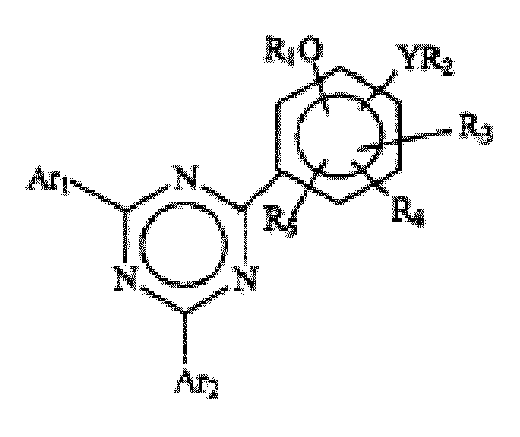
 R1 est hydrogène ;R2, R3, R4 et R5 sont identiques ou différents et sont choisis parmi l'hydrogène, alkyle de 1 à 24 atomes de carbone, halogénoalkyle de 1 à 24 atomes de carbone, aryle de 6 à 24 atomes de carbone, alcényle de 2 à 24 atomes de carbone, acyle de 1 à 24 atomes de carbone, cycloalkyle de jusqu'à 24 atomes de carbone, cycloacyle de 5 à 24 atomes de carbone, aralkyle de 7 à 24 atomes de carbone, ou aracyle de 6 à 24 atomes de carbone, biphénylène substitué ou non substitué, naphtalène substitué ou non substitué, OR, NRR', CONRR', OCOR, CN, SR, SO2R, et éventuellement soit R3 et R4 soit R4 et R5, pris ensemble, faisant partie d'un cycle carbocyclique condensé saturé ou insaturé ;R, R', R6, R7, R8, R9 et R10 sont identiques ou différents et sont choisis chacun parmi l'hydrogène, alkyle de 1 à 24 atomes de carbone, halogénoalkyle de 1 à 24 atomes de carbone, aryle de 6 à 24 atomes de carbone, alcényle de 2 à 24 atomes de carbone, acyle de 1 à 24 atomes de carbone, cycloalkyle de jusqu'à 24 atomes de carbone, cycloacyle de 5 à 24 atomes de carbone, aralkyle de 7 à 24 atomes de carbone, ou aracyle de 6 à 24 atomes de carbone, biphénylène substitué ou non substitué, naphtalène substitué ou non substitué, et éventuellement soit R6 et R7, soit R7 et R8, soit R8 et R9, soit R9 et R10, pris ensemble, faisant partie d'un cycle carbocyclique condensé saturé ou insaturé contenant éventuellement des atomes de O, N ou S dans le cycle, et R6, R7, R8, R9 et R10 peuvent être un alcoxy de 1 à 24 atomes de carbone, et Y est une liaison directe, O, NR" ou S, où R'' est choisi parmi l'hydrogène, alkyle de 1 à 24 atomes de carbone, halogénoalkyle de 1 à 24 atomes de carbone, aryle de 6 à 24 atomes de carbone, alcényle de 2 à 24 atomes de carbone, acyle de 1 à 24 atomes de carbone, cycloalkyle de jusqu'à 24 atomes de carbone, cycloacyle de 5 à 24 atomes de carbone, aralkyle de 7 à 24 atomes de carbone, ou aracyle de 6 à 24 atomes de carbone ;ledit procédé comprenant l'étape consistant à :- mettre en contact un mélange de produits avec au moins deux composants choisis dans le groupe constitué par une base minérale, un alcool et un solvant hydrocarboné,
l'un des composants choisis étant une base minérale, et ledit mélange de produits comprenant ledit composé de Formule 1 et un composé triazine polyphénolique, et- isoler le composé de formule 1 du mélange d'isolement, lequel isolement est effectué- si le mélange de produits sous forme solide est mis en contact avec une base minérale qui est dissoute dans de l'eau, dans un solvant ou un mélange de solvants, par filtration, ou- si le mélange de produits est dissous dans un solvant qui est à base organique, et la base minérale est dissoute dans un solvant qui est à base aqueuse, par élimination de la couche de base minérale des deux couches formées, le solvant utilisé pour dissoudre la base minérale étant non miscible avec le solvant utilisé pour dissoudre le mélange de produits. - Procédé selon la revendication 8, caractérisé en ce que lesdits composants sont une base minérale et un solvant hydrocarboné.
- Procédé selon la revendication 8 ou la revendication 9, caractérisé en ce que les solvants hydrocarbonés sont des composés ayant de un à vingt atomes de carbone.
Priority Applications (3)
| Application Number | Priority Date | Filing Date | Title |
|---|---|---|---|
| EP14187901.5A EP2835368B1 (fr) | 2001-06-22 | 2002-05-21 | Procédé d'Isolation de Bisaryltriazines Monophénoliques |
| EP10184470.2A EP2289884B1 (fr) | 2001-06-22 | 2002-05-21 | Procédé d'isolation de bisaryltriazines monophénoliques |
| EP10184544.4A EP2280005B1 (fr) | 2001-06-22 | 2002-05-21 | Procédé d'isolation de bisaryltriazines monophénoliques |
Applications Claiming Priority (3)
| Application Number | Priority Date | Filing Date | Title |
|---|---|---|---|
| US887128 | 2001-06-22 | ||
| US09/887,128 US6632944B2 (en) | 2001-06-22 | 2001-06-22 | Process for isolation of monophenolic-bisaryl triazines |
| PCT/US2002/016055 WO2003000667A2 (fr) | 2001-06-22 | 2002-05-21 | Procede d'isolation de bisaryltriazines monophenoliques |
Related Child Applications (5)
| Application Number | Title | Priority Date | Filing Date |
|---|---|---|---|
| EP14187901.5A Division EP2835368B1 (fr) | 2001-06-22 | 2002-05-21 | Procédé d'Isolation de Bisaryltriazines Monophénoliques |
| EP10184544.4A Division EP2280005B1 (fr) | 2001-06-22 | 2002-05-21 | Procédé d'isolation de bisaryltriazines monophénoliques |
| EP10184470.2A Division EP2289884B1 (fr) | 2001-06-22 | 2002-05-21 | Procédé d'isolation de bisaryltriazines monophénoliques |
| EP10184470.2 Division-Into | 2010-09-30 | ||
| EP10184544.4 Division-Into | 2010-09-30 |
Publications (2)
| Publication Number | Publication Date |
|---|---|
| EP1397352A2 EP1397352A2 (fr) | 2004-03-17 |
| EP1397352B1 true EP1397352B1 (fr) | 2014-01-01 |
Family
ID=25390499
Family Applications (4)
| Application Number | Title | Priority Date | Filing Date |
|---|---|---|---|
| EP02726905.9A Expired - Lifetime EP1397352B1 (fr) | 2001-06-22 | 2002-05-21 | Procede d'isolation de bisaryltriazines monophenoliques |
| EP10184544.4A Expired - Lifetime EP2280005B1 (fr) | 2001-06-22 | 2002-05-21 | Procédé d'isolation de bisaryltriazines monophénoliques |
| EP14187901.5A Expired - Lifetime EP2835368B1 (fr) | 2001-06-22 | 2002-05-21 | Procédé d'Isolation de Bisaryltriazines Monophénoliques |
| EP10184470.2A Expired - Lifetime EP2289884B1 (fr) | 2001-06-22 | 2002-05-21 | Procédé d'isolation de bisaryltriazines monophénoliques |
Family Applications After (3)
| Application Number | Title | Priority Date | Filing Date |
|---|---|---|---|
| EP10184544.4A Expired - Lifetime EP2280005B1 (fr) | 2001-06-22 | 2002-05-21 | Procédé d'isolation de bisaryltriazines monophénoliques |
| EP14187901.5A Expired - Lifetime EP2835368B1 (fr) | 2001-06-22 | 2002-05-21 | Procédé d'Isolation de Bisaryltriazines Monophénoliques |
| EP10184470.2A Expired - Lifetime EP2289884B1 (fr) | 2001-06-22 | 2002-05-21 | Procédé d'isolation de bisaryltriazines monophénoliques |
Country Status (11)
| Country | Link |
|---|---|
| US (2) | US6632944B2 (fr) |
| EP (4) | EP1397352B1 (fr) |
| JP (2) | JP4838979B2 (fr) |
| KR (1) | KR100920291B1 (fr) |
| CN (1) | CN100497321C (fr) |
| AU (1) | AU2002257307A1 (fr) |
| ES (1) | ES2455271T3 (fr) |
| MX (1) | MXPA03011712A (fr) |
| PT (1) | PT1397352E (fr) |
| TW (1) | TWI301130B (fr) |
| WO (1) | WO2003000667A2 (fr) |
Families Citing this family (4)
| Publication number | Priority date | Publication date | Assignee | Title |
|---|---|---|---|---|
| US6632944B2 (en) * | 2001-06-22 | 2003-10-14 | Cytec Technology Corp. | Process for isolation of monophenolic-bisaryl triazines |
| US9097667B2 (en) * | 2007-12-14 | 2015-08-04 | Biotium, Inc. | Fluorescent compounds |
| ES2463674T3 (es) | 2009-01-19 | 2014-05-28 | Basf Se | Pigmentos negros orgánicos y su preparación |
| CN106565619A (zh) * | 2016-11-10 | 2017-04-19 | 中昊(大连)化工研究设计院有限公司 | 一种精制2‑(2,4‑二羟基苯基)‑4,6‑二苯基‑1,3,5‑均三嗪的方法 |
Family Cites Families (21)
| Publication number | Priority date | Publication date | Assignee | Title |
|---|---|---|---|---|
| GB884802A (en) | 1958-12-24 | 1961-12-20 | Ciba Ltd | New alkylphenyl-halo triazines and process for their manufacture |
| NL275368A (fr) | 1961-03-06 | |||
| US3118887A (en) * | 1961-03-06 | 1964-01-21 | American Cyanamid Co | O-hydroxy substituted tris aryl-s-triazines |
| CH480091A (de) * | 1962-10-30 | 1969-10-31 | Ciba Geigy | Verwendung von neuen Hydroxyphenyl-1,3,5-triazinen als Ultraviolettschutzmittel ausserhalb der Textilindustrie |
| BE639330A (fr) | 1962-10-30 | |||
| NL130993C (fr) | 1963-02-07 | |||
| BE674049A (fr) | 1964-12-21 | |||
| US4092466A (en) | 1976-07-19 | 1978-05-30 | Nasa | Heat resistant polymers of oxidized styrylphosphine |
| ES2081868T3 (es) | 1989-04-21 | 1996-03-16 | Ciba Geigy Ag | Procedimiento para la preparacion de 2-(2',4'-dihidroxifenil)-4,6-diaril-s-triazinas. |
| TW252111B (fr) | 1992-07-02 | 1995-07-21 | Ciba Geigy | |
| TW254936B (fr) | 1993-10-22 | 1995-08-21 | Ciba Geigy | |
| JP3844307B2 (ja) | 1995-08-11 | 2006-11-08 | 株式会社Adeka | 2−(2’,4’−ジヒドロキシフェニル)−4,6−ジアリール−s−トリアジン誘導体の製造方法 |
| DE59608792D1 (de) * | 1995-12-14 | 2002-04-04 | Ciba Sc Holding Ag | Verfahren zur Herstellung von 2-(2,4-Dihydroxyphenyl)-4,6-bis-(2,4-dimethylphenyl)-s-triazin |
| EP0779280B1 (fr) | 1995-12-14 | 2002-02-27 | Ciba SC Holding AG | Procédé pour la préparation de 2-(2,4-Dihydroxyphenyl)-4,6-bis-(2,4-dimethylphenyl)-s-triazine |
| US6242597B1 (en) | 1997-11-21 | 2001-06-05 | Ciba Specialty Chemicals Corporation | Trisaryl-1,3,5-triazine ultraviolet light absorbers |
| EP0941989B1 (fr) | 1998-03-02 | 2009-07-08 | Ciba Holding Inc. | Procédé de préparation de dérivés 2,4-diaryl-6-o-hydroxyphenyl-1,3,5-triazine en présence de catalyseur acide protique |
| AU4425599A (en) | 1998-06-22 | 2000-01-10 | Ciba Specialty Chemicals Holding Inc. | Trisaryl-1,3,5-triazine ultraviolet light absorbers containing hindered phenols |
| US6239276B1 (en) | 1998-06-22 | 2001-05-29 | Cytec Technology Corporation | Non-yellowing para-tertiary-alkyl phenyl substituted triazine and pyrimidine ultraviolet light absorbers |
| JP2002524452A (ja) | 1998-09-04 | 2002-08-06 | サイテク・テクノロジー・コーポレーシヨン | 2−(2,4−ジヒドロキシフェニル)もしくは2−(2,4−ジアルコキシフェニル)−4,6−ビスアリール−1,3,5−トリアジンの製造方法 |
| TWI259182B (en) | 1998-11-17 | 2006-08-01 | Cytec Tech Corp | Process for preparing triazines using a combination of Lewis acids with reaction promoters |
| US6632944B2 (en) * | 2001-06-22 | 2003-10-14 | Cytec Technology Corp. | Process for isolation of monophenolic-bisaryl triazines |
-
2001
- 2001-06-22 US US09/887,128 patent/US6632944B2/en not_active Expired - Lifetime
-
2002
- 2002-05-21 PT PT2726905T patent/PT1397352E/pt unknown
- 2002-05-21 JP JP2003507072A patent/JP4838979B2/ja not_active Expired - Lifetime
- 2002-05-21 EP EP02726905.9A patent/EP1397352B1/fr not_active Expired - Lifetime
- 2002-05-21 ES ES02726905.9T patent/ES2455271T3/es not_active Expired - Lifetime
- 2002-05-21 AU AU2002257307A patent/AU2002257307A1/en not_active Abandoned
- 2002-05-21 MX MXPA03011712A patent/MXPA03011712A/es active IP Right Grant
- 2002-05-21 WO PCT/US2002/016055 patent/WO2003000667A2/fr not_active Ceased
- 2002-05-21 CN CNB028124421A patent/CN100497321C/zh not_active Expired - Lifetime
- 2002-05-21 EP EP10184544.4A patent/EP2280005B1/fr not_active Expired - Lifetime
- 2002-05-21 KR KR1020037016711A patent/KR100920291B1/ko not_active Expired - Fee Related
- 2002-05-21 EP EP14187901.5A patent/EP2835368B1/fr not_active Expired - Lifetime
- 2002-05-21 EP EP10184470.2A patent/EP2289884B1/fr not_active Expired - Lifetime
- 2002-06-20 TW TW091113491A patent/TWI301130B/zh not_active IP Right Cessation
-
2003
- 2003-10-07 US US10/680,017 patent/US20040073028A1/en not_active Abandoned
-
2010
- 2010-11-18 JP JP2010258134A patent/JP5283681B2/ja not_active Expired - Lifetime
Also Published As
| Publication number | Publication date |
|---|---|
| JP2005506962A (ja) | 2005-03-10 |
| ES2455271T3 (es) | 2014-04-15 |
| US20030013879A1 (en) | 2003-01-16 |
| EP2289884B1 (fr) | 2017-09-06 |
| WO2003000667A3 (fr) | 2003-03-27 |
| JP4838979B2 (ja) | 2011-12-14 |
| EP2835368A1 (fr) | 2015-02-11 |
| JP2011057696A (ja) | 2011-03-24 |
| AU2002257307A1 (en) | 2003-01-08 |
| EP2280005B1 (fr) | 2015-08-26 |
| PT1397352E (pt) | 2014-04-07 |
| US6632944B2 (en) | 2003-10-14 |
| CN1547573A (zh) | 2004-11-17 |
| US20040073028A1 (en) | 2004-04-15 |
| KR100920291B1 (ko) | 2009-10-08 |
| EP2835368B1 (fr) | 2017-11-15 |
| EP2289884A1 (fr) | 2011-03-02 |
| KR20040011546A (ko) | 2004-02-05 |
| TWI301130B (en) | 2008-09-21 |
| WO2003000667A2 (fr) | 2003-01-03 |
| EP2280005A1 (fr) | 2011-02-02 |
| CN100497321C (zh) | 2009-06-10 |
| EP1397352A2 (fr) | 2004-03-17 |
| MXPA03011712A (es) | 2004-03-19 |
| JP5283681B2 (ja) | 2013-09-04 |
Similar Documents
| Publication | Publication Date | Title |
|---|---|---|
| JP2857219B2 (ja) | 2―(2’,4’―ジヒドロキシフエニル)―4,6―ジアリール―s―トリアジンの製造方法 | |
| EP1109792B1 (fr) | Procede de production de 2- (2,4- dihydrophenyl) ou 2- (2,4- dialcoxyphenyl)- 4,6- bisayryl- 1,3,5- triazines | |
| CZ365796A3 (en) | Process for preparing 2-(2,4-dihydroxyphenyl)-4,6-bis(2,4-dimethylphenyl)-s-triazine | |
| JP5283681B2 (ja) | モノフェノリック−ビスアリールトリアジンの単離方法 | |
| WO1987004433A1 (fr) | Preparation de 3-dimethylamino-7-methyl-1,2,4-benzotriazine-1-oxyde et d'azapropazone | |
| KR100551926B1 (ko) | 시로스타졸의 제조 방법 | |
| US3563987A (en) | Preparation of cyanuric acid | |
| KR100484265B1 (ko) | 2-(2,4-디히드록시페닐)-4,6-비스(2,4-디메틸페닐)-s-트리아진의제조방법 | |
| US4952725A (en) | Process for the preparation of 4,4'dinitrostilbene-2,2'-disulfonic acid and its salts | |
| US3825562A (en) | Process for recovering 2,2,4-trimethyl-4-(4-hydroxyphenyl)chroman | |
| EP0165006B1 (fr) | Procédé pour la préparation des halométhyl-s-triazines substituées | |
| US4360671A (en) | Preparation of cyanuric acid | |
| KR910006903B1 (ko) | 2,2'-디히드록시-4,4'-디알콕시벤조페논 유도체의 제조방법 | |
| MXPA96006261A (en) | Process for the preparation of 2- (2,4-dihydroxypenyl) -4,6-bis (2,4-dimetylphenyl) -s-triaz | |
| EP1382599B1 (fr) | 2-(2,4 dihydroxyphenyl)-4,6 bis(3,4-dimethylphenyl)-s-triazine et 2-(2,4-dihydroxyphenyl)4(3,4-dimethylphenyl)-6-(2,3-dimethylphenyl)-s-triazine et leurs dérivés en tant qu'absorbeur d'UV | |
| US4288594A (en) | Caustic-free process for the production of monochloro-diamino-s-triazines | |
| JPS5939881A (ja) | S−トリアジン系誘導体の精製法 | |
| NO762517L (fr) | ||
| GB2188627A (en) | Preparation of 3-dimethylamino-7-methyl-1,2,4-benzotriazine-1-oxide |
Legal Events
| Date | Code | Title | Description |
|---|---|---|---|
| PUAI | Public reference made under article 153(3) epc to a published international application that has entered the european phase |
Free format text: ORIGINAL CODE: 0009012 |
|
| 17P | Request for examination filed |
Effective date: 20031128 |
|
| AK | Designated contracting states |
Kind code of ref document: A2 Designated state(s): AT BE CH CY DE DK ES FI FR GB GR IE IT LI LU MC NL PT SE TR |
|
| AX | Request for extension of the european patent |
Extension state: AL LT LV MK RO SI |
|
| RIN1 | Information on inventor provided before grant (corrected) |
Inventor name: CAPPADONA, RUSSELL, C. Inventor name: SINGH, HARGURPREET Inventor name: GUPTA, RAM, BABOO |
|
| 17Q | First examination report despatched |
Effective date: 20081014 |
|
| GRAP | Despatch of communication of intention to grant a patent |
Free format text: ORIGINAL CODE: EPIDOSNIGR1 |
|
| INTG | Intention to grant announced |
Effective date: 20130429 |
|
| GRAJ | Information related to disapproval of communication of intention to grant by the applicant or resumption of examination proceedings by the epo deleted |
Free format text: ORIGINAL CODE: EPIDOSDIGR1 |
|
| GRAP | Despatch of communication of intention to grant a patent |
Free format text: ORIGINAL CODE: EPIDOSNIGR1 |
|
| INTG | Intention to grant announced |
Effective date: 20130711 |
|
| GRAS | Grant fee paid |
Free format text: ORIGINAL CODE: EPIDOSNIGR3 |
|
| GRAA | (expected) grant |
Free format text: ORIGINAL CODE: 0009210 |
|
| AK | Designated contracting states |
Kind code of ref document: B1 Designated state(s): AT BE CH CY DE DK ES FI FR GB GR IE IT LI LU MC NL PT SE TR |
|
| REG | Reference to a national code |
Ref country code: GB Ref legal event code: FG4D |
|
| REG | Reference to a national code |
Ref country code: CH Ref legal event code: EP |
|
| REG | Reference to a national code |
Ref country code: IE Ref legal event code: FG4D |
|
| REG | Reference to a national code |
Ref country code: DE Ref legal event code: R096 Ref document number: 60245902 Country of ref document: DE Effective date: 20140213 |
|
| REG | Reference to a national code |
Ref country code: AT Ref legal event code: REF Ref document number: 647551 Country of ref document: AT Kind code of ref document: T Effective date: 20140215 |
|
| REG | Reference to a national code |
Ref country code: NL Ref legal event code: T3 |
|
| REG | Reference to a national code |
Ref country code: PT Ref legal event code: SC4A Free format text: AVAILABILITY OF NATIONAL TRANSLATION Effective date: 20140331 |
|
| REG | Reference to a national code |
Ref country code: ES Ref legal event code: FG2A Ref document number: 2455271 Country of ref document: ES Kind code of ref document: T3 Effective date: 20140415 |
|
| REG | Reference to a national code |
Ref country code: GR Ref legal event code: EP Ref document number: 20140400628 Country of ref document: GR Effective date: 20140416 |
|
| REG | Reference to a national code |
Ref country code: CH Ref legal event code: NV Representative=s name: REUTELER AND CIE S.A., CH |
|
| PG25 | Lapsed in a contracting state [announced via postgrant information from national office to epo] |
Ref country code: FI Free format text: LAPSE BECAUSE OF FAILURE TO SUBMIT A TRANSLATION OF THE DESCRIPTION OR TO PAY THE FEE WITHIN THE PRESCRIBED TIME-LIMIT Effective date: 20140101 Ref country code: SE Free format text: LAPSE BECAUSE OF FAILURE TO SUBMIT A TRANSLATION OF THE DESCRIPTION OR TO PAY THE FEE WITHIN THE PRESCRIBED TIME-LIMIT Effective date: 20140101 Ref country code: CY Free format text: LAPSE BECAUSE OF FAILURE TO SUBMIT A TRANSLATION OF THE DESCRIPTION OR TO PAY THE FEE WITHIN THE PRESCRIBED TIME-LIMIT Effective date: 20140101 |
|
| PGFP | Annual fee paid to national office [announced via postgrant information from national office to epo] |
Ref country code: ES Payment date: 20140411 Year of fee payment: 13 Ref country code: TR Payment date: 20140403 Year of fee payment: 13 Ref country code: NL Payment date: 20140520 Year of fee payment: 13 Ref country code: PT Payment date: 20140404 Year of fee payment: 13 Ref country code: GR Payment date: 20140414 Year of fee payment: 13 Ref country code: FR Payment date: 20140416 Year of fee payment: 13 |
|
| PGFP | Annual fee paid to national office [announced via postgrant information from national office to epo] |
Ref country code: BE Payment date: 20140404 Year of fee payment: 13 |
|
| REG | Reference to a national code |
Ref country code: DE Ref legal event code: R097 Ref document number: 60245902 Country of ref document: DE |
|
| PG25 | Lapsed in a contracting state [announced via postgrant information from national office to epo] |
Ref country code: DK Free format text: LAPSE BECAUSE OF FAILURE TO SUBMIT A TRANSLATION OF THE DESCRIPTION OR TO PAY THE FEE WITHIN THE PRESCRIBED TIME-LIMIT Effective date: 20140101 |
|
| PLBE | No opposition filed within time limit |
Free format text: ORIGINAL CODE: 0009261 |
|
| STAA | Information on the status of an ep patent application or granted ep patent |
Free format text: STATUS: NO OPPOSITION FILED WITHIN TIME LIMIT |
|
| 26N | No opposition filed |
Effective date: 20141002 |
|
| PG25 | Lapsed in a contracting state [announced via postgrant information from national office to epo] |
Ref country code: LU Free format text: LAPSE BECAUSE OF FAILURE TO SUBMIT A TRANSLATION OF THE DESCRIPTION OR TO PAY THE FEE WITHIN THE PRESCRIBED TIME-LIMIT Effective date: 20140521 |
|
| REG | Reference to a national code |
Ref country code: DE Ref legal event code: R097 Ref document number: 60245902 Country of ref document: DE Effective date: 20141002 |
|
| PG25 | Lapsed in a contracting state [announced via postgrant information from national office to epo] |
Ref country code: MC Free format text: LAPSE BECAUSE OF FAILURE TO SUBMIT A TRANSLATION OF THE DESCRIPTION OR TO PAY THE FEE WITHIN THE PRESCRIBED TIME-LIMIT Effective date: 20140101 |
|
| REG | Reference to a national code |
Ref country code: IE Ref legal event code: MM4A |
|
| PG25 | Lapsed in a contracting state [announced via postgrant information from national office to epo] |
Ref country code: IE Free format text: LAPSE BECAUSE OF NON-PAYMENT OF DUE FEES Effective date: 20140521 |
|
| PGFP | Annual fee paid to national office [announced via postgrant information from national office to epo] |
Ref country code: GB Payment date: 20150527 Year of fee payment: 14 |
|
| REG | Reference to a national code |
Ref country code: PT Ref legal event code: MM4A Free format text: LAPSE DUE TO NON-PAYMENT OF FEES Effective date: 20151123 |
|
| PG25 | Lapsed in a contracting state [announced via postgrant information from national office to epo] |
Ref country code: GR Free format text: LAPSE BECAUSE OF NON-PAYMENT OF DUE FEES Effective date: 20151208 |
|
| REG | Reference to a national code |
Ref country code: NL Ref legal event code: MM Effective date: 20150601 |
|
| REG | Reference to a national code |
Ref country code: FR Ref legal event code: ST Effective date: 20160129 |
|
| PG25 | Lapsed in a contracting state [announced via postgrant information from national office to epo] |
Ref country code: PT Free format text: LAPSE BECAUSE OF NON-PAYMENT OF DUE FEES Effective date: 20151123 |
|
| REG | Reference to a national code |
Ref country code: GR Ref legal event code: ML Ref document number: 20140400628 Country of ref document: GR Effective date: 20151208 |
|
| PG25 | Lapsed in a contracting state [announced via postgrant information from national office to epo] |
Ref country code: NL Free format text: LAPSE BECAUSE OF NON-PAYMENT OF DUE FEES Effective date: 20150601 |
|
| PG25 | Lapsed in a contracting state [announced via postgrant information from national office to epo] |
Ref country code: FR Free format text: LAPSE BECAUSE OF NON-PAYMENT OF DUE FEES Effective date: 20150601 |
|
| GBPC | Gb: european patent ceased through non-payment of renewal fee |
Effective date: 20160521 |
|
| REG | Reference to a national code |
Ref country code: ES Ref legal event code: FD2A Effective date: 20170127 |
|
| PG25 | Lapsed in a contracting state [announced via postgrant information from national office to epo] |
Ref country code: ES Free format text: LAPSE BECAUSE OF NON-PAYMENT OF DUE FEES Effective date: 20150522 |
|
| PG25 | Lapsed in a contracting state [announced via postgrant information from national office to epo] |
Ref country code: GB Free format text: LAPSE BECAUSE OF NON-PAYMENT OF DUE FEES Effective date: 20160521 |
|
| PG25 | Lapsed in a contracting state [announced via postgrant information from national office to epo] |
Ref country code: BE Free format text: LAPSE BECAUSE OF NON-PAYMENT OF DUE FEES Effective date: 20150531 |
|
| PG25 | Lapsed in a contracting state [announced via postgrant information from national office to epo] |
Ref country code: TR Free format text: LAPSE BECAUSE OF NON-PAYMENT OF DUE FEES Effective date: 20150521 |
|
| PGFP | Annual fee paid to national office [announced via postgrant information from national office to epo] |
Ref country code: DE Payment date: 20210427 Year of fee payment: 20 Ref country code: IT Payment date: 20210412 Year of fee payment: 20 |
|
| PGFP | Annual fee paid to national office [announced via postgrant information from national office to epo] |
Ref country code: AT Payment date: 20210426 Year of fee payment: 20 Ref country code: CH Payment date: 20210519 Year of fee payment: 20 |
|
| REG | Reference to a national code |
Ref country code: DE Ref legal event code: R071 Ref document number: 60245902 Country of ref document: DE |
|
| REG | Reference to a national code |
Ref country code: CH Ref legal event code: PL |
|
| REG | Reference to a national code |
Ref country code: AT Ref legal event code: MK07 Ref document number: 647551 Country of ref document: AT Kind code of ref document: T Effective date: 20220521 |