EP1400892A2 - Informationsverarbeitungsgerät, Zeitplaneneingabeverfahren und Computerprogramm zur Verwendung im Informationsverarbeitungsgerät - Google Patents
Informationsverarbeitungsgerät, Zeitplaneneingabeverfahren und Computerprogramm zur Verwendung im Informationsverarbeitungsgerät Download PDFInfo
- Publication number
- EP1400892A2 EP1400892A2 EP03255763A EP03255763A EP1400892A2 EP 1400892 A2 EP1400892 A2 EP 1400892A2 EP 03255763 A EP03255763 A EP 03255763A EP 03255763 A EP03255763 A EP 03255763A EP 1400892 A2 EP1400892 A2 EP 1400892A2
- Authority
- EP
- European Patent Office
- Prior art keywords
- time
- numerical value
- schedule
- hour
- minute
- Prior art date
- Legal status (The legal status is an assumption and is not a legal conclusion. Google has not performed a legal analysis and makes no representation as to the accuracy of the status listed.)
- Ceased
Links
Images






Classifications
-
- G—PHYSICS
- G06—COMPUTING OR CALCULATING; COUNTING
- G06F—ELECTRIC DIGITAL DATA PROCESSING
- G06F3/00—Input arrangements for transferring data to be processed into a form capable of being handled by the computer; Output arrangements for transferring data from processing unit to output unit, e.g. interface arrangements
- G06F3/01—Input arrangements or combined input and output arrangements for interaction between user and computer
- G06F3/048—Interaction techniques based on graphical user interfaces [GUI]
- G06F3/0487—Interaction techniques based on graphical user interfaces [GUI] using specific features provided by the input device, e.g. functions controlled by the rotation of a mouse with dual sensing arrangements, or of the nature of the input device, e.g. tap gestures based on pressure sensed by a digitiser
- G06F3/0489—Interaction techniques based on graphical user interfaces [GUI] using specific features provided by the input device, e.g. functions controlled by the rotation of a mouse with dual sensing arrangements, or of the nature of the input device, e.g. tap gestures based on pressure sensed by a digitiser using dedicated keyboard keys or combinations thereof
-
- G—PHYSICS
- G06—COMPUTING OR CALCULATING; COUNTING
- G06F—ELECTRIC DIGITAL DATA PROCESSING
- G06F3/00—Input arrangements for transferring data to be processed into a form capable of being handled by the computer; Output arrangements for transferring data from processing unit to output unit, e.g. interface arrangements
- G06F3/01—Input arrangements or combined input and output arrangements for interaction between user and computer
- G06F3/048—Interaction techniques based on graphical user interfaces [GUI]
- G06F3/0484—Interaction techniques based on graphical user interfaces [GUI] for the control of specific functions or operations, e.g. selecting or manipulating an object, an image or a displayed text element, setting a parameter value or selecting a range
- G06F3/04847—Interaction techniques to control parameter settings, e.g. interaction with sliders or dials
-
- G—PHYSICS
- G06—COMPUTING OR CALCULATING; COUNTING
- G06Q—INFORMATION AND COMMUNICATION TECHNOLOGY [ICT] SPECIALLY ADAPTED FOR ADMINISTRATIVE, COMMERCIAL, FINANCIAL, MANAGERIAL OR SUPERVISORY PURPOSES; SYSTEMS OR METHODS SPECIALLY ADAPTED FOR ADMINISTRATIVE, COMMERCIAL, FINANCIAL, MANAGERIAL OR SUPERVISORY PURPOSES, NOT OTHERWISE PROVIDED FOR
- G06Q10/00—Administration; Management
- G06Q10/10—Office automation; Time management
- G06Q10/109—Time management, e.g. calendars, reminders, meetings or time accounting
-
- H—ELECTRICITY
- H04—ELECTRIC COMMUNICATION TECHNIQUE
- H04M—TELEPHONIC COMMUNICATION
- H04M1/00—Substation equipment, e.g. for use by subscribers
- H04M1/72—Mobile telephones; Cordless telephones, i.e. devices for establishing wireless links to base stations without route selection
- H04M1/724—User interfaces specially adapted for cordless or mobile telephones
- H04M1/72448—User interfaces specially adapted for cordless or mobile telephones with means for adapting the functionality of the device according to specific conditions
- H04M1/72451—User interfaces specially adapted for cordless or mobile telephones with means for adapting the functionality of the device according to specific conditions according to schedules, e.g. using calendar applications
Definitions
- the present invention relates to an information processing device adapted to manage a schedule inputted thereinto by a user for example, a schedule inputting method for use in the information processing device and a schedule inputting program used in the information processing device.
- this portable telephone comprises: a memory 1; a controlling section 2; a transmitting/receiving antenna 3; a radio communicating section 4; an audio interface (I/F) section 5; a speaker 6; a microphone 7; a sound source LSI (Large-Scale Integration) 8; an LED (Light Emitting Diode) 9; a vibrator 10; a display section 11; and an input section 12.
- a memory 1 As shown in Fig. 1, this portable telephone comprises: a memory 1; a controlling section 2; a transmitting/receiving antenna 3; a radio communicating section 4; an audio interface (I/F) section 5; a speaker 6; a microphone 7; a sound source LSI (Large-Scale Integration) 8; an LED (Light Emitting Diode) 9; a vibrator 10; a display section 11; and an input section 12.
- I/F audio interface
- the memory 1 stores therein operation programs previously entered such as a schedule management program, a communication program, a browser program and a dictionary which can be read out by the controlling section 2.
- the controlling section 2 is adapted to read from the memory 1 information that has been registered (input) into the memory 1 by a user and is required for performing a schedule and an operation or to write such information into the memory 1.
- the controlling section 2 controls various portions of the portable telephone according to the operation programs read from the memory 1.
- the radio communicating section 4 receives radio signals from other network devices via the transmitting/receiving antenna 3 according to the control setting of the controlling section 2 and, if the content of the radio signal is an audio signal, outputs it to the speaker 6 via the audio I/F section 5 or if the content of the radio signal is other data (e.g text, images, video clips), outputs it to the controlling section 2. Also, the radio communicating section 4 transforms data from the controlling section 2 or an audio signal from the audio I/F section 5 into a radio signal according to control performed by the controlling section 2, and then transmits it to another network device via the transmitting/receiving antenna 3.
- the speaker 6 can output an audio signal externally to the user from the vocal I/F section 5, for example as a voice signal.
- the sound source LSI 8 outputs an audio signal such as an alarm sound or incoming call sound to the speaker 6 via the audio I/F section 5 under control of the controlling section 2.
- the LED 9 emits light according to control of the controlling section 2.
- the vibrator 10 vibrates according to control of the controlling section 2.
- the display section 11 performs a display of data according to control of the controlling section 2.
- the input section 12 receives key-inputs from the user and then outputs them to the controlling section 2.
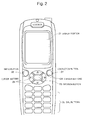
- this portable telephone has a display portion 21 capable of displaying a variety of (picture) screens.
- the input portion comprises: a menu button 22 for opening a menu screen; a decision button 23 for selecting or registering a particular option; cursor buttons 24 for moving a cursor vertically and horizontally; and dial buttons 25 for inputting characters and/or numerals.
- Fig. 7 is a schematic functional block diagram showing an example of a conventional schedule management program used in the portable telephone.
- Input controlling means 31 receives a schedule (reminder, diary, alarm setting) input by the user via the input section 12 and then outputs it to schedule management means 35.
- Display controlling means 32 performs a screen display by using the display section 11 according to instructions from the schedule management means 35.
- Timer means 33 outputs the current time to the schedule management means 35 as needed.
- Alarm controlling means 34 outputs an alarm by using a combination of the LSI 8, the audio I/F section 5 and the speaker 6, the LED 9, the vibrator 10, and the display section 11 according to instructions from the schedule management means 35.
- the schedule management means 35 registers (enters) the schedule obtained from the input controlling means 31 into the memory 1. Also, the schedule management means 35 outputs an instruction to activate an alarm to the alarm controlling means 34 when the present time acquired by the timer means 33 matches a desired alarm time set by the user. Further, the schedule management means 35 outputs an instruction to display a registration screen and/or a registration content to the display controlling means 32.
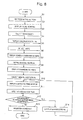
- Fig. 8 is a flowchart illustrating an example of the conventional schedule registration processing performed in the portable telephone.
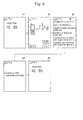
- Fig. 9 illustrates a series of screens that are to be sequentially displayed along with the conventional schedule registration processing.
- Stand-by display 41 is displayed in an initial state of the portable telephone.
- the display controlling means 32 performs a display of the menu screen (S2).
- the display controlling means 32 performs a display of a calendar screen 42 (S4).
- the display controlling means 32 performs a display of a schedule summary screen 43 (S6).
- a schedule summary screen 43 On an example of the calendar screen 42 as shown in Fig. 9, the date of August 22, 2002 is selected.
- the schedule summary screen 43 there is displayed a summary of schedules which have already been registered on selected dates.
- the display controlling means 32 performs a display of a submenu screen 44 (S8).
- the display controlling means 32 performs a display of a content setting screen 45 (S10).
- the content setting screen 45 there are displayed a variety of options (setting items) in connection with the schedule to be newly registered.
- Fig. 9 illustrates an example in which the setting items on the content setting screen 45 comprise: a time; a title of schedule; a memo with respect to the schedule; a kind of an icon displayed on the calendar screen; the presence or absence of repetition of an alarm; a kind of an alarm; an alarm volume; and the presence or absence of a pre-alarm (reminder before set time).
- the user will sequentially select setting items in connection with the schedule by using the cursor buttons 24 and perform desired inputs to respective setting items by using the dial buttons 25 (S11).
- "18:00” is inputted as the time; a "regular conference” is inputted as the title of schedule; a passage “at 17floor assembly room” is inputted as the memo in connection with the schedule; an "asterisk” is inputted as the kind of the icon displayed on the calendar screen; a “null” is inputted as the presence or absence of repetition of the alarm; an “alarm sound” is inputted as the kind of the alarm; "4" is inputted as the alarm volume; and a “null” is inputted as the presence or absence of the pre-alarm.
- the user has performed inputs to the respective setting items, he will select a "completion” by using the completion button 27 and then depresses the decision button 23, thereby completing the inputting of content of the schedule.
- the schedule management means 35 Upon completion of the inputting of the schedule content, the schedule management means 35 decides whether or not a different schedule has already been registered for the same time or when the new schedule is to be registered (S12). If a different schedule has already been registered at the same time (S12: YES), then the display controlling means 32 performs a display of an error screen (not shown) (S14). This control flow returns to the step 10 (S10) at which the user is prompted on the content setting screen 45 to correct the time to be scheduled.
- the schedule management means 35 registers the schedule content inputted as above (S13).
- the display controlling means 32 correspondingly performs a display of a registration completion screen 46, thereafter displaying a calendar screen 47 to end this control flow.
- the icon "asterisk" which has already been set on the content setting screen 45 is displayed on the date: August 22, 2002 on which the schedule has been registered as above.
- the user will be able to confirm the registered schedule.
- an information processing device for managing an inputted schedule comprising:
- the input portion comprises an input section 12 and an input controlling section 31
- the numeric value deciding portion comprises numeric value deciding means 51
- the schedule management portion comprises schedule management means 53, which will be all explained in an embodiment as described below.
- the information processing device as mentioned above may be such in that the numeric value deciding portion is adapted to identify the numeric value as a scheduled time that can be represented by hours and minutes if the numeric value is a number with four digits and can represent a value in hours and minutes.
- the information processing device may be such that the numeric value deciding portion is adapted to identify the numeric value as a scheduled time that can be represented by day, hour and minute if the numeric value is a number with six digits and can be regarded as a value representative of day, hour and minute.
- the information processing device may be such that the numeric value deciding portion is adapted to identify the numeric value as a scheduled time that can be represented by month, day, hour and minute if the numeric value is a number with eight digits and can be regarded as a value representative of month, day, hour and minute.
- the information processing device may be such that the numeric value deciding portion is adapted to identify the numeric value as a scheduled time that can be represented by year, month, day, hour and minute if the numeric value is a number with twelve digits and can be regarded as a value representative of year, month, day, hour and minute.
- the user is able to rapidly register his desired schedule simply by inputting the numeric value of twelve digits representative of year, month, day, hour and minute.
- the information processing device as mentioned above may further comprise: a timer portion adapted to acquire (determine) the current time; and an alarm portion adapted to output an alarm when the current time has reached (reaches) the scheduled time.
- the timer portion comprises timer means 33
- the alarm portion comprises any one or combination of a sound source LSI 8, an audio I/F section 5 and a speaker 6, a LED 9, a vibrator 10, and a display section 11, and an alarm controlling means 34, which will be all explained in an embodiment as described below.
- the information processing device as mentioned above may further comprise:
- the comparator portion comprises comparator means 52 which will be explained in an embodiment as described below.
- the information processing device may be such that the numeric value deciding portion is adapted to identify the numeric value as a time that can be represented by hour and minute if the numeric value is a number with four digits and can be regarded as a value representative of hour and minute, and the comparator portion may be adapted to shift the entered time into the future by one day only as the predetermined period (unit of time) which is spent until the entered time reaches the next same (corresponding) time (scheduled time) in the future in the case where the entered time is previous to the current time represented by hour and minute.
- the numeric value deciding portion is adapted to identify the numeric value as a time that can be represented by hour and minute if the numeric value is a number with four digits and can be regarded as a value representative of hour and minute
- the comparator portion may be adapted to shift the entered time into the future by one day only as the predetermined period (unit of time) which is spent until the entered time reaches the next same (corresponding) time (scheduled time)
- the information processing device may be such that the numeric value deciding portion is adapted to identify the numeric value as a time that can be represented by day, hour and minute if the numeric value is a number with six digits and can be regarded as a value representative of day, hour and minute, and the comparator portion may be adapted to shift the entered time into the future by one month only as the period which is spent until the entered time reaches the next corresponding time in the future in the case where the entered time is previous to the current time represented by day, hour and minute.
- the information processing device may be such that the numeric value deciding portion is adapted to identify the numeric value as a time that can be represented by month, day, hour and minute if the numeric value is a number with eight digits and can be regarded as a value representative of month, day, hour and minute, and the comparator portion may be adapted to shift the entered time into the future by one year only as the period which is spent until the entered time reaches the next corresponding time in the future in the case where the scheduled time is represented to be previous to the current time represented by month, day, hour and minute.
- the information processing device as mentioned above may further comprise an alarm portion adapted to output an alarm when the current time has reached the scheduled time.
- the information processing device as mentioned above may take the form of a portable telephone.
- a schedule inputting method for use in an information processing device adapted for managing an inputted schedule comprising the steps of:
- the user is able to rapidly and surely register his desired oncoming schedule by inputting only a numeric value having a small number of digits.
- a schedule inputting program that is stored in a computer-readable medium and used in an information processing device to cause a computer to perform management of an inputted schedule, comprising steps of:
- the user is able to rapidly and surely register his desired oncoming schedule, e.g. for the next day, by inputting only a numeric value having a small number of digits.
- An information processing device to which the present invention is applied is a device including a CPU and other parts necessary to be capable of performing a schedule registration.
- a device may comprise: a portable telephone, a PDA (Personal Digital Assistant), a PC (Personal Computer), a notebook computer, a digital camera, a digital video camera, and the like.
- the portable telephone will be exemplified as the information processing device and described in the following embodiments.
- the portable telephone of this first embodiment includes an arrangement similar to that as shown in Fig. 1. Its outer appearance is similar to that as shown in Fig. 2.
- Fig. 3 is a schematic functional block diagram illustrating the schedule management program used in the portable telephone of this first embodiment according to the present invention.
- like parts similar to those of Fig. 7 are labeled with corresponding numerals and therefore their explanations are omitted.
- Timer means 33 outputs the current time to comparator means 52 and schedule management means 53 as needed.
- Numeric value deciding means 51 decides whether or not a numeric value obtained from an input controlling means 31 can be appropriately identified as hour and minute. If the numeric value is decided to be appropriate as hour and minute, the numeric value is outputted to the comparator means 52 as hour and minute for a schedule.
- the comparator means 52 compares the hour and minute for the schedule obtained from the numeric value deciding means 51 to the current hour and minute acquired from the timer means 33 and then sets year, month and day for the schedule. Subsequently, the comparator means 33 outputs a scheduled time consisting of year, month, day, hour and minute for the schedule to a schedule management means 53.
- the schedule management means 53 registers as the schedule both of the scheduled time obtained from the comparator means 52 and a preset default schedule content. Also, the schedule management means 53 outputs an instruction to activate an alarm to alarm controlling means 34 when an alarm time set for the schedule and the current time acquired from the timer means 33 are equivalent to each other. Further, the schedule management means 53 outputs an instruction for a display of a registration screen, a registered content, and the like to a display controlling means 32.
- Fig. 4 is a flowchart illustrating an example of the schedule registration processing which will be performed in the portable telephone according to this first embodiment.
- Fig. 5 is a schematic diagram illustrating a series of screens that are to be sequentially transited (displayed) along with the schedule registration processing.
- Stand-by display 61 is used in an initial state of the portable telephone.
- the numeric value deciding means 51 decides whether or not the inputted numerals constitute a number with four digits (S23). If the inputted numerals do not constitute a number with four digits (S23: NO), then a numerical menu screen appears on the portable telephone (S26) on which normal numerical menu processing is performed in response to the user's subsequent input (S27). Thereafter, this control flow ends.
- This normal numerical menu means a menu without a "REGISTRATION INTO SCHEDULE" of a plurality of menu items on the numerical menu screen 63 for the schedule registration.
- the display controlling means 32 performs a display of the numerical menu screen 63 for the schedule registration (S25).
- a numeral inputting screen 62 displays a numeric value "1234" inputted by the user.
- the numeric value deciding means 51 decides that the numeric value "1234" is of four digits and that the numeric value can be appropriate as hour and minute.
- the numeric value deciding means 51 outputs the numeric value of four digits as hour and minute for the schedule to the comparator means 52.
- the numeric value deciding means 51 as shown in Fig. 5 outputs the numeric value "1234" as "12:34" of scheduled hour and minute to the comparator means 52.
- the comparator means 52 decides whether the year, month and day for the schedule is today, i.e., whether the hour and minute for the schedule is later than the current hour and minute (or a numeric value representative of the hour and minute for the schedule is larger than that representative of the current hour and minute) (S29). If the hour and minute for the schedule is later than the current hour and minute (S29: YES), then the comparator means 52 sets the year, month and day for the schedule as today (S30).
- the comparator means 52 sets the year, month and day for the schedule as tomorrow (S31).
- the comparator means 52 decides that the hour and minute "12:34" for the schedule is today's schedule because the scheduled hour and minute is later than the current hour and minute "10:55” and then sets "August 22, 2002 - 12:34" as the scheduled time.
- the comparator means 52 decides that the inputted hour and minute "12:34" for the schedule is tomorrow's schedule because the inputted hour and minute is earlier than (or previous to) the current hour and minute "13:00" and then sets "August 23, 2002 - 12:34" as the scheduled time.
- the schedule management means 53 decides whether the same time as the scheduled time as above has already been registered as a scheduled time for another schedule (S32). If another schedule has already been registered at that same time (S32: YES), then the display controlling means 32 performs a display of an error screen (not shown) and thereafter performs a display of Stand-by display 65 (S34), whereafter this control flow ends.
- the schedule management means 53 registers the scheduled time set by the comparator means 52 and the default schedule content while the display controlling means 32 performs a display of the waiting screen 65 after a display of a registration completion screen 64 (S33), whereafter this control flow ends.
- the schedule content consists of items similar to those appearing on the content setting screen 45 as shown in Fig. 9.
- a time is "inputted four-digit number”; a title of schedule is “quick schedule”; a memo with respect to the schedule is “null”; a kind of an icon displayed on the calendar screen is “asterisk”; the presence or absence of an alarm repetition is “null”; a kind of an alarm is “alarm sound”; an alarm volume is “4"; and the presence or absence of a pre-alarm is “null”.
- the numerical menu screen 63 for use in the schedule registration is displayed after numeral input and then the "REGISTRATION INTO SCHEDULE" is selected to activate the schedule registration.
- the present invention is not limited to it.
- the numeric value deciding means 51 decides that the inputted numerals can be appropriate as hour and minute
- the portable telephone according to this first embodiment it may be possible to perform the conventional schedule registration as explained above by using Figs. 8 and 9, in addition to the schedule registration performed by input of the number with four digits according to this first embodiment.
- a time for a schedule can automatically be decided only by the user's input of a number with four digits which are representative of hour and minute, as a result of which the schedule can quickly be registered into the portable telephone together with the default schedule content.
- a schedule registration will be performed with a scheduled time determined by the input of a number with eight digits.
- the portable telephone of this second embodiment has a similar configuration and outer appearance to those of the first embodiment as shown in Figs. 1 and 2.
- the schedule management program according to this second embodiment is configured with the schematic functional block diagram as shown in Fig. 3, similarly to the first embodiment.
- the numeric value deciding means 51 decides whether or not numeric values obtained from the input controlling means 31 can be appropriately identified as month, day, hour and minute. If the numeric values are determined to be appropriate as month, day, hour and minute, the numeric values are outputted to the comparator means 52 as month, day, hour and minute for a schedule.
- the comparator means 52 sets the year for the schedule by comparing the month, day, hour and minute for the schedule obtained from the numeric value deciding means 51 to the current month, day, hour and minute acquired from the timer means 33 and then outputs a time consisting of the year, month, day, hour and minute for the schedule to the schedule management means 53.
- FIG. 6 is a flowchart illustrating an example of the schedule registration processing which will be performed in the portable telephone according to this second embodiment.
- like processing steps similar to those of Fig. 7 are labeled with corresponding numerals and therefore their explanations are omitted.
- the numeric value deciding means 51 decides whether or not the inputted numerals constitute a number with eight digits (S41). If the inputted numerals do not constitute a number with eight digits (S41: NO), then a numerical menu screen appears on the portable telephone (S26) on which a normal numerical menu processing is performed in response to the user's subsequent input (S27). Thereafter, this control flow ends.
- the display controlling means 32 displays the normal numerical menu screen (S26) on which the normal numerical menu processing is performed in response to the user's subsequent input (S27). Thereafter, this control flow ends.
- the display controlling means 32 performs a display of the numerical menu screen 63 for the schedule registration (S25).
- the numeric value deciding means 51 decides that the numerals "08221234" are of eight digits and are appropriate as month, day, hour and minute.
- the numeric value deciding means 51 outputs this numeric value of eight digits as month, day, hour and minute for the schedule to the comparator means 52.
- the numeric value deciding means 51 outputs the numeric value "08221234" as "August 22 - 12:34" of scheduled month, day, hour and minute to the comparator means 52.
- the comparator means 52 decides whether the year for the schedule is this year, i.e., whether the month, day, hour and minute for the schedule is later than the current month, day, hour and minute (or a numeric value representative of the month, day, hour and minute for the schedule is larger than that representative of the current month, day, hour and minute) (S51). If the month, day, hour and minute for the schedule is later than the current month, day, hour and minute (S51: YES), then the comparator means 52 sets the year for the schedule as this year (S52).
- the comparator means 52 sets the year for the schedule as the next year (S53).
- the comparator means 52 decides that the month, day, hour and minute : "August 22 - 12:34" for the schedule is this year's schedule because the scheduled month, day, hour and minute is later than the current hour and minute "August 22 - 10:55” and then sets "August 22, 2002 - 12:34" as the scheduled time.
- the comparator means 52 decides that the month, day, hour and minute : "August 22 - 12:34" for the schedule is the next year's schedule because the selected month, day, hour and minute is earlier than (or previous to) the current month, day, hour and minute "August 22 - 13:00" and then sets "August 22, 2003 - 12:34" as the scheduled time.
- processing steps for deciding whether the schedule according to this second embodiment can be registered are similar to the processing steps S32-S34 in the flow chart as shown in Fig. 4.
- the numerical menu screen 63 for use in the schedule registration is displayed after numeral input and then the "REGISTRATION INTO SCHEDULE" is selected to activate the schedule registration.
- the present invention is not limited to it.
- the numeric value deciding means 51 decides that the inputted numerals are appropriate as month, day, hour and minute
- a scheduled time can be decided automatically merely by the user's input of a number with eight digits which are representative of month, day, hour and minute, as a result of which the schedule can quickly be registered into the portable telephone together with the default schedule content.
- the schedule registration performed by inputting a number with four digits has been described in the first embodiment while the schedule registration performed by inputting a number with eight digits has been described in the second embodiment.
- the comparator means 52 decides whether the year and month for the schedule is this month, i.e., whether the day, hour and minute for the schedule is later than the current day, hour and minute (or a numeric value representative of the day, hour and minute for the schedule is larger than that representative of the current day, hour and minute). If the day, hour and minute for the schedule is later than the current day, hour and minute, then the comparator means 52 sets the year and month for the schedule as this month.
- the comparator means 52 sets the year and month for the schedule as the next month.
- the numeric value deciding means 51 decides whether the inputted numerals of twelve digits are appropriately identifiable as year, month, day, hour and minute. If it is appropriate, the numeric value deciding means 51 decides the numeric value to be the year, month, day, hour and minute for the schedule. In this case, the comparator means 52 is not used.
- the user can rapidly perform a schedule registration by simply inputting appropriate numerals as a desired schedule time, because the actual scheduled time will automatically be decided and a default schedule content will be registered together with the scheduled time.
Landscapes
- Engineering & Computer Science (AREA)
- Theoretical Computer Science (AREA)
- General Engineering & Computer Science (AREA)
- Business, Economics & Management (AREA)
- Human Computer Interaction (AREA)
- Human Resources & Organizations (AREA)
- General Physics & Mathematics (AREA)
- Physics & Mathematics (AREA)
- Entrepreneurship & Innovation (AREA)
- Strategic Management (AREA)
- Marketing (AREA)
- Operations Research (AREA)
- Quality & Reliability (AREA)
- Tourism & Hospitality (AREA)
- Economics (AREA)
- General Business, Economics & Management (AREA)
- Data Mining & Analysis (AREA)
- Signal Processing (AREA)
- Computer Networks & Wireless Communication (AREA)
- Management, Administration, Business Operations System, And Electronic Commerce (AREA)
- Telephone Function (AREA)
- Calculators And Similar Devices (AREA)
Applications Claiming Priority (2)
| Application Number | Priority Date | Filing Date | Title |
|---|---|---|---|
| JP2002271259A JP4425533B2 (ja) | 2002-09-18 | 2002-09-18 | 情報処理装置、情報処理装置におけるスケジュール入力方法、情報処理装置におけるスケジュール入力プログラム |
| JP2002271259 | 2002-09-18 |
Publications (2)
| Publication Number | Publication Date |
|---|---|
| EP1400892A2 true EP1400892A2 (de) | 2004-03-24 |
| EP1400892A3 EP1400892A3 (de) | 2006-05-10 |
Family
ID=31944546
Family Applications (1)
| Application Number | Title | Priority Date | Filing Date |
|---|---|---|---|
| EP03255763A Ceased EP1400892A3 (de) | 2002-09-18 | 2003-09-16 | Informationsverarbeitungsgerät, Zeitplaneneingabeverfahren und Computerprogramm zur Verwendung im Informationsverarbeitungsgerät |
Country Status (3)
| Country | Link |
|---|---|
| US (2) | US7133693B2 (de) |
| EP (1) | EP1400892A3 (de) |
| JP (1) | JP4425533B2 (de) |
Cited By (2)
| Publication number | Priority date | Publication date | Assignee | Title |
|---|---|---|---|---|
| GB2416880A (en) * | 2004-08-06 | 2006-02-08 | David Griffith | Central heating programming by means of a numerical sequence |
| WO2008081119A3 (fr) * | 2006-12-06 | 2009-02-19 | Bazile Telecom | Systeme telephonique interpretant le nombre de caracteres transmis pour en deduire une commande implicite |
Families Citing this family (8)
| Publication number | Priority date | Publication date | Assignee | Title |
|---|---|---|---|---|
| CN1627851A (zh) * | 2003-12-09 | 2005-06-15 | 三星电子株式会社 | 在无线电话中利用动漫形象来告警日程的方法 |
| KR100735375B1 (ko) * | 2005-08-25 | 2007-07-04 | 삼성전자주식회사 | 이동통신단말기에서 어플리케이션 구동 방법 및 그이동통신단말기 |
| KR101189444B1 (ko) * | 2005-09-29 | 2012-10-09 | 엘지전자 주식회사 | 휴대단말기 및 그의 스케줄 관리방법 |
| KR101446139B1 (ko) | 2007-12-06 | 2014-10-01 | 삼성전자주식회사 | 휴대 단말기 및 그의 알람 설정 방법 |
| JP2011507666A (ja) * | 2007-12-26 | 2011-03-10 | ネルコー ピューリタン ベネット エルエルシー | 生理学的パラメーターに対する履歴傾向アイコン |
| KR20140020121A (ko) * | 2012-08-08 | 2014-02-18 | 삼성전자주식회사 | 일정 관리 기능을 제공하기 위한 방법 및 그 전자 장치 |
| KR20160029573A (ko) * | 2014-09-05 | 2016-03-15 | 삼성전자주식회사 | 위치 정보를 이용한 시간대 설정 방법 및 이를 지원하는 전자 장치 |
| CN110018773B (zh) * | 2019-03-29 | 2020-10-13 | 东莞华贝电子科技有限公司 | 写号方法、系统、装置及可读存储介质 |
Family Cites Families (25)
| Publication number | Priority date | Publication date | Assignee | Title |
|---|---|---|---|---|
| JPS6148676A (ja) | 1984-08-14 | 1986-03-10 | Honda Motor Co Ltd | リ−ド弁装置 |
| JPS6247577A (ja) * | 1985-08-27 | 1987-03-02 | Casio Comput Co Ltd | スケジユ−ル表示装置 |
| US5220540A (en) * | 1988-05-17 | 1993-06-15 | Sharp Kabushiki Kaisha | Data processing apparatus with schedule creation, prioritization, display and control functions |
| US5128981A (en) * | 1989-05-24 | 1992-07-07 | Hitachi, Ltd. | Radio communication system and a portable wireless terminal |
| JPH0277683A (ja) | 1989-07-04 | 1990-03-16 | Casio Comput Co Ltd | アラーム時計 |
| US5252958A (en) * | 1991-09-05 | 1993-10-12 | Daniels John J | Method and apparatus for interspecies communication |
| US5525958A (en) * | 1993-07-30 | 1996-06-11 | Texas Instruments Incorporated | Electronic appointment organizer with paper pad for providing handwritten information correlated to appointments |
| US5859636A (en) * | 1995-12-27 | 1999-01-12 | Intel Corporation | Recognition of and operation on text data |
| US5946647A (en) * | 1996-02-01 | 1999-08-31 | Apple Computer, Inc. | System and method for performing an action on a structure in computer-generated data |
| JPH09288647A (ja) * | 1996-04-22 | 1997-11-04 | Sharp Corp | 情報処理装置 |
| JPH11344584A (ja) | 1998-06-03 | 1999-12-14 | Sharp Corp | スケジュールアラーム処理装置 |
| JP2000010697A (ja) * | 1998-06-26 | 2000-01-14 | Fujitsu Ltd | 情報機器における日付入力装置及びコンピュータ可読媒体 |
| JP2000083282A (ja) * | 1998-09-07 | 2000-03-21 | Mitsubishi Electric Corp | 移動体通信装置 |
| JP2000090151A (ja) | 1998-09-10 | 2000-03-31 | Ibm Japan Ltd | スケジュール表示方法、スケジュール変更方法、スケジュール管理装置、スケジュール管理プログラムを格納した記憶媒体 |
| KR100311031B1 (ko) * | 1999-07-16 | 2001-11-03 | 윤종용 | 휴대폰 타이머 설정방법 |
| JP2001186277A (ja) | 1999-12-27 | 2001-07-06 | Toshiba Corp | 無線通信装置およびその制御方法 |
| JP2001189774A (ja) * | 1999-12-28 | 2001-07-10 | Nec Corp | スケジュール管理装置とスケジュール管理方法及びスケジュール管理プログラムを記録した記録媒体 |
| US7111251B2 (en) * | 2000-07-10 | 2006-09-19 | Fujitsu Limited | Schedule management apparatus, schedule management method, and computer-readable recording medium storing schedule management program |
| GB2366696B (en) | 2000-08-31 | 2004-03-10 | Nokia Mobile Phones Ltd | Reminders for a communication terminal |
| JP2002094614A (ja) * | 2000-09-14 | 2002-03-29 | Nec Corp | 携帯通信装置 |
| AU2001238310A1 (en) | 2000-09-18 | 2002-04-02 | Qualcomm Incorporated | Automatic find and dial |
| JP4686870B2 (ja) * | 2001-02-28 | 2011-05-25 | ソニー株式会社 | 携帯型情報端末装置、情報処理方法、プログラム記録媒体及びプログラム |
| JP4433127B2 (ja) * | 2001-05-22 | 2010-03-17 | 日本電気株式会社 | 移動通信端末、スケジュールデータ登録方法、及びスケジュール報知システム |
| KR100459550B1 (ko) * | 2001-11-06 | 2004-12-03 | 삼성전자주식회사 | 이동 통신 단말의 스케줄 관리 방법 |
| JP3538176B2 (ja) * | 2001-11-28 | 2004-06-14 | 株式会社東芝 | 電子機器およびその制御方法 |
-
2002
- 2002-09-18 JP JP2002271259A patent/JP4425533B2/ja not_active Expired - Fee Related
-
2003
- 2003-09-05 US US10/655,047 patent/US7133693B2/en not_active Expired - Lifetime
- 2003-09-16 EP EP03255763A patent/EP1400892A3/de not_active Ceased
-
2006
- 2006-06-01 US US11/444,327 patent/US7457642B2/en not_active Expired - Fee Related
Non-Patent Citations (1)
| Title |
|---|
| "Digital cellular telecommunications system (Phase 2+); Man-Machine Interface (MMI) of the Mobile Station (MS) (GSM 02.30 version 7.1.0 Release 1998); ETSI TS 100 907", IEEE, LIS, SOPHIA ANTIPOLIS CEDEX, FRANCE, vol. 3-SA1;SMG1, no. V7.1.0, 1 August 1999 (1999-08-01), XP014005597, ISSN: 0000-0001 * |
Cited By (2)
| Publication number | Priority date | Publication date | Assignee | Title |
|---|---|---|---|---|
| GB2416880A (en) * | 2004-08-06 | 2006-02-08 | David Griffith | Central heating programming by means of a numerical sequence |
| WO2008081119A3 (fr) * | 2006-12-06 | 2009-02-19 | Bazile Telecom | Systeme telephonique interpretant le nombre de caracteres transmis pour en deduire une commande implicite |
Also Published As
| Publication number | Publication date |
|---|---|
| JP2004110350A (ja) | 2004-04-08 |
| US20060217151A1 (en) | 2006-09-28 |
| US7133693B2 (en) | 2006-11-07 |
| JP4425533B2 (ja) | 2010-03-03 |
| US20040053640A1 (en) | 2004-03-18 |
| EP1400892A3 (de) | 2006-05-10 |
| US7457642B2 (en) | 2008-11-25 |
Similar Documents
| Publication | Publication Date | Title |
|---|---|---|
| US8744413B2 (en) | Mobile terminal and method for displaying standby screen according to analysis result of user's behavior | |
| CN101601263B (zh) | 定制蜂窝电话的设备及方法 | |
| KR101528266B1 (ko) | 휴대 단말기 및 그의 응용프로그램 제공 방법 | |
| EP0921670A2 (de) | Elektronische Planungsgeräte | |
| US20100167701A1 (en) | Mobile terminal device and schedule management method | |
| EP1400892A2 (de) | Informationsverarbeitungsgerät, Zeitplaneneingabeverfahren und Computerprogramm zur Verwendung im Informationsverarbeitungsgerät | |
| KR101508698B1 (ko) | 휴대용 단말기에서 알람 제어 장치 및 방법 | |
| US7369880B2 (en) | Mobile phone apparatus | |
| US20100002124A1 (en) | Image capturing device with operation scheduling and image capturing method thereof | |
| US7518955B2 (en) | Electronic device and method for enhancing usability of electronic device | |
| US20030114189A1 (en) | Voice alarm apparatus and method for mobile communication terminal | |
| US20070093235A1 (en) | Method and apparatus for calendar call functionality | |
| US20060129442A1 (en) | Audio-visual electronic secretary device and method for the same | |
| JP4931358B2 (ja) | 電子機器 | |
| KR20060075986A (ko) | 자동 일정관리 및 실행을 위한 장치 및 방법 | |
| US20080240411A1 (en) | Ring tone reminders | |
| KR100609579B1 (ko) | 스케줄러 인터페이스의 통화 내역 출력 기능을 가지는 무선통신 단말기 및 그 방법 | |
| KR20090116504A (ko) | 상황별 기능 설정이 가능한 이동통신 단말기 및 그 방법 | |
| KR101100306B1 (ko) | 일정목록 스크롤기능이 구비된 이동통신 단말기 및 그동작방법 | |
| US7072694B2 (en) | Multiple page sound tone dialog communication device | |
| KR100823983B1 (ko) | 휴대단말기에서의 스케줄 자동 알람 방법 | |
| KR100639377B1 (ko) | 이동통신 단말기의 음성인식을 이용한 배경화면 설정 장치및 방법 | |
| KR100447062B1 (ko) | 지하철 도착 시간에 맞춘 알람기능설정방법 및 이를채택한 휴대전화기 | |
| KR20050034981A (ko) | 이동통신단말기에서 스케쥴 관리 기능을 수행하기 위한 방법 | |
| KR20060127283A (ko) | 저장시간순 정보 저장 기능을 가지는 이동통신 단말기 및그 방법 |
Legal Events
| Date | Code | Title | Description |
|---|---|---|---|
| PUAI | Public reference made under article 153(3) epc to a published international application that has entered the european phase |
Free format text: ORIGINAL CODE: 0009012 |
|
| AK | Designated contracting states |
Kind code of ref document: A2 Designated state(s): AT BE BG CH CY CZ DE DK EE ES FI FR GB GR HU IE IT LI LU MC NL PT RO SE SI SK TR |
|
| AX | Request for extension of the european patent |
Extension state: AL LT LV MK |
|
| PUAL | Search report despatched |
Free format text: ORIGINAL CODE: 0009013 |
|
| AK | Designated contracting states |
Kind code of ref document: A3 Designated state(s): AT BE BG CH CY CZ DE DK EE ES FI FR GB GR HU IE IT LI LU MC NL PT RO SE SI SK TR |
|
| AX | Request for extension of the european patent |
Extension state: AL LT LV MK |
|
| 17P | Request for examination filed |
Effective date: 20060717 |
|
| 17Q | First examination report despatched |
Effective date: 20061213 |
|
| AKX | Designation fees paid |
Designated state(s): DE FR GB |
|
| STAA | Information on the status of an ep patent application or granted ep patent |
Free format text: STATUS: THE APPLICATION HAS BEEN REFUSED |
|
| 18R | Application refused |
Effective date: 20120514 |