EP1401903B1 - Wasserlösliche blockcopolymere mit einem hydrophilen block und einem hydrophoben block - Google Patents
Wasserlösliche blockcopolymere mit einem hydrophilen block und einem hydrophoben block Download PDFInfo
- Publication number
- EP1401903B1 EP1401903B1 EP02704847A EP02704847A EP1401903B1 EP 1401903 B1 EP1401903 B1 EP 1401903B1 EP 02704847 A EP02704847 A EP 02704847A EP 02704847 A EP02704847 A EP 02704847A EP 1401903 B1 EP1401903 B1 EP 1401903B1
- Authority
- EP
- European Patent Office
- Prior art keywords
- block
- hydrophilic
- hydrophobic
- monomers
- units
- Prior art date
- Legal status (The legal status is an assumption and is not a legal conclusion. Google has not performed a legal analysis and makes no representation as to the accuracy of the status listed.)
- Expired - Lifetime
Links
- 230000002209 hydrophobic effect Effects 0.000 title claims abstract description 71
- 229920001577 copolymer Polymers 0.000 title claims abstract description 57
- XLYOFNOQVPJJNP-UHFFFAOYSA-N water Substances O XLYOFNOQVPJJNP-UHFFFAOYSA-N 0.000 claims abstract description 43
- 238000006116 polymerization reaction Methods 0.000 claims abstract description 35
- 229920001400 block copolymer Polymers 0.000 claims abstract description 31
- 239000000080 wetting agent Substances 0.000 claims abstract description 8
- 230000001747 exhibiting effect Effects 0.000 claims abstract 2
- 239000000178 monomer Substances 0.000 claims description 65
- PPBRXRYQALVLMV-UHFFFAOYSA-N Styrene Chemical compound C=CC1=CC=CC=C1 PPBRXRYQALVLMV-UHFFFAOYSA-N 0.000 claims description 53
- 230000007062 hydrolysis Effects 0.000 claims description 40
- 238000006460 hydrolysis reaction Methods 0.000 claims description 40
- 229920000642 polymer Polymers 0.000 claims description 37
- NIXOWILDQLNWCW-UHFFFAOYSA-N 2-Propenoic acid Natural products OC(=O)C=C NIXOWILDQLNWCW-UHFFFAOYSA-N 0.000 claims description 32
- CERQOIWHTDAKMF-UHFFFAOYSA-N Methacrylic acid Chemical compound CC(=C)C(O)=O CERQOIWHTDAKMF-UHFFFAOYSA-N 0.000 claims description 32
- NIXOWILDQLNWCW-UHFFFAOYSA-M Acrylate Chemical compound [O-]C(=O)C=C NIXOWILDQLNWCW-UHFFFAOYSA-M 0.000 claims description 31
- JIGUQPWFLRLWPJ-UHFFFAOYSA-N Ethyl acrylate Chemical compound CCOC(=O)C=C JIGUQPWFLRLWPJ-UHFFFAOYSA-N 0.000 claims description 30
- PNJWIWWMYCMZRO-UHFFFAOYSA-N pent‐4‐en‐2‐one Natural products CC(=O)CC=C PNJWIWWMYCMZRO-UHFFFAOYSA-N 0.000 claims description 29
- 125000003118 aryl group Chemical group 0.000 claims description 20
- 229920006395 saturated elastomer Polymers 0.000 claims description 20
- -1 alkyl methacrylates Chemical class 0.000 claims description 17
- 125000000217 alkyl group Chemical group 0.000 claims description 16
- 239000000203 mixture Substances 0.000 claims description 16
- SMZOUWXMTYCWNB-UHFFFAOYSA-N 2-(2-methoxy-5-methylphenyl)ethanamine Chemical compound COC1=CC=C(C)C=C1CCN SMZOUWXMTYCWNB-UHFFFAOYSA-N 0.000 claims description 12
- HRPVXLWXLXDGHG-UHFFFAOYSA-N Acrylamide Chemical compound NC(=O)C=C HRPVXLWXLXDGHG-UHFFFAOYSA-N 0.000 claims description 12
- 239000000243 solution Substances 0.000 claims description 12
- 150000001875 compounds Chemical class 0.000 claims description 11
- 229920000359 diblock copolymer Polymers 0.000 claims description 11
- 150000001336 alkenes Chemical class 0.000 claims description 10
- 125000000623 heterocyclic group Chemical group 0.000 claims description 9
- 238000000034 method Methods 0.000 claims description 9
- 125000002252 acyl group Chemical group 0.000 claims description 8
- 125000002355 alkine group Chemical group 0.000 claims description 8
- WOBHKFSMXKNTIM-UHFFFAOYSA-N Hydroxyethyl methacrylate Chemical compound CC(=C)C(=O)OCCO WOBHKFSMXKNTIM-UHFFFAOYSA-N 0.000 claims description 7
- 125000003178 carboxy group Chemical group [H]OC(*)=O 0.000 claims description 7
- BAPJBEWLBFYGME-UHFFFAOYSA-N Methyl acrylate Chemical compound COC(=O)C=C BAPJBEWLBFYGME-UHFFFAOYSA-N 0.000 claims description 6
- 239000007864 aqueous solution Substances 0.000 claims description 6
- 238000007334 copolymerization reaction Methods 0.000 claims description 6
- 229920002818 (Hydroxyethyl)methacrylate Polymers 0.000 claims description 5
- 125000004423 acyloxy group Chemical group 0.000 claims description 5
- 125000004093 cyano group Chemical group *C#N 0.000 claims description 5
- 239000003973 paint Substances 0.000 claims description 5
- 229920003023 plastic Polymers 0.000 claims description 5
- 239000004033 plastic Substances 0.000 claims description 5
- 239000002253 acid Substances 0.000 claims description 4
- 239000002318 adhesion promoter Substances 0.000 claims description 4
- 125000003917 carbamoyl group Chemical group [H]N([H])C(*)=O 0.000 claims description 4
- 230000008569 process Effects 0.000 claims description 4
- IMROMDMJAWUWLK-UHFFFAOYSA-N Ethenol Chemical group OC=C IMROMDMJAWUWLK-UHFFFAOYSA-N 0.000 claims description 3
- 125000004453 alkoxycarbonyl group Chemical group 0.000 claims description 3
- 125000004414 alkyl thio group Chemical group 0.000 claims description 3
- 125000005161 aryl oxy carbonyl group Chemical group 0.000 claims description 3
- 230000003301 hydrolyzing effect Effects 0.000 claims description 3
- YPHQUSNPXDGUHL-UHFFFAOYSA-N n-methylprop-2-enamide Chemical compound CNC(=O)C=C YPHQUSNPXDGUHL-UHFFFAOYSA-N 0.000 claims description 3
- QNILTEGFHQSKFF-UHFFFAOYSA-N n-propan-2-ylprop-2-enamide Chemical compound CC(C)NC(=O)C=C QNILTEGFHQSKFF-UHFFFAOYSA-N 0.000 claims description 3
- 230000007935 neutral effect Effects 0.000 claims description 3
- 239000002243 precursor Substances 0.000 claims description 3
- BGPJLYIFDLICMR-UHFFFAOYSA-N 1,4,2,3-dioxadithiolan-5-one Chemical compound O=C1OSSO1 BGPJLYIFDLICMR-UHFFFAOYSA-N 0.000 claims description 2
- OMIGHNLMNHATMP-UHFFFAOYSA-N 2-hydroxyethyl prop-2-enoate Chemical compound OCCOC(=O)C=C OMIGHNLMNHATMP-UHFFFAOYSA-N 0.000 claims description 2
- 125000004432 carbon atom Chemical group C* 0.000 claims description 2
- FQPSGWSUVKBHSU-UHFFFAOYSA-N methacrylamide Chemical compound CC(=C)C(N)=O FQPSGWSUVKBHSU-UHFFFAOYSA-N 0.000 claims description 2
- 125000005395 methacrylic acid group Chemical group 0.000 claims description 2
- 229920001223 polyethylene glycol Polymers 0.000 claims description 2
- 229920002451 polyvinyl alcohol Polymers 0.000 claims description 2
- FWFUWXVFYKCSQA-UHFFFAOYSA-M sodium;2-methyl-2-(prop-2-enoylamino)propane-1-sulfonate Chemical compound [Na+].[O-]S(=O)(=O)CC(C)(C)NC(=O)C=C FWFUWXVFYKCSQA-UHFFFAOYSA-M 0.000 claims description 2
- MNCGMVDMOKPCSQ-UHFFFAOYSA-M sodium;2-phenylethenesulfonate Chemical compound [Na+].[O-]S(=O)(=O)C=CC1=CC=CC=C1 MNCGMVDMOKPCSQ-UHFFFAOYSA-M 0.000 claims description 2
- BWYYYTVSBPRQCN-UHFFFAOYSA-M sodium;ethenesulfonate Chemical compound [Na+].[O-]S(=O)(=O)C=C BWYYYTVSBPRQCN-UHFFFAOYSA-M 0.000 claims description 2
- ISXSCDLOGDJUNJ-UHFFFAOYSA-N tert-butyl prop-2-enoate Chemical compound CC(C)(C)OC(=O)C=C ISXSCDLOGDJUNJ-UHFFFAOYSA-N 0.000 claims description 2
- 125000000547 substituted alkyl group Chemical group 0.000 claims 2
- 125000004178 (C1-C4) alkyl group Chemical group 0.000 claims 1
- 125000003006 2-dimethylaminoethyl group Chemical group [H]C([H])([H])N(C([H])([H])[H])C([H])([H])C([H])([H])* 0.000 claims 1
- 239000012530 fluid Substances 0.000 claims 1
- 125000004356 hydroxy functional group Chemical group O* 0.000 claims 1
- 239000003795 chemical substances by application Substances 0.000 abstract description 2
- HEMHJVSKTPXQMS-UHFFFAOYSA-M Sodium hydroxide Chemical compound [OH-].[Na+] HEMHJVSKTPXQMS-UHFFFAOYSA-M 0.000 description 51
- CDBYLPFSWZWCQE-UHFFFAOYSA-L Sodium Carbonate Chemical compound [Na+].[Na+].[O-]C([O-])=O CDBYLPFSWZWCQE-UHFFFAOYSA-L 0.000 description 18
- ROOXNKNUYICQNP-UHFFFAOYSA-N ammonium persulfate Chemical compound [NH4+].[NH4+].[O-]S(=O)(=O)OOS([O-])(=O)=O ROOXNKNUYICQNP-UHFFFAOYSA-N 0.000 description 15
- 239000000839 emulsion Substances 0.000 description 15
- 230000015572 biosynthetic process Effects 0.000 description 14
- 238000003786 synthesis reaction Methods 0.000 description 14
- 239000011734 sodium Substances 0.000 description 12
- IJGRMHOSHXDMSA-UHFFFAOYSA-N Atomic nitrogen Chemical compound N#N IJGRMHOSHXDMSA-UHFFFAOYSA-N 0.000 description 10
- 239000004816 latex Substances 0.000 description 10
- 229920000126 latex Polymers 0.000 description 10
- 229910001220 stainless steel Inorganic materials 0.000 description 10
- 239000010935 stainless steel Substances 0.000 description 10
- 229910000029 sodium carbonate Inorganic materials 0.000 description 9
- 230000000052 comparative effect Effects 0.000 description 8
- 238000010526 radical polymerization reaction Methods 0.000 description 8
- 238000005259 measurement Methods 0.000 description 7
- 229920005604 random copolymer Polymers 0.000 description 7
- CERQOIWHTDAKMF-UHFFFAOYSA-M Methacrylate Chemical compound CC(=C)C([O-])=O CERQOIWHTDAKMF-UHFFFAOYSA-M 0.000 description 6
- FAPWRFPIFSIZLT-UHFFFAOYSA-M Sodium chloride Chemical compound [Na+].[Cl-] FAPWRFPIFSIZLT-UHFFFAOYSA-M 0.000 description 6
- 229910001870 ammonium persulfate Inorganic materials 0.000 description 6
- 238000006243 chemical reaction Methods 0.000 description 6
- 125000002496 methyl group Chemical group [H]C([H])([H])* 0.000 description 6
- 239000004908 Emulsion polymer Substances 0.000 description 5
- 229920003171 Poly (ethylene oxide) Polymers 0.000 description 5
- XBDQKXXYIPTUBI-UHFFFAOYSA-M Propionate Chemical compound CCC([O-])=O XBDQKXXYIPTUBI-UHFFFAOYSA-M 0.000 description 5
- MOTZDAYCYVMXPC-UHFFFAOYSA-N dodecyl hydrogen sulfate Chemical compound CCCCCCCCCCCCOS(O)(=O)=O MOTZDAYCYVMXPC-UHFFFAOYSA-N 0.000 description 5
- 229910052757 nitrogen Inorganic materials 0.000 description 5
- 159000000000 sodium salts Chemical class 0.000 description 5
- 238000003756 stirring Methods 0.000 description 5
- 239000004793 Polystyrene Substances 0.000 description 4
- 125000000129 anionic group Chemical group 0.000 description 4
- 229920002521 macromolecule Polymers 0.000 description 4
- 239000000693 micelle Substances 0.000 description 4
- 239000007787 solid Substances 0.000 description 4
- 238000012546 transfer Methods 0.000 description 4
- XHZPRMZZQOIPDS-UHFFFAOYSA-N 2-Methyl-2-[(1-oxo-2-propenyl)amino]-1-propanesulfonic acid Chemical compound OS(=O)(=O)CC(C)(C)NC(=O)C=C XHZPRMZZQOIPDS-UHFFFAOYSA-N 0.000 description 3
- 239000004160 Ammonium persulphate Substances 0.000 description 3
- OKTJSMMVPCPJKN-UHFFFAOYSA-N Carbon Chemical compound [C] OKTJSMMVPCPJKN-UHFFFAOYSA-N 0.000 description 3
- DGAQECJNVWCQMB-PUAWFVPOSA-M Ilexoside XXIX Chemical compound C[C@@H]1CC[C@@]2(CC[C@@]3(C(=CC[C@H]4[C@]3(CC[C@@H]5[C@@]4(CC[C@@H](C5(C)C)OS(=O)(=O)[O-])C)C)[C@@H]2[C@]1(C)O)C)C(=O)O[C@H]6[C@@H]([C@H]([C@@H]([C@H](O6)CO)O)O)O.[Na+] DGAQECJNVWCQMB-PUAWFVPOSA-M 0.000 description 3
- 239000004952 Polyamide Substances 0.000 description 3
- 239000004743 Polypropylene Substances 0.000 description 3
- KWYUFKZDYYNOTN-UHFFFAOYSA-M Potassium hydroxide Chemical compound [OH-].[K+] KWYUFKZDYYNOTN-UHFFFAOYSA-M 0.000 description 3
- ZMANZCXQSJIPKH-UHFFFAOYSA-N Triethylamine Chemical compound CCN(CC)CC ZMANZCXQSJIPKH-UHFFFAOYSA-N 0.000 description 3
- 230000002776 aggregation Effects 0.000 description 3
- 238000004220 aggregation Methods 0.000 description 3
- 235000019395 ammonium persulphate Nutrition 0.000 description 3
- 238000010560 atom transfer radical polymerization reaction Methods 0.000 description 3
- 239000011248 coating agent Substances 0.000 description 3
- 238000000576 coating method Methods 0.000 description 3
- 239000008367 deionised water Substances 0.000 description 3
- 229910021641 deionized water Inorganic materials 0.000 description 3
- 229920003229 poly(methyl methacrylate) Polymers 0.000 description 3
- 229920002647 polyamide Polymers 0.000 description 3
- 229920000139 polyethylene terephthalate Polymers 0.000 description 3
- 239000005020 polyethylene terephthalate Substances 0.000 description 3
- 239000004926 polymethyl methacrylate Substances 0.000 description 3
- 229920001155 polypropylene Polymers 0.000 description 3
- 239000004800 polyvinyl chloride Substances 0.000 description 3
- 229910052708 sodium Inorganic materials 0.000 description 3
- 239000011780 sodium chloride Substances 0.000 description 3
- 238000012360 testing method Methods 0.000 description 3
- 239000012991 xanthate Substances 0.000 description 3
- QGZKDVFQNNGYKY-UHFFFAOYSA-N Ammonia Chemical compound N QGZKDVFQNNGYKY-UHFFFAOYSA-N 0.000 description 2
- LSNNMFCWUKXFEE-UHFFFAOYSA-M Bisulfite Chemical compound OS([O-])=O LSNNMFCWUKXFEE-UHFFFAOYSA-M 0.000 description 2
- KAKZBPTYRLMSJV-UHFFFAOYSA-N Butadiene Chemical compound C=CC=C KAKZBPTYRLMSJV-UHFFFAOYSA-N 0.000 description 2
- XFXPMWWXUTWYJX-UHFFFAOYSA-N Cyanide Chemical compound N#[C-] XFXPMWWXUTWYJX-UHFFFAOYSA-N 0.000 description 2
- 239000012988 Dithioester Substances 0.000 description 2
- LFQSCWFLJHTTHZ-UHFFFAOYSA-N Ethanol Chemical compound CCO LFQSCWFLJHTTHZ-UHFFFAOYSA-N 0.000 description 2
- LYCAIKOWRPUZTN-UHFFFAOYSA-N Ethylene glycol Chemical compound OCCO LYCAIKOWRPUZTN-UHFFFAOYSA-N 0.000 description 2
- VEXZGXHMUGYJMC-UHFFFAOYSA-N Hydrochloric acid Chemical compound Cl VEXZGXHMUGYJMC-UHFFFAOYSA-N 0.000 description 2
- 239000004698 Polyethylene Substances 0.000 description 2
- WQDUMFSSJAZKTM-UHFFFAOYSA-N Sodium methoxide Chemical compound [Na+].[O-]C WQDUMFSSJAZKTM-UHFFFAOYSA-N 0.000 description 2
- QAOWNCQODCNURD-UHFFFAOYSA-N Sulfuric acid Chemical compound OS(O)(=O)=O QAOWNCQODCNURD-UHFFFAOYSA-N 0.000 description 2
- XTXRWKRVRITETP-UHFFFAOYSA-N Vinyl acetate Chemical compound CC(=O)OC=C XTXRWKRVRITETP-UHFFFAOYSA-N 0.000 description 2
- 150000001252 acrylic acid derivatives Chemical class 0.000 description 2
- 229910052784 alkaline earth metal Inorganic materials 0.000 description 2
- 150000001345 alkine derivatives Chemical class 0.000 description 2
- 125000003545 alkoxy group Chemical group 0.000 description 2
- 239000012736 aqueous medium Substances 0.000 description 2
- 239000002585 base Substances 0.000 description 2
- 229910052799 carbon Inorganic materials 0.000 description 2
- 150000001735 carboxylic acids Chemical class 0.000 description 2
- 238000000502 dialysis Methods 0.000 description 2
- 239000012990 dithiocarbamate Substances 0.000 description 2
- 150000004659 dithiocarbamates Chemical class 0.000 description 2
- 125000005022 dithioester group Chemical group 0.000 description 2
- 229940082150 encore Drugs 0.000 description 2
- 150000002148 esters Chemical class 0.000 description 2
- 238000001506 fluorescence spectroscopy Methods 0.000 description 2
- 159000000011 group IA salts Chemical class 0.000 description 2
- 239000013033 iniferter Substances 0.000 description 2
- 239000007788 liquid Substances 0.000 description 2
- 239000002609 medium Substances 0.000 description 2
- 150000002734 metacrylic acid derivatives Chemical class 0.000 description 2
- 125000001997 phenyl group Chemical group [H]C1=C([H])C([H])=C(*)C([H])=C1[H] 0.000 description 2
- 239000004417 polycarbonate Substances 0.000 description 2
- 229920000515 polycarbonate Polymers 0.000 description 2
- 229920000573 polyethylene Polymers 0.000 description 2
- 229920002223 polystyrene Polymers 0.000 description 2
- 125000002924 primary amino group Chemical group [H]N([H])* 0.000 description 2
- 239000002904 solvent Substances 0.000 description 2
- 239000000758 substrate Substances 0.000 description 2
- DTGKSKDOIYIVQL-WEDXCCLWSA-N (+)-borneol Chemical group C1C[C@@]2(C)[C@@H](O)C[C@@H]1C2(C)C DTGKSKDOIYIVQL-WEDXCCLWSA-N 0.000 description 1
- KGSFMPRFQVLGTJ-UHFFFAOYSA-N 1,1,2-triphenylethylbenzene Chemical class C=1C=CC=CC=1C(C=1C=CC=CC=1)(C=1C=CC=CC=1)CC1=CC=CC=C1 KGSFMPRFQVLGTJ-UHFFFAOYSA-N 0.000 description 1
- NWUYHJFMYQTDRP-UHFFFAOYSA-N 1,2-bis(ethenyl)benzene;1-ethenyl-2-ethylbenzene;styrene Chemical compound C=CC1=CC=CC=C1.CCC1=CC=CC=C1C=C.C=CC1=CC=CC=C1C=C NWUYHJFMYQTDRP-UHFFFAOYSA-N 0.000 description 1
- OVSKIKFHRZPJSS-UHFFFAOYSA-N 2,4-D Chemical compound OC(=O)COC1=CC=C(Cl)C=C1Cl OVSKIKFHRZPJSS-UHFFFAOYSA-N 0.000 description 1
- DPBJAVGHACCNRL-UHFFFAOYSA-N 2-(dimethylamino)ethyl prop-2-enoate Chemical compound CN(C)CCOC(=O)C=C DPBJAVGHACCNRL-UHFFFAOYSA-N 0.000 description 1
- 125000003903 2-propenyl group Chemical group [H]C([*])([H])C([H])=C([H])[H] 0.000 description 1
- ZCYVEMRRCGMTRW-UHFFFAOYSA-N 7553-56-2 Chemical compound [I] ZCYVEMRRCGMTRW-UHFFFAOYSA-N 0.000 description 1
- QTBSBXVTEAMEQO-UHFFFAOYSA-M Acetate Chemical compound CC([O-])=O QTBSBXVTEAMEQO-UHFFFAOYSA-M 0.000 description 1
- QTBSBXVTEAMEQO-UHFFFAOYSA-N Acetic acid Chemical compound CC(O)=O QTBSBXVTEAMEQO-UHFFFAOYSA-N 0.000 description 1
- 229920002972 Acrylic fiber Polymers 0.000 description 1
- QGZKDVFQNNGYKY-UHFFFAOYSA-O Ammonium Chemical compound [NH4+] QGZKDVFQNNGYKY-UHFFFAOYSA-O 0.000 description 1
- 239000004593 Epoxy Substances 0.000 description 1
- AVXURJPOCDRRFD-UHFFFAOYSA-N Hydroxylamine Chemical class ON AVXURJPOCDRRFD-UHFFFAOYSA-N 0.000 description 1
- CNCOEDDPFOAUMB-UHFFFAOYSA-N N-Methylolacrylamide Chemical compound OCNC(=O)C=C CNCOEDDPFOAUMB-UHFFFAOYSA-N 0.000 description 1
- 240000005428 Pistacia lentiscus Species 0.000 description 1
- 239000002202 Polyethylene glycol Substances 0.000 description 1
- 239000004372 Polyvinyl alcohol Substances 0.000 description 1
- ZLMJMSJWJFRBEC-UHFFFAOYSA-N Potassium Chemical compound [K] ZLMJMSJWJFRBEC-UHFFFAOYSA-N 0.000 description 1
- VYPSYNLAJGMNEJ-UHFFFAOYSA-N Silicium dioxide Chemical compound O=[Si]=O VYPSYNLAJGMNEJ-UHFFFAOYSA-N 0.000 description 1
- DBMJMQXJHONAFJ-UHFFFAOYSA-M Sodium laurylsulphate Chemical compound [Na+].CCCCCCCCCCCCOS([O-])(=O)=O DBMJMQXJHONAFJ-UHFFFAOYSA-M 0.000 description 1
- 229920002125 Sokalan® Polymers 0.000 description 1
- VDYBPBLQDTVBRT-UHFFFAOYSA-N [C+2] Chemical group [C+2] VDYBPBLQDTVBRT-UHFFFAOYSA-N 0.000 description 1
- 150000007513 acids Chemical class 0.000 description 1
- ATMLPEJAVWINOF-UHFFFAOYSA-N acrylic acid acrylic acid Chemical compound OC(=O)C=C.OC(=O)C=C ATMLPEJAVWINOF-UHFFFAOYSA-N 0.000 description 1
- 229920000122 acrylonitrile butadiene styrene Polymers 0.000 description 1
- HFBMWMNUJJDEQZ-UHFFFAOYSA-N acryloyl chloride Chemical compound ClC(=O)C=C HFBMWMNUJJDEQZ-UHFFFAOYSA-N 0.000 description 1
- 239000008186 active pharmaceutical agent Substances 0.000 description 1
- 239000003513 alkali Substances 0.000 description 1
- 229910052783 alkali metal Inorganic materials 0.000 description 1
- 150000001342 alkaline earth metals Chemical class 0.000 description 1
- 125000005250 alkyl acrylate group Chemical group 0.000 description 1
- 125000004448 alkyl carbonyl group Chemical group 0.000 description 1
- 150000001412 amines Chemical class 0.000 description 1
- 229910021529 ammonia Inorganic materials 0.000 description 1
- 229920000469 amphiphilic block copolymer Polymers 0.000 description 1
- 150000008064 anhydrides Chemical class 0.000 description 1
- 238000000149 argon plasma sintering Methods 0.000 description 1
- 125000005099 aryl alkyl carbonyl group Chemical group 0.000 description 1
- 125000005129 aryl carbonyl group Chemical group 0.000 description 1
- 125000004429 atom Chemical group 0.000 description 1
- 230000008901 benefit Effects 0.000 description 1
- GCTPMLUUWLLESL-UHFFFAOYSA-N benzyl prop-2-enoate Chemical class C=CC(=O)OCC1=CC=CC=C1 GCTPMLUUWLLESL-UHFFFAOYSA-N 0.000 description 1
- 125000002091 cationic group Chemical group 0.000 description 1
- 239000004568 cement Substances 0.000 description 1
- 238000004587 chromatography analysis Methods 0.000 description 1
- 230000003412 degenerative effect Effects 0.000 description 1
- 238000009792 diffusion process Methods 0.000 description 1
- 238000011038 discontinuous diafiltration by volume reduction Methods 0.000 description 1
- 239000006185 dispersion Substances 0.000 description 1
- 238000001035 drying Methods 0.000 description 1
- 230000000694 effects Effects 0.000 description 1
- 238000001493 electron microscopy Methods 0.000 description 1
- 239000012156 elution solvent Substances 0.000 description 1
- 230000032050 esterification Effects 0.000 description 1
- 238000005886 esterification reaction Methods 0.000 description 1
- NLVXSWCKKBEXTG-UHFFFAOYSA-M ethenesulfonate Chemical compound [O-]S(=O)(=O)C=C NLVXSWCKKBEXTG-UHFFFAOYSA-M 0.000 description 1
- 125000001495 ethyl group Chemical group [H]C([H])([H])C([H])([H])* 0.000 description 1
- 238000002474 experimental method Methods 0.000 description 1
- 239000000835 fiber Substances 0.000 description 1
- 239000000499 gel Substances 0.000 description 1
- 239000011521 glass Substances 0.000 description 1
- 229910052736 halogen Inorganic materials 0.000 description 1
- 150000002367 halogens Chemical class 0.000 description 1
- 125000005842 heteroatom Chemical group 0.000 description 1
- 229920001519 homopolymer Polymers 0.000 description 1
- 229920001600 hydrophobic polymer Polymers 0.000 description 1
- 230000005661 hydrophobic surface Effects 0.000 description 1
- 150000004679 hydroxides Chemical class 0.000 description 1
- WGCNASOHLSPBMP-UHFFFAOYSA-N hydroxyacetaldehyde Natural products OCC=O WGCNASOHLSPBMP-UHFFFAOYSA-N 0.000 description 1
- PNDPGZBMCMUPRI-UHFFFAOYSA-N iodine Chemical compound II PNDPGZBMCMUPRI-UHFFFAOYSA-N 0.000 description 1
- 229910052740 iodine Inorganic materials 0.000 description 1
- 239000011630 iodine Substances 0.000 description 1
- 239000003014 ion exchange membrane Substances 0.000 description 1
- 239000003456 ion exchange resin Substances 0.000 description 1
- 229920003303 ion-exchange polymer Polymers 0.000 description 1
- 230000002427 irreversible effect Effects 0.000 description 1
- 125000001261 isocyanato group Chemical group *N=C=O 0.000 description 1
- 238000004519 manufacturing process Methods 0.000 description 1
- 239000000463 material Substances 0.000 description 1
- 230000007246 mechanism Effects 0.000 description 1
- 239000012528 membrane Substances 0.000 description 1
- 125000004108 n-butyl group Chemical group [H]C([H])([H])C([H])([H])C([H])([H])C([H])([H])* 0.000 description 1
- 238000006386 neutralization reaction Methods 0.000 description 1
- 239000003960 organic solvent Substances 0.000 description 1
- 125000001181 organosilyl group Chemical group [SiH3]* 0.000 description 1
- 125000004043 oxo group Chemical group O=* 0.000 description 1
- 229920000233 poly(alkylene oxides) Chemical group 0.000 description 1
- 239000004584 polyacrylic acid Substances 0.000 description 1
- 229920000915 polyvinyl chloride Polymers 0.000 description 1
- 229910052700 potassium Inorganic materials 0.000 description 1
- 239000011591 potassium Substances 0.000 description 1
- BDAWXSQJJCIFIK-UHFFFAOYSA-N potassium methoxide Chemical compound [K+].[O-]C BDAWXSQJJCIFIK-UHFFFAOYSA-N 0.000 description 1
- LPNYRYFBWFDTMA-UHFFFAOYSA-N potassium tert-butoxide Chemical compound [K+].CC(C)(C)[O-] LPNYRYFBWFDTMA-UHFFFAOYSA-N 0.000 description 1
- 239000000843 powder Substances 0.000 description 1
- ARJOQCYCJMAIFR-UHFFFAOYSA-N prop-2-enoyl prop-2-enoate Chemical compound C=CC(=O)OC(=O)C=C ARJOQCYCJMAIFR-UHFFFAOYSA-N 0.000 description 1
- QQONPFPTGQHPMA-UHFFFAOYSA-N propylene Natural products CC=C QQONPFPTGQHPMA-UHFFFAOYSA-N 0.000 description 1
- 125000004805 propylene group Chemical group [H]C([H])([H])C([H])([*:1])C([H])([H])[*:2] 0.000 description 1
- 238000005086 pumping Methods 0.000 description 1
- 150000003242 quaternary ammonium salts Chemical class 0.000 description 1
- 239000011541 reaction mixture Substances 0.000 description 1
- QDRKDTQENPPHOJ-UHFFFAOYSA-N sodium ethoxide Chemical compound [Na+].CC[O-] QDRKDTQENPPHOJ-UHFFFAOYSA-N 0.000 description 1
- 238000001228 spectrum Methods 0.000 description 1
- 125000003011 styrenyl group Chemical group [H]\C(*)=C(/[H])C1=C([H])C([H])=C([H])C([H])=C1[H] 0.000 description 1
- BDHFUVZGWQCTTF-UHFFFAOYSA-M sulfonate Chemical compound [O-]S(=O)=O BDHFUVZGWQCTTF-UHFFFAOYSA-M 0.000 description 1
- 239000000725 suspension Substances 0.000 description 1
- 125000000999 tert-butyl group Chemical group [H]C([H])([H])C(*)(C([H])([H])[H])C([H])([H])[H] 0.000 description 1
- JOXIMZWYDAKGHI-UHFFFAOYSA-N toluene-4-sulfonic acid Chemical compound CC1=CC=C(S(O)(=O)=O)C=C1 JOXIMZWYDAKGHI-UHFFFAOYSA-N 0.000 description 1
- 238000005809 transesterification reaction Methods 0.000 description 1
- 229920000428 triblock copolymer Polymers 0.000 description 1
- ZDHXKXAHOVTTAH-UHFFFAOYSA-N trichlorosilane Chemical compound Cl[SiH](Cl)Cl ZDHXKXAHOVTTAH-UHFFFAOYSA-N 0.000 description 1
- 239000005052 trichlorosilane Substances 0.000 description 1
Classifications
-
- C—CHEMISTRY; METALLURGY
- C09—DYES; PAINTS; POLISHES; NATURAL RESINS; ADHESIVES; COMPOSITIONS NOT OTHERWISE PROVIDED FOR; APPLICATIONS OF MATERIALS NOT OTHERWISE PROVIDED FOR
- C09D—COATING COMPOSITIONS, e.g. PAINTS, VARNISHES OR LACQUERS; FILLING PASTES; CHEMICAL PAINT OR INK REMOVERS; INKS; CORRECTING FLUIDS; WOODSTAINS; PASTES OR SOLIDS FOR COLOURING OR PRINTING; USE OF MATERIALS THEREFOR
- C09D153/00—Coating compositions based on block copolymers containing at least one sequence of a polymer obtained by reactions only involving carbon-to-carbon unsaturated bonds; Coating compositions based on derivatives of such polymers
-
- C—CHEMISTRY; METALLURGY
- C08—ORGANIC MACROMOLECULAR COMPOUNDS; THEIR PREPARATION OR CHEMICAL WORKING-UP; COMPOSITIONS BASED THEREON
- C08F—MACROMOLECULAR COMPOUNDS OBTAINED BY REACTIONS ONLY INVOLVING CARBON-TO-CARBON UNSATURATED BONDS
- C08F2/00—Processes of polymerisation
- C08F2/38—Polymerisation using regulators, e.g. chain terminating agents, e.g. telomerisation
-
- C—CHEMISTRY; METALLURGY
- C08—ORGANIC MACROMOLECULAR COMPOUNDS; THEIR PREPARATION OR CHEMICAL WORKING-UP; COMPOSITIONS BASED THEREON
- C08F—MACROMOLECULAR COMPOUNDS OBTAINED BY REACTIONS ONLY INVOLVING CARBON-TO-CARBON UNSATURATED BONDS
- C08F293/00—Macromolecular compounds obtained by polymerisation on to a macromolecule having groups capable of inducing the formation of new polymer chains bound exclusively at one or both ends of the starting macromolecule
-
- C—CHEMISTRY; METALLURGY
- C08—ORGANIC MACROMOLECULAR COMPOUNDS; THEIR PREPARATION OR CHEMICAL WORKING-UP; COMPOSITIONS BASED THEREON
- C08F—MACROMOLECULAR COMPOUNDS OBTAINED BY REACTIONS ONLY INVOLVING CARBON-TO-CARBON UNSATURATED BONDS
- C08F293/00—Macromolecular compounds obtained by polymerisation on to a macromolecule having groups capable of inducing the formation of new polymer chains bound exclusively at one or both ends of the starting macromolecule
- C08F293/005—Macromolecular compounds obtained by polymerisation on to a macromolecule having groups capable of inducing the formation of new polymer chains bound exclusively at one or both ends of the starting macromolecule using free radical "living" or "controlled" polymerisation, e.g. using a complexing agent
-
- C—CHEMISTRY; METALLURGY
- C08—ORGANIC MACROMOLECULAR COMPOUNDS; THEIR PREPARATION OR CHEMICAL WORKING-UP; COMPOSITIONS BASED THEREON
- C08F—MACROMOLECULAR COMPOUNDS OBTAINED BY REACTIONS ONLY INVOLVING CARBON-TO-CARBON UNSATURATED BONDS
- C08F8/00—Chemical modification by after-treatment
- C08F8/42—Introducing metal atoms or metal-containing groups
-
- C—CHEMISTRY; METALLURGY
- C08—ORGANIC MACROMOLECULAR COMPOUNDS; THEIR PREPARATION OR CHEMICAL WORKING-UP; COMPOSITIONS BASED THEREON
- C08F—MACROMOLECULAR COMPOUNDS OBTAINED BY REACTIONS ONLY INVOLVING CARBON-TO-CARBON UNSATURATED BONDS
- C08F8/00—Chemical modification by after-treatment
- C08F8/44—Preparation of metal salts or ammonium salts
-
- C—CHEMISTRY; METALLURGY
- C08—ORGANIC MACROMOLECULAR COMPOUNDS; THEIR PREPARATION OR CHEMICAL WORKING-UP; COMPOSITIONS BASED THEREON
- C08L—COMPOSITIONS OF MACROMOLECULAR COMPOUNDS
- C08L53/00—Compositions of block copolymers containing at least one sequence of a polymer obtained by reactions only involving carbon-to-carbon unsaturated bonds; Compositions of derivatives of such polymers
-
- C—CHEMISTRY; METALLURGY
- C09—DYES; PAINTS; POLISHES; NATURAL RESINS; ADHESIVES; COMPOSITIONS NOT OTHERWISE PROVIDED FOR; APPLICATIONS OF MATERIALS NOT OTHERWISE PROVIDED FOR
- C09J—ADHESIVES; NON-MECHANICAL ASPECTS OF ADHESIVE PROCESSES IN GENERAL; ADHESIVE PROCESSES NOT PROVIDED FOR ELSEWHERE; USE OF MATERIALS AS ADHESIVES
- C09J153/00—Adhesives based on block copolymers containing at least one sequence of a polymer obtained by reactions only involving carbon-to-carbon unsaturated bonds; Adhesives based on derivatives of such polymers
-
- C—CHEMISTRY; METALLURGY
- C09—DYES; PAINTS; POLISHES; NATURAL RESINS; ADHESIVES; COMPOSITIONS NOT OTHERWISE PROVIDED FOR; APPLICATIONS OF MATERIALS NOT OTHERWISE PROVIDED FOR
- C09K—MATERIALS FOR MISCELLANEOUS APPLICATIONS, NOT PROVIDED FOR ELSEWHERE
- C09K23/00—Use of substances as emulsifying, wetting, dispersing, or foam-producing agents
-
- C—CHEMISTRY; METALLURGY
- C09—DYES; PAINTS; POLISHES; NATURAL RESINS; ADHESIVES; COMPOSITIONS NOT OTHERWISE PROVIDED FOR; APPLICATIONS OF MATERIALS NOT OTHERWISE PROVIDED FOR
- C09K—MATERIALS FOR MISCELLANEOUS APPLICATIONS, NOT PROVIDED FOR ELSEWHERE
- C09K23/00—Use of substances as emulsifying, wetting, dispersing, or foam-producing agents
- C09K23/16—Amines or polyamines
-
- C—CHEMISTRY; METALLURGY
- C09—DYES; PAINTS; POLISHES; NATURAL RESINS; ADHESIVES; COMPOSITIONS NOT OTHERWISE PROVIDED FOR; APPLICATIONS OF MATERIALS NOT OTHERWISE PROVIDED FOR
- C09K—MATERIALS FOR MISCELLANEOUS APPLICATIONS, NOT PROVIDED FOR ELSEWHERE
- C09K23/00—Use of substances as emulsifying, wetting, dispersing, or foam-producing agents
- C09K23/34—Higher-molecular-weight carboxylic acid esters
-
- C—CHEMISTRY; METALLURGY
- C08—ORGANIC MACROMOLECULAR COMPOUNDS; THEIR PREPARATION OR CHEMICAL WORKING-UP; COMPOSITIONS BASED THEREON
- C08L—COMPOSITIONS OF MACROMOLECULAR COMPOUNDS
- C08L2666/00—Composition of polymers characterized by a further compound in the blend, being organic macromolecular compounds, natural resins, waxes or and bituminous materials, non-macromolecular organic substances, inorganic substances or characterized by their function in the composition
- C08L2666/02—Organic macromolecular compounds, natural resins, waxes or and bituminous materials
Definitions
- the present invention relates to novel water-soluble block polymers comprising a hydrophobic block and a hydrophilic block, the solubility and selfassociation properties of which when diluted in water are variable.
- amphiphilic block polymers Numerous studies have been conducted on amphiphilic block polymers. These studies usually involve organic solvent media, more rarely aqueous media. In fact, in the amphiphilic block polymers studied to date, the strong hydrophobicity of the hydrophobic block most often leads to irreversible and out of equilibrium aggregation or micellization phenomena, when working in water. The control mechanisms and structures is then through a passage in a solvent medium.
- the only amphiphilic block polymers, whose structures have been studied at equilibrium, are polymers having a hydrophobic block and a water-soluble neutral block, for example diblocks polyethylene (PEE) / polyethylene oxide (POE). ), propylene polyoxide / polyethylene oxide.
- amphiphilic block polymers having a hydrophobic block and anionic hydrophilic block have a hydrophobic block and anionic hydrophilic block. It has been shown that when these polymers are soluble in water, they remain in the form of spherical micelles ("star like" micelles). In addition, these polymers are soluble only when the anionic hydrophilic block is very large in weight compared to the hydrophobic block, which greatly limits the number of usable polymers. Finally, they are not really soluble since it has been shown that their critical micelle concentration is extremely low. Due to the presence of micelles at very low concentrations, the systems obtained, when these copolymers are dissolved in water, are in fact suspensions whose viscosity increases strongly with the concentration. Above a critical concentration of the order of 1% by weight, they become difficult to handle gels.
- an object of the present invention is to provide soluble copolymers, ie copolymers in which each macromolecule has the property of being individually soluble without the appearance of aggregation or micellisation. .
- Another object of the present invention is to provide water-soluble copolymers of hydrophobic / hydrophilic structure.
- Another object is to provide copolymers whose solubility and selfassociation properties are adjustable.
- Another object is to obtain an aqueous solution of these copolymers, liquid and transparent over a wide concentration range.
- a block copolymer comprising at least one block of hydrophobic nature and at least one block of hydrophilic nature, the block of hydrophobic nature having hydrophilic units in an amount of between 33 and 99%, preferably between 33 and 80%, relative to the total weight of the units of the hydrophobic block.
- these copolymers are preferably prepared by a so-called living or controlled polymerization process.
- the invention relates to the use of these block copolymers especially as adhesion primers in paints or as wetting agents.
- hydrophobic block is understood to mean a hydrophobic polymer block having hydrophilic units in an amount of between 33 and 99%, preferably between 33 and 80%, relative to the total weight of the units of said block of water. hydrophobic nature. By reason, we mean the part of the block corresponding to a monomer unit.
- block of hydrophilic nature is intended to mean a polymer block comprising only hydrophilic units or having at most 20%, or from 1 to 20% by weight of hydrophobic units relative to the total weight of the units of said block of hydrophilic nature.
- the hydrophilic block is soluble in water.
- the properties of the copolymers according to the present invention can be obtained by the choice of the nature of the hydrophobic blocks and the nature of the hydrophilic blocks, at least the hydrophobic blocks having to comprise hydrophilic units in a precise quantity.
- the blocks of hydrophobic nature and the blocks of hydrophilic nature may be derived from the copolymerization of hydrophobic and hydrophilic monomers.
- the quantities of hydrophilic and hydrophobic units in each of said blocks are then controlled by the respective contents of hydrophilic monomers and of hydrophobic monomers during the polymerization of the blocks.
- the blocks of hydrophobic nature may be derived from the copolymerization of hydrophobic monomers and of hydrophilic monomers, the hydrophilic monomers being present in an amount of between 33 and 99% by weight, preferably between 33 and 80% by weight relative to total weight of the hydrophobic block units.
- blocks of hydrophilic nature may be derived from the copolymerization of hydrophilic monomers and possibly hydrophobic monomers, the hydrophobic monomers being present in an amount of less than 20% by weight, preferably of at least 1% by weight, even more preferably between 1 and 20%, relative to the total weight of the units of the hydrophilic block.
- the units corresponding to the hydrolysable monomers are hydrolysed into hydrophilic units.
- the amounts of hydrophilic and hydrophobic units in each of said blocks are then controlled by the amount of each type of monomer and by the rate of hydrolysis.
- the quantity of hydrophilic and hydrophobic units may depend on two criteria: the contents of the different types of monomers and the degree of hydrolysis.
- hydrolysis is partial, one can play both on the monomer content and the rate of hydrolysis.
- it is styrene.
- the block copolymers according to the invention are diblock copolymers. However, it may also be triblock copolymers, or even multiblock.
- the block of hydrophobic nature is itself derived from the polymerization of a monomer mixture comprising at least 33% by weight of styrene.
- the block polymers according to the invention have a molecular weight of at most 100,000 g / mol, preferably at least 1000 g / mol.
- the preferred polymerization is live radical polymerization using xanthates.
- a first block of the polymer is synthesized of hydrophilic or hydrophobic nature depending on the nature and amount of the monomers used.
- the other block of the polymer is synthesized.
- the ethylenically unsaturated monomers will be chosen from hydrophilic, hydrophobic and hydrolyzable monomers previously defined in the proportions adapted to obtain a block copolymer whose blocks have the characteristics of the invention. According to this method, if all the successive polymerizations are carried out in the same reactor, it is generally preferable that all the monomers used in one step have been consumed before the polymerization of the next step begins, therefore before the new monomers are introduced. However, it may happen that the hydrophobic or hydrophilic monomers of the previous step are still present in the reactor during the polymerization of the next block. In this case, these monomers generally do not represent more than 5 mol% of all the monomers and they participate in the following polymerization by helping to introduce hydrophobic or hydrophilic units into the next block.
- the hydrolysis can be carried out using a base or an acid.
- the base may be chosen from hydroxides of alkali or alkaline earth metals, such as sodium hydroxide or potassium hydroxide, alkali metal alkoxides such as sodium methoxide, sodium ethoxide, potassium methoxide and ethylate. potassium, potassium t-butoxide, ammonia and amines such as triethylamine.
- the acids may be chosen from sulfuric acid, hydrochloric acid and para-toluenesulphonic acid. It is also possible to use an ion exchange resin or an ion exchange membrane of cationic or anionic type.
- the hydrolysis is generally carried out at a temperature between 5 and 100 ° C, preferably between 15 and 90 ° C.
- the block copolymer can be washed, for example by dialysis against water or with the aid of a solvent such as alcohol. It can also be precipitated by lowering the pH below 3.5.
- the hydrolysis can be carried out on a monobloc polymer, which will then be associated to other blocks, or to the final block polymer.
- the invention relates to the use of the foregoing block copolymers as adhesion promoters. They can also be used as wetting agents or hydrophilizing agents for coating more or less hydrophobic surfaces with residual effect after rinsing. Preferably, the polymers may be used in an amount generally between 0.1% and 10% by weight relative to the aqueous medium.
- the block copolymers according to the invention have the advantage of improving the adhesion of paints to hydrophobic substrates such as substrates made of plastics material and of increasing the adhesion of fibers and plastic supports with compounds derived from aqueous dispersions (cement, mastics).
- adhesion promoter it is recommended to use from 0.1 to 10%, preferably from 0.5 to 5% by weight of copolymer relative to the total weight of the paint.
- wetting agent in aqueous solution it is recommended to use an amount of 0.01 to 3%, preferably 0.1 to 1% by weight of copolymer relative to the total weight of said solution.
- the polymerization is carried out in emulsion, in a jacketed reactor equipped with a tri-pale stainless steel stirrer. 488.8 g of water, 10.13 g of dodecyl sulphate, sodium salt (Aldrich) and 0.11 g of sodium carbonate Na 2 CO 3 are introduced at room temperature. The resulting mixture is stirred for 30 minutes (190 rpm) under nitrogen. The stirring continues for an additional 55 minutes during which the temperature is raised to 75 ° C., then a mixture comprising 3.03 g of styrene and 6.4 g of alpha- (o-ethylxanthyl) propionate is incorporated.
- the addition lasts 1 hour.
- the system is maintained at this temperature for an additional three hours.
- the temperature is raised to 85 ° C and yet the emulsion is stirred vigorously. Then 194 g of 2N sodium hydroxide (corresponding to two molar equivalents of sodium hydroxide with respect to the ethyl acrylate) are added thereto for two hours. After complete addition of the sodium hydroxide, the temperature is raised to 95 ° C. and the reaction mixture is maintained under these conditions for 48 hours.
- 2N sodium hydroxide corresponding to two molar equivalents of sodium hydroxide with respect to the ethyl acrylate
- the polymerization is carried out in emulsion, in a jacketed reactor equipped with a tri-pale stainless steel stirrer. 840 g of water, 12.76 g of dodecyl sulphate, sodium salt (Aldrich) and 0.28 g of sodium carbonate Na 2 CO 3 are introduced at room temperature. The resulting mixture is stirred for 30 minutes (190 rpm) under nitrogen. The stirring continues for an additional 55 minutes during which the temperature is raised to 75 ° C., and a mixture comprising 5.93 g of styrene and 8.24 g of alpha- (o-ethylxanthyl) propionate is then added.
- the addition lasts 1 hour.
- the system is maintained at this temperature for an additional three hours.
- the temperature is raised to 85 ° C and yet the emulsion is stirred vigorously. Then 185 g of 2N sodium hydroxide (corresponding to two molar equivalents of sodium hydroxide with respect to the ethyl acrylate) are added thereto for two hours. After complete addition of the sodium hydroxide, the temperature is raised to 95 ° C. and the reaction is maintained under these conditions for 48 hours.
- 2N sodium hydroxide corresponding to two molar equivalents of sodium hydroxide with respect to the ethyl acrylate
- the polymerization is carried out in emulsion, in a jacketed reactor equipped with a tri-pale stainless steel stirrer. 572 g of water, 11.4 g of dodecyl sulphate, sodium salt (Aldrich) and 0.25 g of sodium carbonate Na 2 CO 3 are introduced at room temperature. The resulting mixture is stirred for 30 minutes (190 rpm) under nitrogen. The stirring continues for a further period of 55 minutes during which the temperature is raised to 75 ° C., and a mixture comprising 3.54 g of styrene and 7.36 g of alpha- (o-ethylxanthyl) propionate is then added.
- the addition lasts 1 hour.
- the system is maintained at this temperature for an additional three hours.
- the temperature is raised to 85 ° C and yet the emulsion is stirred vigorously. Then 182 g of 2N sodium hydroxide (corresponding to two molar equivalents of sodium hydroxide with respect to the ethyl acrylate) are added for two hours. After complete addition of the sodium hydroxide, the temperature is raised to 95 ° C. and the reaction is maintained under these conditions for 48 hours.
- 2N sodium hydroxide corresponding to two molar equivalents of sodium hydroxide with respect to the ethyl acrylate
- the polymerization is carried out in emulsion, in a jacketed reactor equipped with a tri-pale stainless steel stirrer. 875 g of water, 13.9 g of dodecyl sulphate, sodium salt (Aldrich) and 0.31 g of sodium carbonate Na 2 CO 3 are introduced at the bottom of the tank. The resulting mixture is stirred for 30 minutes (190 rpm) under nitrogen. The stirring continues for a further period of 55 minutes during which the temperature is raised to 75 ° C., then a mixture comprising 2.16 g of styrene and 9.01 g of alpha- (o-ethylxanthyl) propionate is incorporated.
- the addition lasts 1 hour.
- the system is maintained at this temperature for an additional three hours.
- the temperature is raised to 85 ° C and yet the emulsion is stirred vigorously. Then 182 g of 2N sodium hydroxide (corresponding to two molar equivalents of sodium hydroxide with respect to the ethyl acrylate) are added for two hours. After complete addition of the sodium hydroxide, the temperature is raised to 95 ° C. and the reaction is maintained under these conditions for 48 hours.
- 2N sodium hydroxide corresponding to two molar equivalents of sodium hydroxide with respect to the ethyl acrylate
- the polymerization is carried out in emulsion, in a jacketed reactor equipped with a tri-pale stainless steel stirrer. 492 g of water, 4.79 g of dodecyl sulphate, sodium salt (Aldrich) and 1.39 g of sodium carbonate Na 2 CO 3 are introduced at room temperature. The resulting mixture is stirred for 30 minutes (190 rpm) under nitrogen. The stirring continues for a further period of 55 minutes during which the temperature is raised to 75 ° C., and then a mixture comprising 1.45 g of styrene and 3.04 g of alpha- (o-ethylxanthyl) propionate is incorporated.
- the temperature is raised to 85 ° C and yet the emulsion is stirred vigorously. Then 281 g of 2N sodium hydroxide (corresponding to two molar equivalents of sodium hydroxide with respect to ethyl acrylate) are added for two hours. After complete addition of the sodium hydroxide, the temperature is raised to 95 ° C. and the reaction is maintained under these conditions for 48 hours.
- 2N sodium hydroxide corresponding to two molar equivalents of sodium hydroxide with respect to ethyl acrylate
- All copolymer solutions 1) to 5) are then dialyzed to remove excess NaOH and sodium dodecyl sulfate.
- Deionized water was dialyzed using a SPECTRA / POR® membrane limit of 3500 (cu-off) molecular weight for several days until the conductivity dropped to 20 ⁇ S / cm.
- the solution is then filtered and lyophilized.
- the powder obtained is then resolubilized in deionized water.
- the treated surfaces are, in a first series of experiments, silica glass specimens methylated by a silanation reaction carried out in a 90 ° C oven using trichlorosilane for about one hour.
- the test pieces are washed and stored in alcohol before use.
- the drop angles of advance and retreat of a drop of water are measured respectively at angles of 90 ° and 76 °.
- test pieces are immersed in the copolymer solutions and then rinsed abundantly with water or these solutions are sprayed onto the test pieces and dried.
- the forward and back angles are measured with a Hart Rough autogoniometer.
- a syringe of deionized water is placed so that the tip of the syringe is placed 3 mm from the surface of the specimen before dropping a drop.
- the angle is automatically measured by the Rame Hart Autogoniometer within 10 seconds. When two consecutive angle measurements are identical, this measurement is then the advancing angle.
- the back angle is measured by pumping small amounts of droplet liquid into the syringe and measuring the angles between these volume reductions. These measurements are repeated until two identical consecutive angle measurements are obtained, which is then the angle of retreat.
- the tested copolymer solutions contain or do not contain sodium chloride. The results obtained are collated in Table 2 below.
- copolymers (1) to (4) are used in the state after dialysis and neutralization at pH 9 or not.
- a solution at 0.1% in water of the polymers of Examples (1) to (4) is coated on various plastic surfaces with a film puller in order to deposit a film 50 microns thick. These surfaces are made of polyamide (PA), polycarbonate (PC), polyethylene terephthalate (PETP), polymethyl methacrylate (PMMA), PS (polystyrene) and polyvinyl chloride (PVC).
- PA polyamide
- PC polycarbonate
- PETP polyethylene terephthalate
- PMMA polymethyl methacrylate
- PS polystyrene
- PVC polyvinyl chloride
- a latex film (commercial latex of Rhodia DS 1003) is coated with a film puller in order to deposit a 1.5 mm thick film.
- the latex film is then peeled at a 90 ° angle from the surface with a traction machine.
- the peel strength is measured at a constant tensile speed of 300mm per minute.
- the force is expressed in Newton per millimeter (total peel force divided by the width of the peeled strip).
- Example 4 Example 4 surfaces PA 1.0 1.8 2.8 3 3.7 PC 0.8 2.0 1.2 3.6 3.4 PET 0.9 2.1 1.2 1.5 3.7 PMMA 2.0 3.6 1.5 3.6 3.7 PS 1.5 3.8 1.8 4.1 3.5 PVC 1.6 3.1
Landscapes
- Chemical & Material Sciences (AREA)
- Organic Chemistry (AREA)
- Chemical Kinetics & Catalysis (AREA)
- Polymers & Plastics (AREA)
- Medicinal Chemistry (AREA)
- Health & Medical Sciences (AREA)
- Materials Engineering (AREA)
- Engineering & Computer Science (AREA)
- General Chemical & Material Sciences (AREA)
- Wood Science & Technology (AREA)
- Life Sciences & Earth Sciences (AREA)
- Graft Or Block Polymers (AREA)
- Adhesives Or Adhesive Processes (AREA)
- Paints Or Removers (AREA)
- Laminated Bodies (AREA)
- Other Resins Obtained By Reactions Not Involving Carbon-To-Carbon Unsaturated Bonds (AREA)
- Materials For Medical Uses (AREA)
Claims (24)
- Wasserlösliches Blockcopolymer, das mindestens einen Block hydrophober Natur und mindestens einen Block hydrophiler Natur umfasst, in dem der Block hydrophober Natur hydrophile Motive in einer Menge zwischen 33 Gew.-% und 99 Gew.-%, bezogen auf das Gesamtgewicht der Motive des hydrophoben Blocks, aufweist.
- Blockcopolymer gemäß Anspruch 1, dadurch gekennzeichnet, dass es in einer Lösung in Wasser bis zu einer Konzentration von ungefähr 5 Gew.-% in Form einer fluiden und transparenten wässrigen Lösung vorliegt.
- Blockcopolymer gemäß Anspruch 1 oder 2, dadurch gekennzeichnet, dass der hydrophobe Block hydrophile Motive in einer Menge zwischen 33 Gew.-% und 80 Gew.-%, bezogen auf das Gesamtgewicht der Motive des hydrophoben Blocks, aufweist.
- Blockcopolymer gemäß einem der Ansprüche 1 bis 3, dadurch gekennzeichnet, dass der Block hydrophiler Natur hydrophobe Motive in einer Menge zwischen 1 und 20 Gew.-%, bezogen auf das Gesamtgewicht der Motive des hydrophilen Blocks, aufweist.
- Blockcopolymer gemäß einem der Ansprüche 1 bis 3, dadurch gekennzeichnet, dass der Block hydrophiler Natur ein völlig hydrophiler Block ist.
- Blockcopolymer gemäß einem der Ansprüche 1 bis 5, dadurch gekennzeichnet, dass mindestens einer dieser Blöcke ein Copolymer ist, das aus der Copolymerisation von hydrophilen und hydrophoben Monomeren hervorgegangen ist.
- Blockcopolymer gemäß Anspruch 6, dadurch gekennzeichnet, dass die Mengen an hydrophilen und hydrophoben Motiven in jedem dieser Blöcke durch den jeweiligen Gehalt an hydrophilen Monomeren und hydrophoben Monomeren bei der Polymerisation der Blöcke reguliert wird.
- Blockcopolymer gemäß einem der Ansprüche 5 und 6, dadurch gekennzeichnet, dass mindestens einer dieser Blöcke ein Copolymer ist, das hervorgegangen ist aus:- der Polymerisation von Monomeren, die durch Hydrolyse hydrophil werden können, von nicht-hydrolisierbaren hydrophoben Monomeren und von hydrophilen Monomeren,- anschließender Hydrolyse des erhaltenen Polymers.
- Blockcopolymer gemäß dem vorangehenden Anspruch, dadurch gekennzeichnet, dass die Mengen an hydrophilen und hydrophoben Motiven in jedem dieser Blöcke durch die Menge an Monomeren, die durch Hydrolyse hydrophil werden können, und den Hydrolysegrad reguliert werden.
- Blockcopolymer gemäß einem der Ansprüche 5 bis 9, dadurch gekennzeichnet, dass die hydrophoben Monomere ausgewählt sind aus:- aromatischen Vinylmonomeren,- Diolefinen,- Alkylacrylaten und -methacrylaten, deren Alkylgruppe 1 bis 10 Kohlenstoffatome enthält.
- Blockcopolymer gemäß einem der Ansprüche 5 bis 10, dadurch gekennzeichnet, dass die hydrophilen Monomere ausgewählt sind aus:- Carbonsäuren mit ethylenisch ungesättigter Bindung;- neutralen hydrophilen Monomeren, die ausgewählt sind aus Acrylamid und seinen Derivaten (N-Methylacrylamid, N-Isopropylacrylamid), Methacrylamid, den Makromonomeren Polyethylenglykol-(meth)acrylat, Polyvinylalkohol-(meth)acrylat, Poly(hydroxy-(C1-C4)-alkyl(meth)acrylat)-(meth)acrylat, Poly(N-methylolacrylamid)-(meth)acrylat und Poly((meth)acrylamid)-(meth)acrylat,- anionischen hydrophilen Monomeren, wie etwa Natrium-2-acrylamid-2-methylpropansulfonat (AMPS), Natriumstyrolsulfonat, Natriumvinylsulfonat.
- Blockcopolymer gemäß einem der Ansprüche 5 bis 11, dadurch gekennzeichnet, dass die Monomere, die durch Hydrolyse hydrophil werden können, ausgewählt sind aus:- zur Säure hydrolisierbaren Acryl- und Methacrylestern, wie etwa Methylacrylat, Ethylacrylat, Hydroxyethylacrylat, Hydroxyethylmethacrylat, tert-Butylacrylat,- in Vinylalkohol-Einheiten hydrolysierbares Vinylacetat,- quartäres 2-Dimethylaminoethyl-methacrylat und -acrylat (Madamquat und Adamquat),- Acrylamid und Methacrylamid.
- Blockcopolymer gemäß einem der vorangehenden Ansprüche, dadurch gekennzeichnet, dass die Copolymere Zweiblockcopolymere sind.
- Blockcopolymer gemäß einem der Ansprüche 5 bis 11, dadurch gekennzeichnet, dass es sich um ein Zweiblockcopolymer handelt, in dem:- der Block hydrophiler Natur Acrylsäure-Motive (AA) und Ethylacrylat-Motive (AEt) umfasst, und- der Block hydrophober Natur Styrol- (St) und Methacrylsäure- (AMA) und/oder Hydroxyethylmethacrylat-Motive (HEA) umfasst.
- Blockcopolymer gemäß dem vorangehenden Anspruch, dadurch gekennzeichnet, dass der Block hydrophiler Natur hervorgegangen ist aus:- der Polymerisation von Acrylsäure (AA) und Ethylacrylat (AEt) in einem Gewichtsverhältnis AEt/AA von 98/2,- anschließender Hydrolyse des erhaltenen Polymers mit einem Grad von mindestens 33 Mol-%.
- Blockcopolymer gemäß Anspruch 14 oder 15, dadurch gekennzeichnet, dass der Block hydrophober Natur aus der Polymerisation eines Gemisches von Monomeren hervorgegangen ist, das mindestens 33 Gew.-% Styrol umfasst.
- Blockcopolymer gemäß einem der vorangehenden Ansprüche, dadurch gekennzeichnet, dass es ein Zahlenmittel der Molmasse von höchstens 100.000 g/mol aufweist.
- Blockcopolymere gemäß einem der Ansprüche 1 bis 17, dadurch gekennzeichnet, dass sie durch ein als lebend oder kontrolliert bezeichnetes Polymerisationsverfahren hergestellt wurden.
- Herstellungsverfahren von Blockcopolymeren, wie sie in Anspruch 18 definiert sind, dadurch gekennzeichnet, dass:a) in Kontakt gebracht werden:- mindestens ein ethylenisch ungesättigtes Monomer,- mindestens eine Quelle freier Radikale, und- mindestens eine Verbindung der Formel (I):
 • R eine Gruppe R2O-, R2R'2N- oder R3- darstellt, wobei:R2 und R'2 gleich oder verschieden voneinander (i) eine Alkyl-, Acyl-, Aryl-, Alken- oder Alkingruppe oder (ii) einen gesättigten oder ungesättigten, gegebenenfalls aromatischen Kohlenstoffring oder (iii) einen gesättigten oder ungesättigten Heterocyclus darstellt, wobei diese Gruppen und Ringe (i), (ii) und (iii) substituiert sein können,• R3 H, Cl, eine Alkyl-, Aryl-, Alken- oder Alkingruppe, einen gesättigten oder ungesättigten Ring, einen gesättigten oder ungesättigten Heterocyclus, eine Alkylthio-, Alkoxycarbonyl-, Aryloxycarbonyl-, Carboxy-, Acyloxy-, Carbamoyl-, Cyano-, Dialkyl- oder Diaryl-phosphonat-, Dialkyl- oder Diaryl-phosphinat-Gruppe, eine Polymerkette darstellt,• R1 (i) eine Alkyl-, Acyl-, Aryl-, Alken- oder Alkingruppe, die gegebenenfalls substituiert ist, oder (ii) einen gesättigten oder ungesättigten, gegebenenfalls substituierten oder aromatischen Kohlenstoffring oder (iii) einen gesättigten oder ungesättigten, gegebenenfalls substituierten Heterocyclus, eine Polymerkette darstellt,b) das vorherige Inkontaktbringen mindestens einmal wiederholt wird unter Verwendung von:- Monomeren, die verschieden von jenen der vorherigen Durchführung sind, und- anstelle der Ausgangsverbindung der Formel (I) das Polymer, das aus der vorherigen Durchführung hervorgegangen ist, undc) gegebenenfalls das erhaltene Copolymer hydrolysiert wird.
 - Verfahren gemäß Anspruch 19, dadurch gekennzeichnet, dass die Verbindung der Formel (I) ein Dithiocarbonat ist, das ausgewählt ist aus den Verbindungen der folgenden Formeln (IA), (IB) und (IC):

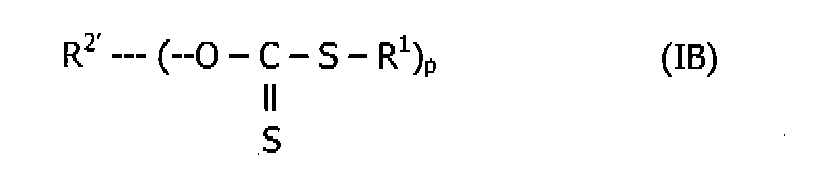
 • R2 und R2' (i) eine Alkyl-, Acyl-, Aryl-, Alken- oder Alkingruppe oder (ii) einen gesättigten oder ungesättigten, gegebenenfalls aromatischen Kohlenstoffring oder (iii) einen gesättigten oder ungesättigten Heterocyclus darstellen, wobei diese Gruppen und Ringe (i), (ii) und (iii) substituiert sein können,• R1 und R1' (i) eine Alkyl-, Acyl-, Aryl-, Alken- oder Alkingruppe, die gegebenenfalls substituiert sind, oder (ii) einen gesättigten oder ungesättigten, gegebenenfalls substituierten oder aromatischen Kohlenstoffring oder (iii) einen gesättigten oder ungesättigten, gegebenenfalls substituierten Heterocyclus, eine Polymerkette darstellen,• p zwischen 2 und 10 liegt.
 - Verfahren der Regulation des Gleichgewichts hydrophil/hydrophob der Blockcopolymere, wie sie in Anspruch 1 definiert sind, und die mindestens einen Block, der aus der Polymerisation von hydrophilen Monomeren hervorgegangen ist, und mindestens einen Block, der aus der Polymerisation von hydrophoben Monomeren hervorgegangen ist, aufweisen, dadurch gekennzeichnet, dass eingefügt werden:- hydrophile Motive in den Block, der aus der Polymerisation von hydrophoben Monomeren hervorgegangen ist, und/oder- hydrophobe Motive in den Block, der aus der Polymerisation von hydrophilen Monomeren hervorgegangen ist.
- Verwendung der Blockcopolymere gemäß einem der Ansprüche 1 bis 17 als Adhäsionsförderer oder Netzmittel.
- Verwendung gemäß Anspruch 22 als Adhäsionsförderer für einen Anstrich, bevor dieser auf eine Unterlage aus Kunststoff aufgetragen wird, in einer Menge von 0,1 bis 10 Gew.-%, vorzugsweise 0,5 bis 5 Gew.-%, bezogen auf das Gesamtgewicht des Anstrichs.
- Verwendung gemäß Anspruch 22 als Netzmittel in wässriger Lösung in einer Menge von 0,01 bis 3 Gew.-%, vorzugsweise 0,1 bis 1 Gew.-%, bezogen auf das Gesamtgewicht dieser Lösung.
Applications Claiming Priority (3)
| Application Number | Priority Date | Filing Date | Title |
|---|---|---|---|
| US09/793,169 US6437040B2 (en) | 1999-09-01 | 2001-02-26 | Water-soluble block copolymers comprising a hydrophilic block and a hydrophobic block |
| US793169 | 2001-02-26 | ||
| PCT/FR2002/000591 WO2002068486A2 (fr) | 2001-02-26 | 2002-02-15 | Copolymeres a blocs hydrosolubles comprenant un bloc hydrophobe et un bloc hydrophile |
Publications (2)
| Publication Number | Publication Date |
|---|---|
| EP1401903A2 EP1401903A2 (de) | 2004-03-31 |
| EP1401903B1 true EP1401903B1 (de) | 2008-08-13 |
Family
ID=25159260
Family Applications (1)
| Application Number | Title | Priority Date | Filing Date |
|---|---|---|---|
| EP02704847A Expired - Lifetime EP1401903B1 (de) | 2001-02-26 | 2002-02-15 | Wasserlösliche blockcopolymere mit einem hydrophilen block und einem hydrophoben block |
Country Status (6)
| Country | Link |
|---|---|
| US (1) | US6437040B2 (de) |
| EP (1) | EP1401903B1 (de) |
| CN (2) | CN1735666A (de) |
| AT (1) | ATE404600T1 (de) |
| DE (1) | DE60228252D1 (de) |
| WO (1) | WO2002068486A2 (de) |
Cited By (3)
| Publication number | Priority date | Publication date | Assignee | Title |
|---|---|---|---|---|
| US8596205B2 (en) | 2008-06-27 | 2013-12-03 | Ssw Holding Company, Inc. | Spill containing refrigerator shelf assembly |
| US9074778B2 (en) | 2009-11-04 | 2015-07-07 | Ssw Holding Company, Inc. | Cooking appliance surfaces having spill containment pattern |
| US10317129B2 (en) | 2011-10-28 | 2019-06-11 | Schott Ag | Refrigerator shelf with overflow protection system including hydrophobic layer |
Families Citing this family (60)
| Publication number | Priority date | Publication date | Assignee | Title |
|---|---|---|---|---|
| DE60138941D1 (de) * | 2000-06-29 | 2009-07-23 | Kuraray Co | Wässriger Dispersion-Klebstoff enthaltend ein Blockcopolymer und ein Polyurethan |
| WO2002090397A1 (fr) * | 2001-05-04 | 2002-11-14 | Rhodia Chimie | Procede de reduction radicalaire de fonctions dithiocarbonylees ou dithiophosphorylees portees par un polymere |
| DE60225550T2 (de) * | 2001-05-04 | 2009-04-02 | Rhodia Chimie | Blockcopolymer-tenside durch eine kontrollierte radikalpolymerisation hergestellt |
| FR2827514B1 (fr) * | 2001-07-18 | 2003-09-12 | Oreal | Composition a usage topique contenant un polymere diblocs |
| CA2474514C (en) * | 2002-02-11 | 2009-07-28 | Rhodia Chimie | Method for controlling the stability or the droplets size of simple water-in-oil emulsions, and stabilized simple water-in-oil emulsions |
| CN1650030A (zh) * | 2002-02-27 | 2005-08-03 | 第三次浪潮技术公司 | 表面修饰、接头附着和聚合方法 |
| US6790908B2 (en) * | 2002-05-09 | 2004-09-14 | Rhodia Inc. | Block copolymer |
| MXPA05001005A (es) * | 2002-07-26 | 2005-05-16 | Atofina | Composicion adhesiva para un medio humedo, con base en copolimeros de bloqueo que comprenden por lo menos un bloque hidrofilo. |
| FR2848557B1 (fr) * | 2002-12-13 | 2006-07-07 | Atofina | Copolymeres a gradient solubles ou du moins dispersibles dans l'eau comme dans les solvants organiques |
| ITTO20030039A1 (it) * | 2003-01-24 | 2004-07-25 | Fresenius Hemocare Italia Srl | Filtro per separare leucociti da sangue intero e/o da preparati derivati dal sangue, procedimento per la fabbricazione del filtro, dispositivo e utilizzazione. |
| CN1287639C (zh) * | 2003-07-24 | 2006-11-29 | 复旦大学 | 有机发光器件中的双亲分子缓冲层及其制备方法 |
| US7192907B2 (en) * | 2003-09-03 | 2007-03-20 | M-I L.L.C. | High performance water-based drilling mud and method of use |
| US7632905B2 (en) | 2004-04-09 | 2009-12-15 | L'oreal S.A. | Block copolymer, composition comprising it and cosmetic treatment process |
| US9011831B2 (en) * | 2004-09-30 | 2015-04-21 | Advanced Cardiovascular Systems, Inc. | Methacrylate copolymers for medical devices |
| US20060140898A1 (en) * | 2004-11-22 | 2006-06-29 | Claude Dubief | Use of a combination of at least one associated polymer and at least one amphiphilic diblock copolymer for thickening cosmetic compositions |
| US7494944B2 (en) * | 2004-12-10 | 2009-02-24 | Rhodia Inc. | Method for durable hydrophilization of a hydrophobic surface |
| FR2880024B1 (fr) * | 2004-12-23 | 2007-02-02 | Arkema Sa | Utilisation de copolymeres a gradient de composition comme stabilisants dans la polymerisation radiculaire en emulsion |
| FR2898067B1 (fr) * | 2006-03-03 | 2008-05-30 | Rhodia Recherches & Tech | Modification de surfaces solides par des associations de polymeres |
| DE102006020712A1 (de) * | 2006-05-04 | 2007-11-08 | Mitsubishi Polyester Film Gmbh | Beschichtete Polyesterfolie mit hoher Oberflächenspannung und niedriger Reibung |
| US7745535B2 (en) * | 2006-07-21 | 2010-06-29 | Arkema Inc. | Amphiphilic block copolymers |
| EP2046932A2 (de) * | 2006-08-03 | 2009-04-15 | Ciba Holding Inc. | Zusammensetzung zur verbesserung der benetzbarkeit von oberflächen |
| WO2008015136A1 (en) * | 2006-08-03 | 2008-02-07 | Ciba Holding Inc. | Block copolymers of diallyldialkylammonium derivatives |
| DE602006006825D1 (de) * | 2006-08-17 | 2009-06-25 | Rhodia Operations | Blockcopolymere, Verfahren zu deren Herstellung und ihre Verwendung in Emulsionen |
| US20080095847A1 (en) * | 2006-10-18 | 2008-04-24 | Thierry Glauser | Stimulus-release carrier, methods of manufacture and methods of treatment |
| CN100443151C (zh) * | 2006-12-27 | 2008-12-17 | 南京工业大学 | 一种两亲性分子对聚丙烯多孔膜表面的亲水化改性方法 |
| DE102007020778A1 (de) * | 2007-05-03 | 2008-11-06 | Giesecke & Devrient Gmbh | Vorrichtung zur Handhabung von Wertdokumenten |
| EP2173777B1 (de) * | 2007-08-02 | 2011-05-18 | DSM IP Assets B.V. | Wässrige dispersionen mit kristallisierbaren blockcopolymeren |
| US8020617B2 (en) | 2007-09-11 | 2011-09-20 | Schlumberger Technology Corporation | Well treatment to inhibit fines migration |
| WO2009090252A1 (en) * | 2008-01-17 | 2009-07-23 | Dsm Ip Assets B.V. | Water borne crosslinkable block copolymers obtained using raft |
| EP2260062B1 (de) * | 2008-04-01 | 2019-08-07 | DSM IP Assets B.V. | Plastikklebstoff mit blockcopolymeren aus raft |
| US11786036B2 (en) | 2008-06-27 | 2023-10-17 | Ssw Advanced Technologies, Llc | Spill containing refrigerator shelf assembly |
| US8541511B2 (en) * | 2008-07-07 | 2013-09-24 | Arkema Inc. | Amphiphilic block copolymer formulations |
| EP2346678B1 (de) | 2008-10-07 | 2017-10-04 | Ross Technology Corporation | Auslaufresistente oberflächen mit wasser- und ölabweisenden rändern |
| KR101908907B1 (ko) * | 2008-10-28 | 2018-10-17 | 알케마 인코포레이티드 | 물 투과 폴리머 멤브레인 |
| US8846063B2 (en) * | 2008-12-16 | 2014-09-30 | Kimberly-Clark Worldwide, Inc. | Personal care composition containing a volatile and a terpene alcohol |
| CA2796305A1 (en) | 2010-03-15 | 2011-09-22 | Ross Technology Corporation | Plunger and methods of producing hydrophobic surfaces |
| FR2965564B1 (fr) | 2010-09-30 | 2012-10-26 | Rhodia Operations | Preparation de polymeres hydrophiles de haute masse par polymerisation radicalaire controlee |
| CN103476898A (zh) | 2011-02-21 | 2013-12-25 | 罗斯科技公司 | 具有低voc粘合剂体系的超疏水性和疏油性涂层 |
| US20140010963A1 (en) * | 2011-03-18 | 2014-01-09 | Dow Corning Corporation | Silicone Release Coating Compositions |
| CN102344538A (zh) * | 2011-07-05 | 2012-02-08 | 天津大学 | 嵌段共聚物温敏水凝胶及其制备方法和应用 |
| EP2791255B1 (de) | 2011-12-15 | 2017-11-01 | Ross Technology Corporation | Zusammensetzung und beschichtung für superhydrophobe leistung |
| EP2864430A4 (de) | 2012-06-25 | 2016-04-13 | Ross Technology Corp | Elastomerische beschichtungen mit hydrophoben und/oder oleophoben eigenschaften |
| WO2014014437A2 (en) | 2012-07-16 | 2014-01-23 | Empire Technology Development Llc | Self-renewing hydrophilic organic coatings |
| AR093422A1 (es) | 2012-11-09 | 2015-06-03 | Colgate Palmolive Co | Copolimeros de bloque para proteccion del esmalte dental |
| FR2998571B1 (fr) | 2012-11-23 | 2015-08-21 | Henkel Ag & Co Kgaa | Copolymeres sequences amphiphiles et detergents pour lave-vaisselle les contenant |
| WO2014171943A1 (en) | 2013-04-18 | 2014-10-23 | Empire Technology Development Llc | Coatings that provide hydrophilic surface |
| KR20160147722A (ko) * | 2014-04-21 | 2016-12-23 | 히타치가세이가부시끼가이샤 | 블록 폴리머 |
| US10023761B2 (en) | 2015-06-29 | 2018-07-17 | Ppg Industries Ohio, Inc. | Coatings for plastic substrates |
| CN105384669B (zh) * | 2015-12-09 | 2018-02-27 | 中南大学 | 黄原酸盐的制备方法 |
| FR3047244B1 (fr) * | 2016-02-01 | 2020-04-03 | Arkema France | Copolymere amphiphile dibloc et son utilisation pour la fabrication de membranes polymeriques de filtration |
| US11230475B2 (en) * | 2016-02-15 | 2022-01-25 | Panasonic Intellectual Property Management Co., Ltd. | Hydrophobic treatment method and manufacturing method for sheet-like member using method |
| US10167367B2 (en) | 2016-10-24 | 2019-01-01 | International Business Machines Corporation | Polycarbonate based pi-pi stabilized nano-objects and hydrogels |
| US11708470B2 (en) | 2016-12-21 | 2023-07-25 | Ppg Industries Ohio, Inc. | Plastic substrate adhesion promoter with random copolymer |
| CN107174969B (zh) * | 2017-05-27 | 2019-06-25 | 江苏梦及科技有限公司 | 一种pet纺粘无纺布/pvdf复合多孔膜及其制备方法 |
| CN107174985B (zh) * | 2017-05-27 | 2019-06-21 | 江苏梦及科技有限公司 | 基于球形胶束改性聚偏氟乙烯/无纺布分离膜及其制备方法 |
| CN107474199A (zh) * | 2017-08-04 | 2017-12-15 | 常州大学 | 一种疏水表面的制备方法 |
| CN110246602B (zh) * | 2019-06-18 | 2020-12-25 | 西南科技大学 | 水性低表面张力高粘度放射性气溶胶压制剂及制备方法 |
| CN117597488A (zh) * | 2021-07-26 | 2024-02-23 | 罗门哈斯公司 | 用于制备经涂覆的纸制品的方法 |
| CN117580995A (zh) * | 2021-07-26 | 2024-02-20 | 罗门哈斯公司 | 经涂覆的纸制品 |
| CN115260860B (zh) * | 2022-08-23 | 2023-08-29 | 广州大学 | 一种有机硅涂料及其制备方法和应用 |
Family Cites Families (16)
| Publication number | Priority date | Publication date | Assignee | Title |
|---|---|---|---|---|
| US3900338A (en) * | 1974-04-30 | 1975-08-19 | Calgon Corp | Water soluble block polymers used as silt control agents |
| US4835211A (en) | 1986-12-18 | 1989-05-30 | The Procter & Gamble Company | Cationic latex compositions capable of producing elastomers with hydrophilic surfaces |
| DE3867334D1 (de) | 1987-06-23 | 1992-02-13 | Mitsubishi Petrochemical Co | Block-copolymere vom typ ab enthaltende hydrophile gruppe. |
| MX173261B (es) | 1988-06-28 | 1994-02-14 | Minnesota Mining & Mfg | Copolimeros acrilicos y metodo para su fabricacion |
| US5856409A (en) | 1989-04-07 | 1999-01-05 | Dow Corning Corporation | Method of making hydrophobic copolymers hydrophilic |
| WO1992007014A1 (en) | 1990-10-11 | 1992-04-30 | E.I. Du Pont De Nemours And Company | Novel silicone-containing acrylic star polymers, block copolymers and macromonomers |
| DE69225591T2 (de) | 1991-02-06 | 1999-01-07 | The Commonwealth Scientific And Industrial Research Organization, Campbell | Polymerisationsregelung |
| US5219945A (en) | 1992-02-20 | 1993-06-15 | E. I. Du Pont De Nemours And Company | ABC triblock methacrylate polymers |
| US5512636A (en) * | 1994-09-06 | 1996-04-30 | Betz Laboratories, Inc. | Cationic graft polymer agglomeration agents for mineral bearing ores |
| AUPM930394A0 (en) * | 1994-11-09 | 1994-12-01 | Commonwealth Scientific And Industrial Research Organisation | Block copolymer synthesis |
| DE19704714A1 (de) * | 1996-01-25 | 1997-07-31 | Basf Ag | Amphiphile Blockcopolymere |
| US5712338A (en) * | 1996-12-27 | 1998-01-27 | E. I. Du Pont De Nemours And Company | Ink jet inks containing polyacrylamides |
| US6111025A (en) | 1997-06-24 | 2000-08-29 | The Lubrizol Corporation | Block copolymer surfactants prepared by stabilized free-radical polymerization |
| FR2773161B1 (fr) | 1997-12-31 | 2000-01-21 | Rhodia Chimie Sa | Procede de synthese de polymeres a blocs |
| DE19909803A1 (de) * | 1999-03-05 | 2000-09-07 | Basf Coatings Ag | Verfahren zur Herstellung eines polymeren Umsetzungsprodukts |
| ATE520721T1 (de) | 1999-09-01 | 2011-09-15 | Rhodia Chimie Sa | Wässrige gelartige zusammensetzungen auf basis von blockcopolymeren mit hydrophilen und hydrophoben blöcken |
-
2001
- 2001-02-26 US US09/793,169 patent/US6437040B2/en not_active Expired - Lifetime
-
2002
- 2002-02-15 AT AT02704847T patent/ATE404600T1/de not_active IP Right Cessation
- 2002-02-15 EP EP02704847A patent/EP1401903B1/de not_active Expired - Lifetime
- 2002-02-15 DE DE60228252T patent/DE60228252D1/de not_active Expired - Lifetime
- 2002-02-15 WO PCT/FR2002/000591 patent/WO2002068486A2/fr not_active Ceased
- 2002-02-18 CN CNA028070623A patent/CN1735666A/zh active Pending
- 2002-02-18 CN CNA02807162XA patent/CN1735635A/zh active Pending
Cited By (3)
| Publication number | Priority date | Publication date | Assignee | Title |
|---|---|---|---|---|
| US8596205B2 (en) | 2008-06-27 | 2013-12-03 | Ssw Holding Company, Inc. | Spill containing refrigerator shelf assembly |
| US9074778B2 (en) | 2009-11-04 | 2015-07-07 | Ssw Holding Company, Inc. | Cooking appliance surfaces having spill containment pattern |
| US10317129B2 (en) | 2011-10-28 | 2019-06-11 | Schott Ag | Refrigerator shelf with overflow protection system including hydrophobic layer |
Also Published As
| Publication number | Publication date |
|---|---|
| EP1401903A2 (de) | 2004-03-31 |
| CN1735666A (zh) | 2006-02-15 |
| US6437040B2 (en) | 2002-08-20 |
| WO2002068486A2 (fr) | 2002-09-06 |
| DE60228252D1 (de) | 2008-09-25 |
| CN1735635A (zh) | 2006-02-15 |
| WO2002068486A3 (fr) | 2003-12-04 |
| ATE404600T1 (de) | 2008-08-15 |
| US20010044498A1 (en) | 2001-11-22 |
Similar Documents
| Publication | Publication Date | Title |
|---|---|---|
| EP1401903A2 (de) | Wasserlösliche blockcopolymere mit einem hydrophilen block und einem hydrophoben block | |
| EP1208119B1 (de) | Wässrige gelartige zusammensetzungen auf basis von blockcopolymeren mit hydrophilen und hydrophoben blöcken | |
| EP1185570B1 (de) | Verfahren zur herstellung von polymeren durch eine kontrollierte radikalischpolymerisation mit halogenierten xanthaten | |
| EP1397403B1 (de) | Blockcopolymer-tenside durch eine kontrollierte radikalpolymerisation hergestellt | |
| EP1044231B1 (de) | Verfahren zur herstellung von blockcopolymeren durch eine kontrollierte radikalpolymerisation mit dithioester | |
| EP1309629B1 (de) | Verfahren zur herstellung von blockcopolymeren durch kontrollierte radikalische polymerisation | |
| EP1319043B1 (de) | Latex mit modifizierten eigenschaften durch zugabe eines wasserlöslichen amphiphilen polymers | |
| EP1242492B1 (de) | Latex mit modifizierter oberflächenchemie und redispergierbare pulver, ihre herstellung und anwendungen | |
| EP1319027B1 (de) | Verfahren zur herstellung von blockcopolymeren durch eine kontrollierte radikalpolymerisation in gegenwart von einer disulfidverbindung | |
| EP1504039A1 (de) | Durch kontrollierte radikalpolymerisation erhaltenes polymer mit mindestens einer boronatfunktion, kombination davon mit einer ligandverbindung und anwendungen davon | |
| FR3018814A1 (fr) | Polymeres amphiphiles multibloc | |
| EP3239186A1 (de) | Herstellung von hydrophilen polymeren grosser masse durch kontrollierte radikalpolymerisation | |
| EP1401973B1 (de) | Anwendung von amphiphilen blockcopolymeren als haftvermittler für filmbildende wässrige zusammenstzungen auf oberflächen mit niedriger oberflächenenergie | |
| EP1483344B1 (de) | Verwendung von blockcopolymeren mit phosphat- und/oder phosphonatgruppen als haftvermittler oder als korrosionsschutzmittel für eine metalloberfläche | |
| FR2903109A1 (fr) | Polymerisation a partir d'une amine di-allylique et compose comprenant une chaine macromoleculaire comprenant des unites derivant de cette amine | |
| EP1409555A2 (de) | Kontrollierte radikalische miniemulsionspolymerisation | |
| WO2002077075A1 (fr) | Procede de fabrication de particules colloidales de forme controlee avec des copolymeres a blocs hydrosolubles comprenant un bloc hydrophobe et un bloc hydrophile | |
| WO2015121225A1 (fr) | Polymère porteur de fonctions phosphorées et d'au moins une fonction azoture, son procédé de synthèse et son utilisation | |
| WO2001027176A1 (fr) | Procede de preparation de polymeres greffes |
Legal Events
| Date | Code | Title | Description |
|---|---|---|---|
| PUAI | Public reference made under article 153(3) epc to a published international application that has entered the european phase |
Free format text: ORIGINAL CODE: 0009012 |
|
| 17P | Request for examination filed |
Effective date: 20030901 |
|
| AK | Designated contracting states |
Kind code of ref document: A2 Designated state(s): AT BE CH CY DE DK ES FI FR GB GR IE IT LI LU MC NL PT SE TR |
|
| AX | Request for extension of the european patent |
Extension state: AL LT LV MK RO SI |
|
| GRAP | Despatch of communication of intention to grant a patent |
Free format text: ORIGINAL CODE: EPIDOSNIGR1 |
|
| GRAS | Grant fee paid |
Free format text: ORIGINAL CODE: EPIDOSNIGR3 |
|
| GRAA | (expected) grant |
Free format text: ORIGINAL CODE: 0009210 |
|
| AK | Designated contracting states |
Kind code of ref document: B1 Designated state(s): AT BE CH CY DE DK ES FI FR GB GR IE IT LI LU MC NL PT SE TR |
|
| REG | Reference to a national code |
Ref country code: GB Ref legal event code: FG4D Free format text: NOT ENGLISH |
|
| REG | Reference to a national code |
Ref country code: CH Ref legal event code: EP |
|
| REG | Reference to a national code |
Ref country code: IE Ref legal event code: FG4D Free format text: LANGUAGE OF EP DOCUMENT: FRENCH |
|
| REF | Corresponds to: |
Ref document number: 60228252 Country of ref document: DE Date of ref document: 20080925 Kind code of ref document: P |
|
| PG25 | Lapsed in a contracting state [announced via postgrant information from national office to epo] |
Ref country code: ES Free format text: LAPSE BECAUSE OF FAILURE TO SUBMIT A TRANSLATION OF THE DESCRIPTION OR TO PAY THE FEE WITHIN THE PRESCRIBED TIME-LIMIT Effective date: 20081124 |
|
| PG25 | Lapsed in a contracting state [announced via postgrant information from national office to epo] |
Ref country code: FI Free format text: LAPSE BECAUSE OF FAILURE TO SUBMIT A TRANSLATION OF THE DESCRIPTION OR TO PAY THE FEE WITHIN THE PRESCRIBED TIME-LIMIT Effective date: 20080813 Ref country code: AT Free format text: LAPSE BECAUSE OF FAILURE TO SUBMIT A TRANSLATION OF THE DESCRIPTION OR TO PAY THE FEE WITHIN THE PRESCRIBED TIME-LIMIT Effective date: 20080813 |
|
| REG | Reference to a national code |
Ref country code: IE Ref legal event code: FD4D |
|
| PG25 | Lapsed in a contracting state [announced via postgrant information from national office to epo] |
Ref country code: IE Free format text: LAPSE BECAUSE OF FAILURE TO SUBMIT A TRANSLATION OF THE DESCRIPTION OR TO PAY THE FEE WITHIN THE PRESCRIBED TIME-LIMIT Effective date: 20080813 Ref country code: DK Free format text: LAPSE BECAUSE OF FAILURE TO SUBMIT A TRANSLATION OF THE DESCRIPTION OR TO PAY THE FEE WITHIN THE PRESCRIBED TIME-LIMIT Effective date: 20080813 |
|
| PLBI | Opposition filed |
Free format text: ORIGINAL CODE: 0009260 |
|
| PG25 | Lapsed in a contracting state [announced via postgrant information from national office to epo] |
Ref country code: PT Free format text: LAPSE BECAUSE OF FAILURE TO SUBMIT A TRANSLATION OF THE DESCRIPTION OR TO PAY THE FEE WITHIN THE PRESCRIBED TIME-LIMIT Effective date: 20090113 |
|
| 26 | Opposition filed |
Opponent name: BASF SE Effective date: 20090507 |
|
| PLAX | Notice of opposition and request to file observation + time limit sent |
Free format text: ORIGINAL CODE: EPIDOSNOBS2 |
|
| NLR1 | Nl: opposition has been filed with the epo |
Opponent name: BASF SE |
|
| PG25 | Lapsed in a contracting state [announced via postgrant information from national office to epo] |
Ref country code: IT Free format text: LAPSE BECAUSE OF FAILURE TO SUBMIT A TRANSLATION OF THE DESCRIPTION OR TO PAY THE FEE WITHIN THE PRESCRIBED TIME-LIMIT Effective date: 20080813 |
|
| PG25 | Lapsed in a contracting state [announced via postgrant information from national office to epo] |
Ref country code: MC Free format text: LAPSE BECAUSE OF NON-PAYMENT OF DUE FEES Effective date: 20090228 |
|
| REG | Reference to a national code |
Ref country code: CH Ref legal event code: PL |
|
| PLAF | Information modified related to communication of a notice of opposition and request to file observations + time limit |
Free format text: ORIGINAL CODE: EPIDOSCOBS2 |
|
| PG25 | Lapsed in a contracting state [announced via postgrant information from national office to epo] |
Ref country code: LI Free format text: LAPSE BECAUSE OF NON-PAYMENT OF DUE FEES Effective date: 20090228 Ref country code: CH Free format text: LAPSE BECAUSE OF NON-PAYMENT OF DUE FEES Effective date: 20090228 |
|
| PLBB | Reply of patent proprietor to notice(s) of opposition received |
Free format text: ORIGINAL CODE: EPIDOSNOBS3 |
|
| PG25 | Lapsed in a contracting state [announced via postgrant information from national office to epo] |
Ref country code: SE Free format text: LAPSE BECAUSE OF FAILURE TO SUBMIT A TRANSLATION OF THE DESCRIPTION OR TO PAY THE FEE WITHIN THE PRESCRIBED TIME-LIMIT Effective date: 20081113 |
|
| PG25 | Lapsed in a contracting state [announced via postgrant information from national office to epo] |
Ref country code: GR Free format text: LAPSE BECAUSE OF FAILURE TO SUBMIT A TRANSLATION OF THE DESCRIPTION OR TO PAY THE FEE WITHIN THE PRESCRIBED TIME-LIMIT Effective date: 20081114 |
|
| PG25 | Lapsed in a contracting state [announced via postgrant information from national office to epo] |
Ref country code: LU Free format text: LAPSE BECAUSE OF NON-PAYMENT OF DUE FEES Effective date: 20090215 |
|
| PG25 | Lapsed in a contracting state [announced via postgrant information from national office to epo] |
Ref country code: TR Free format text: LAPSE BECAUSE OF FAILURE TO SUBMIT A TRANSLATION OF THE DESCRIPTION OR TO PAY THE FEE WITHIN THE PRESCRIBED TIME-LIMIT Effective date: 20080813 |
|
| PG25 | Lapsed in a contracting state [announced via postgrant information from national office to epo] |
Ref country code: CY Free format text: LAPSE BECAUSE OF FAILURE TO SUBMIT A TRANSLATION OF THE DESCRIPTION OR TO PAY THE FEE WITHIN THE PRESCRIBED TIME-LIMIT Effective date: 20080813 |
|
| PLCK | Communication despatched that opposition was rejected |
Free format text: ORIGINAL CODE: EPIDOSNREJ1 |
|
| PLBN | Opposition rejected |
Free format text: ORIGINAL CODE: 0009273 |
|
| STAA | Information on the status of an ep patent application or granted ep patent |
Free format text: STATUS: OPPOSITION REJECTED |
|
| 27O | Opposition rejected |
Effective date: 20120118 |
|
| REG | Reference to a national code |
Ref country code: DE Ref legal event code: R100 Ref document number: 60228252 Country of ref document: DE Effective date: 20120118 |
|
| REG | Reference to a national code |
Ref country code: FR Ref legal event code: PLFP Year of fee payment: 15 |
|
| REG | Reference to a national code |
Ref country code: FR Ref legal event code: PLFP Year of fee payment: 16 |
|
| REG | Reference to a national code |
Ref country code: FR Ref legal event code: PLFP Year of fee payment: 17 |
|
| PGFP | Annual fee paid to national office [announced via postgrant information from national office to epo] |
Ref country code: GB Payment date: 20190213 Year of fee payment: 18 Ref country code: NL Payment date: 20190116 Year of fee payment: 18 Ref country code: FR Payment date: 20190111 Year of fee payment: 18 Ref country code: DE Payment date: 20190205 Year of fee payment: 18 |
|
| PGFP | Annual fee paid to national office [announced via postgrant information from national office to epo] |
Ref country code: BE Payment date: 20190116 Year of fee payment: 18 |
|
| REG | Reference to a national code |
Ref country code: DE Ref legal event code: R119 Ref document number: 60228252 Country of ref document: DE |
|
| REG | Reference to a national code |
Ref country code: NL Ref legal event code: MM Effective date: 20200301 |
|
| GBPC | Gb: european patent ceased through non-payment of renewal fee |
Effective date: 20200215 |
|
| REG | Reference to a national code |
Ref country code: BE Ref legal event code: MM Effective date: 20200229 |
|
| PG25 | Lapsed in a contracting state [announced via postgrant information from national office to epo] |
Ref country code: NL Free format text: LAPSE BECAUSE OF NON-PAYMENT OF DUE FEES Effective date: 20200301 |
|
| PG25 | Lapsed in a contracting state [announced via postgrant information from national office to epo] |
Ref country code: GB Free format text: LAPSE BECAUSE OF NON-PAYMENT OF DUE FEES Effective date: 20200215 Ref country code: DE Free format text: LAPSE BECAUSE OF NON-PAYMENT OF DUE FEES Effective date: 20200901 Ref country code: FR Free format text: LAPSE BECAUSE OF NON-PAYMENT OF DUE FEES Effective date: 20200229 |
|
| PG25 | Lapsed in a contracting state [announced via postgrant information from national office to epo] |
Ref country code: BE Free format text: LAPSE BECAUSE OF NON-PAYMENT OF DUE FEES Effective date: 20200229 |