EP1242492B1 - Latex mit modifizierter oberflächenchemie und redispergierbare pulver, ihre herstellung und anwendungen - Google Patents
Latex mit modifizierter oberflächenchemie und redispergierbare pulver, ihre herstellung und anwendungen Download PDFInfo
- Publication number
- EP1242492B1 EP1242492B1 EP00990042A EP00990042A EP1242492B1 EP 1242492 B1 EP1242492 B1 EP 1242492B1 EP 00990042 A EP00990042 A EP 00990042A EP 00990042 A EP00990042 A EP 00990042A EP 1242492 B1 EP1242492 B1 EP 1242492B1
- Authority
- EP
- European Patent Office
- Prior art keywords
- groups
- alkyl
- optionally substituted
- aryl
- latex
- Prior art date
- Legal status (The legal status is an assumption and is not a legal conclusion. Google has not performed a legal analysis and makes no representation as to the accuracy of the status listed.)
- Expired - Lifetime
Links
- 229920000126 latex Polymers 0.000 title claims abstract description 100
- 239000004816 latex Substances 0.000 title claims abstract description 86
- 239000000843 powder Substances 0.000 title claims abstract description 32
- 238000004519 manufacturing process Methods 0.000 title abstract description 3
- -1 thioether-thione Substances 0.000 claims abstract description 134
- 229920000642 polymer Polymers 0.000 claims abstract description 97
- 239000000178 monomer Substances 0.000 claims abstract description 59
- 239000000203 mixture Substances 0.000 claims abstract description 52
- 238000009472 formulation Methods 0.000 claims abstract description 22
- 238000001035 drying Methods 0.000 claims abstract description 21
- 239000004566 building material Substances 0.000 claims abstract description 7
- 239000012990 dithiocarbamate Substances 0.000 claims abstract description 6
- 239000004820 Pressure-sensitive adhesive Substances 0.000 claims abstract description 5
- 125000003118 aryl group Chemical group 0.000 claims description 71
- 125000003178 carboxy group Chemical group [H]OC(*)=O 0.000 claims description 69
- 125000000217 alkyl group Chemical group 0.000 claims description 52
- 229910052736 halogen Inorganic materials 0.000 claims description 40
- 150000002367 halogens Chemical class 0.000 claims description 40
- 125000003545 alkoxy group Chemical group 0.000 claims description 38
- 125000002924 primary amino group Chemical group [H]N([H])* 0.000 claims description 38
- PPBRXRYQALVLMV-UHFFFAOYSA-N Styrene Chemical compound C=CC1=CC=CC=C1 PPBRXRYQALVLMV-UHFFFAOYSA-N 0.000 claims description 37
- 229920006395 saturated elastomer Polymers 0.000 claims description 36
- 125000002887 hydroxy group Chemical group [H]O* 0.000 claims description 33
- BDHFUVZGWQCTTF-UHFFFAOYSA-N sulfonic acid Chemical compound OS(=O)=O BDHFUVZGWQCTTF-UHFFFAOYSA-N 0.000 claims description 30
- XFXPMWWXUTWYJX-UHFFFAOYSA-N Cyanide Chemical compound N#[C-] XFXPMWWXUTWYJX-UHFFFAOYSA-N 0.000 claims description 27
- 125000004423 acyloxy group Chemical group 0.000 claims description 27
- 125000004093 cyano group Chemical group *C#N 0.000 claims description 27
- 150000001336 alkenes Chemical class 0.000 claims description 26
- 239000004593 Epoxy Substances 0.000 claims description 24
- 229910052783 alkali metal Inorganic materials 0.000 claims description 24
- 125000003917 carbamoyl group Chemical group [H]N([H])C(*)=O 0.000 claims description 24
- 125000004453 alkoxycarbonyl group Chemical group 0.000 claims description 23
- 125000005161 aryl oxy carbonyl group Chemical group 0.000 claims description 22
- 150000001735 carboxylic acids Chemical class 0.000 claims description 21
- 125000000623 heterocyclic group Chemical group 0.000 claims description 21
- 125000001181 organosilyl group Chemical group [SiH3]* 0.000 claims description 20
- 238000006116 polymerization reaction Methods 0.000 claims description 19
- 125000003903 2-propenyl group Chemical group [H]C([*])([H])C([H])=C([H])[H] 0.000 claims description 18
- OKTJSMMVPCPJKN-UHFFFAOYSA-N Carbon Chemical compound [C] OKTJSMMVPCPJKN-UHFFFAOYSA-N 0.000 claims description 18
- 125000002252 acyl group Chemical group 0.000 claims description 18
- 125000004448 alkyl carbonyl group Chemical group 0.000 claims description 18
- 125000005099 aryl alkyl carbonyl group Chemical group 0.000 claims description 18
- 125000005129 aryl carbonyl group Chemical group 0.000 claims description 18
- 229910052799 carbon Inorganic materials 0.000 claims description 18
- 125000005544 phthalimido group Chemical group 0.000 claims description 18
- 229920000233 poly(alkylene oxides) Polymers 0.000 claims description 18
- 150000003242 quaternary ammonium salts Chemical class 0.000 claims description 18
- 125000002355 alkine group Chemical group 0.000 claims description 17
- 239000003973 paint Substances 0.000 claims description 16
- 150000003254 radicals Chemical class 0.000 claims description 16
- NIXOWILDQLNWCW-UHFFFAOYSA-N acrylic acid group Chemical group C(C=C)(=O)O NIXOWILDQLNWCW-UHFFFAOYSA-N 0.000 claims description 14
- 150000001408 amides Chemical class 0.000 claims description 13
- 125000000547 substituted alkyl group Chemical group 0.000 claims description 13
- 239000012991 xanthate Substances 0.000 claims description 13
- 229910052757 nitrogen Inorganic materials 0.000 claims description 12
- 125000004435 hydrogen atom Chemical group [H]* 0.000 claims description 11
- 125000001997 phenyl group Chemical group [H]C1=C([H])C([H])=C(*)C([H])=C1[H] 0.000 claims description 10
- 238000010526 radical polymerization reaction Methods 0.000 claims description 9
- 229920002554 vinyl polymer Polymers 0.000 claims description 9
- KAKZBPTYRLMSJV-UHFFFAOYSA-N Butadiene Chemical compound C=CC=C KAKZBPTYRLMSJV-UHFFFAOYSA-N 0.000 claims description 8
- 150000002148 esters Chemical class 0.000 claims description 8
- 239000003999 initiator Substances 0.000 claims description 8
- 239000000853 adhesive Substances 0.000 claims description 7
- 230000001070 adhesive effect Effects 0.000 claims description 7
- 125000002877 alkyl aryl group Chemical group 0.000 claims description 7
- 125000003710 aryl alkyl group Chemical group 0.000 claims description 7
- 125000004429 atom Chemical group 0.000 claims description 7
- 229910052717 sulfur Inorganic materials 0.000 claims description 7
- 125000000520 N-substituted aminocarbonyl group Chemical group [*]NC(=O)* 0.000 claims description 6
- 125000003739 carbamimidoyl group Chemical group C(N)(=N)* 0.000 claims description 6
- 238000007720 emulsion polymerization reaction Methods 0.000 claims description 6
- 239000002671 adjuvant Substances 0.000 claims description 5
- 150000004659 dithiocarbamates Chemical class 0.000 claims description 5
- YACLQRRMGMJLJV-UHFFFAOYSA-N chloroprene Chemical compound ClC(=C)C=C YACLQRRMGMJLJV-UHFFFAOYSA-N 0.000 claims description 4
- HCXJFMDOHDNDCC-UHFFFAOYSA-N 5-$l^{1}-oxidanyl-3,4-dihydropyrrol-2-one Chemical group O=C1CCC(=O)[N]1 HCXJFMDOHDNDCC-UHFFFAOYSA-N 0.000 claims description 3
- 150000002430 hydrocarbons Chemical class 0.000 claims description 3
- 229910052760 oxygen Inorganic materials 0.000 claims description 3
- 229910052698 phosphorus Inorganic materials 0.000 claims description 3
- 239000007870 radical polymerization initiator Substances 0.000 claims description 3
- 150000005840 aryl radicals Chemical class 0.000 claims description 2
- 150000001721 carbon Chemical group 0.000 claims description 2
- 125000005842 heteroatom Chemical group 0.000 claims description 2
- 239000000725 suspension Substances 0.000 claims description 2
- 125000005309 thioalkoxy group Chemical group 0.000 claims description 2
- 125000002023 trifluoromethyl group Chemical group FC(F)(F)* 0.000 claims description 2
- 239000004215 Carbon black (E152) Substances 0.000 claims 2
- 229930195733 hydrocarbon Natural products 0.000 claims 2
- 125000004663 dialkyl amino group Chemical group 0.000 claims 1
- XLYOFNOQVPJJNP-UHFFFAOYSA-N water Substances O XLYOFNOQVPJJNP-UHFFFAOYSA-N 0.000 abstract description 21
- 239000000839 emulsion Substances 0.000 abstract description 10
- ZOOODBUHSVUZEM-UHFFFAOYSA-N ethoxymethanedithioic acid Chemical group CCOC(S)=S ZOOODBUHSVUZEM-UHFFFAOYSA-N 0.000 abstract description 9
- 239000012988 Dithioester Substances 0.000 abstract description 3
- 125000005022 dithioester group Chemical group 0.000 abstract description 3
- 229920001400 block copolymer Polymers 0.000 abstract 1
- DKVNPHBNOWQYFE-UHFFFAOYSA-N carbamodithioic acid Chemical compound NC(S)=S DKVNPHBNOWQYFE-UHFFFAOYSA-N 0.000 abstract 1
- 238000010422 painting Methods 0.000 abstract 1
- CQEYYJKEWSMYFG-UHFFFAOYSA-N butyl acrylate Chemical compound CCCCOC(=O)C=C CQEYYJKEWSMYFG-UHFFFAOYSA-N 0.000 description 16
- 159000000011 group IA salts Chemical class 0.000 description 16
- VTYYLEPIZMXCLO-UHFFFAOYSA-L Calcium carbonate Chemical compound [Ca+2].[O-]C([O-])=O VTYYLEPIZMXCLO-UHFFFAOYSA-L 0.000 description 14
- QGZKDVFQNNGYKY-UHFFFAOYSA-O Ammonium Chemical compound [NH4+] QGZKDVFQNNGYKY-UHFFFAOYSA-O 0.000 description 13
- 238000002360 preparation method Methods 0.000 description 13
- 230000000052 comparative effect Effects 0.000 description 12
- QYZFTMMPKCOTAN-UHFFFAOYSA-N n-[2-(2-hydroxyethylamino)ethyl]-2-[[1-[2-(2-hydroxyethylamino)ethylamino]-2-methyl-1-oxopropan-2-yl]diazenyl]-2-methylpropanamide Chemical compound OCCNCCNC(=O)C(C)(C)N=NC(C)(C)C(=O)NCCNCCO QYZFTMMPKCOTAN-UHFFFAOYSA-N 0.000 description 11
- 239000000243 solution Substances 0.000 description 11
- 150000001875 compounds Chemical class 0.000 description 10
- 238000000034 method Methods 0.000 description 10
- OZAIFHULBGXAKX-UHFFFAOYSA-N 2-(2-cyanopropan-2-yldiazenyl)-2-methylpropanenitrile Chemical compound N#CC(C)(C)N=NC(C)(C)C#N OZAIFHULBGXAKX-UHFFFAOYSA-N 0.000 description 8
- SMZOUWXMTYCWNB-UHFFFAOYSA-N 2-(2-methoxy-5-methylphenyl)ethanamine Chemical compound COC1=CC=C(C)C=C1CCN SMZOUWXMTYCWNB-UHFFFAOYSA-N 0.000 description 7
- HRPVXLWXLXDGHG-UHFFFAOYSA-N Acrylamide Chemical compound NC(=O)C=C HRPVXLWXLXDGHG-UHFFFAOYSA-N 0.000 description 6
- HEMHJVSKTPXQMS-UHFFFAOYSA-M Sodium hydroxide Chemical compound [OH-].[Na+] HEMHJVSKTPXQMS-UHFFFAOYSA-M 0.000 description 6
- XTXRWKRVRITETP-UHFFFAOYSA-N Vinyl acetate Chemical compound CC(=O)OC=C XTXRWKRVRITETP-UHFFFAOYSA-N 0.000 description 6
- 239000000123 paper Substances 0.000 description 6
- 125000000391 vinyl group Chemical group [H]C([*])=C([H])[H] 0.000 description 6
- NIXOWILDQLNWCW-UHFFFAOYSA-M Acrylate Chemical compound [O-]C(=O)C=C NIXOWILDQLNWCW-UHFFFAOYSA-M 0.000 description 5
- 239000006185 dispersion Substances 0.000 description 5
- 238000010992 reflux Methods 0.000 description 5
- 229920001567 vinyl ester resin Polymers 0.000 description 5
- CSCPPACGZOOCGX-UHFFFAOYSA-N Acetone Chemical compound CC(C)=O CSCPPACGZOOCGX-UHFFFAOYSA-N 0.000 description 4
- IJGRMHOSHXDMSA-UHFFFAOYSA-N Atomic nitrogen Chemical compound N#N IJGRMHOSHXDMSA-UHFFFAOYSA-N 0.000 description 4
- LFQSCWFLJHTTHZ-UHFFFAOYSA-N Ethanol Chemical compound CCO LFQSCWFLJHTTHZ-UHFFFAOYSA-N 0.000 description 4
- WHUUTDBJXJRKMK-VKHMYHEASA-N L-glutamic acid Chemical class OC(=O)[C@@H](N)CCC(O)=O WHUUTDBJXJRKMK-VKHMYHEASA-N 0.000 description 4
- 150000001298 alcohols Chemical class 0.000 description 4
- 229910000019 calcium carbonate Inorganic materials 0.000 description 4
- 125000004432 carbon atom Chemical group C* 0.000 description 4
- 150000001991 dicarboxylic acids Chemical class 0.000 description 4
- UYMKPFRHYYNDTL-UHFFFAOYSA-N ethenamine Chemical compound NC=C UYMKPFRHYYNDTL-UHFFFAOYSA-N 0.000 description 4
- 230000002209 hydrophobic effect Effects 0.000 description 4
- JRKICGRDRMAZLK-UHFFFAOYSA-L peroxydisulfate Chemical compound [O-]S(=O)(=O)OOS([O-])(=O)=O JRKICGRDRMAZLK-UHFFFAOYSA-L 0.000 description 4
- 239000007787 solid Substances 0.000 description 4
- 238000003860 storage Methods 0.000 description 4
- 238000012360 testing method Methods 0.000 description 4
- JAHNSTQSQJOJLO-UHFFFAOYSA-N 2-(3-fluorophenyl)-1h-imidazole Chemical compound FC1=CC=CC(C=2NC=CN=2)=C1 JAHNSTQSQJOJLO-UHFFFAOYSA-N 0.000 description 3
- QGJOPFRUJISHPQ-UHFFFAOYSA-N Carbon disulfide Chemical compound S=C=S QGJOPFRUJISHPQ-UHFFFAOYSA-N 0.000 description 3
- CERQOIWHTDAKMF-UHFFFAOYSA-M Methacrylate Chemical compound CC(=C)C([O-])=O CERQOIWHTDAKMF-UHFFFAOYSA-M 0.000 description 3
- CERQOIWHTDAKMF-UHFFFAOYSA-N Methacrylic acid Chemical compound CC(=C)C(O)=O CERQOIWHTDAKMF-UHFFFAOYSA-N 0.000 description 3
- 239000002202 Polyethylene glycol Substances 0.000 description 3
- 238000005299 abrasion Methods 0.000 description 3
- 150000003863 ammonium salts Chemical class 0.000 description 3
- 229910002091 carbon monoxide Inorganic materials 0.000 description 3
- 125000006297 carbonyl amino group Chemical group [H]N([*:2])C([*:1])=O 0.000 description 3
- 238000000576 coating method Methods 0.000 description 3
- 239000008367 deionised water Substances 0.000 description 3
- 229910021641 deionized water Inorganic materials 0.000 description 3
- 150000002191 fatty alcohols Chemical class 0.000 description 3
- 229910052739 hydrogen Inorganic materials 0.000 description 3
- FQPSGWSUVKBHSU-UHFFFAOYSA-N methacrylamide Chemical compound CC(=C)C(N)=O FQPSGWSUVKBHSU-UHFFFAOYSA-N 0.000 description 3
- LVHBHZANLOWSRM-UHFFFAOYSA-N methylenebutanedioic acid Natural products OC(=O)CC(=C)C(O)=O LVHBHZANLOWSRM-UHFFFAOYSA-N 0.000 description 3
- 239000000693 micelle Substances 0.000 description 3
- 239000000049 pigment Substances 0.000 description 3
- 229920001223 polyethylene glycol Polymers 0.000 description 3
- 229940080818 propionamide Drugs 0.000 description 3
- 241000894007 species Species 0.000 description 3
- 238000003756 stirring Methods 0.000 description 3
- 235000000346 sugar Nutrition 0.000 description 3
- 150000008163 sugars Chemical class 0.000 description 3
- QEQBMZQFDDDTPN-UHFFFAOYSA-N (2-methylpropan-2-yl)oxy benzenecarboperoxoate Chemical compound CC(C)(C)OOOC(=O)C1=CC=CC=C1 QEQBMZQFDDDTPN-UHFFFAOYSA-N 0.000 description 2
- OSSNTDFYBPYIEC-UHFFFAOYSA-N 1-ethenylimidazole Chemical compound C=CN1C=CN=C1 OSSNTDFYBPYIEC-UHFFFAOYSA-N 0.000 description 2
- OVSKIKFHRZPJSS-UHFFFAOYSA-N 2,4-D Chemical compound OC(=O)COC1=CC=C(Cl)C=C1Cl OVSKIKFHRZPJSS-UHFFFAOYSA-N 0.000 description 2
- LDQYWNUWKVADJV-UHFFFAOYSA-N 2-[(1-amino-2-methyl-1-oxopropan-2-yl)diazenyl]-2-methylpropanamide;dihydrate Chemical compound O.O.NC(=O)C(C)(C)N=NC(C)(C)C(N)=O LDQYWNUWKVADJV-UHFFFAOYSA-N 0.000 description 2
- KGIGUEBEKRSTEW-UHFFFAOYSA-N 2-vinylpyridine Chemical class C=CC1=CC=CC=N1 KGIGUEBEKRSTEW-UHFFFAOYSA-N 0.000 description 2
- NLHHRLWOUZZQLW-UHFFFAOYSA-N Acrylonitrile Chemical compound C=CC#N NLHHRLWOUZZQLW-UHFFFAOYSA-N 0.000 description 2
- OMPJBNCRMGITSC-UHFFFAOYSA-N Benzoylperoxide Chemical compound C=1C=CC=CC=1C(=O)OOC(=O)C1=CC=CC=C1 OMPJBNCRMGITSC-UHFFFAOYSA-N 0.000 description 2
- SOGAXMICEFXMKE-UHFFFAOYSA-N Butylmethacrylate Chemical compound CCCCOC(=O)C(C)=C SOGAXMICEFXMKE-UHFFFAOYSA-N 0.000 description 2
- VZCYOOQTPOCHFL-OWOJBTEDSA-N Fumaric acid Chemical compound OC(=O)\C=C\C(O)=O VZCYOOQTPOCHFL-OWOJBTEDSA-N 0.000 description 2
- MHAJPDPJQMAIIY-UHFFFAOYSA-N Hydrogen peroxide Chemical compound OO MHAJPDPJQMAIIY-UHFFFAOYSA-N 0.000 description 2
- DGAQECJNVWCQMB-PUAWFVPOSA-M Ilexoside XXIX Chemical compound C[C@@H]1CC[C@@]2(CC[C@@]3(C(=CC[C@H]4[C@]3(CC[C@@H]5[C@@]4(CC[C@@H](C5(C)C)OS(=O)(=O)[O-])C)C)[C@@H]2[C@]1(C)O)C)C(=O)O[C@H]6[C@@H]([C@H]([C@@H]([C@H](O6)CO)O)O)O.[Na+] DGAQECJNVWCQMB-PUAWFVPOSA-M 0.000 description 2
- BAPJBEWLBFYGME-UHFFFAOYSA-N Methyl acrylate Chemical compound COC(=O)C=C BAPJBEWLBFYGME-UHFFFAOYSA-N 0.000 description 2
- GYCMBHHDWRMZGG-UHFFFAOYSA-N Methylacrylonitrile Chemical compound CC(=C)C#N GYCMBHHDWRMZGG-UHFFFAOYSA-N 0.000 description 2
- KYIKRXIYLAGAKQ-UHFFFAOYSA-N abcn Chemical compound C1CCCCC1(C#N)N=NC1(C#N)CCCCC1 KYIKRXIYLAGAKQ-UHFFFAOYSA-N 0.000 description 2
- 239000002253 acid Substances 0.000 description 2
- 150000003926 acrylamides Chemical class 0.000 description 2
- 150000001252 acrylic acid derivatives Chemical class 0.000 description 2
- XYLMUPLGERFSHI-UHFFFAOYSA-N alpha-Methylstyrene Chemical compound CC(=C)C1=CC=CC=C1 XYLMUPLGERFSHI-UHFFFAOYSA-N 0.000 description 2
- 125000003277 amino group Chemical group 0.000 description 2
- 125000004103 aminoalkyl group Chemical group 0.000 description 2
- VAZSKTXWXKYQJF-UHFFFAOYSA-N ammonium persulfate Chemical compound [NH4+].[NH4+].[O-]S(=O)OOS([O-])=O VAZSKTXWXKYQJF-UHFFFAOYSA-N 0.000 description 2
- 239000003945 anionic surfactant Substances 0.000 description 2
- 239000007900 aqueous suspension Substances 0.000 description 2
- 238000000889 atomisation Methods 0.000 description 2
- 239000011230 binding agent Substances 0.000 description 2
- 230000015572 biosynthetic process Effects 0.000 description 2
- ABBZJHFBQXYTLU-UHFFFAOYSA-N but-3-enamide Chemical compound NC(=O)CC=C ABBZJHFBQXYTLU-UHFFFAOYSA-N 0.000 description 2
- 150000001732 carboxylic acid derivatives Chemical class 0.000 description 2
- 230000001143 conditioned effect Effects 0.000 description 2
- 238000007796 conventional method Methods 0.000 description 2
- HRKQOINLCJTGBK-UHFFFAOYSA-L dioxidosulfate(2-) Chemical compound [O-]S[O-] HRKQOINLCJTGBK-UHFFFAOYSA-L 0.000 description 2
- 239000007789 gas Substances 0.000 description 2
- 150000002763 monocarboxylic acids Chemical class 0.000 description 2
- VXRNYQMFDGOGSI-UHFFFAOYSA-N n-(1,3-dihydroxy-2-methylpropan-2-yl)-2-[[1-[(1,3-dihydroxy-2-methylpropan-2-yl)amino]-2-methyl-1-oxopropan-2-yl]diazenyl]-2-methylpropanamide Chemical compound OCC(C)(CO)NC(=O)C(C)(C)N=NC(C)(C)C(=O)NC(C)(CO)CO VXRNYQMFDGOGSI-UHFFFAOYSA-N 0.000 description 2
- WVFLGSMUPMVNTQ-UHFFFAOYSA-N n-(2-hydroxyethyl)-2-[[1-(2-hydroxyethylamino)-2-methyl-1-oxopropan-2-yl]diazenyl]-2-methylpropanamide Chemical compound OCCNC(=O)C(C)(C)N=NC(C)(C)C(=O)NCCO WVFLGSMUPMVNTQ-UHFFFAOYSA-N 0.000 description 2
- BUGISVZCMXHOHO-UHFFFAOYSA-N n-[1,3-dihydroxy-2-(hydroxymethyl)propan-2-yl]-2-[[1-[[1,3-dihydroxy-2-(hydroxymethyl)propan-2-yl]amino]-2-methyl-1-oxopropan-2-yl]diazenyl]-2-methylpropanamide Chemical compound OCC(CO)(CO)NC(=O)C(C)(C)N=NC(C)(C)C(=O)NC(CO)(CO)CO BUGISVZCMXHOHO-UHFFFAOYSA-N 0.000 description 2
- ZQXSMRAEXCEDJD-UHFFFAOYSA-N n-ethenylformamide Chemical compound C=CNC=O ZQXSMRAEXCEDJD-UHFFFAOYSA-N 0.000 description 2
- 239000002736 nonionic surfactant Substances 0.000 description 2
- 239000002245 particle Substances 0.000 description 2
- VLTRZXGMWDSKGL-UHFFFAOYSA-M perchlorate Inorganic materials [O-]Cl(=O)(=O)=O VLTRZXGMWDSKGL-UHFFFAOYSA-M 0.000 description 2
- VLTRZXGMWDSKGL-UHFFFAOYSA-N perchloric acid Chemical compound OCl(=O)(=O)=O VLTRZXGMWDSKGL-UHFFFAOYSA-N 0.000 description 2
- 150000002976 peresters Chemical class 0.000 description 2
- 229920000058 polyacrylate Polymers 0.000 description 2
- 239000000047 product Substances 0.000 description 2
- HJWLCRVIBGQPNF-UHFFFAOYSA-N prop-2-enylbenzene Chemical compound C=CCC1=CC=CC=C1 HJWLCRVIBGQPNF-UHFFFAOYSA-N 0.000 description 2
- QLNJFJADRCOGBJ-UHFFFAOYSA-N propionamide Chemical compound CCC(N)=O QLNJFJADRCOGBJ-UHFFFAOYSA-N 0.000 description 2
- 229910052708 sodium Inorganic materials 0.000 description 2
- 239000011734 sodium Substances 0.000 description 2
- HRZFUMHJMZEROT-UHFFFAOYSA-L sodium disulfite Chemical compound [Na+].[Na+].[O-]S(=O)S([O-])(=O)=O HRZFUMHJMZEROT-UHFFFAOYSA-L 0.000 description 2
- 235000010262 sodium metabisulphite Nutrition 0.000 description 2
- PMZURENOXWZQFD-UHFFFAOYSA-L sodium sulphate Substances [Na+].[Na+].[O-]S([O-])(=O)=O PMZURENOXWZQFD-UHFFFAOYSA-L 0.000 description 2
- 239000002904 solvent Substances 0.000 description 2
- 239000004094 surface-active agent Substances 0.000 description 2
- 235000018553 tannin Nutrition 0.000 description 2
- 239000001648 tannin Substances 0.000 description 2
- 229920001864 tannin Polymers 0.000 description 2
- OPQYOFWUFGEMRZ-UHFFFAOYSA-N tert-butyl 2,2-dimethylpropaneperoxoate Chemical compound CC(C)(C)OOC(=O)C(C)(C)C OPQYOFWUFGEMRZ-UHFFFAOYSA-N 0.000 description 2
- NMOALOSNPWTWRH-UHFFFAOYSA-N tert-butyl 7,7-dimethyloctaneperoxoate Chemical compound CC(C)(C)CCCCCC(=O)OOC(C)(C)C NMOALOSNPWTWRH-UHFFFAOYSA-N 0.000 description 2
- SWAXTRYEYUTSAP-UHFFFAOYSA-N tert-butyl ethaneperoxoate Chemical compound CC(=O)OOC(C)(C)C SWAXTRYEYUTSAP-UHFFFAOYSA-N 0.000 description 2
- CIHOLLKRGTVIJN-UHFFFAOYSA-N tert‐butyl hydroperoxide Chemical compound CC(C)(C)OO CIHOLLKRGTVIJN-UHFFFAOYSA-N 0.000 description 2
- VZCYOOQTPOCHFL-UHFFFAOYSA-N trans-butenedioic acid Natural products OC(=O)C=CC(O)=O VZCYOOQTPOCHFL-UHFFFAOYSA-N 0.000 description 2
- HGTUJZTUQFXBIH-UHFFFAOYSA-N (2,3-dimethyl-3-phenylbutan-2-yl)benzene Chemical group C=1C=CC=CC=1C(C)(C)C(C)(C)C1=CC=CC=C1 HGTUJZTUQFXBIH-UHFFFAOYSA-N 0.000 description 1
- CCTFAOUOYLVUFG-UHFFFAOYSA-N 2-(1-amino-1-imino-2-methylpropan-2-yl)azo-2-methylpropanimidamide Chemical compound NC(=N)C(C)(C)N=NC(C)(C)C(N)=N CCTFAOUOYLVUFG-UHFFFAOYSA-N 0.000 description 1
- LCPVQAHEFVXVKT-UHFFFAOYSA-N 2-(2,4-difluorophenoxy)pyridin-3-amine Chemical compound NC1=CC=CN=C1OC1=CC=C(F)C=C1F LCPVQAHEFVXVKT-UHFFFAOYSA-N 0.000 description 1
- XMNIXWIUMCBBBL-UHFFFAOYSA-N 2-(2-phenylpropan-2-ylperoxy)propan-2-ylbenzene Chemical compound C=1C=CC=CC=1C(C)(C)OOC(C)(C)C1=CC=CC=C1 XMNIXWIUMCBBBL-UHFFFAOYSA-N 0.000 description 1
- DPBJAVGHACCNRL-UHFFFAOYSA-N 2-(dimethylamino)ethyl prop-2-enoate Chemical compound CN(C)CCOC(=O)C=C DPBJAVGHACCNRL-UHFFFAOYSA-N 0.000 description 1
- QNIRRHUUOQAEPB-UHFFFAOYSA-N 2-(prop-2-enoylamino)butane-2-sulfonic acid Chemical compound CCC(C)(S(O)(=O)=O)NC(=O)C=C QNIRRHUUOQAEPB-UHFFFAOYSA-N 0.000 description 1
- PYKCEDJHRUUDRK-UHFFFAOYSA-N 2-(tert-butyldiazenyl)-2-methylpropanenitrile Chemical compound CC(C)(C)N=NC(C)(C)C#N PYKCEDJHRUUDRK-UHFFFAOYSA-N 0.000 description 1
- DNLZVNZIAOXDTF-UHFFFAOYSA-N 2-[(dimethylamino)methyl]prop-2-enamide Chemical compound CN(C)CC(=C)C(N)=O DNLZVNZIAOXDTF-UHFFFAOYSA-N 0.000 description 1
- VMSBGXAJJLPWKV-UHFFFAOYSA-N 2-ethenylbenzenesulfonic acid Chemical compound OS(=O)(=O)C1=CC=CC=C1C=C VMSBGXAJJLPWKV-UHFFFAOYSA-N 0.000 description 1
- OMIGHNLMNHATMP-UHFFFAOYSA-N 2-hydroxyethyl prop-2-enoate Chemical compound OCCOC(=O)C=C OMIGHNLMNHATMP-UHFFFAOYSA-N 0.000 description 1
- SMBRHGJEDJVDOB-UHFFFAOYSA-N 2-methylpropanimidamide;dihydrochloride Chemical compound Cl.Cl.CC(C)C(N)=N SMBRHGJEDJVDOB-UHFFFAOYSA-N 0.000 description 1
- RUMACXVDVNRZJZ-UHFFFAOYSA-N 2-methylpropyl 2-methylprop-2-enoate Chemical compound CC(C)COC(=O)C(C)=C RUMACXVDVNRZJZ-UHFFFAOYSA-N 0.000 description 1
- CFVWNXQPGQOHRJ-UHFFFAOYSA-N 2-methylpropyl prop-2-enoate Chemical compound CC(C)COC(=O)C=C CFVWNXQPGQOHRJ-UHFFFAOYSA-N 0.000 description 1
- FRIBMENBGGCKPD-UHFFFAOYSA-N 3-(2,3-dimethoxyphenyl)prop-2-enal Chemical compound COC1=CC=CC(C=CC=O)=C1OC FRIBMENBGGCKPD-UHFFFAOYSA-N 0.000 description 1
- FKAJZOZTZXQGTJ-UHFFFAOYSA-N 5,5-dimethyl-1,3-diazabicyclo[2.2.0]hex-3-ene Chemical compound C1N2C(C1(C)C)=NC2 FKAJZOZTZXQGTJ-UHFFFAOYSA-N 0.000 description 1
- PGFZYOCLSPEKSN-UHFFFAOYSA-N 5,5-dimethyl-1,3-diazabicyclo[2.2.0]hex-3-ene dihydrochloride Chemical compound Cl.Cl.CC1(C)CN2CN=C12 PGFZYOCLSPEKSN-UHFFFAOYSA-N 0.000 description 1
- QTBSBXVTEAMEQO-UHFFFAOYSA-M Acetate Chemical compound CC([O-])=O QTBSBXVTEAMEQO-UHFFFAOYSA-M 0.000 description 1
- UHOVQNZJYSORNB-UHFFFAOYSA-N Benzene Chemical compound C1=CC=CC=C1 UHOVQNZJYSORNB-UHFFFAOYSA-N 0.000 description 1
- 239000004342 Benzoyl peroxide Substances 0.000 description 1
- LSNNMFCWUKXFEE-UHFFFAOYSA-M Bisulfite Chemical compound OS([O-])=O LSNNMFCWUKXFEE-UHFFFAOYSA-M 0.000 description 1
- 241000283707 Capra Species 0.000 description 1
- JIGUQPWFLRLWPJ-UHFFFAOYSA-N Ethyl acrylate Chemical compound CCOC(=O)C=C JIGUQPWFLRLWPJ-UHFFFAOYSA-N 0.000 description 1
- WHUUTDBJXJRKMK-UHFFFAOYSA-N Glutamic acid Natural products OC(=O)C(N)CCC(O)=O WHUUTDBJXJRKMK-UHFFFAOYSA-N 0.000 description 1
- WOBHKFSMXKNTIM-UHFFFAOYSA-N Hydroxyethyl methacrylate Chemical compound CC(=C)C(=O)OCCO WOBHKFSMXKNTIM-UHFFFAOYSA-N 0.000 description 1
- YIVJZNGAASQVEM-UHFFFAOYSA-N Lauroyl peroxide Chemical compound CCCCCCCCCCCC(=O)OOC(=O)CCCCCCCCCCC YIVJZNGAASQVEM-UHFFFAOYSA-N 0.000 description 1
- VVQNEPGJFQJSBK-UHFFFAOYSA-N Methyl methacrylate Chemical compound COC(=O)C(C)=C VVQNEPGJFQJSBK-UHFFFAOYSA-N 0.000 description 1
- QLZHNIAADXEJJP-UHFFFAOYSA-N Phenylphosphonic acid Chemical compound OP(O)(=O)C1=CC=CC=C1 QLZHNIAADXEJJP-UHFFFAOYSA-N 0.000 description 1
- 239000004372 Polyvinyl alcohol Chemical class 0.000 description 1
- ZLMJMSJWJFRBEC-UHFFFAOYSA-N Potassium Chemical compound [K] ZLMJMSJWJFRBEC-UHFFFAOYSA-N 0.000 description 1
- OFOBLEOULBTSOW-UHFFFAOYSA-N Propanedioic acid Natural products OC(=O)CC(O)=O OFOBLEOULBTSOW-UHFFFAOYSA-N 0.000 description 1
- XBDQKXXYIPTUBI-UHFFFAOYSA-M Propionate Chemical compound CCC([O-])=O XBDQKXXYIPTUBI-UHFFFAOYSA-M 0.000 description 1
- 229920002125 Sokalan® Polymers 0.000 description 1
- 241001080024 Telles Species 0.000 description 1
- HCHKCACWOHOZIP-UHFFFAOYSA-N Zinc Chemical compound [Zn] HCHKCACWOHOZIP-UHFFFAOYSA-N 0.000 description 1
- 239000000654 additive Substances 0.000 description 1
- 239000003513 alkali Substances 0.000 description 1
- 150000001340 alkali metals Chemical class 0.000 description 1
- 150000001447 alkali salts Chemical class 0.000 description 1
- 125000003342 alkenyl group Chemical group 0.000 description 1
- 150000001345 alkine derivatives Chemical class 0.000 description 1
- 150000004703 alkoxides Chemical class 0.000 description 1
- 125000000304 alkynyl group Chemical group 0.000 description 1
- ROOXNKNUYICQNP-UHFFFAOYSA-N ammonium peroxydisulfate Substances [NH4+].[NH4+].[O-]S(=O)(=O)OOS([O-])(=O)=O ROOXNKNUYICQNP-UHFFFAOYSA-N 0.000 description 1
- 229910001870 ammonium persulfate Inorganic materials 0.000 description 1
- 239000013011 aqueous formulation Substances 0.000 description 1
- 239000012736 aqueous medium Substances 0.000 description 1
- 239000007864 aqueous solution Substances 0.000 description 1
- 230000006399 behavior Effects 0.000 description 1
- 235000019400 benzoyl peroxide Nutrition 0.000 description 1
- 150000001728 carbonyl compounds Chemical class 0.000 description 1
- OGHNVEJMJSYVRP-UHFFFAOYSA-N carvedilol Chemical compound COC1=CC=CC=C1OCCNCC(O)COC1=CC=CC2=C1C1=CC=CC=C1N2 OGHNVEJMJSYVRP-UHFFFAOYSA-N 0.000 description 1
- 229920002678 cellulose Chemical class 0.000 description 1
- 239000001913 cellulose Chemical class 0.000 description 1
- 238000006243 chemical reaction Methods 0.000 description 1
- 239000011248 coating agent Substances 0.000 description 1
- 239000004035 construction material Substances 0.000 description 1
- 230000008094 contradictory effect Effects 0.000 description 1
- 230000001934 delay Effects 0.000 description 1
- 238000002845 discoloration Methods 0.000 description 1
- 239000002270 dispersing agent Substances 0.000 description 1
- 230000000694 effects Effects 0.000 description 1
- VLSUKBCMGJXDLA-UHFFFAOYSA-N ethenesulfonic acid;2-methylprop-2-enoic acid Chemical compound CC(=C)C(O)=O.OS(=O)(=O)C=C VLSUKBCMGJXDLA-UHFFFAOYSA-N 0.000 description 1
- UIWXSTHGICQLQT-UHFFFAOYSA-N ethenyl propanoate Chemical compound CCC(=O)OC=C UIWXSTHGICQLQT-UHFFFAOYSA-N 0.000 description 1
- SUPCQIBBMFXVTL-UHFFFAOYSA-N ethyl 2-methylprop-2-enoate Chemical compound CCOC(=O)C(C)=C SUPCQIBBMFXVTL-UHFFFAOYSA-N 0.000 description 1
- 238000002270 exclusion chromatography Methods 0.000 description 1
- 239000012467 final product Substances 0.000 description 1
- 239000001530 fumaric acid Substances 0.000 description 1
- 239000011521 glass Substances 0.000 description 1
- 239000003292 glue Substances 0.000 description 1
- 235000013922 glutamic acid Nutrition 0.000 description 1
- 239000004220 glutamic acid Substances 0.000 description 1
- 238000009499 grossing Methods 0.000 description 1
- 150000004820 halides Chemical class 0.000 description 1
- 125000001072 heteroaryl group Chemical group 0.000 description 1
- 150000004680 hydrogen peroxides Chemical class 0.000 description 1
- 125000004029 hydroxymethyl group Chemical group [H]OC([H])([H])* 0.000 description 1
- 230000003993 interaction Effects 0.000 description 1
- 159000000014 iron salts Chemical class 0.000 description 1
- VZCYOOQTPOCHFL-UPHRSURJSA-N maleic acid Chemical compound OC(=O)\C=C/C(O)=O VZCYOOQTPOCHFL-UPHRSURJSA-N 0.000 description 1
- 239000011976 maleic acid Substances 0.000 description 1
- 238000005259 measurement Methods 0.000 description 1
- 238000012986 modification Methods 0.000 description 1
- 230000004048 modification Effects 0.000 description 1
- WTNTZFRNCHEDOS-UHFFFAOYSA-N n-(2-hydroxyethyl)-2-methylpropanamide Chemical compound CC(C)C(=O)NCCO WTNTZFRNCHEDOS-UHFFFAOYSA-N 0.000 description 1
- QJGQUHMNIGDVPM-UHFFFAOYSA-N nitrogen group Chemical group [N] QJGQUHMNIGDVPM-UHFFFAOYSA-N 0.000 description 1
- 125000004430 oxygen atom Chemical group O* 0.000 description 1
- PNJWIWWMYCMZRO-UHFFFAOYSA-N pent‐4‐en‐2‐one Natural products CC(=O)CC=C PNJWIWWMYCMZRO-UHFFFAOYSA-N 0.000 description 1
- OJMIONKXNSYLSR-UHFFFAOYSA-N phosphorous acid Chemical compound OP(O)O OJMIONKXNSYLSR-UHFFFAOYSA-N 0.000 description 1
- 229920002401 polyacrylamide Polymers 0.000 description 1
- 239000004584 polyacrylic acid Substances 0.000 description 1
- 230000000379 polymerizing effect Effects 0.000 description 1
- 150000008442 polyphenolic compounds Chemical class 0.000 description 1
- 235000013824 polyphenols Nutrition 0.000 description 1
- 229920002451 polyvinyl alcohol Chemical class 0.000 description 1
- 229920000036 polyvinylpyrrolidone Chemical class 0.000 description 1
- 239000001267 polyvinylpyrrolidone Chemical class 0.000 description 1
- 235000013855 polyvinylpyrrolidone Nutrition 0.000 description 1
- 229910052700 potassium Inorganic materials 0.000 description 1
- 239000011591 potassium Substances 0.000 description 1
- USHAGKDGDHPEEY-UHFFFAOYSA-L potassium persulfate Chemical compound [K+].[K+].[O-]S(=O)(=O)OOS([O-])(=O)=O USHAGKDGDHPEEY-UHFFFAOYSA-L 0.000 description 1
- 239000002243 precursor Substances 0.000 description 1
- PNXMTCDJUBJHQJ-UHFFFAOYSA-N propyl prop-2-enoate Chemical compound CCCOC(=O)C=C PNXMTCDJUBJHQJ-UHFFFAOYSA-N 0.000 description 1
- XWGJFPHUCFXLBL-UHFFFAOYSA-M rongalite Chemical compound [Na+].OCS([O-])=O XWGJFPHUCFXLBL-UHFFFAOYSA-M 0.000 description 1
- 150000003839 salts Chemical class 0.000 description 1
- 230000035945 sensitivity Effects 0.000 description 1
- 238000000926 separation method Methods 0.000 description 1
- 229940001584 sodium metabisulfite Drugs 0.000 description 1
- 239000004296 sodium metabisulphite Substances 0.000 description 1
- CHQMHPLRPQMAMX-UHFFFAOYSA-L sodium persulfate Substances [Na+].[Na+].[O-]S(=O)(=O)OOS([O-])(=O)=O CHQMHPLRPQMAMX-UHFFFAOYSA-L 0.000 description 1
- 159000000000 sodium salts Chemical class 0.000 description 1
- 229910052938 sodium sulfate Inorganic materials 0.000 description 1
- 235000011152 sodium sulphate Nutrition 0.000 description 1
- 238000001179 sorption measurement Methods 0.000 description 1
- 239000007921 spray Substances 0.000 description 1
- 125000004434 sulfur atom Chemical group 0.000 description 1
- 238000003786 synthesis reaction Methods 0.000 description 1
- GJBRNHKUVLOCEB-UHFFFAOYSA-N tert-butyl benzenecarboperoxoate Chemical compound CC(C)(C)OOC(=O)C1=CC=CC=C1 GJBRNHKUVLOCEB-UHFFFAOYSA-N 0.000 description 1
- ISXSCDLOGDJUNJ-UHFFFAOYSA-N tert-butyl prop-2-enoate Chemical compound CC(C)(C)OC(=O)C=C ISXSCDLOGDJUNJ-UHFFFAOYSA-N 0.000 description 1
- 150000003608 titanium Chemical class 0.000 description 1
- NLVXSWCKKBEXTG-UHFFFAOYSA-N vinylsulfonic acid Chemical compound OS(=O)(=O)C=C NLVXSWCKKBEXTG-UHFFFAOYSA-N 0.000 description 1
- 229910052725 zinc Inorganic materials 0.000 description 1
- 239000011701 zinc Substances 0.000 description 1
- CAAIULQYGCAMCD-UHFFFAOYSA-L zinc;hydroxymethanesulfinate Chemical compound [Zn+2].OCS([O-])=O.OCS([O-])=O CAAIULQYGCAMCD-UHFFFAOYSA-L 0.000 description 1
Classifications
-
- C—CHEMISTRY; METALLURGY
- C09—DYES; PAINTS; POLISHES; NATURAL RESINS; ADHESIVES; COMPOSITIONS NOT OTHERWISE PROVIDED FOR; APPLICATIONS OF MATERIALS NOT OTHERWISE PROVIDED FOR
- C09J—ADHESIVES; NON-MECHANICAL ASPECTS OF ADHESIVE PROCESSES IN GENERAL; ADHESIVE PROCESSES NOT PROVIDED FOR ELSEWHERE; USE OF MATERIALS AS ADHESIVES
- C09J151/00—Adhesives based on graft polymers in which the grafted component is obtained by reactions only involving carbon-to-carbon unsaturated bonds; Adhesives based on derivatives of such polymers
- C09J151/006—Adhesives based on graft polymers in which the grafted component is obtained by reactions only involving carbon-to-carbon unsaturated bonds; Adhesives based on derivatives of such polymers grafted on to block copolymers containing at least one sequence of polymer obtained by reactions only involving carbon-to-carbon unsaturated bonds
-
- C—CHEMISTRY; METALLURGY
- C08—ORGANIC MACROMOLECULAR COMPOUNDS; THEIR PREPARATION OR CHEMICAL WORKING-UP; COMPOSITIONS BASED THEREON
- C08F—MACROMOLECULAR COMPOUNDS OBTAINED BY REACTIONS ONLY INVOLVING CARBON-TO-CARBON UNSATURATED BONDS
- C08F287/00—Macromolecular compounds obtained by polymerising monomers on to block polymers
-
- C—CHEMISTRY; METALLURGY
- C08—ORGANIC MACROMOLECULAR COMPOUNDS; THEIR PREPARATION OR CHEMICAL WORKING-UP; COMPOSITIONS BASED THEREON
- C08F—MACROMOLECULAR COMPOUNDS OBTAINED BY REACTIONS ONLY INVOLVING CARBON-TO-CARBON UNSATURATED BONDS
- C08F293/00—Macromolecular compounds obtained by polymerisation on to a macromolecule having groups capable of inducing the formation of new polymer chains bound exclusively at one or both ends of the starting macromolecule
- C08F293/005—Macromolecular compounds obtained by polymerisation on to a macromolecule having groups capable of inducing the formation of new polymer chains bound exclusively at one or both ends of the starting macromolecule using free radical "living" or "controlled" polymerisation, e.g. using a complexing agent
-
- C—CHEMISTRY; METALLURGY
- C08—ORGANIC MACROMOLECULAR COMPOUNDS; THEIR PREPARATION OR CHEMICAL WORKING-UP; COMPOSITIONS BASED THEREON
- C08L—COMPOSITIONS OF MACROMOLECULAR COMPOUNDS
- C08L51/00—Compositions of graft polymers in which the grafted component is obtained by reactions only involving carbon-to-carbon unsaturated bonds; Compositions of derivatives of such polymers
- C08L51/006—Compositions of graft polymers in which the grafted component is obtained by reactions only involving carbon-to-carbon unsaturated bonds; Compositions of derivatives of such polymers grafted on to block copolymers containing at least one sequence of polymer obtained by reactions only involving carbon-to-carbon unsaturated bonds
-
- C—CHEMISTRY; METALLURGY
- C08—ORGANIC MACROMOLECULAR COMPOUNDS; THEIR PREPARATION OR CHEMICAL WORKING-UP; COMPOSITIONS BASED THEREON
- C08L—COMPOSITIONS OF MACROMOLECULAR COMPOUNDS
- C08L53/00—Compositions of block copolymers containing at least one sequence of a polymer obtained by reactions only involving carbon-to-carbon unsaturated bonds; Compositions of derivatives of such polymers
-
- C—CHEMISTRY; METALLURGY
- C09—DYES; PAINTS; POLISHES; NATURAL RESINS; ADHESIVES; COMPOSITIONS NOT OTHERWISE PROVIDED FOR; APPLICATIONS OF MATERIALS NOT OTHERWISE PROVIDED FOR
- C09D—COATING COMPOSITIONS, e.g. PAINTS, VARNISHES OR LACQUERS; FILLING PASTES; CHEMICAL PAINT OR INK REMOVERS; INKS; CORRECTING FLUIDS; WOODSTAINS; PASTES OR SOLIDS FOR COLOURING OR PRINTING; USE OF MATERIALS THEREFOR
- C09D151/00—Coating compositions based on graft polymers in which the grafted component is obtained by reactions only involving carbon-to-carbon unsaturated bonds; Coating compositions based on derivatives of such polymers
- C09D151/006—Coating compositions based on graft polymers in which the grafted component is obtained by reactions only involving carbon-to-carbon unsaturated bonds; Coating compositions based on derivatives of such polymers grafted on to block copolymers containing at least one sequence of polymer obtained by reactions only involving carbon-to-carbon unsaturated bonds
-
- C—CHEMISTRY; METALLURGY
- C09—DYES; PAINTS; POLISHES; NATURAL RESINS; ADHESIVES; COMPOSITIONS NOT OTHERWISE PROVIDED FOR; APPLICATIONS OF MATERIALS NOT OTHERWISE PROVIDED FOR
- C09D—COATING COMPOSITIONS, e.g. PAINTS, VARNISHES OR LACQUERS; FILLING PASTES; CHEMICAL PAINT OR INK REMOVERS; INKS; CORRECTING FLUIDS; WOODSTAINS; PASTES OR SOLIDS FOR COLOURING OR PRINTING; USE OF MATERIALS THEREFOR
- C09D153/00—Coating compositions based on block copolymers containing at least one sequence of a polymer obtained by reactions only involving carbon-to-carbon unsaturated bonds; Coating compositions based on derivatives of such polymers
-
- C—CHEMISTRY; METALLURGY
- C09—DYES; PAINTS; POLISHES; NATURAL RESINS; ADHESIVES; COMPOSITIONS NOT OTHERWISE PROVIDED FOR; APPLICATIONS OF MATERIALS NOT OTHERWISE PROVIDED FOR
- C09J—ADHESIVES; NON-MECHANICAL ASPECTS OF ADHESIVE PROCESSES IN GENERAL; ADHESIVE PROCESSES NOT PROVIDED FOR ELSEWHERE; USE OF MATERIALS AS ADHESIVES
- C09J153/00—Adhesives based on block copolymers containing at least one sequence of a polymer obtained by reactions only involving carbon-to-carbon unsaturated bonds; Adhesives based on derivatives of such polymers
-
- C—CHEMISTRY; METALLURGY
- C08—ORGANIC MACROMOLECULAR COMPOUNDS; THEIR PREPARATION OR CHEMICAL WORKING-UP; COMPOSITIONS BASED THEREON
- C08F—MACROMOLECULAR COMPOUNDS OBTAINED BY REACTIONS ONLY INVOLVING CARBON-TO-CARBON UNSATURATED BONDS
- C08F2438/00—Living radical polymerisation
- C08F2438/03—Use of a di- or tri-thiocarbonylthio compound, e.g. di- or tri-thioester, di- or tri-thiocarbamate, or a xanthate as chain transfer agent, e.g . Reversible Addition Fragmentation chain Transfer [RAFT] or Macromolecular Design via Interchange of Xanthates [MADIX]
-
- C—CHEMISTRY; METALLURGY
- C08—ORGANIC MACROMOLECULAR COMPOUNDS; THEIR PREPARATION OR CHEMICAL WORKING-UP; COMPOSITIONS BASED THEREON
- C08L—COMPOSITIONS OF MACROMOLECULAR COMPOUNDS
- C08L2666/00—Composition of polymers characterized by a further compound in the blend, being organic macromolecular compounds, natural resins, waxes or and bituminous materials, non-macromolecular organic substances, inorganic substances or characterized by their function in the composition
- C08L2666/02—Organic macromolecular compounds, natural resins, waxes or and bituminous materials
Definitions
- the subject of the present invention is a latex with a modified surface chemistry, and thus redispersible powders that can be obtained from said latexes.
- the subject of the invention is formulations intended for applications in building materials, adhesives, paints, papers, including latices or powders, as well as the use of latices or powders in such formulations. .
- Latex products are well known to those skilled in the art, as well as redispersible powders obtained from these latices. They find many applications, particularly as additives in formulations for paints, for paper (coating baths, ground paper) or in formulations intended to be applied in the building industry (adhesives, glues, smoothing coatings, etc.). ). They impart important properties to the formulas in whose composition they enter, thanks, for example, to their binding power, their film-forming power, and their ability to confer particular rheological properties.
- redispersible powders With regard to the redispersible powders, it should be noted that the latter must be easily redispersed in aqueous media, while maintaining a certain insensitivity to water.
- the redipersable powders are generally obtained by drying the latices, in the presence of a drying aid.
- this drying adjuvant which is used with significant amounts (of the order of 10 to 20% relative to the latex), is the origin of difficulty of subsequent implementation of the formulas that contain them.
- the presence of this adjuvant may cause setting delays, discoloration of the formulation, sensitivity to water, heat, etc.
- One of the aims of the present invention is to provide a modified surface chemistry latex, redispersible powders, to solve the problems mentioned above.
- the latices according to the present invention exhibit increased stability in paint formulations.
- the redispersible powders obtained from these latices have an increased redispersibility compared to those obtained from latex obtained by conventional methods from the same monomers in the same proportions.
- redispersible powders obtained according to the invention no longer require the use of such high levels of drying aid, as those conventionally used to obtain a good redispersion.
- It also relates to formulations intended to be applied in construction materials, in the paints, in that of papers, in that of adhesives and adhesives sensitive to pressure and comprising the latex or redispersible powders.
- the process according to the invention consists in carrying out a radical polymerization in the presence of a monobloc, diblock or triblock polymer, soluble and / or dispersible in water, comprising at its end an active group , capable of forming a radical, and chosen from thioethers-thionates, dithiocarbamates, xanthates.
- Aqueous emulsions suitable for the preparation of coatings of paint type is described in the application WO 98/01478. These emulsions are obtained by radical emulsion polymerization of ethylenically unsaturated monomers, free radicals and dithioester species.
- the compound of formula (I) is such that Z 11 is an oxygen atom and Z 12 is a sulfur atom. These compounds are therefore functionalized at the end of the chain by xanthates.
- the polymer A is obtained by employing at least one ethylenically unsaturated monomer chosen from hydrophilic monomers.
- hydrophobic monomers By way of illustration of hydrophobic monomers, mention may in particular be made of styrene or its derivatives, butadiene, chloroprene, (meth) acrylic esters, vinyl esters and vinyl nitriles.
- (meth) acrylic esters denotes the esters of acrylic acid and of methacrylic acid with hydrogenated or fluorinated C 1 -C 12 alcohols, preferably C 1 -C 8 alcohols.
- C 1 -C 12 alcohols preferably C 1 -C 8 alcohols.
- Vinyl nitriles include more particularly those having from 3 to 12 carbon atoms, such as, in particular, acrylonitrile and methacrylonitrile.
- styrene may be replaced in whole or in part by derivatives such as alphamethylstyrene or vinyltoluene.
- the polymer A is a monoblock or a diblock.
- the polymer A has more particularly a molar mass in number of less than 20000, preferably less than 10000. These molar masses are measured by steric exclusion chromatography, using polyethylene glycol as a standard.
- these polymers have a polydispersity index of at most 2, preferably at most 1.5.
- this method of polymerizing block polymers has the advantage of providing block polymers having a low polydispersity index. It also controls the molecular weight of block polymers.
- the groups R 53 are chosen from -CF 3 , -CF 2 CF 2 CF 13 , CN, NO 2 .
- R 54 represents a hydrogen atom.
- radicals R 55 and R 56 which may be identical or different, represent an alkyl radical, preferably a C 1 -C 6 radical.
- the compounds of formulas (B '), (C') can be obtained using an equivalent principle, but from polyhydroxy compounds.
- the monomers used are preferably hydrophobic monomers.
- hydrophobic monomers By way of illustration of hydrophobic monomers, mention may in particular be made of styrene or its derivatives, butadiene, chloroprene, (meth) acrylic esters, vinyl esters and vinyl nitriles.
- (meth) acrylic esters denotes the esters of acrylic acid and of methacrylic acid with hydrogenated or fluorinated C 1 -C 12 alcohols, preferably C 1 -C 8 alcohols.
- Vinyl nitriles include more particularly those having from 3 to 12 carbon atoms, such as, in particular, acrylonitrile and methacrylonitrile.
- styrene may be replaced in whole or in part by derivatives such as alphamethylstyrene or vinyltoluene.
- ethylenically unsaturated monomer at least one monomer chosen from styrene or its derivatives is used. butadiene, chloroprene, (meth) acrylic esters, vinyl esters and vinyl nitriles.
- the polymerization reaction takes place in a conventional manner.
- nonionic or anionic surfactant chosen from alkoxylated mono-, di- or trialkylphenols, alkoxylated mono-, di- or tristyrylphenols, alkoxylated fatty alcohols and alkaline or ammonium salts of sodium sulphates.
- a nonionic or anionic surfactant chosen from alkoxylated mono-, di- or trialkylphenols, alkoxylated mono-, di- or tristyrylphenols, alkoxylated fatty alcohols and alkaline or ammonium salts of sodium sulphates.
- a nonionic or anionic surfactant chosen from alkoxylated mono-, di- or trialkylphenols, alkoxylated mono-, di- or tristyrylphenols, alkoxylated fatty alcohols and alkaline or ammonium salts of sodium sulphates.
- the polymerization temperature is also conventional.
- the temperature is between 50 and 120 ° C, more particularly between 70 and 100 ° C.
- a first embodiment of the polymerization consists in carrying out the latter by introducing the ethylenically unsaturated monomer, the initiator, into a solution of mono, di or triblock polymer.
- this is carried out by introducing in parallel, the ethylenically unsaturated monomer, the initiator, and a solution of mono, di or triblock polymer.
- the polymerization is carried out by introducing the mono, di or triblock polymer, the initiator, into a suspension comprising the polymer having residual ethylenically unsaturated bonds.
- Another object of the present invention is redispersible powders which can be obtained by drying the modified surface chemistry latex.
- the drying can be carried out in a manner known per se.
- the inlet temperature of the hot gas (generally air), at the top of the column, is preferably between 100 and 115 ° C. and the exit temperature is preferably between 55 and 65 ° C.
- the drying is carried out in the presence of a drying aid.
- dispersing agents can be employed.
- polyphenols glutamic acid salts
- polyvinyl alcohol polyvinylpyrrolidone
- cellulose derivatives e.g., cellulose ether, cellulose ether, cellulose ether, cellulose ether, cellulose ether, cellulose ether, cellulose ether, cellulose ether, cellulose ether, cellulose ether, cellulose ether, cellulose ether, cellulose ether, cellulose cellulose derivatives. It should be noted that it is also possible to use a nonionic or anionic surfactant.
- the content of drying adjuvant is less than or equal to 5% by weight relative to the polymer.
- the redispersible latices and powders which are the subject of the present invention may be used in the conventional fields of use, such as in the field of building materials, paints, paper, pressure-sensitive or non-pressure-sensitive adhesives. , among others.
- the present invention also provides formulations for applications in the field of building materials, including modified surface chemistry latex, or redispersible powders.
- Example 1.1 Preparation of an Acrylic Polyacid Monoblock Polymer Comprising a Reactive Xanthate Endpoint (Polymer 1.1)
- the mixture is then stirred and refluxed at 72 ° C for 17 hours and then cooled.
- a clear gel is obtained with a number molar mass of 1050 and a polydispersity index of 1.2 (measured by GPC in water using polyethylene glycol as a standard).
- Example 1.2 Preparation of the polyacrylic acid / polybutyl polyacrylate block polymer comprising a reactive xanthate type end (polymer 1.2)
- the temperature is maintained for 12 hours after the end of the introduction.
- the resulting product is soluble in water at pH 6 at room temperature.
- the solids content of this polymer is 51%.
- Example 1.3 Preparation of the polyacrylamide acid block polymer comprising a reactive end xanthate type (polymer 1.3)
- the mixture is then stirred and heated to reflux at 75 ° C.
- the resulting mixture is then maintained at 75 ° C with stirring for 1 hour and then cooled.
- a clear gel is obtained whose number-average molecular weight is 1050 and the polydispersity index is 1 (measured by GPC in water using polyethylene glycol as a standard).
- the mixture is neutralized to a pH of between 6-7 with a 20% sodium hydroxide solution.
- the mixture is heated to 60 ° C with stirring.
- a preemulsion of monomers is prepared in the following manner:
- the pre-emulsion is neutralized to a pH of between 6 and 7 with a 20% solution of sodium hydroxide.
- the mixture is heated at 80-85 ° C for 45 minutes. Once the temperature is stabilized, the remainder of the preemulsion is added in 3 hours. After 1 hour and a half, 50 g of water are added for 1 hour and a half.
- the resulting latex is maintained at 85 ° C for 30 minutes, then 1000 ppm of tert-butylperbenzoate and 1000 ppm of sodium metabisulfite are added.
- the latex is then stripped.
- the latex obtained has a solids content of 34.7%.
- Example 2.1 Polymerization in emulsion of styrene and butyl acrylate, in the presence of the polymer 1.1 (latex 2.1)
- Example 2.2 Polymerization in emulsion of styrene and butyl acrylate, in the presence of polymer 1.2 (latex 2.2)
- the particle diameter is on average 60 nm.
- the latex flocculates at a pH of 3. This indicates that the latex carries polyacrylic acid-butyl polyacrylate grafts, concentrated on the surface of the particles.
- Example 2.3 Emulsion polymerization of styrene and butyl acrylate, in the presence of polymer 1.3 (latex 2.3)
- Example 2.4 Emulsion polymerization of styrene and butyl acrylate, in the presence of polymer 1.1 (latex 2.4)
- the first is dried without adding a drying aid, the second in the presence of 5% by weight relative to the latex polymer of a sodium salt of glutamic acid.
- a film of 100 .mu.m thick is deposited with each of these compositions and the whole is dried for 15 minutes at 120.degree.
- the scores range from 0 (no redispersion) to 10 (total redispersion), according to a test that consists of putting a small amount of water on the surface of the film and judging the quality of the dispersion after a few seconds.
- drying adjuvant are lower than those generally used in the prior art (of the order of 15% in general, for latex of equivalent size, ie about 100 to 150 nm).
- Example 3.1 The procedure is as for Example 3.1, except that the 5% glutamic acid salt is replaced by 5% by weight relative to the latex polymer, Albatan LNG (tannin marketed by Rhodia).
- the scores range from 0 (no redispersion) to 10 (total redispersion).
- This example is intended to show the resistance to wet abrasion of a latex film obtained according to the invention, and a latex obtained by bringing into play a conventional radical polymerization, these two films comprising calcium carbonate.
- the latices are mixed with Carbital 90 at 10 parts for the latex and 100 parts for the Carbital 90.
- Carbital 90 is an aqueous suspension of calcium carbonate.
- the solids content of the compositions is adjusted to 72.5% and the pH to 8.5.
- compositions are left standing for 24 hours before being applied.
- the mixtures are deposited on a support (called "Lenetta") using a film gun having a gap of 275 ⁇ m in thickness.
- compositions are worn in the presence of a mixture of water and surfactant, with the aid of a brush which automatically performs back and forth movements.
- compositions comprising a latex and calcium carbonate
- the latices are mixed with Carbital 90 at 10 parts for the latex and 100 parts for the Carbital 90.
- Carbital 90 is an aqueous suspension of calcium carbonate.
- the solids content of the compositions is adjusted to 72.5% and the pH to 8.5.
- compositions are left standing for 24 hours before being applied.
- the viscosity values (at 32 sec -1 ) are measured before and after storage for 3 days at 55 ° C. (Carri-Med CSL rheometer 2 100 TA instruments: Shear flow viscosities in plane cone geometry)
- composition comprising the latex according to the invention is more stable than that obtained by using conventional radical polymerization.
Landscapes
- Chemical & Material Sciences (AREA)
- Chemical Kinetics & Catalysis (AREA)
- Organic Chemistry (AREA)
- Health & Medical Sciences (AREA)
- Medicinal Chemistry (AREA)
- Polymers & Plastics (AREA)
- Materials Engineering (AREA)
- Engineering & Computer Science (AREA)
- Life Sciences & Earth Sciences (AREA)
- Wood Science & Technology (AREA)
- Addition Polymer Or Copolymer, Post-Treatments, Or Chemical Modifications (AREA)
- Paints Or Removers (AREA)
- Adhesives Or Adhesive Processes (AREA)
- Paper (AREA)
- Organic Low-Molecular-Weight Compounds And Preparation Thereof (AREA)
- Polysaccharides And Polysaccharide Derivatives (AREA)
- Emulsifying, Dispersing, Foam-Producing Or Wetting Agents (AREA)
- Processes Of Treating Macromolecular Substances (AREA)
- Phenolic Resins Or Amino Resins (AREA)
Claims (24)
- Latex mit modifizierter Oberflächenchemie, dessen Erhalt unter Durchführung einer radikalischen Emulsionspolymerisation in Gegenwart von folgendem möglich ist:- mindestens einem ethylenisch ungesättigten Monomer oder mindestens einem Polymer, das ethylenisch ungesättigte Restbindungen besitzt,- mindestens einem radikalischen Polymerisationsstarter,- mindestens einem in Wasser löslichen und/oder dispergierbaren Ein-, Zwei- oder Dreiblockpolymer, das an seinem äußeren Ende eine aktive Gruppe umfasst, die ein Radikal zu bilden vermag und aus Thioethern-Thionen, Dithiocarbamaten und Xanthaten ausgewählt ist.
- Latex nach dem vorhergehenden Anspruch, dadurch gekennzeichnet, dass die radikalische Polymerisation in Gegenwart eines Polymers durchgeführt wird, das der folgenden Formel entspricht:
(R11)x-Z11-C(=S)-Z12-[A]-R12 (I)
wobei in der Formel:- Z11 C, N oder O darstellt;- Z12 S darstellt,- R11 und R12, die gleich oder verschieden sind, folgendes darstellen:• eine Alkyl-, Acyl-, Aryl-, Alken- oder Alkingruppe, die gegebenenfalls substituiert ist, oder• einen gesättigten oder ungesättigten gegebenenfalls substituierten oder aromatischen Carbocyclus, oder• einen gesättigten oder ungesättigten Heterocyclus, der gegebenenfalls substituiert ist,wobei diese Gruppen und Cyclen (i), (ii) und (iii) durch substituierte Phenylgruppen, substituierte aromatische Gruppen oder folgende Gruppen substituiert sein können: Alkoxycarbonyl oder Aryloxycarbonyl (-COOR), Carboxy (-COOH), Acyloxy (-O2CR), Carbamoyl (-CONR2), Cyano (-CN), Alkylcarbonyl, Alkylarylcarbonyl, Arylcarbonyl, Arylalkylcarbonyl, Phthalimido, Maleimido, Succinimido, Amidino, Guanidimo, Hydroxy (-OH), Amino (-NR2), Halogen, Allyl, Epoxy, Alkoxy (-OR), S-Alkyl, S-Aryl, Gruppen, die einen hydrophilen oder ionischen Charakter aufweisen, ausgewählt aus alkalischen Salzen von Carbonsäuren, alkalischen Salzen von Sulfonsäure, Polyalkylenoxidketten (POE, POP), und kationischen Substituenten (quaternäre Ammoniumsalze),
wobei R eine Alkyl- oder Arylgruppe darstellt,- x der Valenz von Z11 entspricht, oder- x die Wertigkeit 0 besitzt und in diesem Fall Z11 einen Phenyl-, Alken- oder Alkinrest, der gegebenenfalls mit einer Alkyl-, Acyl-, Aryl-, Alken- oder Alkingruppe substituiert ist, die gegebenenfalls substituiert ist; einen gegebenenfalls substituierten gesättigten, ungesättigten oder aromatischen Carbocyclus; einen gegebenenfalls substituierten gesättigten oder ungesättigten Heterocyclus; Alkoxycarbonyl- oder Aryloxycarbonyl- (-COOR); Carboxy- (-COOH); Acyloxy- (O2CR); Carbamoyl- (-CONR2); Cyano- (-CN); Alkylcarbonyl-; Alkylarylcarbonyl-; Arylcarbonyl-; Arylalkylcarbonyl-; Phthalimido-; Maleimido-; Succinimido-; Amidino-; Guanidimo-; Hydroxy- (OH); Amino-(-NR2); Halogen-; Allyl-; Epoxy-; Alkoxy- (-OR); S-Alkyl-; S-Arylgruppen; Gruppen, die einen hydrophilen oder ionischen Charakter aufweisen, ausgewählt aus alkalischen Salzen von Carbonsäuren, alkalischen Salzen von Sulfonsäure, Polyalkylenoxidketten (POE, POP), kationischen Substituenten (quaternäre Ammoniumsalze) darstellt;- A ein Ein-, Zwei- oder Dreiblockpolymer darstellt. - Latex nach Anspruch 1, dadurch gekennzeichnet, dass die Polymerisation in Gegenwart eines Polymers durchgeführt wird, das den folgenden Formeln entspricht:

 - X ein Atom darstellt, das aus C ausgewählt ist;- R22 folgendes darstellt:• (i) eine gegebenenfalls substituierte Alkyl-, Acyl-, Aryl-, Alken- oder Alkingruppe, oder• (ii) einen gesättigten oder ungesättigten, gegebenenfalls substituierten oder aromatischen Carbocyclus, oder• (iii) einen gesättigten oder ungesättigten, gegebenenfalls substituierten oder aromatischen Heterocyclus,wobei diese Gruppen und Cyclen (i), (ii) und (iii) durch substituierte Phenylgruppen, aromatische substituierte Gruppen oder folgende Gruppen substituiert sein können: Alkoxycarbonyl oder Aryloxycarbonyl (-COOR), Carboxy (-COOH), Acyloxy (-O2CR), Carbamoyl (-CONR2), Cyano (-CN), Alkylcarbonyl, Alkylarylcarbonyl, Arylcarbonyl, Arylalkylcarbonyl, Phthalimido, Maleimido, Succinimido, Amidino, Guanidimo, Hydroxy (-OH), Amino (-NR2), Halogen, Allyl, Epoxy, Alkoxy (-OR), S-Alkyl, S-Aryl, Organosilyl, Gruppen, die einen hydrophilen oder ionischen Charakter aufweisen, ausgewählt aus alkalischen Salzen von Carbonsäuren, alkalischen Salzen von Sulfonsäure, Polyalkylenoxidketten (POE, POP), kationischen Substituenten (quaternäre Ammoniumsalze),
wobei R eine Alkyl- oder Arylgruppe darstellt,- Z, R21i, R23 die gleich oder verschieden sind, ausgewählt sind aus:• einem Wasserstoffatom,• einer gegebenenfalls substituierten Alkyl-, Acyl-, Aryl-, Alken- oder Alkingruppe,• einem gesättigten oder ungesättigten gegebenenfalls substituierten oder aromatischen Carbocyclus,• einem gesättigten oder ungesättigten gegebenenfalls substituierten Heterocyclus,• Alkoxycarbonyl- oder Aryloxycarbonyl- (-COOR), Carboxy- (-COOH), Acyloxy- (-O2CR), Carbamoyl- (-CONR2), Cyano- (-CN), Alkylcarbonyl-, Alkylarylcarbonyl-, Arylcarbonyl-, Arylalkylcarbonyl-, Phthalimido-, Maleimido-, Succinimido-, Amidino-, Guanidimo-, Hydroxy- (-OH), Amino- (-NR2), Halogen-, Allyl-, Epoxy-, Alkoxy-(-OR), S-Alkyl-, S-Aryl-, Organosilylgruppen, wobei R eine Alkyl- oder Arylgruppe darstellt,• Gruppen, die einen hydrophilen oder ionischen Charakter aufweisen, ausgewählt aus alkalischen Salzen von Carbonsäuren, alkalischen Salzen von Sulfonsäure, Polyalkylenoxidketten (POE, POP), kationischen Substituenten (quaternäre Ammoniumsalze),- n > 0,- i von 1 bis n variiert,- p 0, 1 oder 2 ist, je nach Valenz von Xferner:- wenn X = C gilt, Z dann keine S-Alkyl- oder S-Aryl-Gruppe ist,- die Gruppe R1i, mit i = n, keine S-Alkyl- oder S-Aryl-Gruppe ist,- A ein Ein-, Zwei- oder Dreiblockpolymer darstellt. - Latex nach Anspruch 1, dadurch gekennzeichnet, dass die Polymerisation in Gegenwart eines Polymers durchgeführt wird, das der folgenden Formel entspricht:
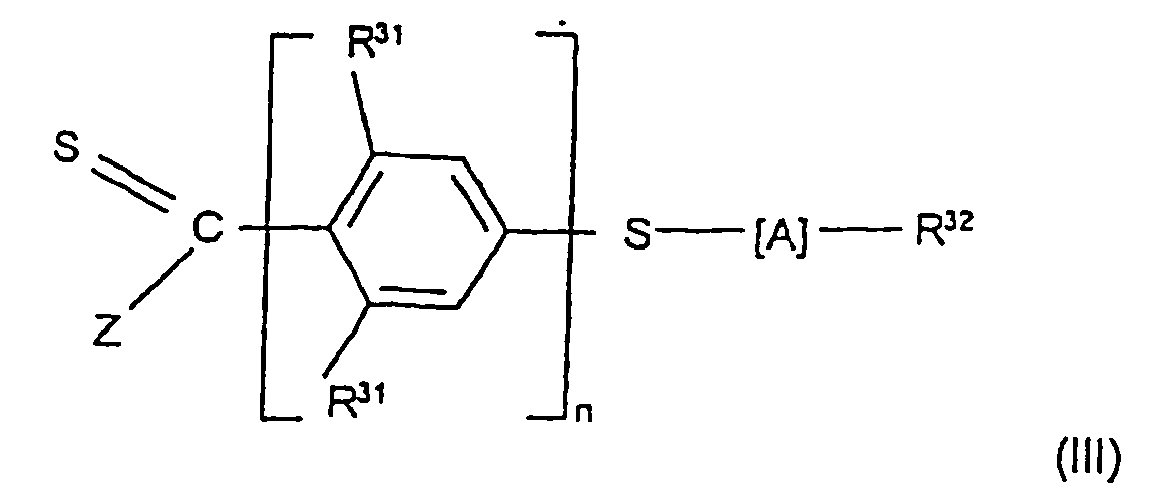 - R32 folgendes darstellt:• (i) eine gegebenenfalls substituierte Alkyl-, Acyl-, Aryl-, Alken- oder Alkingruppe, oder• (ii) einen gesättigten oder ungesättigten, gegebenenfalls substituierten oder aromatischen Carbocyclus, oder• (iii) einen gesättigten oder ungesättigten, gegebenenfalls substituierten oder aromatischen Heterocyclus,wobei diese Gruppen und Cyclen (i), (ii) und (iii) durch substituierte Phenylgruppen, aromatische substituierte Gruppen oder folgende Gruppen substituiert sein können: Alkoxycarbonyl oder Aryloxycarbonyl (-COOR), Carboxy (-COOH), Acyloxy (-O2CR), Carbamoyl (-CONR2), Cyano (-CN), Alkylcarbonyl, Alkylarylcarbonyl, Arylcarbonyl, Arylalkylcarbonyl, Phthalimido, Maleimido, Succinimido, Amidino, Guanidimo, Hydroxy (-OH), Amino (-NR2), Halogen, Allyl, Epoxy, Alkoxy (-OR), S-Alkyl, S-Aryl, Organosilyl, Gruppen, die einen hydrophilen oder ionischen Charakter aufweisen, ausgewählt aus alkalischen Salzen von Carbonsäuren, alkalischen Salzen von Sulfonsäure, Polyalkylenoxidketten (POE, POP), kationischen Substituenten (quaternäre Ammoniumsalze),
wobei R eine Alkyl- oder Arylgruppe darstellt,- Z ausgewählt ist aus:• einem Wasserstoffatom,• einer Alkyl-, Acyl-, Aryl-, Alken- oder Alkingruppe, die gegebenenfalls substituiert ist,• einem gesättigten oder ungesättigten gegebenenfalls substituierten oder aromatischen Carbocyclus,• einem gesättigten oder ungesättigten Heterocyclus, der gegebenenfalls substituiert ist,• Alkoxycarbonyl- oder Aryloxycarbonyl- (-COOR), Carboxy- (-COOH), Acyloxy- (-O2CR), Carbamoyl- (-CONR2), Cyano- (-CN), Alkylcarbonyl-, Alkylarylcarbonyl-, Arylcarbonyl-, Arylalkylcarbonyl-, Phthalimido-, Maleimido-, Succinimido-, Amidino-, Guanidimo-, Hydroxy- (-OH), Amino- (-NR2), Halogen-, Allyl-, Epoxy-, Alkoxy- (-OR), S-Alkyl-, S-Aryl-, Organosilylgruppen, wobei R eine Alkyl- oder Arylgruppe darstellt,• Gruppen, die einen hydrophilen oder ionischen Charakter aufweisen, ausgewählt aus alkalischen Salzen von Carbonsäuren, alkalischen Salzen von Sulfonsäure, Polyalkylenoxidketten (POE, POP), kationischen Substituenten (quaternäre Ammoniumsalze),- R31, gleich oder verschieden, ausgewählt ist aus:• einem Wasserstoffatom,• einer Alkyl-, Acyl-, Aryl-, Alken- oder Alkingruppe, die gegebenenfalls substituiert ist,• einem gesättigten oder ungesättigten gegebenenfalls substituierten oder aromatischen Carbocyclus,• einem gesättigten oder ungesättigten Heterocyclus, der gegebenenfalls substituiert ist,• Alkoxycarbonyl- oder Aryloxycarbonyl- (-COOR), Carboxy- (-COOH), Acyloxy- (-O2CR), Carbamoyl- (-CONR2), Cyano- (-CN), Alkylcarbonyl-, Alkylarylcarbonyl-, Arylcarbonyl-, Arylalkylcarbonyl-, Phthalimido-, Maleimido-, Succinimido-, Amidino-, Guanidimo-, Hydroxy- (-OH), Amino- (-NR2), Halogen-, Allyl-, Epoxy-, Alkoxy- (-OR), S-Alkyl-, S-Aryl-, Organosilylgruppen, wobei R eine Alkyl- oder Arylgruppe darstellt,• Gruppen, die einen hydrophilen oder ionischen Charakter aufweisen, wie alkalische Salze von Carbonsäuren, alkalische Salze von Sulfonsäure, Polyalkylenoxidketten (POE, POP), kationische Substituenten (quaternäre Ammoniumsalze),• SR32-Gruppen- n > 0,- A ein Ein-, Zwei- oder Dreiblockpolymer darstellt. - Latex nach Anspruch 1, dadurch gekennzeichnet, dass die Polymerisation in Gegenwart eines Polymers durchgeführt wird, das der folgenden Formel entspricht:
S=C(Z)-[C≡C]n-S-[A]-R41 (IV)
wobei in der Formel:- R41 folgendes darstellt:• (i) eine gegebenenfalls substituierte Alkyl-, Acyl-, Aryl-, Alken- oder Alkingruppe, oder• (ii) einen gesättigten oder ungesättigten, gegebenenfalls substituierten oder aromatischen Carbocyclus, oder• (iii) einen gesättigten oder ungesättigten, gegebenenfalls substituierten oder aromatischen Heterocyclus,wobei diese Gruppen und Cyclen (i), (ii) und (iii) durch substituierte Phenylgruppen, aromatische substituierte Gruppen oder folgende Gruppen substituiert sein können: Alkoxycarbonyl oder Aryloxycarbonyl (-COOR), Carboxy (-COOH), Acyloxy (-O2CR), Carbamoyl (-CONR2), Cyano (-CN), Alkylcarbonyl, Alkylarylcarbonyl, Arylcarbonyl, Arylalkylcarbonyl, Phthalimido, Maleimido, Succinimido, Amidino, Guanidimo, Hydroxy (-OH), Amino (-NR2), Halogen, Allyl, Epoxy, Alkoxy (-OR), S-Alkyl, S-Aryl, Organosilyl, Gruppen, die einen hydrophilen oder ionischen Charakter aufweisen, ausgewählt aus alkalischen Salzen von Carbonsäuren, alkalischen Salzen von Sulfonsäure, Polyalkylenoxidketten (POE, POP), kationischen Substituenten (quaternäre Ammoniumsalze),
wobei R eine Alkyl- oder Arylgruppe darstellt,- Z, gleich oder verschieden, ausgewählt ist aus:• einem Wasserstoffatom,• einer Alkyl-, Acyl-, Aryl-, Alken- oder Alkingruppe, die gegebenenfalls substituiert ist,• einem gesättigten oder ungesättigten gegebenenfalls substituierten oder aromatischen Carbocyclus,• einem gesättigten oder ungesättigten Heterocyclus, der gegebenenfalls substituiert ist,• Alkoxycarbonyl- oder Aryloxycarbonyl- (-COOR), Carboxy- (-COOH), Acyloxy- (-O2CR), Carbamoyl- (-CONR2), Cyano- (-CN), Alkylcarbonyl-, Alkylarylcarbonyl-, Arylcarbonyl-, Arylalkylcarbonyl-, Phthalimido-, Maleimido-, Succinimido-, Amidino-, Guanidimo-, Hydroxy- (-OH), Amino- (-NR2), Halogen-, Allyl-, Epoxy-, Alkoxy- (-OR), S-Alkyl-, S-Aryl-, Organosilylgruppen, wobei R eine Alkyl- oder Arylgruppe darstellt,• Gruppen, die einen hydrophilen oder ionischen Charakter aufweisen, ausgewählt aus alkalischen Salzen von Carbonsäuren, alkalischen Salzen von Sulfonsäure, Polyalkylenoxidketten (POE, POP), kationischen Substituenten (quaternäre Ammoniumsalze),- n > 0,- A ein Ein-, Zwei- oder Dreiblockpolymer darstellt. - Latex nach Anspruch 1, dadurch gekennzeichnet, dass die Polymerisation in Gegenwart eines Polymers durchgeführt wird, das der folgenden Formel entspricht:
S=C(OR51)-S-[A]-R52 (V)
wobei in der Formel- R51 folgendes darstellt:wobei:
R53, R54, die gleich oder verschieden sind, aus den Gruppen Halogen, =O, =S, -NO2, -SO3R, NCO, CN, OR, -SR, -NR2, -COOR, O2CR, -CONR2, -NCOR2 ausgewählt sind, wobei R ein Wasserstoffatom oder einen Alkyl-, Alkenyl-, Alkinyl-, Cycloalkenyl-, Cycloalkinyl-, Arylrest, der gegebenenfalls mit einem aromatischen oder nichtaromatischen Heterocyclus kondensiert ist, Alkylaryl, Aralkyl, Heteroaryl darstellt; wobei diese Reste gegebenenfalls mit einem oder mehreren Gruppen, die gleich oder verschieden sind, substituiert sein können, die ausgewählt sind aus Halogenen, =O, =S, OH, Alkoxy, SH, Thioalkoxy, NH2, Mono- oder Dialkylamino, CN, COOH, Ester, Amid, CF3 und/oder gegebenenfalls unterbrochen mit einem oder mehreren Atomen, ausgewählt aus O, S, N, P; oder aus einer heterocyclischen Gruppe, die gegebenenfalls mit einer oder mehreren Gruppen, wie zuvor definiert, substituiert ist;
oder R53 und R54 zusammen mit dem Kohlenstoffatom, an das sie gebunden sind, einen Carbo- oder Heterocyclus bilden;- R53, R56, die gleich oder verschieden sind, eine Gruppe wie zuvor für R definiert darstellen; oder zusammen eine C2-C4-Kohlenwasserstoffkette bilden, die gegebenenfalls mit einem Heteroatom, ausgewählt aus O, S und N, unterbrochen ist;- R52 die gleiche Definition wie die für R53 gegebene besitzt;- A ein Ein-, Zwei- oder Dreiblockpolymer darstellt. - Latex nach einem der vorhergehenden Ansprüche, dadurch gekennzeichnet, dass das Polymer A mindestens einer der folgenden Formeln entspricht:


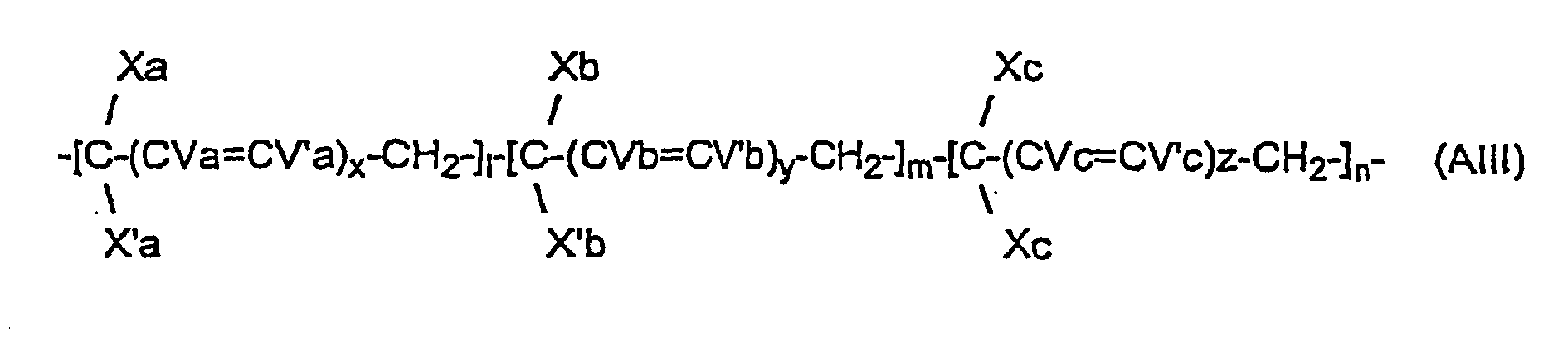 - Va, V'a, Vb, V'b, Vc, V'c, die gleich oder verschieden sind, folgendes darstellen: H, eine Alkylgruppe oder ein Halogen;- Xa, X'a, Xb, X'b, Xc, X'c, die gleich oder verschieden sind, folgendes darstellen: H, ein Halogen oder eine Gruppe R, OR, OCOR, NHCOH, OH, NH2, NHR, N(R)2, (R)2N+O-, NHCOR, CO2H, CO2R, CN, CONH2, CONHR oder CONR2, wobei R, gleich oder verschieden, ausgewählt ist aus Alkyl-, Aryl-, Aralkyl-, Alkaryl-, Alken- oder Organosilylgruppen, die gegebenenfalls perfluoriert und gegebenenfalls mit einer oder mehreren Carboxyl-, Epoxy-, Hydroxyl-, Alkoxy-, Amino-, Halogen-, oder Sulfonsäuregruppen substituiert sind,- l, m, n, gleich oder verschieden, größer oder gleich 1 sind,- x, y, z, gleich oder verschieden, 0 oder 1 sind.
 - Latex nach einem der vorhergehenden Ansprüche, dadurch gekennzeichnet, dass das Polymer A eine Molmassenzahl unter 20000, vorzugsweise unter 10000 aufweist.
- Latex nach einem der vorhergehenden Ansprüche, dadurch gekennzeichnet, dass das oder die ethylenisch ungesättigten Monomere ausgewählt sind aus:
CXdX'd (=CVd-CV'd)t = CH2
- Xd, X'd, gleich oder verschieden, stellen folgendes dar: H, eine Alkylgruppe oder ein Halogen,- Vd, V'd, gleich oder verschieden, stellen folgendes dar: H, ein Halogen oder eine Gruppe R, OR, OCOR, NHCOH, OH, NH2, NHR, N(R)2, (R)2N+O-, NHCOR, CO2H, CO2R, CN, CONH2, CONHR oder CONR2 darstellen, wobei R, gleich oder verschieden, ausgewählt ist aus den Gruppen Alkyl, Aryl, Aralkyl, Alkaryl, Alken oder Organosilyl, die gegebenenfalls perfluoriert und gegebenenfalls mit einer oder mehreren Carboxyl-, Epoxy-, Hydroxyl-, Alkoxy-, Amino-, Halogen- oder Sulfonsäuregruppen substituiert sind,- t 0 oder 1 ist. - Latex nach dem vorhergehenden Anspruch, dadurch gekennzeichnet, dass das oder die ethylenisch ungesättigten Monomere ausgewählt sind aus: Styrol oder seinen Derivaten, Butadien, Chloropren, (Meth)acrylsäureestern und Vinylnitrilen.
- Latex nach einem der vorhergehenden Ansprüche, dadurch gekennzeichnet, dass das Polymer ethylenisch ungesättigte Restbindungen besitzt und durch radikalische Polymerisation von mindestens einem ethylenisch ungesättigten Monomer erhalten wird, ausgewählt aus
CXdX'd (=CVd-CV'd)t = CH2
- Xd, X'd, gleich oder verschieden, stellen folgendes dar: H, eine Alkylgruppe oder ein Halogen,- Vd, V'd, gleich oder verschieden, stellen folgendes dar: H, ein Halogen oder eine Gruppe R, OR, OCOR, NHCOH, OH, NH2, NHR, N(R)2, (R)2N+O-, NHCOR, CO2H, CO2R, CN, CONH2, CONHR oder CONR2, wobei R, gleich oder verschieden, ausgewählt ist aus den Gruppen Alkyl, Aryl, Aralkyl, Alkaryl, Alken oder Organosilyl, die gegebenenfalls perfluoriert und gegebenenfalls mit einer oder mehreren Carboxyl-, Epoxy-, Hydroxyl-, Alkoxy-, Amino-, Halogen- oder Sulfonsäuregruppen substituiert sind,- t 0 oder 1 ist. - Latex nach einem der vorhergehenden Ansprüche, dadurch gekennzeichnet, dass die Polymerisation durch Einbringen des ethylenisch ungesättigten Monomers und des Starters in eine Ein-, Zwei- oder Dreiblockpolymer-Lösung durchgeführt wird.
- Latex nach einem der Ansprüche 1-12, dadurch gekennzeichnet, dass die Polymerisation durch gleichzeitiges Einbringen des ethylenisch ungesättigten Monomers und des Starters und einer Ein-, Zwei- oder Dreiblockpolymer-Lösung durchgeführt wird.
- Latex nach einem der Ansprüche 1-12, dadurch gekennzeichnet, dass die Polymerisation durch Einleiten des Ein-, Zwei- oder Dreiblockpolymers und des Starters in eine Suspension, die das Polymer umfasst, das ethylenisch ungesättigte Restbindungen aufweist, durchgeführt wird.
- Redispergierbare Pulver, deren Erhalt unter Durchführung einer Trocknung des Latex mit modifizierter Oberflächenchemie nach einem der Ansprüche 1 bis 14 möglich ist.
- Pulver nach dem vorhergehenden Anspruch, dadurch gekennzeichnet, dass die Trocknung in Gegenwart eines Trocknungshilfsmittels durchgeführt wird.
- Formulierungen, die für Anwendungen im Bereich der Baumaterialien bestimmt sind, umfassend den Latex mit modifizierter Oberflächenchemie nach einem der Ansprüche 1 bis 14 oder ein redispergierbares Pulver, erhalten nach einem der Ansprüche 15 oder 16.
- Formulierungen, die für Anwendungen im Bereich der Anstrichfarben bestimmt sind, umfassend den Latex mit modifizierter Oberflächenchemie nach einem der Ansprüche 1 bis 13 oder ein redispergierbares Pulver, erhalten nach einem der Ansprüche 15 oder 16.
- Formulierungen, die für Anwendungen im Bereich der Klebstoffe und Haftklebstoffe bestimmt sind, umfassend den Latex mit modifizierter Oberflächenchemie nach einem der Ansprüche 1 bis 14 oder ein redispergierbares Pulver, erhalten nach einem der Ansprüche 15 oder 16.
- Formulierungen, die für Anwendungen im Bereich des Papiers bestimmt sind, umfassend den Latex mit modifizierter Oberflächenchemie nach einem der Ansprüche 1 bis 14 oder ein redispergierbares Pulver, erhalten nach einem der Ansprüche 14 oder 16.
- Verwendung eines Latex mit modifizierter Oberflächenchemie nach einem der Ansprüche 1 bis 14 oder eines redispergierbaren Pulvers, erhalten nach einem der Ansprüche 15 oder 16 in Formulierungen, die für Anwendungen im Bereich der Baumaterialien bestimmt sind.
- Verwendung eines Latex mit modifizierter Oberflächenchemie nach einem der Ansprüche 1 bis 14 oder eines redispergierbaren Pulvers, erhalten nach einem der Ansprüche 15 oder 16, in Formulierungen, die für Anwendungen im Bereich der Anstrichfarben bestimmt sind.
- Verwendung eines Latex mit modifizierter Oberflächenchemie nach einem der Ansprüche 1 bis 14 oder eines redispergierbaren Pulvers, erhalten nach einem der Ansprüche 15 oder 16, in Formulierungen, die für Anwendungen im Bereich der Klebstoffe und Haftklebstoffe bestimmt sind.
- Verwendung eines Latex mit modifizierter Oberflächenchemie nach einem der Ansprüche 1 bis 14 oder eines redispergierbaren Pulvers, erhalten nach einem der Ansprüche 15 oder 16, in Formulierungen, die für Anwendungen im Bereich der Papiere bestimmt sind.
Priority Applications (1)
| Application Number | Priority Date | Filing Date | Title |
|---|---|---|---|
| EP06010051A EP1688445B1 (de) | 1999-12-10 | 2000-12-08 | Latex mit modifizierter Oberflächenchemie und redispergierbare Pulver, ihre Herstellung und Anwendungen |
Applications Claiming Priority (3)
| Application Number | Priority Date | Filing Date | Title |
|---|---|---|---|
| FR9915714A FR2802209B1 (fr) | 1999-12-10 | 1999-12-10 | Latex a chimie de surface modifiee et poudres redispersables , leur obtention et leurs utilisations |
| FR9915714 | 1999-12-10 | ||
| PCT/FR2000/003454 WO2001042325A1 (fr) | 1999-12-10 | 2000-12-08 | Latex a chimie de surface modifiee et poudres redispersables, leur obtention et leurs utilisations |
Related Child Applications (1)
| Application Number | Title | Priority Date | Filing Date |
|---|---|---|---|
| EP06010051A Division EP1688445B1 (de) | 1999-12-10 | 2000-12-08 | Latex mit modifizierter Oberflächenchemie und redispergierbare Pulver, ihre Herstellung und Anwendungen |
Publications (2)
| Publication Number | Publication Date |
|---|---|
| EP1242492A1 EP1242492A1 (de) | 2002-09-25 |
| EP1242492B1 true EP1242492B1 (de) | 2006-05-17 |
Family
ID=9553207
Family Applications (2)
| Application Number | Title | Priority Date | Filing Date |
|---|---|---|---|
| EP06010051A Expired - Lifetime EP1688445B1 (de) | 1999-12-10 | 2000-12-08 | Latex mit modifizierter Oberflächenchemie und redispergierbare Pulver, ihre Herstellung und Anwendungen |
| EP00990042A Expired - Lifetime EP1242492B1 (de) | 1999-12-10 | 2000-12-08 | Latex mit modifizierter oberflächenchemie und redispergierbare pulver, ihre herstellung und anwendungen |
Family Applications Before (1)
| Application Number | Title | Priority Date | Filing Date |
|---|---|---|---|
| EP06010051A Expired - Lifetime EP1688445B1 (de) | 1999-12-10 | 2000-12-08 | Latex mit modifizierter Oberflächenchemie und redispergierbare Pulver, ihre Herstellung und Anwendungen |
Country Status (11)
| Country | Link |
|---|---|
| US (1) | US7012114B2 (de) |
| EP (2) | EP1688445B1 (de) |
| CN (1) | CN1154673C (de) |
| AT (2) | ATE326492T1 (de) |
| AU (1) | AU2685101A (de) |
| CA (1) | CA2393637A1 (de) |
| DE (2) | DE60028082T2 (de) |
| ES (2) | ES2263508T3 (de) |
| FR (1) | FR2802209B1 (de) |
| MX (1) | MXPA02005166A (de) |
| WO (1) | WO2001042325A1 (de) |
Families Citing this family (21)
| Publication number | Priority date | Publication date | Assignee | Title |
|---|---|---|---|---|
| FR2814168B1 (fr) * | 2000-09-18 | 2006-11-17 | Rhodia Chimie Sa | Procede de synthese de polymeres a blocs par polymerisation radicalaire controlee en presence d'un compose disulfure |
| FR2814170B1 (fr) * | 2000-09-18 | 2005-05-27 | Rhodia Chimie Sa | Nouveau latex a proprietes de surface modifiees par l' ajout d'un copolymere hydrosoluble a caractere amphiphile |
| FR2826658B1 (fr) * | 2001-06-29 | 2003-09-05 | Rhodia Chimie Sa | Synthese de polymeres par voie radicalaire controlee en miniemulsion |
| CN101102889B (zh) | 2005-01-10 | 2011-09-21 | 艾利丹尼森公司 | 可剥离卷曲标签 |
| US9422465B2 (en) | 2006-11-02 | 2016-08-23 | Avery Dennison Corporation | Emulsion adhesive for washable film |
| US20110111244A1 (en) | 2008-04-01 | 2011-05-12 | Michael Arnoldus Jacobus Schellekens | Adhesion to plastic with block copolymers obtained using raft |
| CN102027029B (zh) * | 2008-05-15 | 2014-05-28 | 帝斯曼知识产权资产管理有限公司 | 利用raft得到的嵌段共聚物 |
| CN102076795B (zh) * | 2008-06-30 | 2015-05-13 | 帝斯曼知识产权资产管理有限公司 | 利用raft得到的嵌段共聚物对金属表面的粘附 |
| EP3255111B1 (de) | 2009-03-30 | 2022-10-12 | Avery Dennison Corporation | Ablösbares klebeetikett mit polymerfilmlage mit hohem zugmodul |
| EP2415042B1 (de) | 2009-03-30 | 2017-03-29 | Avery Dennison Corporation | Entfernbares klebeetikett, das eine polymerfilmschicht mit wasseraffinität enthält |
| US20120018098A1 (en) | 2009-03-30 | 2012-01-26 | Avery Dennison Corporation | Removable Adhesive Label Containing Inherently Shrinkable Polymeric Film |
| US8062555B2 (en) * | 2009-04-16 | 2011-11-22 | Rhodia Operations | Co-assembly method and co-assembled structures made thereby |
| US8545821B2 (en) * | 2009-11-05 | 2013-10-01 | Avon Products, Inc. | Cosmetic use of water-redispersible powders |
| WO2013086722A1 (en) | 2011-12-15 | 2013-06-20 | Dow Global Technologies Llc | Dry mix formulations containing carboxylated styrene-butadiene redispersible polymer powders and alumina rich containing cements |
| US9169382B2 (en) | 2012-03-09 | 2015-10-27 | Dow Global Technologies Llc | Carboxyl group containing acrylic RDP and dry mix cement formulations containing them |
| EP3472212A4 (de) * | 2016-06-15 | 2020-02-19 | Rhodia Operations | Hochleistungsfähige tensidfreie latexe für verbesserte wasserbeständigkeit |
| WO2018049135A1 (en) * | 2016-09-09 | 2018-03-15 | Rhodia Operations | Self-thickening latex for waterborne systems and related methods |
| CN109843987B (zh) * | 2016-10-14 | 2022-06-03 | 大金工业株式会社 | 含氟聚合物的粉体及其制造方法 |
| US12522756B2 (en) | 2018-12-28 | 2026-01-13 | Saint-Gobain Performance Plastics Corporation | Adhesive composition and methods of forming the same |
| EP3902887A4 (de) | 2018-12-28 | 2022-11-02 | Saint-Gobain Performance Plastics Corporation | Haftzusammensetzungen und verfahren zur herstellung davon |
| KR20240118784A (ko) | 2021-12-17 | 2024-08-05 | 솔베이 스페셜티 폴리머스 이태리 에스.피.에이. | 플루오로단량체의 유화 중합 방법 |
Citations (1)
| Publication number | Priority date | Publication date | Assignee | Title |
|---|---|---|---|---|
| WO1998001478A1 (en) * | 1996-07-10 | 1998-01-15 | E.I. Du Pont De Nemours And Company | Polymerization with living characteristics |
Family Cites Families (12)
| Publication number | Priority date | Publication date | Assignee | Title |
|---|---|---|---|---|
| US5314962A (en) * | 1987-04-07 | 1994-05-24 | Mitsubishi Petrochemical Company Limited | ABA type block copolymers |
| JPS64111A (en) * | 1987-06-23 | 1989-01-05 | Mitsubishi Petrochem Co Ltd | Surface modification of polymeric material |
| DE69009380T2 (de) * | 1989-09-07 | 1994-09-15 | Tosoh Corp | Chloroprenpolymerisat. |
| AUPM930394A0 (en) | 1994-11-09 | 1994-12-01 | Commonwealth Scientific And Industrial Research Organisation | Block copolymer synthesis |
| FR2764892B1 (fr) * | 1997-06-23 | 2000-03-03 | Rhodia Chimie Sa | Procede de synthese de polymeres a blocs |
| CA2337339A1 (en) | 1997-07-21 | 1999-02-04 | Commonwealth Scientific And Industrial Research Organisation | Synthesis of dithioester chain transfer agents and use of bis(thioacyl) disulfides or dithioesters as chain transfer agents |
| CA2309279C (en) | 1997-12-18 | 2009-07-14 | E.I. Du Pont De Nemours And Company | Polymerization process with living characteristics and polymers made therefrom |
| CA2315914A1 (fr) | 1997-12-31 | 1999-07-15 | Xavier Franck | Procede de synthese de polymeres a blocs par polymerisation radicalaire controlee a partir de composes dithiocarbamates |
| FR2773161B1 (fr) | 1997-12-31 | 2000-01-21 | Rhodia Chimie Sa | Procede de synthese de polymeres a blocs |
| DE69917311T2 (de) * | 1998-07-10 | 2004-12-09 | E.I. Du Pont De Nemours And Co., Wilmington | Mikrogele und verfahren zu deren herstellung |
| FR2794464B1 (fr) * | 1999-06-04 | 2005-03-04 | Rhodia Chimie Sa | Procede de synthese de polymeres a blocs par polymerisation radicalaire controlee a l'aide de thioether-thiones |
| FR2814170B1 (fr) * | 2000-09-18 | 2005-05-27 | Rhodia Chimie Sa | Nouveau latex a proprietes de surface modifiees par l' ajout d'un copolymere hydrosoluble a caractere amphiphile |
-
1999
- 1999-12-10 FR FR9915714A patent/FR2802209B1/fr not_active Expired - Lifetime
-
2000
- 2000-12-08 US US10/149,018 patent/US7012114B2/en not_active Expired - Lifetime
- 2000-12-08 WO PCT/FR2000/003454 patent/WO2001042325A1/fr not_active Ceased
- 2000-12-08 CN CNB008168628A patent/CN1154673C/zh not_active Expired - Lifetime
- 2000-12-08 EP EP06010051A patent/EP1688445B1/de not_active Expired - Lifetime
- 2000-12-08 EP EP00990042A patent/EP1242492B1/de not_active Expired - Lifetime
- 2000-12-08 AT AT00990042T patent/ATE326492T1/de not_active IP Right Cessation
- 2000-12-08 CA CA002393637A patent/CA2393637A1/fr not_active Abandoned
- 2000-12-08 ES ES00990042T patent/ES2263508T3/es not_active Expired - Lifetime
- 2000-12-08 ES ES06010051T patent/ES2341022T3/es not_active Expired - Lifetime
- 2000-12-08 DE DE60028082T patent/DE60028082T2/de not_active Expired - Lifetime
- 2000-12-08 DE DE60044104T patent/DE60044104D1/de not_active Expired - Lifetime
- 2000-12-08 AU AU26851/01A patent/AU2685101A/en not_active Abandoned
- 2000-12-08 AT AT06010051T patent/ATE462741T1/de not_active IP Right Cessation
- 2000-12-08 MX MXPA02005166A patent/MXPA02005166A/es unknown
Patent Citations (1)
| Publication number | Priority date | Publication date | Assignee | Title |
|---|---|---|---|---|
| WO1998001478A1 (en) * | 1996-07-10 | 1998-01-15 | E.I. Du Pont De Nemours And Company | Polymerization with living characteristics |
Also Published As
| Publication number | Publication date |
|---|---|
| EP1688445B1 (de) | 2010-03-31 |
| AU2685101A (en) | 2001-06-18 |
| CA2393637A1 (fr) | 2001-06-14 |
| EP1688445A1 (de) | 2006-08-09 |
| DE60028082D1 (de) | 2006-06-22 |
| FR2802209B1 (fr) | 2002-03-01 |
| US7012114B2 (en) | 2006-03-14 |
| DE60028082T2 (de) | 2006-11-30 |
| MXPA02005166A (es) | 2002-11-07 |
| FR2802209A1 (fr) | 2001-06-15 |
| ES2263508T3 (es) | 2006-12-16 |
| ATE462741T1 (de) | 2010-04-15 |
| US20030114548A1 (en) | 2003-06-19 |
| CN1407997A (zh) | 2003-04-02 |
| EP1242492A1 (de) | 2002-09-25 |
| DE60044104D1 (de) | 2010-05-12 |
| ES2341022T3 (es) | 2010-06-14 |
| WO2001042325A1 (fr) | 2001-06-14 |
| CN1154673C (zh) | 2004-06-23 |
| ATE326492T1 (de) | 2006-06-15 |
Similar Documents
| Publication | Publication Date | Title |
|---|---|---|
| EP1242492B1 (de) | Latex mit modifizierter oberflächenchemie und redispergierbare pulver, ihre herstellung und anwendungen | |
| EP1401903B1 (de) | Wasserlösliche blockcopolymere mit einem hydrophilen block und einem hydrophoben block | |
| EP1208119B1 (de) | Wässrige gelartige zusammensetzungen auf basis von blockcopolymeren mit hydrophilen und hydrophoben blöcken | |
| US6825290B2 (en) | Process for the preparation of latices using block copolymers as surfactants | |
| EP1319043B1 (de) | Latex mit modifizierten eigenschaften durch zugabe eines wasserlöslichen amphiphilen polymers | |
| EP1397403B1 (de) | Blockcopolymer-tenside durch eine kontrollierte radikalpolymerisation hergestellt | |
| EP0877765B1 (de) | Pfropfcopolymere, verfahren zu deren herstellung, zusammensetzungen die sie enthalten und ihre verwendung zur herstellung von wässrigen und/oder organischen pigmentdispersionen | |
| FR2924714A1 (fr) | Procede de preparation d'une dispersion aqueuse de particules de polymeres par un procede de polymerisation radicalaire en dispersion, dispersions obtenues et revetements prepares avec celles-ci. | |
| EP1406970B1 (de) | Zusammensetzung enthaltend ein mit wenigstens zwei ionischen blöcken blockcopolymer und eine mit entgegengesetzter ladung komponente | |
| EP1711536A1 (de) | Verfahren zur radikalischen emulsionspolymerisation unter verwendung von wasserlöslichen alkoxyaminen | |
| FR3018814A1 (fr) | Polymeres amphiphiles multibloc | |
| EP0728154B1 (de) | Waessrige polymerdispersion, verfahren zu seiner herstellung und seine verwendung zur lackformulierung | |
| FR2861400A1 (fr) | Procede pour preparer un latex a chimie de surface modifiee, le latex susceptible d'etre obtenu par ce procede et ses utilisations dans le domaine de la construction | |
| WO2002077075A1 (fr) | Procede de fabrication de particules colloidales de forme controlee avec des copolymeres a blocs hydrosolubles comprenant un bloc hydrophobe et un bloc hydrophile | |
| FR2712296A1 (fr) | Liant latex pour composition de revêtement. | |
| FR3152278A1 (fr) | polymère hydrosoluble ramifié comme liant pour batterie | |
| WO2005014660A1 (fr) | Preparation de particules polymeriques presentant une ecorce et des pores internes non connectes entre eux, particules resultantes et utilisations |
Legal Events
| Date | Code | Title | Description |
|---|---|---|---|
| PUAI | Public reference made under article 153(3) epc to a published international application that has entered the european phase |
Free format text: ORIGINAL CODE: 0009012 |
|
| 17P | Request for examination filed |
Effective date: 20020501 |
|
| AK | Designated contracting states |
Kind code of ref document: A1 Designated state(s): AT BE CH CY DE DK ES FI FR GB GR IE IT LI LU MC NL PT SE TR |
|
| AX | Request for extension of the european patent |
Free format text: AL;LT;LV;MK;RO;SI |
|
| 17Q | First examination report despatched |
Effective date: 20040317 |
|
| GRAP | Despatch of communication of intention to grant a patent |
Free format text: ORIGINAL CODE: EPIDOSNIGR1 |
|
| GRAC | Information related to communication of intention to grant a patent modified |
Free format text: ORIGINAL CODE: EPIDOSCIGR1 |
|
| GRAS | Grant fee paid |
Free format text: ORIGINAL CODE: EPIDOSNIGR3 |
|
| GRAA | (expected) grant |
Free format text: ORIGINAL CODE: 0009210 |
|
| AK | Designated contracting states |
Kind code of ref document: B1 Designated state(s): AT BE CH CY DE DK ES FI FR GB GR IE IT LI LU MC NL PT SE TR |
|
| PG25 | Lapsed in a contracting state [announced via postgrant information from national office to epo] |
Ref country code: FI Free format text: LAPSE BECAUSE OF FAILURE TO SUBMIT A TRANSLATION OF THE DESCRIPTION OR TO PAY THE FEE WITHIN THE PRESCRIBED TIME-LIMIT Effective date: 20060517 Ref country code: AT Free format text: LAPSE BECAUSE OF FAILURE TO SUBMIT A TRANSLATION OF THE DESCRIPTION OR TO PAY THE FEE WITHIN THE PRESCRIBED TIME-LIMIT Effective date: 20060517 |
|
| REG | Reference to a national code |
Ref country code: GB Ref legal event code: FG4D Free format text: NOT ENGLISH |
|
| REG | Reference to a national code |
Ref country code: CH Ref legal event code: EP |
|
| REG | Reference to a national code |
Ref country code: IE Ref legal event code: FG4D Free format text: LANGUAGE OF EP DOCUMENT: FRENCH |
|
| REF | Corresponds to: |
Ref document number: 60028082 Country of ref document: DE Date of ref document: 20060622 Kind code of ref document: P |
|
| REG | Reference to a national code |
Ref country code: CH Ref legal event code: NV Representative=s name: KIRKER & CIE SA |
|
| PG25 | Lapsed in a contracting state [announced via postgrant information from national office to epo] |
Ref country code: SE Free format text: LAPSE BECAUSE OF FAILURE TO SUBMIT A TRANSLATION OF THE DESCRIPTION OR TO PAY THE FEE WITHIN THE PRESCRIBED TIME-LIMIT Effective date: 20060817 Ref country code: DK Free format text: LAPSE BECAUSE OF FAILURE TO SUBMIT A TRANSLATION OF THE DESCRIPTION OR TO PAY THE FEE WITHIN THE PRESCRIBED TIME-LIMIT Effective date: 20060817 |
|
| GBT | Gb: translation of ep patent filed (gb section 77(6)(a)/1977) |
Effective date: 20060808 |
|
| PG25 | Lapsed in a contracting state [announced via postgrant information from national office to epo] |
Ref country code: PT Free format text: LAPSE BECAUSE OF FAILURE TO SUBMIT A TRANSLATION OF THE DESCRIPTION OR TO PAY THE FEE WITHIN THE PRESCRIBED TIME-LIMIT Effective date: 20061017 |
|
| REG | Reference to a national code |
Ref country code: ES Ref legal event code: FG2A Ref document number: 2263508 Country of ref document: ES Kind code of ref document: T3 |
|
| PG25 | Lapsed in a contracting state [announced via postgrant information from national office to epo] |
Ref country code: MC Free format text: LAPSE BECAUSE OF NON-PAYMENT OF DUE FEES Effective date: 20061231 |
|
| PLBE | No opposition filed within time limit |
Free format text: ORIGINAL CODE: 0009261 |
|
| STAA | Information on the status of an ep patent application or granted ep patent |
Free format text: STATUS: NO OPPOSITION FILED WITHIN TIME LIMIT |
|
| 26N | No opposition filed |
Effective date: 20070220 |
|
| PG25 | Lapsed in a contracting state [announced via postgrant information from national office to epo] |
Ref country code: GR Free format text: LAPSE BECAUSE OF FAILURE TO SUBMIT A TRANSLATION OF THE DESCRIPTION OR TO PAY THE FEE WITHIN THE PRESCRIBED TIME-LIMIT Effective date: 20060818 |
|
| PG25 | Lapsed in a contracting state [announced via postgrant information from national office to epo] |
Ref country code: LU Free format text: LAPSE BECAUSE OF NON-PAYMENT OF DUE FEES Effective date: 20061208 |
|
| PG25 | Lapsed in a contracting state [announced via postgrant information from national office to epo] |
Ref country code: CY Free format text: LAPSE BECAUSE OF FAILURE TO SUBMIT A TRANSLATION OF THE DESCRIPTION OR TO PAY THE FEE WITHIN THE PRESCRIBED TIME-LIMIT Effective date: 20060517 |
|
| PGFP | Annual fee paid to national office [announced via postgrant information from national office to epo] |
Ref country code: CH Payment date: 20121213 Year of fee payment: 13 Ref country code: IE Payment date: 20121211 Year of fee payment: 13 |
|
| PGFP | Annual fee paid to national office [announced via postgrant information from national office to epo] |
Ref country code: BE Payment date: 20121217 Year of fee payment: 13 |
|
| PGFP | Annual fee paid to national office [announced via postgrant information from national office to epo] |
Ref country code: TR Payment date: 20131120 Year of fee payment: 14 Ref country code: ES Payment date: 20131114 Year of fee payment: 14 Ref country code: IT Payment date: 20131107 Year of fee payment: 14 |
|
| BERE | Be: lapsed |
Owner name: RHODIA CHIMIE Effective date: 20131231 |
|
| REG | Reference to a national code |
Ref country code: CH Ref legal event code: PL |
|
| REG | Reference to a national code |
Ref country code: IE Ref legal event code: MM4A |
|
| PG25 | Lapsed in a contracting state [announced via postgrant information from national office to epo] |
Ref country code: IE Free format text: LAPSE BECAUSE OF NON-PAYMENT OF DUE FEES Effective date: 20131208 Ref country code: LI Free format text: LAPSE BECAUSE OF NON-PAYMENT OF DUE FEES Effective date: 20131231 Ref country code: BE Free format text: LAPSE BECAUSE OF NON-PAYMENT OF DUE FEES Effective date: 20131231 Ref country code: CH Free format text: LAPSE BECAUSE OF NON-PAYMENT OF DUE FEES Effective date: 20131231 |
|
| REG | Reference to a national code |
Ref country code: FR Ref legal event code: PLFP Year of fee payment: 16 |
|
| PG25 | Lapsed in a contracting state [announced via postgrant information from national office to epo] |
Ref country code: IT Free format text: LAPSE BECAUSE OF NON-PAYMENT OF DUE FEES Effective date: 20141208 |
|
| REG | Reference to a national code |
Ref country code: ES Ref legal event code: FD2A Effective date: 20160129 |
|
| PG25 | Lapsed in a contracting state [announced via postgrant information from national office to epo] |
Ref country code: ES Free format text: LAPSE BECAUSE OF NON-PAYMENT OF DUE FEES Effective date: 20141209 |
|
| REG | Reference to a national code |
Ref country code: FR Ref legal event code: PLFP Year of fee payment: 17 |
|
| PG25 | Lapsed in a contracting state [announced via postgrant information from national office to epo] |
Ref country code: TR Free format text: LAPSE BECAUSE OF NON-PAYMENT OF DUE FEES Effective date: 20141208 |
|
| REG | Reference to a national code |
Ref country code: FR Ref legal event code: PLFP Year of fee payment: 18 |
|
| PGFP | Annual fee paid to national office [announced via postgrant information from national office to epo] |
Ref country code: NL Payment date: 20191114 Year of fee payment: 20 Ref country code: DE Payment date: 20191126 Year of fee payment: 20 |
|
| PGFP | Annual fee paid to national office [announced via postgrant information from national office to epo] |
Ref country code: FR Payment date: 20191115 Year of fee payment: 20 |
|
| PGFP | Annual fee paid to national office [announced via postgrant information from national office to epo] |
Ref country code: GB Payment date: 20191206 Year of fee payment: 20 |
|
| REG | Reference to a national code |
Ref country code: DE Ref legal event code: R071 Ref document number: 60028082 Country of ref document: DE |
|
| REG | Reference to a national code |
Ref country code: NL Ref legal event code: MK Effective date: 20201207 |
|
| REG | Reference to a national code |
Ref country code: GB Ref legal event code: PE20 Expiry date: 20201207 |
|
| PG25 | Lapsed in a contracting state [announced via postgrant information from national office to epo] |
Ref country code: GB Free format text: LAPSE BECAUSE OF EXPIRATION OF PROTECTION Effective date: 20201207 |