EP1403640B1 - Peptidimmobilisierte grundplatte und vefahren zum testen eines zielproteins unter verwendung derselben - Google Patents
Peptidimmobilisierte grundplatte und vefahren zum testen eines zielproteins unter verwendung derselben Download PDFInfo
- Publication number
- EP1403640B1 EP1403640B1 EP02724696A EP02724696A EP1403640B1 EP 1403640 B1 EP1403640 B1 EP 1403640B1 EP 02724696 A EP02724696 A EP 02724696A EP 02724696 A EP02724696 A EP 02724696A EP 1403640 B1 EP1403640 B1 EP 1403640B1
- Authority
- EP
- European Patent Office
- Prior art keywords
- peptide
- target protein
- peptides
- substrate
- binding
- Prior art date
- Legal status (The legal status is an assumption and is not a legal conclusion. Google has not performed a legal analysis and makes no representation as to the accuracy of the status listed.)
- Expired - Lifetime
Links
- 108090000623 proteins and genes Proteins 0.000 title claims abstract description 148
- 102000004169 proteins and genes Human genes 0.000 title claims abstract description 147
- 238000000034 method Methods 0.000 title claims description 75
- 108090000765 processed proteins & peptides Proteins 0.000 claims abstract description 302
- 102000004196 processed proteins & peptides Human genes 0.000 claims abstract description 112
- 230000027455 binding Effects 0.000 claims abstract description 40
- 238000012360 testing method Methods 0.000 claims abstract description 30
- 230000008859 change Effects 0.000 claims abstract description 11
- 239000000758 substrate Substances 0.000 claims description 87
- 235000018102 proteins Nutrition 0.000 claims description 65
- 150000001413 amino acids Chemical class 0.000 claims description 40
- 235000001014 amino acid Nutrition 0.000 claims description 31
- 125000000524 functional group Chemical group 0.000 claims description 22
- 238000005259 measurement Methods 0.000 claims description 20
- GNBHRKFJIUUOQI-UHFFFAOYSA-N fluorescein Chemical class O1C(=O)C2=CC=CC=C2C21C1=CC=C(O)C=C1OC1=CC(O)=CC=C21 GNBHRKFJIUUOQI-UHFFFAOYSA-N 0.000 claims description 17
- 239000007850 fluorescent dye Substances 0.000 claims description 11
- 125000001295 dansyl group Chemical group [H]C1=C([H])C(N(C([H])([H])[H])C([H])([H])[H])=C2C([H])=C([H])C([H])=C(C2=C1[H])S(*)(=O)=O 0.000 claims description 10
- 238000002866 fluorescence resonance energy transfer Methods 0.000 claims description 9
- 125000003396 thiol group Chemical group [H]S* 0.000 claims description 8
- XUJNEKJLAYXESH-UHFFFAOYSA-N cysteine Natural products SCC(N)C(O)=O XUJNEKJLAYXESH-UHFFFAOYSA-N 0.000 claims description 5
- 235000018417 cysteine Nutrition 0.000 claims description 5
- 150000003220 pyrenes Chemical class 0.000 claims description 5
- 238000010791 quenching Methods 0.000 claims description 4
- 150000005181 nitrobenzenes Chemical class 0.000 claims description 2
- PYWVYCXTNDRMGF-UHFFFAOYSA-N rhodamine B Chemical class [Cl-].C=12C=CC(=[N+](CC)CC)C=C2OC2=CC(N(CC)CC)=CC=C2C=1C1=CC=CC=C1C(O)=O PYWVYCXTNDRMGF-UHFFFAOYSA-N 0.000 claims description 2
- 238000006243 chemical reaction Methods 0.000 abstract description 17
- 238000003556 assay Methods 0.000 abstract description 7
- 238000012545 processing Methods 0.000 abstract description 3
- ZMXDDKWLCZADIW-UHFFFAOYSA-N N,N-Dimethylformamide Chemical compound CN(C)C=O ZMXDDKWLCZADIW-UHFFFAOYSA-N 0.000 description 42
- 239000011347 resin Substances 0.000 description 32
- 229920005989 resin Polymers 0.000 description 32
- 239000000523 sample Substances 0.000 description 27
- 239000000243 solution Substances 0.000 description 22
- 125000000999 tert-butyl group Chemical group [H]C([H])([H])C(*)(C([H])([H])[H])C([H])([H])[H] 0.000 description 22
- 125000003088 (fluoren-9-ylmethoxy)carbonyl group Chemical group 0.000 description 20
- -1 ethyldansyl group Chemical group 0.000 description 20
- XLYOFNOQVPJJNP-UHFFFAOYSA-N water Chemical compound O XLYOFNOQVPJJNP-UHFFFAOYSA-N 0.000 description 19
- FAPWRFPIFSIZLT-UHFFFAOYSA-M Sodium chloride Chemical compound [Na+].[Cl-] FAPWRFPIFSIZLT-UHFFFAOYSA-M 0.000 description 18
- 238000002156 mixing Methods 0.000 description 15
- 125000003277 amino group Chemical group 0.000 description 13
- 238000003786 synthesis reaction Methods 0.000 description 13
- YBJHBAHKTGYVGT-ZKWXMUAHSA-N (+)-Biotin Chemical compound N1C(=O)N[C@@H]2[C@H](CCCCC(=O)O)SC[C@@H]21 YBJHBAHKTGYVGT-ZKWXMUAHSA-N 0.000 description 12
- DTQVDTLACAAQTR-UHFFFAOYSA-N Trifluoroacetic acid Chemical compound OC(=O)C(F)(F)F DTQVDTLACAAQTR-UHFFFAOYSA-N 0.000 description 12
- 230000015572 biosynthetic process Effects 0.000 description 12
- NQRYJNQNLNOLGT-UHFFFAOYSA-N Piperidine Chemical compound C1CCNCC1 NQRYJNQNLNOLGT-UHFFFAOYSA-N 0.000 description 10
- 239000011521 glass Substances 0.000 description 10
- 239000000126 substance Substances 0.000 description 10
- BZTDTCNHAFUJOG-UHFFFAOYSA-N 6-carboxyfluorescein Chemical compound C12=CC=C(O)C=C2OC2=CC(O)=CC=C2C11OC(=O)C2=CC=C(C(=O)O)C=C21 BZTDTCNHAFUJOG-UHFFFAOYSA-N 0.000 description 9
- RTZKZFJDLAIYFH-UHFFFAOYSA-N Diethyl ether Chemical compound CCOCC RTZKZFJDLAIYFH-UHFFFAOYSA-N 0.000 description 9
- KDXKERNSBIXSRK-UHFFFAOYSA-N Lysine Natural products NCCCCC(N)C(O)=O KDXKERNSBIXSRK-UHFFFAOYSA-N 0.000 description 9
- OKKJLVBELUTLKV-UHFFFAOYSA-N Methanol Chemical compound OC OKKJLVBELUTLKV-UHFFFAOYSA-N 0.000 description 9
- 108010038807 Oligopeptides Proteins 0.000 description 9
- 102000015636 Oligopeptides Human genes 0.000 description 9
- 210000004027 cell Anatomy 0.000 description 9
- 238000003776 cleavage reaction Methods 0.000 description 9
- 239000000203 mixture Substances 0.000 description 9
- 230000007017 scission Effects 0.000 description 9
- 239000011780 sodium chloride Substances 0.000 description 9
- 239000007790 solid phase Substances 0.000 description 9
- 238000005406 washing Methods 0.000 description 9
- QTBSBXVTEAMEQO-UHFFFAOYSA-N Acetic acid Chemical compound CC(O)=O QTBSBXVTEAMEQO-UHFFFAOYSA-N 0.000 description 8
- 239000004382 Amylase Substances 0.000 description 8
- 102000013142 Amylases Human genes 0.000 description 8
- 108010065511 Amylases Proteins 0.000 description 8
- 102000000584 Calmodulin Human genes 0.000 description 8
- 108010041952 Calmodulin Proteins 0.000 description 8
- HEDRZPFGACZZDS-UHFFFAOYSA-N Chloroform Chemical compound ClC(Cl)Cl HEDRZPFGACZZDS-UHFFFAOYSA-N 0.000 description 8
- WHUUTDBJXJRKMK-UHFFFAOYSA-N Glutamic acid Natural products OC(=O)C(N)CCC(O)=O WHUUTDBJXJRKMK-UHFFFAOYSA-N 0.000 description 8
- WHUUTDBJXJRKMK-VKHMYHEASA-N L-glutamic acid Chemical compound OC(=O)[C@@H](N)CCC(O)=O WHUUTDBJXJRKMK-VKHMYHEASA-N 0.000 description 8
- KDXKERNSBIXSRK-YFKPBYRVSA-N L-lysine Chemical compound NCCCC[C@H](N)C(O)=O KDXKERNSBIXSRK-YFKPBYRVSA-N 0.000 description 8
- JGFZNNIVVJXRND-UHFFFAOYSA-N N,N-Diisopropylethylamine (DIPEA) Chemical compound CCN(C(C)C)C(C)C JGFZNNIVVJXRND-UHFFFAOYSA-N 0.000 description 8
- 125000003172 aldehyde group Chemical group 0.000 description 8
- 235000019418 amylase Nutrition 0.000 description 8
- 238000010647 peptide synthesis reaction Methods 0.000 description 8
- 239000000047 product Substances 0.000 description 8
- 238000011160 research Methods 0.000 description 7
- 238000012552 review Methods 0.000 description 7
- QKNYBSVHEMOAJP-UHFFFAOYSA-N 2-amino-2-(hydroxymethyl)propane-1,3-diol;hydron;chloride Chemical compound Cl.OCC(N)(CO)CO QKNYBSVHEMOAJP-UHFFFAOYSA-N 0.000 description 6
- 108090001008 Avidin Proteins 0.000 description 6
- LFQSCWFLJHTTHZ-UHFFFAOYSA-N Ethanol Chemical compound CCO LFQSCWFLJHTTHZ-UHFFFAOYSA-N 0.000 description 6
- XUJNEKJLAYXESH-REOHCLBHSA-N L-Cysteine Chemical compound SC[C@H](N)C(O)=O XUJNEKJLAYXESH-REOHCLBHSA-N 0.000 description 6
- 229960002685 biotin Drugs 0.000 description 6
- 235000020958 biotin Nutrition 0.000 description 6
- 239000011616 biotin Substances 0.000 description 6
- 239000000872 buffer Substances 0.000 description 6
- 238000011161 development Methods 0.000 description 6
- 230000018109 developmental process Effects 0.000 description 6
- 238000004007 reversed phase HPLC Methods 0.000 description 6
- 238000001269 time-of-flight mass spectrometry Methods 0.000 description 6
- 244000144725 Amygdalus communis Species 0.000 description 5
- 241000588724 Escherichia coli Species 0.000 description 5
- 108010067902 Peptide Library Proteins 0.000 description 5
- 235000020224 almond Nutrition 0.000 description 5
- 238000004458 analytical method Methods 0.000 description 5
- 239000003153 chemical reaction reagent Substances 0.000 description 5
- 238000007796 conventional method Methods 0.000 description 5
- 238000001514 detection method Methods 0.000 description 5
- 150000002148 esters Chemical class 0.000 description 5
- 239000012634 fragment Substances 0.000 description 5
- NPZTUJOABDZTLV-UHFFFAOYSA-N hydroxybenzotriazole Substances O=C1C=CC=C2NNN=C12 NPZTUJOABDZTLV-UHFFFAOYSA-N 0.000 description 5
- 238000011068 loading method Methods 0.000 description 5
- 125000006239 protecting group Chemical group 0.000 description 5
- 239000011550 stock solution Substances 0.000 description 5
- BPVHBBXCESDRKW-UHFFFAOYSA-N 5(6)-carboxyfluorescein Chemical compound C12=CC=C(O)C=C2OC2=CC(O)=CC=C2C21OC(=O)C1=CC(C(=O)O)=CC=C21.C12=CC=C(O)C=C2OC2=CC(O)=CC=C2C11OC(=O)C2=CC=C(C(=O)O)C=C21 BPVHBBXCESDRKW-UHFFFAOYSA-N 0.000 description 4
- 240000006439 Aspergillus oryzae Species 0.000 description 4
- 235000002247 Aspergillus oryzae Nutrition 0.000 description 4
- 108091003079 Bovine Serum Albumin Proteins 0.000 description 4
- 239000007983 Tris buffer Substances 0.000 description 4
- 125000000539 amino acid group Chemical group 0.000 description 4
- 229940098773 bovine serum albumin Drugs 0.000 description 4
- 125000003178 carboxy group Chemical group [H]OC(*)=O 0.000 description 4
- 230000000875 corresponding effect Effects 0.000 description 4
- ZYGHJZDHTFUPRJ-UHFFFAOYSA-N coumarin Chemical compound C1=CC=C2OC(=O)C=CC2=C1 ZYGHJZDHTFUPRJ-UHFFFAOYSA-N 0.000 description 4
- 235000013922 glutamic acid Nutrition 0.000 description 4
- 239000004220 glutamic acid Substances 0.000 description 4
- RLSSMJSEOOYNOY-UHFFFAOYSA-N m-cresol Chemical compound CC1=CC=CC(O)=C1 RLSSMJSEOOYNOY-UHFFFAOYSA-N 0.000 description 4
- 238000002360 preparation method Methods 0.000 description 4
- 238000011282 treatment Methods 0.000 description 4
- LENZDBCJOHFCAS-UHFFFAOYSA-N tris Chemical compound OCC(N)(CO)CO LENZDBCJOHFCAS-UHFFFAOYSA-N 0.000 description 4
- VQTBINYMFPKLQD-UHFFFAOYSA-N (2,5-dioxopyrrolidin-1-yl) 2-(3-hydroxy-6-oxoxanthen-9-yl)benzoate Chemical compound C=12C=CC(=O)C=C2OC2=CC(O)=CC=C2C=1C1=CC=CC=C1C(=O)ON1C(=O)CCC1=O VQTBINYMFPKLQD-UHFFFAOYSA-N 0.000 description 3
- SWZCTMTWRHEBIN-QFIPXVFZSA-N (2s)-2-(9h-fluoren-9-ylmethoxycarbonylamino)-3-(4-hydroxyphenyl)propanoic acid Chemical compound C([C@@H](C(=O)O)NC(=O)OCC1C2=CC=CC=C2C2=CC=CC=C21)C1=CC=C(O)C=C1 SWZCTMTWRHEBIN-QFIPXVFZSA-N 0.000 description 3
- WEVYAHXRMPXWCK-UHFFFAOYSA-N Acetonitrile Chemical compound CC#N WEVYAHXRMPXWCK-UHFFFAOYSA-N 0.000 description 3
- 235000011437 Amygdalus communis Nutrition 0.000 description 3
- 102000000119 Beta-lactoglobulin Human genes 0.000 description 3
- 108010059892 Cellulase Proteins 0.000 description 3
- 229920002307 Dextran Polymers 0.000 description 3
- 108010060630 Lactoglobulins Proteins 0.000 description 3
- 102000016943 Muramidase Human genes 0.000 description 3
- 108010014251 Muramidase Proteins 0.000 description 3
- 108010062010 N-Acetylmuramoyl-L-alanine Amidase Proteins 0.000 description 3
- 108091005804 Peptidases Proteins 0.000 description 3
- 239000004365 Protease Substances 0.000 description 3
- 102100037486 Reverse transcriptase/ribonuclease H Human genes 0.000 description 3
- 125000000217 alkyl group Chemical group 0.000 description 3
- 102000004139 alpha-Amylases Human genes 0.000 description 3
- 108090000637 alpha-Amylases Proteins 0.000 description 3
- 229940024171 alpha-amylase Drugs 0.000 description 3
- 150000003862 amino acid derivatives Chemical class 0.000 description 3
- 102000005936 beta-Galactosidase Human genes 0.000 description 3
- 108010005774 beta-Galactosidase Proteins 0.000 description 3
- 108010047754 beta-Glucosidase Proteins 0.000 description 3
- 102000006995 beta-Glucosidase Human genes 0.000 description 3
- 239000013592 cell lysate Substances 0.000 description 3
- 229940106157 cellulase Drugs 0.000 description 3
- 239000003086 colorant Substances 0.000 description 3
- 238000001506 fluorescence spectroscopy Methods 0.000 description 3
- 150000003278 haem Chemical class 0.000 description 3
- 230000003100 immobilizing effect Effects 0.000 description 3
- 238000002372 labelling Methods 0.000 description 3
- 239000004325 lysozyme Substances 0.000 description 3
- 229960000274 lysozyme Drugs 0.000 description 3
- 235000010335 lysozyme Nutrition 0.000 description 3
- 238000000302 molecular modelling Methods 0.000 description 3
- 239000003068 molecular probe Substances 0.000 description 3
- 229920000729 poly(L-lysine) polymer Polymers 0.000 description 3
- 229920001184 polypeptide Polymers 0.000 description 3
- 238000010532 solid phase synthesis reaction Methods 0.000 description 3
- 239000002904 solvent Substances 0.000 description 3
- 238000001179 sorption measurement Methods 0.000 description 3
- 230000002194 synthesizing effect Effects 0.000 description 3
- WGTODYJZXSJIAG-UHFFFAOYSA-N tetramethylrhodamine chloride Chemical compound [Cl-].C=12C=CC(N(C)C)=CC2=[O+]C2=CC(N(C)C)=CC=C2C=1C1=CC=CC=C1C(O)=O WGTODYJZXSJIAG-UHFFFAOYSA-N 0.000 description 3
- 239000011534 wash buffer Substances 0.000 description 3
- GOPWHXPXSPIIQZ-FQEVSTJZSA-N (4s)-4-(9h-fluoren-9-ylmethoxycarbonylamino)-5-[(2-methylpropan-2-yl)oxy]-5-oxopentanoic acid Chemical compound C1=CC=C2C(COC(=O)N[C@@H](CCC(O)=O)C(=O)OC(C)(C)C)C3=CC=CC=C3C2=C1 GOPWHXPXSPIIQZ-FQEVSTJZSA-N 0.000 description 2
- CXCHEKCRJQRVNG-UHFFFAOYSA-N 2,2,2-trifluoroethanesulfonyl chloride Chemical compound FC(F)(F)CS(Cl)(=O)=O CXCHEKCRJQRVNG-UHFFFAOYSA-N 0.000 description 2
- HZAXFHJVJLSVMW-UHFFFAOYSA-N 2-Aminoethan-1-ol Chemical compound NCCO HZAXFHJVJLSVMW-UHFFFAOYSA-N 0.000 description 2
- FPQQSJJWHUJYPU-UHFFFAOYSA-N 3-(dimethylamino)propyliminomethylidene-ethylazanium;chloride Chemical compound Cl.CCN=C=NCCCN(C)C FPQQSJJWHUJYPU-UHFFFAOYSA-N 0.000 description 2
- QCVGEOXPDFCNHA-UHFFFAOYSA-N 5,5-dimethyl-2,4-dioxo-1,3-oxazolidine-3-carboxamide Chemical compound CC1(C)OC(=O)N(C(N)=O)C1=O QCVGEOXPDFCNHA-UHFFFAOYSA-N 0.000 description 2
- 108010088751 Albumins Proteins 0.000 description 2
- 102000009027 Albumins Human genes 0.000 description 2
- 241000228245 Aspergillus niger Species 0.000 description 2
- 241000283690 Bos taurus Species 0.000 description 2
- UXVMQQNJUSDDNG-UHFFFAOYSA-L Calcium chloride Chemical compound [Cl-].[Cl-].[Ca+2] UXVMQQNJUSDDNG-UHFFFAOYSA-L 0.000 description 2
- BVKZGUZCCUSVTD-UHFFFAOYSA-L Carbonate Chemical compound [O-]C([O-])=O BVKZGUZCCUSVTD-UHFFFAOYSA-L 0.000 description 2
- 108010000912 Egg Proteins Proteins 0.000 description 2
- 102000002322 Egg Proteins Human genes 0.000 description 2
- 239000004472 Lysine Substances 0.000 description 2
- 229910019142 PO4 Inorganic materials 0.000 description 2
- 108010033276 Peptide Fragments Proteins 0.000 description 2
- 102000007079 Peptide Fragments Human genes 0.000 description 2
- 239000004793 Polystyrene Substances 0.000 description 2
- JUJWROOIHBZHMG-UHFFFAOYSA-N Pyridine Chemical compound C1=CC=NC=C1 JUJWROOIHBZHMG-UHFFFAOYSA-N 0.000 description 2
- WYURNTSHIVDZCO-UHFFFAOYSA-N Tetrahydrofuran Chemical compound C1CCOC1 WYURNTSHIVDZCO-UHFFFAOYSA-N 0.000 description 2
- 238000002835 absorbance Methods 0.000 description 2
- 238000013459 approach Methods 0.000 description 2
- 238000003491 array Methods 0.000 description 2
- 239000012888 bovine serum Substances 0.000 description 2
- 239000001110 calcium chloride Substances 0.000 description 2
- 229910001628 calcium chloride Inorganic materials 0.000 description 2
- 150000001732 carboxylic acid derivatives Chemical class 0.000 description 2
- 238000005119 centrifugation Methods 0.000 description 2
- 238000012512 characterization method Methods 0.000 description 2
- 210000000991 chicken egg Anatomy 0.000 description 2
- 238000000978 circular dichroism spectroscopy Methods 0.000 description 2
- 229960000956 coumarin Drugs 0.000 description 2
- 235000001671 coumarin Nutrition 0.000 description 2
- 125000000332 coumarinyl group Chemical group O1C(=O)C(=CC2=CC=CC=C12)* 0.000 description 2
- 238000010511 deprotection reaction Methods 0.000 description 2
- 238000003745 diagnosis Methods 0.000 description 2
- 238000001035 drying Methods 0.000 description 2
- 230000000694 effects Effects 0.000 description 2
- 235000014103 egg white Nutrition 0.000 description 2
- 125000004185 ester group Chemical group 0.000 description 2
- WBJINCZRORDGAQ-UHFFFAOYSA-N ethyl formate Chemical compound CCOC=O WBJINCZRORDGAQ-UHFFFAOYSA-N 0.000 description 2
- 239000000706 filtrate Substances 0.000 description 2
- 150000002211 flavins Chemical class 0.000 description 2
- 239000012530 fluid Substances 0.000 description 2
- 238000005227 gel permeation chromatography Methods 0.000 description 2
- 238000004128 high performance liquid chromatography Methods 0.000 description 2
- 125000000717 hydrazino group Chemical group [H]N([*])N([H])[H] 0.000 description 2
- 230000003993 interaction Effects 0.000 description 2
- 235000018977 lysine Nutrition 0.000 description 2
- 235000012054 meals Nutrition 0.000 description 2
- 235000013336 milk Nutrition 0.000 description 2
- 239000008267 milk Substances 0.000 description 2
- 210000004080 milk Anatomy 0.000 description 2
- 108020004707 nucleic acids Proteins 0.000 description 2
- 102000039446 nucleic acids Human genes 0.000 description 2
- 150000007523 nucleic acids Chemical class 0.000 description 2
- 125000000913 palmityl group Chemical group [H]C([*])([H])C([H])([H])C([H])([H])C([H])([H])C([H])([H])C([H])([H])C([H])([H])C([H])([H])C([H])([H])C([H])([H])C([H])([H])C([H])([H])C([H])([H])C([H])([H])C([H])([H])C([H])([H])[H] 0.000 description 2
- YBYRMVIVWMBXKQ-UHFFFAOYSA-N phenylmethanesulfonyl fluoride Chemical compound FS(=O)(=O)CC1=CC=CC=C1 YBYRMVIVWMBXKQ-UHFFFAOYSA-N 0.000 description 2
- NBIIXXVUZAFLBC-UHFFFAOYSA-K phosphate Chemical compound [O-]P([O-])([O-])=O NBIIXXVUZAFLBC-UHFFFAOYSA-K 0.000 description 2
- 239000010452 phosphate Substances 0.000 description 2
- 229920002223 polystyrene Polymers 0.000 description 2
- 150000004033 porphyrin derivatives Chemical class 0.000 description 2
- 125000002924 primary amino group Chemical group [H]N([H])* 0.000 description 2
- 230000004850 protein–protein interaction Effects 0.000 description 2
- 238000000746 purification Methods 0.000 description 2
- KIDHWZJUCRJVML-UHFFFAOYSA-N putrescine Chemical compound NCCCCN KIDHWZJUCRJVML-UHFFFAOYSA-N 0.000 description 2
- 238000011002 quantification Methods 0.000 description 2
- 239000010453 quartz Substances 0.000 description 2
- 239000011541 reaction mixture Substances 0.000 description 2
- 230000004044 response Effects 0.000 description 2
- 230000002207 retinal effect Effects 0.000 description 2
- NCYCYZXNIZJOKI-OVSJKPMPSA-N retinal group Chemical group C\C(=C/C=O)\C=C\C=C(\C=C\C1=C(CCCC1(C)C)C)/C NCYCYZXNIZJOKI-OVSJKPMPSA-N 0.000 description 2
- 230000035945 sensitivity Effects 0.000 description 2
- VYPSYNLAJGMNEJ-UHFFFAOYSA-N silicon dioxide Inorganic materials O=[Si]=O VYPSYNLAJGMNEJ-UHFFFAOYSA-N 0.000 description 2
- PCMORTLOPMLEFB-UHFFFAOYSA-N sinapic acid Chemical compound COC1=CC(C=CC(O)=O)=CC(OC)=C1O PCMORTLOPMLEFB-UHFFFAOYSA-N 0.000 description 2
- 239000007787 solid Substances 0.000 description 2
- 239000006228 supernatant Substances 0.000 description 2
- HNKJADCVZUBCPG-UHFFFAOYSA-N thioanisole Chemical compound CSC1=CC=CC=C1 HNKJADCVZUBCPG-UHFFFAOYSA-N 0.000 description 2
- LWIHDJKSTIGBAC-UHFFFAOYSA-K tripotassium phosphate Chemical compound [K+].[K+].[K+].[O-]P([O-])([O-])=O LWIHDJKSTIGBAC-UHFFFAOYSA-K 0.000 description 2
- AFVLVVWMAFSXCK-UHFFFAOYSA-N α-cyano-4-hydroxycinnamic acid Chemical compound OC(=O)C(C#N)=CC1=CC=C(O)C=C1 AFVLVVWMAFSXCK-UHFFFAOYSA-N 0.000 description 2
- FUKOTTQGWQVMQB-UHFFFAOYSA-N (2-bromoacetyl) 2-bromoacetate Chemical compound BrCC(=O)OC(=O)CBr FUKOTTQGWQVMQB-UHFFFAOYSA-N 0.000 description 1
- RNHDAKUGFHSZEV-UHFFFAOYSA-N 1,4-dioxane;hydrate Chemical compound O.C1COCCO1 RNHDAKUGFHSZEV-UHFFFAOYSA-N 0.000 description 1
- WFIYPADYPQQLNN-UHFFFAOYSA-N 2-[2-(4-bromopyrazol-1-yl)ethyl]isoindole-1,3-dione Chemical compound C1=C(Br)C=NN1CCN1C(=O)C2=CC=CC=C2C1=O WFIYPADYPQQLNN-UHFFFAOYSA-N 0.000 description 1
- FZTIWOBQQYPTCJ-UHFFFAOYSA-N 4-[4-(4-carboxyphenyl)phenyl]benzoic acid Chemical compound C1=CC(C(=O)O)=CC=C1C1=CC=C(C=2C=CC(=CC=2)C(O)=O)C=C1 FZTIWOBQQYPTCJ-UHFFFAOYSA-N 0.000 description 1
- SJQRQOKXQKVJGJ-UHFFFAOYSA-N 5-(2-aminoethylamino)naphthalene-1-sulfonic acid Chemical group C1=CC=C2C(NCCN)=CC=CC2=C1S(O)(=O)=O SJQRQOKXQKVJGJ-UHFFFAOYSA-N 0.000 description 1
- ZMERMCRYYFRELX-UHFFFAOYSA-N 5-{[2-(iodoacetamido)ethyl]amino}naphthalene-1-sulfonic acid Chemical compound C1=CC=C2C(S(=O)(=O)O)=CC=CC2=C1NCCNC(=O)CI ZMERMCRYYFRELX-UHFFFAOYSA-N 0.000 description 1
- JDDWRLPTKIOUOF-UHFFFAOYSA-N 9h-fluoren-9-ylmethyl n-[[4-[2-[bis(4-methylphenyl)methylamino]-2-oxoethoxy]phenyl]-(2,4-dimethoxyphenyl)methyl]carbamate Chemical compound COC1=CC(OC)=CC=C1C(C=1C=CC(OCC(=O)NC(C=2C=CC(C)=CC=2)C=2C=CC(C)=CC=2)=CC=1)NC(=O)OCC1C2=CC=CC=C2C2=CC=CC=C21 JDDWRLPTKIOUOF-UHFFFAOYSA-N 0.000 description 1
- 108010017640 Aspartic Acid Proteases Proteins 0.000 description 1
- 102000004580 Aspartic Acid Proteases Human genes 0.000 description 1
- XDTMQSROBMDMFD-UHFFFAOYSA-N C1CCCCC1 Chemical compound C1CCCCC1 XDTMQSROBMDMFD-UHFFFAOYSA-N 0.000 description 1
- 101000904177 Clupea pallasii Gonadoliberin-1 Proteins 0.000 description 1
- BUXAPSQPMALTOY-WHFBIAKZSA-N Cys-Glu Chemical compound SC[C@H](N)C(=O)N[C@H](C(O)=O)CCC(O)=O BUXAPSQPMALTOY-WHFBIAKZSA-N 0.000 description 1
- BDWIZLQVVWQMTB-XKBZYTNZSA-N Cys-Glu-Thr Chemical compound C[C@H]([C@@H](C(=O)O)NC(=O)[C@H](CCC(=O)O)NC(=O)[C@H](CS)N)O BDWIZLQVVWQMTB-XKBZYTNZSA-N 0.000 description 1
- 102000005927 Cysteine Proteases Human genes 0.000 description 1
- 108010005843 Cysteine Proteases Proteins 0.000 description 1
- 150000008574 D-amino acids Chemical class 0.000 description 1
- 238000000018 DNA microarray Methods 0.000 description 1
- KCXVZYZYPLLWCC-UHFFFAOYSA-N EDTA Chemical compound OC(=O)CN(CC(O)=O)CCN(CC(O)=O)CC(O)=O KCXVZYZYPLLWCC-UHFFFAOYSA-N 0.000 description 1
- 241000196324 Embryophyta Species 0.000 description 1
- 108010067306 Fibronectins Proteins 0.000 description 1
- 102000016359 Fibronectins Human genes 0.000 description 1
- WQZGKKKJIJFFOK-GASJEMHNSA-N Glucose Natural products OC[C@H]1OC(O)[C@H](O)[C@@H](O)[C@@H]1O WQZGKKKJIJFFOK-GASJEMHNSA-N 0.000 description 1
- SXRSQZLOMIGNAQ-UHFFFAOYSA-N Glutaraldehyde Chemical compound O=CCCCC=O SXRSQZLOMIGNAQ-UHFFFAOYSA-N 0.000 description 1
- 239000000579 Gonadotropin-Releasing Hormone Substances 0.000 description 1
- 239000007821 HATU Substances 0.000 description 1
- 102100039981 Hairy and enhancer of split-related protein HELT Human genes 0.000 description 1
- 101001034987 Homo sapiens Hairy and enhancer of split-related protein HELT Proteins 0.000 description 1
- 241000725303 Human immunodeficiency virus Species 0.000 description 1
- 108010016183 Human immunodeficiency virus 1 p16 protease Proteins 0.000 description 1
- QHUREMVLLMNUAX-OSUNSFLBSA-N Ile-Thr-Val Chemical compound CC[C@H](C)[C@@H](C(=O)N[C@@H]([C@@H](C)O)C(=O)N[C@@H](C(C)C)C(=O)O)N QHUREMVLLMNUAX-OSUNSFLBSA-N 0.000 description 1
- 108010058683 Immobilized Proteins Proteins 0.000 description 1
- AHLPHDHHMVZTML-BYPYZUCNSA-N L-Ornithine Chemical compound NCCC[C@H](N)C(O)=O AHLPHDHHMVZTML-BYPYZUCNSA-N 0.000 description 1
- CKLJMWTZIZZHCS-REOHCLBHSA-N L-aspartic acid Chemical compound OC(=O)[C@@H](N)CC(O)=O CKLJMWTZIZZHCS-REOHCLBHSA-N 0.000 description 1
- 102000019298 Lipocalin Human genes 0.000 description 1
- 108050006654 Lipocalin Proteins 0.000 description 1
- 241000763212 Lype Species 0.000 description 1
- YFQSSOAGMZGXFT-MEYUZBJRSA-N Lys-Thr-Tyr Chemical compound [H]N[C@@H](CCCCN)C(=O)N[C@@H]([C@@H](C)O)C(=O)N[C@@H](CC1=CC=C(O)C=C1)C(O)=O YFQSSOAGMZGXFT-MEYUZBJRSA-N 0.000 description 1
- 108010006035 Metalloproteases Proteins 0.000 description 1
- 102000005741 Metalloproteases Human genes 0.000 description 1
- NQTADLQHYWFPDB-UHFFFAOYSA-N N-Hydroxysuccinimide Chemical compound ON1C(=O)CCC1=O NQTADLQHYWFPDB-UHFFFAOYSA-N 0.000 description 1
- 102000002002 Neurokinin-1 Receptors Human genes 0.000 description 1
- 108010040718 Neurokinin-1 Receptors Proteins 0.000 description 1
- AHLPHDHHMVZTML-UHFFFAOYSA-N Orn-delta-NH2 Natural products NCCCC(N)C(O)=O AHLPHDHHMVZTML-UHFFFAOYSA-N 0.000 description 1
- UTJLXEIPEHZYQJ-UHFFFAOYSA-N Ornithine Natural products OC(=O)C(C)CCCN UTJLXEIPEHZYQJ-UHFFFAOYSA-N 0.000 description 1
- 108091093037 Peptide nucleic acid Proteins 0.000 description 1
- 239000002202 Polyethylene glycol Substances 0.000 description 1
- 239000004743 Polypropylene Substances 0.000 description 1
- 239000005700 Putrescine Substances 0.000 description 1
- 108700020471 RNA-Binding Proteins Proteins 0.000 description 1
- 102000044126 RNA-Binding Proteins Human genes 0.000 description 1
- AUNGANRZJHBGPY-SCRDCRAPSA-N Riboflavin Chemical compound OC[C@@H](O)[C@@H](O)[C@@H](O)CN1C=2C=C(C)C(C)=CC=2N=C2C1=NC(=O)NC2=O AUNGANRZJHBGPY-SCRDCRAPSA-N 0.000 description 1
- 108010022999 Serine Proteases Proteins 0.000 description 1
- 102000012479 Serine Proteases Human genes 0.000 description 1
- 101000857870 Squalus acanthias Gonadoliberin Proteins 0.000 description 1
- 101800001690 Transmembrane protein gp41 Proteins 0.000 description 1
- 229920004890 Triton X-100 Polymers 0.000 description 1
- 239000013504 Triton X-100 Substances 0.000 description 1
- 241000700605 Viruses Species 0.000 description 1
- 238000010521 absorption reaction Methods 0.000 description 1
- 125000002777 acetyl group Chemical group [H]C([H])([H])C(*)=O 0.000 description 1
- 239000002253 acid Substances 0.000 description 1
- 235000019647 acidic taste Nutrition 0.000 description 1
- 125000002252 acyl group Chemical group 0.000 description 1
- 102000035181 adaptor proteins Human genes 0.000 description 1
- 108091005764 adaptor proteins Proteins 0.000 description 1
- 150000001408 amides Chemical class 0.000 description 1
- 150000008064 anhydrides Chemical class 0.000 description 1
- 210000004102 animal cell Anatomy 0.000 description 1
- 239000005557 antagonist Substances 0.000 description 1
- 239000000427 antigen Substances 0.000 description 1
- 102000036639 antigens Human genes 0.000 description 1
- 108091007433 antigens Proteins 0.000 description 1
- 230000001580 bacterial effect Effects 0.000 description 1
- 235000013361 beverage Nutrition 0.000 description 1
- 230000000903 blocking effect Effects 0.000 description 1
- 210000004369 blood Anatomy 0.000 description 1
- 239000008280 blood Substances 0.000 description 1
- 238000007664 blowing Methods 0.000 description 1
- 210000001124 body fluid Anatomy 0.000 description 1
- 239000010839 body fluid Substances 0.000 description 1
- GDTBXPJZTBHREO-UHFFFAOYSA-N bromine Chemical group BrBr GDTBXPJZTBHREO-UHFFFAOYSA-N 0.000 description 1
- 238000005864 bromoacetylation reaction Methods 0.000 description 1
- 210000004899 c-terminal region Anatomy 0.000 description 1
- 229940041514 candida albicans extract Drugs 0.000 description 1
- 230000003915 cell function Effects 0.000 description 1
- 238000005352 clarification Methods 0.000 description 1
- 150000001875 compounds Chemical class 0.000 description 1
- 238000010276 construction Methods 0.000 description 1
- 238000001816 cooling Methods 0.000 description 1
- 230000002596 correlated effect Effects 0.000 description 1
- 150000004775 coumarins Chemical class 0.000 description 1
- 230000008878 coupling Effects 0.000 description 1
- 238000010168 coupling process Methods 0.000 description 1
- 238000005859 coupling reaction Methods 0.000 description 1
- 238000013461 design Methods 0.000 description 1
- 201000010099 disease Diseases 0.000 description 1
- 208000037265 diseases, disorders, signs and symptoms Diseases 0.000 description 1
- 238000005516 engineering process Methods 0.000 description 1
- 230000005284 excitation Effects 0.000 description 1
- 238000002474 experimental method Methods 0.000 description 1
- 125000005519 fluorenylmethyloxycarbonyl group Chemical group 0.000 description 1
- 238000002189 fluorescence spectrum Methods 0.000 description 1
- 235000013305 food Nutrition 0.000 description 1
- 238000004108 freeze drying Methods 0.000 description 1
- 230000006870 function Effects 0.000 description 1
- 238000010353 genetic engineering Methods 0.000 description 1
- 239000008103 glucose Substances 0.000 description 1
- XLXSAKCOAKORKW-AQJXLSMYSA-N gonadorelin Chemical compound C([C@@H](C(=O)NCC(=O)N[C@@H](CC(C)C)C(=O)N[C@@H](CCCNC(N)=N)C(=O)N1[C@@H](CCC1)C(=O)NCC(N)=O)NC(=O)[C@H](CO)NC(=O)[C@H](CC=1C2=CC=CC=C2NC=1)NC(=O)[C@H](CC=1N=CNC=1)NC(=O)[C@H]1NC(=O)CC1)C1=CC=C(O)C=C1 XLXSAKCOAKORKW-AQJXLSMYSA-N 0.000 description 1
- GNOIPBMMFNIUFM-UHFFFAOYSA-N hexamethylphosphoric triamide Chemical compound CN(C)P(=O)(N(C)C)N(C)C GNOIPBMMFNIUFM-UHFFFAOYSA-N 0.000 description 1
- 101150085823 hsdR gene Proteins 0.000 description 1
- 230000007062 hydrolysis Effects 0.000 description 1
- 238000006460 hydrolysis reaction Methods 0.000 description 1
- 125000002887 hydroxy group Chemical group [H]O* 0.000 description 1
- 125000002349 hydroxyamino group Chemical group [H]ON([H])[*] 0.000 description 1
- 238000011065 in-situ storage Methods 0.000 description 1
- 238000010348 incorporation Methods 0.000 description 1
- 239000012948 isocyanate Substances 0.000 description 1
- 150000002513 isocyanates Chemical class 0.000 description 1
- 239000007788 liquid Substances 0.000 description 1
- 238000003760 magnetic stirring Methods 0.000 description 1
- 239000011159 matrix material Substances 0.000 description 1
- 238000000816 matrix-assisted laser desorption--ionisation Methods 0.000 description 1
- 230000007246 mechanism Effects 0.000 description 1
- MYWUZJCMWCOHBA-VIFPVBQESA-N methamphetamine Chemical compound CN[C@@H](C)CC1=CC=CC=C1 MYWUZJCMWCOHBA-VIFPVBQESA-N 0.000 description 1
- 239000002808 molecular sieve Substances 0.000 description 1
- 238000012900 molecular simulation Methods 0.000 description 1
- 230000000869 mutational effect Effects 0.000 description 1
- 150000002790 naphthalenes Chemical class 0.000 description 1
- 239000002547 new drug Substances 0.000 description 1
- 229960003104 ornithine Drugs 0.000 description 1
- 230000003647 oxidation Effects 0.000 description 1
- 238000007254 oxidation reaction Methods 0.000 description 1
- 239000002245 particle Substances 0.000 description 1
- 239000008188 pellet Substances 0.000 description 1
- QKFJKGMPGYROCL-UHFFFAOYSA-N phenyl isothiocyanate Chemical compound S=C=NC1=CC=CC=C1 QKFJKGMPGYROCL-UHFFFAOYSA-N 0.000 description 1
- 239000008363 phosphate buffer Substances 0.000 description 1
- 239000000049 pigment Substances 0.000 description 1
- 210000002381 plasma Anatomy 0.000 description 1
- 229920001223 polyethylene glycol Polymers 0.000 description 1
- 229920001155 polypropylene Polymers 0.000 description 1
- 229910000160 potassium phosphate Inorganic materials 0.000 description 1
- 235000011009 potassium phosphates Nutrition 0.000 description 1
- 239000000843 powder Substances 0.000 description 1
- 230000004224 protection Effects 0.000 description 1
- 229940070376 protein Drugs 0.000 description 1
- 238000002731 protein assay Methods 0.000 description 1
- 238000002331 protein detection Methods 0.000 description 1
- UMJSCPRVCHMLSP-UHFFFAOYSA-N pyridine Natural products COC1=CC=CN=C1 UMJSCPRVCHMLSP-UHFFFAOYSA-N 0.000 description 1
- 239000000376 reactant Substances 0.000 description 1
- 230000009257 reactivity Effects 0.000 description 1
- 210000003296 saliva Anatomy 0.000 description 1
- 238000012216 screening Methods 0.000 description 1
- 238000011896 sensitive detection Methods 0.000 description 1
- 210000002966 serum Anatomy 0.000 description 1
- URGAHOPLAPQHLN-UHFFFAOYSA-N sodium aluminosilicate Chemical compound [Na+].[Al+3].[O-][Si]([O-])=O.[O-][Si]([O-])=O URGAHOPLAPQHLN-UHFFFAOYSA-N 0.000 description 1
- 238000000527 sonication Methods 0.000 description 1
- 230000009870 specific binding Effects 0.000 description 1
- 238000009987 spinning Methods 0.000 description 1
- 238000003756 stirring Methods 0.000 description 1
- 238000001308 synthesis method Methods 0.000 description 1
- 125000004213 tert-butoxy group Chemical group [H]C([H])([H])C(O*)(C([H])([H])[H])C([H])([H])[H] 0.000 description 1
- YLQBMQCUIZJEEH-UHFFFAOYSA-N tetrahydrofuran Natural products C=1C=COC=1 YLQBMQCUIZJEEH-UHFFFAOYSA-N 0.000 description 1
- WROMPOXWARCANT-UHFFFAOYSA-N tfa trifluoroacetic acid Chemical compound OC(=O)C(F)(F)F.OC(=O)C(F)(F)F WROMPOXWARCANT-UHFFFAOYSA-N 0.000 description 1
- 238000002560 therapeutic procedure Methods 0.000 description 1
- 210000001519 tissue Anatomy 0.000 description 1
- 125000002221 trityl group Chemical group [H]C1=C([H])C([H])=C([H])C([H])=C1C([*])(C1=C(C(=C(C(=C1[H])[H])[H])[H])[H])C1=C([H])C([H])=C([H])C([H])=C1[H] 0.000 description 1
- 108010051110 tyrosyl-lysine Proteins 0.000 description 1
- 210000002700 urine Anatomy 0.000 description 1
- 230000000007 visual effect Effects 0.000 description 1
- 239000012138 yeast extract Substances 0.000 description 1
Images
Classifications
-
- C—CHEMISTRY; METALLURGY
- C40—COMBINATORIAL TECHNOLOGY
- C40B—COMBINATORIAL CHEMISTRY; LIBRARIES, e.g. CHEMICAL LIBRARIES
- C40B30/00—Methods of screening libraries
- C40B30/04—Methods of screening libraries by measuring the ability to specifically bind a target molecule, e.g. antibody-antigen binding, receptor-ligand binding
-
- C—CHEMISTRY; METALLURGY
- C07—ORGANIC CHEMISTRY
- C07K—PEPTIDES
- C07K1/00—General methods for the preparation of peptides, i.e. processes for the organic chemical preparation of peptides or proteins of any length
- C07K1/107—General methods for the preparation of peptides, i.e. processes for the organic chemical preparation of peptides or proteins of any length by chemical modification of precursor peptides
- C07K1/1072—General methods for the preparation of peptides, i.e. processes for the organic chemical preparation of peptides or proteins of any length by chemical modification of precursor peptides by covalent attachment of residues or functional groups
- C07K1/1077—General methods for the preparation of peptides, i.e. processes for the organic chemical preparation of peptides or proteins of any length by chemical modification of precursor peptides by covalent attachment of residues or functional groups by covalent attachment of residues other than amino acids or peptide residues, e.g. sugars, polyols, fatty acids
-
- C—CHEMISTRY; METALLURGY
- C07—ORGANIC CHEMISTRY
- C07K—PEPTIDES
- C07K14/00—Peptides having more than 20 amino acids; Gastrins; Somatostatins; Melanotropins; Derivatives thereof
-
- G—PHYSICS
- G01—MEASURING; TESTING
- G01N—INVESTIGATING OR ANALYSING MATERIALS BY DETERMINING THEIR CHEMICAL OR PHYSICAL PROPERTIES
- G01N33/00—Investigating or analysing materials by specific methods not covered by groups G01N1/00 - G01N31/00
- G01N33/48—Biological material, e.g. blood, urine; Haemocytometers
- G01N33/50—Chemical analysis of biological material, e.g. blood, urine; Testing involving biospecific ligand binding methods; Immunological testing
- G01N33/68—Chemical analysis of biological material, e.g. blood, urine; Testing involving biospecific ligand binding methods; Immunological testing involving proteins, peptides or amino acids
- G01N33/6803—General methods of protein analysis not limited to specific proteins or families of proteins
- G01N33/6845—Methods of identifying protein-protein interactions in protein mixtures
Definitions
- the present invention relates to a method for measuring (a) target protein(s) using a peptide-immobilized substrate.
- Analyses of functions of proteins existing in the body are important tasks. Methods for identifying and quantifying these expressed proteins satisfy the wide social demands from the clarification of cell functions in the research field to the diagnoses and therapies in the medical field. As means for identifying and quantifying proteins, methods utilizing antibodies and various biosensor systems utilizing arrays of specific proteins are known.
- the concept for developing the conventional protein chips is based on immobilization of proteins or fragments thereof, whose structures are known. Immobilization of antibody molecules is also based on this concept.
- quantification of the loading amount is problematic, and uniform immobilization is difficult.
- the yield of immobilization is generally low and depends on the properties of the peptide fragments, the method lacks reliability and so wide use thereof is prevented.
- the sites of cleavage are restricted because of specificities of the cleavage (if the proteins are cleaved without specificities, the resultants are random fragments and so the molecules immobilized on the chips cannot be identified), thus, free design can not be accomplished.
- the thus immobilized proteins have structures different from those in the body, and may not have the structures indispensable for attaining the desired recognitions.
- the dual-labelled version of Crk-II was prepared from three fragments: full-length recombinant Crk-II (prepared by a genetic engineering method), and two small synthetic polypeptides. Native chemical ligation was then used to hook the polypeptides together in a stepwise fashion. (See the paragraph bridging the left and right hand columns of page 257.)
- Described herein is a method involving a peptide-immobilized substrate for measuring (a) target protein(s), with which the peptide can have a structure required for being recognized by the target protein, with which the accurate loading amount of the peptide can be attained, and by which (a) trace amount(s) of the target protein(s) may be measured accurately and simply.
- target protein(s) with which the peptide can have a structure required for being recognized by the target protein, with which the accurate loading amount of the peptide can be attained, and by which (a) trace amount(s) of the target protein(s) may be measured accurately and simply.
- a peptide-immobilized substrate for measuring a target protein comprising a chemically synthesized peptide having an expected spatial structures or having a binding ability with the target protein, which the peptide can bind with the target proteins and which is immobilized on the substrate, as defined in the appended claims.
- a protein in a test sample may be easily and simply measured, or a protein contained in an unknown test sample may be identified or characterized by immobilizing a plurality of chemically synthesized peptides on a substrate; reacting the peptides with a test sample which may contain the target protein; assigning a visible physical value to the signal measured for each of the peptides; and outputting visible data of the peptides in an array, as defined in the appended claims.
- a peptide-immobilized substrate for measuring (a) target protein(s), comprising (a) chemically synthesized peptide(s) having (an) expected spatial structure(s) or having (a) binding ability(abilities) with said target protein(s), which peptide(s) can bind with said target protein(s) and which is(are) immobilized on said substrate.
- the present invention provides a method for measuring (a) target protein(s) comprising contacting said peptide-immobilized substrate according to the present invention with said target protein(s); and measuring said target protein(s) bound to said peptide(s) based on the change of said signal(s), as defined in the appended claims.
- the present invention further provides a method for measuring (a) protein(s) in a test sample, comprising the steps of bringing a plurality of chemically synthesized peptides each of which has an expected spatial structure or a binding ability with the target protein, which can or might bind to the target protein, into contact with said test sample which may contain the target protein(s), said plurality of peptides being immobilized on the same or different substrates; measuring the signals which change upon binding between the peptides and the target protein(s); converting each of the values measured for each peptide into data with which differences between measured values may be recognized with naked eye and outputting visible data of the peptides in an array, as defined in the appended claims.
- the present invention still further provides a method for identifying or characterizing (a) protein(s) in a test sample comprising carrying out the method according to the present invention for various test samples; accumulating outputted measured values to produce a database; comparing measured data for an unknown test sample with the measured data in said database thereby identifying or characterizing said unknown test sample, as defined in the appended claims.
- each of the peptides is a chemically synthesized peptide, and may be immobilized on the substrate under the conditions wherein the functional groups in the side chains of the amino acids are protected or unprotected. That is, the peptide may be immobilized on the substrate at a particular site, and the effective immobilizing amount may be arbitrarily controlled.
- the peptide may be freely designed, so that an arbitrary label or functional molecular group may be attached to an arbitrary site, or a peptide containing an amino acid which does not occur in natural proteins may be employed.
- the peptide is labeled according to the appended claims. Still further, by the fingerprint method according to the present invention, identification or characterization of the protein contained in the test sample may be attained easily and quickly, and a number of test samples or unknown test samples may be measured.
- the peptide to be immobilized on the substrate is a chemically synthesized peptide as defined in the claims.
- Most of the naturally occurring proteins have the properties to molecularly recognize the oligopeptides having particular spatial structures and bind with them (Reference: W. E. Stites, Chem Rev, 97, 1233-1250 (1997) , Protein-protein interactions: Interface structure, binding thermodynamics, and mutational analysis; D. P. Fairlie et al, Curr. Medicinal Chem., 5, 29-62 (1998) Toward protein surface mimetics; and A. G. Cochran, Chem & Biol, 7, R85-R94 (2000 ), Antagonist of protein-protein interactions).
- the first candidate of the peptide used in the present invention is such a peptide having a particular spatial structure.
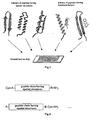
- the spatial structures of the oligopeptide, which bind with proteins include various spatial structures such as ⁇ -helix, ⁇ -loop- ⁇ , ⁇ -turn, ⁇ -loop- ⁇ and ⁇ -strand.
- peptides having such a particular spatial structure are exemplified. These spatial structures are those which the peptide may have when the peptide is bound with the target protein, and the peptide does not necessarily have these spatial structures when it is merely immobilized on the substrate.
- the term "having an expected spatial structure” means that the peptide has the expected spatial structure when bound with the target protein. It should be noted that the entire peptide does not necessarily has the expected spatial structure, as long as most part of the peptide (preferably not less than 60%, more preferably not less than 70% in terms of the number of amino acids) has the expected spatial structure. Therefore, to one or both terminal regions of the peptide, the label(s) hereinbelow described may be bound, and the region(s) may not participate in the formation of the expected spatial structure.
- binding region region(s) at which the peptide is immobilized on the substrate or to which the label(s) is(are) attached and the region to be subjected to the binding with the target protein.
- the region (hereinafter also referred to as “core region”) to be subjected to the binding with the target protein have the spatial structure which is optimum to the binding.
- the binding region(s) is(are) preferably attached to one or both termini of the core region.
- the peptide having the above-mentioned spatial structure may have a circular structure. In some cases, by making the peptide in a circular form, the binding affinity with the protein may be largely increased.
- a peptide antigen may be chemically synthesized and may be used as the peptide for measuring an antibody, the binding between the peptide and the target protein is hot necessarily antigen-antibody reaction at all.
- proteins which bind with the oligopeptides having the above-described spatial structures the following proteins are exemplified.
- proteins which bind with an oligopeptide having ⁇ -helix structure calmodulin and gp41 of HIV are exemplified.
- proteins which bind with an oligopeptide having ⁇ -loop structure amylase is exemplified.
- proteins which bind with a ⁇ -strand peptide MHC proteins, aspartic acid proteases, HIV-1 protease, cysteine proteases, metalloproteases and serine proteases are exemplified.
- proteins which bind with a ⁇ -loop- ⁇ or ⁇ -turn peptide As the proteins which bind with a ⁇ -loop- ⁇ or ⁇ -turn peptide, fibronectin, LH-RH receptors, substance P receptors, somatostatin receptors and the like are exemplified. But the proteins are not restricted thereto.
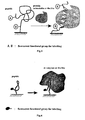
- peptide derivatives having binding abilities with the target proteins such as those in which an organic molecule group (functional molecule group) known to have an interaction with a protein is attached to a particular site, may also be used as the peptide.
- functional molecule groups include porphyrin derivatives (heme), flavin derivatives, alkyl groups such as retinal and palmityl group, nucleic acid bases and peptide nucleic acids, but the functional molecule groups are not restricted thereto.
- proteins which bind with these functional molecule groups the following proteins are exemplified.
- proteins which bind with porphyrin derivative (heme)-containing peptides apo-heme proteins are exemplified.
- proteins which bind with flavin derivative-containing peptides apo-flavin proteins are exemplified.
- proteins which bind with peptides containing alkyl groups such as retinal and palmityl group
- lipocalin proteins are exemplified.
- proteins which bind with the nucleic acid base-containing peptides DNases, RNases, various gene function-controlling proteins and RNA-binding proteins are exemplified.
- Fig. 1 The concept of the peptide-immobilized substrate comprising a chemically synthesized peptide having an expected spatial structure or having a binding ability with the target protein, which peptide is immobilized on the substrate, is schematically shown in Fig. 1.
- the target protein bound with the peptide immobilized on the substrate is measured by a method in which the peptide to be immobilized is labeled with (a) label(s) whose signal changes upon binding of the peptide with the target protein, and the target protein is measured based on the change of the label(s).
- the peptide used in the present invention is labeled with (a) label(s) which changes the signal upon binding of the peptide with the target protein, as defined in the appended claims.
- fluorescent labels include fluorescein and derivatives thereof having the fluorescein structure such as carboxyfluorescein; dansyl group and derivatives thereof having the structure of dansyl group such as ethyldansyl group; coumarin derivatives; pyrene derivatives; and naphthalene derivatives, but the fluorescent labels are not restricted thereto.
- These fluorescent label reagents per se are known and many of them are commercially available.
- the methods per se for labeling an amino acid by binding a commercially available fluorescent dye with (a) functional group(s) in the amino acid, such as amino group are known.
- the label may easily be introduced by binding the label to the side chain of lysine, glutamic acid or cysteine, or to the amino terminal or carboxyl terminal of the peptide, by the method described in Example 1. Since various fluorescence-labeled building blocks used for the synthesis are commercially available from Molecular Probe, U.S. and so on, these commercially available building blocks may be used as they are.
- the signals emitted by the above-described labels are changed upon binding of the peptide with the target protein. Although the signal is changed even in cases where a single label is bound to the peptide, it is preferred to bind a plurality of different labels to different sites in the peptide because the change of the signals may be detected more sensitively and so the detection sensitivity may be further promoted. In the especially preferred mode, two types of fluorescent pigments whose fluorescent wavelengths are different arc bound to different sites in the peptide. By so doing, sensitive detection maybe attained utilizing fluorescence resonance energy transfer (FRET) system.
- FRET fluorescence resonance energy transfer
- Examples of the combinations of the fluorescent labels which are preferred for attaining FRET, include combinations of a fluorescein derivative and a rhodamine derivative; a dansyl derivative and a fluorescein derivative; and a pyrene derivative and a fluorescein derivative, but the combinations are not restricted thereto.
- the site(s) at which the label(s) is(are) bound is(are) preferably one or both termini of the peptide. It is preferred to bind different labels, preferably two types of fluorescent labels whose fluorescent wavelengths are different, to the both end regions of the peptide.
- Fig. 2 A and B denote amino acid residues whose side chains are bound with the fluorescent labels.
- each of the peptide chains is bound to the substrate through the sulfhydryl group in the side chain of the Cys residue.
- the peptide is a labeled peptide having two types of different fluorescent groups at both termini, and measurement utilizing FRET may be attained.
- the amino acid residues A and B are not restricted to Lys, but any compounds having functional groups which are relatively highly reactive, such as Om (ornithine), Glu(glutamic acid) and cysteine may be employed. By introducing groups for labeling utilizing the highly reactive functional groups, building blocks may be prepared.
- the label groups may be introduced site-specifically, after synthesis of the peptide (assembly of amino acid residues). These synthesis procedures are well-known in the field of peptide synthesis chemistry.
- One of the functional groups in each combination shown in Table 1 below may be employed, and so the amino acid is not restricted to Cys.
- the peptide may be immobilized site-specifically.
- the residue such as Cys used for immobilization may be arranged after the C-terminal (after B in the above-mentioned drawing). That is, among the two structures shown in Fig. 2, the structure shown in the lower location may be employed. In Fig. 2, the portion indicated as "peptide chain having the expected spatial structure" is the core region mentioned above.
- the peptides used in the present invention are those chemically synthesized.
- the peptide may be synthesized while protecting the functional groups in the side chains of the amino acids, and the synthesized peptide may be bound to the substrate site-specifically.
- the peptide to be immobilized is a protected peptide, it is deprotected after immobilization of the peptide. It is also possible to immobilize a free (unprotected) peptide. For example, by arranging Cys residue at the terminal, or by arranging one of avidin and biotin, site-specific binding may be easily attained even if the peptide is unprotected (see Table 1 below).
- the peptide may be bound to the substrate at a prescribed site, and the loading amount of the effective peptide (i.e., the peptide which can have the expected spatial structure) may be arbitrarily controlled.
- the protected functional groups are usually deprotected after the peptide is bound to the substrate.
- binding of the peptide to the substrate at a site with which the expected spatial structure cannot be attained when it encounters the protein which interacts with the peptide can surely be prevented.
- the peptide may easily be purified and assayed, so that the loading amount to the substrate may surely be controlled.
- the above-described functional molecule groups or the labels may easily be introduced to the amino acids, and in turn, may easily be bound to the peptide. Still further, in cases where it is preferred to use an amino acid which does not naturally occur, such an amino acid may easily be incorporated into the peptide.
- the peptides in which all or a part of the amino-acid residues constituting the peptide chain are D-amino acids which are not naturally occurring, and the peptides having functional groups other than amino acids, such as heme, flavin and alkyl chains, and the like may also be employed as the peptide to be immobilized, so that the flexibility of measurement is largely increased.
- the chemical synthesis per se of the peptide may be carried out by well-known methods, and may easily be carried out by using a commercially available peptide synthesizer. In this case, it is preferred to carry out the synthesis while protecting the functional groups of the amino acids.
- Kiyoshi NOKIHARA Journal of Synthetic Organic Chemistry Japan, 52, 347-358, 1994 , " Highly Efficient Peptide Synthesis: Simultaneous and Automatic Synthesis of Multiple Peptides and Peptide Library”; Kiyoshi NOKIHARA and Yoshio YOKOMIZO, Shimadzu Review, 52, 1-8, 1995 , " Cleaving Off of Synthetic Peptides by Fmoc-tBu Strategy”; Kiyoshi NOKIHARA, Shimadzu Review, 50, 13-24, 1993 , " Reagents for Highly Efficient Solid Phase Synthesis of Peptides”; Kiyoshi NOKIHARA, Shimadzu Review, 50, 3-12, 1993 , " Fundamental of Peptide Chemical Synthesis”; Kiyoshi NOKIHARA, Rintaro YAMAMOTO, Hajime HAZAMA, Shin NAKAMURA, Shimadzu Review, 50,
- the chemically synthesized peptide is then immobilized on the substrate. This may preferably be attained by reacting the amino group, carboxyl group or the like of the peptide with the amino group, carboxyl group or the like on the substrate thereby binding the peptide to the substrate by covalent bond.
- biotin or avidin is bound to the peptide (this may be carried out through the functional group in the side chain of a desired amino acid by a conventional method), and the biotin or avidin may be bound to the avidin or biotin fixed on the substrate. Examples of the combination of the functional group (or substance) and the functional group (or substance) on the peptide are shown in Table 1.
- the methods per se for immobilizing the peptide on the substrate through the reaction between the functional groups (or substances) shown in Table 1 are well-known.
- the methods for preparing the substrate having the functional groups (or substances) shown in Table 1 are also well-known, and such substrates are commercially available.
- the commercially available substrates may preferably be employed.
- Table 1 Substrate Peptide Reagent for Immobilization Amino group Amino group Glutaraldehyde Amino group Carboxyl group Carbodiimide Carboxyl group Amino group Carbodiimide Sulfhydryl group Bromoacetyl group Spontaneously reacts upon mixing. Bromoacetyl group Sulfhydryl group Spontaneously reacts upon mixing.
- each peptide to be immobilized on the substrate is not restricted at all, and may be appropriately selected depending on the concentration of the target protein in the test sample, reactivity between the peptide and the target protein and the like. For example, it is about 1 fmol (1 femto mol) to 1000 nmol, preferably about 0.01 pmol to 1000 pmol.
- the binding of the peptide to the substrate may also be carried out by physical adsorption.
- the immobilization of the peptide may be attained by contacting a solution of the peptide in a buffer with the substrate.
- the immobilization reaction may be carried out, for example, at room temperature for about 15 minutes to 2 hours, or at 4°C overnight, as in the conventional methods.
- the concentration of the peptide solution used for immobilization may be appropriately selected depending on the type of the peptide, and type and concentration of the substance to be measured in the test sample. For example, it is about 1 ng/ml to 100 ⁇ g/ml.
- the peptide-immobilized substrate it is preferred to immobilize a plurality of kinds of peptides on a single substrate at specified regions, respectively. By so doing, a plurality of target proteins may be measured simultaneously.
- the number of the kinds of the peptides is not restricted, and usually, it is preferred to immobilize 100 to 10,000 kinds, more preferably about 1000 to 3000 kinds of peptides on a single substrate.
- any substrate which can bind the chemically synthesized peptides may be employed without restriction, and glass substrates such as slide glass, may be employed as in the conventional DNA chips. Substrates having small recesses or grooves may be employed, and wells of microplates may also be used as the substrates.
- the inner wall of each well constitutes the peptide-immobilized substrate.
- the peptides are immobilized by physical adsorption, it is preferred to use wells of a microplate, or grooves or recesses formed in a chip such as slide glass as the substrate, so that the peptide solution may be poured.
- the measurement may be carried out without problem even if a portion of the peptides are eluted into the solution during the reaction with the target proteins.
- the peptide-immobilized substrate may be used for measuring the target protein(s).
- the term "measuring” herein includes both detection and quantification.
- the measurement of the target protein(s) may be carried out by adding a sample which may contain the target protein(s) onto the peptide-immobilized substrate, allowing the reaction, then washing the chip and measuring the signal.
- the reaction with the sample may be carried out, usually, at 4°C to 40°C for about 1 minute to 3 hours, preferably at room temperature for about 1 minute to 15 minutes, but the reaction conditions are not restricted thereto.
- the sample is not restricted at all.
- examples of the sample include homoginates of animal cells, plant cells, bacterial cells and viruses as well as fractions thereof; body fluids such as blood, serum, plasma, urine, saliva, tissue fluid and spinal fluid; and various foods and beverages, but the samples are not restricted thereto.
- the target protein(s) may be measured accurately and simply.
- the peptide-immobilized substrate may be used not only for the measurement of the intended target protein(s), but also for the screening of unknown target protein(s). That is, the number of the types of the basal oligopeptides which can have the particular spatial structures are thought to be about 10. Based on these oligopeptides, when considering the combinations of the sizes, acidities, basicities, aromaticities, aliphaticities and so on, the number of the basal peptides are thought to be about 3000. Thus, after chemically synthesizing these 3000 kinds of peptides and preparing the peptide-immobilized substrate according to the present invention using the peptides, various proteins are reacted with the substrate.
- the protein(s) in the test sample may be measured easily and simply, and the protein(s) contained in an unknown sample may be identified or characterized.
- Preferred examples of the data recognized with naked eye include, physical values related to color, such as color, brightness and/or chroma, and it is preferred that the difference in color can be recognized with naked eye depending on the measured value for each peptide.
- the measured values can be distinguished with naked eye, and they arc outputted in an array.
- a colored pattern is formed by the measured values for the peptides.
- this color pattern becomes unique to each test sample, so that it serves as if a fingerprint (the method according to the present invention in which the measured values are converted to data which can be recognized with naked eye may be referred to as "fingerprint method" for convenience).
- Conversion of the differences among various values into visible data may easily be carried out by using a commercially available computer software. That is, data processing softwares which enable to make the differences among values be visible are commercially available. An example thereof is Igor Pro ver.4.04 (commercially available from WaveMetrics, Inc).
- a data processing software for example, by inputting the rate of change of the fluorescence intensities before and after the reaction with the immobilized chemically synthesized peptides as measured values into the software, it is possible to output colors such that, for example, the larger the rate of change, the more yellowish the color (this color can be selected in the software). Further, the colors corresponding to the measured values are outputted in an array. Therefore, a colored stripe pattern is formed for each test sample. Since this colored stripe pattern is unique depending on the type and amount of the protein contained in the test sample, it may be used as a fingerprint which enables to identify or characterize (judging of the characters or properties, identification or estimation of content) the protein contained in an unknown sample.
- a plurality of target proteins may be contained in the test sample. Even when a plurality of target proteins are contained, since a unique colored pattern is outputted depending on the types and amounts of the target proteins, it can be used as a fingerprint of the sample. In this case, it is preferred that the chemically synthesized peptides which bind with each of the target proteins be immobilized on the substrate. However, even if there are no chemically synthesized peptides which bind with one or more of the plurality of target proteins, a colored stripe pattern is formed corresponding thereto, so that lack of the chemically synthesized peptides which bind to one or more target proteins is not necessarily problematic.
- those chemically synthesized peptides which have possibilities to bind with the target protein(s) may also be immobilized on the substrate.
- chemically synthesized peptides each of which has a random region therein may be immobilized. In such a case, it is unknown what peptide binds with what target protein. However, anyway, since a unique colored pattern is outputted depending on the type(s) and amount(s) of the target protein(s), it can be used as a fingerprint of the sample.
- unknown test samples By carrying out measurements by the fingerprint method using the same substrate on which chemically synthesized peptides are immobilized, accumulating the measured values to produce a database, and by comparing the measured data for an unknown sample with the measured data accumulated in the database, unknown test samples may be identified or characterized.
- the fingerprint method is also one of the modes of the method according to the present invention using the above-described peptide-immobilized substrate, the above-described explanations about the chemically synthesized peptides, their labels, binding methods, test samples and reaction conditions are applicable to the fingerprint method.
- calmodulin was measured using a peptide chip in which peptides having ⁇ -helix structure, each of which both termini were labeled with different fluorescent labels, were immobilized on a substrate.
- the procedures were carried out as follows:
- the sequence of the core region of the peptides, which forms ⁇ -helix structure was designed by molecular modeling using a computer (molecular modeling using Insight II / Discover, Molecular Simulation, U.S.) based on the amino acid sequence of the peptide described in a reference ( K. T. O'Neil and W.F. DeGrado, Trend Biochem Sci, 15, 59-64 (1990) ).
- the amino acid sequence Leu-Lys-Lys-Leu-Leu-Lys-Leu-Leu-Lys-Lys-Leu-Leu-Lys-Leu was employed as the amino acid sequence of the core region.
- Rf1, Rf2 and Rf3 were fluorescent groups, that is, ethyldansyl group, dabsyl group and carboxyfluorescein group, respectively.
- Fluorescent amino acid derivatives in which the fluorescent groups (A and B in Fig. 3) were introduced in the side chains of glutamic acid and lysine were synthesized, and used as building blocks.
- the carboxylic acid to which a dabsyl group was attached was converted into N-hydroxysuccinimide-activated ester derivative using diisopropylcarbidiimide.
- carboxyfluorescein was converted to N-hydroxysuccinnimide-activated ester derivative using diisopropylcarbidiimide.
- the amino group in the side chain of Fmoc-Lys-OH (Product #04-12-1042, Novabiochem, Switzerland) and the above-described activated ester were stirred overnight at room temperature in dimethylformamide according to a conventional method. Thereafter, the reaction mixture was concentrated and precipitated with ether to obtain Fmoc-Lys(Rf3)-OH labeled with a fluorescent label. Yield: 85%.
- the peptides labeled with the labels A and B in the drawing were synthesized in amounts of 15 ⁇ mol, respectively, by the solid phase peptide synthesis according to the well-known Fmoc strategy. That is, using TentaGel SRAM, Product #S30-023 (Rink-amide resin with polyethylene glycol chain) of Rapp Polymere, Germany, as the solid carrier, Fmoc-amino acid derivatives were sequentially condensed. This was carried out using the method described in Japanese Patent No. 2007165 entitled Multiple Simultaneous Chemical Reaction Apparatus, and using the Multiple Simultaneous Peptide Synthesizer Model PSSM-8 commercially available from Shimadzu Corporation.
- the substrate was obtained by bromoacetylation of an aminopropyl glass (Product No. 2550, Coming, U.S.). That is, bromoacetic acid was dissolved in dimethylformamide, and water-soluble carbodiimide (1.05 equivalents) was added thereto under stirring while cooling the mixture in ice. Twenty minutes later, an aminopropyl glass plate was immersed therein and the mixture was stirred by gently shaking the whole mixture at room temperature for 2 hours. Then the glass plate was removed and washed with 50% aqueous dimethylformamide solution and tetrahydrofuran, followed by drying in a desiccator under reduced pressrue.
- an aminopropyl glass Product No. 2550, Coming, U.S.
- Each of the synthetic peptides (concentration: 0.1 to 10 ⁇ M) was immobilized by being reacted with the brom groups on the substrate at room temperature for 30 minutes.
- measurement of fluorescence was performed employing exciting wavelength of 340 nm and detection wavelength of 480 nm.
- a calmodulin solution Tris buffer pH7.4, 150mM NaCl, 0.1mM CaCl 2 , calmodulin concentration: 1.0 ⁇ M
- amylase was measured using a peptide chip in which a peptide whose one terminus was labeled with a fluorescent label, which peptide has ⁇ -loop structure, was immobilized on a substrate.
- the procedures were carried out as follows:
- Example 1 As in Example 1, as schematically shown in Fig. 4, a peptide which forms ⁇ -loop structure was designed by molecular modeling using a computer based on the amino acid sequence of the peptide described in a reference ( F.J. Blanco et al., Eur J Biochem 200, 345-351 (1991) , S. Ono et al, Biosci Biotechnol Biochem, 62, 1621-1623 (1998) ). As a result, as the amino acid sequence of the core region, the sequence Tyr-Gln-Ser-Trp-Arg-Tyr-Ser-Gln-Ala was employed.
- the sequence was Lys(Rf)-Tyr-Gln-Ser-Trp-Arg-Tyr-Ser-Gln-Ala-Cys-NH 2 .
- Example 1 using the fluorescent amino acid derivative having a fluorescent group (such as carboxyfluorescein) on the side chain of the amino acid as a building block, the peptides were synthesized by the solid phase peptide synthesis method using the Fmoc strategy in an amount of about 15 ⁇ mol, respectively.
- Each peptide (concentration: 0.1 to 10 ⁇ M) in Tris buffer, pH8.0 was immobilized on the plate through thioether bond as in Example 1.
- fluorescence measurement was performed employing exciting wavelength of 490 nm and detection wavelength of 520 nm.
- amylase solution Tris buffer pH7.4, 150mM NaCl, amylase concentration: 1.0 ⁇ M
- 126 kinds of peptides having the sequences Ac-Cys-Glu-Thr-Ile-Thr-Val-Xaa-Xaa-Xaa-Xaa-Lys-Thr-Tyr-Lys(F)-Lys-NH2 (wherein "Ac” represents acetyl group and (F) represents a fluorescent label) were synthesized, and each one of the peptides was immobilized on one well in a microplate.
- Each of the peptides was reacted with 1) ⁇ -amylase, 2) bovine serum albumin (BSA), 3) ⁇ -glucosidase, 4) ⁇ -galactosidase, 5) lysozyme, 6) cellulase, 7) ⁇ -lactoglobulin, 8) defatted almond powder (protein mixture), 9) mixture of 1) to 7) or 10) cell lysate of E. coli , and the fluorescence intensities before and after the reaction were measured.
- the rate of change of the fluorescence intensities were inputted in Igor Pro ver.4.04 (commercially available from WaveMetrics, Inc), and the colors corresponding to the values (the higher the value, the more yellowish) were outputted in an array.
- Peptides were synthesized by the solid-phase method by means of Fmoc chemistry.
- HPLC was performed on a system composed of a Hitachi D7500 Chromato-Integrator, a L7400 UV-VIS Detector using a Wakosil 5C18 (4.6 ⁇ 150 mm) for analysis or a YMC ODS A323 (10 ⁇ 250 mm) for purification or on a Shimadzu LC2010C system using a Cadenza CD-C18 column (4.6 ⁇ 50 mm) with a linear gradient of acetonitrile/0.1% trifluoroacetic acid (TFA) at a flow rate of 1.0 mL min -1 .
- TFA trifluoroacetic acid
- MALDI-TOFMS was performed on a Shimadzu KOMPACT MALDI III mass spectrometer with 3,5-dimethoxy-4-hydroxycinnamic acid (SA) or ⁇ -cyano-4-hydroxycinnamic acid (CHCA) as a matrix.
- Amino acid analyses were carried out using a Wakopak WS-PTC column (4.0 ⁇ 200 mm, Wako Pure Chemical Industries) after hydrolysis in 6 M HCl at 110 °C for 24 h in a sealed tube and labeling by phcnyl isocyanate (PITC).
- Fmoc-amino acids (6 eq.)(equivalent may be hereinafter referred to as "eq".
- 2-(1H-benzotriazole-1-yl)-1,1,3,3-tetramethyluronium hexafluorophosphate (HBTU, 6 eq.)
- HOBt•H2O (6 eq.)
- DIEA (12 eq.) in NMP were used for coupling of amino acids (for 30 min, twice), and 25% piperidine in NMP was used for Fmoc-removal.
- DMF was used as solvent for other procedure such as washing.
- Fmoc(15-23)Acm-resin or Fmoc(15-23)Trt-resin were treated with 20% (v/v) piperidine / NMP to remove a Fmoc group.
- 5(6)-carboxyfluorescein (5(6)-FAM, Molecular probes, Inc.) was coupled to N -terminus of peptides using 5(6)-FAM (1.5 eq.), HBTU (1.5 eq.), HOBt•H2O (1.5 eq.) and DIEA (3 eq.) in DMF for 1.5 h (x 2) or 2.5 h (x 1).
- the resin and the protecting groups except Acm were removed by 1 h treatment of TFA / m -cresol / ethaneditiol / thioanisole (40 / 1 / 3 / 3, v/v) at room temperature.
- the peptides were purified by RP-HPLC and characterized by MALDI-TOFMS: F(15-23)Acm m/z 1721.4 ([M+H] + calcd. 1721.8); F(15-23)SH 1649.4 (1649.7).
- Fmoc(15-23)Acm-resin or Fmoc(15-23)Trt-resin were treated with 20% (v/v) piperidine / NMP to remove a Fmoc group.
- a dansyl moiety was introduced to N -terminus of peptides using 5-dimcthylaminonaphthalene-1-sulfonyl chloride (dansyl Cl, 3-6 eq.) in DMF for 2-3 h.
- the peptide was cleaved from resin and all protecting groups except Acm were removed according to the procedure same as fluorescein-labeled peptides.
- the peptides were purified by RP-HPLC and characterized by MALDI-TOFMS: D(15-23)Acm m/z 1596.3 ([M+H] + calcd. 1596.8); D(15-23)SH 1525.9 (1525.7).
- Fmoc(15-23)Trt-resin was treated with 20% (v/v) piperidine / NMP to remove a Fmoc group.
- a fluorescein moiety was introduced to N -terminus of peptides using 5(6)-carboxyfluorescein succinimisyl ester (5(6)-FAM, SE, Molecular probes, Inc., 1.2 eq.) and DIEA (2 eq.) in DMF for 7 h.
- the peptide was cleaved from resin and all protecting groups were removed according to the procedure same as fluoresccin-labeled peptides and purified by RP-HPLC.
- the obtained peptide was dissolved in 100 mM Tris-HCl (pH 7.4) and N -(iodoacetaminoethyl)-1-naphthylamine-5'-sulfonic (IAEDANS, Research Organics, 3 eq.) dissolved in DMF was added. After 1 h, the reactant was purified by RP-HPLC. The peptide was characterized by MALDI-TOFMS: F(15-23)ED m/z 1959.2 ([M+H] + calcd. 1956.0).
- a coumarin moiety was introduced into the side chain amino group of Lys residue using 7-diethylaminocoumarin-3-carboxylilc acid (Fluka, 2 eq.), HBTU (2 eq.), HOBt•H2O (2 eq.) and DIEA (4 cq.) in NMP for 30 min ( ⁇ 2).
- Fmoc group of peptide was removed by the treatment with 20% (v/v) piperidine / NMP and fluorescein moiety was introduced to the N -terminus of peptides by the procedure same as fluorescein-labeled peptides.
- the peptide was cleaved from resin and all protecting groups were removed according to the procedure same as described above.
- the peptides were purified by RP-HPLC and characterized by MALDI-TOFMS: H(15-23)C m/z 1559.7 ([M+H] + calcd. 1559.7); F(15-23)C 1919.3 (1918.0).
- the peptides were assembled on Rink amide SS resin (Advanced ChemTech, 0.6 mmol/g). Fmoc-Cys(Trt)-Glu(OtBu)-Thr(tBu)-Ile-Thr(tBu)-Val-Ser(tBu)-Trp-Arg(Pbf)-Tyr(tBu)-Lys(Boc)-Thr(tBu)-Tyr(tBu)-Lys(Mtt)-Lys(Boc)-resin (Fmoc-Loop1(Mtt)-resin) was synthesized on an Advanced ChemTech Model 348 MPS peptide synthesizer with the same procedure described above.
- Fluorescence spectra were recorded on a Hitachi fluorescence spectrophotometer 850 with a thermo-regulator using a quartz cell with 10 mm pathlength. All measurements were performed at 25 °C, in 20 mM Tris-HCl (pH 7.4) or 20 mM Tris-HCl containing 150 mM NaCl (pH 7.4).
- Circular dichroism spectroscopy was performed on a Jasco J-720WI spectropolarimeter with thermo-regulator using a quartz cell with 1 mm pathlength. All the measurements were performed in 20 mM Tris-HCl containing 150 mM NaCl (pH 7.4) at 25 °C.
- the designed libraries were synthesized on a module for multiple simultaneous synthesis SRM96 (Shimadzu Scientific Research Inc). The synthesis was carried out based on the instructions by the manufacturer and the following reference: Reference: Tadashi YASUHARA, Kiyoshi NOKIHARA, Tadasu FURUSHO and Eiko KATAOKA, Tokyo University of Agriculture, Nogaku Shuho (Journal of Tokyo University of Agriculture), 43, 260-267, 1999 .
- the peptide library consisting of 63 library peptides and the peptide with native sequence (SWRY), that is, totally 64 kinds of peptides were synthesized at once.
- the peptide chain were assembled on a 4-(2',4'-dimethoxyphenyl-Fmoc-aminomethyl)phenoxyacetamido-norleusyl-MBHA resin (Rink amide MBHA resin).
- the common residues sequence at the C-terminus were coupled assembled in bulk using a Big LibraTube Rt20 (Shimadzu Scientific Research Inc.). Then, the dried resin was dispensed into the reaction tube of a SRM96 and following residues were coupled on a SRM using IIBTU (10 eq.), HOBt•H2O (10 eq.) and DIEA (12 eq.). Protected amino acid (10 eq.) was reacted as an acyl component.
- the filtrates containing peptides were concentrated by N 2 blowing, and then diethyl ether was added to precipitate the peptides.
- the solution with precipitants were transferred into 1.5 mL polypropylene tube, and centrifuged to collect precipitants. The precipitant were washed with fresh ether for 5 times and dried in centrifugal evaporator.
- the crude peptides were purified by gel permeation chromatography (GPC) using SRM96, of which tubes were filled with Sephadex G-10 (Pharmacia) swelled with 10% (v/v) AcOH aq. (ca. 1.00 ⁇ L per tube). Since the peptides labeled with the fluorescent label were colored, the desired fraction was easily obtained by visual observation. The solution was evaporated to dryness by centrifuging evaporator. The residual acetic acid was removed by freeze drying with addition of water. The resulted peptides were dissolved in 200 ⁇ L of MeOH and stored with tightly capped at 4 °C.
- Fluorescence intensities of the fluorescent-labeled peptides in microtiter plates (Assay Plate, Asahi Techno Glass) as solutions or immobilized to the substrates were measured on a PerSeptive Biosystems CytoFluorTM 4000TR multi-well plate reader at 30 °C. Excitation and emission filters used were 485/20 and 530/10 (for fluorescein-labeled peptides), 360/20 and 515/10 (for a dansyl-labeled peptide), 450/50 and 530/10 (for a coumarin and fluorescein labeled peptide), respectively.
- Dextran (100.0 mg, average MW 64,000-76,000, Sigma D4751) was freeze dried from water (ca. 20 mL). Dried dextran was dissolved in hexamethylphosphoric triamide (10 mL) at 115 °C in a 50 mL single necked round bottom flask connected with a calcium chloride tube. The solution was brought to room temperature, and 2,2,2-trifluoroethanesulfonyl chloride (tresyl chloride, 220 ⁇ L, 2 mmol, Aldrich 32,478-7) were added dropwise over 1 mill under magnetic stirring. After 15 min, dry pyridine (440 ⁇ L, 5.4 mmol) was added dropwise over 1 min.
- the poly-L-lysine coated plates were washed four times with washing buffer (10 mM phosphate, 2.7 mM KCI, 500 mM NaCl, 1% (v/v) Triton X-100, pH 7.2), three times with water, and dried with N 2 .
- TAD 0.5 mg/mL
- phosphate buffer 10 mM phosphate, 150 mM NaCl, pH 7.2
- 1,4-diaminobutane 10 mM, diluted from 1 M stock solution in DMF
- carbonate buffer was added to the TAD modified plates (100 ⁇ L/well) and incubated for 2 h at room temperature.
- blocking solution 0.1 M 2-aminoethanol in water, pH 8.0 adjusted by HCl
- was added 200 ⁇ L/well
- the amino-functionalized plates were then washed three times with the washing buffer ( supra ), three times with water, and dried with N 2 .
- Bromoacetic acid was introduced to the amino-functionalized plates using its anhydride.
- Bromoacetic acid anhydride was prepared in situ by mixing of BrAcOH (0.6 M) and DIC (0.3 M) in DMF or NMP for 60 min. It was diluted to 10 mM by water and added to the plate (100 ⁇ L/well), and incubated for 5 h at room temperature or overnight at 4 °C. The plates were washed three times with water, and further processed as below.
- the peptides with free SII group were dissolved in MeOH as stock solutions (ca. 1 mM).
- the peptides solution were diluted to 10 ⁇ M by 100 mM Tris buffer (pH 8.0) and immediately added to the bromoacetylated acid-modified plate (100 ⁇ L/well). The plate was incubated for 10 h at room temperature and then washing with the washing buffer for overnight at 4 °C. After washing with water and dried with N 2 , the plate was kept at 4 °C.
- the solutions of proteins were added to the peptide-immobilized plate (100 ⁇ L/well), and the plate was incubated at 4°C for 24 hours.
- the fluorescence intensities ( I ) were measured by using a microplate reader (CytoFluorTM) at 30 °C. After washing with water, the buffer was added to the plates (100 ⁇ L/well) and measured fluorescence intensities ( I 0 ) again by using a microplate reader (CytoFluorTM) at 30 °C.
- the experiments were repeated twice for each protein and the averages of I / I 0 were recorded.
- E . coli . JA221 (F-, hsdR, DtrpES, leuB6, lacY, recAI) was inoculated onto ca. 5 mL of liquid media composed of 1% trypton, 0.5 % yeast extract, and 1 % NaCl (w/v) and preincubated at 37 °C for overnight. Then all of the culture was inoculated into 400 mL of same media and incubated at 37 °C for overnight with vigorous shaking. The cells were harvested by spinning, and the cell pellets were suspended in the buffer (100 mM potassium phosphate, pH 6.5), followed by washing.
- the buffer 100 mM potassium phosphate, pH 6.5
- the washed cells were resuspended in 16 mL of the buffer and disrupted by sonication using ultrasonic disintegrator in an ice bath. Cell debris and larger particles were removed by centrifugation at 12000 rpm for 20 min, and the supernatant was collected. Total protein concentration of obtained supernatant was estimated as 30 mg/mL, by using Bio-Rad DC Protein Assay kit.
- the solution was diluted to a concentration of 0.86 mg/mL with 1.0 mM of phenylmethylsulfonyl fluoride and 5 mM of EDTA, and analyzed by the peptide-immobilized plate.
- a sofware Igor Pro ver.4,04 WiveMetrics, Inc.
- the line of y 1 was displayed as a line graph for all proteins (10 lines) (1. ⁇ -amylase from Aspergillus oryzae , 2. albumin from Bovine serum (BSA), 3. ⁇ -glucosidase from Almonds, 4. ⁇ -galactosidase from Aspergillus oryzae , 5.
Landscapes
- Chemical & Material Sciences (AREA)
- Health & Medical Sciences (AREA)
- Life Sciences & Earth Sciences (AREA)
- Molecular Biology (AREA)
- Organic Chemistry (AREA)
- General Health & Medical Sciences (AREA)
- Biochemistry (AREA)
- Engineering & Computer Science (AREA)
- Medicinal Chemistry (AREA)
- Biophysics (AREA)
- Immunology (AREA)
- Proteomics, Peptides & Aminoacids (AREA)
- Physics & Mathematics (AREA)
- Urology & Nephrology (AREA)
- Analytical Chemistry (AREA)
- Genetics & Genomics (AREA)
- General Chemical & Material Sciences (AREA)
- Chemical Kinetics & Catalysis (AREA)
- Hematology (AREA)
- Biomedical Technology (AREA)
- Bioinformatics & Computational Biology (AREA)
- Biotechnology (AREA)
- Cell Biology (AREA)
- Bioinformatics & Cheminformatics (AREA)
- Microbiology (AREA)
- Gastroenterology & Hepatology (AREA)
- Food Science & Technology (AREA)
- General Physics & Mathematics (AREA)
- Pathology (AREA)
- Peptides Or Proteins (AREA)
- Measuring Or Testing Involving Enzymes Or Micro-Organisms (AREA)
- Investigating Or Analysing Materials By The Use Of Chemical Reactions (AREA)
Claims (17)
- Verfahren zum Messen von (einem) Targetprotein(en), umfassend folgende Schritte:das Kontaktieren eines peptidimmobilisierten Substrats mit dem/den Targetprotein(en); sowiedas Messen des Targetproteins/der Targetproteine, das/die an das/die Peptid(e) gebunden ist/sind, basierend auf der Veränderung des Signals/der Signale,wobei es sich bei dem peptidimmobilisierten Substrat um Folgendes handelt:ein peptidimmobilisiertes Substrat zum Messen von (einem) Targetprotein(en), umfassend (ein) chemisch synthetisierte(s) Peptid(e) mit (einer) erwarteten Raumstruktur(en) oder mit (einer) Bindungsfähigkeit(en) mit dem/den Targetprotein(en), wobei das/die Peptid(e) eine Bindung mit dem/den Targetprotein(en) eingehen kann/können und auf dem Substrat immobilisiert ist/sind;wobei das/die Peptid(e) mit (einer) Markierung(en) markiert ist/sind, deren Signal(e) nach der Bindung des/der Peptid(e) mit dem/den Targetprotein(en) verändert wird/werden;wobei es sich bei der/den Markierung(en) um (eine) fluoreszierende Markierung(en) handelt, die an (eine) Aminosäure(n) gebunden ist/sind, die sich an (einer) bestimmten Stelle(n) befindet/befinden, wobei die Aminosäure(n) unter den Aminosäuren ist/sind, aus denen das Peptid besteht;wobei:entweder: zwei Arten fluoreszierender Markierungen an bestimmte Aminosäuren gebunden sind, die sich an unterschiedlichen Stellen befinden, und wobei die zwei Arten fluoreszierender Markierungen unterschiedliche Fluoreszenz-Wellenlängen aufweisen und unter Verwendung von FRET oder eines fluoreszenzquenchenden Systems zum Messen geeignet sind;oder: das/die Peptid(e) mit einer einzigen Art fluoreszierender Markierung markiert ist/sind, deren Signal nach der Bindung des Peptids/der Peptide mit dem/den Targetprotein(en) sterisch induzierten Veränderungen unterzogen wird;und wobei die Anzahl an Aminosäuren, aus denen das Peptid besteht, bei 5 bis 20 liegt.
- Verfahren nach Anspruch 1, wobei zwei Arten fluoreszierender Markierungen an bestimmte Aminosäuren gebunden sind, die sich an unterschiedlichen Stellen befinden, und wobei die zwei Arten fluoreszierender Markierungen unterschiedliche fluoreszierende Wellenlängen aufweisen und unter Verwendung von FRET oder eines fluoreszenzquenchenden Systems zum Messen geeignet sind.
- Verfahren nach Anspruch 1 oder 2, wobei die zwei Arten fluoreszierender Markierungen aus Folgendem ausgewählt sind:einem Fluorescein-Derivat und einem Rhodamin-Derivat;einem Dansyl-Derivat und einem Fluorescein-Derivat;einem Pyren-Derivat und einem Fluorescein-Derivat;einem Dansyl-Derivat und einem Dabsyl-Derivat; undeinem Pyren-Derivat und einem Nitrobenzol-Derivat.
- Verfahren nach einem der Ansprüche 1 bis 3, wobei das/die Peptid(e) (eine) Aminosäuresequenz(en) besitzt/besitzen, die auf Molekularebene so kreiert ist/sind, dass die erwartete(n) Raumstruktur(en) erhalten wird/werden.
- Verfahren nach einem der Ansprüche 1 bis 4, wobei die Markierung(en) an eine oder beide terminale(n) Region(en) des Peptids gebunden ist/sind.
- Verfahren nach Anspruch 5, wobei zwei Arten fluoreszierender Markierungen mit unterschiedlichen Fluoreszenz-Wellenlängen, die unter Verwendung von FRET oder eines fluoreszenzquenchenden Systems zum Messen geeignet sind, an eine oder beide terminale(n) Region(en) des Peptids gebunden sind.
- Verfahren nach einem der Ansprüche 1 bis 6, wobei es sich bei dem/den Peptid(en) um eines/jene handelt, das/die synthetisiert wird/werden, während die funktionellen Gruppen in den Seitenketten der Aminosäuren geschützt sind, und das/die an das Substrat an (einer) gewünschten Stelle(n) durch Bindung des/der Peptids/Peptide an das Substrat gebunden wird/werden, während die funktionellen Gruppen geschützt sind, die anschließend entschützt werden, nachdem das/die Peptid(e) an das Substrat gebunden ist/sind.
- Verfahren nach einem der Ansprüche 1 bis 6, wobei jedes Peptid (eine) funktionelle Gruppe(n) an seiner terminalen Region aufweist, die chemisch an das Substrat bindet, und durch die funktionelle Gruppe an das Substrat gebunden ist.
- Verfahren nach Anspruch 8, wobei jedes Peptid Cystein an einem Ende davon aufweist und durch die Sulfhydrylgruppe des Cysteins an das Substrat gebunden ist.
- Verfahren nach einem der Ansprüche 1 bis 9, wobei jedes Peptid mittels kovalenter Bindung an das Substrat gebunden ist.
- Verfahren nach einem der Ansprüche 1 bis 10, wobei jedes Peptid eine Kernregion, die der Bindung mit dem Targetprotein zu unterziehen ist, sowie (eine) Bindungsregion(en) aufweist, die der Bindung an das Substrat und der Bindung mit der/den Markierung(en), in Fällen, in denen das Peptid die Markierung(en) aufweist, zu unterziehen ist/sind, wobei die Kernregion eine für die Bindung mit dem Targetprotein optimale Raumstruktur aufweist.
- Verfahren nach einem der Ansprüche 1 bis 11, wobei eine Vielzahl verschiedener der Peptide an vorgeschriebene Stellen auf einem einzelnen Substrat gebunden ist.
- Verfahren nach einem der Ansprüche 1 bis 12 zum Messen von (einem) Targetprotein(en) in einer Testprobe, umfassend folgende Schritte:das Kontaktieren einer Vielzahl verschiedener, chemisch synthetisierter Peptide, von denen jedes eine erwartete Raumstruktur oder eine Bindungsfähigkeit mit dem Targetprotein besitzt, die an das Targetprotein binden kann oder könnte, mit der Testprobe, die das/die Targetprotein(e) enthalten kann, wobei die Vielzahl verschiedener Peptide auf demselben oder verschiedenen Substraten immobilisiert ist;das Messen der Signale, die sich nach der Bindung zwischen den Peptiden und dem/den Targetprotein(en) verändern;das Umwandeln eines jeden der für jedes Peptid gemessenen Werte in Daten, mit denen Unterschiede zwischen gemessenen Werten mit bloßem Auge erkannt werden können, sowie das schlussendliche Darstellen sichtbarer Daten der Peptide in einer Anordnung.
- Verfahren nach Anspruch 13, wobei der sichtbare physikalische Wert Farbe, Helligkeit und/oder Chromatizität ist und Farbunterschiede in Abhängigkeit von dem für jedes Peptid gemessenen Wert mit bloßem Auge erkannt werden können.
- Verfahren nach Anspruch 13 oder 14, wobei eine Vielzahl verschiedener, chemisch synthetisierter Peptide, die eine Bindung mit einer Vielzahl verschiedener Targetproteine eingehen, immobilisiert wird.
- Verfahren zur Identifikation oder Beschreibung von (einem) Protein(en) in einer Testprobe, umfassend folgende Schritte:das Durchführen eines Verfahrens nach Anspruch 13 oder 14 für verschiedene Testproben;das Sammeln der erhaltenen gemessenen Werte, um eine Datenbank zu erstellen;das Vergleichen der gemessenen Daten einer unbekannten Testprobe mit den gemessenen Daten in der Datenbank, wodurch die unbekannte Testprobe identifiziert oder charakterisiert wird.
- Verfahren nach einem der Ansprüche 13 bis 16, wobei zumindest ein Teil der Vielzahl verschiedener Peptide Zufallssequenzen in zumindest einem Teil ihrer Aminosäuresequenzen enthält.
Priority Applications (1)
| Application Number | Priority Date | Filing Date | Title |
|---|---|---|---|
| EP07020589A EP1914550A1 (de) | 2001-05-07 | 2002-05-07 | Peptidimmobilisiertes Substrat und Verfahren zum Messen eines Zielproteins damit |
Applications Claiming Priority (5)
| Application Number | Priority Date | Filing Date | Title |
|---|---|---|---|
| JP2001136606 | 2001-05-07 | ||
| JP2001136606 | 2001-05-07 | ||
| JP2002001759 | 2002-01-08 | ||
| JP2002001759 | 2002-01-08 | ||
| PCT/JP2002/004426 WO2002090985A1 (en) | 2001-05-07 | 2002-05-07 | Peptide-immobilized baseboard and method of assaying target protein using the same |
Related Child Applications (1)
| Application Number | Title | Priority Date | Filing Date |
|---|---|---|---|
| EP07020589A Division EP1914550A1 (de) | 2001-05-07 | 2002-05-07 | Peptidimmobilisiertes Substrat und Verfahren zum Messen eines Zielproteins damit |
Publications (3)
| Publication Number | Publication Date |
|---|---|
| EP1403640A1 EP1403640A1 (de) | 2004-03-31 |
| EP1403640A4 EP1403640A4 (de) | 2004-06-30 |
| EP1403640B1 true EP1403640B1 (de) | 2007-12-05 |
Family
ID=26614715
Family Applications (2)
| Application Number | Title | Priority Date | Filing Date |
|---|---|---|---|
| EP02724696A Expired - Lifetime EP1403640B1 (de) | 2001-05-07 | 2002-05-07 | Peptidimmobilisierte grundplatte und vefahren zum testen eines zielproteins unter verwendung derselben |
| EP07020589A Ceased EP1914550A1 (de) | 2001-05-07 | 2002-05-07 | Peptidimmobilisiertes Substrat und Verfahren zum Messen eines Zielproteins damit |
Family Applications After (1)
| Application Number | Title | Priority Date | Filing Date |
|---|---|---|---|
| EP07020589A Ceased EP1914550A1 (de) | 2001-05-07 | 2002-05-07 | Peptidimmobilisiertes Substrat und Verfahren zum Messen eines Zielproteins damit |
Country Status (6)
| Country | Link |
|---|---|
| US (1) | US8148141B2 (de) |
| EP (2) | EP1403640B1 (de) |
| JP (2) | JP4562018B2 (de) |
| AT (1) | ATE380342T1 (de) |
| DE (1) | DE60223922T2 (de) |
| WO (1) | WO2002090985A1 (de) |
Families Citing this family (17)
| Publication number | Priority date | Publication date | Assignee | Title |
|---|---|---|---|---|
| WO2003106640A2 (en) | 2002-06-14 | 2003-12-24 | Case Western Reserve University | Cell targeting methods and compositions |
| US20060263336A1 (en) * | 2003-03-24 | 2006-11-23 | Caplan Arnold I | Cell targeting methods and compositions |
| WO2007020636A1 (en) * | 2005-08-15 | 2007-02-22 | Technion Research And Development Foundation Ltd. | Printable materials |
| US8865398B2 (en) | 2006-09-01 | 2014-10-21 | Abbott Laboratories | Combination hepatitis C virus antigen and antibody detection method |
| JP5062524B2 (ja) * | 2007-08-29 | 2012-10-31 | 株式会社ハイペップ研究所 | 固相基板表面上の官能基の定量方法 |
| US20120190574A1 (en) | 2009-06-19 | 2012-07-26 | The Arizona Board of Regents, A body Corporate of the State of Arizona for and on behalf of Arizona | Compound Arrays for Sample Profiling |
| TWI655213B (zh) * | 2012-07-13 | 2019-04-01 | Menicon Co., Ltd. | 自我組織化肽衍生物的製造方法 |
| US10161938B2 (en) | 2013-12-27 | 2018-12-25 | Roche Sequencing Solutions, Inc. | Systematic discovery, maturation and extension of peptide binders to proteins |
| AU2016251501A1 (en) | 2015-04-20 | 2017-10-19 | F. Hoffmann-La Roche Ag | Specific peptide binders to proteins identified via systemic discovery, maturation and extension process |
| US10758886B2 (en) | 2015-09-14 | 2020-09-01 | Arizona Board Of Regents On Behalf Of Arizona State University | Conditioned surfaces for in situ molecular array synthesis |
| JP2019526786A (ja) | 2016-06-20 | 2019-09-19 | ヘルステル・インコーポレイテッドHealthtell Inc. | 自己免疫疾患の診断および処置のための方法 |
| AU2017281039A1 (en) | 2016-06-20 | 2019-01-24 | Healthtell Inc. | Methods for differential diagnosis of autoimmune diseases |
| US11371990B2 (en) | 2016-11-11 | 2022-06-28 | Cowper Sciences Inc. | Methods for identifying candidate biomarkers |
| US12025615B2 (en) | 2017-09-15 | 2024-07-02 | Arizona Board Of Regents On Behalf Of Arizona State University | Methods of classifying response to immunotherapy for cancer |
| EP4038222A4 (de) | 2019-10-02 | 2023-10-18 | Arizona Board of Regents on behalf of Arizona State University | Verfahren und zusammensetzungen zur identifizierung von neoantigenen zur verwendung bei der behandlung und vorbeugung von krebs |
| CN114195857B (zh) * | 2021-10-14 | 2023-07-04 | 中国科学院海洋研究所 | 一种降压肽及其制备方法和应用 |
| CN115572319B (zh) * | 2022-06-27 | 2025-12-19 | 欧诗漫生物股份有限公司 | 珍珠美白抗衰组合多肽和单一美白多肽的制备方法和应用 |
Citations (1)
| Publication number | Priority date | Publication date | Assignee | Title |
|---|---|---|---|---|
| US5714342A (en) * | 1994-10-28 | 1998-02-03 | Oncoimmunin, Inc. | Compositions for the detection of protease in biological samples and methods of use therefo |
Family Cites Families (23)
| Publication number | Priority date | Publication date | Assignee | Title |
|---|---|---|---|---|
| SE446866B (sv) * | 1977-11-15 | 1986-10-13 | Sloan Kettering Inst Cancer | Sett att framstella en aktiv polypeptid med formaga att inducera differentiering av bade t-lymfocyter och komplementreceptor (cr?72+) b-lymfocyter |
| US4507230A (en) * | 1982-05-12 | 1985-03-26 | Research Corporation | Peptide synthesis reagents and method of use |
| US5591646A (en) * | 1992-09-02 | 1997-01-07 | Arris Pharmaceutical | Method and apparatus for peptide synthesis and screening |
| US6165335A (en) * | 1996-04-25 | 2000-12-26 | Pence And Mcgill University | Biosensor device and method |
| JPH1025299A (ja) | 1996-07-12 | 1998-01-27 | Nec Corp | 整列ペプチド、及びそれを用いたタンパク質の結合・相互作用部位検出方法 |
| NZ334809A (en) * | 1996-10-07 | 2000-12-22 | Schering Corp | Assay for the detection of antibodies against p53 |
| US5998204A (en) * | 1997-03-14 | 1999-12-07 | The Regents Of The University Of California | Fluorescent protein sensors for detection of analytes |
| US6376257B1 (en) * | 1997-04-24 | 2002-04-23 | University Of Rochester | Detection by fret changes of ligand binding by GFP fusion proteins |
| JPH10319017A (ja) * | 1997-05-20 | 1998-12-04 | Toyobo Co Ltd | 蛍光エネルギー転移を利用した物質の測定方法およびそのための試薬 |
| US6927025B1 (en) * | 1997-09-03 | 2005-08-09 | Biovation Limited | Methods for protein screening |
| US6197599B1 (en) * | 1998-07-30 | 2001-03-06 | Guorong Chin | Method to detect proteins |
| US7018846B1 (en) * | 1998-08-10 | 2006-03-28 | Science & Technology Corporation @ Unm | Display of receptors and analysis of binding interactions and drug libraries |
| US6441152B1 (en) * | 1998-12-08 | 2002-08-27 | Boston Probes, Inc. | Methods, kits and compositions for the identification of nucleic acids electrostatically bound to matrices |
| WO2000048990A1 (en) * | 1999-02-18 | 2000-08-24 | The Regents Of The University Of California | Phthalamide-lanthanide complexes for use as luminescent markers |
| GB9904395D0 (en) * | 1999-02-25 | 1999-04-21 | Fluorescience Ltd | Protein assay |
| EP1159615A2 (de) | 1999-03-10 | 2001-12-05 | National Institutes of Health, as represented by the Secretary, Department of Health and Human Services of the Government | Universales eiweiseinreihungssystem |
| US6284465B1 (en) * | 1999-04-15 | 2001-09-04 | Agilent Technologies, Inc. | Apparatus, systems and method for locating nucleic acids bound to surfaces |
| US6692916B2 (en) * | 1999-06-28 | 2004-02-17 | Source Precision Medicine, Inc. | Systems and methods for characterizing a biological condition or agent using precision gene expression profiles |
| GB9923146D0 (en) * | 1999-09-30 | 1999-12-01 | Imperial College | Detector array |
| WO2001064831A1 (en) * | 2000-02-29 | 2001-09-07 | The Board Of Trustees Of The Leland Stanford Junior University | Microarray substrate with integrated photodetector and methods of use thereof |
| JP2001242116A (ja) * | 2000-03-02 | 2001-09-07 | Fuji Photo Film Co Ltd | タンパクチップおよびタンパク質の検出方法 |
| JP3643520B2 (ja) * | 2000-07-04 | 2005-04-27 | 独立行政法人科学技術振興機構 | cGMP可視化プローブ及びそれを利用したcGMPの検出・定量方法 |
| ATE378596T1 (de) * | 2000-09-25 | 2007-11-15 | U S Medical Res Inst Of Infect | Hoch-durchsatz assays für proteolytische aktivitäten von clostridium neurotoxinen |
-
2002
- 2002-05-07 WO PCT/JP2002/004426 patent/WO2002090985A1/ja not_active Ceased
- 2002-05-07 DE DE60223922T patent/DE60223922T2/de not_active Expired - Lifetime
- 2002-05-07 EP EP02724696A patent/EP1403640B1/de not_active Expired - Lifetime
- 2002-05-07 JP JP2002588191A patent/JP4562018B2/ja not_active Expired - Lifetime
- 2002-05-07 AT AT02724696T patent/ATE380342T1/de not_active IP Right Cessation
- 2002-05-07 US US10/476,861 patent/US8148141B2/en not_active Expired - Fee Related
- 2002-05-07 EP EP07020589A patent/EP1914550A1/de not_active Ceased
-
2008
- 2008-07-14 JP JP2008182422A patent/JP4912362B2/ja not_active Expired - Lifetime
Patent Citations (1)
| Publication number | Priority date | Publication date | Assignee | Title |
|---|---|---|---|---|
| US5714342A (en) * | 1994-10-28 | 1998-02-03 | Oncoimmunin, Inc. | Compositions for the detection of protease in biological samples and methods of use therefo |
Also Published As
| Publication number | Publication date |
|---|---|
| EP1403640A1 (de) | 2004-03-31 |
| WO2002090985A1 (en) | 2002-11-14 |
| JPWO2002090985A1 (ja) | 2004-08-26 |
| EP1914550A1 (de) | 2008-04-23 |
| JP4912362B2 (ja) | 2012-04-11 |
| DE60223922T2 (de) | 2008-11-27 |
| ATE380342T1 (de) | 2007-12-15 |
| EP1403640A4 (de) | 2004-06-30 |
| US20050084902A1 (en) | 2005-04-21 |
| US8148141B2 (en) | 2012-04-03 |
| DE60223922D1 (de) | 2008-01-17 |
| JP2008268231A (ja) | 2008-11-06 |
| JP4562018B2 (ja) | 2010-10-13 |
Similar Documents
| Publication | Publication Date | Title |
|---|---|---|
| JP4912362B2 (ja) | ペプチド固定化基板及びそれを用いた標的タンパク質の測定方法 | |
| US20240192221A1 (en) | Protein sequencing method and reagents | |
| US9625469B2 (en) | Identifying peptides at the single molecule level | |
| JP3771262B2 (ja) | 生物学的サンプル中のプロテアーゼの検出のための組成物及びその使用方法 | |
| Rothbart et al. | Peptide microarrays to interrogate the “histone code” | |
| US20230107647A1 (en) | Single molecule peptide sequencing | |
| CN111499692A (zh) | 靶向新型冠状病毒covid-19的多肽及其应用 | |
| JP2003522961A (ja) | セグメント合成 | |
| US7736909B2 (en) | Methods and compositions comprising capture agents | |
| US7135325B2 (en) | Short enzyme donor fragment | |
| US5814470A (en) | Melittin-related polypeptides, mixture sets and libraries thereof | |
| CN107607720A (zh) | 一步法检测三唑磷残留的elisa试剂盒及其应用 | |
| Pennington | Site-specific chemical modification procedures | |
| KR20120093151A (ko) | 개선된 바이오폴리머의 스크리닝 | |
| US20040185499A1 (en) | Method of epitope scanning using fluorescence polarization | |
| JP2008271963A (ja) | 糖尿病合併症検査用試薬 | |
| CN108948174A (zh) | 一种瓜氨酸修饰肽及其应用 | |
| KR20220113147A (ko) | 오보뮤코이드에 특이적으로 결합하는 펩타이드 및 이의 용도 | |
| JP2002187899A (ja) | ルシフェラーゼに対して結合性を有するペプチド | |
| KR20230057075A (ko) | 트롬빈 검출용 신규한 펩타이드 및 이의 용도 | |
| JP5278873B2 (ja) | 癌診断用試薬 | |
| KR20230057129A (ko) | 트롬빈 검출용 신규한 펩타이드 | |
| de Carvalho et al. | Amino acid sequence of the Phaseolus vulgaris var.“Fogo na Serra” inhibitor and interactive surface modeling for the enzyme-inhibitor complex |
Legal Events
| Date | Code | Title | Description |
|---|---|---|---|
| PUAI | Public reference made under article 153(3) epc to a published international application that has entered the european phase |
Free format text: ORIGINAL CODE: 0009012 |
|
| 17P | Request for examination filed |
Effective date: 20031204 |
|
| AK | Designated contracting states |
Kind code of ref document: A1 Designated state(s): AT BE CH CY DE DK ES FI FR GB GR IE IT LI LU MC NL PT SE TR |
|
| RIC1 | Information provided on ipc code assigned before grant |
Ipc: 7G 01N 33/542 A Ipc: 7G 01N 33/58 B |
|
| A4 | Supplementary search report drawn up and despatched |
Effective date: 20040513 |
|
| 17Q | First examination report despatched |
Effective date: 20041109 |
|
| RAP1 | Party data changed (applicant data changed or rights of an application transferred) |
Owner name: HIPEP LABORATORIES |
|
| RIN1 | Information on inventor provided before grant (corrected) |
Inventor name: MIHARA, HISAKAZU Inventor name: NOKIHARA, KIYOSHI |
|
| 17Q | First examination report despatched |
Effective date: 20041109 |
|
| GRAP | Despatch of communication of intention to grant a patent |
Free format text: ORIGINAL CODE: EPIDOSNIGR1 |
|
| GRAS | Grant fee paid |
Free format text: ORIGINAL CODE: EPIDOSNIGR3 |
|
| GRAA | (expected) grant |
Free format text: ORIGINAL CODE: 0009210 |
|
| RIN1 | Information on inventor provided before grant (corrected) |
Inventor name: NOKIHARA, KIYOSHI Inventor name: MIHARA, HISAKAZU |
|
| AK | Designated contracting states |
Kind code of ref document: B1 Designated state(s): AT BE CH CY DE DK ES FI FR GB GR IE IT LI LU MC NL PT SE TR |
|
| REG | Reference to a national code |
Ref country code: GB Ref legal event code: FG4D |
|
| REG | Reference to a national code |
Ref country code: IE Ref legal event code: FG4D |
|
| REG | Reference to a national code |
Ref country code: CH Ref legal event code: EP |
|
| REF | Corresponds to: |
Ref document number: 60223922 Country of ref document: DE Date of ref document: 20080117 Kind code of ref document: P |
|
| PG25 | Lapsed in a contracting state [announced via postgrant information from national office to epo] |
Ref country code: SE Free format text: LAPSE BECAUSE OF FAILURE TO SUBMIT A TRANSLATION OF THE DESCRIPTION OR TO PAY THE FEE WITHIN THE PRESCRIBED TIME-LIMIT Effective date: 20080305 Ref country code: ES Free format text: LAPSE BECAUSE OF FAILURE TO SUBMIT A TRANSLATION OF THE DESCRIPTION OR TO PAY THE FEE WITHIN THE PRESCRIBED TIME-LIMIT Effective date: 20080316 Ref country code: NL Free format text: LAPSE BECAUSE OF FAILURE TO SUBMIT A TRANSLATION OF THE DESCRIPTION OR TO PAY THE FEE WITHIN THE PRESCRIBED TIME-LIMIT Effective date: 20071205 Ref country code: LI Free format text: LAPSE BECAUSE OF FAILURE TO SUBMIT A TRANSLATION OF THE DESCRIPTION OR TO PAY THE FEE WITHIN THE PRESCRIBED TIME-LIMIT Effective date: 20071205 Ref country code: CH Free format text: LAPSE BECAUSE OF FAILURE TO SUBMIT A TRANSLATION OF THE DESCRIPTION OR TO PAY THE FEE WITHIN THE PRESCRIBED TIME-LIMIT Effective date: 20071205 |
|
| PG25 | Lapsed in a contracting state [announced via postgrant information from national office to epo] |
Ref country code: FI Free format text: LAPSE BECAUSE OF FAILURE TO SUBMIT A TRANSLATION OF THE DESCRIPTION OR TO PAY THE FEE WITHIN THE PRESCRIBED TIME-LIMIT Effective date: 20071205 |
|
| NLV1 | Nl: lapsed or annulled due to failure to fulfill the requirements of art. 29p and 29m of the patents act | ||
| REG | Reference to a national code |
Ref country code: CH Ref legal event code: PL |
|
| PG25 | Lapsed in a contracting state [announced via postgrant information from national office to epo] |
Ref country code: AT Free format text: LAPSE BECAUSE OF FAILURE TO SUBMIT A TRANSLATION OF THE DESCRIPTION OR TO PAY THE FEE WITHIN THE PRESCRIBED TIME-LIMIT Effective date: 20071205 |
|
| ET | Fr: translation filed | ||
| PG25 | Lapsed in a contracting state [announced via postgrant information from national office to epo] |
Ref country code: BE Free format text: LAPSE BECAUSE OF FAILURE TO SUBMIT A TRANSLATION OF THE DESCRIPTION OR TO PAY THE FEE WITHIN THE PRESCRIBED TIME-LIMIT Effective date: 20071205 |
|
| PG25 | Lapsed in a contracting state [announced via postgrant information from national office to epo] |
Ref country code: PT Free format text: LAPSE BECAUSE OF FAILURE TO SUBMIT A TRANSLATION OF THE DESCRIPTION OR TO PAY THE FEE WITHIN THE PRESCRIBED TIME-LIMIT Effective date: 20080505 |
|
| PLBE | No opposition filed within time limit |
Free format text: ORIGINAL CODE: 0009261 |
|
| STAA | Information on the status of an ep patent application or granted ep patent |
Free format text: STATUS: NO OPPOSITION FILED WITHIN TIME LIMIT |
|
| PG25 | Lapsed in a contracting state [announced via postgrant information from national office to epo] |
Ref country code: DK Free format text: LAPSE BECAUSE OF FAILURE TO SUBMIT A TRANSLATION OF THE DESCRIPTION OR TO PAY THE FEE WITHIN THE PRESCRIBED TIME-LIMIT Effective date: 20071205 |
|
| 26N | No opposition filed |
Effective date: 20080908 |
|
| PG25 | Lapsed in a contracting state [announced via postgrant information from national office to epo] |
Ref country code: MC Free format text: LAPSE BECAUSE OF NON-PAYMENT OF DUE FEES Effective date: 20080531 |
|
| PG25 | Lapsed in a contracting state [announced via postgrant information from national office to epo] |
Ref country code: GR Free format text: LAPSE BECAUSE OF FAILURE TO SUBMIT A TRANSLATION OF THE DESCRIPTION OR TO PAY THE FEE WITHIN THE PRESCRIBED TIME-LIMIT Effective date: 20080306 |
|
| PG25 | Lapsed in a contracting state [announced via postgrant information from national office to epo] |
Ref country code: IE Free format text: LAPSE BECAUSE OF NON-PAYMENT OF DUE FEES Effective date: 20080507 |
|
| PG25 | Lapsed in a contracting state [announced via postgrant information from national office to epo] |
Ref country code: CY Free format text: LAPSE BECAUSE OF FAILURE TO SUBMIT A TRANSLATION OF THE DESCRIPTION OR TO PAY THE FEE WITHIN THE PRESCRIBED TIME-LIMIT Effective date: 20071205 |
|
| PG25 | Lapsed in a contracting state [announced via postgrant information from national office to epo] |
Ref country code: LU Free format text: LAPSE BECAUSE OF NON-PAYMENT OF DUE FEES Effective date: 20080507 |
|
| PG25 | Lapsed in a contracting state [announced via postgrant information from national office to epo] |
Ref country code: TR Free format text: LAPSE BECAUSE OF FAILURE TO SUBMIT A TRANSLATION OF THE DESCRIPTION OR TO PAY THE FEE WITHIN THE PRESCRIBED TIME-LIMIT Effective date: 20071205 |
|
| REG | Reference to a national code |
Ref country code: FR Ref legal event code: PLFP Year of fee payment: 15 |
|
| REG | Reference to a national code |
Ref country code: FR Ref legal event code: PLFP Year of fee payment: 16 |
|
| REG | Reference to a national code |
Ref country code: FR Ref legal event code: PLFP Year of fee payment: 17 |
|
| PGFP | Annual fee paid to national office [announced via postgrant information from national office to epo] |
Ref country code: PT Payment date: 20190522 Year of fee payment: 14 |
|
| PGFP | Annual fee paid to national office [announced via postgrant information from national office to epo] |
Ref country code: DE Payment date: 20200529 Year of fee payment: 19 Ref country code: FR Payment date: 20200428 Year of fee payment: 19 |
|
| PGFP | Annual fee paid to national office [announced via postgrant information from national office to epo] |
Ref country code: GB Payment date: 20200520 Year of fee payment: 19 |
|
| PG25 | Lapsed in a contracting state [announced via postgrant information from national office to epo] |
Ref country code: IT Free format text: LAPSE BECAUSE OF NON-PAYMENT OF DUE FEES Effective date: 20200507 |
|
| REG | Reference to a national code |
Ref country code: DE Ref legal event code: R119 Ref document number: 60223922 Country of ref document: DE |
|
| GBPC | Gb: european patent ceased through non-payment of renewal fee |
Effective date: 20210507 |
|
| PG25 | Lapsed in a contracting state [announced via postgrant information from national office to epo] |
Ref country code: GB Free format text: LAPSE BECAUSE OF NON-PAYMENT OF DUE FEES Effective date: 20210507 Ref country code: DE Free format text: LAPSE BECAUSE OF NON-PAYMENT OF DUE FEES Effective date: 20211201 |
|
| PG25 | Lapsed in a contracting state [announced via postgrant information from national office to epo] |
Ref country code: FR Free format text: LAPSE BECAUSE OF NON-PAYMENT OF DUE FEES Effective date: 20210531 |