EP1403654B1 - Positions- und Geschwindigkeits-Kalman-Filter in Empfängern für ein globales satellitengestützes Navigationssystem - Google Patents
Positions- und Geschwindigkeits-Kalman-Filter in Empfängern für ein globales satellitengestützes Navigationssystem Download PDFInfo
- Publication number
- EP1403654B1 EP1403654B1 EP03019925A EP03019925A EP1403654B1 EP 1403654 B1 EP1403654 B1 EP 1403654B1 EP 03019925 A EP03019925 A EP 03019925A EP 03019925 A EP03019925 A EP 03019925A EP 1403654 B1 EP1403654 B1 EP 1403654B1
- Authority
- EP
- European Patent Office
- Prior art keywords
- kalman filter
- receiver
- current
- velocity
- gps
- Prior art date
- Legal status (The legal status is an assumption and is not a legal conclusion. Google has not performed a legal analysis and makes no representation as to the accuracy of the status listed.)
- Expired - Lifetime
Links
- 238000005259 measurement Methods 0.000 claims abstract description 60
- 239000011159 matrix material Substances 0.000 claims description 32
- 238000000034 method Methods 0.000 claims description 25
- 230000000644 propagated effect Effects 0.000 claims description 4
- 238000005295 random walk Methods 0.000 claims description 4
- 239000000969 carrier Substances 0.000 claims description 2
- 230000000694 effects Effects 0.000 abstract description 5
- 239000013598 vector Substances 0.000 description 22
- 230000008569 process Effects 0.000 description 12
- 230000003595 spectral effect Effects 0.000 description 10
- 230000008859 change Effects 0.000 description 8
- 230000007704 transition Effects 0.000 description 5
- 238000012937 correction Methods 0.000 description 4
- 230000002411 adverse Effects 0.000 description 3
- 238000009499 grossing Methods 0.000 description 3
- 230000005540 biological transmission Effects 0.000 description 2
- 238000004364 calculation method Methods 0.000 description 2
- 230000001419 dependent effect Effects 0.000 description 2
- 238000010586 diagram Methods 0.000 description 2
- 239000000203 mixture Substances 0.000 description 2
- 238000013459 approach Methods 0.000 description 1
- 230000008901 benefit Effects 0.000 description 1
- 230000015556 catabolic process Effects 0.000 description 1
- 230000002596 correlated effect Effects 0.000 description 1
- 230000000875 corresponding effect Effects 0.000 description 1
- 238000006731 degradation reaction Methods 0.000 description 1
- 238000009795 derivation Methods 0.000 description 1
- 230000001627 detrimental effect Effects 0.000 description 1
- 230000009977 dual effect Effects 0.000 description 1
- 238000009472 formulation Methods 0.000 description 1
- 239000005433 ionosphere Substances 0.000 description 1
- 239000000463 material Substances 0.000 description 1
- 238000012546 transfer Methods 0.000 description 1
- 239000005436 troposphere Substances 0.000 description 1
Images

Classifications
-
- G—PHYSICS
- G01—MEASURING; TESTING
- G01S—RADIO DIRECTION-FINDING; RADIO NAVIGATION; DETERMINING DISTANCE OR VELOCITY BY USE OF RADIO WAVES; LOCATING OR PRESENCE-DETECTING BY USE OF THE REFLECTION OR RERADIATION OF RADIO WAVES; ANALOGOUS ARRANGEMENTS USING OTHER WAVES
- G01S19/00—Satellite radio beacon positioning systems; Determining position, velocity or attitude using signals transmitted by such systems
- G01S19/38—Determining a navigation solution using signals transmitted by a satellite radio beacon positioning system
- G01S19/39—Determining a navigation solution using signals transmitted by a satellite radio beacon positioning system the satellite radio beacon positioning system transmitting time-stamped messages, e.g. GPS [Global Positioning System], GLONASS [Global Orbiting Navigation Satellite System] or GALILEO
- G01S19/42—Determining position
- G01S19/45—Determining position by combining measurements of signals from the satellite radio beacon positioning system with a supplementary measurement
- G01S19/47—Determining position by combining measurements of signals from the satellite radio beacon positioning system with a supplementary measurement the supplementary measurement being an inertial measurement, e.g. tightly coupled inertial
-
- G—PHYSICS
- G01—MEASURING; TESTING
- G01S—RADIO DIRECTION-FINDING; RADIO NAVIGATION; DETERMINING DISTANCE OR VELOCITY BY USE OF RADIO WAVES; LOCATING OR PRESENCE-DETECTING BY USE OF THE REFLECTION OR RERADIATION OF RADIO WAVES; ANALOGOUS ARRANGEMENTS USING OTHER WAVES
- G01S19/00—Satellite radio beacon positioning systems; Determining position, velocity or attitude using signals transmitted by such systems
- G01S19/38—Determining a navigation solution using signals transmitted by a satellite radio beacon positioning system
- G01S19/39—Determining a navigation solution using signals transmitted by a satellite radio beacon positioning system the satellite radio beacon positioning system transmitting time-stamped messages, e.g. GPS [Global Positioning System], GLONASS [Global Orbiting Navigation Satellite System] or GALILEO
- G01S19/42—Determining position
- G01S19/43—Determining position using carrier phase measurements, e.g. kinematic positioning; using long or short baseline interferometry
- G01S19/44—Carrier phase ambiguity resolution; Floating ambiguity; LAMBDA [Least-squares AMBiguity Decorrelation Adjustment] method
Definitions
- the invention relates generally to GPS systems and, in particular, to Kalman filters for use in GPS systems.
- a global positioning system (GPS) receiver requires signals from a number of GPS satellites in order to accurately calculate its position.
- the GPS receiver acquires and tracks signals consisting of carrier, pseudo random codes and modulated data from various satellites.
- the receiver correlates locally-generated codes with the codes received from the respective satellites, to derive timing information relating the receiver time relative to the local generation of code chips to the satellite time at the times of the transmission of the corresponding code chips.
- the timing relationship between the receiver time and the transmission times of the signals at the various satellites can be used in conjunction with the modulated data from the respective satellites to generate a position of the receiver with respect to a reference frame shared with the satellites, for example, the earth centered earth fixed (ECEF) frame.
- ECEF earth centered earth fixed
- At least 4 satellites are required to provide a GPS position solution.
- the GPS receiver determines pseudoranges to the respective satellites and associated Doppler rates, and based on these determines its position relative to the satellites. Corrections to pseudorange measurements with respect to a fixed position, which is generated at a "base station" receiver, can be used to derive a relative position of the local receiver with respect to the base station position. Further, carrier measurements taken at the base station and the local receiver can be mixed in a known manner, to reduce the noise on pseudorange measurements. For example, the carrier measurements associated with a given set of satellites over time may be used to produce carrier-smoothed pseudorange measurements.
- the mix of carrier measurements and pseudorange measurements is adversely affected by ionospheric phase advance and multipath.
- the ionospheric phase advance is equal to and the opposite of the isonospheric group delay, such that over time the change in pseudorange errors deviates from the changes in carrier measurements according to the ionospheric change.
- pseudorange errors that are corrupted by multipath are biased, such that the combined pseudorange carrier measurement error is difficult to estimate.
- the carrier measurements from the same set of satellites must be continuously tracked for a sufficiently long time, for example, 100 seconds, to be useful in smoothing, i.e., reducing the noise on, the pseudorange measurements.
- GPS satellites It is common for one or more of the GPS satellites to become unavailable to the GPS receiver for various periods of time in, for example, urban environments, when the GPS receiver travels under a bridge, through a tunnel, or through what is referred to in the literature as an "urban canyon,” in which buildings block the signals or produce excessively large multipath signals that make the satellite signals detrimental to use for position calculations.
- the accuracy of the pseudorange measurements reverts back to the unsmoothed level, since the continuous tracking required for carrier-smoothing has been interrupted.
- Hwang, P. Y. and Brown, R. G.: "GPS navigation: combining pseudorange with continuous carrier phase using a Kalman filter”, discloses a Kalman filter based approach for integrating GPS code and carrier measurements efficiently.
- an integration of GPS code-ranging information with carrier phase measurements is proposed which can provide highly precise position solutions corrupted by very little high-frequency error.
- a general combination of GPS code and carrier measurements is described, where the vehicle motion is described as a random process.
- the continuous carrier phase measurements provide a dynamically exact reference trajectory in much the same manner as in an inertial system, and the pseudorange data is then used to update this reference trajectory via a Kalman filter.
- the present invention provides a GPS Receiver in accordance with independent claim 1, and an associated method in accordance with independent claim 6. Further preferred embodiments are given in the dependent claims.
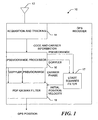
- a GPS receiver 10 receives GPS satellite signals over an antenna 12, and processes the signals from at least 4 satellites to calculate GPS position.
- Acquisition and tracking circuitry 14 operates in a known manner to acquire the satellite signals and track the respective carriers and the pseudorandom codes.
- a pseudorange processor 16 uses carrier and code timing information to calculate pseudoranges to the respective satellites and the associated Doppler rates, also in a known manner.
- the pseudoranges, Doppler rates and carrier phase measurements for the respective satellites are supplied to a PDP Kalman filter 18, which uses the pseudoranges, Doppler rates and delta phase measurements to update system error and covariance information relating to the current position and also a previous position of the receiver, and further to propagate the information relating to current position and velocity error states.
- the Kalman filter 18 then uses the propagated information to produce a GPS position.
- the PDP Kalman filter 18 may also be referred to as a "pseudorange/delta phase Kalman filter.”
- the GPS receiver 10 may also determine its position relative to a fixed-position base receiver (not shown), either through the use of differential correction measurements generated at the base station or after resolving associated carrier cycle ambiguities in a known manner.
- a Kalman filter generally updates information relating to current position only. As discussed, the PDP Kalman filter 18 processes information relating to a previous position as well as the current position. Before discussing the PDP Kalman filter 18 in sections 2 and 3, we discuss known Kalman filters in Section 1.
- a Kalman filter in general terms, estimates of a series of parameters that describe and predict the behavior of a system.
- the Kalman filter operates with a set of state variables that describe errors in the system and an associated variance covariance matrix that describes the current knowledge level of the state.
- the Kalman filter maintains an optimal estimate of the system errors and associated covariance over time and in the presence of external measurements through the use of propagation and updating processes.
- x(+) represents the state vector after update
- x(-) represents the state vector after propagation
- ⁇ is the state transition matrix which is a time solution to a dynamics matrix F
- Q is a process noise matrix that represents the time propagation of the spectral densities of the state elements and compensates for incorrect modeling over time.
- the Kalman filter propagation step uses knowledge of the state dynamic behavior determined from the physics of the system and the stochastic characteristics of the system over time.
- the Kalman filter update step thus uses the linear relationship between the state and observation vectors in conjunction with the covariance matrices related to those vectors to determine corrections to both the state vector and the state covariance matrix.
- the PDP Kalman filter 18 determines position and velocity error states using pseudoranges, Doppler rate and delta phase measurements. For ease of understanding, we first discuss the assumptions and manipulations that underlie the updating and propagation steps, in terms of using pseudoranges and Doppler rates to update the current position and velocity error states. We then discuss the PDP Kalman filter operations that update information relating to both the current and a previous position, and also the operations that propagate the current position and velocity information.
- the associated 6 x 6 state covariance matrix P is initialized from a first determination of the current position and velocity of the receiver.
- the initial position and velocity information is, for example, supplied by least squares filter 17.
- the errors associated with the initial position and velocity error states are expected to be relatively large, and the state covariance matrix P initially includes relatively large elements along the diagonal and zeros otherwise.
- the propagation of the state vector and the covariance matrix P is based on the solution of the differential equations describing the dynamics of the state elements. An assumption is made that the receiver is operating under constant velocity conditions, and we have modeled the system noise as a random walk.
- the process noise matrix Q is based on the transition and the spectral densities Q( ⁇ ) of the random forcing functions associated with the state according to the equation:
- Q ECEF ⁇ 0 ⁇ t ⁇ ⁇ ⁇ Q ⁇ ⁇ ⁇ ⁇ T ⁇ d ⁇
- Q( ⁇ ) is a spectral density matrix for the random forcing function vector for the state elements.
- the spectral densities for the state element forcing functions are not known, and for the PDP Kalman filter 18 the spectral densities will vary with the system dynamics. The spectral densities for the position and velocity will thus be chosen heuristically such that the propagated covariance reflects the actual performance of the system.
- the Q ECEF derivation is simple and an analytic expression can be generated because the quantity Q( ⁇ ) VEL_ECEF is not position dependent.
- the spectral density for the velocity is derived from the cleaned Doppler misclosures, that is, misclosures with outliers removed, where a misclosure is the difference between the actual observations and the theoretical observations that are based on the current satellite set and the last set of position estimates.
- the filter thus automatically adapts to changes in system dynamics.
- the spectral densities for position are similarly derived from delta phase misclosures.
- the linear relationship between the measurements and the state are derived as a matrix of partial derivatives of the functions that link the measurements and the state elements. If such functions do not exist, then the state is not observable with the measurement set. Once the linear relationship between the state and the measurement set is determined, that is, once the H matrix is determined, the update process follows the update step described earlier.
- the pseudorange measurements are differenced across satellites.
- the measurement that is most closely related to the position in the filter is the reduced pseudorange difference, that is, the measured pseudorange difference minus the theoretical pseudorange difference, with the differencing removing the common clock offset.
- s a scaling factor that is included to account for a geometrical discrepancy that results because the line of sight is generally not in the direction of the velocity vector.
- a scale factor of s 1.5 is used.
- the misclosure w is small and the velocity error is represented largely by the variance after the previous update. If there is a change in the dynamics of the system, however, more process noise is applied because the misclosure w is relatively large.
- the PDP Kalman filter 18 uses pseudoranges, the associated Doppler rates and delta phase measurements.
- the delta phase measurements represent an integrated velocity over time and provide an estimate of the change in receiver position over time in the direction of the satellite generating the phase.
- the PDP Kalman filter includes update and propagation steps that have been modified to include the updating of both the prior and the current positions and the propagation of the current position.
- the PDP Kalman filter 18 compensates for the changes to satellite position and atmospheric conditions, and removes the clock biases that are included in the delta phase measurements.
- the PDP Kalman filter 18 compensates for satellite motion using the available satellite orbit information. Any residual errors caused by differences in the actual satellite motion from the predicted orbit are small when compared to the errors associated with atmospheric changes, and the residual errors are thus ignored.
- the PDP Kalman filter compensates for the adverse affects in the phase measurements that are associated with atmospheric changes, that is, the changes in the ionosphere and troposphere, by accounting for the changes in part in the error models associated with the measurements and in part in the process noise that is applied to the position information during propagation, that is, in the q p elements of the matrix Q.
- the PDP Kalman filter removes the receiver clock biases from the delta phase measurements by differencing the delta phase measurements across satellites.
- the underlying phase measurements are thus double differenced across time and the satellites, to remove both clock rate and receiver clock offset biases.
- x t1 - x t0 is the vector of position differences between t 1 (the current time) and to (the previous time) with respect
- the propagation step of the PDP Kalman filter 18 is modified to support the dynamics equations for the random walk model that involves both the prior and the current positions. Further, the PDP Kalman filter is modified to transfer the current position elements, p 1 , to the prior position spot in the state vector as part of the propagation. Accordingly, the current position after the previous update becomes the previous position after propagation. At the same time, the PDP Kalman filter propagates the current position error according to the estimated velocity error.
- R ⁇ ⁇ 2
- the gain matrix for a small phase variance will be close to 1.0 for the current position element, close to 1.0/t for the velocity element, and close to 0.0 for the previous position element.
- the system's current position will be reduced by almost the exact amount (t ⁇ v ) by which it was in error, and the velocity will be reduced by ⁇ v , the amount by which it was in error. Accordingly, if the geometry is good and the error on the phase is small, the relative position and velocity errors will be almost eliminated with the phase update.
- the PDP Kalman filter updates position and velocity related information for each of the satellites for which phase differences are available over a measurement interval. Unlike the prior phase-smoothing techniques, the PDP Kalman filter thus provides noise-reduced updated position information as long as at least two satellites are available.
- Fig. 2 we describe the operations of the GPS receiver by way of an example that consists of a NovAtel OEM4 dual frequency GPS receiver that has been modified to include the PDP Kalman filter.
- the OEM4 can provide L1 and L2 range and carrier measurements, as well as single point, pseudorange differential and carrier-based differential GPS positioning.
- the GPS receiver thus includes four filters, namely, a PSR position filter 206 which is a pseudorange least squares position estimator that can operate in either single point or differential mode, a pseudorange/carrier RTK floating ambiguity filter 204, a carrier-based RTK fixed ambiguity filter 208, and the PDP Kalman filter, which is denoted in the drawing by the reference numeral 212.
- An additional filter that provides low latency positions computed from the current local carrier measurements, predicted base station measurements and the best available ambiguities, is also part of the system, but is not material to the operation of the PDP Kalman filter, so is mentioned here only in passing.
- the respective filters have different error characteristics, and are thus associated with different covariance matrices.
- the position and covariance information from each filter are provided to a best-position task 202, which, based on a minimum covariance trace, selects as the GPS position the best of the positions provided by the respective filters.
- the selected GPS position information is then included in the information that is, for example, provided to a user.
- the best GPS position and associated position velocity covariance information are provided to a signal re-acquisition task 210 and the GPS RTK floating point ambiguity filter 206.
- the filter 206 uses the information to perform integrity checks or, as appropriate, to aid in ambiguity resolution operations, and the signal re-acquisition task uses the information, as appropriate, to aid in signal re-acquisition tasks.
- the signal re-acquisition task 210 requires the instantaneous code and Doppler rate of a given satellite signal as seen by the receiver in order to synchronize a local code generator to the code in the satellite signal.
- the signal re-acquisition task uses the updated GPS position and the velocity or, as appropriate, the velocity covariance information, provided by the best position task, in conjunction with the receiver clock offset and the known satellite position, to generate the theoretical pseudorange to the satellite.
- the GPS receiver then re-sets the local code generator to an appropriate code chip based on the theoretical pseudorange.
- the GPS receiver must also resolve cycle ambiguities in order to determine the GPS position relative to the fixed-position receiver.
- the GPS receiver first estimates the floating ambiguities associated with the RTK floating ambiguity filter 204. When the position is accurate as represented by the associated covariance, the GPS receiver initializes a search space for the RTK fixed ambiguity filter 208, and the fixed ambiguity resolution process can begin.
- the PDP Kalman filter essentially removes the adverse affects of system dynamics from position calculation. Further, the PDP Kalman filter produces reduced noise position information as long as delta phase information is available. Thus, the same set of satellites need only be available over one epoch.
- the PDP Kalman filter with its updating of both current and previous position information using delta phase measurements, or an integral of velocity, may be modified to use instead a measurement of the rotation over time of a wheel of, for example, an automobile that carries the GPS receiver. If altitude is one of the system parameters, the PDP Kalman filter may be further modified to use a change in barometric readings over time as an indicator of altitude.
Landscapes
- Engineering & Computer Science (AREA)
- Radar, Positioning & Navigation (AREA)
- Remote Sensing (AREA)
- Computer Networks & Wireless Communication (AREA)
- Physics & Mathematics (AREA)
- General Physics & Mathematics (AREA)
- Position Fixing By Use Of Radio Waves (AREA)
- Radio Relay Systems (AREA)
Claims (13)
- GPS- (global positioning system; weltweites (US) Navigationssystem)-Empfänger (10), mit:A) einer Antenne (12) zum Empfangen von Signalen von einer Mehrzahl GPS-Satelliten;B) einem Erfassungs- und Verfolgungsprozessor (14) zum Erfassen und Verfolgen der Satellitensignale und zum Ausführen von Trägerphasen- und Codemessungen;C) einem Pseudobereich- und Doppler-Raten-Prozessor (16) zum Bestimmen von Pseudobereichen der jeweiligen Satelliten und zugehöriger Doppler-Raten auf Basis der Trägerphasen- und Codemessungen; undD) einem Pseudobereich-/Deltaphasen-Kalman-Filter (18) zum Verwenden der Pseudobereichs-, Doppler-Raten- und Deltaphasenmessungen zur Aktualisierung momentaner und voriger positionsbezogener Informationen und zum Übertragen momentaner positions- und geschwindigkeitsbezogener Informationen sowie zum Bestimmen der Position des GPS-Empfängers (10) unter Verwendung der übertragenen Informationen.
- Empfänger (10) nach Anspruch 1, der ferner enthält:ein zweites Filter (17) zum Bestimmen einer Ausgangsposition des Empfängers (10), wobei das zweite Filter (17) die Informationen bezüglich der Ausgangsposition dem Pseudobereich-/Deltaphasen-Kalman-Filter (18) bereitstellt, unddas Pseudobereich-/Deltaphasen-Kalman-Filter (18) die Informationen bezüglich der Ausgangsposition verwendet, um eine Varianz-Kovarianz-Matrix zu initialisieren, die zur Aktualisierung und Übertragung verwendet wird.
- Empfänger (10) nach Anspruch 2, bei dem das zweite Filter (17) ein Filter für die kleinsten Quadrate ist.
- Empfänger (10) nach einem der vorigen Ansprüche, bei dem das Pseudobereich-/Deltaphasen-Kalman-Filter (18) Systemmodelle verwendet, die auf der Annahme einer konstanten Geschwindigkeit beruhen.
- Empfänger (10) nach Anspruch 4, bei dem die Systemmodelle ferner auf einem Zufallsbewegungsmodell für das Systemrauschen basieren.
- Verfahren zur Positionsbestimmung unter Verwendung eines Kalman-Filters, wobei das Verfahren die Schritte enthält:A) Empfangen von Signalen von einer Mehrzahl GPS-Satelliten;B) Erfassen und Verfolgen von Trägern und Codes in den Satellitensignalen;C) Bestimmen von Pseudobereichen und Doppler-Raten auf Basis der Träger- und Codemessungen;D) Messen eines Parameters, der die Positionsänderungen über der Zeit misst;E) Verwenden des Parameters, der Pseudobereiche und Doppler-Raten zur Aktualisierung momentaner und voriger positionsbezogener Informationen und zum Übertragen momentaner positions- und geschwindigkeitsbezogener Informationen;F) Verwenden der übertragenen momentanen positions- und geschwindigkeitsbezogenen Informationen zum Bestimmen der Position.
- Verfahren nach Anspruch 6, bei dem der Parameter im Schritt der Parametermessung die Trägerphase ist.
- Verfahren nach Anspruch 6, bei dem der Parameter im Schritt der Parametermessung die Radumdrehungen ist.
- Verfahren nach Anspruch 6, bei dem der Parameter im Schritt der Parametermessung der barometrische Druck ist.
- Verfahren nach einem der Ansprüche 6 bis 9, bei dem das Verfahren zur Bestimmung der GPS-Position in Schritt F) angewendet wird.
- Verfahren nach Anspruch 10, das ferner den Schritt der Bestimmung einer Ausgangs-GPS-Position und die Bereitstellung der Ausgangs-GPS-Position an das Kalman-Filter enthält, um erstmals positionsbezogene Informationen zu bestimmen.
- Verfahren nach Anspruch 11, bei dem der Schritt der erstmaligen Bestimmung positionsbezogener Informationen die Bestimmung von Varianz-Kovarianz-Informationen bezüglich der momentanen und vorherigen Positionsfehlerzustände enthält.
- Verfahren nach Anspruch 12, bei dem der Schritt der erstmaligen Bestimmung positionsbezogener Informationen ferner die Annahme einer konstanten Geschwindigkeit und die Bestimmung von Varianz-Kovarianz-Informationen bezüglich der momentanen Geschwindigkeitsfehlerzustände enthält.
Applications Claiming Priority (2)
| Application Number | Priority Date | Filing Date | Title |
|---|---|---|---|
| US10/253,161 US6664923B1 (en) | 2002-09-24 | 2002-09-24 | Position and velocity Kalman filter for use with global navigation satelite system receivers |
| US253161 | 2002-09-24 |
Publications (2)
| Publication Number | Publication Date |
|---|---|
| EP1403654A1 EP1403654A1 (de) | 2004-03-31 |
| EP1403654B1 true EP1403654B1 (de) | 2010-03-17 |
Family
ID=29711660
Family Applications (1)
| Application Number | Title | Priority Date | Filing Date |
|---|---|---|---|
| EP03019925A Expired - Lifetime EP1403654B1 (de) | 2002-09-24 | 2003-09-02 | Positions- und Geschwindigkeits-Kalman-Filter in Empfängern für ein globales satellitengestützes Navigationssystem |
Country Status (4)
| Country | Link |
|---|---|
| US (1) | US6664923B1 (de) |
| EP (1) | EP1403654B1 (de) |
| AT (1) | ATE461461T1 (de) |
| DE (1) | DE60331714D1 (de) |
Cited By (1)
| Publication number | Priority date | Publication date | Assignee | Title |
|---|---|---|---|---|
| DE102017201886B3 (de) | 2017-02-07 | 2018-05-24 | Audi Ag | Verfahren zur Ermittlung einer Genauigkeitsinformation eines Positionsvektors |
Families Citing this family (43)
| Publication number | Priority date | Publication date | Assignee | Title |
|---|---|---|---|---|
| JP2006502412A (ja) * | 2002-10-04 | 2006-01-19 | シグテック・ナヴィゲーション・プロプライエタリー・リミテッド | 衛星利用測位システムの改良 |
| US7193559B2 (en) * | 2003-01-21 | 2007-03-20 | Novatel, Inc. | Inertial GPS navigation system with modified kalman filter |
| US20050169415A1 (en) * | 2004-01-30 | 2005-08-04 | Agere Systems Inc. | Timing error recovery system |
| US20050203702A1 (en) * | 2004-03-12 | 2005-09-15 | Sharpe Richard T. | Method for backup dual-frequency navigation during brief periods when measurement data is unavailable on one of two frequencies |
| US8031112B2 (en) * | 2004-03-19 | 2011-10-04 | Purdue Research Foundation, Office Of Technology Commercialization | System and method for high dynamic acquisition and tracking of signals from the global positioning system |
| US7490008B2 (en) * | 2004-09-17 | 2009-02-10 | Itt Manufacturing Enterprises, Inc. | GPS accumulated delta range processing for navigation applications |
| KR101216551B1 (ko) * | 2006-03-06 | 2012-12-31 | 콸콤 인코포레이티드 | 측정 스티칭을 사용한 위치 결정 방법 |
| US8600660B2 (en) * | 2006-09-29 | 2013-12-03 | Honeywell International Inc. | Multipath modeling for deep integration |
| US8016653B2 (en) * | 2007-02-01 | 2011-09-13 | Sportvision, Inc. | Three dimensional virtual rendering of a live event |
| WO2009000314A1 (en) * | 2007-06-22 | 2008-12-31 | Trimble Terrasat Gmbh | Position tracking device and method |
| US8237609B2 (en) * | 2009-02-22 | 2012-08-07 | Trimble Navigation Limited | GNSS position coasting |
| US8725327B2 (en) * | 2008-04-22 | 2014-05-13 | Exelis Inc. | Navigation system and method of obtaining accurate navigational information in signal challenging environments |
| US9322918B2 (en) | 2009-02-22 | 2016-04-26 | Trimble Navigation Limited | GNSS surveying methods and apparatus |
| US9074897B2 (en) * | 2009-06-15 | 2015-07-07 | Qualcomm Incorporated | Real-time data with post-processing |
| EP2336721A1 (de) * | 2009-12-21 | 2011-06-22 | Converteam Technology Ltd | Fehlererkennungsverfahren |
| US8704707B2 (en) | 2010-06-02 | 2014-04-22 | Qualcomm Incorporated | Position determination using measurements from past and present epochs |
| US9846241B2 (en) * | 2010-07-30 | 2017-12-19 | Deere & Company | Navigation system and method using RTK with data received from a mobile base station |
| US8880001B1 (en) * | 2011-04-14 | 2014-11-04 | Rockwell Collins, Inc. | Collaborative positioning, navigation and timing |
| EP2815252B1 (de) | 2012-02-17 | 2017-02-01 | Topcon Positioning Systems, Inc. | Verbesserung der positionierungsqualität von empfängern in einem globalen navigationssatellitensystem |
| EP2815253B1 (de) | 2012-02-17 | 2018-11-21 | Topcon Positioning Systems, Inc. | Verbesserung der positionierungsqualität von empfängern eines globalen navigationssatellitensystems |
| CN102928858B (zh) * | 2012-10-25 | 2014-04-16 | 北京理工大学 | 基于改进扩展卡尔曼滤波的gnss单点动态定位方法 |
| ES2693463T3 (es) * | 2013-05-06 | 2018-12-11 | Intel IP Corporation | Descubrimiento y selección de red de acceso |
| CN105722735B (zh) | 2013-06-03 | 2018-01-30 | E-Aam 传动系统公司 | 用于确定车速参数的方法 |
| US10231337B2 (en) | 2014-12-16 | 2019-03-12 | Inertial Sense, Inc. | Folded printed circuit assemblies and related methods |
| RU2605457C1 (ru) * | 2015-09-18 | 2016-12-20 | Федеральное государственное казенное военное образовательное учреждение высшего профессионального образования "ВОЕННАЯ АКАДЕМИЯ СВЯЗИ имени Маршала Советского Союза С.М. Буденного" Министерства обороны Российской Федерации | Способ определения местоположения пользовательского терминала с использованием двух спутников-ретрансляторов |
| CN105510950B (zh) * | 2015-12-01 | 2016-08-17 | 中国人民解放军国防科学技术大学 | 一种基于共时钟接收机的实时精密定姿方法 |
| WO2017131548A1 (en) * | 2016-01-25 | 2017-08-03 | Limited Liability Company "Topcon Positioning Systems" | Methods and apparatus for estimating motion parameters of gnss receiver |
| EP3415954B1 (de) * | 2016-02-12 | 2025-01-22 | Panasonic Intellectual Property Management Co., Ltd. | Koordinatenausgabeverfahren und koordinatenausgabevorrichtung |
| US10222483B2 (en) * | 2016-03-18 | 2019-03-05 | Deere & Company | Satellite navigation receiver with improved ambiguity resolution |
| US11747487B2 (en) * | 2018-03-26 | 2023-09-05 | Texas Instruments Incorporated | GNSS receiver clock frequency drift detection |
| DE102018111758A1 (de) * | 2018-05-16 | 2019-11-21 | Northrop Grumman Litef Gmbh | Positionsbestimmung mittels Satellitennavigation |
| US10871576B2 (en) * | 2018-05-16 | 2020-12-22 | Qualcomm Incorporated | Error mitigation in doppler based satellite positioning system measurements |
| US10830902B2 (en) | 2018-06-21 | 2020-11-10 | Unicore Communications, Inc. | Real-time kinematic using standalone global navigation satellite system receiver |
| US11714200B2 (en) | 2020-03-18 | 2023-08-01 | Honeywell International Inc. | Single-difference based pre-filter of measurements for use in solution separation framework |
| US11460585B2 (en) * | 2020-03-18 | 2022-10-04 | Honeywell International Inc. | Implementing single differences within a solution separation framework |
| US11742883B2 (en) | 2020-10-16 | 2023-08-29 | Deere & Company | Adaptive narrowband interference rejection for satellite navigation receiver |
| US11671133B2 (en) | 2020-10-16 | 2023-06-06 | Deere & Company | Adaptive narrowband and wideband interference rejection for satellite navigation receiver |
| US11750274B2 (en) | 2020-10-16 | 2023-09-05 | Deere & Company | Adaptive narrowband interference rejection for satellite navigation receiver |
| CN115542354B (zh) * | 2021-06-30 | 2026-03-06 | 博通集成电路(上海)股份有限公司 | 计算接收机位置-速度-时间结果的装置和方法 |
| EP4187285B1 (de) | 2021-11-29 | 2024-12-25 | Trimble Inc. | Verfahren und systeme zum verarbeiten von zeitdifferenzierten beobachtungsdaten von navigationssatellitensystemen |
| US12066551B2 (en) | 2022-02-18 | 2024-08-20 | Deere & Company | Multi-constellation, multi-frequency GNSS system for interference mitigation |
| US12153143B2 (en) | 2022-02-18 | 2024-11-26 | Deere & Company | Multi-constellation, multi-frequency GNSS system for interference mitigation |
| CN115242297B (zh) * | 2022-09-21 | 2022-11-25 | 腾讯科技(深圳)有限公司 | 移动终端的运动参数确定方法、装置、设备和存储介质 |
Family Cites Families (5)
| Publication number | Priority date | Publication date | Assignee | Title |
|---|---|---|---|---|
| US4894662A (en) * | 1982-03-01 | 1990-01-16 | Western Atlas International, Inc. | Method and system for determining position on a moving platform, such as a ship, using signals from GPS satellites |
| US6259991B1 (en) * | 1999-02-10 | 2001-07-10 | X-Cyte Inc. | Environmental location system |
| US6529827B1 (en) * | 1999-11-01 | 2003-03-04 | Garmin Corporation | GPS device with compass and altimeter and method for displaying navigation information |
| US6407699B1 (en) * | 2000-04-14 | 2002-06-18 | Chun Yang | Method and device for rapidly extracting time and frequency parameters from high dynamic direct sequence spread spectrum radio signals under interference |
| US6427122B1 (en) * | 2000-12-23 | 2002-07-30 | American Gnc Corporation | Positioning and data integrating method and system thereof |
-
2002
- 2002-09-24 US US10/253,161 patent/US6664923B1/en not_active Expired - Lifetime
-
2003
- 2003-09-02 AT AT03019925T patent/ATE461461T1/de not_active IP Right Cessation
- 2003-09-02 EP EP03019925A patent/EP1403654B1/de not_active Expired - Lifetime
- 2003-09-02 DE DE60331714T patent/DE60331714D1/de not_active Expired - Lifetime
Cited By (1)
| Publication number | Priority date | Publication date | Assignee | Title |
|---|---|---|---|---|
| DE102017201886B3 (de) | 2017-02-07 | 2018-05-24 | Audi Ag | Verfahren zur Ermittlung einer Genauigkeitsinformation eines Positionsvektors |
Also Published As
| Publication number | Publication date |
|---|---|
| ATE461461T1 (de) | 2010-04-15 |
| US6664923B1 (en) | 2003-12-16 |
| EP1403654A1 (de) | 2004-03-31 |
| DE60331714D1 (de) | 2010-04-29 |
Similar Documents
| Publication | Publication Date | Title |
|---|---|---|
| US6664923B1 (en) | Position and velocity Kalman filter for use with global navigation satelite system receivers | |
| US7193559B2 (en) | Inertial GPS navigation system with modified kalman filter | |
| AU2002315595B2 (en) | An inertial/GPS navigation system | |
| US7119741B2 (en) | Method for combined use of a local RTK system and a regional, wide-area, or global carrier-phase positioning system | |
| US6127968A (en) | On-the-fly RTK positioning system with single frequency receiver | |
| EP2380036B1 (de) | Navigationsempfänger und verfahren zur kombinierten verwendung eines rtk-standardsystems und carrier-phase-dgps | |
| CN101371159B (zh) | 组合使用本地定位系统、本地rtk系统与区域、广域或全球载波相位定位系统的方法 | |
| CN101449179B (zh) | 从区域、广域或全球载波相位差分导航(wadgps)向本地实时动态(rtk)导航系统过渡时增加位置信息可靠性的方法 | |
| US20040257277A1 (en) | Method and apparatus for locating position of a satellite signal receiver | |
| AU2002315595A1 (en) | An inertial/GPS navigation system | |
| US20050203702A1 (en) | Method for backup dual-frequency navigation during brief periods when measurement data is unavailable on one of two frequencies | |
| US7567208B2 (en) | Position and time determination under weak signal conditions | |
| WO2005071431A1 (en) | Inertial gps navigation system with modified kalman filter | |
| WO2010053395A1 (en) | Method and device of satellite navigation system's integrity control | |
| CN121348363B (zh) | 用于城市复杂环境下的ins辅助矢量跟踪方法及系统 | |
| AU2011205068B2 (en) | A method for combined use of a local RTK system and a regional, wide-area, or global carrier-phase positioning system | |
| Ford et al. | NovAtel Inc. new positioning filter: Phase smoothing in the position domain |
Legal Events
| Date | Code | Title | Description |
|---|---|---|---|
| PUAI | Public reference made under article 153(3) epc to a published international application that has entered the european phase |
Free format text: ORIGINAL CODE: 0009012 |
|
| AK | Designated contracting states |
Kind code of ref document: A1 Designated state(s): AT BE BG CH CY CZ DE DK EE ES FI FR GB GR HU IE IT LI LU MC NL PT RO SE SI SK TR |
|
| AX | Request for extension of the european patent |
Extension state: AL LT LV MK |
|
| 17P | Request for examination filed |
Effective date: 20040705 |
|
| AKX | Designation fees paid |
Designated state(s): AT BE BG CH CY CZ DE DK EE ES FI FR GB GR HU IE IT LI LU MC NL PT RO SE SI SK TR |
|
| AXX | Extension fees paid |
Extension state: LV Payment date: 20030902 Extension state: AL Payment date: 20030902 Extension state: MK Payment date: 20030902 Extension state: LT Payment date: 20030902 |
|
| 17Q | First examination report despatched |
Effective date: 20070725 |
|
| GRAP | Despatch of communication of intention to grant a patent |
Free format text: ORIGINAL CODE: EPIDOSNIGR1 |
|
| GRAJ | Information related to disapproval of communication of intention to grant by the applicant or resumption of examination proceedings by the epo deleted |
Free format text: ORIGINAL CODE: EPIDOSDIGR1 |
|
| GRAP | Despatch of communication of intention to grant a patent |
Free format text: ORIGINAL CODE: EPIDOSNIGR1 |
|
| GRAS | Grant fee paid |
Free format text: ORIGINAL CODE: EPIDOSNIGR3 |
|
| GRAA | (expected) grant |
Free format text: ORIGINAL CODE: 0009210 |
|
| AK | Designated contracting states |
Kind code of ref document: B1 Designated state(s): AT BE BG CH CY CZ DE DK EE ES FI FR GB GR HU IE IT LI LU MC NL PT RO SE SI SK TR |
|
| AX | Request for extension of the european patent |
Extension state: AL LT LV MK |
|
| REG | Reference to a national code |
Ref country code: GB Ref legal event code: FG4D |
|
| REG | Reference to a national code |
Ref country code: CH Ref legal event code: EP |
|
| REG | Reference to a national code |
Ref country code: NL Ref legal event code: T3 Ref country code: IE Ref legal event code: FG4D |
|
| REF | Corresponds to: |
Ref document number: 60331714 Country of ref document: DE Date of ref document: 20100429 Kind code of ref document: P |
|
| REG | Reference to a national code |
Ref country code: CH Ref legal event code: NV Representative=s name: FELBER & PARTNER AG PATENTANWAELTE |
|
| LTIE | Lt: invalidation of european patent or patent extension |
Effective date: 20100317 |
|
| PG25 | Lapsed in a contracting state [announced via postgrant information from national office to epo] |
Ref country code: FI Free format text: LAPSE BECAUSE OF FAILURE TO SUBMIT A TRANSLATION OF THE DESCRIPTION OR TO PAY THE FEE WITHIN THE PRESCRIBED TIME-LIMIT Effective date: 20100317 Ref country code: AT Free format text: LAPSE BECAUSE OF FAILURE TO SUBMIT A TRANSLATION OF THE DESCRIPTION OR TO PAY THE FEE WITHIN THE PRESCRIBED TIME-LIMIT Effective date: 20100317 Ref country code: SI Free format text: LAPSE BECAUSE OF FAILURE TO SUBMIT A TRANSLATION OF THE DESCRIPTION OR TO PAY THE FEE WITHIN THE PRESCRIBED TIME-LIMIT Effective date: 20100317 |
|
| PG25 | Lapsed in a contracting state [announced via postgrant information from national office to epo] |
Ref country code: GR Free format text: LAPSE BECAUSE OF FAILURE TO SUBMIT A TRANSLATION OF THE DESCRIPTION OR TO PAY THE FEE WITHIN THE PRESCRIBED TIME-LIMIT Effective date: 20100618 Ref country code: ES Free format text: LAPSE BECAUSE OF FAILURE TO SUBMIT A TRANSLATION OF THE DESCRIPTION OR TO PAY THE FEE WITHIN THE PRESCRIBED TIME-LIMIT Effective date: 20100628 Ref country code: RO Free format text: LAPSE BECAUSE OF FAILURE TO SUBMIT A TRANSLATION OF THE DESCRIPTION OR TO PAY THE FEE WITHIN THE PRESCRIBED TIME-LIMIT Effective date: 20100317 Ref country code: EE Free format text: LAPSE BECAUSE OF FAILURE TO SUBMIT A TRANSLATION OF THE DESCRIPTION OR TO PAY THE FEE WITHIN THE PRESCRIBED TIME-LIMIT Effective date: 20100317 Ref country code: CY Free format text: LAPSE BECAUSE OF FAILURE TO SUBMIT A TRANSLATION OF THE DESCRIPTION OR TO PAY THE FEE WITHIN THE PRESCRIBED TIME-LIMIT Effective date: 20100317 Ref country code: BE Free format text: LAPSE BECAUSE OF FAILURE TO SUBMIT A TRANSLATION OF THE DESCRIPTION OR TO PAY THE FEE WITHIN THE PRESCRIBED TIME-LIMIT Effective date: 20100317 Ref country code: SE Free format text: LAPSE BECAUSE OF FAILURE TO SUBMIT A TRANSLATION OF THE DESCRIPTION OR TO PAY THE FEE WITHIN THE PRESCRIBED TIME-LIMIT Effective date: 20100317 |
|
| PG25 | Lapsed in a contracting state [announced via postgrant information from national office to epo] |
Ref country code: SK Free format text: LAPSE BECAUSE OF FAILURE TO SUBMIT A TRANSLATION OF THE DESCRIPTION OR TO PAY THE FEE WITHIN THE PRESCRIBED TIME-LIMIT Effective date: 20100317 Ref country code: CZ Free format text: LAPSE BECAUSE OF FAILURE TO SUBMIT A TRANSLATION OF THE DESCRIPTION OR TO PAY THE FEE WITHIN THE PRESCRIBED TIME-LIMIT Effective date: 20100317 Ref country code: BG Free format text: LAPSE BECAUSE OF FAILURE TO SUBMIT A TRANSLATION OF THE DESCRIPTION OR TO PAY THE FEE WITHIN THE PRESCRIBED TIME-LIMIT Effective date: 20100617 |
|
| PLBE | No opposition filed within time limit |
Free format text: ORIGINAL CODE: 0009261 |
|
| STAA | Information on the status of an ep patent application or granted ep patent |
Free format text: STATUS: NO OPPOSITION FILED WITHIN TIME LIMIT |
|
| PG25 | Lapsed in a contracting state [announced via postgrant information from national office to epo] |
Ref country code: DK Free format text: LAPSE BECAUSE OF FAILURE TO SUBMIT A TRANSLATION OF THE DESCRIPTION OR TO PAY THE FEE WITHIN THE PRESCRIBED TIME-LIMIT Effective date: 20100317 Ref country code: PT Free format text: LAPSE BECAUSE OF FAILURE TO SUBMIT A TRANSLATION OF THE DESCRIPTION OR TO PAY THE FEE WITHIN THE PRESCRIBED TIME-LIMIT Effective date: 20100719 |
|
| 26N | No opposition filed |
Effective date: 20101220 |
|
| PG25 | Lapsed in a contracting state [announced via postgrant information from national office to epo] |
Ref country code: IT Free format text: LAPSE BECAUSE OF FAILURE TO SUBMIT A TRANSLATION OF THE DESCRIPTION OR TO PAY THE FEE WITHIN THE PRESCRIBED TIME-LIMIT Effective date: 20100317 |
|
| PG25 | Lapsed in a contracting state [announced via postgrant information from national office to epo] |
Ref country code: MC Free format text: LAPSE BECAUSE OF NON-PAYMENT OF DUE FEES Effective date: 20100930 |
|
| PG25 | Lapsed in a contracting state [announced via postgrant information from national office to epo] |
Ref country code: IE Free format text: LAPSE BECAUSE OF NON-PAYMENT OF DUE FEES Effective date: 20100902 |
|
| PG25 | Lapsed in a contracting state [announced via postgrant information from national office to epo] |
Ref country code: HU Free format text: LAPSE BECAUSE OF FAILURE TO SUBMIT A TRANSLATION OF THE DESCRIPTION OR TO PAY THE FEE WITHIN THE PRESCRIBED TIME-LIMIT Effective date: 20100918 Ref country code: LU Free format text: LAPSE BECAUSE OF NON-PAYMENT OF DUE FEES Effective date: 20100902 |
|
| PG25 | Lapsed in a contracting state [announced via postgrant information from national office to epo] |
Ref country code: TR Free format text: LAPSE BECAUSE OF FAILURE TO SUBMIT A TRANSLATION OF THE DESCRIPTION OR TO PAY THE FEE WITHIN THE PRESCRIBED TIME-LIMIT Effective date: 20100317 |
|
| REG | Reference to a national code |
Ref country code: FR Ref legal event code: PLFP Year of fee payment: 14 |
|
| REG | Reference to a national code |
Ref country code: CH Ref legal event code: PCAR Free format text: NEW ADDRESS: DUFOURSTRASSE 116, 8008 ZUERICH (CH) |
|
| REG | Reference to a national code |
Ref country code: FR Ref legal event code: PLFP Year of fee payment: 15 |
|
| REG | Reference to a national code |
Ref country code: FR Ref legal event code: PLFP Year of fee payment: 16 |
|
| PGFP | Annual fee paid to national office [announced via postgrant information from national office to epo] |
Ref country code: NL Payment date: 20200926 Year of fee payment: 18 |
|
| REG | Reference to a national code |
Ref country code: NL Ref legal event code: MM Effective date: 20211001 |
|
| PG25 | Lapsed in a contracting state [announced via postgrant information from national office to epo] |
Ref country code: NL Free format text: LAPSE BECAUSE OF NON-PAYMENT OF DUE FEES Effective date: 20211001 |
|
| PGFP | Annual fee paid to national office [announced via postgrant information from national office to epo] |
Ref country code: GB Payment date: 20220927 Year of fee payment: 20 Ref country code: DE Payment date: 20220928 Year of fee payment: 20 |
|
| PGFP | Annual fee paid to national office [announced via postgrant information from national office to epo] |
Ref country code: FR Payment date: 20220926 Year of fee payment: 20 |
|
| PGFP | Annual fee paid to national office [announced via postgrant information from national office to epo] |
Ref country code: CH Payment date: 20221005 Year of fee payment: 20 |
|
| REG | Reference to a national code |
Ref country code: DE Ref legal event code: R071 Ref document number: 60331714 Country of ref document: DE |
|
| REG | Reference to a national code |
Ref country code: CH Ref legal event code: PL |
|
| REG | Reference to a national code |
Ref country code: GB Ref legal event code: PE20 Expiry date: 20230901 |
|
| PG25 | Lapsed in a contracting state [announced via postgrant information from national office to epo] |
Ref country code: GB Free format text: LAPSE BECAUSE OF EXPIRATION OF PROTECTION Effective date: 20230901 |