EP1405903A1 - Procédé de traitement d'un vin à l'aide d'un alliage de cuivre, d'or et d'argent de mesure de l'aptitude au vieillissement et dispositif pour la mise en oeuvre du procédé - Google Patents
Procédé de traitement d'un vin à l'aide d'un alliage de cuivre, d'or et d'argent de mesure de l'aptitude au vieillissement et dispositif pour la mise en oeuvre du procédé Download PDFInfo
- Publication number
- EP1405903A1 EP1405903A1 EP03368094A EP03368094A EP1405903A1 EP 1405903 A1 EP1405903 A1 EP 1405903A1 EP 03368094 A EP03368094 A EP 03368094A EP 03368094 A EP03368094 A EP 03368094A EP 1405903 A1 EP1405903 A1 EP 1405903A1
- Authority
- EP
- European Patent Office
- Prior art keywords
- wine
- copper
- per cent
- silver
- gold
- Prior art date
- Legal status (The legal status is an assumption and is not a legal conclusion. Google has not performed a legal analysis and makes no representation as to the accuracy of the status listed.)
- Granted
Links
Images

Classifications
-
- C—CHEMISTRY; METALLURGY
- C12—BIOCHEMISTRY; BEER; SPIRITS; WINE; VINEGAR; MICROBIOLOGY; ENZYMOLOGY; MUTATION OR GENETIC ENGINEERING
- C12H—PASTEURISATION, STERILISATION, PRESERVATION, PURIFICATION, CLARIFICATION OR AGEING OF ALCOHOLIC BEVERAGES; METHODS FOR ALTERING THE ALCOHOL CONTENT OF FERMENTED SOLUTIONS OR ALCOHOLIC BEVERAGES
- C12H1/00—Pasteurisation, sterilisation, preservation, purification, clarification, or ageing of alcoholic beverages
- C12H1/12—Pasteurisation, sterilisation, preservation, purification, clarification, or ageing of alcoholic beverages without precipitation
- C12H1/16—Pasteurisation, sterilisation, preservation, purification, clarification, or ageing of alcoholic beverages without precipitation by physical means, e.g. irradiation
-
- C—CHEMISTRY; METALLURGY
- C12—BIOCHEMISTRY; BEER; SPIRITS; WINE; VINEGAR; MICROBIOLOGY; ENZYMOLOGY; MUTATION OR GENETIC ENGINEERING
- C12H—PASTEURISATION, STERILISATION, PRESERVATION, PURIFICATION, CLARIFICATION OR AGEING OF ALCOHOLIC BEVERAGES; METHODS FOR ALTERING THE ALCOHOL CONTENT OF FERMENTED SOLUTIONS OR ALCOHOLIC BEVERAGES
- C12H1/00—Pasteurisation, sterilisation, preservation, purification, clarification, or ageing of alcoholic beverages
- C12H1/22—Ageing or ripening by storing, e.g. lagering of beer
-
- C—CHEMISTRY; METALLURGY
- C22—METALLURGY; FERROUS OR NON-FERROUS ALLOYS; TREATMENT OF ALLOYS OR NON-FERROUS METALS
- C22C—ALLOYS
- C22C9/00—Alloys based on copper
Definitions
- the present invention relates to the field of oenology and in particular a accelerated aging process of a given wine and a device for the implementation of process.
- Aging ability is traditionally assumed as a function of vintage wines, their colors, grape varieties used and the method of winemaking. Some wines are tasted too early or too late and, very often, the user does not consume them at their peak.
- the aging of a wine follows its fermentation, which is mainly a wine reduction operation. Then, the latter is stored in an atmosphere or an anti-oxidant packaging in order to to avoid too brutal oxidation - worst of all for the professional wine maker - and ensure the condition of a slow oxidation to drive the wine to its apogee.
- the main antioxidant elements used are based on sulfur, the state of sulphites or sulphides, so as to allow the wine to undergo the effect of a slow oxidation, cellar aging at constant temperature.
- the present invention aims to provide a method for household an accelerated oxidation-reduction process of the wine in a perfectly controlled way to ensure a predetermined organoleptic aging.
- Another object of the present invention is to provide a simple device and effective for treating wine by redox operation perfectly controlled and, consequently, a predetermined aging of the wine.
- a third object of the present invention consists in producing a standard of measure for the aging ability of a wine.
- the alloying element is composed of 60 to 99.9 percent copper, 0.05 to 20 percent silver and 0.05 to 20 percent Golden.
- the alloy is 95 percent copper, 3 percent gold and 2 percent silver.
- the copper is hammered thus ensuring the aging controlled in the best conditions.
- the invention also provides a device for oenological use producing a accelerated aging of a given wine and nevertheless perfectly controlled.
- the device comprises a neutral support element on the oxidizing plane and an element having a contact surface and a predefined redox power.
- the alloying element is a tablet of circular shape and having a composition of 60 to 99.9 percent copper, 0.05 to 20 percent silver and 0.05 to 20 percent gold.
- the copper is hammered and its composition is preferably 95%, the composition of silver is 3% and that of gold is 2%.
- the invention thus notably makes a measuring element or a standard used to measure the aging ability of a specific wine
- the device comprises a circuit electronic measurement of the quenching time combined with a warning circuit of in order to increase the accuracy of the measurement of the aging ability.
- the wine is, in general, composed of three elements, namely a structure, aromas and fat.
- the aging of the wine results from the control of the redox of the wine, this usually carried out in an appropriate cellar with given hygrometry and temperature characteristics.
- an alloying element consisting of three components, namely copper, silver and gold. As we know, these three components belong to the same classification according to the classification elements of Mendeleiv and possess a clean self-oxidizing power that combines with that of others.
- copper and silver elements will capture the element suffers, in the state of sulphide or sulphide present in the wine so as to provoke the release of the element suffers and, consequently, cause the release of aromas of wine.
- the three elements of the alloy act in concert, and their effects reinforce each other by ensuring the release of aromas similar to that resulting from an aging wine cellar.
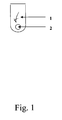
- FIG. 1 illustrates a first embodiment of the invention, particularly simple and inexpensive to produce, in the form of a tool allowing accelerated aging - and yet perfectly controlled - wine in contact with this one.
- This tool is in the form of a tongue 1 inside which is installed an element a surface alloy element 2 determined and composed an alloy of three metals such as copper, gold and silver.
- the element 2 is in the form of a circular pellet having a copper composition between 60 and 99.9%, silver between 0.05% and 20% and gold between 0.05% and 20%.
- the pellet has a diameter of between 3 millimeters and 50 millimeters in diameter.
- the precise composition of the pellet determines precisely its power oxidant and the accelerated aging rate of the wine in contact with it.
- the following precise composition is adopted: 95% copper for the pellet, 3% for silver and 2% for gold.
- the pellet a diameter of 6 millimeters.
- the tool has a sufficiently elongated and narrow shape to allow direct contact with the wine contained in a bottle.
- the tool of Figure 1 can be realized in a form to associate the functional part of the tool with an aesthetic perfectly dissociable and that, for the sake of clarity, it was not represented in the Figure 1.
- the device according to the invention realizes a true measuring instrument, a standard of wine aging.
- the process according to the invention is naturally intended to be combined with an electronic measure of time.
- the alloy composition being determined, the oxidation-reduction effect on the wine is a function of the time of quenching of the tool in the glass - or in any cuvée - and this time can be conveniently measured by an electronic system associated with the tool.
- FIG. 2 illustrates such an embodiment which is in the form of a new tool - presenting itself as a thermometer, and that the professional winemaker or the consumer can soak in the wine glass or in the bottle to provoke an operation of oxidation-reduction perfectly controlled.
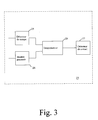
- the tool is in the form of a support element 21, comprising a calibrated alloy pad 22 and an electronic circuit 23 whose block diagram is given in FIG. electronics 23 includes a timer element 24 - suitably calibrated according to the surface of the tablet - and a sensor element 25 for the detection of quenching in the wine.
- the applications of the invention are many, both for professionals and consumers.
- the professional will be able to test the quality of the wine and the aptitude for aging.
- the the consumer will be able to taste his wine more quickly at his peak and thus avoid to store it for many years in his wine cellar.
- the process used according to a rigorous protocol, also allows improve rearing conditions, avoid or eliminate certain mercaptans in the wine. It is also a means of decision support for the oenologist and the winemaker in the work of the wines from the vinification phase to the implementation bottle.
Landscapes
- Chemical & Material Sciences (AREA)
- Engineering & Computer Science (AREA)
- Organic Chemistry (AREA)
- Health & Medical Sciences (AREA)
- Wood Science & Technology (AREA)
- Zoology (AREA)
- Biochemistry (AREA)
- Bioinformatics & Cheminformatics (AREA)
- General Engineering & Computer Science (AREA)
- General Health & Medical Sciences (AREA)
- Genetics & Genomics (AREA)
- Food Science & Technology (AREA)
- Life Sciences & Earth Sciences (AREA)
- Toxicology (AREA)
- Materials Engineering (AREA)
- Mechanical Engineering (AREA)
- Metallurgy (AREA)
- Investigating Or Analyzing Non-Biological Materials By The Use Of Chemical Means (AREA)
- Distillation Of Fermentation Liquor, Processing Of Alcohols, Vinegar And Beer (AREA)
- Food Preservation Except Freezing, Refrigeration, And Drying (AREA)
- Food-Manufacturing Devices (AREA)
- Measuring Or Testing Involving Enzymes Or Micro-Organisms (AREA)
- Investigating And Analyzing Materials By Characteristic Methods (AREA)
- Surface Acoustic Wave Elements And Circuit Networks Thereof (AREA)
Abstract
Description
- mise en contact du vin à traiter avec un élément d'alliage de cuivre, d'or et d'argent présentant une surface et une composition définie de manière à réaliser une opération d'oxydoréduction accélérée et calibrée du vin.
Claims (15)
- Procédé de traitement d'un vin contenu dans un récipient ouvert ou fermé et visant à modifier ses propriétés organoleptiques comportant les étapes suivantes :mise en contact du vin à traiter avec un élément d'alliage de cuivre, d'or et d'argent présentant une surface et une composition définie de manière à réaliser une opération d'oxydoréduction accélérée et calibrée du vin.
- Procédé de traitement du vin conformément à la revendication 1 caractérisé par un élément d'alliage composé de 60 à 99.9 pour cent de cuivre, 0.05 à 20 pour cent d'argent et 0.05 à 20 pour cent d'or.
- Procédé de traitement du vin selon la revendication 2 caractérisé en ce que ledit élément d'alliage se compose de 95 pour cent de cuivre, de 3 pour cent d'or et de 2 pour cent d'argent.
- Procédé de traitement du vin selon la revendication 2 caractérisé en ce que le cuivre est martelé.
- Dispositif à usage oenologique permettant de réaliser un vieillissement accéléré d'un vin comportant un élément support (1), neutre sur le plan oxydant, et un élément (2) présentant une surface de contact et un pouvoir d'oxydo réduction prédéterminée, de manière à réaliser une opération de vieillissement accélérée maítrisée.
- Dispositif selon la revendication 5 caractérisé en ce que l'élément (2) oxydant se compose d'un alliage composé de 60 à 99.9 pour cent de cuivre, 0.05 à 20 pour cent d'argent et 0.05 à 20 pour cent d'or
- Dispositif selon la revendication 6 caractérisé en ce que l'élément oxydant (2) se compose se compose de 95 pour cent de cuivre, de 3 pour cent d'or et de 2 pour cent d'argent.
- Dispositif selon la revendication 7 caractérisé en ce que le cuivre est martelé.
- Dispositif selon l'une des revendications 5 à 8 caractérisé en ce qu'il présente une forme adaptée au goulot d'une bouteille de vin ou à celui d'un tonneau.
- Dispositif selon l'une des revendications 5 à 8 caractérisé en ce qu'il comporte un circuit électronique assurant la mesure d'un temps de trempe prédéterminé de manière à réaliser une opération de vieillissement précise et calibrée.
- instrument de mesure de l'aptitude au vieillissement d'un vin comportant un premier élément support (1), neutre sur le plan oxydant, et un élément (2) présentant une surface de contact et un pouvoir d'oxydo réduction prédéterminée, de manière à réaliser une opération de vieillissement accélérée maítrisée.
- Instrument de mesure selon la revendication 11 caractérisé en ce que l'élément (2) oxydant se compose d'un alliage composé de 60 à 99.9 pour cent de cuivre, 0.05 à 20 pour cent d'argent et 0.05 à 20 pour cent d'or
- Instrument de mesure selon la revendication 12 caractérisé en ce que l'élément oxydant (2) se compose se compose de 95 pour cent de cuivre, de 3 pour cent d'or et de 2 pour cent d'argent.
- Dispositif à usage oenologique permettant de donner des indications sur la qualité des vins et leur aptitude au vieillissement, caractérisé en ce qu'il est composé d'un support neutre et d'une pastille d'alliage qui permet de modifier l'équilibre de l'oxydoréduction du vin.
- Dispositif selon la revendication 1 caractérisé en une composition de cuivre martelé comprise entre 60 et 99.9.%, et de préférence 95%, d'argent entre 0.05 et 20% et de préférence 3%, et d'or entre 0.05 et 20% , de préférence 2%.
Applications Claiming Priority (2)
| Application Number | Priority Date | Filing Date | Title |
|---|---|---|---|
| FR0212302 | 2002-10-04 | ||
| FR0212302A FR2845393B1 (fr) | 2002-10-04 | 2002-10-04 | Dispositif a usage oenologique permettant de donner des indications sur la qualite des vins et leur aptitude au vieillissement |
Publications (2)
| Publication Number | Publication Date |
|---|---|
| EP1405903A1 true EP1405903A1 (fr) | 2004-04-07 |
| EP1405903B1 EP1405903B1 (fr) | 2008-05-14 |
Family
ID=31985435
Family Applications (1)
| Application Number | Title | Priority Date | Filing Date |
|---|---|---|---|
| EP03368094A Expired - Lifetime EP1405903B1 (fr) | 2002-10-04 | 2003-10-03 | Procédé de traitement d'un vin à l'aide d'un alliage de cuivre, d'or et d'argent, de mesure de l'aptitude au vieillissement et dispositif pour la mise en oeuvre du procédé |
Country Status (6)
| Country | Link |
|---|---|
| EP (1) | EP1405903B1 (fr) |
| AT (1) | ATE395409T1 (fr) |
| DE (1) | DE60320909D1 (fr) |
| DK (1) | DK1405903T3 (fr) |
| ES (1) | ES2309290T3 (fr) |
| FR (1) | FR2845393B1 (fr) |
Cited By (4)
| Publication number | Priority date | Publication date | Assignee | Title |
|---|---|---|---|---|
| WO2005095574A1 (fr) * | 2004-03-04 | 2005-10-13 | Thomas Franck | Procede de traitement d’un vin, de mesure de l’aptitude au vieillissement et dispositif pour la mise en œuvre du procede |
| WO2007110396A1 (fr) * | 2006-03-24 | 2007-10-04 | Industrie De Nora S.P.A. | processus POUR L'évolution électrochimique du vin à un potentiel régulé et réacteur correspondant |
| FR2932186A1 (fr) * | 2008-06-09 | 2009-12-11 | Amuse Cosmetic Co Ltd | Procede d'acceleration du processus de vieillissement d'une liqueur |
| WO2022195123A1 (fr) * | 2021-03-19 | 2022-09-22 | Mundorf Eb Gmbh | Alliage cuivre-argent-or |
Citations (6)
| Publication number | Priority date | Publication date | Assignee | Title |
|---|---|---|---|---|
| CH100237A (de) * | 1922-05-31 | 1923-07-16 | Meyer & Stuedeli A G | Metallegierung, besonders zur Herstellung von Uhrgehäusen, Uhrenbestandteilen, Bijouteriewaren usw. |
| DE893332C (de) * | 1951-08-24 | 1953-10-15 | Era Esterator G M B H | Koerniges Kontaktmaterial, insbesondere zum Schnellreifen von alkoholhaltigen Fluessigkeiten |
| SU737447A1 (ru) * | 1978-10-16 | 1980-05-30 | Всесоюзный Заочный Институт Пищевой Промышленности | Способ созревани напитков |
| GB2292749A (en) * | 1994-08-31 | 1996-03-06 | Golden Dream Sp Co Ltd | Golf club heads |
| DE19721920A1 (de) * | 1997-05-26 | 1998-12-03 | Litterst Werner Alfons | Vorrichtung und Verfahren zum Beeinflussen des Aromas von Getränken |
| WO2002064726A1 (fr) * | 2001-02-12 | 2002-08-22 | Titania S.P.A. | Processus d'evolution maitrisee de vins et dispositif de realisation correspondant |
Family Cites Families (1)
| Publication number | Priority date | Publication date | Assignee | Title |
|---|---|---|---|---|
| DE3826744A1 (de) * | 1988-08-05 | 1990-03-08 | Mueller Bernhard | Verfahren zur behandlung von alkoholischen und alkoholfreien getraenken mit einem magnetfeld |
-
2002
- 2002-10-04 FR FR0212302A patent/FR2845393B1/fr not_active Expired - Fee Related
-
2003
- 2003-10-03 DK DK03368094T patent/DK1405903T3/da active
- 2003-10-03 AT AT03368094T patent/ATE395409T1/de active
- 2003-10-03 DE DE60320909T patent/DE60320909D1/de not_active Expired - Lifetime
- 2003-10-03 ES ES03368094T patent/ES2309290T3/es not_active Expired - Lifetime
- 2003-10-03 EP EP03368094A patent/EP1405903B1/fr not_active Expired - Lifetime
Patent Citations (6)
| Publication number | Priority date | Publication date | Assignee | Title |
|---|---|---|---|---|
| CH100237A (de) * | 1922-05-31 | 1923-07-16 | Meyer & Stuedeli A G | Metallegierung, besonders zur Herstellung von Uhrgehäusen, Uhrenbestandteilen, Bijouteriewaren usw. |
| DE893332C (de) * | 1951-08-24 | 1953-10-15 | Era Esterator G M B H | Koerniges Kontaktmaterial, insbesondere zum Schnellreifen von alkoholhaltigen Fluessigkeiten |
| SU737447A1 (ru) * | 1978-10-16 | 1980-05-30 | Всесоюзный Заочный Институт Пищевой Промышленности | Способ созревани напитков |
| GB2292749A (en) * | 1994-08-31 | 1996-03-06 | Golden Dream Sp Co Ltd | Golf club heads |
| DE19721920A1 (de) * | 1997-05-26 | 1998-12-03 | Litterst Werner Alfons | Vorrichtung und Verfahren zum Beeinflussen des Aromas von Getränken |
| WO2002064726A1 (fr) * | 2001-02-12 | 2002-08-22 | Titania S.P.A. | Processus d'evolution maitrisee de vins et dispositif de realisation correspondant |
Non-Patent Citations (2)
| Title |
|---|
| DATABASE FSTA [online] INTERNATIONAL FOOD INFORMATION SERVICE (IFIS), FRANFURT/MAIN, DE; AVAKYANTS S P ET AL: "Process for maturing beverages.", XP002267027, Database accession no. 81-1-03-h0449 * |
| USSR PATENT 737 447 1980 * |
Cited By (4)
| Publication number | Priority date | Publication date | Assignee | Title |
|---|---|---|---|---|
| WO2005095574A1 (fr) * | 2004-03-04 | 2005-10-13 | Thomas Franck | Procede de traitement d’un vin, de mesure de l’aptitude au vieillissement et dispositif pour la mise en œuvre du procede |
| WO2007110396A1 (fr) * | 2006-03-24 | 2007-10-04 | Industrie De Nora S.P.A. | processus POUR L'évolution électrochimique du vin à un potentiel régulé et réacteur correspondant |
| FR2932186A1 (fr) * | 2008-06-09 | 2009-12-11 | Amuse Cosmetic Co Ltd | Procede d'acceleration du processus de vieillissement d'une liqueur |
| WO2022195123A1 (fr) * | 2021-03-19 | 2022-09-22 | Mundorf Eb Gmbh | Alliage cuivre-argent-or |
Also Published As
| Publication number | Publication date |
|---|---|
| ES2309290T3 (es) | 2008-12-16 |
| ATE395409T1 (de) | 2008-05-15 |
| FR2845393B1 (fr) | 2005-08-05 |
| DK1405903T3 (da) | 2008-09-08 |
| EP1405903B1 (fr) | 2008-05-14 |
| FR2845393A1 (fr) | 2004-04-09 |
| DE60320909D1 (de) | 2008-06-26 |
Similar Documents
| Publication | Publication Date | Title |
|---|---|---|
| CA2556675C (fr) | Procede de traitement d'un vin, de mesure de l'aptitude au vieillissement et dispositif pour la mise en oeuvre du procede | |
| Siebert et al. | Selective determination of volatile sulfur compounds in wine by gas chromatography with sulfur chemiluminescence detection | |
| AU2021201880A1 (en) | Non-invasive wine taint detector | |
| de Arruda Moura Pietrowski et al. | Influence of fermentation with Hanseniaspora sp. yeast on the volatile profile of fermented apple | |
| Martinelli et al. | Stable carbon isotopic composition of the wine and CO2 bubbles of sparkling wines: Detecting C4 sugar additions | |
| Saliba et al. | Consumer rejection threshold for 1, 8-cineole (eucalyptol) in Australian red wine | |
| Monteiro et al. | Sensory profile of pink port wines: Development of a flavour lexicon | |
| EP1405903B1 (fr) | Procédé de traitement d'un vin à l'aide d'un alliage de cuivre, d'or et d'argent, de mesure de l'aptitude au vieillissement et dispositif pour la mise en oeuvre du procédé | |
| Geffroy et al. | A sensory, chemical and consumer study of the peppery typicality of French Gamay wines from cool-climate vineyards | |
| Wilkinson et al. | Wine of reduced alcohol content: Consumer and society demand vs industry willingness and ability to deliver | |
| Geffroy et al. | Are peppery notes the main negative driver of liking for young French consumers in a Duras red wine made from a cool and wet season? | |
| RU2411519C2 (ru) | Устройство для обработки вина и измерения его подверженности старению | |
| Herjavec et al. | The Influence of maceration on the composition of some volatile compounds and sensory properties of Traminer wines | |
| WO2019193018A1 (fr) | Procédé de mesure de la capacité antioxydante d'un liquide alimentaire au moyen d'un dispositif de mesure électrochimique | |
| FR3165074A1 (fr) | Procédé de détermination d’une signature électrochimique d’un liquide | |
| Kyzas et al. | Wine Tasting | |
| Van Antwerpen | Chemical and sensory profiling of dry and semi-dry South African Chenin blanc wines | |
| EP0994351A1 (fr) | Procédé de détection d'une adultération d'un jus de fruit concentré par des sirops de sucres exogènes | |
| Marić et al. | Sensory evaluation and some acetate esters of bottle aged Chardonnay wines | |
| Marchal et al. | Use of mathematical laws for optimizing the doses of swelled and dry bentonite during the fining of white wines. Part I: Clarification and colloidal stability | |
| Dou | Volatile Differences of Pitted and Non-pittedFallglo'Tangerine and WhiteMarsh'Grapefruit | |
| FR2905936A1 (fr) | Recipient destine a estimer le taux d'alcoolemie. | |
| Witrick | Characterization of aroma and flavor compounds present in lambic (gueuze) beer | |
| Howard | Oxygen-Another tool for the winemaker's kit bag | |
| FR3163164A1 (fr) | Procédé électrochimique de détection et/ou de quantification du dioxyde de soufre dans un liquide |
Legal Events
| Date | Code | Title | Description |
|---|---|---|---|
| PUAI | Public reference made under article 153(3) epc to a published international application that has entered the european phase |
Free format text: ORIGINAL CODE: 0009012 |
|
| AK | Designated contracting states |
Kind code of ref document: A1 Designated state(s): AT BE BG CH CY CZ DE DK EE ES FI FR GB GR HU IE IT LI LU MC NL PT RO SE SI SK TR |
|
| AX | Request for extension of the european patent |
Extension state: AL LT LV MK |
|
| 17P | Request for examination filed |
Effective date: 20041007 |
|
| AKX | Designation fees paid |
Designated state(s): AT BE BG CH CY CZ DE DK EE ES FI FR GB GR HU IE IT LI LU MC NL PT RO SE SI SK TR |
|
| 17Q | First examination report despatched |
Effective date: 20050222 |
|
| GRAP | Despatch of communication of intention to grant a patent |
Free format text: ORIGINAL CODE: EPIDOSNIGR1 |
|
| GRAS | Grant fee paid |
Free format text: ORIGINAL CODE: EPIDOSNIGR3 |
|
| GRAA | (expected) grant |
Free format text: ORIGINAL CODE: 0009210 |
|
| AK | Designated contracting states |
Kind code of ref document: B1 Designated state(s): AT BE BG CH CY CZ DE DK EE ES FI FR GB GR HU IE IT LI LU MC NL PT RO SE SI SK TR |
|
| REG | Reference to a national code |
Ref country code: GB Ref legal event code: FG4D Free format text: NOT ENGLISH |
|
| REG | Reference to a national code |
Ref country code: CH Ref legal event code: EP |
|
| RAP4 | Party data changed (patent owner data changed or rights of a patent transferred) |
Owner name: THOMAS, FRANCK Owner name: ZANON, LORENZO |
|
| REG | Reference to a national code |
Ref country code: IE Ref legal event code: FG4D |
|
| RIN2 | Information on inventor provided after grant (corrected) |
Inventor name: ZANON, LORENZO Inventor name: THOMAS, FRANCK |
|
| REF | Corresponds to: |
Ref document number: 60320909 Country of ref document: DE Date of ref document: 20080626 Kind code of ref document: P |
|
| REG | Reference to a national code |
Ref country code: CH Ref legal event code: PUE Owner name: MICROVISION LTD. Free format text: THOMAS, FRANCK#VILLA 2 147 IMPASSE DE LA BRAGUE#06600 ANTIBES (FR) $ ZANON, LORENZO#1 ROUTE DE VOLNAY#21190 MEURSAULT (FR) -TRANSFER TO- MICROVISION LTD.#36/F, YAT CHAU INTERNATIONAL PLAZA NO. 118 CONNAUGHT ROAD WEST#HONG KONG (CN) Ref country code: CH Ref legal event code: PUE Owner name: LEADER WAVE LIMITED Free format text: MICROVISION LTD.#36/F, YAT CHAU INTERNATIONAL PLAZA NO. 118 CONNAUGHT ROAD WEST#HONG KONG (CN) -TRANSFER TO- LEADER WAVE LIMITED#OFFICE ROOM 3603-9 118 CONNAUGHT ROAD WEST#HONG KONG (CN) |
|
| RAP2 | Party data changed (patent owner data changed or rights of a patent transferred) |
Owner name: MICROVISION LTD. |
|
| RIN2 | Information on inventor provided after grant (corrected) |
Inventor name: ZANON, LORENZO Inventor name: THOMAS, FRANCK |
|
| PG25 | Lapsed in a contracting state [announced via postgrant information from national office to epo] |
Ref country code: SI Free format text: LAPSE BECAUSE OF FAILURE TO SUBMIT A TRANSLATION OF THE DESCRIPTION OR TO PAY THE FEE WITHIN THE PRESCRIBED TIME-LIMIT Effective date: 20080514 |
|
| REG | Reference to a national code |
Ref country code: CH Ref legal event code: NV Representative=s name: SPIERENBURG & PARTNER AG, PATENT- UND MARKENANWAEL |
|
| PG25 | Lapsed in a contracting state [announced via postgrant information from national office to epo] |
Ref country code: FI Free format text: LAPSE BECAUSE OF FAILURE TO SUBMIT A TRANSLATION OF THE DESCRIPTION OR TO PAY THE FEE WITHIN THE PRESCRIBED TIME-LIMIT Effective date: 20080514 |
|
| NLT2 | Nl: modifications (of names), taken from the european patent patent bulletin |
Owner name: MICROVISION LTD. Effective date: 20080827 |
|
| BECA | Be: change of holder's address |
Owner name: LEADER WAVE LTDOFFICE ROOM 3603-9, 118 CONNAUGHT R Effective date: 20081126 |
|
| BECH | Be: change of holder |
Owner name: LEADER WAVE LTD Effective date: 20081126 |
|
| REG | Reference to a national code |
Ref country code: ES Ref legal event code: FG2A Ref document number: 2309290 Country of ref document: ES Kind code of ref document: T3 |
|
| RAP2 | Party data changed (patent owner data changed or rights of a patent transferred) |
Owner name: LEADER WAVE LIMITED |
|
| REG | Reference to a national code |
Ref country code: IE Ref legal event code: FD4D Ref country code: GB Ref legal event code: 732E |
|
| PG25 | Lapsed in a contracting state [announced via postgrant information from national office to epo] |
Ref country code: SE Free format text: LAPSE BECAUSE OF FAILURE TO SUBMIT A TRANSLATION OF THE DESCRIPTION OR TO PAY THE FEE WITHIN THE PRESCRIBED TIME-LIMIT Effective date: 20080814 Ref country code: PT Free format text: LAPSE BECAUSE OF FAILURE TO SUBMIT A TRANSLATION OF THE DESCRIPTION OR TO PAY THE FEE WITHIN THE PRESCRIBED TIME-LIMIT Effective date: 20081014 Ref country code: IE Free format text: LAPSE BECAUSE OF FAILURE TO SUBMIT A TRANSLATION OF THE DESCRIPTION OR TO PAY THE FEE WITHIN THE PRESCRIBED TIME-LIMIT Effective date: 20080514 Ref country code: CZ Free format text: LAPSE BECAUSE OF FAILURE TO SUBMIT A TRANSLATION OF THE DESCRIPTION OR TO PAY THE FEE WITHIN THE PRESCRIBED TIME-LIMIT Effective date: 20080514 |
|
| PG25 | Lapsed in a contracting state [announced via postgrant information from national office to epo] |
Ref country code: SK Free format text: LAPSE BECAUSE OF FAILURE TO SUBMIT A TRANSLATION OF THE DESCRIPTION OR TO PAY THE FEE WITHIN THE PRESCRIBED TIME-LIMIT Effective date: 20080514 Ref country code: RO Free format text: LAPSE BECAUSE OF FAILURE TO SUBMIT A TRANSLATION OF THE DESCRIPTION OR TO PAY THE FEE WITHIN THE PRESCRIBED TIME-LIMIT Effective date: 20080514 |
|
| NLT2 | Nl: modifications (of names), taken from the european patent patent bulletin |
Owner name: LEADER WAVE LIMITED Effective date: 20081224 |
|
| PLBE | No opposition filed within time limit |
Free format text: ORIGINAL CODE: 0009261 |
|
| STAA | Information on the status of an ep patent application or granted ep patent |
Free format text: STATUS: NO OPPOSITION FILED WITHIN TIME LIMIT |
|
| 26N | No opposition filed |
Effective date: 20090217 |
|
| PG25 | Lapsed in a contracting state [announced via postgrant information from national office to epo] |
Ref country code: EE Free format text: LAPSE BECAUSE OF FAILURE TO SUBMIT A TRANSLATION OF THE DESCRIPTION OR TO PAY THE FEE WITHIN THE PRESCRIBED TIME-LIMIT Effective date: 20080514 Ref country code: BG Free format text: LAPSE BECAUSE OF FAILURE TO SUBMIT A TRANSLATION OF THE DESCRIPTION OR TO PAY THE FEE WITHIN THE PRESCRIBED TIME-LIMIT Effective date: 20080814 |
|
| PG25 | Lapsed in a contracting state [announced via postgrant information from national office to epo] |
Ref country code: MC Free format text: LAPSE BECAUSE OF NON-PAYMENT OF DUE FEES Effective date: 20081031 |
|
| NLS | Nl: assignments of ep-patents |
Owner name: MICROVISION LTD. Effective date: 20090327 Owner name: LEADER WAVE LIMITED Effective date: 20090327 |
|
| PG25 | Lapsed in a contracting state [announced via postgrant information from national office to epo] |
Ref country code: HU Free format text: LAPSE BECAUSE OF FAILURE TO SUBMIT A TRANSLATION OF THE DESCRIPTION OR TO PAY THE FEE WITHIN THE PRESCRIBED TIME-LIMIT Effective date: 20081115 Ref country code: CY Free format text: LAPSE BECAUSE OF FAILURE TO SUBMIT A TRANSLATION OF THE DESCRIPTION OR TO PAY THE FEE WITHIN THE PRESCRIBED TIME-LIMIT Effective date: 20080514 |
|
| PG25 | Lapsed in a contracting state [announced via postgrant information from national office to epo] |
Ref country code: TR Free format text: LAPSE BECAUSE OF FAILURE TO SUBMIT A TRANSLATION OF THE DESCRIPTION OR TO PAY THE FEE WITHIN THE PRESCRIBED TIME-LIMIT Effective date: 20080514 |
|
| PG25 | Lapsed in a contracting state [announced via postgrant information from national office to epo] |
Ref country code: GR Free format text: LAPSE BECAUSE OF FAILURE TO SUBMIT A TRANSLATION OF THE DESCRIPTION OR TO PAY THE FEE WITHIN THE PRESCRIBED TIME-LIMIT Effective date: 20080815 |
|
| REG | Reference to a national code |
Ref country code: FR Ref legal event code: TP |
|
| REG | Reference to a national code |
Ref country code: FR Ref legal event code: PLFP Year of fee payment: 13 |
|
| REG | Reference to a national code |
Ref country code: FR Ref legal event code: TP Owner name: PSP, FR Effective date: 20160204 |
|
| REG | Reference to a national code |
Ref country code: CH Ref legal event code: PUE Owner name: PSP SOCIETE EN NOM COLLECTIF, FR Free format text: FORMER OWNER: LEADER WAVE LIMITED, CN |
|
| REG | Reference to a national code |
Ref country code: DE Ref legal event code: R082 Ref document number: 60320909 Country of ref document: DE Representative=s name: RACKETTE PATENTANWAELTE PARTG MBB, DE Ref country code: DE Ref legal event code: R081 Ref document number: 60320909 Country of ref document: DE Owner name: PSP, FR Free format text: FORMER OWNER: LEADER WAVE LTD., HONG KONG, HK |
|
| REG | Reference to a national code |
Ref country code: FR Ref legal event code: PLFP Year of fee payment: 14 |
|
| REG | Reference to a national code |
Ref country code: GB Ref legal event code: 732E Free format text: REGISTERED BETWEEN 20161020 AND 20161026 |
|
| REG | Reference to a national code |
Ref country code: GB Ref legal event code: 732E Free format text: REGISTERED BETWEEN 20170112 AND 20170118 |
|
| REG | Reference to a national code |
Ref country code: FR Ref legal event code: PLFP Year of fee payment: 15 |
|
| REG | Reference to a national code |
Ref country code: ES Ref legal event code: PC2A Owner name: PSP SNC Effective date: 20171108 |
|
| PGFP | Annual fee paid to national office [announced via postgrant information from national office to epo] |
Ref country code: LU Payment date: 20171019 Year of fee payment: 15 |
|
| PGFP | Annual fee paid to national office [announced via postgrant information from national office to epo] |
Ref country code: DE Payment date: 20171019 Year of fee payment: 15 Ref country code: DK Payment date: 20171019 Year of fee payment: 15 |
|
| PGFP | Annual fee paid to national office [announced via postgrant information from national office to epo] |
Ref country code: CH Payment date: 20171019 Year of fee payment: 15 Ref country code: AT Payment date: 20171020 Year of fee payment: 15 Ref country code: NL Payment date: 20171019 Year of fee payment: 15 Ref country code: IT Payment date: 20171023 Year of fee payment: 15 Ref country code: BE Payment date: 20171019 Year of fee payment: 15 Ref country code: ES Payment date: 20171121 Year of fee payment: 15 Ref country code: GB Payment date: 20171019 Year of fee payment: 15 |
|
| REG | Reference to a national code |
Ref country code: FR Ref legal event code: PLFP Year of fee payment: 16 |
|
| REG | Reference to a national code |
Ref country code: DE Ref legal event code: R119 Ref document number: 60320909 Country of ref document: DE |
|
| REG | Reference to a national code |
Ref country code: DK Ref legal event code: EBP Effective date: 20181031 |
|
| REG | Reference to a national code |
Ref country code: CH Ref legal event code: PL |
|
| REG | Reference to a national code |
Ref country code: NL Ref legal event code: MM Effective date: 20181101 |
|
| REG | Reference to a national code |
Ref country code: AT Ref legal event code: MM01 Ref document number: 395409 Country of ref document: AT Kind code of ref document: T Effective date: 20181003 |
|
| GBPC | Gb: european patent ceased through non-payment of renewal fee |
Effective date: 20181003 |
|
| REG | Reference to a national code |
Ref country code: BE Ref legal event code: MM Effective date: 20181031 Ref country code: BE Ref legal event code: PD Owner name: PSP; FR Free format text: DETAILS ASSIGNMENT: CHANGE OF OWNER(S), AFFECTATION / CESSION; FORMER OWNER NAME: LEADER WAVE LIMITED Effective date: 20160830 |
|
| PG25 | Lapsed in a contracting state [announced via postgrant information from national office to epo] |
Ref country code: LU Free format text: LAPSE BECAUSE OF NON-PAYMENT OF DUE FEES Effective date: 20181003 |
|
| PG25 | Lapsed in a contracting state [announced via postgrant information from national office to epo] |
Ref country code: NL Free format text: LAPSE BECAUSE OF NON-PAYMENT OF DUE FEES Effective date: 20181101 Ref country code: DE Free format text: LAPSE BECAUSE OF NON-PAYMENT OF DUE FEES Effective date: 20190501 |
|
| PG25 | Lapsed in a contracting state [announced via postgrant information from national office to epo] |
Ref country code: CH Free format text: LAPSE BECAUSE OF NON-PAYMENT OF DUE FEES Effective date: 20181031 Ref country code: BE Free format text: LAPSE BECAUSE OF NON-PAYMENT OF DUE FEES Effective date: 20181031 Ref country code: LI Free format text: LAPSE BECAUSE OF NON-PAYMENT OF DUE FEES Effective date: 20181031 |
|
| PG25 | Lapsed in a contracting state [announced via postgrant information from national office to epo] |
Ref country code: AT Free format text: LAPSE BECAUSE OF NON-PAYMENT OF DUE FEES Effective date: 20181003 Ref country code: DK Free format text: LAPSE BECAUSE OF NON-PAYMENT OF DUE FEES Effective date: 20181031 Ref country code: IT Free format text: LAPSE BECAUSE OF NON-PAYMENT OF DUE FEES Effective date: 20181003 Ref country code: GB Free format text: LAPSE BECAUSE OF NON-PAYMENT OF DUE FEES Effective date: 20181003 |
|
| REG | Reference to a national code |
Ref country code: ES Ref legal event code: FD2A Effective date: 20191129 |
|
| PG25 | Lapsed in a contracting state [announced via postgrant information from national office to epo] |
Ref country code: ES Free format text: LAPSE BECAUSE OF NON-PAYMENT OF DUE FEES Effective date: 20181004 |
|
| PGFP | Annual fee paid to national office [announced via postgrant information from national office to epo] |
Ref country code: FR Payment date: 20221012 Year of fee payment: 20 |