EP1407927A2 - Mécanisme de commande pour soutient lombaire - Google Patents
Mécanisme de commande pour soutient lombaire Download PDFInfo
- Publication number
- EP1407927A2 EP1407927A2 EP03022661A EP03022661A EP1407927A2 EP 1407927 A2 EP1407927 A2 EP 1407927A2 EP 03022661 A EP03022661 A EP 03022661A EP 03022661 A EP03022661 A EP 03022661A EP 1407927 A2 EP1407927 A2 EP 1407927A2
- Authority
- EP
- European Patent Office
- Prior art keywords
- shaft
- actuating mechanism
- actuating
- spine support
- threads
- Prior art date
- Legal status (The legal status is an assumption and is not a legal conclusion. Google has not performed a legal analysis and makes no representation as to the accuracy of the status listed.)
- Withdrawn
Links
Images

Classifications
-
- B—PERFORMING OPERATIONS; TRANSPORTING
- B60—VEHICLES IN GENERAL
- B60N—SEATS SPECIALLY ADAPTED FOR VEHICLES; VEHICLE PASSENGER ACCOMMODATION NOT OTHERWISE PROVIDED FOR
- B60N2/00—Seats specially adapted for vehicles; Arrangement or mounting of seats in vehicles
- B60N2/64—Back-rests or cushions
- B60N2/66—Lumbar supports
- B60N2/667—Lumbar supports having flexible support member bowed by applied forces
- B60N2/6671—Lumbar supports having flexible support member bowed by applied forces with cable actuators
-
- B—PERFORMING OPERATIONS; TRANSPORTING
- B60—VEHICLES IN GENERAL
- B60N—SEATS SPECIALLY ADAPTED FOR VEHICLES; VEHICLE PASSENGER ACCOMMODATION NOT OTHERWISE PROVIDED FOR
- B60N2/00—Seats specially adapted for vehicles; Arrangement or mounting of seats in vehicles
- B60N2/64—Back-rests or cushions
- B60N2/66—Lumbar supports
- B60N2/667—Lumbar supports having flexible support member bowed by applied forces
- B60N2/6673—Lumbar supports having flexible support member bowed by applied forces with motor driven adjustments
-
- B—PERFORMING OPERATIONS; TRANSPORTING
- B60—VEHICLES IN GENERAL
- B60N—SEATS SPECIALLY ADAPTED FOR VEHICLES; VEHICLE PASSENGER ACCOMMODATION NOT OTHERWISE PROVIDED FOR
- B60N2/00—Seats specially adapted for vehicles; Arrangement or mounting of seats in vehicles
- B60N2/90—Details or parts not otherwise provided for
- B60N2/919—Positioning and locking mechanisms
- B60N2/933—Positioning and locking mechanisms rotatable
- B60N2/938—Positioning and locking mechanisms rotatable and provided with braking systems
Definitions
- the present invention relates to a mechanism for actuating of a spine support, particular a spine support in a backrest of a vehicle seat.
- High quality vehicle seats can in many aspects be adapted to the anatomy of the driver. Besides the adaptation of the drivers seat with respect to the steering wheel and the adjustment of the backrest tilt, it is known for example to adjust the depth of the seat, tilt of the seat or height of the seat of the vehicle. Very high quality vehicle seats also allow to adjust the shape of the backrest to the respective driver. This can be done for example by inflatable support pillows, that are situated at different locations of the backrest. Further so-called spine supports are known, that are situated in the lower region of the backrest of a vehicle seat. These spine supports are adjustable in their concavity, so that the curvature of the backrest can be adapted to the back of the driver. In some vehicle seats, the height of the spine support can additionally be adjusted.
- the spine support is slideably arranged along the backrest.
- the adaptation of the backrest of a vehicle seat to a driver enables a relief of the spine and enables a more relaxed seating position. Problems of the back, that may occur during long drives, are thereby avoided.
- the actuation of the pulling cables is performed by means of electrical or manual actuating mechanisms.
- Electrical actuating mechanisms can be mounted at any arbitrary position within the vehicle seat.
- Manual actuating mechanisms are normally integrated into the backrest, for an easy adjustment, in such a manner that a hand lever or rotary knob can easily be reached, when it extends at the side of the backrest. If concavity and height of the spine support are adjustable, two actuating mechanisms are needed.
- an actuating mechanism for a spine support which regulates the curvature of the spine support via bowden cables.
- the actuating mechanism comprises a rotary knob with inner threads, into which a screw is moved under a rotation of the rotary knob.
- a pulling cable of a bowden cable is connected to the screw, so that the bowden cable is tightened by rotating the rotary knob.
- the concavity of the spine support is increased.
- This document further discloses an actuating mechanism wherein the pulling cable of a bowden cable is wound onto a drum. The drum is rotated by a rotary knob via a worm gear. Again, this causes the pulling cable of the bowden cable to be tightened or released, so that the spine support leads to a corresponding shape of the spine support.
- actuating mechanisms for spine supports are known from the DE 198 50 121 and the EP 0 552 904 which adjust the spine support via bowden cables.
- the bowden cables are actuated by actuating elements, which are moved by a shaft with outer threads.
- the actuating elements are moved to or away from each other by means of two areas of the threads of the shaft with an opposite sense of rotation in case of a rotation of the shaft.
- the present invention solves this problem by an actuating mechanism that is based on a novel principle for adjusting a spine support, particularly for the backrest of a vehicle seat.
- the actuating mechanism is connected via bowden cables to the spine support and allows an adjustment of its concavity or its position.
- An actuating mechanism comprises a shaft for moving of at least one actuating element as well as a driving shaft for driving the shaft via a gear, wherein the gear converts a first rotational angle of the driving shaft into a second rotational angle of the shaft and wherein the second rotational angle is greater than the first one.
- the adjusting the spine support therefore requires less rotations of the driving shaft than the shaft. Therefore, the spine support can be adjusted fast and easily without multiple rotations of an motor or an operating element connected to the driving shaft.
- the gear comprises a first bevel wheel connected to the driving shaft and a second bevel wheel connected to the shaft.
- the actuating mechanism can be build very compact for an easier arrangment within the backrest of a seat.
- the first bevel wheel preferably comprises a larger diameter than the second bevel wheel. A rotation of the driving shaft is converted into a faster rotation of the shaft. Thereby, a faster adjustment of the spine support is achieved.
- the first bevel wheel comprises a bevel wheel segment. If the gear transmission ratio between the bevel wheels is sufficiantly high, not an entire first bevel wheel is needed, but only a segment thereof. The unnecessary material and the unnecessary space can thereby be spared.
- the first bevel wheel consists of a bevel wheel segment, which comprises a segment angle of substantially 120°. The spine support is adjusted by rotating an actuating element connected to the bevel wheel segment, for example a rotary knob, by a maximum rotation of 120° only. Therefore, the spine support can be adjusted by a single movement of the wrist.
- the driving shaft is arranged substantially perpendicularly to the shaft.
- the actuating mechanism can then favorably be arranged at the frame of a vehicle seat, wherein the bowden cables connected to the actuating mechanism can be guided without heavy bending.
- the shaft comprises outer threads, having a first part with a first sense of rotation and a second part with a second sense of rotation.
- the actuating mechanism further comprises a first actuating element engaging the first part of the outer threads of the shaft by inner threads and a second actuating element engaging the second part of the outer threads of the shaft by inner threads. Under a rotation of the shaft, the engaged actuating elements are sliding to or away from each other.
- the first range of the outer threads of the shaft is made as a left handed threads and the second range of the outer threads of the shaft is made as a right handed threads.
- the first range of the outer threads of the shaft could be made as a right handed threads and the second range of the outer threads of the shaft can be made as a left handed threads.
- the lead of the parts of the outer threads of the shaft are configured so that for an arbitrary adjustment of the spine support, the shaft does a rotation of not more than 360°. Thereby, the spine support can be adjusted, by not more than a single rotation of the shaft.
- the driving shaft is connected to a rotary knob or a hand lever for a manually actuation of the spine support.
- a manually adjustment of the spine support the user can actuate a rotary knob or a hand lever situated at the vehicle seat.
- the driving shaft is connected to a motor for an motorized actuation of the spine support.
- the spine support can for example electrically be adjusted.
- a pulling cable of at least one bowden cable is connected with a first actuating element for actuating a spine support.
- a sheeting of the at least one bowden cable is connected with the second actuating element. The concavity of the spine support or the position of the spine support in the backrest is adjusted via this at least one bowden cable.
- At least two bowden cables are connected with the actuating elements.
- the spine support can for example be shifted in parallel, if the first bowden cable is attached to the left side and the second bowden cable is attached on the right side of the spine support.
- the actuating mechanism comprises fixing elements, that connect the actuating mechanism to the frame of the vehicle seat.
- these fixing elements comprise clips, for clipping the actuating mechanism to the frame of a vehicle seat.
- the actuating mechanism can be mounted fast and without tools.
- the actuating mechanism comprises contact faces at its outside, for mounting the actuating mechanism to the frame of a vehicle seat.
- the actuating mechanism contacts the frame of the vehicle seat after the mounting at special contact faces, and thereby has a defined and substantially clearance free position.
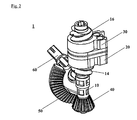
- the actuating mechanism 1 comprises a first 20 and a second actuating element 30 to which a first pulling cable 80 and a second pulling cable 90 is connected.
- the pulling cables 80, 90 are parts of two bowden cables (not shown) which are connected with a spine support.
- the pulling cables 80, 90 are uniformly actuated.
- the pulling cables 80, 90 are connected with a first actuating element 20 and the sheath of the bowden cable with the second actuating element 30.
- the pulling cables 80, 90 are tightened when the first actuating element 20 and the second actuating element 30 are moved away from each other.
- the actuating elements 20, 30 are moveably supported within the housing 70.
- only one movable actuating element 20, 30 may be provided.
- the pulling cable or the sheath of the bowden cable is then connected with the movable actuating element, whereas the other part of the bowden cable is connected with a rigid receptacle.
- the spine support connected to the actuating mechanism is adjusted by means of the tension of the pulling cables 80, 90.
- the spine supports can usually be adjusted in their concavity and also in their height.
- the pulling cables 80, 90 of a first actuating mechanism 1 are connected to the curvature mechanism of a spine support (not shown).
- a tightening of the cables 80, 90 for example, increases the concavity of the spine support, a releasing decreases the concavity.
- An opposing kind of operation is achieved by another embodiment of the curvature mechanism.
- the pulling cables 80, 90 of a second actuating mechanism 1 are connected to a translating mechanism of a spine support (not shown). Due to the translating mechanism the height of the spine support can be adjusted within the backrest.
- the actuating of the second actuating mechanism 1 for example leads to a parallel up or down movement of the spine support within the backrest of a vehicle seat.
- the actuating mechanism 1 may be identically or differently provided, depending on the respective embodiment.
- the actuating elements 20, 30 of an actuating mechanism 1 each comprise inner threads that engage the outer threads 14, 16 of a shaft 10.
- the inner threads of the first actuating element 20 are preferably provided as a left handed threads
- the inner threads of the second actuating element 30 are preferably provided as a right handed threads.
- the shaft 10 comprises two threaded parts 14, 16, wherein the first part 14 is provided as left handed threads, which engage the left handed threads of the first actuating element 20.
- the second part 16 of the threads of the shaft 10 is configured as a right handed threads, which engage the inner threads of the second actuating element 30.
- the actuating elements 20, 30 are shifted to or away from each other.
- the senses of rotation of the threaded parts are configured the other way round. This does not effect the functional principle of the actuating mechanism 1.
- the above mentioned senses of rotation are preferably described for an actuating element 20 which is installed into a left seat of a vehicle.
- the actuation element 20 would we configured as follows.
- the inner threads of the first actuating element 20 are preferably provided as a right handed threads
- the inner threads of the second actuating element 30 are preferably provided as a left handed threads. Therefore the shaft 10 comprises two threaded parts 14, 16, wherein the first part 14 is provided as right handed threads, which engage the right handed threads of the first actuating element 20.
- the second part 16 of the threads of the shaft 10 is configured as left handed threads, which engage the left handed inner threads of the second actuating element 30.
- the lead of the parts 14, 16 of the outer threads of the shaft 10 are preferably configured, so that, for an actuation of the spine support along its complete range of adjustment preferably few rotations of the shaft 10 are necessary. Therefore, the user does not have to rotate the operating element long winded for adjusting the spine support but can adjust the spine support with one movement of the wrist.
- the lead of the parts 14, 16 of the outer threads of the shaft 10 are selected such that the shaft 10 for an arbitrary actuation of the spine support performs a maximum rotation of 360°.
- the shaft 10 comprises a bevel wheel 40, for driving the shaft 10.
- the bevel wheel 40 engages with a bevel wheel 50, which has preferably a greater diameter than the bevel wheel 40.
- the bevel wheel 50 is connected with a driving shaft 60 which is preferably located substantially perpendicular to the shaft 10. Due to a rotation of the driving shaft 60 around a first angle, the shaft 10 is rotated around a second angle.
- the gear is configured so that the second rotational angle is larger than the first one. That means, that the gear 40, 50 is configured as a gear with a speed increasing ratio. As a consequence, it is not necessary to excessively rotate the driving shaft 60 for an adjustment of the spine support.
- the bevel wheel 50 is provided as a bevel wheel segment, in case the transmission ratio between bevel wheel 50 and 40 is selected sufficiently high. Then, the driving shaft 60 must only be rotated around a certain angle, for example to adjust the spine support to its maximum concavity.
- the bevel wheel segment of the bevel wheel 50 comprises an angle of 120°.
- the diameter of the bevel wheel 50 is selected to be great enough, so that the shaft 10 is rotated around the necessary angle of rotation, for example 360°, when the bevel wheel 50 is rotated around 120°.
- the driving shaft 60 may for example be actuated by means of an hand lever.
- the driving shaft 60 is as well as the shaft 10 supported inside the housing 70. Under a rotation of the driving shaft 60, the bevel wheel 50 connected thereto leading to a rotation of the bevel wheel 40 of the shaft 10 engaged thereto.
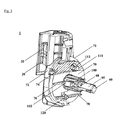
- the driving shaft 60 extends through a hub 100 out of the housing 70 of the actuating mechanism 1 as shown in Figure 3.
- a shaft connection 65 is provided at the free end of the driving shaft 60, which extends out of the housing 70.
- the shaft connection 65 can be provided as an arbitrary positive or none-positive shaft connection.
- the shaft connection 65 is made as a squared connection.
- An operating element (not shown), for example a rotary knob or a hand lever, is preferably attached to the shaft connection 65 of the driving shaft 60. A rotational motion is applied to the actuating mechanism 1 via the hand lever or the rotary knob. A user can adjust the spine support of the vehicle seat via these operating elements.
- an actuation of the operating element with a torque of max. 4 Nm leads to a tensile force on one of the pulling cables 80, 90 of max. 800 N.
- the spine support can be adjusted in its complete range of adjustment by the small rotation of the operating element of not more than 120°.
- the operator can comfortably adjust the spine support with a single rotation of the wrist or a small displacement of the hand lever. Multiple rotations of the operating element are not necessary.
- the adjustment of the spine support is fast and comfortable.
- a motor (not shown) can be connected to the driving shaft 60 instead of a manual operating element.
- the spine support can be for example electrically be adjusted.
- Low speed electric motors or other motorized drives can be used due to the gear.
- other drives can be used, that rotate by a certain rotational angle only.
- the housing 70 consists of two housing halves 71, 72 which are preferably divided substantially on the height of the symmetry lines of the shaft 10 and the driving shaft 60.
- the housing 70 For bearing the shaft 10 as well as the driving shaft 60 bearing halves are formed into the housing 70. Further, gliding faces are formed into the housing 10 to stop a rotation of the actuating elements 20, 30 and to allow their axial shift.
- the housing 70 as well as all gear elements described above are preferably manufactured from metals, plastic materials or composite materials.
- the elements of the actuating mechanism 1 preferably consist of a glass fiber reinforced plastic material.
- the actuating mechanism 1 is mounted from the inside at the lateral frame of a backrest of a vehicle seat.
- the frame of a backrest usually consists of a formed sheet metal part.
- the hub 100 is pushed through the frame, so that the driving shaft 60 protrudes laterally out of the backrest.
- the actuating mechanism 1 is connected to the spine support via bowden cables, the assembly position of the actuating mechanism 1 can freely by selected at the backrest. Due to the preferably perpendicular arrangement of the driving shaft 60 to the shaft 10, the bowden cables initially run parallel to the lateral frame of the backrest at their exit location of the actuating mechanism 1. Thereby, the bowden cables can be connected to the spine support with an advantageous 180° curve.
- the assembly position of the actuating mechanism 1 is chosen according to ergonomic aspects. During driving, the operating element must easily be reached and actuated by the driver. To arrange the actuating mechanism 1 it is particularly preferred slightly below the mid of the side of the backrest of a vehicle seat. In case the concavity and also the height of the spine support should be adjusted, two actuating mechanisms 1 are preferably arranged at the side of the backrest of a vehicle seat.
- the actuating mechanism 1 can be mounted at the frame of the backrest by means of all common mounting techniques, for example screwing, riveting or gluing. Preferably, the actuating mechanism 1 is mounted to the frame of the backrest by clipping.
- the housing 70 of the actuating mechanism 1 preferably comprises several connecting elements 100, 110, 120 as shown in Figure 3. In the shown embodiment, a connecting element 110, a locating pin 120, a hub 100 as well as contact faces 74, 76 and 78 are provided at the housing 70.
- the actuating mechanism 1 For mounting the actuating mechanism 1 within the backrest, the actuating mechanism 1 is clipped to the frame of the backrest. Therefore holes in the frame of the backrest are provided which correspond to the fixing elements 100, 110, 120.
- the fixing elements 100, 110, 120 protruding from the contact faces 74, 76, 78 are pushed through the corresponding holes in the sheet metal frame.
- the fixing element 110 and the hub 100 are provided with clips 102, 112, engaging during assembly the sheet metal of the frame of the backrest.
- a locating pin 120 which also engages a respective hole in the sheet metal of the frame of the backrest, fixes the position of the actuating mechanism 1 at the backrest.
- the actuating mechanism 1 is mounted fast and easily to the frame of the backrest by clipping from the inside. In the mounted state the contact faces 74, 76, 78 are evenly contacting the sheet metal of the frame. For a disassembly, the clips 102 and 112 are pushed in from the outside, and the actuating mechanism 1 can easily be released from the frame of the backrest of the vehicle seat.
- an operating element (not shown) is attached to the shaft connection 65 of the driving shaft 60 from the outside.
- the operating element can be formed arbitrarily, for example as a rotary knob or hand lever.
- the shaft connection 65 is provided with an indentation 68 in order to provide a secure mounting of the operating element to the driving shaft 60.
- the indentation 68 engages a respective recess within the operating element. A disassembly can be done by pulling at the operating element with an increased force.
Landscapes
- Engineering & Computer Science (AREA)
- Aviation & Aerospace Engineering (AREA)
- Transportation (AREA)
- Mechanical Engineering (AREA)
- Seats For Vehicles (AREA)
- Chairs For Special Purposes, Such As Reclining Chairs (AREA)
- Chair Legs, Seat Parts, And Backrests (AREA)
Applications Claiming Priority (2)
| Application Number | Priority Date | Filing Date | Title |
|---|---|---|---|
| DE10246823 | 2002-10-08 | ||
| DE10246823A DE10246823A1 (de) | 2002-10-08 | 2002-10-08 | Betätigungsmechanismus für eine Lordosenstütze |
Publications (2)
| Publication Number | Publication Date |
|---|---|
| EP1407927A2 true EP1407927A2 (fr) | 2004-04-14 |
| EP1407927A3 EP1407927A3 (fr) | 2008-01-23 |
Family
ID=32010373
Family Applications (1)
| Application Number | Title | Priority Date | Filing Date |
|---|---|---|---|
| EP03022661A Withdrawn EP1407927A3 (fr) | 2002-10-08 | 2003-10-07 | Mécanisme de commande pour soutient lombaire |
Country Status (2)
| Country | Link |
|---|---|
| EP (1) | EP1407927A3 (fr) |
| DE (1) | DE10246823A1 (fr) |
Families Citing this family (1)
| Publication number | Priority date | Publication date | Assignee | Title |
|---|---|---|---|---|
| DE102006022425B4 (de) * | 2006-05-13 | 2008-07-10 | GM Global Technology Operations, Inc., Detroit | Betätigungsvorrichtung zum Verändern der Lage von Teilen eines Fahrzeugsitzes |
Family Cites Families (15)
| Publication number | Priority date | Publication date | Assignee | Title |
|---|---|---|---|---|
| GB2150824B (en) * | 1983-12-10 | 1987-12-31 | Wilmot Breeden Ltd | Lumbar adjustment mechanism |
| FR2596334B1 (fr) * | 1986-03-25 | 1990-10-05 | Renault | Dossier de siege avec dispositif de reglage de l'appui lombaire |
| JPH0540763Y2 (fr) * | 1987-10-20 | 1993-10-15 | ||
| JPH0612711Y2 (ja) * | 1989-05-08 | 1994-04-06 | シロキ工業株式会社 | シート |
| AT394829B (de) * | 1989-08-04 | 1992-06-25 | Schuster Wilhelm | Rueckenlehne fuer einen fahrzeugsitz, mit einer verstellbaren lendenstuetze |
| IT1239943B (it) * | 1990-03-09 | 1993-11-27 | Lorenza Sessini | Cuscinetto per sostegno anatomico, in specie lombare e cervicale, per gli schienali dei sedili |
| JPH0731727Y2 (ja) * | 1991-08-22 | 1995-07-26 | 池田物産株式会社 | ランバーサポート装置 |
| CA2106383A1 (fr) * | 1992-01-20 | 1993-07-21 | Donald William Alexander Hay | Dispositifs de soutien lombaire reglable pour sieges |
| US5651584A (en) * | 1995-04-24 | 1997-07-29 | L & P Property Management Company | Lumbar support structure for automotive vehicle |
| DE29706398U1 (de) * | 1997-04-10 | 1997-05-22 | Megaplast S.A., Bilbao | Rückenstütze für Lehnen, insbesondere von Kraftfahrzeugsitzen |
| GB2335845B (en) * | 1998-03-27 | 2000-03-15 | Youngflex Ag | Seat assembly providing adjustable lumbar support |
| DE19850121B4 (de) * | 1998-10-30 | 2005-10-13 | Fico Cables, S.A., Rubi | Justierbare Lordosenstütze |
| GB0008130D0 (en) * | 2000-04-03 | 2000-05-24 | Youngflex Ag | Manual actuating means |
| GB2362818B (en) * | 2000-06-01 | 2002-09-11 | Chern Shing Top Co Ltd | Back cushion assembly |
| US7000986B2 (en) * | 2001-09-28 | 2006-02-21 | Ficosa North America | Lumbar support apparatus |
-
2002
- 2002-10-08 DE DE10246823A patent/DE10246823A1/de not_active Ceased
-
2003
- 2003-10-07 EP EP03022661A patent/EP1407927A3/fr not_active Withdrawn
Also Published As
| Publication number | Publication date |
|---|---|
| DE10246823A1 (de) | 2004-04-22 |
| EP1407927A3 (fr) | 2008-01-23 |
Similar Documents
| Publication | Publication Date | Title |
|---|---|---|
| KR100804857B1 (ko) | 모터 차량용 조절 가능한 페달 기구 | |
| EP0884213B1 (fr) | Dispositif d'inclinaison | |
| KR101839131B1 (ko) | 시트조절을 위한 액츄에이터 어셈블리와 그 방법 | |
| US6367349B1 (en) | Adjustable brake, clutch and accelerator pedals | |
| EP1562806B1 (fr) | Mecanisme de reglage de rapport pour un levier d'actionnement | |
| US7464620B2 (en) | Actuator | |
| CN102092325A (zh) | 用于腰部支撑件的调整装置和调整腰部支撑件的方法 | |
| KR20080065663A (ko) | 시트부품 조정장치와 시트 및 방법 | |
| WO1994024904A1 (fr) | Support lombaire ajustable | |
| US6321617B1 (en) | Adjustable pedal assembly | |
| US6314831B2 (en) | Adjustable pedal-parallel screw and rod | |
| US6533235B1 (en) | Twisted end interference fit flex shaft | |
| JPH07115629B2 (ja) | 押圧力の調整可能なワイパ装置 | |
| US8051956B2 (en) | Driving device for a parking brake system | |
| EP1407927A2 (fr) | Mécanisme de commande pour soutient lombaire | |
| FR2764857A1 (fr) | Mecanisme de serrage d'une colonne reglable de direction | |
| EP1280034B1 (fr) | Dispositif pour ajuster la position d'une pédale | |
| JPH07334262A (ja) | 前後調節可能な操作ペダル装置 | |
| EP1143322A1 (fr) | Ensemble de pédales réglables en position | |
| JP2004521421A (ja) | 乗物用のブレーキペダル及びこれを用いた自動車用のペダルボックスモジュール | |
| EP1496416A1 (fr) | Mécanisme d'actionnement pour cables bowden | |
| EP1343065B1 (fr) | Dispositif de réglage de postion de pédales d'un véhicule automobile | |
| US20070142117A1 (en) | Shaft to socket connection having an interference fit | |
| KR20130071260A (ko) | 차량용 스티어링 컬럼 | |
| KR20050108105A (ko) | 위치 조절이 가능한 페달 |
Legal Events
| Date | Code | Title | Description |
|---|---|---|---|
| PUAI | Public reference made under article 153(3) epc to a published international application that has entered the european phase |
Free format text: ORIGINAL CODE: 0009012 |
|
| AK | Designated contracting states |
Kind code of ref document: A2 Designated state(s): AT BE BG CH CY CZ DE DK EE ES FI FR GB GR HU IE IT LI LU MC NL PT RO SE SI SK TR |
|
| AX | Request for extension of the european patent |
Extension state: AL LT LV MK |
|
| PUAL | Search report despatched |
Free format text: ORIGINAL CODE: 0009013 |
|
| AK | Designated contracting states |
Kind code of ref document: A3 Designated state(s): AT BE BG CH CY CZ DE DK EE ES FI FR GB GR HU IE IT LI LU MC NL PT RO SE SI SK TR |
|
| AX | Request for extension of the european patent |
Extension state: AL LT LV MK |
|
| RIC1 | Information provided on ipc code assigned before grant |
Ipc: A47C 7/46 20060101ALI20071214BHEP Ipc: B60N 2/44 20060101ALI20071214BHEP Ipc: B60N 2/66 20060101AFI20031219BHEP |
|
| 17P | Request for examination filed |
Effective date: 20080317 |
|
| 17Q | First examination report despatched |
Effective date: 20080526 |
|
| AKX | Designation fees paid |
Designated state(s): AT BE BG CH CY CZ DE DK EE ES FI FR GB GR HU IE IT LI LU MC NL PT RO SE SI SK TR |
|
| STAA | Information on the status of an ep patent application or granted ep patent |
Free format text: STATUS: THE APPLICATION IS DEEMED TO BE WITHDRAWN |
|
| 18D | Application deemed to be withdrawn |
Effective date: 20100501 |