EP1408662A1 - Système et procédé pour égalisation de signaux à grande vitesse - Google Patents
Système et procédé pour égalisation de signaux à grande vitesse Download PDFInfo
- Publication number
- EP1408662A1 EP1408662A1 EP20030020569 EP03020569A EP1408662A1 EP 1408662 A1 EP1408662 A1 EP 1408662A1 EP 20030020569 EP20030020569 EP 20030020569 EP 03020569 A EP03020569 A EP 03020569A EP 1408662 A1 EP1408662 A1 EP 1408662A1
- Authority
- EP
- European Patent Office
- Prior art keywords
- tap
- equalization
- signal
- transmitter
- trailing
- Prior art date
- Legal status (The legal status is an assumption and is not a legal conclusion. Google has not performed a legal analysis and makes no representation as to the accuracy of the status listed.)
- Withdrawn
Links
- 238000000034 method Methods 0.000 title claims abstract description 60
- 238000004891 communication Methods 0.000 claims abstract description 97
- 239000002243 precursor Substances 0.000 abstract description 16
- 230000002708 enhancing effect Effects 0.000 abstract description 3
- 230000004044 response Effects 0.000 description 27
- 238000012937 correction Methods 0.000 description 17
- 230000005540 biological transmission Effects 0.000 description 13
- AFYCEAFSNDLKSX-UHFFFAOYSA-N coumarin 460 Chemical compound CC1=CC(=O)OC2=CC(N(CC)CC)=CC=C21 AFYCEAFSNDLKSX-UHFFFAOYSA-N 0.000 description 13
- 230000000694 effects Effects 0.000 description 12
- 230000002123 temporal effect Effects 0.000 description 10
- 230000003044 adaptive effect Effects 0.000 description 9
- 230000008859 change Effects 0.000 description 9
- 239000006185 dispersion Substances 0.000 description 9
- 230000008901 benefit Effects 0.000 description 6
- 238000010586 diagram Methods 0.000 description 6
- 238000012986 modification Methods 0.000 description 6
- 230000004048 modification Effects 0.000 description 6
- 230000002500 effect on skin Effects 0.000 description 5
- 230000008569 process Effects 0.000 description 5
- 230000003111 delayed effect Effects 0.000 description 4
- 229920005994 diacetyl cellulose Polymers 0.000 description 4
- 230000006978 adaptation Effects 0.000 description 3
- 230000003466 anti-cipated effect Effects 0.000 description 3
- 238000013461 design Methods 0.000 description 3
- 230000001934 delay Effects 0.000 description 2
- 238000009434 installation Methods 0.000 description 2
- 230000007246 mechanism Effects 0.000 description 2
- 230000003071 parasitic effect Effects 0.000 description 2
- 230000011664 signaling Effects 0.000 description 2
- 230000001360 synchronised effect Effects 0.000 description 2
- 238000012546 transfer Methods 0.000 description 2
- 230000002411 adverse Effects 0.000 description 1
- 230000032683 aging Effects 0.000 description 1
- 230000009118 appropriate response Effects 0.000 description 1
- 230000006399 behavior Effects 0.000 description 1
- 239000002131 composite material Substances 0.000 description 1
- 239000004020 conductor Substances 0.000 description 1
- 238000007796 conventional method Methods 0.000 description 1
- 230000006735 deficit Effects 0.000 description 1
- 230000000593 degrading effect Effects 0.000 description 1
- 238000001514 detection method Methods 0.000 description 1
- 230000006870 function Effects 0.000 description 1
- 230000003116 impacting effect Effects 0.000 description 1
- 239000012212 insulator Substances 0.000 description 1
- 238000004519 manufacturing process Methods 0.000 description 1
- 230000000116 mitigating effect Effects 0.000 description 1
- 230000003287 optical effect Effects 0.000 description 1
- 230000009290 primary effect Effects 0.000 description 1
- 238000011084 recovery Methods 0.000 description 1
- 230000035945 sensitivity Effects 0.000 description 1
- 230000002459 sustained effect Effects 0.000 description 1
Images






Classifications
-
- H—ELECTRICITY
- H04—ELECTRIC COMMUNICATION TECHNIQUE
- H04L—TRANSMISSION OF DIGITAL INFORMATION, e.g. TELEGRAPHIC COMMUNICATION
- H04L25/00—Baseband systems
- H04L25/02—Details ; arrangements for supplying electrical power along data transmission lines
- H04L25/03—Shaping networks in transmitter or receiver, e.g. adaptive shaping networks
- H04L25/03006—Arrangements for removing intersymbol interference
- H04L25/03343—Arrangements at the transmitter end
-
- H—ELECTRICITY
- H04—ELECTRIC COMMUNICATION TECHNIQUE
- H04L—TRANSMISSION OF DIGITAL INFORMATION, e.g. TELEGRAPHIC COMMUNICATION
- H04L25/00—Baseband systems
- H04L25/02—Details ; arrangements for supplying electrical power along data transmission lines
- H04L25/03—Shaping networks in transmitter or receiver, e.g. adaptive shaping networks
- H04L25/03006—Arrangements for removing intersymbol interference
- H04L25/03012—Arrangements for removing intersymbol interference operating in the time domain
- H04L25/03019—Arrangements for removing intersymbol interference operating in the time domain adaptive, i.e. capable of adjustment during data reception
- H04L25/03038—Arrangements for removing intersymbol interference operating in the time domain adaptive, i.e. capable of adjustment during data reception with a non-recursive structure
-
- H—ELECTRICITY
- H04—ELECTRIC COMMUNICATION TECHNIQUE
- H04L—TRANSMISSION OF DIGITAL INFORMATION, e.g. TELEGRAPHIC COMMUNICATION
- H04L25/00—Baseband systems
- H04L25/02—Details ; arrangements for supplying electrical power along data transmission lines
- H04L25/03—Shaping networks in transmitter or receiver, e.g. adaptive shaping networks
- H04L25/03878—Line equalisers; line build-out devices
- H04L25/03885—Line equalisers; line build-out devices adaptive
Definitions
- This invention relates to a system and method for providing high-speed digital communications through a communications channel, and more particularly to an equalizer for communications systems implemented in wired type environments, for example microstrip, stripline, printed circuit board (e.g., a backplane) and cable.
- wired type environments for example microstrip, stripline, printed circuit board (e.g., a backplane) and cable.
- Communications systems are continuing to increase the rate at which data is transmitted between devices.
- the increase in data rate presents a challenge to maintain, enhance or optimize the ability to recover the transmitted signal and thereby the information contained therein.
- increasing the rate of transfer of data tends to adversely impact the fidelity of the received signal.
- high-speed digital baseband communications systems often encounter debilitating signal reflections and signal dispersion as the rate of data transfer increases.
- Signal reflections are often due to mismatches of impedances between the impedances of the devices (whether the devices are connected in a point-to-point or bus configuration), and/or mismatches of the impedance of the communications channel and termination resistors.
- Signal dispersion also known as intersymbol interference
- bandwidth limitations of the communications channel may be caused by bandwidth limitations of the communications channel. Dispersion in many situations is due to two primary effects, namely, dielectric loss and skin effect. The effects of dielectric loss are often limited or minimized in communications systems, for example, wired systems, through careful design of the conductor insulator.
- intersymbol interference caused by dielectric loss may be difficult to eliminate, or sufficiently or adequately limit or minimize.
- dispersion of the transmitted signal may be observed in the time domain as a symmetric broadening of that signal. This broadening of the transmitted signal produces both pre-cursor (before the pulse peak of the signal) and post-cursor (after the pulse peak of the signal) intersymbol interference.
- Dispersion effects attributable to skin-effect tend to be observed predominately as post-cursor intersymbol interference. Although the debilitating effects caused by skin-effect may not be dominant when compared to effects of dielectric loss, skin-effect may be a source of dispersion to be addressed at higher transmission rates.
- pre-cursor and/or post-cursor impairment whether due to skin effect or dielectric loss, must be addressed as transmission rates increase.
- circuitry for example, a finite impulse response filter (“FIR filter”), in the receiver to equalize the transmitted signals in an effort to address, or compensate for the effects of dispersion and reflection of the transmitted signal and/or the sensitivity of the system to that distortion or reflection.
- FIR filter finite impulse response filter
- Such circuitry typically includes a one or more taps having fixed or pre-programmed "positions" and coefficients. These taps are typically “trailer” or “trailing” taps and, as such, the equalization circuitry address only post-cursor signal distortion.
- the equalization circuitry also includes "trailer” or “trailing” taps to provide an equalization signal that is produced after transmission of the information signal.
- the pre-emphasis equalization circuitry like the equalization circuitry implemented in the receiver, is designed to address only post-cursor signal distortion.
- conventional communications systems employ an FIR filter having fixed or pre-programmed tap positions and coefficients in the transmitter.
- the taps are positioned to compensate for post cursor intersymbol interference.
- the duration of the equalization signal and the relative position or placement of the tap(s) of the equalization circuitry are selected or designed to avoid interference with the signal representative of the transmitted information. As such, at the transmitter, there is no temporal overlap between the equalization signal and the information signal. in this way, the equalization signal is less likely to interfere with the pulse peak of the transmitted signal (i.e., the symbol or data signal).
- incorporating more complex equalization circuitry tends to add cost, complexity and power consumption to a transmitter, receiver and/or transceiver.
- conventional pre-emphasis tends to suffer from over-equalization at the boundaries of the symbol (data signal) and may exhibit large parasitic capacitances thereby degrading the performance of the system.
- over-equalization may impact successive symbols or data signals, thereby contributing to the debilitating effects of signal reflections and dispersion.
- equalization circuitry and techniques having a minimum of complexity and taps; however, such circuitry and techniques often are unable to provide sufficient compensation for high-speed communications systems.
- the present invention is directed to a technique of, and system for enhancing the performance of high-speed digital communications through a communications channel, for example a backplane.
- a data communications system includes a transmitter having equalization circuitry to compensate for bandwidth limitations and reflections in high-speed digital communication systems.
- the equalization circuitry is designed, programmed and/or configured to introduce compensation that is ideally the inverse of the intersymbol interference caused by the communications channel in order to improve the signal integrity in high-speed communications and enhance the operation and performance of such systems.
- the equalization circuitry may include leading and/or trailing taps to reduce, minimize, mitigate or effectively eliminate pre-cursor and/or post-cursor intersymbol interference due to, for example, bandwidth limitations and reflections in high-speed digital communication systems.
- the amount of intersymbol interference may be programmed, adjusted or controlled by varying the positioning of the tap(s), varying the coefficients of the tap(s), and/or varying the pulse durations of the tap(s) (that is, the pulse duration of the equalization signal attributed to the tap).
- the present invention is a system for providing data communication over a communications channel, wherein the communications channel includes a backplane.
- the system comprises a first transmitter and a first receiver, both coupled to the communications channel.
- the first transmitter includes equalization circuitry having at least one leading tap and at least one trailing tap wherein the at least one leading tap and the at least one trailing tap provide an equalization signals that temporally overlap with a data signal and wherein the transmitter outputs an equalized data signal.
- the taps of the equalization circuitry may include programmable coefficients, programmable positioning, and/or programmable pulse durations.
- the system further includes a back channel for transmitting information from the first receiver back to the first transmitter wherein the information is representative of the coefficients of the taps of the equalization circuitry in the first transmitter.
- the system may also include a second transmitter coupled, via a communications channel, to a second receiver.
- the first receiver may calculate information which is representative of the equalization circuitry's coefficients (for example, intermittently or periodically) and the second transmitter may transmit that information to the second receiver. Thereafter, the information may be provided to the first transmitter for implementation by the equalization circuitry.
- the first transmitter may use the information to adjust, program, alter or vary the operation or response of the equalization circuitry.
- the taps of the equalization circuitry include programmable coefficients and wherein information which is representative of the programmable coefficients is provided to the system using an external interface.
- the information provided via the back channel or external interface may be the actual positions of the tap(s), coefficients of the tap(s), and/or pulse durations of the tap(s).
- the information may be adjustments, modifications and/or changes to be made to the positions of the tap(s), the coefficients of the tap(s), and/or the pulse durations of the tap(s).
- information which is representative of the positions of the tap(s), the coefficients of the tap(s), and/or the pulse durations of the tap(s) is intended to define the actual positions (i.e., absolute values) of the tap(s), coefficients of the tap(s), and/or pulse durations of the tap(s), as well as information pertaining to adjustments, modifications and/or changes to be made to the positions (i.e., relative values) of the tap(s), the coefficients of the tap(s), and/or the pulse durations of the tap(s).
- the present invention is a system for providing data communication over a communications channel, wherein the communications channel includes a backplane.
- the system of this aspect includes a first transmitter coupled to a first receiver via the communications channel.
- the first transmitter includes equalization circuitry having a first trailing tap that provides an equalization signal that temporally overlaps with a data signal, wherein the transmitter generates an equalized data signal using the equalization signal and the data signal.
- the first trailing tap may include a programmable coefficient, a programmable position, and/or a programmable pulse
- the system further includes a back channel for transmitting information which is representative of the coefficient of the tap of the equalization circuitry to the transmitter.
- the system may include a second transmitter coupled to a second receiver via the communications channel.
- the first receiver may calculate information which is representative of the coefficient (for example, periodically) and the second transmitter may transmit the information to the second receiver.
- the first transmitter may use the information to adjust, program, alter or vary the operation or response of the equalization circuitry
- the equalization circuitry may also include a second trailing tap wherein the second trailing tap provides an equalization signal that temporally overlaps with a data signal.
- the transmitter may generate the equalized data signal using the equalization signals provided by the first and second trailing taps and the data signal.
- the equalization circuitry further includes a leading tap wherein the leading tap provides an equalization signal that temporally overlaps with a data signal.
- the transmitter may generate the equalized data signal using the equalization signal provided by the leading tap, the equalization signals provided by the first and second trailing taps, and the data signal.
- the present invention is a method for equalization of data signals that are transmitted over a communications channel (for example, a backplane).
- the method may include generating a first equalization signal using a leading tap wherein the first equalization signal temporally overlaps with a data signal, generating a second equalization signal using a first trailing tap wherein the second equalization signal temporally overlaps with the data signal, and generating an equalized data signal using the first and second equalization signals with the data signal.
- the method may further include transmitting the equalized data signal.
- the method of this aspect of the invention may further include generating a third equalization signal using a third trailing tap wherein the third equalization signal temporally overlaps with the data signal.
- the method may include generating a third equalization signal using a third trailing tap wherein the third equalization signal does not temporally overlap with the data signal.
- the method may include controlling the first and/or second equalization signals by controlling the position of the trailing tap, the coefficient of the trailing tap and/or the duration of the tap.
- the method includes receiving the equalized data signal using a receiver, generating information which is representative of the coefficient of the trailing tap(s) (either absolute or relative information), and providing the information which is representative of the coefficient of the trailing tap to the transmitter to control, adjust or modify the coefficient of the trailing tap.
- a transmitter includes equalization circuitry and techniques to compensate for bandwidth limitations and reflections in high-speed digital communication systems.
- the circuitry and techniques of this embodiment is designed, programmed and/or configured to introduce intersymbol interference in order to improve the signal integrity in high-speed communications and enhance the operation and performance of such systems.
- the circuitry and techniques include leading and/or trailing taps to reduce, minimize, mitigate or effectively eliminate pre-cursor and/or post-cursor intersymbol interference due to, for example, bandwidth limitations and reflections in high-speed digital communication systems.
- the equalization circuitry and techniques may reduce, minimize or eliminate non optimum (e.g., over-equalization) at the boundaries of the data signal (i.e., the symbol).
- the equalization effect may include an infinite impulse response (IIR) equalization component that is created by the impulse response of the communications channel.
- IIR infinite impulse response
- the leader and/or trailer taps of the equalization circuitry are adjustable "corrections" applied to the transmitted symbol. These "correction" pulses are dispersed along with the transmitted symbol by the impulse response of the communications channel. As such, the longer the channel's impulse response, the longer the correction pulses. This may reduce or minimize the number of taps required (over a time-sampled equalizer implemented at the receiver) to achieve a desired response and thereby improve or enhance the bandwidth of the transmitter output.
- the circuitry and technique according to one embodiment of the present invention may include pre-emphasis implemented as an analog FIR filter having one or more taps positioned before and/or after the transmitted symbol.
- the taps are positioned to temporally overlap with the data signal to thereby introduced intersymbol interference.
- the amount of intersymbol interference may be programmed, adjusted or controlled by varying the positioning of the tap(s), varying the coefficients of the tap(s), and/or varying the pulse durations of the tap(s) (that is, the pulse duration of the equalization signal attributed to the tap).
- the positions of the tap(s), the coefficients of the tap(s), and/or the pulse durations of the tap(s) may be adjusted or controlled during operation of the transmitter.
- the adjustment or control of the taps of the circuitry for equalization may be accomplished using an adaptive algorithm.
- tap weights or coefficients (values) may be determined or controlled in response to a conventional linear adaptive algorithm (for example, Least Mean Square, Recursive Least Square, and stochastic versions thereof) to provide enhanced or optimal reception (maximum eye-opening) at a receiver.
- a stochastic zero forcing algorithm may be employed to provide convergence (stochastic Least Mean Square).
- the adaptive algorithm uses samples of the received signal provided by the receiver to force the edges of the symbol pulse or data signal towards zero. Such an algorithm may have a robust convergence behavior.
- the adjustment or control of the taps of the equalization circuitry may be by the user via programming either before or during operation of the transmitter.
- the user may provide information representative of the positions of the tap(s), the coefficients of the tap(s), and/or the pulse durations of the tap(s) in order to change, enhance or optimize the performance of the transmitter, receiver and/or the communications system.
- This information may be the actual positions of the tap(s), the coefficients of the tap(s) and/or the pulse durations of the tap(s).
- This information may also be adjustments, modifications and/or changes to be made to the positions of the tap(s), the coefficients of the tap(s), and/or the pulse durations of the tap(s).
- Such information may be provided directly to the transmitter (to be implemented within the equalization circuitry) or to a controller to distribute to the transmitter or set of transmitters.
- the positions of the tap(s), the coefficients of the tap(s), and/or the pulse durations of the tap(s) may be pre-programmed or pre-set, for example, by permanently, semi-permanently or temporarily (i.e., until re-programmed) storing information which is representative of the positions of the tap(s), the coefficients of the tap(s), and/or the pulse durations of the tap(s) in an SRAM, DRAM, ROM, PROM, EPROM, EEPROM or the like (e.g., configuring the state of a certain pin or pins on the package).
- the information representative of the positions of the tap(s), the coefficients of the tap(s) and/or the pulse durations of the tap(s) may be stored or in, for example an SRAM, DRAM, ROM or EEPROM.
- the transmitter may access the memory to retrieve the necessary information during start-up/power-up, initialization or re-initialization.
- the information which is representative of the positions of the tap(s), the coefficients of the tap(s), and/or the pulse durations of the tap(s) may be the actual positions of the tap(s), the coefficients of the tap(s) and/or the pulse durations of the tap(s).
- this information may also be adjustments, modifications and/or changes to be made to the positions of the tap(s), the coefficients of the tap(s), and/or the pulse durations of the tap(s).
- the memory used to store the information representative of the positions of the tap(s), the coefficients of the tap(s) and/or the pulse durations of the tap(s) may be comprised of discrete component(s) or may reside on the integrated circuit containing the transmitter, receiver or transceiver.
- the pre-set or preprogrammed positions of the tap(s), the coefficients of the tap(s) and/or the pulse durations of the tap(s) may be fine-tuned to enhance the system performance.
- the system may implement fine adjustments to the predetermined positions of the tap(s), the coefficients of the tap(s) and/or the pulse durations of the tap(s).
- the fine adjustments may be accomplished or implemented by the user or by an adaptive algorithm as mentioned above. In this way, convergence may be obtained more rapidly and/or a less complex adaptive algorithm may be implemented.
- the present invention is a high-speed digital communication system 10 including transmitter 100 (having equalization circuitry) and receiver 200.
- transmitter 100 is connected to receiver 200 via communications channel 300, for example, a backplane.
- transmitter 100 encodes and transforms a digital representation of the data into electrical signals.
- the transmitter 100 also transmits the signals to receiver 200.
- the received signals which may be distorted with respect to the signals transmitted into or onto communications channel 300 by transmitter 100, are processed and decoded by receiver 200 to reconstruct a digital representation of the transmitted information.
- the digital communication system 10 typically includes a plurality of transmitters and receivers.
- communications system 10 includes a plurality of unidirectional transmitter and receiver pairs (transmitter 100a and receiver 200b; and transmitter 100b and receiver 200a).
- Transmitter 100a and receiver 200a may be incorporated into transceiver 400a (in the form of an integrated circuit).
- transmitter 100b and receiver 200b are incorporated into transceiver 400b.
- there are a plurality of such transmitter/receiver pairs in simultaneous operation for example, four, five, eight or ten transmitter/receiver pairs, communicating across communications channel 300.
- the transmitter and receiver pairs simultaneously transmit data across channel 300.
- transmitters 100 and receivers 200 employ a multilevel pulse amplitude modulated (PAM-n) communications technique.
- transmitters 100 and receivers 200 may employ a PAM-4 signaling technique to send two bits of data through channel 300. That is, each transmitter/receiver pair may operate in the same manner to send two bits of data for each symbol transmitted through the channel 300.
- PAM-n pulse amplitude modulated
- five successive symbols are associated with each eight-bit data byte.
- the additional overhead associated with this form of encoding may be used to ensure adequate symbol crossings, necessary for timing recovery and/or to provide DC balance. That overhead may also be used to transmit control information for controlling or modifying the operation of the adaptive or adjustable equalization circuitry in a transmitter.
- the present invention may utilize other modulation formats that encode fewer or more bits per symbol codes based on other than byte wide user may be readily adapted or employed.
- other communications mechanisms that use different encoding tables, other than four levels, or use other modulation mechanisms may also be used, for example, PAM-5, PAM-8, PAM-16, CAP, and wavelet modulation.
- the techniques described herein are in fact applicable to any and all modulation schemes, including but not limited to, PAM-4 encoding described herein.
- equalization circuitry is incorporated into each transmitter of a high-speed digital communication system.
- the equalization circuitry incorporates leading and/or trailing taps to reduce, minimize, mitigate or effectively eliminate pre-cursor and/or post-cursor intersymbol interference due to, for example, bandwidth limitations and reflections in high-speed digital communication systems.
- the extent of equalization introduced by the circuitry may vary between equalization circuitry of each transmitter in the high-speed digital communication system.
- equalization circuitry 500 may be characterized as an analog FIR filter having a basic topology including three taps, namely leading tap 502, trailing tap 504 and information, symbol or data tap 506.
- the leading and trailing taps 502 and 504, respectively, are designed and configured to introduce compensation that is ideally the inverse of the effects caused by the communications channel.
- the positioning of the taps, relative to the data or symbol tap 506, may be controlled, varied or adjusted to provide a desired or predetermined output.
- the positions of taps 502 and 504 are determined and/or adjusted by changing the values of y 1 and x 1 , respectively.
- the amplitude of the pre-cursor and post-cursor intersymbol interference is determined or controlled by the respective coefficients (C lead and C trail ).
- C lead determines the amplitude of the signal introduced in the leading tap
- C trail determines the amplitude of the signal introduced in the trailing tap.
- a scaling operation is performed whereby the leading or trailing signals are "multiplied" by C lead and C trail . This operation is represented by the multiplier symbol 508 and 510, respectively. Both C lead and C trail may be controlled, set and/or changed as described above.
- a scaling operation may also be performed with respect to the symbol or data signal.
- data or symbol is "multiplied" by C symbol . It should be noted, however, that the coefficient C symbol is typically 1.
- the output of the leading tap 502 and trailing tap 504 are combined, along with the output of data or symbol tap, via a summation operation (i.e., summation symbol 516) to produce an output signal 514.
- the output signal 514 is representative of the signal transmitted by the transmitter to the receiver.
- the amount of equalization may be adjusted or controlled by altering the positioning of the tap(s), changing the coefficients of the taps, and/or varying the pulse durations of the tap(s).
- a change in the positioning of the taps will produce a change in the timing of signals 518 and 520 generated by the leading and trailing taps 502 and 504, respectively.
- the ability to change, vary or program the positions of the taps is illustrated by lines 524a and 524b (signal 518), and lines 524c and 524d (signal 520).
- a change in the coefficients of the taps will produce signals 518 and 520 having larger or smaller amplitudes.
- the amplitude of equalization signal 518 (of leading tap 502) may be characterized as D(n) x C lead .
- the amplitude of equalization signal 520 (of trailing tap 504) may be characterized as D(n) x C trail .
- Lines 526a and 526b indicate the capability of changing, varying and/or programming the coefficients of the taps.
- Changing the pulse duration of signals 518 and 520 will, among other things, increase or decrease the high frequency equalization.
- the extent of high frequency equalization increases as the duration of the equalization signals 518 and 520 decrease.
- higher speed analog and digital circuitry may be necessary to implement the transmitter.
- the ability to change the pulse duration of the taps is also illustrated by lines 524a and 524b (leader equalization signal 518), and lines 524c and 524d (trailer equalization signal 520).
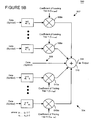
- the equalization circuitry 500 may include a plurality of leading taps 502 and/or a plurality of trailing taps 504.
- the extent of pre-cursor and post-cursor correction i.e., intersymbol interference
- the extent of pre-cursor and post-cursor correction may be adjusted or controlled by altering the positioning of the tap(s) of leading taps 502 and trailing taps 504, changing the coefficients of the taps of leading taps 502 and trailing taps 504, and/or varying the pulse durations of the tap(s) (that is, the pulse duration of the equalization signal attributed to the tap(s)) of the leading taps 502 and trailing taps 504.
- a digital signal generator (for example, a signal generator having a variable, controllable or programmable period)) may be employed to provide equalization signals having pulse durations and/or shapes that are different than the period and/or shape of the symbol.
- the digital signal generator may generate signals having different pulse widths and as such, equalization signals may have different widths and each may be different than the period of the symbol.
- the signal generator may supply the input(s) to the tap(s) of the leading tap(s) and/or the trailing taps.
- the positions of the tap(s), the coefficients of the tap(s), and/or the pulse durations of the tap(s) are adjusted or controlled during operation of the transmitter, for example using an adaptive algorithm, as described above.
- the enhanced, suitable or optimum values of the positions of the tap(s), the coefficients of the tap(s), and/or the pulse durations of the equalization signal(s) may be determined by heuristic means to provide the range of equalization (after adaptation) for a given class of communication channels.
- the adjustment or control of the taps of the equalization circuitry may be user programmable (either before or during operation of the transmitter).
- the positions of the tap(s), the coefficients of the tap(s), and/or the pulse durations of the equalization signal(s) may, in another embodiment, be pre-programmed or pre-set, for example, by permanently, semi-permanently or temporarily (i.e., until re-programmed) storing information representative of the positions of the tap(s), the coefficients of the tap(s), and/or the pulse durations of the tap(s) in an SRAM, DRAM, ROM, PROM, EPROM, EEPROM or the like.
- the pre-programmed or pre-set positions of the tap(s), the coefficients of the tap(s) and/or the pulse durations of the tap(s) may thereafter be fine-tuned to enhance the system performance.
- a back channel may be advantageous to provide information to the equalization circuitry that resides in the transmitter.
- a back channel is a communication path and technique that facilitates providing information that is determined and/or generated by a receiver and used by the corresponding transmitter to adjust or modify output signal characteristics of that transmitter.
- equalization circuitry that resides in transmitter 100a receives control or adaptation information that is determined and/or generated by receiver 200b via transmitter 100b and receiver 200a.
- back channel is comprised of transmitter 100b, receiver 200a, and communications channel 300 that connects transmitter 100b to receiver 200a.
- back channel data forms a part of the user data channel.
- back channel data may be transmitted asynchronously at the same time user data is transmitted without reducing or significantly impacting the amount of channel communications capacity dedicated to user data.
- back channel data is sent in a back channel data frame or data packet.
- the data frame may include a frame header, a set of data bits, a set of control bits, and a data frame trailer.
- the frame header is used to mark the beginning of a data frame to allow the transmitter and receiver to remain synchronized as to the proper beginning of the data frame.
- the set of data bits contains the data to be transmitted across the back channel and is distinguished from the set of control bits used to control the operation of the back channel as necessary.
- the data frame trailer is used to mark the end of a data frame to further allow the transmitter and receiver to remain synchronized as to the proper end of the data frame.
- the information provided via the back channel may be the actual positions (absolute values) of the tap(s), coefficients of the tap(s), and/or pulse durations of the tap(s).
- the information may be adjustments, modifications and/or changes to be made to the positions (relative values) of the tap(s), the coefficients of the tap(s), and/or the pulse durations of the tap(s).
- information which is representative of the positions of the tap(s), the coefficients of the tap(s), and/or the pulse durations of the tap(s) is intended to define the actual positions of the tap(s), coefficients of the tap(s), and/or pulse durations of the tap(s), as well as information pertaining to adjustments, modifications and/or changes to be made to the positions of the tap(s), the coefficients of the tap(s), and/or the pulse durations of the tap(s).
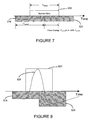
- the equalizer tap timing relationship where y 1 and x 1 are both equal to about 1 ⁇ 2 produces leading and trailing equalization signals 518 and 520 that encompass about the entire period of the symbol of information signal.
- the leading and trailing equalization signals 518 and 520 respectively, each temporally overlap symbol signal 522 by appropriately 50% of the period of symbol signal 522.
- the intersymbol interference may reduce or eliminate over-equalization at the symbol boundaries.
- the output of equalization circuitry 500 may, as a practical matter, be determined adding leading and trailing equalization signals 518 and 520, respectively, and symbol signal 522.
- y 1 and x 1 are both equal to about 1 ⁇ 2
- the coefficients of the leading and trailing taps 502 and 504 produce equalization signals 518 and 520 as illustrated in FIGURE 8, output signal 528 is produced.
- the positions of the tap(s), the coefficients of the tap(s), and/or the pulse durations of the tap(s) vary, the shape and energy content of output signal 528 will change accordingly.
- equalization circuitry includes taps having certain or predetermined positions, coefficients, and pulse durations.
- the specific delays may be determined by heuristic means to provide the "best" range of equalization (after adaptation) for a class of communication channels.
- the leading and trailing taps are arranged to provide an equalization (pulse) signal overlap of about 25% of the data signal (i.e., symbol).
- the duration(s) or period(s) of the "taps" may be selected to be other than a full period of the symbol or data signal.
- the period or duration of the equalization signals is about 1 ⁇ 2 of the period of the symbol or data signal.
- the positions of the tap(s), the coefficients of the tap(s), and/or the pulse durations of the tap(s) determine the shape and energy content of output signal 528.
- Certain communications environments may require differing amounts of post-cursor and/or pre-cursor correction in order to provide a desired response, for example, as measured by the receiver.
- the trailing taps may include more than one tap each having a position, coefficient and/or pulse duration that produces a relative tap timing and amplitude to "correct" for a post-cursor distortion that is larger than pre-cursor distortion.
- a second tap of trailing taps 504 may provide additional equalization signal to address this disproportionate distortion.
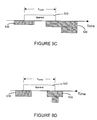
- the timing responses of FIGURES 9C, 9D and 9E may be generated, for example, using the topology of FIGURE 5B.
- the taps of trailing taps 504 may have different positions, coefficients and/or pulse durations. In this way, the tap of trailing taps 504 may provide additional equalization signal to address distortions that vary greatly over time.
- a second tap of leading taps 502 and a second tap of trailing taps 504 may provide additional equalization signal to address pre-cursor and post-cursor distortions that exhibit consideration variation.
- the pulse duration of equalization signal generated by the second taps of the leading and trailing taps are shorter than that of the first taps.
- the correction signals produced by the leading and trailing taps 502 and 504 of the equalization circuitry may address large variations of pre-cursor and post-cursor distortions. These variations may enhance the ability of the receiver to repeatedly recover the transmitted signal.
- timing response of FIGURE 9F may be generated using the topology of FIGURE 5B.
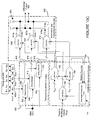
- the equalization circuitry 500 may include temporal adjustment circuitry 600, amplitude adjustment circuitry 700, and summation and transmission circuitry 800.
- the temporal adjustment circuitry 600 is designed to provide or create, among other things, the selected timing relationship between the pre-equalized data signal, leading tap signal and the trailing tap signal.
- the temporal adjustment circuitry receives leading tap input 602, trailing tap input 604 and data (i.e., symbol) input 606. Each input is applied to a corresponding shift register, which is selectively clocked to generate the selected or desired timing relationships between the equalization signals and the symbol (i.e., the pre-equalized data signal).
- leading tap input 602, trailing tap input 604 and data input 606 are the same signal.
- shift register 608 receives leading tap input 602 and, in response to the timing signal ⁇ 1 , outputs a delayed and temporally aligned version of input 602.
- shift register 610 receives trailing tap input 604 and, in response to the timing signal ⁇ 3 , outputs a delayed temporally aligned version of input 604.
- Shift register 612 receives the symbol or pre-equalized signal and, in response to the timing signal ⁇ 2 , outputs a delayed and temporally aligned version of input 606.
- the signals output by the shift registers are precisely aligned relative to each other.
- shift register 608, 610, and 612 may be comprised of a set or group of parallel latches (the number in the set or group being equal to the number of digital inputs 602, 604, and 606).
- shift register 608, 610, and 612 may be comprised a plurality of cascaded sets or groups of parallel latches (the number of latches in each set or group being equal to the number of digital inputs 602, 604, and 606) in order to introduce a "fixed" delay (i.e., the delay through the set(s) or group(s) of parallel latches) of the signals relative to the other shift registers.
- the relative delay of input signals 602, 604 and 606 introduced by the shift registers and timing unit is equal to the delay introduced by the design of the respective shift registers and the differences in phases/delays between timing signals ⁇ 1 , ⁇ 2 , and ⁇ 3 .
- circuitry for example, flip/flops and/or pass gates (whose gate electrodes are coupled to the timing signals from timing unit 900), may be implemented to provide a delayed and temporally aligned version of an input.
- flip/flops and/or pass gates whose gate electrodes are coupled to the timing signals from timing unit 900
- any digital delay element having a controllable delay may be implemented in the present invention to delay and temporally align the symbol and equalization signals.
- the timing unit 900 provides a plurality of timing or clock signals having highly precise phase (and frequency) relationships.
- the timing unit 900 may be well known clock alignment circuitry, for example, delay locked loop circuitry or phase locked loop circuitry.
- a highly precise phase (and frequency) relationship between data input 606 and leading and trailing tap inputs 602 and 604, respectively, may be sustained during operation of the system and over a wide operating environment.
- clock alignment circuitry may also be employed. Indeed, any clock alignment circuitry that outputs a plurality of clock signals having highly precise and constant phase (and frequency) relationships, whether now know or later developed, may be implemented in the present invention.
- the temporal adjustment circuitry 600 and timing unit 900 may also provide a predetermined and/or programmable relationship between the duration of the leading tap signal, the trailing tap signal, and/or the pre-equalized data signal (i.e., symbol).
- the clock signals used to clock the shift registers may be selected to provide a predetermined and/or programmable relationship between the signals.
- the period of timing signal ⁇ 1 may control the period or duration of leading tap signal 602. In this way, a precise period or duration of the leading tap signal (relative to the pre-equalized signal and/or trailing tap signal) may be selected to provide a desired amount of pre-cursor equalization.
- the period of timing signal ⁇ 2 may control the period or duration of trailing tap signal 604.
- a precise duration of the trailing tap signal (relative to the pre-equalized signal and/or leading tap signal) may be selected to provide a desired amount of post-cursor equalization.
- the period of the leading and trailing tap signals 602 and 604 may be programmed or controlled independently. That is, each tap signal may be programmed to a unique or different period or duration. In this way, the communication system has a considerable degree of flexibility in addressing pre-cursor and post-cursor distortions.
- the amplitude adjustment circuitry 700 is designed to provide predetermined and/or programmable adjustment of the amplitude of the leading and trailing tap signals in relation to the transmitted signal (A xmit ).
- multiplying digital to analog converters (“MDACs") 702 and 704 convert the tap coefficients C lead and C trail into analog representations thereof.
- the MDACs 702 and 704 use the analog representation of the transmit amplitude control (A xmit ) as a reference current to provide appropriate scaling.
- MDACs 702 and 704 convert the digital C lead and C trail tap coefficients into a current to drive for MDACs 808 and 814, respectively, in summation and transmission circuitry 800.
- the resolution of MDACs 702 and 704 may be selected according to the anticipated range of the leading and trailing coefficients. In this regard, in certain environments, the amplitude of the equalization signal of the trailing tap(s) may be larger than that of the leading tap(s) in order to address disproportionate post-cursor dispersion. Accordingly, it may be advantageous to employ a higher resolution DAC to convert the trailing coefficient.
- leading and trailing taps provide intentional corrective intersymbol interference.
- the coefficients of the leading and trailing taps are varied to provide enhanced or optimum system performance, the peak amplitude of the transmitted signal will also vary. Accordingly, it may be advantageous to incorporate an additional "control loop" to limit, minimize or prevent overdriving the transmitter output in response to variations of the leading and trailing tap coefficients and thereby prevent clipping of the signal at the transmitter output.
- replica current(s) from coefficient MDACs 702 and 704 are compared to the reference current to generate the transmitter output current level. In one embodiment, this may also be the reference level for all symbol and coefficient DACs 702, 704 and 706. As such, for a given timing and range of coefficient taps, an algorithm may be implemented to prevent the clipping of the output signal.
- an automatic gain control (AGC) technique for example, the output of a peak detector may be compared to a reference signal (i.e., the maximum allowable transmit amplitude) and, using a standard control loop (e.g., a lossy-type integrator) a reference voltage may be determined for DAC 706.
- AGC automatic gain control
- the summation and transmission circuitry 800 is designed to sum the equalization signals and the pre-equalized data signal into an equalized data signal and output the equalized data signal (differential output 802) onto the communications channel, for example, a backplane.
- summation and transmission circuitry 800 receives the temporally aligned leading tap, trailing tap, and data signals from temporal adjustment circuitry 600.
- the summation and transmission circuitry 800 uses the amplitude information from the amplitude adjustment circuitry 700, the summation and transmission circuitry 800 generates a differential output 802.
- the transmitted signal i.e., differential output 802 is generated via current summation and thereafter translated into a voltage using termination resistors 804.
- the temporally aligned leading tap signal 806 is provided to MDAC 808.
- MDAC 808 converts signal 806 to an analog representation thereof to produce leading tap signals 810a and 810b.
- the output of MDAC 702 provides the appropriate scaling of the leading tap correction (leading tap coefficient C lead ) by converting the leading tap coefficient C lead to an analog signal and providing that signal to MDAC 808.
- MDAC 808 uses the analog representation of the leading tap coefficient C lead as the reference current to provide appropriate scaling based on the magnitude of coefficient C lead .
- temporally aligned trailing tap signal 812 is provided to MDAC 814 to generate the leading tap signals 816a and 816b.
- the MDAC 820 receives the analog representation of the trailing tap coefficient (from MDAC 704) to introduce or implement the appropriate scaling of the trailing tap correction.
- MDAC 814 uses the analog representation of the leading tap coefficient C trail as a reference current to provide appropriate scaling for MDAC 814 based on coefficient C trail .
- MDAC 820 which converts the digital information to an analog representation thereof.
- MDAC 820 uses the analog representation of the transmit amplitude control A xmit as a reference current to provide appropriate scaling.
- the analog representation is output on signal lines 822a and 822b.
- the outputs of the parallel combination of MDACs 808, 814 and 820 are summed via current summation and translated into a voltage signal using termination resistors 804 (see, for example, signal 528 in FIGURE 8).
- the termination resistors 804 are employed as a current summation node. In this way, the output exhibits a low impedance and the bandwidth of the output is correspondingly high. While more than three taps may be implemented, increasing the number of taps may impact the bandwidth of the transmitter or the system due to parasitic capacitances introduced by the transmitter.
- FIGURE 10A may be well suited for implementing PAM-4 baseband transmission.
- parallel current MDACs are employed to convert the binary data D(n) to PAM-4.
- other baseband modulation schemes may be implemented, for example, a one-bit MDAC may be used for NRZ transmission scheme.
- MDACs 808, 814, and 820 may be n-level MDACs to accommodate that transmission or encoding scheme.
- different pulse durations of leading tap input signals 602 and trailing tap input signal 604 may be provided by adjusting the period of timing signals ⁇ 1 and ⁇ 3 .
- a longer period (or larger pulse duration) may be obtained by applying timing signals to shift registers 608 and 610 that have a longer period.
- the value that resides in the shift registers is maintained in those registers for a longer period of time relative to symbol or data signal 606.
- the timing signals ⁇ 1 and ⁇ 3 will maintain a precise phase relationship with respect to timing signal ⁇ 2 regardless of changes or variations in the period(s) of ⁇ 1 and ⁇ 3 .
- the equalization signals will have a shorter period relative to symbol or data signal 606.
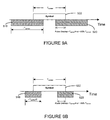
- the value that resides in the shift registers is clocked-out of the registers more quickly (relative to symbol or data signal 606) and the digital information (i.e., 806 and 812) provided to MDACs 808 and 814 changes accordingly so that the lengths of correction signals are shorter (compare, for example, FIGURES 9A and 9B).
- the appropriate timing signals may be provided by timing unit 900 and may be selected or programmed based on the considerations described above. That is, in one embodiment, the pulse durations of the tap(s) are adjusted or controlled during operation of the transmitter, for example using an adaptive algorithm, as described above. In another embodiment, the adjustment or control may be by user programming (either before or during operation of the transmitter).
- the pulse durations of the tap(s) may, in another embodiment, be pre-programmed or pre-set, for example, by permanently, semi-permanently or temporarily (i.e., until re-programmed) storing information representative of the pulse durations of the tap(s) in an SRAM, DRAM, ROM, PROM, EPROM, EEPROM or the like.
- the pre-programmed or pre-set pulse durations of the tap(s) may thereafter be fine-tuned to enhance the system performance.
- equalized data signal 802. there are many techniques for generating equalized data signal 802. For example, the summation of the equalization signals and the data signal (symbol) may be performed before converting the digital signals to analog representations. Under this circumstance, one DAC may be employed rather than three as illustrated in FIGURES 10A, 10B and 10C.
- a plurality of topologies of the equalization circuitry may be predetermined, preset or pre-programmed and selection of the topology to be implement by the equalization circuitry may be made, for example, at start-up/power-up or may be made during installation of the system (via hardwiring a pin on the package to a given state).
- the plurality of topologies may have: (1) predetermined, preset or pre-programmed timing relationships of the correction taps relative to the transmitted symbol (data signal), (2) predetermined, preset or pre-programmed tap coefficients, and/or (3) predetermined, preset or pre-programmed pulse durations of the equalization signals.
- a given topology of the plurality of topologies may be selected by the user according to, for example, an anticipated response of the system based on the communications environment. In this way, certain aspects of the complexity may be reduced or eliminated.
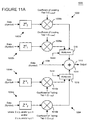
- leading taps 1002 may include two tap paths 1002a and 1002b (each path may have one or more taps). The selection of leading tap path 1002a or 1002b, and as such the leading tap path to be incorporated into the equalization process, is made by multiplexer 1016. It should be noted that leading taps 1002 may include more than just two tap paths.
- trailing taps 1004 may include two tap paths 1004a and 1004b (each path may have one or more taps). The selection of leading tap path 1004a or 1004b, and as such the trailing tap path to be incorporated into the equalization process, is made by multiplexer 1018. As with the leading taps, trailing taps 1004 may include more than just two tap paths.
- first leading tap path 1002a and trailing tap path 1004a may provide a tap timing, amplitude (coefficient), and pulse width relationship according to FIGURE 7 or FIGURE 9A.
- a second leading tap path 1002b and trailing tap path 1004b may provide a tap timing, amplitude (coefficient), and pulse width relationship according to FIGURE 9B or FIGURE 9C.
- multiplexers 1016 and 1018 the tap timing(s) of leading and trailing taps 1002 and 1004 are controlled by the multiplexers.
- This embodiment may be implemented in a manner according to FIGURE 10C.
- multiplexers 1016 and 1018 of FIGURE 11B are represented by multiplexers 902a and 902c of FIGURE 10C.
- Multiplexer 902b incorporates more flexibility into system 10 in that all three taps may be temporally adjusted.
- the topologies of the leading and trailing taps may or may not include intersymbol interference (i.e., temporal overlap of the equalization signals with the data (symbol) signal).
- a first topology may include y 1 and x 1 that are equal to about 1 ⁇ 2 or 3 ⁇ 4.
- a second topology may include y 2 and/or x 2 that are greater than or equal to about 1.
- the first topology includes temporal overlap between the leading/trailing taps and the data signal (symbol) (as illustrated in, for example, FIGURES 7, 9A and 9B)
- the second topology will include no temporal overlap or only the leading or trailing tap will temporally overlap.
- the user or system may select between the predetermined equalization effects (via multiplexers 1016 and 1018 and select signals) at installation (via configuring the state of a certain pin or pins on the package), after start-up/power-up, during an initialization sequence or a re-initialization sequence, or during operation.
- the predetermined, preset or pre-programmed parameters of the taps may be "hardwired" permanently, semi-permanently or temporarily (i.e., until re-programmed) by way of a DRAM, SRAM, ROM, PROM, EPROM, EEPROM or the like (e.g., configuring the state of a certain pin or pins on the package).
- a register on the transmitter may be programmed to store information representative of the selected leading and/or trailing tap paths.
- the register may be programmed or accessed after start-up/power-up, during an initialization sequence or a re-initialization sequence, or during operation.
- the selection of the tap paths to be implemented in the equalization process may be made by the user or the system, via programming of the register, according to, for example, a given or anticipated response of the communications channel.
- a given tap path may be advantageous in systems that experience or observe considerable jitter of the clock and/or data signals or in systems that experience or observe considerable crosstalk between signal lines.
- the selected response of the equalization circuitry may be implemented via programming of a discrete register or a register that may reside on the integrated circuit containing the transmitter (and the equalization circuitry).
- the parameters of the taps may also be fine tuned to enhance the system performance.
- the system may implement fine adjustments to the predetermined, preset or pre-programmed timing relationships of the correction taps, tap coefficients, and/or pulse durations of the equalization signals.
- the fine adjustments to these parameters may be accomplished using any of the techniques described above. Indeed, all techniques for determining these parameters, whether now known or later developed, are intended to be within the scope of the present invention.
- a first path of the leading and/or trailing taps may be "turned off' or disabled and another leading and/or trailing tap path may be "turned on” or enabled quite rapidly.
- the system need not determine the initial parameters (or some of the initial parameters) of the tap paths because such parameters may be stored in, for example, a DRAM, SRAM, ROM or EPROM. As such, the time delay in implementing a new equalization response or effect may be reduced and the system may become operational more rapidly.
- the equalization circuitry may include as many leading and/or trailing tap paths as desired.
- the taps may include a predetermined, preset or pre-programmed timing relationship, coefficients, and/or pulse durations. The user or system may then select from the plurality of tap paths which provides a given, desired or appropriate response.
- the system according to one aspect of the present invention includes leading and/or trailing tap(s) to provide intentional corrective intersymbol interference to reduce, minimize, mitigate or effectively eliminate pre-cursor and/or post-cursor intersymbol interference due to, for example, bandwidth limitations and reflections in high-speed digital communication systems.
- the amount of intersymbol interference correction designed into the equalization topology is controlled or determined by the timing relationship of the correction taps relative to the transmitted symbol or data, the coefficients of the taps, and/or the pulse durations of the equalization signals.
- the equalization structure and techniques of the present invention are incorporated into the transmitter.
- implementing the equalization circuitry and technique of the present invention at the transmitter may have an advantage in that it includes an IIR like-equalization component (a group delay response) created by the impulse response of the communications channel.
- the leader and/or trailer taps of the equalization circuitry are adjustable "corrections" applied to the transmitted symbol. These "correction" pulses are dispersed in the same manner that the transmitted symbol is dispersed by the impulse response of the channel. This effect may reduce or minimize the number of taps required to achieve a desired response and thereby improve or enhance the bandwidth of the transmitter output and the overall performance of the system.
- the present invention may be implemented using more than three taps (See, for example, FIGURE 5B). Indeed, some of the taps need not overlap but may be conventional type taps that have no overlap with the symbol or data signal and, as such, introduce no intentional intersymbol interference at the transmitter (see, for example, FIGURES 12C, 12D, 12E and 12F). Thus, the present invention may be a combination of overlapping and non-overlapping taps.
- the present invention may be implemented using only leading tap(s) (see, for example, FIGURE 12A), or trailing tap(s) (see, for example, FIGURES 12B and 12C), or as described above, using leading and trailing tap(s)(see, for example, FIGURES 5A, 5B, 6 and 11).
- the present invention may be implemented using overlapping leading tap(s) or trailing tap(s) and non-overlapping leading and/or trailing tap(s) (see, for example, FIGURES 12D, 12E and 12F).
- Other permutations of leading and trailing taps are suitable and are contemplated. As such, all permutations of leading and/or trailing taps having at least one tap that introduces intersymbol interference are intended to fall within the scope of the present invention.
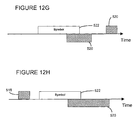
- the present invention may be implemented with taps having coefficients that are either positive or negative (i.e., digital C lead and C trail tap coefficients may be either positive or negative).
- the taps may be programmed or configured to add or subtract energy from the transmitted pulse.
- it may be advantageous to include a digital C trail tap coefficient that is positive and, as such, adds energy to compensate or address the reflection See for example, FIGURE 12G).
- it may be advantageous to include a digital C lead tap coefficient that is positive and, as such, adds energy to compensate or address an unwanted response of the system See for example, FIGURE 12H).
- the present invention has been described in the context of an analog FIR filter having one or more taps positioned before and/or after the transmitted symbol, the present invention may be implemented using other types of equalization circuitry, for example, IIR filters.
- signals are pulse or square shaped signals
- those illustrations should not be taken as limiting. Indeed, any shaped signals may be appropriate and the pulse shape of the equalization signal(s) is programmable or controllable so that the energy content of the equalization signals may be modified to provide the system additional flexibility in reducing, minimizing, mitigating or effectively eliminating pre-cursor and/or post-cursor intersymbol interference.
- communications channel 300 described herein may be, for example, constructed using one or more cables, wires, traces or the like, or may be part of a backplane, or may be a wireless communications medium through which the signal passes from transmitter 100 to receiver 200.
- any such communications media when used in conjunction with a corresponding transmitter/receiver pair appropriate for a particular medium, may be used to construct a communications channel in accordance with the present invention.
- all types of channels of communication i.e., communication channels, whether now known or later developed are intended to fall within the scope of the present invention.
- circuit may mean either a single component or a multiplicity of components, either active and/or passive, which are coupled together to provide or perform a desired function.
- circuitry may mean a circuit (whether integrated or otherwise), a group of such circuits, a processor(s), a processor(s) implementing software, or a combination of a circuit (whether integrated or otherwise), a group of such circuits, a processor(s) and/or a processor(s) implementing software.
- signal may mean a current or voltage signal whether in an analog or a digital form.
Landscapes
- Engineering & Computer Science (AREA)
- Power Engineering (AREA)
- Computer Networks & Wireless Communication (AREA)
- Signal Processing (AREA)
- Cable Transmission Systems, Equalization Of Radio And Reduction Of Echo (AREA)
- Dc Digital Transmission (AREA)
Applications Claiming Priority (2)
| Application Number | Priority Date | Filing Date | Title |
|---|---|---|---|
| US10/269,446 US7386053B2 (en) | 2002-10-11 | 2002-10-11 | System and method of equalization of high speed signals |
| US269446 | 2002-10-11 |
Publications (1)
| Publication Number | Publication Date |
|---|---|
| EP1408662A1 true EP1408662A1 (fr) | 2004-04-14 |
Family
ID=32030386
Family Applications (1)
| Application Number | Title | Priority Date | Filing Date |
|---|---|---|---|
| EP20030020569 Withdrawn EP1408662A1 (fr) | 2002-10-11 | 2003-09-18 | Système et procédé pour égalisation de signaux à grande vitesse |
Country Status (2)
| Country | Link |
|---|---|
| US (5) | US7386053B2 (fr) |
| EP (1) | EP1408662A1 (fr) |
Cited By (1)
| Publication number | Priority date | Publication date | Assignee | Title |
|---|---|---|---|---|
| CN103259512A (zh) * | 2012-01-31 | 2013-08-21 | 阿尔特拉公司 | 多电平幅度信号传输接收器 |
Families Citing this family (21)
| Publication number | Priority date | Publication date | Assignee | Title |
|---|---|---|---|---|
| US7386053B2 (en) * | 2002-10-11 | 2008-06-10 | Synopsys, Inc | System and method of equalization of high speed signals |
| US7126378B2 (en) | 2003-12-17 | 2006-10-24 | Rambus, Inc. | High speed signaling system with adaptive transmit pre-emphasis |
| US7092472B2 (en) * | 2003-09-16 | 2006-08-15 | Rambus Inc. | Data-level clock recovery |
| US7397848B2 (en) | 2003-04-09 | 2008-07-08 | Rambus Inc. | Partial response receiver |
| US7233164B2 (en) * | 2003-12-17 | 2007-06-19 | Rambus Inc. | Offset cancellation in a multi-level signaling system |
| US7773668B1 (en) * | 2004-01-21 | 2010-08-10 | Altera Corporation | Adaptive equalization methods and apparatus for programmable logic devices |
| US7817743B2 (en) * | 2004-12-22 | 2010-10-19 | Rambus Inc. | Multi-tone system with oversampled precoders |
| US8509321B2 (en) * | 2004-12-23 | 2013-08-13 | Rambus Inc. | Simultaneous bi-directional link |
| EP1856869B1 (fr) | 2005-01-20 | 2017-09-13 | Rambus Inc. | Systemes de signalisation a grande vitesse a egalisation et preaccentuation adaptables |
| GB2422991B (en) * | 2005-02-03 | 2009-06-17 | Agilent Technologies Inc | Method of equalising a channel and apparatus therefor |
| JP4666030B2 (ja) * | 2008-09-03 | 2011-04-06 | ソニー株式会社 | 情報処理装置、及び信号判定方法 |
| US8472513B2 (en) * | 2009-01-14 | 2013-06-25 | Lsi Corporation | TX back channel adaptation algorithm |
| JP5298894B2 (ja) * | 2009-01-30 | 2013-09-25 | 富士通株式会社 | 歪み補償装置,光受信装置及び光送受信システム |
| US8798126B2 (en) | 2011-10-31 | 2014-08-05 | Hewlett-Packard Development Company, L.P. | Receiver calibration using offset-data error rates |
| JP5807574B2 (ja) * | 2012-02-01 | 2015-11-10 | 富士通株式会社 | 送信回路、及び送信方法 |
| US8767811B2 (en) * | 2012-07-30 | 2014-07-01 | Lsi Corporation | Back channel adaptation using channel pulse response |
| US9595495B1 (en) | 2015-09-28 | 2017-03-14 | Altera Corporation | Multi-level signaling for on-package chip-to-chip interconnect through silicon bridge |
| US9866326B1 (en) * | 2016-10-12 | 2018-01-09 | Arista Networks, Inc. | Method for self-calibration of an electrical and/or optical channel |
| US9935682B1 (en) * | 2016-12-22 | 2018-04-03 | Dell Products, Lp | System and method for PAM-4 transmitter bit equalization for improved channel performance |
| KR20190051314A (ko) | 2017-11-06 | 2019-05-15 | 삼성전자주식회사 | 포스트 엠퍼시스 신호를 출력하기 위한 전자 회로 |
| US11153135B1 (en) * | 2021-01-11 | 2021-10-19 | Texas Instruments Incorporated | Methods and systems for adaptive equalization with wide range of signal amplitudes |
Citations (3)
| Publication number | Priority date | Publication date | Assignee | Title |
|---|---|---|---|---|
| EP0180066A2 (fr) * | 1984-11-02 | 1986-05-07 | Universal Data Systems Inc | Système de communication à modem à branchements multiples |
| EP1229698A2 (fr) * | 2001-02-01 | 2002-08-07 | Broadcom Corporation | Egaliseur à décision récursif pour canaux à phase minimale et maximale |
| US20020141347A1 (en) * | 2001-03-30 | 2002-10-03 | Harp Jeffrey C. | System and method of reducing ingress noise |
Family Cites Families (8)
| Publication number | Priority date | Publication date | Assignee | Title |
|---|---|---|---|---|
| US3716807A (en) * | 1971-05-24 | 1973-02-13 | Ibm | Recursive automatic equalizer and method of operation therefore |
| US4021738A (en) * | 1976-03-01 | 1977-05-03 | Bell Telephone Laboratories, Incorporated | Adaptive equalizer with fast convergence properties |
| US4422175A (en) * | 1981-06-11 | 1983-12-20 | Racal-Vadic, Inc. | Constrained adaptive equalizer |
| JPS5870716A (ja) * | 1981-10-24 | 1983-04-27 | Toyoda Autom Loom Works Ltd | 繊維束のドラフト方法および装置 |
| NL8202438A (nl) * | 1982-06-16 | 1984-01-16 | Philips Nv | Eindinrichting voor een duplex transmissiestelsel. |
| US4995057A (en) * | 1988-11-02 | 1991-02-19 | At&T Bell Laboratories | Technique for achieving the theoretical coding gain of digital signals incorporating error correction |
| US7386053B2 (en) * | 2002-10-11 | 2008-06-10 | Synopsys, Inc | System and method of equalization of high speed signals |
| US7263122B2 (en) * | 2003-07-29 | 2007-08-28 | Synopsys, Inc. | Receiver based decision feedback equalization circuitry and techniques |
-
2002
- 2002-10-11 US US10/269,446 patent/US7386053B2/en not_active Expired - Lifetime
-
2003
- 2003-04-10 US US10/412,101 patent/US7233617B2/en not_active Expired - Lifetime
- 2003-04-10 US US10/410,942 patent/US7277480B2/en not_active Expired - Lifetime
- 2003-09-18 EP EP20030020569 patent/EP1408662A1/fr not_active Withdrawn
-
2008
- 2008-04-25 US US12/109,779 patent/US7545860B2/en not_active Expired - Lifetime
-
2009
- 2009-06-08 US US12/480,197 patent/US7903729B2/en not_active Expired - Lifetime
Patent Citations (3)
| Publication number | Priority date | Publication date | Assignee | Title |
|---|---|---|---|---|
| EP0180066A2 (fr) * | 1984-11-02 | 1986-05-07 | Universal Data Systems Inc | Système de communication à modem à branchements multiples |
| EP1229698A2 (fr) * | 2001-02-01 | 2002-08-07 | Broadcom Corporation | Egaliseur à décision récursif pour canaux à phase minimale et maximale |
| US20020141347A1 (en) * | 2001-03-30 | 2002-10-03 | Harp Jeffrey C. | System and method of reducing ingress noise |
Non-Patent Citations (2)
| Title |
|---|
| FARJAD-RAD R ET AL: "A 0.4-MUM CMOS 10-GB/S 4-PAM PRE-EMPHASIS SERIAL LINK TRANSMITTER", IEEE JOURNAL OF SOLID-STATE CIRCUITS, IEEE INC. NEW YORK, US, VOL. 34, NR. 5, PAGE(S) 580-585, ISSN: 0018-9200, XP000908569 * |
| IEEE, IEEE 802.14A. HIGH-CAPACITY PHYSICAL LAYER SPECIFICATION, 1999, pages 1 - 81, XP002267224, Retrieved from the Internet <URL:http://home.knology.net/ieee80214/802_14a/dr1rev4_working99-124.pdf> [retrieved on 20040119] * |
Cited By (2)
| Publication number | Priority date | Publication date | Assignee | Title |
|---|---|---|---|---|
| CN103259512A (zh) * | 2012-01-31 | 2013-08-21 | 阿尔特拉公司 | 多电平幅度信号传输接收器 |
| CN103259512B (zh) * | 2012-01-31 | 2018-04-20 | 阿尔特拉公司 | 多电平幅度信号传输接收器 |
Also Published As
| Publication number | Publication date |
|---|---|
| US20040071203A1 (en) | 2004-04-15 |
| US20080198915A1 (en) | 2008-08-21 |
| US7903729B2 (en) | 2011-03-08 |
| US7277480B2 (en) | 2007-10-02 |
| US7386053B2 (en) | 2008-06-10 |
| US7233617B2 (en) | 2007-06-19 |
| US20090262797A1 (en) | 2009-10-22 |
| US20040071205A1 (en) | 2004-04-15 |
| US7545860B2 (en) | 2009-06-09 |
| US20040071204A1 (en) | 2004-04-15 |
Similar Documents
| Publication | Publication Date | Title |
|---|---|---|
| US7545860B2 (en) | System and method of equalization of high speed signals | |
| US12316482B2 (en) | High-speed signaling systems and methods with adaptable, continuous-time equalization | |
| US11115247B2 (en) | Methods and circuits for asymmetric distribution of channel equalization between devices | |
| US7230979B2 (en) | System and method for high speed digital signaling | |
| JP2005278222A (ja) | データ通信のための混合モード適応アナログ受信アーキテクチャ | |
| US7330506B2 (en) | System and method for providing variable delay FIR equalizer for serial baseband communications | |
| CN116827731A (zh) | 判决反馈均衡器及其相关方法 | |
| HK1159884B (en) | A transmitter and receiver |
Legal Events
| Date | Code | Title | Description |
|---|---|---|---|
| PUAI | Public reference made under article 153(3) epc to a published international application that has entered the european phase |
Free format text: ORIGINAL CODE: 0009012 |
|
| AK | Designated contracting states |
Kind code of ref document: A1 Designated state(s): AT BE BG CH CY CZ DE DK EE ES FI FR GB GR HU IE IT LI LU MC NL PT RO SE SI SK TR |
|
| AX | Request for extension of the european patent |
Extension state: AL LT LV MK |
|
| AKX | Designation fees paid | ||
| REG | Reference to a national code |
Ref country code: DE Ref legal event code: 8566 |
|
| STAA | Information on the status of an ep patent application or granted ep patent |
Free format text: STATUS: THE APPLICATION IS DEEMED TO BE WITHDRAWN |
|
| 18D | Application deemed to be withdrawn |
Effective date: 20041015 |