EP1409577B1 - Matieres a mouler thermoplastiques ignifugees - Google Patents
Matieres a mouler thermoplastiques ignifugees Download PDFInfo
- Publication number
- EP1409577B1 EP1409577B1 EP02743254A EP02743254A EP1409577B1 EP 1409577 B1 EP1409577 B1 EP 1409577B1 EP 02743254 A EP02743254 A EP 02743254A EP 02743254 A EP02743254 A EP 02743254A EP 1409577 B1 EP1409577 B1 EP 1409577B1
- Authority
- EP
- European Patent Office
- Prior art keywords
- weight
- tartrates
- thermoplastic molding
- alkyl
- component
- Prior art date
- Legal status (The legal status is an assumption and is not a legal conclusion. Google has not performed a legal analysis and makes no representation as to the accuracy of the status listed.)
- Expired - Lifetime
Links
- 238000009757 thermoplastic moulding Methods 0.000 title claims abstract description 16
- 239000000463 material Substances 0.000 title abstract description 6
- 239000000203 mixture Substances 0.000 claims abstract description 69
- 229920000728 polyester Polymers 0.000 claims abstract description 29
- FEWJPZIEWOKRBE-UHFFFAOYSA-N Tartaric acid Natural products [H+].[H+].[O-]C(=O)C(O)C(O)C([O-])=O FEWJPZIEWOKRBE-UHFFFAOYSA-N 0.000 claims abstract description 24
- FEWJPZIEWOKRBE-JCYAYHJZSA-N Dextrotartaric acid Chemical compound OC(=O)[C@H](O)[C@@H](O)C(O)=O FEWJPZIEWOKRBE-JCYAYHJZSA-N 0.000 claims abstract description 21
- 239000011975 tartaric acid Substances 0.000 claims abstract description 18
- 235000002906 tartaric acid Nutrition 0.000 claims abstract description 18
- 229910052736 halogen Inorganic materials 0.000 claims abstract description 8
- 150000002367 halogens Chemical class 0.000 claims abstract description 8
- 150000003892 tartrate salts Chemical class 0.000 claims abstract description 7
- 229920001169 thermoplastic Polymers 0.000 claims abstract description 6
- 239000004416 thermosoftening plastic Substances 0.000 claims abstract description 6
- -1 alkali metal tartrates Chemical class 0.000 claims description 58
- 238000000465 moulding Methods 0.000 claims description 24
- 125000004432 carbon atom Chemical group C* 0.000 claims description 21
- 229910052739 hydrogen Inorganic materials 0.000 claims description 17
- 239000001257 hydrogen Substances 0.000 claims description 17
- 150000002148 esters Chemical class 0.000 claims description 14
- 239000003063 flame retardant Substances 0.000 claims description 13
- 150000002431 hydrogen Chemical group 0.000 claims description 11
- 125000002887 hydroxy group Chemical group [H]O* 0.000 claims description 11
- 125000001931 aliphatic group Chemical group 0.000 claims description 10
- 125000004209 (C1-C8) alkyl group Chemical group 0.000 claims description 9
- 239000003381 stabilizer Substances 0.000 claims description 9
- RNFJDJUURJAICM-UHFFFAOYSA-N 2,2,4,4,6,6-hexaphenoxy-1,3,5-triaza-2$l^{5},4$l^{5},6$l^{5}-triphosphacyclohexa-1,3,5-triene Chemical compound N=1P(OC=2C=CC=CC=2)(OC=2C=CC=CC=2)=NP(OC=2C=CC=CC=2)(OC=2C=CC=CC=2)=NP=1(OC=1C=CC=CC=1)OC1=CC=CC=C1 RNFJDJUURJAICM-UHFFFAOYSA-N 0.000 claims description 8
- 229910019142 PO4 Inorganic materials 0.000 claims description 6
- ADCOVFLJGNWWNZ-UHFFFAOYSA-N antimony trioxide Chemical compound O=[Sb]O[Sb]=O ADCOVFLJGNWWNZ-UHFFFAOYSA-N 0.000 claims description 6
- 235000021317 phosphate Nutrition 0.000 claims description 6
- 229910052698 phosphorus Inorganic materials 0.000 claims description 6
- XEEYBQQBJWHFJM-UHFFFAOYSA-N Iron Chemical compound [Fe] XEEYBQQBJWHFJM-UHFFFAOYSA-N 0.000 claims description 5
- WVDDGKGOMKODPV-UHFFFAOYSA-N Benzyl alcohol Chemical compound OCC1=CC=CC=C1 WVDDGKGOMKODPV-UHFFFAOYSA-N 0.000 claims description 4
- OAICVXFJPJFONN-UHFFFAOYSA-N Phosphorus Chemical compound [P] OAICVXFJPJFONN-UHFFFAOYSA-N 0.000 claims description 4
- 239000000654 additive Substances 0.000 claims description 4
- 125000002723 alicyclic group Chemical group 0.000 claims description 4
- 229910052784 alkaline earth metal Inorganic materials 0.000 claims description 4
- LJCFOYOSGPHIOO-UHFFFAOYSA-N antimony pentoxide Chemical compound O=[Sb](=O)O[Sb](=O)=O LJCFOYOSGPHIOO-UHFFFAOYSA-N 0.000 claims description 4
- 239000000835 fiber Substances 0.000 claims description 4
- 235000016337 monopotassium tartrate Nutrition 0.000 claims description 4
- 229910052760 oxygen Inorganic materials 0.000 claims description 4
- 239000001301 oxygen Substances 0.000 claims description 4
- XRBCRPZXSCBRTK-UHFFFAOYSA-N phosphonous acid Chemical compound OPO XRBCRPZXSCBRTK-UHFFFAOYSA-N 0.000 claims description 4
- 239000011574 phosphorus Substances 0.000 claims description 4
- 229910052717 sulfur Inorganic materials 0.000 claims description 4
- 235000011006 sodium potassium tartrate Nutrition 0.000 claims description 3
- 239000011593 sulfur Substances 0.000 claims description 3
- 229910000165 zinc phosphate Inorganic materials 0.000 claims description 3
- KIQKNTIOWITBBA-UHFFFAOYSA-K antimony(3+);phosphate Chemical compound [Sb+3].[O-]P([O-])([O-])=O KIQKNTIOWITBBA-UHFFFAOYSA-K 0.000 claims description 2
- 239000003990 capacitor Substances 0.000 claims description 2
- 125000004437 phosphorous atom Chemical group 0.000 claims description 2
- 239000007858 starting material Substances 0.000 claims description 2
- LRXTYHSAJDENHV-UHFFFAOYSA-H zinc phosphate Chemical compound [Zn+2].[Zn+2].[Zn+2].[O-]P([O-])([O-])=O.[O-]P([O-])([O-])=O LRXTYHSAJDENHV-UHFFFAOYSA-H 0.000 claims description 2
- NBIIXXVUZAFLBC-UHFFFAOYSA-K phosphate Chemical compound [O-]P([O-])([O-])=O NBIIXXVUZAFLBC-UHFFFAOYSA-K 0.000 claims 2
- 239000010452 phosphate Substances 0.000 claims 2
- OJMIONKXNSYLSR-UHFFFAOYSA-N phosphorous acid Chemical compound OP(O)O OJMIONKXNSYLSR-UHFFFAOYSA-N 0.000 claims 2
- 229910052783 alkali metal Inorganic materials 0.000 claims 1
- 229910000318 alkali metal phosphate Inorganic materials 0.000 claims 1
- 229910000316 alkaline earth metal phosphate Inorganic materials 0.000 claims 1
- ILRRQNADMUWWFW-UHFFFAOYSA-K aluminium phosphate Chemical compound O1[Al]2OP1(=O)O2 ILRRQNADMUWWFW-UHFFFAOYSA-K 0.000 claims 1
- 229910000154 gallium phosphate Inorganic materials 0.000 claims 1
- LWFNJDOYCSNXDO-UHFFFAOYSA-K gallium;phosphate Chemical compound [Ga+3].[O-]P([O-])([O-])=O LWFNJDOYCSNXDO-UHFFFAOYSA-K 0.000 claims 1
- 229910052742 iron Inorganic materials 0.000 claims 1
- NKAAEMMYHLFEFN-UHFFFAOYSA-M monosodium tartrate Chemical class [Na+].OC(=O)C(O)C(O)C([O-])=O NKAAEMMYHLFEFN-UHFFFAOYSA-M 0.000 claims 1
- LJCNRYVRMXRIQR-UHFFFAOYSA-L potassium sodium tartrate Chemical class [Na+].[K+].[O-]C(=O)C(O)C(O)C([O-])=O LJCNRYVRMXRIQR-UHFFFAOYSA-L 0.000 claims 1
- AVTYONGGKAJVTE-UHFFFAOYSA-L potassium tartrate Chemical class [K+].[K+].[O-]C(=O)C(O)C(O)C([O-])=O AVTYONGGKAJVTE-UHFFFAOYSA-L 0.000 claims 1
- 239000001472 potassium tartrate Substances 0.000 claims 1
- 235000011005 potassium tartrates Nutrition 0.000 claims 1
- KYKNRZGSIGMXFH-UHFFFAOYSA-M potassium;2,3-dihydroxybutanedioate;hydron Chemical class [K+].OC(=O)C(O)C(O)C([O-])=O KYKNRZGSIGMXFH-UHFFFAOYSA-M 0.000 claims 1
- 230000001681 protective effect Effects 0.000 claims 1
- HELHAJAZNSDZJO-UHFFFAOYSA-L sodium tartrate Chemical class [Na+].[Na+].[O-]C(=O)C(O)C(O)C([O-])=O HELHAJAZNSDZJO-UHFFFAOYSA-L 0.000 claims 1
- 239000001433 sodium tartrate Substances 0.000 claims 1
- 235000011004 sodium tartrates Nutrition 0.000 claims 1
- BHEPBYXIRTUNPN-UHFFFAOYSA-N hydridophosphorus(.) (triplet) Chemical compound [PH] BHEPBYXIRTUNPN-UHFFFAOYSA-N 0.000 abstract 1
- 239000000178 monomer Substances 0.000 description 30
- 229920001971 elastomer Polymers 0.000 description 28
- UFHFLCQGNIYNRP-UHFFFAOYSA-N Hydrogen Chemical compound [H][H] UFHFLCQGNIYNRP-UHFFFAOYSA-N 0.000 description 18
- 150000001875 compounds Chemical class 0.000 description 18
- 238000000034 method Methods 0.000 description 18
- 239000004417 polycarbonate Substances 0.000 description 16
- 239000005060 rubber Substances 0.000 description 16
- 229960001367 tartaric acid Drugs 0.000 description 16
- 229920000515 polycarbonate Polymers 0.000 description 15
- 125000000217 alkyl group Chemical group 0.000 description 14
- 125000003118 aryl group Chemical group 0.000 description 13
- 125000003178 carboxy group Chemical group [H]OC(*)=O 0.000 description 12
- 239000000806 elastomer Substances 0.000 description 12
- PPBRXRYQALVLMV-UHFFFAOYSA-N Styrene Natural products C=CC1=CC=CC=C1 PPBRXRYQALVLMV-UHFFFAOYSA-N 0.000 description 11
- 125000001997 phenyl group Chemical group [H]C1=C([H])C([H])=C(*)C([H])=C1[H] 0.000 description 11
- 150000003254 radicals Chemical class 0.000 description 11
- KAKZBPTYRLMSJV-UHFFFAOYSA-N Butadiene Chemical compound C=CC=C KAKZBPTYRLMSJV-UHFFFAOYSA-N 0.000 description 10
- IISBACLAFKSPIT-UHFFFAOYSA-N bisphenol A Chemical compound C=1C=C(O)C=CC=1C(C)(C)C1=CC=C(O)C=C1 IISBACLAFKSPIT-UHFFFAOYSA-N 0.000 description 10
- 229920001577 copolymer Polymers 0.000 description 10
- WKBOTKDWSSQWDR-UHFFFAOYSA-N Bromine atom Chemical compound [Br] WKBOTKDWSSQWDR-UHFFFAOYSA-N 0.000 description 9
- CERQOIWHTDAKMF-UHFFFAOYSA-N Methacrylic acid Chemical compound CC(=C)C(O)=O CERQOIWHTDAKMF-UHFFFAOYSA-N 0.000 description 9
- GDTBXPJZTBHREO-UHFFFAOYSA-N bromine Substances BrBr GDTBXPJZTBHREO-UHFFFAOYSA-N 0.000 description 9
- 229910052794 bromium Inorganic materials 0.000 description 9
- 238000002425 crystallisation Methods 0.000 description 9
- 230000008025 crystallization Effects 0.000 description 9
- 229920000139 polyethylene terephthalate Polymers 0.000 description 9
- 239000005020 polyethylene terephthalate Substances 0.000 description 9
- 229920000642 polymer Polymers 0.000 description 9
- RRHGJUQNOFWUDK-UHFFFAOYSA-N Isoprene Chemical compound CC(=C)C=C RRHGJUQNOFWUDK-UHFFFAOYSA-N 0.000 description 8
- 229920001283 Polyalkylene terephthalate Polymers 0.000 description 8
- 239000002253 acid Substances 0.000 description 8
- CQEYYJKEWSMYFG-UHFFFAOYSA-N butyl acrylate Chemical compound CCCCOC(=O)C=C CQEYYJKEWSMYFG-UHFFFAOYSA-N 0.000 description 8
- QQVIHTHCMHWDBS-UHFFFAOYSA-N isophthalic acid Chemical compound OC(=O)C1=CC=CC(C(O)=O)=C1 QQVIHTHCMHWDBS-UHFFFAOYSA-N 0.000 description 8
- 239000012071 phase Substances 0.000 description 8
- KKEYFWRCBNTPAC-UHFFFAOYSA-N Terephthalic acid Chemical compound OC(=O)C1=CC=C(C(O)=O)C=C1 KKEYFWRCBNTPAC-UHFFFAOYSA-N 0.000 description 7
- NIXOWILDQLNWCW-UHFFFAOYSA-N acrylic acid group Chemical group C(C=C)(=O)O NIXOWILDQLNWCW-UHFFFAOYSA-N 0.000 description 7
- 238000012545 processing Methods 0.000 description 7
- 125000001424 substituent group Chemical group 0.000 description 7
- VGGSQFUCUMXWEO-UHFFFAOYSA-N Ethene Chemical compound C=C VGGSQFUCUMXWEO-UHFFFAOYSA-N 0.000 description 6
- VZCYOOQTPOCHFL-OWOJBTEDSA-N Fumaric acid Chemical compound OC(=O)\C=C\C(O)=O VZCYOOQTPOCHFL-OWOJBTEDSA-N 0.000 description 6
- KRKNYBCHXYNGOX-UHFFFAOYSA-N citric acid Chemical compound OC(=O)CC(O)(C(O)=O)CC(O)=O KRKNYBCHXYNGOX-UHFFFAOYSA-N 0.000 description 6
- 238000004519 manufacturing process Methods 0.000 description 6
- 229920000573 polyethylene Polymers 0.000 description 6
- 238000006116 polymerization reaction Methods 0.000 description 6
- 238000002360 preparation method Methods 0.000 description 6
- 239000000047 product Substances 0.000 description 6
- 239000000126 substance Chemical group 0.000 description 6
- VZCYOOQTPOCHFL-UHFFFAOYSA-N trans-butenedioic acid Natural products OC(=O)C=CC(O)=O VZCYOOQTPOCHFL-UHFFFAOYSA-N 0.000 description 6
- SMZOUWXMTYCWNB-UHFFFAOYSA-N 2-(2-methoxy-5-methylphenyl)ethanamine Chemical compound COC1=CC=C(C)C=C1CCN SMZOUWXMTYCWNB-UHFFFAOYSA-N 0.000 description 5
- ZAMOUSCENKQFHK-UHFFFAOYSA-N Chlorine atom Chemical compound [Cl] ZAMOUSCENKQFHK-UHFFFAOYSA-N 0.000 description 5
- 229920002943 EPDM rubber Polymers 0.000 description 5
- 239000005977 Ethylene Substances 0.000 description 5
- YCKRFDGAMUMZLT-UHFFFAOYSA-N Fluorine atom Chemical compound [F] YCKRFDGAMUMZLT-UHFFFAOYSA-N 0.000 description 5
- OFOBLEOULBTSOW-UHFFFAOYSA-N Malonic acid Chemical compound OC(=O)CC(O)=O OFOBLEOULBTSOW-UHFFFAOYSA-N 0.000 description 5
- BAPJBEWLBFYGME-UHFFFAOYSA-N Methyl acrylate Chemical compound COC(=O)C=C BAPJBEWLBFYGME-UHFFFAOYSA-N 0.000 description 5
- 150000007513 acids Chemical class 0.000 description 5
- 239000000460 chlorine Substances 0.000 description 5
- 229910052801 chlorine Inorganic materials 0.000 description 5
- 125000003700 epoxy group Chemical group 0.000 description 5
- 229910052731 fluorine Inorganic materials 0.000 description 5
- 239000011737 fluorine Substances 0.000 description 5
- FPYJFEHAWHCUMM-UHFFFAOYSA-N maleic anhydride Chemical compound O=C1OC(=O)C=C1 FPYJFEHAWHCUMM-UHFFFAOYSA-N 0.000 description 5
- 238000002156 mixing Methods 0.000 description 5
- 229920001707 polybutylene terephthalate Polymers 0.000 description 5
- 150000003839 salts Chemical class 0.000 description 5
- 150000004756 silanes Chemical class 0.000 description 5
- RFFLAFLAYFXFSW-UHFFFAOYSA-N 1,2-dichlorobenzene Chemical compound ClC1=CC=CC=C1Cl RFFLAFLAYFXFSW-UHFFFAOYSA-N 0.000 description 4
- JIGUQPWFLRLWPJ-UHFFFAOYSA-N Ethyl acrylate Chemical compound CCOC(=O)C=C JIGUQPWFLRLWPJ-UHFFFAOYSA-N 0.000 description 4
- LYCAIKOWRPUZTN-UHFFFAOYSA-N Ethylene glycol Chemical compound OCCO LYCAIKOWRPUZTN-UHFFFAOYSA-N 0.000 description 4
- QIGBRXMKCJKVMJ-UHFFFAOYSA-N Hydroquinone Chemical compound OC1=CC=C(O)C=C1 QIGBRXMKCJKVMJ-UHFFFAOYSA-N 0.000 description 4
- ISWSIDIOOBJBQZ-UHFFFAOYSA-N Phenol Chemical compound OC1=CC=CC=C1 ISWSIDIOOBJBQZ-UHFFFAOYSA-N 0.000 description 4
- YGYAWVDWMABLBF-UHFFFAOYSA-N Phosgene Chemical compound ClC(Cl)=O YGYAWVDWMABLBF-UHFFFAOYSA-N 0.000 description 4
- VYPSYNLAJGMNEJ-UHFFFAOYSA-N Silicium dioxide Chemical compound O=[Si]=O VYPSYNLAJGMNEJ-UHFFFAOYSA-N 0.000 description 4
- 150000001298 alcohols Chemical class 0.000 description 4
- 150000001408 amides Chemical class 0.000 description 4
- 150000001735 carboxylic acids Chemical class 0.000 description 4
- 239000012141 concentrate Substances 0.000 description 4
- 150000001991 dicarboxylic acids Chemical class 0.000 description 4
- 150000001993 dienes Chemical class 0.000 description 4
- UKMSUNONTOPOIO-UHFFFAOYSA-N docosanoic acid Chemical compound CCCCCCCCCCCCCCCCCCCCCC(O)=O UKMSUNONTOPOIO-UHFFFAOYSA-N 0.000 description 4
- NAQMVNRVTILPCV-UHFFFAOYSA-N hexane-1,6-diamine Chemical compound NCCCCCCN NAQMVNRVTILPCV-UHFFFAOYSA-N 0.000 description 4
- 125000004464 hydroxyphenyl group Chemical group 0.000 description 4
- FEWJPZIEWOKRBE-LWMBPPNESA-N levotartaric acid Chemical compound OC(=O)[C@@H](O)[C@H](O)C(O)=O FEWJPZIEWOKRBE-LWMBPPNESA-N 0.000 description 4
- 239000012764 mineral filler Substances 0.000 description 4
- RPQRDASANLAFCM-UHFFFAOYSA-N oxiran-2-ylmethyl prop-2-enoate Chemical compound C=CC(=O)OCC1CO1 RPQRDASANLAFCM-UHFFFAOYSA-N 0.000 description 4
- PNJWIWWMYCMZRO-UHFFFAOYSA-N pent‐4‐en‐2‐one Natural products CC(=O)CC=C PNJWIWWMYCMZRO-UHFFFAOYSA-N 0.000 description 4
- 150000003013 phosphoric acid derivatives Chemical class 0.000 description 4
- 125000004178 (C1-C4) alkyl group Chemical group 0.000 description 3
- GOXQRTZXKQZDDN-UHFFFAOYSA-N 2-Ethylhexyl acrylate Chemical compound CCCCC(CC)COC(=O)C=C GOXQRTZXKQZDDN-UHFFFAOYSA-N 0.000 description 3
- NLHHRLWOUZZQLW-UHFFFAOYSA-N Acrylonitrile Chemical compound C=CC#N NLHHRLWOUZZQLW-UHFFFAOYSA-N 0.000 description 3
- 239000005995 Aluminium silicate Substances 0.000 description 3
- 239000004908 Emulsion polymer Substances 0.000 description 3
- PEDCQBHIVMGVHV-UHFFFAOYSA-N Glycerine Chemical compound OCC(O)CO PEDCQBHIVMGVHV-UHFFFAOYSA-N 0.000 description 3
- FEWJPZIEWOKRBE-XIXRPRMCSA-N Mesotartaric acid Chemical compound OC(=O)[C@@H](O)[C@@H](O)C(O)=O FEWJPZIEWOKRBE-XIXRPRMCSA-N 0.000 description 3
- 239000004698 Polyethylene Substances 0.000 description 3
- 239000004793 Polystyrene Substances 0.000 description 3
- DNIAPMSPPWPWGF-UHFFFAOYSA-N Propylene glycol Chemical compound CC(O)CO DNIAPMSPPWPWGF-UHFFFAOYSA-N 0.000 description 3
- HEMHJVSKTPXQMS-UHFFFAOYSA-M Sodium hydroxide Chemical compound [OH-].[Na+] HEMHJVSKTPXQMS-UHFFFAOYSA-M 0.000 description 3
- YXFVVABEGXRONW-UHFFFAOYSA-N Toluene Chemical compound CC1=CC=CC=C1 YXFVVABEGXRONW-UHFFFAOYSA-N 0.000 description 3
- 150000001252 acrylic acid derivatives Chemical class 0.000 description 3
- 239000003513 alkali Substances 0.000 description 3
- 125000003545 alkoxy group Chemical group 0.000 description 3
- 235000012211 aluminium silicate Nutrition 0.000 description 3
- 125000000732 arylene group Chemical group 0.000 description 3
- 125000001797 benzyl group Chemical group [H]C1=C([H])C([H])=C(C([H])=C1[H])C([H])([H])* 0.000 description 3
- 238000004132 cross linking Methods 0.000 description 3
- 238000001125 extrusion Methods 0.000 description 3
- 239000001530 fumaric acid Substances 0.000 description 3
- 239000011521 glass Substances 0.000 description 3
- 239000003365 glass fiber Substances 0.000 description 3
- 230000009477 glass transition Effects 0.000 description 3
- VOZRXNHHFUQHIL-UHFFFAOYSA-N glycidyl methacrylate Chemical compound CC(=C)C(=O)OCC1CO1 VOZRXNHHFUQHIL-UHFFFAOYSA-N 0.000 description 3
- 239000008187 granular material Substances 0.000 description 3
- 238000010438 heat treatment Methods 0.000 description 3
- 238000001746 injection moulding Methods 0.000 description 3
- NLYAJNPCOHFWQQ-UHFFFAOYSA-N kaolin Chemical compound O.O.O=[Al]O[Si](=O)O[Si](=O)O[Al]=O NLYAJNPCOHFWQQ-UHFFFAOYSA-N 0.000 description 3
- VZCYOOQTPOCHFL-UPHRSURJSA-N maleic acid Chemical compound OC(=O)\C=C/C(O)=O VZCYOOQTPOCHFL-UPHRSURJSA-N 0.000 description 3
- 239000011976 maleic acid Substances 0.000 description 3
- 238000005259 measurement Methods 0.000 description 3
- 150000002734 metacrylic acid derivatives Chemical class 0.000 description 3
- 238000006384 oligomerization reaction Methods 0.000 description 3
- 239000002245 particle Substances 0.000 description 3
- 229920003023 plastic Polymers 0.000 description 3
- 239000004033 plastic Substances 0.000 description 3
- 229920002223 polystyrene Polymers 0.000 description 3
- 229920001343 polytetrafluoroethylene Polymers 0.000 description 3
- KYKNRZGSIGMXFH-ZVGUSBNCSA-M potassium bitartrate Chemical compound [K+].OC(=O)[C@H](O)[C@@H](O)C([O-])=O KYKNRZGSIGMXFH-ZVGUSBNCSA-M 0.000 description 3
- 229920006395 saturated elastomer Polymers 0.000 description 3
- 238000005809 transesterification reaction Methods 0.000 description 3
- 125000006832 (C1-C10) alkylene group Chemical group 0.000 description 2
- MYRTYDVEIRVNKP-UHFFFAOYSA-N 1,2-Divinylbenzene Chemical compound C=CC1=CC=CC=C1C=C MYRTYDVEIRVNKP-UHFFFAOYSA-N 0.000 description 2
- QHZLMUACJMDIAE-UHFFFAOYSA-N 1-monopalmitoylglycerol Chemical compound CCCCCCCCCCCCCCCC(=O)OCC(O)CO QHZLMUACJMDIAE-UHFFFAOYSA-N 0.000 description 2
- HECLRDQVFMWTQS-RGOKHQFPSA-N 1755-01-7 Chemical compound C1[C@H]2[C@@H]3CC=C[C@@H]3[C@@H]1C=C2 HECLRDQVFMWTQS-RGOKHQFPSA-N 0.000 description 2
- 125000003903 2-propenyl group Chemical group [H]C([*])([H])C([H])=C([H])[H] 0.000 description 2
- VEORPZCZECFIRK-UHFFFAOYSA-N 3,3',5,5'-tetrabromobisphenol A Chemical compound C=1C(Br)=C(O)C(Br)=CC=1C(C)(C)C1=CC(Br)=C(O)C(Br)=C1 VEORPZCZECFIRK-UHFFFAOYSA-N 0.000 description 2
- UMPGNGRIGSEMTC-UHFFFAOYSA-N 4-[1-(4-hydroxyphenyl)-3,3,5-trimethylcyclohexyl]phenol Chemical compound C1C(C)CC(C)(C)CC1(C=1C=CC(O)=CC=1)C1=CC=C(O)C=C1 UMPGNGRIGSEMTC-UHFFFAOYSA-N 0.000 description 2
- NIRYBKWMEWFDPM-UHFFFAOYSA-N 4-[3-(4-hydroxyphenyl)-3-methylbutyl]phenol Chemical compound C=1C=C(O)C=CC=1C(C)(C)CCC1=CC=C(O)C=C1 NIRYBKWMEWFDPM-UHFFFAOYSA-N 0.000 description 2
- 235000021357 Behenic acid Nutrition 0.000 description 2
- SDDLEVPIDBLVHC-UHFFFAOYSA-N Bisphenol Z Chemical compound C1=CC(O)=CC=C1C1(C=2C=CC(O)=CC=2)CCCCC1 SDDLEVPIDBLVHC-UHFFFAOYSA-N 0.000 description 2
- IRIAEXORFWYRCZ-UHFFFAOYSA-N Butylbenzyl phthalate Chemical compound CCCCOC(=O)C1=CC=CC=C1C(=O)OCC1=CC=CC=C1 IRIAEXORFWYRCZ-UHFFFAOYSA-N 0.000 description 2
- 0 CO*(N([N+]([O-])OC)OC)[N+]([O-])O Chemical compound CO*(N([N+]([O-])OC)OC)[N+]([O-])O 0.000 description 2
- 229920000049 Carbon (fiber) Polymers 0.000 description 2
- 208000006558 Dental Calculus Diseases 0.000 description 2
- PIICEJLVQHRZGT-UHFFFAOYSA-N Ethylenediamine Chemical compound NCCN PIICEJLVQHRZGT-UHFFFAOYSA-N 0.000 description 2
- MHAJPDPJQMAIIY-UHFFFAOYSA-N Hydrogen peroxide Chemical compound OO MHAJPDPJQMAIIY-UHFFFAOYSA-N 0.000 description 2
- DGAQECJNVWCQMB-PUAWFVPOSA-M Ilexoside XXIX Chemical compound C[C@@H]1CC[C@@]2(CC[C@@]3(C(=CC[C@H]4[C@]3(CC[C@@H]5[C@@]4(CC[C@@H](C5(C)C)OS(=O)(=O)[O-])C)C)[C@@H]2[C@]1(C)O)C)C(=O)O[C@H]6[C@@H]([C@H]([C@@H]([C@H](O6)CO)O)O)O.[Na+] DGAQECJNVWCQMB-PUAWFVPOSA-M 0.000 description 2
- OWYWGLHRNBIFJP-UHFFFAOYSA-N Ipazine Chemical compound CCN(CC)C1=NC(Cl)=NC(NC(C)C)=N1 OWYWGLHRNBIFJP-UHFFFAOYSA-N 0.000 description 2
- UQSXHKLRYXJYBZ-UHFFFAOYSA-N Iron oxide Chemical compound [Fe]=O UQSXHKLRYXJYBZ-UHFFFAOYSA-N 0.000 description 2
- VQTUBCCKSQIDNK-UHFFFAOYSA-N Isobutene Chemical compound CC(C)=C VQTUBCCKSQIDNK-UHFFFAOYSA-N 0.000 description 2
- VVQNEPGJFQJSBK-UHFFFAOYSA-N Methyl methacrylate Chemical compound COC(=O)C(C)=C VVQNEPGJFQJSBK-UHFFFAOYSA-N 0.000 description 2
- LRHPLDYGYMQRHN-UHFFFAOYSA-N N-Butanol Chemical compound CCCCO LRHPLDYGYMQRHN-UHFFFAOYSA-N 0.000 description 2
- IPRJXAGUEGOFGG-UHFFFAOYSA-N N-butylbenzenesulfonamide Chemical compound CCCCNS(=O)(=O)C1=CC=CC=C1 IPRJXAGUEGOFGG-UHFFFAOYSA-N 0.000 description 2
- ZLMJMSJWJFRBEC-UHFFFAOYSA-N Potassium Chemical compound [K] ZLMJMSJWJFRBEC-UHFFFAOYSA-N 0.000 description 2
- JUJWROOIHBZHMG-UHFFFAOYSA-N Pyridine Chemical compound C1=CC=NC=C1 JUJWROOIHBZHMG-UHFFFAOYSA-N 0.000 description 2
- 235000021355 Stearic acid Nutrition 0.000 description 2
- QAOWNCQODCNURD-UHFFFAOYSA-N Sulfuric acid Chemical compound OS(O)(=O)=O QAOWNCQODCNURD-UHFFFAOYSA-N 0.000 description 2
- WYURNTSHIVDZCO-UHFFFAOYSA-N Tetrahydrofuran Chemical compound C1CCOC1 WYURNTSHIVDZCO-UHFFFAOYSA-N 0.000 description 2
- GWEVSGVZZGPLCZ-UHFFFAOYSA-N Titan oxide Chemical compound O=[Ti]=O GWEVSGVZZGPLCZ-UHFFFAOYSA-N 0.000 description 2
- QYKIQEUNHZKYBP-UHFFFAOYSA-N Vinyl ether Chemical class C=COC=C QYKIQEUNHZKYBP-UHFFFAOYSA-N 0.000 description 2
- OCKWAZCWKSMKNC-UHFFFAOYSA-N [3-octadecanoyloxy-2,2-bis(octadecanoyloxymethyl)propyl] octadecanoate Chemical compound CCCCCCCCCCCCCCCCCC(=O)OCC(COC(=O)CCCCCCCCCCCCCCCCC)(COC(=O)CCCCCCCCCCCCCCCCC)COC(=O)CCCCCCCCCCCCCCCCC OCKWAZCWKSMKNC-UHFFFAOYSA-N 0.000 description 2
- BEIOEBMXPVYLRY-UHFFFAOYSA-N [4-[4-bis(2,4-ditert-butylphenoxy)phosphanylphenyl]phenyl]-bis(2,4-ditert-butylphenoxy)phosphane Chemical compound CC(C)(C)C1=CC(C(C)(C)C)=CC=C1OP(C=1C=CC(=CC=1)C=1C=CC(=CC=1)P(OC=1C(=CC(=CC=1)C(C)(C)C)C(C)(C)C)OC=1C(=CC(=CC=1)C(C)(C)C)C(C)(C)C)OC1=CC=C(C(C)(C)C)C=C1C(C)(C)C BEIOEBMXPVYLRY-UHFFFAOYSA-N 0.000 description 2
- WNLRTRBMVRJNCN-UHFFFAOYSA-N adipic acid Chemical compound OC(=O)CCCCC(O)=O WNLRTRBMVRJNCN-UHFFFAOYSA-N 0.000 description 2
- 125000002947 alkylene group Chemical group 0.000 description 2
- 150000001412 amines Chemical class 0.000 description 2
- 229910000410 antimony oxide Inorganic materials 0.000 description 2
- QVGXLLKOCUKJST-UHFFFAOYSA-N atomic oxygen Chemical compound [O] QVGXLLKOCUKJST-UHFFFAOYSA-N 0.000 description 2
- TZCXTZWJZNENPQ-UHFFFAOYSA-L barium sulfate Chemical compound [Ba+2].[O-]S([O-])(=O)=O TZCXTZWJZNENPQ-UHFFFAOYSA-L 0.000 description 2
- 229940116226 behenic acid Drugs 0.000 description 2
- VCCBEIPGXKNHFW-UHFFFAOYSA-N biphenyl-4,4'-diol Chemical group C1=CC(O)=CC=C1C1=CC=C(O)C=C1 VCCBEIPGXKNHFW-UHFFFAOYSA-N 0.000 description 2
- 229920001400 block copolymer Polymers 0.000 description 2
- 230000031709 bromination Effects 0.000 description 2
- 238000005893 bromination reaction Methods 0.000 description 2
- WERYXYBDKMZEQL-UHFFFAOYSA-N butane-1,4-diol Chemical compound OCCCCO WERYXYBDKMZEQL-UHFFFAOYSA-N 0.000 description 2
- 239000011575 calcium Substances 0.000 description 2
- 229910052791 calcium Inorganic materials 0.000 description 2
- 235000012241 calcium silicate Nutrition 0.000 description 2
- 229910052918 calcium silicate Inorganic materials 0.000 description 2
- GUPPESBEIQALOS-UHFFFAOYSA-L calcium tartrate Chemical compound [Ca+2].[O-]C(=O)C(O)C(O)C([O-])=O GUPPESBEIQALOS-UHFFFAOYSA-L 0.000 description 2
- 239000001427 calcium tartrate Substances 0.000 description 2
- 235000011035 calcium tartrate Nutrition 0.000 description 2
- OYACROKNLOSFPA-UHFFFAOYSA-N calcium;dioxido(oxo)silane Chemical compound [Ca+2].[O-][Si]([O-])=O OYACROKNLOSFPA-UHFFFAOYSA-N 0.000 description 2
- KBPLFHHGFOOTCA-UHFFFAOYSA-N caprylic alcohol Natural products CCCCCCCCO KBPLFHHGFOOTCA-UHFFFAOYSA-N 0.000 description 2
- 239000004917 carbon fiber Substances 0.000 description 2
- ZSWFCLXCOIISFI-UHFFFAOYSA-N cyclopentadiene Chemical compound C1C=CC=C1 ZSWFCLXCOIISFI-UHFFFAOYSA-N 0.000 description 2
- 229960001270 d- tartaric acid Drugs 0.000 description 2
- GHVNFZFCNZKVNT-UHFFFAOYSA-N decanoic acid Chemical compound CCCCCCCCCC(O)=O GHVNFZFCNZKVNT-UHFFFAOYSA-N 0.000 description 2
- 239000006185 dispersion Substances 0.000 description 2
- POULHZVOKOAJMA-UHFFFAOYSA-N dodecanoic acid Chemical compound CCCCCCCCCCCC(O)=O POULHZVOKOAJMA-UHFFFAOYSA-N 0.000 description 2
- 125000001495 ethyl group Chemical group [H]C([H])([H])C([H])([H])* 0.000 description 2
- 239000012765 fibrous filler Substances 0.000 description 2
- 239000000945 filler Substances 0.000 description 2
- 125000003055 glycidyl group Chemical group C(C1CO1)* 0.000 description 2
- 229920000578 graft copolymer Polymers 0.000 description 2
- KEMQGTRYUADPNZ-UHFFFAOYSA-N heptadecanoic acid Chemical compound CCCCCCCCCCCCCCCCC(O)=O KEMQGTRYUADPNZ-UHFFFAOYSA-N 0.000 description 2
- PYGSKMBEVAICCR-UHFFFAOYSA-N hexa-1,5-diene Chemical compound C=CCCC=C PYGSKMBEVAICCR-UHFFFAOYSA-N 0.000 description 2
- IPCSVZSSVZVIGE-UHFFFAOYSA-N hexadecanoic acid Chemical compound CCCCCCCCCCCCCCCC(O)=O IPCSVZSSVZVIGE-UHFFFAOYSA-N 0.000 description 2
- XXMIOPMDWAUFGU-UHFFFAOYSA-N hexane-1,6-diol Chemical compound OCCCCCCO XXMIOPMDWAUFGU-UHFFFAOYSA-N 0.000 description 2
- 239000003112 inhibitor Substances 0.000 description 2
- 229910052500 inorganic mineral Inorganic materials 0.000 description 2
- 125000000959 isobutyl group Chemical group [H]C([H])([H])C([H])(C([H])([H])[H])C([H])([H])* 0.000 description 2
- 239000000314 lubricant Substances 0.000 description 2
- 238000002844 melting Methods 0.000 description 2
- 230000008018 melting Effects 0.000 description 2
- 125000002496 methyl group Chemical group [H]C([H])([H])* 0.000 description 2
- 239000011707 mineral Substances 0.000 description 2
- 235000010755 mineral Nutrition 0.000 description 2
- SLCVBVWXLSEKPL-UHFFFAOYSA-N neopentyl glycol Chemical compound OCC(C)(C)CO SLCVBVWXLSEKPL-UHFFFAOYSA-N 0.000 description 2
- 229910052757 nitrogen Inorganic materials 0.000 description 2
- BDJRBEYXGGNYIS-UHFFFAOYSA-N nonanedioic acid Chemical compound OC(=O)CCCCCCCC(O)=O BDJRBEYXGGNYIS-UHFFFAOYSA-N 0.000 description 2
- FBUKVWPVBMHYJY-UHFFFAOYSA-N nonanoic acid Chemical compound CCCCCCCCC(O)=O FBUKVWPVBMHYJY-UHFFFAOYSA-N 0.000 description 2
- UTOPWMOLSKOLTQ-UHFFFAOYSA-N octacosanoic acid Chemical compound CCCCCCCCCCCCCCCCCCCCCCCCCCCC(O)=O UTOPWMOLSKOLTQ-UHFFFAOYSA-N 0.000 description 2
- GLDOVTGHNKAZLK-UHFFFAOYSA-N octadecan-1-ol Chemical compound CCCCCCCCCCCCCCCCCCO GLDOVTGHNKAZLK-UHFFFAOYSA-N 0.000 description 2
- QIQXTHQIDYTFRH-UHFFFAOYSA-N octadecanoic acid Chemical compound CCCCCCCCCCCCCCCCCC(O)=O QIQXTHQIDYTFRH-UHFFFAOYSA-N 0.000 description 2
- OQCDKBAXFALNLD-UHFFFAOYSA-N octadecanoic acid Natural products CCCCCCCC(C)CCCCCCCCC(O)=O OQCDKBAXFALNLD-UHFFFAOYSA-N 0.000 description 2
- VTRUBDSFZJNXHI-UHFFFAOYSA-N oxoantimony Chemical compound [Sb]=O VTRUBDSFZJNXHI-UHFFFAOYSA-N 0.000 description 2
- WXZMFSXDPGVJKK-UHFFFAOYSA-N pentaerythritol Chemical compound OCC(CO)(CO)CO WXZMFSXDPGVJKK-UHFFFAOYSA-N 0.000 description 2
- 125000000843 phenylene group Chemical group C1(=C(C=CC=C1)*)* 0.000 description 2
- 239000004810 polytetrafluoroethylene Substances 0.000 description 2
- 239000011591 potassium Substances 0.000 description 2
- 229960003975 potassium Drugs 0.000 description 2
- 229910052700 potassium Inorganic materials 0.000 description 2
- 229940086065 potassium hydrogentartrate Drugs 0.000 description 2
- LJCNRYVRMXRIQR-OLXYHTOASA-L potassium sodium L-tartrate Chemical compound [Na+].[K+].[O-]C(=O)[C@H](O)[C@@H](O)C([O-])=O LJCNRYVRMXRIQR-OLXYHTOASA-L 0.000 description 2
- 125000002924 primary amino group Chemical group [H]N([H])* 0.000 description 2
- GHMLBKRAJCXXBS-UHFFFAOYSA-N resorcinol Chemical compound OC1=CC=CC(O)=C1 GHMLBKRAJCXXBS-UHFFFAOYSA-N 0.000 description 2
- CXMXRPHRNRROMY-UHFFFAOYSA-N sebacic acid Chemical compound OC(=O)CCCCCCCCC(O)=O CXMXRPHRNRROMY-UHFFFAOYSA-N 0.000 description 2
- 239000011734 sodium Substances 0.000 description 2
- 229910052708 sodium Inorganic materials 0.000 description 2
- 235000014214 soft drink Nutrition 0.000 description 2
- 239000000243 solution Substances 0.000 description 2
- 239000008117 stearic acid Substances 0.000 description 2
- 150000003440 styrenes Chemical class 0.000 description 2
- 239000000454 talc Substances 0.000 description 2
- 229910052623 talc Inorganic materials 0.000 description 2
- 125000000999 tert-butyl group Chemical group [H]C([H])([H])C(*)(C([H])([H])[H])C([H])([H])[H] 0.000 description 2
- VMPHSYLJUKZBJJ-UHFFFAOYSA-N trilaurin Chemical compound CCCCCCCCCCCC(=O)OCC(OC(=O)CCCCCCCCCCC)COC(=O)CCCCCCCCCCC VMPHSYLJUKZBJJ-UHFFFAOYSA-N 0.000 description 2
- DCXXMTOCNZCJGO-UHFFFAOYSA-N tristearoylglycerol Chemical compound CCCCCCCCCCCCCCCCCC(=O)OCC(OC(=O)CCCCCCCCCCCCCCCCC)COC(=O)CCCCCCCCCCCCCCCCC DCXXMTOCNZCJGO-UHFFFAOYSA-N 0.000 description 2
- 125000000391 vinyl group Chemical group [H]C([*])=C([H])[H] 0.000 description 2
- 239000010456 wollastonite Substances 0.000 description 2
- 229910052882 wollastonite Inorganic materials 0.000 description 2
- 239000011701 zinc Substances 0.000 description 2
- DNIAPMSPPWPWGF-VKHMYHEASA-N (+)-propylene glycol Chemical compound C[C@H](O)CO DNIAPMSPPWPWGF-VKHMYHEASA-N 0.000 description 1
- OJOWICOBYCXEKR-APPZFPTMSA-N (1S,4R)-5-ethylidenebicyclo[2.2.1]hept-2-ene Chemical compound CC=C1C[C@@H]2C[C@@H]1C=C2 OJOWICOBYCXEKR-APPZFPTMSA-N 0.000 description 1
- RRKODOZNUZCUBN-CCAGOZQPSA-N (1z,3z)-cycloocta-1,3-diene Chemical class C1CC\C=C/C=C\C1 RRKODOZNUZCUBN-CCAGOZQPSA-N 0.000 description 1
- UXUFTKZYJYGMGO-CMCWBKRRSA-N (2s,3s,4r,5r)-5-[6-amino-2-[2-[4-[3-(2-aminoethylamino)-3-oxopropyl]phenyl]ethylamino]purin-9-yl]-n-ethyl-3,4-dihydroxyoxolane-2-carboxamide Chemical compound O[C@@H]1[C@H](O)[C@@H](C(=O)NCC)O[C@H]1N1C2=NC(NCCC=3C=CC(CCC(=O)NCCN)=CC=3)=NC(N)=C2N=C1 UXUFTKZYJYGMGO-CMCWBKRRSA-N 0.000 description 1
- WYTZZXDRDKSJID-UHFFFAOYSA-N (3-aminopropyl)triethoxysilane Chemical compound CCO[Si](OCC)(OCC)CCCN WYTZZXDRDKSJID-UHFFFAOYSA-N 0.000 description 1
- LJQVLJXQHTULEP-UHFFFAOYSA-N (3-hydroxyphenyl)-(4-hydroxyphenyl)methanone Chemical compound C1=CC(O)=CC=C1C(=O)C1=CC=CC(O)=C1 LJQVLJXQHTULEP-UHFFFAOYSA-N 0.000 description 1
- PRBHEGAFLDMLAL-GQCTYLIASA-N (4e)-hexa-1,4-diene Chemical compound C\C=C\CC=C PRBHEGAFLDMLAL-GQCTYLIASA-N 0.000 description 1
- 125000000008 (C1-C10) alkyl group Chemical group 0.000 description 1
- 125000004169 (C1-C6) alkyl group Chemical group 0.000 description 1
- YPFDHNVEDLHUCE-UHFFFAOYSA-N 1,3-propanediol Substances OCCCO YPFDHNVEDLHUCE-UHFFFAOYSA-N 0.000 description 1
- OKMWKBLSFKFYGZ-UHFFFAOYSA-N 1-behenoylglycerol Chemical compound CCCCCCCCCCCCCCCCCCCCCC(=O)OCC(O)CO OKMWKBLSFKFYGZ-UHFFFAOYSA-N 0.000 description 1
- QFGCFKJIPBRJGM-UHFFFAOYSA-N 12-[(2-methylpropan-2-yl)oxy]-12-oxododecanoic acid Chemical compound CC(C)(C)OC(=O)CCCCCCCCCCC(O)=O QFGCFKJIPBRJGM-UHFFFAOYSA-N 0.000 description 1
- DSAYAFZWRDYBQY-UHFFFAOYSA-N 2,5-dimethylhexa-1,5-diene Chemical compound CC(=C)CCC(C)=C DSAYAFZWRDYBQY-UHFFFAOYSA-N 0.000 description 1
- VZSRBBMJRBPUNF-UHFFFAOYSA-N 2-(2,3-dihydro-1H-inden-2-ylamino)-N-[3-oxo-3-(2,4,6,7-tetrahydrotriazolo[4,5-c]pyridin-5-yl)propyl]pyrimidine-5-carboxamide Chemical compound C1C(CC2=CC=CC=C12)NC1=NC=C(C=N1)C(=O)NCCC(N1CC2=C(CC1)NN=N2)=O VZSRBBMJRBPUNF-UHFFFAOYSA-N 0.000 description 1
- STMDPCBYJCIZOD-UHFFFAOYSA-N 2-(2,4-dinitroanilino)-4-methylpentanoic acid Chemical compound CC(C)CC(C(O)=O)NC1=CC=C([N+]([O-])=O)C=C1[N+]([O-])=O STMDPCBYJCIZOD-UHFFFAOYSA-N 0.000 description 1
- VXHYVVAUHMGCEX-UHFFFAOYSA-N 2-(2-hydroxyphenoxy)phenol Chemical compound OC1=CC=CC=C1OC1=CC=CC=C1O VXHYVVAUHMGCEX-UHFFFAOYSA-N 0.000 description 1
- BLDLRWQLBOJPEB-UHFFFAOYSA-N 2-(2-hydroxyphenyl)sulfanylphenol Chemical compound OC1=CC=CC=C1SC1=CC=CC=C1O BLDLRWQLBOJPEB-UHFFFAOYSA-N 0.000 description 1
- XSVZEASGNTZBRQ-UHFFFAOYSA-N 2-(2-hydroxyphenyl)sulfinylphenol Chemical compound OC1=CC=CC=C1S(=O)C1=CC=CC=C1O XSVZEASGNTZBRQ-UHFFFAOYSA-N 0.000 description 1
- QUWAJPZDCZDTJS-UHFFFAOYSA-N 2-(2-hydroxyphenyl)sulfonylphenol Chemical compound OC1=CC=CC=C1S(=O)(=O)C1=CC=CC=C1O QUWAJPZDCZDTJS-UHFFFAOYSA-N 0.000 description 1
- KAIRTVANLJFYQS-UHFFFAOYSA-N 2-(3,5-dimethylheptyl)phenol Chemical compound CCC(C)CC(C)CCC1=CC=CC=C1O KAIRTVANLJFYQS-UHFFFAOYSA-N 0.000 description 1
- JJRUAPNVLBABCN-UHFFFAOYSA-N 2-(ethenoxymethyl)oxirane Chemical compound C=COCC1CO1 JJRUAPNVLBABCN-UHFFFAOYSA-N 0.000 description 1
- XBQRPFBBTWXIFI-UHFFFAOYSA-N 2-chloro-4-[2-(3-chloro-4-hydroxyphenyl)propan-2-yl]phenol Chemical compound C=1C=C(O)C(Cl)=CC=1C(C)(C)C1=CC=C(O)C(Cl)=C1 XBQRPFBBTWXIFI-UHFFFAOYSA-N 0.000 description 1
- AAAWJUMVTPNRDT-UHFFFAOYSA-N 2-methylpentane-1,5-diol Chemical compound OCC(C)CCCO AAAWJUMVTPNRDT-UHFFFAOYSA-N 0.000 description 1
- YMTYZTXUZLQUSF-UHFFFAOYSA-N 3,3'-Dimethylbisphenol A Chemical compound C1=C(O)C(C)=CC(C(C)(C)C=2C=C(C)C(O)=CC=2)=C1 YMTYZTXUZLQUSF-UHFFFAOYSA-N 0.000 description 1
- ZDWSNKPLZUXBPE-UHFFFAOYSA-N 3,5-ditert-butylphenol Chemical compound CC(C)(C)C1=CC(O)=CC(C(C)(C)C)=C1 ZDWSNKPLZUXBPE-UHFFFAOYSA-N 0.000 description 1
- SJECZPVISLOESU-UHFFFAOYSA-N 3-trimethoxysilylpropan-1-amine Chemical compound CO[Si](OC)(OC)CCCN SJECZPVISLOESU-UHFFFAOYSA-N 0.000 description 1
- VPWNQTHUCYMVMZ-UHFFFAOYSA-N 4,4'-sulfonyldiphenol Chemical compound C1=CC(O)=CC=C1S(=O)(=O)C1=CC=C(O)C=C1 VPWNQTHUCYMVMZ-UHFFFAOYSA-N 0.000 description 1
- CUAUDSWILJWDOD-UHFFFAOYSA-N 4-(3,5-dimethylheptyl)phenol Chemical compound CCC(C)CC(C)CCC1=CC=C(O)C=C1 CUAUDSWILJWDOD-UHFFFAOYSA-N 0.000 description 1
- KJWMCPYEODZESQ-UHFFFAOYSA-N 4-Dodecylphenol Chemical compound CCCCCCCCCCCCC1=CC=C(O)C=C1 KJWMCPYEODZESQ-UHFFFAOYSA-N 0.000 description 1
- JLBJTVDPSNHSKJ-UHFFFAOYSA-N 4-Methylstyrene Chemical compound CC1=CC=C(C=C)C=C1 JLBJTVDPSNHSKJ-UHFFFAOYSA-N 0.000 description 1
- RIBPTGQSXYJRBQ-UHFFFAOYSA-N 4-[2,5-di(propan-2-yl)phenyl]phenol Chemical compound CC(C)C1=CC=C(C(C)C)C(C=2C=CC(O)=CC=2)=C1 RIBPTGQSXYJRBQ-UHFFFAOYSA-N 0.000 description 1
- ODJUOZPKKHIEOZ-UHFFFAOYSA-N 4-[2-(4-hydroxy-3,5-dimethylphenyl)propan-2-yl]-2,6-dimethylphenol Chemical compound CC1=C(O)C(C)=CC(C(C)(C)C=2C=C(C)C(O)=C(C)C=2)=C1 ODJUOZPKKHIEOZ-UHFFFAOYSA-N 0.000 description 1
- OYBSNZVMHMBUGW-UHFFFAOYSA-N 4-[2-(4-hydroxyphenyl)cyclohexyl]phenol Chemical compound C1=CC(O)=CC=C1C1C(C=2C=CC(O)=CC=2)CCCC1 OYBSNZVMHMBUGW-UHFFFAOYSA-N 0.000 description 1
- SWDDLRSGGCWDPH-UHFFFAOYSA-N 4-triethoxysilylbutan-1-amine Chemical compound CCO[Si](OCC)(OCC)CCCCN SWDDLRSGGCWDPH-UHFFFAOYSA-N 0.000 description 1
- RBVMDQYCJXEJCJ-UHFFFAOYSA-N 4-trimethoxysilylbutan-1-amine Chemical compound CO[Si](OC)(OC)CCCCN RBVMDQYCJXEJCJ-UHFFFAOYSA-N 0.000 description 1
- OJOWICOBYCXEKR-UHFFFAOYSA-N 5-ethylidenebicyclo[2.2.1]hept-2-ene Chemical compound C1C2C(=CC)CC1C=C2 OJOWICOBYCXEKR-UHFFFAOYSA-N 0.000 description 1
- DMGCMUYMJFRQSK-UHFFFAOYSA-N 5-prop-1-en-2-ylbicyclo[2.2.1]hept-2-ene Chemical compound C1C2C(C(=C)C)CC1C=C2 DMGCMUYMJFRQSK-UHFFFAOYSA-N 0.000 description 1
- HRPVXLWXLXDGHG-UHFFFAOYSA-N Acrylamide Chemical compound NC(=O)C=C HRPVXLWXLXDGHG-UHFFFAOYSA-N 0.000 description 1
- NIXOWILDQLNWCW-UHFFFAOYSA-M Acrylate Chemical compound [O-]C(=O)C=C NIXOWILDQLNWCW-UHFFFAOYSA-M 0.000 description 1
- 229920002126 Acrylic acid copolymer Polymers 0.000 description 1
- 241001136792 Alle Species 0.000 description 1
- PJRWEQZTNQKIBH-XYOKQWHBSA-N CC(C)C(O/C=C(/C(C([Br]=C)=C1C)[Br]=C)\C(C)=C1[Br]=C)=O Chemical compound CC(C)C(O/C=C(/C(C([Br]=C)=C1C)[Br]=C)\C(C)=C1[Br]=C)=O PJRWEQZTNQKIBH-XYOKQWHBSA-N 0.000 description 1
- OYPRJOBELJOOCE-UHFFFAOYSA-N Calcium Chemical compound [Ca] OYPRJOBELJOOCE-UHFFFAOYSA-N 0.000 description 1
- UXVMQQNJUSDDNG-UHFFFAOYSA-L Calcium chloride Chemical compound [Cl-].[Cl-].[Ca+2] UXVMQQNJUSDDNG-UHFFFAOYSA-L 0.000 description 1
- 239000005632 Capric acid (CAS 334-48-5) Substances 0.000 description 1
- 239000004215 Carbon black (E152) Substances 0.000 description 1
- NXYVHOSMFFQYKB-UHFFFAOYSA-N ClC=1C(=C(C(=C(C1)Cl)O)C(C)(C)C1=C(C(=CC(=C1O)Cl)Cl)O)O.OC1=CC=C(C=C1)C(C)(C)C1=CC=C(C=C1)O Chemical compound ClC=1C(=C(C(=C(C1)Cl)O)C(C)(C)C1=C(C(=CC(=C1O)Cl)Cl)O)O.OC1=CC=C(C=C1)C(C)(C)C1=CC=C(C=C1)O NXYVHOSMFFQYKB-UHFFFAOYSA-N 0.000 description 1
- 208000015943 Coeliac disease Diseases 0.000 description 1
- MQIUGAXCHLFZKX-UHFFFAOYSA-N Di-n-octyl phthalate Natural products CCCCCCCCOC(=O)C1=CC=CC=C1C(=O)OCCCCCCCC MQIUGAXCHLFZKX-UHFFFAOYSA-N 0.000 description 1
- 239000004641 Diallyl-phthalate Substances 0.000 description 1
- MYMOFIZGZYHOMD-UHFFFAOYSA-N Dioxygen Chemical group O=O MYMOFIZGZYHOMD-UHFFFAOYSA-N 0.000 description 1
- 241000196324 Embryophyta Species 0.000 description 1
- 239000004593 Epoxy Substances 0.000 description 1
- LFQSCWFLJHTTHZ-UHFFFAOYSA-N Ethanol Chemical compound CCO LFQSCWFLJHTTHZ-UHFFFAOYSA-N 0.000 description 1
- GYHNNYVSQQEPJS-UHFFFAOYSA-N Gallium Chemical compound [Ga] GYHNNYVSQQEPJS-UHFFFAOYSA-N 0.000 description 1
- 239000004609 Impact Modifier Substances 0.000 description 1
- 239000005639 Lauric acid Substances 0.000 description 1
- WHXSMMKQMYFTQS-UHFFFAOYSA-N Lithium Chemical compound [Li] WHXSMMKQMYFTQS-UHFFFAOYSA-N 0.000 description 1
- GYCMBHHDWRMZGG-UHFFFAOYSA-N Methylacrylonitrile Chemical compound CC(=C)C#N GYCMBHHDWRMZGG-UHFFFAOYSA-N 0.000 description 1
- REYJJPSVUYRZGE-UHFFFAOYSA-N Octadecylamine Chemical compound CCCCCCCCCCCCCCCCCCN REYJJPSVUYRZGE-UHFFFAOYSA-N 0.000 description 1
- 235000021314 Palmitic acid Nutrition 0.000 description 1
- 239000005643 Pelargonic acid Substances 0.000 description 1
- 241001123663 Penicillium expansum Species 0.000 description 1
- 239000004743 Polypropylene Substances 0.000 description 1
- NINIDFKCEFEMDL-UHFFFAOYSA-N Sulfur Chemical compound [S] NINIDFKCEFEMDL-UHFFFAOYSA-N 0.000 description 1
- XTXRWKRVRITETP-UHFFFAOYSA-N Vinyl acetate Chemical compound CC(=O)OC=C XTXRWKRVRITETP-UHFFFAOYSA-N 0.000 description 1
- HCHKCACWOHOZIP-UHFFFAOYSA-N Zinc Chemical compound [Zn] HCHKCACWOHOZIP-UHFFFAOYSA-N 0.000 description 1
- 239000005083 Zinc sulfide Substances 0.000 description 1
- YIMQCDZDWXUDCA-UHFFFAOYSA-N [4-(hydroxymethyl)cyclohexyl]methanol Chemical compound OCC1CCC(CO)CC1 YIMQCDZDWXUDCA-UHFFFAOYSA-N 0.000 description 1
- 125000004018 acid anhydride group Chemical group 0.000 description 1
- 230000002378 acidificating effect Effects 0.000 description 1
- 239000001361 adipic acid Substances 0.000 description 1
- 235000011037 adipic acid Nutrition 0.000 description 1
- 125000003158 alcohol group Chemical group 0.000 description 1
- 150000001335 aliphatic alkanes Chemical class 0.000 description 1
- 150000007933 aliphatic carboxylic acids Chemical class 0.000 description 1
- 150000001447 alkali salts Chemical class 0.000 description 1
- 150000001342 alkaline earth metals Chemical class 0.000 description 1
- 125000004453 alkoxycarbonyl group Chemical group 0.000 description 1
- 125000005037 alkyl phenyl group Chemical group 0.000 description 1
- XYLMUPLGERFSHI-UHFFFAOYSA-N alpha-Methylstyrene Chemical compound CC(=C)C1=CC=CC=C1 XYLMUPLGERFSHI-UHFFFAOYSA-N 0.000 description 1
- PNEYBMLMFCGWSK-UHFFFAOYSA-N aluminium oxide Inorganic materials [O-2].[O-2].[O-2].[Al+3].[Al+3] PNEYBMLMFCGWSK-UHFFFAOYSA-N 0.000 description 1
- 125000003368 amide group Chemical group 0.000 description 1
- 150000008064 anhydrides Chemical class 0.000 description 1
- 238000000137 annealing Methods 0.000 description 1
- 150000004056 anthraquinones Chemical class 0.000 description 1
- 239000004760 aramid Substances 0.000 description 1
- 229920006231 aramid fiber Polymers 0.000 description 1
- 238000000149 argon plasma sintering Methods 0.000 description 1
- 125000003710 aryl alkyl group Chemical group 0.000 description 1
- 239000010425 asbestos Substances 0.000 description 1
- NGPGDYLVALNKEG-UHFFFAOYSA-N azanium;azane;2,3,4-trihydroxy-4-oxobutanoate Chemical compound [NH4+].[NH4+].[O-]C(=O)C(O)C(O)C([O-])=O NGPGDYLVALNKEG-UHFFFAOYSA-N 0.000 description 1
- SOJZPUFVOCGQIP-UHFFFAOYSA-M azanium;potassium;2,3-dihydroxybutanedioate Chemical compound [NH4+].[K+].[O-]C(=O)C(O)C(O)C([O-])=O SOJZPUFVOCGQIP-UHFFFAOYSA-M 0.000 description 1
- QGKIJYBOYMJGHT-UHFFFAOYSA-M azanium;sodium;2,3-dihydroxybutanedioate Chemical compound [NH4+].[Na+].[O-]C(=O)C(O)C(O)C([O-])=O QGKIJYBOYMJGHT-UHFFFAOYSA-M 0.000 description 1
- IRERQBUNZFJFGC-UHFFFAOYSA-L azure blue Chemical compound [Na+].[Na+].[Na+].[Na+].[Na+].[Na+].[Na+].[Na+].[Al+3].[Al+3].[Al+3].[Al+3].[Al+3].[Al+3].[S-]S[S-].[O-][Si]([O-])([O-])[O-].[O-][Si]([O-])([O-])[O-].[O-][Si]([O-])([O-])[O-].[O-][Si]([O-])([O-])[O-].[O-][Si]([O-])([O-])[O-].[O-][Si]([O-])([O-])[O-] IRERQBUNZFJFGC-UHFFFAOYSA-L 0.000 description 1
- 239000002585 base Substances 0.000 description 1
- 239000011324 bead Substances 0.000 description 1
- SACFUYHFVLEBGD-UHFFFAOYSA-N benzene-1,3-diol;[2-(2-hydroxybenzoyl)phenyl]-(2-hydroxyphenyl)methanone Chemical compound OC1=CC=CC(O)=C1.OC1=CC=CC=C1C(=O)C1=CC=CC=C1C(=O)C1=CC=CC=C1O SACFUYHFVLEBGD-UHFFFAOYSA-N 0.000 description 1
- BJQHLKABXJIVAM-UHFFFAOYSA-N bis(2-ethylhexyl) phthalate Chemical compound CCCCC(CC)COC(=O)C1=CC=CC=C1C(=O)OCC(CC)CCCC BJQHLKABXJIVAM-UHFFFAOYSA-N 0.000 description 1
- ZPOLOEWJWXZUSP-AATRIKPKSA-N bis(prop-2-enyl) (e)-but-2-enedioate Chemical compound C=CCOC(=O)\C=C\C(=O)OCC=C ZPOLOEWJWXZUSP-AATRIKPKSA-N 0.000 description 1
- ZPOLOEWJWXZUSP-WAYWQWQTSA-N bis(prop-2-enyl) (z)-but-2-enedioate Chemical compound C=CCOC(=O)\C=C/C(=O)OCC=C ZPOLOEWJWXZUSP-WAYWQWQTSA-N 0.000 description 1
- QUDWYFHPNIMBFC-UHFFFAOYSA-N bis(prop-2-enyl) benzene-1,2-dicarboxylate Chemical compound C=CCOC(=O)C1=CC=CC=C1C(=O)OCC=C QUDWYFHPNIMBFC-UHFFFAOYSA-N 0.000 description 1
- 239000006085 branching agent Substances 0.000 description 1
- 239000006227 byproduct Substances 0.000 description 1
- 229960005069 calcium Drugs 0.000 description 1
- YYRMJZQKEFZXMX-UHFFFAOYSA-L calcium bis(dihydrogenphosphate) Chemical compound [Ca+2].OP(O)([O-])=O.OP(O)([O-])=O YYRMJZQKEFZXMX-UHFFFAOYSA-L 0.000 description 1
- 239000001110 calcium chloride Substances 0.000 description 1
- 229910001628 calcium chloride Inorganic materials 0.000 description 1
- 229940062672 calcium dihydrogen phosphate Drugs 0.000 description 1
- AXCZMVOFGPJBDE-UHFFFAOYSA-L calcium dihydroxide Chemical compound [OH-].[OH-].[Ca+2] AXCZMVOFGPJBDE-UHFFFAOYSA-L 0.000 description 1
- 239000000920 calcium hydroxide Substances 0.000 description 1
- 229910001861 calcium hydroxide Inorganic materials 0.000 description 1
- 229910000389 calcium phosphate Inorganic materials 0.000 description 1
- 239000000378 calcium silicate Substances 0.000 description 1
- 229910052799 carbon Inorganic materials 0.000 description 1
- 239000006229 carbon black Substances 0.000 description 1
- 150000004649 carbonic acid derivatives Chemical class 0.000 description 1
- 125000002915 carbonyl group Chemical group [*:2]C([*:1])=O 0.000 description 1
- 239000003054 catalyst Substances 0.000 description 1
- 239000007795 chemical reaction product Substances 0.000 description 1
- 239000003795 chemical substances by application Substances 0.000 description 1
- YACLQRRMGMJLJV-UHFFFAOYSA-N chloroprene Chemical compound ClC(=C)C=C YACLQRRMGMJLJV-UHFFFAOYSA-N 0.000 description 1
- PMMYEEVYMWASQN-IMJSIDKUSA-N cis-4-Hydroxy-L-proline Chemical compound O[C@@H]1CN[C@H](C(O)=O)C1 PMMYEEVYMWASQN-IMJSIDKUSA-N 0.000 description 1
- 238000003776 cleavage reaction Methods 0.000 description 1
- 239000011248 coating agent Substances 0.000 description 1
- 238000000576 coating method Methods 0.000 description 1
- 239000003086 colorant Substances 0.000 description 1
- 238000010276 construction Methods 0.000 description 1
- 238000007796 conventional method Methods 0.000 description 1
- 238000001816 cooling Methods 0.000 description 1
- 238000007334 copolymerization reaction Methods 0.000 description 1
- 239000003431 cross linking reagent Substances 0.000 description 1
- 125000004093 cyano group Chemical group *C#N 0.000 description 1
- 125000004122 cyclic group Chemical group 0.000 description 1
- 150000001924 cycloalkanes Chemical class 0.000 description 1
- 125000002993 cycloalkylene group Chemical group 0.000 description 1
- MGNZXYYWBUKAII-UHFFFAOYSA-N cyclohexa-1,3-diene Chemical class C1CC=CC=C1 MGNZXYYWBUKAII-UHFFFAOYSA-N 0.000 description 1
- QYQADNCHXSEGJT-UHFFFAOYSA-N cyclohexane-1,1-dicarboxylate;hydron Chemical class OC(=O)C1(C(O)=O)CCCCC1 QYQADNCHXSEGJT-UHFFFAOYSA-N 0.000 description 1
- 230000003247 decreasing effect Effects 0.000 description 1
- 125000002704 decyl group Chemical group [H]C([H])([H])C([H])([H])C([H])([H])C([H])([H])C([H])([H])C([H])([H])C([H])([H])C([H])([H])C([H])([H])C([H])([H])* 0.000 description 1
- 230000001419 dependent effect Effects 0.000 description 1
- UCVPKAZCQPRWAY-UHFFFAOYSA-N dibenzyl benzene-1,2-dicarboxylate Chemical compound C=1C=CC=C(C(=O)OCC=2C=CC=CC=2)C=1C(=O)OCC1=CC=CC=C1 UCVPKAZCQPRWAY-UHFFFAOYSA-N 0.000 description 1
- 150000001990 dicarboxylic acid derivatives Chemical class 0.000 description 1
- 235000014113 dietary fatty acids Nutrition 0.000 description 1
- 125000001664 diethylamino group Chemical group [H]C([H])([H])C([H])([H])N(*)C([H])([H])C([H])([H])[H] 0.000 description 1
- ISRJTGUYHVPAOR-UHFFFAOYSA-N dihydrodicyclopentadienyl acrylate Chemical compound C1CC2C3C(OC(=O)C=C)C=CC3C1C2 ISRJTGUYHVPAOR-UHFFFAOYSA-N 0.000 description 1
- VVYDVQWJZWRVPE-UHFFFAOYSA-L dimethyltin(2+);diiodide Chemical compound C[Sn](C)(I)I VVYDVQWJZWRVPE-UHFFFAOYSA-L 0.000 description 1
- 150000002009 diols Chemical class 0.000 description 1
- NJLLQSBAHIKGKF-UHFFFAOYSA-N dipotassium dioxido(oxo)titanium Chemical compound [K+].[K+].[O-][Ti]([O-])=O NJLLQSBAHIKGKF-UHFFFAOYSA-N 0.000 description 1
- 238000002845 discoloration Methods 0.000 description 1
- 238000009826 distribution Methods 0.000 description 1
- TVIDDXQYHWJXFK-UHFFFAOYSA-N dodecanedioic acid Chemical class OC(=O)CCCCCCCCCCC(O)=O TVIDDXQYHWJXFK-UHFFFAOYSA-N 0.000 description 1
- 238000001035 drying Methods 0.000 description 1
- 239000000975 dye Substances 0.000 description 1
- 235000013399 edible fruits Nutrition 0.000 description 1
- 230000000694 effects Effects 0.000 description 1
- 239000003995 emulsifying agent Substances 0.000 description 1
- 238000007720 emulsion polymerization reaction Methods 0.000 description 1
- 150000002118 epoxides Chemical class 0.000 description 1
- KCWGHIAGIBAKFB-UHFFFAOYSA-N ethane-1,2-diamine;octadecanoic acid Chemical compound NCCN.CCCCCCCCCCCCCCCCCC(O)=O.CCCCCCCCCCCCCCCCCC(O)=O KCWGHIAGIBAKFB-UHFFFAOYSA-N 0.000 description 1
- HQQADJVZYDDRJT-UHFFFAOYSA-N ethene;prop-1-ene Chemical group C=C.CC=C HQQADJVZYDDRJT-UHFFFAOYSA-N 0.000 description 1
- SUPCQIBBMFXVTL-UHFFFAOYSA-N ethyl 2-methylprop-2-enoate Chemical compound CCOC(=O)C(C)=C SUPCQIBBMFXVTL-UHFFFAOYSA-N 0.000 description 1
- 229920001038 ethylene copolymer Polymers 0.000 description 1
- 239000000194 fatty acid Substances 0.000 description 1
- 229930195729 fatty acid Natural products 0.000 description 1
- 150000004665 fatty acids Chemical class 0.000 description 1
- 239000010433 feldspar Substances 0.000 description 1
- 238000000855 fermentation Methods 0.000 description 1
- 230000004151 fermentation Effects 0.000 description 1
- 229920002313 fluoropolymer Polymers 0.000 description 1
- 239000004811 fluoropolymer Substances 0.000 description 1
- 239000012634 fragment Substances 0.000 description 1
- 235000011389 fruit/vegetable juice Nutrition 0.000 description 1
- 125000000524 functional group Chemical group 0.000 description 1
- 229910052733 gallium Inorganic materials 0.000 description 1
- UHUSDOQQWJGJQS-UHFFFAOYSA-N glycerol 1,2-dioctadecanoate Chemical compound CCCCCCCCCCCCCCCCCC(=O)OCC(CO)OC(=O)CCCCCCCCCCCCCCCCC UHUSDOQQWJGJQS-UHFFFAOYSA-N 0.000 description 1
- 235000019674 grape juice Nutrition 0.000 description 1
- 239000010440 gypsum Substances 0.000 description 1
- 229910052602 gypsum Inorganic materials 0.000 description 1
- QVTWBMUAJHVAIJ-UHFFFAOYSA-N hexane-1,4-diol Chemical compound CCC(O)CCCO QVTWBMUAJHVAIJ-UHFFFAOYSA-N 0.000 description 1
- 229920001519 homopolymer Polymers 0.000 description 1
- 229930195733 hydrocarbon Natural products 0.000 description 1
- 150000002430 hydrocarbons Chemical class 0.000 description 1
- 125000004435 hydrogen atom Chemical group [H]* 0.000 description 1
- 230000003301 hydrolyzing effect Effects 0.000 description 1
- 238000010348 incorporation Methods 0.000 description 1
- 239000011261 inert gas Substances 0.000 description 1
- 238000010102 injection blow moulding Methods 0.000 description 1
- 239000001023 inorganic pigment Substances 0.000 description 1
- 229910052740 iodine Inorganic materials 0.000 description 1
- 150000002500 ions Chemical class 0.000 description 1
- 125000001449 isopropyl group Chemical group [H]C([H])([H])C([H])(*)C([H])([H])[H] 0.000 description 1
- 150000002576 ketones Chemical class 0.000 description 1
- 229910052744 lithium Inorganic materials 0.000 description 1
- 150000004668 long chain fatty acids Chemical class 0.000 description 1
- ZLNQQNXFFQJAID-UHFFFAOYSA-L magnesium carbonate Chemical compound [Mg+2].[O-]C([O-])=O ZLNQQNXFFQJAID-UHFFFAOYSA-L 0.000 description 1
- 239000001095 magnesium carbonate Substances 0.000 description 1
- 229910000021 magnesium carbonate Inorganic materials 0.000 description 1
- 235000014380 magnesium carbonate Nutrition 0.000 description 1
- 229940053326 magnesium salt Drugs 0.000 description 1
- 159000000003 magnesium salts Chemical class 0.000 description 1
- 239000011159 matrix material Substances 0.000 description 1
- 239000012528 membrane Substances 0.000 description 1
- 229910052751 metal Inorganic materials 0.000 description 1
- 239000002184 metal Substances 0.000 description 1
- 150000002739 metals Chemical class 0.000 description 1
- FQPSGWSUVKBHSU-UHFFFAOYSA-N methacrylamide Chemical compound CC(=C)C(N)=O FQPSGWSUVKBHSU-UHFFFAOYSA-N 0.000 description 1
- 125000005397 methacrylic acid ester group Chemical group 0.000 description 1
- 239000010445 mica Substances 0.000 description 1
- 229910052618 mica group Inorganic materials 0.000 description 1
- GVYLCNUFSHDAAW-UHFFFAOYSA-N mirex Chemical compound ClC12C(Cl)(Cl)C3(Cl)C4(Cl)C1(Cl)C1(Cl)C2(Cl)C3(Cl)C4(Cl)C1(Cl)Cl GVYLCNUFSHDAAW-UHFFFAOYSA-N 0.000 description 1
- 239000006082 mold release agent Substances 0.000 description 1
- 235000019691 monocalcium phosphate Nutrition 0.000 description 1
- 239000012170 montan wax Substances 0.000 description 1
- TVMXDCGIABBOFY-UHFFFAOYSA-N n-Octanol Natural products CCCCCCCC TVMXDCGIABBOFY-UHFFFAOYSA-N 0.000 description 1
- WQEPLUUGTLDZJY-UHFFFAOYSA-N n-Pentadecanoic acid Natural products CCCCCCCCCCCCCCC(O)=O WQEPLUUGTLDZJY-UHFFFAOYSA-N 0.000 description 1
- 125000004108 n-butyl group Chemical group [H]C([H])([H])C([H])([H])C([H])([H])C([H])([H])* 0.000 description 1
- GOQYKNQRPGWPLP-UHFFFAOYSA-N n-heptadecyl alcohol Natural products CCCCCCCCCCCCCCCCCO GOQYKNQRPGWPLP-UHFFFAOYSA-N 0.000 description 1
- 125000004123 n-propyl group Chemical group [H]C([H])([H])C([H])([H])C([H])([H])* 0.000 description 1
- RXOHFPCZGPKIRD-UHFFFAOYSA-N naphthalene-2,6-dicarboxylic acid Chemical compound C1=C(C(O)=O)C=CC2=CC(C(=O)O)=CC=C21 RXOHFPCZGPKIRD-UHFFFAOYSA-N 0.000 description 1
- 239000002667 nucleating agent Substances 0.000 description 1
- HYBLFDUGSBOMPI-UHFFFAOYSA-N octa-1,4-diene Chemical compound CCCC=CCC=C HYBLFDUGSBOMPI-UHFFFAOYSA-N 0.000 description 1
- 239000003921 oil Substances 0.000 description 1
- 239000012860 organic pigment Substances 0.000 description 1
- 238000002103 osmometry Methods 0.000 description 1
- 230000003647 oxidation Effects 0.000 description 1
- 238000007254 oxidation reaction Methods 0.000 description 1
- NFHFRUOZVGFOOS-UHFFFAOYSA-N palladium;triphenylphosphane Chemical compound [Pd].C1=CC=CC=C1P(C=1C=CC=CC=1)C1=CC=CC=C1.C1=CC=CC=C1P(C=1C=CC=CC=1)C1=CC=CC=C1.C1=CC=CC=C1P(C=1C=CC=CC=1)C1=CC=CC=C1.C1=CC=CC=C1P(C=1C=CC=CC=1)C1=CC=CC=C1 NFHFRUOZVGFOOS-UHFFFAOYSA-N 0.000 description 1
- QYZLKGVUSQXAMU-UHFFFAOYSA-N penta-1,4-diene Chemical compound C=CCC=C QYZLKGVUSQXAMU-UHFFFAOYSA-N 0.000 description 1
- 150000004965 peroxy acids Chemical class 0.000 description 1
- 150000002979 perylenes Chemical class 0.000 description 1
- AQSJGOWTSHOLKH-UHFFFAOYSA-N phosphite(3-) Chemical class [O-]P([O-])[O-] AQSJGOWTSHOLKH-UHFFFAOYSA-N 0.000 description 1
- 239000004014 plasticizer Substances 0.000 description 1
- 238000006068 polycondensation reaction Methods 0.000 description 1
- 229920000098 polyolefin Polymers 0.000 description 1
- 229920001155 polypropylene Polymers 0.000 description 1
- 229920000166 polytrimethylene carbonate Polymers 0.000 description 1
- 239000012286 potassium permanganate Substances 0.000 description 1
- 229940074439 potassium sodium tartrate Drugs 0.000 description 1
- CZMCJOKDDOIMHO-UHFFFAOYSA-L potassium;2,3-dihydroxybutanedioate;oxostibanylium Chemical compound [K+].[Sb+]=O.[O-]C(=O)C(O)C(O)C([O-])=O CZMCJOKDDOIMHO-UHFFFAOYSA-L 0.000 description 1
- MIUHTAPTWUXUQJ-UHFFFAOYSA-N potassium;antimony(3+) Chemical compound [K+].[Sb+3] MIUHTAPTWUXUQJ-UHFFFAOYSA-N 0.000 description 1
- 238000004313 potentiometry Methods 0.000 description 1
- 239000000843 powder Substances 0.000 description 1
- XOJVVFBFDXDTEG-UHFFFAOYSA-N pristane Chemical compound CC(C)CCCC(C)CCCC(C)CCCC(C)C XOJVVFBFDXDTEG-UHFFFAOYSA-N 0.000 description 1
- FBCQUCJYYPMKRO-UHFFFAOYSA-N prop-2-enyl 2-methylprop-2-enoate Chemical compound CC(=C)C(=O)OCC=C FBCQUCJYYPMKRO-UHFFFAOYSA-N 0.000 description 1
- QTECDUFMBMSHKR-UHFFFAOYSA-N prop-2-enyl prop-2-enoate Chemical compound C=CCOC(=O)C=C QTECDUFMBMSHKR-UHFFFAOYSA-N 0.000 description 1
- 125000001436 propyl group Chemical group [H]C([*])([H])C([H])([H])C([H])([H])[H] 0.000 description 1
- PNXMTCDJUBJHQJ-UHFFFAOYSA-N propyl prop-2-enoate Chemical compound CCCOC(=O)C=C PNXMTCDJUBJHQJ-UHFFFAOYSA-N 0.000 description 1
- AOHJOMMDDJHIJH-UHFFFAOYSA-N propylenediamine Chemical compound CC(N)CN AOHJOMMDDJHIJH-UHFFFAOYSA-N 0.000 description 1
- 238000000746 purification Methods 0.000 description 1
- UMJSCPRVCHMLSP-UHFFFAOYSA-N pyridine Natural products COC1=CC=CN=C1 UMJSCPRVCHMLSP-UHFFFAOYSA-N 0.000 description 1
- 239000010453 quartz Substances 0.000 description 1
- 229910052895 riebeckite Inorganic materials 0.000 description 1
- 230000007017 scission Effects 0.000 description 1
- 238000000926 separation method Methods 0.000 description 1
- 229910000077 silane Inorganic materials 0.000 description 1
- 239000000377 silicon dioxide Substances 0.000 description 1
- 229920002379 silicone rubber Polymers 0.000 description 1
- 238000004513 sizing Methods 0.000 description 1
- 239000002893 slag Substances 0.000 description 1
- 235000011121 sodium hydroxide Nutrition 0.000 description 1
- NKAAEMMYHLFEFN-ZVGUSBNCSA-M sodium;(2r,3r)-2,3,4-trihydroxy-4-oxobutanoate Chemical compound [Na+].OC(=O)[C@H](O)[C@@H](O)C([O-])=O NKAAEMMYHLFEFN-ZVGUSBNCSA-M 0.000 description 1
- HHJJPFYGIRKQOM-UHFFFAOYSA-N sodium;oxido-oxo-phenylphosphanium Chemical compound [Na+].[O-][P+](=O)C1=CC=CC=C1 HHJJPFYGIRKQOM-UHFFFAOYSA-N 0.000 description 1
- 239000007790 solid phase Substances 0.000 description 1
- 238000007711 solidification Methods 0.000 description 1
- 230000008023 solidification Effects 0.000 description 1
- 125000000472 sulfonyl group Chemical group *S(*)(=O)=O 0.000 description 1
- 125000004434 sulfur atom Chemical group 0.000 description 1
- 238000010557 suspension polymerization reaction Methods 0.000 description 1
- 229940095064 tartrate Drugs 0.000 description 1
- ISXSCDLOGDJUNJ-UHFFFAOYSA-N tert-butyl prop-2-enoate Chemical compound CC(C)(C)OC(=O)C=C ISXSCDLOGDJUNJ-UHFFFAOYSA-N 0.000 description 1
- 150000003509 tertiary alcohols Chemical class 0.000 description 1
- YLQBMQCUIZJEEH-UHFFFAOYSA-N tetrahydrofuran Natural products C=1C=COC=1 YLQBMQCUIZJEEH-UHFFFAOYSA-N 0.000 description 1
- 238000012719 thermal polymerization Methods 0.000 description 1
- 239000004408 titanium dioxide Substances 0.000 description 1
- 238000004448 titration Methods 0.000 description 1
- MGMXGCZJYUCMGY-UHFFFAOYSA-N tris(4-nonylphenyl) phosphite Chemical compound C1=CC(CCCCCCCCC)=CC=C1OP(OC=1C=CC(CCCCCCCCC)=CC=1)OC1=CC=C(CCCCCCCCC)C=C1 MGMXGCZJYUCMGY-UHFFFAOYSA-N 0.000 description 1
- CMPGARWFYBADJI-UHFFFAOYSA-L tungstic acid Chemical compound O[W](O)(=O)=O CMPGARWFYBADJI-UHFFFAOYSA-L 0.000 description 1
- 235000013799 ultramarine blue Nutrition 0.000 description 1
- 238000000214 vapour pressure osmometry Methods 0.000 description 1
- 238000011514 vinification Methods 0.000 description 1
- 229920001567 vinyl ester resin Polymers 0.000 description 1
- 229920002554 vinyl polymer Polymers 0.000 description 1
- 239000002699 waste material Substances 0.000 description 1
- XLYOFNOQVPJJNP-UHFFFAOYSA-N water Substances O XLYOFNOQVPJJNP-UHFFFAOYSA-N 0.000 description 1
- 239000001993 wax Substances 0.000 description 1
- XOOUIPVCVHRTMJ-UHFFFAOYSA-L zinc stearate Chemical compound [Zn+2].CCCCCCCCCCCCCCCCCC([O-])=O.CCCCCCCCCCCCCCCCCC([O-])=O XOOUIPVCVHRTMJ-UHFFFAOYSA-L 0.000 description 1
- 229910052984 zinc sulfide Inorganic materials 0.000 description 1
- DRDVZXDWVBGGMH-UHFFFAOYSA-N zinc;sulfide Chemical compound [S-2].[Zn+2] DRDVZXDWVBGGMH-UHFFFAOYSA-N 0.000 description 1
Classifications
-
- C—CHEMISTRY; METALLURGY
- C08—ORGANIC MACROMOLECULAR COMPOUNDS; THEIR PREPARATION OR CHEMICAL WORKING-UP; COMPOSITIONS BASED THEREON
- C08K—Use of inorganic or non-macromolecular organic substances as compounding ingredients
- C08K5/00—Use of organic ingredients
- C08K5/0008—Organic ingredients according to more than one of the "one dot" groups of C08K5/01 - C08K5/59
- C08K5/0066—Flame-proofing or flame-retarding additives
-
- H—ELECTRICITY
- H05—ELECTRIC TECHNIQUES NOT OTHERWISE PROVIDED FOR
- H05K—PRINTED CIRCUITS; CASINGS OR CONSTRUCTIONAL DETAILS OF ELECTRIC APPARATUS; MANUFACTURE OF ASSEMBLAGES OF ELECTRICAL COMPONENTS
- H05K1/00—Printed circuits
- H05K1/02—Details
- H05K1/03—Use of materials for the substrate
- H05K1/0313—Organic insulating material
- H05K1/0353—Organic insulating material consisting of two or more materials, e.g. two or more polymers, polymer + filler, + reinforcement
- H05K1/0373—Organic insulating material consisting of two or more materials, e.g. two or more polymers, polymer + filler, + reinforcement containing additives, e.g. fillers
Definitions
- the invention relates to the use of the molding compositions according to the invention for the production of fibers, films and moldings of any kind.
- the molding compositions according to the invention contain from 10 to 98, preferably from 10 to 97, and in particular from 30 to 80,% by weight of a thermoplastic polyester.
- polyesters A) based on aromatic dicarboxylic acids and an aliphatic or aromatic dihydroxy compound are used.
- a first group of preferred polyesters are polyalkylene terephthalates, in particular having 2 to 10 carbon atoms in the alcohol part.
- Such polyalkylene terephthalates are known per se and described in the literature. They contain an aromatic ring in the main chain derived from the aromatic dicarboxylic acid.
- the aromatic ring may also be substituted, for example by halogen, such as chlorine and bromine, or by C 1 -C 4 -alkyl groups, such as methyl, ethyl, i- or n-propyl and n, i and t-butyl groups ,
- polyalkylene terephthalates can be prepared by reacting aromatic dicarboxylic acids, their esters or other ester-forming derivatives with aliphatic dihydroxy compounds in a manner known per se.
- Preferred dicarboxylic acids are 2,6-naphthalenedicarboxylic acid, terephthalic acid and isophthalic acid or mixtures thereof. Up to 30 mol%, preferably not more than 10 mol% of the aromatic dicarboxylic acids can be replaced by aliphatic or cycloaliphatic dicarboxylic acids such as adipic acid, azelaic acid, sebacic acid, dodecanedioic acids and cyclohexanedicarboxylic acids.
- aliphatic dihydroxy compounds are diols having 2 to 6 carbon atoms, in particular 1,2-ethanediol, 1,3-propanediol, 1,4-butanediol, 1,6-hexanediol, 1,4-hexanediol, 1,4-cyclohexanediol, 1 , 4-cyclohexanedimethanol and neopentyl glycol or mixtures thereof.
- polyesters (A) are polyalkylene terephthalates which are derived from alkanediols having 2 to 6 C atoms. Of these, particularly preferred are polyethylene terephthalate, polypropylene terephthalate and polybutylene terephthalate or mixtures thereof. Preference is furthermore given to PET and / or PBT which contain up to 1% by weight, preferably up to 0.75% by weight, of 1,6-hexanediol and / or 2-methyl-1,5-pentanediol as further monomer units.
- the viscosity number of the polyesters (A) is generally in the range from 50 to 220, preferably from 80 to 160 (measured in a 0.5% strength by weight solution in a phenol / o-dichlorobenzene mixture (wt. 1 at 25 ° C) according to ISO 1628.
- polyesters whose carboxyl end group content is up to 100 meq / kg, preferably up to 50 meq / kg and in particular up to 40 meq / kg of polyester.
- Such polyesters can, for example, according to the method of DE-A 44 01 055 getting produced.
- the carboxyl end group content is usually determined by titration methods (eg potentiometry).
- Particularly preferred molding compositions contain as component A) a mixture of polyesters which are different from PBT, such as, for example, polyethylene terephthalate (PET).
- PBT polyethylene terephthalate
- the proportion of, for example, the polyethylene terephthalate is preferably in the
- PET recyclates also termed scrap PET
- PBT polyalkylene terephthalates
- Both types of recycled material can be present either as regrind or in the form of granules. In the latter case, the slag cyclates after separation and purification are melted in an extruder and granulated. This usually facilitates the handling, the flowability and the metering for further processing steps.
- the maximum edge length should be 6 mm, preferably less than 5 mm.
- the residual moisture content after drying is preferably ⁇ 0.2%, in particular ⁇ 0.05%.
- Suitable aromatic dicarboxylic acids are the compounds already described for the polyalkylene terephthalates. Preference is given to mixtures of from 5 to 100 mol% of isophthalic acid and from 0 to 95 mol% of terephthalic acid, in particular mixtures of about 80%. Terephthalic acid with 20% isophthalic acid to about equivalent mixtures of these two acids used.
- the aromatic dihydroxy compounds preferably have the general formula in which Z represents an alkylene or cycloalkylene group having up to 8 C atoms, an arylene group having up to 12 C atoms, a carbonyl group, a sulfonyl group, an oxygen or sulfur atom or a chemical bond and in the m is the value 0 to 2 has.
- the compounds may also carry C 1 -C 6 -alkyl or alkoxy groups and fluorine, chlorine or bromine as substituents on the phenylene groups.
- dihydroxydiphenyl Di (hydroxyphenyl) alkane, Di (hydroxyphenyl) cycloalkane, Di (hydroxyphenyl) sulfide, Di (hydroxyphenyl) ether, ketone di- (hydroxyphenyl), di- (hydroxyphenyl) sulfoxide, ⁇ , ⁇ '-di (hydroxyphenyl) -dialkylbenzol, Di (hydroxyphenyl) sulfone, di (hydroxybenzoyl) benzene Resorcinol and Hydroquinone and their nuclear alkylated or ring-halogenated derivatives called.
- polyalkylene terephthalates and wholly aromatic polyesters. These generally contain from 20 to 98% by weight of the polyalkylene terephthalate and from 2 to 80% by weight of the wholly aromatic polyester.
- polyester block copolymers such as copolyetheresters may also be used.
- Such products are known per se and in the literature, for example in the US Pat. No. 3,651,014 , described. Also in the trade corresponding products are available, eg Hytrel ® (DuPont).
- Suitable halogen-free polycarbonates are, for example, those based on diphenols of the general formula wherein Q is a single bond, a C 1 to C 8 alkylene, a C 2 to C 3 alkylidene, a C 3 to C 6 cycloalkylidene group, a C 6 to C 12 arylene group, and -O- , -S- or -SO 2 - and m is an integer from 0 to 2.
- the diphenols may also have substituents on the phenylene radicals, such as C 1 - to C 6 -alkyl or C 1 - to C 6 -alkoxy.
- Preferred diphenols of the formula are, for example, hydroquinone, resorcinol, 4,4'-dihydroxydiphenyl, 2,2-bis (4-hydroxyphenyl) propane, 2,4-bis (4-hydroxyphenyl) -2-methylbutane, 1,1 bis (4-hydroxyphenyl) -cyclohexane.
- Particularly preferred are 2,2-bis (4-hydroxyphenyl) propane and 1,2-bis (4-hydroxyphenyl) cyclohexane, and 1,1-bis (4-hydroxyphenyl) -3,3,5- trimethylcyclohexane.
- both homopolycarbonates and copolycarbonates are suitable as component A, and in addition to the bisphenol A homopolymer, the copolycarbonates of bisphenol A are preferred.
- the suitable polycarbonates may be branched in a known manner, preferably by the incorporation of from 0.05 to 2.0 mol%, based on the sum of the diphenols used, of at least trifunctional compounds, for example those having three or more than three phenolic compounds OH groups.
- Polycarbonates which have proved to be particularly suitable have the relative viscosities ⁇ rel of from 1.10 to 1.50, in particular from 1.25 to 1.40. This corresponds to average molecular weights M w (weight average) of 10,000 to 200,000, preferably from 20,000 to 80,000 g / mol.
- the diphenols of the general formula are known per se or can be prepared by known processes.
- the polycarbonates can be prepared, for example, by reacting the diphenols with phosgene by the phase boundary process or with phosgene by the homogeneous phase process (the so-called pyridine process), the molecular weight to be set in each case being achieved in a known manner by a corresponding amount of known chain terminators.
- phosgene by the phase boundary process or with phosgene by the homogeneous phase process (the so-called pyridine process)
- pyridine process the molecular weight to be set in each case being achieved in a known manner by a corresponding amount of known chain terminators.
- Suitable chain terminators include phenol, pt-butylphenol, but also long-chain alkylphenols such as 4- (1,3-tetramethylbutyl) phenol, according to DE-OS 28 42 005 or monoalkylphenols or dialkylphenols having a total of 8 to 20 C atoms in the alkyl substituents according to DE-A 35 06 472 such as p-nonylphenyl, 3,5-di-t-butylphenol, pt-octylphenol, p-dodecylphenol, 2- (3,5-dimethyl-heptyl) -phenol and 4- (3,5-dimethylheptyl) -phenol.
- long-chain alkylphenols such as 4- (1,3-tetramethylbutyl) phenol, according to DE-OS 28 42 005 or monoalkylphenols or dialkylphenols having a total of 8 to 20 C atoms in the alkyl substituents according to DE
- Halogen-free polycarbonates in the context of the present invention means that the polycarbonates are composed of halogen-free diphenols, halogen-free chain terminators and optionally halogen-free branching agents, the content of minor ppm amounts of saponifiable chlorine, resulting, for example, from the preparation of the polycarbonates with phosgene by the interfacial process, is not to be regarded as halogen-containing in the context of the invention.
- Such polycarbonates with ppm contents of saponifiable chlorine are halogen-free polycarbonates in the context of the present invention.
- suitable components A) may be mentioned amorphous polyester carbonates, wherein phosgene against aromatic dicarboxylic acid units such as isophthalic acid and / or terephthalic acid units, at the production was replaced.
- aromatic dicarboxylic acid units such as isophthalic acid and / or terephthalic acid units
- bisphenol A can be replaced by bisphenol TMC.
- polycarbonates are available under the trademark APEC HT® from Bayer.
- Preferred oxides b 2 ) are antimony trioxide and antimony pentoxide.
- the oxide b 2 ) can be incorporated into the polymer A) in so-called batches (concentrates), it being possible for example to use thermoplastics in the concentrate which correspond to component A) or are different from the respective component A).
- Suitable flame retardants b 1 are preferably brominated compounds, such as brominated oligocarbonates (BC 52 or BC 58 from Great Lakes or FG 7000 from Teijin Chem.) Of the structural formula:
- polypentabromobenzyl acrylates with n> 4 eg FR 1025 from Dead Sea Bromine (DSB)
- DSB Dead Sea Bromine
- Preferred brominated compounds are furthermore oligomeric reaction products (n> 3) of tetrabromo-bis-phenol-A with epoxides (eg FR 2300 and 2400 from DSB) of the formula:
- the brominated oligostyrenes preferably used as flame retardants have a mean degree of polymerization (number average) between 4 and 90, preferably between 5 and 60, measured by vapor pressure osmometry in toluene. Cyclic oligomers are also suitable. According to a preferred embodiment of the invention, the brominated oligomeric styrenes to be used have the following formula I, in which R is hydrogen or an aliphatic radical, in particular an alkyl radical such as CH 2 or C 2 H 5 and n is the number of repeating chain building blocks. R 'may be both H and bromine as well as a fragment of a common radical generator:
- n can be 4 - 88, preferably 4 - 58.
- the brominated oligostyrenes contain from 40 to 80% by weight, preferably from 55 to 70% by weight, of bromine. Preferred is a product that is predominantly made of polydibromostyrene. The substances are melted undecomposed and z.
- the preparation of the flame retardant can also be carried out by ionic oligomerization of styrene and subsequent bromination.
- the amount of brominated oligostyrene required for the flameproofing of the polyester depends on the bromine content.
- the bromine content in the molding compositions according to the invention is from 2 to 20 wt .-%, preferably from 5 to 12 wt .-%.
- the brominated polystyrenes according to the invention are usually prepared according to the method described in US Pat EP-A 47 549 obtained methods described:
- n '(see III) generally has values from 120 to 2000, which corresponds to a molecular weight of 40,000 to 1,000,000, preferably from 130,000 to 800,000.
- the bromine content (based on the content of nucleus-substituted bromine) is generally at least 55, preferably at least 60 and in particular 68 wt .-%.
- the commercially available pulverulent products generally have a glass transition temperature of 160 ° to 200 ° C. and are available, for example, under the names HP 7010 from Albemarle and Pyrocheck® PB 68 from Ferro Corporation or Saytex 7010 from Albemarle.
- the degree of polymerization n can usually be determined by determining the molecular weight.
- M n molecular weight 2000
- M w molecular weight 10000
- chlorine-containing flame retardants b 1 are suitable, with Dechlorane® plus from Oxychem being preferred.
- the molding compositions according to the invention contain 0.01 to 5, preferably 0.05 to 2 and in particular 0.05 to 1 wt .-% tartaric acid or tartrates or mixtures thereof.
- Tartaric acid is generally understood as meaning Rompp-Chemie Lexikon, 1992, Georg Thieme Verlag, Stuttgart, 9th edition, pp. 5025-5027 2.3-Dihydroxysuccinic acid, threaric acid, tartaric acid with the molecular formula C 4 H 6 O 6 , MW. 150.09.
- Tartaric acid occurs in 3 stereoisomeric forms: The L - (+) form [so-called. natural W.
- Tartaric acid is a strong acid (pK a1 2.98, pK a2 4.34, other data: pk a1 2.93, PK a2 4.23, each at 25 °).
- the DL ( ⁇ ) form of tartaric acid (racemic tartaric acid, racemic acid, vesesic acid, (CAS [133-37-9], mp 205-206 °) is not found in nature, but forms in small amounts in the Winemaking or meso-tartaric acid by heating L-tartaric acid in caustic soda.
- the L-shape comes in many plants u. Fruits before, in free form u. as potassium, calcium or magnesium salt, for example in grape juice partly as free tartaric acid, partly as potassium hydrogen tartrate, which separates out as tartar along with calcium tartrate after the fermentation of the wine.
- D-tartaric acid also known as unnatural tartaric acid, is very rare in nature, it is found in the leaves of the West African tree Bankinia reticulata.
- Tartar is usually converted with calcium chloride or calcium hydroxide into calcium tartrate. From this, tartaric acid and gypsum are liberated with sulfuric acid. Tartaric acid is thus a by-product of wine production.
- DL or meso-tartaric acid is obtained in the oxidation of fumaric acid or maleic anhydride with hydrogen peroxide, potassium permanganate, peracids, in the presence of tungstic acid on an industrial scale.
- D-tartaric acid can be obtained from racemic tartaric acid with Penicillium glaucum, which degrades only L-tartaric acid.
- tartrates are understood as meaning the esters and salts of tartaric acid. If only 1 H of the two carboxy groups is replaced by organic radicals or metals, the so-called acidic or hydrogentartrates (also called bitartrates) are generally contained.
- Preferred tartrates are the salts of tartaric acid, especially those salts formed with alkaline earth or alkali ions.
- alkaline earth or alkali salts are Brechweinstein (potassium antimony (III) oxidtartrat)
- Tartaric acid (potassium hydrogen tartrate), Seignette salt (potassium sodium tartrate), sodium and sodium hydrogen tartrate or mixtures thereof.
- Other suitable salts are potassium ammonium tartrate, sodium ammonium tartrate or ammonium tartrate.
- Suitable esters are those which can be derived from alcohols having 1 to 10 C atoms, preferably aliphatic alkyl groups.
- the molding compositions according to the invention may contain 0 to 5, preferably 0.1 to 5 and in particular 0.1 to 2 wt .-% of a phosphorus-containing stabilizer.
- At least one RO and at least R 1 -O-group a phenol radical which carries in the 2-position, a sterically hindered group, in particular t-butyl radicals.
- tetrakis (2,4-di-tert-butyl-phenyl) -biphenyls diphosphonite which is commercially available as Irgafos ® PEPQ Ciba Specialty Chemicals GmbH:
- RO- and R 1 -O- are divalent radicals, they are preferably derived from di- or trihydric alcohols.
- 2-tert-butylphenyl 2-phenylphenyl, 2- (1 ', 1'-dimethyl-propyl) -phenyl, 2-cyclohexylphenyl, 2-tert-butyl-4-methylphenyl, 2 , 4-di-tert-amyl-phenyl, 2,4-di-tert-butyl-phenyl, 2,4-diphenylphenyl, 2,4-di-tert-octylphenyl, 2-tert-butyl-4-phenyl-phenyl, 2,4-bis- (1 ', 1'-dimethylpropyl) -phenyl, 2- (1'-phenyl-1'-methylethyl) -phenyl, 2,4-bis (1'-phenyl-1'-methylethyl) -phenyl and 2,4-di-tert-butyl-6-methylphenyl prefers.
- Process for the preparation of phosphonites D) are the DE-A 40 01 397 which can be contained in amounts of from 0.001 to 5, preferably from 0.01 to 3 wt .-% in the molding compositions.
- Preferred compounds are and in which is particularly preferred.
- inorganic basic phosphates such as alkaline earth metal or alkali phosphates or mixtures thereof.
- zinc phosphate, lithium, sodium, potassium, Al, gallium and antimony phosphate may be mentioned.
- the molding compositions according to the invention may contain from 0 to 70, preferably up to 50,% by weight of further additives.
- the molding compositions according to the invention 0 to 5, in particular 0.01 to 5, preferably 0.05 to 3 and in particular 0.1 to 2 wt .-% of at least one ester or amide of saturated or unsaturated aliphatic carboxylic acids having 10 to 40 , preferably 16 to 22 carbon atoms with aliphatic saturated alcohols or amines having 2 to 40, preferably 2 to 6 carbon atoms.
- the carboxylic acids can be 1- or 2-valent. Examples which may be mentioned are pelargonic acid, palmitic acid, lauric acid, margaric acid, dodecanedioic acid, behenic acid and particularly preferably stearic acid, capric acid and montanic acid (mixture of fatty acids having 30 to 40 carbon atoms).
- the aliphatic alcohols can be 1 to 4 valent.
- examples of alcohols are n-butanol, n-octanol, stearyl alcohol, ethylene glycol, propylene glycol, neopentyl glycol, pentaerythritol, with glycerol and pentaerythritol being preferred.
- the aliphatic amines can be monohydric to trihydric. Examples of these are stearylamine, ethylenediamine, propylenediamine, hexamethylenediamine, di (6-aminohexyl) amine, with ethylenediamine and hexamethylenediamine being particularly preferred.
- Preferred esters or Accordingly, amides are glycerol distearate, glycerol tristearate, ethylenediamine distearate, glycerol monopalmitate, glycerol trilaurate, glycerol monobehenate and pentaerythritol tetrastearate.
- additives C) are, for example, in amounts of up to 40, preferably up to 30 wt .-% rubber-elastic polymers (often also referred to as impact modifiers, elastomers or rubbers).
- these are copolymers which are preferably composed of at least two of the following monomers: ethylene, propylene, butadiene, isobutene, isoprene, chloroprene, vinyl acetate, styrene, acrylonitrile and acrylic or methacrylic acid esters having 1 to 18 C atoms in the alcohol component.
- EPM ethylene-propylene
- EPDM ethylene-propylene-diene
- EPM rubbers generally have virtually no double bonds, while EPDM rubbers can have 1 to 20 double bonds / 100 carbon atoms.
- diene monomers for EPDM rubbers for example, conjugated dienes such as isoprene and butadiene, non-conjugated dienes having 5 to 25 carbon atoms such as penta-1,4-diene, hexa-1,4-diene, hexa-1,5 -diene, 2,5-dimethylhexa-1,5-diene and octa-1,4-diene, cyclic dienes such as cyclopentadiene, cyclohexadienes, cyclooctadienes and dicyclopentadiene and alkenylnorbornenes such as 5-ethylidene-2-norbornene, 5-butylidene-2 norbornene, 2-methallyl-5-norbornene, 2-isopropenyl-5-norbornene and tricyclodienes such as 3-methyl-tricyclo (5.2.1.0.2.6) -3,8-decadiene or mixtures thereof.
- the diene content of the EPDM rubbers is preferably 0.5 to 50, in particular 1 to 8 wt .-%, based on the total weight of the rubber.
- EPM or EPDM rubbers may preferably also be grafted with reactive carboxylic acids or their derivatives.
- reactive carboxylic acids or their derivatives e.g. Acrylic acid, methacrylic acid and its derivatives, e.g. Glycidyl (meth) acrylate, and called maleic anhydride.
- Another group of preferred rubbers are copolymers of ethylene with acrylic acid and / or methacrylic acid and / or the esters of these acids.
- the rubbers may also contain dicarboxylic acids such as maleic acid and fumaric acid or derivatives of these acids, for example esters and anhydrides, and / or monomers containing epoxy groups.
- dicarboxylic acid derivatives or monomers containing epoxy groups are preferably incorporated into the rubber by addition of monomers containing dicarboxylic acid or epoxy groups of the general formulas I or II or III or IV to the monomer mixture
- R 1 C (COOR 2 ) C (COOR 3 )
- R 4 (I) wherein R 1 to R 9 represent hydrogen or alkyl groups having 1 to 6 C-atom and m is an integer from 0 to 20, g is an integer from 0 to 10 and p is an integer from 0 to 5.
- the radicals R 1 to R 9 preferably denote hydrogen, where m is 0 or 1 and g is 1.
- the corresponding compounds are maleic acid, fumaric acid, maleic anhydride, allyl glycidyl ether and vinyl glycidyl ether.
- Preferred compounds of formulas I, II and IV are maleic acid, maleic anhydride and epoxy group-containing esters of acrylic acid and / or methacrylic acid such as glycidyl acrylate, glycidyl methacrylate and the esters with tertiary alcohols such as t-butyl acrylate. Although the latter have no free carboxyl groups, their behavior is close to the free acids and are therefore termed monomers with latent carboxyl groups.
- the copolymers consist of 50 to 98 wt .-% of ethylene, 0.1 to 20 wt .-% of monomers containing epoxy groups and / or methacrylic acid and / or monomers containing acid anhydride groups and the remaining amount of (meth) acrylic acid esters.
- esters of acrylic and / or methacrylic acid are the methyl, ethyl, propyl and i- or t-butyl esters.
- vinyl esters and vinyl ethers can also be used as comonomers.
- the ethylene copolymers described above can be prepared by methods known per se, preferably by random copolymerization under high pressure and elevated temperature. Corresponding methods are generally known.
- Preferred elastomers are also emulsion polymers, their preparation e.g. at Blackley in the monograph "Emulsion Polymerization".
- the emulsifiers and catalysts which can be used are known per se.
- homogeneously constructed elastomers or those with a shell structure can be used.
- the shell-like structure is determined by the order of addition of the individual monomers; the morphology of the polymers is also influenced by this order of addition.
- acrylates such as e.g. N-butyl acrylate and 2-ethylhexyl acrylate, corresponding methacrylates, butadiene and isoprene and their mixtures called.
- monomers for the preparation of the rubber portion of the elastomers acrylates such as e.g. N-butyl acrylate and 2-ethylhexyl acrylate, corresponding methacrylates, butadiene and isoprene and their mixtures called.
- monomers may be reacted with other monomers such as e.g. Styrene, acrylonitrile, vinyl ethers and other acrylates or methacrylates such as methyl methacrylate, methyl acrylate, ethyl acrylate and propyl acrylate are copolymerized.
- the soft or rubber phase (with a glass transition temperature below 0 ° C) of the elastomers may be the core, the outer shell, or a middle shell (for elastomers having more than two shell construction); in the case of multi-shell elastomers, it is also possible for a plurality of shells to consist of a rubber phase.
- one or more hard components are involved in the build-up of the elastomer, these are generally synthesized by polymerization of styrene, acrylonitrile, methacrylonitrile, ⁇ -methylstyrene, p-methylstyrene, acrylic esters and methacrylates such as methyl acrylate, ethyl acrylate and methyl methacrylate produced as main monomers.
- these hard components with glass transition temperatures of more than 20 ° C.
- these are generally synthesized by polymerization of styrene, acrylonitrile, methacrylonitrile, ⁇ -methylstyrene, p-methylstyrene, acrylic esters and methacrylates such as methyl acrylate, ethyl acrylate and methyl methacrylate produced as main monomers.
- smaller proportions of other comonomers can also be used here.
- acrylamide, methacrylamide and substituted esters of acrylic acid or methacrylic acid such as (Nt-butylamino) ethyl methacrylate, ethyl acrylate (N, N-dimethylamino), (N, N-dimethylamino) methyl acrylate and (N, N diethylamino) called ethyl acrylate.
- the particles of the rubber phase can also be crosslinked.
- monomers acting as crosslinking agents are buta-1,3-diene, divinylbenzene, diallyl phthalate and dihydrodicyclopentadienyl acrylate and those described in US Pat EP-A 50 265 described compounds.
- graftlinking monomers ie monomers having two or more polymerizable double bonds which react at different rates during the polymerization.
- the different polymerization rates bring a certain proportion of unsaturated double bonds in the rubber with it. If a further phase is subsequently grafted onto such a rubber, the double bonds present in the rubber react at least partially with the grafting monomers to form chemical bonds, ie the grafted-on phase is at least partially linked to the grafting base via chemical bonds.
- graft-crosslinking monomers examples include allyl-containing monomers, in particular allyl esters of ethylenically unsaturated carboxylic acids such as allyl acrylate, allyl methacrylate, diallyl maleate, diallyl fumarate, diallyl itaconate or the corresponding monoallyl compounds of these dicarboxylic acids.
- allyl-containing monomers in particular allyl esters of ethylenically unsaturated carboxylic acids such as allyl acrylate, allyl methacrylate, diallyl maleate, diallyl fumarate, diallyl itaconate or the corresponding monoallyl compounds of these dicarboxylic acids.
- graft-crosslinking monomers examples include graft-crosslinking monomers, for more details, for example, on the U.S. Patent 4,148,846 directed.
- the proportion of these crosslinking monomers in the impact-modifying polymer is up to 5% by weight, preferably not more than 3% by weight, based on the impact-modifying polymer.
- graft polymers having a multi-shell structure instead of graft polymers having a multi-shell structure, homogeneous, i. single-shell elastomers of buta-1,3-diene, isoprene and n-butyl acrylate or copolymers thereof are used. These products can also be prepared by concomitant use of crosslinking monomers or monomers having reactive groups.
- emulsion polymers examples include n-butyl acrylate / (meth) acrylic acid copolymers, n-butyl acrylate / glycidyl acrylate or n-butyl acrylate / glycidyl methacrylate copolymers, graft polymers having an n-butyl acrylate or butadiene based inner core and an outer shell of the above copolymers and copolymers of ethylene with comonomers which provide reactive groups.
- the described elastomers may also be prepared by other conventional methods, e.g. by suspension polymerization.
- Silicone rubbers as in DE-A 37 25 576 , of the EP-A 235 690 , of the DE-A 38 00 603 and the EP-A 319 290 are also preferred.
- fibrous or particulate fillers are carbon fibers, glass fibers, glass beads, amorphous silica, asbestos, calcium silicate, calcium metasilicate, magnesium carbonate, kaolin, chalk, powdered quartz, mica, barium sulfate and feldspar called in amounts up to 50 wt .-%, in particular 1 to 50%, preferably 5 to 40 and in particular 15 to 35 wt .-% are used.
- Preferred fibrous fillers are carbon fibers, aramid fibers and potassium titanate fibers, glass fibers being particularly preferred as E glass. These can be used as rovings or cut glass in the commercial forms.
- the fibrous fillers can be surface-pretreated for better compatibility with the thermoplastic with a silane compound.
- Preferred silane compounds are aminopropyltrimethoxysilane, aminobutyltrimethoxysilane, aminopropyltriethoxysilane, aminobutyltriethoxysilane and the corresponding silanes which contain a glycidyl group as substituent X.
- the silane compounds are generally used in amounts of 0.05 to 5, preferably 0.5 to 1.5 and in particular 0.8 to 1 wt .-% (based on C) for surface coating.
- acicular mineral fillers are also suitable.
- needle-shaped mineral fillers are understood to mean a mineral filler with a pronounced needle-like character.
- An example is acicular wollastonite.
- the mineral has an L / D (length diameter) ratio of 8: 1 to 35: 1, preferably 8: 1 to 11: 1.
- the mineral filler may optionally be pretreated with the silane compounds mentioned above; however, pretreatment is not essential.
- Kaolin, calcined kaolin, wollastonite, talc and chalk are mentioned as further fillers.
- inorganic pigments such as ultramarine blue, iron oxide, titanium dioxide, zinc sulfide and carbon black, furthermore organic pigments such as phthalocyanines, quinacridones, perylenes and also dyes such as nigrosine and anthraquinones as colorants.
- sodium phenylphosphinate, alumina, silica and preferably talc may be used as nucleating agents.
- lubricants and mold release agents which are usually used in amounts of up to 1 wt .-%, are preferably long-chain fatty acids (eg stearic acid or behenic acid), their salts (eg Ca or Zn stearate) or montan waxes (mixtures of straight-chain, saturated Carboxylic acids with chain lengths of 28 to 32 carbon atoms) or their alkali and / or alkaline earth metal salts, preferably Ca-montanate and Na-montanate and low molecular weight polyethylene or polypropylene waxes.
- long-chain fatty acids eg stearic acid or behenic acid
- their salts eg Ca or Zn stearate
- montan waxes mixturetures of straight-chain, saturated Carboxylic acids with chain lengths of 28 to 32 carbon atoms
- alkali and / or alkaline earth metal salts preferably Ca-montanate and Na-montanate and low molecular weight polyethylene or polypropy
- plasticizers are dioctyl phthalate, dibenzyl phthalate, butyl benzyl phthalate, hydrocarbon oils, N- (n-butyl) benzenesulfonamide.
- the molding compositions of the invention may contain from 0 to 5 wt .-%, preferably 0.1 to 3 wt .-% of an anti-dripping agent, such as fluorine-containing ethylene polymers. These are polymers of ethylene with a fluorine content of 55 to 76 wt .-%, preferably 70 to 76 wt .-%.
- PTFE polytetrafluoroethylene
- tetrafluoroethylene-hexafluoropropylene copolymers or tetrafluoroethylene copolymers with smaller proportions (generally up to 50% by weight) of copolymerizable ethylenically unsaturated monomers.
- PTFE polytetrafluoroethylene
- tetrafluoroethylene-hexafluoropropylene copolymers or tetrafluoroethylene copolymers with smaller proportions (generally up to 50% by weight) of copolymerizable ethylenically unsaturated monomers.
- fluorine-containing ethylene polymers are homogeneously distributed in the molding compositions and preferably have a particle size d 50 (number average) in the range of 0.05 to 10 .mu.m, in particular from 0.1 to 5 .mu.m. These small particle sizes can be achieved particularly preferably by using aqueous dispersions of fluorine-containing ethylene polymers and incorporating them into a polyester melt.
- thermoplastic molding compositions according to the invention can be prepared by processes known per se, in which mixing the starting components in conventional mixing devices such as screw extruders, Brabender mills or Banbury mills and then extruded. After extrusion, the extrudate can be cooled and comminuted. It is also possible to premix individual components and then to add the remaining starting materials individually and / or likewise mixed. In a preferred embodiment, in the presence of component D), these can be mixed in advance with component C) and / or preferably applied to the granules A) at room temperature to 180 ° C. Equally preferred is the addition of a lubricant E) when at least 80% of the desired final viscosity is reached in the preparation of component A). The mixing temperatures are usually 230 to 290 ° C.
- components B) to C) can be mixed with a polyester prepolymer, formulated and granulated.
- the resulting granules are then condensed in solid phase under inert gas continuously or discontinuously at a temperature below the melting point of component A) to the desired viscosity.
- thermoplastic molding compositions 1 to 98% by weight of A) 1 to 30% by weight B) 0.01 to 5 wt .-% C) 0.11 to 5 wt .-% D).
- thermoplastic molding compositions of the invention are characterized by good crystallization behavior and good flame retardancy.
- the processing takes place as far as possible without changing the polymer matrix (discoloration).
- the molding compositions are characterized by a good stability of the molecular weight during processing, as well as short cycle times and good demolding behavior. They are suitable for the production of fibers, films and moldings, in particular for applications in the electrical and electronics sector. These applications include, in particular, lamp parts such as lamp sockets and holders, plugs and plug connectors, bobbins, casings for capacitors or contactors, as well as fuse switches, relay housings and reflectors.
- Component a 1 Polybutylene terephthalate having a viscosity number of 130 ml / g and a carboxyl end group content of 25 meq / kg (VZ measured in 0.5 wt .-% solution of phenol / o-dichlorobenzene, 1: 1 mixture at 25 ° C. according to ISO 1628), containing 0.65% by weight, based on A1 pentaerythritol tetrastearate (component E1), Component a 2 : PET with a VZ of 76 ml / g.
- Antimony trioxide (as concentrate 90% in polyethylene) Component C1 cream of tartar Component C2 Tartaric acid (in powder form) Component CV (for comparison) Citric acid (powdered) Component D l Irgafos® TNPP from Ciba Geigy Spez. Chemie GmbH
- the components A) to E) were mixed in the proportions shown in the table on an extruder at 260 ° C, homogenized, granulated and dried. Components C and D were premixed at RT.
Landscapes
- Chemical & Material Sciences (AREA)
- Health & Medical Sciences (AREA)
- Chemical Kinetics & Catalysis (AREA)
- Medicinal Chemistry (AREA)
- Polymers & Plastics (AREA)
- Organic Chemistry (AREA)
- Compositions Of Macromolecular Compounds (AREA)
- Polymers With Sulfur, Phosphorus Or Metals In The Main Chain (AREA)
Claims (11)
- Masses de moulage thermoplastiques contenantA) 10 à 98 % en poids d'au moins un polyester thermoplastique,B) 1 à 30 % en poids d'une combinaison d'agents ignifugeants à base, par rapport à 100 % en poids de B),b1) de 20 à 99 % en poids d'un agent ignifugeant contenant de l'halogène,b2) de 1 à 80 % en poids d'un trioxyde ou pentoxyde d'antimoine,C) 0,01 à 5 % en poids d'acide tartrique ou de tartrates ou de leurs mélanges,D) 0 à 5 % en poids d'au moins un stabilisant contenant du phosphore,E) 0 à 70 % en poids d'autres additifs,la somme des % en poids des composants A) à E) donnant 100 %.
- Masses de moulage thermoplastiques suivant la revendication 1, contenant
1 à 98 % en poids de A)
1 à 30 % en poids de B)
0,01 à 5 % en poids de C)
0,11 à 5 % en poids de D). - Masses de moulage thermoplastiques suivant les revendications 1 ou 2, dans lesquelles le composant D) est constitué d'un phosphonite organique ou d'un phosphite organique ou d'un phosphate basique inorganique ou de leurs mélanges.
- Masses de moulage thermoplastiques suivant les revendications 1 à 3, dans lesquelles le composant D) est constitué d'un phosphonite organique de la formule générale (I) :
 m vaut 0 ou 1,n vaut 0 ou 1,Y représente un pont oxygène, soufre ou 1,4-phénylène ou un terme de pont de la formule -CH(R2)-,
tous les groupes R-O- et R1-O- représentant indépendamment les uns des autres le radical d'un alcool aliphatique, alicyclique ou aromatique qui peut contenir jusqu'à trois groupes hydroxyle, les groupes hydroxyle n'étant cependant pas agencés de façon à ce qu'ils puissent être des parties d'un noyau contenant du phosphore (désignés par groupes R-O- monovalents), ou chacun des deux groupes R-O- ou R1-O- fixés sur un atome de phosphore représentant, chaque fois indépendamment les uns des autres, conjointement le radical d'un alcool aliphatique, alicyclique ou aromatique comportant au total jusqu'à trois groupes hydroxyle (désignés par groupes R-O- ou R1-O-bivalents),R2 représente de l'hydrogène ou un groupe alkyle en C1-C8 ou un groupe de la formule COOR3, etR3 représente un groupe alkyle en C1-C8. - Masses de moulage thermoplastiques suivant les revendications 1 à 3, dans lesquelles le phosphite organique D) présente la formule générale (II) :
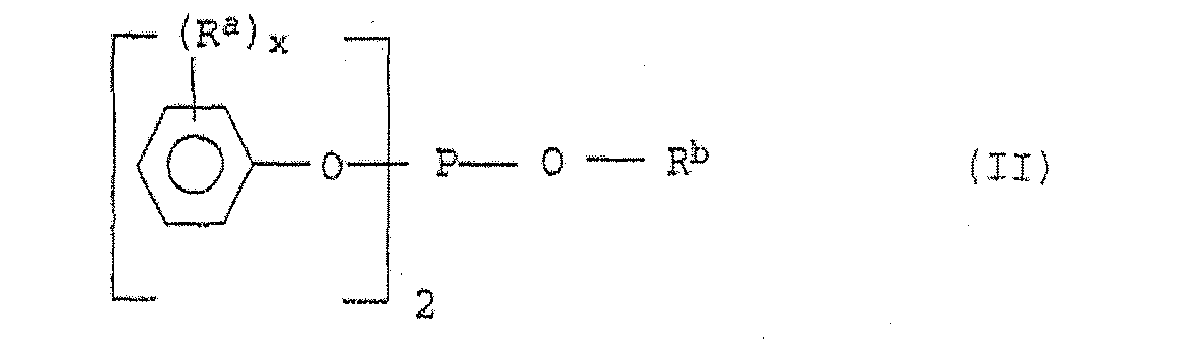 x vaut 1 à 5,Ra est un radical aliphatique comportant 1 à10 atomes de C,Rb est un radical aliphatique comportant 1 à 30 atomes de C, ou un radical aromatique éventuellement substitué comportant 1 à 20 atomes de C.
- Masses de moulage thermoplastiques suivant les revendications 1 à 5, dans lesquelles le phosphate basique inorganique D) est constitué de phosphate de zinc, de phosphate d'aluminium, de phosphate de gallium, de phosphate d'antimoine, de phosphates de métaux alcalino-terreux ou alcalins ou de leurs mélanges.
- Masses de moulage thermoplastiques suivant les revendications 1 à 6, contenant des tartrates de métal alcalin ou de métal alcalino-terreux ou des esters de l'acide tartrique ou leurs mélanges, comme composant C).
- Masses de moulage thermoplastiques suivant les revendications 1 à 7, dans lesquelles le composant C) est constitué de tartrate de potassium, d'hydrogénotartrate de potassium, de tartrate de potassium et de sodium, de tartrate de sodium, d'hydrogénotartrate de sodium ou de leurs mélanges.
- Utilisation des masses de moulage suivant les revendications 1 à 8, pour la préparation de corps façonnés, de feuilles ou de fibres.
- Pièces moulées de n'importe quel type, que l'on peut obtenir à partir des masses de moulage thermoplastiques suivant les revendications 1 à 8.
- Boîtiers de bobine, armatures de bobine, porte-bobines, boîtiers de condensateur, connecteurs, broches de connecteur, ponts de connecteur, supports de puce, cartes imprimées, pièces de lampe, douilles de lampe, boîtiers de démarreur, boîtiers de transformateur, boîtiers d'accumulateur, roues de ventilateur, châssis de roues de ventilateur, socles de lampe, écrans de lampe, supports de lampe, interrupteurs, petits appareils ménagers électriques, boîtiers de fer à repasser, installations de commutation, commutateurs de protection de puissance, chargeurs de batterie, prises femelles, pièces de construction de moteurs, pièces de construction de générateurs, barrettes à bornes, que l'on peut obtenir à partir des masses de moulage thermoplastiques suivant les revendications 1 à 8.
Applications Claiming Priority (3)
| Application Number | Priority Date | Filing Date | Title |
|---|---|---|---|
| DE10132057 | 2001-07-05 | ||
| DE10132057A DE10132057A1 (de) | 2001-07-05 | 2001-07-05 | Flammgeschützte thermoplastische Formmassen |
| PCT/EP2002/007339 WO2003004553A1 (fr) | 2001-07-05 | 2002-07-03 | Matieres a mouler thermoplastiques ignifugees |
Publications (2)
| Publication Number | Publication Date |
|---|---|
| EP1409577A1 EP1409577A1 (fr) | 2004-04-21 |
| EP1409577B1 true EP1409577B1 (fr) | 2007-07-25 |
Family
ID=7690354
Family Applications (1)
| Application Number | Title | Priority Date | Filing Date |
|---|---|---|---|
| EP02743254A Expired - Lifetime EP1409577B1 (fr) | 2001-07-05 | 2002-07-03 | Matieres a mouler thermoplastiques ignifugees |
Country Status (6)
| Country | Link |
|---|---|
| US (1) | US7125923B2 (fr) |
| EP (1) | EP1409577B1 (fr) |
| AT (1) | ATE368073T1 (fr) |
| DE (2) | DE10132057A1 (fr) |
| ES (1) | ES2288190T3 (fr) |
| WO (1) | WO2003004553A1 (fr) |
Cited By (1)
| Publication number | Priority date | Publication date | Assignee | Title |
|---|---|---|---|---|
| CN103613914A (zh) * | 2013-11-13 | 2014-03-05 | 广东聚石化学股份有限公司 | 一种高灼热丝起燃温度环保阻燃pbt复合材料及其制备方法 |
Families Citing this family (12)
| Publication number | Priority date | Publication date | Assignee | Title |
|---|---|---|---|---|
| DE10132056A1 (de) * | 2001-07-05 | 2003-01-16 | Basf Ag | Flammgeschützte thermoplastische Formmassen |
| JP4526865B2 (ja) * | 2004-04-30 | 2010-08-18 | Sabicイノベーティブプラスチックスジャパン合同会社 | ポリエステル樹脂製光反射体 |
| US8178208B2 (en) * | 2006-12-01 | 2012-05-15 | Sabic Innovative Plastives IP B.V. | Polyester compositions, methods of manufacture, and uses thereof |
| EP1942134A1 (fr) * | 2006-12-20 | 2008-07-09 | Nexans | Composition de polymère moussant de traitement à haute température |
| EP1935931A1 (fr) * | 2006-12-20 | 2008-06-25 | Nexans | Composition de polymère moussant de traitement à haute température |
| WO2010101908A1 (fr) * | 2009-03-03 | 2010-09-10 | E. I. Du Pont De Nemours And Company | Article moulé thermoplastique ayant une couche métallique |
| US20100227960A1 (en) * | 2009-03-03 | 2010-09-09 | E.I. Du Pont De Nemours And Company | Process of making a poly(trimethylene terephthalate) resin having low cyclic dimer content, and compositions and articles therefrom |
| US20100251934A1 (en) * | 2009-04-03 | 2010-10-07 | Smith Kimberly L | Modeling compounds and method of making same |
| EP2463338B1 (fr) * | 2010-12-13 | 2013-08-28 | LANXESS Deutschland GmbH | Procédé d'optimisation du comportement de cristallisation de masses moulées à base de polyester |
| JP7144924B2 (ja) * | 2017-08-22 | 2022-09-30 | ポリプラスチックス株式会社 | 難燃性ポリブチレンテレフタレート樹脂組成物 |
| CN111868172B (zh) | 2018-03-22 | 2022-04-15 | 宝理塑料株式会社 | 阻燃性聚对苯二甲酸丁二醇酯树脂组合物 |
| US20220127451A1 (en) * | 2020-10-28 | 2022-04-28 | Dell Products L.P. | Fan unit containing recycled and renewable polymeric compositions |
Family Cites Families (12)
| Publication number | Priority date | Publication date | Assignee | Title |
|---|---|---|---|---|
| US3953539A (en) * | 1973-03-28 | 1976-04-27 | Teijin Ltd. | Aromatic polyester resin composition having inhibited coloration and method for inhibiting coloration |
| JPS5282941A (en) * | 1975-12-29 | 1977-07-11 | Mitsubishi Chem Ind Ltd | Reinforced flame-retardant thermoplastic resin compositions |
| US4061810A (en) * | 1976-09-27 | 1977-12-06 | Allied Chemical Corporation | Flame-retardant carpet and composition for preparing the same |
| JPS5529542A (en) * | 1978-08-23 | 1980-03-01 | Mitsui Toatsu Chem Inc | Polyolefin resin composition |
| US4857673A (en) * | 1984-03-19 | 1989-08-15 | Vulkor Incorporated | Polyolefin compounds having improved thermal stability and electrical conductors coated therewith |
| US4532290A (en) * | 1984-05-02 | 1985-07-30 | General Electric Company | Stabilized polycarbonate-polyester compositions |
| JPH0243253A (ja) * | 1988-08-03 | 1990-02-13 | Kanegafuchi Chem Ind Co Ltd | 射出成形用難燃性ポリエステル系樹脂組成物 |
| US5153271A (en) * | 1991-11-18 | 1992-10-06 | Bridgestone/Firestone, Inc. | Diene polymers and copolymers terminated by reaction with aromatic nitriles |
| US6262161B1 (en) * | 1997-06-26 | 2001-07-17 | The Dow Chemical Company | Compositions having improved ignition resistance |
| DE19753542A1 (de) | 1997-12-03 | 1999-06-10 | Basf Ag | Polycarbonatformmassen |
| DE10132056A1 (de) | 2001-07-05 | 2003-01-16 | Basf Ag | Flammgeschützte thermoplastische Formmassen |
| US7347764B2 (en) * | 2004-02-05 | 2008-03-25 | Silverlit Toys Manufactory, Ltd. | Toy racing game |
-
2001
- 2001-07-05 DE DE10132057A patent/DE10132057A1/de not_active Withdrawn
-
2002
- 2002-07-03 EP EP02743254A patent/EP1409577B1/fr not_active Expired - Lifetime
- 2002-07-03 US US10/482,649 patent/US7125923B2/en not_active Expired - Fee Related
- 2002-07-03 WO PCT/EP2002/007339 patent/WO2003004553A1/fr not_active Ceased
- 2002-07-03 ES ES02743254T patent/ES2288190T3/es not_active Expired - Lifetime
- 2002-07-03 AT AT02743254T patent/ATE368073T1/de not_active IP Right Cessation
- 2002-07-03 DE DE50210558T patent/DE50210558D1/de not_active Expired - Fee Related
Non-Patent Citations (1)
| Title |
|---|
| None * |
Cited By (2)
| Publication number | Priority date | Publication date | Assignee | Title |
|---|---|---|---|---|
| CN103613914A (zh) * | 2013-11-13 | 2014-03-05 | 广东聚石化学股份有限公司 | 一种高灼热丝起燃温度环保阻燃pbt复合材料及其制备方法 |
| CN103613914B (zh) * | 2013-11-13 | 2016-01-20 | 广东聚石化学股份有限公司 | 一种高灼热丝起燃温度环保阻燃pbt复合材料及其制备方法 |
Also Published As
| Publication number | Publication date |
|---|---|
| DE10132057A1 (de) | 2003-01-16 |
| EP1409577A1 (fr) | 2004-04-21 |
| US7125923B2 (en) | 2006-10-24 |
| DE50210558D1 (de) | 2007-09-06 |
| ES2288190T3 (es) | 2008-01-01 |
| ATE368073T1 (de) | 2007-08-15 |
| WO2003004553A1 (fr) | 2003-01-16 |
| US20040209984A1 (en) | 2004-10-21 |
Similar Documents
| Publication | Publication Date | Title |
|---|---|---|
| EP0736571B1 (fr) | Masses de moulage thermoplastiques ignifugés | |
| EP0932643B1 (fr) | Matieres de moulage ignifugees | |
| EP1511808B1 (fr) | Matieres a mouler thermoplastiques noires ignifugees | |
| DE10304341A1 (de) | Hydrolysebeständige Polyester | |
| EP1412429B1 (fr) | Matieres de moulage thermoplastiques ignifugees | |
| EP1084181A1 (fr) | Matieres de moulage polyester ignifugees | |
| EP1192221B1 (fr) | Melanges polyester/polycarbonate | |
| DE10132057A1 (de) | Flammgeschützte thermoplastische Formmassen | |
| EP3044255B1 (fr) | Polyesters ignifuges | |
| EP0932642B1 (fr) | Matieres moulables ignifugees | |
| WO2004056914A1 (fr) | Matiere polyester a mouler electriquement isolante et thermoconductrice | |
| DE10132058A1 (de) | Flammgeschützte thermoplastische Formmassen | |
| WO2013189779A1 (fr) | Polyesters ignifugés comprenant des homopolymères polyacrylonitrile | |
| EP1537178B1 (fr) | Procede pour la preparation des matieres a mouler thermoplastiques a base de polyesters | |
| WO2000068317A1 (fr) | Polyesters ignifuges halogenes | |
| EP1917308B1 (fr) | Eléments de phares en polyester | |
| WO2001038432A1 (fr) | Matieres thermoplastiques polyesteriques protegees contre les flammes | |
| DE102011087869A1 (de) | Lasermarkierbare flammgeschützte Formkörper | |
| WO2000058401A1 (fr) | Melanges polyester/polycarbonate a stabilite dimensionnelle | |
| WO2000041470A2 (fr) | Procédé de préparation de mélanges de polymères | |
| WO2000046295A1 (fr) | Matiere moulable a base de polyester a resistance elevee aux chocs |
Legal Events
| Date | Code | Title | Description |
|---|---|---|---|
| PUAI | Public reference made under article 153(3) epc to a published international application that has entered the european phase |
Free format text: ORIGINAL CODE: 0009012 |
|
| 17P | Request for examination filed |
Effective date: 20040205 |
|
| AK | Designated contracting states |
Kind code of ref document: A1 Designated state(s): AT BE BG CH CY CZ DE DK EE ES FI FR GB GR IE IT LI LU MC NL PT SE SK TR |
|
| RIN1 | Information on inventor provided before grant (corrected) |
Inventor name: GEPRAEGS, MICHAEL |
|
| GRAP | Despatch of communication of intention to grant a patent |
Free format text: ORIGINAL CODE: EPIDOSNIGR1 |
|
| GRAS | Grant fee paid |
Free format text: ORIGINAL CODE: EPIDOSNIGR3 |
|
| GRAA | (expected) grant |
Free format text: ORIGINAL CODE: 0009210 |
|
| AK | Designated contracting states |
Kind code of ref document: B1 Designated state(s): AT BE BG CH CY CZ DE DK EE ES FI FR GB GR IE IT LI LU MC NL PT SE SK TR |
|
| REG | Reference to a national code |
Ref country code: GB Ref legal event code: FG4D Free format text: NOT ENGLISH |
|
| REG | Reference to a national code |
Ref country code: CH Ref legal event code: EP |
|
| REG | Reference to a national code |
Ref country code: IE Ref legal event code: FG4D Free format text: LANGUAGE OF EP DOCUMENT: GERMAN |
|
| REF | Corresponds to: |
Ref document number: 50210558 Country of ref document: DE Date of ref document: 20070906 Kind code of ref document: P |
|
| GBT | Gb: translation of ep patent filed (gb section 77(6)(a)/1977) |
Effective date: 20070912 |
|
| ET | Fr: translation filed | ||
| REG | Reference to a national code |
Ref country code: ES Ref legal event code: FG2A Ref document number: 2288190 Country of ref document: ES Kind code of ref document: T3 |
|
| PG25 | Lapsed in a contracting state [announced via postgrant information from national office to epo] |
Ref country code: PT Free format text: LAPSE BECAUSE OF FAILURE TO SUBMIT A TRANSLATION OF THE DESCRIPTION OR TO PAY THE FEE WITHIN THE PRESCRIBED TIME-LIMIT Effective date: 20071226 Ref country code: NL Free format text: LAPSE BECAUSE OF FAILURE TO SUBMIT A TRANSLATION OF THE DESCRIPTION OR TO PAY THE FEE WITHIN THE PRESCRIBED TIME-LIMIT Effective date: 20070725 Ref country code: BG Free format text: LAPSE BECAUSE OF FAILURE TO SUBMIT A TRANSLATION OF THE DESCRIPTION OR TO PAY THE FEE WITHIN THE PRESCRIBED TIME-LIMIT Effective date: 20071025 Ref country code: FI Free format text: LAPSE BECAUSE OF FAILURE TO SUBMIT A TRANSLATION OF THE DESCRIPTION OR TO PAY THE FEE WITHIN THE PRESCRIBED TIME-LIMIT Effective date: 20070725 |
|
| NLV1 | Nl: lapsed or annulled due to failure to fulfill the requirements of art. 29p and 29m of the patents act | ||
| RAP2 | Party data changed (patent owner data changed or rights of a patent transferred) |
Owner name: BASF SE |
|
| REG | Reference to a national code |
Ref country code: IE Ref legal event code: FD4D |
|
| PG25 | Lapsed in a contracting state [announced via postgrant information from national office to epo] |
Ref country code: DK Free format text: LAPSE BECAUSE OF FAILURE TO SUBMIT A TRANSLATION OF THE DESCRIPTION OR TO PAY THE FEE WITHIN THE PRESCRIBED TIME-LIMIT Effective date: 20070725 Ref country code: GR Free format text: LAPSE BECAUSE OF FAILURE TO SUBMIT A TRANSLATION OF THE DESCRIPTION OR TO PAY THE FEE WITHIN THE PRESCRIBED TIME-LIMIT Effective date: 20071026 |
|
| PG25 | Lapsed in a contracting state [announced via postgrant information from national office to epo] |
Ref country code: CZ Free format text: LAPSE BECAUSE OF FAILURE TO SUBMIT A TRANSLATION OF THE DESCRIPTION OR TO PAY THE FEE WITHIN THE PRESCRIBED TIME-LIMIT Effective date: 20070725 Ref country code: SK Free format text: LAPSE BECAUSE OF FAILURE TO SUBMIT A TRANSLATION OF THE DESCRIPTION OR TO PAY THE FEE WITHIN THE PRESCRIBED TIME-LIMIT Effective date: 20070725 Ref country code: IE Free format text: LAPSE BECAUSE OF FAILURE TO SUBMIT A TRANSLATION OF THE DESCRIPTION OR TO PAY THE FEE WITHIN THE PRESCRIBED TIME-LIMIT Effective date: 20070725 |
|
| PLBE | No opposition filed within time limit |
Free format text: ORIGINAL CODE: 0009261 |
|
| STAA | Information on the status of an ep patent application or granted ep patent |
Free format text: STATUS: NO OPPOSITION FILED WITHIN TIME LIMIT |
|
| PG25 | Lapsed in a contracting state [announced via postgrant information from national office to epo] |
Ref country code: SE Free format text: LAPSE BECAUSE OF FAILURE TO SUBMIT A TRANSLATION OF THE DESCRIPTION OR TO PAY THE FEE WITHIN THE PRESCRIBED TIME-LIMIT Effective date: 20071025 |
|
| 26N | No opposition filed |
Effective date: 20080428 |
|
| PGFP | Annual fee paid to national office [announced via postgrant information from national office to epo] |
Ref country code: DE Payment date: 20080711 Year of fee payment: 7 Ref country code: ES Payment date: 20080821 Year of fee payment: 7 |
|
| PGFP | Annual fee paid to national office [announced via postgrant information from national office to epo] |
Ref country code: FR Payment date: 20080718 Year of fee payment: 7 |
|
| PGFP | Annual fee paid to national office [announced via postgrant information from national office to epo] |
Ref country code: GB Payment date: 20080709 Year of fee payment: 7 |
|
| REG | Reference to a national code |
Ref country code: CH Ref legal event code: PL |
|
| PG25 | Lapsed in a contracting state [announced via postgrant information from national office to epo] |
Ref country code: MC Free format text: LAPSE BECAUSE OF NON-PAYMENT OF DUE FEES Effective date: 20080731 |
|
| PG25 | Lapsed in a contracting state [announced via postgrant information from national office to epo] |
Ref country code: EE Free format text: LAPSE BECAUSE OF FAILURE TO SUBMIT A TRANSLATION OF THE DESCRIPTION OR TO PAY THE FEE WITHIN THE PRESCRIBED TIME-LIMIT Effective date: 20070725 |
|
| PG25 | Lapsed in a contracting state [announced via postgrant information from national office to epo] |
Ref country code: CH Free format text: LAPSE BECAUSE OF NON-PAYMENT OF DUE FEES Effective date: 20080731 Ref country code: LI Free format text: LAPSE BECAUSE OF NON-PAYMENT OF DUE FEES Effective date: 20080731 |
|
| PG25 | Lapsed in a contracting state [announced via postgrant information from national office to epo] |
Ref country code: CY Free format text: LAPSE BECAUSE OF FAILURE TO SUBMIT A TRANSLATION OF THE DESCRIPTION OR TO PAY THE FEE WITHIN THE PRESCRIBED TIME-LIMIT Effective date: 20070725 |
|
| PG25 | Lapsed in a contracting state [announced via postgrant information from national office to epo] |
Ref country code: AT Free format text: LAPSE BECAUSE OF NON-PAYMENT OF DUE FEES Effective date: 20080703 |
|
| GBPC | Gb: european patent ceased through non-payment of renewal fee |
Effective date: 20090703 |
|
| REG | Reference to a national code |
Ref country code: FR Ref legal event code: ST Effective date: 20100331 |
|
| PG25 | Lapsed in a contracting state [announced via postgrant information from national office to epo] |
Ref country code: FR Free format text: LAPSE BECAUSE OF NON-PAYMENT OF DUE FEES Effective date: 20090731 |
|
| PG25 | Lapsed in a contracting state [announced via postgrant information from national office to epo] |
Ref country code: GB Free format text: LAPSE BECAUSE OF NON-PAYMENT OF DUE FEES Effective date: 20090703 |
|
| PG25 | Lapsed in a contracting state [announced via postgrant information from national office to epo] |
Ref country code: DE Free format text: LAPSE BECAUSE OF NON-PAYMENT OF DUE FEES Effective date: 20100202 |
|
| PG25 | Lapsed in a contracting state [announced via postgrant information from national office to epo] |
Ref country code: LU Free format text: LAPSE BECAUSE OF NON-PAYMENT OF DUE FEES Effective date: 20080703 Ref country code: BE Free format text: LAPSE BECAUSE OF NON-PAYMENT OF DUE FEES Effective date: 20080731 |
|
| PG25 | Lapsed in a contracting state [announced via postgrant information from national office to epo] |
Ref country code: TR Free format text: LAPSE BECAUSE OF FAILURE TO SUBMIT A TRANSLATION OF THE DESCRIPTION OR TO PAY THE FEE WITHIN THE PRESCRIBED TIME-LIMIT Effective date: 20070725 |
|
| REG | Reference to a national code |
Ref country code: ES Ref legal event code: FD2A Effective date: 20090704 |
|
| PG25 | Lapsed in a contracting state [announced via postgrant information from national office to epo] |
Ref country code: ES Free format text: LAPSE BECAUSE OF NON-PAYMENT OF DUE FEES Effective date: 20090704 |
|
| PG25 | Lapsed in a contracting state [announced via postgrant information from national office to epo] |
Ref country code: IT Free format text: LAPSE BECAUSE OF NON-PAYMENT OF DUE FEES Effective date: 20090703 |