EP1413607A2 - Schwarze Partikel auf der Basis von Eisen und diese enthaltende schwarze Toner - Google Patents
Schwarze Partikel auf der Basis von Eisen und diese enthaltende schwarze Toner Download PDFInfo
- Publication number
- EP1413607A2 EP1413607A2 EP03256644A EP03256644A EP1413607A2 EP 1413607 A2 EP1413607 A2 EP 1413607A2 EP 03256644 A EP03256644 A EP 03256644A EP 03256644 A EP03256644 A EP 03256644A EP 1413607 A2 EP1413607 A2 EP 1413607A2
- Authority
- EP
- European Patent Office
- Prior art keywords
- particles
- black
- iron
- black iron
- based particles
- Prior art date
- Legal status (The legal status is an assumption and is not a legal conclusion. Google has not performed a legal analysis and makes no representation as to the accuracy of the status listed.)
- Withdrawn
Links
- XEEYBQQBJWHFJM-UHFFFAOYSA-N Iron Chemical compound [Fe] XEEYBQQBJWHFJM-UHFFFAOYSA-N 0.000 title claims abstract description 306
- 239000002245 particle Substances 0.000 title claims abstract description 237
- 229910052742 iron Inorganic materials 0.000 title claims abstract description 131
- 239000006104 solid solution Substances 0.000 claims abstract description 44
- 229910052596 spinel Inorganic materials 0.000 claims abstract description 23
- 239000011029 spinel Substances 0.000 claims abstract description 23
- 229920005989 resin Polymers 0.000 claims abstract description 16
- 239000011347 resin Substances 0.000 claims abstract description 16
- 239000011230 binding agent Substances 0.000 claims abstract description 11
- JEIPFZHSYJVQDO-UHFFFAOYSA-N iron(III) oxide Inorganic materials O=[Fe]O[Fe]=O JEIPFZHSYJVQDO-UHFFFAOYSA-N 0.000 claims description 46
- 230000005415 magnetization Effects 0.000 claims description 43
- 239000000203 mixture Substances 0.000 claims description 29
- 239000001055 blue pigment Substances 0.000 claims description 27
- 150000001875 compounds Chemical class 0.000 claims description 26
- 229910002593 Fe-Ti Inorganic materials 0.000 claims description 24
- 238000000034 method Methods 0.000 claims description 21
- 238000002441 X-ray diffraction Methods 0.000 claims description 16
- 229910006297 γ-Fe2O3 Inorganic materials 0.000 claims description 10
- 239000010936 titanium Substances 0.000 abstract description 44
- 229910052719 titanium Inorganic materials 0.000 abstract description 8
- RTAQQCXQSZGOHL-UHFFFAOYSA-N Titanium Chemical compound [Ti] RTAQQCXQSZGOHL-UHFFFAOYSA-N 0.000 abstract description 7
- SZVJSHCCFOBDDC-UHFFFAOYSA-N iron(II,III) oxide Inorganic materials O=[Fe]O[Fe]O[Fe]=O SZVJSHCCFOBDDC-UHFFFAOYSA-N 0.000 description 34
- UQSXHKLRYXJYBZ-UHFFFAOYSA-N Iron oxide Chemical compound [Fe]=O UQSXHKLRYXJYBZ-UHFFFAOYSA-N 0.000 description 24
- 239000006249 magnetic particle Substances 0.000 description 22
- 238000004519 manufacturing process Methods 0.000 description 17
- 239000000243 solution Substances 0.000 description 17
- 150000003609 titanium compounds Chemical class 0.000 description 17
- HEMHJVSKTPXQMS-UHFFFAOYSA-M Sodium hydroxide Chemical compound [OH-].[Na+] HEMHJVSKTPXQMS-UHFFFAOYSA-M 0.000 description 12
- PVOXCLVRHYZZEP-UHFFFAOYSA-M [OH-].[O-2].[Ti+3] Chemical compound [OH-].[O-2].[Ti+3] PVOXCLVRHYZZEP-UHFFFAOYSA-M 0.000 description 10
- 239000007900 aqueous suspension Substances 0.000 description 10
- 238000001354 calcination Methods 0.000 description 9
- PPBRXRYQALVLMV-UHFFFAOYSA-N Styrene Chemical compound C=CC1=CC=CC=C1 PPBRXRYQALVLMV-UHFFFAOYSA-N 0.000 description 8
- 239000011248 coating agent Substances 0.000 description 8
- 238000000576 coating method Methods 0.000 description 8
- 239000000049 pigment Substances 0.000 description 8
- 239000000178 monomer Substances 0.000 description 7
- 239000003973 paint Substances 0.000 description 7
- 238000010298 pulverizing process Methods 0.000 description 7
- 229910003079 TiO5 Inorganic materials 0.000 description 6
- 239000003086 colorant Substances 0.000 description 6
- 230000000052 comparative effect Effects 0.000 description 6
- 229910005451 FeTiO3 Inorganic materials 0.000 description 5
- 239000003513 alkali Substances 0.000 description 5
- 239000006229 carbon black Substances 0.000 description 5
- 238000011156 evaluation Methods 0.000 description 5
- 239000000463 material Substances 0.000 description 5
- 239000011259 mixed solution Substances 0.000 description 5
- 238000002156 mixing Methods 0.000 description 5
- 230000001590 oxidative effect Effects 0.000 description 5
- 150000003388 sodium compounds Chemical class 0.000 description 5
- VYPSYNLAJGMNEJ-UHFFFAOYSA-N Silicium dioxide Chemical compound O=[Si]=O VYPSYNLAJGMNEJ-UHFFFAOYSA-N 0.000 description 4
- CDBYLPFSWZWCQE-UHFFFAOYSA-L Sodium Carbonate Chemical compound [Na+].[Na+].[O-]C([O-])=O CDBYLPFSWZWCQE-UHFFFAOYSA-L 0.000 description 4
- 239000000654 additive Substances 0.000 description 4
- 239000007864 aqueous solution Substances 0.000 description 4
- 239000007789 gas Substances 0.000 description 4
- 238000010438 heat treatment Methods 0.000 description 4
- YDZQQRWRVYGNER-UHFFFAOYSA-N iron;titanium;trihydrate Chemical compound O.O.O.[Ti].[Fe] YDZQQRWRVYGNER-UHFFFAOYSA-N 0.000 description 4
- 229910052751 metal Inorganic materials 0.000 description 4
- 239000012071 phase Substances 0.000 description 4
- 239000011342 resin composition Substances 0.000 description 4
- 239000011734 sodium Substances 0.000 description 4
- 239000007787 solid Substances 0.000 description 4
- XLYOFNOQVPJJNP-UHFFFAOYSA-N water Substances O XLYOFNOQVPJJNP-UHFFFAOYSA-N 0.000 description 4
- NIXOWILDQLNWCW-UHFFFAOYSA-N 2-Propenoic acid Natural products OC(=O)C=C NIXOWILDQLNWCW-UHFFFAOYSA-N 0.000 description 3
- 229920006026 co-polymeric resin Polymers 0.000 description 3
- 229920001577 copolymer Polymers 0.000 description 3
- 238000000635 electron micrograph Methods 0.000 description 3
- 238000010335 hydrothermal treatment Methods 0.000 description 3
- XLYOFNOQVPJJNP-UHFFFAOYSA-M hydroxide Chemical compound [OH-] XLYOFNOQVPJJNP-UHFFFAOYSA-M 0.000 description 3
- 230000000379 polymerizing effect Effects 0.000 description 3
- 229920001909 styrene-acrylic polymer Polymers 0.000 description 3
- 229910000349 titanium oxysulfate Inorganic materials 0.000 description 3
- 125000000391 vinyl group Chemical group [H]C([*])=C([H])[H] 0.000 description 3
- 229920002554 vinyl polymer Polymers 0.000 description 3
- BVKZGUZCCUSVTD-UHFFFAOYSA-L Carbonate Chemical compound [O-]C([O-])=O BVKZGUZCCUSVTD-UHFFFAOYSA-L 0.000 description 2
- DGAQECJNVWCQMB-PUAWFVPOSA-M Ilexoside XXIX Chemical compound C[C@@H]1CC[C@@]2(CC[C@@]3(C(=CC[C@H]4[C@]3(CC[C@@H]5[C@@]4(CC[C@@H](C5(C)C)OS(=O)(=O)[O-])C)C)[C@@H]2[C@]1(C)O)C)C(=O)O[C@H]6[C@@H]([C@H]([C@@H]([C@H](O6)CO)O)O)O.[Na+] DGAQECJNVWCQMB-PUAWFVPOSA-M 0.000 description 2
- BAPJBEWLBFYGME-UHFFFAOYSA-N Methyl acrylate Chemical compound COC(=O)C=C BAPJBEWLBFYGME-UHFFFAOYSA-N 0.000 description 2
- NBIIXXVUZAFLBC-UHFFFAOYSA-N Phosphoric acid Chemical compound OP(O)(O)=O NBIIXXVUZAFLBC-UHFFFAOYSA-N 0.000 description 2
- PMZURENOXWZQFD-UHFFFAOYSA-L Sodium Sulfate Chemical compound [Na+].[Na+].[O-]S([O-])(=O)=O PMZURENOXWZQFD-UHFFFAOYSA-L 0.000 description 2
- FAPWRFPIFSIZLT-UHFFFAOYSA-M Sodium chloride Chemical compound [Na+].[Cl-] FAPWRFPIFSIZLT-UHFFFAOYSA-M 0.000 description 2
- QAOWNCQODCNURD-UHFFFAOYSA-N Sulfuric acid Chemical compound OS(O)(=O)=O QAOWNCQODCNURD-UHFFFAOYSA-N 0.000 description 2
- GWEVSGVZZGPLCZ-UHFFFAOYSA-N Titan oxide Chemical compound O=[Ti]=O GWEVSGVZZGPLCZ-UHFFFAOYSA-N 0.000 description 2
- 238000004026 adhesive bonding Methods 0.000 description 2
- 229910001854 alkali hydroxide Inorganic materials 0.000 description 2
- 150000008044 alkali metal hydroxides Chemical class 0.000 description 2
- 229910052782 aluminium Inorganic materials 0.000 description 2
- 239000004359 castor oil Substances 0.000 description 2
- 235000019438 castor oil Nutrition 0.000 description 2
- 238000006243 chemical reaction Methods 0.000 description 2
- 239000003795 chemical substances by application Substances 0.000 description 2
- 239000011362 coarse particle Substances 0.000 description 2
- 229910052802 copper Inorganic materials 0.000 description 2
- 238000010556 emulsion polymerization method Methods 0.000 description 2
- 238000001125 extrusion Methods 0.000 description 2
- ZEMPKEQAKRGZGQ-XOQCFJPHSA-N glycerol triricinoleate Natural products CCCCCC[C@@H](O)CC=CCCCCCCCC(=O)OC[C@@H](COC(=O)CCCCCCCC=CC[C@@H](O)CCCCCC)OC(=O)CCCCCCCC=CC[C@H](O)CCCCCC ZEMPKEQAKRGZGQ-XOQCFJPHSA-N 0.000 description 2
- 239000011361 granulated particle Substances 0.000 description 2
- 230000002209 hydrophobic effect Effects 0.000 description 2
- BAUYGSIQEAFULO-UHFFFAOYSA-L iron(2+) sulfate (anhydrous) Chemical compound [Fe+2].[O-]S([O-])(=O)=O BAUYGSIQEAFULO-UHFFFAOYSA-L 0.000 description 2
- 239000004922 lacquer Substances 0.000 description 2
- 229910044991 metal oxide Inorganic materials 0.000 description 2
- 150000004706 metal oxides Chemical class 0.000 description 2
- 239000006082 mold release agent Substances 0.000 description 2
- -1 organosilane compounds Chemical class 0.000 description 2
- 229920001225 polyester resin Polymers 0.000 description 2
- 229920000642 polymer Polymers 0.000 description 2
- 239000003505 polymerization initiator Substances 0.000 description 2
- 229910052700 potassium Inorganic materials 0.000 description 2
- KMUONIBRACKNSN-UHFFFAOYSA-N potassium dichromate Chemical compound [K+].[K+].[O-][Cr](=O)(=O)O[Cr]([O-])(=O)=O KMUONIBRACKNSN-UHFFFAOYSA-N 0.000 description 2
- 239000000843 powder Substances 0.000 description 2
- 229910052710 silicon Inorganic materials 0.000 description 2
- 239000000377 silicon dioxide Substances 0.000 description 2
- 238000005245 sintering Methods 0.000 description 2
- 229910052708 sodium Inorganic materials 0.000 description 2
- 229910000029 sodium carbonate Inorganic materials 0.000 description 2
- 229910052938 sodium sulfate Inorganic materials 0.000 description 2
- 235000011152 sodium sulphate Nutrition 0.000 description 2
- 238000010558 suspension polymerization method Methods 0.000 description 2
- 238000005406 washing Methods 0.000 description 2
- SMZOUWXMTYCWNB-UHFFFAOYSA-N 2-(2-methoxy-5-methylphenyl)ethanamine Chemical compound COC1=CC=C(C)C=C1CCN SMZOUWXMTYCWNB-UHFFFAOYSA-N 0.000 description 1
- HYKDWGUFDOYDGV-UHFFFAOYSA-N 4-anilinobenzenesulfonic acid Chemical compound C1=CC(S(=O)(=O)O)=CC=C1NC1=CC=CC=C1 HYKDWGUFDOYDGV-UHFFFAOYSA-N 0.000 description 1
- 238000004438 BET method Methods 0.000 description 1
- 239000004593 Epoxy Substances 0.000 description 1
- JIGUQPWFLRLWPJ-UHFFFAOYSA-N Ethyl acrylate Chemical compound CCOC(=O)C=C JIGUQPWFLRLWPJ-UHFFFAOYSA-N 0.000 description 1
- VTLYFUHAOXGGBS-UHFFFAOYSA-N Fe3+ Chemical compound [Fe+3] VTLYFUHAOXGGBS-UHFFFAOYSA-N 0.000 description 1
- 101000845012 Macrovipera lebetina Disintegrin lebein-1-alpha Proteins 0.000 description 1
- 101000845007 Macrovipera lebetina Disintegrin lebein-1-beta Proteins 0.000 description 1
- 229910010298 TiOSO4 Inorganic materials 0.000 description 1
- 230000002411 adverse Effects 0.000 description 1
- AOADSHDCARXSGL-ZMIIQOOPSA-M alkali blue 4B Chemical compound CC1=CC(/C(\C(C=C2)=CC=C2NC2=CC=CC=C2S([O-])(=O)=O)=C(\C=C2)/C=C/C\2=N\C2=CC=CC=C2)=CC=C1N.[Na+] AOADSHDCARXSGL-ZMIIQOOPSA-M 0.000 description 1
- 229910000147 aluminium phosphate Inorganic materials 0.000 description 1
- QVGXLLKOCUKJST-UHFFFAOYSA-N atomic oxygen Chemical compound [O] QVGXLLKOCUKJST-UHFFFAOYSA-N 0.000 description 1
- IRERQBUNZFJFGC-UHFFFAOYSA-L azure blue Chemical compound [Na+].[Na+].[Na+].[Na+].[Na+].[Na+].[Na+].[Na+].[Al+3].[Al+3].[Al+3].[Al+3].[Al+3].[Al+3].[S-]S[S-].[O-][Si]([O-])([O-])[O-].[O-][Si]([O-])([O-])[O-].[O-][Si]([O-])([O-])[O-].[O-][Si]([O-])([O-])[O-].[O-][Si]([O-])([O-])[O-].[O-][Si]([O-])([O-])[O-] IRERQBUNZFJFGC-UHFFFAOYSA-L 0.000 description 1
- 229910052788 barium Inorganic materials 0.000 description 1
- 239000011367 bulky particle Substances 0.000 description 1
- CQEYYJKEWSMYFG-UHFFFAOYSA-N butyl acrylate Chemical compound CCCCOC(=O)C=C CQEYYJKEWSMYFG-UHFFFAOYSA-N 0.000 description 1
- 229910052791 calcium Inorganic materials 0.000 description 1
- 238000011088 calibration curve Methods 0.000 description 1
- ZZNMWGVMOBOREI-VQTJNVASSA-N chembl464952 Chemical compound C1([C@H]2OC=3C4=C(C=5C=CC(C)(C)OC=5C=3C(=O)[C@@H]2O)OC(C=C4)(C)C)=CC=CC=C1 ZZNMWGVMOBOREI-VQTJNVASSA-N 0.000 description 1
- 238000009614 chemical analysis method Methods 0.000 description 1
- 229910017052 cobalt Inorganic materials 0.000 description 1
- 239000010941 cobalt Substances 0.000 description 1
- GUTLYIVDDKVIGB-UHFFFAOYSA-N cobalt atom Chemical compound [Co] GUTLYIVDDKVIGB-UHFFFAOYSA-N 0.000 description 1
- 239000000084 colloidal system Substances 0.000 description 1
- 238000004040 coloring Methods 0.000 description 1
- 239000011246 composite particle Substances 0.000 description 1
- XCJYREBRNVKWGJ-UHFFFAOYSA-N copper(II) phthalocyanine Chemical compound [Cu+2].C12=CC=CC=C2C(N=C2[N-]C(C3=CC=CC=C32)=N2)=NC1=NC([C]1C=CC=CC1=1)=NC=1N=C1[C]3C=CC=CC3=C2[N-]1 XCJYREBRNVKWGJ-UHFFFAOYSA-N 0.000 description 1
- 239000002537 cosmetic Substances 0.000 description 1
- 239000003431 cross linking reagent Substances 0.000 description 1
- 238000000151 deposition Methods 0.000 description 1
- 239000006185 dispersion Substances 0.000 description 1
- 238000007580 dry-mixing Methods 0.000 description 1
- 238000001035 drying Methods 0.000 description 1
- 229920001971 elastomer Polymers 0.000 description 1
- 238000010828 elution Methods 0.000 description 1
- 239000003995 emulsifying agent Substances 0.000 description 1
- 230000001747 exhibiting effect Effects 0.000 description 1
- 239000000945 filler Substances 0.000 description 1
- 238000001914 filtration Methods 0.000 description 1
- 239000010419 fine particle Substances 0.000 description 1
- 239000011261 inert gas Substances 0.000 description 1
- 239000000976 ink Substances 0.000 description 1
- 229910021506 iron(II) hydroxide Inorganic materials 0.000 description 1
- NCNCGGDMXMBVIA-UHFFFAOYSA-L iron(ii) hydroxide Chemical compound [OH-].[OH-].[Fe+2] NCNCGGDMXMBVIA-UHFFFAOYSA-L 0.000 description 1
- YWXYYJSYQOXTPL-SLPGGIOYSA-N isosorbide mononitrate Chemical compound [O-][N+](=O)O[C@@H]1CO[C@@H]2[C@@H](O)CO[C@@H]21 YWXYYJSYQOXTPL-SLPGGIOYSA-N 0.000 description 1
- 238000004898 kneading Methods 0.000 description 1
- 229910052749 magnesium Inorganic materials 0.000 description 1
- 229910052748 manganese Inorganic materials 0.000 description 1
- YTCQFLFGFXZUSN-BAQGIRSFSA-N microline Chemical compound OC12OC3(C)COC2(O)C(C(/Cl)=C/C)=CC(=O)C21C3C2 YTCQFLFGFXZUSN-BAQGIRSFSA-N 0.000 description 1
- 238000012986 modification Methods 0.000 description 1
- 230000004048 modification Effects 0.000 description 1
- 229910052759 nickel Inorganic materials 0.000 description 1
- 230000033116 oxidation-reduction process Effects 0.000 description 1
- KADRTWZQWGIUGO-UHFFFAOYSA-L oxotitanium(2+);sulfate Chemical compound [Ti+2]=O.[O-]S([O-])(=O)=O KADRTWZQWGIUGO-UHFFFAOYSA-L 0.000 description 1
- 229910052760 oxygen Inorganic materials 0.000 description 1
- 239000001301 oxygen Substances 0.000 description 1
- PNJWIWWMYCMZRO-UHFFFAOYSA-N pent‐4‐en‐2‐one Natural products CC(=O)CC=C PNJWIWWMYCMZRO-UHFFFAOYSA-N 0.000 description 1
- 229910052698 phosphorus Inorganic materials 0.000 description 1
- 239000004645 polyester resin Substances 0.000 description 1
- 229920001296 polysiloxane Polymers 0.000 description 1
- 229920002635 polyurethane Polymers 0.000 description 1
- 239000004814 polyurethane Substances 0.000 description 1
- 230000001376 precipitating effect Effects 0.000 description 1
- 239000005060 rubber Substances 0.000 description 1
- 239000012266 salt solution Substances 0.000 description 1
- 150000003839 salts Chemical class 0.000 description 1
- 239000011780 sodium chloride Substances 0.000 description 1
- 238000003746 solid phase reaction Methods 0.000 description 1
- 239000003381 stabilizer Substances 0.000 description 1
- 238000003756 stirring Methods 0.000 description 1
- 229910052712 strontium Inorganic materials 0.000 description 1
- 150000003440 styrenes Chemical class 0.000 description 1
- 239000000725 suspension Substances 0.000 description 1
- 239000004408 titanium dioxide Substances 0.000 description 1
- XJDNKRIXUMDJCW-UHFFFAOYSA-J titanium tetrachloride Chemical compound Cl[Ti](Cl)(Cl)Cl XJDNKRIXUMDJCW-UHFFFAOYSA-J 0.000 description 1
- YONPGGFAJWQGJC-UHFFFAOYSA-K titanium(iii) chloride Chemical compound Cl[Ti](Cl)Cl YONPGGFAJWQGJC-UHFFFAOYSA-K 0.000 description 1
- 238000004448 titration Methods 0.000 description 1
- 235000013799 ultramarine blue Nutrition 0.000 description 1
- 239000003981 vehicle Substances 0.000 description 1
- 229910052725 zinc Inorganic materials 0.000 description 1
- 229910052726 zirconium Inorganic materials 0.000 description 1
Images


Classifications
-
- B—PERFORMING OPERATIONS; TRANSPORTING
- B82—NANOTECHNOLOGY
- B82Y—SPECIFIC USES OR APPLICATIONS OF NANOSTRUCTURES; MEASUREMENT OR ANALYSIS OF NANOSTRUCTURES; MANUFACTURE OR TREATMENT OF NANOSTRUCTURES
- B82Y30/00—Nanotechnology for materials or surface science, e.g. nanocomposites
-
- C—CHEMISTRY; METALLURGY
- C09—DYES; PAINTS; POLISHES; NATURAL RESINS; ADHESIVES; COMPOSITIONS NOT OTHERWISE PROVIDED FOR; APPLICATIONS OF MATERIALS NOT OTHERWISE PROVIDED FOR
- C09C—TREATMENT OF INORGANIC MATERIALS, OTHER THAN FIBROUS FILLERS, TO ENHANCE THEIR PIGMENTING OR FILLING PROPERTIES ; PREPARATION OF CARBON BLACK ; PREPARATION OF INORGANIC MATERIALS WHICH ARE NO SINGLE CHEMICAL COMPOUNDS AND WHICH ARE MAINLY USED AS PIGMENTS OR FILLERS
- C09C1/00—Treatment of specific inorganic materials other than fibrous fillers; Preparation of carbon black
- C09C1/22—Compounds of iron
- C09C1/24—Oxides of iron
-
- C—CHEMISTRY; METALLURGY
- C01—INORGANIC CHEMISTRY
- C01P—INDEXING SCHEME RELATING TO STRUCTURAL AND PHYSICAL ASPECTS OF SOLID INORGANIC COMPOUNDS
- C01P2002/00—Crystal-structural characteristics
- C01P2002/30—Three-dimensional structures
- C01P2002/32—Three-dimensional structures spinel-type (AB2O4)
-
- C—CHEMISTRY; METALLURGY
- C01—INORGANIC CHEMISTRY
- C01P—INDEXING SCHEME RELATING TO STRUCTURAL AND PHYSICAL ASPECTS OF SOLID INORGANIC COMPOUNDS
- C01P2002/00—Crystal-structural characteristics
- C01P2002/70—Crystal-structural characteristics defined by measured X-ray, neutron or electron diffraction data
- C01P2002/72—Crystal-structural characteristics defined by measured X-ray, neutron or electron diffraction data by d-values or two theta-values, e.g. as X-ray diagram
-
- C—CHEMISTRY; METALLURGY
- C01—INORGANIC CHEMISTRY
- C01P—INDEXING SCHEME RELATING TO STRUCTURAL AND PHYSICAL ASPECTS OF SOLID INORGANIC COMPOUNDS
- C01P2004/00—Particle morphology
- C01P2004/01—Particle morphology depicted by an image
- C01P2004/04—Particle morphology depicted by an image obtained by TEM, STEM, STM or AFM
-
- C—CHEMISTRY; METALLURGY
- C01—INORGANIC CHEMISTRY
- C01P—INDEXING SCHEME RELATING TO STRUCTURAL AND PHYSICAL ASPECTS OF SOLID INORGANIC COMPOUNDS
- C01P2004/00—Particle morphology
- C01P2004/60—Particles characterised by their size
- C01P2004/62—Submicrometer sized, i.e. from 0.1-1 micrometer
-
- C—CHEMISTRY; METALLURGY
- C01—INORGANIC CHEMISTRY
- C01P—INDEXING SCHEME RELATING TO STRUCTURAL AND PHYSICAL ASPECTS OF SOLID INORGANIC COMPOUNDS
- C01P2004/00—Particle morphology
- C01P2004/60—Particles characterised by their size
- C01P2004/64—Nanometer sized, i.e. from 1-100 nanometer
-
- C—CHEMISTRY; METALLURGY
- C01—INORGANIC CHEMISTRY
- C01P—INDEXING SCHEME RELATING TO STRUCTURAL AND PHYSICAL ASPECTS OF SOLID INORGANIC COMPOUNDS
- C01P2006/00—Physical properties of inorganic compounds
- C01P2006/42—Magnetic properties
-
- C—CHEMISTRY; METALLURGY
- C01—INORGANIC CHEMISTRY
- C01P—INDEXING SCHEME RELATING TO STRUCTURAL AND PHYSICAL ASPECTS OF SOLID INORGANIC COMPOUNDS
- C01P2006/00—Physical properties of inorganic compounds
- C01P2006/60—Optical properties, e.g. expressed in CIELAB-values
- C01P2006/62—L* (lightness axis)
-
- Y—GENERAL TAGGING OF NEW TECHNOLOGICAL DEVELOPMENTS; GENERAL TAGGING OF CROSS-SECTIONAL TECHNOLOGIES SPANNING OVER SEVERAL SECTIONS OF THE IPC; TECHNICAL SUBJECTS COVERED BY FORMER USPC CROSS-REFERENCE ART COLLECTIONS [XRACs] AND DIGESTS
- Y10—TECHNICAL SUBJECTS COVERED BY FORMER USPC
- Y10T—TECHNICAL SUBJECTS COVERED BY FORMER US CLASSIFICATION
- Y10T428/00—Stock material or miscellaneous articles
- Y10T428/29—Coated or structually defined flake, particle, cell, strand, strand portion, rod, filament, macroscopic fiber or mass thereof
- Y10T428/2982—Particulate matter [e.g., sphere, flake, etc.]
-
- Y—GENERAL TAGGING OF NEW TECHNOLOGICAL DEVELOPMENTS; GENERAL TAGGING OF CROSS-SECTIONAL TECHNOLOGIES SPANNING OVER SEVERAL SECTIONS OF THE IPC; TECHNICAL SUBJECTS COVERED BY FORMER USPC CROSS-REFERENCE ART COLLECTIONS [XRACs] AND DIGESTS
- Y10—TECHNICAL SUBJECTS COVERED BY FORMER USPC
- Y10T—TECHNICAL SUBJECTS COVERED BY FORMER US CLASSIFICATION
- Y10T428/00—Stock material or miscellaneous articles
- Y10T428/29—Coated or structually defined flake, particle, cell, strand, strand portion, rod, filament, macroscopic fiber or mass thereof
- Y10T428/2982—Particulate matter [e.g., sphere, flake, etc.]
- Y10T428/2991—Coated
Definitions
- the present invention relates to black iron-based particles and a black toner containing the black iron-based particles, and more particularly, to black iron-based particles having not only an excellent blackness but also a less magnetization value, and a black toner containing the black iron-based particles, which has not only an excellent blackness but also a low magnetization value.
- the black iron-based particles of the present invention are used as black-colored pigments and paints, colorants for resin compositions, etc., and, in particular, are applicable to black non-magnetic toners.
- black pigments such as magnetite particles, ilmenite particles and carbon black have been generally used as colorants for paints, printing inks, cosmetics, rubbers, resin compositions or the like.
- composite particles prepared by mixing-dispersing black magnetic iron oxide particles such as magnetite particles in resins have been more frequently used for a magnetic toner as an electrophotographic developer.
- the black toner has been strongly required to have a sufficient blackness.
- non-magnetic toners have been used in the fields of printers or copying machines.
- black non-magnetic toners having non-magnetic properties or a much less magnetization value which are suitably applicable to the current developing systems.
- the black toners Although, as described above, it has been strongly required to improve various properties of the black toners, it is known that the black toners, especially black pigments contained therein, have significant influences on developing characteristics. That is, since the properties of the black toners have a close relationship with those of the black pigments mixed and dispersed therein, it has also been strongly required to further improve properties of the black pigments used in the black toners.
- black particles used therein have been required to show a sufficient blackness and an excellent dispersibility. Also, in order to suitably apply the black toners to the current developing systems using non-magnetic toners, the black particles used therein have also been required to be particles having non-magnetic properties or a much less magnetization value.
- carbon black as non-magnetic particles is in the form of fine particles having an average particle diameter of about 0.005 to 0.05 ⁇ m, it may be difficult to disperse the carbon black in vehicle or resin compositions.
- the carbon black is in the form of bulky particles having a bulk density of about 0.1 g/cm 3 , the carbon black is poor in handling property and workability.
- the low magnetization value (saturation magnetization value) used herein means that the magnetization value (saturation magnetization value) is minimized so as to be applicable to the current developing systems, more specifically, is usually not more than 60 Am 2 /kg, preferably not more than 40 Am 2 /kg.
- black-colored iron-based particles there are known ilmenite particles obtained by hydrothermal treatment (Japanese Patent Application Laid-Open (KOKAI) No. 1-298028(1989)); black pigment particles having a mixed composition composed of Fe 2 TiO 5 and Fe 2 O 3 -FeTiO 3 solid solution (Japanese Patent Application Laid-Open (KOKAI) No. 3-2276(1991)); black magnetic iron oxide particles having a magnetization value ⁇ 1000 (at a magnetic field of 1 kOe) of 20 to 50 Am 2 /kg, and containing titanium in an amount of 0.5 to 10.0 atm% based on whole Fe (Japanese Patent Application Laid-Open (KOKAI) No. 8-34617(1996)); and titanium-containing magnetite particles (Japanese Patent Application Laid-Open (KOKAI) No. 2002-196528).
- non-magnetic particles described in Japanese Patent Application Laid-Open (KOKAI) No. 3-2276(1991) contain Fe 2 TiO 5 and, therefore, have a low magnetization value, such particles have a low tinting strength and, therefore, fail to show a sufficient blackness, as shown in the below-mentioned Comparative
- the black magnetic iron oxide particles described in Japanese Patent Application Laid-Open (KOKAI) No. 8-34617(1996) have a Ti content of 0.5 to 10 atm% and a magnetization value ⁇ 1000 at a magnetic field of 1 kOe as high as 20 to 50 emu/g and, therefore, fail to sufficiently apply to the current non-magnetic developing systems.
- the black toner containing a metal oxide has a magnetization value of not more than 40 emu/g.
- Ti-containing magnetite particles having a large average particle diameter were used as the metal oxide in Examples, the obtained black toner fails to show a satisfactory tinting strength.
- An object of the present invention is to provide black iron-based particles having not only an excellent blackness but also a less magnetization value.
- Another object of the present invention is to provide a black toner having not only an excellent blackness but also a less magnetization value.
- black iron-based particles comprising a FeTiO 3 -Fe 2 O 3 solid solution or a mixed composition of a FeTiO 3 -Fe 2 O 3 solid solution and an iron-based oxide having a spinel structure, and having a Ti content of from more than 10.0 atm% to 40.0 atm%, calculated as Ti, based on whole Fe, and a blackness (L* value) of 6 to 13.
- black iron-based particles comprising (1) a FeTiO 3 -Fe 2 O 3 solid solution or a mixed composition of a FeTiO 3 -Fe 2 O 3 solid solution and an iron-based oxide having a spinel structure, and (2) a Na-Fe-Ti compound, and having a Ti content of from more than 10.0 atm% to 40.0 atm%, calculated as Ti, based on whole Fe, and a blackness (L* value) of 6 to 13.
- black iron-based particles comprising (1) a FeTiO 3 -Fe 2 O 3 solid solution or a mixed composition of a FeTiO 3 -Fe 2 O 3 solid solution and an iron-based oxide having a spinel structure, and (2) a blue pigment, and having a Ti content of from more than 10.0 atm% to 40.0 atm%, calculated as Ti, based on whole Fe, and a blackness (L* value) of 6 to 13.
- black iron-based particles comprising (1) a FeTiO 3 -Fe 2 O 3 solid solution or a mixed composition of a FeTiO 3 -Fe 2 O 3 solid solution and an iron-based oxide having a spinel structure, (2) a Na-Fe-Ti compound, and (3) a blue pigment, and having a Ti content of from more than 10.0 atm% to 40.0 atm%, calculated as Ti, based on whole Fe, and a blackness (L* value) of 6 to 13.
- black iron-based particles a FeTiO 3 -Fe 2 O 3 solid solution or a mixed composition of a FeTiO 3 -Fe 2 O 3 solid solution and an iron-based oxide having a spinel structure, and having a Ti content of from more than 10.0 atm% to 40.0 atm%, calculated as Ti, based on whole Fe, a blackness (L* value) of 6 to 13, a saturation magnetization value of 5 to 40 Am 2 /kg and an average particle diameter of 0.04 to 0.24 ⁇ m.
- black iron-based particles comprising:
- black iron-based particles comprising:
- a black non-magnetic toner comprising a binder resin and the black iron-based particles as defined in any one of the above aspects.
- the black iron-based particles according to the present invention comprises (1) a FeTiO 3 -Fe 2 O 3 solid solution or (2) a mixed composition of a FeTiO 3 -Fe 2 O 3 solid solution and an iron-based oxide having a spinel structure.
- the iron-based oxide having a spinel structure may be constituted by a Fe 3 O 4 - ⁇ -Fe 2 O 3 solid solution.
- the black iron-based particles of the present invention contain the Fe 3 O 4 - ⁇ -Fe 2 O 3 solid solution in such an amount that a ratio of a peak intensity of (220) plane of Fe 3 O 4 - ⁇ -Fe 2 O 3 to a peak intensity of (104) plane of FeTiO 3 -Fe 2 O 3 is usually 1:0.01 to 1:0.5, preferably 1:0.05 to 1:0.45, when measured by an X-ray diffraction method as described hereinafter.
- the peak intensity ratio is 1:0.5 or more, the obtained particles tend to have a high magnetization value, so that it may be difficult to apply the particles to the current developing systems using non-magnetic toners.
- the black iron-based particles of the present invention have a Ti content of usually from more than 10.0 atm% to 40.0 atm%, preferably 12 to 35 atm%, more preferably 20 to 33.3 atm% based on the whole Fe.
- the Ti content is not more than 10.0 atm%, the obtained particles tend to have a high magnetization value, so that it may be difficult to apply the particles to the current developing systems using non-magnetic toners.
- the Ti content is more than 40.0 atm%, an unreacted Ti compound tends to remain in the obtained particles, thereby failing to attain the aimed blackness and tinting strength.
- the black iron-based particles of the present invention have a blackness (L* value) of usually 6 to 13, preferably 6 to 12.5, more preferably 6 to 11.5.
- L* value blackness
- the obtained particles tend to fail to show a sufficient blackness and, therefore, may be unusable as a black pigment.
- the black iron-based particles of the present invention have a saturation magnetization value of usually not more than 60 Am 2 /kg, preferably 0.1 to 40 Am 2 /kg, more preferably 5 to 30 Am 2 /kg, still more preferably 5 to 25 Am 2 /kg.
- the saturation magnetization value is more than 60 Am 2 /kg, it may be difficult to apply the obtained particles to the current developing systems using non-magnetic toners, and further the obtained toner image tends to fail to exhibit a sufficient image density, and tends to suffer from fogging.
- the black iron-based particles of the present invention have an average particle diameter of usually 0.01 to 0.50 ⁇ m, preferably 0.04 to 0.24 ⁇ m, more preferably 0.08 to 0.20 ⁇ m.
- the average particle diameter is less than 0.01 ⁇ m, the obtained particles tend to fail to show a sufficient blackness.
- the average particle diameter is more than 0.50 ⁇ m, the obtained particles tend to fail to show a sufficient tinting strength.
- the black iron-based particles of the present invention have a BET specific surface area value of usually 3 to 30 m 2 /g, preferably 6 to 30 m 2 /g, more preferably 6.5 to 20 m 2 /g.
- the BET specific surface area value is less than 3 m 2 /g, the obtained black non-magnetic particles tend to become coarse, or sintering within or between the particles tends to be caused, resulting in production of coarse particles having a poor tinting strength.
- the BET specific surface area value is more than 30 m 2 /g, it may be difficult to obtain particles having a sufficient blackness.
- the black iron-based particles of the present invention have a tinting strength of usually 35 to 45, preferably 35 to 44, when measured by the below-mentioned drawdown evaluation method.
- a black non-magnetic toner prepared from the black non-magnetic particles tends to fail to form a toner image having a sufficient image density. It may not be possible to industrially produce black non-magnetic particles having a tinting strength of less than 35.
- the black iron-based particles of the present invention may further contain a Na-Fe-Ti compound.
- the black iron-based particles containing the Na-Fe-Ti compound can be further improved in blackness. Therefore, the black iron-based particles containing the Na-Fe-Ti compound can show a sufficient blackness even though Fe 2 TiO 5 is included therein.
- Na-Fe-Ti compound examples may include NaFeTi 3 O 8 , NaFeTiO 4 , Na 0.75 Fe 0.75 Ti 0.25 O 2 or the like.
- the amount of sodium contained in the black iron-based particles is usually not more than 10% by weight, preferably 0.01 to 7% by weight.
- the particles obtained after the calcination tend to contain an increased amount of the iron-based oxide having a spinel structure, so that it may be difficult to attain the desired magnetization value.
- the amount of the Na-Fe-Ti compound may be contained in the black iron-based particles in such an amount that a ratio of a main peak intensity of the Na-Fe-Ti compound to a peak intensity of (104) plane of FeTiO 3 -Fe 2 O 3 is preferably 0.01:1 to 1.00:1, more preferably 0.01:1 to 0.7:1, still more preferably 0.01:1 to 0.5:1, when measured by an X-ray diffraction method as described hereinafter.
- the peak intensity ratio is more than 1.00:1, the obtained particles tend to exhibit a high magnetization value, so that it may be difficult to apply the particles to the current developing systems using non-magnetic toners.
- the "main peak” used herein means such a peak having a maximum peak intensity in X-ray diffraction.
- the main peak of NaFeTi 3 O 8 is a peak observed at a spacing (d) of 3.63 ⁇
- the main peak of NaFeTiO 4 is a peak observed at (112) plane thereof
- the main peak of Na 0.75 Fe 0.75 Ti 0.25 O 2 is a peak observed at (104) plane thereof.
- the black iron-based particles containing the Na-Fe-Ti compound have substantially the same Ti content and average particle diameter as those of the above-mentioned black iron-based particles containing no Na-Fe-Ti compound. Further, the black iron-based particles containing the Na-Fe-Ti compound have a magnetization value of preferably 0.1 to 60 Am 2 /kg, more preferably 0.1 to 40 Am 2 /kg, a blackness (L* value) of preferably 6 to 12, more preferably 6 to 11, and a tinting strength of preferably 35 to 43.5, when measured by the below-mentioned drawdown evaluation method.
- the black iron-based particles of the present invention may contain a blue pigment.
- the blue pigment may be present with the FeTiO 3 -Fe 2 O 3 solid solution (1) or the mixed composition (2) composed of FeTiO 3 -Fe 2 O 3 solid solution and the iron-based oxide having a spinel structure.
- the blue pigment may be adhered on the surface of each particle composed of the FeTiO 3 -Fe 2 O 3 solid solution, or the mixed composition of the FeTiO 3 -Fe 2 O 3 solid solution and the iron-based oxide having a spinel structure.
- the black iron-based particles having the blue pigment can be further improved in blackness and tinting strength.
- the amount of the blue pigment is usually not more than 20% by weight, preferably 0.1 to 20% by weight, more preferably 1 to 10% by weight.
- the blue pigment content is more than 20%, the obtained particles tend to exhibit a hue closer to that of the blue pigment due to too large amount of the blue pigment, thereby failing to show the desired blackness.
- the black iron-based particles having the blue pigment have substantially the same composition, average particle diameter and magnetization value as those of the above-mentioned black iron-based particles having no blue pigment. More specifically, the black iron-based particles having the blue pigment, have a blackness (L* value) of preferably 6 to 12, more preferably 6 to 11, and a tinting strength of preferably 30 to 42, when measured by the below-mentioned drawdown evaluation method.
- the blue pigment used in the present invention is not restricted to particular ones.
- the blue pigment may include known blue pigments such as alkali blue, phthalocyanine blue, cobalt blue and ultramarine blue.
- the black iron-based particles may contain, in addition to iron and titanium, at least one element selected from the group consisting of K, Ca, Sr, Ba, Zr, Mg, Al, Si, P, Mn, Co, Ni, Cu, Zn or the like, in an amount of not more than 10 atm% based on a total amount of iron and titanium.
- black toner black non-magnetic toner
- the black toner of the present invention comprises the black iron-based particles according to the present invention, and a binder resin, and may further optionally contain a mold release agent, a colorant, a charge controller and other additives, if required.
- the black toner has an average particle diameter of usually 3 to 15 ⁇ m, preferably 5 to 12 ⁇ m, and as low a magnetization value (saturation magnetization value) as possible, e.g., usually not more than 30 Am 2 /kg, preferably not more than 20 Am 2 /kg.
- the mixing ratio of the binder resin and the black iron-based particles may be determined such that the black iron-based particles is contained in an amount of usually 0.1 to 900 parts by weight, preferably 17 to 185 parts by weight based on 100 parts by weight of the binder resin.
- binder resin may include polyester resins, styrene-acrylic copolymer resins, and vinyl-based polymers or copolymers obtained by polymerizing or copolymerizing vinyl-based monomers such as styrene, acrylic acid alkyl esters and methacrylic acid alkyl esters.
- styrene monomers may include styrene and substituted styrenes.
- acrylic acid alkyl ester monomers may include acrylic acid, methyl acrylate, ethyl acrylate, butyl acrylate or the like.
- the above copolymers may preferably contain styrene-based components in an amount of 50 to 95% by weight.
- the above vinyl-based polymers or copolymers may be used in combination with polyester-based resins, epoxy-based resins, polyurethane-based resins, etc.
- the black toner of the present invention shows an image density of images of preferably not less than 1.25.
- the black iron-based particles of the present invention can be produced by coating the surface of magnetite particles having a Fe 2+ content of usually 17 to 28% by weight, preferably 18 to 27% by weight (calculated as FeO), with a titanium compound, heat-calcining the thus coated magnetite particles at a temperature of usually 650 to 880°C under a non-oxidative atmosphere, and then pulverizing the thus calcined particles.
- the magnetite particles used in the present invention have a Fe 2+ content of less than 17% by weight (calculated as FeO), unnecessary phases are formed in the obtained particles, resulting in deteriorated blackness thereof. It may be difficult to industrially produce magnetite particles' having a Fe 2+ content of more than 28% by weight.
- the magnetite particles used in the present invention have an average particle diameter of usually 0.007 to 0.4 ⁇ m, preferably 0.01 to 0.3 ⁇ m, more preferably 0.02 to 0.2 ⁇ m, a BET specific surface area value of usually 7.5 to 50 m 2 /g, preferably 8 to 30 m 2 /g.
- the magnetite particles may be produced by ordinary methods, for example, by passing an oxygen-containing gas through a ferrous salt reaction solution containing ferrous hydroxide colloid obtained by reacting an aqueous ferrous salt solution with an aqueous alkali solution.
- titanium compound used in the present invention may include titanyl sulfate, titanium tetrachloride, titanium trichloride or the like.
- the amount of the titanium compound added is usually 10 to 40 atm%, preferably 12 to 35 atm%, more preferably 20 to 33.3 atm% based on whole Fe.
- the titanium compound titanium oxide hydroxide
- the pH value When no alkali solution is added and, as a result, the pH value is lowered, the elution of iron may be caused, so that Fe 2 TiO 5 may be formed after the calcination, resulting in insufficient blackness of the obtained particles.
- the Na-Fe-Ti compound is contained, the obtained particles can show a sufficient blackness even though Fe 2 TiO 5 is formed therein. Therefore, upon adding the titanium compound, the pH value of the water suspension may be lowered without addition of the alkali solution.
- these elements may be previously contained in the magnetite particles, or various salts of the metal elements or a solution containing these metal elements may be added to the aqueous solution containing the magnetite particles whose surface is coated with the titanium compound.
- the heat-calcination of the present invention is performed under a non-oxidative atmosphere. Under an oxidative atmosphere, it may be difficult to obtain the black iron-based particles having a high blackness.
- the heat-calcination of the present invention is performed in a temperature range of usually 650 to 880°C, preferably 700 to 850°C.
- the heat-calcination temperature is less than 650°C, the solid phase reaction between the magnetite particles and the Ti compound tends to become insufficient, so that it may be difficult to obtain the aimed black iron-based particles.
- the heat-calcination temperature is more than 880°C, the sintering within or between the particles tends to be caused, resulting in production of coarse particles.
- the black iron-based particles containing the Na-Fe-Ti compound can be produced (i) by adding the titanium compound and then a sodium compound to a water suspension containing the magnetite particles, and then drying the thus obtained particles; or (ii) by preparing magnetite particles, adding a titanium compound to a water suspension containing the magnetite particles, filtering out and water-washing the particles, and then dry-mixing the obtained particles with a sodium compound.
- the thus produced black iron-based particles containing the Na-Fe-Ti compound are heat-calcined in a temperature range of 650 to 880°C under a non-oxidative atmosphere, and then pulverized.
- Examples of the sodium compound used in the above production method may include sodium hydroxide, sodium sulfate, sodium carbonate, sodium chloride or the like.
- the sodium compound there may be used sodium hydroxide or sodium carbonate in the form of the aqueous alkali hydroxide solution or the aqueous alkali carbonate solution which is used to allow the water suspension to maintain the pH value immediately after adding the titanium compound thereto without lowering upon coating the surface of the magnetite particles with the titanium compound (titanium oxide hydroxide).
- the blue pigment may be added to the black iron-based particles upon pulverization thereof.
- the blue pigment may be bonded or coated on the surface of the respective particles composed of (1) the FeTiO 3 -Fe 2 O 3 solid solution or (2) the mixed composition of the FeTiO 3 -Fe 2 O 3 solid solution and the iron-based oxide having a spinel structure, through a gluing agent.
- the gluing agent there may be used organosilane compounds obtainable from alkoxysilanes, or polysiloxanes.
- the black non-magnetic toner can be produced by known methods in which a predetermined amount of the binder resin and a predetermined amount of the black non-magnetic particles are subjected to mixing, kneading and pulverization.
- a mixture containing the black non-magnetic particles and the binder resin, and further optionally containing a mold release agent, a colorant, a charge controller and other additives, if required, is intimately mixed by a mixer, heat-kneaded by a heating kneader to disperse the black non-magnetic particles, etc. in the binder resin, and then cooled and solidified to obtain a kneaded resin material.
- the thus obtained kneaded resin material is then subjected to pulverization and classification to obtain particles having a desired particle diameter.
- the mixer there may be used a Henschel mixer, a ball mill or the like.
- the heating kneader there may be used a roll mill, a kneader, a twin-screw extruder or the like.
- the pulverization of particles may be performed using a pulverizer such as a cutter mill and a jet mill, and the classification may be performed using a known air classifier.
- the black non-magnetic toner may also be produced by a suspension polymerization method or an emulsion polymerization method.
- the black non-magnetic toner may be produced by dissolving and dispersing a mixture containing a polymerizable monomer and black magnetic iron oxide particles and further optionally containing a colorant, a polymerization initiator, a cross-linking agent, a charge controller and other additives, if required, to obtain a monomer composition, adding the obtained monomer composition to a water phase containing a suspension stabilizer while stirring to obtain granulated particles, and then polymerizing the granulated particles to obtain a toner having a desired particle diameter.
- the black non-magnetic toner may be produced by dispersing a monomer and black non-magnetic particles together with a colorant, a polymerization initiator, etc., if required, in a water, and polymerizing the water dispersion while adding an emulsifier thereto to obtain a toner having a desired particle diameter.
- the reason why the black iron-based particles of the present invention can exhibit an excellent blackness is considered to be that since iron-based oxide having a spinel structure containing a large amount of Fe 2+ is used as raw particles, the production of unnecessary phases adversely affecting the blackness can be inhibited even when subjecting the particles to heat-treatment.
- the blue pigment is included as additives in the black non-magnetic particles or adhered onto the surface of the black non-magnetic particles, the blackness and tinting strength of the obtained particles can be further enhanced.
- the black iron-based particles of the present invention are suitably used as black-colored pigments and paints, coloring materials for resin compositions, fillers, etc., because of an excellent blackness and a less magnetization value thereof.
- the black non-magnetic toner produced using the black iron-based particles of the present invention are suitable as a non-magnetic toner since the non-magnetic toner can exhibit not only a high blackness but also a low magnetization value.
- aqueous solution containing 38.9 mol of titanyl sulfate (corresponding to 30 atm% (calculated as Ti) based on whole Fe contained in magnetite particles) was added to a water suspension containing 10 kg of spherical magnetite particles (average particle diameter: 0.15 ⁇ m; BET specific area: 10.8 m 2 /g; FeO content: 25.6% by weight). Meanwhile, upon the addition, an aqueous NaOH solution was added to the resultant mixed solution so as not to lower the pH value of the reaction solution.
- the obtained particles were filtered out, washing and then dried to obtain spherical black magnetic iron oxide particles whose surface was coated with the titanium oxide hydroxide.
- the thus obtained black iron-based particles had a Ti content of 29.9 atm% based on whole Fe, a saturation magnetization value ⁇ s of 10.5 Am 2 /kg, a blackness (L* value) of 9.7, a tinting strength of 40.4, and an average particle diameter 0.17 ⁇ m as shown in the electron micrograph of Fig. 1.
- a saturation magnetization value ⁇ s 10.5 Am 2 /kg
- a blackness (L* value) of 9.7 a blackness (L* value) of 9.7
- a tinting strength 40.4
- an average particle diameter 0.17 ⁇ m as shown in the electron micrograph of Fig. 1.
- the black iron-based particles were composed of a mixed composition of FeTiO 3 -Fe 2 O 3 solid solution and Fe 3 O 4 - ⁇ -Fe 2 O 3 solid solution, and the ratio of a peak intensity of (220) plane of FeTiO 3 -Fe 2 O 3 to a peak intensity of (104) plane of FeTiO 3 -Fe 2 O 3 solid was 1:0.09.
- the above prepared black iron-based particles were mixed with the following components at a mixing ratio shown below using a Henschel mixer, and the obtained composition was melt-kneaded by a twin-screw extrusion kneader (tradename: "S-1” manufactured by Kurimoto Tekkosha Co., Ltd.).
- the obtained kneaded material was cooled, finely pulverized and then classified to separate particles having an volume-average particle diameter of 8 to 10 ⁇ m (measured using "Multisizer” (tradename) manufactured by Coulter Counter Co., Ltd.), thereby obtaining toner particles.
- hydrophobic finer silica powder (tradename "RX-200” produced by Nippon Aerojil Co., Ltd.) was externally added to 100 parts by weight of the thus obtained toner particles, thereby obtaining an electrophotographic black toner.
- Styrene-acrylic copolymer resin ("HI-MER SB-308” produced by Sanyo Kasei Kogyo Co., Ltd.) 100 parts by weight Black iron-based particles 25 parts by weight Negative charge controller (“BONTRON E-84” produced by Orient Kagaku Kogyo Co., Ltd.) 0.5 part by weight Low-molecular weight wax (“BISCOL 550-P” produced by Sanyo Kasei Kogyo Co., Ltd.) 5 parts by weight
- Example 2 The same procedure as defined in Example 1 was conducted except that kind of magnetite, amount of the titanium compound added and heat-calcination treatment temperature were changed variously, thereby obtaining black iron-based particles.
- the obtained granular magnetite particles whose surface was coated with the hydroxide of Ti had a Ti (IV) content of 21.0 atm% based on a sum of Fe (II) and Fe (III) .
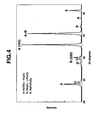
- the obtained black particles had a Ti content of 21.0 atm% based on whole Fe, a saturation magnetization value ⁇ s of 0.6 Am 2 /kg, a blackness (L* value) of 14.1, a tinting strength of 46.9 and an average particle diameter of 0.25 ⁇ m, and that as shown in the X-ray diffraction pattern of Fig. 3, the black particles were composed of a mixed composition of Fe 2 O 3 -FeTiO 3 solid solution and Fe 2 TiO 5 .
- Example 2 The same procedure as defined in Example 1 was conducted except that kind of the black non-magnetic particles was changed variously, thereby obtaining black toners.
- the thus obtained spherical black magnetic iron oxide particles whose surface was coated with the titanium oxide hydroxide were mixed with 420 g of sodium sulfate. Then, 10 kg of the thus obtained mixture was heat-calcined under a N 2 gas flow at 750°C for 60 minutes and then pulverized to obtain black iron-based particles.
- the thus obtained black iron-based particles had a Ti content of 29.8 atm% based on whole Fe, a saturation magnetization value ⁇ s of 12 Am 2 /kg, a blackness (L* value) of 9.2, a tinting strength of 40.2 and a BET specific surface area of 8.5 m 2 /g.
- a saturation magnetization value ⁇ s of 12 Am 2 /kg
- a blackness (L* value) of 9.2
- a tinting strength 40.2
- a BET specific surface area 8.5 m 2 /g.
- the black iron-based particles were composed of a mixed composition of FeTiO 3 -Fe 2 O 3 solid solution, Fe 3 O 4 - ⁇ -Fe 2 O 3 solid solution and NaFeTi 3 O 8 , and the ratio of a main peak (peak at a spacing (d) of 3.63 ⁇ ) intensity of NaFeTi 3 O 8 to a peak intensity of (104) plane of FeTiO 3 -Fe 2 O 3 was 0.08:1.
- the above prepared black iron-based particles were mixed with the following components at a mixing ratio shown below using a Henschel mixer, and the obtained composition was melt-kneaded by a twin-screw extrusion kneader (tradename: "S-1” manufactured by Kurimoto Tekkosha Co., Ltd.).
- the obtained kneaded material was cooled, finely pulverized and then classified to separate particles having an volume-average particle diameter of 8 to 10 ⁇ m (measured using "Multisizer” (tradename) manufactured by Coulter Counter Co., Ltd.), thereby obtaining toner particles.
- hydrophobic finer silica powder (tradename "RX-200” produced by Nippon Aerojil Co., Ltd.) was externally added to 100 parts by weight of the thus obtained toner particles, thereby obtaining an electrophotographic toner.
- Styrene-acrylic copolymer resin ("HI-MER SB-308” produced by Sanyo Kasei Kogyo Co., Ltd.) 100 parts by weight Black iron-based particles 25 parts by weight Negative charge controller (“BONTRON E-84” produced by Orient Kagaku Kogyo Co., Ltd.) 0.5 part by weight Low-molecular weight wax (“BISCOL 550-P” produced by Sanyo Kasei Kogyo Co., Ltd.) 5 parts by weight
- Example 34 The same procedure as defined in Example 34 was conducted except that kind of magnetite, amount of the titanium compound added, amount of the sodium compound added and heat-calcination treatment temperature were changed variously, thereby producing black iron-based particles.
- Example 34 The same procedure as defined in Example 34 was conducted except that the blue pigment was added upon the pulverization treatment, thereby obtaining black non-magnetic particles.
- Example 34 The same procedure as defined in Example 34 was conducted except that kind of the black non-magnetic particles was changed variously, thereby obtaining black toners.
Landscapes
- Chemical & Material Sciences (AREA)
- Engineering & Computer Science (AREA)
- Nanotechnology (AREA)
- Organic Chemistry (AREA)
- Physics & Mathematics (AREA)
- Composite Materials (AREA)
- Condensed Matter Physics & Semiconductors (AREA)
- General Physics & Mathematics (AREA)
- Materials Engineering (AREA)
- Crystallography & Structural Chemistry (AREA)
- Developing Agents For Electrophotography (AREA)
- Compounds Of Iron (AREA)
Applications Claiming Priority (2)
| Application Number | Priority Date | Filing Date | Title |
|---|---|---|---|
| JP2002310210 | 2002-10-24 | ||
| JP2002310210 | 2002-10-24 |
Publications (2)
| Publication Number | Publication Date |
|---|---|
| EP1413607A2 true EP1413607A2 (de) | 2004-04-28 |
| EP1413607A3 EP1413607A3 (de) | 2005-01-05 |
Family
ID=32064368
Family Applications (1)
| Application Number | Title | Priority Date | Filing Date |
|---|---|---|---|
| EP03256644A Withdrawn EP1413607A3 (de) | 2002-10-24 | 2003-10-22 | Schwarze Partikel auf der Basis von Eisen und diese enthaltende schwarze Toner |
Country Status (2)
| Country | Link |
|---|---|
| US (2) | US6844067B2 (de) |
| EP (1) | EP1413607A3 (de) |
Cited By (6)
| Publication number | Priority date | Publication date | Assignee | Title |
|---|---|---|---|---|
| EP1726566A3 (de) * | 2005-05-23 | 2008-02-13 | Toda Kogyo Corporation | SchwarzeTeilchen auf Basis von Eisen und deren Verwendung für Farben, Kautschuk- und Harzzusammensetzungen. |
| WO2008055542A1 (en) * | 2006-11-08 | 2008-05-15 | Rockwood Italia Spa | Iron oxide containing precipitated crystalline titanium dioxide and process for the manufacture thereof |
| WO2008154716A1 (en) * | 2007-06-21 | 2008-12-24 | FACULDADES CATÓLICAS, SOCIEDADE CIVIL MANTENEDORA DA PUC Rio | Alkaline and terrous-alkaline transition metal oxide micro- and submicro-materials, and hydrothermic process for obtaining the same |
| EP2186779A1 (de) * | 2006-11-08 | 2010-05-19 | Rockwood Italia SpA | Mit Eisenoxid dotiertes gefälltes kristallines Titandioxid und Herstellungsverfahren dafür |
| US8404204B2 (en) | 2008-03-31 | 2013-03-26 | Rockwood Italia Spa | Granulate having photocatalytic activity and methods for manufacturing the same |
| CN105032174A (zh) * | 2008-03-31 | 2015-11-11 | 意大利乐科伍德公司 | 光催化涂布颗粒用于分解空气污染物的用途 |
Families Citing this family (10)
| Publication number | Priority date | Publication date | Assignee | Title |
|---|---|---|---|---|
| JP3905048B2 (ja) * | 2003-03-17 | 2007-04-18 | 株式会社リコー | 静電荷像現像用トナー、プロセスカートリッジ、定着方法、画像形成方法、及び画像形成装置 |
| KR20070119756A (ko) * | 2005-04-15 | 2007-12-20 | 캐논 가부시끼가이샤 | 흑색 토너 |
| US8262730B2 (en) | 2005-12-07 | 2012-09-11 | Zimmer, Inc. | Methods of bonding or modifying hydrogels using irradiation |
| ITMI20060381A1 (it) * | 2006-03-02 | 2007-09-03 | Solvay Solexis Spa | Fluidi di scambio termico |
| US8110242B2 (en) | 2006-03-24 | 2012-02-07 | Zimmer, Inc. | Methods of preparing hydrogel coatings |
| US7572505B2 (en) * | 2006-04-28 | 2009-08-11 | Toda Kogyo Corporation | Black magnetic iron oxide particles having high breakdown voltage |
| US7731988B2 (en) | 2007-08-03 | 2010-06-08 | Zimmer, Inc. | Multi-polymer hydrogels |
| US8062739B2 (en) | 2007-08-31 | 2011-11-22 | Zimmer, Inc. | Hydrogels with gradient |
| US20110070138A1 (en) * | 2008-03-31 | 2011-03-24 | Claudia Menini | Use of photocatalytically coated particles for decomposition of air pollutants |
| CN105056956B (zh) * | 2015-07-31 | 2017-11-28 | 江苏师范大学 | 一种可见光响应的钛酸铁钠光催化材料及其制备方法和应用 |
Family Cites Families (10)
| Publication number | Priority date | Publication date | Assignee | Title |
|---|---|---|---|---|
| JP2736680B2 (ja) * | 1989-05-30 | 1998-04-02 | 戸田工業株式会社 | 黒色顔料粒子粉末 |
| JP3138359B2 (ja) * | 1993-05-13 | 2001-02-26 | キヤノン株式会社 | インクタンク、該タンクとインクヘッドとを一体に構成してなるインクタンク一体型ヘッドカートリッジ、前記インクタンクまたはヘッドカートリッジを具備したインクジェットプリント装置 |
| US5652060A (en) * | 1995-06-15 | 1997-07-29 | Toda Kogyo Corporation | Spherical magnetic particles for magnetic toner and process for producing the same |
| JP2741499B2 (ja) * | 1996-02-15 | 1998-04-15 | 工業技術院長 | 耐熱性無機顔料粉末及びその製造方法 |
| US5873610A (en) * | 1996-12-19 | 1999-02-23 | Itt Automotive, Inc. | Female connector member for large tolerance male member endforms |
| US6130017A (en) * | 1998-04-20 | 2000-10-10 | Toda Kogyo Corporation | Black non-magnetic composite particles for black toner and black toner using the same |
| US6383637B1 (en) * | 1999-04-16 | 2002-05-07 | Toda Kogyo Corporation | Black magnetic iron oxide particles for magnetic toner and process for producing the same |
| KR100740027B1 (ko) * | 2001-01-23 | 2007-07-18 | 토다 고교 가부시끼가이샤 | 흑색 자성 산화철 입자 및 자성 토너 |
| EP1343053B1 (de) * | 2002-03-01 | 2008-12-24 | Ricoh Company, Ltd. | Schwarzer Toner, Herstellungsverfahren, Bilderzeugungsverfahren und Bilderzeugungsvorrichtung |
| JP2003345067A (ja) * | 2002-05-29 | 2003-12-03 | Dainippon Ink & Chem Inc | 静電荷像現像用トナー |
-
2003
- 2003-10-17 US US10/686,776 patent/US6844067B2/en not_active Expired - Fee Related
- 2003-10-22 EP EP03256644A patent/EP1413607A3/de not_active Withdrawn
-
2005
- 2005-01-11 US US11/032,084 patent/US20050123756A1/en not_active Abandoned
Cited By (10)
| Publication number | Priority date | Publication date | Assignee | Title |
|---|---|---|---|---|
| EP1726566A3 (de) * | 2005-05-23 | 2008-02-13 | Toda Kogyo Corporation | SchwarzeTeilchen auf Basis von Eisen und deren Verwendung für Farben, Kautschuk- und Harzzusammensetzungen. |
| US7687564B2 (en) | 2005-05-23 | 2010-03-30 | Toda Kogyo Corporation | Black iron-based particles, and black paint and rubber or resin composition using the same |
| WO2008055542A1 (en) * | 2006-11-08 | 2008-05-15 | Rockwood Italia Spa | Iron oxide containing precipitated crystalline titanium dioxide and process for the manufacture thereof |
| EP2186779A1 (de) * | 2006-11-08 | 2010-05-19 | Rockwood Italia SpA | Mit Eisenoxid dotiertes gefälltes kristallines Titandioxid und Herstellungsverfahren dafür |
| US7833935B2 (en) | 2006-11-08 | 2010-11-16 | Rockwood Italia S.P.A. | Iron oxide containing precipitated crystalline titanium dioxide and process for the manufacture thereof |
| AU2006350519B2 (en) * | 2006-11-08 | 2011-10-06 | Huntsman Pigments S.p.A. | Iron oxide containing precipitated crystalline titanium dioxide and process for the manufacture thereof |
| CN101600498B (zh) * | 2006-11-08 | 2013-01-16 | 意大利乐科伍德公司 | 含有沉淀的结晶二氧化钛的铁氧化物及其制备方法 |
| WO2008154716A1 (en) * | 2007-06-21 | 2008-12-24 | FACULDADES CATÓLICAS, SOCIEDADE CIVIL MANTENEDORA DA PUC Rio | Alkaline and terrous-alkaline transition metal oxide micro- and submicro-materials, and hydrothermic process for obtaining the same |
| US8404204B2 (en) | 2008-03-31 | 2013-03-26 | Rockwood Italia Spa | Granulate having photocatalytic activity and methods for manufacturing the same |
| CN105032174A (zh) * | 2008-03-31 | 2015-11-11 | 意大利乐科伍德公司 | 光催化涂布颗粒用于分解空气污染物的用途 |
Also Published As
| Publication number | Publication date |
|---|---|
| US20040131852A1 (en) | 2004-07-08 |
| US20050123756A1 (en) | 2005-06-09 |
| US6844067B2 (en) | 2005-01-18 |
| EP1413607A3 (de) | 2005-01-05 |
Similar Documents
| Publication | Publication Date | Title |
|---|---|---|
| US6844067B2 (en) | Black iron-based particles and black toner containing the same | |
| EP1225600B1 (de) | Schwarze magnetische Eisenoxidteilchen und magnetischer Toner | |
| EP0187434B2 (de) | Sphärische magnetische Teilchen | |
| EP0622426B1 (de) | Körmige, beschichtete Magnetitteilchen und deren Herstellungsverfahren | |
| US6383637B1 (en) | Black magnetic iron oxide particles for magnetic toner and process for producing the same | |
| JP4150881B2 (ja) | 黒色磁性酸化鉄粒子粉末 | |
| JP4344999B2 (ja) | 鉄系黒色粒子粉末及び該鉄系黒色粒子粉末を含有する黒色トナー | |
| EP1466868B1 (de) | Schwarzes mischoxidteilchen und herstellungsverfahren dafür | |
| US6475687B2 (en) | Magnetic composite particles for black magnetic toner and black magnetic toner using the same | |
| JP4497285B2 (ja) | 鉄系黒色粒子粉末及び該鉄系黒色粒子粉末を含有する黒色トナー | |
| JP3440586B2 (ja) | 粒状マグネタイト粒子粉末及びその製造法 | |
| JP4534125B2 (ja) | 鉄系黒色粒子粉末及び該鉄系黒色粒子粉末を含有する黒色トナー | |
| JP4183497B2 (ja) | 黒色複合酸化物粒子及びその製造方法 | |
| JPH10171158A (ja) | 球状を呈した磁性トナー用磁性酸化鉄粒子粉末及び該磁性酸化鉄粒子粉末を用いた磁性トナー | |
| JP3440585B2 (ja) | 粒状マグネタイト粒子粉末及びその製造法 | |
| JP4868111B2 (ja) | トナー用鉄系黒色粒子粉末 | |
| JP4753029B2 (ja) | トナー用鉄系黒色粒子粉末 | |
| US6596255B2 (en) | Tin-containing granular magnetic oxide particles and process for producing the same | |
| US20020045700A1 (en) | Non-magnetic composite particles for black toner and black toner using the same | |
| JP2008096758A (ja) | トナー用鉄系黒色粒子粉末 | |
| JPH06310318A (ja) | 粒状マグネタイト粒子粉末及びその製造法 |
Legal Events
| Date | Code | Title | Description |
|---|---|---|---|
| PUAI | Public reference made under article 153(3) epc to a published international application that has entered the european phase |
Free format text: ORIGINAL CODE: 0009012 |
|
| AK | Designated contracting states |
Kind code of ref document: A2 Designated state(s): AT BE BG CH CY CZ DE DK EE ES FI FR GB GR HU IE IT LI LU MC NL PT RO SE SI SK TR |
|
| AX | Request for extension of the european patent |
Extension state: AL LT LV MK |
|
| PUAL | Search report despatched |
Free format text: ORIGINAL CODE: 0009013 |
|
| RIC1 | Information provided on ipc code assigned before grant |
Ipc: 7H 01F 1/36 B Ipc: 7G 03G 9/083 B Ipc: 7C 01G 49/00 B Ipc: 7C 09C 1/24 A |
|
| AK | Designated contracting states |
Kind code of ref document: A3 Designated state(s): AT BE BG CH CY CZ DE DK EE ES FI FR GB GR HU IE IT LI LU MC NL PT RO SE SI SK TR |
|
| AX | Request for extension of the european patent |
Extension state: AL LT LV MK |
|
| 17P | Request for examination filed |
Effective date: 20050204 |
|
| AKX | Designation fees paid |
Designated state(s): DE FR GB NL |
|
| RAP1 | Party data changed (applicant data changed or rights of an application transferred) |
Owner name: TODA KOGYO CORPORATION |
|
| GRAP | Despatch of communication of intention to grant a patent |
Free format text: ORIGINAL CODE: EPIDOSNIGR1 |
|
| STAA | Information on the status of an ep patent application or granted ep patent |
Free format text: STATUS: THE APPLICATION IS DEEMED TO BE WITHDRAWN |
|
| 18D | Application deemed to be withdrawn |
Effective date: 20090926 |