EP1413697A2 - Schliessblech und Schlosssystem bzw. Schliessblech für ein Schloss - Google Patents
Schliessblech und Schlosssystem bzw. Schliessblech für ein Schloss Download PDFInfo
- Publication number
- EP1413697A2 EP1413697A2 EP03256517A EP03256517A EP1413697A2 EP 1413697 A2 EP1413697 A2 EP 1413697A2 EP 03256517 A EP03256517 A EP 03256517A EP 03256517 A EP03256517 A EP 03256517A EP 1413697 A2 EP1413697 A2 EP 1413697A2
- Authority
- EP
- European Patent Office
- Prior art keywords
- keep
- door
- keeps
- lock
- rail
- Prior art date
- Legal status (The legal status is an assumption and is not a legal conclusion. Google has not performed a legal analysis and makes no representation as to the accuracy of the status listed.)
- Withdrawn
Links
- 238000000034 method Methods 0.000 claims description 9
- 239000000463 material Substances 0.000 claims description 5
- 230000000694 effects Effects 0.000 description 4
- 238000004519 manufacturing process Methods 0.000 description 3
- 239000002184 metal Substances 0.000 description 3
- 238000000465 moulding Methods 0.000 description 2
- 238000003825 pressing Methods 0.000 description 2
- 238000010586 diagram Methods 0.000 description 1
Images
Classifications
-
- E—FIXED CONSTRUCTIONS
- E05—LOCKS; KEYS; WINDOW OR DOOR FITTINGS; SAFES
- E05B—LOCKS; ACCESSORIES THEREFOR; HANDCUFFS
- E05B15/00—Other details of locks; Parts for engagement by bolts of fastening devices
- E05B15/02—Striking-plates; Keepers; Bolt staples; Escutcheons
- E05B15/0205—Striking-plates, keepers, staples
- E05B15/024—Striking-plates, keepers, staples adjustable
- E05B15/0245—Movable elements held by friction, cooperating teeth, or the like
-
- E—FIXED CONSTRUCTIONS
- E05—LOCKS; KEYS; WINDOW OR DOOR FITTINGS; SAFES
- E05B—LOCKS; ACCESSORIES THEREFOR; HANDCUFFS
- E05B15/00—Other details of locks; Parts for engagement by bolts of fastening devices
- E05B15/02—Striking-plates; Keepers; Bolt staples; Escutcheons
- E05B15/0205—Striking-plates, keepers, staples
- E05B15/022—Striking-plates, keepers, staples movable, resilient or yieldable
-
- E—FIXED CONSTRUCTIONS
- E05—LOCKS; KEYS; WINDOW OR DOOR FITTINGS; SAFES
- E05C—BOLTS OR FASTENING DEVICES FOR WINGS, SPECIALLY FOR DOORS OR WINDOWS
- E05C9/00—Arrangements of simultaneously actuated bolts or other securing devices at well-separated positions on the same wing
- E05C9/18—Details of fastening means or of fixed retaining means for the ends of bars
- E05C9/1808—Keepers
-
- E—FIXED CONSTRUCTIONS
- E05—LOCKS; KEYS; WINDOW OR DOOR FITTINGS; SAFES
- E05B—LOCKS; ACCESSORIES THEREFOR; HANDCUFFS
- E05B63/00—Locks or fastenings with special structural characteristics
- E05B63/04—Locks or fastenings with special structural characteristics for alternative use on the right-hand or left-hand side of wings
- E05B63/042—Locks or fastenings with special structural characteristics for alternative use on the right-hand or left-hand side of wings constructed symmetrically
-
- E—FIXED CONSTRUCTIONS
- E05—LOCKS; KEYS; WINDOW OR DOOR FITTINGS; SAFES
- E05B—LOCKS; ACCESSORIES THEREFOR; HANDCUFFS
- E05B65/00—Locks or fastenings for special use
- E05B65/08—Locks or fastenings for special use for sliding wings
- E05B65/0811—Locks or fastenings for special use for sliding wings the bolts pivoting about an axis perpendicular to the wings
Definitions
- the present invention relates to a keep and lock assembly. It is particularly applicable to door keeps and locks, but not limited there to. For example it could be applied to keeps and locks for windows. Whilst the present invention is discussed below mostly with reference to doors it is to be understood that similar considerations apply to windows.
- PVC-U doors and doors made from other materials, have a number of keeps, or strikes, fixed to the outer door frame in positions to engage with various features in a lock or latch of the door leaf.
- PVC-U doors being more flexible than doors made from most other conventional materials, usually require a number of keeps (typically at least three and often as many as eight) for the lock or locks to engage with to maintain the integrity of the door leaf to the door frame and to provide effective security and weathering of the door.
- the provision of a number of keeps makes the door frame look untidy and, from a manufacturing point of view, it takes time to position and fix each of these keeps.
- the existing solution to this problem is to provide a single piece of metal, sometimes running the full height of the (outer) frame of the door, having the necessary features to engage with the door lock(s) in the same way as a plurality of separate keeps.
- the door locks currently available in the industry are not symmetrical about the horizontal centre line. This is because, especially for a hinged door, the arrangement of locks and keeps not only needs to provide security against an intruder, but also needs to provide good weathering (e.g. by pressing the door leaf against seals in the outer frame). In order to achieve good weathering, the locks of hinged doors engage with the keeps in a manner which pulls the door leaf and the door frame together so as to press the door leaf against seals provided on the door frame.
- the positioning of keeps for security purposes is determined by potential methods of attack by an intruder, while the positioning for weathering purposes is determined by the need to urge the door leaf against seals in the frame in a reasonably even manner over the height of the door.
- left and right-handed versions when one piece keeps or keep rails are used, different left and right-handed versions must be provided to fit left and right-handed doors (doors which close on their left or right sides).
- the need for different left and right-handed versions is a disadvantage in terms of stocking, manufacture and supply since one part is preferable to two.
- a further problem is that keeps, especially 'one-piece keeps' or 'keep rails' having a plurality of keeps take up space on the outer door frame and therefore limit the positions at which the frame can be fixed to the brickwork.
- the positions for fixing are important and must ideally comply with industry standards.
- At its most general one aspect of the present invention proposes providing a keep and lock assembly in which the lock(s) are operable to extend into the keeps in a manner which urges the body supporting the lock(s) sideways of the direction of the lock's extension into the keeps, wherein the keeps are provided on an elongate member and disposed symmetrically about a horizontal centre line of the elongate member.
- the 'horizontal' centre line is a centre line that extends perpendicular to the longitudinal length of the elongate member (i.e. perpendicular to its longest axis). This gives rise to two possibilities: a centre line extending in the plane of the elongate member and one extending perpendicular to the plane of the elongate member.
- the keeps are disposed symmetrically about the first of these (the centre line in the plane of the elongate member and perpendicular to the longitudinal length of the elongate member), however they may be symmetrical with respect to both.
- This symmetry allows the elongate member, hereinafter also referred to as a 'one piece keep' or 'keep rail', to be rotated about its horizontal centre line without altering the relative position of the keeps so that the keep rail can be used for example, on either the left or right hand side of a door. If instead of a door, the keep rail is used with a window the above described symmetry allows the keep rail to be used on either the left or right or alternatively the upper or lower edge of the window.
- the elongate member, or keep rail is preferably, but not necessarily formed of metal.
- a first aspect of the present invention may provide a keep and lock assembly comprising a keep rail having a plurality of keeps and a lock or locks operable to extend into the keeps, so as to engage the keeps in such a manner that the lock or locks are urged sideways of their direction of extension and wherein the keeps are positioned symmetrically about a central axis of the keep rail extending perpendicular to the longitudinal axis of the keep rail.
- central axis extends in the plane of the keep rail.
- the symmetry means that by 180° rotation about said central axis the rail can be converted from a left handed rail for use on the left hand side of a door to a right handed rail for use on the right hand side of a door or on different sides of a window.
- a left handed rail for use on the left hand side of a door
- a right handed rail for use on the right hand side of a door or on different sides of a window.
- the assembly is fixed or attached to a door frame and a door leaf.
- the assembly can be fixed or attached to a window frame and a window leaf.
- a window frame is the frame mounted to the building structure and the 'window leaf' is the part of the window which can be opened (e.g. window pane and the sash or casement in which the pane is mounted).
- the keep rail is mounted on the frame and the lock(s) is/are mounted on the leaf; however, it would theoretically be possible to use the reverse configuration with the keep rail mounted on the leaf and the locks mounted on the frame.
- the door or window is hinged, i.e. the leaf is hingedly attached to the frame.
- Extension of the lock(s) into the keeps has the effect of locking the door or window by preventing (or at least strictly limiting) movement of the leaf out of the plane of the frame.
- the above mentioned lateral urging of the body (e.g. the door or window leaf) supporting the lock(s) relative to the direction of the lock's extension is an urging (e.g. pushing or pulling) of the door or window leaf in a direction out of the plane of the frame so as to press it against seals provided on the frame. This provides good weathering.
- the lock(s) have bolts or pins, which taper to widen away from their distal ends, then as the bolts or pins are extended into the keeps, their engagement with the sidewalls of the keeps will push the leaf laterally to engage seals provided on the frame.
- the walls of the keep aperture (which in use receives the lock) can be tapered to provide the same effect.
- Each keep may be provided with a top plate having an aperture, which the lock passes through before entering the keep (when the lock is operated).
- the top plate has a tapered leading edge and engagement of the extended portion of the lock (which may e.g. be a bolt, or a hook) with the leading edge, urges the body holding the lock sideways of the direction of extension as described above.
- the positioning of the top plate is adjustable, for example by an adjustment mechanism that allows its horizontal position relative to the keep to be adjusted. This enables adjustment of the top plate to provide optimal pressing of the door leaf against the seals.
- a second aspect of the present invention may provide a kit of parts for making a lock and keep rail assembly according to the first aspect of the invention, the kit of parts comprising a keep rail having a plurality of keeps for engaging a lock, the lock or locks operable to extend into the keeps so as to engage the keeps in such a manner that the lock or locks are urged sideways of their direction of extension and wherein the keeps are positioned symmetrically about a central axis of the keep rail extending perpendicular to the longitudinal axis of the keep rail.
- the lock(s) and the keep rail may have any of the features described above in the first aspect of the invention.
- the kit of parts may also include a door or window frame and/or a door or window leaf to which the lock or the keep rail can be attached.
- a third aspect of the present invention may provide a method of assembling a (preferably hinged) door or window comprising the steps of:
- the keep rail is fixed to the frame (and a lock is provided in the leaf), but it would theoretically be possible to attach the keep rail to the leaf and have the lock on the frame.
- PVC-U doors doors in which the door leaf is formed from PVC-U
- the present invention is not limited to PVC-U doors and can be used with doors formed from other materials.
- the present invention can also be applied to windows, including but not limited to windows having a PVL-U frame.
- a fourth aspect of the present invention provides a keep rail (especially, but not necessarily for a hinged door or window) having one or more keeps for engaging with a lock or latch of a door or window and one or more slots in the keep rail through which fixing screws can be inserted for fixing a door or window frame to the structure of a building.
- the door or window frame (or a side of the frame) will usually be provided to the installer with the keep rail already attached.
- the keep rail has a plurality of keeps.
- the slot or slots are elongate which gives the installer freedom to fix the frame to the building at the most convenient location.
- the slots have a greater longitudinal extent than the keeps.
- the slots are provided at separate locations to the keeps so that any fixing screws do not interfere with the lock/latch-keep engagement.
- a cover is provided that can be positioned over the head of screws or other means for fixing the frame to the building.
- the screw heads can then be covered after they have been inserted through the slots, so that they are not visible. This gives the frame a tidier appearance.
- the cover may be in the form of a moulding and conveniently clips to the keep rail.
- the fourth aspect of the present invention may be combined with any of the above aspects of the present invention.
- a fifth aspect of the present invention provides a method of installing a door or window frame, comprising the steps of fixing a keep rail having one or more keeps to a frame and then fixing the frame to a building structure by inserting fixing means, such as screws, through slots in the keep rail.
- the keep rail may have any of the features mentioned above under the other aspects of the invention.
- the door leaf (when present) may be made of PVC-U or any other appropriate material.
- the keep rail preferably, has at least 3 keeps and may have more.
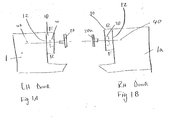
- Fig. 1a is a cross section of a horizontal plane of a left handed (LH) door having such a lock and keep rail assembly.
- the door comprises an outer frame, the left side 1 of which is shown in Fig. 1a, a keep rail 10 and a door leaf (not shown) hingedly attached to a right side of the frame and having a lock 20 for engaging with a keep 30 in the keep rail 10 when the door is closed.
- the keep 30 includes an aperture with which a projecting part of the lock 20 can engage with when the door is closed.
- the lock 20 engages with the keep 30 in a manner which holds (and in this example actually pulls) the door leaf and the keep rail 10 together to effect a weathering seal.
- Fig. 1b shows a cross section in a horizontal plane of a right handed (RH) door.
- the door is the same as that shown in Fig. 1b except that the door leaf (not shown) hinges on the left side of the frame and closes towards the right side 1a of the frame and the keep rail 10 has been rotated 180 degrees about its centre line to fit with the lock 20a on the right hand side of the door leaf.
- the keep rail 10 is an elongate member, formed of metal, having a plurality of keeps 30 along its length.
- Each keep 30 is in the form of an aperture, which engages with a feature of a lock 20 of the door leaf (each keep can engage with a different feature of the same lock, or with a different lock from the other keeps if there are several locks in the assembly).
- keep rail 10 in Fig. 1a has the same physical structure as the keep rail 10 in Fig. 1b, the difference simply being that the keep rail in Fig. 1b has been rotated about 180 degrees about its vertical longitudinal axis to fit the right side 1a of a door frame and to engage with a lock 20a on the right side of a door leaf.
- the keep rail 10 and the keeps therein are symmetrical about a vertical plane 40 bisecting the keep rail.
- the keep rail 10 can be rotated about a central vertical axis by 180 degrees and maintain symmetry about the centre line 40.
- the keep rail has reflectional symmetry about the vertical bisecting plane 40 and 180 degree rotational symmetry about its vertical axis (i.e. two-fold rotational symmetry). In the above example, this allows the same keep rail to be used for both left and right handed doors.
- the nominal front and rear of the keep rail are shown by reference numerals F and R respectively.
- the rail is the opposite way round in Fig 1B as it has been rotated by 180° about its central vertical axis.
- a first embodiment of the present invention is a keep rail and lock assembly having reflectional symmetry about a horizontal plane and rotational symmetry about a horizontal axis.
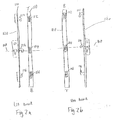
- Fig. 2a is a schematic diagram showing the keep rail 110 when orientated for engagement with features of a lock on a left handed door.
- the keep rail 110 has three keeps 112, 114, 116 for engagement with features 122, 124 and 126 respectively of lock 120 of the left handed door leaf.
- the lock features 122, 124 and 126 are hook shaped and capable of engaging their respective keeps 112, 114 and 116 so as to hold the lock 120 and keep rail 110 together.
- T and B are used to detonate the nominal top and bottom of the keep rail which is the "right way up” in Fig. 2a.
- Fig. 2b the keep rail 110 is used in a right handed door and the same reference numerals are used to denote corresponding features.
- the keep rail is structurally the same as in Fig. 2a, but has been rotated 180 degrees about its horizontal axis 140 so it is now the "wrong way up" with its bottom B at the upper end, its top T at the lower end and it faces the opposite direction (towards the left side of the door frame).
- the lock 110 in Fig. 2b belongs to a right handed door.
- the keep rail 110 has reflectional symmetry about a bisecting horizontal plane and 180 degrees rotational symmetry about a central axis 140 in that plane.
- the rotational symmetry about the horizontal axis has the advantage that the seating platform does not have to be symmetrical about a vertical centre line.
- this solution works even when the keep rail is used on the seating platforms having a varied contour.
- the lock(s), which the keeps engage with need to be symmetrical about the horizontal bisecting plane.
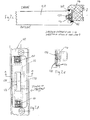
- Fig 2c is a partial cross section in the horizontal plane, showing the direction in which the door leaf 150 is pressed against the seals 160, 161 provided on the door frame 1.
- Figs 2d and 2e show a mechanism for urging the door leaf against the seals 160, 161 when the door is locked.
- Each keep 112, 114, 116 has a top plate placed over it.
- Fig 2d is a front plan view showing a top plate 170 attached to the keep rail 110 over keep 114.
- the top plate 170 has an aperture 175 through which a portion 124 of the lock 120 extends when the lock is operated to engage the keep 114.
- a side of the extended portion 124 slides along the leading edge 176 of the aperture 175.
- the leading edge 176 is tapers inwards as shown in Fig 2e, which is a cross section along the line A-A of Fig 2d. Because the leading edge 176 tapers inwards the lock is pushed sideways of its direction of extension and this pulls the door leaf 150 into the seals 160, 161.
- the top plate 170 is adjustably attached to the keep rail 110 by a screw and slot arrangement 180. This enables the horizontal positioning of the keep rail to be adjusted by the installer, as indicated by the arrow in Fig 2d, to give optimum engagement of the door leaf 150 with the seals 160, 161 when the door is locked.
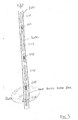
- Fig. 3 shows a third embodiment of the present invention.
- This third embodiment comprises a one piece keep rail 200 which has a plurality (in this case three) keeps 202, 204 and 206 disposed along its length.
- a plurality of elongate slots 210, 212, 214 and 216 disposed along the length of the rail between the keeps.
- These slots allow a door frame, to which the keep rail 200 is attached, to be fixed to the structure of the building, for example by the use of frame fixing screws which are driven through the slots.
- the installer has a choice of positions for securing the frame to the building structure. This is desirable as industry standards prescribe fixing in certain positions.
- a cover moulding (not shown) is also provided and clips to the keep rail so that the heads of the frame fixing screws are not visible.
Landscapes
- Engineering & Computer Science (AREA)
- Mechanical Engineering (AREA)
- Wing Frames And Configurations (AREA)
- Support Devices For Sliding Doors (AREA)
Applications Claiming Priority (2)
| Application Number | Priority Date | Filing Date | Title |
|---|---|---|---|
| GB0224924A GB0224924D0 (en) | 2002-10-25 | 2002-10-25 | Door keep |
| GB0224924 | 2002-10-25 |
Publications (2)
| Publication Number | Publication Date |
|---|---|
| EP1413697A2 true EP1413697A2 (de) | 2004-04-28 |
| EP1413697A3 EP1413697A3 (de) | 2004-12-08 |
Family
ID=9946623
Family Applications (1)
| Application Number | Title | Priority Date | Filing Date |
|---|---|---|---|
| EP03256517A Withdrawn EP1413697A3 (de) | 2002-10-25 | 2003-10-16 | Schliessblech und Schlosssystem bzw. Schliessblech für ein Schloss |
Country Status (2)
| Country | Link |
|---|---|
| EP (1) | EP1413697A3 (de) |
| GB (1) | GB0224924D0 (de) |
Cited By (5)
| Publication number | Priority date | Publication date | Assignee | Title |
|---|---|---|---|---|
| FR2936542A1 (fr) * | 2008-09-26 | 2010-04-02 | Metalux | Gache reglable de serrure |
| AT514537A1 (de) * | 2013-06-04 | 2015-01-15 | Riha Alfred Dipl Htl Ing | Sicherheitstür-Zarge-Kombination |
| EP3067490A1 (de) * | 2015-03-12 | 2016-09-14 | Aug. Winkhaus GmbH & Co. KG | Schliessblech für einen treibstangenbeschlag |
| CN108026742A (zh) * | 2015-08-13 | 2018-05-11 | 马科技术有限责任公司 | 闭锁件 |
| CN112922456A (zh) * | 2021-01-26 | 2021-06-08 | 宁波荣鑫电器有限公司 | 用于锁定集装箱门的抗弯扭防拆锁定装置 |
Citations (1)
| Publication number | Priority date | Publication date | Assignee | Title |
|---|---|---|---|---|
| GB2313620A (en) | 1993-12-29 | 1997-12-03 | Cego Frameware Ltd | Multi-point locking assembly for a door or window |
Family Cites Families (2)
| Publication number | Priority date | Publication date | Assignee | Title |
|---|---|---|---|---|
| EP1191173A3 (de) * | 2000-09-22 | 2002-11-20 | Avocet Hardware PLC | Verriegelungsvorrichtung für Türen oder Fenster |
| DE10123629A1 (de) * | 2001-05-15 | 2002-12-05 | Erich Matouschek | Einrichtung zum Sichern von Fenster, Türen und dgl. gegen unberechtigtes Öffnen |
-
2002
- 2002-10-25 GB GB0224924A patent/GB0224924D0/en not_active Ceased
-
2003
- 2003-10-16 EP EP03256517A patent/EP1413697A3/de not_active Withdrawn
Patent Citations (1)
| Publication number | Priority date | Publication date | Assignee | Title |
|---|---|---|---|---|
| GB2313620A (en) | 1993-12-29 | 1997-12-03 | Cego Frameware Ltd | Multi-point locking assembly for a door or window |
Cited By (7)
| Publication number | Priority date | Publication date | Assignee | Title |
|---|---|---|---|---|
| FR2936542A1 (fr) * | 2008-09-26 | 2010-04-02 | Metalux | Gache reglable de serrure |
| AT514537A1 (de) * | 2013-06-04 | 2015-01-15 | Riha Alfred Dipl Htl Ing | Sicherheitstür-Zarge-Kombination |
| AT514537B1 (de) * | 2013-06-04 | 2016-05-15 | Wertheim Vertriebsgesellschaft M B H | Sicherheitstür-Zarge-Kombination |
| EP3067490A1 (de) * | 2015-03-12 | 2016-09-14 | Aug. Winkhaus GmbH & Co. KG | Schliessblech für einen treibstangenbeschlag |
| CN108026742A (zh) * | 2015-08-13 | 2018-05-11 | 马科技术有限责任公司 | 闭锁件 |
| CN108026742B (zh) * | 2015-08-13 | 2019-12-24 | 马科技术有限责任公司 | 闭锁件 |
| CN112922456A (zh) * | 2021-01-26 | 2021-06-08 | 宁波荣鑫电器有限公司 | 用于锁定集装箱门的抗弯扭防拆锁定装置 |
Also Published As
| Publication number | Publication date |
|---|---|
| GB0224924D0 (en) | 2002-12-04 |
| EP1413697A3 (de) | 2004-12-08 |
Similar Documents
| Publication | Publication Date | Title |
|---|---|---|
| CA2081394C (en) | Retainer for pre-hung door | |
| US6651389B2 (en) | Casement window with improved tie bar guide and striker | |
| US6550733B1 (en) | Supporting means for a screening device | |
| US20030052492A1 (en) | Swing adaptable astragal with lockable unitary flush bolt assemblies | |
| EP2857622B1 (de) | Türzarge für bündig nach innen öffnende Tür | |
| US4809400A (en) | Security hardware for doors | |
| CN110573691A (zh) | 改进的玻璃框架系统及方法 | |
| US5787639A (en) | Door and frame mounting enabling door hanger bolt assembly | |
| US20050086879A1 (en) | Retainer for prehung door | |
| EP1061219A1 (de) | Scharnier für Rahmen | |
| KR100439112B1 (ko) | 레일은폐형 창호장치 | |
| JP2000045639A (ja) | 引 戸 | |
| US20030093871A1 (en) | Closure assembly | |
| EP1471196B1 (de) | Sperrriegel für Tür- oder Fensterflügel | |
| US5682715A (en) | Two piece center mull for multiple door assembly | |
| GB2351526A (en) | Method of securing a shoot bolt to a gearbox, and a gearbox therefor | |
| KR102429191B1 (ko) | 창호 | |
| KR102026443B1 (ko) | 창호용 잠금핸들의 설치구조 | |
| GB2173246A (en) | Device to restrict door opening | |
| GB2111577A (en) | Casement window fastener | |
| US4872715A (en) | Sliding door and lock combination | |
| GB2304793A (en) | A slide for slidably attaching an espagnolette or locking bar to a window or door frame to facilitate positioning during mounting | |
| JPS6341485Y2 (de) | ||
| EP1413697A3 (de) | Schliessblech und Schlosssystem bzw. Schliessblech für ein Schloss | |
| WO1994015052A1 (en) | Panel locking arrangement |
Legal Events
| Date | Code | Title | Description |
|---|---|---|---|
| PUAI | Public reference made under article 153(3) epc to a published international application that has entered the european phase |
Free format text: ORIGINAL CODE: 0009012 |
|
| AK | Designated contracting states |
Kind code of ref document: A2 Designated state(s): AT BE BG CH CY CZ DE DK EE ES FI FR GB GR HU IE IT LI LU MC NL PT RO SE SI SK TR |
|
| AX | Request for extension of the european patent |
Extension state: AL LT LV MK |
|
| PUAL | Search report despatched |
Free format text: ORIGINAL CODE: 0009013 |
|
| AK | Designated contracting states |
Kind code of ref document: A3 Designated state(s): AT BE BG CH CY CZ DE DK EE ES FI FR GB GR HU IE IT LI LU MC NL PT RO SE SI SK TR |
|
| AX | Request for extension of the european patent |
Extension state: AL LT LV MK |
|
| 17P | Request for examination filed |
Effective date: 20050208 |
|
| AKX | Designation fees paid |
Designated state(s): AT BE BG CH CY CZ DE DK EE ES FI FR GB GR HU IE IT LI LU MC NL PT RO SE SI SK TR |
|
| RAP1 | Party data changed (applicant data changed or rights of an application transferred) |
Owner name: EPWIN GROUP LIMITED |
|
| 17Q | First examination report despatched |
Effective date: 20100118 |
|
| STAA | Information on the status of an ep patent application or granted ep patent |
Free format text: STATUS: THE APPLICATION IS DEEMED TO BE WITHDRAWN |
|
| 18D | Application deemed to be withdrawn |
Effective date: 20130503 |