EP1417889B1 - Appareil et procédé d'immobilisation de carcasses - Google Patents
Appareil et procédé d'immobilisation de carcasses Download PDFInfo
- Publication number
- EP1417889B1 EP1417889B1 EP03025538A EP03025538A EP1417889B1 EP 1417889 B1 EP1417889 B1 EP 1417889B1 EP 03025538 A EP03025538 A EP 03025538A EP 03025538 A EP03025538 A EP 03025538A EP 1417889 B1 EP1417889 B1 EP 1417889B1
- Authority
- EP
- European Patent Office
- Prior art keywords
- carcase
- arrangement
- holding means
- halves
- movable
- Prior art date
- Legal status (The legal status is an assumption and is not a legal conclusion. Google has not performed a legal analysis and makes no representation as to the accuracy of the status listed.)
- Expired - Lifetime
Links
Images





Classifications
-
- A—HUMAN NECESSITIES
- A22—BUTCHERING; MEAT TREATMENT; PROCESSING POULTRY OR FISH
- A22B—SLAUGHTERING
- A22B7/00—Slaughterhouse arrangements
- A22B7/001—Conveying arrangements
- A22B7/002—Devices for hanging animal carcasses while being conveyed or stored, e.g. gambrels, hooks
Definitions
- the present invention relates to a device and a method for use in a slaughtering line for handling of a carcase consisting of two interconnected carcase halves, which are hung in at least one gambrel or hook.
- Carcases in a slaughtering line may comprise two interconnected carcase halves, which are hung in one or more gambrels or hooks.
- the carcases halves may hang together in the snout, in a piece of the fat of the neck or be completely separate.
- the head may in certain cases be cut off early at the line of slaughtering for hygiene purposes.
- the present invention relates to the handling of carcase after they have been mid-split and thereby consist of carcase halves as described above.
- the devices for fixating of carcase halves during an automated treatment is often used in slaughtering lines.
- the carcases are most often hung in the hind legs, so that the front part hangs loose below.
- slaughtering lines must be able to handle all shapes and sizes of carcases, for which reason measuring equipment has been designed for measuring the size of the carcase or position of the anatomical points in respect of the point of hanging.
- the automated treatment processes may thereby be adjusted in order to ensure sufficiently accurate performance in relation to that particular carcase.
- the carcase halves are more movable, if the two halves are not interconnected. Thus, it is more difficult to control the carcase halves than the carcases and thereby also the fixation processes and treatment processes which follow subsequently.
- a device for fixation of a carcase which is hung in the rear end.
- the fixation relates to the holding of the carcase in a position previous to a cutting process, which is performed by fixating the head concurrently with the exposing of the carcase to a pull downwards, so that the carcase is stretched out and fixated.
- the cutting process relates to a longitudinal cut through of the carcase, which means that the fixation in this device has been arranged for the entire carcase.
- An apparatus for configuring an animal carcass is known from US 6.244.951.
- the apparatus comprises a frame, a carriage, a connecting member, first and second opposable arms and a drive mechanism.
- the apparatus is for configuring the animal carcass for processing by a leaf lard puller.
- the object of the present invention is thus to provide a device, which, essentially in the same movement, is capable of fixating and pivoting two interconnected carcase halves, whereby the inner side of the carcase halves is exposed to or made available for a subsequent treatment process.
- the object of the present invention is to provide a device for fixation of the carcase halves, so that the mobility is rapidly controlled and the carcase halves are maintained.
- a further object of the present invention is to provide a device for fixating and pivoting different sizes of carcase halves.
- the present invention is new and characteristic in that the device according to claim 1 comprises a movable arrangement, which is connected to two holding means. Furthermore, the arrangement may be moved towards the movable path of the carcase and has been arranged to bring the holding means in contact with each of their carcase halves.
- the holding means is arranged to fixate the carcase halves, and is pivotally connected with the arrangement and furthermore arranged to pivot the carcase halves opposite one another to a working position.
- the carcase halves are fixated and furthermore that they are pivoted, so that the inner side of the carcase halves is opened and thereby is exposed previous to a subsequent treatment process.
- a simple construction for fixation and pivoting of carcase after they have been mid-split is obtained, which is easy to incorporate in the existing slaughtering line in the positions, where the inner side of the carcase halves is to be treated.
- a further advantage is that it is possible to automate the treatment processes, which were previously manual and hereby very time-consuming.
- Treatment processes which are possible to automate by the present invention are, among other things, cleaning of the neck, cleaning of intestines remains, cleaning of heart fat from the carcase half and cleaning of leaf remains from the carcase half.
- the movable path of the carcase is meant that path which follows the two interconnected carcase halves in the slaughtering line during the carrying through of various treatment processes.
- the movable path of the carcase is substantially identically with the course of the conveyor.
- working position is meant that the carcase is available for a subsequent working process, also called a treatment process.
- the arrangement has been arranged to lead the holding means forward to the carcase halves, so that the holding means are initially led into engagement around each of their carcase halves.
- the carcase halves are fixated, whereby possibility is given to stop/decelerate the uncontrolled movements in the carcase halves, because there is a certain clearance between the single carcase half and the holding means previous to the fixation.
- the carcase halves are subsequently pivoted opposite one another to a working position, the inner side of the single carcase half is exposed, so that its inner side no longer turns towards the other interconnected carcase half. It is hereby possible to carry out treatment processes automatically which were previously manual.
- each holding means may comprise a control part and a resting part, which may be moved towards one another for fixation of the carcase half.
- the holding means is pivoted 5°-250°, preferably 80°-120° in relation to one another.
- the holding means may be pivoted from an angle of around 0° to an angle of preferably 80°-120° in relation to one another after or concurrently with the fixation of the carcase halves in the holding means.
- At least a rack may be arranged on the arrangement and at least gear wheel on the control part and the resting part, so that the control part and resting part are pivoted by movement of the rack of the arrangement.
- the arrangement is moved as a telescopic arm, cylinder piston, via rails, pivotal parts and/or the like.
- the present invention may fit several different treatment processes by replacing linear moving parts with rotating parts and the other way around.
- the arrangement may be moved by means of pneumatics, servomotors, hydraulics and/or the like.
- the arrangement may comprise a parallelogram construction for movement towards the movable path of the carcase.
- a construction of the arrangement is obtained, which does not occupy much space in the direction perpendicularly away from the movable path of the carcase.
- the device may comprise a plurality of hydraulic cylinders, where a first cylinder at least is arranged for moving the arrangement towards the movable path of the carcase, where a second cylinder is arranged for pivoting the control parts and where a third cylinder is arranged for pivoting the resting parts.
- the device comprises means, which are arranged for moving the device in a sideways direction, substantially parallel to the movable path of the carcase.
- the device may seize and fixate the carcase halves in an early state, so that there is essentially control of the movements of the carcase previous to the subsequent slaughtering process is to be carried out.
- control part is pivoted towards the resting part to a squeezing fixation of the carcase half. Subsequently, the resting part performs a pivoting movement together with the control part to the said working position. In other embodiments it may be the opposite situation, where it is the resting part which is pivoted until a squeezing fixation with the control part.
- the arrangement is further moved forward after complete or partly fixation of the carcase halves in the holding means perpendicular to the movable path of the carcase and thereby the holding means is pivoted opposite one another.
- the present invention may be time-saving by carrying out only a partly fixation of the carcase halves previous to the actual pivoting movement.
- a tool is led from the opposite side towards the inner side of the carcase half and treats these when a contact has been obtained e.g. cleans the neck area.
- the leading of the tool may occur by means of a manipulator.
- the device according to the invention may also be used for fixation of the carcase halves, which is to be treated manually or automatically.
- the present invention relates to a method for use in a slaughtering line for handling of a carcase according to claim 11, in which the method comprises the possibility to move an arrangement, which is in connection with two holding means, towards the movable path of the carcase half and by bringing the holding means in contact with each of their carcase halves, the possibility to fixate the carcase halves by means of the holding means and the possibility to pivot the carcase halves opposite one another to a working position by pivoting of the holding means on the arrangement.
- the arrangement and the holding means are preferably moved in a sideways direction, substantially parallel to the movable path of the carcase.
- the carcase may be expedient accelerated in relation to its normal speed through the slaughtering line.
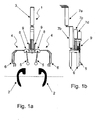
- Fig. 1a and 1b show a device 1 for use in a slaughtering line according to the present invention.
- the device 1 comprises a movable arrangement 3 with two holding means 4, where the arrangement 3 may be moved towards the movable path of the carcase 2, which is here indicated by a dotted line.
- carcase is for example meant pig carcases.
- the carcase halves 2 are shown mid-split and thereby as a cross section.
- the holding means 4 consists of a control part 5 and a resting part 6, which have been placed in that end of the arrangement 3, which is closest to the carcase 2.
- the opposite end of the arrangement 3 is stationary, except for the fact that it may e.g. be moved up and down in an adjustment to the size and the position of the carcase half 2.
- the resting part 6 is shown fork-shaped with an upper and a lower prong, but the resting part may in other embodiments take other shapes, e.g. a entire plate, grating, rod, pipe etc.
- the control part 5 is here shown as a rod with a round end, but may also take other forms such as a plate, pipe, grating, fork etc. It is however important in the designing of the control part and the resting part, that they do not possess sharp parts or edges, which may be cut or be stocked at the inner side of the carcase halves during the use.
- the resting part 6 is shown as having a trapeze-like shape and the control part 5 as a straight rod, which parts in other embodiments may take other shapes depending on use and the size of the carcases.
- the arrangement 3 comprises several cylinders 7 (7a, 7b, 7c and 7d), which has been arranged to in turn move the arrangement 3 towards the movable path of the carcase 2 as a telescopic arm, and brings with it the holding means 4 in contact with each of their carcase halves 2.
- the arrangement 3 may in other embodiments be moved via rails, pivotally parts or the like.
- the arrangement 3 is moved by means of different means such as by the aid of pneumatics, servomotors, hydraulics or the like.
- the arrangement 3 is moved by pneumatics in form of air cylinders 7.
- Fig. 1a and 1b the holding means 4 is shown in a starting position at an angle of 0° in relation to one another.
- both the control part 5 and the resting part 6 are shown in starting positions at an angle of 0° in relation to one another.
- the holding means 4 is seen in Fig. 2a and 2b in contact with each of their carcase halves 2. This has been done by pushing forward the cylinder 7b, which forms part of the arrangement 3, so that the arrangement 3 has been extended. Thus, it is both the holding means 4, control part 5 with gear wheel 8, resting part 6 and that part of the arrangement 3, where upon the rack has been placed, which is pushed forward towards the movable path of the carcase half 2.
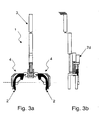
- each holding means 4 comprises a control part 5 and a resting part 6, which may be moved towards one another for fixation of the carcase half 2, which it appears from Fig. 3a and 3b.
- the control parts 5 is pivoted towards the resting parts 6 into a fixation of the carcase halves 2.
- the control part 5 which in the first place is pivoted towards the resting part 6 until squeezing fixation of the carcase half 2 has been obtained.
- This turn of the control part 5 is carried out by displacing the cylinder 7d forward towards the movable path of the carcase half 2, in which the rack 9 is moved forward and the gear wheel 8 and the control part 5 are pivoted.
- Fig. 5a and 5b the holding means appear in a pivoted position, and it appears that the control part 5 presses on the inner side of the carcase 2 and the resting part 6 presses on the outer side of the carcase 2, so that the carcase halves are totally fixated.
- the turn is carried out in this embodiment by the cylinder 7c pushing the end of the arrangement 3, whereupon a rack 10 is placed, forward.
- the rack 10 is in connection with a gear wheel (not shown), which is in connection with the resting part 6.
- the cylinder 7d is in connection with the cylinder 7c, at which the rack 9 is likewise moved forward.
- the control part 5 is further pivoted, via gear wheel 8, together with the resting part 6, so that the carcase halves are maintained between the control part and the resting part during the entire turn.
- the holding means 4 may be pivoted 5°-250°, preferably 80°-120° in relation to one another and the same holding means 4 is in Fig. 5a and 5b shown in pivoted position.
- the holding means 4 merely is pivoted 80°-250° in relation to one another the carcase halves 2 are merely partly opened, at which time is saved in the process in relation to a complete opening, where the carcase halves 2 are pivoted until 250°.
- the fixation and the exposure of the carcase halves 2 last 1-15 sec., preferably 2-5 sec.
- an adjustment of the step time of the other processes on the slaughtering line is obtained, and some manual treatment processes are avoided.
- the device 1 may be arranged to handle the carcases, which are brought to a standstill on the slaughtering line or may be arranged to follow a carcase, which is led at a normal speed on the line.
- the device 1 may in the present invention function by moving the arrangement 3 from the starting position, see Fig. 1a and 1b, forward towards the movable path of the carcase 2, see Fig. 2a and 2b, so that the control part of the holding means 4 is pivoted until fixation of the carcase half 2 by a further movement of the arrangement 3, see Fig. 3a and 3b. Subsequently, the arrangement 3 is further extended towards past the movable path of the carcase 2, see Fig. 4a and 4b. Subsequent to this the arrangement is further moved forward, so that the rack 10 moves the gear wheel connected to the resting part, in which the resting part is pivoted, see Fig. 5a and 5b. The rack 9 is further in connection with a rack 10, in which the movement of the rack 10 will likewise move the rack 9, so that the control part 5 is pivoted, via the gear wheel 8.
- the carcase halves according to the present invention are opened and the inner side of the carcase halves are exposed and brought in position to the further treatment process.
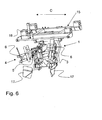
- Fig. 6 a further preferred embodiment of the device according to the invention is shown.
- the device is here shown in perspective seen from the front.
- the device 1 comprises a means 15 in form of a carriage, which may move in a sideways direction, indicated by the arrow C.
- the carriage 15 is designed as a rectangular frame, where in each corner bearings 16 are arranged through which transverse shafts (not shown) may extend, so that the carriage 15 may move on these shafts.
- the frame has the function that it carries the entire device 1.
- the carriage 15 may have other geometric configurations.
- the holding means 4 is here shown with the control parts 5 extending forward and the resting parts 6 being spread out to each of the side.
- the device 1 comprises two support plates 17, which is arranged under the actual holding means 4. These support plates 17 is adjusted to support those parts of the carcase halves which isn't fixated and maintained of the holding means.
- the movable arrangement 3 comprises in this embodiment a first part 20, which is pivotally connected with the hindmost part of the frame 15. The part is extended slanting forward, down to a pivoting point 21, where after it continues substantially horizontally out towards the holding means 4.
- the arrangement comprises a second part 22, which is pivotally connected to the front part of the frame 15.
- the part 22 has in this embodiment substantially in form of an angle.
- the first portion 23 of the part 22 is extending behind, down to an angle, where after the second portion 24 of the part 22 is extending forward and downward towards a pivoting part 25.
- the two portions 23 and 24 are substantially rigidly connected via the angle.
- the device 3 has two separate parts 22 (only one is shown), whereby it is thus obtained that the arrangement 3 is not oscillated.
- the two parts 20 and 22 end in a supporting arrangement 26, which is arranged to support the holding means 4.
- the device 1 comprises a hydraulic cylinder 27, which extends from the hindmost part of the frame 15 and down to the supporting arrangement 26.
- the two parts 20 and 22 are moved by the arrangement 3 and owing to their configuration the movement will substantially be curved. It is the parts 20 and 22 which essentially form the parallelogram construction.
- a second cylinder 28 is arranged, which is arranged to pivot the control parts 5, and a third cylinder 29, which is arranged to pivot the resting parts 6.
- the mentioned cylinders 27, 28 and 29 may with advantage be controlled of a control unit (not shown), where the speed by means of which the different parts are moved along may be controlled independently of each other, which will be appreciated by a man skilled in the art.
- the shown embodiment of the invention 1 in Fig. 6 and 7 has that advantage that it does not occupy a lot of space in a slaughtering line. Thus, it is simple to incorporate in already existing slaughtering lines without being necessary to create extra space for the movement of the arrangement 3 back and forward.
- the device 1 is in this embodiment hung in a frame 15, which may move in a sideways direction but it may likewise be that the device is carried or supported by a firmly mounted frame. It may also be that the movable frame, instead of being hung, may be led on rails on the floor.
- means which may accelerate the carcase, i.e. its speed, when it reaches the device 1 and that slaughtering process, which is attached to the device.
- This has the advantage that the time of the entire process, i.e. maintaining, fixating, carrying out of the slaughtering process and the washing of the device 1 is lowered.
- Fig. 8 and 9 an embodiment of the holding means is shown, which preferable may be used in connection with the embodiment of the device 1 shown in Fig. 6 and 7.
- control parts 5 are shown spread to the side in Fig. 8. It appears evidently that at the ends of the control part 5, which turns away from the resting parts 6 gear wheels 30 are arranged. During the activation of the cylinder 28 (not shown), which are fastened at the pin 31 on the means 32, the means 32 is pivoted so that this moves the left of the control parts 5, whereby the right control part is likewise moving via the gear wheels 30, which are in engagement with one another. In Fig. 9 the control parts 5 are shown pivoted so that they now extend forward.
- the resting parts 6 may in a corresponding way be pivoted by means of the gear wheel 33 and the cylinder 29 and thus will not now be described further.
Landscapes
- Life Sciences & Earth Sciences (AREA)
- Engineering & Computer Science (AREA)
- Food Science & Technology (AREA)
- Chain Conveyers (AREA)
- Vehicle Cleaning, Maintenance, Repair, Refitting, And Outriggers (AREA)
- Processing Of Meat And Fish (AREA)
- Meat, Egg Or Seafood Products (AREA)
Claims (16)
- Un dispositif (1) pour utilisation sur une ligne d'abattage pour la manutention d'une carcasse constituée de deux demi-carcasses reliées entre elles (2), suspendues à au moins un jambier ou crochet, le dispositif comprenant un système mobile (3) relié à deux moyens de fixation (4), lequel système (3) est déplaçable vers la trajectoire mobile de la carcasse (2) et prévu de manière à mettre en contact les moyens de fixation (4) avec chacune de leurs demi-carcasses (2), et les moyens de fixation (4) étant disposés de manière à immobiliser les demi-carcasses (2), caractérisé en ce que les moyens de fixation (4) sont raccordés au système (3) de manière pivotable et, en outre, disposés de manière à faire pivoter les demi-carcasses (2) en vis-à-vis dans une position de travail.
- Un dispositif (1) selon la revendication 1, dans lequel chaque moyen de fixation (4) comprend un élément de commande (5) et un élément d'appui (6) qui sont déplaçables l'un vers l'autre pour immobiliser la demi-carcasse (2).
- Un dispositif (1) selon la revendication 2, dans lequel les moyens de fixation (4) pivotent de 5° à 250°, de préférence de 80° à 120° l'un par rapport à l'autre.
- Un dispositif (1) selon les revendications 2-3, dans lequel au moins une crémaillère (9, 10) est prévue sur le système (3) et au moins une roue dentée (8) est prévue sur l'élément de commande (5) et l'élément d'appui (6) de sorte que l'élément de commande (5) et l'élément d'appui (6) soient pivotés par le mouvement des crémaillères (9, 10) du système (3).
- Un dispositif (1) selon l'une quelconque des revendications précédentes, dans lequel le système (3) est déplaçable par des moyens pneumatiques, servomoteurs, hydrauliques et/ou similaires.
- Un dispositif (1) selon l'une quelconque des revendications précédentes, dans lequel le système (3) est déplacé comme un bras télescopique, via des rails, pivots et/ou éléments similaires.
- Un dispositif (1) selon les revendications 1, 2, 3 ou 5, dans lequel le système (3) se compose d'une structure en parallélogramme pour effectuer le mouvement vers la trajectoire mobile de la carcasse.
- Un dispositif (1) selon la revendication 7, dans lequel le système (3) comporte une pluralité de vérins hydrauliques, au moins un premier vérin (27) étant prévu pour déplacer le système (3) vers la trajectoire mobile de la carcasse, un second vérin (28) étant prévu pour le pivotement des éléments de commande (5) et un troisième vérin (29) étant prévu pour le pivotement des éléments d'appui (6).
- Un dispositif (1) selon l'une quelconque des revendications précédentes, dans lequel l'appareil (1) comporte des moyens (15, 16) prévus pour déplacer l'appareil (1) latéralement, de manière sensiblement parallèle à la trajectoire mobile de la carcasse.
- Un dispositif (1) selon la revendication 7, dans lequel un autre moyen est prévu pour accélérer la carcasse par rapport à sa vitesse normale à travers la ligne d'abattage.
- Un procédé pour utilisation sur une ligne d'abattage, destiné à la manutention d'une carcasse constituée de deux demi-carcasses (2) reliées entre elles, qui est suspendue à au moins un jambier ou crochet, le procédé consistant à déplacer un système (3), raccordé à deux moyens de fixation (4), vers la trajectoire mobile de la carcasse (2) pour mettre en contact les moyens de fixation (4) avec chacune de leurs demi-carcasses (2), à immobiliser les demi-carcasses (2) par les moyens de fixation (4), et à effectuer la rotation des demi-carcasses (2) l'une en face de l'autre vers une position de travail par rotation des moyens de fixation (4) sur le système (3).
- Un procédé selon la revendication 11, dans lequel les moyens de fixation (4) comportent un élément de commande (5) et un élément d'appui (6) qui sont déplaçables l'un vers l'autre pour immobiliser la demi-carcasse (2), et dans lequel les moyens de fixation (4) pivotent vers l'élément d'appui (6) pour immobiliser la demi-carcasse (2) par serrage, puis l'élément d'appui (6) exécute un mouvement pivotant avec l'élément de commande (5) vers ladite position de travail.
- Un procédé selon la revendication 11 ou 12, dans lequel le système (3), après immobilisation totale ou partielle des demi-carcasses (2) dans les moyens de fixation (4), est déplacé plus avant vers la trajectoire mobile de la carcasse (2), permettant le pivotement des moyens de fixation (4) l'un en face de l'autre.
- Un procédé selon la revendication 11, dans lequel le système (3) et les moyens de fixation (4) sont déplacés latéralement, de manière sensiblement parallèle à la trajectoire mobile de la carcasse.
- Un procédé selon la revendication 11, dans lequel la carcasse est accélérée par rapport à sa vitesse normale à travers la ligne d'abattage.
- Utilisation du dispositif selon les revendications 1-10 pour la manutention d'une carcasse constituée de deux demi-carcasses (2) reliées entre elles, qui est suspendue à au moins un jambier ou un crochet sur une ligne d'abattage.
Applications Claiming Priority (2)
| Application Number | Priority Date | Filing Date | Title |
|---|---|---|---|
| DK200201722 | 2002-11-08 | ||
| DKPA200201722 | 2002-11-08 |
Publications (3)
| Publication Number | Publication Date |
|---|---|
| EP1417889A2 EP1417889A2 (fr) | 2004-05-12 |
| EP1417889A3 EP1417889A3 (fr) | 2004-05-19 |
| EP1417889B1 true EP1417889B1 (fr) | 2006-06-07 |
Family
ID=32103854
Family Applications (1)
| Application Number | Title | Priority Date | Filing Date |
|---|---|---|---|
| EP03025538A Expired - Lifetime EP1417889B1 (fr) | 2002-11-08 | 2003-11-07 | Appareil et procédé d'immobilisation de carcasses |
Country Status (4)
| Country | Link |
|---|---|
| EP (1) | EP1417889B1 (fr) |
| AT (1) | ATE328484T1 (fr) |
| DE (1) | DE60305842T2 (fr) |
| ES (1) | ES2261849T3 (fr) |
Families Citing this family (7)
| Publication number | Priority date | Publication date | Assignee | Title |
|---|---|---|---|---|
| ES2288072B2 (es) * | 2005-06-16 | 2008-09-16 | Extraccion De Medulas Y Complementos, S.L. | Dispositivo para la extraccion simultanea de la medula espinal, la duramadre, el nacimiento de los tejidos nerviosos y los ganglios raquideos, en canal, de todo tipo de ganado. |
| EP1937077B1 (fr) * | 2005-09-06 | 2011-11-02 | Teknologisk Institut | Appareil et procédé de découpage de filets |
| NZ594533A (en) * | 2011-08-25 | 2014-07-25 | Ovine Automation Ltd | Improved carrier |
| AU2013308456A1 (en) | 2012-08-31 | 2014-12-18 | Jarvis Products Corporation | Carcass stabilizer |
| CN110226617A (zh) * | 2019-07-08 | 2019-09-13 | 浙江浙华智能科技有限公司 | 一种羊胴体夹持机构 |
| CN116280969B (zh) * | 2023-04-17 | 2023-10-03 | 山东郯润生态食品有限公司 | 一种生猪屠宰场用生猪输送装置 |
| CN116686864B (zh) * | 2023-07-06 | 2025-10-31 | 青岛建华食品机械制造有限公司 | 一种气动推进装置及其使用方法 |
Family Cites Families (3)
| Publication number | Priority date | Publication date | Assignee | Title |
|---|---|---|---|---|
| NL9102032A (nl) * | 1991-12-05 | 1993-07-01 | Ccm Beheer Bv | Werkwijze en inrichting voor het uitvoeren van bewerkingen aan karkassen van slachtdieren. |
| NL1014060C2 (nl) * | 2000-01-14 | 2001-07-17 | Stork Mps Bv | Inrichting en werkwijze voor het positioneren van aan achterpoten opgehangen karkassen van groot vee. |
| US6244951B1 (en) * | 2000-04-28 | 2001-06-12 | Hormel Foods, Llc | Hog carcass configurer |
-
2003
- 2003-11-07 EP EP03025538A patent/EP1417889B1/fr not_active Expired - Lifetime
- 2003-11-07 DE DE60305842T patent/DE60305842T2/de not_active Expired - Lifetime
- 2003-11-07 AT AT03025538T patent/ATE328484T1/de not_active IP Right Cessation
- 2003-11-07 ES ES03025538T patent/ES2261849T3/es not_active Expired - Lifetime
Also Published As
| Publication number | Publication date |
|---|---|
| ES2261849T3 (es) | 2006-11-16 |
| EP1417889A2 (fr) | 2004-05-12 |
| EP1417889A3 (fr) | 2004-05-19 |
| DE60305842T2 (de) | 2007-01-25 |
| ATE328484T1 (de) | 2006-06-15 |
| DE60305842D1 (de) | 2006-07-20 |
Similar Documents
| Publication | Publication Date | Title |
|---|---|---|
| EP1692942B1 (fr) | Dispositif pour suspendre de nouveau un animal de boucherie | |
| US11785956B2 (en) | Method and device for positioning and/or handling carcasses and/or carcass parts during the slaughter of animals on an industrial scale | |
| DK2591680T3 (en) | DEVICES AND METHOD FOR PROCESSING cattle carcasses | |
| DK2912947T3 (en) | Method and device for boning non-boned bones | |
| WO1999041990A2 (fr) | Procedes et appareils destines a des operations de traitement sur des animaux abattus ou sur des parties de ces animaux | |
| EP1222858B1 (fr) | Procédé et dispositif de traitement d'un paquet d'organes d'un animal abattu | |
| EP1417889B1 (fr) | Appareil et procédé d'immobilisation de carcasses | |
| EP0031337A1 (fr) | Appareil pour depouiller des cadavres des moutons a l'abattage. | |
| USRE36645E (en) | Method and apparatus for removing a hide from a back portion and tail of a carcass | |
| AU2009222532B2 (en) | A method and device for de-gambrelling | |
| US9820495B2 (en) | Evisceration apparatus and a method for eviscerating suspended poultry | |
| EP3415013B1 (fr) | Procédé et appareil d'éviscération de volailles en suspension | |
| US7815497B2 (en) | Apparatus and method for cutting-free of tender-loin | |
| EP1406500B1 (fr) | Procede et dispositif permettant l'extraction des os internes de la partie avant d'une carcasse | |
| US3245107A (en) | Carcass gripping apparatus | |
| JP4562923B2 (ja) | 後肢で吊った屠殺済み食用獣の前肢を位置決めするための方法及び装置 | |
| NL1024963C2 (nl) | Werkwijze en inrichting voor het van een karkasdeel losmaken van een botdeel. | |
| FI105144B (fi) | Menetelmä ja laitos osan erottamiseksi ruhosta | |
| EP0917824A2 (fr) | Dispositif et procédé pour couper la trachée et l'oesophage d'une carcasse | |
| DK176414B1 (da) | Anordning og fremgangsmåde til fiksering af slagtekroppe | |
| EP0274208A1 (fr) | Dispositif et procédé pour supporter une carcasse pendant l'écorchement | |
| JPH06319435A (ja) | ソーセージの移送装置 | |
| SU856421A1 (ru) | Устройство дл пересадки туш м са с одного подвесного пути на другой | |
| GB2293085A (en) | Carcass processing | |
| GB2197779A (en) | A method and apparatus for dressing carcases |
Legal Events
| Date | Code | Title | Description |
|---|---|---|---|
| PUAI | Public reference made under article 153(3) epc to a published international application that has entered the european phase |
Free format text: ORIGINAL CODE: 0009012 |
|
| PUAL | Search report despatched |
Free format text: ORIGINAL CODE: 0009013 |
|
| AK | Designated contracting states |
Kind code of ref document: A2 Designated state(s): AT BE BG CH CY CZ DE DK EE ES FI FR GB GR HU IE IT LI LU MC NL PT RO SE SI SK TR |
|
| AX | Request for extension of the european patent |
Extension state: AL LT LV MK |
|
| AK | Designated contracting states |
Kind code of ref document: A3 Designated state(s): AT BE BG CH CY CZ DE DK EE ES FI FR GB GR HU IE IT LI LU MC NL PT RO SE SI SK TR |
|
| AX | Request for extension of the european patent |
Extension state: AL LT LV MK |
|
| 17P | Request for examination filed |
Effective date: 20041028 |
|
| AKX | Designation fees paid |
Designated state(s): AT BE BG CH CY CZ DE DK EE ES FI FR GB GR HU IE IT LI LU MC NL PT RO SE SI SK TR |
|
| GRAP | Despatch of communication of intention to grant a patent |
Free format text: ORIGINAL CODE: EPIDOSNIGR1 |
|
| GRAS | Grant fee paid |
Free format text: ORIGINAL CODE: EPIDOSNIGR3 |
|
| GRAA | (expected) grant |
Free format text: ORIGINAL CODE: 0009210 |
|
| AK | Designated contracting states |
Kind code of ref document: B1 Designated state(s): AT BE BG CH CY CZ DE DK EE ES FI FR GB GR HU IE IT LI LU MC NL PT RO SE SI SK TR |
|
| PG25 | Lapsed in a contracting state [announced via postgrant information from national office to epo] |
Ref country code: RO Free format text: LAPSE BECAUSE OF FAILURE TO SUBMIT A TRANSLATION OF THE DESCRIPTION OR TO PAY THE FEE WITHIN THE PRESCRIBED TIME-LIMIT Effective date: 20060607 Ref country code: CH Free format text: LAPSE BECAUSE OF FAILURE TO SUBMIT A TRANSLATION OF THE DESCRIPTION OR TO PAY THE FEE WITHIN THE PRESCRIBED TIME-LIMIT Effective date: 20060607 Ref country code: IT Free format text: LAPSE BECAUSE OF FAILURE TO SUBMIT A TRANSLATION OF THE DESCRIPTION OR TO PAY THE FEE WITHIN THE PRESCRIBED TIME-LIMIT;WARNING: LAPSES OF ITALIAN PATENTS WITH EFFECTIVE DATE BEFORE 2007 MAY HAVE OCCURRED AT ANY TIME BEFORE 2007. THE CORRECT EFFECTIVE DATE MAY BE DIFFERENT FROM THE ONE RECORDED. Effective date: 20060607 Ref country code: LI Free format text: LAPSE BECAUSE OF FAILURE TO SUBMIT A TRANSLATION OF THE DESCRIPTION OR TO PAY THE FEE WITHIN THE PRESCRIBED TIME-LIMIT Effective date: 20060607 Ref country code: AT Free format text: LAPSE BECAUSE OF FAILURE TO SUBMIT A TRANSLATION OF THE DESCRIPTION OR TO PAY THE FEE WITHIN THE PRESCRIBED TIME-LIMIT Effective date: 20060607 Ref country code: BE Free format text: LAPSE BECAUSE OF FAILURE TO SUBMIT A TRANSLATION OF THE DESCRIPTION OR TO PAY THE FEE WITHIN THE PRESCRIBED TIME-LIMIT Effective date: 20060607 Ref country code: CZ Free format text: LAPSE BECAUSE OF FAILURE TO SUBMIT A TRANSLATION OF THE DESCRIPTION OR TO PAY THE FEE WITHIN THE PRESCRIBED TIME-LIMIT Effective date: 20060607 Ref country code: SK Free format text: LAPSE BECAUSE OF FAILURE TO SUBMIT A TRANSLATION OF THE DESCRIPTION OR TO PAY THE FEE WITHIN THE PRESCRIBED TIME-LIMIT Effective date: 20060607 Ref country code: FI Free format text: LAPSE BECAUSE OF FAILURE TO SUBMIT A TRANSLATION OF THE DESCRIPTION OR TO PAY THE FEE WITHIN THE PRESCRIBED TIME-LIMIT Effective date: 20060607 Ref country code: SI Free format text: LAPSE BECAUSE OF FAILURE TO SUBMIT A TRANSLATION OF THE DESCRIPTION OR TO PAY THE FEE WITHIN THE PRESCRIBED TIME-LIMIT Effective date: 20060607 |
|
| REG | Reference to a national code |
Ref country code: GB Ref legal event code: FG4D |
|
| REG | Reference to a national code |
Ref country code: CH Ref legal event code: EP |
|
| REG | Reference to a national code |
Ref country code: IE Ref legal event code: FG4D |
|
| REF | Corresponds to: |
Ref document number: 60305842 Country of ref document: DE Date of ref document: 20060720 Kind code of ref document: P |
|
| REG | Reference to a national code |
Ref country code: SE Ref legal event code: TRGR |
|
| PG25 | Lapsed in a contracting state [announced via postgrant information from national office to epo] |
Ref country code: IE Free format text: LAPSE BECAUSE OF NON-PAYMENT OF DUE FEES Effective date: 20061107 Ref country code: PT Free format text: LAPSE BECAUSE OF FAILURE TO SUBMIT A TRANSLATION OF THE DESCRIPTION OR TO PAY THE FEE WITHIN THE PRESCRIBED TIME-LIMIT Effective date: 20061107 |
|
| REG | Reference to a national code |
Ref country code: ES Ref legal event code: FG2A Ref document number: 2261849 Country of ref document: ES Kind code of ref document: T3 |
|
| PG25 | Lapsed in a contracting state [announced via postgrant information from national office to epo] |
Ref country code: MC Free format text: LAPSE BECAUSE OF NON-PAYMENT OF DUE FEES Effective date: 20061130 |
|
| REG | Reference to a national code |
Ref country code: CH Ref legal event code: PL |
|
| ET | Fr: translation filed | ||
| PLBE | No opposition filed within time limit |
Free format text: ORIGINAL CODE: 0009261 |
|
| STAA | Information on the status of an ep patent application or granted ep patent |
Free format text: STATUS: NO OPPOSITION FILED WITHIN TIME LIMIT |
|
| 26N | No opposition filed |
Effective date: 20070308 |
|
| PG25 | Lapsed in a contracting state [announced via postgrant information from national office to epo] |
Ref country code: GR Free format text: LAPSE BECAUSE OF FAILURE TO SUBMIT A TRANSLATION OF THE DESCRIPTION OR TO PAY THE FEE WITHIN THE PRESCRIBED TIME-LIMIT Effective date: 20060908 |
|
| PG25 | Lapsed in a contracting state [announced via postgrant information from national office to epo] |
Ref country code: BG Free format text: LAPSE BECAUSE OF FAILURE TO SUBMIT A TRANSLATION OF THE DESCRIPTION OR TO PAY THE FEE WITHIN THE PRESCRIBED TIME-LIMIT Effective date: 20060907 Ref country code: EE Free format text: LAPSE BECAUSE OF FAILURE TO SUBMIT A TRANSLATION OF THE DESCRIPTION OR TO PAY THE FEE WITHIN THE PRESCRIBED TIME-LIMIT Effective date: 20060607 |
|
| PG25 | Lapsed in a contracting state [announced via postgrant information from national office to epo] |
Ref country code: DK Free format text: LAPSE BECAUSE OF NON-PAYMENT OF DUE FEES Effective date: 20061130 Ref country code: HU Free format text: LAPSE BECAUSE OF FAILURE TO SUBMIT A TRANSLATION OF THE DESCRIPTION OR TO PAY THE FEE WITHIN THE PRESCRIBED TIME-LIMIT Effective date: 20061208 Ref country code: LU Free format text: LAPSE BECAUSE OF NON-PAYMENT OF DUE FEES Effective date: 20061107 Ref country code: TR Free format text: LAPSE BECAUSE OF FAILURE TO SUBMIT A TRANSLATION OF THE DESCRIPTION OR TO PAY THE FEE WITHIN THE PRESCRIBED TIME-LIMIT Effective date: 20060607 |
|
| PG25 | Lapsed in a contracting state [announced via postgrant information from national office to epo] |
Ref country code: CY Free format text: LAPSE BECAUSE OF FAILURE TO SUBMIT A TRANSLATION OF THE DESCRIPTION OR TO PAY THE FEE WITHIN THE PRESCRIBED TIME-LIMIT Effective date: 20060607 |
|
| REG | Reference to a national code |
Ref country code: FR Ref legal event code: TP Owner name: TEKNOLOGISK INSTITUT, DK Effective date: 20110907 |
|
| REG | Reference to a national code |
Ref country code: DE Ref legal event code: R081 Ref document number: 60305842 Country of ref document: DE Owner name: TEKNOLOGISK INSTITUT, DK Free format text: FORMER OWNER: SLAGTERIERNES FORSKNINGSINSTITUT, ROSKILDE, DK Effective date: 20110920 Ref country code: DE Ref legal event code: R082 Ref document number: 60305842 Country of ref document: DE Representative=s name: STORK BAMBERGER PATENTANWAELTE, DE Effective date: 20110920 Ref country code: DE Ref legal event code: R082 Ref document number: 60305842 Country of ref document: DE Representative=s name: STORK BAMBERGER PATENTANWAELTE PARTMBB, DE Effective date: 20110920 |
|
| REG | Reference to a national code |
Ref country code: NL Ref legal event code: TD Effective date: 20111213 Ref country code: NL Ref legal event code: SD Effective date: 20111213 |
|
| REG | Reference to a national code |
Ref country code: GB Ref legal event code: 732E Free format text: REGISTERED BETWEEN 20111201 AND 20111207 |
|
| REG | Reference to a national code |
Ref country code: ES Ref legal event code: PC2A Owner name: TEKNOLOGISK INSTITUT Effective date: 20120215 |
|
| REG | Reference to a national code |
Ref country code: FR Ref legal event code: PLFP Year of fee payment: 13 |
|
| REG | Reference to a national code |
Ref country code: FR Ref legal event code: PLFP Year of fee payment: 14 |
|
| REG | Reference to a national code |
Ref country code: FR Ref legal event code: PLFP Year of fee payment: 15 |
|
| PGFP | Annual fee paid to national office [announced via postgrant information from national office to epo] |
Ref country code: NL Payment date: 20201125 Year of fee payment: 18 |
|
| PGFP | Annual fee paid to national office [announced via postgrant information from national office to epo] |
Ref country code: SE Payment date: 20201125 Year of fee payment: 18 Ref country code: FR Payment date: 20201120 Year of fee payment: 18 Ref country code: GB Payment date: 20201120 Year of fee payment: 18 Ref country code: DE Payment date: 20201119 Year of fee payment: 18 |
|
| PGFP | Annual fee paid to national office [announced via postgrant information from national office to epo] |
Ref country code: ES Payment date: 20210122 Year of fee payment: 18 |
|
| REG | Reference to a national code |
Ref country code: DE Ref legal event code: R119 Ref document number: 60305842 Country of ref document: DE |
|
| REG | Reference to a national code |
Ref country code: NL Ref legal event code: MM Effective date: 20211201 |
|
| GBPC | Gb: european patent ceased through non-payment of renewal fee |
Effective date: 20211107 |
|
| PG25 | Lapsed in a contracting state [announced via postgrant information from national office to epo] |
Ref country code: SE Free format text: LAPSE BECAUSE OF NON-PAYMENT OF DUE FEES Effective date: 20211108 |
|
| PG25 | Lapsed in a contracting state [announced via postgrant information from national office to epo] |
Ref country code: NL Free format text: LAPSE BECAUSE OF NON-PAYMENT OF DUE FEES Effective date: 20211201 |
|
| PG25 | Lapsed in a contracting state [announced via postgrant information from national office to epo] |
Ref country code: GB Free format text: LAPSE BECAUSE OF NON-PAYMENT OF DUE FEES Effective date: 20211107 Ref country code: DE Free format text: LAPSE BECAUSE OF NON-PAYMENT OF DUE FEES Effective date: 20220601 |
|
| PG25 | Lapsed in a contracting state [announced via postgrant information from national office to epo] |
Ref country code: FR Free format text: LAPSE BECAUSE OF NON-PAYMENT OF DUE FEES Effective date: 20211130 |
|
| REG | Reference to a national code |
Ref country code: ES Ref legal event code: FD2A Effective date: 20230207 |
|
| PG25 | Lapsed in a contracting state [announced via postgrant information from national office to epo] |
Ref country code: ES Free format text: LAPSE BECAUSE OF NON-PAYMENT OF DUE FEES Effective date: 20211108 |