EP1420428B1 - Elektromagnetisches Relais - Google Patents
Elektromagnetisches Relais Download PDFInfo
- Publication number
- EP1420428B1 EP1420428B1 EP03024963A EP03024963A EP1420428B1 EP 1420428 B1 EP1420428 B1 EP 1420428B1 EP 03024963 A EP03024963 A EP 03024963A EP 03024963 A EP03024963 A EP 03024963A EP 1420428 B1 EP1420428 B1 EP 1420428B1
- Authority
- EP
- European Patent Office
- Prior art keywords
- contact
- contact plate
- fixed
- moving contact
- moving
- Prior art date
- Legal status (The legal status is an assumption and is not a legal conclusion. Google has not performed a legal analysis and makes no representation as to the accuracy of the status listed.)
- Expired - Lifetime
Links
- 230000005489 elastic deformation Effects 0.000 claims description 12
- XEEYBQQBJWHFJM-UHFFFAOYSA-N Iron Chemical compound [Fe] XEEYBQQBJWHFJM-UHFFFAOYSA-N 0.000 description 44
- 229910052742 iron Inorganic materials 0.000 description 22
- 230000002787 reinforcement Effects 0.000 description 10
- 238000010276 construction Methods 0.000 description 9
- 238000005192 partition Methods 0.000 description 8
- 239000000565 sealant Substances 0.000 description 8
- 239000000470 constituent Substances 0.000 description 5
- 238000005452 bending Methods 0.000 description 3
- 230000007547 defect Effects 0.000 description 2
- 230000033001 locomotion Effects 0.000 description 2
- 239000011347 resin Substances 0.000 description 2
- 229920005989 resin Polymers 0.000 description 2
- 239000000428 dust Substances 0.000 description 1
- 230000009545 invasion Effects 0.000 description 1
- 239000000696 magnetic material Substances 0.000 description 1
- 238000000034 method Methods 0.000 description 1
- 238000000465 moulding Methods 0.000 description 1
- 239000011435 rock Substances 0.000 description 1
- 229910000679 solder Inorganic materials 0.000 description 1
- 238000005476 soldering Methods 0.000 description 1
- 238000005482 strain hardening Methods 0.000 description 1
- 238000004804 winding Methods 0.000 description 1
Images



Classifications
-
- H—ELECTRICITY
- H01—ELECTRIC ELEMENTS
- H01H—ELECTRIC SWITCHES; RELAYS; SELECTORS; EMERGENCY PROTECTIVE DEVICES
- H01H50/00—Details of electromagnetic relays
- H01H50/64—Driving arrangements between movable part of magnetic circuit and contact
- H01H50/641—Driving arrangements between movable part of magnetic circuit and contact intermediate part performing a rectilinear movement
- H01H50/642—Driving arrangements between movable part of magnetic circuit and contact intermediate part performing a rectilinear movement intermediate part being generally a slide plate, e.g. a card
-
- H—ELECTRICITY
- H01—ELECTRIC ELEMENTS
- H01H—ELECTRIC SWITCHES; RELAYS; SELECTORS; EMERGENCY PROTECTIVE DEVICES
- H01H50/00—Details of electromagnetic relays
- H01H50/54—Contact arrangements
- H01H50/56—Contact spring sets
-
- H—ELECTRICITY
- H01—ELECTRIC ELEMENTS
- H01H—ELECTRIC SWITCHES; RELAYS; SELECTORS; EMERGENCY PROTECTIVE DEVICES
- H01H11/00—Apparatus or processes specially adapted for the manufacture of electric switches
- H01H11/04—Apparatus or processes specially adapted for the manufacture of electric switches of switch contacts
- H01H11/06—Fixing of contacts to carrier ; Fixing of contacts to insulating carrier
- H01H2011/062—Fixing of contacts to carrier ; Fixing of contacts to insulating carrier by inserting only
-
- H—ELECTRICITY
- H01—ELECTRIC ELEMENTS
- H01H—ELECTRIC SWITCHES; RELAYS; SELECTORS; EMERGENCY PROTECTIVE DEVICES
- H01H50/00—Details of electromagnetic relays
- H01H50/02—Bases; Casings; Covers
- H01H50/04—Mounting complete relay or separate parts of relay on a base or inside a case
- H01H50/041—Details concerning assembly of relays
- H01H2050/046—Assembling parts of a relay by using snap mounting techniques
-
- H—ELECTRICITY
- H01—ELECTRIC ELEMENTS
- H01H—ELECTRIC SWITCHES; RELAYS; SELECTORS; EMERGENCY PROTECTIVE DEVICES
- H01H50/00—Details of electromagnetic relays
- H01H50/02—Bases; Casings; Covers
- H01H50/04—Mounting complete relay or separate parts of relay on a base or inside a case
-
- H—ELECTRICITY
- H01—ELECTRIC ELEMENTS
- H01H—ELECTRIC SWITCHES; RELAYS; SELECTORS; EMERGENCY PROTECTIVE DEVICES
- H01H50/00—Details of electromagnetic relays
- H01H50/14—Terminal arrangements
-
- H—ELECTRICITY
- H01—ELECTRIC ELEMENTS
- H01H—ELECTRIC SWITCHES; RELAYS; SELECTORS; EMERGENCY PROTECTIVE DEVICES
- H01H50/00—Details of electromagnetic relays
- H01H50/54—Contact arrangements
-
- H—ELECTRICITY
- H01—ELECTRIC ELEMENTS
- H01H—ELECTRIC SWITCHES; RELAYS; SELECTORS; EMERGENCY PROTECTIVE DEVICES
- H01H50/00—Details of electromagnetic relays
- H01H50/64—Driving arrangements between movable part of magnetic circuit and contact
- H01H50/641—Driving arrangements between movable part of magnetic circuit and contact intermediate part performing a rectilinear movement
Definitions
- This invention relates to an electromagnetic relay.
- a known electromagnetic relay employs a construction in which a coil block is put on a base, a moving contact plate and fixed contact plates are implanted in such a fashion as to oppose one another, the moving contact plate is allowed to undergo elastic deformation as the coil block is excited and demagnetized, and a moving contact of the moving contact plate is brought into contact with and out of contact from fixed contacts of the fixed contact plates (refer to patent reference 1, for example).
- Patent reference 1 Japanese Patent Laid-Open No. 190757/1997
- the invention provides an electromagnetic relay as defined in claim 1.
- This construction can secure desired elastic force due to the existence of the connection portion having a small width, and can improve impact resistance by preventing stress concentration while making it possible to set a reserve load due to the bending work at the contact fitting portion.
- a slit portion along a centerline of the moving contact plate and to adjust an elastic modulus of the moving contact plate by changing the shape of the slit portion.
- the invention provides also an electromagnetic relay as defined in claim 3.
- the existence of the open portion makes it possible to adjust an elastic modulus of the fixed contact plate and to conduct an adjustment work of the moving contact plate by inserting a jig, and the existence of the protuberance for reinforcement makes it possible to acquire desired impact resistance.
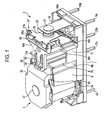
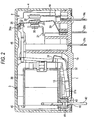
- Figs. 1 and 2 show an electromagnetic relay according to an embodiment.
- the electromagnetic relay briefly has a construction in which a contact switch mechanism 2 and a coil block 3 are arranged on a base 1 and these constituents are covered with a case 4.
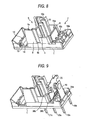
- An insulating wall 5 divides the base 1 into a coil block-fitting portion 6 and a contact switch mechanism-fitting portion 7 as shown in Figs. 8 to 10.
- the insulating wall 5 has a partition portion 8 and both side portions 9. protuberance portions 10 are so formed at the center of the partition portion 8 as to extend in a vertical direction with a predetermined gap between them. The protuberance portions 10 reinforce the partition portion 8 and guide with their upper edge protuberance portions 10a a card 100 that will be later described.
- An auxiliary insulating wall 11 is formed at a lower part of each protuberance portion 10 in such a fashion as to define a recess in cooperation with the insulating wall 5.
- a guide groove 11a extending in the vertical direction is formed at the center of the inner surface of the auxiliary insulating wall 11.
- groove portions 9a and 9b extending in the vertical direction while their positions are deviated from each other are formed on the inner and outer surfaces of both side portions 9, respectively.
- the inner surface groove portion 9a guides a yoke 30 to be later described.
- the outer surface groove portion 9b is a recession for molding the base 1.
- a partition wall 12 partitions the coil block-fitting portion 6.
- An escape recess portion 13 is defined in the bottom surface on the side of the insulating wall so partitioned.
- a notch portion 14 is defined in both sidewalls.
- Through-holes 15 are defined in the remaining partitioned portions and coil terminals 42 are fitted into both end portions of the through-hole 15.
- Three base reinforcement ribs 16 defined between both through-holes 15 connect the partition wall 12 to the sidewall on one of the sides.
- the base reinforcement ribs 16 allow a resin to smoothly fluidize when the base 1 is molded even when the thickness of the bottom surface is small, and also play the role of reinforcement.
- the partition wall 12 and the base reinforcement ribs 16 together constitute a push-in acceptance portion 17 for pushing and fixing an increased thickness portion 41 of the coil block 3 that will be later described.
- reference numeral 1a denotes a standoff.
- the standoff 1a forms a clearance with the bottom surface of the base when the electromagnetic relay is mounted to a printed board and eliminates influences of a solder at the time of soldering.
- the contact switch mechanism-fitting portion 7 has contact plate push-in portions 18a, 18b and 18c at three positions as shown in Fig. 8.
- the contact switch mechanism 2 includes a first fixed contact plate 19, a moving contact plate 20 and a second fixed contact plate 21 that are serially pushed into the contact plate push-in portions 18a, 18b and 18c from one of the ends 18a of these contact plate push-in portions 18a, 18b and 18c.
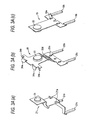
- the first fixed contact plate 19 is substantially flat as shown in Fig. 3A(c) and has at its upper end the first fixed contact 22 and at its lower end a protuberance 19a to be pushed into the contact plate push-in portion 18. Terminal portions 19b and 19c extend downward from both sides of the first fixed contact plate 19.
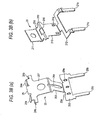
- the moving contact plate 20 has a contact-fitting portion 201 to which a moving contact 23 is fixed, a push-in fixing portion 202 which is pushed into and fixed to the base 1 and from which terminal portions 20b and 20c extend and a connection portion 203 which connects the contact fitting portion 201 and the push-in fixing portion 202 as shown in Figs. 3A(b) and 3B(a).
- the moving contact 23 has contact surfaces with fixed contacts 22 and 26 on both of its surfaces. Card acceptance portions 24a and 24b extending obliquely vertically are formed at the upper edge of the contact-fitting portion 201.
- a protruding distance of the card acceptance portions 24a and 24b is set to a value at which the card 100 to be later described does not fall off even when the moving contact plate 20 undergoes elastic deformation.
- the intermediate part of each card acceptance portion 24a, 24b constitutes an escape portion 25 lest it becomes an obstacle when the second fixed contact plate 21 is inserted from above.
- the contact-fitting portion 201 having a greater width than the connection portion 203 is bent at its lower edge. Consequently, the occurrence region of maximum stress when the moving contact plate 20 undergoes elastic deformation is much more dispersed than when the connection portion 203 or the boundary portion with the connection portion 203 is bent, and the contact-fitting portion 201 does not undergo elastic deformation even when impact force operates.
- Push-in protuberance portions 20a are formed in the push-in fixing portion 202 in the same way as the first fixed contact plate 19. Terminal portions 20b and 20c extend from both sides of the moving contact plate 20. A slit 20d is defined at the center of the connection portion 203 so as to allow easy elastic deformation. A boundary portion of the push-in fixing portion 202 with the connection portion 203 is bent and notches 204 are formed on both sides of the bent portion to mitigate stress concentration and to allow the connection portion 203 to easily undergo elastic deformation.
- the second fixed contact plate 21 includes a contact fitting portion 211 to which a fixed contact 26 is fixed, a leg portion 212 which is pushed in and fixed to the base 1 and from which terminal portions 21b and 21c extend, and a connection portion 213 for connecting the contact fitting portion 211 to the leg portion 212.
- a first increased width portion 214 is formed at a boundary between the contact fitting portion 211 and the connection portion 213 and the second fixed contact plate 21 is bent substantially at right angles at this first increased width portion 214.
- a second increased width portion 215 is formed at the upper part of the connection portion 213. The second fixed contact plate 21 is bent substantially at right angles at this second increased width portion 215, too.
- a rectangular open portion 216 is formed at the center of the second increased width portion 215.
- the rectangular open portion 216 is disposed so that a jig, or the like, for adjusting spring property of the moving contact plate 20 can be inserted after completion of the assembly of each component to the base 1. Because the increased width portions 214 and 215 exist, the second fixed contact plate 21 does not undergo elastic deformation due to the operation of impact force even when it is bent or when the rectangular open portion 216 is formed.
- Push-in protuberance portions 21a are formed at the lower part of the connection portion 213.
- the second fixed contact plate 21 is fitted to the base 1 under the state where it is guided by the guide groove 11a of the auxiliary insulating wall 11.
- the auxiliary insulating wall 11 secures desired insulating performance (creep distance) with the moving contact plate 20 when the moving contact 23 is spaced apart from the second fixed contact 26.
- the coil block 3 is obtained by winding a coil 29 onto a core 27 through a spool 28 as shown in Figs. 4 and 5.
- a yoke 30 is fixed to the upper end of the core 27.
- a flange-like lower end of the core 27 operates as an attraction surface 27a.
- the yoke 30 is constituted by a substantially L-shaped magnetic material and has at the center of one of its ends an opening 30a into which the core 27 is fitted and fixed.
- An anchor acceptance portion 30b for fitting a hinge spring 31 is formed at a side edge of the other end of the yoke 30.
- the other end of the yoke 30 operates as a support point for rotation.
- a substantially L-shaped moving iron plate 32 is supported in such a fashion that a bent portion 33 can freely rock while being held by the hinge spring 31.
- the hinge spring 31 includes an anchor portion 31a anchored to the anchor acceptance portion 30b of the yoke 30 described above and a rectangular pressure contact portion 31b into which the reduced width portion 35 of the moving iron plate 32 is fitted and which comes into pressure contact with the bent portion 33.
- the rectangular pressure contact portion 31b comes into pressure contact with a step portion 32a and a curved surface 32b of the bent portion 33 of the moving iron plate 32 and urges the moving iron plate 32 counter-clockwise in Fig. 2, that is, in a direction in which the attracted portion 34b comes away from the attraction surface 27a of the core 27.
- the card 100 is interposed between the anchor portion 35a of the moving iron plate 32 and the card acceptance portion 24 of the moving contact plate 20.
- the card 100 has at one of its ends an anchor holding portion 36 to which the anchor portion 35a of the moving iron plate 32 is anchored and at its other end a push portion 37 into which the card acceptance portion 24 is pushed.
- the anchor holding portion 36 has a contact plate 38 that comes into contact with the anchor portion 35a of the moving iron plate 32, and a flexible holding plate 39 that flexibly holds the anchor portion 35a from both sides.
- a clearance is defined between the contact plate 38 and the flexible holding plate 39.
- the push-in portion 37 has a reduced thickness portion 37a and guide plates 37b and 37b that are positioned on both sides of the reduced thickness portion 37a and are supported by the card acceptance portions 24b on the lower side.
- the distal end of the reduced thickness portion 37a is preferably shaped into a taper surface or a curve surface so that the reduced thickness portion 37a can come into surface contact with the card acceptance portions 24a and 24b of the moving contact plate 20.
- a card reinforcement rib 40 having a substantial E shape when viewed on a plane reinforces the reduced thickness portion 37a.
- Upper and lower card acceptance portions 24a and 24b of the moving contact plate 20 come into contact with the upper and lower surface edge portions of the reduced thickness portion 37a, respectively.
- the card reinforcement rib 40 not only reinforces the reduced thickness portion 37a but also allows a resin to smoothly flow when the card 100 is molded and prevents the occurrence of problems such as short shot.
- the guide plates 37b and 37b guide from both sides the card acceptance portion 24a on the upper side.
- the spool 28 has a cylindrical shape and the core 27 is inserted through the spool 28.
- the spool 28 has flanges 28a and 28b at its both ends. Protuberances 28c are formed at three positions of the upper flange 28a and guide the yoke 30.
- Increased thickness portions 41 are formed on both sides of the lower flange 28b. Each increased thickness portion 41 has a terminal hole 41a into which the coil terminal 42 is pushed. A ring-like recess 43 is formed around the terminal hole 41a on the bottom surface side.
- Each increased thickness portion 41 is pushed into each push-in acceptance portion 17 of the base 1 when the coil block 3 is fitted to the base 1, stores a sealant flowing from the through-hole 15 in its ring-like recess 43 and prevents further inflow.
- the coil 29 is wound on a drum portion of the spool 28 and both of its ends are wound on the coil terminal 42, respectively.
- the case 4 has substantially a box shape the lower surface of which is open.
- the case 4 covers constituent components.
- a gas vent hole 44 is formed at a corner of the upper surface to emit the gas resulting from the seal work to the outside.
- the gas vent hole 44 is thermally sealed when the electromagnetic relay is completed.
- First and second protuberance portions 45 and 46 protruding inward are formed at a corner and a center portion of the ceiling surface of the base 1 as shown in Fig. 2, respectively.
- the first protuberance portion 45 guides the yoke 30 and the second protuberance portion 46 restricts the moving range of the card 100.
- the coil block 3 is formed in a separate step.
- the coil 29 is wound on the core 27 through the spool 28 as shown in Fig. 4 and both ends of the coil 29 are wound on the coil terminals 42 pushed into and fixed to the increased thickness portion 41, respectively.
- One of the ends of the yoke 30 is fixed to the upper end of the core 27 and the moving iron plate 32 is arranged at the other end of the yoke 30 in such a fashion as to be capable of rocking.
- the moving iron plate 32 is fitted to the yoke 30 through the hinge spring 31 and is urged to come away from the attraction surface 27a of the core 27.
- the coil block 3 shown in Fig. 5 is thus completed.
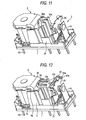
- the moving contact plate 20 and the first and second fixed contact plates 19 and 21 are pushed into and fixed to the base 1 as shown in Fig. 9 and the completed coil block 3 is assembled to the base 1 as shown in Figs. 10 and 11.
- the coil block 3 is fixed as the increased thickness portion 41 is pushed into the push-in acceptance portion 17 and both side portions 9 of the yoke 30 are pushed into the inner surface groove portion 9a.
- a space is defined under this state between the base 1 and the coil block 3 and a rotation space of the moving iron plate 32 can be secured.
- the escape recess 13 formed in the base 1 restricts the height of the electromagnetic relay.
- Each contact plate is pushed into and fixed to the base 1 in the sequence of the first fixed contact plate 19, the moving contact plate 20 and the second fixed contact plate 21.
- the second fixed contact plate 21 When the second fixed contact plate 21 is first pushed in, its bent portion prevents the push-in operation of the moving contact plate 20. Therefore, the moving contact plate 20 is first pushed in and then the second fixed contact plate 21 is pushed in and fixed. In this case, the escape portion 25 prevents the interference of the second fixed contact 26 though the card acceptance portion 24 is formed at the upper end of the moving contact plate 20.
- the anchor holding portion 36 of the card 100 is anchored to the anchor portion 35a of the moving iron plate 32 as shown in Fig. 12.
- the flexible holding plate 39 undergoes elastic deformation and then returns to its original shape.
- the flexible holding plate 39 and the contact plate 38 hold the anchor portion 35a.
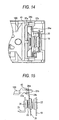
- the reduced thickness portion 37a of the card 100 is positioned between the upper and lower card acceptance portions 24 formed at the upper end of the moving contact plate 20. As shown in Figs. 14 and 15, the card acceptance portions 24 prevent fall-off of the card 100 in the vertical direction and the guide plate 37b formed on the card 100 prevents a positioning error of the card 100 in the transverse direction.
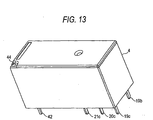
- the case 4 is fitted to the base 1 as shown in Fig. 13 to cover the constituent components.
- the base 1 is turned upside down so that its bottom surface faces upward, and the terminal holes and the fitting portion between the base 1 and the case 4, and so forth, are sealed with the sealant by use of a nozzle, or the like.
- the sealant enters the inside due to capillary.
- the sealant entering from the clearance between each terminal portion 19b, 19c, 20b, 20c, 21b, 21c of each contact plate 19, 20, 21 and the terminal hole is far from the region in which the contacts are opened and closed, and improves the fixing strength of the contact plates to the base 1.
- the sealant entering from the clearance between the coil terminal 42 and the through-hole 15 is stored in the ring-like recess 43 formed in the increased thickness portion 41 of the coil block 3 and its further invasion is checked. Even when the sealant enters beyond the ring-like recess portion 43, the partition wall 12 prevents the sealant from reaching the driving region of the moving iron plate 32. Therefore, even when the driving region of the moving iron plate 32 is positioned in the proximity of the region that the sealant enters, the problem due to adhesion, etc does not occur.
- the electromagnetic relay is completed in the manner described above.
- the gas vent hole 44 formed in the case 4 may well be used while left open or under the sealed state after it is thermally sealed depending on the environment of use. Even when impact force acts on the internal constituent components due to fall, or the like, no problem occurs because each component is firmly fixed to the base 1.
- the card 100 in particular, has the simple construction in which the moving iron plate 32 and the moving contact plate 20 are merely interconnected. One of the ends of the card is interconnected to the moving iron plate 32 through the anchor holding portion 36 and the other end guides the reduced thickness portion 37a of the push-in portion 37 within the range in which the moving contact plate 20 can undergo deformation.
- the upper end protuberance portion 10a formed on the insulating wall 5 of the base 1 is positioned between the contact plate 38 and the flexible holding plate 39 constituting the anchor holding portion 36 and the second protuberance portion 46 formed on the case 4 is positioned above the card 100. Therefore, even when any impact force operates, the card 100 does not fall off.
- the moving iron plate 32 rotates counter-clockwise in Fig. 2 due to the urging force of the hinge spring 31 with the rotation support point at the distal end of the yoke 30 being the center.
- the moving contact plate 20 is under the erected state due to its own flexible force and keeps the moving contact 23 under the closed state relative to the second fixed contact 26.
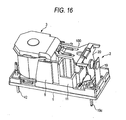
- the fixed contact plates 19 and 20 are disposed on both sides of the moving contact plate 20, but they may be disposed on only one side. In other words, it is possible to employ a construction in which only the second fixed contact plate 21 is not disposed but the rest of the constituent components are as such used as shown in Fig. 16.
- the guide plate 37b of the card 100 is disposed separately from the card reinforcement rib 40.
- the card reinforcement rib 40 operates also as the guide plate 37b.
- the card reinforcement ribs 40 positioned on both sides guide both side portions 9 of the upper card acceptance portion 24.
- At least one each card acceptance portion 24 of the moving contact plate 20 may well exist at the upper and lower positions.
- the card acceptance portion 24 may well be formed at the center.
- the invention bends a part of the contact-fitting portion and deviates the positions of the fixed contacts and the terminal portions with respect to the implanting direction of the fixed contact plates. Therefore, the invention makes it possible to set a reserve load, can secure desired strength for the bent portion and can acquire a construction excellent in impact resistance.
Landscapes
- Physics & Mathematics (AREA)
- Electromagnetism (AREA)
- Electromagnets (AREA)
- Telephone Set Structure (AREA)
Claims (3)
- Elektromagnetisches Relais, bei welchem ein Spulenblock (3) auf eine Basis (1) aufgesetzt ist, eine Beweglichkontaktplatte (20) und Festkontaktplatten (19, 21) in einander gegenüberliegender Weise eingesetzt sind, wobei die Beweglichkontaktplatte (20) bei Erregung und Entregung des Spulenblocks (3) eine elastische Verformung durchmachen kann und ein beweglicher Kontakt (23) der Beweglichkontaktplatte (20) in und außer Berührung mit Festkontakten (22, 26) der Festkontaktplatten (19, 21) gebracht wird, wobei
die Beweglichkontaktplatte (20) einen Kontakteinsetzabschnitt (201), an welchem der bewegliche Kontakt (23) befestigt ist, einen Eindrück-Befestigungsabschnitt (202), welcher in die Basis (1) gedrückt und an ihr befestigt ist und von welchem sich Anschlussabschnitte (20b, 20c) wegerstrecken, dadurch gekennzeichnet, dass die Beweglichkontaktplatte (20) einen Verbindungsabschnitt (203) zur Verbindung des Kontakteinsetzabschnitts (201) mit dem Eindrück-Befestigungsabschnitt (202) aufweist;
der Verbindungsabschnitt (203) eine kleinere Breite als der Kontakteinsetzabschnitt (201) und der Eindrück-Befestigungsabschnitt (202) hat; und
ein Grenzabschnitt des Eindrück-Befestigungsabschnitt (202) zum Verbindungsabschnitt (203) und ein Teil des Kontakteinsetzabschnitts (201) in einer solchen Weise gebogen sind, dass die Positionen des beweglichen Kontakts (23) und der Anschlussabschnitte (20b, 20c) in Bezug auf eine Einsetzrichtung der Beweglichkontaktplatte (20) versetzt sind. - Elektromagnetisches Relais nach Anspruch 1, wobei ein Schlitzabschnitt (20d) längs einer Mittellinie der Beweglichkontaktplatte (20) definiert ist und ein Elastizitätskoeffizient der Beweglichkontaktplatte (20) mit Änderung der Form des Schlitzabschnitts (20d) einstellbar ist.
- Elektromagnetisches Relais, bei welchem ein Spulenblock (3) auf eine Basis (1) aufgesetzt ist, eine Beweglichkontaktplatte (20) und Festkontaktplatten (19, 21) in einander gegenüberliegender Weise eingesetzt sind, wobei die Beweglichkontaktplatte (20) bei Erregung und Entregung des Spulen blocks (3) eine elastische Verformung durchmachen kann und ein beweglicher Kontakt (23) der Beweglichkontaktplatte (20) in und außer Berührung mit Festkontakten (22, 26) der Festkontaktplatten (19, 21) gebracht wird, wobei
eine (21) der Festkontaktplatten (19, 21) einen Kontakteinsetzabschnitt (211), an welchem einer der Festkontakte (22, 26) befestigt ist, einen Beinabschnitt (212), von welchem sich Anschlussabschnitte (21b, 21c) wegerstrecken, und einen Verbindungsabschnitt (213) zur Verbindung des Kontakteinsetzabschnitts (211) mit dem Beinabschnitt (212) aufweist;
ein Grenzabschnitt zwischen dem Kontakteinsetzabschnitt (211) und dem Verbindungsabschnitt (213) und ein Grenzabschnitt zwischen dem Verbindungsabschnitt (213) und dem Beinabschnitt (212) jeweils so gebogen sind, dass Positionen des einen (26) der Festkontakte (22, 26) und der Anschlussabschnitte (21b, 21c) in Bezug auf eine Einführungsrichtung der einen (21) der Festkontaktplatten (19, 21) versetzt sind; und
ein offener Abschnitt (216) in dem zweiten Abschnitt erhöhter Breite (215) ausgebildet ist,
dadurch gekennzeichnet, dass ein erster Abschnitt erhöhter Breite (214) an der Grenze zwischen dem Kontaktbefestigungsabschnitt (211) und dem Verbindungsabschnitt (213) ausgebildet ist;
ein zweiter Abschnitt erhöhter Breite (215) im oberen Teil des Verbindungsabschnitts (213) ausgebildet ist.
Applications Claiming Priority (2)
| Application Number | Priority Date | Filing Date | Title |
|---|---|---|---|
| JP2002328089 | 2002-11-12 | ||
| JP2002328089A JP4168733B2 (ja) | 2002-11-12 | 2002-11-12 | 電磁継電器 |
Publications (2)
| Publication Number | Publication Date |
|---|---|
| EP1420428A1 EP1420428A1 (de) | 2004-05-19 |
| EP1420428B1 true EP1420428B1 (de) | 2006-09-13 |
Family
ID=32171359
Family Applications (1)
| Application Number | Title | Priority Date | Filing Date |
|---|---|---|---|
| EP03024963A Expired - Lifetime EP1420428B1 (de) | 2002-11-12 | 2003-10-29 | Elektromagnetisches Relais |
Country Status (6)
| Country | Link |
|---|---|
| US (1) | US6940375B2 (de) |
| EP (1) | EP1420428B1 (de) |
| JP (1) | JP4168733B2 (de) |
| CN (1) | CN1275274C (de) |
| DE (1) | DE60308292T8 (de) |
| ES (1) | ES2268250T3 (de) |
Families Citing this family (63)
| Publication number | Priority date | Publication date | Assignee | Title |
|---|---|---|---|---|
| EP1681699B1 (de) * | 2004-07-14 | 2011-04-13 | Panasonic Electric Works Co., Ltd. | Elektromagnetisches relais |
| ITPC20050004U1 (it) * | 2005-03-10 | 2006-09-11 | Electrica Srl | Rele' voltmetrico con aggancio migliorato dei terminali |
| CN100403474C (zh) * | 2005-05-19 | 2008-07-16 | 厦门宏发电声有限公司 | 一种电磁继电器衔铁部件 |
| CN100369177C (zh) * | 2005-05-19 | 2008-02-13 | 厦门宏发电声有限公司 | 一种电磁继电器的动簧 |
| JP4466506B2 (ja) * | 2005-08-12 | 2010-05-26 | オムロン株式会社 | リレー |
| USD553576S1 (en) * | 2005-10-27 | 2007-10-23 | Omron Corporation | Electromagnetic relay |
| JP4742954B2 (ja) * | 2006-03-31 | 2011-08-10 | オムロン株式会社 | 電磁継電器 |
| JP2007273289A (ja) * | 2006-03-31 | 2007-10-18 | Omron Corp | 電磁継電器 |
| JP2007273292A (ja) * | 2006-03-31 | 2007-10-18 | Omron Corp | 電磁継電器 |
| JP2008053152A (ja) | 2006-08-28 | 2008-03-06 | Omron Corp | 静音型電磁継電器 |
| US7477119B2 (en) * | 2007-03-02 | 2009-01-13 | Good Sky Electric Co., Ltd. | Electromagnetic relay |
| JP4952324B2 (ja) * | 2007-03-22 | 2012-06-13 | オムロン株式会社 | 電磁継電器 |
| JP4946559B2 (ja) * | 2007-03-22 | 2012-06-06 | オムロン株式会社 | 電磁継電器 |
| US7659800B2 (en) * | 2007-08-01 | 2010-02-09 | Philipp Gruner | Electromagnetic relay assembly |
| US7710224B2 (en) * | 2007-08-01 | 2010-05-04 | Clodi, L.L.C. | Electromagnetic relay assembly |
| TW201019364A (en) * | 2008-11-12 | 2010-05-16 | Good Sky Electric Co Ltd | An electromagnetic relay |
| CN102103942B (zh) * | 2009-12-17 | 2013-06-05 | 厦门宏发电声股份有限公司 | 一种继电器的衔铁与推动机构之间的连接结构 |
| JP5494042B2 (ja) | 2010-03-12 | 2014-05-14 | オムロン株式会社 | 接点開閉構造及び電磁リレー |
| CN101777459B (zh) * | 2010-03-12 | 2012-10-10 | 厦门宏发电声股份有限公司 | 一种结构简单、抗冲击能力强的电磁继电器 |
| KR101357084B1 (ko) * | 2010-03-15 | 2014-02-03 | 오므론 가부시키가이샤 | 접촉 스위칭 장치 |
| US8514040B2 (en) | 2011-02-11 | 2013-08-20 | Clodi, L.L.C. | Bi-stable electromagnetic relay with x-drive motor |
| JP4883232B1 (ja) | 2011-03-14 | 2012-02-22 | オムロン株式会社 | 電磁継電器 |
| JP5807174B2 (ja) * | 2011-03-23 | 2015-11-10 | パナソニックIpマネジメント株式会社 | 電磁リレー |
| JP5741338B2 (ja) * | 2011-09-15 | 2015-07-01 | オムロン株式会社 | 端子部材のシール構造、及び、電磁継電器 |
| JP6025414B2 (ja) * | 2011-09-30 | 2016-11-16 | 富士通コンポーネント株式会社 | 電磁継電器 |
| JP6056264B2 (ja) * | 2012-08-24 | 2017-01-11 | オムロン株式会社 | 電磁石装置およびそれを用いた電磁継電器 |
| JP6171286B2 (ja) * | 2012-08-24 | 2017-08-02 | オムロン株式会社 | 電磁石装置 |
| JP6024287B2 (ja) * | 2012-08-24 | 2016-11-16 | オムロン株式会社 | 電磁石装置、その組立方法およびそれを用いた電磁継電器 |
| JP2014107224A (ja) * | 2012-11-29 | 2014-06-09 | Fujitsu Component Ltd | 電磁継電器及び電磁継電器の製造方法 |
| JP2014139898A (ja) * | 2013-01-21 | 2014-07-31 | Fujitsu Component Ltd | 電磁継電器 |
| JP2014165152A (ja) * | 2013-02-27 | 2014-09-08 | Fujitsu Component Ltd | 電磁継電器 |
| CN203457022U (zh) * | 2013-03-01 | 2014-02-26 | 美国调速器公司 | 具有增强的磁结构的电磁致动器 |
| JP2015035403A (ja) * | 2013-08-09 | 2015-02-19 | オムロン株式会社 | 接点機構およびこれを用いた電磁継電器 |
| US9159514B2 (en) * | 2013-11-18 | 2015-10-13 | Tyco Electronics Corporation | Relay connector assembly for a relay system |
| JP6291931B2 (ja) * | 2014-03-14 | 2018-03-14 | オムロン株式会社 | 電子機器のシール構造およびこの電子機器のシール構造を用いた電磁継電器 |
| JP6422249B2 (ja) * | 2014-07-03 | 2018-11-14 | 富士通コンポーネント株式会社 | 電磁継電器 |
| CN106716587B (zh) * | 2014-07-23 | 2018-12-11 | 富士通电子零件有限公司 | 电磁继电器 |
| JP6433706B2 (ja) | 2014-07-28 | 2018-12-05 | 富士通コンポーネント株式会社 | 電磁継電器及びコイル端子 |
| EP2996137B1 (de) * | 2014-09-10 | 2019-05-08 | Tyco Electronics EC Trutnov s.r.o. | Jochanordnung mit Verzögerungselement zum Schalten einer Vorrichtung und dergleichen |
| DE102014220700B4 (de) * | 2014-10-13 | 2018-10-11 | Tyco Electronics Austria Gmbh | Kontaktfeder für ein elektrisches Schaltelement und Kammrelais |
| EP3051563B1 (de) | 2015-01-30 | 2019-12-11 | Tyco Electronics Austria GmbH | Federelement für ein elektrisches schaltelement |
| EP3051562B1 (de) * | 2015-01-30 | 2018-12-26 | Tyco Electronics Austria GmbH | Federelement für eine elektrische Schaltvorrichtung wie ein Kammrelais |
| CN108028155B (zh) * | 2015-09-15 | 2019-08-23 | 松下知识产权经营株式会社 | 电磁继电器 |
| JP6458705B2 (ja) | 2015-10-29 | 2019-01-30 | オムロン株式会社 | リレー |
| JP6414019B2 (ja) * | 2015-10-29 | 2018-10-31 | オムロン株式会社 | リレー |
| JP6471678B2 (ja) | 2015-10-29 | 2019-02-20 | オムロン株式会社 | 接触片ユニット及びリレー |
| JP6664978B2 (ja) * | 2016-01-29 | 2020-03-13 | 富士通コンポーネント株式会社 | 電磁継電器 |
| WO2018095417A1 (zh) * | 2016-11-24 | 2018-05-31 | 厦门宏发汽车电子有限公司 | 一种静簧与线圈架之间的插装结构 |
| CN106601557B (zh) * | 2017-01-11 | 2019-07-09 | 厦门宏发电声股份有限公司 | 一种动簧片及其拍合式继电器的动簧片与轭铁的连接结构 |
| CN106935442B (zh) * | 2017-02-10 | 2019-03-26 | 宁波华冠电子有限公司 | 一种推杆式大功率电磁继电器 |
| JP6787182B2 (ja) | 2017-02-28 | 2020-11-18 | オムロン株式会社 | 電子機器のシール構造、シール構造を備えた電子機器、および、電子機器の製造方法 |
| JP2018170241A (ja) * | 2017-03-30 | 2018-11-01 | 富士通コンポーネント株式会社 | 電磁継電器 |
| JP6726156B2 (ja) * | 2017-12-04 | 2020-07-22 | 富士通コンポーネント株式会社 | 電磁継電器 |
| JP6973200B2 (ja) * | 2018-03-13 | 2021-11-24 | オムロン株式会社 | 接点開閉装置 |
| JP7154151B2 (ja) * | 2019-02-15 | 2022-10-17 | 富士通コンポーネント株式会社 | 電磁継電器の端子及び電磁継電器 |
| CN110957187B (zh) * | 2019-12-03 | 2025-06-24 | 漳州宏发电声有限公司 | 一种防断裂误接通的动簧结构及电磁继电器 |
| JP7443842B2 (ja) * | 2020-03-11 | 2024-03-06 | オムロン株式会社 | 電磁継電器 |
| JP7638633B2 (ja) | 2020-06-30 | 2025-03-04 | Fclコンポーネント株式会社 | 電磁継電器 |
| USD951210S1 (en) * | 2020-11-20 | 2022-05-10 | Song Chuan Precision Co., Ltd. | Electronic switch |
| USD951209S1 (en) * | 2020-11-20 | 2022-05-10 | Song Chuan Precision Co., Ltd. | Electronic switch |
| CN112768304B (zh) * | 2021-02-07 | 2025-03-18 | 三友联众集团股份有限公司 | 一种带有高强度防回跳端子的继电器 |
| US11404232B1 (en) * | 2021-03-17 | 2022-08-02 | Song Chuan Precision Co., Ltd. | Electromagnetic relay capable of externally and manually controlling, turning on, and shutting off electric power |
| CN115602494A (zh) * | 2022-07-27 | 2023-01-13 | 厦门宏发电力电器有限公司(Cn) | 一种簧片与底座的连接结构及其磁保持电磁继电器 |
Family Cites Families (8)
| Publication number | Priority date | Publication date | Assignee | Title |
|---|---|---|---|---|
| JPH0469836U (de) * | 1990-10-26 | 1992-06-19 | ||
| JP2892230B2 (ja) * | 1992-08-07 | 1999-05-17 | アンデン株式会社 | 電磁継電器 |
| JPH09190757A (ja) * | 1996-01-11 | 1997-07-22 | Omron Corp | 電磁継電器 |
| WO1998013843A1 (en) * | 1996-09-27 | 1998-04-02 | Siemens Electromechanical Components, Inc. | Improved relay and relay terminal |
| JP3826464B2 (ja) * | 1997-01-09 | 2006-09-27 | オムロン株式会社 | 電磁継電器 |
| JP2000173433A (ja) * | 1998-12-07 | 2000-06-23 | Matsushita Electric Works Ltd | 電磁継電器 |
| JP4085513B2 (ja) * | 1999-04-28 | 2008-05-14 | オムロン株式会社 | 電気機器の封止構造 |
| JP4334158B2 (ja) * | 2001-03-26 | 2009-09-30 | 富士通コンポーネント株式会社 | 電磁継電器 |
-
2002
- 2002-11-12 JP JP2002328089A patent/JP4168733B2/ja not_active Expired - Fee Related
-
2003
- 2003-10-29 DE DE60308292T patent/DE60308292T8/de active Active
- 2003-10-29 ES ES03024963T patent/ES2268250T3/es not_active Expired - Lifetime
- 2003-10-29 EP EP03024963A patent/EP1420428B1/de not_active Expired - Lifetime
- 2003-11-12 US US10/706,313 patent/US6940375B2/en not_active Expired - Lifetime
- 2003-11-12 CN CN200310114279.8A patent/CN1275274C/zh not_active Expired - Fee Related
Also Published As
| Publication number | Publication date |
|---|---|
| US20040119566A1 (en) | 2004-06-24 |
| ES2268250T3 (es) | 2007-03-16 |
| DE60308292D1 (de) | 2006-10-26 |
| JP2004164949A (ja) | 2004-06-10 |
| US6940375B2 (en) | 2005-09-06 |
| CN1275274C (zh) | 2006-09-13 |
| DE60308292T8 (de) | 2007-07-12 |
| CN1499557A (zh) | 2004-05-26 |
| JP4168733B2 (ja) | 2008-10-22 |
| EP1420428A1 (de) | 2004-05-19 |
| DE60308292T2 (de) | 2007-04-05 |
Similar Documents
| Publication | Publication Date | Title |
|---|---|---|
| EP1420428B1 (de) | Elektromagnetisches Relais | |
| EP1420429B1 (de) | Elektromagnetisches Relais | |
| EP1418604B1 (de) | Elektromagnetisches Relais | |
| US7750769B2 (en) | Electromagnetic relay | |
| US20080231396A1 (en) | Electromagnetic relay | |
| US20080231395A1 (en) | Electromagnetic relay | |
| KR20140102126A (ko) | 전자 계전기 | |
| JP4052015B2 (ja) | 高周波リレー | |
| JP7821997B2 (ja) | 電磁継電器 | |
| JP4135475B2 (ja) | 電磁継電器 | |
| JP3932722B2 (ja) | 電磁継電器 | |
| JP4039122B2 (ja) | 高周波リレー | |
| JP3932700B2 (ja) | 電磁継電器 | |
| JP3932716B2 (ja) | 電磁継電器 | |
| US20250218715A1 (en) | Relay | |
| JP4172205B2 (ja) | 高周波リレー | |
| JP2001250464A (ja) | 電磁継電器の製造方法 | |
| JPH08235996A (ja) | 電磁継電器 |
Legal Events
| Date | Code | Title | Description |
|---|---|---|---|
| PUAI | Public reference made under article 153(3) epc to a published international application that has entered the european phase |
Free format text: ORIGINAL CODE: 0009012 |
|
| AK | Designated contracting states |
Kind code of ref document: A1 Designated state(s): AT BE BG CH CY CZ DE DK EE ES FI FR GB GR HU IE IT LI LU MC NL PT RO SE SI SK TR |
|
| AX | Request for extension of the european patent |
Extension state: AL LT LV MK |
|
| 17P | Request for examination filed |
Effective date: 20040324 |
|
| AKX | Designation fees paid |
Designated state(s): DE ES FR GB IT |
|
| GRAP | Despatch of communication of intention to grant a patent |
Free format text: ORIGINAL CODE: EPIDOSNIGR1 |
|
| GRAS | Grant fee paid |
Free format text: ORIGINAL CODE: EPIDOSNIGR3 |
|
| GRAA | (expected) grant |
Free format text: ORIGINAL CODE: 0009210 |
|
| AK | Designated contracting states |
Kind code of ref document: B1 Designated state(s): DE ES FR GB IT |
|
| PG25 | Lapsed in a contracting state [announced via postgrant information from national office to epo] |
Ref country code: IT Free format text: LAPSE BECAUSE OF FAILURE TO SUBMIT A TRANSLATION OF THE DESCRIPTION OR TO PAY THE FEE WITHIN THE PRESCRIBED TIME-LIMIT;WARNING: LAPSES OF ITALIAN PATENTS WITH EFFECTIVE DATE BEFORE 2007 MAY HAVE OCCURRED AT ANY TIME BEFORE 2007. THE CORRECT EFFECTIVE DATE MAY BE DIFFERENT FROM THE ONE RECORDED. Effective date: 20060913 |
|
| REG | Reference to a national code |
Ref country code: GB Ref legal event code: FG4D |
|
| REF | Corresponds to: |
Ref document number: 60308292 Country of ref document: DE Date of ref document: 20061026 Kind code of ref document: P |
|
| REG | Reference to a national code |
Ref country code: ES Ref legal event code: FG2A Ref document number: 2268250 Country of ref document: ES Kind code of ref document: T3 |
|
| ET | Fr: translation filed | ||
| PLBE | No opposition filed within time limit |
Free format text: ORIGINAL CODE: 0009261 |
|
| STAA | Information on the status of an ep patent application or granted ep patent |
Free format text: STATUS: NO OPPOSITION FILED WITHIN TIME LIMIT |
|
| 26N | No opposition filed |
Effective date: 20070614 |
|
| REG | Reference to a national code |
Ref country code: DE Ref legal event code: R082 Ref document number: 60308292 Country of ref document: DE Representative=s name: KILIAN KILIAN & PARTNER, DE Ref country code: DE Ref legal event code: R082 Ref document number: 60308292 Country of ref document: DE Representative=s name: KILIAN KILIAN & PARTNER MBB PATENTANWAELTE, DE |
|
| PGFP | Annual fee paid to national office [announced via postgrant information from national office to epo] |
Ref country code: FR Payment date: 20121022 Year of fee payment: 10 |
|
| PGFP | Annual fee paid to national office [announced via postgrant information from national office to epo] |
Ref country code: IT Payment date: 20121024 Year of fee payment: 10 Ref country code: ES Payment date: 20121030 Year of fee payment: 10 |
|
| REG | Reference to a national code |
Ref country code: FR Ref legal event code: ST Effective date: 20140630 |
|
| PG25 | Lapsed in a contracting state [announced via postgrant information from national office to epo] |
Ref country code: FR Free format text: LAPSE BECAUSE OF NON-PAYMENT OF DUE FEES Effective date: 20131031 Ref country code: IT Free format text: LAPSE BECAUSE OF NON-PAYMENT OF DUE FEES Effective date: 20131029 |
|
| REG | Reference to a national code |
Ref country code: ES Ref legal event code: FD2A Effective date: 20141107 |
|
| PG25 | Lapsed in a contracting state [announced via postgrant information from national office to epo] |
Ref country code: ES Free format text: LAPSE BECAUSE OF NON-PAYMENT OF DUE FEES Effective date: 20131030 |
|
| PGFP | Annual fee paid to national office [announced via postgrant information from national office to epo] |
Ref country code: GB Payment date: 20181024 Year of fee payment: 16 |
|
| PGFP | Annual fee paid to national office [announced via postgrant information from national office to epo] |
Ref country code: DE Payment date: 20191015 Year of fee payment: 17 |
|
| GBPC | Gb: european patent ceased through non-payment of renewal fee |
Effective date: 20191029 |
|
| PG25 | Lapsed in a contracting state [announced via postgrant information from national office to epo] |
Ref country code: GB Free format text: LAPSE BECAUSE OF NON-PAYMENT OF DUE FEES Effective date: 20191029 |
|
| REG | Reference to a national code |
Ref country code: DE Ref legal event code: R119 Ref document number: 60308292 Country of ref document: DE |
|
| PG25 | Lapsed in a contracting state [announced via postgrant information from national office to epo] |
Ref country code: DE Free format text: LAPSE BECAUSE OF NON-PAYMENT OF DUE FEES Effective date: 20210501 |