EP1426804A2 - Composition absorbant hydrogène et câbles optiques comportant de telles compositions - Google Patents
Composition absorbant hydrogène et câbles optiques comportant de telles compositions Download PDFInfo
- Publication number
- EP1426804A2 EP1426804A2 EP03027759A EP03027759A EP1426804A2 EP 1426804 A2 EP1426804 A2 EP 1426804A2 EP 03027759 A EP03027759 A EP 03027759A EP 03027759 A EP03027759 A EP 03027759A EP 1426804 A2 EP1426804 A2 EP 1426804A2
- Authority
- EP
- European Patent Office
- Prior art keywords
- optical fiber
- carbon
- hydrogen
- telecommunication cable
- absorbing composition
- Prior art date
- Legal status (The legal status is an assumption and is not a legal conclusion. Google has not performed a legal analysis and makes no representation as to the accuracy of the status listed.)
- Withdrawn
Links
Images
Classifications
-
- B—PERFORMING OPERATIONS; TRANSPORTING
- B01—PHYSICAL OR CHEMICAL PROCESSES OR APPARATUS IN GENERAL
- B01J—CHEMICAL OR PHYSICAL PROCESSES, e.g. CATALYSIS OR COLLOID CHEMISTRY; THEIR RELEVANT APPARATUS
- B01J20/00—Solid sorbent compositions or filter aid compositions; Sorbents for chromatography; Processes for preparing, regenerating or reactivating thereof
- B01J20/02—Solid sorbent compositions or filter aid compositions; Sorbents for chromatography; Processes for preparing, regenerating or reactivating thereof comprising inorganic material
- B01J20/20—Solid sorbent compositions or filter aid compositions; Sorbents for chromatography; Processes for preparing, regenerating or reactivating thereof comprising inorganic material comprising free carbon; comprising carbon obtained by carbonising processes
- B01J20/205—Carbon nanostructures, e.g. nanotubes, nanohorns, nanocones, nanoballs
-
- B—PERFORMING OPERATIONS; TRANSPORTING
- B82—NANOTECHNOLOGY
- B82Y—SPECIFIC USES OR APPLICATIONS OF NANOSTRUCTURES; MEASUREMENT OR ANALYSIS OF NANOSTRUCTURES; MANUFACTURE OR TREATMENT OF NANOSTRUCTURES
- B82Y30/00—Nanotechnology for materials or surface science, e.g. nanocomposites
-
- C—CHEMISTRY; METALLURGY
- C01—INORGANIC CHEMISTRY
- C01B—NON-METALLIC ELEMENTS; COMPOUNDS THEREOF; METALLOIDS OR COMPOUNDS THEREOF NOT COVERED BY SUBCLASS C01C
- C01B3/00—Hydrogen; Gaseous mixtures containing hydrogen; Separation of hydrogen from mixtures containing it; Purification of hydrogen; Reversible storage of hydrogen
- C01B3/0005—Reversible storage of hydrogen, e.g. by hydrogen getters or electrodes
- C01B3/001—Reversible storage of hydrogen, e.g. by hydrogen getters or electrodes characterised by the uptaking media; Treatment thereof
- C01B3/0018—Inorganic elements or compounds, e.g. oxides, nitrides, borohydrides or zeolites; Solutions thereof
- C01B3/0021—Elemental carbon, e.g. active carbon, carbon nanotubes or fullerenes
-
- G—PHYSICS
- G02—OPTICS
- G02B—OPTICAL ELEMENTS, SYSTEMS OR APPARATUS
- G02B6/00—Light guides; Structural details of arrangements comprising light guides and other optical elements, e.g. couplings
- G02B6/44—Mechanical structures for providing tensile strength and external protection for fibres, e.g. optical transmission cables
- G02B6/4401—Optical cables
- G02B6/4429—Means specially adapted for strengthening or protecting the cables
- G02B6/44382—Means specially adapted for strengthening or protecting the cables the means comprising hydrogen absorbing materials
-
- G—PHYSICS
- G02—OPTICS
- G02B—OPTICAL ELEMENTS, SYSTEMS OR APPARATUS
- G02B6/00—Light guides; Structural details of arrangements comprising light guides and other optical elements, e.g. couplings
- G02B6/44—Mechanical structures for providing tensile strength and external protection for fibres, e.g. optical transmission cables
- G02B6/4401—Optical cables
- G02B6/4429—Means specially adapted for strengthening or protecting the cables
- G02B6/44384—Means specially adapted for strengthening or protecting the cables the means comprising water blocking or hydrophobic materials
-
- Y—GENERAL TAGGING OF NEW TECHNOLOGICAL DEVELOPMENTS; GENERAL TAGGING OF CROSS-SECTIONAL TECHNOLOGIES SPANNING OVER SEVERAL SECTIONS OF THE IPC; TECHNICAL SUBJECTS COVERED BY FORMER USPC CROSS-REFERENCE ART COLLECTIONS [XRACs] AND DIGESTS
- Y02—TECHNOLOGIES OR APPLICATIONS FOR MITIGATION OR ADAPTATION AGAINST CLIMATE CHANGE
- Y02E—REDUCTION OF GREENHOUSE GAS [GHG] EMISSIONS, RELATED TO ENERGY GENERATION, TRANSMISSION OR DISTRIBUTION
- Y02E60/00—Enabling technologies; Technologies with a potential or indirect contribution to GHG emissions mitigation
- Y02E60/30—Hydrogen technology
- Y02E60/32—Hydrogen storage
Definitions
- the present invention relates to optical fibers and more specifically optical fibers that are surrounded by a hydrogen absorbing composition containing a carbon nanostructure. Particularly, this composition prevents the interaction of hydrogen with the optical fibers.
- optical fibers are silica (i.e., glass) fiber or filament of exceptionally high purity and specific properties (e.g., refractive index) that transmit data in the form of light impulses.
- Optical fiber cables have been found to have a number of applications as they are capable of transmitting signals over great distances, at high speeds and with relatively low signal loss as compared to standard wire or cable networks. Some of the technologies utilizing optical fiber cables include: medicine, aviation, communications, automotive, control applications, etc.
- optical fibers are protected from destructive factors, such as weather, moisture, temperature extremes and physical damage (i.e., stress, strain, impact).
- optical fibers are arranged in any number of ways and disposed in a sheath system which surrounds and protects the fibers.
- the fibers may be placed in a buffer tube which functions as an intermediary between the optical fibers and the sheath.
- the fibers can be centrally located within a centrally located single buffer tube containing one or more optical fibers; the cables may contain a plurality of buffer tubes disposed therein and stranded in any manner, such as helical or alternating helical arrangement; the cables may contain a central strength member; or the cables include slotted cores in which a plurality of optical fibers reside.
- one of the deficiencies recognized in the cables to date is the interaction of hydrogen with the optical fibers which can lead to increased attenuation in the optical fibers.
- hydrogen is formed either during the manufacturing of the thermoplastic cable, or through the chemical reaction of traces of water, in liquid or gaseous state, which can penetrate into the cable itself.
- hydrogen located outside the cable can reach the optical fibers of a cable through diffusion.
- gaseous hydrogen comes into contact with an optical fiber, the transmitted signals may become attenuated. This effect can be irreversible and may compromise the transmission capacity of the cable.
- U.S. Patent No. 6,085,009 discloses a gel which is water blocking agent for an optical fiber cable buffer tube.
- the gel includes a polyolefin oil, wherein less than 3 weight percent of the polyolefin species in the oil has a molecular weight below 2000, a thixotropic agent and a thermal oxidation stabilizer. This patent is hereby incorporated by reference in its entirety.
- U.S. Patent No. 5,455,881 describes an optical fiber telecommunication cable, wherein a portion of the internal volume includes a hydrogen-absorbing composition.
- the composition includes a hydrocarbon compound and a catalyst selected from a group including transition metals, salts and organic and inorganic complexes of transition metals, characterized in that the hydrocarbon group includes at least 90% of a substantially homogeneous silicon-free hydrocarbon which is not obtained by polymerization of monomers including conjugated dienes.
- U.S. Patent No. 4,725,123 describes a hydrogen absorbing mixture for protecting optical cables.
- the mixture includes at least one oxide selected from among oxides of titanium, vanadium, chromium, manganese, etc.
- Another basic component of the mixture is a catalyst selected from among transition metals such as palladium powder and complexes thereof.
- This mixture is incorporated into a cable filler, such as a silicon grease, and introduced into the cable as a filler material.
- U.S. Patent No. 4,715,678 discloses a "hydrogen trapping" material disposed in a fiber optic cable in conjunction with at least one of a waterblocking and a water-absorbing substance.
- the hydrogen trapping material includes activated manganese or a finely divided palladium.
- Another disadvantage is the high cost of the hydrogen-absorbent components utilized in the prior art filling gels. Particularly, the inclusion of palladium powder has been found to be expensive.
- the alternative means of hydrogen absorption by including metal hydrides and metal exchanged zeolites has likewise been found to be expensive and subject to limited effectiveness after exposure to water.
- an innovative optical fiber telecommunication cable with a hydrogen absorbing gel composition disposed therein is provided.
- the invention finds particular applicability in the telecommunication industry, wherein the cables are exposed to a wide range of environmental conditions.
- the gel composition is to be utilized in fiber optic cable applications, wherein the optical fibers are adequately protected from possible attenuation of the signal transmitted therethrough.
- Another object of this invention is to provide a hydrogen absorbing gel having a carbon nanostructure component which is less expensive than the hydrogen-absorbing components of the prior art (e.g., palladium powder, metal hydride and metal exchanged zeolites).
- an optical fiber telecommunication cable is provided.
- the cable includes:
- an optical fiber telecommunication cable includes:
- a hydrogen absorbing gel composition includes:
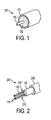
- Fig. 1 illustrates a fiber optic cable, in accordance with an exemplary embodiment of the invention.
- Cable 100 has an optical fiber/filament 110 disposed within sheath/outer protective layer 120. Disposed therebetween is a hydrogen absorbing composition 130 in accordance with the invention.
- hydrogen absorbing composition refers to a filling material to be employed in a fiber optic cable system and it will be understood to mean a water-blocking material, preferably in a gel form.
- composition 130 Hydrogen absorbing composition 130 (sometimes referred to as simply, "composition 130") must meet certain rheological characteristics which renders composition 130 suitable for use in cable 100. As will be recognized by those skilled in the art, the necessary criteria includes viscosity, material compatibility (i.e. with the sheath 120), oil separation, cable drip performance, thermooxidative stability, etc. For example, if the drip performance of composition 130 at elevated temperatures is poor, the composition can flow out of the cable and into splice enclosures or undesired locations.
- composition 130 of the present invention is a thixotropic material, such as a stable gel-like substance.
- Optical fiber 110 surrounded by the gel-like substance, is loosely accommodated in sheath 120.
- composition 130 permits a degree of movement between optical fiber 110 and sheath 120 in order to prevent an undue strain being placed on fiber 110 when bent or flexed.
- composition 130 is a thixotropic material which has the ability to flow when subjected to shearing forces and to return to the gel form when at rest.
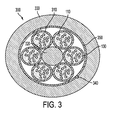
- a number of bundles 210 are disposed in sheath/outer protective layer 220 contain optical fibers 110.
- bundles 210 are formed by arranging optical fibers 110 in any number of ways. Some of the configurations include a simple linear arrangement where the fibers are disposed in close proximity to one another. In a further arrangement, the fibers may be stranded or intertwined in any manner such as helical or alternating helical arrangement, within each respective bundle 210.
- the hydrogen absorbing composition 130 is disposed between the bundles and the sheath/outer protective layer 220. Further, composition 130 may be utilized to fill any openings that may exist between optical fibers 110 within one bundle 210.
- Fig. 3 illustrates a typical stranded optical fiber cable 300 having a core comprised of buffer tubes 310, each of which houses optical fibers, stranded about a central strength member 320.
- a sheath/outer protective layer 330 is disposed over the core region on the exterior of the buffer tubes.
- a ripcord 340 is provided near the interface of wrap 350 and outer jacket 330.
- Hydrogen absorbing composition 130 is disposed within the buffer tubes 310, and may also be disposed within the core, outside of the buffer tubes.
- buffer tubes 310 are low cost polyolefin materials, such polyethylene, polypropylene, polybutylene, polyolefin copolymers, polyolefin terpolymers, and mixtures thereof.
- polypropylene-polyethylene copolymers or compounds, which are less expensive than polybutyrene terephthalate (PBT), polycarbonate or Nylon 12 can be used to make buffer tubes for optical fiber cables by incorporating nucleating agents in the polypropylene-polyethylene copolymer melt prior to extrusion of a buffer tube or by incorporating filler materials with the copolymer during the extrusion of a buffer tube.
- buffer tubes 310 While the polyolefin materials utilized in buffer tubes 310 are inexpensive, such materials may be incompatible with some water-blocking filling materials due to the polymer/solvent interactions that induce swelling of the polymer by the filling material. This deleterious effect on cable 300 has been addressed as described in both U.S. Patent No. 6,085,009, and the present invention.
- hydrogen absorbing composition 130 includes one or more synthetic oils, a thixotropic or pseudoplasticity agent, a thermal oxidative stabilizer, and a hydrogen absorbing component.
- the synthetic oil, which forms the base of composition 130 may, for example, include polyolefins, polyalphaolefins, polyglycols, polybutenes, polyisobutylenes, polypropenes, poly-n-decene, poly-n-pentene, poly-n-hexene, poly-n-octene, fractionated mineral oil, silicone oils, and blends thereof.
- the average molecular weight of the synthetic oil is greater than about 350 and preferably greater than about 2000.
- Commercially suitable polyalphaolefins include HITEC 174 oil available from the Ethyl Corporation or SHF 404 or SHF 1003 oil available from the ExxonMobil corporation.
- a second component namely, a thixotropic/pseudoplasticity agent is added to the synthetic oil component to provide the rheological characteristics discussed above.
- the thixotropic agent or modifier thickens the oil constituent so that oil separation is reduced.
- Oil separation or syneresis is a property of a gel-like composition which describes the tendency to bleed oil during the lifetime of the composition.
- selection of a proper thixotropic modifier requires the manufacturer to strike a balance between competing properties imparted to the ultimate composition 130.
- addition of an inorganic thixotropy modifier increases the material's yield stress and viscosity.
- Addition of a polymeric additive may impart different rheological properties to the material.
- a proper mixture of base oils, inorganic and/or polymeric modifiers must be formulated such that oil separation and rheological properties are acceptable.
- the thixotropic agent/modifier may be either organic, inorganic, or a combination thereof. Therefore, the thixotropic agent can be fumed silica, a block copolymer, or a combination of both. Other relatively high viscosity semi-liquids, sometimes referred to as semisolids, or rubbers may be appropriate. Block copolymers and semi-liquid rubbers, referred to collectively as rubber polymers, can be employed.
- cps centipoise
- Exemplary diblock copolymers include: (a) a styrene-ethylene propylene block copolymer (SEP), unplasticized, having a styrene/rubber ratio of about 0.59, a specific gravity of about 0.93, a break strength per ASTM D-412 of 300 psi, and being available from the Shell Chemical Company of Houston, Texas, under the trade designation Kraton G 1701; (b) a styrene-ethylene propylene block copolymer having a sytrene to rubber ratio of about 0.39 and available from the Shell Chemical Company under the designation G1702; and (c) a diblock copolymer of ethylene and propylene available from the Shell Chemical Company under the designation G1750.
- SEP styrene-ethylene propylene block copolymer
- G1750 styrene-ethylene propylene block copolymer
- Kraton 1726 copolymer which is a mixture of 30% styrene-ethylene butylene-styrene triblock copolymer (SEBS) and 70% styrene-ethylene butylene diblock copolymer (SEB).
- SEBS styrene-ethylene butylene-styrene triblock copolymer
- SEB styrene-ethylene butylene diblock copolymer
- a preferred embodiment uses Kraton G1701 block copolymer.
- the third component added to the synthetic oil is an oxidant system.
- the oxidant system is any material which is capable of functioning as a thermal oxidation stabilizer.
- Typical thermal oxidation stabilizers that may be employed include hindered phenolics, hindered amines, thiostabilizers such as DSTDP, and/or BHT.
- these antioxidants are incorporated in quantities less than 1% with hindered phenolics and amines requiring only a fraction of a percent to achieve suitable oxidative stability.
- a feature of the present invention is that one or more additional components are added to the gel composition, thereby rendering composition 130 hydrogen absorbent.
- these additional components may act independently, each being optimized for different potential conditions, or they may work synergistically.
- one or more of the additional components has a carbon nonostructure capable of absorbing hydrogen, as discussed below.
- Nonlimiting examples of preferred carbon nanostructures are those selected from carbon nanotubes, carbon fibrils, carbon nanoshells, and carbon nanofibers.
- the nanostructure will be substantially graphitic, and in the case of carbon nanofibers, the interstices will be the distance between graphitic platelets of about 0.335 nm. It is to be understood that the terms "carbon filaments,” “carbon whiskers,” “carbon nanofibers,” and “carbon fibrils,” are sometimes used interchangeably by those having ordinary skill in the art and any of the structures denoted.
- the nanostructures of the present invention store hydrogen by chemisorbing molecular hydrogen in the interstices of the nanostructure. That is, by a non-dissociative mechanism, as opposed to a dissociative chemisorption method, like palladium hydrogen absorption wherein the hydrogen molecule is split and atomic hydrogen is held by palladium. Accordingly, as part of composition 130 the carbon nanostructure, in the form of fibrils or nanotubes, etc., absorbs hydrogen which is deleterious to optical fibers 110.
- carbon fibrils which themselves are sometimes referred to as carbon nanotubes, can be of the type described in U.S. Pat. Nos. 4,663,230 and 5,165,909, both of which are incorporated herein by reference.
- Carbon fibrils are reported to be essentially cylindrical discrete structures characterized by a substantially constant diameter between about 3.5 nm and 70 nm, a length greater than about 5, preferably 100 times the diameter, an outer region of multiple essentially continuous layers of ordered carbon atoms having c-axis that are substantially perpendicular to the cylindrical axis of the fibril, and a distinct inner core region.
- Each of the layers and core are reported in the above patents to be disposed substantially concentrically about the cylindrical axis of the fibril.
- the carbon fibrils are catalytically grown by the thermal decomposition of a gaseous carbon-containing compound.
- Carbon nanotubes other than those which are sometimes also referred to as carbon fibrils, will typically be of the fullerene type. Such structures are described in an article by M. S. Dresselhaus et al entitled Fullerenes, on pages 2087-2092 in Journal of Materials Research ., Vol. 8, No. 8, August 1993, which article is incorporated herein by reference. Fullerenes are C n cage molecules built from a collection of hexagonal and pentagonal faces.
- C 60 fullerenes are typically referred to as “buckminster fullerenes” or simply “buckyballs"
- C 60 -derived tubules can be defined, in simplest terms by bisecting a C 60 molecule at the equator and joining the two resulting hemispheres with a cylindrical tube one monolayer thick and with the same diameter as C 60 .
- Carbon nanotubes can also be defined as substantially hollow structures comprised of substantially parallel graphite layers aligned at distances of about 0.335 nm to 0.67 nm from each other.
- single-walled carbon nanotubes such as the type described in U.S. Patent No. 6,333,016, which is hereby incorporated by reference in its entirety, are preferred.
- Single-walled carbon nanotubes have been found to be stronger and more absorbent than multi-walled carbon nanotubes.
- the carbon nanotubes can be combined with palladium powder or metal hydride components to provide adequate hydrogen consumption.
- the combination of multiple hydrogen absorbing technologies may make the composition more effective under a wider range of conditions because the different technologies for hydrogen absorption operate differently.
- carbon nanotubes introduced into the synthetic matrix of composition 130 have been found to store up to 8% by weight of hydrogen at room temperature and moderate pressure (i.e., atmospheric). This corresponds to a hydrogen absorption capacity of 2 milliMoles/gram, if about 5% carbon nanotubes by weight were incorporated into composition 130.
- the absorption capacity ranges from about 0.1 to about 2 mmol of hydrogen/gm of carbon nanotubes, and the composition contains between about 0.25 and about 5 weight percent carbon nanotubes.
- a hydrogen absorbing composition in accordance with the invention was prepared and introduced into a sewer cable.
- the composition contained a synthetic oil, a thixotropic or pseudoplasticity agent, a thermal oxidative stabilizer and a hydrogen absorbent component.
- the hydrogen absorbent component was in the form of carbon nanotubes and was present in an amount to 5 percent by weight of the composition.
- the cable is filled with 7.65 x 10 -3 moles of air at one atmosphere of pressure (i.e.,7.65 x 10 -5 mol/cc x 100cc/m).
- 7.65 x 10 -5 mols/m or, 8 mmols of gas molecules.
- the sewer cable contained about 8.5g of a gel composition per meter of cable.
- the cable had a 1.7 mm inside diameter and a fiber bundle disposed therein, where the diameter of the bundle was 0.93 mm.
- the hydrogen absorption of the gel is 2 mmol/g.
- the composition of the present invention when utilized in a sewer cable absorbs 17mmol of hydrogen/meter (i.e., 8.5g x 2mmol/g), which amounts to about two atmospheres of hydrogen pressure.
- a cable filling material of the prior art which includes about 1% of palladium on charcoal powder was inserted into sewer cables under the same test conditions as described above.
- the hydrogen absorption provided by such a gel is about 0.00038 milliMole/gram.
- the palladium powder absorbs less than 0.1 millimole of hydrogen/gram of filling material. Therefore, when 8.5 grams of gel per meter of cable is utilized, 3.2 x 10 -3 mmol of hydrogen are absorbed. This corresponds to ⁇ 0.1% of one atmosphere of hydrogen pressure.
- This cable filling material including about 3% of silver-exchanged zeolites in the synthetic matrix, was found to absorb less than 0.00008 milliMole/gram of gel.
- a composition of gel including approximately 92% polyolefin gel, 5% pyrogenic silica, and 3% powdered silver-exchanged zeolites was inserted into sewer cables under the same conditions, as described above.
- the hydrogen absorbent materials of the prior art are inferior in hydrogen absorption composition to the present invention.
- a cable filling material of the prior art which includes about 1% of palladium powder was inserted into sewer cables under the same test conditions as described above.
- the hydrogen absorption provided by such a gel was about 0.0005 milliMole/gram, wherein the palladium powder absorbs less than 0.1milliMole/gram. Therefore, when 8.5 grams of gel per meter of cable is utilized, 4.25 x 10 -3 mmol of hydrogen are absorbed. This corresponds to ⁇ 0.1% of one atmosphere of hydrogen pressure.
Landscapes
- Chemical & Material Sciences (AREA)
- Engineering & Computer Science (AREA)
- Nanotechnology (AREA)
- Organic Chemistry (AREA)
- Physics & Mathematics (AREA)
- Materials Engineering (AREA)
- Chemical Kinetics & Catalysis (AREA)
- Inorganic Chemistry (AREA)
- Crystallography & Structural Chemistry (AREA)
- General Physics & Mathematics (AREA)
- Analytical Chemistry (AREA)
- Optics & Photonics (AREA)
- Composite Materials (AREA)
- Condensed Matter Physics & Semiconductors (AREA)
- Combustion & Propulsion (AREA)
- Insulated Conductors (AREA)
- Compositions Of Macromolecular Compounds (AREA)
Applications Claiming Priority (2)
| Application Number | Priority Date | Filing Date | Title |
|---|---|---|---|
| US10/309,020 US20040109652A1 (en) | 2002-12-04 | 2002-12-04 | Fiber optic cables with a hydrogen absorbing material |
| US309020 | 2002-12-04 |
Publications (2)
| Publication Number | Publication Date |
|---|---|
| EP1426804A2 true EP1426804A2 (fr) | 2004-06-09 |
| EP1426804A3 EP1426804A3 (fr) | 2004-06-30 |
Family
ID=32312234
Family Applications (1)
| Application Number | Title | Priority Date | Filing Date |
|---|---|---|---|
| EP03027759A Withdrawn EP1426804A3 (fr) | 2002-12-04 | 2003-12-03 | Composition absorbant hydrogène et câbles optiques comportant de telles compositions |
Country Status (2)
| Country | Link |
|---|---|
| US (1) | US20040109652A1 (fr) |
| EP (1) | EP1426804A3 (fr) |
Cited By (7)
| Publication number | Priority date | Publication date | Assignee | Title |
|---|---|---|---|---|
| WO2006034722A1 (fr) * | 2004-09-27 | 2006-04-06 | Prysmian Cavi E Sistemi Energia S.R.L. | Cable optique de communication |
| WO2009063369A1 (fr) * | 2007-11-12 | 2009-05-22 | Schlumberger Canada Limited | Câble de surveillance de fond de trou doté d'une couche absorbant l'hydrogène |
| US7995886B2 (en) | 2004-09-27 | 2011-08-09 | Prysmian Cavi E Sistemi Energia S.R.L. | Water-resistant optical cable and manufacturing method |
| WO2013098289A1 (fr) | 2011-12-30 | 2013-07-04 | Agence Nationale Pour La Gestion Des Dechets Radioactifs | Dispositif de detection et/ou de dosage d'hydrogene et procede de detection et/ou de dosage d'hydrogene |
| WO2019068340A1 (fr) * | 2017-10-06 | 2019-04-11 | Prysmian S.P.A. | Câble à fibres optiques résistant au feu et ayant un nombre de fibres élevé |
| WO2019145046A1 (fr) * | 2018-01-29 | 2019-08-01 | Prysmian S.P.A. | Câble à fibres optiques résistant au feu |
| US11651870B2 (en) * | 2019-03-29 | 2023-05-16 | Prysmian S.P.A. | Cable with semi-conducting outermost layer |
Families Citing this family (13)
| Publication number | Priority date | Publication date | Assignee | Title |
|---|---|---|---|---|
| US7110653B2 (en) * | 2001-12-20 | 2006-09-19 | Alcatel Canada Inc. | Optical network unit |
| US7372880B2 (en) * | 2002-12-20 | 2008-05-13 | Alnair Labs Corporation | Optical pulse lasers |
| US7082239B2 (en) * | 2003-06-17 | 2006-07-25 | Weatherford/Lamb, Inc. | Protected optical fiber cable and hydrogen gettering agent |
| US7449432B2 (en) * | 2006-03-07 | 2008-11-11 | Ashland Licensing And Intellectual Property, Llc (Alip) | Gear oil composition containing nanomaterial |
| CN102207593B (zh) * | 2010-03-30 | 2012-12-19 | 上海鸿辉光通材料有限公司 | 一种光电缆用无硅型触变性光纤填充膏及其制备方法 |
| CN102207595B (zh) * | 2010-03-30 | 2013-02-13 | 上海鸿辉光通科技股份有限公司 | 一种带状光缆用光纤带涂覆膏及其制备方法 |
| CN102207594B (zh) * | 2010-03-30 | 2013-02-13 | 上海鸿辉光通科技股份有限公司 | 一种带状光缆用触变性光纤填充膏及其制备方法 |
| CN102280186B (zh) * | 2010-06-12 | 2013-09-11 | 上海鸿辉光通科技股份有限公司 | 一种电缆用热熔型阻燃填充膏及其制备方法 |
| US8571369B2 (en) * | 2010-09-03 | 2013-10-29 | Draka Comteq B.V. | Optical-fiber module having improved accessibility |
| US20140079360A1 (en) * | 2012-09-17 | 2014-03-20 | Tyson York Winarski | Nanotube fiber optic cable |
| US20160358691A1 (en) * | 2014-02-07 | 2016-12-08 | Masterchem Solutions, Inc. | Cable Filling or Flooding Composition |
| EP3064974A1 (fr) | 2015-03-03 | 2016-09-07 | Nexans | Câble de surveillance de fond de puits |
| US11250972B1 (en) * | 2018-11-15 | 2022-02-15 | Superior Essex International LP | Hybrid cables comprising carbon nanotubes utilized to transmit power |
Family Cites Families (17)
| Publication number | Priority date | Publication date | Assignee | Title |
|---|---|---|---|---|
| GB8321229D0 (en) * | 1983-08-05 | 1983-09-07 | Bicc Plc | Optical cables |
| JPS6082156A (ja) * | 1983-10-13 | 1985-05-10 | ドル−オリバ− インコ−ポレイテツド | ハイドロサイクロン |
| IT1185667B (it) * | 1985-08-30 | 1987-11-12 | Pirelli Cavi Spa | Cavo per telecomunicazione a fibre ottiche |
| IT1186003B (it) * | 1985-10-08 | 1987-11-18 | Pirelli Cavi Spa | Cavo per telecomunizioni a fibre ottiche incorporante una miscela idrogeno assorbente e miscela idrogeno assorbente per cavi a fibre ottiche |
| US5458784A (en) * | 1990-10-23 | 1995-10-17 | Catalytic Materials Limited | Removal of contaminants from aqueous and gaseous streams using graphic filaments |
| US5429869A (en) * | 1993-02-26 | 1995-07-04 | W. L. Gore & Associates, Inc. | Composition of expanded polytetrafluoroethylene and similar polymers and method for producing same |
| US5411928A (en) * | 1993-05-24 | 1995-05-02 | The United States Of America As Represented By The United States Department Of Energy | Composition for absorbing hydrogen |
| IT1264902B1 (it) * | 1993-06-29 | 1996-10-17 | Pirelli Cavi Spa | Composizione idrogeno-assorbente per cavi a fibre ottiche e cavo a fibre ottiche includente la suddetta composizione |
| US5519172A (en) * | 1994-09-13 | 1996-05-21 | W. L. Gore & Associates, Inc. | Jacket material for protection of electrical conductors |
| US5800706A (en) * | 1996-03-06 | 1998-09-01 | Hyperion Catalysis International, Inc. | Nanofiber packed beds having enhanced fluid flow characteristics |
| US5905833A (en) * | 1997-07-01 | 1999-05-18 | Lucent Technologies Inc. | Optical fiber cable having an improved filling material within its core |
| US6085009A (en) * | 1998-05-12 | 2000-07-04 | Alcatel | Water blocking gels compatible with polyolefin optical fiber cable buffer tubes and cables made therewith |
| DE19826681B4 (de) * | 1998-06-16 | 2004-02-12 | Marquardt, Niels, Dr. | Verfahren zur Herstellung von neuartigen Getter-Werkstoffen in Form dünner metallischer und kohlenstoffhaltiger nanostrukturierter Schichten und Verwendung derselben zur Hochvakuumerzeugung und Gasspeicherung |
| US6160939A (en) * | 1999-03-31 | 2000-12-12 | Lucent Technologies Inc. | Optical cable having a filling material with stable viscosity and yield stress |
| US6333016B1 (en) * | 1999-06-02 | 2001-12-25 | The Board Of Regents Of The University Of Oklahoma | Method of producing carbon nanotubes |
| US20020015848A1 (en) * | 2000-06-13 | 2002-02-07 | Naoya Kobayashi | Hollow carbon particles and process for producing the same |
| US20040016769A1 (en) * | 2002-03-15 | 2004-01-29 | Redmond Scott D. | Hydrogen storage, distribution, and recovery system |
-
2002
- 2002-12-04 US US10/309,020 patent/US20040109652A1/en not_active Abandoned
-
2003
- 2003-12-03 EP EP03027759A patent/EP1426804A3/fr not_active Withdrawn
Cited By (15)
| Publication number | Priority date | Publication date | Assignee | Title |
|---|---|---|---|---|
| US7995886B2 (en) | 2004-09-27 | 2011-08-09 | Prysmian Cavi E Sistemi Energia S.R.L. | Water-resistant optical cable and manufacturing method |
| WO2006034722A1 (fr) * | 2004-09-27 | 2006-04-06 | Prysmian Cavi E Sistemi Energia S.R.L. | Cable optique de communication |
| CN100557471C (zh) * | 2004-09-27 | 2009-11-04 | 普雷斯曼电缆及系统能源有限公司 | 用于通讯的光缆 |
| AU2004323686B2 (en) * | 2004-09-27 | 2011-04-14 | Prysmian Cavi E Sistemi Energia S.R.L. | Optical cable for communication |
| US7536071B2 (en) | 2004-09-27 | 2009-05-19 | Prysmian Cavi E Sistemi Energia S.R.L. | Optical cable for communication |
| WO2009063369A1 (fr) * | 2007-11-12 | 2009-05-22 | Schlumberger Canada Limited | Câble de surveillance de fond de trou doté d'une couche absorbant l'hydrogène |
| US7769251B2 (en) | 2007-11-12 | 2010-08-03 | Schlumberger Technology Corporation | Hydrocarbon monitoring cable with an absorbing layer |
| WO2013098289A1 (fr) | 2011-12-30 | 2013-07-04 | Agence Nationale Pour La Gestion Des Dechets Radioactifs | Dispositif de detection et/ou de dosage d'hydrogene et procede de detection et/ou de dosage d'hydrogene |
| US9500632B2 (en) | 2011-12-30 | 2016-11-22 | Agence Nationale Pour La Gestion Des Dechets Radioactifs | Device for detecting and/or dosing hydrogen and method of detecting and/or dosing hydrogen |
| WO2019068340A1 (fr) * | 2017-10-06 | 2019-04-11 | Prysmian S.P.A. | Câble à fibres optiques résistant au feu et ayant un nombre de fibres élevé |
| US10983296B2 (en) | 2017-10-06 | 2021-04-20 | Prysmian S.P.A. | Fire resistant fiber optic cable with high fiber count |
| RU2746920C1 (ru) * | 2017-10-06 | 2021-04-22 | Призмиан С.П.А. | Огнестойкий волоконно-оптический кабель с большим количеством волокон |
| WO2019145046A1 (fr) * | 2018-01-29 | 2019-08-01 | Prysmian S.P.A. | Câble à fibres optiques résistant au feu |
| US11555974B2 (en) | 2018-01-29 | 2023-01-17 | Prysmian S.P.A. | Fire resistant fiber optic cable |
| US11651870B2 (en) * | 2019-03-29 | 2023-05-16 | Prysmian S.P.A. | Cable with semi-conducting outermost layer |
Also Published As
| Publication number | Publication date |
|---|---|
| EP1426804A3 (fr) | 2004-06-30 |
| US20040109652A1 (en) | 2004-06-10 |
Similar Documents
| Publication | Publication Date | Title |
|---|---|---|
| EP1426804A2 (fr) | Composition absorbant hydrogène et câbles optiques comportant de telles compositions | |
| CA1324276C (fr) | Cable de fibres optiques | |
| KR940008674B1 (ko) | 응집된 클래딩 광섬유 케이블 | |
| US6714707B2 (en) | Optical cable housing an optical unit surrounded by a plurality of gel layers | |
| JP3104948B2 (ja) | 光ファイバケーブルおよびその防水充填組成物 | |
| US5082348A (en) | Optical fiber cable | |
| US9279952B2 (en) | Water-blocked optical cable and process for the production thereof | |
| EP0361863B1 (fr) | Câble de communication ayant des réserves pour bloquer l'eau dans le noyau | |
| US5905833A (en) | Optical fiber cable having an improved filling material within its core | |
| CA2066948A1 (fr) | Cable a fibres optiques dont l'ame comprend un materiau hydrofuge anti-goutte, sans ressuage et compatible avec le revetement des fibres optiques | |
| MXPA05003739A (es) | Componentes de cable optico. | |
| US20210247579A1 (en) | Flexible, non-preferential bend jackets for optical fiber cables | |
| AU2020227636B2 (en) | Optical fiber cable jacket with low modulus of elasticity | |
| US12405437B2 (en) | Fiber carrying structure with rip cord and related method | |
| EP1323781B1 (fr) | Gel de silicone bloquant l'infiltration d'eau, pour cables de fibres optiques utilisés à basse température | |
| US11506851B1 (en) | Cables having buffer elements formed with two-dimensional fillers | |
| AU2011253639B2 (en) | Water-blocked optical cable and process for the production thereof | |
| US20020004138A1 (en) | Novel optical fiber gel fluid | |
| CA2841282A1 (fr) | Cable optique impermeable a l'eau et procede de production de ce dernier |
Legal Events
| Date | Code | Title | Description |
|---|---|---|---|
| PUAI | Public reference made under article 153(3) epc to a published international application that has entered the european phase |
Free format text: ORIGINAL CODE: 0009012 |
|
| PUAL | Search report despatched |
Free format text: ORIGINAL CODE: 0009013 |
|
| AK | Designated contracting states |
Kind code of ref document: A2 Designated state(s): AT BE BG CH CY CZ DE DK EE ES FI FR GB GR HU IE IT LI LU MC NL PT RO SE SI SK TR |
|
| AX | Request for extension of the european patent |
Extension state: AL LT LV MK |
|
| AK | Designated contracting states |
Kind code of ref document: A3 Designated state(s): AT BE BG CH CY CZ DE DK EE ES FI FR GB GR HU IE IT LI LU MC NL PT RO SE SI SK TR |
|
| AX | Request for extension of the european patent |
Extension state: AL LT LV MK |
|
| RIN1 | Information on inventor provided before grant (corrected) |
Inventor name: COAT, PIERRE Inventor name: RISCH, BRIAN G. Inventor name: NEOGI, SWATI |
|
| 17P | Request for examination filed |
Effective date: 20041116 |
|
| AKX | Designation fees paid |
Designated state(s): AT BE BG CH CY CZ DE DK EE ES FI FR GB GR HU IE IT LI LU MC NL PT RO SE SI SK TR |
|
| 17Q | First examination report despatched |
Effective date: 20050405 |
|
| 17Q | First examination report despatched |
Effective date: 20050405 |
|
| RAP1 | Party data changed (applicant data changed or rights of an application transferred) |
Owner name: ALCATEL LUCENT |
|
| STAA | Information on the status of an ep patent application or granted ep patent |
Free format text: STATUS: THE APPLICATION IS DEEMED TO BE WITHDRAWN |
|
| 18D | Application deemed to be withdrawn |
Effective date: 20070115 |