EP1428560A1 - Jeu de table joue par plusieurs joueurs et methode de jeu correspondante - Google Patents
Jeu de table joue par plusieurs joueurs et methode de jeu correspondante Download PDFInfo
- Publication number
- EP1428560A1 EP1428560A1 EP02762967A EP02762967A EP1428560A1 EP 1428560 A1 EP1428560 A1 EP 1428560A1 EP 02762967 A EP02762967 A EP 02762967A EP 02762967 A EP02762967 A EP 02762967A EP 1428560 A1 EP1428560 A1 EP 1428560A1
- Authority
- EP
- European Patent Office
- Prior art keywords
- piece
- pieces
- plural
- dice
- player
- Prior art date
- Legal status (The legal status is an assumption and is not a legal conclusion. Google has not performed a legal analysis and makes no representation as to the accuracy of the status listed.)
- Withdrawn
Links
Images



Classifications
-
- A—HUMAN NECESSITIES
- A63—SPORTS; GAMES; AMUSEMENTS
- A63F—CARD, BOARD, OR ROULETTE GAMES; INDOOR GAMES USING SMALL MOVING PLAYING BODIES; VIDEO GAMES; GAMES NOT OTHERWISE PROVIDED FOR
- A63F3/00—Board games; Raffle games
-
- A—HUMAN NECESSITIES
- A63—SPORTS; GAMES; AMUSEMENTS
- A63F—CARD, BOARD, OR ROULETTE GAMES; INDOOR GAMES USING SMALL MOVING PLAYING BODIES; VIDEO GAMES; GAMES NOT OTHERWISE PROVIDED FOR
- A63F3/00—Board games; Raffle games
- A63F3/00003—Types of board games
- A63F3/00075—War games
-
- A—HUMAN NECESSITIES
- A63—SPORTS; GAMES; AMUSEMENTS
- A63F—CARD, BOARD, OR ROULETTE GAMES; INDOOR GAMES USING SMALL MOVING PLAYING BODIES; VIDEO GAMES; GAMES NOT OTHERWISE PROVIDED FOR
- A63F1/00—Card games
- A63F1/04—Card games combined with other games
- A63F2001/0475—Card games combined with other games with pictures or figures
- A63F2001/0483—Card games combined with other games with pictures or figures having symbols or direction indicators for playing the game
-
- A—HUMAN NECESSITIES
- A63—SPORTS; GAMES; AMUSEMENTS
- A63F—CARD, BOARD, OR ROULETTE GAMES; INDOOR GAMES USING SMALL MOVING PLAYING BODIES; VIDEO GAMES; GAMES NOT OTHERWISE PROVIDED FOR
- A63F3/00—Board games; Raffle games
- A63F3/00697—Playing pieces
- A63F2003/00747—Playing pieces with particular shapes
-
- A—HUMAN NECESSITIES
- A63—SPORTS; GAMES; AMUSEMENTS
- A63F—CARD, BOARD, OR ROULETTE GAMES; INDOOR GAMES USING SMALL MOVING PLAYING BODIES; VIDEO GAMES; GAMES NOT OTHERWISE PROVIDED FOR
- A63F9/00—Games not otherwise provided for
- A63F9/04—Dice; Dice-boxes; Mechanical dice-throwing devices
- A63F2009/0486—Dice with symbols, e.g. indicating a direction for moving a playing piece
Definitions
- This invention relates to a board game played by plural players and the method of play thereof.
- pieces of each player are initially set on a play filed on which the advancing path patterns of the pieces are depicted.
- the plural players in turn advance their pieces along the advancing path according to the rules of the game.
- the player When a player's piece gets in a predetermined positional relationship with a piece(s) of the opponent(s), the player eliminates the opponent's (opponents') piece(s) from the play field (or from the board) according to the predetermined power of each of his/her piece.
- the board game of the present invention comprises a play field having a plurality of polygonal grids which extend continuously and a plurality of game component sets used by a plurality of players for the play thereof.
- the play field may be made with any material such as paper or board, as far as it is in a form of a sheet.
- the shape of polygonal grids may be triangle, square or pentagon, etc.
- the grid is in a shape of regular polygon as an unfolded die is placed on the play field, which step will be described in the following.
- predetermined grids on the play field whose number equals to that of the possible players are depicted differently from the rest of the grids. For example those grids may be colored differently from the rest of the grids for identifying purpose.
- the game component set includes a plurality of dice, plural kinds of pieces having visually identifiable features and belonging to predetermined plural groups and/or predetermined plural levels and a plurality of cards corresponding to each piece which respectively show identification of the piece, capacity (special power, effect, etc.), conditions inwhichpower within capacity can be wielded or exerted, and group and/or level the piece belongs to.
- a die consists of a polyhedron having n (n is an integer which is 3 or more) polygonal plates which have the substantially same shape and dimension with the grids of the play field and are connected with one another.
- the die of polyhedron can be unfolded in the present invention.
- Each of the n polygonal plates is connected to specific adjacent polygonal plates in such a manner that each of said n polygonal plates is so as to be connected to those specific adjacent polygonal plates when the die (polyhedron) is unfolded two-dimensionally.
- N polygonal plates consisting a die may be formed integrally with synthetic resin material. In this instance joining portions where two adjacent plates are joined and connecting portions and connected portions which are used to fix up a die may also be integrally formed with synthetic resin material.
- a die may also be formed with a foldable sheet such as paper.
- a plurality of marks are depicted. Those marks include Die-Unfolding Mark which is a decisive factor for unfolding a die, Advancement Mark which permits saving a cost (or a charge) necessary for advancing a piece, one or more Execution Marks which permits saving a cost (or a charge) necessary for wielding or exerting power of a piece and one or more Identification Marks which show the group and /or level to which a piece belongs.
- the above mentioned one or more Execution Marks may include Attack Mark which permits saving a cost (or a charge) for attacking (one of powers of each piece), Defense Mark which permits saving a cost (or a charge) for defending (one of powers of each piece) and one or more Special Ability Marks which permit saving a cost (or a charge) for wielding or exerting a predetermined special ability of apiece.
- Attack Mark which permits saving a cost (or a charge) for attacking (one of powers of each piece)
- Defense Mark which permits saving a cost (or a charge) for defending (one of powers of each piece)
- Special Ability Marks which permit saving a cost (or a charge) for wielding or exerting a predetermined special ability of apiece.
- These Die-Unfolding Mark, Advancement Mark, Execution Mark and Identification Mark may be depicted with at least one of the factors, color, figure, pattern, symbol, number and letter. By combining these factors, it is possible to depict more marks on the outside of
- Powers of a piece include, for example, attacking power, defending power, special power of wielding or exerting a predetermined attacking or defending power, power to form a way of escape, power to entrap, power to mine, etc.
- Position Mark On inside of at least one of n polygonal plates of which mark shows a position where a piece is placed.
- a Position Mark it is possible to place a piece on a specific polygonal plate when a rule for the initial position of a piece is made.
- the Position Mark is arranged in such a manner that a player can write on the Position Mark for the player to identify the die, the player can easily collect his/her dice looking for the writing on the Position Mark.
- a piece comprises a base which is placed on the play field and a featuring portion which is set on the base and capable of showing the direction. If such pieces are integrally formed with synthetic resin material, pieces can be made in a large quantity at a low cost.
- the featuring portion may be in any shape as far as the front and rear sides can be identified.
- the featuring portions of course may be in a figure of animal, man, imaginary animal (monster), etc. Especially when a figure of an animal is used for a piece, it is easily understood that the direction in which the animal is facing is the front without making any specific regulations as to the direction of a piece.
- the piece may have a shape which features the capacity (of power) of the piece. It is preferable to provide a piece with a portion on which a player can write to identify his/her piece. With such writing on each piece, the player can easily collect his/ her pieces after the game.
- attacking target-type pieces having defending power, attacking power and sustaining power and effect-demonstrating type pieces which only have predetermined effects.
- defending power, attacking power, and sustaining power are indicated with numerals and/or volume.
- costs which are necessary for wielding or exerting such powers are shown.
- Defending power means a capacity or power of a piece of which power is deducted from the opponent's attacking power to weaken the attacking power of the opponent's piece.
- attacking power means a capacity or power of a piece of which power is deducted from the opponent's defending power to weaken the defending power of the opponent's piece.
- Sustaining power means a power which can sustain the existence of a piece until the numeral thereof becomes zero (0) by the attacking power of the opponent being deducted from the sustaining power after the defending power of the piece has become zero (0).
- each player can enjoy the game using plural pieces without memorizing all powers of each piece. It is preferable also to depict, on each card corresponding to a piece, Execution Mark necessary for a piece to demonstrate the ability thereof. With this indication, each player need not memorize the necessary cost for demonstrating an ability of a piece and the player can pursue the game smoothly. In addition, each piece need not be given all of Attacking Power, Defending Power and Sustaining Power.
- Sustaining Power may be set at zero (0), or the three powers (Attacking Power, Defending Power and Sustaining Power) may all be set at zero (0) and Special Ability or Special Effect may be given to a piece to wield, exert or demonstrate instead.
- Addition/Deduction Unit having plural Addition/Deduction Display portions corresponding to Advancement Mark and one or more Execution Marks.
- a player need not memorize or write down the numeral (point) of each mark or increase or decrease of cost of each mark but can record surely such numeral (point) or increase or decrease of cost.
- the development of the game is speedy.
- the Advancement Mark, Attack Mark, Defense Mark and one or more Special Ability Marks to be depicted adjacent to Addition/Deduction Display portions of the Addition/Deduction Unit. With such indication players can add or deduct points speedily without being puzzled.
- a game component it is also preferable to include in a game component set plural marbles (chip-like parts) which are shaped like candy drops and can be placed on a card. These marbles can indicate to the players the decrease of Sustaining Power of a specific piece by placing on a card such number of the marbles as corresponds to the actual decrease of Sustaining Power during the game. Thus the game development is carried out smoothly.
- players can pursue the game using the above-mentioned board game according to specific rules.
- each player has his/her turn in order and in each turn each player carries out the following steps (a)-(f).
- each player in order executes the above steps and the unfolded dice will form an advancing path pattern for pieces. Also in each turn each player can save costs for making his/her pieces used for fighting to wield or exert power. When a piece stands on an advancing path pattern and a player owns costs saved for making the piece wield or exert power thereof, the player can advance his/her piece or execute other actions. Therefore each player can enjoy the game by advancing his/her piece or, in some cases, by making the piece demonstrate specific ability or power thereof even before the fighting between the player's piece and that of the opponent's starts.
- a Master Piece which is the proxy of a player may be included among various pieces classified into plural groups and levels in a game component set.
- the Master Piece When a Master Piece is included in a game, it is preferable for the Master Piece to be placed on the play field at the beginning of the game. In this instance it is preferable that a specific grid on which the Master Piece is placed should be arranged to be easily distinguished from other grids. Defining the capacity or power of the Master Piece is arbitrary. For example, the lower the capacity or power of the Master Piece is defined, the more important the strategy for defending the Master Piece in a game becomes, and a player can have more fun in elaborating his/her strategy for the game.
- each player is, in a series of actions, supposed to select a die to be unfolded, to form an advancing path pattern with the unfolded die, to select a piece, to save cost necessary for pursuing the game and to decide whether or not it is necessary to advance his/her piece or attack the opponent's piece therewith by paying the cost and carry out his/her decision.
- the development of a game varies greatly depending on a combination of plural decisions during one turn. Therefor each player can change his/her strategy for the game enjoying the selections during each turn, which will enable unexpected development of the game as compared to the conventional board games and will give more satisfaction to players.
- a die is unfolded to form an advancing path pattern.
- Such advancing path pattern will vary in each game, therefor the game development will naturally be different in each game. Thus players can enjoy the game for longer period of time in comparison with other conventional board games.
- a rule may be set forth that at the first Piece-Placement Step each player is required to place his/her unfolded die to cover at least one grid which is adjacent to the grid on which his/her Master Piece is placed.
- each player is required to place his/her unfolded die not to overlap the already-placed unfolded die and yet to place his/her unfolded die to cover at least one of the grids adjacent to the grids which are covered by the already-placed unfolded die.
- each player can save necessary costs until his/her dice touch his/her opponents dice, thus the game can be developed smoothly.
- each player may advance his/her piece along an advancing path pattern formed by unfolded dice in order and when his /her piece gets in a predetermined positional relationship with the opponent's piece, the player is allowed to attack the opponent's piece or the opponent's Master Piece.
- the attacking conditions are limited to certain extent, players can fight against opponents while saving costs (even with a small amount of costs saved).
- the rule may be set forth as, for example, a piece under attack whose Sustaining Power is decreasing because of the opponent's piece whose Attacking Power surpasses the piece's Defending Power is regarded as destroyed when its Life Power goes down to zero (0).
- the rule may be set forth that a piece is placed on the corresponding card until the piece is placed on an unfolded die placed on the play field.
- the rule may set forth that the corresponding card of the piece is turned over and the piece is placed on the turned-over card or the piece is laid on the card. In such arrangement it is clear to players which pieces can be used and which cannot. Also players can pursue the game recognizing the pieces the opponents have and enjoy a fair game.
- Winning or losing may be decided within a discretion of players.
- the rule may be set forth as follows. When a Master Piece has incurred a predetermined amount of damage, the owner of the Master Piece is determined to have lost the game. In this instance, not only attacking but also defending is a significant factor of strategy and players can enjoy the game fully.
- Path plates comprising paths or path patterns may be prepared beforehand, instead of forming the path patterns on the play field by unfolding dice.
- the dice don't need to be unfoldable.
- the game component set includes a plurality of dice, plural kinds of pieces respectively having visually identifiable features and belonging to predetermined plural groups and/or predetermined plural levels, and a plurality of cards corresponding to the plural kinds of pieces and describing at least denominations to identify corresponding pieces, capacity or ability of the corresponding pieces, conditions for wielding or exerting the capacity or ability of the pieces, and the groups and/or the levels, and a plurality of path plates in such shapes as to cover areas formed by a plurality of polygonal grids which extend continuously on the play field.
- a plurality of the path plates may be all in the same shape, but they, of course, may be in different shapes of plural types.
- using the path plates increases the number of components, it allows the game to advance smoothly, because the players can save the time to fold or unfold the dice.
- the path plates are formed in different shapes, the game can be more exciting because selecting the path plates plays a significant role in determining strategy.
- the die is the polyhedron having n outsides (n is an integer which is 3 or more).
- How large area is occupied by each player on the play field can be instantly recognized, when a plurality of the path plates used by a plural players are so constructed as to be distinguishable from the path plates of other players. Therefore, how large area is occupied on the play field can be a factor for determining a winner. More specifically, for this purpose, different colors and/or patterns may be used.
- a plurality of the path plates may be so constructed as to identify a front face thereof and a back face thereof at a glance.
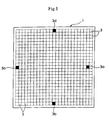
- the board game in the present invention comprises a play field 1, used by the players in common, having a plurality of polygonal grids extending continuously and a game component set used by each of plural players for their own play.
- the play field 1 as shown in Fig. 1 is for the maximum of four (4) players and may be formed with paper, vinyl sheet, wooden board, sheet of synthetic resin, etc.
- On the play field 1 a plurality of the polygonal grids (square in this case) are depicted to form a matrix.
- four (equal number to the number of players) grids 3a-3d of the grids 3 of the play field are colored differently from the rest of the grids 3 to make them distinguishable.
- the distinguishable grids 3a and 3c and 3b and 3d are placed across from each other respectively. These distinguishable grids 3a-3d are the places for each player to place his/her respective Master Piece at the beginning of the game and also the guide for initially placing an unfolded die (which will be described in the following) on the play field.
- the game component set used in this embodiment comprises a plurality of dice 5 as described later with reference to Figs. 2, 3A-3C, 4A-4F, and 5A-5D, a plurality of pieces 25a-25d as described later with reference to Figs. 6, a plurality of cards 33 corresponding to pieces as described later with Fig. 7, an Addition/Deduction Unit for costs 35 shown in Figs. 8A and 8B, and a plurality of marbles 39 as shown in Fig. 9.
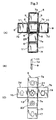
- FIGs. 3A and 3C show the inside and outside of an unfolded die.
- a die 5 is a hexahedron with six (6) polygonal plates 7a-7f (square plates in this instance) which has the substantially same contour and dimensions with the polygonal grids 3.
- the six (6) polygonal plates of the die can be unfolded and therefore each of the six (6) polygonal plates are connected to specific adjacent polygonal plate(s) in such a manner that when the die is unfolded two dimensionally each polygonal plate is connected to that specific adjacent polygonal plate(s).
- the six polygonal plates 7a-7f constituting a die are formed integrally with synthetic resin.
- each of connected portions 11 consists of a cavity whose cross sectional shape is substantially a rectangle and each of connecting portions 11 consists of a projection which is forced in the cavity constituting the connected portion 9.
- connecting portion 11 By forcing a connecting portion 11 in a corresponding connected portion 9, a die is fixed up in such a manner to enable unfolding the die.
- connecting portions 11 and connected portions 9 are not limited to examples shown in the drawings.
- the following marks are depicted on the outside of the polygonal plates 7a-7f constituting a die.
- the marks are one (1) Die-Unfolding Mark 13 which is the decisive factor for unfolding a die, one (1) Advancement Mark 15 which indicates that a player can save a necessary cost for advancing a piece and four (4) Execution Marks 17-23 which indicate respectively that a player can save a necessary cost for demonstrating ability or power of a piece.
- Attacking Mark 17 indicates that a player can save a cost necessary for attacking (one of the capacity or powers given to a piece), and Defending Mark 19 which indicates that a player can save a cost necessary for defending (one of the capacity or powers given to a piece) and the two Special Ability Marks 21 and 23 indicate respectively that a player can save a cost necessary for making his/her piece to demonstrate a predetermined special ability or power of the piece.
- the Group (one of the Identification Marks) to which a piece belongs is shown by the color of the polygonal plates 7a-7f constituting a die.
- the Level (one of the Identification Marks) of a piece is indicated by an alphabetical symbol depicted inside a Die-Unfolding Mark 13.
- Position Mark 25 for placing a piece when the die is unfolded is depicted.
- the Position Mark 25 is a seal on which letters can be written with a ball-point pen or a felt-tip pen.
- Plural Position Marks may be attached to plural polygonal plates constituting a die so that a player may have increased opportunities for deciding a position for placing his/her piece.
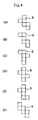
- the unfolding pattern of a die is not limited to the kind shown in Fig. 3A-3C.
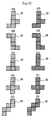
- Figs. 4A-4F show different patterns of unfolded dice.
- One game component may include one kind of dice having one kind of unfolded pattern, or plural kinds of dice having plural kinds of unfolded patterns.
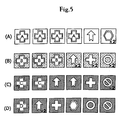
- Figs. 5A-5D show some combinations of marks depicted on the outside of the dice used in a game.
- Fig. 5A-5D show an example of the kinds of marks depicted on the six (6) plates of a die 5. From Figs. 5A to Fig. 5D, the number of Die-Unfolding Marks shown is decreasing. If a player chooses a die shown in Fig. 5A thereby having more Die-Unfolding Marks, the player will have more chances to unfold a die but the player will have fewer chances to save necessary costs as described in the following. On the contrary, if a player uses a die like Fig. 5D, the player has fewer chances to unfold a die but have more chances to save costs.
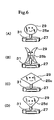
- Figs. 6A-6D show an example of plural pieces 25a-25d which have visually identifiable features and belong to predetermined Groups and Levels.
- These pieces 25a-25d comprise respectively a base 27 to be placed on the play field, and a feature portion 29 which are formed on the base and show the direction of the pieces.
- the pieces are formed integrally with synthetic resin material and the surfaces of the pieces are painted.
- On the feature portion 29 of each piece two eyes are depicted to show the front and the rear sides.
- the feature portion 29 may of course have a figure of an animal, a man, an imaginary animal (monster), etc.
- the base 27 is provided with a writing portion 31 by which a player can be identified.
- These writing portions 31 are also seals on which players can write his/her name or other things with pens. With these writing portions it is possible for a player to collect his/her own pieces looking for the writing on the writing portions as the guide after a game is over.
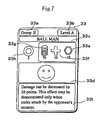
- Fig. 7 shows an example of the front side of a card 33 produced corresponding to a piece such as piece 25a, one of plural kinds of pieces, to indicate the denomination for identifying the piece, the capacity of the piece (special ability or power, effect, etc.), conditions for demonstrating such capacity and the Group and the Level of the piece.
- Each piece such as 25a and others is featured by the writings on the card 33 corresponding to each piece.
- Plural kinds of pieces such as 25a and others include attacking object-type pieces provided with Defending Power, Attacking Power and Sustaining Power and effect demonstrating- type pieces demonstrating predetermined effects to opponents' pieces.
- Each piece is classified into different groups and yet the piece is given a certain Level which shows the degree of the capacity of the piece. Therefore, as described in the following, a player is required to choose a piece of such a Level that is decided by the rolling of dice from among the pieces of such Group that is decided by the rolling of the dice.
- the capacity of the piece includes for example ability or power to attack, ability or power to defend, ability or power to conduct predetermined special attack or defense, ability or power to form a way of escape, ability or power to entrap, ability or power to mine, etc.
- the piece 25a is an attacking object-type piece.
- the Group 33a to which the piece belongs is "Group II"
- the Level 33b to which the piece belongs is "Level A”
- the Name 33c of the piece is "Ball man.”
- the Picture 33d of the piece is also shown.
- the Attacking Power of the piece is 10 points, Defending Power 40 points, and Sustaining Power 70 points.
- These "Powers” are indicated in numeral or volume along with respective marks 33e-33g thereof.
- the cost which is necessary for demonstrating the Special Ability or Power of the piece is shown with a numeral and an Execution Mark 33h which indicates the kind of cost.
- the Content 33i of the Special Power which can be demonstrated by paying the cost is also shown.
- the "Defending Power” means the power to weaken the "Attacking Power of an opponent's piece” by deducting the numeral of the “Defending Power” from the figure of the “Attacking Power of the opponent's piece. " On the contrary, the “Attacking Power” means the power to weaken the “Defending Power of an opponent's piece” by deducting the numeral of the “Attacking Power” from the numeral of the "Defending Power of the opponent's piece.” Moreover the “Sustaining Power” means the power which sustain a piece to exist in a game until the Sustaining Power becomes zero (0) by the numeral of Attacking Power of the opponent's piece being deducted from the figure of the Sustaining Power, after the Defending Power of the piece has become zero (0). With descriptions of these powers written on each card corresponding to each piece, each player can enjoy a game without having to memorize all the powers of each piece particularly.
- a Master Piece a piece shown in Fig. 6D, which serves as a proxy of a player is included among plural kinds of pieces in a game component set.
- This Master Piece is placed on the above-mentioned distinguishable grid at the beginning of the game. It is arbitrary to define the power of the Master Piece. The lower the powers of the Master Piece are set, the more important it becomes to plan a strategy for defending the Master Piece in a game, which will give more fun to a player in elaborating a strategy. In this instance the Master Piece is given just Attacking Power and the Defending Power, which is described on a card corresponding to the Master Piece.
- pieces may include such an effect demonstrating-type of piece as a mine which destroys a piece coming across the place thereof (coming across the grid on which the mine is placed).
- an effect demonstrating-type of piece as a mine which destroys a piece coming across the place thereof (coming across the grid on which the mine is placed).
- the cards are of course prepared for the effect demonstrating-type of pieces.
- Fig. 8A shows an Addition/Deduction Unit included in a game component set.
- the Addition/Deduction Unit has five (5) Addition/Deduction Display portions 35a-35e corresponding to an Advancement Mark and four Execution Marks.
- This Addition/Deduction Unit is integrally formed with synthetic resin and has Addition/Deduction Display portions 35a-35 respectively having 10 holes on the surface.
- Addition/Deduction Display portions 35a-35e Advancement Mark, Attack Mark, Defense Mark and one or more Special Power Marks are depicted.
- Addition/Deduction Unit 35 With the Addition/Deduction Unit 35, a player can securely record addition or deduction of points for each mark without having to memorize or write down.
- An Addition/Deduction Unit 35 shown in Figs. 8A and 8B is an example and the Addition/Deduction Unit is not limited thereto.
- pins 37 need not be used but other things equivalent to such pins may be prepared for an Addition/Deduction Unit, which uses those substitutions for addition or deduction by changing the positions of those things.
- Fig. 9 shows a perspective of one of a plurality of marbles 39 included in a game component set. It is enough if there are eight (8) or ten (10) marbles for a game. During a game the decrease of the Sustaining Power of a piece can be shown to players by placing, on a card, the number of marbles corresponding to the decreased amount of Sustaining Power.
- a game will develop according to the rules using the above-mentioned board game.
- each player places his/her own Master Piece on the grids 3a, 3c.
- each player puts his/her own cards on a place which is next to the play field and which the opponent can see.
- each player puts his/her pieces onto the corresponding cards.
- the Addition/Deduction Unit 35 as shown in Figs. 6A-6D is also placed on a position which the opponent can see.
- the pattern of the unfolded dice used in this game are not limited to one pattern but are in various patterns as shown in Figs. 4A-4F.
- Each player then has a turn in order.
- the rule then sets forth that each player will conduct the following steps (a) - (f) in each turn.
- each player chooses three dice from among his/her dice 5. Then each player rolls dice onto a rolling place (usually a floor or desktop on which the play field is placed).
- a rolling place usually a floor or desktop on which the play field is placed.
- each player unfolds (or opens up) two-dimensionally a die having a Die-Unfolding Mark and place the unfolded die on a play field to cover six (6) grids which are connected to one another.
- the unfolded dice 51-54 are those dice which were unfolded on the play field by one player and the unfolded dice 61-63 are those dice which were unfolded on the play field by the opponent.
- the black circles depicted on respective unfolded dice are each player's pieces 25.
- the rule sets forth that the unfolded dice 51 and 61 must be placed in such a manner that one of the adjacent grids to 3a and 3c must be covered by the unfolded dice.
- the unfolded die 5 is placed in such a manner that one of such unfolded die must be set adjacent to at least one polygonal plate of the player's already-unfolded die placed on the play field and yet any polygonal plates of such unfolded die must not overlap polygonal plates of the player's or opponent's unfolded dice.
- the unfolded dice form an advancing path pattern on the play field.
- the player chooses a piece, according to the Group and Level recognized from the three dice rolled on the rolling place, from among the pieces included in a game component set used by the player.
- the player then places the piece onto one of the plural polygonal plates constituting the die.
- the Group to which the piece belongs is indicated by the color of the outside of the polygonal plates
- the Level of the piece is indicated by the alphabetical letter written inside the Die-Unfolding Mark.
- the piece selected is placed on an inside of a polygonal plate having the Position Mark. In this instance the piece is placedwith the front thereof faced toward the opponent so that the player's pieces and the opponent's pieces may easily be distinguished.
- the advancing path pattern is not connected, and therefore, in principle, the piece of the player and that of the opponent cannot fight against each other.
- the rules set forth that when the player's piece and that of the opponent's have reached a certain positional relationship with each other after the respective pieces have been advanced along the advancing path pattern formed with the unfolded dice in order, the player can, for the first time, attack the opponent's piece or Master Piece.
- Typical conditions for attacking is a case in which the player's piece and that of the opponent's stand on the grids adjacent to each other.
- the player's piece can exceptionally attack such opponent's piece as is on the m th grid from the grid on which the player's piece stand.
- the content of the attack may be determined as a Special Ability or Power.
- one of the Special Powers may be such as four times of the original power may be acquired by paying twice the costs, or the opponent's piece ahead in the front direction, however many grids away, maybe attacked.
- These Special Powers may be determined in various ways and are not limited to the Special Powers described in the present specification.
- the destruction of the piece is avoided if the sum of Defending Power and the Sustaining Power is larger than the Attacking Power of the opponent's piece.
- the Sustaining Power decreases after being added to the Defending Power.
- the decreased value of the Sustaining Power is indicated by placing the marbles whose number is equivalent to the decreased value of the Sustaining Power. For example, if one of the player's piece having 30 points of Defending Power and 40 points of Sustaining Power is attacked by one of the opponent's piece having 40 points of Attacking Power, the Sustaining Power of the player's piece is decreased by 10 points and one (1) marble is placed on the corresponding card.
- Attacking Power and Defending Power may basically be wielded or exerted only once during each turn by paying necessary costs. This means that if the Defending Power was wielded or exerted in the previous turn, the same Defending Power may be wielded or exerted by paying the necessary costs again in the following turn. In this instance each time the cost is paid, the pin of the Addition/Deduction Unit 35 is moved accordingly.
- the rule sets forth that after a piece is destroyed (either by loosing in a fight against one of the opponent's piece or by the effect (blast) of a mine), the corresponding card is turned over, and the piece is placed on the turned-over card, or the piece is laid on the corresponding card. By doing so, still usable pieces and pieces which are not usable any more are recognizable at a glance and the player can pursue the game recognizing the opponent's usable pieces.
- the rule sets forth that when the Master Piece has been attacked (or damaged) the predetermined number of times, it is decided that the owner (the player) of the Master Piece has lost the game.
- the rules further set forth that when a piece is advanced, the player may advance his/her piece jumping over another piece of the player which stands ahead in the advancing path but may not advance his/her piece jumping over a piece of the opponent which stands ahead in the advancing path. Also in the Die-Unfolding Step the rule may sets forth that a once-destroyed piece may be revitalized if predetermined conditioned are satisfied.
- each piece is given both Group and Level.
- Each piece may be given at least one of the Group and Level.
- Fig. 11 is a perspective which shows how the things are before starting the board game (for two players) according to another embodiment of the present invention.
- the paths are formed by placing the unfolded dice 5 on the play field.
- the embodiment of Fig. 11 is different from the above-mentioned embodiment in that dice 5' which are not unfoldable are used, and that a plurality of path plates 50 for forming the paths are additionally used.
- Fig. 11 shows five dice 5' and five path plates 50 per player, as an example. The number of path plates, however, is actually fifteen per player, and that of the dice is also fifteen.
- Dice 5' used in this embodiment are the same as the unfoldable dice shown in Fig. 2, except that dice 5' are not unfoldable.
- dice 5' are polyhedrons having n outsides (n is an integer of three or more).
- Die-Unfolding Mark which is a decisive factor for placing the path plates on the play field
- Advancement Mark which allows saving a cost (or a charge) necessary for advancing a piece
- Execution Marks which allow saving a cost (or a charge) necessary for wielding or exerting power of a piece
- Identification Marks which show the group and /or level to which a piece belongs are indicated on n outsides of the polyhedron.
- Figs.12 (A) ⁇ (J) indicate examples of a plurality of path plates 50 in such shapes as to cover areas formed by a plurality of polygonal grids which extend continuously on the play field.
- Figs. 12 (A) to (E) are plan views of five types of path plates for one player, and Figs. 12 (F) to (J) indicate five types of path plates for the other. In these examples, the color and/or pattern of the path plates for each player is different so that each player can instantly identify his or her path plates.
- path plates 50 increase the number of game components, it allows the game to advance smoothly because the players can save the time to fold or unfold the dice. Also, if the path plates 50 are formed in different shapes, selecting the path plates 50 plays a significant role in determining strategy.
- the game advancement process according to this embodiment is the same as the process according to the first embodiment described above, except that, once the advancement is determined by throwing the dice, the player selects one path plate from a plurality of path plates held by that player, and form the paths on the play field by placing the path plates, instead of unfolding the dice. Therefore, the method of play in this embodiment is not described here.
- a board game and method of play thereof which can provide an unexpected game development and more satisfaction to players is provided.
- the advancing path patterns for pieces vary each time game is played, thus the unexpectedness in a game development increases.
- the present invention can provide more fun, as compared to the conventional games, to players in working out their strategies during a game.
- pieces may be given Special Powers and the game development can be varied by making pieces wield or exert such Special Powers by paying necessary costs. Still more it is possible according to the present invention to provide an unexpected development of a game by ruling that even if a piece possesses Attacking Power or Defending Power, the piece may not wield or exert the power thereof without paying the necessary cost.
- pieces and corresponding cards are placed, it is possible to provide a fair game development as still usable pieces and already-destroyed pieces (pieces considered to have been destroyed) are easy to be recognized at a glance.
- pieces may be prepared arbitrarily, and it is possible to give players fun in acquiring various pieces and elaborating various strategies.
- path plates Although using the path plates increases the number of game components, it allows the game to advance smoothly because the players can save the time to fold or unfold the dice. Particularly, when the path plates are formed in different shapes, selecting the path plates plays a significant role in determining strategy, thereby making the game more interesting.
Landscapes
- Engineering & Computer Science (AREA)
- Multimedia (AREA)
- Educational Technology (AREA)
- Toys (AREA)
- Pinball Game Machines (AREA)
Applications Claiming Priority (3)
| Application Number | Priority Date | Filing Date | Title |
|---|---|---|---|
| JP2001264013 | 2001-08-31 | ||
| JP2001264013 | 2001-08-31 | ||
| PCT/JP2002/008890 WO2003018149A1 (fr) | 2001-08-31 | 2002-09-02 | Jeu de table joue par plusieurs joueurs et methode de jeu correspondante |
Publications (2)
| Publication Number | Publication Date |
|---|---|
| EP1428560A1 true EP1428560A1 (fr) | 2004-06-16 |
| EP1428560A4 EP1428560A4 (fr) | 2005-04-13 |
Family
ID=19090680
Family Applications (1)
| Application Number | Title | Priority Date | Filing Date |
|---|---|---|---|
| EP02762967A Withdrawn EP1428560A4 (fr) | 2001-08-31 | 2002-09-02 | Jeu de table joue par plusieurs joueurs et methode de jeu correspondante |
Country Status (7)
| Country | Link |
|---|---|
| US (1) | US20040239031A1 (fr) |
| EP (1) | EP1428560A4 (fr) |
| JP (1) | JPWO2003018149A1 (fr) |
| KR (1) | KR20040039311A (fr) |
| CN (1) | CN1549737A (fr) |
| CA (1) | CA2458847A1 (fr) |
| WO (1) | WO2003018149A1 (fr) |
Cited By (2)
| Publication number | Priority date | Publication date | Assignee | Title |
|---|---|---|---|---|
| US6997458B1 (en) | 2004-10-20 | 2006-02-14 | Darrick Yokomi | Plural sided rolling game piece and method of play |
| ES2684409A1 (es) * | 2017-03-31 | 2018-10-02 | José Ángel NOLASCO MACIRAS | Juego de lucha sobre tablero |
Families Citing this family (13)
| Publication number | Priority date | Publication date | Assignee | Title |
|---|---|---|---|---|
| WO2005061064A1 (fr) * | 2003-12-09 | 2005-07-07 | Adrian Blair Gardiner | Jeu |
| JP4382104B2 (ja) * | 2007-03-01 | 2009-12-09 | 株式会社コナミデジタルエンタテインメント | ゲーム玩具 |
| US20090309306A1 (en) * | 2008-04-18 | 2009-12-17 | Trish Bell | Trading card game including spheres in the play pattern |
| KR100984292B1 (ko) * | 2008-07-10 | 2010-09-30 | 송재언 | 놀이판, 놀이말집합체 및 놀이장치 |
| WO2010151155A1 (fr) * | 2009-06-23 | 2010-12-29 | Yu Leonardo M | Jeu de société simulant la survie dans la jungle |
| US8668201B1 (en) * | 2012-11-08 | 2014-03-11 | Ludovic Roudy | Temporary tattoo game piece for a fighting game and method of play |
| CN108786100B (zh) * | 2017-05-03 | 2021-08-03 | 施政 | 一种交互卡片游戏系统 |
| USD815212S1 (en) * | 2017-06-29 | 2018-04-10 | Norman Chan | Chess board design |
| USD943860S1 (en) * | 2018-09-18 | 2022-02-15 | Jose E. Lopez | Meditation cube |
| CN112657171A (zh) * | 2019-10-16 | 2021-04-16 | 东北林业大学 | 秦始皇陵兵马俑文化创意棋 |
| CN112808628A (zh) * | 2021-02-08 | 2021-05-18 | 陈安卓 | 围棋棋子分拣器 |
| US12508497B1 (en) * | 2022-04-12 | 2025-12-30 | David Drymiller | Die for game |
| CN115155057B (zh) * | 2022-07-26 | 2024-05-07 | 北京字跳网络技术有限公司 | 界面显示方法及装置、存储介质、电子设备 |
Family Cites Families (13)
| Publication number | Priority date | Publication date | Assignee | Title |
|---|---|---|---|---|
| US3506267A (en) * | 1967-03-02 | 1970-04-14 | Gordon P Taillie | Game apparatus comprising upright board with through openings for cubical playing pieces |
| US4194742A (en) * | 1978-07-31 | 1980-03-25 | Adams Ezra J | Land and sea war game apparatus |
| JPS58192568A (ja) * | 1982-05-04 | 1983-11-10 | 宮田 善雄 | ヘビに模したふだを交互に連らねて食うか食わせるかを争うゲ−ム |
| US4489946A (en) * | 1982-09-30 | 1984-12-25 | Ortiz Burgos Angel A | Board game having consistent shape relationship among its parts |
| JPS5995080A (ja) * | 1982-11-25 | 1984-05-31 | 平沢 邦彦 | 多目的ダイス玩具 |
| US4801147A (en) * | 1986-08-15 | 1989-01-31 | Miller James R | Method of playing a board game |
| GB8707366D0 (en) * | 1987-03-27 | 1987-04-29 | Gilpin W G | Apparatus for playing board game |
| DE8705084U1 (de) * | 1987-04-04 | 1988-04-28 | Fleck, Hellmuth, 2000 Hamburg | Klapp-Würfel |
| GB2215623B (en) * | 1987-10-23 | 1991-07-31 | Rotation Limited | Apparatus for playing a game for one or more players and to games played with the apparatus |
| JPH079375U (ja) * | 1993-07-21 | 1995-02-10 | 國雄 中澤 | 枡目盤双六大学ゲーム |
| JP3013238U (ja) * | 1994-12-28 | 1995-07-11 | 株式会社トミー | ゲーム装置 |
| US6062563A (en) * | 1995-09-11 | 2000-05-16 | De Keller; David Guy | Casino game |
| GB9608313D0 (en) * | 1995-11-20 | 1996-06-26 | Liddell Thomas W | Hierarchy board game |
-
2002
- 2002-09-02 WO PCT/JP2002/008890 patent/WO2003018149A1/fr not_active Ceased
- 2002-09-02 KR KR10-2004-7002952A patent/KR20040039311A/ko not_active Withdrawn
- 2002-09-02 EP EP02762967A patent/EP1428560A4/fr not_active Withdrawn
- 2002-09-02 CA CA002458847A patent/CA2458847A1/fr not_active Abandoned
- 2002-09-02 JP JP2003522660A patent/JPWO2003018149A1/ja not_active Withdrawn
- 2002-09-02 US US10/488,158 patent/US20040239031A1/en not_active Abandoned
- 2002-09-02 CN CNA028170644A patent/CN1549737A/zh active Pending
Cited By (2)
| Publication number | Priority date | Publication date | Assignee | Title |
|---|---|---|---|---|
| US6997458B1 (en) | 2004-10-20 | 2006-02-14 | Darrick Yokomi | Plural sided rolling game piece and method of play |
| ES2684409A1 (es) * | 2017-03-31 | 2018-10-02 | José Ángel NOLASCO MACIRAS | Juego de lucha sobre tablero |
Also Published As
| Publication number | Publication date |
|---|---|
| JPWO2003018149A1 (ja) | 2004-12-09 |
| CN1549737A (zh) | 2004-11-24 |
| CA2458847A1 (fr) | 2003-03-06 |
| US20040239031A1 (en) | 2004-12-02 |
| WO2003018149A1 (fr) | 2003-03-06 |
| KR20040039311A (ko) | 2004-05-10 |
| EP1428560A4 (fr) | 2005-04-13 |
Similar Documents
| Publication | Publication Date | Title |
|---|---|---|
| EP1428560A1 (fr) | Jeu de table joue par plusieurs joueurs et methode de jeu correspondante | |
| US6938899B2 (en) | Tile-based board game | |
| US6585265B2 (en) | Board game played by plural players and method of play thereof | |
| US5451050A (en) | Interactive board game | |
| US5779239A (en) | Chip-A-tak board and dice game | |
| US20030020239A1 (en) | Apparatus and method for a card game and apparatus and method for a card game in combination with action-figures | |
| US5791649A (en) | Poker style board game and method for playing same | |
| US7392986B2 (en) | Method and apparatus for card game | |
| US20060038349A1 (en) | Set of cards for game playing and related method | |
| JP2002065937A (ja) | 戦闘シミュレーションカードゲームユニット、戦闘シミュレーションゲーム装置及びコンピュータプログラム | |
| US7086645B2 (en) | Game with collectible pieces | |
| US7267342B2 (en) | Games and methods of playing games with collectable game components | |
| Daniels | Make your own board game: Designing, building, and playing an original tabletop game | |
| US7287752B2 (en) | Simulated golf game | |
| US7475877B2 (en) | Apparatus and method for a race game wherein competitors apply defensive strategies and math skills to win | |
| JP6990208B2 (ja) | ゲーム玩具 | |
| US20230028725A1 (en) | Block Stacking Game | |
| US20080054569A1 (en) | Trading chip game method of play and playing surface designed for game | |
| US20070216094A1 (en) | Peg-board based games | |
| KR102182986B1 (ko) | 카드 보드게임 도구 및 카드 보드게임 방법 | |
| JP7385792B2 (ja) | 高確率ビンゴカード | |
| US20040041341A1 (en) | Game cube and method for playing a game of resource development | |
| EP2110166A2 (fr) | Jeu de cartes de collection comprenant des sphères | |
| Malmuth | Poker Essays | |
| HK1068567A (en) | Board game played by players and its playing method |
Legal Events
| Date | Code | Title | Description |
|---|---|---|---|
| PUAI | Public reference made under article 153(3) epc to a published international application that has entered the european phase |
Free format text: ORIGINAL CODE: 0009012 |
|
| 17P | Request for examination filed |
Effective date: 20040310 |
|
| AK | Designated contracting states |
Kind code of ref document: A1 Designated state(s): AT BE BG CH CY CZ DE DK EE ES FI FR GB GR IE IT LI LU MC NL PT SE SK TR |
|
| AX | Request for extension of the european patent |
Extension state: AL LT LV MK RO SI |
|
| A4 | Supplementary search report drawn up and despatched |
Effective date: 20050223 |
|
| STAA | Information on the status of an ep patent application or granted ep patent |
Free format text: STATUS: THE APPLICATION IS DEEMED TO BE WITHDRAWN |
|
| 18D | Application deemed to be withdrawn |
Effective date: 20060401 |