EP1428810A2 - Verbindungs-Bibliotheken aus mit verschiedenen Tags markierten Oligomeren - Google Patents
Verbindungs-Bibliotheken aus mit verschiedenen Tags markierten Oligomeren Download PDFInfo
- Publication number
- EP1428810A2 EP1428810A2 EP03078845A EP03078845A EP1428810A2 EP 1428810 A2 EP1428810 A2 EP 1428810A2 EP 03078845 A EP03078845 A EP 03078845A EP 03078845 A EP03078845 A EP 03078845A EP 1428810 A2 EP1428810 A2 EP 1428810A2
- Authority
- EP
- European Patent Office
- Prior art keywords
- support
- labelled
- different
- label
- oligonucleotide
- Prior art date
- Legal status (The legal status is an assumption and is not a legal conclusion. Google has not performed a legal analysis and makes no representation as to the accuracy of the status listed.)
- Withdrawn
Links
- 150000001875 compounds Chemical class 0.000 claims abstract description 59
- -1 trimethylphenyl Chemical group 0.000 claims abstract description 50
- 238000004458 analytical method Methods 0.000 claims abstract description 48
- 238000004949 mass spectrometry Methods 0.000 claims abstract description 45
- 239000000126 substance Substances 0.000 claims abstract description 31
- 238000006243 chemical reaction Methods 0.000 claims abstract description 27
- 239000000178 monomer Substances 0.000 claims abstract description 26
- 108020004707 nucleic acids Proteins 0.000 claims abstract description 26
- 102000039446 nucleic acids Human genes 0.000 claims abstract description 26
- 150000007523 nucleic acids Chemical class 0.000 claims abstract description 26
- 238000003776 cleavage reaction Methods 0.000 claims abstract description 10
- 230000007017 scission Effects 0.000 claims abstract description 10
- 238000003556 assay Methods 0.000 claims abstract description 7
- 238000004519 manufacturing process Methods 0.000 claims abstract description 3
- 108091034117 Oligonucleotide Proteins 0.000 claims description 104
- 238000000034 method Methods 0.000 claims description 67
- JLCPHMBAVCMARE-UHFFFAOYSA-N [3-[[3-[[3-[[3-[[3-[[3-[[3-[[3-[[3-[[3-[[3-[[5-(2-amino-6-oxo-1H-purin-9-yl)-3-[[3-[[3-[[3-[[3-[[3-[[5-(2-amino-6-oxo-1H-purin-9-yl)-3-[[5-(2-amino-6-oxo-1H-purin-9-yl)-3-hydroxyoxolan-2-yl]methoxy-hydroxyphosphoryl]oxyoxolan-2-yl]methoxy-hydroxyphosphoryl]oxy-5-(5-methyl-2,4-dioxopyrimidin-1-yl)oxolan-2-yl]methoxy-hydroxyphosphoryl]oxy-5-(6-aminopurin-9-yl)oxolan-2-yl]methoxy-hydroxyphosphoryl]oxy-5-(6-aminopurin-9-yl)oxolan-2-yl]methoxy-hydroxyphosphoryl]oxy-5-(6-aminopurin-9-yl)oxolan-2-yl]methoxy-hydroxyphosphoryl]oxy-5-(6-aminopurin-9-yl)oxolan-2-yl]methoxy-hydroxyphosphoryl]oxyoxolan-2-yl]methoxy-hydroxyphosphoryl]oxy-5-(5-methyl-2,4-dioxopyrimidin-1-yl)oxolan-2-yl]methoxy-hydroxyphosphoryl]oxy-5-(4-amino-2-oxopyrimidin-1-yl)oxolan-2-yl]methoxy-hydroxyphosphoryl]oxy-5-(5-methyl-2,4-dioxopyrimidin-1-yl)oxolan-2-yl]methoxy-hydroxyphosphoryl]oxy-5-(5-methyl-2,4-dioxopyrimidin-1-yl)oxolan-2-yl]methoxy-hydroxyphosphoryl]oxy-5-(6-aminopurin-9-yl)oxolan-2-yl]methoxy-hydroxyphosphoryl]oxy-5-(6-aminopurin-9-yl)oxolan-2-yl]methoxy-hydroxyphosphoryl]oxy-5-(4-amino-2-oxopyrimidin-1-yl)oxolan-2-yl]methoxy-hydroxyphosphoryl]oxy-5-(4-amino-2-oxopyrimidin-1-yl)oxolan-2-yl]methoxy-hydroxyphosphoryl]oxy-5-(4-amino-2-oxopyrimidin-1-yl)oxolan-2-yl]methoxy-hydroxyphosphoryl]oxy-5-(6-aminopurin-9-yl)oxolan-2-yl]methoxy-hydroxyphosphoryl]oxy-5-(4-amino-2-oxopyrimidin-1-yl)oxolan-2-yl]methyl [5-(6-aminopurin-9-yl)-2-(hydroxymethyl)oxolan-3-yl] hydrogen phosphate Polymers Cc1cn(C2CC(OP(O)(=O)OCC3OC(CC3OP(O)(=O)OCC3OC(CC3O)n3cnc4c3nc(N)[nH]c4=O)n3cnc4c3nc(N)[nH]c4=O)C(COP(O)(=O)OC3CC(OC3COP(O)(=O)OC3CC(OC3COP(O)(=O)OC3CC(OC3COP(O)(=O)OC3CC(OC3COP(O)(=O)OC3CC(OC3COP(O)(=O)OC3CC(OC3COP(O)(=O)OC3CC(OC3COP(O)(=O)OC3CC(OC3COP(O)(=O)OC3CC(OC3COP(O)(=O)OC3CC(OC3COP(O)(=O)OC3CC(OC3COP(O)(=O)OC3CC(OC3COP(O)(=O)OC3CC(OC3COP(O)(=O)OC3CC(OC3COP(O)(=O)OC3CC(OC3COP(O)(=O)OC3CC(OC3COP(O)(=O)OC3CC(OC3CO)n3cnc4c(N)ncnc34)n3ccc(N)nc3=O)n3cnc4c(N)ncnc34)n3ccc(N)nc3=O)n3ccc(N)nc3=O)n3ccc(N)nc3=O)n3cnc4c(N)ncnc34)n3cnc4c(N)ncnc34)n3cc(C)c(=O)[nH]c3=O)n3cc(C)c(=O)[nH]c3=O)n3ccc(N)nc3=O)n3cc(C)c(=O)[nH]c3=O)n3cnc4c3nc(N)[nH]c4=O)n3cnc4c(N)ncnc34)n3cnc4c(N)ncnc34)n3cnc4c(N)ncnc34)n3cnc4c(N)ncnc34)O2)c(=O)[nH]c1=O JLCPHMBAVCMARE-UHFFFAOYSA-N 0.000 claims description 42
- 239000011324 bead Substances 0.000 claims description 41
- 239000011521 glass Substances 0.000 claims description 38
- 125000003118 aryl group Chemical group 0.000 claims description 34
- 239000007787 solid Substances 0.000 claims description 31
- 239000000523 sample Substances 0.000 claims description 30
- 239000003153 chemical reaction reagent Substances 0.000 claims description 28
- 238000009396 hybridization Methods 0.000 claims description 23
- 238000001819 mass spectrum Methods 0.000 claims description 22
- 238000003786 synthesis reaction Methods 0.000 claims description 20
- 125000001424 substituent group Chemical group 0.000 claims description 16
- 125000003368 amide group Chemical group 0.000 claims description 13
- 150000003573 thiols Chemical group 0.000 claims description 13
- 230000000155 isotopic effect Effects 0.000 claims description 12
- 150000002148 esters Chemical class 0.000 claims description 11
- 125000005647 linker group Chemical group 0.000 claims description 11
- 125000003729 nucleotide group Chemical group 0.000 claims description 11
- 125000002924 primary amino group Chemical group [H]N([H])* 0.000 claims description 10
- 125000003860 C1-C20 alkoxy group Chemical group 0.000 claims description 9
- 150000008064 anhydrides Chemical group 0.000 claims description 9
- 125000002843 carboxylic acid group Chemical group 0.000 claims description 9
- 125000001183 hydrocarbyl group Chemical group 0.000 claims description 9
- 125000002950 monocyclic group Chemical group 0.000 claims description 9
- 125000000449 nitro group Chemical group [O-][N+](*)=O 0.000 claims description 9
- 125000000467 secondary amino group Chemical group [H]N([*:1])[*:2] 0.000 claims description 9
- BDHFUVZGWQCTTF-UHFFFAOYSA-N sulfonic acid Chemical group OS(=O)=O BDHFUVZGWQCTTF-UHFFFAOYSA-N 0.000 claims description 9
- 125000001302 tertiary amino group Chemical group 0.000 claims description 9
- 238000004989 laser desorption mass spectroscopy Methods 0.000 claims description 8
- 239000003446 ligand Substances 0.000 claims description 7
- 239000002773 nucleotide Substances 0.000 claims description 7
- 108010039918 Polylysine Proteins 0.000 claims description 6
- 229920000656 polylysine Polymers 0.000 claims description 6
- 230000003993 interaction Effects 0.000 claims description 5
- TXDNPSYEJHXKMK-UHFFFAOYSA-N sulfanylsilane Chemical compound S[SiH3] TXDNPSYEJHXKMK-UHFFFAOYSA-N 0.000 claims description 4
- 150000002540 isothiocyanates Chemical class 0.000 claims description 3
- 238000002372 labelling Methods 0.000 claims description 3
- 238000010348 incorporation Methods 0.000 claims description 2
- NMHMNPHRMNGLLB-UHFFFAOYSA-N phloretic acid Chemical group OC(=O)CCC1=CC=C(O)C=C1 NMHMNPHRMNGLLB-UHFFFAOYSA-N 0.000 claims description 2
- 238000012163 sequencing technique Methods 0.000 claims description 2
- 230000000269 nucleophilic effect Effects 0.000 claims 2
- 229920000620 organic polymer Polymers 0.000 claims 2
- 125000002221 trityl group Chemical group [H]C1=C([H])C([H])=C([H])C([H])=C1C([*])(C1=C(C(=C(C(=C1[H])[H])[H])[H])[H])C1=C([H])C([H])=C([H])C([H])=C1[H] 0.000 abstract description 40
- 239000000243 solution Substances 0.000 description 49
- WEVYAHXRMPXWCK-UHFFFAOYSA-N Acetonitrile Chemical compound CC#N WEVYAHXRMPXWCK-UHFFFAOYSA-N 0.000 description 40
- YMWUJEATGCHHMB-UHFFFAOYSA-N Dichloromethane Chemical compound ClCCl YMWUJEATGCHHMB-UHFFFAOYSA-N 0.000 description 27
- YXFVVABEGXRONW-UHFFFAOYSA-N Toluene Chemical compound CC1=CC=CC=C1 YXFVVABEGXRONW-UHFFFAOYSA-N 0.000 description 24
- HEDRZPFGACZZDS-MICDWDOJSA-N Trichloro(2H)methane Chemical compound [2H]C(Cl)(Cl)Cl HEDRZPFGACZZDS-MICDWDOJSA-N 0.000 description 24
- 150000001412 amines Chemical class 0.000 description 24
- 239000000203 mixture Substances 0.000 description 24
- 239000000047 product Substances 0.000 description 24
- XLYOFNOQVPJJNP-UHFFFAOYSA-N water Substances O XLYOFNOQVPJJNP-UHFFFAOYSA-N 0.000 description 24
- 230000015572 biosynthetic process Effects 0.000 description 23
- LFQSCWFLJHTTHZ-UHFFFAOYSA-N Ethanol Chemical compound CCO LFQSCWFLJHTTHZ-UHFFFAOYSA-N 0.000 description 19
- OKKJLVBELUTLKV-UHFFFAOYSA-N Methanol Chemical compound OC OKKJLVBELUTLKV-UHFFFAOYSA-N 0.000 description 18
- 238000002515 oligonucleotide synthesis Methods 0.000 description 17
- 150000008300 phosphoramidites Chemical class 0.000 description 16
- 238000001514 detection method Methods 0.000 description 13
- 239000011159 matrix material Substances 0.000 description 13
- QGZKDVFQNNGYKY-UHFFFAOYSA-N Ammonia Chemical compound N QGZKDVFQNNGYKY-UHFFFAOYSA-N 0.000 description 12
- QTBSBXVTEAMEQO-UHFFFAOYSA-N Acetic acid Chemical compound CC(O)=O QTBSBXVTEAMEQO-UHFFFAOYSA-N 0.000 description 11
- 150000001408 amides Chemical group 0.000 description 10
- 230000000295 complement effect Effects 0.000 description 10
- 230000008878 coupling Effects 0.000 description 10
- 238000010168 coupling process Methods 0.000 description 10
- 238000005859 coupling reaction Methods 0.000 description 10
- 239000004743 Polypropylene Substances 0.000 description 9
- HEMHJVSKTPXQMS-UHFFFAOYSA-M Sodium hydroxide Chemical compound [OH-].[Na+] HEMHJVSKTPXQMS-UHFFFAOYSA-M 0.000 description 9
- 125000000956 methoxy group Chemical group [H]C([H])([H])O* 0.000 description 9
- 229920001155 polypropylene Polymers 0.000 description 9
- 238000003756 stirring Methods 0.000 description 9
- 108020004414 DNA Proteins 0.000 description 8
- 101100170604 Mus musculus Dmap1 gene Proteins 0.000 description 8
- 239000012491 analyte Substances 0.000 description 8
- 238000005160 1H NMR spectroscopy Methods 0.000 description 7
- 125000002103 4,4'-dimethoxytriphenylmethyl group Chemical group [H]C1=C([H])C([H])=C(C([H])=C1[H])C(*)(C1=C([H])C([H])=C(OC([H])([H])[H])C([H])=C1[H])C1=C([H])C([H])=C(OC([H])([H])[H])C([H])=C1[H] 0.000 description 7
- 108700028369 Alleles Proteins 0.000 description 7
- KFZMGEQAYNKOFK-UHFFFAOYSA-N Isopropanol Chemical compound CC(C)O KFZMGEQAYNKOFK-UHFFFAOYSA-N 0.000 description 7
- 239000002253 acid Substances 0.000 description 7
- 239000000872 buffer Substances 0.000 description 7
- 239000011541 reaction mixture Substances 0.000 description 7
- 239000002904 solvent Substances 0.000 description 7
- PIDGHIAXBNCWSW-UHFFFAOYSA-N (2,5-dioxopyrrolidin-1-yl) 4-[2-hydroxy-1,1-bis(4-methoxyphenyl)-7-[(2,2,2-trifluoroacetyl)amino]heptyl]benzoate Chemical compound C1=CC(OC)=CC=C1C(C(O)CCCCCNC(=O)C(F)(F)F)(C=1C=CC(=CC=1)C(=O)ON1C(CCC1=O)=O)C1=CC=C(OC)C=C1 PIDGHIAXBNCWSW-UHFFFAOYSA-N 0.000 description 6
- CSCPPACGZOOCGX-UHFFFAOYSA-N Acetone Chemical compound CC(C)=O CSCPPACGZOOCGX-UHFFFAOYSA-N 0.000 description 6
- IJGRMHOSHXDMSA-UHFFFAOYSA-N Atomic nitrogen Chemical compound N#N IJGRMHOSHXDMSA-UHFFFAOYSA-N 0.000 description 6
- QUSNBJAOOMFDIB-UHFFFAOYSA-N Ethylamine Chemical compound CCN QUSNBJAOOMFDIB-UHFFFAOYSA-N 0.000 description 6
- JUJWROOIHBZHMG-UHFFFAOYSA-N Pyridine Chemical compound C1=CC=NC=C1 JUJWROOIHBZHMG-UHFFFAOYSA-N 0.000 description 6
- VYPSYNLAJGMNEJ-UHFFFAOYSA-N Silicium dioxide Chemical compound O=[Si]=O VYPSYNLAJGMNEJ-UHFFFAOYSA-N 0.000 description 6
- HQABUPZFAYXKJW-UHFFFAOYSA-N butan-1-amine Chemical compound CCCCN HQABUPZFAYXKJW-UHFFFAOYSA-N 0.000 description 6
- 238000002474 experimental method Methods 0.000 description 6
- 238000003818 flash chromatography Methods 0.000 description 6
- 229910052739 hydrogen Inorganic materials 0.000 description 6
- ZRSNZINYAWTAHE-UHFFFAOYSA-N p-methoxybenzaldehyde Chemical compound COC1=CC=C(C=O)C=C1 ZRSNZINYAWTAHE-UHFFFAOYSA-N 0.000 description 6
- FYSNRJHAOHDILO-UHFFFAOYSA-N thionyl chloride Chemical compound ClS(Cl)=O FYSNRJHAOHDILO-UHFFFAOYSA-N 0.000 description 6
- 238000005406 washing Methods 0.000 description 6
- 230000002378 acidificating effect Effects 0.000 description 5
- HAXFWIACAGNFHA-UHFFFAOYSA-N aldrithiol Chemical compound C=1C=CC=NC=1SSC1=CC=CC=N1 HAXFWIACAGNFHA-UHFFFAOYSA-N 0.000 description 5
- 229910021529 ammonia Inorganic materials 0.000 description 5
- 239000000460 chlorine Substances 0.000 description 5
- 238000009826 distribution Methods 0.000 description 5
- 239000012154 double-distilled water Substances 0.000 description 5
- 239000006260 foam Substances 0.000 description 5
- PCHJSUWPFVWCPO-UHFFFAOYSA-N gold Chemical compound [Au] PCHJSUWPFVWCPO-UHFFFAOYSA-N 0.000 description 5
- 239000010931 gold Substances 0.000 description 5
- 229910052737 gold Inorganic materials 0.000 description 5
- 150000002500 ions Chemical class 0.000 description 5
- 238000001840 matrix-assisted laser desorption--ionisation time-of-flight mass spectrometry Methods 0.000 description 5
- 239000013615 primer Substances 0.000 description 5
- 238000000746 purification Methods 0.000 description 5
- 238000001228 spectrum Methods 0.000 description 5
- RYHBNJHYFVUHQT-UHFFFAOYSA-N 1,4-Dioxane Chemical compound C1COCCO1 RYHBNJHYFVUHQT-UHFFFAOYSA-N 0.000 description 4
- FALRKNHUBBKYCC-UHFFFAOYSA-N 2-(chloromethyl)pyridine-3-carbonitrile Chemical compound ClCC1=NC=CC=C1C#N FALRKNHUBBKYCC-UHFFFAOYSA-N 0.000 description 4
- UUEWCQRISZBELL-UHFFFAOYSA-N 3-trimethoxysilylpropane-1-thiol Chemical compound CO[Si](OC)(OC)CCCS UUEWCQRISZBELL-UHFFFAOYSA-N 0.000 description 4
- HEDRZPFGACZZDS-UHFFFAOYSA-N Chloroform Chemical compound ClC(Cl)Cl HEDRZPFGACZZDS-UHFFFAOYSA-N 0.000 description 4
- 238000003747 Grignard reaction Methods 0.000 description 4
- UIIMBOGNXHQVGW-UHFFFAOYSA-M Sodium bicarbonate Chemical compound [Na+].OC([O-])=O UIIMBOGNXHQVGW-UHFFFAOYSA-M 0.000 description 4
- 125000003277 amino group Chemical group 0.000 description 4
- 238000010586 diagram Methods 0.000 description 4
- WGLUMOCWFMKWIL-UHFFFAOYSA-N dichloromethane;methanol Chemical compound OC.ClCCl WGLUMOCWFMKWIL-UHFFFAOYSA-N 0.000 description 4
- 230000007935 neutral effect Effects 0.000 description 4
- 239000002777 nucleoside Substances 0.000 description 4
- 239000003921 oil Substances 0.000 description 4
- 230000008569 process Effects 0.000 description 4
- 125000006239 protecting group Chemical group 0.000 description 4
- 229940014800 succinic anhydride Drugs 0.000 description 4
- KZNICNPSHKQLFF-UHFFFAOYSA-N succinimide Chemical compound O=C1CCC(=O)N1 KZNICNPSHKQLFF-UHFFFAOYSA-N 0.000 description 4
- 125000003396 thiol group Chemical group [H]S* 0.000 description 4
- VHUUQVKOLVNVRT-UHFFFAOYSA-N Ammonium hydroxide Chemical compound [NH4+].[OH-] VHUUQVKOLVNVRT-UHFFFAOYSA-N 0.000 description 3
- QOSSAOTZNIDXMA-UHFFFAOYSA-N Dicylcohexylcarbodiimide Chemical compound C1CCCCC1N=C=NC1CCCCC1 QOSSAOTZNIDXMA-UHFFFAOYSA-N 0.000 description 3
- XEKOWRVHYACXOJ-UHFFFAOYSA-N Ethyl acetate Chemical compound CCOC(C)=O XEKOWRVHYACXOJ-UHFFFAOYSA-N 0.000 description 3
- LYCAIKOWRPUZTN-UHFFFAOYSA-N Ethylene glycol Chemical compound OCCO LYCAIKOWRPUZTN-UHFFFAOYSA-N 0.000 description 3
- ZMANZCXQSJIPKH-UHFFFAOYSA-N Triethylamine Chemical compound CCN(CC)CC ZMANZCXQSJIPKH-UHFFFAOYSA-N 0.000 description 3
- 150000007513 acids Chemical class 0.000 description 3
- 230000008901 benefit Effects 0.000 description 3
- 238000010511 deprotection reaction Methods 0.000 description 3
- 238000006642 detritylation reaction Methods 0.000 description 3
- WBKFWQBXFREOFH-UHFFFAOYSA-N dichloromethane;ethyl acetate Chemical compound ClCCl.CCOC(C)=O WBKFWQBXFREOFH-UHFFFAOYSA-N 0.000 description 3
- 238000010790 dilution Methods 0.000 description 3
- 239000012895 dilution Substances 0.000 description 3
- 239000012153 distilled water Substances 0.000 description 3
- 239000000706 filtrate Substances 0.000 description 3
- 239000000463 material Substances 0.000 description 3
- 229910052757 nitrogen Inorganic materials 0.000 description 3
- 125000003835 nucleoside group Chemical group 0.000 description 3
- 239000012074 organic phase Substances 0.000 description 3
- 239000002245 particle Substances 0.000 description 3
- 125000001997 phenyl group Chemical group [H]C1=C([H])C([H])=C(*)C([H])=C1[H] 0.000 description 3
- 238000006303 photolysis reaction Methods 0.000 description 3
- 230000015843 photosynthesis, light reaction Effects 0.000 description 3
- 239000002244 precipitate Substances 0.000 description 3
- 238000002360 preparation method Methods 0.000 description 3
- UMJSCPRVCHMLSP-UHFFFAOYSA-N pyridine Natural products COC1=CC=CN=C1 UMJSCPRVCHMLSP-UHFFFAOYSA-N 0.000 description 3
- 230000002829 reductive effect Effects 0.000 description 3
- 238000010992 reflux Methods 0.000 description 3
- 125000006853 reporter group Chemical group 0.000 description 3
- 230000035945 sensitivity Effects 0.000 description 3
- 239000000377 silicon dioxide Substances 0.000 description 3
- 238000012546 transfer Methods 0.000 description 3
- DTQVDTLACAAQTR-UHFFFAOYSA-N trifluoroacetic acid Substances OC(=O)C(F)(F)F DTQVDTLACAAQTR-UHFFFAOYSA-N 0.000 description 3
- YBJHBAHKTGYVGT-ZKWXMUAHSA-N (+)-Biotin Chemical compound N1C(=O)N[C@@H]2[C@H](CCCCC(=O)O)SC[C@@H]21 YBJHBAHKTGYVGT-ZKWXMUAHSA-N 0.000 description 2
- GEICQPPIZVXSAI-UHFFFAOYSA-N (2,5-dioxopyrrolidin-1-yl) 4-[2-hydroxy-1-(4-methoxyphenyl)-1-phenyl-7-[(2,2,2-trifluoroacetyl)amino]heptyl]benzoate Chemical compound C1=CC(OC)=CC=C1C(C(O)CCCCCNC(=O)C(F)(F)F)(C=1C=CC(=CC=1)C(=O)ON1C(CCC1=O)=O)C1=CC=CC=C1 GEICQPPIZVXSAI-UHFFFAOYSA-N 0.000 description 2
- ADFXKUOMJKEIND-UHFFFAOYSA-N 1,3-dicyclohexylurea Chemical compound C1CCCCC1NC(=O)NC1CCCCC1 ADFXKUOMJKEIND-UHFFFAOYSA-N 0.000 description 2
- BGCYSPBEPMOQII-UHFFFAOYSA-N 2,2,2-trifluoro-n-(6-hydroxyhexyl)acetamide Chemical compound OCCCCCCNC(=O)C(F)(F)F BGCYSPBEPMOQII-UHFFFAOYSA-N 0.000 description 2
- QKNYBSVHEMOAJP-UHFFFAOYSA-N 2-amino-2-(hydroxymethyl)propane-1,3-diol;hydron;chloride Chemical compound Cl.OCC(N)(CO)CO QKNYBSVHEMOAJP-UHFFFAOYSA-N 0.000 description 2
- IFQUPKAISSPFTE-UHFFFAOYSA-N 4-benzoylbenzoic acid Chemical compound C1=CC(C(=O)O)=CC=C1C(=O)C1=CC=CC=C1 IFQUPKAISSPFTE-UHFFFAOYSA-N 0.000 description 2
- LTPVSOCPYWDIFU-UHFFFAOYSA-N 4-methoxyphenylethylamine Chemical compound COC1=CC=C(CCN)C=C1 LTPVSOCPYWDIFU-UHFFFAOYSA-N 0.000 description 2
- 102000053602 DNA Human genes 0.000 description 2
- 239000003155 DNA primer Substances 0.000 description 2
- 230000006820 DNA synthesis Effects 0.000 description 2
- RTZKZFJDLAIYFH-UHFFFAOYSA-N Diethyl ether Chemical compound CCOCC RTZKZFJDLAIYFH-UHFFFAOYSA-N 0.000 description 2
- ZHNUHDYFZUAESO-UHFFFAOYSA-N Formamide Chemical compound NC=O ZHNUHDYFZUAESO-UHFFFAOYSA-N 0.000 description 2
- VEXZGXHMUGYJMC-UHFFFAOYSA-N Hydrochloric acid Chemical compound Cl VEXZGXHMUGYJMC-UHFFFAOYSA-N 0.000 description 2
- BAVYZALUXZFZLV-UHFFFAOYSA-N Methylamine Chemical compound NC BAVYZALUXZFZLV-UHFFFAOYSA-N 0.000 description 2
- NQTADLQHYWFPDB-UHFFFAOYSA-N N-Hydroxysuccinimide Chemical compound ON1C(=O)CCC1=O NQTADLQHYWFPDB-UHFFFAOYSA-N 0.000 description 2
- SECXISVLQFMRJM-UHFFFAOYSA-N N-Methylpyrrolidone Chemical compound CN1CCCC1=O SECXISVLQFMRJM-UHFFFAOYSA-N 0.000 description 2
- 239000007832 Na2SO4 Substances 0.000 description 2
- 108010038807 Oligopeptides Proteins 0.000 description 2
- 102000015636 Oligopeptides Human genes 0.000 description 2
- BHHGXPLMPWCGHP-UHFFFAOYSA-N Phenethylamine Chemical compound NCCC1=CC=CC=C1 BHHGXPLMPWCGHP-UHFFFAOYSA-N 0.000 description 2
- PMZURENOXWZQFD-UHFFFAOYSA-L Sodium Sulfate Chemical compound [Na+].[Na+].[O-]S([O-])(=O)=O PMZURENOXWZQFD-UHFFFAOYSA-L 0.000 description 2
- FAPWRFPIFSIZLT-UHFFFAOYSA-M Sodium chloride Chemical compound [Na+].[Cl-] FAPWRFPIFSIZLT-UHFFFAOYSA-M 0.000 description 2
- IQFYYKKMVGJFEH-XLPZGREQSA-N Thymidine Chemical compound O=C1NC(=O)C(C)=CN1[C@@H]1O[C@H](CO)[C@@H](O)C1 IQFYYKKMVGJFEH-XLPZGREQSA-N 0.000 description 2
- WETWJCDKMRHUPV-UHFFFAOYSA-N acetyl chloride Chemical compound CC(Cl)=O WETWJCDKMRHUPV-UHFFFAOYSA-N 0.000 description 2
- 238000013459 approach Methods 0.000 description 2
- 238000003491 array Methods 0.000 description 2
- 239000012298 atmosphere Substances 0.000 description 2
- RWCCWEUUXYIKHB-UHFFFAOYSA-N benzophenone Chemical compound C=1C=CC=CC=1C(=O)C1=CC=CC=C1 RWCCWEUUXYIKHB-UHFFFAOYSA-N 0.000 description 2
- 239000012965 benzophenone Substances 0.000 description 2
- RFVHVYKVRGKLNK-UHFFFAOYSA-N bis(4-methoxyphenyl)methanone Chemical compound C1=CC(OC)=CC=C1C(=O)C1=CC=C(OC)C=C1 RFVHVYKVRGKLNK-UHFFFAOYSA-N 0.000 description 2
- 229910021538 borax Inorganic materials 0.000 description 2
- 125000003178 carboxy group Chemical group [H]OC(*)=O 0.000 description 2
- PAFZNILMFXTMIY-UHFFFAOYSA-N cyclohexylamine Chemical compound NC1CCCCC1 PAFZNILMFXTMIY-UHFFFAOYSA-N 0.000 description 2
- 238000001212 derivatisation Methods 0.000 description 2
- 239000000975 dye Substances 0.000 description 2
- 150000004795 grignard reagents Chemical class 0.000 description 2
- 125000002887 hydroxy group Chemical group [H]O* 0.000 description 2
- 238000011534 incubation Methods 0.000 description 2
- 229910052751 metal Inorganic materials 0.000 description 2
- 239000002184 metal Substances 0.000 description 2
- 125000002496 methyl group Chemical group [H]C([H])([H])* 0.000 description 2
- DDIZAANNODHTRB-UHFFFAOYSA-N methyl p-anisate Chemical compound COC(=O)C1=CC=C(OC)C=C1 DDIZAANNODHTRB-UHFFFAOYSA-N 0.000 description 2
- 238000002156 mixing Methods 0.000 description 2
- FEMOMIGRRWSMCU-UHFFFAOYSA-N ninhydrin Chemical compound C1=CC=C2C(=O)C(O)(O)C(=O)C2=C1 FEMOMIGRRWSMCU-UHFFFAOYSA-N 0.000 description 2
- 230000009871 nonspecific binding Effects 0.000 description 2
- 230000003647 oxidation Effects 0.000 description 2
- 238000007254 oxidation reaction Methods 0.000 description 2
- 230000036961 partial effect Effects 0.000 description 2
- 230000037361 pathway Effects 0.000 description 2
- 238000000524 positive electrospray ionisation mass spectrometry Methods 0.000 description 2
- ULWHHBHJGPPBCO-UHFFFAOYSA-N propane-1,1-diol Chemical group CCC(O)O ULWHHBHJGPPBCO-UHFFFAOYSA-N 0.000 description 2
- WGYKZJWCGVVSQN-UHFFFAOYSA-N propylamine Chemical compound CCCN WGYKZJWCGVVSQN-UHFFFAOYSA-N 0.000 description 2
- 108090000623 proteins and genes Proteins 0.000 description 2
- 125000004076 pyridyl group Chemical group 0.000 description 2
- 230000009257 reactivity Effects 0.000 description 2
- 229910000030 sodium bicarbonate Inorganic materials 0.000 description 2
- 229910052938 sodium sulfate Inorganic materials 0.000 description 2
- 235000010339 sodium tetraborate Nutrition 0.000 description 2
- 238000010561 standard procedure Methods 0.000 description 2
- 239000000758 substrate Substances 0.000 description 2
- 229960002317 succinimide Drugs 0.000 description 2
- 239000013076 target substance Substances 0.000 description 2
- 238000004809 thin layer chromatography Methods 0.000 description 2
- ANRHNWWPFJCPAZ-UHFFFAOYSA-M thionine Chemical compound [Cl-].C1=CC(N)=CC2=[S+]C3=CC(N)=CC=C3N=C21 ANRHNWWPFJCPAZ-UHFFFAOYSA-M 0.000 description 2
- JOXIMZWYDAKGHI-UHFFFAOYSA-N toluene-4-sulfonic acid Chemical compound CC1=CC=C(S(O)(=O)=O)C=C1 JOXIMZWYDAKGHI-UHFFFAOYSA-N 0.000 description 2
- YNJBWRMUSHSURL-UHFFFAOYSA-N trichloroacetic acid Chemical compound OC(=O)C(Cl)(Cl)Cl YNJBWRMUSHSURL-UHFFFAOYSA-N 0.000 description 2
- BSVBQGMMJUBVOD-UHFFFAOYSA-N trisodium borate Chemical compound [Na+].[Na+].[Na+].[O-]B([O-])[O-] BSVBQGMMJUBVOD-UHFFFAOYSA-N 0.000 description 2
- 238000005866 tritylation reaction Methods 0.000 description 2
- APJYDQYYACXCRM-UHFFFAOYSA-N tryptamine Chemical compound C1=CC=C2C(CCN)=CNC2=C1 APJYDQYYACXCRM-UHFFFAOYSA-N 0.000 description 2
- SMMFELCJCBTQLI-UHFFFAOYSA-N (2,5-dioxopyrrolidin-1-yl) 4-[3-hydroxypropoxy-(4-methoxyphenyl)-phenylmethyl]benzoate Chemical compound C1=CC(OC)=CC=C1C(OCCCO)(C=1C=CC(=CC=1)C(=O)ON1C(CCC1=O)=O)C1=CC=CC=C1 SMMFELCJCBTQLI-UHFFFAOYSA-N 0.000 description 1
- XEKGMBAKVJAVAZ-UHFFFAOYSA-N (2,6-dimethoxyphenyl)methanamine Chemical compound COC1=CC=CC(OC)=C1CN XEKGMBAKVJAVAZ-UHFFFAOYSA-N 0.000 description 1
- VJNGGOMRUHYAMC-UHFFFAOYSA-N (3,5-difluorophenyl)methanamine Chemical compound NCC1=CC(F)=CC(F)=C1 VJNGGOMRUHYAMC-UHFFFAOYSA-N 0.000 description 1
- SWFHGTMLYIBPPA-UHFFFAOYSA-N (4-methoxyphenyl)-phenylmethanone Chemical compound C1=CC(OC)=CC=C1C(=O)C1=CC=CC=C1 SWFHGTMLYIBPPA-UHFFFAOYSA-N 0.000 description 1
- JRZGPXSSNPTNMA-UHFFFAOYSA-N 1,2,3,4-tetrahydronaphthalen-1-amine Chemical compound C1=CC=C2C(N)CCCC2=C1 JRZGPXSSNPTNMA-UHFFFAOYSA-N 0.000 description 1
- RPFLVLIPBDQGAQ-UHFFFAOYSA-N 1,2-diisothiocyanatobenzene Chemical compound S=C=NC1=CC=CC=C1N=C=S RPFLVLIPBDQGAQ-UHFFFAOYSA-N 0.000 description 1
- DTGGNTMERRTPLR-UHFFFAOYSA-N 1,2-diphenylethanamine Chemical compound C=1C=CC=CC=1C(N)CC1=CC=CC=C1 DTGGNTMERRTPLR-UHFFFAOYSA-N 0.000 description 1
- DTOUUUZOYKYHEP-UHFFFAOYSA-N 1,3-bis(2-ethylhexyl)-5-methyl-1,3-diazinan-5-amine Chemical compound CCCCC(CC)CN1CN(CC(CC)CCCC)CC(C)(N)C1 DTOUUUZOYKYHEP-UHFFFAOYSA-N 0.000 description 1
- YPFDHNVEDLHUCE-UHFFFAOYSA-N 1,3-propanediol Substances OCCCO YPFDHNVEDLHUCE-UHFFFAOYSA-N 0.000 description 1
- FBQIUSDQWOLCNY-UHFFFAOYSA-N 1-(2-ethoxyphenyl)piperazine Chemical compound CCOC1=CC=CC=C1N1CCNCC1 FBQIUSDQWOLCNY-UHFFFAOYSA-N 0.000 description 1
- HJORCZCMNWLHMB-UHFFFAOYSA-N 1-(3-aminopropyl)pyrrolidin-2-one Chemical compound NCCCN1CCCC1=O HJORCZCMNWLHMB-UHFFFAOYSA-N 0.000 description 1
- AVJKDKWRVSSJPK-UHFFFAOYSA-N 1-(4-fluorophenyl)piperazine Chemical compound C1=CC(F)=CC=C1N1CCNCC1 AVJKDKWRVSSJPK-UHFFFAOYSA-N 0.000 description 1
- IDPURXSQCKYKIJ-UHFFFAOYSA-N 1-(4-methoxyphenyl)methanamine Chemical compound COC1=CC=C(CN)C=C1 IDPURXSQCKYKIJ-UHFFFAOYSA-N 0.000 description 1
- UZDDXUMOXKDXNE-UHFFFAOYSA-N 1-(4-methylphenyl)ethanamine Chemical compound CC(N)C1=CC=C(C)C=C1 UZDDXUMOXKDXNE-UHFFFAOYSA-N 0.000 description 1
- FJLUATLTXUNBOT-UHFFFAOYSA-N 1-Hexadecylamine Chemical compound CCCCCCCCCCCCCCCCN FJLUATLTXUNBOT-UHFFFAOYSA-N 0.000 description 1
- JBWYRBLDOOOJEU-UHFFFAOYSA-N 1-[chloro-(4-methoxyphenyl)-phenylmethyl]-4-methoxybenzene Chemical compound C1=CC(OC)=CC=C1C(Cl)(C=1C=CC(OC)=CC=1)C1=CC=CC=C1 JBWYRBLDOOOJEU-UHFFFAOYSA-N 0.000 description 1
- JPZYXGPCHFZBHO-UHFFFAOYSA-N 1-aminopentadecane Chemical compound CCCCCCCCCCCCCCCN JPZYXGPCHFZBHO-UHFFFAOYSA-N 0.000 description 1
- WRVHTDZJMNUGQN-UHFFFAOYSA-N 1-anthracen-9-yl-n-methylmethanamine Chemical compound C1=CC=C2C(CNC)=C(C=CC=C3)C3=CC2=C1 WRVHTDZJMNUGQN-UHFFFAOYSA-N 0.000 description 1
- YUBDLZGUSSWQSS-UHFFFAOYSA-N 1-benzylpiperidin-4-amine Chemical compound C1CC(N)CCN1CC1=CC=CC=C1 YUBDLZGUSSWQSS-UHFFFAOYSA-N 0.000 description 1
- HBVNLKQGRZPGRP-UHFFFAOYSA-N 1-benzylpyrrolidin-3-amine Chemical compound C1C(N)CCN1CC1=CC=CC=C1 HBVNLKQGRZPGRP-UHFFFAOYSA-N 0.000 description 1
- BMVXCPBXGZKUPN-UHFFFAOYSA-N 1-hexanamine Chemical compound CCCCCCN BMVXCPBXGZKUPN-UHFFFAOYSA-N 0.000 description 1
- NXMXETCTWNXSFG-UHFFFAOYSA-N 1-methoxypropan-2-amine Chemical compound COCC(C)N NXMXETCTWNXSFG-UHFFFAOYSA-N 0.000 description 1
- CAPCBAYULRXQAN-UHFFFAOYSA-N 1-n,1-n-diethylpentane-1,4-diamine Chemical compound CCN(CC)CCCC(C)N CAPCBAYULRXQAN-UHFFFAOYSA-N 0.000 description 1
- DPQNQLKPUVWGHE-UHFFFAOYSA-N 2,2,3,3,3-pentafluoropropan-1-amine Chemical compound NCC(F)(F)C(F)(F)F DPQNQLKPUVWGHE-UHFFFAOYSA-N 0.000 description 1
- NWPSMNWTUXJOFW-UHFFFAOYSA-N 2,2-dimethyl-4-phenyl-1,3-dioxan-4-amine Chemical compound O1C(C)(C)OCCC1(N)C1=CC=CC=C1 NWPSMNWTUXJOFW-UHFFFAOYSA-N 0.000 description 1
- NHZLLKNRTDIFAD-UHFFFAOYSA-N 2,5-dihydro-1,3-oxazole Chemical compound C1OCN=C1 NHZLLKNRTDIFAD-UHFFFAOYSA-N 0.000 description 1
- WXTMDXOMEHJXQO-UHFFFAOYSA-N 2,5-dihydroxybenzoic acid Chemical compound OC(=O)C1=CC(O)=CC=C1O WXTMDXOMEHJXQO-UHFFFAOYSA-N 0.000 description 1
- PNHGJPJOMCXSKN-UHFFFAOYSA-N 2-(1-methylpyrrolidin-2-yl)ethanamine Chemical compound CN1CCCC1CCN PNHGJPJOMCXSKN-UHFFFAOYSA-N 0.000 description 1
- GIAFURWZWWWBQT-UHFFFAOYSA-N 2-(2-aminoethoxy)ethanol Chemical compound NCCOCCO GIAFURWZWWWBQT-UHFFFAOYSA-N 0.000 description 1
- GXWMQSSSRSHOBL-UHFFFAOYSA-N 2-(4-bromophenyl)-4,4-dimethyl-5h-1,3-oxazole Chemical compound CC1(C)COC(C=2C=CC(Br)=CC=2)=N1 GXWMQSSSRSHOBL-UHFFFAOYSA-N 0.000 description 1
- OHJDDVYUQCSBSG-UHFFFAOYSA-N 2-(4-bromophenyl)-4,5-dihydro-1,3-oxazole Chemical compound C1=CC(Br)=CC=C1C1=NCCO1 OHJDDVYUQCSBSG-UHFFFAOYSA-N 0.000 description 1
- MGOFGGSRRSHLBH-UHFFFAOYSA-N 2-(tritylamino)hexanoic acid Chemical compound C=1C=CC=CC=1C(C=1C=CC=CC=1)(NC(CCCC)C(O)=O)C1=CC=CC=C1 MGOFGGSRRSHLBH-UHFFFAOYSA-N 0.000 description 1
- 229940058020 2-amino-2-methyl-1-propanol Drugs 0.000 description 1
- BOWUOGIPSRVRSJ-UHFFFAOYSA-N 2-aminohexano-6-lactam Chemical compound NC1CCCCNC1=O BOWUOGIPSRVRSJ-UHFFFAOYSA-N 0.000 description 1
- QUYTZULIGAMRMT-UHFFFAOYSA-N 2-cyanoethylperoxyphosphonamidous acid Chemical class NP(O)OOCCC#N QUYTZULIGAMRMT-UHFFFAOYSA-N 0.000 description 1
- IMLAIXAZMVDRGA-UHFFFAOYSA-N 2-phenoxyethanamine Chemical compound NCCOC1=CC=CC=C1 IMLAIXAZMVDRGA-UHFFFAOYSA-N 0.000 description 1
- JIMSXLUBRRQALI-UHFFFAOYSA-N 2-phenylmethoxycyclopentan-1-amine Chemical compound NC1CCCC1OCC1=CC=CC=C1 JIMSXLUBRRQALI-UHFFFAOYSA-N 0.000 description 1
- XPQIPUZPSLAZDV-UHFFFAOYSA-N 2-pyridylethylamine Chemical compound NCCC1=CC=CC=N1 XPQIPUZPSLAZDV-UHFFFAOYSA-N 0.000 description 1
- WRXNJTBODVGDRY-UHFFFAOYSA-N 2-pyrrolidin-1-ylethanamine Chemical compound NCCN1CCCC1 WRXNJTBODVGDRY-UHFFFAOYSA-N 0.000 description 1
- YYAYTNPNFKPFNG-UHFFFAOYSA-N 3-(2-methylpiperidin-1-yl)propan-1-amine Chemical compound CC1CCCCN1CCCN YYAYTNPNFKPFNG-UHFFFAOYSA-N 0.000 description 1
- PHIYHIOQVWTXII-UHFFFAOYSA-N 3-amino-1-phenylpropan-1-ol Chemical compound NCCC(O)C1=CC=CC=C1 PHIYHIOQVWTXII-UHFFFAOYSA-N 0.000 description 1
- KDHWOCLBMVSZPG-UHFFFAOYSA-N 3-imidazol-1-ylpropan-1-amine Chemical compound NCCCN1C=CN=C1 KDHWOCLBMVSZPG-UHFFFAOYSA-N 0.000 description 1
- JOZZAIIGWFLONA-UHFFFAOYSA-N 3-methylbutan-2-amine Chemical compound CC(C)C(C)N JOZZAIIGWFLONA-UHFFFAOYSA-N 0.000 description 1
- UIKUBYKUYUSRSM-UHFFFAOYSA-N 3-morpholinopropylamine Chemical compound NCCCN1CCOCC1 UIKUBYKUYUSRSM-UHFFFAOYSA-N 0.000 description 1
- LYUQWQRTDLVQGA-UHFFFAOYSA-N 3-phenylpropylamine Chemical compound NCCCC1=CC=CC=C1 LYUQWQRTDLVQGA-UHFFFAOYSA-N 0.000 description 1
- AOAUDAYOMHDUEU-UHFFFAOYSA-N 3-silylpropane-1-thiol Chemical compound [SiH3]CCCS AOAUDAYOMHDUEU-UHFFFAOYSA-N 0.000 description 1
- SJECZPVISLOESU-UHFFFAOYSA-N 3-trimethoxysilylpropan-1-amine Chemical compound CO[Si](OC)(OC)CCCN SJECZPVISLOESU-UHFFFAOYSA-N 0.000 description 1
- 238000004679 31P NMR spectroscopy Methods 0.000 description 1
- FXNSVEQMUYPYJS-UHFFFAOYSA-N 4-(2-aminoethyl)benzenesulfonamide Chemical compound NCCC1=CC=C(S(N)(=O)=O)C=C1 FXNSVEQMUYPYJS-UHFFFAOYSA-N 0.000 description 1
- BLFRQYKZFKYQLO-UHFFFAOYSA-N 4-aminobutan-1-ol Chemical compound NCCCCO BLFRQYKZFKYQLO-UHFFFAOYSA-N 0.000 description 1
- IJIYDMWUDPDQET-UHFFFAOYSA-N 4-bromo-2-phenyl-4,5-dihydro-1,3-oxazole Chemical compound BrC1COC(C=2C=CC=CC=2)=N1 IJIYDMWUDPDQET-UHFFFAOYSA-N 0.000 description 1
- WECUIGDEWBNQJJ-UHFFFAOYSA-N 4-phenylbutan-2-amine Chemical compound CC(N)CCC1=CC=CC=C1 WECUIGDEWBNQJJ-UHFFFAOYSA-N 0.000 description 1
- AGNFWIZBEATIAK-UHFFFAOYSA-N 4-phenylbutylamine Chemical compound NCCCCC1=CC=CC=C1 AGNFWIZBEATIAK-UHFFFAOYSA-N 0.000 description 1
- BGNLXETYTAAURD-UHFFFAOYSA-N 4-tert-butylcyclohexan-1-amine Chemical compound CC(C)(C)C1CCC(N)CC1 BGNLXETYTAAURD-UHFFFAOYSA-N 0.000 description 1
- ZZHVXIPXTCBVBE-UHFFFAOYSA-N 5-(diaminomethylideneamino)-2-[[2-[[1-[3-hydroxy-2-[[3-phenyl-2-[[2-[[1-(pyrrolidine-2-carbonyl)pyrrolidine-2-carbonyl]amino]acetyl]amino]propanoyl]amino]propanoyl]pyrrolidine-2-carbonyl]amino]-3-phenylpropanoyl]amino]pentanoic acid Chemical compound C1CCN(C(=O)C(CO)NC(=O)C(CC=2C=CC=CC=2)NC(=O)CNC(=O)C2N(CCC2)C(=O)C2NCCC2)C1C(=O)NC(C(=O)NC(CCCN=C(N)N)C(O)=O)CC1=CC=CC=C1 ZZHVXIPXTCBVBE-UHFFFAOYSA-N 0.000 description 1
- LQGKDMHENBFVRC-UHFFFAOYSA-N 5-aminopentan-1-ol Chemical compound NCCCCCO LQGKDMHENBFVRC-UHFFFAOYSA-N 0.000 description 1
- RBMUAGDCCJDQLE-UHFFFAOYSA-N 5-methyl-2-propan-2-ylcyclohexan-1-amine Chemical compound CC(C)C1CCC(C)CC1N RBMUAGDCCJDQLE-UHFFFAOYSA-N 0.000 description 1
- ZCYVEMRRCGMTRW-UHFFFAOYSA-N 7553-56-2 Chemical compound [I] ZCYVEMRRCGMTRW-UHFFFAOYSA-N 0.000 description 1
- 102400000344 Angiotensin-1 Human genes 0.000 description 1
- 101800000734 Angiotensin-1 Proteins 0.000 description 1
- DWRXFEITVBNRMK-UHFFFAOYSA-N Beta-D-1-Arabinofuranosylthymine Natural products O=C1NC(=O)C(C)=CN1C1C(O)C(O)C(CO)O1 DWRXFEITVBNRMK-UHFFFAOYSA-N 0.000 description 1
- WKBOTKDWSSQWDR-UHFFFAOYSA-N Bromine atom Chemical compound [Br] WKBOTKDWSSQWDR-UHFFFAOYSA-N 0.000 description 1
- UXVMQQNJUSDDNG-UHFFFAOYSA-L Calcium chloride Chemical compound [Cl-].[Cl-].[Ca+2] UXVMQQNJUSDDNG-UHFFFAOYSA-L 0.000 description 1
- OKTJSMMVPCPJKN-UHFFFAOYSA-N Carbon Chemical compound [C] OKTJSMMVPCPJKN-UHFFFAOYSA-N 0.000 description 1
- BVKZGUZCCUSVTD-UHFFFAOYSA-L Carbonate Chemical compound [O-]C([O-])=O BVKZGUZCCUSVTD-UHFFFAOYSA-L 0.000 description 1
- ZAMOUSCENKQFHK-UHFFFAOYSA-N Chlorine atom Chemical compound [Cl] ZAMOUSCENKQFHK-UHFFFAOYSA-N 0.000 description 1
- 108020004635 Complementary DNA Proteins 0.000 description 1
- 229920000742 Cotton Polymers 0.000 description 1
- 102000012410 DNA Ligases Human genes 0.000 description 1
- 108010061982 DNA Ligases Proteins 0.000 description 1
- 230000004568 DNA-binding Effects 0.000 description 1
- MHZGKXUYDGKKIU-UHFFFAOYSA-N Decylamine Chemical compound CCCCCCCCCCN MHZGKXUYDGKKIU-UHFFFAOYSA-N 0.000 description 1
- YZCKVEUIGOORGS-OUBTZVSYSA-N Deuterium Chemical compound [2H] YZCKVEUIGOORGS-OUBTZVSYSA-N 0.000 description 1
- XBPCUCUWBYBCDP-UHFFFAOYSA-N Dicyclohexylamine Chemical compound C1CCCCC1NC1CCCCC1 XBPCUCUWBYBCDP-UHFFFAOYSA-N 0.000 description 1
- KCXVZYZYPLLWCC-UHFFFAOYSA-N EDTA Chemical compound OC(=O)CN(CC(O)=O)CCN(CC(O)=O)CC(O)=O KCXVZYZYPLLWCC-UHFFFAOYSA-N 0.000 description 1
- PXGOKWXKJXAPGV-UHFFFAOYSA-N Fluorine Chemical compound FF PXGOKWXKJXAPGV-UHFFFAOYSA-N 0.000 description 1
- 239000007818 Grignard reagent Substances 0.000 description 1
- WJYIASZWHGOTOU-UHFFFAOYSA-N Heptylamine Chemical compound CCCCCCCN WJYIASZWHGOTOU-UHFFFAOYSA-N 0.000 description 1
- 102000003960 Ligases Human genes 0.000 description 1
- 108090000364 Ligases Proteins 0.000 description 1
- FYYHWMGAXLPEAU-UHFFFAOYSA-N Magnesium Chemical compound [Mg] FYYHWMGAXLPEAU-UHFFFAOYSA-N 0.000 description 1
- OFOBLEOULBTSOW-UHFFFAOYSA-N Malonic acid Chemical compound OC(=O)CC(O)=O OFOBLEOULBTSOW-UHFFFAOYSA-N 0.000 description 1
- REYJJPSVUYRZGE-UHFFFAOYSA-N Octadecylamine Chemical compound CCCCCCCCCCCCCCCCCCN REYJJPSVUYRZGE-UHFFFAOYSA-N 0.000 description 1
- 108010021757 Polynucleotide 5'-Hydroxyl-Kinase Proteins 0.000 description 1
- 102000008422 Polynucleotide 5'-hydroxyl-kinase Human genes 0.000 description 1
- 229920001213 Polysorbate 20 Polymers 0.000 description 1
- 229910006124 SOCl2 Inorganic materials 0.000 description 1
- XUIMIQQOPSSXEZ-UHFFFAOYSA-N Silicon Chemical compound [Si] XUIMIQQOPSSXEZ-UHFFFAOYSA-N 0.000 description 1
- CDBYLPFSWZWCQE-UHFFFAOYSA-L Sodium Carbonate Chemical compound [Na+].[Na+].[O-]C([O-])=O CDBYLPFSWZWCQE-UHFFFAOYSA-L 0.000 description 1
- 208000037065 Subacute sclerosing leukoencephalitis Diseases 0.000 description 1
- 206010042297 Subacute sclerosing panencephalitis Diseases 0.000 description 1
- PLZVEHJLHYMBBY-UHFFFAOYSA-N Tetradecylamine Chemical compound CCCCCCCCCCCCCCN PLZVEHJLHYMBBY-UHFFFAOYSA-N 0.000 description 1
- 101000803959 Thermus thermophilus (strain ATCC 27634 / DSM 579 / HB8) DNA ligase Proteins 0.000 description 1
- 101900061264 Thermus thermophilus DNA ligase Proteins 0.000 description 1
- RYYWUUFWQRZTIU-UHFFFAOYSA-N Thiophosphoric acid Chemical group OP(O)(S)=O RYYWUUFWQRZTIU-UHFFFAOYSA-N 0.000 description 1
- 239000007983 Tris buffer Substances 0.000 description 1
- DHVHORCFFOSRBP-UHFFFAOYSA-N [3,5-bis(trifluoromethyl)phenyl]methanamine Chemical compound NCC1=CC(C(F)(F)F)=CC(C(F)(F)F)=C1 DHVHORCFFOSRBP-UHFFFAOYSA-N 0.000 description 1
- ADHUUMWSWNPEMZ-UHFFFAOYSA-N [3-fluoro-5-(trifluoromethyl)phenyl]methanamine Chemical compound NCC1=CC(F)=CC(C(F)(F)F)=C1 ADHUUMWSWNPEMZ-UHFFFAOYSA-N 0.000 description 1
- 238000005903 acid hydrolysis reaction Methods 0.000 description 1
- 239000012190 activator Substances 0.000 description 1
- 239000011149 active material Substances 0.000 description 1
- 239000000654 additive Substances 0.000 description 1
- 230000000996 additive effect Effects 0.000 description 1
- 125000000217 alkyl group Chemical group 0.000 description 1
- DKNWSYNQZKUICI-UHFFFAOYSA-N amantadine Chemical compound C1C(C2)CC3CC2CC1(N)C3 DKNWSYNQZKUICI-UHFFFAOYSA-N 0.000 description 1
- 238000005576 amination reaction Methods 0.000 description 1
- 150000001413 amino acids Chemical class 0.000 description 1
- CBTVGIZVANVGBH-UHFFFAOYSA-N aminomethyl propanol Chemical compound CC(C)(N)CO CBTVGIZVANVGBH-UHFFFAOYSA-N 0.000 description 1
- 239000000908 ammonium hydroxide Substances 0.000 description 1
- 238000005915 ammonolysis reaction Methods 0.000 description 1
- IQFYYKKMVGJFEH-UHFFFAOYSA-N beta-L-thymidine Natural products O=C1NC(=O)C(C)=CN1C1OC(CO)C(O)C1 IQFYYKKMVGJFEH-UHFFFAOYSA-N 0.000 description 1
- 238000002306 biochemical method Methods 0.000 description 1
- 230000003851 biochemical process Effects 0.000 description 1
- 230000004071 biological effect Effects 0.000 description 1
- 229920001222 biopolymer Polymers 0.000 description 1
- 229960002685 biotin Drugs 0.000 description 1
- 235000020958 biotin Nutrition 0.000 description 1
- 239000011616 biotin Substances 0.000 description 1
- 230000000903 blocking effect Effects 0.000 description 1
- GDTBXPJZTBHREO-UHFFFAOYSA-N bromine Substances BrBr GDTBXPJZTBHREO-UHFFFAOYSA-N 0.000 description 1
- 229910052794 bromium Inorganic materials 0.000 description 1
- 238000010804 cDNA synthesis Methods 0.000 description 1
- 239000001110 calcium chloride Substances 0.000 description 1
- 229910001628 calcium chloride Inorganic materials 0.000 description 1
- 229910052799 carbon Inorganic materials 0.000 description 1
- 150000001732 carboxylic acid derivatives Chemical group 0.000 description 1
- 239000003054 catalyst Substances 0.000 description 1
- 150000001793 charged compounds Chemical class 0.000 description 1
- 125000003636 chemical group Chemical group 0.000 description 1
- 229910052801 chlorine Inorganic materials 0.000 description 1
- 239000007979 citrate buffer Substances 0.000 description 1
- 238000004140 cleaning Methods 0.000 description 1
- 239000011248 coating agent Substances 0.000 description 1
- 238000000576 coating method Methods 0.000 description 1
- 239000002299 complementary DNA Substances 0.000 description 1
- 238000004590 computer program Methods 0.000 description 1
- 238000012790 confirmation Methods 0.000 description 1
- 239000007822 coupling agent Substances 0.000 description 1
- 239000013058 crude material Substances 0.000 description 1
- 239000012043 crude product Substances 0.000 description 1
- VXVVUHQULXCUPF-UHFFFAOYSA-N cycloheptanamine Chemical compound NC1CCCCCC1 VXVVUHQULXCUPF-UHFFFAOYSA-N 0.000 description 1
- HSOHBWMXECKEKV-UHFFFAOYSA-N cyclooctanamine Chemical compound NC1CCCCCCC1 HSOHBWMXECKEKV-UHFFFAOYSA-N 0.000 description 1
- NISGSNTVMOOSJQ-UHFFFAOYSA-N cyclopentanamine Chemical compound NC1CCCC1 NISGSNTVMOOSJQ-UHFFFAOYSA-N 0.000 description 1
- 238000012217 deletion Methods 0.000 description 1
- 230000037430 deletion Effects 0.000 description 1
- 230000001419 dependent effect Effects 0.000 description 1
- 238000000151 deposition Methods 0.000 description 1
- 230000008021 deposition Effects 0.000 description 1
- 238000013461 design Methods 0.000 description 1
- 238000003795 desorption Methods 0.000 description 1
- 229910052805 deuterium Inorganic materials 0.000 description 1
- 125000004431 deuterium atom Chemical group 0.000 description 1
- 239000000539 dimer Substances 0.000 description 1
- MGHPNCMVUAKAIE-UHFFFAOYSA-N diphenylmethanamine Chemical compound C=1C=CC=CC=1C(N)C1=CC=CC=C1 MGHPNCMVUAKAIE-UHFFFAOYSA-N 0.000 description 1
- 238000006073 displacement reaction Methods 0.000 description 1
- 238000004090 dissolution Methods 0.000 description 1
- DLNKOYKMWOXYQA-UHFFFAOYSA-N dl-pseudophenylpropanolamine Natural products CC(N)C(O)C1=CC=CC=C1 DLNKOYKMWOXYQA-UHFFFAOYSA-N 0.000 description 1
- JRBPAEWTRLWTQC-UHFFFAOYSA-N dodecylamine Chemical compound CCCCCCCCCCCCN JRBPAEWTRLWTQC-UHFFFAOYSA-N 0.000 description 1
- 239000000428 dust Substances 0.000 description 1
- 125000006575 electron-withdrawing group Chemical group 0.000 description 1
- 239000003480 eluent Substances 0.000 description 1
- 230000002255 enzymatic effect Effects 0.000 description 1
- 238000006911 enzymatic reaction Methods 0.000 description 1
- 150000002118 epoxides Chemical class 0.000 description 1
- 229940093476 ethylene glycol Drugs 0.000 description 1
- 238000000684 flow cytometry Methods 0.000 description 1
- GNBHRKFJIUUOQI-UHFFFAOYSA-N fluorescein Chemical compound O1C(=O)C2=CC=CC=C2C21C1=CC=C(O)C=C1OC1=CC(O)=CC=C21 GNBHRKFJIUUOQI-UHFFFAOYSA-N 0.000 description 1
- 238000001943 fluorescence-activated cell sorting Methods 0.000 description 1
- 229910052731 fluorine Inorganic materials 0.000 description 1
- 239000011737 fluorine Substances 0.000 description 1
- DDRPCXLAQZKBJP-UHFFFAOYSA-N furfurylamine Chemical compound NCC1=CC=CO1 DDRPCXLAQZKBJP-UHFFFAOYSA-N 0.000 description 1
- 238000003205 genotyping method Methods 0.000 description 1
- BEBCJVAWIBVWNZ-UHFFFAOYSA-N glycinamide Chemical compound NCC(N)=O BEBCJVAWIBVWNZ-UHFFFAOYSA-N 0.000 description 1
- 150000004820 halides Chemical class 0.000 description 1
- 229910052736 halogen Inorganic materials 0.000 description 1
- 150000002367 halogens Chemical class 0.000 description 1
- 238000010438 heat treatment Methods 0.000 description 1
- 229960004867 hexetidine Drugs 0.000 description 1
- 239000012145 high-salt buffer Substances 0.000 description 1
- 125000004435 hydrogen atom Chemical group [H]* 0.000 description 1
- CBOIHMRHGLHBPB-UHFFFAOYSA-N hydroxymethyl Chemical compound O[CH2] CBOIHMRHGLHBPB-UHFFFAOYSA-N 0.000 description 1
- 238000005286 illumination Methods 0.000 description 1
- 238000007654 immersion Methods 0.000 description 1
- 238000011065 in-situ storage Methods 0.000 description 1
- 229910052740 iodine Inorganic materials 0.000 description 1
- 239000011630 iodine Substances 0.000 description 1
- 239000007788 liquid Substances 0.000 description 1
- 230000000873 masking effect Effects 0.000 description 1
- 238000001906 matrix-assisted laser desorption--ionisation mass spectrometry Methods 0.000 description 1
- 238000005259 measurement Methods 0.000 description 1
- 238000002493 microarray Methods 0.000 description 1
- 238000003541 multi-stage reaction Methods 0.000 description 1
- RWIVICVCHVMHMU-UHFFFAOYSA-N n-aminoethylmorpholine Chemical compound NCCN1CCOCC1 RWIVICVCHVMHMU-UHFFFAOYSA-N 0.000 description 1
- GMTCPFCMAHMEMT-UHFFFAOYSA-N n-decyldecan-1-amine Chemical compound CCCCCCCCCCNCCCCCCCCCC GMTCPFCMAHMEMT-UHFFFAOYSA-N 0.000 description 1
- NVSYANRBXPURRQ-UHFFFAOYSA-N naphthalen-1-ylmethanamine Chemical compound C1=CC=C2C(CN)=CC=CC2=C1 NVSYANRBXPURRQ-UHFFFAOYSA-N 0.000 description 1
- FJDUDHYHRVPMJZ-UHFFFAOYSA-N nonan-1-amine Chemical compound CCCCCCCCCN FJDUDHYHRVPMJZ-UHFFFAOYSA-N 0.000 description 1
- 239000012038 nucleophile Substances 0.000 description 1
- IOQPZZOEVPZRBK-UHFFFAOYSA-N octan-1-amine Chemical compound CCCCCCCCN IOQPZZOEVPZRBK-UHFFFAOYSA-N 0.000 description 1
- 229940046166 oligodeoxynucleotide Drugs 0.000 description 1
- 229940124276 oligodeoxyribonucleotide Drugs 0.000 description 1
- 238000002966 oligonucleotide array Methods 0.000 description 1
- 239000012044 organic layer Substances 0.000 description 1
- DPBLXKKOBLCELK-UHFFFAOYSA-N pentan-1-amine Chemical compound CCCCCN DPBLXKKOBLCELK-UHFFFAOYSA-N 0.000 description 1
- VLTRZXGMWDSKGL-UHFFFAOYSA-N perchloric acid Chemical compound OCl(=O)(=O)=O VLTRZXGMWDSKGL-UHFFFAOYSA-N 0.000 description 1
- 239000012071 phase Substances 0.000 description 1
- 229940117803 phenethylamine Drugs 0.000 description 1
- ANRQGKOBLBYXFM-UHFFFAOYSA-M phenylmagnesium bromide Chemical compound Br[Mg]C1=CC=CC=C1 ANRQGKOBLBYXFM-UHFFFAOYSA-M 0.000 description 1
- YZTJYBJCZXZGCT-UHFFFAOYSA-N phenylpiperazine Chemical compound C1CNCCN1C1=CC=CC=C1 YZTJYBJCZXZGCT-UHFFFAOYSA-N 0.000 description 1
- 125000002467 phosphate group Chemical group [H]OP(=O)(O[H])O[*] 0.000 description 1
- 238000005731 phosphitylation reaction Methods 0.000 description 1
- 239000004033 plastic Substances 0.000 description 1
- 229920003023 plastic Polymers 0.000 description 1
- 229920000729 poly(L-lysine) polymer Polymers 0.000 description 1
- 238000002264 polyacrylamide gel electrophoresis Methods 0.000 description 1
- 239000000256 polyoxyethylene sorbitan monolaurate Substances 0.000 description 1
- 235000010486 polyoxyethylene sorbitan monolaurate Nutrition 0.000 description 1
- 229920000166 polytrimethylene carbonate Polymers 0.000 description 1
- 239000000843 powder Substances 0.000 description 1
- 238000001556 precipitation Methods 0.000 description 1
- 239000002243 precursor Substances 0.000 description 1
- 238000012746 preparative thin layer chromatography Methods 0.000 description 1
- 150000003141 primary amines Chemical class 0.000 description 1
- 108090000765 processed proteins & peptides Proteins 0.000 description 1
- 102000004196 processed proteins & peptides Human genes 0.000 description 1
- DWUCCPNOMFYDOL-UHFFFAOYSA-N propyl(sulfanyl)silicon Chemical compound CCC[Si]S DWUCCPNOMFYDOL-UHFFFAOYSA-N 0.000 description 1
- 239000012264 purified product Substances 0.000 description 1
- TZNXEWGKCWPLQI-UHFFFAOYSA-N pyren-1-ylmethanamine Chemical compound C1=C2C(CN)=CC=C(C=C3)C2=C2C3=CC=CC2=C1 TZNXEWGKCWPLQI-UHFFFAOYSA-N 0.000 description 1
- 238000010791 quenching Methods 0.000 description 1
- 230000000171 quenching effect Effects 0.000 description 1
- 230000009467 reduction Effects 0.000 description 1
- 230000003252 repetitive effect Effects 0.000 description 1
- 238000011160 research Methods 0.000 description 1
- 230000000717 retained effect Effects 0.000 description 1
- 230000002441 reversible effect Effects 0.000 description 1
- 238000009738 saturating Methods 0.000 description 1
- 238000012216 screening Methods 0.000 description 1
- 238000013207 serial dilution Methods 0.000 description 1
- 238000002444 silanisation Methods 0.000 description 1
- 229910052710 silicon Inorganic materials 0.000 description 1
- 239000010703 silicon Substances 0.000 description 1
- 239000002356 single layer Substances 0.000 description 1
- 239000011734 sodium Substances 0.000 description 1
- 235000017557 sodium bicarbonate Nutrition 0.000 description 1
- 239000011780 sodium chloride Substances 0.000 description 1
- OVYTZAASVAZITK-UHFFFAOYSA-M sodium;ethanol;hydroxide Chemical compound [OH-].[Na+].CCO OVYTZAASVAZITK-UHFFFAOYSA-M 0.000 description 1
- 241000894007 species Species 0.000 description 1
- 230000003595 spectral effect Effects 0.000 description 1
- 239000012086 standard solution Substances 0.000 description 1
- 239000007858 starting material Substances 0.000 description 1
- 235000000346 sugar Nutrition 0.000 description 1
- 150000008163 sugars Chemical class 0.000 description 1
- 239000006228 supernatant Substances 0.000 description 1
- 239000000725 suspension Substances 0.000 description 1
- 238000012360 testing method Methods 0.000 description 1
- BRNULMACUQOKMR-UHFFFAOYSA-N thiomorpholine Chemical compound C1CSCCN1 BRNULMACUQOKMR-UHFFFAOYSA-N 0.000 description 1
- RYYWUUFWQRZTIU-UHFFFAOYSA-K thiophosphate Chemical group [O-]P([O-])([O-])=S RYYWUUFWQRZTIU-UHFFFAOYSA-K 0.000 description 1
- 229940104230 thymidine Drugs 0.000 description 1
- 238000001269 time-of-flight mass spectrometry Methods 0.000 description 1
- ABVVEAHYODGCLZ-UHFFFAOYSA-N tridecan-1-amine Chemical compound CCCCCCCCCCCCCN ABVVEAHYODGCLZ-UHFFFAOYSA-N 0.000 description 1
- 239000013638 trimer Substances 0.000 description 1
- 125000003258 trimethylene group Chemical group [H]C([H])([*:2])C([H])([H])C([H])([H])[*:1] 0.000 description 1
- JBWKIWSBJXDJDT-UHFFFAOYSA-N triphenylmethyl chloride Chemical compound C=1C=CC=CC=1C(C=1C=CC=CC=1)(Cl)C1=CC=CC=C1 JBWKIWSBJXDJDT-UHFFFAOYSA-N 0.000 description 1
- 239000001226 triphosphate Substances 0.000 description 1
- 235000011178 triphosphate Nutrition 0.000 description 1
- UNXRWKVEANCORM-UHFFFAOYSA-N triphosphoric acid Chemical compound OP(O)(=O)OP(O)(=O)OP(O)(O)=O UNXRWKVEANCORM-UHFFFAOYSA-N 0.000 description 1
- LENZDBCJOHFCAS-UHFFFAOYSA-N tris Chemical compound OCC(N)(CO)CO LENZDBCJOHFCAS-UHFFFAOYSA-N 0.000 description 1
- QFKMMXYLAPZKIB-UHFFFAOYSA-N undecan-1-amine Chemical compound CCCCCCCCCCCN QFKMMXYLAPZKIB-UHFFFAOYSA-N 0.000 description 1
- AFVLVVWMAFSXCK-UHFFFAOYSA-N α-cyano-4-hydroxycinnamic acid Chemical compound OC(=O)C(C#N)=CC1=CC=C(O)C=C1 AFVLVVWMAFSXCK-UHFFFAOYSA-N 0.000 description 1
Images




Classifications
-
- C—CHEMISTRY; METALLURGY
- C12—BIOCHEMISTRY; BEER; SPIRITS; WINE; VINEGAR; MICROBIOLOGY; ENZYMOLOGY; MUTATION OR GENETIC ENGINEERING
- C12Q—MEASURING OR TESTING PROCESSES INVOLVING ENZYMES, NUCLEIC ACIDS OR MICROORGANISMS; COMPOSITIONS OR TEST PAPERS THEREFOR; PROCESSES OF PREPARING SUCH COMPOSITIONS; CONDITION-RESPONSIVE CONTROL IN MICROBIOLOGICAL OR ENZYMOLOGICAL PROCESSES
- C12Q1/00—Measuring or testing processes involving enzymes, nucleic acids or microorganisms; Compositions therefor; Processes of preparing such compositions
- C12Q1/68—Measuring or testing processes involving enzymes, nucleic acids or microorganisms; Compositions therefor; Processes of preparing such compositions involving nucleic acids
- C12Q1/6869—Methods for sequencing
- C12Q1/6872—Methods for sequencing involving mass spectrometry
-
- C—CHEMISTRY; METALLURGY
- C07—ORGANIC CHEMISTRY
- C07H—SUGARS; DERIVATIVES THEREOF; NUCLEOSIDES; NUCLEOTIDES; NUCLEIC ACIDS
- C07H21/00—Compounds containing two or more mononucleotide units having separate phosphate or polyphosphate groups linked by saccharide radicals of nucleoside groups, e.g. nucleic acids
-
- C—CHEMISTRY; METALLURGY
- C40—COMBINATORIAL TECHNOLOGY
- C40B—COMBINATORIAL CHEMISTRY; LIBRARIES, e.g. CHEMICAL LIBRARIES
- C40B20/00—Methods specially adapted for identifying library members
- C40B20/04—Identifying library members by means of a tag, label, or other readable or detectable entity associated with the library members, e.g. decoding processes
-
- C—CHEMISTRY; METALLURGY
- C40—COMBINATORIAL TECHNOLOGY
- C40B—COMBINATORIAL CHEMISTRY; LIBRARIES, e.g. CHEMICAL LIBRARIES
- C40B30/00—Methods of screening libraries
- C40B30/04—Methods of screening libraries by measuring the ability to specifically bind a target molecule, e.g. antibody-antigen binding, receptor-ligand binding
-
- C—CHEMISTRY; METALLURGY
- C40—COMBINATORIAL TECHNOLOGY
- C40B—COMBINATORIAL CHEMISTRY; LIBRARIES, e.g. CHEMICAL LIBRARIES
- C40B40/00—Libraries per se, e.g. arrays, mixtures
- C40B40/04—Libraries containing only organic compounds
- C40B40/06—Libraries containing nucleotides or polynucleotides, or derivatives thereof
-
- C—CHEMISTRY; METALLURGY
- C40—COMBINATORIAL TECHNOLOGY
- C40B—COMBINATORIAL CHEMISTRY; LIBRARIES, e.g. CHEMICAL LIBRARIES
- C40B50/00—Methods of creating libraries, e.g. combinatorial synthesis
- C40B50/08—Liquid phase synthesis, i.e. wherein all library building blocks are in liquid phase or in solution during library creation; Particular methods of cleavage from the liquid support
- C40B50/10—Liquid phase synthesis, i.e. wherein all library building blocks are in liquid phase or in solution during library creation; Particular methods of cleavage from the liquid support involving encoding steps
-
- C—CHEMISTRY; METALLURGY
- C40—COMBINATORIAL TECHNOLOGY
- C40B—COMBINATORIAL CHEMISTRY; LIBRARIES, e.g. CHEMICAL LIBRARIES
- C40B50/00—Methods of creating libraries, e.g. combinatorial synthesis
- C40B50/14—Solid phase synthesis, i.e. wherein one or more library building blocks are bound to a solid support during library creation; Particular methods of cleavage from the solid support
- C40B50/16—Solid phase synthesis, i.e. wherein one or more library building blocks are bound to a solid support during library creation; Particular methods of cleavage from the solid support involving encoding steps
-
- C—CHEMISTRY; METALLURGY
- C40—COMBINATORIAL TECHNOLOGY
- C40B—COMBINATORIAL CHEMISTRY; LIBRARIES, e.g. CHEMICAL LIBRARIES
- C40B60/00—Apparatus specially adapted for use in combinatorial chemistry or with libraries
- C40B60/10—Apparatus specially adapted for use in combinatorial chemistry or with libraries for identifying library members
-
- C—CHEMISTRY; METALLURGY
- C40—COMBINATORIAL TECHNOLOGY
- C40B—COMBINATORIAL CHEMISTRY; LIBRARIES, e.g. CHEMICAL LIBRARIES
- C40B70/00—Tags or labels specially adapted for combinatorial chemistry or libraries, e.g. fluorescent tags or bar codes
-
- C—CHEMISTRY; METALLURGY
- C40—COMBINATORIAL TECHNOLOGY
- C40B—COMBINATORIAL CHEMISTRY; LIBRARIES, e.g. CHEMICAL LIBRARIES
- C40B30/00—Methods of screening libraries
- C40B30/10—Methods of screening libraries by measuring physical properties, e.g. mass
-
- C—CHEMISTRY; METALLURGY
- C40—COMBINATORIAL TECHNOLOGY
- C40B—COMBINATORIAL CHEMISTRY; LIBRARIES, e.g. CHEMICAL LIBRARIES
- C40B40/00—Libraries per se, e.g. arrays, mixtures
- C40B40/04—Libraries containing only organic compounds
- C40B40/10—Libraries containing peptides or polypeptides, or derivatives thereof
Definitions
- This invention concerns reagents of the kind which comprise a product which is built up using stepwise reactions, often chemical reactions, and associated tag moieties which track the synthetic pathway and/or the reagents used.
- the product will often be an oligomer and the tags define the identity and position of at least one monomer residue in the oligomer.
- Such reagents are useful in assay methods in which they can generate much more information than can be generated by a simple labelled analyte. Sets and libraries of such reagents can be created by combinatorial chemistry and are valuable for screening large numbers of compound e.g. for biological activity.
- positively charged tag groups are generated for analysis by mass spectrometry by cleavage, e.g. photocleavage of neutral molecules.
- WO 95/04160 describes a reagent which comprises:
- WO 94/08051 describes a system used to make simultaneously a library of all oligomers each attached to a bead. Any individual bead made by a split and mix process carries a unique chemical product, and this is true of each bead which goes through the same synthetic pathway. Two coupling steps are used at each point in the process: one step affects the synthon or ligand; the other alters the structure of a tag which is also carried on the bead. Tags are designed to identify the steps through which the bead has been taken.
- the invention provides a method of making a set of labelled compounds, by the use of a support and a set of labels, which method comprises the steps:
- the method uses a support which is repeatedly divided into lots which are then recombined.
- the support may be a massive support e.g. a flat sheet or silicon chip or microtitre plate which is divided e.g. by masking into regions for performing the different chemical reactions.
- the support may be a polymeric material which is soluble in some solvents and not in others, and which is separated into lots or recombined e.g. by precipitation or dissolution. Most usually the support will be particulate, e.g. pins or fibres or capillaries or preferably beads. Derivatised beads for performing combinatorial chemistry by a split and mix strategy are commercially available and can be used here.
- a preferred particulate support comprises beads having cleavable linkers, wherein each cleavable linker has one group for defined chemical procedures e.g. oligomer synthesis and another group for labelling. By this means it is possible at the end of the synthesis, to recover the labelled chemical products e.g. oligomers into solution.
- the method of the invention involves performing at least one step a) and at least one step b), most usually at least three steps in all.
- Each step involves performing a reaction, generally but not necessarily a chemical reaction.
- An example of such a reaction might be the removal of a protective group so as to leave a primary amine or hydroxyl or carboxylic acid group.
- the chemical reaction involves coupling a chemical moiety to the support.
- the chemical moiety will usually be an organic chemical group, for example as described in WO 94/08051. While successive chemical moieties may be attached to the support through separate linkers, more usually, successive chemical moieties will be joined to each other to form a chain extending from the support.
- the chemical moieties are monomer units which are built up to form oligomer chains.
- the set of labelled compounds is a library of n s labelled oligomers, where n is the number of different monomer units and s is the number of monomer units in each labelled oligomer, wherein step a) is performed once to couple a different monomer unit to each lot of the support, and step b) is performed s-1 times.
- the oligomer may be for example an oligonucleotide or an oligopeptide.
- n is generally 4.
- n is generally about 20 when only natural amino acids are used. But the principles of the invention are equally applicable to other oligomers formed from other polymerisable monomers.
- the value of s is not critical, and may typically be from 2 - 100 e.g. 3 - 20 or more.
- the fraction of each lot that is tagged in each step is generally less than 50%.
- the support has cleavable linkers, wherein each cleavable linker has at least one group for chemical reaction e.g. chemical synthesis and another group for labelling.
- each resulting labelled compound comprises a single label and at least one chemical moiety.
- the method involves the use of a set of up to and including n x s different labels.
- each different label be distinguishable by the analytical procedure used to detect the labels.
- Groups used as labels should be much more stable to acidic (or other chemical) treatment involved in oligomer synthesis compared to the protecting groups commonly used (e.g. DMT groups to provide 5' or 3'-protection in nucleotide synthons).
- Preferred labels are those in which a charged group, preferably a positively charged group is generated by cleavage e.g. photocleavage of a neutral molecule for analysis by mass spectrometry. Examples of such preferred labels are discussed below.
- a split and mix strategy requires a solid support carrying cleavable linkers with three arms - one to attach to the solid support through a cleavable bond; one to initiate synthesis of a chemical product e.g. oligomer; and a third for attachment of the tags.
- the sites for coupling of synthon and tag monomers will optionally be protected by removable groups. The process can be illustrated by the synthesis of oligomers on a particulate solid support.
- the particles of the support are first combined and mixed, and then divided into n lots, where n is the number of different monomers - 4 in the case of natural nucleotides - and each monomer is coupled to its site on one lot of the support.
- a unique tag representing the monomer just added and its position in the sequence is then coupled to a fraction of the support, corresponding approximately to the number of monomers in the final oligomer (i.e. 1/s for an oligomer with s monomer units).
- a tag may be coupled to a fraction of the support before or simultaneous with, rather than after, the monomer which it represents. Partial coupling may be achieved in a number of different ways.
- a protecting group on the site may be partially removed;
- the coupling may be taken to a fraction of completion;
- a fraction of the support may be removed and coupling taken to completion before the fraction is returned to the pool.
- the oligomer is extended one unit at a time, and the tags are added one at a time.
- the end result is a mixture of molecules on each particle; each molecule will carry the same sequence of monomers in the oligomer, but a fraction, 1/s for s-mers, will carry the tag added at any of the s coupling steps.
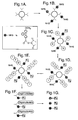
- FIG. 1 of the accompanying drawings An example of this embodiment is shown in Figure 1 of the accompanying drawings.
- A is illustrated a solid support in the form of a bead derivatised with cleavable linkers each having two arms.
- B one of the two arms of each linker has been reacted with a trityl group carrying a succinimidyl substituent.
- C the other branch of each linker has been reacted with a nucleotide residue shown as G; and one portion of the NHS groups has been substituted by a label R 1 .
- oligonucleotide synthesis has continued by formation of dimer chains GT; and a second portion of the NHS groups has been substituted by a second label R 2 .
- oligonucleotide synthesis has continued by formation of chains GTT; and a third portion of the NHS groups has been substituted by a label R 3 .
- ammonolysis of the beads has given rise to a pool of oligonucleotides of the same sequence, in which each one is attached to a different tag.
- photolysis has detached three derivatised trityl groups for analysis by mass spectrometry. The split and mix approach ensures that all the oligonucleotides attached to any bead have the same s-mer sequence; and that the bead also carries a total of s different labels, each of which indicates the position and identity of one monomer residue of the oligomer.
- an alternative way of partial coupling is to cap the extension of a fraction of the chemical compounds e.g. oligomers with a stable tag group at each extension step.
- the coupling agents could include a small proportion of a phosphoramidite protected by one of the stable trityl groups described below as mass tags. Elongation will produce a major proportion with the desired base and a small fraction with a corresponding tag marking the nature and position of the base.
- Oligonucleotide synthesis is performed on derivatised beads A, the first, second and third stages of this synthesis being shown as B, C and D.
- Each of four phosphoramidite reagents contains a small fraction depending on the length of the oligomer, preferably less than 1/s, of a capping phosphoramidite bearing a very acid-stable NHS-substituted trityl group. After each stage of synthesis, all incorporated NHS groups are reacted with an amine thereby attaching a label.
- o-methyl phosphoramidite could be used to withstand repetitive amination reactions.
- each bead carries a plurality of s-mer oligomers of identical sequence, together with a total of s different substituted trityl labels each of which indicates the identity and position of a monomer unit of the oligomer.
- the beads are used in an assay procedure. Thereafter photolysis of a bead generates charged substituted trityl moieties E for detection by mass spectroscopy. Alternatively the labelled oligonucleotides can be released into solution.
- this invention provides a set of labelled compounds wherein a molecule of a compound of the set is tagged with a single label which identifies the nature and/or the position of a component of that molecule, and different molecules of the same compound are tagged with different labels.
- the set of labelled compounds may be releasably attached to a solid support e.g. beads; or may be mixed together in solution.
- a library consisting of a plurality of the sets of the labelled compounds as herein defined, e.g. a library of n s labelled oligomers, where n is the number of different monomer units and s is the number of monomer units in each labelled oligomer.
- the invention provides a reagent comprising a solid support which carries on its surface molecules of an oligomer, with different oligomer molecules having the same sequence wherein the oligomer molecules include some shorter oligomer molecules and a shorter oligomer molecule carries a label which identifies the nature and position of a monomer unit of the oligomer molecule.
- a library consists of a plurality of the said reagents, in which the solid supports are preferably beads.
- preferred labels are groups of the formula R 1 R 2 R 3 C ⁇ where R 1 , R 2 and R 3 are the same or different and each is a monocyclic or fused ring aromatic group that is substituted or unsubstituted. These are groups of the trityl (triphenylmethyl) family. Other possible labels include troponium and those discussed in WO 97/27331. Trityl groups have the desirable property that they are readily cleaved by illumination with a laser in a mass spectrometer. Sensitivity of detection of trityl groups is high because of the stability of the positively charged carbonium ion. This sensitivity gives rise to a number of advantages, e.g. there are enough trityl groups in a molecular monolayer such as results if trityl labelled molecules are tethered covalently to a surface.
- R 1 , R 2 and R 3 carries a substituent selected from C 1 -C 20 alkoxy or hydrocarbyl either unsubstituted or substituted by carboxylic acid, sulphonic acid, nitro, cyano, hydroxyl, thiol, primary, secondary or tertiary amino, primary or secondary amido, anhydride, carbonyl halide or active ester.
- Hydrogen atoms in these substituents may be partly or wholly replaced by deuterium or halogen e.g. fluorine; this improves the range available for analysis by mass spectrometry.
- each of R 1 , R 2 and R 3 is aryl, more preferably phenyl. While substituents may be present at any point in the aromatic (e.g. phenyl) ring, para-substituents are convenient and are preferred. The substituents may be present to confer desired physical or chemical properties on the trityl (or other) group. For example, electron withdrawing groups at ortho or para positions increase the stability of trityl groups to acid hydrolysis. Substituents may be present to alter the formula weight of the trityl (or other) group, so as to enable easy detection and discrimination by mass spectrometry. Non-radioactive isotopic substituents are suitable for this purpose, e.g.
- the masses of the majority of commercially available amines lie in the range of 50 - 250 Da. For some applications it would be desirable to have up to a few hundred mass-tags.
- the resolution of the tags in TOF-mass spectrometry was found to be satisfactory with at least 4 Da difference between the masses of tags. Therefore, the above range of amines can only yield about 50 different tags. To increase this amount using the same pool of amines, it is possible to incorporate two or four or even more amide substituents per trityl group, and this is illustrated in the experimental section below.
- FIG. 3 The principle of the system is illustrated in Figure 3 of the accompanying drawings.
- an oligonucleotide has been synthesised on a CPG support.
- a 5'-hydroxyl group of the oligonucleotide has been replaced by an NHS-substituted trityl group.
- an amide group NHR has been introduced, in which R is chosen to have a characteristic formula weight.
- the labelled oligonucleotide has been released into solution for use in an assay procedure.
- the NHR-substituted trityl group has been volatilised by photolysis and has been detected by mass spectrometry.
- the invention provides a nucleic acid determination method, which method comprises providing a labelled oligonucleotide or nucleic acid, and removing the label by cleavage to give a charged species which is subjected to mass spectrometry.
- nucleic acid analysis e.g. sequencing or sequence difference analysis, is performed by the use of a labelled primer and/or labelled chain extending nucleotides and/or labelled chain terminating nucleotide analogues, wherein the label is as described above.
- the invention provides an assay method in which a labelled probe is partitioned into two fractions of which one is determined, the probe comprising a ligand joined to a label by a link which is cleavable to give a charged species for analysis by mass spectrometry.
- the invention also includes a library of probes, each comprising a ligand joined to a label by a link which is cleavable to give a charged species for analysis by mass spectrometry, wherein each different probe has a different label.
- the labels are as described above.
- Certain of the labels are envisaged as new compounds per se according to the invention. These are compounds of the formula R 1 R 2 R 3 CY; where Y is a leaving group e.g. halide or tosylate for displacement by a nucleophile e.g. a thiol, alcohol or amine group; and R 1 , R 2 and R 3 are as defined above, with the proviso that R 1 , R 2 and R 3 together carry at least two amide groups and/or at least two reactive groups for coupling e.g. N-hydroxysuccinimide ester groups.
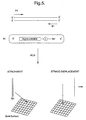
- the inventors have manufactured a disposable glass insert for use as a target surface for laser desorption ionisation mass spectrometry.
- the glass target may be used for analysis of samples spotted and dried directly on to the glass surface.
- the glass target may also be chemically activated and used as a solid support for immobilised nucleic acids or other compounds using methods already developed. Complementary nucleic acids, mass-tagged oligonucleotides or other compounds isolated and localised on the glass target may then be subjected to direct analysis by laser desorption ionisation mass spectrometry.
- One advantage of using a solid support is that it may be introduced directly into a mass spectrometer for subsequent detection and avoids unnecessary liquid handling of the sample.
- Organic polymeric surfaces such as polypropylene are possible alternatives to glass.
- Any surface chemistry developed for attachment of compounds to glass may be used to immobilise these compounds directly on to a target for laser desorption ionisation mass spectrometry or matrix-assisted laser desorption ionisation mass spectrometry.
- a target for laser desorption ionisation mass spectrometry or matrix-assisted laser desorption ionisation mass spectrometry For example 3-mercaptopropyl silane derivatisation (Rogers, et al 1999) or amine derivatisation (Beattie, et al 1995; Chen, et al 1999) for the attachment of nucleic acids.
- the glass inserts are significantly cheaper than conventional inserts and are truly disposable. Mass spectrometry performance is unaffected. (See Example 4 below).
- the invention also provides an insert for use as a target for laser desorption ionisation mass spectrometry, which insert has a target surface of glass carrying an immobilised compound for analysis.
- the invention also provides a kit comprising a mass spectrometer and a supply of inserts, for use as targets for laser desorption mass spectrometry, having target surfaces of glass.
- a system for analysing nucleic acids comprises:
- a system for analysing nucleic acids on a solid support comprises:
- an automated system for analysing nucleic acids comprises:
- Each base and base position in an oligonucleotide is associated with a unique mass tag.
- the isotopic abundances of the elements in the tag are also known, so a complete distribution of masses and abundances of all isotopic variants of each tag can be calculated.
- the major heavy isotopes of a tag are those due to the presence of 13 C, and a typical isotopic abundance distribution is that for C 27 H 30 O 2 N, with relative abundances of 73:22:3 for isotopic masses 400.228, 401.231 and 402.234 respectively.
- These abundance distributions characterise the tags' presence in a mass spectrum, and help to distinguish tags from other features in the spectrum.
- Mass tags containing these elements will therefore have their own characteristic isotopic distributions.
- the aim is to design tags with characteristic sets of masses which facilitate identification amongst a background of chemical 'noise'.
- Mass standards are included in each spectrum to allow the spectrum's mass axis to be calibrated. Use of mass standards both within and on either side of the tag mass range ensures accurate mass measurement throughout this range. Ions representing a complete set of possible masses are often seen in mass spectra and these represent the ideal calibration set.
- a program has been written to calculate the isotopic abundance distribution and corresponding isotopic masses of any mass tag, using the known masses and isotopic abundances of the elements in each tag. This information is calculated for all mass tags available for use in tagging oligonucleotides.
- a second program uses this information to determine the presence of mass tags and hence the sequence in the mass spectrum generated by an oligonucleotide, and works as follows. For each base position in the oligonucleotide, the four regions of the mass spectrum corresponding to the masses of the four possible tags (including their isotopic variants) are examined and compared with the expected tag spectrum. The comparison is done either by identification of spectral peak positions and amplitudes and their differences from those of the potential tag, or by measuring the sum of squares of residuals between the experimental spectrum and that expected from the potential tag. In either case, the four potential tags are ranked by the chosen measure and the best tag is used to assign a base to that base position.
- a more powerful approach is to examine each possible oligonucleotide in turn, obtaining a goodness of fit over all s tag regions by the method described above, and then ranking the oligonucleotide sequences by this measure.
- N-succinimidyl-4-[bis-(4-methoxyphenyl)-chloromethyl]-benzoate (1) was synthesised according to the reported procedures (1,2).
- N-succinimidyl-4-[(4-methoxydiphenyl)-chloromethyl]-benzoate (2) was synthesised according to the reported procedures (1,2), but 4-methoxybenzophenone was used in the Grignard synthesis instead of 4, 4'-dimethoxybenzophenone.
- N-succinimidy-4-[bis-(phenyl)-chloromethyl]-benzoate (3) was synthesised according to the reported procedures (1,2), but benzophenone was used in the Grignard synthesis instead of 4, 4'-dimethoxybenzophenone.
- the masses of the majority of commercially available amines lay in the range of 50-250 Da. For some applications it would be desirable to have up to a few hundred mass-tags. The resolution of the tags in TOF mass-spectrometry was found to be satisfactory with at least 4 Da difference between the masses of tags. Therefore, the above range of amines can only yield about 50 different tags.
- the inventors synthesised another trityl-based compound with two activated carboxyl groups (6), which upon reaction with amine would form two amide bonds thus giving other series of mass-tags as compared, for example, to (2) . Additional increase of mass can be achieved by attaching even more amines to trityl core by using, for example, (8).
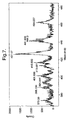
- reaction mixtures were then analysed by mass spectrometry without matrix, to prevent formation of molecular ions, by applying 1 ⁇ l of these mixtures directly onto a sample target plate and allowing them to dry.
- Typical results are presented in Table 1.
- the compounds which gave the strongest signal were selected and analysed as a mixtures by mixing all and applying 1 ⁇ l of the mixture to the target plate. Excellent results were achieved, both with and without matrix.
- the trityl group should give clean high intensity signal in (MA)LDI-TOF analysis. It should also survive several steps of acidic treatment used to remove 5'-DMTr group in oligonucleotide synthesis, that is, be orthogonal to other protective groups involved.
- the NHS-group is stable to the conditions of oligonucleotide synthesis, see Example 2).
- the MMTr(NHS) group is preferred as the one to meet both these demands.
- oligonucleotide trimer 5'-GAA-3'
- 5'-GAA-3' was synthesised directly on PEG-grafted Rapp beads on 1 ⁇ mol scale of synthesis using standard 3'-phosphoramidites.
- the beads were then subject to 4 more steps of oligonucleotide synthesis, this time according to split-and-mix strategy as outlined in Figure 2, using 7 and 16 different amines, thus producing a library of 256 different 7-mers.
- After ammonia deprotection the beads were washed and hybridised to 0.05 ⁇ mol of 5'-Cy5-TTC.CAG.T (10) and 5'-Cy5-TTC.TAT.T (11) as described below.
- Beads were selected by hybridisation with Cy5-labelled oligonucleotide.
- the size of Rapp-beads ( ⁇ 0.3 mm) allows for manual removal of positively identified beads, visible with the naked eye, from the pool.
- automated methods such as Flow-cytometry (FACS), might be used. Selected beads were detritylated and the mixtures of tags released analysed by mass spectrometry.
- the 3'-methylphosphoramidites of 5'-Fmoc-protected nucleosides could be preferably used instead of cyanoethoxy phosphoramidites, to prevent the untimely loss of the CNET- group due to the treatment with amines and DBU.
- Oligonucleotide synthesis was carried out using commercially available standard A, C, G and T, PAC, fluorescein and Cy5 phosphoramidites according to the manufacturer's protocols.
- oligonucleotide synthesis was carried out on 1 ⁇ mol scale using phosphoramidite mixtures: A + 7 , C + 7 , G + 7 and T + 7 , according to the manufacturer's protocol, but the supply of deblocking reagent (diluted to 50% of its original concentration with methylene chloride) to the columns was reduced to 10-15 sec, with subsequent waiting step (10 sec) and another portion of acid (10 sec). Subsequent thorough acetonitrile washing of the columns ensured that all DMTR+ is desorbed.
- the columns were washed with acetonitrile using Manual Control mode, and then treated with corresponding amines (0.3-0.5 ml of 0.5-1 M solutions in dioxan/THF, depending on the solubility of an amine) for 1 min using 1 ml syringes.
- the columns were then washed excessively with acetonitrile and dried in vacuo for 15 min.
- the beads from all columns were then combined together in a 0.3 ml reaction vial with conical chamber (Pierce), mixed and then split again in four portions by pipetting the suspension of beads in acetonitrile (about 1 volume of solvent per 1 volume of beads) using a 1 ml Eppendorf tip.
- the beads were hybridised to 5'-Cy5-labelled 7-mer oligonucleotides 5'-TTC.CAG.T ( 10 ) and 5'-TTC.TAT.T ( 11 ) in 1.5 ml of 3.5 M TMA buffer (51) in a 4 ml vial which was rotated on a Spiramix 10 machine overnight at 8°C.
- TMA buffer 511 in a 4 ml vial which was rotated on a Spiramix 10 machine overnight at 8°C.
- the beads were then washed 5 times with TMA buffer at the same temperature, transferred onto a surface of a 7.5 x 5 cm microscope slide and the excess of the buffer removed by blotting with tissue paper.
- Thiolated oligonucleotides have previously been used to immobilise PCR products onto gold monolayers (e.g. Hegner et al .). The attachment is due to bonding between the gold and the thiol group. Using this chemical reaction it is possible to immobilise any gene, or region of any gene, onto the gold plated surface of a mass spectrometer target plate, via a thiol linkage.
- This example illustrates the immobilisation of PCR products to the gold surface of mass spectrometer target plates; hybridisation and ligation of pairs of oligonucleotides, one of which defines the locus and the other a putative allele; the allele is characterised by the detection of a trityl tag(s) by mass spectrometer.
- the example given uses M13mp18 ssDNA as a putative target region.
- a 225 base pair PCR product was amplified from M13mp18 ssDNA using two oligonucleotide primers; A1 5'ACTGGCCGTCGTTTTAC3'-; B1 5'AAGGGCGATCGGTGCGG 3'-.
- A1 was synthesised with the addition of a 17 atom linker molecule, and a thiol group, to the 5' end using conventional phosphoramidite chemistry (see figure ). The thiol group was activated with a 200 fold excess of DTT, and 5ng of product was spotted on to the gold target plate. Incubation in 100% humidity overnight was sufficient to immobilise the PCR product. Excess template was removed by flooding the plate with 10mM Tris-HCl (pH 7.5).
- the oligonucleotide defining the locus, C1 - 5'GTAAAACGACGGCCAGT3' was synthesised with a phosphate group coupled to the 5' end.
- Two putative allele defining oligonucleotides were synthesised, D1 and D2- 5'CACGACGTT3' differing only in their 5' terminus where D1 was tagged with dimethoxytrityl and D2 with monomethoxytrityl. Both oligonucleotides were synthesised using conventional phosphoramidite chemistry and were fully complementary to the PCR amplified product.
- Ligation and hybridisation was at 46°C (Housby and Southern, 1998) overnight in 100% humidity, and under saturating concentrations of oligonucleotides C1 and D1 and/or D2.
- a thermostable DNA ligase, Tth was used because of its high temperature optimum for ligation and high degree of discrimination for the 3' end of substrate oligonucleotide. Residual unligated oligonucleotides were removed by washing.
- MMT monomethoxytrityl
- Derivatised T residues have been coupled with aminated DMT and MMT derivatives as described. A selection of DMT tagged T residues have been mixed together and analysed by mass spectrometry (see figure 7.)
- a disposable glass insert, for use as a target surface for laser desorption ionisation mass spectrometry was manufactured from 1 mm plain soda glass, cut to a rectangle 45mm x 46mm, and the cut edges bevelled.
- a standard gold-plated metal insert (Perkin Elmer/Perseptive Biosystems part number VES 503 405) may be used as a template to position orientation markings on the reverse of the glass insert prior to assembly.
- the insert was held in a disposable sample plate holder (Perkin Elmer/Perseptive Biosystems part number VES 700 314).
- the 4 retaining screws of the sample holder were removed, the glass insert placed into the upper rectangular frame from behind, and the sample holder was reassembled.
- Samples for analysis may be applied using existing methods.
- Perkin Elmer/Perseptive Biosystems "Voyager"TM BiospectrometryTM Workstation software version 4.03 may be used to correctly locate samples on the plate, and analysis was performed using existing methods.
- the mass spectrum shown in Figure 8 was produced by application of the manufacturer's recommended mass calibration mixture to a glass target.
- the mixture (Perkin Elmer/Perseptive Biosystems part number 2-3243-00-000) comprises 3 peptides des-arg1-bradykinin, angiotensin 1 and glu1-fibrinopeptide B. Analysis was performed using a standard method. The theoretical mass of the singly protonated ion is 904.4681 Da, 1296.6853 Da and 1570.6774 Da respectively
- a 9-mer oligonucleotide with DMT left 'on' at the end of conventional phosphoramidite DNA synthesis was spotted (2000 pmol) on to a piece of polypropylene.
- Laser Desorption/Ionisation Time of Flight Mass Spectrometry, without matrix revealed a peak at 309.3 mass units.
- the mass of DMT is 303 mass units.
- the higher observed mass is due to the polypropylene (strip) target being placed behind the disposable target plate, thereby increasing the ion flight length.
- the plate was used to keep the polypropylene strip secured for mass spectrometry.
- Glass targets are prepared for mass spectrometric analysis as described in Example 4.
- the surface is activated by treatment with epoxysilane (Beattie et al, 1995) and a target DNA is synthesised with a terminal amine at either the 3' or 5' end.
- 5 ⁇ M of aminated oligonucleotide is spotted on to the surface of the activated glass plate and left from 2 hours to overnight.
- the surface is washed in H 2 O at 60°C, 10 mM triethylamine, pH 9.2, at room temperature, followed by 2 washed in hot water.
- Hybridisation of a probe oligonucleotide, labelled with a 32 P radioisotope is in 3M TMAC, 60 mM Tris pH 7.5, 6 mM EDTA, 0.03% SDS, for 1 hour, followed by a 1 hour wash in the same buffer. Analysis of the hybridisation efficiency can be determined by phosphorimager analysis. Ligation and mass spectrometric analysis of tagged oligonucleotides will determine the allele.
- oligonucleotides For the immobilisation of aminated oligonucleotides the plates are activated by phenylendiisothiocyanate (PDITC) (Weiler and Hoheisel, 1997).
- Target oligonucleotides are synthesised with a 5' or 3' amine. Immobilisation of the target DNA is carried out in 0.001 M NaOH, 0.1 - 1.0 ⁇ M oligonucleotide, for 2 hours, at room temperature.
- Hybridisation of 32 P radiolabelled complementary probe oligonucleotides is carried out in 3 x SSPE and 0.5% SDS for 1 hour followed by washing in the same buffer and subsequent phosphorimager analysis. Ligation and mass spectrometric analysis of tagged oligonucleotides will determine the allele.
- Target DNA is immobilised via a thiol / disulphide exchange reaction.
- the thiol group can be readily added to the 5' end of any oligonucleotide using standard phosphoramidite chemistry.
- 10 ⁇ M if thiolated oligonucleotide, in 500 mM NaHCO 3 (pH 9.0) is spotted on to the activated mercaptosilane surface, for 2 hours to overnight. The surface is then washed in TNTw buffer (10 mM Tris-HCl, pH 7.5, 150 mM NaCl and 0.05% Tween 20).
- a 40 base 5' thiolated oligonucleotide has been immobilised to a mercaptosilanised glass target.
- Hybridisation of a 32 P radiolabelled 17 base complementary probe sequence has demonstrated high specificity for the complementary target sequence with little background hybridisation.
- a 27-mer oligonucleotide was attached to a glass mass spectrometry target pre-treated with polylysine. After treatment to inhibit non-specific binding, specific hybridisation of a complementary 14-mer with high efficiency has been successfully demonstrated.
- Oligo 1a is labelled with fluorescent cyanine dye
- oligo 1b is the same sequence unlabelled.
- Oligo 2 is also cyanine labelled and is complementary in sequence to bases 11 to 24 of oligos 1a and 1b.
- Hybridisation solution (4 x SSC, 0.25% SDS, 240 pmol oligo 2) was prepared in a total volume of 52 ⁇ l, boiled for 2 minutes, placed on to the glass target and covered with an untreated glass target. Hybridisation proceeded for 8 hours in a humid chamber containing 3 x SSC at room temperature. The target was then rinsed 3 times in 2 x SSC, briefly rinsed in deionised distilled water and allowed to dry in air. Attachment of the labelled oligo 2 to the immobilised, unlabelled complementary sequence oligo 1b was confirmed by fluorescence scanning.
- fluorescence of bound oligo 1a was detected from 500 ng/ ⁇ l.
- fluorescence of bound oligo 2 was detected across the complete range of dilutions from 500 ng/ ⁇ l to 1 ng/ ⁇ l. Non-specific background fluorescence is acceptable.
- a solution experiment was performed to test the ligation of tagged oligonucleotides to template DNA.
- 9 base oligonucleotides were either tagged or not.
- a matched oligonucleotide had a mass tag of 413.5 units, and a mismatched oligonucleotide had a mass tag of 402 units.
- a 17 base primer was used to direct the ligation process.
- the reaction comprised of combinations of each 9-mer oligonucleotide.
- the concentrations of template and tagged oligonucleotides was 120 fmol whilst the 17 base primer was at a concentration of 60 fmol.
- the primer was radiolabelled with 32 P using polynucleotide kinase.
- Each reaction contained 50 units of Thermus thermophilus DNA ligase and was incubated for four hours at either 37°C or 46°C.
- the reaction was stopped with formamide and the products analysed by polyacrylamide gel electrophores
- the resulting ligated band was excised from the gel and the DNA eluted by incubation in a high salt buffer at 37°C overnight.
- the DNA was then purified and analysed by mass spectroscopy without matrix.
- the resulting mass of 413.5 corresponded to the mass tag used for the ligation of the fully complementary oligonucleotide, N.
- Untreated glass slides were soaked in a solution of 5% (v/v) (3--mercaptopropyl)trimethoxysilane in dry toluene for 6 hours. The slides were washed with dry toluene followed by ethanol. The slides were subsequently soaked overnight in a 6.66 g/l solution of 2,2'-dipyridyl disulfide in isopropanol. The slides were finally washed isopropanol and air dried.
- Oligonucleotide solutions of 40 ⁇ M, 20 ⁇ M, 8 ⁇ M and 4 ⁇ M were prepared in water.
- oligonucleotide solution 1 ⁇ l oligonucleotide solution was applied on each spot.
- the slides were kept at room temperature for 18 hours, washed with water followed by isopropanol and were allowed to dry.
- O 1 - ⁇ [4-(butylamidocarboxy)]-4'-methoxytrityl ⁇ -6-trifluoroacetamido-1-hexanol (5) A solution of O 1 - ⁇ [4-(succinimidylcarboxy)]-4'-methoxytrityl ⁇ -6-trifluoroacetamido-1-hexanol (0.39g, 0.63mmol) in acetonitrile (5ml) was treated with an excess of neat n-butylamine (0.18g, 2.5mmol, 0.25ml). The solution was stirred overnight at ambient temperature under an atmosphere of nitrogen.
- O 1 - ⁇ [4-(butylamidocarboxy)]-4'-methoxytrityl ⁇ -6-amino-1-hexanol (7) A solution of O 1 - ⁇ [4-(butylamidocarboxy)]-4'-methoxytrityl ⁇ -6-trifluoroacetamido-1-hexanol (0.35g, 0.6mmol) in methanol (5ml) was treated with 0.88spg aqueous ammonia (1ml) at ambient temperature. The solution was stirred overnight and the solvent then removed under vacuum.
- O 1 - ⁇ [4-(butylamidocarboxy)]-4',4"-dimethoxytrityl ⁇ -6-amino-1-hexanol (8) was prepared from O 1 - ⁇ [4-(butylamidocarboxy)]-4',4"-dimethoxytrityl ⁇ -6-trifluoroacetamido-1-hexanol (0.45g, 0.7mmol) and aqueous ammonia (1ml) using the procedure described above.
- O 1 - ⁇ [4-(butylamidocarboxy ⁇ ]-4'-methoxytrityl ⁇ -6-succinamido-1-hexanol (9).
- O 1 - ⁇ [4-(butylamidocarboxy)]-4'-methoxytrityl ⁇ -6-amino-1-hexanol ( ⁇ 0.3mmol) was dissolved in anhydrous pyridine (5ml) at ambient temperature. Succinic anhydride (0.07g, 0.7mmol) was then added and the resulting solution stirred at ambient temperature for 2 hours. The solvent was then removed under vacuum and the residue analysed by t.l.c (4:1 dichloromethane - ethyl acetate).
- O 1 - ⁇ [4-(butylamidocarboxy)]-4', 4"-dimethoxytrityl ⁇ -6-succinamido-1-hexanol (10) was prepared from O 1 - ⁇ [4-(butylamidocarboxy)]-4', 4"-dimethoxytrityl ⁇ -6-amino-1-hexanol ( ⁇ 0.35mmol) and succinic anhydride (0.09g, 0.9mmol) using the procedure described above. The product was used without further purification.
- a solution of O 1 - ⁇ [4-(butylamidocarboxy)]-4'-methoxytrityl ⁇ -6-succinamido-1-hexanol and O -( N -succinimidyl)- N,N,N',N' -tetramethyluronium tetrafluoroborate in acetonitrile was treated with N,N -(diisopropyl)ethylamine while stirring at ambient temperature.
- N-Tritylaminocaproic acid 214 mg, 0.57 mmol
- dicyclohexylcarbodiimide 154 mg, 0.75 mmol
- 4-N-dimethylaminopyridine 21 mg, 0.17 mmol
- N-hydroxysuccinimide 86 mg, 0.75 mmol
- the reaction mixture was stirred overnight at room temperature.
- Dicyclohexylurea was filtered off, and the filtrate was evaporated to dryness and purified by flash chromatography (gradient of dichloromethane to 2% methanol / dichloromethane). Pale yellow foam isolated (270mg, 98%).
- Conjugates of allylamino-dUtp such as biotin, haptens, dyes and metal chelates have been reported in the literature as substrates for incorporation by polymerases.
- a system of ligating mass-tagged oligo nucleotides to anchored complementary DNA sequences on a solid support via a hybridising third oligo is described.
- the system uses Tth DNA ligase as an enzymatic component, which catalyses the ligation of a DMT-modified oligo (the "reporter” sequence) onto a hybridising "probe” oligo.
- the probe oligo applied in solution, is localised by hybridisation to tethered "template' oligos which remain attached to the solid support throughout all manipulations and detection. Hybridisation of neither the probe nor the reporter oligos will occur at elevated temperatures due to their short length, but the ligated product, with consequent higher Tm, is retained as wash temperatures are raised.
- the success of the ligation is dependent on the correct mismatch detection of the 3' base on the reporter against the corresponding base on the anchored template. Tth ligase will not catalyse the reaction in the presence of a mismatched
- Oligos have been specifically attached to derivatised glass surfaces using a variety of available and developed chemistries. Oligos with a terminal 5' amine group have been used in conjunction with isothiocyanate and epoxide derivatised glass, while thiol-modified oligos have been anchored using mercaptopropyl silane and pyridyl disulphide methods. This latter method, is the subject of the experiments described in this report.
- the probe and reporter oligos have Tm values of 42 and 26°C respectively, allowing both to anneal at the experimental temperature of 22°C. Successive washing at higher temperatures reduces the amount of annealed primer, demonstrated in Chart 1 for the 15-mer probe, with the greatest reduction occurring in the region of the oligo's Tm. This pattern is consistent for both concentrations of oligo analysed (8 and 6 ⁇ M). This indicates that hybridisation is the primary mode of interaction between the probe and template with good signal-to-noise ratios occurring for the higher concentrations of template.
- Chart 2 demonstrates a decrease in signal intensity as template deposition concentrations are lowered. There is considerable variability in the pyridyl disulphide attachment chemistry such that at lower template concentrations hybridization intensity is not consistent.
Landscapes
- Chemical & Material Sciences (AREA)
- Organic Chemistry (AREA)
- Life Sciences & Earth Sciences (AREA)
- Health & Medical Sciences (AREA)
- Molecular Biology (AREA)
- Biochemistry (AREA)
- Chemical Kinetics & Catalysis (AREA)
- General Chemical & Material Sciences (AREA)
- Medicinal Chemistry (AREA)
- Engineering & Computer Science (AREA)
- Proteomics, Peptides & Aminoacids (AREA)
- General Health & Medical Sciences (AREA)
- Analytical Chemistry (AREA)
- Physics & Mathematics (AREA)
- Wood Science & Technology (AREA)
- Immunology (AREA)
- Genetics & Genomics (AREA)
- Structural Engineering (AREA)
- Biotechnology (AREA)
- Zoology (AREA)
- Bioinformatics & Cheminformatics (AREA)
- Microbiology (AREA)
- Biophysics (AREA)
- General Engineering & Computer Science (AREA)
- Spectroscopy & Molecular Physics (AREA)
- Other Investigation Or Analysis Of Materials By Electrical Means (AREA)
- Measuring Or Testing Involving Enzymes Or Micro-Organisms (AREA)
- Investigating Or Analysing Biological Materials (AREA)
- Pyrane Compounds (AREA)
- Apparatus Associated With Microorganisms And Enzymes (AREA)
Priority Applications (1)
| Application Number | Priority Date | Filing Date | Title |
|---|---|---|---|
| EP03078845A EP1428810A3 (de) | 1998-05-15 | 1999-05-17 | Verbindungs-Bibliotheken aus mit verschiedenen Tags markierten Oligomeren |
Applications Claiming Priority (4)
| Application Number | Priority Date | Filing Date | Title |
|---|---|---|---|
| EP98303873 | 1998-05-15 | ||
| EP98303873 | 1998-05-15 | ||
| EP99922334A EP1068216B1 (de) | 1998-05-15 | 1999-05-17 | Bibliotheken von unterschiedlich markierten oligomeren |
| EP03078845A EP1428810A3 (de) | 1998-05-15 | 1999-05-17 | Verbindungs-Bibliotheken aus mit verschiedenen Tags markierten Oligomeren |
Related Parent Applications (1)
| Application Number | Title | Priority Date | Filing Date |
|---|---|---|---|
| EP99922334A Division EP1068216B1 (de) | 1998-05-15 | 1999-05-17 | Bibliotheken von unterschiedlich markierten oligomeren |
Publications (2)
| Publication Number | Publication Date |
|---|---|
| EP1428810A2 true EP1428810A2 (de) | 2004-06-16 |
| EP1428810A3 EP1428810A3 (de) | 2004-07-14 |
Family
ID=8234828
Family Applications (2)
| Application Number | Title | Priority Date | Filing Date |
|---|---|---|---|
| EP99922334A Expired - Lifetime EP1068216B1 (de) | 1998-05-15 | 1999-05-17 | Bibliotheken von unterschiedlich markierten oligomeren |
| EP03078845A Withdrawn EP1428810A3 (de) | 1998-05-15 | 1999-05-17 | Verbindungs-Bibliotheken aus mit verschiedenen Tags markierten Oligomeren |
Family Applications Before (1)
| Application Number | Title | Priority Date | Filing Date |
|---|---|---|---|
| EP99922334A Expired - Lifetime EP1068216B1 (de) | 1998-05-15 | 1999-05-17 | Bibliotheken von unterschiedlich markierten oligomeren |
Country Status (9)
| Country | Link |
|---|---|
| US (3) | US6780981B1 (de) |
| EP (2) | EP1068216B1 (de) |
| JP (1) | JP2002515588A (de) |
| AT (1) | ATE256142T1 (de) |
| AU (1) | AU3943799A (de) |
| CA (1) | CA2332862A1 (de) |
| DE (1) | DE69913509T2 (de) |
| DK (1) | DK1068216T3 (de) |
| WO (1) | WO1999060007A2 (de) |
Cited By (6)
| Publication number | Priority date | Publication date | Assignee | Title |
|---|---|---|---|---|
| EP1510522A1 (de) * | 2003-08-30 | 2005-03-02 | Agilent Technologies Inc | Verfahren zur Herstellung von Polynukleotide unter Verwendung von einem modifizierten Trägermaterial |
| US7135565B2 (en) | 2000-07-28 | 2006-11-14 | Agilent Technologies, Inc. | Synthesis of polynucleotides using combined oxidation/deprotection chemistry |
| US7193077B2 (en) | 2003-08-30 | 2007-03-20 | Agilent Technologies, Inc. | Exocyclic amine triaryl methyl protecting groups in two-step polynucleotide synthesis |
| US7385050B2 (en) | 2003-08-30 | 2008-06-10 | Agilent Technologies, Inc. | Cleavable linker for polynucleotide synthesis |
| US7417139B2 (en) | 2003-08-30 | 2008-08-26 | Agilent Technologies, Inc. | Method for polynucleotide synthesis |
| US7427679B2 (en) | 2003-08-30 | 2008-09-23 | Agilent Technologies, Inc. | Precursors for two-step polynucleotide synthesis |
Families Citing this family (40)
| Publication number | Priority date | Publication date | Assignee | Title |
|---|---|---|---|---|
| US7211390B2 (en) | 1999-09-16 | 2007-05-01 | 454 Life Sciences Corporation | Method of sequencing a nucleic acid |
| US7244559B2 (en) | 1999-09-16 | 2007-07-17 | 454 Life Sciences Corporation | Method of sequencing a nucleic acid |
| AU2001278968A1 (en) * | 2000-07-19 | 2002-01-30 | Pointilliste, Inc. | Nested sorting and high throughput screening |
| EP1309855A2 (de) | 2000-08-14 | 2003-05-14 | Isis Innovation Limited | Massenspektrometrie |
| AU2001294777A1 (en) * | 2000-09-28 | 2002-04-08 | Matrix Technologies Corporation | Improved support for solid phase hybridization assays |
| EP1401850A1 (de) * | 2001-06-20 | 2004-03-31 | Nuevolution A/S | Nukleosidderivate zur herstellung einer verbindungsbibliothek |
| GB0115581D0 (en) * | 2001-06-26 | 2001-08-15 | Glaxo Group Ltd | Method of mass spectometry |
| DE60230927D1 (de) * | 2001-07-16 | 2009-03-05 | Caprotec Bioanalytics Gmbh | Fangverbindungen, ihre entnahme und verfahren zur analysierung des proteoms und von komplexen zusammensetzungen |
| DE10147074A1 (de) * | 2001-09-25 | 2003-05-08 | Beru Ag | Verfahren zum Betreiben einer aus mehreren Heizelementen bestehenden mehrstufigen elektrischen Heizung |
| US6902921B2 (en) | 2001-10-30 | 2005-06-07 | 454 Corporation | Sulfurylase-luciferase fusion proteins and thermostable sulfurylase |
| US6956114B2 (en) | 2001-10-30 | 2005-10-18 | '454 Corporation | Sulfurylase-luciferase fusion proteins and thermostable sulfurylase |
| DE60324778D1 (de) * | 2002-03-15 | 2009-01-02 | Nuevolution As | Eine verbesserte methode zur synthese von matritzenabhängigen molekülen |
| US10731151B2 (en) | 2002-03-15 | 2020-08-04 | Nuevolution A/S | Method for synthesising templated molecules |
| EP1490693A1 (de) | 2002-04-04 | 2004-12-29 | Xzillion GmbH & CO.KG | Verfahren zur bestimmung von analyten |
| WO2004013070A2 (en) * | 2002-08-01 | 2004-02-12 | Nuevolution A/S | Multi-step synthesis of templated molecules |
| DE10240746A1 (de) * | 2002-09-01 | 2004-03-18 | Epigenomics Ag | Verfahren zum Nachweis von Nukleinsäuresequenzen mittels spaltbarer Sondenmoleküle |
| DK3299463T3 (da) | 2002-10-30 | 2020-12-07 | Nuevolution As | Enzymatisk kodning |
| WO2004044243A1 (ja) * | 2002-11-13 | 2004-05-27 | Hitachi High-Technologies Corporation | 核酸の増幅方法及びその装置 |
| WO2004044242A1 (en) * | 2002-11-14 | 2004-05-27 | John Nicholas Housby | Polymorphism assay |
| ATE450609T1 (de) * | 2002-12-19 | 2009-12-15 | Nuevolution As | Durch quasizufallsstrukturen und funktionen geführte synthesemethode |
| DE602004030212D1 (de) | 2003-01-16 | 2011-01-05 | Caprotec Bioanalytics Gmbh | Verfahren zur identifizierung von auf arzneimittel nicht-zielgerichteten proteinen |
| US7575865B2 (en) | 2003-01-29 | 2009-08-18 | 454 Life Sciences Corporation | Methods of amplifying and sequencing nucleic acids |
| CA2513889A1 (en) | 2003-01-29 | 2004-08-19 | 454 Corporation | Double ended sequencing |
| DE10304219B3 (de) * | 2003-01-30 | 2004-08-19 | Epigenomics Ag | Verfahren zum Nachweis von Cytosin-Methylierungsmustern mit hoher Sensitivität |
| US20070026397A1 (en) | 2003-02-21 | 2007-02-01 | Nuevolution A/S | Method for producing second-generation library |
| GB0306756D0 (en) * | 2003-03-24 | 2003-04-30 | Xzillion Gmbh & Co Kg | Mass labels |
| WO2005003778A2 (en) * | 2003-07-02 | 2005-01-13 | Nuevolution A/S | A method for identifying a synthetic molecule having affinity towards a target |
| WO2005026387A1 (en) | 2003-09-18 | 2005-03-24 | Nuevolution A/S | A method for obtaining structural information concerning an encoded molecule and method for selecting compounds |
| TW200533919A (en) * | 2003-12-08 | 2005-10-16 | Oxford Gene Tech Ip Ltd | Derivatived molecules for mass spectrometry |
| EP1506959A3 (de) * | 2004-09-22 | 2005-07-27 | Oxford Gene Technology Ip Limited | Derivatisierte Molekülen für Massenspektroskopie |
| EP1723255B1 (de) * | 2004-02-17 | 2010-12-29 | Nuevolution A/S | Anreicherungsverfahren mit eliminierung durch fehlpaarungshybridisierung |
| EP1718662A4 (de) * | 2004-02-27 | 2008-12-31 | Hitachi Chemical Res Ct Inc | Multiplexnachweissonden |
| US7622281B2 (en) * | 2004-05-20 | 2009-11-24 | The Board Of Trustees Of The Leland Stanford Junior University | Methods and compositions for clonal amplification of nucleic acid |
| US8632970B2 (en) | 2005-05-09 | 2014-01-21 | Affymetrix, Inc. | Multiplex capture of nucleic acids |
| LT2336315T (lt) | 2005-12-01 | 2017-11-10 | Nuevolution A/S | Fermentiniai kodavimo būdai, skirti efektyviai didelių bibliotekų sintezei |
| US20070224601A1 (en) * | 2006-03-24 | 2007-09-27 | Mccuen Heather B | Quantification of depurination through the use of two cleavage sites |
| US7960526B2 (en) * | 2009-03-30 | 2011-06-14 | Berry And Associates, Inc. | Colorimetric-oxycarbonyl protecting groups for use in organic syntheses |
| CA2832672A1 (en) | 2010-04-16 | 2011-10-20 | Nuevolution A/S | Bi-functional complexes and methods for making and using such complexes |
| WO2012003478A2 (en) | 2010-07-02 | 2012-01-05 | Ventana Medical Systems, Inc. | Detecting targets using mass tags and mass spectrometry |
| CN115506034B (zh) * | 2017-09-25 | 2025-12-05 | 普莱克斯姆公司 | 寡核苷酸编码的化学文库 |
Family Cites Families (13)
| Publication number | Priority date | Publication date | Assignee | Title |
|---|---|---|---|---|
| US5410068A (en) * | 1989-10-23 | 1995-04-25 | Perseptive Biosystems, Inc. | Succinimidyl trityl compounds and a process for preparing same |
| DK0604552T3 (da) | 1991-09-18 | 1997-08-04 | Affymax Tech Nv | Fremgangsmåde til syntese af forskellige samlinger af oligomerer |
| US5565324A (en) * | 1992-10-01 | 1996-10-15 | The Trustees Of Columbia University In The City Of New York | Complex combinatorial chemical libraries encoded with tags |
| US5605798A (en) * | 1993-01-07 | 1997-02-25 | Sequenom, Inc. | DNA diagnostic based on mass spectrometry |
| US6074823A (en) * | 1993-03-19 | 2000-06-13 | Sequenom, Inc. | DNA sequencing by mass spectrometry via exonuclease degradation |
| CA2158642A1 (en) | 1993-03-19 | 1994-09-29 | Hubert Koster | Dna sequencing by mass spectrometry via exonuclease degradation |
| GB9315847D0 (en) * | 1993-07-30 | 1993-09-15 | Isis Innovation | Tag reagent and assay method |
| US6075166A (en) * | 1995-03-31 | 2000-06-13 | Smithkline Beecham Corporation | Photolytically cleavable encoding and linking agents for use in combinatorial chemistry |
| EP0868535B9 (de) * | 1996-01-23 | 2007-05-09 | Qiagen Genomics, Inc. | Verfahren und zusammenstellungen zur sequenzbestimmung von nukleinsäuremolekulen |
| ATE204290T1 (de) * | 1996-11-06 | 2001-09-15 | Sequenom Inc | Zusammensetzungen und verfahren zur immobilisierung von nukleinsäure auf festträgern |
| EP1460083B1 (de) | 1996-11-06 | 2006-01-18 | Sequenom, Inc. | Verfahren zur Analyse und Vorrichtung |
| US6699668B1 (en) * | 1997-01-15 | 2004-03-02 | Xzillion Gmbh & Co. | Mass label linked hybridisation probes |
| WO1998031830A1 (en) | 1997-01-15 | 1998-07-23 | Brax Group Limited | Mass label linked hybridisation probes |
-
1999
- 1999-05-17 EP EP99922334A patent/EP1068216B1/de not_active Expired - Lifetime
- 1999-05-17 AU AU39437/99A patent/AU3943799A/en not_active Abandoned
- 1999-05-17 AT AT99922334T patent/ATE256142T1/de not_active IP Right Cessation
- 1999-05-17 US US09/700,462 patent/US6780981B1/en not_active Expired - Fee Related
- 1999-05-17 CA CA002332862A patent/CA2332862A1/en not_active Abandoned
- 1999-05-17 DE DE69913509T patent/DE69913509T2/de not_active Expired - Fee Related
- 1999-05-17 WO PCT/GB1999/001561 patent/WO1999060007A2/en not_active Ceased
- 1999-05-17 DK DK99922334T patent/DK1068216T3/da active
- 1999-05-17 JP JP2000549625A patent/JP2002515588A/ja active Pending
- 1999-05-17 EP EP03078845A patent/EP1428810A3/de not_active Withdrawn
-
2004
- 2004-05-11 US US10/843,873 patent/US7399846B2/en not_active Expired - Fee Related
-
2007
- 2007-05-04 US US11/800,241 patent/US7741044B2/en not_active Expired - Fee Related
Non-Patent Citations (1)
| Title |
|---|
| GILDEA B.D. ET AL: "A versatile acid-labile linker for modification of synthetic biomolecules", TETRAHEDRON LETTERS, vol. 31, no. 49, 26 November 1990 (1990-11-26), UNITED KINGDOM, pages 7095 - 7098, XP000172821 * |
Cited By (7)
| Publication number | Priority date | Publication date | Assignee | Title |
|---|---|---|---|---|
| US7135565B2 (en) | 2000-07-28 | 2006-11-14 | Agilent Technologies, Inc. | Synthesis of polynucleotides using combined oxidation/deprotection chemistry |
| EP1510522A1 (de) * | 2003-08-30 | 2005-03-02 | Agilent Technologies Inc | Verfahren zur Herstellung von Polynukleotide unter Verwendung von einem modifizierten Trägermaterial |
| US7193077B2 (en) | 2003-08-30 | 2007-03-20 | Agilent Technologies, Inc. | Exocyclic amine triaryl methyl protecting groups in two-step polynucleotide synthesis |
| US7385050B2 (en) | 2003-08-30 | 2008-06-10 | Agilent Technologies, Inc. | Cleavable linker for polynucleotide synthesis |
| US7417139B2 (en) | 2003-08-30 | 2008-08-26 | Agilent Technologies, Inc. | Method for polynucleotide synthesis |
| US7427679B2 (en) | 2003-08-30 | 2008-09-23 | Agilent Technologies, Inc. | Precursors for two-step polynucleotide synthesis |
| US7585970B2 (en) | 2003-08-30 | 2009-09-08 | Agilent Technologies, Inc. | Method of polynucleotide synthesis using modified support |
Also Published As
| Publication number | Publication date |
|---|---|
| ATE256142T1 (de) | 2003-12-15 |
| WO1999060007A3 (en) | 2000-01-20 |
| EP1068216B1 (de) | 2003-12-10 |
| DE69913509T2 (de) | 2004-09-23 |
| WO1999060007A2 (en) | 1999-11-25 |
| JP2002515588A (ja) | 2002-05-28 |
| US7399846B2 (en) | 2008-07-15 |
| DK1068216T3 (da) | 2004-04-13 |
| AU3943799A (en) | 1999-12-06 |
| EP1068216A2 (de) | 2001-01-17 |
| CA2332862A1 (en) | 1999-11-25 |
| US20090029866A1 (en) | 2009-01-29 |
| US7741044B2 (en) | 2010-06-22 |
| US6780981B1 (en) | 2004-08-24 |
| DE69913509D1 (de) | 2004-01-22 |
| EP1428810A3 (de) | 2004-07-14 |
| US20050003408A1 (en) | 2005-01-06 |
Similar Documents
| Publication | Publication Date | Title |
|---|---|---|
| EP1068216B1 (de) | Bibliotheken von unterschiedlich markierten oligomeren | |
| RU2158310C2 (ru) | Реагент (варианты), библиотека реагентов, способы проведения анализа | |
| US8691729B2 (en) | Reaction discovery system | |
| US6287780B1 (en) | Compounds for mass spectrometry comprising nucleic acid bases and aryl ether mass markers | |
| US20130040842A1 (en) | Methods And Compositions For Phototransfer | |
| JP2001512131A (ja) | 塩基アナログ | |
| WO2019105421A1 (zh) | 核苷类似物、制备方法及应用 | |
| JP2004510433A (ja) | Dnaおよびrnaを解読するための大量並行方法 | |
| CN106467913B (zh) | 用于原位合成探针阵列的探针倒转方法 | |
| US6541203B2 (en) | Detecting structural or synthetic information about chemical compounds | |
| KR20250037772A (ko) | 아미노산 폴리머를 dna 폴리머로 리코딩함으로써 단백질 정보의 결정 | |
| EP2038074B1 (de) | Herstellung und verwendung von oberflächenmolekülen von unterschiedlicher dichte | |
| AU771491B2 (en) | Method for characterizing nucleic acid fragments | |
| EP1956089B1 (de) | Verfahren zum nachweis einer zielnukleinsäure mit spezifischer basensequenz sowie nukleinsäuresatz zum nachweis | |
| CN101384757A (zh) | 小分子印渍 | |
| WO2009061402A2 (en) | Methods and compounds for phototransfer | |
| JP2005114515A (ja) | 質量分析可能な原子群を構成単位とする鎖状構造を有する分子に対して付加情報を付与して、情報記録コードとして利用する方法 | |
| US20050147984A1 (en) | Interaction detection on several probe arrays | |
| EP1275655A1 (de) | Silicium enthaltende Linker für Nukleinsäure-Massmarker | |
| JP2004016135A (ja) | プローブ溶解用液体組成物 |
Legal Events
| Date | Code | Title | Description |
|---|---|---|---|
| PUAI | Public reference made under article 153(3) epc to a published international application that has entered the european phase |
Free format text: ORIGINAL CODE: 0009012 |
|
| PUAL | Search report despatched |
Free format text: ORIGINAL CODE: 0009013 |
|
| AC | Divisional application: reference to earlier application |
Ref document number: 1068216 Country of ref document: EP Kind code of ref document: P |
|
| AK | Designated contracting states |
Kind code of ref document: A2 Designated state(s): AT BE CH CY DE DK ES FI FR GB GR IE IT LI LU MC NL PT SE |
|
| AK | Designated contracting states |
Kind code of ref document: A3 Designated state(s): AT BE CH CY DE DK ES FI FR GB GR IE IT LI LU MC NL PT SE |
|
| RIC1 | Information provided on ipc code assigned before grant |
Ipc: 7C 07B 61/00 B Ipc: 7C 07H 21/00 A |
|
| 17P | Request for examination filed |
Effective date: 20041223 |
|
| AKX | Designation fees paid |
Designated state(s): AT BE CH CY DE DK ES FI FR GB GR IE IT LI LU MC NL PT SE |
|
| 17Q | First examination report despatched |
Effective date: 20070615 |
|
| STAA | Information on the status of an ep patent application or granted ep patent |
Free format text: STATUS: THE APPLICATION IS DEEMED TO BE WITHDRAWN |
|
| 18D | Application deemed to be withdrawn |
Effective date: 20071228 |