EP1429565A2 - Procédé et appareil pour reproduire la couleur de peau pour signal video - Google Patents
Procédé et appareil pour reproduire la couleur de peau pour signal video Download PDFInfo
- Publication number
- EP1429565A2 EP1429565A2 EP03257515A EP03257515A EP1429565A2 EP 1429565 A2 EP1429565 A2 EP 1429565A2 EP 03257515 A EP03257515 A EP 03257515A EP 03257515 A EP03257515 A EP 03257515A EP 1429565 A2 EP1429565 A2 EP 1429565A2
- Authority
- EP
- European Patent Office
- Prior art keywords
- value
- color
- area
- input pixel
- values
- Prior art date
- Legal status (The legal status is an assumption and is not a legal conclusion. Google has not performed a legal analysis and makes no representation as to the accuracy of the status listed.)
- Withdrawn
Links
Images

Classifications
-
- H—ELECTRICITY
- H04—ELECTRIC COMMUNICATION TECHNIQUE
- H04N—PICTORIAL COMMUNICATION, e.g. TELEVISION
- H04N9/00—Details of colour television systems
- H04N9/64—Circuits for processing colour signals
-
- H—ELECTRICITY
- H04—ELECTRIC COMMUNICATION TECHNIQUE
- H04N—PICTORIAL COMMUNICATION, e.g. TELEVISION
- H04N1/00—Scanning, transmission or reproduction of documents or the like, e.g. facsimile transmission; Details thereof
- H04N1/46—Colour picture communication systems
- H04N1/56—Processing of colour picture signals
- H04N1/60—Colour correction or control
- H04N1/62—Retouching, i.e. modification of isolated colours only or in isolated picture areas only
- H04N1/628—Memory colours, e.g. skin or sky
-
- H—ELECTRICITY
- H04—ELECTRIC COMMUNICATION TECHNIQUE
- H04N—PICTORIAL COMMUNICATION, e.g. TELEVISION
- H04N9/00—Details of colour television systems
- H04N9/64—Circuits for processing colour signals
- H04N9/643—Hue control means, e.g. flesh tone control
Definitions
- the present invention relates to an apparatus and a method for reproducing a skin color in a video signal, and more particularly, to an apparatus and a method for improving the quality of reproducing a skin color in a video signal, with standardizing the value of a color difference signal in an untypical skin color (hereinafter called 'untypical color') area as the value of a color difference signal in a typical skin color (hereinafter called 'typical color') area, based on a memory color.
- 'untypical color' untypical skin color
- 'typical color' typical skin color
- the human optic nerve is very sensitive to skin color reproduced by a video display.
- human eyes immediately sense even a slight variation or abnormality when skin color is reproduced.
- skin color reproduction capability greatly influences image quality of a display.
- an image of high quality is required, and for this reason, optimization of reproduction of skin color is very important.
- Prior art related to skin color reproduction includes a method for reproducing skin color by determining a skin-color-area using a color signal phase of an input image signal and phase shifting or adjusting amplitude of a color signal (U.S. Patent Nos. 3,748,825, 3,729,578, 3,873,760, and 4,327,374), a method for reproducing skin color by adjusting average luminance as well as the phase and amplitude of a color signal (U.S. Patent No. 5,585,860), and a method for reproducing skin color by determining a skin-color-area according to amplitude of a color signal and adjusting at least one of three color signals such as Red, Green, and Blue(U.S. Patent Nos. 3,253,305 and 5,381,185).
- operational convenience can be pursued, but the accuracy of determination of a skin-color-area, which is a premise of reproduction of skin color, is small.
- an adjustment object_color may not be adjusted, or an adjustment non-object color may be adjusted.
- Another prior art document discloses a method for reproducing skin color by detecting a skin-color-area using fuzzy modeling by hue, saturation, and luminance of a video signal and adjusting saturation and luminance of the video signal (U.S. Patent No. 6,272,239).
- a one-dimensional skin-color model is used in this method.
- the accuracy of a skin-color-area is small, and an undesirable color may be adjusted.
- Another prior art document discloses an approach that is different from the above-mentioned prior art. It discloses a method for reproducing skin color, in which a specific color of a typical color of skin is designated in advance in chromaticity coordinates, a square area within a proper range centering oh the specific color is determined as a skin-color-area, and all colors within the square area are adjusted as the specific color (U.S. Patent No. 5,384,501).
- This method has the following problems. First, a distribution of actual skin colors in chromaticity coordinates has a nearly circular or oval shape. But, in this method, the area of the skin color is determined as a square area. Thus, an adjustment non-object color may be adjusted, as in the above-mentioned technologies.
- the method comprises changing brightness of skin color into a specific and typical brightness value. In this case, brightness of a specific pixel may be lowered.
- an apparatus for reproducing skin color in a video signal includes an input pixel value position discriminating unit which discriminates whether a value of an input pixel is in an untypical skin color (hereinafter called 'untypical color') area of a skin-color-area in chromaticity coordinates, and a standardization pixel value obtaining unit which if it is discriminated that the value of the input pixel is in the untypical color area, adjusts the value of the input pixel so that the value of the input pixel approaches a typical skin color (hereinafter called 'typical color') area of the skin-color-area, and obtains a standardized value of the input pixel.
- the apparatus further includes a brightness strengthening unit which adjusts a brightness value Y of the input pixel and generates a strengthened value Ya of a brightness signal.
- a method for reproducing skin color in a video signal includes (a) discriminating whether a value of an input pixel is in an untypical skin color (hereinafter called 'untypical color') area of a skin-color-area in chromaticity coordinates, and (b) if it is discriminated that the value of the input pixel is in the untypical color area, adjusting the value of the input pixel so that the value of the input pixel approaches a typical skin color (hereinafter called 'typical color') area of the skin-color-area, and obtaining a standardized value of the input pixel.
- 'untypical color' untypical skin color
- 'typical color' typical skin color
- the present invention thus provides an apparatus and a method for reproducing a skin color in a video signal, and more particularly, to an apparatus and a method for improving the quality of reproducing a skin color in a video signal, with standardizing the value of a color difference signal in an untypical color area as the value of a color difference signal in a typical color area, based on a memory color.
- a skin color area is determined by squared Mahalanobis distance formula which expresses the constant density contour of a regular distribution probability density function.
- the premise of determining the skin color area using the formula is that the distribution of an actual skin color on a chromaticity coordinate is modeled by two-variable regular distribution.
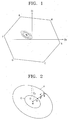
- FIG. 1 an area of skin color indicated in chromaticity coordinates is shown as a distribution of points.
- the x-axis of the graph of FIG. 1 represents a color signal Cb, and the y-axis represents a color signal Cr.
- R represents the position of Red
- G represents the position of Green
- B represents the position of Blue
- C represents the position of Cyan
- M represents the position of Magenta
- Y represents the position of Yellow.
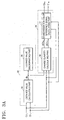
- FIG. 2 is an enlarged drawing of the skin color area of FIG. 1.
- an area of a skin color in chromaticity coordinates is divided into a typical skin-color-area (typical color area, inside inner oval) and an untypical skin-color-area (untypical color area, between outer and inner ovals) which surrounds the typical skin-color-area.
- an input pixel value is adjusted so that P approaches P', that is, a pixel existing in the untypical color area approaches the typical color area using this distribution model of skin color, thereby reproducing skin color as a standardized value of an input pixel.
- the present invention is different from the above-mentioned U.S. Patent No. 5,384,601 in that standardization of an input pixel is based on a predetermined area, i.e., the typical color area not just a single point, to reflect human visual characteristics.
- a predetermined area i.e., the typical color area not just a single point
- the input pixel is standardized as the predetermined area, not just the single point.
- A represents an outermost contour of a skin-color-area
- C represents an outermost contour of a typical color area
- P represents a point with coordinates Cbi and Cri of the color difference signals of an input pixel
- P' represents a standardized point with coordinates Cba and Cra of color difference signals of an input pixel after the coordinates of the input pixel Cbi and Cri are adjusted.
- M represents a point with average coordinates of a typical color
- M' represents a point where a line running through M and P intersects C.
- e represents a vector which is placed toward P centering on M'
- e' represents a vector which is placed toward P' centering on M'.
- D1 represents a distance between M and C, i.e., the approximate width of the typical color area
- D2 represents a distance between M and A, i.e., the approximate width of the skin-color-area.
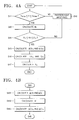
- FIG. 3A shows the structure of an apparatus for reproducing skin color in a video signal according to the present invention.
- the apparatus for reproducing skin color in a video signal largely includes two elements: an input pixel value position discriminating unit 30 comprising a distance value calculating part 34 which calculates a distance between a point P in chromaticity coordinates corresponding to values of two color difference signals of an input pixel, and a point M for which average values of the two color difference signals of the typical color area are used, a distance value discriminating part 35 which discriminates whether the distance value is within the typical color area or the untypical color area; a standardization pixel value obtaining unit 31 comprising a change quantity calculating part 36 which calculates standardized change quantities ⁇ Cba and ⁇ Cra of the values of the color difference signals of the input pixel from an outermost value of a color difference signals in the typical color area, and a standardization color difference signal calculating part 37 which calculates standardized values Cba and Cra of the values of color difference signals of an input pixel using the standardized change quantities ⁇ Cba and ⁇ Cra.
- the distance value calculating part 34 calculates a distance value dp between the point P with the chromaticity coordinates Cbi and Cri of color difference signals of an input pixel, and the point M whose coordinates are average values of the two color difference signals of the typical color area.
- the distance value discriminating part 35 discriminates whether the distance value dp is within the width value of the typical color area or the untypical color area.
- the change quantity calculating part 36 calculates standardized change quantities ⁇ Cba and ⁇ Cra of the values of the color difference signals of the input pixel when the distance value dp is within the typical color area and the untypical color area.
- the standardization color difference signal calculating part 37 calculates standardized values Cba and Cra of color difference signals of the input pixel using standardized change quantities ⁇ Cba and ⁇ Cra.
- FIG. 3B shows the detailed structure of the apparatus for reproducing skin color in a video signal according to an embodiment of the present invention.
- a factor storing unit 32 stores factors, used in elements which will be mentioned later, such as a maximum brightness value Ymaxp of skin color, a minimum brightness value Yminp of the skin color, an average brightness value Ymean of the skin color, a change quantity constant ⁇ Y of the brightness value of the skin color, a standard deviation ⁇ x of the value of the color difference signal Cb of the typical color, a standard deviation ⁇ y of the value of a color difference signal Cr of the skin color, a correlation coefficient p between the color difference signals Cr and Cb, an average value Cbp of the color difference signal Cb of the typical color, an average value Crp of the color difference signal Cr of the skin color, a distance D1 between the point M of the average value of the two color difference signals and the outermost contour of the typical color area, a distance D2 between the point M and the outermost contour of the typical color area,
- An input brightness value discriminating unit 33 receives brightness values Ymaxp and Yminp of the skin color received from the factor storing unit 32 and discriminates whether a brightness value Y of the input pixel satisfies Y min p ⁇ Y ⁇ Y max p . If the brightness value Y of the input pixel does not satisfy the above conditions, this means that the brightness value of the input pixel is not in the range of the brightness value of the skin color. Thus, the input brightness value discriminating unit 33 discriminates whether a brightness value Y of a next input pixel satisfies the above inequality.
- the range of the brightness value of the skin color is experimentally determined.
- the range of the brightness value of the skin color may be determined by evaluating the brightness of the skin color in a set of video chips photographed under various illumination conditions.
- an operation starting signal Enabler A is applied to the distance value calculating part 34 so that the distance value calculating part 34 calculates the distance dp between the point P in the chromaticity coordinates of the color difference signals Cbi and Cri and the point M.
- the distance value calculating part 34 receives the factors ⁇ x, ⁇ y, p, Cbp, and Crp from the factor storing unit 32 and calculates the distance dp between the point P in the chromaticity coordinates of the values Cbi and Cri of the two color difference signals and the point M.
- dp is called a squared Mahalanobis distance and is the distance between two groups having constant covariance matrices and different average values.
- Square means a constant density contour of a regular distribution probability density function of the skin-color-area modeled using the two-variable regular distribution.
- Euclid distance is a distance from a plane
- squared Mahalanobis distance is a distance considering increase and decrease in a mountain slope.
- the distance value discriminating part 35 receives the factors D1 and D2 from the factor storing unit 32 and discriminates whether the distance value dp satisfies D1 ⁇ dp ⁇ D 2 . That is, the distance value discriminating part 35 discriminates whether the values of the color difference signals of the input pixel are between the outermost contour C of the typical color and the outermost contour A of the skin-color-area. As a result of discrimination, a standardization subject pixel does not belong to the typical color area but belongs to the skin-color-area, that is, belongs to the untypical color area. The reason why a pixel belonging to the typical color area is not standardized is described above.
- the pixel belonging to the typical color area is adjusted as a single color, human visual characteristics cannot be reflected. Accordingly, in the present embodiment, when the input pixel is in the typical color area, the brightness value of the input pixel and the values of the color difference signals are used without change when they are reproduced in a video display.
- an operation starting signal Enabler B is applied to the change quantity calculating part 36 from the distance value discriminating part 35. Then, the change quantity calculating part 36 obtains values of the color difference signals Cb' and Cr' of a point M' at which a straight line connecting the points M and P to each other intersects an outermost contour C in the typical color area, and calculates differences ⁇ Cb and ⁇ Cr (the length of the vector e) for each of the difference signals between the point M' and the point P.
- the change quantity calculating part 36 calculates a distance between a point P' on a straight line placed in a distance proportional to a standardization index ⁇ assigned to the differences ⁇ Cb and ⁇ Cr and the point M' for standardization of the values Cbi and Cri and calculates standardized change quantities ⁇ Cba and ⁇ Cra(the length of a vector e') of the values Cbi and Cri from the outermost contour in the typical color area.
- ⁇ Cbp and ⁇ Crp represent differences between the average values Cbp and Crp of the color difference signals Cb and Cr at the point M and the values Cbi and Cri of the color difference signals Cb and Cr at the point P.
- ⁇ Cb' and ⁇ Cr' represent differences between the average values Cbp and Crp and the values Cb' and Cr' of the color difference signals Cb and Cr at the point M'.
- the differences ⁇ Cb and ⁇ Cr for each of the difference signals between the point M' and the point P are obtained by Equations 3.
- ⁇ Cb Cbi - Cb'
- ⁇ Cr Cri - Cr'
- ⁇ Cb and ⁇ Cr should be adjusted for standardization of the values Cri and Cbi.
- a standardization index ⁇ is assigned to ⁇ Cb and ⁇ Cr.
- ⁇ is obtained by Equations 4.
- s is a value set in the factor storing unit 32, and is called a strength constant, and corresponds to an initial value (or offset) of the standardization index ⁇ .
- a(d) is a linear function and is used as a functional parameter for introduction of ⁇ .
- ⁇ is between 0 and 1.
- the standardization color difference signal calculating part 37 calculates the standardized values Cba and Cra of the color difference signals of the input pixel using ⁇ Cba and ⁇ Cra.
- the values Cba and Cra are obtained by Equations 6.
- the values Cbi and Cri are changed into the standardized values Cba and Cra, and the standardized values Cba and Cra are reproduced as color difference signals of a video display.
- the apparatus for reproducing skin color in a video signal according to the present invention further includes a brightness strengthening unit 38 which adjusts the brightness value Y of the input pixel using a predetermined method and generates a strengthened value Ya of a brightness signal.
- a brightness signal is not adjusted, and only a color signal is adjusted to reproduce the skin color.
- An example of a prior-art method for adjusting a brightness signal is the above-mentioned U.S. Patent No. 5,384,601.
- the method comprises changing a brightness value of an input pixel into a specific and typical brightness value of skin color.
- the specific brightness value of the input pixel is reduced.
- skin color becomes darker, that is, the brightness value of the skin color decreases, due to a secondary effect caused by black level improvement for adjusting a black level in a video signal or an automatic contrast level for adjusting the beam strength of a cathode ray tube. For these reasons, strengthening the brightness value of the input pixel is necessary.
- a value which is obtained by dividing ( ⁇ Y+Ymean-Yminp) by (Ymean-Yminp) is assigned to Y as a coefficient w11, and then, a corrected value w12 of the minimum brightness value Yminp is added to w11 x Y as an offset, thereby obtaining Ya.
- ⁇ Y is an experimentally determined change quantity constant of a brightness value of skin color.
- the value of ⁇ Y is 5.
- the input pixel is standardized by adjusting the values Y, Cbi, and Cri of the input pixel as Ya, Cba, and Cra to approach the typical color area, and thus, the video display can reproduce skin color using the standardized values.
- a method for reproducing skin color in a video signal according to the present invention largely comprises two steps.
- the first step is discriminating an input pixel value position by calculating a distance between a point P in chromaticity coordinates at which values of color difference signals of an input pixel are used, and a point M at which an average value of the color difference signals of the typical color area is used, and discriminating whether the distance value is between a width value of the typical color area and a width value of the untypical color area.
- the second step is obtaining a standardization pixel value by calculating standardized change quantities from an outermost value of color difference signals in the typical color area of the values of the color difference signals of the input pixel and calculating standardized values Cba and Cra of color difference signals of the input pixel using the standardized change quantities.
- FIG. 4A is a flowchart illustrating a method for reproducing skin color in a video signal according to an embodiment of the present invention.
- S41 by discriminating whether the brightness value Y of the input pixel is between the minimum brightness value Yminp and the maximum brightness value Ymaxp of the skin color (S41), it is discriminated whether the input pixel has a brightness value of a skin color.
- S41 is a first step of discriminating whether the input pixel is a standardization subject pixel.
- step S42 a next input pixel is processed.
- step of calculating a distance dp between a point P of the input pixel and a point M of an average value of color difference signals of a typical color is calculating a distance dp using factors such as ⁇ x, ⁇ y, p, Cbp, and Crp.
- dp is obtained by Equation 1 presented above.
- the brightness value of the input pixel is first evaluated to discriminate whether the standardization subject pixel in step S41. Then, it is discriminated whether the color difference signals of the input pixel have values of standardization subject color difference signals.
- step S44 the position of the point which represents the values of the standardization subject color difference signals should be between the outermost contour of the typical color area and the outermost contour of the skin-color-area. Even when the color difference signals of the input pixel satisfy the above conditions of step S41, if they do not satisfy the conditions of step (S44), the input pixel is excluded from being a standardization object.
- Such a standardization non-subject input pixel is a pixel that is in the typical color area or outside the skin-color-area. Thus, if the color difference signals of the input pixel are in the typical color are or outside of the skin-color-area, a next input pixel is processed in step S42.
- step S45 comprises calculating values Cb' and Cr' of color difference signals of an outermost contour point M' of the typical color area and change quantities ⁇ Cb and ⁇ Cr of the values Cbi and Cri from the values Cb' and Cr' (S451), obtaining a standardization index ⁇ for standardization of the values Cbi and Cri (S452), and calculating the change quantities ⁇ Cba and ⁇ Cra by assigning the standardization index ⁇ to the change quantities ⁇ Cb and ⁇ Cr (S453).
- each of the values defined in steps S451 through S453 may be obtained by Equations 2 through 5.
- the detailed steps S451 through S453 of S45 are shown in FIG. 4B.
- ⁇ Cba and ⁇ Cra are respectively added to the values Cbi and Cri of the color difference signals of the input pixel, so as to calculate the standardized values Cba and Cra of the color difference signals (S46).
- the method for reproducing skin color in a video signal according to the present invention further comprises obtaining a strengthened brightness value Ya by changing the brightness value Y using a predetermined method (S47).
- the step S47 is necessary for the above-mentioned reasons, and Ya is obtained by Equations 7. Thus, detailed descriptions thereof will be omitted.
- the present invention can be implemented as a computer readable code recorded on a computer readable recording medium.
- the computer readable recording medium may be ROM, RAM, a CD-ROM, a magnetic tape, a floppy disc, and a DVD, or may be carrier waves (i.e., transmission over the Internet).
- the computer readable recording medium may also be installed in a computer system that is connected to a network, and thus the computer readable codes can be stored and executed in a distributed mode.
- standardization is based on a predetermined area other than a single color.
- a prior-art problem that colors are adjusted to orient a single typical color and human visual characteristics cannot be reflected is solved.
- a proper standardization index is assigned to a difference according to brightness value and values of color difference signals of an input pixel other than standardization by a uniform basis, such that skin color is reproduced to be more natural to human eyes, thereby improving the image quality of a digitalized video display.
Landscapes
- Engineering & Computer Science (AREA)
- Multimedia (AREA)
- Signal Processing (AREA)
- Processing Of Color Television Signals (AREA)
- Image Processing (AREA)
- Color Image Communication Systems (AREA)
- Facsimile Image Signal Circuits (AREA)
Applications Claiming Priority (2)
| Application Number | Priority Date | Filing Date | Title |
|---|---|---|---|
| KR2002080060 | 2002-12-14 | ||
| KR1020020080060A KR100543698B1 (ko) | 2002-12-14 | 2002-12-14 | 영상신호의 피부색 재현 장치 및 방법 |
Publications (2)
| Publication Number | Publication Date |
|---|---|
| EP1429565A2 true EP1429565A2 (fr) | 2004-06-16 |
| EP1429565A3 EP1429565A3 (fr) | 2007-06-27 |
Family
ID=32322390
Family Applications (1)
| Application Number | Title | Priority Date | Filing Date |
|---|---|---|---|
| EP03257515A Withdrawn EP1429565A3 (fr) | 2002-12-14 | 2003-11-28 | Procédé et appareil pour reproduire la couleur de peau pour signal video |
Country Status (5)
| Country | Link |
|---|---|
| US (1) | US7792354B2 (fr) |
| EP (1) | EP1429565A3 (fr) |
| JP (1) | JP2004201314A (fr) |
| KR (1) | KR100543698B1 (fr) |
| CN (1) | CN100401786C (fr) |
Cited By (1)
| Publication number | Priority date | Publication date | Assignee | Title |
|---|---|---|---|---|
| EP2133837A4 (fr) * | 2007-03-30 | 2013-07-24 | Mitsubishi Electric Corp | Appareil de traitement d'image et support de stockage de programme |
Families Citing this family (12)
| Publication number | Priority date | Publication date | Assignee | Title |
|---|---|---|---|---|
| JP2006203841A (ja) * | 2004-12-24 | 2006-08-03 | Sharp Corp | 画像処理装置、カメラ装置、画像出力装置、画像処理方法、色補正処理プログラムおよび可読記録媒体 |
| KR100714395B1 (ko) | 2005-02-22 | 2007-05-04 | 삼성전자주식회사 | 입력영상의 색을 선택적으로 조정하는 색변환 장치 및 그방법 |
| US7595920B2 (en) * | 2005-02-23 | 2009-09-29 | Brother Kogyo Kabushiki Kaisha | Processing apparatus and processing method of color image information |
| US7577291B2 (en) * | 2005-03-07 | 2009-08-18 | Oplus Technologies Ltd. | Method of color correction |
| KR100824794B1 (ko) * | 2006-07-18 | 2008-04-24 | 삼성전자주식회사 | 화소 신호의 색을 변경하는 방법 및 장치 |
| KR100834765B1 (ko) * | 2006-12-07 | 2008-06-05 | 삼성전자주식회사 | 선호색을 재현하는 장치 및 방법 |
| KR100843095B1 (ko) | 2006-12-13 | 2008-07-03 | 삼성전자주식회사 | 선호색 재현 장치 및 방법 |
| JP2009059009A (ja) * | 2007-08-30 | 2009-03-19 | Dainippon Printing Co Ltd | 色補正画像画像の作成方法と色補正画像作成装置 |
| EP2068569B1 (fr) * | 2007-12-05 | 2017-01-25 | Vestel Elektronik Sanayi ve Ticaret A.S. | Procédé et appareil de détection et de réglage des valeurs de couleur des pixels du ton de chair |
| CN102096911B (zh) * | 2011-01-31 | 2012-08-01 | 格科微电子(上海)有限公司 | 亮度提升的方法 |
| CN102509070A (zh) * | 2011-10-12 | 2012-06-20 | 西安理工大学 | 一种基于视频的关注广告人数统计的人脸区域跟踪方法 |
| CN104156915A (zh) * | 2014-07-23 | 2014-11-19 | 小米科技有限责任公司 | 肤色调整方法和装置 |
Citations (2)
| Publication number | Priority date | Publication date | Assignee | Title |
|---|---|---|---|---|
| US5130935A (en) | 1986-03-31 | 1992-07-14 | Canon Kabushiki Kaisha | Color image processing apparatus for extracting image data having predetermined color information from among inputted image data and for correcting inputted image data in response to the extracted image data |
| US5384501A (en) | 1990-06-15 | 1995-01-24 | Kabushiki Kaisha Toshiba | Integration circuit including a differential amplifier having a variable transconductance |
Family Cites Families (24)
| Publication number | Priority date | Publication date | Assignee | Title |
|---|---|---|---|---|
| US3253305A (en) * | 1963-09-06 | 1966-05-31 | Simpson Herbert Corp | Mold filling apparatus including a discharge door with flexible leading edge |
| US3748825A (en) * | 1969-05-12 | 1973-07-31 | Dove Inc J B | Film straightener apparatus for wrapping articles in stretchable film |
| US3729578A (en) * | 1971-08-04 | 1973-04-24 | Magnavox Co | Method and apparatus for modifying electrical signals |
| US3873760A (en) * | 1972-10-18 | 1975-03-25 | Gen Electric | Flesh tone correction using color difference signals |
| JPS55149588A (en) * | 1979-05-10 | 1980-11-20 | Matsushita Electric Ind Co Ltd | Color stabilization unit for color television receiver |
| JPH05328118A (ja) * | 1992-05-27 | 1993-12-10 | Sanyo Electric Co Ltd | カラー画像処理方法 |
| JPH0638230A (ja) * | 1992-07-20 | 1994-02-10 | Hitachi Gazou Joho Syst:Kk | 肌色補正及びその装置 |
| JPH0678320A (ja) * | 1992-08-25 | 1994-03-18 | Matsushita Electric Ind Co Ltd | 色調整装置 |
| JP3370770B2 (ja) * | 1994-04-15 | 2003-01-27 | 松下電器産業株式会社 | 映像信号の肌色再生回路 |
| JPH0879549A (ja) * | 1994-09-06 | 1996-03-22 | Fuji Xerox Co Ltd | 画像処理装置 |
| GB9424971D0 (en) * | 1994-12-10 | 1995-02-08 | At & T Global Inf Solution | Document authentication system |
| EP0886437B1 (fr) * | 1997-06-17 | 2004-11-24 | Seiko Epson Corporation | Procédé et dispositif pour le réglage de la couleur |
| JPH1127693A (ja) * | 1997-07-03 | 1999-01-29 | Sony Corp | クロマキー装置 |
| JPH1128305A (ja) * | 1997-07-11 | 1999-02-02 | Taiyo Eng Kk | 重金属含有吸着剤中の油分の回収方法 |
| EP0927952B1 (fr) * | 1997-12-30 | 2003-05-07 | STMicroelectronics S.r.l. | Correction de couleur d'image digitale avec logique floue |
| JP3907810B2 (ja) * | 1998-01-07 | 2007-04-18 | 富士フイルム株式会社 | 3次元ルックアップテーブルの補正法およびこれを行う画像処理装置ならびにこれを備えたデジタルカラープリンタ |
| JPH11275377A (ja) | 1998-03-25 | 1999-10-08 | Fujitsu Ltd | カラーデータ変換方法及びその装置 |
| JP2923894B1 (ja) * | 1998-03-31 | 1999-07-26 | 日本電気株式会社 | 光源判定方法、肌色補正方法、カラー画像補正方法、光源判定装置、肌色補正装置、カラー画像補正装置及びコンピュータ読み取り可能な記録媒体 |
| JP2001186323A (ja) * | 1999-12-24 | 2001-07-06 | Fuji Photo Film Co Ltd | 証明写真システム及び画像処理方法 |
| CN1147723C (zh) * | 2000-03-14 | 2004-04-28 | 华中理工大学 | 产品图象自动检测方法 |
| US6477271B1 (en) * | 2000-04-07 | 2002-11-05 | Avid Technology, Inc. | Secondary color modification of a digital image |
| JP2002033934A (ja) * | 2000-07-18 | 2002-01-31 | Fuji Photo Film Co Ltd | 画像処理装置及び方法 |
| JP2002117402A (ja) * | 2000-10-11 | 2002-04-19 | Orisu:Kk | 画像処理方法及びその装置 |
| KR20040009966A (ko) * | 2002-07-26 | 2004-01-31 | 삼성전자주식회사 | 색 보정장치 및 방법 |
-
2002
- 2002-12-14 KR KR1020020080060A patent/KR100543698B1/ko not_active Expired - Fee Related
-
2003
- 2003-11-28 EP EP03257515A patent/EP1429565A3/fr not_active Withdrawn
- 2003-12-01 US US10/724,050 patent/US7792354B2/en active Active
- 2003-12-01 CN CNB2003101188630A patent/CN100401786C/zh not_active Expired - Fee Related
- 2003-12-15 JP JP2003416873A patent/JP2004201314A/ja active Pending
Patent Citations (2)
| Publication number | Priority date | Publication date | Assignee | Title |
|---|---|---|---|---|
| US5130935A (en) | 1986-03-31 | 1992-07-14 | Canon Kabushiki Kaisha | Color image processing apparatus for extracting image data having predetermined color information from among inputted image data and for correcting inputted image data in response to the extracted image data |
| US5384501A (en) | 1990-06-15 | 1995-01-24 | Kabushiki Kaisha Toshiba | Integration circuit including a differential amplifier having a variable transconductance |
Non-Patent Citations (1)
| Title |
|---|
| PETER BODROGI: "Colour Memory for Various Sky, Skin and Plant Colour-Effect of the Image Context", COLOR RESEARCH AND APPLICATION, vol. 26, no. 4, August 2001 (2001-08-01) |
Cited By (1)
| Publication number | Priority date | Publication date | Assignee | Title |
|---|---|---|---|---|
| EP2133837A4 (fr) * | 2007-03-30 | 2013-07-24 | Mitsubishi Electric Corp | Appareil de traitement d'image et support de stockage de programme |
Also Published As
| Publication number | Publication date |
|---|---|
| KR100543698B1 (ko) | 2006-01-20 |
| JP2004201314A (ja) | 2004-07-15 |
| KR20040053500A (ko) | 2004-06-24 |
| US20040114798A1 (en) | 2004-06-17 |
| US7792354B2 (en) | 2010-09-07 |
| CN1509082A (zh) | 2004-06-30 |
| EP1429565A3 (fr) | 2007-06-27 |
| CN100401786C (zh) | 2008-07-09 |
Similar Documents
| Publication | Publication Date | Title |
|---|---|---|
| US6359703B1 (en) | Image processing apparatus and method | |
| US7068328B1 (en) | Method, apparatus and recording medium for image processing | |
| US7720279B2 (en) | Specifying flesh area on image | |
| US7791649B2 (en) | Apparatus, medium, and method with automatic white balance control | |
| US5278641A (en) | Brightness referenced color image correcting apparatus | |
| US5712925A (en) | Image processing system which maps color image signals within a reproduction range of an output device | |
| EP0967791B1 (fr) | Procédé et appareil de traitement d'image et support d'enregistrement | |
| EP0415648B1 (fr) | Appareil de traitement d'images | |
| EP1326433B1 (fr) | Appareil et méthode de contrôle de luminosité d'image | |
| US7792354B2 (en) | Apparatus and method for reproducing skin color in video signal | |
| US6694051B1 (en) | Image processing method, image processing apparatus and recording medium | |
| JP3992177B2 (ja) | 画像処理装置、画像処理方法及びコンピュータ・プログラム | |
| US7646393B2 (en) | Apparatus and method for adjusting primary color component of image, and computer-readable recording media for storing computer program | |
| US7421120B2 (en) | Apparatus correcting image by luminance histogram | |
| US20010015815A1 (en) | Image forming apparatus which excels in reproducibility of colors, fine lines and gradations even in a copy made from a copied image | |
| EP0595353B1 (fr) | Procédé et appareil pour générer une courbe de normalisation | |
| EP2068569B1 (fr) | Procédé et appareil de détection et de réglage des valeurs de couleur des pixels du ton de chair | |
| US6312101B1 (en) | Method of printing digital images using multiple colorants having substantially the same color | |
| JPH11298736A (ja) | 画像処理方法、画像処理プログラムが記録された可読記録媒体及び画像処理装置 | |
| US8111940B2 (en) | Image correction apparatus and method, and image correction program | |
| US7456998B2 (en) | Image processing apparatus, image processing method, and computer program | |
| US6373993B1 (en) | Image processing method and image processing apparatus | |
| JP4545766B2 (ja) | 画像処理装置、画像形成装置、画像読取装置、画像処理プログラムおよび記録媒体 | |
| US6882451B2 (en) | Method and means for determining estimated relative exposure values from optical density values of photographic media |
Legal Events
| Date | Code | Title | Description |
|---|---|---|---|
| PUAI | Public reference made under article 153(3) epc to a published international application that has entered the european phase |
Free format text: ORIGINAL CODE: 0009012 |
|
| 17P | Request for examination filed |
Effective date: 20031222 |
|
| AK | Designated contracting states |
Kind code of ref document: A2 Designated state(s): AT BE BG CH CY CZ DE DK EE ES FI FR GB GR HU IE IT LI LU MC NL PT RO SE SI SK TR |
|
| AX | Request for extension of the european patent |
Extension state: AL LT LV MK |
|
| PUAL | Search report despatched |
Free format text: ORIGINAL CODE: 0009013 |
|
| AK | Designated contracting states |
Kind code of ref document: A3 Designated state(s): AT BE BG CH CY CZ DE DK EE ES FI FR GB GR HU IE IT LI LU MC NL PT RO SE SI SK TR |
|
| AX | Request for extension of the european patent |
Extension state: AL LT LV MK |
|
| AKX | Designation fees paid |
Designated state(s): DE FR GB |
|
| 17Q | First examination report despatched |
Effective date: 20080408 |
|
| STAA | Information on the status of an ep patent application or granted ep patent |
Free format text: STATUS: THE APPLICATION IS DEEMED TO BE WITHDRAWN |
|
| 18D | Application deemed to be withdrawn |
Effective date: 20100601 |