EP1429754B1 - Kombination ausgewählter opioide mit muscarin-antagonisten zur therapie der harninkontinenz - Google Patents
Kombination ausgewählter opioide mit muscarin-antagonisten zur therapie der harninkontinenz Download PDFInfo
- Publication number
- EP1429754B1 EP1429754B1 EP02779368A EP02779368A EP1429754B1 EP 1429754 B1 EP1429754 B1 EP 1429754B1 EP 02779368 A EP02779368 A EP 02779368A EP 02779368 A EP02779368 A EP 02779368A EP 1429754 B1 EP1429754 B1 EP 1429754B1
- Authority
- EP
- European Patent Office
- Prior art keywords
- alkyl
- chosen
- och
- unsubstituted
- phenyl
- Prior art date
- Legal status (The legal status is an assumption and is not a legal conclusion. Google has not performed a legal analysis and makes no representation as to the accuracy of the status listed.)
- Expired - Lifetime
Links
- 206010046543 Urinary incontinence Diseases 0.000 title claims abstract description 24
- 229940005483 opioid analgesics Drugs 0.000 title abstract description 7
- 239000005557 antagonist Substances 0.000 title description 4
- UQOFGTXDASPNLL-XHNCKOQMSA-N Muscarine Chemical compound C[C@@H]1O[C@H](C[N+](C)(C)C)C[C@H]1O UQOFGTXDASPNLL-XHNCKOQMSA-N 0.000 title 1
- 150000001875 compounds Chemical class 0.000 claims abstract description 104
- 150000003839 salts Chemical class 0.000 claims abstract description 62
- 239000002253 acid Substances 0.000 claims abstract description 31
- XIQVNETUBQGFHX-UHFFFAOYSA-N Ditropan Chemical compound C=1C=CC=CC=1C(O)(C(=O)OCC#CCN(CC)CC)C1CCCCC1 XIQVNETUBQGFHX-UHFFFAOYSA-N 0.000 claims abstract description 27
- 238000011282 treatment Methods 0.000 claims abstract description 14
- PZNRRUTVGXCKFC-IUODEOHRSA-N (2r,3r)-1-(dimethylamino)-3-(3-methoxyphenyl)-2-methylpentan-3-ol Chemical compound CN(C)C[C@@H](C)[C@](O)(CC)C1=CC=CC(OC)=C1 PZNRRUTVGXCKFC-IUODEOHRSA-N 0.000 claims abstract description 13
- 239000003795 chemical substances by application Substances 0.000 claims abstract description 5
- 229910052731 fluorine Inorganic materials 0.000 claims description 178
- 229910052801 chlorine Inorganic materials 0.000 claims description 166
- 229910052739 hydrogen Inorganic materials 0.000 claims description 129
- 229920006395 saturated elastomer Polymers 0.000 claims description 103
- 125000004178 (C1-C4) alkyl group Chemical group 0.000 claims description 62
- 125000000217 alkyl group Chemical group 0.000 claims description 62
- 125000000956 methoxy group Chemical group [H]C([H])([H])O* 0.000 claims description 61
- 125000001997 phenyl group Chemical group [H]C1=C([H])C([H])=C(*)C([H])=C1[H] 0.000 claims description 55
- 239000000203 mixture Substances 0.000 claims description 53
- 125000002496 methyl group Chemical group [H]C([H])([H])* 0.000 claims description 50
- HBAQYPYDRFILMT-UHFFFAOYSA-N 8-[3-(1-cyclopropylpyrazol-4-yl)-1H-pyrazolo[4,3-d]pyrimidin-5-yl]-3-methyl-3,8-diazabicyclo[3.2.1]octan-2-one Chemical class C1(CC1)N1N=CC(=C1)C1=NNC2=C1N=C(N=C2)N1C2C(N(CC1CC2)C)=O HBAQYPYDRFILMT-UHFFFAOYSA-N 0.000 claims description 48
- 125000002023 trifluoromethyl group Chemical group FC(F)(F)* 0.000 claims description 48
- -1 C5-6-cycloalkyl radical Chemical class 0.000 claims description 45
- 125000001797 benzyl group Chemical group [H]C1=C([H])C([H])=C(C([H])=C1[H])C([H])([H])* 0.000 claims description 42
- 229940126062 Compound A Drugs 0.000 claims description 38
- NLDMNSXOCDLTTB-UHFFFAOYSA-N Heterophylliin A Natural products O1C2COC(=O)C3=CC(O)=C(O)C(O)=C3C3=C(O)C(O)=C(O)C=C3C(=O)OC2C(OC(=O)C=2C=C(O)C(O)=C(O)C=2)C(O)C1OC(=O)C1=CC(O)=C(O)C(O)=C1 NLDMNSXOCDLTTB-UHFFFAOYSA-N 0.000 claims description 38
- TVYLLZQTGLZFBW-ZBFHGGJFSA-N (R,R)-tramadol Chemical compound COC1=CC=CC([C@]2(O)[C@H](CCCC2)CN(C)C)=C1 TVYLLZQTGLZFBW-ZBFHGGJFSA-N 0.000 claims description 37
- 125000004169 (C1-C6) alkyl group Chemical group 0.000 claims description 36
- 125000000094 2-phenylethyl group Chemical group [H]C1=C([H])C([H])=C(C([H])=C1[H])C([H])([H])C([H])([H])* 0.000 claims description 36
- 239000012453 solvate Substances 0.000 claims description 36
- 229960004380 tramadol Drugs 0.000 claims description 32
- 150000007513 acids Chemical class 0.000 claims description 28
- 150000003254 radicals Chemical class 0.000 claims description 27
- OOGJQPCLVADCPB-HXUWFJFHSA-N tolterodine Chemical compound C1([C@@H](CCN(C(C)C)C(C)C)C=2C(=CC=C(C)C=2)O)=CC=CC=C1 OOGJQPCLVADCPB-HXUWFJFHSA-N 0.000 claims description 26
- 150000004677 hydrates Chemical class 0.000 claims description 24
- TVYLLZQTGLZFBW-GOEBONIOSA-N tramadol Natural products COC1=CC=CC([C@@]2(O)[C@@H](CCCC2)CN(C)C)=C1 TVYLLZQTGLZFBW-GOEBONIOSA-N 0.000 claims description 21
- VEXZGXHMUGYJMC-UHFFFAOYSA-N Hydrochloric acid Chemical compound Cl VEXZGXHMUGYJMC-UHFFFAOYSA-N 0.000 claims description 20
- 229910052794 bromium Inorganic materials 0.000 claims description 19
- 229910052740 iodine Inorganic materials 0.000 claims description 19
- 125000004076 pyridyl group Chemical group 0.000 claims description 18
- 125000000335 thiazolyl group Chemical group 0.000 claims description 18
- 125000001544 thienyl group Chemical group 0.000 claims description 18
- 229960004045 tolterodine Drugs 0.000 claims description 18
- BDIAUFOIMFAIPU-UHFFFAOYSA-N valepotriate Natural products CC(C)CC(=O)OC1C=C(C(=COC2OC(=O)CC(C)C)COC(C)=O)C2C11CO1 BDIAUFOIMFAIPU-UHFFFAOYSA-N 0.000 claims description 18
- 239000003814 drug Substances 0.000 claims description 17
- 239000000126 substance Substances 0.000 claims description 17
- 125000000999 tert-butyl group Chemical group [H]C([H])([H])C(*)(C([H])([H])[H])C([H])([H])[H] 0.000 claims description 16
- OROGSEYTTFOCAN-UHFFFAOYSA-N hydrocodone Natural products C1C(N(CCC234)C)C2C=CC(O)C3OC2=C4C1=CC=C2OC OROGSEYTTFOCAN-UHFFFAOYSA-N 0.000 claims description 14
- BQJCRHHNABKAKU-KBQPJGBKSA-N morphine Chemical compound O([C@H]1[C@H](C=C[C@H]23)O)C4=C5[C@@]12CCN(C)[C@@H]3CC5=CC=C4O BQJCRHHNABKAKU-KBQPJGBKSA-N 0.000 claims description 14
- XADCESSVHJOZHK-UHFFFAOYSA-N Meperidine Chemical compound C=1C=CC=CC=1C1(C(=O)OCC)CCN(C)CC1 XADCESSVHJOZHK-UHFFFAOYSA-N 0.000 claims description 13
- RMRJXGBAOAMLHD-IHFGGWKQSA-N buprenorphine Chemical compound C([C@]12[C@H]3OC=4C(O)=CC=C(C2=4)C[C@@H]2[C@]11CC[C@]3([C@H](C1)[C@](C)(O)C(C)(C)C)OC)CN2CC1CC1 RMRJXGBAOAMLHD-IHFGGWKQSA-N 0.000 claims description 13
- 229960000482 pethidine Drugs 0.000 claims description 13
- 125000006527 (C1-C5) alkyl group Chemical group 0.000 claims description 12
- ZEUITGRIYCTCEM-KRWDZBQOSA-N (S)-duloxetine Chemical compound C1([C@@H](OC=2C3=CC=CC=C3C=CC=2)CCNC)=CC=CS1 ZEUITGRIYCTCEM-KRWDZBQOSA-N 0.000 claims description 12
- VTXTVLAQPBIPPF-HOCLYGCPSA-N 1-[(1r,2r)-2-(3-methoxyphenyl)cyclohexyl]-n,n-dimethylmethanamine Chemical compound COC1=CC=CC([C@H]2[C@@H](CCCC2)CN(C)C)=C1 VTXTVLAQPBIPPF-HOCLYGCPSA-N 0.000 claims description 12
- JIRYWFYYBBRJAN-UKRRQHHQSA-N 3-[(1s,2s)-2-[(dimethylamino)methyl]cyclohexyl]phenol Chemical compound CN(C)C[C@H]1CCCC[C@@H]1C1=CC=CC(O)=C1 JIRYWFYYBBRJAN-UKRRQHHQSA-N 0.000 claims description 12
- UMTBGMDYYBKESP-ZWNOBZJWSA-N 3-[(2r,3r)-4-(dimethylamino)-2-hydroxy-3-methylbutan-2-yl]phenol Chemical compound CN(C)C[C@@H](C)[C@@](C)(O)C1=CC=CC(O)=C1 UMTBGMDYYBKESP-ZWNOBZJWSA-N 0.000 claims description 12
- KWTWDQCKEHXFFR-RISCZKNCSA-N 3-[(2s,3s)-1-(dimethylamino)-2-methylpentan-3-yl]phenol Chemical compound CN(C)C[C@@H](C)[C@H](CC)C1=CC=CC(O)=C1 KWTWDQCKEHXFFR-RISCZKNCSA-N 0.000 claims description 12
- LQJLLAOISDVBJM-UHFFFAOYSA-N 6-[(dimethylamino)methyl]-1-(3-methoxyphenyl)cyclohexane-1,3-diol Chemical compound COC1=CC=CC(C2(O)C(CCC(O)C2)CN(C)C)=C1 LQJLLAOISDVBJM-UHFFFAOYSA-N 0.000 claims description 12
- JNCMHMUGTWEVOZ-UHFFFAOYSA-N F[CH]F Chemical compound F[CH]F JNCMHMUGTWEVOZ-UHFFFAOYSA-N 0.000 claims description 12
- OROGSEYTTFOCAN-DNJOTXNNSA-N codeine Natural products C([C@H]1[C@H](N(CC[C@@]112)C)C3)=C[C@H](O)[C@@H]1OC1=C2C3=CC=C1OC OROGSEYTTFOCAN-DNJOTXNNSA-N 0.000 claims description 12
- 229960002677 darifenacin Drugs 0.000 claims description 12
- HXGBXQDTNZMWGS-RUZDIDTESA-N darifenacin Chemical compound C=1C=CC=CC=1C([C@H]1CN(CCC=2C=C3CCOC3=CC=2)CC1)(C(=O)N)C1=CC=CC=C1 HXGBXQDTNZMWGS-RUZDIDTESA-N 0.000 claims description 12
- WDEFBBTXULIOBB-WBVHZDCISA-N dextilidine Chemical compound C=1C=CC=CC=1[C@@]1(C(=O)OCC)CCC=C[C@H]1N(C)C WDEFBBTXULIOBB-WBVHZDCISA-N 0.000 claims description 12
- RBOXVHNMENFORY-DNJOTXNNSA-N dihydrocodeine Chemical compound C([C@H]1[C@H](N(CC[C@@]112)C)C3)C[C@H](O)[C@@H]1OC1=C2C3=CC=C1OC RBOXVHNMENFORY-DNJOTXNNSA-N 0.000 claims description 12
- 229960002866 duloxetine Drugs 0.000 claims description 12
- QUPDWYMUPZLYJZ-UHFFFAOYSA-N ethyl Chemical compound C[CH2] QUPDWYMUPZLYJZ-UHFFFAOYSA-N 0.000 claims description 12
- JIRYWFYYBBRJAN-ZFWWWQNUSA-N faxeladol Chemical compound CN(C)C[C@@H]1CCCC[C@H]1C1=CC=CC(O)=C1 JIRYWFYYBBRJAN-ZFWWWQNUSA-N 0.000 claims description 12
- VUWZPRWSIVNGKG-UHFFFAOYSA-N fluoromethane Chemical compound F[CH2] VUWZPRWSIVNGKG-UHFFFAOYSA-N 0.000 claims description 12
- 229960000365 meptazinol Drugs 0.000 claims description 12
- JLICHNCFTLFZJN-HNNXBMFYSA-N meptazinol Chemical compound C=1C=CC(O)=CC=1[C@@]1(CC)CCCCN(C)C1 JLICHNCFTLFZJN-HNNXBMFYSA-N 0.000 claims description 12
- 125000006237 oxymethylenoxy group Chemical group [H]C([H])([*:1])[*:2] 0.000 claims description 12
- KWTWDQCKEHXFFR-SMDDNHRTSA-N tapentadol Chemical compound CN(C)C[C@H](C)[C@@H](CC)C1=CC=CC(O)=C1 KWTWDQCKEHXFFR-SMDDNHRTSA-N 0.000 claims description 12
- 125000000876 trifluoromethoxy group Chemical group FC(F)(F)O* 0.000 claims description 12
- 125000001889 triflyl group Chemical group FC(F)(F)S(*)(=O)=O 0.000 claims description 12
- XYYVYLMBEZUESM-UHFFFAOYSA-N dihydrocodeine Natural products C1C(N(CCC234)C)C2C=CC(=O)C3OC2=C4C1=CC=C2OC XYYVYLMBEZUESM-UHFFFAOYSA-N 0.000 claims description 10
- 229960001736 buprenorphine Drugs 0.000 claims description 9
- 229960000805 nalbuphine Drugs 0.000 claims description 9
- NETZHAKZCGBWSS-CEDHKZHLSA-N nalbuphine Chemical compound C([C@]12[C@H]3OC=4C(O)=CC=C(C2=4)C[C@@H]2[C@]1(O)CC[C@@H]3O)CN2CC1CCC1 NETZHAKZCGBWSS-CEDHKZHLSA-N 0.000 claims description 9
- WRRSFOZOETZUPG-FFHNEAJVSA-N (4r,4ar,7s,7ar,12bs)-9-methoxy-3-methyl-2,4,4a,7,7a,13-hexahydro-1h-4,12-methanobenzofuro[3,2-e]isoquinoline-7-ol;hydrate Chemical compound O.C([C@H]1[C@H](N(CC[C@@]112)C)C3)=C[C@H](O)[C@@H]1OC1=C2C3=CC=C1OC WRRSFOZOETZUPG-FFHNEAJVSA-N 0.000 claims description 8
- 229960004126 codeine Drugs 0.000 claims description 8
- 229960000920 dihydrocodeine Drugs 0.000 claims description 8
- 238000002360 preparation method Methods 0.000 claims description 8
- RKUNBYITZUJHSG-UHFFFAOYSA-N Hyosciamin-hydrochlorid Natural products CN1C(C2)CCC1CC2OC(=O)C(CO)C1=CC=CC=C1 RKUNBYITZUJHSG-UHFFFAOYSA-N 0.000 claims description 7
- 229960000396 atropine Drugs 0.000 claims description 7
- RKUNBYITZUJHSG-SPUOUPEWSA-N atropine Chemical compound O([C@H]1C[C@H]2CC[C@@H](C1)N2C)C(=O)C(CO)C1=CC=CC=C1 RKUNBYITZUJHSG-SPUOUPEWSA-N 0.000 claims description 7
- 125000000113 cyclohexyl group Chemical group [H]C1([H])C([H])([H])C([H])([H])C([H])(*)C([H])([H])C1([H])[H] 0.000 claims description 7
- 125000001449 isopropyl group Chemical group [H]C([H])([H])C([H])(*)C([H])([H])[H] 0.000 claims description 7
- 229960005181 morphine Drugs 0.000 claims description 7
- BDPAJJIAIBKWER-UHFFFAOYSA-N n,n-dimethyl-1-(2-phenylcyclohexyl)methanamine Chemical class CN(C)CC1CCCCC1C1=CC=CC=C1 BDPAJJIAIBKWER-UHFFFAOYSA-N 0.000 claims description 7
- VOKSWYLNZZRQPF-GDIGMMSISA-N pentazocine Chemical compound C1C2=CC=C(O)C=C2[C@@]2(C)[C@@H](C)[C@@H]1N(CC=C(C)C)CC2 VOKSWYLNZZRQPF-GDIGMMSISA-N 0.000 claims description 7
- 229960005301 pentazocine Drugs 0.000 claims description 7
- YBYOJLGHTBBSOM-BXUZGUMPSA-N (2r,3r)-4-(dimethylamino)-2-(3-methoxyphenyl)-3-methylbutan-2-ol Chemical compound COC1=CC=CC([C@](C)(O)[C@H](C)CN(C)C)=C1 YBYOJLGHTBBSOM-BXUZGUMPSA-N 0.000 claims description 6
- DSYYVFJOQLAICR-UHFFFAOYSA-N 1-(dimethylamino)-2-methyl-3-(3-methylsulfanylphenyl)pentan-3-ol Chemical compound CN(C)CC(C)C(O)(CC)C1=CC=CC(SC)=C1 DSYYVFJOQLAICR-UHFFFAOYSA-N 0.000 claims description 6
- PZNRRUTVGXCKFC-UHFFFAOYSA-N 1-(dimethylamino)-3-(3-methoxyphenyl)-2-methylpentan-3-ol Chemical compound CN(C)CC(C)C(O)(CC)C1=CC=CC(OC)=C1 PZNRRUTVGXCKFC-UHFFFAOYSA-N 0.000 claims description 6
- WDVAIHBIAZDPOF-UHFFFAOYSA-N 1-[1-[(dimethylamino)methyl]cyclohexyl]-1-(3-methoxyphenyl)propan-1-ol Chemical compound C1CCCCC1(CN(C)C)C(O)(CC)C1=CC=CC(OC)=C1 WDVAIHBIAZDPOF-UHFFFAOYSA-N 0.000 claims description 6
- CJHTXPLNTROVHR-UHFFFAOYSA-N 3-(3,4-dichlorophenyl)-1-(dimethylamino)-2-methylpentan-3-ol Chemical compound CN(C)CC(C)C(O)(CC)C1=CC=C(Cl)C(Cl)=C1 CJHTXPLNTROVHR-UHFFFAOYSA-N 0.000 claims description 6
- GYDHGSUDUMBHNZ-UHFFFAOYSA-N 3-(4-chlorophenyl)-1-(dimethylamino)-2-methylpentan-3-ol Chemical compound CN(C)CC(C)C(O)(CC)C1=CC=C(Cl)C=C1 GYDHGSUDUMBHNZ-UHFFFAOYSA-N 0.000 claims description 6
- JTHFDCYVTZRONV-HIFRSBDPSA-N 3-[(1r,2r)-2-[(dimethylamino)methyl]-1-fluorocyclohexyl]phenol Chemical compound CN(C)C[C@H]1CCCC[C@]1(F)C1=CC=CC(O)=C1 JTHFDCYVTZRONV-HIFRSBDPSA-N 0.000 claims description 6
- MZDLFGXIEFIURY-UHFFFAOYSA-N 3-[2-[(dimethylamino)methyl]-1-hydroxy-5-(trifluoromethyl)cyclohexyl]phenol Chemical compound CN(C)CC1CCC(C(F)(F)F)CC1(O)C1=CC=CC(O)=C1 MZDLFGXIEFIURY-UHFFFAOYSA-N 0.000 claims description 6
- VIBKCCHMNVUCEA-UHFFFAOYSA-N 3-[3-(difluoromethyl)phenyl]-1-(dimethylamino)-2-methylpentan-3-ol Chemical compound CN(C)CC(C)C(O)(CC)C1=CC=CC(C(F)F)=C1 VIBKCCHMNVUCEA-UHFFFAOYSA-N 0.000 claims description 6
- UMTBGMDYYBKESP-UHFFFAOYSA-N 3-[4-(dimethylamino)-2-hydroxy-3-methylbutan-2-yl]phenol Chemical compound CN(C)CC(C)C(C)(O)C1=CC=CC(O)=C1 UMTBGMDYYBKESP-UHFFFAOYSA-N 0.000 claims description 6
- YBYOJLGHTBBSOM-UHFFFAOYSA-N 4-(dimethylamino)-2-(3-methoxyphenyl)-3-methylbutan-2-ol Chemical compound COC1=CC=CC(C(C)(O)C(C)CN(C)C)=C1 YBYOJLGHTBBSOM-UHFFFAOYSA-N 0.000 claims description 6
- KEBATUUZCBAPEK-UHFFFAOYSA-N 6-[(dimethylamino)methyl]-1-(3-hydroxyphenyl)cyclohexane-1,3-diol Chemical compound CN(C)CC1CCC(O)CC1(O)C1=CC=CC(O)=C1 KEBATUUZCBAPEK-UHFFFAOYSA-N 0.000 claims description 6
- 108010000437 Deamino Arginine Vasopressin Proteins 0.000 claims description 6
- OGDVEMNWJVYAJL-LEPYJNQMSA-N Ethyl morphine Chemical compound C([C@H]1[C@H](N(CC[C@@]112)C)C3)=C[C@H](O)[C@@H]1OC1=C2C3=CC=C1OCC OGDVEMNWJVYAJL-LEPYJNQMSA-N 0.000 claims description 6
- UIQMVEYFGZJHCZ-SSTWWWIQSA-N Nalorphine Chemical compound C([C@@H](N(CC1)CC=C)[C@@H]2C=C[C@@H]3O)C4=CC=C(O)C5=C4[C@@]21[C@H]3O5 UIQMVEYFGZJHCZ-SSTWWWIQSA-N 0.000 claims description 6
- VVWYOYDLCMFIEM-UHFFFAOYSA-N Propantheline Chemical compound C1=CC=C2C(C(=O)OCC[N+](C)(C(C)C)C(C)C)C3=CC=CC=C3OC2=C1 VVWYOYDLCMFIEM-UHFFFAOYSA-N 0.000 claims description 6
- LQJLLAOISDVBJM-FMKPAKJESA-N axomadol Chemical compound COC1=CC=CC([C@]2(O)[C@H](CC[C@@H](O)C2)CN(C)C)=C1 LQJLLAOISDVBJM-FMKPAKJESA-N 0.000 claims description 6
- 229960001113 butorphanol Drugs 0.000 claims description 6
- IFKLAQQSCNILHL-QHAWAJNXSA-N butorphanol Chemical compound N1([C@@H]2CC3=CC=C(C=C3[C@@]3([C@]2(CCCC3)O)CC1)O)CC1CCC1 IFKLAQQSCNILHL-QHAWAJNXSA-N 0.000 claims description 6
- 229960004281 desmopressin Drugs 0.000 claims description 6
- NFLWUMRGJYTJIN-NXBWRCJVSA-N desmopressin Chemical compound C([C@H]1C(=O)N[C@H](C(N[C@@H](CC(N)=O)C(=O)N[C@@H](CSSCCC(=O)N[C@@H](CC=2C=CC(O)=CC=2)C(=O)N1)C(=O)N1[C@@H](CCC1)C(=O)N[C@@H](CCCNC(N)=N)C(=O)NCC(N)=O)=O)CCC(=O)N)C1=CC=CC=C1 NFLWUMRGJYTJIN-NXBWRCJVSA-N 0.000 claims description 6
- HYPPXZBJBPSRLK-UHFFFAOYSA-N diphenoxylate Chemical compound C1CC(C(=O)OCC)(C=2C=CC=CC=2)CCN1CCC(C#N)(C=1C=CC=CC=1)C1=CC=CC=C1 HYPPXZBJBPSRLK-UHFFFAOYSA-N 0.000 claims description 6
- 229960004192 diphenoxylate Drugs 0.000 claims description 6
- 229960002236 emepronium Drugs 0.000 claims description 6
- JEJBJBKVPOWOQK-UHFFFAOYSA-N emepronium Chemical compound C=1C=CC=CC=1C(CC(C)[N+](C)(C)CC)C1=CC=CC=C1 JEJBJBKVPOWOQK-UHFFFAOYSA-N 0.000 claims description 6
- BCGWQEUPMDMJNV-UHFFFAOYSA-N imipramine Chemical compound C1CC2=CC=CC=C2N(CCCN(C)C)C2=CC=CC=C21 BCGWQEUPMDMJNV-UHFFFAOYSA-N 0.000 claims description 6
- XBMIVRRWGCYBTQ-AVRDEDQJSA-N levacetylmethadol Chemical compound C=1C=CC=CC=1C(C[C@H](C)N(C)C)([C@@H](OC(C)=O)CC)C1=CC=CC=C1 XBMIVRRWGCYBTQ-AVRDEDQJSA-N 0.000 claims description 6
- 229960000938 nalorphine Drugs 0.000 claims description 6
- UWJUQVWARXYRCG-UHFFFAOYSA-N o-desmethyltramadol Chemical compound CN(C)CC1CCCCC1(O)C1=CC=CC(O)=C1 UWJUQVWARXYRCG-UHFFFAOYSA-N 0.000 claims description 6
- 229960001491 trospium Drugs 0.000 claims description 6
- OYYDSUSKLWTMMQ-JKHIJQBDSA-N trospium Chemical compound [N+]12([C@@H]3CC[C@H]2C[C@H](C3)OC(=O)C(O)(C=2C=CC=CC=2)C=2C=CC=CC=2)CCCC1 OYYDSUSKLWTMMQ-JKHIJQBDSA-N 0.000 claims description 6
- 229960002825 viminol Drugs 0.000 claims description 6
- ZILPIBYANAFGMS-UHFFFAOYSA-N viminol Chemical compound CCC(C)N(C(C)CC)CC(O)C1=CC=CN1CC1=CC=CC=C1Cl ZILPIBYANAFGMS-UHFFFAOYSA-N 0.000 claims description 6
- 229930003347 Atropine Natural products 0.000 claims description 5
- QPCVHQBVMYCJOM-UHFFFAOYSA-N Propiverine Chemical compound C=1C=CC=CC=1C(C=1C=CC=CC=1)(OCCC)C(=O)OC1CCN(C)CC1 QPCVHQBVMYCJOM-UHFFFAOYSA-N 0.000 claims description 5
- 229960004801 imipramine Drugs 0.000 claims description 5
- 229960003510 propiverine Drugs 0.000 claims description 5
- QSHYRDQULOQBSQ-UHFFFAOYSA-N 1-(dimethylamino)-3-(3-methoxyphenyl)-4,4-dimethylpentan-3-ol Chemical compound COC1=CC=CC(C(O)(CCN(C)C)C(C)(C)C)=C1 QSHYRDQULOQBSQ-UHFFFAOYSA-N 0.000 claims description 4
- GVSLZYPVERZJGU-BJJXKVORSA-N 3-[(1r,2r,5s)-2-[(dimethylamino)methyl]-1-hydroxy-5-methylcyclohexyl]phenol Chemical compound C1[C@@H](C)CC[C@H](CN(C)C)[C@@]1(O)C1=CC=CC(O)=C1 GVSLZYPVERZJGU-BJJXKVORSA-N 0.000 claims description 4
- OGDVEMNWJVYAJL-UHFFFAOYSA-N Ethylmorphine Natural products C1C(N(CCC234)C)C2C=CC(O)C3OC2=C4C1=CC=C2OCC OGDVEMNWJVYAJL-UHFFFAOYSA-N 0.000 claims description 4
- UWJUQVWARXYRCG-HIFRSBDPSA-N O-Desmethyltramadol Chemical compound CN(C)C[C@H]1CCCC[C@]1(O)C1=CC=CC(O)=C1 UWJUQVWARXYRCG-HIFRSBDPSA-N 0.000 claims description 4
- CBFGWFWDTULPPI-CXAGYDPISA-N [(2r,3r)-1-(dimethylamino)-3-(3-methoxyphenyl)-2-methylpentan-3-yl] acetate Chemical compound CN(C)C[C@@H](C)[C@](OC(C)=O)(CC)C1=CC=CC(OC)=C1 CBFGWFWDTULPPI-CXAGYDPISA-N 0.000 claims description 4
- 150000002148 esters Chemical class 0.000 claims description 4
- 229960004578 ethylmorphine Drugs 0.000 claims description 4
- 229960002428 fentanyl Drugs 0.000 claims description 4
- PJMPHNIQZUBGLI-UHFFFAOYSA-N fentanyl Chemical compound C=1C=CC=CC=1N(C(=O)CC)C(CC1)CCN1CCC1=CC=CC=C1 PJMPHNIQZUBGLI-UHFFFAOYSA-N 0.000 claims description 4
- 229960000697 propantheline Drugs 0.000 claims description 4
- GVGLGOZIDCSQPN-PVHGPHFFSA-N Heroin Chemical compound O([C@H]1[C@H](C=C[C@H]23)OC(C)=O)C4=C5[C@@]12CCN(C)[C@@H]3CC5=CC=C4OC(C)=O GVGLGOZIDCSQPN-PVHGPHFFSA-N 0.000 claims description 3
- JAQUASYNZVUNQP-USXIJHARSA-N Levorphanol Chemical compound C1C2=CC=C(O)C=C2[C@]23CCN(C)[C@H]1[C@@H]2CCCC3 JAQUASYNZVUNQP-USXIJHARSA-N 0.000 claims description 3
- IDBPHNDTYPBSNI-UHFFFAOYSA-N N-(1-(2-(4-Ethyl-5-oxo-2-tetrazolin-1-yl)ethyl)-4-(methoxymethyl)-4-piperidyl)propionanilide Chemical compound C1CN(CCN2C(N(CC)N=N2)=O)CCC1(COC)N(C(=O)CC)C1=CC=CC=C1 IDBPHNDTYPBSNI-UHFFFAOYSA-N 0.000 claims description 3
- BRUQQQPBMZOVGD-XFKAJCMBSA-N Oxycodone Chemical compound O=C([C@@H]1O2)CC[C@@]3(O)[C@H]4CC5=CC=C(OC)C2=C5[C@@]13CCN4C BRUQQQPBMZOVGD-XFKAJCMBSA-N 0.000 claims description 3
- ZTVQQQVZCWLTDF-UHFFFAOYSA-N Remifentanil Chemical compound C1CN(CCC(=O)OC)CCC1(C(=O)OC)N(C(=O)CC)C1=CC=CC=C1 ZTVQQQVZCWLTDF-UHFFFAOYSA-N 0.000 claims description 3
- 239000000654 additive Substances 0.000 claims description 3
- 229960001391 alfentanil Drugs 0.000 claims description 3
- LLPOLZWFYMWNKH-CMKMFDCUSA-N hydrocodone Chemical compound C([C@H]1[C@H](N(CC[C@@]112)C)C3)CC(=O)[C@@H]1OC1=C2C3=CC=C1OC LLPOLZWFYMWNKH-CMKMFDCUSA-N 0.000 claims description 3
- 229960000240 hydrocodone Drugs 0.000 claims description 3
- WVLOADHCBXTIJK-YNHQPCIGSA-N hydromorphone Chemical compound O([C@H]1C(CC[C@H]23)=O)C4=C5[C@@]12CCN(C)[C@@H]3CC5=CC=C4O WVLOADHCBXTIJK-YNHQPCIGSA-N 0.000 claims description 3
- 229960001410 hydromorphone Drugs 0.000 claims description 3
- 229960003406 levorphanol Drugs 0.000 claims description 3
- NMXXDRKTOJAAQS-UHFFFAOYSA-N n,n-dimethyl-3-phenylpropan-1-amine Chemical class CN(C)CCCC1=CC=CC=C1 NMXXDRKTOJAAQS-UHFFFAOYSA-N 0.000 claims description 3
- IHEHEFLXQFOQJO-UHFFFAOYSA-N piritramide Chemical compound C1CC(C(=O)N)(N2CCCCC2)CCN1CCC(C#N)(C=1C=CC=CC=1)C1=CC=CC=C1 IHEHEFLXQFOQJO-UHFFFAOYSA-N 0.000 claims description 3
- 229960001286 piritramide Drugs 0.000 claims description 3
- 229960003394 remifentanil Drugs 0.000 claims description 3
- 229960004739 sufentanil Drugs 0.000 claims description 3
- GGCSSNBKKAUURC-UHFFFAOYSA-N sufentanil Chemical compound C1CN(CCC=2SC=CC=2)CCC1(COC)N(C(=O)CC)C1=CC=CC=C1 GGCSSNBKKAUURC-UHFFFAOYSA-N 0.000 claims description 3
- ALFGKMXHOUSVAD-UHFFFAOYSA-N Ketobemidone Chemical compound C=1C=CC(O)=CC=1C1(C(=O)CC)CCN(C)CC1 ALFGKMXHOUSVAD-UHFFFAOYSA-N 0.000 claims description 2
- INUNXTSAACVKJS-OAQYLSRUSA-N dextromoramide Chemical compound C([C@@H](C)C(C(=O)N1CCCC1)(C=1C=CC=CC=1)C=1C=CC=CC=1)N1CCOCC1 INUNXTSAACVKJS-OAQYLSRUSA-N 0.000 claims description 2
- 229960003701 dextromoramide Drugs 0.000 claims description 2
- CAHCBJPUTCKATP-FAWZKKEFSA-N etorphine Chemical compound O([C@H]1[C@@]2(OC)C=C[C@@]34C[C@@H]2[C@](C)(O)CCC)C2=C5[C@]41CCN(C)[C@@H]3CC5=CC=C2O CAHCBJPUTCKATP-FAWZKKEFSA-N 0.000 claims description 2
- 229950004155 etorphine Drugs 0.000 claims description 2
- 229960003029 ketobemidone Drugs 0.000 claims description 2
- 229960002085 oxycodone Drugs 0.000 claims description 2
- LLPOLZWFYMWNKH-UHFFFAOYSA-N trans-dihydrocodeinone Natural products C1C(N(CCC234)C)C2CCC(=O)C3OC2=C4C1=CC=C2OC LLPOLZWFYMWNKH-UHFFFAOYSA-N 0.000 claims description 2
- 125000006273 (C1-C3) alkyl group Chemical group 0.000 claims 12
- 229960004193 dextropropoxyphene Drugs 0.000 claims 4
- XLMALTXPSGQGBX-GCJKJVERSA-N dextropropoxyphene Chemical compound C([C@](OC(=O)CC)([C@H](C)CN(C)C)C=1C=CC=CC=1)C1=CC=CC=C1 XLMALTXPSGQGBX-GCJKJVERSA-N 0.000 claims 4
- 229960001402 tilidine Drugs 0.000 claims 4
- 229960003461 dezocine Drugs 0.000 claims 2
- VTMVHDZWSFQSQP-VBNZEHGJSA-N dezocine Chemical compound C1CCCC[C@H]2CC3=CC=C(O)C=C3[C@]1(C)[C@H]2N VTMVHDZWSFQSQP-VBNZEHGJSA-N 0.000 claims 2
- 229960002710 levomethadone Drugs 0.000 claims 1
- USSIQXCVUWKGNF-QGZVFWFLSA-N levomethadone Chemical compound C=1C=CC=CC=1C(C[C@@H](C)N(C)C)(C(=O)CC)C1=CC=CC=C1 USSIQXCVUWKGNF-QGZVFWFLSA-N 0.000 claims 1
- 238000000034 method Methods 0.000 abstract description 6
- 229960005434 oxybutynin Drugs 0.000 abstract description 3
- 239000008194 pharmaceutical composition Substances 0.000 abstract description 3
- 235000002639 sodium chloride Nutrition 0.000 description 39
- 125000003118 aryl group Chemical group 0.000 description 16
- 125000000753 cycloalkyl group Chemical group 0.000 description 16
- 239000004480 active ingredient Substances 0.000 description 15
- 206010027566 Micturition urgency Diseases 0.000 description 14
- 239000002585 base Substances 0.000 description 13
- FZNCGRZWXLXZSZ-CIQUZCHMSA-N Voglibose Chemical compound OCC(CO)N[C@H]1C[C@](O)(CO)[C@@H](O)[C@H](O)[C@H]1O FZNCGRZWXLXZSZ-CIQUZCHMSA-N 0.000 description 12
- 230000000694 effects Effects 0.000 description 11
- 229940079593 drug Drugs 0.000 description 8
- 230000008602 contraction Effects 0.000 description 7
- 230000001022 anti-muscarinic effect Effects 0.000 description 6
- 125000001072 heteroaryl group Chemical group 0.000 description 6
- 239000003149 muscarinic antagonist Substances 0.000 description 6
- FAPWRFPIFSIZLT-UHFFFAOYSA-M Sodium chloride Chemical compound [Na+].[Cl-] FAPWRFPIFSIZLT-UHFFFAOYSA-M 0.000 description 5
- 229910052799 carbon Inorganic materials 0.000 description 5
- 0 C[C@@](CC[C@@]1CN(C)C)C[C@]1(*)c(c(*)c1O*)c(*)c(C)c1I Chemical compound C[C@@](CC[C@@]1CN(C)C)C[C@]1(*)c(c(*)c1O*)c(*)c(C)c1I 0.000 description 4
- SIKJAQJRHWYJAI-UHFFFAOYSA-N Indole Chemical compound C1=CC=C2NC=CC2=C1 SIKJAQJRHWYJAI-UHFFFAOYSA-N 0.000 description 4
- 241000700159 Rattus Species 0.000 description 4
- 230000000202 analgesic effect Effects 0.000 description 4
- 150000001450 anions Chemical class 0.000 description 4
- 150000001768 cations Chemical class 0.000 description 4
- 125000005842 heteroatom Chemical group 0.000 description 4
- BXWNKGSJHAJOGX-UHFFFAOYSA-N hexadecan-1-ol Chemical compound CCCCCCCCCCCCCCCCO BXWNKGSJHAJOGX-UHFFFAOYSA-N 0.000 description 4
- 230000027939 micturition Effects 0.000 description 4
- 238000006467 substitution reaction Methods 0.000 description 4
- LFQSCWFLJHTTHZ-UHFFFAOYSA-N Ethanol Chemical compound CCO LFQSCWFLJHTTHZ-UHFFFAOYSA-N 0.000 description 3
- LYCAIKOWRPUZTN-UHFFFAOYSA-N Ethylene glycol Chemical compound OCCO LYCAIKOWRPUZTN-UHFFFAOYSA-N 0.000 description 3
- PEDCQBHIVMGVHV-UHFFFAOYSA-N Glycerine Chemical compound OCC(O)CO PEDCQBHIVMGVHV-UHFFFAOYSA-N 0.000 description 3
- 206010021639 Incontinence Diseases 0.000 description 3
- KFZMGEQAYNKOFK-UHFFFAOYSA-N Isopropanol Chemical compound CC(C)O KFZMGEQAYNKOFK-UHFFFAOYSA-N 0.000 description 3
- 241000124008 Mammalia Species 0.000 description 3
- DNIAPMSPPWPWGF-UHFFFAOYSA-N Propylene glycol Chemical compound CC(O)CO DNIAPMSPPWPWGF-UHFFFAOYSA-N 0.000 description 3
- GWEVSGVZZGPLCZ-UHFFFAOYSA-N Titan oxide Chemical compound O=[Ti]=O GWEVSGVZZGPLCZ-UHFFFAOYSA-N 0.000 description 3
- 239000013543 active substance Substances 0.000 description 3
- KRKNYBCHXYNGOX-UHFFFAOYSA-N citric acid Chemical compound OC(=O)CC(O)(C(O)=O)CC(O)=O KRKNYBCHXYNGOX-UHFFFAOYSA-N 0.000 description 3
- 235000014113 dietary fatty acids Nutrition 0.000 description 3
- 239000000194 fatty acid Substances 0.000 description 3
- 229930195729 fatty acid Natural products 0.000 description 3
- 229960004127 naloxone Drugs 0.000 description 3
- UZHSEJADLWPNLE-GRGSLBFTSA-N naloxone Chemical compound O=C([C@@H]1O2)CC[C@@]3(O)[C@H]4CC5=CC=C(O)C2=C5[C@@]13CCN4CC=C UZHSEJADLWPNLE-GRGSLBFTSA-N 0.000 description 3
- NLKNQRATVPKPDG-UHFFFAOYSA-M potassium iodide Chemical compound [K+].[I-] NLKNQRATVPKPDG-UHFFFAOYSA-M 0.000 description 3
- 239000011780 sodium chloride Substances 0.000 description 3
- 210000005070 sphincter Anatomy 0.000 description 3
- 239000003826 tablet Substances 0.000 description 3
- 210000002700 urine Anatomy 0.000 description 3
- KWGRBVOPPLSCSI-WPRPVWTQSA-N (-)-ephedrine Chemical compound CN[C@@H](C)[C@H](O)C1=CC=CC=C1 KWGRBVOPPLSCSI-WPRPVWTQSA-N 0.000 description 2
- 125000006552 (C3-C8) cycloalkyl group Chemical group 0.000 description 2
- FCEHBMOGCRZNNI-UHFFFAOYSA-N 1-benzothiophene Chemical compound C1=CC=C2SC=CC2=C1 FCEHBMOGCRZNNI-UHFFFAOYSA-N 0.000 description 2
- 125000003903 2-propenyl group Chemical group [H]C([*])([H])C([H])=C([H])[H] 0.000 description 2
- USSIQXCVUWKGNF-UHFFFAOYSA-N 6-(dimethylamino)-4,4-diphenylheptan-3-one Chemical compound C=1C=CC=CC=1C(CC(C)N(C)C)(C(=O)CC)C1=CC=CC=C1 USSIQXCVUWKGNF-UHFFFAOYSA-N 0.000 description 2
- UJOBWOGCFQCDNV-UHFFFAOYSA-N 9H-carbazole Chemical compound C1=CC=C2C3=CC=CC=C3NC2=C1 UJOBWOGCFQCDNV-UHFFFAOYSA-N 0.000 description 2
- 241001535291 Analges Species 0.000 description 2
- CIWBSHSKHKDKBQ-JLAZNSOCSA-N Ascorbic acid Chemical compound OC[C@H](O)[C@H]1OC(=O)C(O)=C1O CIWBSHSKHKDKBQ-JLAZNSOCSA-N 0.000 description 2
- YLQBMQCUIZJEEH-UHFFFAOYSA-N Furan Chemical compound C=1C=COC=1 YLQBMQCUIZJEEH-UHFFFAOYSA-N 0.000 description 2
- WQZGKKKJIJFFOK-GASJEMHNSA-N Glucose Natural products OC[C@H]1OC(O)[C@H](O)[C@@H](O)[C@@H]1O WQZGKKKJIJFFOK-GASJEMHNSA-N 0.000 description 2
- OZYUPQUCAUTOBP-QXAKKESOSA-N Levallorphan Chemical compound C([C@H]12)CCC[C@@]11CCN(CC=C)[C@@H]2CC2=CC=C(O)C=C21 OZYUPQUCAUTOBP-QXAKKESOSA-N 0.000 description 2
- TWRXJAOTZQYOKJ-UHFFFAOYSA-L Magnesium chloride Chemical compound [Mg+2].[Cl-].[Cl-] TWRXJAOTZQYOKJ-UHFFFAOYSA-L 0.000 description 2
- CSNNHWWHGAXBCP-UHFFFAOYSA-L Magnesium sulfate Chemical compound [Mg+2].[O-][S+2]([O-])([O-])[O-] CSNNHWWHGAXBCP-UHFFFAOYSA-L 0.000 description 2
- QIAFMBKCNZACKA-UHFFFAOYSA-N N-benzoylglycine Chemical compound OC(=O)CNC(=O)C1=CC=CC=C1 QIAFMBKCNZACKA-UHFFFAOYSA-N 0.000 description 2
- PVNIIMVLHYAWGP-UHFFFAOYSA-N Niacin Chemical compound OC(=O)C1=CC=CN=C1 PVNIIMVLHYAWGP-UHFFFAOYSA-N 0.000 description 2
- 102000003840 Opioid Receptors Human genes 0.000 description 2
- 108090000137 Opioid Receptors Proteins 0.000 description 2
- WCUXLLCKKVVCTQ-UHFFFAOYSA-M Potassium chloride Chemical compound [Cl-].[K+] WCUXLLCKKVVCTQ-UHFFFAOYSA-M 0.000 description 2
- KYQCOXFCLRTKLS-UHFFFAOYSA-N Pyrazine Chemical compound C1=CN=CC=N1 KYQCOXFCLRTKLS-UHFFFAOYSA-N 0.000 description 2
- JUJWROOIHBZHMG-UHFFFAOYSA-N Pyridine Chemical compound C1=CC=NC=C1 JUJWROOIHBZHMG-UHFFFAOYSA-N 0.000 description 2
- KAESVJOAVNADME-UHFFFAOYSA-N Pyrrole Chemical compound C=1C=CNC=1 KAESVJOAVNADME-UHFFFAOYSA-N 0.000 description 2
- SMWDFEZZVXVKRB-UHFFFAOYSA-N Quinoline Chemical compound N1=CC=CC2=CC=CC=C21 SMWDFEZZVXVKRB-UHFFFAOYSA-N 0.000 description 2
- 229920001800 Shellac Polymers 0.000 description 2
- VYPSYNLAJGMNEJ-UHFFFAOYSA-N Silicium dioxide Chemical compound O=[Si]=O VYPSYNLAJGMNEJ-UHFFFAOYSA-N 0.000 description 2
- YTPLMLYBLZKORZ-UHFFFAOYSA-N Thiophene Chemical compound C=1C=CSC=1 YTPLMLYBLZKORZ-UHFFFAOYSA-N 0.000 description 2
- RZOXEODOFNEZRS-UHFFFAOYSA-N Tramazoline hydrochloride Chemical compound [Cl-].N1CCN=C1[NH2+]C1=CC=CC2=C1CCCC2 RZOXEODOFNEZRS-UHFFFAOYSA-N 0.000 description 2
- XLOMVQKBTHCTTD-UHFFFAOYSA-N Zinc monoxide Chemical compound [Zn]=O XLOMVQKBTHCTTD-UHFFFAOYSA-N 0.000 description 2
- 229940081735 acetylcellulose Drugs 0.000 description 2
- 229950005506 acetylmethadol Drugs 0.000 description 2
- 229910052784 alkaline earth metal Inorganic materials 0.000 description 2
- 125000002947 alkylene group Chemical group 0.000 description 2
- 229940035676 analgesics Drugs 0.000 description 2
- 239000000730 antalgic agent Substances 0.000 description 2
- WPYMKLBDIGXBTP-UHFFFAOYSA-N benzoic acid Chemical compound OC(=O)C1=CC=CC=C1 WPYMKLBDIGXBTP-UHFFFAOYSA-N 0.000 description 2
- IOJUPLGTWVMSFF-UHFFFAOYSA-N benzothiazole Chemical compound C1=CC=C2SC=NC2=C1 IOJUPLGTWVMSFF-UHFFFAOYSA-N 0.000 description 2
- WQZGKKKJIJFFOK-VFUOTHLCSA-N beta-D-glucose Chemical compound OC[C@H]1O[C@@H](O)[C@H](O)[C@@H](O)[C@@H]1O WQZGKKKJIJFFOK-VFUOTHLCSA-N 0.000 description 2
- 230000037396 body weight Effects 0.000 description 2
- 239000001506 calcium phosphate Substances 0.000 description 2
- OSGAYBCDTDRGGQ-UHFFFAOYSA-L calcium sulfate Chemical compound [Ca+2].[O-]S([O-])(=O)=O OSGAYBCDTDRGGQ-UHFFFAOYSA-L 0.000 description 2
- 239000002775 capsule Substances 0.000 description 2
- 125000004432 carbon atom Chemical group C* 0.000 description 2
- 229920002301 cellulose acetate Polymers 0.000 description 2
- 229960000541 cetyl alcohol Drugs 0.000 description 2
- 125000001495 ethyl group Chemical group [H]C([H])([H])C([H])([H])* 0.000 description 2
- 238000009472 formulation Methods 0.000 description 2
- 229940093915 gynecological organic acid Drugs 0.000 description 2
- 125000004051 hexyl group Chemical group [H]C([H])([H])C([H])([H])C([H])([H])C([H])([H])C([H])([H])C([H])([H])* 0.000 description 2
- PZOUSPYUWWUPPK-UHFFFAOYSA-N indole Natural products CC1=CC=CC2=C1C=CN2 PZOUSPYUWWUPPK-UHFFFAOYSA-N 0.000 description 2
- RKJUIXBNRJVNHR-UHFFFAOYSA-N indolenine Natural products C1=CC=C2CC=NC2=C1 RKJUIXBNRJVNHR-UHFFFAOYSA-N 0.000 description 2
- 230000005764 inhibitory process Effects 0.000 description 2
- AWJUIBRHMBBTKR-UHFFFAOYSA-N isoquinoline Chemical compound C1=NC=CC2=CC=CC=C21 AWJUIBRHMBBTKR-UHFFFAOYSA-N 0.000 description 2
- 229960000263 levallorphan Drugs 0.000 description 2
- HQKMJHAJHXVSDF-UHFFFAOYSA-L magnesium stearate Chemical compound [Mg+2].CCCCCCCCCCCCCCCCCC([O-])=O.CCCCCCCCCCCCCCCCCC([O-])=O HQKMJHAJHXVSDF-UHFFFAOYSA-L 0.000 description 2
- 238000004519 manufacturing process Methods 0.000 description 2
- 150000007522 mineralic acids Chemical class 0.000 description 2
- 102000051367 mu Opioid Receptors Human genes 0.000 description 2
- DQCKKXVULJGBQN-XFWGSAIBSA-N naltrexone Chemical compound N1([C@@H]2CC3=CC=C(C=4O[C@@H]5[C@](C3=4)([C@]2(CCC5=O)O)CC1)O)CC1CC1 DQCKKXVULJGBQN-XFWGSAIBSA-N 0.000 description 2
- 229960003086 naltrexone Drugs 0.000 description 2
- 150000007524 organic acids Chemical class 0.000 description 2
- 235000005985 organic acids Nutrition 0.000 description 2
- 239000000546 pharmaceutical excipient Substances 0.000 description 2
- 239000006187 pill Substances 0.000 description 2
- 230000008092 positive effect Effects 0.000 description 2
- IOLCXVTUBQKXJR-UHFFFAOYSA-M potassium bromide Chemical compound [K+].[Br-] IOLCXVTUBQKXJR-UHFFFAOYSA-M 0.000 description 2
- 230000011514 reflex Effects 0.000 description 2
- 230000001020 rhythmical effect Effects 0.000 description 2
- 239000004208 shellac Substances 0.000 description 2
- ZLGIYFNHBLSMPS-ATJNOEHPSA-N shellac Chemical compound OCCCCCC(O)C(O)CCCCCCCC(O)=O.C1C23[C@H](C(O)=O)CCC2[C@](C)(CO)[C@@H]1C(C(O)=O)=C[C@@H]3O ZLGIYFNHBLSMPS-ATJNOEHPSA-N 0.000 description 2
- 229940113147 shellac Drugs 0.000 description 2
- 235000013874 shellac Nutrition 0.000 description 2
- 239000000243 solution Substances 0.000 description 2
- 230000002269 spontaneous effect Effects 0.000 description 2
- 125000001424 substituent group Chemical group 0.000 description 2
- 239000000829 suppository Substances 0.000 description 2
- 230000001629 suppression Effects 0.000 description 2
- 239000000725 suspension Substances 0.000 description 2
- 238000013268 sustained release Methods 0.000 description 2
- 239000012730 sustained-release form Substances 0.000 description 2
- 238000012360 testing method Methods 0.000 description 2
- 230000001225 therapeutic effect Effects 0.000 description 2
- 210000000626 ureter Anatomy 0.000 description 2
- 230000002485 urinary effect Effects 0.000 description 2
- 239000003981 vehicle Substances 0.000 description 2
- 125000000391 vinyl group Chemical group [H]C([*])=C([H])[H] 0.000 description 2
- XLYOFNOQVPJJNP-UHFFFAOYSA-N water Substances O XLYOFNOQVPJJNP-UHFFFAOYSA-N 0.000 description 2
- 239000001993 wax Substances 0.000 description 2
- 108020001612 μ-opioid receptors Proteins 0.000 description 2
- LNAZSHAWQACDHT-XIYTZBAFSA-N (2r,3r,4s,5r,6s)-4,5-dimethoxy-2-(methoxymethyl)-3-[(2s,3r,4s,5r,6r)-3,4,5-trimethoxy-6-(methoxymethyl)oxan-2-yl]oxy-6-[(2r,3r,4s,5r,6r)-4,5,6-trimethoxy-2-(methoxymethyl)oxan-3-yl]oxyoxane Chemical compound CO[C@@H]1[C@@H](OC)[C@H](OC)[C@@H](COC)O[C@H]1O[C@H]1[C@H](OC)[C@@H](OC)[C@H](O[C@H]2[C@@H]([C@@H](OC)[C@H](OC)O[C@@H]2COC)OC)O[C@@H]1COC LNAZSHAWQACDHT-XIYTZBAFSA-N 0.000 description 1
- 125000000008 (C1-C10) alkyl group Chemical group 0.000 description 1
- 125000006645 (C3-C4) cycloalkyl group Chemical group 0.000 description 1
- 125000006555 (C3-C5) cycloalkyl group Chemical group 0.000 description 1
- 125000005913 (C3-C6) cycloalkyl group Chemical group 0.000 description 1
- 125000006272 (C3-C7) cycloalkyl group Chemical group 0.000 description 1
- 125000006704 (C5-C6) cycloalkyl group Chemical group 0.000 description 1
- 125000006705 (C5-C7) cycloalkyl group Chemical group 0.000 description 1
- AGBQKNBQESQNJD-SSDOTTSWSA-N (R)-lipoic acid Chemical compound OC(=O)CCCC[C@@H]1CCSS1 AGBQKNBQESQNJD-SSDOTTSWSA-N 0.000 description 1
- XBYRMPXUBGMOJC-UHFFFAOYSA-N 1,2-dihydropyrazol-3-one Chemical compound OC=1C=CNN=1 XBYRMPXUBGMOJC-UHFFFAOYSA-N 0.000 description 1
- NAOLWIGVYRIGTP-UHFFFAOYSA-N 1,3,5-trihydroxyanthracene-9,10-dione Chemical compound C1=CC(O)=C2C(=O)C3=CC(O)=CC(O)=C3C(=O)C2=C1 NAOLWIGVYRIGTP-UHFFFAOYSA-N 0.000 description 1
- FTNJQNQLEGKTGD-UHFFFAOYSA-N 1,3-benzodioxole Chemical compound C1=CC=C2OCOC2=C1 FTNJQNQLEGKTGD-UHFFFAOYSA-N 0.000 description 1
- WNXJIVFYUVYPPR-UHFFFAOYSA-N 1,3-dioxolane Chemical compound C1COCO1 WNXJIVFYUVYPPR-UHFFFAOYSA-N 0.000 description 1
- RYHBNJHYFVUHQT-UHFFFAOYSA-N 1,4-Dioxane Chemical compound C1COCCO1 RYHBNJHYFVUHQT-UHFFFAOYSA-N 0.000 description 1
- TUSDEZXZIZRFGC-UHFFFAOYSA-N 1-O-galloyl-3,6-(R)-HHDP-beta-D-glucose Natural products OC1C(O2)COC(=O)C3=CC(O)=C(O)C(O)=C3C3=C(O)C(O)=C(O)C=C3C(=O)OC1C(O)C2OC(=O)C1=CC(O)=C(O)C(O)=C1 TUSDEZXZIZRFGC-UHFFFAOYSA-N 0.000 description 1
- VBICKXHEKHSIBG-UHFFFAOYSA-N 1-monostearoylglycerol Chemical compound CCCCCCCCCCCCCCCCCC(=O)OCC(O)CO VBICKXHEKHSIBG-UHFFFAOYSA-N 0.000 description 1
- IIZPXYDJLKNOIY-JXPKJXOSSA-N 1-palmitoyl-2-arachidonoyl-sn-glycero-3-phosphocholine Chemical compound CCCCCCCCCCCCCCCC(=O)OC[C@H](COP([O-])(=O)OCC[N+](C)(C)C)OC(=O)CCC\C=C/C\C=C/C\C=C/C\C=C/CCCCC IIZPXYDJLKNOIY-JXPKJXOSSA-N 0.000 description 1
- 125000000530 1-propynyl group Chemical group [H]C([H])([H])C#C* 0.000 description 1
- VOXZDWNPVJITMN-ZBRFXRBCSA-N 17β-estradiol Chemical compound OC1=CC=C2[C@H]3CC[C@](C)([C@H](CC4)O)[C@@H]4[C@@H]3CCC2=C1 VOXZDWNPVJITMN-ZBRFXRBCSA-N 0.000 description 1
- PDQRQJVPEFGVRK-UHFFFAOYSA-N 2,1,3-benzothiadiazole Chemical compound C1=CC=CC2=NSN=C21 PDQRQJVPEFGVRK-UHFFFAOYSA-N 0.000 description 1
- FFFIRKXTFQCCKJ-UHFFFAOYSA-N 2,4,6-trimethylbenzoic acid Chemical compound CC1=CC(C)=C(C(O)=O)C(C)=C1 FFFIRKXTFQCCKJ-UHFFFAOYSA-N 0.000 description 1
- VIKBNMWOLLIQPG-UHFFFAOYSA-N 2-methyldecanedioic acid Chemical compound OC(=O)C(C)CCCCCCCC(O)=O VIKBNMWOLLIQPG-UHFFFAOYSA-N 0.000 description 1
- AJHPGXZOIAYYDW-UHFFFAOYSA-N 3-(2-cyanophenyl)-2-[(2-methylpropan-2-yl)oxycarbonylamino]propanoic acid Chemical compound CC(C)(C)OC(=O)NC(C(O)=O)CC1=CC=CC=C1C#N AJHPGXZOIAYYDW-UHFFFAOYSA-N 0.000 description 1
- 125000003542 3-methylbutan-2-yl group Chemical group [H]C([H])([H])C([H])(*)C([H])(C([H])([H])[H])C([H])([H])[H] 0.000 description 1
- CYDQOEWLBCCFJZ-UHFFFAOYSA-N 4-(4-fluorophenyl)oxane-4-carboxylic acid Chemical compound C=1C=C(F)C=CC=1C1(C(=O)O)CCOCC1 CYDQOEWLBCCFJZ-UHFFFAOYSA-N 0.000 description 1
- QCQCHGYLTSGIGX-GHXANHINSA-N 4-[[(3ar,5ar,5br,7ar,9s,11ar,11br,13as)-5a,5b,8,8,11a-pentamethyl-3a-[(5-methylpyridine-3-carbonyl)amino]-2-oxo-1-propan-2-yl-4,5,6,7,7a,9,10,11,11b,12,13,13a-dodecahydro-3h-cyclopenta[a]chrysen-9-yl]oxy]-2,2-dimethyl-4-oxobutanoic acid Chemical compound N([C@@]12CC[C@@]3(C)[C@]4(C)CC[C@H]5C(C)(C)[C@@H](OC(=O)CC(C)(C)C(O)=O)CC[C@]5(C)[C@H]4CC[C@@H]3C1=C(C(C2)=O)C(C)C)C(=O)C1=CN=CC(C)=C1 QCQCHGYLTSGIGX-GHXANHINSA-N 0.000 description 1
- ALYNCZNDIQEVRV-PZFLKRBQSA-N 4-amino-3,5-ditritiobenzoic acid Chemical compound [3H]c1cc(cc([3H])c1N)C(O)=O ALYNCZNDIQEVRV-PZFLKRBQSA-N 0.000 description 1
- ODHCTXKNWHHXJC-VKHMYHEASA-N 5-oxo-L-proline Chemical compound OC(=O)[C@@H]1CCC(=O)N1 ODHCTXKNWHHXJC-VKHMYHEASA-N 0.000 description 1
- BSYNRYMUTXBXSQ-FOQJRBATSA-N 59096-14-9 Chemical compound CC(=O)OC1=CC=CC=C1[14C](O)=O BSYNRYMUTXBXSQ-FOQJRBATSA-N 0.000 description 1
- 229920001817 Agar Polymers 0.000 description 1
- GUBGYTABKSRVRQ-XLOQQCSPSA-N Alpha-Lactose Chemical compound O[C@@H]1[C@@H](O)[C@@H](O)[C@@H](CO)O[C@H]1O[C@@H]1[C@@H](CO)O[C@H](O)[C@H](O)[C@H]1O GUBGYTABKSRVRQ-XLOQQCSPSA-N 0.000 description 1
- 239000005995 Aluminium silicate Substances 0.000 description 1
- BHELIUBJHYAEDK-OAIUPTLZSA-N Aspoxicillin Chemical compound C1([C@H](C(=O)N[C@@H]2C(N3[C@H](C(C)(C)S[C@@H]32)C(O)=O)=O)NC(=O)[C@H](N)CC(=O)NC)=CC=C(O)C=C1 BHELIUBJHYAEDK-OAIUPTLZSA-N 0.000 description 1
- 206010004446 Benign prostatic hyperplasia Diseases 0.000 description 1
- 239000005711 Benzoic acid Substances 0.000 description 1
- COVZYZSDYWQREU-UHFFFAOYSA-N Busulfan Chemical compound CS(=O)(=O)OCCCCOS(C)(=O)=O COVZYZSDYWQREU-UHFFFAOYSA-N 0.000 description 1
- UXVMQQNJUSDDNG-UHFFFAOYSA-L Calcium chloride Chemical compound [Cl-].[Cl-].[Ca+2] UXVMQQNJUSDDNG-UHFFFAOYSA-L 0.000 description 1
- 229920002134 Carboxymethyl cellulose Polymers 0.000 description 1
- 206010010219 Compulsions Diseases 0.000 description 1
- FBPFZTCFMRRESA-FSIIMWSLSA-N D-Glucitol Natural products OC[C@H](O)[C@H](O)[C@@H](O)[C@H](O)CO FBPFZTCFMRRESA-FSIIMWSLSA-N 0.000 description 1
- FBPFZTCFMRRESA-KVTDHHQDSA-N D-Mannitol Chemical compound OC[C@@H](O)[C@@H](O)[C@H](O)[C@H](O)CO FBPFZTCFMRRESA-KVTDHHQDSA-N 0.000 description 1
- FBPFZTCFMRRESA-JGWLITMVSA-N D-glucitol Chemical compound OC[C@H](O)[C@@H](O)[C@H](O)[C@H](O)CO FBPFZTCFMRRESA-JGWLITMVSA-N 0.000 description 1
- 229920002307 Dextran Polymers 0.000 description 1
- 239000012848 Dextrorphan Substances 0.000 description 1
- 235000019739 Dicalciumphosphate Nutrition 0.000 description 1
- 239000001263 FEMA 3042 Substances 0.000 description 1
- 229930091371 Fructose Natural products 0.000 description 1
- 239000005715 Fructose Substances 0.000 description 1
- RFSUNEUAIZKAJO-ARQDHWQXSA-N Fructose Chemical compound OC[C@H]1O[C@](O)(CO)[C@@H](O)[C@@H]1O RFSUNEUAIZKAJO-ARQDHWQXSA-N 0.000 description 1
- 108010010803 Gelatin Proteins 0.000 description 1
- SQUHHTBVTRBESD-UHFFFAOYSA-N Hexa-Ac-myo-Inositol Natural products CC(=O)OC1C(OC(C)=O)C(OC(C)=O)C(OC(C)=O)C(OC(C)=O)C1OC(C)=O SQUHHTBVTRBESD-UHFFFAOYSA-N 0.000 description 1
- 206010020853 Hypertonic bladder Diseases 0.000 description 1
- DGAQECJNVWCQMB-PUAWFVPOSA-M Ilexoside XXIX Chemical compound C[C@@H]1CC[C@@]2(CC[C@@]3(C(=CC[C@H]4[C@]3(CC[C@@H]5[C@@]4(CC[C@@H](C5(C)C)OS(=O)(=O)[O-])C)C)[C@@H]2[C@]1(C)O)C)C(=O)O[C@H]6[C@@H]([C@H]([C@@H]([C@H](O6)CO)O)O)O.[Na+] DGAQECJNVWCQMB-PUAWFVPOSA-M 0.000 description 1
- CKLJMWTZIZZHCS-REOHCLBHSA-N L-aspartic acid Chemical compound OC(=O)[C@@H](N)CC(O)=O CKLJMWTZIZZHCS-REOHCLBHSA-N 0.000 description 1
- MKXZASYAUGDDCJ-SZMVWBNQSA-N LSM-2525 Chemical compound C1CCC[C@H]2[C@@]3([H])N(C)CC[C@]21C1=CC(OC)=CC=C1C3 MKXZASYAUGDDCJ-SZMVWBNQSA-N 0.000 description 1
- GUBGYTABKSRVRQ-QKKXKWKRSA-N Lactose Natural products OC[C@H]1O[C@@H](O[C@H]2[C@H](O)[C@@H](O)C(O)O[C@@H]2CO)[C@H](O)[C@@H](O)[C@H]1O GUBGYTABKSRVRQ-QKKXKWKRSA-N 0.000 description 1
- 240000007472 Leucaena leucocephala Species 0.000 description 1
- 235000010643 Leucaena leucocephala Nutrition 0.000 description 1
- FYYHWMGAXLPEAU-UHFFFAOYSA-N Magnesium Chemical compound [Mg] FYYHWMGAXLPEAU-UHFFFAOYSA-N 0.000 description 1
- 229930195725 Mannitol Natural products 0.000 description 1
- 229920000168 Microcrystalline cellulose Polymers 0.000 description 1
- 239000004368 Modified starch Substances 0.000 description 1
- 229920000881 Modified starch Polymers 0.000 description 1
- 229940121948 Muscarinic receptor antagonist Drugs 0.000 description 1
- 206010049816 Muscle tightness Diseases 0.000 description 1
- WHNWPMSKXPGLAX-UHFFFAOYSA-N N-Vinyl-2-pyrrolidone Chemical compound C=CN1CCCC1=O WHNWPMSKXPGLAX-UHFFFAOYSA-N 0.000 description 1
- OKJIRPAQVSHGFK-UHFFFAOYSA-N N-acetylglycine Chemical compound CC(=O)NCC(O)=O OKJIRPAQVSHGFK-UHFFFAOYSA-N 0.000 description 1
- 229940127523 NMDA Receptor Antagonists Drugs 0.000 description 1
- 208000000693 Neurogenic Urinary Bladder Diseases 0.000 description 1
- 229940127450 Opioid Agonists Drugs 0.000 description 1
- 235000019483 Peanut oil Nutrition 0.000 description 1
- LRBQNJMCXXYXIU-PPKXGCFTSA-N Penta-digallate-beta-D-glucose Natural products OC1=C(O)C(O)=CC(C(=O)OC=2C(=C(O)C=C(C=2)C(=O)OC[C@@H]2[C@H]([C@H](OC(=O)C=3C=C(OC(=O)C=4C=C(O)C(O)=C(O)C=4)C(O)=C(O)C=3)[C@@H](OC(=O)C=3C=C(OC(=O)C=4C=C(O)C(O)=C(O)C=4)C(O)=C(O)C=3)[C@H](OC(=O)C=3C=C(OC(=O)C=4C=C(O)C(O)=C(O)C=4)C(O)=C(O)C=3)O2)OC(=O)C=2C=C(OC(=O)C=3C=C(O)C(O)=C(O)C=3)C(O)=C(O)C=2)O)=C1 LRBQNJMCXXYXIU-PPKXGCFTSA-N 0.000 description 1
- PCNDJXKNXGMECE-UHFFFAOYSA-N Phenazine Natural products C1=CC=CC2=NC3=CC=CC=C3N=C21 PCNDJXKNXGMECE-UHFFFAOYSA-N 0.000 description 1
- 206010036018 Pollakiuria Diseases 0.000 description 1
- 229920003171 Poly (ethylene oxide) Polymers 0.000 description 1
- 239000002202 Polyethylene glycol Substances 0.000 description 1
- ZLMJMSJWJFRBEC-UHFFFAOYSA-N Potassium Chemical compound [K] ZLMJMSJWJFRBEC-UHFFFAOYSA-N 0.000 description 1
- KWYUFKZDYYNOTN-UHFFFAOYSA-M Potassium hydroxide Chemical compound [OH-].[K+] KWYUFKZDYYNOTN-UHFFFAOYSA-M 0.000 description 1
- 208000004403 Prostatic Hyperplasia Diseases 0.000 description 1
- YZCKVEUIGOORGS-IGMARMGPSA-N Protium Chemical compound [1H] YZCKVEUIGOORGS-IGMARMGPSA-N 0.000 description 1
- CZPWVGJYEJSRLH-UHFFFAOYSA-N Pyrimidine Chemical compound C1=CN=CN=C1 CZPWVGJYEJSRLH-UHFFFAOYSA-N 0.000 description 1
- DBMJMQXJHONAFJ-UHFFFAOYSA-M Sodium laurylsulphate Chemical compound [Na+].CCCCCCCCCCCCOS([O-])(=O)=O DBMJMQXJHONAFJ-UHFFFAOYSA-M 0.000 description 1
- 229920002472 Starch Polymers 0.000 description 1
- 235000021355 Stearic acid Nutrition 0.000 description 1
- 206010066218 Stress Urinary Incontinence Diseases 0.000 description 1
- 229930006000 Sucrose Natural products 0.000 description 1
- CZMRCDWAGMRECN-UGDNZRGBSA-N Sucrose Chemical compound O[C@H]1[C@H](O)[C@@H](CO)O[C@@]1(CO)O[C@@H]1[C@H](O)[C@@H](O)[C@H](O)[C@@H](CO)O1 CZMRCDWAGMRECN-UGDNZRGBSA-N 0.000 description 1
- NINIDFKCEFEMDL-UHFFFAOYSA-N Sulfur Chemical compound [S] NINIDFKCEFEMDL-UHFFFAOYSA-N 0.000 description 1
- 229940123445 Tricyclic antidepressant Drugs 0.000 description 1
- 208000000921 Urge Urinary Incontinence Diseases 0.000 description 1
- 206010046555 Urinary retention Diseases 0.000 description 1
- HOBWAPHTEJGALG-JKCMADFCSA-N [(1r,5s)-8-methyl-8-azoniabicyclo[3.2.1]octan-3-yl] 3-hydroxy-2-phenylpropanoate;sulfate Chemical compound [O-]S([O-])(=O)=O.C([C@H]1CC[C@@H](C2)[NH+]1C)C2OC(=O)C(CO)C1=CC=CC=C1.C([C@H]1CC[C@@H](C2)[NH+]1C)C2OC(=O)C(CO)C1=CC=CC=C1 HOBWAPHTEJGALG-JKCMADFCSA-N 0.000 description 1
- 210000001015 abdomen Anatomy 0.000 description 1
- YGCFIWIQZPHFLU-UHFFFAOYSA-N acesulfame Chemical compound CC1=CC(=O)NS(=O)(=O)O1 YGCFIWIQZPHFLU-UHFFFAOYSA-N 0.000 description 1
- 229960005164 acesulfame Drugs 0.000 description 1
- ODHCTXKNWHHXJC-UHFFFAOYSA-N acide pyroglutamique Natural products OC(=O)C1CCC(=O)N1 ODHCTXKNWHHXJC-UHFFFAOYSA-N 0.000 description 1
- 125000005073 adamantyl group Chemical group C12(CC3CC(CC(C1)C3)C2)* 0.000 description 1
- 239000002671 adjuvant Substances 0.000 description 1
- 239000008272 agar Substances 0.000 description 1
- 235000010419 agar Nutrition 0.000 description 1
- 235000010443 alginic acid Nutrition 0.000 description 1
- 229920000615 alginic acid Polymers 0.000 description 1
- 239000003513 alkali Substances 0.000 description 1
- 150000001342 alkaline earth metals Chemical class 0.000 description 1
- 125000003545 alkoxy group Chemical group 0.000 description 1
- AGBQKNBQESQNJD-UHFFFAOYSA-N alpha-Lipoic acid Natural products OC(=O)CCCCC1CCSS1 AGBQKNBQESQNJD-UHFFFAOYSA-N 0.000 description 1
- 235000012211 aluminium silicate Nutrition 0.000 description 1
- 238000004458 analytical method Methods 0.000 description 1
- RWZYAGGXGHYGMB-UHFFFAOYSA-N anthranilic acid Chemical compound NC1=CC=CC=C1C(O)=O RWZYAGGXGHYGMB-UHFFFAOYSA-N 0.000 description 1
- 239000000043 antiallergic agent Substances 0.000 description 1
- 239000003963 antioxidant agent Substances 0.000 description 1
- 235000006708 antioxidants Nutrition 0.000 description 1
- 238000013459 approach Methods 0.000 description 1
- 150000005840 aryl radicals Chemical class 0.000 description 1
- 235000010323 ascorbic acid Nutrition 0.000 description 1
- 239000011668 ascorbic acid Substances 0.000 description 1
- 229960005070 ascorbic acid Drugs 0.000 description 1
- 235000003704 aspartic acid Nutrition 0.000 description 1
- 125000004429 atom Chemical group 0.000 description 1
- QVGXLLKOCUKJST-UHFFFAOYSA-N atomic oxygen Chemical group [O] QVGXLLKOCUKJST-UHFFFAOYSA-N 0.000 description 1
- 229960002028 atropine sulfate Drugs 0.000 description 1
- 239000000440 bentonite Substances 0.000 description 1
- 235000012216 bentonite Nutrition 0.000 description 1
- 229910000278 bentonite Inorganic materials 0.000 description 1
- SVPXDRXYRYOSEX-UHFFFAOYSA-N bentoquatam Chemical compound O.O=[Si]=O.O=[Al]O[Al]=O SVPXDRXYRYOSEX-UHFFFAOYSA-N 0.000 description 1
- RFRXIWQYSOIBDI-UHFFFAOYSA-N benzarone Chemical compound CCC=1OC2=CC=CC=C2C=1C(=O)C1=CC=C(O)C=C1 RFRXIWQYSOIBDI-UHFFFAOYSA-N 0.000 description 1
- 235000010233 benzoic acid Nutrition 0.000 description 1
- 229960004365 benzoic acid Drugs 0.000 description 1
- XSCHRSMBECNVNS-UHFFFAOYSA-N benzopyrazine Natural products N1=CC=NC2=CC=CC=C21 XSCHRSMBECNVNS-UHFFFAOYSA-N 0.000 description 1
- QRUDEWIWKLJBPS-UHFFFAOYSA-N benzotriazole Chemical compound C1=CC=C2N[N][N]C2=C1 QRUDEWIWKLJBPS-UHFFFAOYSA-N 0.000 description 1
- 239000012964 benzotriazole Substances 0.000 description 1
- OQFSQFPPLPISGP-UHFFFAOYSA-N beta-carboxyaspartic acid Natural products OC(=O)C(N)C(C(O)=O)C(O)=O OQFSQFPPLPISGP-UHFFFAOYSA-N 0.000 description 1
- 239000011230 binding agent Substances 0.000 description 1
- 230000033228 biological regulation Effects 0.000 description 1
- 201000000563 bladder tuberculosis Diseases 0.000 description 1
- 125000000484 butyl group Chemical group [H]C([*])([H])C([H])([H])C([H])([H])C([H])([H])[H] 0.000 description 1
- 239000001110 calcium chloride Substances 0.000 description 1
- 229910001628 calcium chloride Inorganic materials 0.000 description 1
- 229960002713 calcium chloride Drugs 0.000 description 1
- 235000011148 calcium chloride Nutrition 0.000 description 1
- 229910000389 calcium phosphate Inorganic materials 0.000 description 1
- 235000011010 calcium phosphates Nutrition 0.000 description 1
- 159000000007 calcium salts Chemical class 0.000 description 1
- 235000011132 calcium sulphate Nutrition 0.000 description 1
- 239000001768 carboxy methyl cellulose Substances 0.000 description 1
- 235000010948 carboxy methyl cellulose Nutrition 0.000 description 1
- 239000008112 carboxymethyl-cellulose Substances 0.000 description 1
- 229940105329 carboxymethylcellulose Drugs 0.000 description 1
- 239000000969 carrier Substances 0.000 description 1
- 238000012512 characterization method Methods 0.000 description 1
- 239000007910 chewable tablet Substances 0.000 description 1
- 239000000812 cholinergic antagonist Substances 0.000 description 1
- 235000015165 citric acid Nutrition 0.000 description 1
- 229960004106 citric acid Drugs 0.000 description 1
- 239000011248 coating agent Substances 0.000 description 1
- 239000003240 coconut oil Substances 0.000 description 1
- 235000019864 coconut oil Nutrition 0.000 description 1
- 229960000913 crospovidone Drugs 0.000 description 1
- 229940109275 cyclamate Drugs 0.000 description 1
- WZHCOOQXZCIUNC-UHFFFAOYSA-N cyclandelate Chemical compound C1C(C)(C)CC(C)CC1OC(=O)C(O)C1=CC=CC=C1 WZHCOOQXZCIUNC-UHFFFAOYSA-N 0.000 description 1
- 125000004122 cyclic group Chemical group 0.000 description 1
- 125000000000 cycloalkoxy group Chemical group 0.000 description 1
- 125000001995 cyclobutyl group Chemical group [H]C1([H])C([H])([H])C([H])(*)C1([H])[H] 0.000 description 1
- 125000000582 cycloheptyl group Chemical group [H]C1([H])C([H])([H])C([H])([H])C([H])([H])C([H])(*)C([H])([H])C1([H])[H] 0.000 description 1
- HCAJEUSONLESMK-UHFFFAOYSA-N cyclohexylsulfamic acid Chemical compound OS(=O)(=O)NC1CCCCC1 HCAJEUSONLESMK-UHFFFAOYSA-N 0.000 description 1
- 125000000640 cyclooctyl group Chemical group [H]C1([H])C([H])([H])C([H])([H])C([H])([H])C([H])(*)C([H])([H])C([H])([H])C1([H])[H] 0.000 description 1
- 125000001511 cyclopentyl group Chemical group [H]C1([H])C([H])([H])C([H])([H])C([H])(*)C1([H])[H] 0.000 description 1
- 125000004851 cyclopentylmethyl group Chemical group C1(CCCC1)C* 0.000 description 1
- 125000001559 cyclopropyl group Chemical group [H]C1([H])C([H])([H])C1([H])* 0.000 description 1
- 125000004186 cyclopropylmethyl group Chemical group [H]C([H])(*)C1([H])C([H])([H])C1([H])[H] 0.000 description 1
- 201000003146 cystitis Diseases 0.000 description 1
- KWGRBVOPPLSCSI-UHFFFAOYSA-N d-ephedrine Natural products CNC(C)C(O)C1=CC=CC=C1 KWGRBVOPPLSCSI-UHFFFAOYSA-N 0.000 description 1
- 125000002704 decyl group Chemical group [H]C([H])([H])C([H])([H])C([H])([H])C([H])([H])C([H])([H])C([H])([H])C([H])([H])C([H])([H])C([H])([H])C([H])([H])* 0.000 description 1
- 229960001985 dextromethorphan Drugs 0.000 description 1
- JAQUASYNZVUNQP-PVAVHDDUSA-N dextrorphan Chemical compound C1C2=CC=C(O)C=C2[C@@]23CCN(C)[C@@H]1[C@H]2CCCC3 JAQUASYNZVUNQP-PVAVHDDUSA-N 0.000 description 1
- 229950006878 dextrorphan Drugs 0.000 description 1
- 239000008121 dextrose Substances 0.000 description 1
- 229960002069 diamorphine Drugs 0.000 description 1
- NEFBYIFKOOEVPA-UHFFFAOYSA-K dicalcium phosphate Chemical compound [Ca+2].[Ca+2].[O-]P([O-])([O-])=O NEFBYIFKOOEVPA-UHFFFAOYSA-K 0.000 description 1
- 229910000390 dicalcium phosphate Inorganic materials 0.000 description 1
- 229940038472 dicalcium phosphate Drugs 0.000 description 1
- 239000003085 diluting agent Substances 0.000 description 1
- 201000010099 disease Diseases 0.000 description 1
- 208000037265 diseases, disorders, signs and symptoms Diseases 0.000 description 1
- 239000007884 disintegrant Substances 0.000 description 1
- 238000009826 distribution Methods 0.000 description 1
- 239000002552 dosage form Substances 0.000 description 1
- 239000008298 dragée Substances 0.000 description 1
- 239000006196 drop Substances 0.000 description 1
- 239000000975 dye Substances 0.000 description 1
- 239000008157 edible vegetable oil Substances 0.000 description 1
- 229960002179 ephedrine Drugs 0.000 description 1
- 229960005309 estradiol Drugs 0.000 description 1
- 229930182833 estradiol Natural products 0.000 description 1
- BEFDCLMNVWHSGT-UHFFFAOYSA-N ethenylcyclopentane Chemical compound C=CC1CCCC1 BEFDCLMNVWHSGT-UHFFFAOYSA-N 0.000 description 1
- 125000001301 ethoxy group Chemical group [H]C([H])([H])C([H])([H])O* 0.000 description 1
- 239000000945 filler Substances 0.000 description 1
- 229960000855 flavoxate Drugs 0.000 description 1
- SPIUTQOUKAMGCX-UHFFFAOYSA-N flavoxate Chemical compound C1=CC=C2C(=O)C(C)=C(C=3C=CC=CC=3)OC2=C1C(=O)OCCN1CCCCC1 SPIUTQOUKAMGCX-UHFFFAOYSA-N 0.000 description 1
- 125000003914 fluoranthenyl group Chemical group C1(=CC=C2C=CC=C3C4=CC=CC=C4C1=C23)* 0.000 description 1
- 125000003983 fluorenyl group Chemical group C1(=CC=CC=2C3=CC=CC=C3CC12)* 0.000 description 1
- 235000011389 fruit/vegetable juice Nutrition 0.000 description 1
- LRBQNJMCXXYXIU-QWKBTXIPSA-N gallotannic acid Chemical compound OC1=C(O)C(O)=CC(C(=O)OC=2C(=C(O)C=C(C=2)C(=O)OC[C@H]2[C@@H]([C@@H](OC(=O)C=3C=C(OC(=O)C=4C=C(O)C(O)=C(O)C=4)C(O)=C(O)C=3)[C@H](OC(=O)C=3C=C(OC(=O)C=4C=C(O)C(O)=C(O)C=4)C(O)=C(O)C=3)[C@@H](OC(=O)C=3C=C(OC(=O)C=4C=C(O)C(O)=C(O)C=4)C(O)=C(O)C=3)O2)OC(=O)C=2C=C(OC(=O)C=3C=C(O)C(O)=C(O)C=3)C(O)=C(O)C=2)O)=C1 LRBQNJMCXXYXIU-QWKBTXIPSA-N 0.000 description 1
- 239000008273 gelatin Substances 0.000 description 1
- 229940014259 gelatin Drugs 0.000 description 1
- 229920000159 gelatin Polymers 0.000 description 1
- 235000019322 gelatine Nutrition 0.000 description 1
- 235000011852 gelatine desserts Nutrition 0.000 description 1
- 239000008103 glucose Substances 0.000 description 1
- 229940075529 glyceryl stearate Drugs 0.000 description 1
- 239000008187 granular material Substances 0.000 description 1
- 229910052736 halogen Inorganic materials 0.000 description 1
- 150000002367 halogens Chemical class 0.000 description 1
- 125000003187 heptyl group Chemical group [H]C([*])([H])C([H])([H])C([H])([H])C([H])([H])C([H])([H])C([H])([H])C([H])([H])[H] 0.000 description 1
- 125000000623 heterocyclic group Chemical group 0.000 description 1
- FYAQQULBLMNGAH-UHFFFAOYSA-N hexane-1-sulfonic acid Chemical compound CCCCCCS(O)(=O)=O FYAQQULBLMNGAH-UHFFFAOYSA-N 0.000 description 1
- 229940088597 hormone Drugs 0.000 description 1
- 239000005556 hormone Substances 0.000 description 1
- 239000001257 hydrogen Substances 0.000 description 1
- 125000003392 indanyl group Chemical group C1(CCC2=CC=CC=C12)* 0.000 description 1
- 238000001802 infusion Methods 0.000 description 1
- 230000002401 inhibitory effect Effects 0.000 description 1
- 229960000367 inositol Drugs 0.000 description 1
- CDAISMWEOUEBRE-GPIVLXJGSA-N inositol Chemical compound O[C@H]1[C@H](O)[C@@H](O)[C@H](O)[C@H](O)[C@@H]1O CDAISMWEOUEBRE-GPIVLXJGSA-N 0.000 description 1
- 230000003993 interaction Effects 0.000 description 1
- 239000003456 ion exchange resin Substances 0.000 description 1
- 229920003303 ion-exchange polymer Polymers 0.000 description 1
- 150000002500 ions Chemical class 0.000 description 1
- 125000000959 isobutyl group Chemical group [H]C([H])([H])C([H])(C([H])([H])[H])C([H])([H])* 0.000 description 1
- FZWBNHMXJMCXLU-BLAUPYHCSA-N isomaltotriose Chemical compound O[C@@H]1[C@@H](O)[C@H](O)[C@@H](CO)O[C@@H]1OC[C@@H]1[C@@H](O)[C@H](O)[C@@H](O)[C@@H](OC[C@@H](O)[C@@H](O)[C@H](O)[C@@H](O)C=O)O1 FZWBNHMXJMCXLU-BLAUPYHCSA-N 0.000 description 1
- NLYAJNPCOHFWQQ-UHFFFAOYSA-N kaolin Chemical compound O.O.O=[Al]O[Si](=O)O[Si](=O)O[Al]=O NLYAJNPCOHFWQQ-UHFFFAOYSA-N 0.000 description 1
- 210000003734 kidney Anatomy 0.000 description 1
- 239000008101 lactose Substances 0.000 description 1
- 239000000787 lecithin Substances 0.000 description 1
- 235000010445 lecithin Nutrition 0.000 description 1
- 229940067606 lecithin Drugs 0.000 description 1
- 229940087121 levomethadyl Drugs 0.000 description 1
- 235000019136 lipoic acid Nutrition 0.000 description 1
- 230000007774 longterm Effects 0.000 description 1
- 239000000314 lubricant Substances 0.000 description 1
- 229910052749 magnesium Inorganic materials 0.000 description 1
- 235000001055 magnesium Nutrition 0.000 description 1
- 239000011777 magnesium Substances 0.000 description 1
- 229910001629 magnesium chloride Inorganic materials 0.000 description 1
- 229960002337 magnesium chloride Drugs 0.000 description 1
- 235000011147 magnesium chloride Nutrition 0.000 description 1
- 239000000395 magnesium oxide Substances 0.000 description 1
- CPLXHLVBOLITMK-UHFFFAOYSA-N magnesium oxide Inorganic materials [Mg]=O CPLXHLVBOLITMK-UHFFFAOYSA-N 0.000 description 1
- 229960000869 magnesium oxide Drugs 0.000 description 1
- 235000012245 magnesium oxide Nutrition 0.000 description 1
- 235000019359 magnesium stearate Nutrition 0.000 description 1
- 229940057948 magnesium stearate Drugs 0.000 description 1
- 229910052943 magnesium sulfate Inorganic materials 0.000 description 1
- 235000019341 magnesium sulphate Nutrition 0.000 description 1
- AXZKOIWUVFPNLO-UHFFFAOYSA-N magnesium;oxygen(2-) Chemical compound [O-2].[Mg+2] AXZKOIWUVFPNLO-UHFFFAOYSA-N 0.000 description 1
- 239000000594 mannitol Substances 0.000 description 1
- 235000010355 mannitol Nutrition 0.000 description 1
- 229960001855 mannitol Drugs 0.000 description 1
- 239000000463 material Substances 0.000 description 1
- 239000002207 metabolite Substances 0.000 description 1
- 229960001797 methadone Drugs 0.000 description 1
- 229920000609 methyl cellulose Polymers 0.000 description 1
- 239000001923 methylcellulose Substances 0.000 description 1
- 229960002900 methylcellulose Drugs 0.000 description 1
- 235000010981 methylcellulose Nutrition 0.000 description 1
- 235000019813 microcrystalline cellulose Nutrition 0.000 description 1
- 239000008108 microcrystalline cellulose Substances 0.000 description 1
- 229940016286 microcrystalline cellulose Drugs 0.000 description 1
- 235000019426 modified starch Nutrition 0.000 description 1
- 235000013379 molasses Nutrition 0.000 description 1
- 239000006082 mold release agent Substances 0.000 description 1
- 210000003205 muscle Anatomy 0.000 description 1
- 229940035363 muscle relaxants Drugs 0.000 description 1
- 239000003158 myorelaxant agent Substances 0.000 description 1
- 125000004123 n-propyl group Chemical group [H]C([H])([H])C([H])([H])C([H])([H])* 0.000 description 1
- 125000001624 naphthyl group Chemical group 0.000 description 1
- 125000001971 neopentyl group Chemical group [H]C([*])([H])C(C([H])([H])[H])(C([H])([H])[H])C([H])([H])[H] 0.000 description 1
- 235000001968 nicotinic acid Nutrition 0.000 description 1
- 229960003512 nicotinic acid Drugs 0.000 description 1
- 239000011664 nicotinic acid Substances 0.000 description 1
- IJGRMHOSHXDMSA-UHFFFAOYSA-N nitrogen Substances N#N IJGRMHOSHXDMSA-UHFFFAOYSA-N 0.000 description 1
- 229910052757 nitrogen Inorganic materials 0.000 description 1
- QJGQUHMNIGDVPM-UHFFFAOYSA-N nitrogen group Chemical group [N] QJGQUHMNIGDVPM-UHFFFAOYSA-N 0.000 description 1
- QIQXTHQIDYTFRH-UHFFFAOYSA-N octadecanoic acid Chemical compound CCCCCCCCCCCCCCCCCC(O)=O QIQXTHQIDYTFRH-UHFFFAOYSA-N 0.000 description 1
- OQCDKBAXFALNLD-UHFFFAOYSA-N octadecanoic acid Natural products CCCCCCCC(C)CCCCCCCCC(O)=O OQCDKBAXFALNLD-UHFFFAOYSA-N 0.000 description 1
- 125000002347 octyl group Chemical group [H]C([*])([H])C([H])([H])C([H])([H])C([H])([H])C([H])([H])C([H])([H])C([H])([H])C([H])([H])[H] 0.000 description 1
- 239000001301 oxygen Chemical group 0.000 description 1
- 229910052760 oxygen Inorganic materials 0.000 description 1
- 230000002445 parasympatholytic effect Effects 0.000 description 1
- 238000007911 parenteral administration Methods 0.000 description 1
- 239000000312 peanut oil Substances 0.000 description 1
- 239000001814 pectin Substances 0.000 description 1
- 235000010987 pectin Nutrition 0.000 description 1
- 229920001277 pectin Polymers 0.000 description 1
- 230000035515 penetration Effects 0.000 description 1
- 125000001147 pentyl group Chemical group C(CCCC)* 0.000 description 1
- 230000002093 peripheral effect Effects 0.000 description 1
- 238000011458 pharmacological treatment Methods 0.000 description 1
- LFSXCDWNBUNEEM-UHFFFAOYSA-N phthalazine Chemical compound C1=NN=CC2=CC=CC=C21 LFSXCDWNBUNEEM-UHFFFAOYSA-N 0.000 description 1
- LYKMMUBOEFYJQG-UHFFFAOYSA-N piperoxan Chemical compound C1OC2=CC=CC=C2OC1CN1CCCCC1 LYKMMUBOEFYJQG-UHFFFAOYSA-N 0.000 description 1
- 239000011505 plaster Substances 0.000 description 1
- 229920001223 polyethylene glycol Polymers 0.000 description 1
- 229920001451 polypropylene glycol Polymers 0.000 description 1
- 235000013809 polyvinylpolypyrrolidone Nutrition 0.000 description 1
- 229920000523 polyvinylpolypyrrolidone Polymers 0.000 description 1
- 239000001267 polyvinylpyrrolidone Substances 0.000 description 1
- 229920000036 polyvinylpyrrolidone Polymers 0.000 description 1
- 235000013855 polyvinylpyrrolidone Nutrition 0.000 description 1
- 229940072033 potash Drugs 0.000 description 1
- 239000011591 potassium Substances 0.000 description 1
- 229910052700 potassium Inorganic materials 0.000 description 1
- BWHMMNNQKKPAPP-UHFFFAOYSA-L potassium carbonate Substances [K+].[K+].[O-]C([O-])=O BWHMMNNQKKPAPP-UHFFFAOYSA-L 0.000 description 1
- 235000015320 potassium carbonate Nutrition 0.000 description 1
- 239000001103 potassium chloride Substances 0.000 description 1
- 235000011164 potassium chloride Nutrition 0.000 description 1
- 229960002816 potassium chloride Drugs 0.000 description 1
- 235000007715 potassium iodide Nutrition 0.000 description 1
- 230000003389 potentiating effect Effects 0.000 description 1
- 230000002028 premature Effects 0.000 description 1
- 239000003755 preservative agent Substances 0.000 description 1
- 230000001737 promoting effect Effects 0.000 description 1
- 125000001436 propyl group Chemical group [H]C([*])([H])C([H])([H])C([H])([H])[H] 0.000 description 1
- UMJSCPRVCHMLSP-UHFFFAOYSA-N pyridine Natural products COC1=CC=CN=C1 UMJSCPRVCHMLSP-UHFFFAOYSA-N 0.000 description 1
- JWVCLYRUEFBMGU-UHFFFAOYSA-N quinazoline Chemical compound N1=CN=CC2=CC=CC=C21 JWVCLYRUEFBMGU-UHFFFAOYSA-N 0.000 description 1
- 238000011552 rat model Methods 0.000 description 1
- 210000000664 rectum Anatomy 0.000 description 1
- 238000012552 review Methods 0.000 description 1
- 235000019204 saccharin Nutrition 0.000 description 1
- CVHZOJJKTDOEJC-UHFFFAOYSA-N saccharin Chemical compound C1=CC=C2C(=O)NS(=O)(=O)C2=C1 CVHZOJJKTDOEJC-UHFFFAOYSA-N 0.000 description 1
- 229940081974 saccharin Drugs 0.000 description 1
- 239000000901 saccharin and its Na,K and Ca salt Substances 0.000 description 1
- 150000004671 saturated fatty acids Chemical class 0.000 description 1
- 235000003441 saturated fatty acids Nutrition 0.000 description 1
- CDAISMWEOUEBRE-UHFFFAOYSA-N scyllo-inosotol Natural products OC1C(O)C(O)C(O)C(O)C1O CDAISMWEOUEBRE-UHFFFAOYSA-N 0.000 description 1
- 125000002914 sec-butyl group Chemical group [H]C([H])([H])C([H])([H])C([H])(*)C([H])([H])[H] 0.000 description 1
- 239000008159 sesame oil Substances 0.000 description 1
- 235000011803 sesame oil Nutrition 0.000 description 1
- 239000000377 silicon dioxide Substances 0.000 description 1
- 235000015424 sodium Nutrition 0.000 description 1
- 239000011734 sodium Substances 0.000 description 1
- 229940083542 sodium Drugs 0.000 description 1
- 229910052708 sodium Inorganic materials 0.000 description 1
- 229960002668 sodium chloride Drugs 0.000 description 1
- 239000001540 sodium lactate Substances 0.000 description 1
- 235000011088 sodium lactate Nutrition 0.000 description 1
- 229940005581 sodium lactate Drugs 0.000 description 1
- 235000019333 sodium laurylsulphate Nutrition 0.000 description 1
- 239000008247 solid mixture Substances 0.000 description 1
- 239000002904 solvent Substances 0.000 description 1
- 239000004334 sorbic acid Substances 0.000 description 1
- 235000010199 sorbic acid Nutrition 0.000 description 1
- 229940075582 sorbic acid Drugs 0.000 description 1
- 239000000600 sorbitol Substances 0.000 description 1
- 235000010356 sorbitol Nutrition 0.000 description 1
- 229960002920 sorbitol Drugs 0.000 description 1
- 239000003549 soybean oil Substances 0.000 description 1
- 235000012424 soybean oil Nutrition 0.000 description 1
- 210000000278 spinal cord Anatomy 0.000 description 1
- 230000008925 spontaneous activity Effects 0.000 description 1
- 239000007921 spray Substances 0.000 description 1
- 229940032147 starch Drugs 0.000 description 1
- 235000019698 starch Nutrition 0.000 description 1
- 239000008107 starch Substances 0.000 description 1
- 239000008117 stearic acid Substances 0.000 description 1
- 229960004274 stearic acid Drugs 0.000 description 1
- 208000022170 stress incontinence Diseases 0.000 description 1
- 239000005720 sucrose Substances 0.000 description 1
- 235000000346 sugar Nutrition 0.000 description 1
- 235000021092 sugar substitutes Nutrition 0.000 description 1
- 150000008163 sugars Chemical class 0.000 description 1
- 229910052717 sulfur Inorganic materials 0.000 description 1
- 239000011593 sulfur Substances 0.000 description 1
- 238000011477 surgical intervention Methods 0.000 description 1
- 239000003765 sweetening agent Substances 0.000 description 1
- 208000024891 symptom Diseases 0.000 description 1
- 230000002195 synergetic effect Effects 0.000 description 1
- 235000020357 syrup Nutrition 0.000 description 1
- 239000006188 syrup Substances 0.000 description 1
- 239000000454 talc Substances 0.000 description 1
- 235000012222 talc Nutrition 0.000 description 1
- 229910052623 talc Inorganic materials 0.000 description 1
- 235000015523 tannic acid Nutrition 0.000 description 1
- 229920002258 tannic acid Polymers 0.000 description 1
- 229940033123 tannic acid Drugs 0.000 description 1
- 125000001973 tert-pentyl group Chemical group [H]C([H])([H])C([H])([H])C(*)(C([H])([H])[H])C([H])([H])[H] 0.000 description 1
- 125000005329 tetralinyl group Chemical group C1(CCCC2=CC=CC=C12)* 0.000 description 1
- 238000002560 therapeutic procedure Methods 0.000 description 1
- 229960002663 thioctic acid Drugs 0.000 description 1
- 229930192474 thiophene Natural products 0.000 description 1
- 239000004408 titanium dioxide Substances 0.000 description 1
- OGIDPMRJRNCKJF-UHFFFAOYSA-N titanium oxide Inorganic materials [Ti]=O OGIDPMRJRNCKJF-UHFFFAOYSA-N 0.000 description 1
- 230000000699 topical effect Effects 0.000 description 1
- QORWJWZARLRLPR-UHFFFAOYSA-H tricalcium bis(phosphate) Chemical compound [Ca+2].[Ca+2].[Ca+2].[O-]P([O-])([O-])=O.[O-]P([O-])([O-])=O QORWJWZARLRLPR-UHFFFAOYSA-H 0.000 description 1
- 239000003029 tricyclic antidepressant agent Substances 0.000 description 1
- 150000004670 unsaturated fatty acids Chemical class 0.000 description 1
- 235000021122 unsaturated fatty acids Nutrition 0.000 description 1
- 210000003708 urethra Anatomy 0.000 description 1
- 206010046494 urge incontinence Diseases 0.000 description 1
- 210000001635 urinary tract Anatomy 0.000 description 1
- 229920002554 vinyl polymer Polymers 0.000 description 1
- 239000008215 water for injection Substances 0.000 description 1
- 239000011787 zinc oxide Substances 0.000 description 1
- 229960001296 zinc oxide Drugs 0.000 description 1
- 235000014692 zinc oxide Nutrition 0.000 description 1
- XOOUIPVCVHRTMJ-UHFFFAOYSA-L zinc stearate Chemical compound [Zn+2].CCCCCCCCCCCCCCCCCC([O-])=O.CCCCCCCCCCCCCCCCCC([O-])=O XOOUIPVCVHRTMJ-UHFFFAOYSA-L 0.000 description 1
- 229940057977 zinc stearate Drugs 0.000 description 1
- NWONKYPBYAMBJT-UHFFFAOYSA-L zinc sulfate Chemical compound [Zn+2].[O-]S([O-])(=O)=O NWONKYPBYAMBJT-UHFFFAOYSA-L 0.000 description 1
- 229960001763 zinc sulfate Drugs 0.000 description 1
- 229910000368 zinc sulfate Inorganic materials 0.000 description 1
Classifications
-
- A—HUMAN NECESSITIES
- A61—MEDICAL OR VETERINARY SCIENCE; HYGIENE
- A61K—PREPARATIONS FOR MEDICAL, DENTAL OR TOILETRY PURPOSES
- A61K31/00—Medicinal preparations containing organic active ingredients
- A61K31/33—Heterocyclic compounds
- A61K31/395—Heterocyclic compounds having nitrogen as a ring hetero atom, e.g. guanethidine or rifamycins
- A61K31/435—Heterocyclic compounds having nitrogen as a ring hetero atom, e.g. guanethidine or rifamycins having six-membered rings with one nitrogen as the only ring hetero atom
- A61K31/47—Quinolines; Isoquinolines
- A61K31/485—Morphinan derivatives, e.g. morphine, codeine
-
- A—HUMAN NECESSITIES
- A61—MEDICAL OR VETERINARY SCIENCE; HYGIENE
- A61K—PREPARATIONS FOR MEDICAL, DENTAL OR TOILETRY PURPOSES
- A61K31/00—Medicinal preparations containing organic active ingredients
- A61K31/13—Amines
- A61K31/135—Amines having aromatic rings, e.g. ketamine, nortriptyline
- A61K31/137—Arylalkylamines, e.g. amphetamine, epinephrine, salbutamol, ephedrine or methadone
-
- A—HUMAN NECESSITIES
- A61—MEDICAL OR VETERINARY SCIENCE; HYGIENE
- A61K—PREPARATIONS FOR MEDICAL, DENTAL OR TOILETRY PURPOSES
- A61K31/00—Medicinal preparations containing organic active ingredients
- A61K31/21—Esters, e.g. nitroglycerine, selenocyanates
- A61K31/215—Esters, e.g. nitroglycerine, selenocyanates of carboxylic acids
- A61K31/216—Esters, e.g. nitroglycerine, selenocyanates of carboxylic acids of acids having aromatic rings, e.g. benactizyne, clofibrate
-
- A—HUMAN NECESSITIES
- A61—MEDICAL OR VETERINARY SCIENCE; HYGIENE
- A61P—SPECIFIC THERAPEUTIC ACTIVITY OF CHEMICAL COMPOUNDS OR MEDICINAL PREPARATIONS
- A61P13/00—Drugs for disorders of the urinary system
-
- A—HUMAN NECESSITIES
- A61—MEDICAL OR VETERINARY SCIENCE; HYGIENE
- A61P—SPECIFIC THERAPEUTIC ACTIVITY OF CHEMICAL COMPOUNDS OR MEDICINAL PREPARATIONS
- A61P13/00—Drugs for disorders of the urinary system
- A61P13/02—Drugs for disorders of the urinary system of urine or of the urinary tract, e.g. urine acidifiers
-
- A—HUMAN NECESSITIES
- A61—MEDICAL OR VETERINARY SCIENCE; HYGIENE
- A61P—SPECIFIC THERAPEUTIC ACTIVITY OF CHEMICAL COMPOUNDS OR MEDICINAL PREPARATIONS
- A61P13/00—Drugs for disorders of the urinary system
- A61P13/10—Drugs for disorders of the urinary system of the bladder
-
- A—HUMAN NECESSITIES
- A61—MEDICAL OR VETERINARY SCIENCE; HYGIENE
- A61P—SPECIFIC THERAPEUTIC ACTIVITY OF CHEMICAL COMPOUNDS OR MEDICINAL PREPARATIONS
- A61P43/00—Drugs for specific purposes, not provided for in groups A61P1/00-A61P41/00
-
- A—HUMAN NECESSITIES
- A61—MEDICAL OR VETERINARY SCIENCE; HYGIENE
- A61P—SPECIFIC THERAPEUTIC ACTIVITY OF CHEMICAL COMPOUNDS OR MEDICINAL PREPARATIONS
- A61P7/00—Drugs for disorders of the blood or the extracellular fluid
- A61P7/12—Antidiuretics, e.g. drugs for diabetes insipidus
-
- A—HUMAN NECESSITIES
- A61—MEDICAL OR VETERINARY SCIENCE; HYGIENE
- A61K—PREPARATIONS FOR MEDICAL, DENTAL OR TOILETRY PURPOSES
- A61K2300/00—Mixtures or combinations of active ingredients, wherein at least one active ingredient is fully defined in groups A61K31/00 - A61K41/00
-
- A—HUMAN NECESSITIES
- A61—MEDICAL OR VETERINARY SCIENCE; HYGIENE
- A61K—PREPARATIONS FOR MEDICAL, DENTAL OR TOILETRY PURPOSES
- A61K45/00—Medicinal preparations containing active ingredients not provided for in groups A61K31/00 - A61K41/00
- A61K45/06—Mixtures of active ingredients without chemical characterisation, e.g. antiphlogistics and cardiaca
Definitions
- the invention relates to the use of a combination of compounds of group A, in particular opioids, and compounds of group B, in particular antimuscarinics and other predominantly peripherally acting substances, for the manufacture of a medicament for the treatment of increased urinary urgency or urinary incontinence and corresponding medicaments and methods of treatment of increased urinary urgency or urinary incontinence.
- Urinary incontinence is the involuntary discharge of urine. This occurs uncontrollably when the pressure within the bladder exceeds the pressure necessary to close the ureter.
- the causes may be an increased internal bladder pressure (eg due to detrusor instability) with the consequence of urge incontinence and a reduced sphincter pressure (eg after birth or surgical interventions) resulting in stress incontinence.
- the detrusor is the roughly bundled, multi-layered bladder wall musculature, the contraction of which leads to the removal of the urine, the sphincter of the sphincter of the urethra.
- There are mixed forms of these types of incontinence as well as the so-called excess incontinence or reflex incontinence (eg after spinal cord damage).
- urinary incontinence, urgency and increased urinary frequency are all possible symptoms of benign prostatic hyperplasia. More about this complex can be found at Chutka, DS and Takahashi, PY, 1998, Drugs 560: 587-595 ,
- Urinary urgency is the urinary voiding (micturition) condition of increased bladder muscle tension as it approaches bladder capacity (or if exceeded). This tension acts as a micturition stimulus.
- urinary voiding micturition
- the occurrence of premature or frequent, sometimes even painful, urinary urgency up to the so-called urinary compulsion is understood as an increased urinary urgency.
- causes may include bladder infections and neurogenic bladder disorders as well as bladder tuberculosis. But not all causes have been resolved.
- drugs that increase urethral or bladder neck resistance in particular show affinities for ⁇ -adrenoreceptors such as ephedrine, ⁇ -adrenoreceptors such as clenbutarol, or hormones such as estradiol.
- NMDA receptor antagonists such as dextromethorphan and dextrorphan alone or in combination with other abovementioned active substances ( WO 9627375 ).
- the object of the present invention was therefore to find substances or substance combinations which are helpful for the treatment of increased urinary urgency or urinary incontinence and at the effective doses preferably at the same time lower side effects and / or show analgesic effects as known from the prior art, in particular a synergistic effect for the treatment of urinary incontinence show.
- alkyl or cycloalkyl radicals saturated and unsaturated (but not aromatic), branched, unbranched and cyclic hydrocarbons which may be unsubstituted or mono- or polysubstituted.
- C 1-2 alkyl is for C1 or C2 alkyl
- C 1-4 -alkyl represents C1-, C2-, C3- or C4 Alkyl, C 1-5 -alkyl for C 1 , C 2, C 3, C 4 or C 5 -alkyl, C 1-6 -alkyl for C 1 , C 2, C 3, C 4, C 5 or C 6 Alkyl, C 1-7 -alkyl for C 1, C 2, C 3, C 4, C 5, C 6 or C 7 -alkyl, C 1-8 -alkyl for C 1 -, C 2 -, C 3 -, C 4 -, C5, C6, C7 or C8 alkyl, C1-10 alkyl for C1, C2, C3, C4, C5, C6, C7, C8, - C9- or C10-alkyl and C 1-18 -alkyl for C 1, C 2, C 3, C 4, C 5, C 6, C 7,
- C 3-4 cycloalkyl for C3- or C4-cycloalkyl C 3-5 cycloalkyl for C3, C4 or C5 cycloalkyl, C3-6 cycloalkyl for C3, C4, C5 or C6 -Cycloalkyl, C 3-7 -cycloalkyl for C 3, C 4, C 5, C 6 or C 7 -cycloalkyl, C 3-8 -cycloalkyl C3, C4, C5, C6, C7 or C8 cycloalkyl, C 4-5 cycloalkyl for C4 or C5 cycloalkyl, C 4-6 cycloalkyl for C4, C5 or C6-cycloalkyl, C 4-7 cycloalkyl for C 4, C 5, C 6 or C 7 cycloalkyl, C 5-6 cycloalkyl for C 5 or C 6 cycloalkyl and C 5-7 cycloalkyl for C 5, C 6 or C 7 cycloalkyl ,
- cycloalkyl also includes, in particular, mono- or polysubstituted, preferably monounsaturated, unsaturated cycloalkyls without a heteroatom in the ring, as long as the cycloalkyl is not an aromatic system.
- alkyl or cycloalkyl radicals are preferably methyl, ethyl, vinyl (ethenyl), propyl, allyl (2-propenyl), 1-propynyl, methylethyl, butyl, 1-methylpropyl, 2-methylpropyl, 1,1-dimethylethyl, Pentyl, 1,1-dimethylpropyl, 1,2-dimethylpropyl, 2,2-dimethylpropyl, hexyl, 1-methylpentyl, cyclopropyl, 2-methylcyclopropyl, cyclopropylmethyl, cyclobutyl, cyclopentyl, cyclopentylmethyl, cyclohexyl, cycloheptyl, cyclooctyl, but also adamantyl, CHF 2 , CF 3 or CH 2 OH and pyrazolinone, oxopyrazolinone, [1,4] dioxane or di
- Particularly preferred substituents here are F, Cl and OH.
- the hydrogen radical may also be represented by OC 1-3 -alkyl or C 1-3 -alkyl (in each case monosubstituted or polysubstituted or unsubstituted), in particular methyl, ethyl, n-propyl, i-propyl, CF 3 , methoxy or ethoxy, be replaced.
- (CH 2 ) 3-6 is -CH 2 -CH 2 -CH 2 -, -CH 2 -CH 2 -CH 2 -, -CH 2 -CH 2 -CH 2 -CH 2 - and CH 2 -CH 2 -CH 2 -CH 2 -CH 2 - to understand under (CH 2 ) 1-4 is -CH 2 -, -CH 2 -CH 2 -, -CH 2 - CH 2 -CH 2 - and -CH 2 -CH 2 -CH 2 -CH 2 - to understand under (CH 2 ) 4-5 is -CH 2 -CH 2 -CH 2 -CH 2 - and -CH 2 - CH 2 -CH 2 -CH 2 -CH 2 - to understand, etc.
- aryl radical is understood as meaning ring systems having at least one aromatic ring but no heteroatoms in even one of the rings. Examples are phenyl, naphthyl, fluoranthenyl, fluorenyl, tetralinyl or indanyl, in particular 9H-fluorenyl or anthracenyl radicals, which may be unsubstituted or monosubstituted or polysubstituted.
- a heteroaryl radical is understood as meaning heterocyclic ring systems having at least one unsaturated ring which contain one or more heteroatoms from the group consisting of nitrogen, oxygen and / or sulfur and may also be monosubstituted or polysubstituted.
- Exemplary are from the group of heteroaryls furan, benzofuran, thiophene, benzothiophene, pyrrole, pyridine, pyrimidine, pyrazine, quinoline, isoquinoline, phthalazine, benzo-1,2,5 thiadiazole, benzothiazole, indole, benzotriazole, benzodioxolane, benzodioxane, carbazole, Indole and quinazoline listed.
- Substituted substitution of the aryl or heteroaryl with R 23 , OR 23 is a halogen, preferably F and / or Cl, a CF 3 , a CN, a NO 2 , a NR 24 R 25 in connection with aryl and heteroaryl.
- the radical R 23 is H, a C 1-10 -alkyl, preferably a C 1-6 -alkyl, an aryl or heteroaryl or a bonded via a C 1-3 alkylene group aryl or heteroaryl radical, where these aryl and heteroaryl radicals may not themselves be substituted by aryl or heteroaryl radicals
- the radicals R 24 and R 25 identical or different, represent H, a C 1-10 -alkyl, preferably a C 1-6 -alkyl, an aryl, a heteroaryl or a C 1-3 Alkylene group bonded aryl or heteroaryl radical, these aryl and heteroaryl radicals may not themselves be substituted by aryl or heteroaryl radicals, or the radicals R 24 and R 25 together are CH 2 CH 2 OCH 2 CH 2 , CH 2 CH 2 NR 26 CH 2 CH 2 or (CH 2 ) 3-6 , and R 26 is H, a C 1-10 alkyl, preferably
- the term salt means any form of the active ingredient according to the invention in which it assumes an ionic form or is charged and is coupled with a counterion (a cation or anion) or is in solution.
- a counterion a cation or anion
- these also include complexes of the active ingredient with other molecules and ions, in particular complexes that are complexed via ionic interactions.
- physiologically acceptable salt in particular with cations or bases
- Particularly preferred are the salts of the alkali and alkaline earth metals but also with NH 4 + , but especially (mono-) or (di) sodium, (mono-) or (di) potassium, magnesium or calcium salts.
- physiologically tolerable salt in particular with anions or acids
- physiologically tolerable salt further denotes salts of at least one of the compounds according to the invention-usually, for example, nitrogen-protonated-as a cation having at least one anion which is physiologically-in particular when used in the art Humans and / or mammals - are veurs.
- a physiologically acceptable acid namely salts of the respective active ingredient with inorganic or organic acids, which are physiologically compatible - in particular when used in humans and / or mammals.
- physiologically tolerated salts of certain acids are salts of: hydrochloric, hydrobromic, sulfuric, methanesulfonic, formic, acetic, oxalic, succinic, malic, tartaric, mandelic, fumaric, lactic, citric, glutamic, 1,1-dioxo-1,2 -dihydro1b6-benzo [d] isothiazol-3-one (saccharic acid), monomethyl sebacic acid, 5-oxoproline, hexane-1-sulfonic acid, nicotinic acid, 2-, 3- or 4-aminobenzoic acid, 2,4,6-trimethyl- benzoic acid, ⁇ -lipoic acid, acetylglycine, acetylsalicylic acid, hippuric acid and / or aspartic acid.
- Particularly preferred is the hydrochloride salt.
- Suitable salts in the context of this invention and in each described use and each of the medicaments described are salts of the respective active ingredient with inorganic or organic acids and / or a sugar substitute such as saccharin, cyclamate or acesulfame.
- a sugar substitute such as saccharin, cyclamate or acesulfame.
- particularly preferred is the hydrochloride.
- compounds of group d) it is particularly preferred for compounds of group d) , if it is true that compounds of formula II in the form of diastereomers with the relative configuration IIa in particular in mixtures with a higher proportion of this diastereomer in comparison to the other diastereomer or as a pure diastereomer, and or the compounds of the formula II are used in the form of the (+) - enantiomer, in particular in mixtures with a higher proportion of the (+) - enantiomer compared to the (-) - enantiomer of a racemic compound or as a pure (+) - enantiomer.
- compounds of group e) it is particularly preferred for compounds of group e) , if it is true that compounds of formula III in the form of their diastereomers with the relative configuration IIIa be present, especially in mixtures with higher proportion of this diastereomer compared to the other diastereomers or as a pure diastereomer and or in that the compounds of the formula III are used in the form of the (+) enantiomer, in particular in mixtures with a higher proportion of the (+) enantiomer in comparison to the (-) enantiomer of a racemic compound or as a pure (+) enantiomer.
- compounds of group d) it is particularly preferred for compounds of group d) , if it is true that the compounds of formula II in the form of diastereomers with the relative configuration lla in particular in mixtures with a higher proportion of this diastereomer in comparison to the other diastereomer or as a pure diastereomer, and or in that the compounds of the formula II are in the form of the (+) - enantiomer, in particular in mixtures with a higher proportion of the (+) - enantiomer in comparison to the (-) - enantiomer of a racemic compound or as a pure (+) - enantiomer.
- compounds of group e) it is particularly preferred for compounds of group e) , if it is true that the compounds of formula III in the form of their diastereomers with the relative configuration IIIa are present, especially in mixtures with higher proportion of this diastereomer compared to the other diastereomers or as a pure diastereomer and or in that the compounds of the formula III are present in the form of the (+) - enantiomer, in particular in mixtures with a higher proportion of the (+) - enantiomer compared with the (-) - enantiomer of a racemic compound or as a pure (+) - enantiomer.
- Another object of the invention is a medicament, preferably for the treatment of increased urinary urgency or urinary incontinence, containing a combination of active substances according to the invention and optionally suitable additives and / or adjuvants.
- Suitable additives and / or auxiliaries for the purposes of this invention are all substances known to the person skilled in the art from the prior art for achieving galenic formulations.
- the choice of these excipients and the amounts to be used depend on whether the drug is to be administered orally, intravenously, intraperitoneally, intradermally, intramuscularly, intranasally, buccally or locally.
- preparations in the form of tablets, chewable tablets, dragees, capsules, granules, drops, juices or syrups are suitable, for parenteral, topical and inhalative administration solutions, suspensions, readily reconstitutable dry preparations and sprays. Another possibility is suppositories for use in the rectum.
- a depot in dissolved form, a carrier film or a plaster optionally with the addition of skin penetration promoting agents
- suitable percutaneous administration forms are examples of suitable percutaneous administration forms.
- auxiliaries and admixtures for the oral administration forms are disintegrants, lubricants, binders, fillers, mold release agents, optionally solvents, flavorings, sugars, in particular vehicles, diluents, dyes, antioxidants, etc.
- suppositories may include waxes or fatty acid esters and for parenteral application agents Carriers, preservatives, suspension aids, etc. may be used.
- the amounts of active substance to be administered to patients vary depending on the weight of the patient, the mode of administration and the severity of the disease.
- the compounds according to the invention can be released with a delay.
- appropriate sustained-release formulations in particular in the form of a "Once-daily" preparations, which must be taken only once a day, particularly preferred.
- drugs containing at least 0.05 to 90.0% of the active ingredient in particular low effective dosages, to avoid side effects or analgesic effects.
- 0.1 to 5000 mg / kg, in particular 1 to 500 mg / kg, preferably 2 to 250 mg / kg body weight of at least one compound of the formula I is applied.
- 0.01-5 mg / kg, preferably 0.03-2 mg / kg, in particular 0.05-1 mg / kg of body weight is also preferred and usual.
- Excipients may be, for example, water, ethanol, 2-propanol, glycerol, ethylene glycol, propylene glycol, polyethylene glycol, polypropylene glycol, glucose, fructose, lactose, sucrose, dextrose, molasses, starch, modified starch, gelatin, sorbitol, inositol, mannitol, microcrystalline cellulose , Methylcellulose, carboxymethylcellulose, cellulose acetate, shellac, cetyl alcohol, polyvinylpyrrolidone, paraffins, waxes, natural and synthetic gums, acacia, alginates, dextran, saturated and unsaturated fatty acids, stearic acid, magnesium stearate, zinc stearate, glyceryl stearate, sodium lauryl sulfate, edible oils, sesame oil, coconut oil, Peanut oil, soybean oil, lecithin, sodium lactate, polyoxyethylene and -propy
- compositions according to the invention are carried out by means well known in the art of pharmaceutical formulation, devices, methods and methods as described, for example, in U.S. Pat. Remington's Pharmaceutical Sciences, Ed. AR Gennaro, 17th Ed., Mack Publishing Company, Easton, Pa. (1985), especially in Part 8, Chapters 76-93 , are described.
- a solid formulation such as a tablet
- the active ingredient of the drug with a pharmaceutical carrier, e.g. conventional tablet ingredients, such as corn starch, lactose, sucrose, sorbitol, talc, magnesium stearate, dicalcium phosphate or pharmaceutically acceptable gums, and pharmaceutical diluents, e.g. Water, granulated to form a solid composition containing active ingredient in homogeneous distribution.
- a pharmaceutical carrier e.g. conventional tablet ingredients, such as corn starch, lactose, sucrose, sorbitol, talc, magnesium stearate, dicalcium phosphate or pharmaceutically acceptable gums
- pharmaceutical diluents e.g. Water
- homogeneous distribution it is meant herein that the active ingredient is distributed evenly throughout the composition so that it can be readily subdivided into equally effective unit dose forms such as tablets, pills or capsules.
- the solid composition is then subdivided into unit dose forms.
- the tablets or pills of the drug or compositions of the invention may also be coated or otherwise compounded to provide a sustained release dosage form.
- Suitable coating agents are i.a. polymeric acids and mixtures of polymeric acids with materials such as e.g. Shellac, cetyl alcohol and / or cellulose acetate.
- the medicaments according to the invention show only slight side effects, it may be advantageous, for example to avoid certain forms of dependence, to use not only the combination of compounds A and B but also morphine antagonists, in particular naloxone, naltrexone and / or levallorphan.
- the invention also relates to a method for the treatment of increased urinary urgency or urinary incontinence, in which the active ingredient combination of compound A and compound B , in particular in a therapeutically (respectively) effective dosage, is used.
- compound A ((+) - ( 2R , 3R ) -1-dimethylamino-3- (3-methoxyphenyl) -2-methylpentan-3-ol; hydrochloride) in the dosage 0.1 mg / kg iv combined with compound B (oxybutynin) at the dose 0.03 mg / kg iv and compared the effect of this combination with that of the individual substances. Single substances and combination showed an inhibition of the contraction rate (micturition events / min).
- the data is summarized in the following table.
- the investigated combination of substances has a positive effect on bladder regulation and is thus suitable for the treatment of urinary incontinence.
Landscapes
- Health & Medical Sciences (AREA)
- Life Sciences & Earth Sciences (AREA)
- Chemical & Material Sciences (AREA)
- Veterinary Medicine (AREA)
- Public Health (AREA)
- Medicinal Chemistry (AREA)
- General Health & Medical Sciences (AREA)
- Animal Behavior & Ethology (AREA)
- Pharmacology & Pharmacy (AREA)
- Epidemiology (AREA)
- General Chemical & Material Sciences (AREA)
- Organic Chemistry (AREA)
- Nuclear Medicine, Radiotherapy & Molecular Imaging (AREA)
- Engineering & Computer Science (AREA)
- Chemical Kinetics & Catalysis (AREA)
- Bioinformatics & Cheminformatics (AREA)
- Emergency Medicine (AREA)
- Urology & Nephrology (AREA)
- Diabetes (AREA)
- Hematology (AREA)
- Pharmaceuticals Containing Other Organic And Inorganic Compounds (AREA)
- Acyclic And Carbocyclic Compounds In Medicinal Compositions (AREA)
- Medicines That Contain Protein Lipid Enzymes And Other Medicines (AREA)
Description
- Die Erfindung betrifft die Verwendung einer Kombination von Verbindungen der Gruppe A, insbesondere Opioiden, und Verbindungen der Gruppe B, insbesondere Antimuskarinika und anderen überwiegend peripher wirkenden Stoffen, zur Herstellung eines Arzneimittels zur Behandlung von vermehrtem Harndrang bzw. Haminkontinenz sowie entsprechende Arzneimittel und Verfahren zur Behandlung von vermehrtem Harndrang bzw. Harninkontinenz.
- Harninkontinenz ist der unwillkürliche Harnabgang. Dieser tritt unkontrolliert auf, wenn der Druck innerhalb der Harnblase den Druck übersteigt, der zum Schließen des Harnleiters notwendig ist. Ursachen können zum einen ein erhöhter interner Blasendruck (z. B. durch Detrusorinstabilität) mit der Folge der Dranginkontinenz und zum anderen ein erniedrigter Sphinkterdruck (z. B. nach Geburt oder chirurgischen Eingriffen) mit der Folge der Streßinkontinenz sein. Der Detrusor ist die grob gebündelte mehrschichtige Blasenwandmuskulatur, deren Kontraktion zur Hamentleerung führt, der Sphinkter der Schließmuskel der Harnröhre. Es treten Mischformen dieser Inkontinenzarten sowie die sogenannte Überflußinkontinenz oder Reflexinkontinenz (z. B. nach Rückenmarksschädigungen) auf. So sind beispielsweise Harninkontinenz, Harndrang und erhöhte Miktionsfrequenz alles mögliche Symptome der benignen Prostatahyperplasie. Näheres zu diesem Komplex findet sich bei Chutka, D. S. und Takahashi, P. Y., 1998, Drugs 560: 587-595.
- Harndrang ist der auf Harnentleerung (Miktion) abzielende Zustand vermehrter Blasenmuskelspannung bei Annäherung an die Blasenkapazität (bzw. bei deren Überschreitung). Dabei wirkt diese Anspannung als Miktionsreiz. Unter einem vermehrten Harndrang versteht man dabei insbesondere das Auftreten vorzeitigen oder gehäuften manchmal sogar schmerzhaften Harndrangs bis hin zum sog. Harnzwang. Das führt in der Folge zu einer deutlich häufigeren Miktion. Ursachen können u.a. Harnblasenentzündungen und neurogene Blasenstörungen sowie auch Blasentuberkulose sein. Es sind aber noch nicht alle Ursachen geklärt.
- Vermehrter Harndrang wie auch Harninkontinenz werden als extrem unangenehm empfunden und es besteht ein deutlicher Bedarf bei von diesen Indikationen betroffenen Personen, eine möglichst langfristige Verbesserung zu erreichen.
- Üblicherweise werden vermehrter Harndrang und insbesondere Harninkontinenz medikamentös mit Substanzen behandelt, die an den Reflexen des unteren Harntraktes beteiligt sind (Wein, A. J., 1998, Urology 51 (Suppl. 21): 43-47). Meistens sind dies Medikamente, die eine hemmende Wirkung auf den Detrusormuskel, der für den inneren Blasendruck verantwortlich ist, haben. Diese Medikamente sind z. B. Parasympatholytika wie Oxybutynin, Propiverin oder Tolterodin, trizyklische Antidepressiva wie Imipramin oder Muskelrelaxantien wie Flavoxat. Andere Medikamente, die insbesondere den Widerstand der Harnröhre oder des Blasenhalses erhöhen, zeigen Affinitäten zu α-Adrenorezeptoren wie Ephedrin, zu β-Adrenorezeptoren wie Clenbutarol oder sind Hormone wie Östradiol. Geeignet sind auch NMDA-Rezeptor-Antagonisten wie Dextrometorphan und Dextrorphan alleine oder in Kombination mit anderen oben genannten Wirkstoffen (
WO 9627375 - Einen genauen Einblick in die verwendeten Therapeutika und Therapiemethoden, insbesondere bezüglich der Antimuskarinika und anderer peripher wirkender Stoffe, geben hier der Übersichtsartikel von K.E. Andersson et al. "The pharmacological treatment of urinary incontinence",. BJU International (1999), 84, 923 - 947, Butera J.A. et al, Expert Opinion on Therapeutic Patents (1998) 8/8 (1017-1035), Smith, C. P. and Chancellor, M. B., Expert Opinion on Therapeutic Patents (2001) 11(1). 17-31
- Auch bestimmte Diarylmethylpiperazine und -piperidine sind für diese Indikation in der
WO 93/15062 WO 98/46216 WO 0124783 - Bei den hier in Frage kommenden Indikationen ist zu beachten, daß es sich im allgemeinen um sehr langfristige medikamentöse Anwendungen handelt und sich die Betroffenen im Gegensatz zu vielen Situationen, in denen Analgetika eingesetzt werden, einer sehr unangenehmen, aber nicht unaushaltbaren Situation gegenüber sehen. Daher ist hier - noch mehr als bei Analgetika - darauf zu achten, Nebenwirkungen zu vermeiden, will der Betroffene nicht ein Übel gegen das andere tauschen. Auch sind bei einer dauerhaften Harninkontinenzbehandlung auch analgetische Wirkungen weitgehend unerwünscht.
- Aus dem Stand der Technik sind bereits Kombinationen von Opioiden mit Antimuskarinika bekannt, wobei jedoch die Behandlung der Harninkontinenz nicht offenbart ist. So offenbart
DE 3129982 eine Kombination aus Atropinsulfat und Diphenoxylat-HCl als Antiallergikum.GB 857194 - Aufgabe der vorliegenden Erfindung war es daher, Stoffe oder Stoffkombinationen aufzufinden, die zur Behandlung von vermehrtem Harndrang bzw. Harninkontinenz hilfreich sind und bei den wirksamen Dosen bevorzugt gleichzeitig geringere Nebenwirkungen und/oder analgetische Wirkungen zeigen als aus dem Stand der Technik bekannt, insbesondere einen synergistischen Effekt zur Behandlung der Harninkontinenz zeigen.
- Überraschenderweise wurde nun gefunden, daß eine Kombination aus Verbindungen der Gruppe A, die Opioide und andere zentralwirkende Substanzen, die mit Opioid-Rezeptoren wechselwirken und deren Effekte durch Naloxon antagonisiert werden können, oder insbesondere Substanzen, die über einen Opiat-Rezeptor, insbesondere den µ-Rezeptor, wirken, umfaßt, und Verbindungen der Gruppe B, die Muskarinantagonisten, und andere überwiegend peripher wirkende, in der Harninkontinenz bekanntermaßen wirksame Substanzen umfaßt, eine hervorragende Wirkung auf die Blasenfunktion besitzen. Weiter erwiesen sich diese Kombinationen - deutlich über das Erwartete hinaus - bereits bei sehr geringen Dosen als so wirksam, daß die kombinierten Wirkstoffe niedrig dosiert eingesetzt werden konnten. Dadurch gehen bei therapeutischer Anwendung sonst bei höheren notwendigen Dosierungen auftretende Nebenwirkungen deutlich zurück, während die therapeutische Wirkung durch diese Kombination aus peripherem, überwiegend direkt auf die Blase oder Blasenmuskulatur wirkendem, antimuskarinem Effekt und zentralem Opioid-Effekt bzw. µ-Rezeptor-Effekt voll erhalten bleibt.
- Dementsprechend ist Erfindungsgegenstand die Verwendung einer Wirkstoffkombination aus wenigstens einer der Verbindungen A und wenigstens einer der Verbindungen B, mit Verbindung A ausgewählt aus:
- Gruppe a) enthaltend: Tramadol, O-Demethyltramadol, oder O-desmethyl-N-mono-desmethyl-tramadol gegebenenfalls in Form ihrer Racemate, ihrer reinen Stereoisomeren, insbesondere Enantiomeren oder Diastereomeren, oder in Form von Mischungen der Stereoisomeren, insbesondere der Enantiomeren oder Diastereomeren, in einem beliebigen Mischungsverhältnis; in Form ihrer Säuren oder ihrer Basen oder in Form ihrer Salze, insbesondere der physiologisch verträglichen Salze, oder in Form ihrer Solvate, insbesondere der Hydrate;
- Gruppe b) enthaltend:
- Codein
- Dextropropxyphen
- Dihydrocodein
- Diphenoxylat
- Ethylmorphin
- Meptazinol
- Nalbuphin
- Pethidin (Meperidine)
- Tilidin
- Tramadol
- Viminol
- Butorphanol
- Dextromoramid
- Dezocin
- Diacetylmorphin (Heroin)
- Hydrocodon
- Hydromorphon
- Ketobemidon
- Levomethadon
- Levomethadyl-Acetate (I-α-Acetylmethadol (LAAM))
- Levorphanol
- Morphin
- Nalorphin
- Oxycodon
- Pentazocin
- Piritramide
- Alfentanil
- Buprenorphin
- Etorphin
- Fentanyl
- Remifentanil
- Sufentanil
- Gruppe c) enthaltend:
- 1-Phenyl-3-dimethylamino-propanverbindungen gemäß allgemeiner Formel I

- X ausgewählt ist aus OH, F, Cl, H oder OC(O)R7 mit R7 ausgewählt aus C1-3-Alkyl, verzweigt oder unverzweigt, gesättigt oder ungesättigt, unsubstituiert oder ein- oder mehrfach substituiert,
- R1 ausgewählt ist aus C1-4-Alkyl, verzweigt oder unverzweigt, gesättigt oder ungesättigt, unsubstituiert oder ein- oder mehrfach substituiert,
- R2 und R3 jeweils unabhängig voneinander ausgewählt sind aus H oder C1-4-Alkyl, verzweigt oder unverzweigt, gesättigt oder ungesättigt, unsubstituiert oder ein- oder mehrfach substituiert,
oder - R2 und R3 zusammen einen gesättigten C4-7-Cycloalkylrest bilden, unsubstituiert oder ein- oder mehrfach substituiert,
- R9 bis R13 jeweils unabhängig voneinander ausgewählt sind aus H, F, Cl, Br, I, CH2F, CHF2, CF3, OH, SH, OR14, OCF3, SR14, NR17R18, SOCH3, SOCF3; SO2CH3, SO2CF3, CN, COOR14, NO2, CONR17R18; C1-6-Alkyl, verzweigt oder unverzweigt, gesättigt oder ungesättigt, unsubstituiert oder ein-oder mehrfach substituiert; Phenyl, unsubstituiert oder ein- oder mehrfach substituiert;
- mit R14 ausgewählt aus C1-6-Alkyl; Pyridyl, Thienyl, Thiazolyl, Phenyl, Benzyl oder Phenethyl, jeweils unsubstituiert oder ein- oder mehrfach substituiert; PO(O-C1-4-Alkyl)2, CO(OC1-5-Alkyl), CONH-C6H4-(C1-3-Alkyl), CO(C1-5-Alkyl), CO-CHR17-NHR18, CO-C6H4-R15, mit R15 ortho-OCOC1-3-Alkyl oder meta- oder para-CH2N(R16)2 mit R16 C1-4-Alkyl oder 4-Morpholino, wobei in den Resten R14, R15 und R16 die Alkylgruppen verzweigt oder unverzweigt, gesättigt oder ungesättigt, unsubstituiert oder ein- oder mehrfach substituiert sein können;
- mit R17 und R18 jeweils unabhängig voneinander ausgewählt aus H; C1-6-Alkyl, verzweigt oder unverzweigt, gesättigt oder ungesättigt, unsubstituiert oder ein- oder mehrfach substituiert; Phenyl, Benzyl oder Phenethyl, jeweils unsubstituiert oder ein- oder mehrfach substituiert,
- R9 und R10 oder R10 und R11 zusammen einen OCH2O-, OCH2CH2O-, OCH=CH-, CH=CHO-, CH=C(CH3)O-, OC(CH3)=CH-, (CH2)4- oder OCH=CHO-Ring bilden,
- 1-Phenyl-3-dimethylamino-propanverbindungen gemäß allgemeiner Formel I
- Gruppe d) enthaltend:
- substituierte 6-Dimethylaminomethyl-1-phenylcyclohexanverbindungen gemäß allgemeiner Formel II

- X ausgewählt ist aus OH, F, Cl, H oder OC(O)R7 mit R7 ausgewählt aus C1-3-Alkyl, verzweigt oder unverzweigt, gesättigt oder ungesättigt, unsubstituiert oder ein- oder mehrfach substituiert,
- R1 ausgewählt ist aus C1-4-Alkyl, Benzyl, CF3, OH, OCH2-C6H5, O-C1-4-Alkyl, Cl oder F und
- R9 bis R13 jeweils unabhängig voneinander ausgewählt sind aus H, F, Cl, Br, I, CH2F, CHF2, CF3, OH, SH, OR14, OCF3, SR14, NR17R18, SOCH3, SOCF3; SO2CH3, SO2CF3, CN, COOR14, NO2, CONR17R18 ; C1-6-Alkyl, verzweigt oder unverzweigt, gesättigt oder ungesättigt, unsubstituiert oder ein- oder mehrfach substituiert; Phenyl, unsubstituiert oder ein- oder mehrfach substituiert;
- mit R14 ausgewählt aus C1-6-Alkyl; Pyridyl, Thienyl, Thiazolyl, Phenyl, Benzyl oder Phenethyl, jeweils unsubstituiert oder ein- oder mehrfach substituiert; PO(O-C1-4-Alkyl)2, CO(OC1-5-Alkyl), CONH-C6H4-(C1-3-Alkyl), CO(C1-5-Alkyl), CO-CHR17-NHR18, CO-C6H4-R15, mit R15 ortho-OCOC1-3-Alkyl oder meta- oder para-CH2N(R16)2 mit R16 C1-4-Alkyl oder 4-Morpholino, wobei in den Resten R14, R15 und R16 die Alkylgruppen verzweigt oder unverzweigt, gesättigt oder ungesättigt, unsubstituiert oder ein- oder mehrfach substituiert sein können;
- mit R17 und R18 jeweils unabhängig voneinander ausgewählt aus H; C1-6-Alkyl, verzweigt oder unverzweigt, gesättigt oder ungesättigt, unsubstituiert oder ein- oder mehrfach substituiert; Phenyl, Benzyl oder Phenethyl, jeweils unsubstituiert oder ein- oder mehrfach substituiert,
- R9 und R10 oder R10 und R11 zusammen einen OCH2O-, OCH2CH2O-, OCH=CH-, CH=CHO-, CH=C(CH3)O-, OC(CH3)=CH-, (CH2)4- oder OCH=CHO-Ring bilden,
und/oder - substituierte 6-Dimethylaminomethyl-1-phenylcyclohexanverbindungen gemäß allgemeiner Formel II
- Gruppe e) enthaltend:
- 6-Dimethylaminomethyl-1-phenyl-cyclohexanverbindungen gemäß allgemeiner Formel III

- X ausgewählt ist aus OH, F, Cl, H oder OC(O)R7 mit R7 ausgewählt aus C1-3-Alkyl, verzweigt oder unverzweigt, gesättigt oder ungesättigt, unsubstituiert oder ein- oder mehrfach substituiert, und
- R9 bis R13 jeweils unabhängig voneinander ausgewählt sind aus H, F, Cl, Br, I, CH2F, CHF2, CF3, OH, SH, OR14, OCF3, SR14, NR17R18, SOCH3, SOCF3; SO2CH3, SO2CF3, CN, COOR14, NO2, CONR17R18; C1-6-Alkyl, verzweigt oder unverzweigt, gesättigt oder ungesättigt, unsubstituiert oder ein-oder mehrfach substituiert; Phenyl, unsubstituiert oder ein- oder mehrfach substituiert;
- mit R14 ausgewählt aus C1-6-Alkyl; Pyridyl, Thienyl, Thiazolyl, Phenyl, Benzyl oder Phenethyl, jeweils unsubstituiert oder ein- oder mehrfach substituiert; PO(O-C1-4-Alkyl)2, CO(OC1-5-Alkyl), CONH-C6H4-(C1-3-Alkyl), CO(C1-5-Alkyl), CO-CHR17-NHR18, CO-C6H4-R15, mit R15 ortho-OCOC1-3-Alkyl oder meta- oder para-CH2N(R16)2 mit R16 C1-4-Alkyl oder 4-Morpholino, wobei in den Resten R14, R15 und R16 die Alkylgruppen verzweigt oder unverzweigt, gesättigt oder ungesättigt, unsubstituiert oder ein- oder mehrfach substituiert sein können;
- mit R17 und R18 jeweils unabhängig voneinander ausgewählt aus H; C1-6-Alkyl, verzweigt oder unverzweigt, gesättigt oder ungesättigt, unsubstituiert oder ein- oder mehrfach substituiert; Phenyl, Benzyl oder Phenethyl, jeweils unsubstituiert oder ein- oder mehrfach substituiert,
- R9 und R10 oder R10 und R11 zusammen einen OCH2O-, OCH2CH2O-, OCH=CH-, CH=CHO-, CH=C(CH3)O-, OC(CH3)=CH-, (CH2)4- oder OCH=CHO-Ring bilden,
- mit der Maßgabe, daß, wenn R9, R11 und R13 H entsprechen, und einer von R10 oder R12 H und der andere OCH3 entspricht, X nicht OH sein darf,
- gegebenenfalls in Form ihrer Racemate, ihrer reinen Stereoisomeren, insbesondere Enantiomeren oder Diastereomeren, oder in Form von Mischungen der Stereoisomeren, insbesondere der Enantiomeren oder Diastereomeren, in einem beliebigen Mischungsverhältnis; in dargestellter Form oder in Form ihrer Säuren oder ihrer Basen oder in Form ihrer Salze, insbesondere der physiologisch verträglichen Salze, oder in Form ihrer Solvate, insbesondere der Hydrate;
- den Antimuskarinika: Atropin, Oxybutinin, Propiverin, Propanthelin, Emepronium, Trospium, Tolterodin, Darifenacin und α,α-Diphenylessigsäure-4-(N-methylpiperidyl)-ester, sowie Duloxetin, Imipramin und Desmopressin,
- gegebenenfalls in Form ihrer Racemate, ihrer reinen Stereoisomeren, insbesondere Enantiomeren oder Diastereomeren, oder in Form von Mischungen der Stereoisomeren, insbesondere der Enantiomeren oder Diastereomeren, in einem beliebigen Mischungsverhältnis; in Form ihrer Säuren oder ihrer Basen oder in Form ihrer Salze, insbesondere der physiologisch verträglichen Salze, oder in Form ihrer Solvate, insbesondere der Hydrate;
- zur Herstellung eines Arzneimittels zur Behandlung von vermehrtem Harndrang bzw. Harninkontinenz.
- 6-Dimethylaminomethyl-1-phenyl-cyclohexanverbindungen gemäß allgemeiner Formel III
- Überraschenderweise hatte sich herausgestellt, daß die Kombination der genannten Substanzen bestimmte physiologische Parameter, die bei vermehrtem Harndrang bzw. Harninkontinenz von Bedeutung sind, deutlich positiv beeinflußen. Jede einzelne dieser Veränderungen kann eine deutliche Erleichterung im symptomatischen Bild von betroffener Patienten bedeuten.
- Im Sinne dieser Erfindung versteht man unter Alkyl- bzw. Cykloalkyl-Resten gesättigte und ungesättigte (aber nicht aromatische), verzweigte, unverzweigte und cyclische Kohlenwasserstoffe, die unsubstituiert oder ein- oder mehrfach substituiert sein können. Dabei steht C1-2-Alkyl für C1- oder C2-Alkyl, C1-3-Alkyl für C1-, C2- oder C3-Alkyl, C1-4-Alkyl für C1-, C2-, C3- oder C4-Alkyl, C1-5-Alkyl für C1-, C2-, C3-, C4- oder C5-Alkyl, C1-6-Alkyl für C1-, C2-, C3-, C4-, C5- oder C6-Alkyl, C1-7-Alkyl für C1-, C2-, C3-, C4-, C5-, C6- oder C7-Alkyl, C1-8-Alkyl für C1-, C2-, C3-, C4-, C5-, C6-, C7- oder C8-Alkyl, C1-10-Alkyl für C1-, C2-, C3-, C4-, C5-, C6-, C7-, C8,- C9- oder C10-Alkyl und C1-18-Alkyl für C1-, C2-, C3-, C4-, C5-, C6-, C7-, C8,- C9-, C10-, C11-, C12-, C13-, C14-, C15-, C16-, C17- oder C18-Alkyl. Weiter steht C3-4-Cycloalkyl für C3- oder C4-Cycloalkyl, C3-5-Cycloalkyl für C3-, C4- oder C5-Cycloalkyl, C3-6-Cycloalkyl für C3-, C4-, C5- oder C6-Cycloalkyl, C3-7-Cycloalkyl für C3-, C4-, C5-, C6- oder C7-Cycloalkyl, C3-8-Cycloalkyl für C3-, C4-, C5-, C6-, C7- oder C8-Cycloalkyl, C4-5-Cycloalkyl für C4- oder C5-Cycloalkyl, C4-6-Cycloalkyl für C4-, C5- oder C6-Cycloalkyl, C4-7-Cycloalkyl für C4-, C5-, C6- oder C7-Cycloalkyl, C5-6-Cycloalkyl für C5- oder C6-Cycloalkyl und C5-7-Cycloalkyl für C5-, C6- oder C7-Cycloalkyl. In Bezug auf Cycloalkyl umfaßt der Begriff auch gesättigte Cycloalkyle, in denen ein oder 2 Kohlenstoffatome durch ein Heteroatom, S,-N oder O ersetzt sind. Unter den Begriff Cycloalkyl fallen aber insbesondere auch ein- oder mehrfach, vorzugsweise einfach, ungesättigte Cycloalkyle ohne Heteroatom im Ring, solange das Cycloalkyl kein aromatisches System darstellt. Vorzugsweise sind die Alkyl- bzw. Cykloalkyl-Reste Methyl, Ethyl, Vinyl (Ethenyl), Propyl, Allyl (2-Propenyl), 1-Propinyl, Methylethyl, Butyl, 1-Methylpropyl, 2-Methylpropyl, 1,1-Dimethylethyl, Pentyl, 1,1-Dimethylpropyl, 1,2-Dimethylpropyl, 2,2-Dimethylpropyl, Hexyl, 1-Methylpentyl, Cyclopropyl, 2-Methylcyclopropyl, Cyclopropylmethyl, Cyclobutyl, Cyclopentyl, Cyclopentylmethyl, Cyclohexyl, Cycloheptyl, Cyclooctyl, aber auch Adamantyl, CHF2, CF3 oder CH2OH sowie Pyrazolinon, Oxopyrazolinon, [1,4]Dioxan oder Dioxolan.
- Dabei versteht man im Zusammenhang mit Alkyl und Cycloalkyl - solange dies nicht ausdrücklich anders definiert ist - unter dem Begriff substituiert im Sinne dieser Erfindung die Substitution mindestens eines (gegebenenfalls auch mehrerer) Wasserstoffreste(s) durch F, Cl, Br, l, NH2, SH oder OH, wobei unter "mehrfach substituiert" bzw. "substituiert" bei mehrfacher Substitution zu verstehen ist, daß die Substitution sowohl an verschiedenen als auch an gleichen Atomen mehrfach mit den gleichen oder verschiedenen Substituenten erfolgt, beispielsweise dreifach am gleichen C-Atom wie im Falle von CF3 oder an verschiedenen Stellen wie im Falle von -CH(OH)-CH=CH-CHCl2. Besonders bevorzugte Substituenten sind hier F, Cl und OH. In Bezug auf Cycloalkyl kann der Wasserstoffrest auch durch OC1-3-Alkyl oder C1-3-Alkyl (jeweils ein- oder mehrfach substituiert oder unsubstituiert), insbesondere Methyl, Ethyl, n-Propyl, i-Propyl, CF3, Methoxy oder Ethoxy, ersetzt sein.
- Unter dem Begriff (CH2)3-6 ist -CH2-CH2-CH2-, -CH2-CH2-CH2-CH2-, -CH2-CH2-CH2-CH2-CH2- und CH2-CH2-CH2-CH2-CH2-CH2- zu verstehen, unter (CH2)1-4 ist -CH2-, -CH2-CH2-, -CH2-CH2-CH2- und -CH2-CH2-CH2-CH2- zu verstehen, unter (CH2)4-5 ist -CH2-CH2-CH2-CH2- und -CH2-CH2-CH2-CH2-CH2- zu verstehen, etc.
- Unter einem Aryl-Rest werden Ringsysteme mit mindestens einem armomatischen Ring aber ohne Heteroatome in auch nur einem der Ringe verstanden. Beispiele sind Phenyl-, Naphthyl-, Fluoranthenyl-, Fluorenyl-, Tetralinyl- oder Indanyl, insbesondere 9H-Fluorenyl- oder Anthracenyl-Reste, die unsubstituiert oder einfach oder mehrfach substituiert sein können.
- Unter einem Heteroaryl-Rest werden heterocyclische Ringsysteme mit mindestens einem ungesättigten Ring verstanden, die ein oder mehrere Heteroatome aus der Gruppe Stickstoff, Sauerstoff und/oder Schwefel enthalten und auch einfach oder mehrfach substituiert sein können. Beispielhaft seien aus der Gruppe der Heteroaryle Furan, Benzofuran, Thiophen, Benzothiophen, Pyrrol, Pyridin, Pyrimidin, Pyrazin, Chinolin, Isochinolin, Phthalazin, Benzo-1,2,5 thiadiazol, Benzothiazol, Indol, Benzotriazol, Benzodioxolan, Benzodioxan, Carbazol, Indol und Chinazolin aufgeführt.
- Dabei versteht man im Zusammenhang mit Aryl und Heteroaryl unter substituiert die Substitution des Aryls oder Heteroaryls mit R23, OR23 einem Halogen, vorzugsweise F und/oder Cl, einem CF3, einem CN, einem NO2, einem NR24R25, einem C1-6-Alkyl (gesättigt), einem C1-6-Alkoxy, einem C3-8-Cycloalkoxy, einem C3-8-Cycloalkyl oder einem C2-6-Alkylen.
- Dabei steht der Rest R23 für H, einen C1-10-Alkyl-, vorzugsweise einen C1-6-Alkyl-, einen Aryl- oder Heteroaryl- oder für einen über eine C1-3-Alkylen-Gruppe gebundenen Aryl- oder Heteroaryl-Rest, wobei diese Aryl und Heteroarylreste nicht selbst mit Aryl- oder Heteroaryl-Resten substituiert sein dürfen,
die Reste R24 und R25, gleich oder verschieden, für H, einen C1-10-Alkyl-, vorzugsweise einen C1-6-Alkyl-, einen Aryl-, einen Heteroaryl- oder einen über eine C1-3-Alkylen-Gruppe gebundenen Aryl- oder Heteroaryl-Rest bedeuten, wobei diese Aryl und Heteroarylreste nicht selbst mit Aryl- oder Heteroaryl-Resten substituiert sein dürfen,
oder die Reste R24 und R25 bedeuten zusammen CH2CH2OCH2CH2, CH2CH2NR26CH2CH2 oder (CH2)3-6, und
der Rest R26 für H, einen C1-10-Alkyl-, vorzugsweise einen C1-6-Alkyl-, einen Aryl-, oder Heteroaryl- Rest oder für einen über eine C1-3-AlkylenGruppe gebundenen Aryl- oder Heteroaryl-Rest, wobei diese Aryl und Heteroarylreste nicht selbst mit Aryl- oder Heteroaryl-Resten substituiert sein dürfen. - Unter dem Begriff Salz ist im Sinne dieser Erfindung jegliche Form des erfindungsgemäßen Wirkstoffes zu verstehen, in dem dieser eine ionische Form annimmt bzw. geladen ist und mit einem Gegenion (einem Kation oder Anion) gekoppelt ist bzw. sich in Lösung befindet. Darunter sind auch Komplexe des Wirkstoffes mit anderen Molekülen und Ionen zu verstehen, insbesondere Komplexe, die über ionische Wechselwirkungen komplexiert sind.
- Unter dem Begriff des physiologisch verträglichen Salzes (insbesondere mit Kationen oder Basen) versteht man im Sinne dieser Erfindung Salze mindestens einer der erfindungsgemäßen Verbindungen - meist einer (deprotonierten) Säure - als Anion mit mindestens einem, vorzugsweise anorganischen, Kation, die physiologisch - insbesondere bei Anwendung im Menschen und/oder Säugetier - verträglich sind. Besonders bevorzugt sind die Salze der Alkali- und Erdalkalimetalle aber auch mit NH4 +, insbesondere aber (Mono-) oder (Di-) Natrium-, (Mono-) oder (Di-) Kalium-, Magnesium- oder Calzium-Salze.
- Unter dem Begriff des physiologisch verträglichen Salzes (insbesondere mit Anionen oder Säuren) versteht man im Sinne dieser Erfindung weiter Salze mindestens einer der erfindungsgemäßen Verbindungen - meist, beispielsweise am Stickstoff, protoniert - als Kation mit mindestens einem Anion, die physiologisch - insbesondere bei Anwendung im Menschen und/oder Säugetier - veträglich sind. Insbesondere versteht man darunter im Sinne dieser Erfindung das mit einer physiologisch verträglichen Säure gebildete Salz, nämlich Salze des jeweiligen Wirkstoffes mit anorganischen bzw. organischen Säuren, die physiologisch - insbesondere bei Anwendung im Menschen und/oder Säugetier - verträglich sind. Beispiele für physiologisch verträgliche Salze bestimmter Säuren sind Salze der: Salzsäure, Bromwasserstoffsäure, Schwefelsäure, Methansulfonsäure, Ameisensäure, Essigsäure, Oxalsäure, Bernsteinsäure, Apfelsäure, Weinsäure, Mandelsäure, Fumarsäure, Milchsäure, Zitronensäure, Glutaminsäure, 1,1-Dioxo-1,2-dihydro1b6-benzo[d]isothiazol-3-on (Saccharinsäure), Monomethylsebacinsäure, 5-Oxo-prolin, Hexan-1-sulfonsäure, Nicotinsäure, 2-, 3- oder 4-Aminobenzoesäure, 2,4,6-Trimethyl-benzoesäure, a-Liponsäure, Acetylglycin, Acetylsalicylsäure, Hippursäure und/oder Asparaginsäure. Besonders bevorzugt ist das Hydrochlorid-Salz.
- Geeignete Salze im Sinne dieser Erfindung und in jeder beschriebenen Verwendung und jedem der beschriebenen Arzneimittel sind Salze des jeweiligen Wirkstoffes mit anorganischen bzw. organischen Säuren und/oder einem Zuckeraustauschstoff wie Saccharin, Cyclamat oder Acesulfam. Besonders bevorzugt ist jedoch das Hydrochlorid.
- Verbindungen der Gruppe c) und deren Herstellung sind aus der
DE 44 26 245 A1 bzw. derUS 6,248,737 bekannt. Verbindungen der Gruppe d) und e) und deren Herstellung sind aus derDE 195 25 137 A1 bzw.US 5,733,936 bzw.US RE37355E bekannt. - In einer bevorzugten Ausführungsform gilt für die erfindungsgemäße Verwendung, daß die Verbindung A in Gruppe a) ausgewählt ist aus:
- Tramadol, (+)-Tramadol, (+)-O-Demethyltramadol oder (+)-O-desmethyl-N-mono-desmethyl-tramadol,
- vorzugsweise Tramadol oder (+)-Tramadol,
- insbesondere (+)-Tramadol.
- In einer bevorzugten Ausführungsform gilt für die erfindungsgemäße Verwendung, daß die Verbindung A in Gruppe b) ausgewählt ist aus:
- Codein
- Dextropropxyphen
- Dihydrocodein
- Diphenoxylat
- Ethylmorphin
- Meptazinol
- Nalbuphin
- Pethidin (Meperidine)
- Tilidin
- Viminol
- Butorphanol
- Dezocin
- Nalorphin
- Pentazocin
- Buprenorphin
- Codein
- Dextropropxyphen
- Dihydrocodein
- Meptazinol
- Nalbuphin
- Tilidin
- Buprenorphin
- In einer bevorzugten Ausführungsform gilt für die erfindungsgemäße Verwendung, daß die Verbindung A in Gruppe c) ausgewählt ist aus Verbindungen gemäß Formel I für die gilt:
- X ausgewählt ist aus
- OH, F, Cl, OC(O)CH3 oder H, vorzugsweise OH, F, OC(O)CH3 oder H,
- R1 ausgewählt ist aus
- C1-4-Alkyl, gesättigt und unsubstituiert, verzweigt oder unverzweigt; vorzugsweise CH3, C2H5, C4H9 oder t-Butyl, insbesondere CH3 oder C2H5,
- R2 und R3 unabhängig voneinander ausgewählt sind aus
- H, C1-4-Alkyl, gesättigt und unsubstituiert, verzweigt oder unverzweigt; vorzugsweise H, CH3, C2H5, i-Propyl oder t-Butyl, insbesondere H oder CH3, vorzugsweise R3 = H,
oder - R2 und R3 zusammen einen C5-6-Cycloalkylrest bilden, gesättigt oder ungesättigt, unsubstituiert oder ein- oder mehrfach substituiert, vorzugsweise gesättigt und unsubstituiert, insbesondere Cyclohexyl.
- H, C1-4-Alkyl, gesättigt und unsubstituiert, verzweigt oder unverzweigt; vorzugsweise H, CH3, C2H5, i-Propyl oder t-Butyl, insbesondere H oder CH3, vorzugsweise R3 = H,
- R9 bis R13, wobei 3 oder 4 der Reste R9 bis R13 H entsprechen müssen, unabhängig voneinander ausgewählt sind aus
- H, Cl, F, OH, CF2H, CF3 oder C1-4-Alkyl, gesättigt und unsubstituiert, verzweigt oder unverzweigt; OR14 oder SR14, mit R14 ausgewählt aus C1-3-Alkyl, gesättigt und unsubstituiert, verzweigt oder unverzweigt;
- vorzugsweise H, Cl, F, OH, CF2H, CF3, OCH3 oder SCH3
- oder R12 und R11 einen 3,4-OCH=CH-Ring bilden
- wenn R9, R11 und R13 H entsprechen, einer von R10 oder R12 auch H entspricht, während der andere ausgewählt ist aus:
- Cl, F, OH, CF2H, CF3, OR14 oder SR14, vorzugsweise OH, CF2H, OCH3 oder SCH3
- wenn R9 und R13 H entsprechen und R11 OH, OCH3, Cl oder F, vorzugsweise Cl, entspricht, einer von R10 oder R12 auch H entspricht, während der andere OH, OCH3, Cl oder F, vorzugsweise Cl, entspricht,
oder, - wenn R9, R10, R12 und R13 H entsprechen, R11 ausgewählt ist aus CF3, CF2H, Cl oder F, vorzugsweise F,
oder, - wenn R10, R11 und R12 H entsprechen, einer von R9 oder R13 auch H entspricht, während der andere ausgewählt ist aus OH, OC2H5 oder OC3H7.
- H, Cl, F, OH, CF2H, CF3 oder C1-4-Alkyl, gesättigt und unsubstituiert, verzweigt oder unverzweigt; OR14 oder SR14, mit R14 ausgewählt aus C1-3-Alkyl, gesättigt und unsubstituiert, verzweigt oder unverzweigt;
- Dabei ist es für Verbindungen der Gruppe c) besonders bevorzugt, wenn gilt, daß Verbindungen der Formel I mit R3 = H in Form der Diastereomeren mit der relativen Konfiguration la

und/oder
daß die Verbindungen der Formel I in Form des (+)-Enantiomeren, insbesondere in Mischungen mit höherem Anteil des (+)-Enantiomeren im Vergleich zum (-)-Enantiomeren einer racemischen Verbindung oder als reines (+)-Enantiomer verwendet werden. - Dabei ist es besonders bevorzugt, wenn Verbindung A ausgewählt aus folgender Gruppe verwendet wird:
- ■ (2RS,3RS)-1-Dimethylamino-3-(3-methoxy-phenyl)-2-methyl-pentan-3-ol,
- ■ (2R,3R)-1-Dimethylamino-3-(3-methoxy-phenyl)-2-methyl-pentan-3-ol,
- ■ (+)-(2R,3R)-1-Dimethylamino-3-(3-methoxy-phenyl)-2-methyl-pentan-3-ol,
- ■ (2RS,3RS)-3-(3,4-Dichlorophenyl)-1-dimethylamino-2-methyl-pentan-3-ol,
- ■ (2RS,3RS)-3-(3-Difluoromethyl-phenyl)-1-dimethylamino-2-methyl-pentan-3-ol,
- ■ (2RS,3RS)-1-Dimethylamino-2-methyl-3-(3-methylsulfanylphenyl)-pentan-3-ol,
- ■ (3RS)-1-Dimethylamirio-3-(3-methoxy-phenyl)-4,4-dimethylpentan-3-ol,
- ■ (2RS,3RS)-3-(3-Dimethylamino-1-ethyl-1-hydroxy-2-methylpropyl)-phenol,
- ■ (1RS,2RS)-3-(3-Dimethylamino-1-hydroxy-1,2-dimethyl-propyl)-phenol,
- ■ (+)-(1R,2R)-3-(3-Dimethylamino-1-hydroxy-1,2-dimethylpropyl)-phenol,
- ■ (+)-(1R,2R)-3-(3-Dimethylamino-1-hydroxy-1,2-dimethyl-propyl)-phenol,
- ■ (1R,2R)-3-(3-Dimethylamino-1-ethyl-2-methyl-propyl)-phenol,
- ■ (-)-(1R,2R)-3-(3-Dimethylamino-1-ethyl-2-methyl-propyl)-phenol,
- ■ (1S,2S)-3-(3-Dimethylamino-1-ethyl-2-methyl-propyl)-phenol,
- ■ (+)-(1S,2S)-3-(3-Dimethylamino-1-ethyl-2-methyl-propyl)-phenol,
- ■ (+)-(1R,2R)-Essigsäure-3-dimethylamino-1-ethyl-1-(3-methoxy-phenyl)-2-methyl-propylester;
- ■ (1RS)-1-(1-Dimethylaminomethyl-cyclohexyl)-1-(3-methoxy-phenyl)-propan-1-ol,
- ■ (2RS, 3RS)-3-(4-Chlorophenyl)-1-dimethylamino-2-methyl-pentan-3-ol,
- ■ (+)-(2R,3R)-3-(3-Dimethylamino-1-ethyl-1-hydroxy-2-methylpropyl)-phenol,
- ■ (2RS,3RS)-4-Dimethylamino-2-(3-methoxy-phenyl)-3-methyl-butan-2-ol und
- ■ (+)-(2R,3R)-4-Dimethylamino-2-(3-methoxy-phenyl)-3-methyl-butan-2-ol,
- In einer bevorzugten Ausführungsform gilt für die erfindungsgemäße Verwendung, daß die Verbindung A in Gruppe d) ausgewählt ist aus Verbindungen gemäß Formel II für die gilt, daß:
- X ausgewählt ist aus
- OH, F, Cl, OC(O)CH3 oder H, vorzugsweise OH, F oder H, insbesondere OH,
- R1 ausgewählt ist aus
- C1-4-Alkyl, CF3, OH, O-C1-4-Alkyl, Cl oder F, vorzugsweise OH, CF3 oder CH3,
- R9 bis R13, wobei 3 oder 4 der Reste R9 bis R13 H entsprechen müssen, unabhängig voneinander ausgewählt sind aus
- H, Cl, F, OH, CF2H, CF3 oder C1-4-Alkyl, gesättigt und unsubstituiert, verzweigt oder unverzweigt; OR14 oder SR14, mit R14 ausgewählt aus C1-3-Alkyl, gesättigt und unsubstituiert, verzweigt oder unverzweigt;
- vorzugsweise H, Cl, F, OH, CF2H, CF3, OCH3 oder SCH3
- oder R12 und R11 einen 3,4-OCH=CH-Ring bilden,
- wenn R9, R11 und R13 H entsprechen, einer von R10 oder R12 auch H entspricht, während der andere ausgewählt ist aus:
- Cl, F, OH, CF2H, CF3, OR14 oder SR14, vorzugsweise OH, CF2H, OR14 oder SCH3, insbesondere OH oder OC1-3-Alkyl, vorzugsweise OH oder OCH3,
- wenn R9 und R13 H entsprechen und R11 OH, OCH3, Cl oder F, vorzugsweise Cl, entspricht, einer von R10 oder R12 auch H entspricht, während der andere OH, OCH3, Cl oder F, vorzugsweise Cl, entspricht,
oder, - wenn R9, R10, R12 und R13 H entsprechen, R11 ausgewählt ist aus CF3, CF2H, Cl oder F, vorzugsweise F,
oder, - wenn R10, R11 und R12 H entsprechen, einer von R9 oder R13 auch H entspricht, während der andere ausgewählt ist aus OH, OC2H5 oder OC3H7,
ganz insbesondere bevorzugt, - wenn R9, R11 und R13 H entsprechen, einer von R10 oder R12 auch H entspricht, während der andere ausgewählt ist aus:
- Cl, F, OH, SH, CF2H, CF3, OR14 oder SR14, vorzugsweise OH oder OR14, insbesondere OH oder OC1-3-Alkyl, vorzugsweise OH oder OCH3.
- H, Cl, F, OH, CF2H, CF3 oder C1-4-Alkyl, gesättigt und unsubstituiert, verzweigt oder unverzweigt; OR14 oder SR14, mit R14 ausgewählt aus C1-3-Alkyl, gesättigt und unsubstituiert, verzweigt oder unverzweigt;
- Dabei ist es für Verbindungen der Gruppe d) besonders bevorzugt, wenn gilt, daß Verbindungen der Formel II in Form der Diastereomeren mit der relativen Konfiguration IIa

und/oder
daß die Verbindungen der Formel II in Form des (+)-Enantiomeren, insbesondere in Mischungen mit höherem Anteil des (+)-Enantiomeren im Vergleich zum (-)-Enantiomeren einer racemischen Verbindung oder als reines (+)-Enantiomer verwendet werden. - Dabei ist es besonders bevorzugt, wenn Verbindung A ausgewählt aus folgender Gruppe verwendet wird:
- ■ (1RS,3RS,6RS)-6-Dimethylaminomethyl-1-(3-methoxy-phenyl)-cyclohexan-1,3-diol,
- ■ (+)-(1R,3R,6R)-6-Dimethylaminomethyl-1-(3-methoxy-phenyl)-cyclohexan-1,3-diol,
- ■ (1RS,3RS,6RS)-6-Dimethylaminomethyl-1-(3-hydroxyphenyl)-cyclohexan-1,3-diol,
- ■ (1RS,3SR,6RS)-6-Dimethylaminomethyl-1-(3-methoxy-phenyl)-cyclohexan-1,3-diol,
- ■ (+)-(1R,2R,5S)-3-(2-Dimethy)aminomethyl-1-hydroxy-5-methyl-cyclohexyl)-phenol oder
- ■ (1RS,2RS,5RS)-3-(2-Dimethylaminomethyl-1-hydroxy-5-trifluoromethyl-cyclohexyl)-phenol,
- In einer bevorzugten Ausführungsform gilt für die erfindungsgemäße Verwendung, daß die Verbindung A in Gruppe e) ausgewählt ist aus Verbindungen gemäß Formel III für die gilt, daß:
- X ausgewählt ist aus
- OH, F, Cl, OC(O)CH3 oder H, vorzugsweise OH, F oder H, insbesondere F oder H.
- R9 bis R13, wobei 3 oder 4 der Reste R9 bis R13 H entsprechen müssen, unabhängig voneinander ausgewählt sind aus
- H, Cl, F, OH, CF2H, CF3 oder C1-4-Alkyl, gesättigt und unsubstituiert, verzweigt oder unverzweigt; OR14 oder SR14, mit R14 ausgewählt aus C1-3-Alkyl, gesättigt und unsubstituiert, verzweigt oder unverzweigt;
- vorzugsweise H, Cl, F, OH, CF2H, CF3, OCH3 oder SCH3
- oder R12 und R11 einen 3,4-OCH=CH-Ring bilden
- H, Cl, F, OH, CF2H, CF3 oder C1-4-Alkyl, gesättigt und unsubstituiert, verzweigt oder unverzweigt; OR14 oder SR14, mit R14 ausgewählt aus C1-3-Alkyl, gesättigt und unsubstituiert, verzweigt oder unverzweigt;
- insbesondere dadurch gekennzeichnet, daß,
- wenn R9, R11 und R13 H entsprechen, einer von R10 oder R12 auch H entspricht, während der andere ausgewählt ist aus:
- Cl, F, OH, CF2H, CF3, OR14 oder SR14, vorzugsweise OH, CF2H, OR14 oder SCH3, insbesondere OH oder OC1-3-Alkyl, vorzugsweise OH oder OCH3,
- wenn R9 und R13 H entsprechen und R11 OH, OCH3, Cl oder F, vorzugsweise Cl, entspricht, einer von R10 oder R12 auch H entspricht, während der andere OH, OCH3, Cl oder F, vorzugsweise Cl, entspricht,
oder, - wenn R9, R10, R12 und R13 H entsprechen, R11 ausgewählt ist aus CF3, CF2H, Cl oder F, vorzugsweise F,
oder, - wenn R10, R11 und R12 H entsprechen, einer von R9 oder R13 auch H entspricht, während der andere ausgewählt ist aus OH, OC2H5 oder OC3H7,
ganz insbesondere bevorzugt, - wenn R9, R11 und R13 H entsprechen, einer von R10 oder R12 auch H entspricht, während der andere ausgewählt ist aus:
- Cl, F, OH, SH, CF2H, CF3, OR14 oder SR14, vorzugsweise OH oder OR14, insbesondere OH oder OC1-3-Alkyl, vorzugsweise OH oder OCH3.
- wenn R9, R11 und R13 H entsprechen, einer von R10 oder R12 auch H entspricht, während der andere ausgewählt ist aus:
- Dabei ist es für Verbindungen der Gruppe e) besonders bevorzugt, wenn gilt, daß Verbindungen der Formel III in Form ihrer Diastereomeren mit der relativen Konfiguration IIIa

und/oder
, daß die Verbindungen der Formel III in Form des (+)-Enantiomeren, insbesondere in Mischungen mit höherem Anteil des (+)-Enantiomeren im Vergleich zum (-)-Enantiomeren einer racemischen Verbindung oder als reines (+)-Enantiomer verwendet werden. - Dabei ist es besonders bevorzugt, wenn Verbindung A ausgewählt aus folgender Gruppe verwendet wird:
- ■ (+)-(1R,2R)-3-(2-Dimethylaminomethyl-1-fluoro-cyclohexyl)-phenol,
- ■ (+)-(1S,2S)-3-(2-Dimethylaminomethyl-cyclohexyl)-phenol oder
- ■ (1S,2S)-3-(2-Dimethylaminomethyl-cyclohexyl)-phenol oder
- ■ (-)-(1R,2R)-3-(2-Dimethylaminomethyl-cyclohexyl)-phenol,
- ■ (1R,2R)-3-(2-Dimethylaminomethyl-cyclohexyl)-phenol,
- ■ (-)-(1R,2R)-[2-(3-Methoxy-phenyl)-cyclohexylmethyl]-dimethylamin,
- ■ (1R,2R)-[2-(3-Methoxy-phenyl)-cyclohexylmethyl]-dimethylamin,
- Für eine besonders bevorzugte Verwendung gilt, daß die Verbindung B ausgewählt ist aus:
- Darifenacin, Duloxetin, Oxybutinin oder Tolterodin,
- vorzugsweise ausgewählt ist aus
- Duloxetin, Oxybutinin oder Tolterodin,
- vorzugsweise ausgewählt ist aus
- Oxybutinin oder Tolterodin.
- Auch wenn die erfindungsgemässen Verwendungen lediglich geringe Nebenwirkungen zeigen, kann es beispielsweise zur Vermeidung von bestimmten Formen der Abhängigkeit auch von Vorteil sein, neben der Kombination der Verbindungen A und B auch Morphinantagonisten, insbesondere Naloxon, Naltrexon und/oder Levallorphan, zu verwenden.
- Ein weiterer Gegenstand der Erfindung ist eine Wirkstoffkombination aus wenigstens einer der Verbindungen A und wenigstens einer der Verbindungen B, mit Verbindung A ausgewählt aus:
- Gruppe a) enthaltend:
- Tramadol, O-Demethyltramadol oder O-desmethyl-N-monodesmethyl-tramadol gegebenenfalls in Form ihrer Racemate, ihrer reinen Stereoisomeren, insbesondere Enantiomeren oder Diastereomeren, oder in Form von Mischungen der Stereoisomeren, insbesondere der Enantiomeren oder Diastereomeren, in einem beliebigen Mischungsverhältnis; in Form ihrer Säuren oder ihrer Basen oder in Form ihrer Salze, insbesondere der physiologisch verträglichen Salze, oder in Form ihrer Solvate, insbesondere der Hydrate;
- Gruppe b) enthaltend:
- Codein
- Dextropropxyphen
- Dihydrocodein
- Meptazinol
- Nalbuphin
- Tilidin
- Buprenorphin
- Gruppe c) enthaltend:
- 1-Phenyl-3-dimethyfamino-propanverbindungen gemäß allgemeiner Formel I

- X ausgewählt ist aus OH, F, Cl, H oder OC(O)R7 mit R7 ausgewählt aus C1-3-Alkyl, verzweigt oder unverzweigt, gesättigt oder ungesättigt, unsubstituiert oder ein- oder mehrfach substituiert,
- R1 ausgewählt ist aus C1-4-Alkyl, verzweigt oder unverzweigt, gesättigt oder ungesättigt, unsubstituiert oder ein- oder mehrfach substituiert,
- R2 und R3 jeweils unabhängig voneinander ausgewählt sind aus H oder C1-4-Alkyl, verzweigt oder unverzweigt, gesättigt oder ungesättigt, unsubstituiert oder ein- oder mehrfach substituiert,
oder - R2 und R3 zusammen einen gesättigten C4-7-Cycloalkylrest bilden, unsubstituiert oder ein- oder mehrfach substituiert,
- R9 bis R13 jeweils unabhängig voneinander ausgewählt sind aus H, F, Cl, Br, I, CH2F, CHF2, CF3, OH, SH, OR14, OCF3, SR14, NR17R18, SOCH3, SOCF3; SO2CH3, SO2CF3, CN, COOR14, NO2, CONR17R18; C1-6-Alkyl, verzweigt oder unverzweigt, gesättigt oder ungesättigt, unsubstituiert oder ein-oder mehrfach substituiert; Phenyl, unsubstituiert oder ein- oder mehrfach substituiert;
- mit R14 ausgewählt aus C1-6-Alkyl; Pyridyl, Thienyl, Thiazolyl, Phenyl, Benzyl oder Phenethyl, jeweils unsubstituiert oder ein- oder mehrfach substituiert; PO(O-C1-4-Alkyl)2, CO(OC1-5-Alkyl), CONH-C6H4-(C1-3-Alkyl), CO(C1-5-Alkyl), CO-CHR17-NHR18, CO-C6H4-R15, mit R15 ortho-OCOC1-3-Alkyl oder meta- oder para-CH2N(R16)2 mit R16 C1-4-Alkyl oder 4-Morpholino, wobei in den Resten R14, R15 und R16 die Alkylgruppen verzweigt oder unverzweigt, gesättigt oder ungesättigt, unsubstituiert oder ein- oder mehrfach substituiert sein können;
- mit R17 und R18 jeweils unabhängig voneinander ausgewählt aus H; C1-6-Alkyl, verzweigt oder unverzweigt, gesättigt oder ungesättigt, unsubstituiert oder ein- oder mehrfach substituiert; Phenyl, Benzyl oder Phenethyl, jeweils unsubstituiert oder ein- oder mehrfach substituiert,
- R9 und R10 oder R10 und R11 zusammen einen OCH2O-, OCH2CH2O-, OCH=CH-, CH=CHO-, CH=C(CH3)O-, OC(CH3)=CH-, (CH2)4- oder OCH=CHO-Ring bilden,
- 1-Phenyl-3-dimethyfamino-propanverbindungen gemäß allgemeiner Formel I
- Gruppe d) enthaltend:
- substituierte 6-Dimethylaminomethyl-1-phenyl-cyclohexanverbindungen gemäß allgemeiner Formel II

- X ausgewählt ist aus OH, F, Cl, H oder OC(O)R7 mit R7 ausgewählt aus C1-3-Alkyl, verzweigt oder unverzweigt, gesättigt oder ungesättigt, unsubstituiert oder ein- oder mehrfach substituiert,
- R1 ausgewählt ist aus C1-4-Alkyl, Benzyl, CF3, OH, OCH2-C6H5, O-C1-4-Alkyl, Cl oder F und
- R9 bis R13 jeweils unabhängig voneinander ausgewählt sind aus H, F, Cl, Br, I, CH2F, CHF2, CF3, OH, SH, OR14, OCF3, SR14, NR17R18, SOCH3, SOCF3; SO2CH3, SO2CF3, CN, COOR14, NO2, CONR17R18; C1-6-Alkyl, verzweigt oder unverzweigt, gesättigt oder ungesättigt, unsubstituiert oder ein- oder mehrfach substituiert; Phenyl, unsubstituiert oder ein- oder mehrfach substituiert;
- mit R14 ausgewählt aus C1-6-Alkyl; Pyridyl, Thienyl, Thiazolyl, Phenyl, Benzyl oder Phenethyl, jeweils unsubstituiert oder ein- oder mehrfach substituiert; PO(O-C1-4-Alkyl)2, CO(OC1-5-Alkyl), CONH-C6H4-(C1-3-Alkyl), CO(C1-5-Alkyl), CO-CHR17-NHR18, CO-C6H4-R15, mit R15 ortho-OCOC1-3-Alkyl oder meta- oder para-CH2N(R16)2 mit R16 C1-4-Alkyl oder 4-Morpholino, wobei in den Resten R14, R15 und R16 die Alkylgruppen verzweigt oder unverzweigt, gesättigt oder ungesättigt, unsubstituiert oder ein- oder mehrfach substituiert sein können;
- mit R17 und R18 jeweils unabhängig voneinander ausgewählt aus H; C1-6-Alkyl, verzweigt oder unverzweigt, gesättigt oder ungesättigt, unsubstituiert oder ein- oder mehrfach substituiert; Phenyl, Benzyl oder Phenethyl, jeweils unsubstituiert oder ein- oder mehrfach substituiert,
- R9 und R10 oder R10 und R11 zusammen einen OCH2O-, OCH2CH2O-, OCH=CH-, CH=CHO-, CH=C(CH3)O-, OC(CH3)=CH-, (CH2)4- oder OCH=CHO-Ring bilden,
und/oder - substituierte 6-Dimethylaminomethyl-1-phenyl-cyclohexanverbindungen gemäß allgemeiner Formel II
- Gruppe e) enthaltend:
- 6-Dimethylaminomethyl-1-phenyl-cyclohexanverbindungen gemäß allgemeiner Formel III

- X ausgewählt ist aus OH, F, Cl, H oder OC(O)R7 mit R7 ausgewählt aus C1-3-Alkyl, verzweigt oder unverzweigt, gesättigt oder ungesättigt, unsubstituiert oder ein- oder mehrfach substituiert, und
- R9 bis R13 jeweils unabhängig voneinander ausgewählt sind aus H, F, Cl, Br, I, CH2F, CHF2, CF3, OH, SH, OR14, OCF3, SR14, NR17R18, SOCH3, SOCF3; SO2CH3, SO2CF3, CN, COOR14, NO2, CONR17R18; C1-6-Alkyl, verzweigt oder unverzweigt, gesättigt oder ungesättigt, unsubstituiert oder ein-oder mehrfach substituiert; Phenyl, unsubstituiert oder ein- oder mehrfach substituiert;
- mit R14 ausgewählt aus C1-6-Alkyl; Pyridyl, Thienyl, Thiazolyl, Phenyl, Benzyl oder Phenethyl, jeweils unsubstituiert oder ein- oder mehrfach substituiert; PO(O-C1-4-Alkyl)2, CO(OC1-5-Alkyl), CONH-C6H4-(C1-3-Alkyl), CO(C1-5-Alkyl), CO-CHR17-NHR18, CO-C6H4-R15, mit R15 ortho-OCOC1-3-Alkyl oder meta- oder para-CH2N(R16)2 mit R16 C1-4-Alkyl oder 4-Morpholino, wobei in den Resten R14, R15 und R16 die Alkylgruppen verzweigt oder unverzweigt, gesättigt oder ungesättigt, unsubstituiert oder ein- oder mehrfach substituiert sein können;
- mit R17 und R18 jeweils unabhängig voneinander ausgewählt aus H; C1-6-Alkyl, verzweigt oder unverzweigt, gesättigt oder ungesättigt, unsubstituiert oder ein- oder mehrfach substituiert; Phenyl, Benzyl oder Phenethyl, jeweils unsubstituiert oder ein- oder mehrfach substituiert,
- R9 und R10 oder R10 und R11 zusammen einen OCH2O-, OCH2CH2O-, OCH=CH-, CH=CHO-, CH=C(CH3)O-, OC(CH3)=CH-, (CH2)4- oder OCH=CHO-Ring bilden,
- mit der Maßgabe, daß, wenn R9, R11 und R13 H entsprechen, und einer von R10 oder R12 H und der andere OCH3 entspricht, X nicht OH sein darf,
und mit wenigstens einer der Verbindungen B, ausgewählt aus:- den Antimuskarinika: Atropin, Oxybutinin, Propiverin, Propanthelin, Emepronium, Trospium, Tolterodin, Darifenacin und α,α-Diphenylessigsäure-4-(N-methylpiperidyl)-ester, sowie Duloxetin, lmipramin und Desmopressin,
- 6-Dimethylaminomethyl-1-phenyl-cyclohexanverbindungen gemäß allgemeiner Formel III
- Für die Wirkstoffkombination ist es besonders bevorzugt, wenn gilt, daß die Verbindung A in Gruppe a) ausgewählt ist aus:
- Tramadol, (+)-Tramadol, (+)-O-Demethyltramadol oder (+)-O-desmethyl-N-mono-desmethyl-tramadol, vorzugsweise Tramadol oder (+)-Tramadol, insbesondere (+)-Tramadol.
- Für die Wirkstoffkombination ist es besonders bevorzugt, wenn gilt, daß die Verbindung A in Gruppe c) ausgewählt ist aus Verbindungen gemäß Formel I für die gilt, daß:
- X ausgewählt ist aus
- OH, F, Cl, OC(O)CH3 oder H, vorzugsweise OH, F, OC(O)CH3 oder H,
- R1 ausgewählt ist aus
- C1-4-Alkyl, gesättigt und unsubstituiert, verzweigt oder unverzweigt; vorzugsweise CH3, C2H5, C4Hg oder t-Butyl, insbesondere CH3 oder C2H5,
- R2 und R3 unabhängig voneinander ausgewählt sind aus
- H, C1-4-Alkyl, gesättigt und unsubstituiert, verzweigt oder unverzweigt; vorzugsweise H, CH3, C2H5, i-Propyl oder t-Butyl, insbesondere H oder CH3, vorzugsweise R3 = H,
oder - R2 und R3 zusammen einen C5-6-Cycloalkylrest bilden, gesättigt oder ungesättigt, unsubstituiert oder ein- oder mehrfach substituiert, vorzugsweise gesättigt und unsubstituiert, insbesondere Cyclohexyl.
- H, C1-4-Alkyl, gesättigt und unsubstituiert, verzweigt oder unverzweigt; vorzugsweise H, CH3, C2H5, i-Propyl oder t-Butyl, insbesondere H oder CH3, vorzugsweise R3 = H,
- R9 bis R13, wobei 3 oder 4 der Reste R9 bis R13 H entsprechen müssen, unabhängig voneinander ausgewählt sind aus
- H, Cl, F, OH, CF2H, CF3 oder C1-4-Alkyl, gesättigt und unsubstituiert, verzweigt oder unverzweigt; OR14 oder SR14, mit R14 ausgewählt aus C1-3-Alkyl, gesättigt und unsubstituiert, verzweigt oder unverzweigt;
- vorzugsweise H, Cl, F, OH, CF2H, CF3, OCH3 oder SCH3
- oder R12 und R11 einen 3,4-OCH=CH-Ring bilden
- wenn R9, R11 und R13 H entsprechen, einer von R10 oder R12 auch H entspricht, während der andere ausgewählt ist aus:
- Cl, F, OH, CF2H, CF3, OR14 oder SR14, vorzugsweise OH, CF2H, OCH3 oder SCH3
- wenn R9 und R13 H entsprechen und R11 OH, OCH3, Cl oder F, vorzugsweise Cl, entspricht, einer von R10 oder R12 auch H entspricht, während der andere OH, OCH3, Cl oder F, vorzugsweise Cl, entspricht,
oder, - wenn R9, R10, R12 und R13 H entsprechen, R11 ausgewählt ist aus CF3, CF2H, Cl oder F, vorzugsweise F,
oder, - wenn R10, R11 und R12 H entsprechen, einer von R9 oder R13 auch H entspricht, während der andere ausgewählt ist aus OH, OC2H5 oder OC3H7.
- H, Cl, F, OH, CF2H, CF3 oder C1-4-Alkyl, gesättigt und unsubstituiert, verzweigt oder unverzweigt; OR14 oder SR14, mit R14 ausgewählt aus C1-3-Alkyl, gesättigt und unsubstituiert, verzweigt oder unverzweigt;
- Dabei ist es für Verbindungen der Gruppe c) besonders bevorzugt, wenn gilt, daß die Verbindungen der Formel I mit R3 = H in Form der Diastereomeren mit der relativen Konfiguration la

und/oder
daß die Verbindungen der Formel I in Form des (+)-Enantiomeren, insbesondere in Mischungen mit höherem Anteil des (+)-Enantiomeren im Vergleich zum (-)-Enantiomeren einer racemischen Verbindung oder als reines (+)-Enantiomer vorliegen. - Dabei ist es besonders bevorzugt, wenn Verbindung A ausgewählt ist aus folgender Gruppe:
- ■ (2RS,3RS)-1-Dimethylamino-3-(3-methoxy-phenyl)-2-methyl-pentan-3-ol,
- ■ (2R,3R)-1-Dimethylamino-3-(3-methoxy-phenyl)-2-methyl-pentan-3-ol,
- ■ (+)-(2R,3R)-1-Dimethylamino-3-(3-methoxy-phenyl)-2-methyl-pentan-3-ol,
- ■ (2RS,3RS)-3-(3,4-Dichlorophenyl)-1-dimethylamino-2-methyl-pentan-3-ol,
- ■ (2RS,3RS)-3-(3-Difluoromethyl-phenyl)-1-dimethylamino-2-methyl-pentan-3-ol,
- ■ (2RS,3RS)-1-Dimethylamino-2-methyl-3-(3-methylsulfanylphenyl)-pentan-3-ol,
- ■ (3RS)-1-Dimethylamino-3-(3-methoxy-phenyl)-4,4-dimethyl-pentan-3-ol,
- ■ (2RS,3RS)-3-(3-Dimethylamino-1-ethyl-1-hydroxy-2-methyl-propyl)-phenol,
- ■ (1RS,2RS)-3-(3-Dimethylamino-1-hydroxy-1,2-dimethyl-propyl)-phenol,
- ■ (+)-(1R,2R)-3-(3-Dimethylamino-1-hydroxy-1,2-dimethylpropyl)-phenol,
- ■ (+)-(1R,2R)-3-(3-Dimethylamino-1-hydroxy-1,2-dimethyl-propyl)-phenol,
- ■ (1R,2R)-3-(3-Dimethylamino-1-ethyl-2-methyl-propyl)-phenol,
- ■ (-)-(1R,2R)-3-(3-Dimethylamino-1-ethyl-2-methyl-propyl)-phenol,
- ■ (1S,2S)-3-(3-Dimethylamino-1-ethyl-2-methyl-propyl)-phenol,
- ■ (+)-(1S,2S)-3-(3-Dimethylamino-1-ethyl-2-methyl-propyl)-phenol,
- ■ (+)-(1R,2R)-Essigsäure-3-dimethylamino-1-ethyl-1-(3-methoxy-phenyl)-2-methyl-propylester,
- ■ (1RS)-1-(1-Dimethylaminomethyl-cyclohexyl)-1-(3-methoxy-phenyl)-propan-1-ol,
- ■ (2RS,3RS)-3-(4-Chlorophenyl)-1-dimethylamino-2-methyl-pentan-3-ol,
- ■ (+)-(2R,3R)-3-(3-Dimethylamino-1-ethyl-1-hydroxy-2-methylpropyl)-phenol,
- ■ (2RS,3RS)-4-Dimethylamino-2-(3-methoxy-phenyl)-3-methyl-butan-2-ol und
- ■ (+)-(2R,3R)-4-Dimethylamino-2-(3-methoxy-phenyl)-3-methyl-butan-2-ol,
- Für die Wirkstoffkombination ist es besonders bevorzugt, wenn gilt, daß die Verbindung A in Gruppe d) ausgewählt ist aus Verbindungen gemäß Formel II für die gilt, daß:
- X ausgewählt ist aus
- OH, F, Cl, OC(O)CH3 oder H, vorzugsweise OH, F oder H, insbesondere OH,
- R1 ausgewählt ist aus
- C1-4-Alkyl, CF3, OH, O-C1-4-Alkyl, Cl oder F, vorzugsweise OH, CF3 oder CH3,
- R9 bis R13, wobei 3 oder 4 der Reste R9 bis R13 H entsprechen müssen, unabhängig voneinander ausgewählt sind aus
- H, Cl, F, OH, CF2H, CF3 oder C1-4-Alkyl, gesättigt und unsubstituiert, verzweigt oder unverzweigt; OR14 oder SR14, mit R14 ausgewählt aus C1-3-Alkyl, gesättigt und unsubstituiert, verzweigt oder unverzweigt;
- vorzugsweise H, Cl, F, OH, CF2H, CF3, OCH3 oder SCH3
- oder R12 und R11 einen 3,4-OCH=CH-Ring bilden,
- wenn R9, R11 und R13 H entsprechen, einer von R10 oder R12 auch H entspricht, während der andere ausgewählt ist aus:
- Cl, F, OH, CF2H, CF3, OR14 oder SR14, vorzugsweise OH, CF2H, OR14 oder SCH3, insbesondere OH oder OC1-3-Alkyl, vorzugsweise OH oder OCH3,
- wenn R9 und R13 H entsprechen und R11 OH, OCH3, Cl oder F, vorzugsweise Cl, entspricht, einer von R10 oder R12 auch H entspricht, während der andere OH, OCH3, Cl oder F, vorzugsweise Cl, entspricht,
oder, - wenn R9, R10, R12 und R13 H entsprechen, R11 ausgewählt ist aus CF3, CF2H, Cl oder F, vorzugsweise F,
oder, - wenn R10, R11 und R12 H entsprechen, einer von R9 oder R13 auch H entspricht, während der andere ausgewählt ist aus OH, OC2H5 oder OC3H7,
ganz insbesondere bevorzugt, - wenn R9, R11 und R13 H entsprechen, einer von R10 oder R12 auch H entspricht, während der andere ausgewählt ist aus:
- Cl, F, OH, SH, CF2H, CF3, OR14 oder SR14, vorzugsweise OH oder OR14, insbesondere OH oder OC1-3-Alkyl, vorzugsweise OH oder OCH3.
- H, Cl, F, OH, CF2H, CF3 oder C1-4-Alkyl, gesättigt und unsubstituiert, verzweigt oder unverzweigt; OR14 oder SR14, mit R14 ausgewählt aus C1-3-Alkyl, gesättigt und unsubstituiert, verzweigt oder unverzweigt;
- Dabei ist es für Verbindungen der Gruppe d) besonders bevorzugt, wenn gilt, daß die Verbindungen der Formel II in Form der Diastereomeren mit der relativen Konfiguration lla

und/oder
daß die Verbindungen der Formel II in Form des (+)-Enantiomeren, insbesondere in Mischungen mit höherem Anteil des (+)-Enantiomeren im Vergleich zum (-)-Enantiomeren einer racemischen Verbindung oder als reines (+)-Enantiomer vorliegen. - Dabei ist es besonders bevorzugt, wenn Verbindung A ausgewählt ist aus folgender Gruppe:
- ■ (1RS,3RS,6RS)-6-Dimethylaminomethyl-1-(3-methoxyphenyl)-cyclohexan-1,3-diol,
- ■ (+)-(1R,3R,6R)-6-Dimethylaminomethyl-1-(3-methoxyphenyl)-cyclohexan-1,3-diol,
- ■ (1RS,3RS,6RS)-6-Dimethylaminomethyl-1-(3-hydroxyphenyl)-cyclohexan-1,3-diol,
- ■ (1RS,3SR,6RS)-6-Dimethylaminomethyl-1-(3-methoxyphenyl)-cyclohexan-1,3-diol,
- ■ (+)-(1R,2R,5S)-3-(2-Dimethylaminomethyl-1-hydroxy-5-methyl-cyclohexyl)-phenol oder
- ■ (1RS,2RS,5RS)-3-(2-Dimethylaminomethyl-1-hydroxy-5-trifluoromethyl-cyclohexyl)-phenol,
- Für die Wirkstoffkombination ist es besonders bevorzugt, wenn gilt, daß die Verbindung A in Gruppe e) ausgewählt ist aus Verbindungen gemäß Formel III für die gilt, daß:
- X ausgewählt ist aus
- OH, F, Cl, OC(O)CH3 oder H, vorzugsweise OH, F oder H, insbesondere F oder H.
- R9 bis R13, wobei 3 oder 4 der Reste R9 bis R13 H entsprechen müssen, unabhängig voneinander ausgewählt sind aus H, Cl, F, OH, CF2H, CF3 oder C1-4-Alkyl, gesättigt und unsubstituiert, verzweigt oder unverzweigt; OR14 oder SR14, mit R14 ausgewählt aus C1-3-Alkyl, gesättigt und unsubstituiert, verzweigt oder unverzweigt;
- vorzugsweise H, Cl, F, OH, CF2H, CF3, OCH3 oder SCH3
- oder R12 und R11 einen 3,4-OCH=CH-Ring bilden
- wenn R9, R11 und R13 H entsprechen, einer von R10 oder R12 auch H entspricht, während der andere ausgewählt ist aus:
- Cl, F, OH, CF2H, CF3, OR14 oder SR14, vorzugsweise OH, CF2H, OR14 oder SCH3, insbesondere OH oder OC1-3-Alkyl, vorzugsweise OH oder OCH3,
- wenn R9 und R13 H entsprechen und R11 OH, OCH3, Cl oder F, vorzugsweise Cl, entspricht, einer von R10 oder R12 auch H entspricht, während der andere OH, OCH3, Cl oder F, vorzugsweise Cl, entspricht,
oder, - wenn R9, R10, R12 und R13 H entsprechen, R11 ausgewählt ist aus CF3, CF2H, Cl oder F, vorzugsweise F,
oder, - wenn R10, R11 und R12 H entsprechen, einer von R9 oder R13 auch H entspricht, während der andere ausgewählt ist aus OH, OC2H5 oder OC3H7,
ganz insbesondere bevorzugt, - wenn R9, R11 und R13 H entsprechen, einer von R10 oder R12 auch H entspricht, während der andere ausgewählt ist aus:
- Cl, F, OH, SH, CF2H, CF3, OR14 oder SR14, vorzugsweise OH oder OR14, insbesondere OH oder OC1-3-Alkyl, vorzugsweise OH oder OCH3.
- Dabei ist es für Verbindungen der Gruppe e) besonders bevorzugt, wenn gilt, daß die Verbindungen der Formel III in Form ihrer Diastereomeren mit der relativen Konfiguration IIIa

und/oder
, daß die Verbindungen der Formel III in Form des (+)-Enantiomeren, insbesondere in Mischungen mit höherem Anteil des (+)-Enantiomeren im Vergleich zum (-)-Enantiomeren einer racemischen Verbindung oder als reines (+)-Enantiomer vorliegen. - Dabei ist es besonders bevorzugt, wenn Verbindung A ausgewählt ist aus -folgender Gruppe:
- ■ (+)-(1R,2R)-3-(2-Dimethylaminomethyl-1-fluoro-cyclohexyl)-phenol,
- ■ (+)-(1S,2S)-3-(2-Dimethylaminomethyl-cyclohexyl)-phenol oder
- ■ (1S,2S)-3-(2-Dimethylaminomethyl-cyclohexyl)-phenol oder
- ■ (-)-(1R,2R)-3-(2-Dimethylaminomethyl-cyclohexyl)-phenol,
- ■ (1R,2R)-3-(2-Dimethylaminomethyl-cyclohexyl)-phenol,
- ■ (-)-(1R,2R)-[2-(3-Methoxy-phenyl)-cyclohexylmethyl]-dimethylamin,
- ■ (1R,2R)-[2-(3-Methoxy-phenyl)-cyclohexylmethyl]-dimethylamin,
- In einer generell besonders bevorzugten Form der erfindungsgemäßen Wirkstoffkombination ist die Verbindung B ausgewählt aus:
- Darifenacin, Duloxetin, Oxybutinin oder Tolterodin,
- vorzugsweise ausgewählt ist aus
- Duloxetin, Oxybutinin oder Tolterodin,
- vorzugsweise ausgewählt ist aus
- Oxybutinin oder Tolterodin.
- Ein weiterer Gegenstand der Erfindung ist ein Arzneimittel, vorzugsweise zur Behandlung von vermehrtem Harndrang bzw. Harninkontinenz, enthaltend eine erfindungsgemäße Wirkstoffkombination sowie gegebenenfalls geeignete Zusatz- und/oder Hilfsstoffe.
- Geeignete Zusatz- und/oder Hilfsstoffe im Sinne dieser Erfindung sind alle dem Fachmann aus dem Stand der Technik bekannten Stoffe zur Erreichung galenischer Formulierungen. Die Auswahl dieser Hilfsstoffe sowie die einzusetzenden Mengen derselben hängen davon ab, ob das Arzneimittel oral, intravenös, intraperitoneal, intradermal, intramuskulär, intranasal, buccal oder lokal appliziert werden soll. Für die orale Applikation eignen sich Zubereitungen in Form von Tabletten, Kautabletten, Dragees, Kapseln, Granulaten, Tropfen, Säften oder Sirupen, für die parenterale, topische und inhalative Applikation Lösungen, Suspensionen, leicht rekonstituierbare Trockenzubereitungen sowie Sprays. Eine weitere Möglichkeit sind Suppositorien für die Anwendung im Rektum. Die Anwendung in einem Depot in gelöster Form, einer Trägerfolie oder einem Pflaster, gegebenenfalls unter Zusatz von die Hautpenetration fördernden Mitteln, sind Beispiele für geeignete perkutane Applikationsformen. Beispiele für Hilfs- und Zusatzmitteln für die oralen Applikationsformen sind Sprengmittel, Gleitmittel, Binder, Füllmittel, Formtrennmittel, gegebenenfalls Lösungsmittel, Geschmacksstoffe, Zucker, insbesondere Trägermittel, Verdünnungsmittel, Farbstoffe, Antioxidantien etc. Für Suppositorien können u.a. Wachse bzw. Fettsäureester und für parenterale Applikationsmittel Trägerstoffe, Konservierungsmittel, Suspensionshilfsmittel etc. verwendet werden. Die an Patienten zu verabreichenden Wirkstoffmengen variieren in Abhängigkeit vom Gewicht des Patienten, von der Applikationsart und dem Schweregrad der Erkrankung. Aus oral, rektal oder perkutan anwendbaren Zubereitungsformen können die erfindungsgemäßen Verbindungen verzögert freigesetzt werden. Bei der erfindungsgemäßen Indikation sind entsprechende Retard-Formulierungen, insbesondere in Form eines "Once-daily"-Präparats, das nur einmal am Tag eingenommen werden muß, besonders bevorzugt.
- Weiter bevorzugt sind Arzneimittel, die wenigstens 0,05 bis 90,0 % des Wirkstoffes enthalten, insbesondere niedrige wirksame Dosierungen, um Neben- oder analgetische Wirkungen zu vermeiden. Üblicherweise werden 0,1 bis 5000 mg/kg, insbesondere 1 bis 500 mg/kg, vorzugsweise 2 bis 250 mg/kg Körpergewicht wenigstens einer Verbindung der Formel I appliziert. Ebenso bevorzugt und üblich ist aber auch die Applikation von 0,01 - 5 mg/kg, vorzugsweise 0,03 bis 2 mg/kg, insbesondere 0,05 bis 1 mg/kg Körpergewicht.
- Hilfsstoffe können beispielsweise sein: Wasser, Ethanol, 2-Propanol, Glycerin, Ethylenglycol, Propylenglycol, Polyethylenglycol, Polypropylenglycol, Glucose, Fructose, Lactose, Saccharose, Dextrose, Melasse, Stärke, modifizierte Stärke, Gelatine, Sorbitol, Inositol, Mannitol, mikrokristalline Cellulose, Methylcellulose, Carboxymethylcellulose, Celluloseacetat, Schellack, Cetylalkohol, Polyvinylpyrrolidon, Paraffine, Wachse, natürliche und synthetische Gummis, Akaziengummi, Alginate, Dextran, gesättigte und ungesättigte Fettsäuren, Stearinsäure, Magnesiumstearat, Zinkstearat, Glycerylstearat, Natriumlaurylsulfat, genießbare Öle, Sesamöl, Kokusnußöl, Erdnußöl, Sojabohnenöl, Lecithin, Natriumlactat, Polyoxyethylen- und -propylen-fettsäureester, Sorbitanfettsäureester, Sorbinsäure, Benzoesäure, Citronensäure, Ascorbinsäure, Tanninsäure, Natriumchlorid, Kaliumchlorid, Magnesiumchlorid, Calciumchlorid, Magnesiumoxid, Zinkoxid, Siliciumdioxid, Titanoxid, Titandioxid, Magnesiumsulfat, Zinksulfat, Calciumsulfat, Pottasche, Calciumphosphat, Dicalciumphosphat, Kaliumbromid, Kaliumiodid, Talkum, Kaolin, Pectin, Crospovidon, Agar und Bentonit.
- Die Herstellung der erfindungsgemäßen Arzneimittel und pharmazeutischen Zusammensetzungen erfolgt mit Hilfe von im Stand der Technik der pharmazeutischen Formulierung wohlbekannten Mitteln, Vorrichtungen, Methoden und Verfahren, wie sie beispielsweise in "Remington's Pharmaceutical Sciences", Hrsg. A.R. Gennaro, 17. Ed., Mack Publishing Company, Easton, Pa. (1985), insbesondere in Teil 8, Kapitel 76 bis 93, beschrieben sind.
- So kann z.B. für eine feste Formulierung, wie eine Tablette, der Wirkstoff des Arzneimittels mit einem pharmazeutischen Träger, z.B. herkömmlichen Tabletteninhaltsstoffen, wie Maisstärke, Lactose, Saccharose, Sorbitol, Talkum, Magnesiumstearat, Dicalciumphosphat oder pharmazeutisch akzeptable Gummis, und pharmazeutischen Verdünnungsmitteln, wie z.B. Wasser, granuliert werden, um eine feste Zusammensetzungzu bilden, die Wirkstoff in homogener Verteilung enthält. Unter einer homogenen Verteilung wird hier verstanden, daß der Wirkstoff gleichmäßig über die gesamte Zusammensetzung verteilt ist, so daß diese ohne weiteres in gleich wirksame Einheitsdosis-Formen, wie Tabletten, Pillen oder Kapseln, unterteilt werden kann. Die feste Zusammensetzungwird anschließend in Einheitsdosis-Formen unterteilt. Die Tabletten oder Pillen des erfindungsgemäßen Arzneimittels bzw. der erfindungsgemäßen Zusammensetzungen können auch überzogen oder auf andere Weise kompoundiert werden, um eine Dosisform mit verzögerter Freisetzung bereitzustellen. Geeignete Beschichtungsmittel sind u.a. polymere Säuren und Mischungen von polymeren Säuren mit Materialien wie z.B. Schellack, Cetylalkohol und/oder Celluloseacetat.
- Auch wenn die erfindungsgemässen Arzneimittel lediglich geringe Nebenwirkungen zeigen, kann es beispielsweise zur Vermeidung von bestimmten Formen der Abhängigkeit von Vorteil sein, neben der Kombination der Verbindungen A und B auch Morphinantagonisten, insbesondere Naloxon, Naltrexon und/oder Levallorphan, zu verwenden.
- Weiter betrifft die Erfindung auch ein Verfahren zur Behandlung von vermehrtem Harndrang bzw. Harninkontinenz, bei dem die Wirkstoffkombination aus Verbindung A und Verbindung B, insbesondere in einer therapeutisch (jeweils) wirksamen Dosierung, verwendet wird.
- Die folgenden Beispiele sollen die Erfindung erläutern, ohne daß der Gegenstand der Erfindung darauf beschränkt wäre.
- Die cystometrische Untersuchung an naiven weiblichen Ratten wurde nach der Methode von Kimura et al. (Kimura et al., 1996, Int. J. Urol. 3:218-227) durchgeführt. An narkotisierten, ventilierten Ratten wird das Abdomen eröffnet und die Harnleiter abgebunden. Der Harn wird von den Nieren abgeleitet. Ein Katheter wird in die Blase eingeführt und fixiert. Über diesen wird Saline mittels Infusionspumpe in die Blase infundiert, bis diese rhythmische Spontanaktivität in Form von Kontraktionen zeigt, welche über einen angeschlossenen Druckaufnehmer aufgenommen werden können. Die Testsubstanz wird nach Erreichen stabiler Ausgangswerte i.v. appliziert. Eine Beeinflussung der Blasenfunktion äußert sich über die Unterdrückung der Spontankontraktionen. Im vorliegenden Beispiel wurde Verbindung A ((+)-(2R,3R)-1-Dimethylamino-3-(3-methoxy-phenyl)-2-methyl-pentan-3-ol; hydrochlorid) in der Dosierung 0.1 mg/kg i.v. mit Verbindung B (Oxybutynin) in der Dosierung 0.03mg/kg i.v. kombiniert und die Wirkung dieser Kombination mit der der Einzelsubstanzen verglichen. Einzelsubstanzen und Kombination zeigten eine Hemmung der Kontraktionsrate (Miktionsereignisse/min). Die Daten sind in der folgenden Tabelle zusammengefasst.
Substanz Verbindung A 0.1 mg/kg i.v. Verbindung B 0.03mg/kg i.v. Verbindung A 0.1 mg/kg i.v. + Verbindung B 0.3mg/kg i.v. Vehikelkontrolle i.v. Hemmung der Kontraktionsrate gegenüber dem Vortest [%MPE] 21,7% 10,7% 42,5% 4,0% - Bei allen hier aufgelisteten Substanzen und Kombinationen war eine Unterdrückung der Spontankontraktionen in den Ratten meßbar.
- Die untersuchte Kombination der Substanzen zeigt eine positive Wirkung auf die Blasenregulation und ist somit geeignet zur Behandlung der Harninkontinenz.
- 20 g Tramadol und 1 g Tolterodin wird in 1 l Wasser für Injektionszwecke bei Raumtemperatur gelöst und anschließend durch Zugabe von NaCl auf isotone Bedingungen eingestellt.
Claims (26)
- Verwendung einer Wirkstoffkombination aus wenigstens einer der Verbindungen A und wenigstens einer der Verbindungen B, mit Verbindung A ausgewählt aus:Gruppe a) enthaltend:Tramadol, O-Demethyltramadol, oder O-desmethyl-N-monodesmethyl-tramadol gegebenenfalls in Form ihrer Racemate, ihrer reinen Stereoisomeren, insbesondere Enantiomeren oder Diastereomeren, oder in Form von Mischungen der Stereoisomeren, insbesondere der Enantiomeren oder Diastereomeren, in einem beliebigen Mischungsverhältnis; in Form ihrer Säuren oder ihrer Basen oder in Form ihrer Salze, insbesondere der physiologisch verträglichen Salze, oder in Form ihrer Solvate, insbesondere der Hydrate;;Gruppe b) enthaltend:• Codein• Dextropropxyphen• Dihydrocodein• Diphenoxylat• Ethylmorphin• Meptazinol• Nalbuphin• Pethidin (Meperidine)• Tilidin• Tramadol• Viminol• Butorphanol• Dextromoramid• Dezocin• Diacetylmorphin (Heroin)• Hydrocodon• Hydromorphon• Ketobemidon• Levomethadon• Levomethadyl-Acetate (I-α-Acetylmethadol (LAAM))• Levorphanol• Morphin• Nalorphin• Oxycodon• Pentazocin• Piritramide• Alfentanil• Buprenorphin• Etorphin• Fentanyl• Remifentanil• Sufentanilgegebenenfalls in Form ihrer Racemate, ihrer reinen Stereoisomeren, insbesondere Enantiomeren oder Diastereomeren, oder in Form von Mischungen der Stereoisomeren, insbesondere der Enantiomeren oder Diastereomeren, in einem beliebigen Mischungsverhältnis; in Form ihrer Säuren oder ihrer Basen oder in Form ihrer Salze, insbesondere der physiologisch verträglichen Salze, oder in Form ihrer Solvate, insbesondere der Hydrate;Gruppe c) enthaltend:1-Phenyl-3-dimethylamino-propanverbindungen gemäß allgemeiner Formel Iworin
 X ausgewählt ist aus OH, F, Cl, H oder OC(O)R7 mit R7 ausgewählt aus C1-3-Alkyl, verzweigt oder unverzweigt, gesättigt oder ungesättigt, unsubstituiert oder ein- oder mehrfach substituiert,R1 ausgewählt ist aus C1-4-Alkyl, verzweigt oder unverzweigt, gesättigt oder ungesättigt, unsubstituiert oder ein- oder mehrfach substituiert,R2 und R3 jeweils unabhängig voneinander ausgewählt sind aus H oder C1-4-Alkyl, verzweigt oder unverzweigt, gesättigt oder ungesättigt, unsubstituiert oder ein- oder mehrfach substituiert,
oderR2 und R3 zusammen einen gesättigten C4-7-Cycloalkylrest bilden, unsubstituiert oder ein- oder mehrfach substituiert,R9 bis R13 jeweils unabhängig voneinander ausgewählt sind aus H, F, Cl, Br, I, CH2F, CHF2, CF3, OH, SH, OR14, OCF3, SR14, NR17R18, SOCH3, SOCF3; SO2CH3, SO2CF3, CN, COOR14, NO2, CONR17R18; C1-6-Alkyl, verzweigt oder unverzweigt, gesättigt oder ungesättigt, unsubstituiert oder ein-oder mehrfach substituiert; Phenyl, unsubstituiert oder ein- oder mehrfach substituiert;mit R14 ausgewählt aus C1-6-Alkyl; Pyridyl, Thienyl, Thiazolyl, Phenyl, Benzyl oder Phenethyl, jeweils unsubstituiert oder ein- oder mehrfach substituiert; PO(O-C1-4-Alkyl)2, CO(OC1-5-Alkyl), CONH-C6H4-(C1-3-Alkyl), CO(C1-5-Alkyl), CO-CHR17-NHR18, CO-C6H4-R15, mit R15 ortho-OCOC1-3-Alkyl oder meta- oder para-CH2N(R16)2 mit R16 C1-4-Alkyl oder 4-Morpholino, wobei in den Resten R14, R15 und R16 die Alkylgruppen verzweigt oder unverzweigt, gesättigt oder ungesättigt, unsubstituiert oder ein- oder mehrfach substituiert sein können;mit R17 und R18 jeweils unabhängig voneinander ausgewählt aus H; C1-6-Alkyl, verzweigt oder unverzweigt, gesättigt oder ungesättigt, unsubstituiert oder ein- oder mehrfach substituiert; Phenyl, Benzyl oder Phenethyl, jeweils unsubstituiert oder ein- oder mehrfach substituiert,oderR9 und R10 oder R10 und R11 zusammen einen OCH2O-, OCH2CH2O-, OCH=CH-, CH=CHO-, CH=C(CH3)O-, OC(CH3)=CH-, (CH2)4- oder OCH=CHO-Ring bilden,gegebenenfalls in Form ihrer Racemate, ihrer reinen Stereoisomeren, insbesondere Enantiomeren oder Diastereomeren, oder in Form von Mischungen der Stereoisomeren, insbesondere der Enantiomeren oder Diastereomeren, in einem beliebigen Mischungsverhältnis; in dargestellter Form oder in Form ihrer Säuren oder ihrer Basen oder in Form ihrer Salze, insbesondere der physiologisch verträglichen Salze, oder in Form ihrer Solvate, insbesondere der Hydrate;;Gruppe d) enthaltend:substituierte 6-Dimethylaminomethyl-1-phenyl-cyclohexanverbindungen gemäß allgemeiner Formel IIworin X ausgewählt ist aus OH, F, Cl, H oder OC(O)R7 mit R7 ausgewählt aus C1-3-Alkyl, verzweigt oder unverzweigt, gesättigt oder ungesättigt, unsubstituiert oder ein-oder mehrfach substituiert,R1 ausgewählt ist aus C1-4-Alkyl, Benzyl, CF3, OH, OCH2-C6H5, O-C1-4-Alkyl, Cl oder F undR9 bis R13 jeweils unabhängig voneinander ausgewählt sind aus H, F, Cl, Br, I, CH2F, CHF2, CF3, OH, SH, OR14, OCF3, SR14, NR17R18, SOCH3, SOCF3; SO2CH3, SO2CF3, CN, COOR14, NO2, CONR17R18; C1-6-Alkyl, verzweigt oder unverzweigt, gesättigt oder ungesättigt, unsubstituiert oder ein- oder mehrfach substituiert; Phenyl, unsubstituiert oder ein- oder mehrfach substituiert;mit R14 ausgewählt aus C1-6-Alkyl; Pyridyl, Thienyl, Thiazolyl, Phenyl, Benzyl oder Phenethyl, jeweils unsubstituiert oder ein- oder mehrfach substituiert; PO(O-C1-4-Alkyl)2, CO(OC1-5-Alkyl), CONH-C6H4-(C1-3-Alkyl), CO(C1-5-Alkyl), CO-CHR17-NHR18, CO-C6H4-R15, mit R15 ortho-OCOC1-3-Alkyl oder meta- oder para-CH2N(R16)2 mit R16 C1-4-Alkyl oder 4-Morpholino, wobei in den Resten R14, R15 und R16 die Alkylgruppen verzweigt oder unverzweigt, gesättigt oder ungesättigt, unsubstituiert oder ein- oder mehrfach substituiert sein können;mit R17 und R18 jeweils unabhängig voneinander ausgewählt aus H; C1-6-Alkyl, verzweigt oder unverzweigt, gesättigt oder ungesättigt, unsubstituiert oder ein- oder mehrfach substituiert; Phenyl, Benzyl oder Phenethyl, jeweils unsubstituiert oder ein- oder mehrfach substituiert,oderR9 und R10 oder R10 und R11 zusammen einen OCH2O-, OCH2CH2O-, OCH=CH-, CH=CHO-, CH=C(CH3)O-, OC(CH3)=CH-, (CH2)4- oder OCH=CHO-Ring bilden,gegebenenfalls in Form ihrer Racemate, ihrer reinen Stereoisomeren, insbesondere Enantiomeren oder Diastereomeren, oder in Form von Mischungen der Stereoisomeren, insbesondere der Enantiomeren oder Diastereomeren, in einem beliebigen Mischungsverhältnis; in dargestellter Form oder in Form ihrer Säuren oder ihrer Basen oder in Form ihrer Salze, insbesondere der physiologisch verträglichen Salze, oder in Form ihrer Solvate, insbesondere der Hydrate;und/oderGruppe e) enthaltend:zur Herstellung eines Arzneimittels zur Behandlung von vermehrtem Harndrang bzw. Harninkontinenz.6-Dimethylaminomethyl-1-phenyl-cyclohexanverbindungen gemäß allgemeiner Formel IIIworin
 X ausgewählt ist aus OH, F, Cl, H oder OC(O)R7 mit R7 ausgewählt aus C1-3-Alkyl, verzweigt oder unverzweigt, gesättigt oder ungesättigt, unsubstituiert oder ein- oder mehrfach substituiert, undR9 bis R13 jeweils unabhängig voneinander ausgewählt sind aus H, F, Cl, Br, I, CH2F, CHF2, CF3, OH, SH, OR14, OCF3, SR14, NR17R18, SOCH3, SOCF3; SO2CH3, SO2CF3, CN, COOR14, NO2, CONR17R18; C1-6-Alkyl, verzweigt oder unverzweigt, gesättigt oder ungesättigt, unsubstituiert oder ein-oder mehrfach substituiert; Phenyl, unsubstituiert oder ein- oder mehrfach substituiert;mit R14 ausgewählt aus C1-6-Alkyl; Pyridyl, Thienyl, Thiazolyl, Phenyl, Benzyl oder Phenethyl, jeweils unsubstituiert oder ein- oder mehrfach substituiert; PO(O-C1-4-Alkyl)2, CO(OC1-5-Alkyl), CONH-C6H4-(C1-3-Alkyl), CO(C1-5-Alkyl), CO-CHR17-NHR18, CO-C6H4-R15, mit R15 ortho-OCOC1-3-Alkyl oder meta- oder para-CH2N(R16)2 mit R16 C1-4-Alkyl oder 4-Morpholino, wobei in den Resten R14, R15 und R16 die Alkylgruppen verzweigt oder unverzweigt, gesättigt oder ungesättigt, unsubstituiert oder ein- oder mehrfach substituiert sein können;mit R17 und R18 jeweils unabhängig voneinander ausgewählt aus H; C1-6-Alkyl, verzweigt oder unverzweigt, gesättigt oder ungesättigt, unsubstituiert oder ein- oder mehrfach substituiert; Phenyl, Benzyl oder Phenethyl, jeweils unsubstituiert oder ein- oder mehrfach substituiert,oderR9 und R10 oder R10 und R11 zusammen einen OCH2O-, OCH2CH2O-, OCH=CH-, CH=CHO-, CH=C(CH3)O-, OC(CH3)=CH-, (CH2)4- oder OCH=CHO-Ring bilden,mit der Maßgabe, daß, wenn R9, R11 und R13 H entsprechen, und einer von R10 oder R12 H und der andere OCH3 entspricht, X nicht OH sein darf,gegebenenfalls in Form ihrer Racemate, ihrer reinen Stereoisomeren, insbesondere Enantiomeren oder Diastereomeren, oder in Form von Mischungen der Stereoisomeren, insbesondere der Enantiomeren oder Diastereomeren, in einem beliebigen Mischungsverhältnis; in dargestellter Form oder in Form ihrer Säuren oder ihrer Basen oder in Form ihrer Salze, insbesondere der physiologisch verträglichen Salze, öder in Form ihrer Solvate, insbesondere der Hydrate;und mit wenigstens einer der Verbindungen B, ausgewählt aus:den Antimuskarinika: Atropin, Oxybutinin, Propiverin, Propanthelin, Emepronium, Trospium, Tolterodin, Darifenacin und α,α-Diphenylessigsäure-4-(N-methyl-piperidyl)-ester, sowie Duloxetin, Imipramin und Desmopressin,gegebenenfalls in Form ihrer Racemate, ihrer reinen Stereoisomeren, insbesondere Enantiomeren oder Diastereomeren, oder in Form von Mischungen der Stereoisomeren, insbesondere der Enantiomeren oder Diastereomeren, in einem beliebigen Mischungsverhältnis; in Form ihrer Säuren oder ihrer Basen oder in Form ihrer Salze, insbesondere der physiologisch verträglichen Salze, oder in Form ihrer Solvate, insbesondere der Hydrate;
 - Verwendung gemäß Anspruch 1, dadurch gekennzeichnet, daß die Verbindung A in Gruppe a) ausgewählt ist aus:Tramadol, (+)-Tramadol, (+)-O-Demethyltramadol oder (+)-O-desmethyl-N-mono-desmethyl-tramadol, vorzugsweise Tramadol oder (+)-Tramadol, insbesondere (+)-Tramadol.
- Verwendung gemäß Anspruch 1, dadurch gekennzeichnet, daß die Verbindung A in Gruppe b) ausgewählt ist aus:• Codein• Dextropropxyphen• Dihydrocodein• Diphenoxylat• Ethylmorphin• Meptazinol• Nalbuphin• Pethidin (Meperidine)• Tilidin• Viminol• Butorphanol• Dezocin• Nalorphin• Pentazocin• Buprenorphin,vorzugsweise• Codein• Dextropropxyphen• Dihydrocodein• Meptazinol• Nalbuphin• Tilidin• Buprenorphin
- Verwendung gemäß Anspruch 1, dadurch gekennzeichnet, daß die Verbindung A in Gruppe c) ausgewählt ist aus Verbindungen gemäß Formel I für die gilt:X ausgewählt ist ausOH, F, Cl, OC(O)CH3 oder H, vorzugsweise OH, F, OC(O)CH3 oder H,und/oderR1 ausgewählt ist ausC1-4-Alkyl, gesättigt und unsubstituiert, verzweigt oder unverzweigt; vorzugsweise CH3, C2H5, C4H9 oder t-Butyl, insbesondere CH3 oder C2H5,und/oderR2 und R3 unabhängig voneinander ausgewählt sind ausH, C1-4-Alkyl, gesättigt und unsubstituiert, verzweigt oder unverzweigt; vorzugsweise H, CH3, C2H5, i-Propyl oder t-Butyl, insbesondere H oder CH3, vorzugsweise R3 = H,
oderR2 und R3 zusammen einen C5-6-Cycloalkylrest bilden, gesättigt oder ungesättigt, unsubstituiert oder ein- oder mehrfach substituiert, vorzugsweise gesättigt und unsubstituiert, insbesondere Cyclohexyl.und/oderR9 bis R13, wobei 3 oder 4 der Reste R9 bis R13 H entsprechen müssen, unabhängig voneinander ausgewählt sind ausH, Cl, F, OH, CF2H, CF3 oder C1-4-Alkyl, gesättigt und unsubstituiert, verzweigt oder unverzweigt; OR14 oder SR14, mit R14 ausgewählt aus C1-3-Alkyl, gesättigt und unsubstituiert, verzweigt oder unverzweigt;vorzugsweise H, Cl, F, OH, CF2H, CF3, OCH3 oder SCH3oder R12 und R11 einen 3,4-OCH=CH-Ring bildeninsbesonderewenn R9, R11 und R13 H entsprechen, einer von R10 oder R12 auch H entspricht, während der andere ausgewählt ist aus:Cl, F, OH, CF2H, CF3, OR14 oder SR14, vorzugsweise OH, CF2H, OCH3 oder SCH3oder,wenn R9 und R13 H entsprechen und R11 OH, OCH3, Cl oder F, vorzugsweise Cl, entspricht, einer von R10 oder R12 auch H entspricht, während der andere OH, OCH3, Cl oder F, vorzugsweise Cl, entspricht,
oder,wenn R9, R10, R12 und R13 H entsprechen, R11 ausgewählt ist aus CF3, CF2H, Cl oder F, vorzugsweise F,
oder,wenn R10, R11 und R12 H entsprechen, einer von R9 oder R13 auch H entspricht, während der andere ausgewählt ist aus OH, OC2H5 oder OC3H7. - Verwendung gemäß Anspruch 4, dadurch gekennzeichnet, daß Verbindungen der Formel I mit R3 = H in Form der Diastereomeren mit der relativen Konfiguration la

und/oder
daß die Verbindungen der Formel I in Form des (+)-Enantiomeren, insbesondere in Mischungen mit höherem Anteil des (+)-Enantiomeren im Vergleich zum (-)-Enantiomeren einer racemischen Verbindung oder als reines (+)-Enantiomer verwendet werden. - Verwendung gemäß einem der Ansprüche 4 oder 5, dadurch gekennzeichnet, daß Verbindung A ausgewählt aus folgender Gruppe verwendet wird:■ (2RS,3RS)-1-Dimethylamino-3-(3-methoxy-phenyl)-2-methyl-pentan-3-ol,■ (2R,3R)-1-Dimethylamino-3-(3-methoxy-phenyl)-2-methyl-pentan-3-ol,■ (+)-(2R,3R)-1-Dimethylamino-3-(3-methoxy-phenyl)-2-methyl-pentan-3-ol,■ (2RS,3RS)-3-(3,4-Dichlorophenyl)-1-dimethylamino-2-methyl-pentan-3-ol,■ (2RS,3RS)-3-(3-Difluoromethyl-phenyl)-1-dimethylamino-2-methyl-pentan-3-ol,■ (2RS,3RS)-1-Dimethylamino-2-methyl-3-(3-methylsulfanyl-phenyl)-pentan-3-ol,■ (3RS)-1-Dimethylamino-3-(3-methoxy-phenyl)-4,4-dimethyl-pentan-3-ol,■ (2RS,3RS)-3-(3-Dimethylamino-1-ethyl-1-hydroxy-2-methylpropyl)-phenol,■ (1RS,2RS)-3-(3-Dimethylamino-1-hydroxy-1,2-dimethyl-propyl)-phenol,■ (+)-(1R,2R)-3-(3-Dimethylamino-1-hydroxy-1,2-dimethylpropyl)-phenol,■ (+)-(1R,2R)-3-(3-Dimethylamino-1-hydroxy-1,2-dimethyl-propyl)-phenol,■ (1R,2R)-3-(3-Dimethylamino-1-ethyl-2-methyl-propyl)-phenol,■ (-)-(1R,2R)-3-(3-Dimethylamino-1-ethyl-2-methyl-propyl)-phenol,■ (1S,2S)-3-(3-Dimethylamino-1-ethyl-2-methyl-propyl)-phenol,■ (+)-(1S,2S)-3-(3-Dimethylamino-1-ethyl-2-methyl-propyl)-phenol,■ (+)-(1R,2R)-Essigsäure-3-dimethylamino-1-ethyl-1-(3-methoxy-phenyl)-2-methyl-propylester,■ (1RS)-1-(1-Dimethylaminomethyl-cyclohexyl)-1-(3-methoxy-phenyl)-propan-1-ol,■ (2RS,3RS)-3-(4-Chlorophenyl)-1-dimethylamino-2-methyl-pentan-3-ol,■ (+)-(2R,3R)-3-(3-Dimethylamino-1-ethyl-1-hydroxy-2-methylpropyl)-phenol,■ (2RS,3RS)-4-Dimethylamino-2-(3-methoxy-phenyl)-3-methyl-butan-2-ol und■ (+)-(2R,3R)-4-Dimethylamino-2-(3-methoxy-phenyl)-3-methyl-butan-2-ol,vorzugsweise als Hydrochlorid.
- Verwendung gemäß Anspruch 1, dadurch gekennzeichnet, daß die Verbindung A in Gruppe d) ausgewählt ist aus Verbindungen gemäß Formel II für die gilt, daß:X ausgewählt ist ausOH, F, Cl, OC(O)CH3 oder H, vorzugsweise OH, F oder H, insbesondere OH,und/oderR1 ausgewählt ist ausC1-4-Alkyl, CF3, OH, O-C1-4-Alkyl, Cl oder F, vorzugsweise OH, CF3 oder CH3,und/oderR9 bis R13, wobei 3 oder 4 der Reste R9 bis R13 H entsprechen müssen, unabhängig voneinander ausgewählt sind ausH, Cl, F, OH, CF2H, CF3 oder C1-4-Alkyl, gesättigt und unsubstituiert, verzweigt oder unverzweigt; OR14 oder SR14, mit R14 ausgewählt aus C1-3-Alkyl, gesättigt und unsubstituiert, verzweigt oder unverzweigt;vorzugsweise H, Cl, F, OH, CF2H, CF3, OCH3 oder SCH3oder R12 und R11 einen 3,4-OCH=CH-Ring bilden,insbesonderewenn R9, R11 und R13 H entsprechen, einer von R10 oder R12 auch H entspricht, während der andere ausgewählt ist aus:Cl, F, OH, CF2H, CF3, OR14 oder SR14, vorzugsweise OH, CF2H, OR14 oder SCH3, insbesondere OH oder OC1-3-Alkyl, vorzugsweise OH oder OCH3,oder,wenn R9 und R13 H entsprechen und R11 OH, OCH3, Cl oder F, vorzugsweise Cl, entspricht, einer von R10 oder R12 auch H entspricht, während der andere OH, OCH3, Cl oder F, vorzugsweise Cl, entspricht,
oder,wenn R9, R10, R12 und R13 H entsprechen, R11 ausgewählt ist aus CF3, CF2H, Cl oder F, vorzugsweise F,
oder,wenn R10, R11 und R12 H entsprechen, einer von R9 oder R13 auch H entspricht, während der andere ausgewählt ist aus OH, OC2H5 oder OC3H7,
ganz insbesondere bevorzugt,wenn R9, R11 und R13 H entsprechen, einer von R10 oder R12 auch H entspricht, während der andere ausgewählt ist aus:Cl, F, OH, SH, CF2H, CF3, OR14 oder SR14, vorzugsweise OH oder OR14, insbesondere OH oder OC1-3-Alkyl, vorzugsweise OH oder OCH3. - Verwendung gemäß Anspruch 7, dadurch gekennzeichnet, daß Verbindungen der Formel II in Form der Diastereomeren mit der relativen Konfiguration IIa
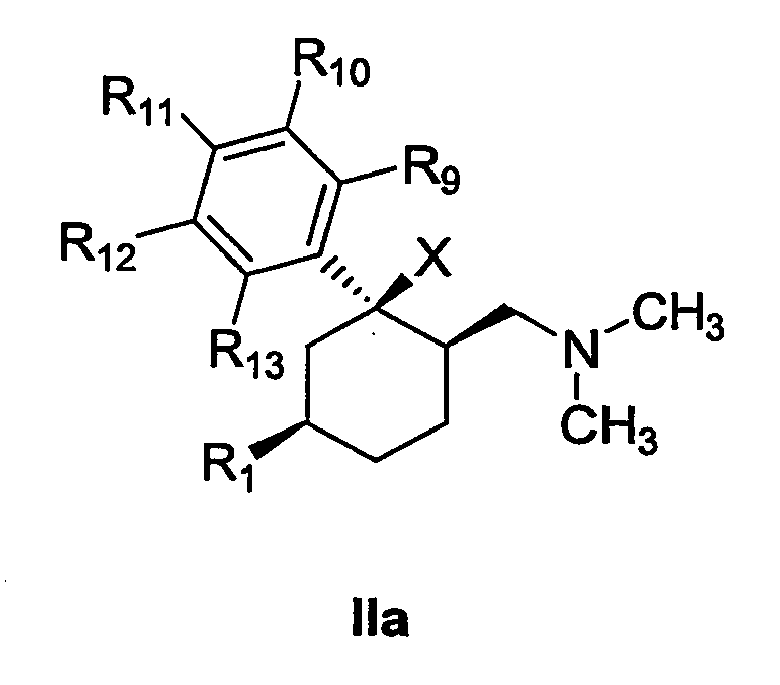
und/oder
daß die Verbindungen der Formel II in Form des (+)-Enantiomeren, insbesondere in Mischungen mit höherem Anteil des (+)-Enantiomeren im Vergleich zum (-)-Enantiomeren einer racemischen Verbindung oder als reines (+)-Enantiomer verwendet werden. - Verwendung gemäß einem der Ansprüche 7 oder 8, dadurch gekennzeichnet, daß Verbindung A ausgewählt aus folgender Gruppe verwendet wird:■ (1RS,3RS,6RS)-6-Dimethylaminomethyl-1-(3-methoxy-phenyl)-cyclohexan-1,3-diol,■ (+)-(1R,3R,6R)-6-Dimethylaminomethyl-1-(3-methoxy-phenyl)-cyclohexan-1,3-diol,■ (1RS,3RS,6RS)-6-Dimethylaminomethyl-1-(3-hydroxyphenyl)-cyclohexan-1,3-diol,■ (1RS,3SR,6RS)-6-Dimethylaminomethyl-1-(3-methoxy-phenyl)-cyclohexan-1,3-diol,■ (+)-(1R,2R,5S)-3-(2-Dimethylaminomethyl-1-hydroxy-5-methyl-cyclohexyl)-phenol oder■ (1RS,2RS,5RS)-3-(2-Dimethylaminomethyl-1-hydroxy-5-trifluoromethyl-cyclohexyl)-phenol,vorzugsweise als Hydrochlorid.
- Verwendung gemäß Anspruch 1, dadurch gekennzeichnet, daß die Verbindung A in Gruppe e) ausgewählt ist aus Verbindungen gemäß Formel III für die gilt, daß:X ausgewählt ist ausOH, F, Cl, OC(O)CH3 oder H, vorzugsweise OH, F oder H, insbesondere F oder H.und/oderR9 bis R13, wobei 3 oder 4 der Reste R9 bis R13 H entsprechen müssen, unabhängig voneinander ausgewählt sind ausH, Cl, F, OH, CF2H, CF3 oder C1-4-Alkyl, gesättigt und unsubstituiert, verzweigt oder unverzweigt; OR14 oder SR14, mit R14 ausgewählt aus C1-3-Alkyl, gesättigt und unsubstituiert, verzweigt oder unverzweigt;vorzugsweise H, Cl, F, OH, CF2H, CF3, OCH3 oder SCH3oder R12 und R11 einen 3,4-OCH=CH-Ring bildeninsbesondere dadurch gekennzeichnet, daß,wenn R9, R11 und R13 H entsprechen, einer von R10 oder R12 auch H entspricht, während der andere ausgewählt ist aus:Cl, F, OH, CF2H, CF3, OR14 oder SR14, vorzugsweise OH, CF2H, OR14 oder SCH3, insbesondere OH oder OC1-3-Alkyl, vorzugsweise OH oder OCH3,oder,wenn R9 und R13 H entsprechen und R11 OH, OCH3, Cl oder F, vorzugsweise Cl, entspricht, einer von R10 oder R12 auch H entspricht, während der andere OH, OCH3, Cl oder F, vorzugsweise Cl, entspricht,
oder,wenn R9, R10, R12 und R13 H entsprechen, R11 ausgewählt ist aus CF3, CF2H, Cl oder F, vorzugsweise F,
oder,wenn R10, R11 und R12 H entsprechen, einer von R9 oder R13 auch H entspricht, während der andere ausgewählt ist aus OH, OC2H5 oder OC3H7,
ganz insbesondere bevorzugt,wenn R9, R11 und R13 H entsprechen, einer von R10 oder R12 auch H entspricht, während der andere ausgewählt ist aus:Cl, F, OH, SH, CF2H, CF3, OR14 oder SR14, vorzugsweise OH oder OR14, insbesondere OH oder OC1-3-Alkyl, vorzugsweise OH oder OCH3. - Verwendung gemäß Anspruch 10, dadurch gekennzeichnet, daß Verbindungen der Formel lll in Form ihrer Diastereomeren mit der relativen Konfiguration llla

und/oder
, daß die Verbindungen der Formel III in Form des (+)-Enantiomeren, insbesondere in Mischungen mit höherem Anteil des (+)-Enantiomeren im Vergleich zum (-)-Enantiomeren einer racemischen Verbindung oder als reines (+)-Enantiomer verwendet werden. - Verwendung gemäß einem der Ansprüche 10 oder 11, dadurch gekennzeichnet, daß Verbindung A ausgewählt aus folgender Gruppe verwendet wird:■ (+)-(1R,2R)-3-(2-Dimethylaminomethyl-1-fluoro-cyclohexyl)-phenol,■ (+)-(1S,2S)3-(2-Dimethylaminomethyl-cyclohexyl)-phenol oder■ (1S,2S)-3-(2-Dimethylaminomethyl-cyclohexyl)-phenol oder■ (-)-(1R,2R)-3-(2-Dimethylaminomethyl-cyclohexyl)-phenol,■ (1R,2R)-3-(2-Dimethylaminomethyl-cyclohexyl)-phenol,■ (-)-(1R,2R)-[2-(3-Methoxy-phenylrcyclohexylmethyl]-dimethylamin,■ (1R,2R)-[2-(3-Methoxy-phenyl)-cyclohexylmethyl]-dimethylamin,vorzugsweise als Hydrochlorid.
- Verwendung gemäß einem der Ansprüche 1 bis 12, dadurch gekennzeichnet, daß die Verbindung B ausgewählt ist aus:Darifenacin, Duloxetin, Oxybutinin oder Tolterodin,vorzugsweise ausgewählt ist ausDuloxetin, Oxybutinin oder Tolterodin,vorzugsweise ausgewählt ist ausOxybutinin oder Tolterodin.
- Wirkstoffkombination aus wenigstens einer der Verbindungen A und wenigstens einer der Verbindungen B, mit Verbindung A ausgewählt aus:Gruppe a) enthaltend:Tramadol, O-Demethyltramadol oder O-desmethyl-N-monodesmethyl-tramadol gegebenenfalls in Form ihrer Racemate, ihrer reinen Stereoisomeren, insbesondere Enantiomeren oder Diastereomeren, oder in Form von Mischungen der Stereoisomeren, insbesondere der Enantiomeren oder Diastereomeren, in einem beliebigen Mischungsverhältnis; in Form ihrer Säuren oder ihrer Basen oder in Form ihrer Salze, insbesondere der physiologisch verträglichen Salze, oder in Form ihrer Solvate, insbesondere der Hydrate;Gruppe b) enthaltend:• Codein• Dextropropxyphen• Dihydrocodein• Meptazinol• Nalbuphin• Tilidin• Buprenorphingegebenenfalls in Form ihrer Racemate, ihrer reinen Stereoisomeren, insbesondere Enantiomeren oder Diastereomeren, oder in Form von Mischungen der Stereoisomeren, insbesondere der Enantiomeren oder Diastereomeren, in einem beliebigen Mischungsverhältnis; in Form ihrer Säuren oder ihrer Basen oder in Form ihrer Salze, insbesondere der physiologisch verträglichen Salze, oder in Form ihrer Solvate, insbesondere der Hydrate;Gruppe c) enthaltend:1-Phenyl-3-dimethylamino-propanverbindungen gemäß allgemeiner Formel Iworin
 X ausgewählt ist aus OH, F, Cl, H oder OC(O)R7 mit R7 ausgewählt aus C1-3-Alkyl, verzweigt oder unverzweigt, gesättigt oder ungesättigt, unsubstituiert oder ein- oder mehrfach substituiert,R1 ausgewählt ist aus C1-4-Alkyl, verzweigt oder unverzweigt, gesättigt oder ungesättigt, unsubstituiert oder ein- oder mehrfach substituiert,R2 und R3 jeweils unabhängig voneinander ausgewählt sind aus H oder C1-4-Alkyl, verzweigt oder unverzweigt, gesättigt oder ungesättigt, unsubstituiert oder ein- oder mehrfach substituiert,
oderR2 und R3 zusammen einen gesättigten C4-7-Cycloalkylrest bilden, unsubstituiert oder ein- oder mehrfach substituiert,R9 bis R13 jeweils unabhängig voneinander ausgewählt sind aus H, F, Cl, Br, l, CH2F, CHF2, CF3, OH, SH, OR14, OCF3, SR14, NR17R18, SOCH3, SOCF3; SO2CH3, SO2CF3, CN, COOR14, NO2, CONR17R18; C1-6-Alkyl, verzweigt oder unverzweigt, gesättigt oder ungesättigt, unsubstituiert oder ein-oder mehrfach substituiert; Phenyl, unsubstituiert oder ein- oder mehrfach substituiert;mit R14 ausgewählt aus C1-6-Alkyl; Pyridyl, Thienyl, Thiazolyl, Phenyl, Benzyl oder Phenethyl, jeweils unsubstituiert oder ein- oder mehrfach substituiert; PO(O-C1-4-Alkyl)2, CO(OC1-5-Alkyl), CONH-C6H4-(C1-3-Alkyl), CO(C1-5-Alkyl), CO-CHR17-NHR18, CO-C6H4-R15, mit R15 ortho-OCOC1-3-Alkyl oder meta- oder para-CH2N(R16)2 mit R16 C1-4-Alkyl oder 4-Morpholino, wobei in den Resten R14, R15 und R16 die Alkylgruppen verzweigt oder unverzweigt, gesättigt oder ungesättigt, unsubstituiert oder ein- oder mehrfach substituiert sein können;mit R17 und R18 jeweils unabhängig voneinander ausgewählt aus H; C1-6-Alkyl, verzweigt oder unverzweigt, gesättigt oder ungesättigt, unsubstituiert oder ein- oder mehrfach substituiert; Phenyl, Benzyl oder Phenethyl, jeweils unsubstituiert oder ein- oder mehrfach substituiert,oderR9 und R10 oder R10 und R11 zusammen einen OCH2O-, -OCH2CH2O-, OCH=CH-, CH=CHO-, CH=C(CH3)O-, OC(CH3)=CH-, (CH2)4- oder OCH=CHO-Ring bilden,gegebenenfalls in Form ihrer Racemate, ihrer reinen Stereoisomeren, insbesondere Enantiomeren oder Diastereomeren, oder in Form von Mischungen der Stereoisomeren, insbesondere der Enantiomeren oder Diastereomeren, in einem beliebigen Mischungsverhältnis; in dargestellter Form oder in Form ihrer Säuren oder ihrer Basen oder in Form ihrer Salze, insbesondere der physiologisch verträglichen Salze, oder in Form ihrer Solvate, insbesondere der Hydrate;Gruppe d) enthaltend:substituierte 6-Dimethylaminomethyl-1-phenyl-cyclohexanverbindungen gemäß allgemeiner Formel IIworin X ausgewählt ist aus OH, F, Cl, H oder OC(O)R7 mit R7 ausgewählt aus C1-3-Alkyl, verzweigt oder unverzweigt, gesättigt oder ungesättigt, unsubstituiert oder ein- oder mehrfach substituiert,R1 ausgewählt ist aus C1-4-Alkyl, Benzyl, CF3, OH, OCH2-C6H5, O-C1-4-Alkyl, Cl oder F undR9 bis R13 jeweils unabhängig voneinander ausgewählt sind aus H, F, Cl, Br, I, CH2F, CHF2, CF3, OH, SH, OR14, OCF3, SR14, NR17R18, SOCH3, SOCF3; SO2CH3, SO2CF3, CN, COOR14, NO2, CONR17R18; C1-6-Alkyl, verzweigt oder unverzweigt, gesättigt oder ungesättigt, unsubstituiert oder ein- oder mehrfach substituiert; Phenyl, unsubstituiert oder ein- oder mehrfach substituiert;mit R14 ausgewählt aus C1-6-Alkyl; Pyridyl, Thienyl, Thiazolyl, Phenyl, Benzyl oder Phenethyl, jeweils unsubstituiert oder ein- oder mehrfach substituiert; PO(O-C1-4-Alkyl)2, CO(OC1-5-Alkyl), CONH-C6H4-(C1-3-Alkyl), CO(C1-5-Alkyl), CO-CHR17-NHR18, CO-C6H4-R15, mit R15 ortho-OCOC1-3-Alkyl oder meta- oder para-CH2N(R16)2 mit R16 C1-4-Alkyl oder 4-Morpholino, wobei in den Resten R14, R15 und R16 die Alkylgruppen verzweigt oder unverzweigt, gesättigt oder ungesättigt, unsubstituiert oder ein- oder mehrfach substituiert sein können;mit R17 und R18 jeweils unabhängig voneinander ausgewählt aus H; C1-6-Alkyl, verzweigt oder unverzweigt, gesättigt oder ungesättigt, unsubstituiert oder ein- oder mehrfach substituiert; Phenyl, Benzyl oder Phenethyl, jeweils unsubstituiert oder ein- oder mehrfach substituiert,oderR9 und R10 oder R10 und R11 zusammen einen OCH2O-, OCH2CH2O-, OCH=CH-, CH=CHO-, CH=C(CH3)O-, OC(CH3)=CH-, (CH2)4- oder OCH=CHO-Ring bilden,gegebenenfalls in Form ihrer Racemate, ihrer reinen Stereoisomeren, insbesondere Enantiomeren oder Diastereomeren, oder in Form von Mischungen der Stereoisomeren, insbesondere der Enantiomeren oder Diastereomeren, in einem beliebigen Mischungsverhältnis; in dargestellter Form oder in Form ihrer Säuren oder ihrer Basen oder in Form ihrer Salze, insbesondere der physiologisch verträglichen Salze, oder in Form ihrer Solvate, insbesondere der Hydrate;und/oderGruppe e) enthaltend:6-Dimethylaminomethyl-1-phenyl-cyclohexanverbindungen gemäß allgemeiner Formel IIIworin
 X ausgewählt ist aus OH, F, Cl, H oder OC(O)R7 mit R7 ausgewählt aus C1-3-Alkyl, verzweigt oder unverzweigt, gesättigt oder ungesättigt, unsubstituiert oder ein- oder mehrfach substituiert, undR9 bis R13 jeweils unabhängig voneinander ausgewählt sind aus H, F, Cl, Br, I, CH2F, CHF2, CF3, OH, SH, OR14, OCF3, SR14, NR17R18, SOCH3, SOCF3; SO2CH3, SO2CF3, CN, COOR14, NO2, CONR17R18; C1-6-Alkyl, verzweigt oder unverzweigt, gesättigt oder ungesättigt, unsubstituiert oder ein-oder mehrfach substituiert; Phenyl, unsubstituiert oder ein- oder mehrfach substituiert;mit R14 ausgewählt aus C1-6-Alkyl; Pyridyl, Thienyl, Thiazolyl,. Phenyl, Benzyl oder Phenethyl, jeweils unsubstituiert oder ein- oder mehrfach substituiert; PO(O-C1-4-Alkyl)2, CO(OC1-5-Alkyl), CONH-C6H4-(C1-3-Alkyl), CO(C1-5-Alkyl), CO-CHR17-NHR18, CO-C6H4-R15, mit R15 ortho-OCOC1-3-Alkyl oder meta- oder para-CH2N(R16)2 mit R16 C1-4-Alkyl oder 4-Morpholino, wobei in den Resten R14, R15 und R16 die Alkylgruppen verzweigt oder unverzweigt, gesättigt oder ungesättigt, unsubstituiert oder ein- oder mehrfach substituiert sein können;mit R17 und R18 jeweils unabhängig voneinander ausgewählt aus H; C1-6-Alkyl, verzweigt oder unverzweigt, gesättigt oder ungesättigt, unsubstituiert oder ein- oder mehrfach substituiert; Phenyl, Benzyl oder Phenethyl, jeweils unsubstituiert oder ein- oder mehrfach substituiert,oderR9 und R10 oder R10 und R11 zusammen einen OCH2O-, OCH2CH2O-, OCH=CH-, CH=CHO-, CH=C(CH3)O-, OC(CH3)=CH-, (CH2)4- oder OCH=CHO-Ring bilden,mit der Maßgabe, daß, wenn R9, R11 und R13 H entsprechen, und einer von R10 oder R12 H und der andere OCH3 entspricht, X nicht OH sein darf,gegebenenfalls in Form ihrer Racemate, ihrer reinen Stereoisomeren, insbesondere Enantiomeren oder Diastereomeren, oder in Form von Mischungen der Stereoisomeren, insbesondere der Enantiomeren oder Diastereomeren, in einem beliebigen Mischungsverhältnis; in dargestellter Form oder in Form ihrer Säuren oder ihrer Basen oder in Form ihrer Salze, insbesondere der physiologisch verträglichen Salze, oder in Form ihrer Solvate, insbesondere der Hydrate;und mit wenigstens einer der Verbindungen B, ausgewählt aus:den Antimuskarinika: Atropin, Oxybutinin, Propiverin, Propanthelin, Emepronium, Trospium, Tolterodin, Darifenacin und α,α-Diphenylessigsäure-4-(N-methyl-piperidyl)-ester, sowie Duloxetin, lmipramin und Desmopressin,gegebenenfalls in Form ihrer Racemate, ihrer reinen Stereoisomeren, insbesondere Enantiomeren oder Diastereomeren, oder in Form von Mischungen der Stereoisomeren, insbesondere der Enantiomeren oder Diastereomeren, in einem beliebigen Mischungsverhältnis; in Form ihrer Säuren oder ihrer Basen oder in Form ihrer Salze, insbesondere der physiologisch verträglichen Salze, oder in Form ihrer Solvate, insbesondere der Hydrate.
 - Wirkstoffkombination gemäß Anspruch 14, dadurch gekennzeichnet, daß die Verbindung A in Gruppe a) ausgewählt ist aus:Tramadol, (+)-Tramadol, (+)-O-Demethyltramadol oder (+)-O-desmethyl-N-mono-desmethyl-tramadol, vorzugsweise Tramadol oder (+)-Tramadol, insbesondere (+)-Tramadol.
- Wirkstoffkombination gemäß Anspruch 14, dadurch gekennzeichnet, daß die Verbindung A in Gruppe c) ausgewählt ist aus Verbindungen gemäß Formel I für die gilt, daß:X ausgewählt ist ausOH, F, Cl, OC(O)CH3 oder H, vorzugsweise OH, F, OC(O)CH3 oder H,und/oderR1 ausgewählt ist ausC1-4-Alkyl, gesättigt und unsubstituiert, verzweigt oder unverzweigt; vorzugsweise CH3, C2H5, C4H9 oder t-Butyl, insbesondere CH3 oder C2H5,und/oderR2 und R3 unabhängig voneinander ausgewählt sind ausH, C1-4-Alkyl, gesättigt und unsubstituiert, verzweigt oder unverzweigt; vorzugsweise H, CH3, C2H5, i-Propyl oder t-Butyl, insbesondere H oder CH3, vorzugsweise R3 = H,
oderR2 und R3 zusammen einen C5-6-Cycloalkylrest bilden, gesättigt oder ungesättigt, unsubstituiert oder ein- oder mehrfach substituiert, vorzugsweise gesättigt und unsubstituiert, insbesondere Cyclohexyl.und/oderR9 bis R13, wobei 3 oder 4 der Reste R9 bis R13 H entsprechen müssen, unabhängig voneinander ausgewählt sind ausH, Cl, F, OH, CF2H, CF3 oder C1-4-Alkyl, gesättigt und unsubstituiert, verzweigt oder unverzweigt; OR14 oder SR14, mit R14 ausgewählt aus C1-3-Alkyl, gesättigt und unsubstituiert, verzweigt oder unverzweigt;vorzugsweise H, Cl, F, OH, CF2H, CF3, OCH3 oder SCH3oder R12 und R11 einen 3,4-OCH=CH-Ring bildeninsbesonderewenn R9, R11 und R13 H entsprechen, einer von R10 oder R12 auch H entspricht, während der andere ausgewählt ist aus:Cl, F, OH, CF2H, CF3, OR14 oder SR14, vorzugsweise OH, CF2H, OCH3 oder SCH3oder,wenn R9 und R13 H entsprechen und R11 OH, OCH3, Cl oder F, vorzugsweise Cl, entspricht, einer von R10 oder R12 auch H entspricht, während der andere OH, OCH3, Cl oder F, vorzugsweise Cl, entspricht,
oder,wenn R9, R10, R12 und R13 H entsprechen, R11 ausgewählt ist aus CF3, CF2H, Cl oder F, vorzugsweise F,
oder,wenn R10, R11 und R12 H entsprechen, einer von R9 oder R13 auch H entspricht, während der andere ausgewählt ist aus OH, OC2H5 oder OC3H7. - Wirkstoffkombination gemäß Anspruch 16, dadurch gekennzeichnet, daß die Verbindungen der Formel I mit R3 = H in Form der Diastereomeren mit der relativen Konfiguration la

und/oder
daß die Verbindungen der Formel I in Form des (+)-Enantiomeren, insbesondere in Mischungen mit höherem Anteil des (+)-Enantiomeren im Vergleich zum (-)-Enantiomeren einer racemischen Verbindung oder als reines (+)-Enantiomer vorliegen. - Wirkstoffkombination gemäß einem der Ansprüche 16 oder 17, dadurch gekennzeichnet, daß die Verbindung A ausgewählt ist aus folgender Gruppe:■ (2RS,3RS)-1-Dimethylamino-3-(3-methoxy-phenyl)-2-methyl-pentan-3-ol,■ (2R,3R)-1-Dimethylamino-3-(3-methoxy-phenyl)-2-methyl-pentan-3-ol,■ (+)-(2R,3R)-1-Dimethylamino-3-(3-methoxy-phenyl)-2-methyl-pentan-3-ol,■ (2RS,3RS)-3-(3,4-Dichlorophenyl)-1-dimethylamino-2-methyl-pentan-3-ol,■ (2RS,3RS)-3-(3-Difluoromethyl-phenyl)-1-dimethylamino-2-methyl-pentan-3-ol,■ (2RS,3RS)-1-Dimethylamino-2-methyl-3-(3-methylsulfanyl-phenyl)-pentan-3-ol,■ (3RS)-1-Dimethylamino-3-(3-methoxy-phenyl)-4,4-dimethyl-pentan-3-ol,■ (2RS,3RS)-3-(3-Dimethylamino-1-ethyl-1-hydroxy-2-methylpropyl)-phenol,■ (1RS,2RS)-3-(3-Dimethylamino-1-hydroxy-1,2-dimethyl-propyl)-phenol,■ (+)-(1R,2R)-3-(3-Dimethylamino-1-hydroxy-1,2-dimethylpropyl)-phenol,■ (+)-(1R,2R)-3-(3-Dimethylamino-1-hydroxy-1,2-dimethyl-propyl)-phenol,■ (1R,2R)-3-(3-Dimethylamino-1-ethyl-2-methyl-propyl)-phenol,■ (-)-(1R,2R)-3-(3-Dimethylamino-1-ethyl-2-methyl-propyl)-phenol,■ (1S,2S)-3-(3-Dimethylamino-1-ethyl-2-methyl-propyl)-phenol,■ (+)-(1S,2S)-3-(3-Dimethylamino-1-ethyl-2-methyl-propyl)-phenol,■ (+)-(1R,2R)-Essigsäure-3-dimethylamino-1-ethyl-1-(3-methoxy-phenyl)-2-methyl-propylester,■ (1RS)-1-(1-Dimethylaminomethyl-cyclohexyl)-1-(3-methoxy-phenyl)-propan-1-ol,■ (2RS, 3RS)-3-(4-Chlorophenyl)-1-dimethylamino-2-methyl-pentan-3-ol,■ (+)-(2R,3R)-3-(3-Dimethylamino-1-ethyl-1-hydroxy-2-methylpropyl)-phenol,■ (2RS,3RS)-4-Dimethylamino-2-(3-methoxy-phenyl)-3-methyl-butan-2-ol und■ (+)-(2R,3R)-4-Dimethylamino-2-(3-methoxy-phenyl)-3-methyl-butan-2-ol,vorzugsweise als Hydrochlorid.
- Wirkstoffkombination gemäß Anspruch 14, dadurch gekennzeichnet, daß die Verbindung A in Gruppe d) ausgewählt ist aus Verbindungen gemäß Formel II für die gilt, daß:X ausgewählt ist ausOH, F, Cl, OC(O)CH3 oder H, vorzugsweise OH, F oder H, insbesondere OH,und/oderR1 ausgewählt ist ausC1-4-Alkyl, CF3, OH, O-C1-4-Alkyl, Cl oder F, vorzugsweise OH, CF3 oder CH3,und/oderR9 bis R13, wobei 3 oder 4 der Reste R9 bis R13 H entsprechen müssen, unabhängig voneinander ausgewählt sind ausH, Cl, F, OH, CF2H, CF3 oder C1-4-Alkyl, gesättigt und unsubstituiert, verzweigt oder unverzweigt; OR14 oder SR14, mit R14 ausgewählt aus C1-3-Alkyl, gesättigt und unsubstituiert, verzweigt oder unverzweigt;vorzugsweise H, Cl, F, OH, CF2H, CF3, OCH3 oder SCH3oder R12 und R11 einen 3,4-OCH=CH-Ring bilden,insbesonderewenn R9, R11 und R13 H entsprechen, einer von R10 oder R12 auch H entspricht, während der andere ausgewählt ist aus:Cl, F, OH, CF2H, CF3, OR14 oder SR14, vorzugsweise OH, CF2H, OR14 oder SCH3, insbesondere OH oder OC1-3-Alkyl, vorzugsweise OH oder OCH3,oder,wenn R9 und R13 H entsprechen und R11 OH, OCH3, Cl oder F, vorzugsweise Cl, entspricht, einer von R10 oder R12 auch H entspricht, während der andere OH, OCH3, Cl oder F, vorzugsweise Cl, entspricht,
oder,wenn R9, R10, R12 und R13 H entsprechen, R11 ausgewählt ist aus CF3, CF2H, Cl oder F, vorzugsweise F,
oder,wenn R10, R11 und R12 H entsprechen, einer von R9 oder R13 auch H entspricht, während der andere ausgewählt ist aus OH, OC2H5 oder OC3H7,
ganz insbesondere bevorzugt,wenn R9, R11 und R13 H entsprechen, einer von R10 oder R12 auch H entspricht, während der andere ausgewählt ist aus:Cl, F, OH, SH, CF2H, CF3, OR14 oder SR14, vorzugsweise OH oder OR14, insbesondere OH oder OC1-3-Alkyl, vorzugsweise OH oder OCH3. - Wirkstoffkombination gemäß Anspruch 19, dadurch gekennzeichnet, daß die Verbindungen der Formel II in Form der Diastereomeren mit der relativen Konfiguration lla

und/oder
daß die Verbindungen der Formel II in Form des (+)-Enantiomeren, insbesondere in Mischungen mit höherem Anteil des (+)-Enantiomeren im Vergleich zum (-)-Enantiomeren einer racemischen Verbindung oder als reines (+)-Enantiomer vorliegen. - Wirkstoffkombination gemäß einem der Ansprüche 19 oder 20, dadurch gekennzeichnet, daß Verbindung A ausgewählt ist aus folgender Gruppe:■ (1 RS,3RS,6RS)-6-Dimethylaminomethyl-1-(3-methoxy-phenyl)-cyclohexan-1,3-diol,■ (+)-(1R,3R,6R)-6-Dimethylaminomethyl-1-(3-methoxy-phenyl)-cyclohexan-1,3-diol,■ (1RS,3RS,6RS)-6-Dimethylaminomethyl-1-(3-hydroxyphenyl)-cyclohexan-1,3-diol,■ (1RS,3SR,6RS)-6-Dimethylaminomethyl-1-(3-methoxy-phenyl)-cyclohexan-1,3-diol,■ (+)-(1R,2R,5S)-3-(2-Dimethylaminomethyl-1-hydroxy-5-methyl-cyclohexyl)-phenol oder■ (1RS,2RS,5RS)-3-(2-Dimethylaminomethyl-1-hydroxy-5-trifluoromethyl-cyclohexyl)-phenol,vorzugsweise als Hydrochlorid.
- Wirkstoffkombination gemäß Anspruch 14, dadurch gekennzeichnet, daß die Verbindung A in Gruppe e) ausgewählt ist aus Verbindungen gemäß Formel III für die gilt, daß:X ausgewählt ist ausOH, F, Cl, OC(O)CH3 oder H, vorzugsweise OH, F oder H, insbesondere F oder H.und/oderR9 bis R13, wobei 3 oder 4 der Reste R9 bis R13 H entsprechen müssen, unabhängig voneinander ausgewählt sind ausH, Cl, F, OH, CF2H, CF3 oder C1-4-Alkyl, gesättigt und unsubstituiert, verzweigt oder unverzweigt; OR14 oder SR14, mit R14 ausgewählt aus C1-3-Alkyl, gesättigt und unsubstituiert, verzweigt oder unverzweigt;vorzugsweise H, Cl, F, OH, CF2H, CF3, OCH3 oder SCH3oder R12 und R11 einen 3,4-OCH=CH-Ring bildeninsbesondere dadurch gekennzeichnet, daß,wenn R9, R11 und R13 H entsprechen, einer von R10 oder R12 auch H entspricht, während der andere ausgewählt ist aus:Cl, F, OH, CF2H, CF3, OR14 oder SR14, vorzugsweise OH, CF2H, OR14 oder SCH3, insbesondere OH oder OC1-3-Alkyl, vorzugsweise OH oder OCH3,oder,wenn R9 und R13 H entsprechen und R11 OH, OCH3, Cl oder F, vorzugsweise Cl, entspricht, einer von R10 oder R12 auch H entspricht, während der andere OH, OCH3, Cl oder F, vorzugsweise Cl, entspricht,
oder,wenn R9, R10, R12 und R13 H entsprechen, R11 ausgewählt ist aus CF3, CF2H, Cl oder F, vorzugsweise F,
oder,wenn R10, R11 und R12 H entsprechen, einer von R9 oder R13 auch H entspricht, während der andere ausgewählt ist aus OH, OC2H5 oder OC3H7,
ganz insbesondere bevorzugt,wenn R9, R11 und R13 H entsprechen, einer von R10 oder R12 auch H entspricht, während der andere ausgewählt ist aus:Cl, F, OH, SH, CF2H, CF3, OR14 oder SR14, vorzugsweise OH oder OR14, insbesondere OH oder OC1-3-Alkyl, vorzugsweise OH oder OCH3. - Wirkstoffkombination gemäß Anspruch 22, dadurch gekennzeichnet, daß die Verbindungen der Formel III in Form ihrer Diastereomeren mit der relativen Konfiguration IIIa

und/oder
, daß die Verbindungen der Formel III in Form des (+)-Enantiomeren, insbesondere in Mischungen mit höherem Anteil des (+)-Enantiomeren im Vergleich zum (-)-Enantiomeren einer racemischen Verbindung oder als reines (+)-Enantiomer vorliegen. - Wirkstoffkombination gemäß einem der Ansprüche 22 oder 23, dadurch gekennzeichnet, daß die Verbindung A ausgewählt ist aus folgender Gruppe:■ (+)-(1R,2R)-3-(2-Dimethylaminomethyl-1-fluoro-cyclohexyl)-phenol,■ (+)-(1S,2S)-3-(2-Dimethylaminomethyl-cyclohexyl)-phenol oder■ (1S,2S)-3-(2-Dimethylaminomethyl-cyclohexyl)-phenol oder■ (-)-(1R,2R)-3-(2-Dimethylaminomethyl-cyclohexyl)-phenol,■ (1R,2R)-3-(2-Dimethylaminomethyl-cyclohexyl)-phenol,■ (-)-(1R,2R)-[2-(3-Methoxy-phenyl)-cyclohexylmethyl]-dimethylamin,■ (1R,2R)-[2-(3-Methoxy-phenyl)-cyclohexylmethyl]-dimethylamin,vorzugsweise als Hydrochlorid.
- Wirkstoffkombination gemäß einem der Ansprüche 14 bis 24, dadurch gekennzeichnet, daß die Verbindung B ausgewählt ist aus:Darifenacin, Duloxetin, Oxybutinin oder Tolterodin,vorzugsweise ausgewählt ist ausDuloxetin, Oxybutinin oder Tolterodin,vorzugsweise ausgewählt ist ausOxybutinin oder Tolterodin.
- Arzneimittel, vorzugsweise zur Behandlung von vermehrtem Harndrang bzw. Harninkontinenz, enthaltend eine Wirkstoffkombination gemäß einem der Ansprüche 14 bis 25 sowie gegebenenfalls geeignete Zusatz- und/oder Hilfsstoffe.
Applications Claiming Priority (3)
| Application Number | Priority Date | Filing Date | Title |
|---|---|---|---|
| DE10146275A DE10146275A1 (de) | 2001-09-18 | 2001-09-18 | Kombination ausgewählter Opioide mit Muscarin-Antagonisten zur Therapie der Harninkontinenz |
| DE10146275 | 2001-09-18 | ||
| PCT/EP2002/010460 WO2003024444A1 (de) | 2001-09-18 | 2002-09-18 | Kombination ausgewählter opioide mit muscarin-antagonisten zur therapie der harninkontinenz |
Publications (2)
| Publication Number | Publication Date |
|---|---|
| EP1429754A1 EP1429754A1 (de) | 2004-06-23 |
| EP1429754B1 true EP1429754B1 (de) | 2008-01-16 |
Family
ID=7699618
Family Applications (1)
| Application Number | Title | Priority Date | Filing Date |
|---|---|---|---|
| EP02779368A Expired - Lifetime EP1429754B1 (de) | 2001-09-18 | 2002-09-18 | Kombination ausgewählter opioide mit muscarin-antagonisten zur therapie der harninkontinenz |
Country Status (21)
| Country | Link |
|---|---|
| US (2) | US20040242617A1 (de) |
| EP (1) | EP1429754B1 (de) |
| JP (1) | JP4511176B2 (de) |
| KR (1) | KR100891438B1 (de) |
| CN (1) | CN100384413C (de) |
| AT (1) | ATE383854T1 (de) |
| AU (1) | AU2002342707B2 (de) |
| BR (1) | BR0212714A (de) |
| CA (1) | CA2460655C (de) |
| DE (2) | DE10146275A1 (de) |
| EC (1) | ECSP045025A (de) |
| ES (1) | ES2299608T3 (de) |
| HU (1) | HUP0401485A3 (de) |
| IL (2) | IL160894A0 (de) |
| MX (1) | MXPA04002510A (de) |
| NO (1) | NO333016B1 (de) |
| NZ (1) | NZ531777A (de) |
| PL (1) | PL209272B1 (de) |
| RU (1) | RU2305562C2 (de) |
| WO (1) | WO2003024444A1 (de) |
| ZA (1) | ZA200402853B (de) |
Families Citing this family (21)
| Publication number | Priority date | Publication date | Assignee | Title |
|---|---|---|---|---|
| DE10146275A1 (de) | 2001-09-18 | 2003-04-24 | Gruenenthal Gmbh | Kombination ausgewählter Opioide mit Muscarin-Antagonisten zur Therapie der Harninkontinenz |
| US7410965B2 (en) | 2002-05-29 | 2008-08-12 | Gruenenthal Gmbh | Delayed release pharmaceutical composition containing 1-dimethyl-amino-3-(3-methoxyphenyl)-2-methyl-pentan-3-ol |
| DE10224108A1 (de) * | 2002-05-29 | 2004-01-29 | Grünenthal GmbH | 1-Dimethylamino-3-(3-methoxy-phenyl)-2-methyl-pentan-3-ol enthaltendes Arzneimiitel mit verzögerter Wirkstofffreisetzung |
| DE10224556A1 (de) * | 2002-05-31 | 2004-01-08 | Grünenthal GmbH | 1-Dimethylamino- 3-(3-methoxy-phenyl)2-methyl-pentan-3-ol entaltendes Arzneimittel in verschiedenen Formulierungen |
| DE60315258T2 (de) * | 2002-12-20 | 2008-05-08 | Dynogen Pharmaceuticals Inc., Waltham | Behandlung von nicht-schmerzhaften blasenstörungen mit modulatoren der alpha-2-delta-untereinheit des calciumkanals |
| EP1492519B1 (de) * | 2003-03-21 | 2006-11-15 | Dynogen Pharmaceuticals, Inc. | Verfahren zur behandlung von erkrankungen der unteren harnwege mit antimuskarinika und mit modulatoren der alpha-2-delta untereinheit des kalziumkanals |
| DE10356362A1 (de) * | 2003-11-28 | 2005-06-23 | Grünenthal GmbH | Verwendung von 1-Phenyl-3-dimethylamino-propanverbindungen zur Therapie von Angststörungen |
| ES2485867T3 (es) * | 2004-05-14 | 2014-08-14 | Janssen Pharmaceutica Nv | Compuestos opioides de carboxamido |
| DE102005009217A1 (de) * | 2005-02-25 | 2006-08-31 | Grünenthal GmbH | Phosphatsalze der 6-Dimethylaminomethyl-1-(3-methoxyphenyl)-1,3-dihydroxy-cyclohexanverbindungen |
| US20070032551A1 (en) * | 2005-07-22 | 2007-02-08 | Gruenenthal Gmbh | Salt of dimethylaminomethyl-phenyl-cyclohexane and crystalline forms thereof |
| JP5323480B2 (ja) * | 2005-07-22 | 2013-10-23 | グリュネンタール・ゲゼルシャフト・ミト・ベシュレンクテル・ハフツング | 3−[2−(ジメチルアミノ)メチル−(シクロヘキシ−1−イル)]−フェノールのHCl多形体 |
| US7884247B2 (en) * | 2005-07-22 | 2011-02-08 | Gruenenthal Gmbh | Salt of dimethylaminomethyl-phenyl-cyclohexane and crystalline forms thereof |
| DE102007022790A1 (de) * | 2007-05-11 | 2008-11-20 | Grünenthal GmbH | Axomadol zur Schmerzbehandlung bei Arthrose |
| ES2758831T3 (es) * | 2008-10-30 | 2020-05-06 | Gruenenthal Gmbh | Nuevas y potentes formas de dosificación de tapentadol |
| WO2011110595A1 (de) | 2010-03-10 | 2011-09-15 | Grünenthal GmbH | Kristalline salze und/oder cokristalle von o-desmethyltramadol |
| KR20130030260A (ko) | 2010-05-10 | 2013-03-26 | 유로-셀티큐 에스.에이. | 히드로모르폰 및 날록손을 포함하는 제약 조성물 |
| NZ603173A (en) | 2010-05-10 | 2014-10-31 | Euro Celtique Sa | Manufacturing of active-free granules and tablets comprising the same |
| WO2011141490A1 (en) | 2010-05-10 | 2011-11-17 | Euro-Celtique S.A. | Combination of active loaded granules with additional actives |
| CN103040828B (zh) * | 2013-01-07 | 2015-12-02 | 常州康普药业有限公司 | 复方地芬诺酯片及其制备方法 |
| EP3068397A1 (de) | 2013-11-13 | 2016-09-21 | Euro-Celtique S.A. | Hydromorphon und naloxon zur behandlung von schmerzen und opioid-reizdarm-dysfunktionssyndrom |
| US11977085B1 (en) | 2023-09-05 | 2024-05-07 | Elan Ehrlich | Date rape drug detection device and method of using same |
Family Cites Families (19)
| Publication number | Priority date | Publication date | Assignee | Title |
|---|---|---|---|---|
| GB857194A (en) * | 1957-07-05 | 1960-12-29 | Clinical Products Ltd | Therapeutic agents comprising ion-exchange resins |
| NL127065C (de) | 1964-04-22 | |||
| US5736577A (en) | 1995-01-31 | 1998-04-07 | Sepracor, Inc. | Methods and compositions for treating urinary incontinence using optically pure (S)-oxybutynin |
| DE3012837A1 (de) * | 1979-04-10 | 1980-10-30 | Sandoz Ag | Analgetische und myotonolytische praeparate |
| DE3129982A1 (de) * | 1981-07-29 | 1983-02-17 | Jutta 8200 Rosenheim Meyer | "antiallergikum" |
| US5073560A (en) | 1990-07-20 | 1991-12-17 | Fisons Corporation | Spiro-isoxazolidine derivatives as cholinergic agents |
| DE4041559A1 (de) | 1990-12-22 | 1992-06-25 | Boehringer Ingelheim Kg | Neue wirkstoffkombinationen |
| SE9202218D0 (sv) * | 1992-07-22 | 1992-07-22 | Kabi Pharmacia Ab | Pharmacologically active alfa-(tertiary-aminomethyl)-benzenemethanol derivatives, pharmaceutical composition containing them, therapeutical use thereof and processes for their preparation |
| RU2133744C1 (ru) * | 1993-07-30 | 1999-07-27 | Дельта Фармасьютикалз, Инк. | Пиперазиновые соединения |
| DE4426245A1 (de) | 1994-07-23 | 1996-02-22 | Gruenenthal Gmbh | 1-Phenyl-3-dimethylamino-propanverbindungen mit pharmakologischer Wirkung |
| EP0820288B1 (de) * | 1995-03-03 | 2004-02-11 | Endo Pharmaceuticals Inc. | Verwendung von dextromethorphan oder dextrorphan zur behandlung der harninkontinenz |
| DE19525137C2 (de) | 1995-07-11 | 2003-02-27 | Gruenenthal Gmbh | 6-Dimethylaminomethyl-1-phenyl-cyclohexanverbin -dungen als Zwischenprodukte zur Herstellung pharmazeutischer Wirkstoffe |
| DE19609847A1 (de) * | 1996-03-13 | 1997-09-18 | Gruenenthal Gmbh | Dimethyl-(3-aryl-but-3-enyl)-aminverbindungen als pharmazeutische Wirkstoffe |
| CA2259012C (en) | 1996-07-19 | 2008-05-13 | Gunnar Aberg | S(-)-tolterodine in the treatment of urinary and gastrointestinal disorders |
| JP4085433B2 (ja) * | 1997-04-11 | 2008-05-14 | 日本新薬株式会社 | 頻尿・尿失禁治療剤 |
| PE20010623A1 (es) * | 1999-10-05 | 2001-07-07 | Gruenenthal Chemie | Uso de (+)-tramadol y/o o-demetiltramadol para tratamiento de urgencia urinaria incrementada y/o incontinencia urinaria |
| PT1257277E (pt) * | 2000-02-24 | 2005-09-30 | Pharmacia & Upjohn Co Llc | Novas combinacoes de farmacos |
| DE10059412A1 (de) * | 2000-11-30 | 2002-06-13 | Gruenenthal Gmbh | Verwendung von 1-Phenyl-3-dimethylamino-propanverbindungen zur Therapie der Harninkontinenz |
| DE10146275A1 (de) | 2001-09-18 | 2003-04-24 | Gruenenthal Gmbh | Kombination ausgewählter Opioide mit Muscarin-Antagonisten zur Therapie der Harninkontinenz |
-
2001
- 2001-09-18 DE DE10146275A patent/DE10146275A1/de not_active Withdrawn
-
2002
- 2002-09-18 MX MXPA04002510A patent/MXPA04002510A/es active IP Right Grant
- 2002-09-18 AT AT02779368T patent/ATE383854T1/de active
- 2002-09-18 RU RU2004111788/15A patent/RU2305562C2/ru not_active IP Right Cessation
- 2002-09-18 KR KR1020047004002A patent/KR100891438B1/ko not_active Expired - Fee Related
- 2002-09-18 ES ES02779368T patent/ES2299608T3/es not_active Expired - Lifetime
- 2002-09-18 HU HU0401485A patent/HUP0401485A3/hu unknown
- 2002-09-18 BR BR0212714-8A patent/BR0212714A/pt not_active Application Discontinuation
- 2002-09-18 DE DE50211566T patent/DE50211566D1/de not_active Expired - Lifetime
- 2002-09-18 AU AU2002342707A patent/AU2002342707B2/en not_active Ceased
- 2002-09-18 NZ NZ531777A patent/NZ531777A/en not_active IP Right Cessation
- 2002-09-18 WO PCT/EP2002/010460 patent/WO2003024444A1/de not_active Ceased
- 2002-09-18 CA CA2460655A patent/CA2460655C/en not_active Expired - Fee Related
- 2002-09-18 CN CNB028227794A patent/CN100384413C/zh not_active Expired - Fee Related
- 2002-09-18 JP JP2003528540A patent/JP4511176B2/ja not_active Expired - Fee Related
- 2002-09-18 EP EP02779368A patent/EP1429754B1/de not_active Expired - Lifetime
- 2002-09-18 PL PL369235A patent/PL209272B1/pl unknown
- 2002-09-18 IL IL16089402A patent/IL160894A0/xx unknown
-
2004
- 2004-03-12 NO NO20041059A patent/NO333016B1/no not_active IP Right Cessation
- 2004-03-16 IL IL160894A patent/IL160894A/en not_active IP Right Cessation
- 2004-03-17 EC EC2004005025A patent/ECSP045025A/es unknown
- 2004-03-18 US US10/803,187 patent/US20040242617A1/en not_active Abandoned
- 2004-04-15 ZA ZA2004/02853A patent/ZA200402853B/en unknown
-
2011
- 2011-09-23 US US13/242,672 patent/US8946290B2/en not_active Expired - Fee Related
Also Published As
Similar Documents
| Publication | Publication Date | Title |
|---|---|---|
| US8946290B2 (en) | Combination of selected opioids with muscarine antagonists for treating urinary incontinence | |
| EP1839654B1 (de) | Verwendung von (1R, 2R)-3-(3-Dimenthylamino-1-ethyl-2-methyl-propyl)-phenol zur Behandlung von Entzündungsschmerz | |
| EP1507520A1 (de) | Kombination ausgew hlter opioide mit anderen wirkstoffen zur therapie der harninkontinenz | |
| EP1438034B1 (de) | Verwendung von 1-phenyl-3-dimethylamino-propan-verbindungen zur therapie der harninkontinenz | |
| EP1337246B1 (de) | Verwendung von 6-dimethylaminomethyl-1-phenyl-cyclohexanverbindungen zur therapie der harninkontinenz | |
| EP1353660B1 (de) | Verwendung von substituierten 6-dimethylaminomethyl-1-phenyl-cyclohexanverbindungen zur therapie der harninkontinenz | |
| EP1337254A2 (de) | Verwendung von schwachen opioiden und gemischten opioidagonisten / -antagonisten zur therapie der harninkontinenz | |
| EP1509216B1 (de) | Wirkstoffsalze und ester von 1-dimethylamino-3-(3-methoxy-phenyl)-2-methyl-pentan-3-ol und 3-(3-dimethylamino-1-ethyl-1-hydroxy-2-methyl-propyl)-phenol | |
| DE10335566A1 (de) | Arzneimittel enthaltend Derivate von Aryl( oder Heteroaryl)azolylcarbinolen | |
| WO2003101440A1 (de) | Metabolite von 1-dimethylamino-3-(3-methoxy-phenyl)-2-methyl-pentan-3-ol sowie deren verwendung zur behandlung von harninkontinenz | |
| US20050137194A1 (en) | Combination of selected opioids with other active compounds for treatment of urinary incontinence | |
| DE20115429U1 (de) | Opioide in der Harninkontinenz | |
| HK1075205B (en) | Combination of selected opioids with muscarine antagonists for treating urinary incontinence | |
| DE10326103A1 (de) | Kombination ausgewählter Analgetika mit COX II-Inhibitoren |
Legal Events
| Date | Code | Title | Description |
|---|---|---|---|
| PUAI | Public reference made under article 153(3) epc to a published international application that has entered the european phase |
Free format text: ORIGINAL CODE: 0009012 |
|
| 17P | Request for examination filed |
Effective date: 20040221 |
|
| AK | Designated contracting states |
Kind code of ref document: A1 Designated state(s): AT BE BG CH CY CZ DE DK EE ES FI FR GB GR IE IT LI LU MC NL PT SE SK TR |
|
| AX | Request for extension of the european patent |
Extension state: AL LT LV MK RO SI |
|
| 17Q | First examination report despatched |
Effective date: 20061103 |
|
| GRAP | Despatch of communication of intention to grant a patent |
Free format text: ORIGINAL CODE: EPIDOSNIGR1 |
|
| RIC1 | Information provided on ipc code assigned before grant |
Ipc: A61P 13/10 20060101ALI20070709BHEP Ipc: A61K 31/485 20060101ALN20070709BHEP Ipc: A61K 31/137 20060101ALN20070709BHEP Ipc: A61K 31/216 20060101AFI20070709BHEP |
|
| GRAS | Grant fee paid |
Free format text: ORIGINAL CODE: EPIDOSNIGR3 |
|
| GRAA | (expected) grant |
Free format text: ORIGINAL CODE: 0009210 |
|
| AK | Designated contracting states |
Kind code of ref document: B1 Designated state(s): AT BE BG CH CY CZ DE DK EE ES FI FR GB GR IE IT LI LU MC NL PT SE SK TR |
|
| AX | Request for extension of the european patent |
Extension state: LT LV RO SI |
|
| REG | Reference to a national code |
Ref country code: GB Ref legal event code: FG4D Free format text: NOT ENGLISH |
|
| REG | Reference to a national code |
Ref country code: CH Ref legal event code: EP |
|
| REG | Reference to a national code |
Ref country code: IE Ref legal event code: FG4D Free format text: LANGUAGE OF EP DOCUMENT: GERMAN |
|
| REG | Reference to a national code |
Ref country code: CH Ref legal event code: NV Representative=s name: BRAUNPAT BRAUN EDER AG |
|
| GBT | Gb: translation of ep patent filed (gb section 77(6)(a)/1977) |
Effective date: 20080207 |
|
| REF | Corresponds to: |
Ref document number: 50211566 Country of ref document: DE Date of ref document: 20080306 Kind code of ref document: P |
|
| REG | Reference to a national code |
Ref country code: ES Ref legal event code: FG2A Ref document number: 2299608 Country of ref document: ES Kind code of ref document: T3 |
|
| PG25 | Lapsed in a contracting state [announced via postgrant information from national office to epo] |
Ref country code: FI Free format text: LAPSE BECAUSE OF FAILURE TO SUBMIT A TRANSLATION OF THE DESCRIPTION OR TO PAY THE FEE WITHIN THE PRESCRIBED TIME-LIMIT Effective date: 20080116 |
|
| PG25 | Lapsed in a contracting state [announced via postgrant information from national office to epo] |
Ref country code: BG Free format text: LAPSE BECAUSE OF FAILURE TO SUBMIT A TRANSLATION OF THE DESCRIPTION OR TO PAY THE FEE WITHIN THE PRESCRIBED TIME-LIMIT Effective date: 20080416 |
|
| ET | Fr: translation filed | ||
| PG25 | Lapsed in a contracting state [announced via postgrant information from national office to epo] |
Ref country code: PT Free format text: LAPSE BECAUSE OF FAILURE TO SUBMIT A TRANSLATION OF THE DESCRIPTION OR TO PAY THE FEE WITHIN THE PRESCRIBED TIME-LIMIT Effective date: 20080616 |
|
| REG | Reference to a national code |
Ref country code: IE Ref legal event code: FD4D |
|
| PG25 | Lapsed in a contracting state [announced via postgrant information from national office to epo] |
Ref country code: DK Free format text: LAPSE BECAUSE OF FAILURE TO SUBMIT A TRANSLATION OF THE DESCRIPTION OR TO PAY THE FEE WITHIN THE PRESCRIBED TIME-LIMIT Effective date: 20080116 Ref country code: SE Free format text: LAPSE BECAUSE OF FAILURE TO SUBMIT A TRANSLATION OF THE DESCRIPTION OR TO PAY THE FEE WITHIN THE PRESCRIBED TIME-LIMIT Effective date: 20080416 Ref country code: IE Free format text: LAPSE BECAUSE OF FAILURE TO SUBMIT A TRANSLATION OF THE DESCRIPTION OR TO PAY THE FEE WITHIN THE PRESCRIBED TIME-LIMIT Effective date: 20080116 Ref country code: SK Free format text: LAPSE BECAUSE OF FAILURE TO SUBMIT A TRANSLATION OF THE DESCRIPTION OR TO PAY THE FEE WITHIN THE PRESCRIBED TIME-LIMIT Effective date: 20080116 Ref country code: CZ Free format text: LAPSE BECAUSE OF FAILURE TO SUBMIT A TRANSLATION OF THE DESCRIPTION OR TO PAY THE FEE WITHIN THE PRESCRIBED TIME-LIMIT Effective date: 20080116 |
|
| PLBE | No opposition filed within time limit |
Free format text: ORIGINAL CODE: 0009261 |
|
| STAA | Information on the status of an ep patent application or granted ep patent |
Free format text: STATUS: NO OPPOSITION FILED WITHIN TIME LIMIT |
|
| 26N | No opposition filed |
Effective date: 20081017 |
|
| PG25 | Lapsed in a contracting state [announced via postgrant information from national office to epo] |
Ref country code: MC Free format text: LAPSE BECAUSE OF NON-PAYMENT OF DUE FEES Effective date: 20080930 Ref country code: EE Free format text: LAPSE BECAUSE OF FAILURE TO SUBMIT A TRANSLATION OF THE DESCRIPTION OR TO PAY THE FEE WITHIN THE PRESCRIBED TIME-LIMIT Effective date: 20080116 |
|
| PG25 | Lapsed in a contracting state [announced via postgrant information from national office to epo] |
Ref country code: CY Free format text: LAPSE BECAUSE OF FAILURE TO SUBMIT A TRANSLATION OF THE DESCRIPTION OR TO PAY THE FEE WITHIN THE PRESCRIBED TIME-LIMIT Effective date: 20080116 |
|
| PG25 | Lapsed in a contracting state [announced via postgrant information from national office to epo] |
Ref country code: LU Free format text: LAPSE BECAUSE OF NON-PAYMENT OF DUE FEES Effective date: 20080918 |
|
| PG25 | Lapsed in a contracting state [announced via postgrant information from national office to epo] |
Ref country code: TR Free format text: LAPSE BECAUSE OF FAILURE TO SUBMIT A TRANSLATION OF THE DESCRIPTION OR TO PAY THE FEE WITHIN THE PRESCRIBED TIME-LIMIT Effective date: 20080116 |
|
| PG25 | Lapsed in a contracting state [announced via postgrant information from national office to epo] |
Ref country code: GR Free format text: LAPSE BECAUSE OF FAILURE TO SUBMIT A TRANSLATION OF THE DESCRIPTION OR TO PAY THE FEE WITHIN THE PRESCRIBED TIME-LIMIT Effective date: 20080417 |
|
| PGFP | Annual fee paid to national office [announced via postgrant information from national office to epo] |
Ref country code: NL Payment date: 20140910 Year of fee payment: 13 Ref country code: DE Payment date: 20140930 Year of fee payment: 13 Ref country code: CH Payment date: 20140915 Year of fee payment: 13 |
|
| PGFP | Annual fee paid to national office [announced via postgrant information from national office to epo] |
Ref country code: AT Payment date: 20140827 Year of fee payment: 13 Ref country code: ES Payment date: 20140812 Year of fee payment: 13 Ref country code: GB Payment date: 20140917 Year of fee payment: 13 |
|
| PGFP | Annual fee paid to national office [announced via postgrant information from national office to epo] |
Ref country code: IT Payment date: 20140918 Year of fee payment: 13 |
|
| PGFP | Annual fee paid to national office [announced via postgrant information from national office to epo] |
Ref country code: FR Payment date: 20140906 Year of fee payment: 13 |
|
| PGFP | Annual fee paid to national office [announced via postgrant information from national office to epo] |
Ref country code: BE Payment date: 20140912 Year of fee payment: 13 |
|
| REG | Reference to a national code |
Ref country code: DE Ref legal event code: R119 Ref document number: 50211566 Country of ref document: DE |
|
| PG25 | Lapsed in a contracting state [announced via postgrant information from national office to epo] |
Ref country code: IT Free format text: LAPSE BECAUSE OF NON-PAYMENT OF DUE FEES Effective date: 20150918 |
|
| REG | Reference to a national code |
Ref country code: CH Ref legal event code: PL |
|
| REG | Reference to a national code |
Ref country code: AT Ref legal event code: MM01 Ref document number: 383854 Country of ref document: AT Kind code of ref document: T Effective date: 20150918 |
|
| GBPC | Gb: european patent ceased through non-payment of renewal fee |
Effective date: 20150918 |
|
| REG | Reference to a national code |
Ref country code: NL Ref legal event code: MM Effective date: 20151001 |
|
| REG | Reference to a national code |
Ref country code: FR Ref legal event code: ST Effective date: 20160531 |
|
| PG25 | Lapsed in a contracting state [announced via postgrant information from national office to epo] |
Ref country code: DE Free format text: LAPSE BECAUSE OF NON-PAYMENT OF DUE FEES Effective date: 20160401 Ref country code: LI Free format text: LAPSE BECAUSE OF NON-PAYMENT OF DUE FEES Effective date: 20150930 Ref country code: GB Free format text: LAPSE BECAUSE OF NON-PAYMENT OF DUE FEES Effective date: 20150918 Ref country code: CH Free format text: LAPSE BECAUSE OF NON-PAYMENT OF DUE FEES Effective date: 20150930 |
|
| PG25 | Lapsed in a contracting state [announced via postgrant information from national office to epo] |
Ref country code: AT Free format text: LAPSE BECAUSE OF NON-PAYMENT OF DUE FEES Effective date: 20150918 Ref country code: NL Free format text: LAPSE BECAUSE OF NON-PAYMENT OF DUE FEES Effective date: 20151001 Ref country code: FR Free format text: LAPSE BECAUSE OF NON-PAYMENT OF DUE FEES Effective date: 20150930 |
|
| REG | Reference to a national code |
Ref country code: ES Ref legal event code: FD2A Effective date: 20161027 |
|
| PG25 | Lapsed in a contracting state [announced via postgrant information from national office to epo] |
Ref country code: ES Free format text: LAPSE BECAUSE OF NON-PAYMENT OF DUE FEES Effective date: 20150919 |
|
| PG25 | Lapsed in a contracting state [announced via postgrant information from national office to epo] |
Ref country code: BE Free format text: LAPSE BECAUSE OF NON-PAYMENT OF DUE FEES Effective date: 20150930 |